April 17, 2017 — Party Animal, Inc. has announced it is recalling specific lots of two varieties of its Cocolicious canned dog foods because they have each tested positive for the euthanasia drug, pentobarbital.
What’s Being Recalled?
The following products are affected by the recall:
Cocolicious Beef and Turkey
Size: 12 ounce cans
Lot Number: 0136E15204 04
Best By Date: July 2019
Cocolicious Chicken and Beef
Size: 12 ounce cans
Lot Number: 0134E15 237 13
Best By Date: August 2019
What Caused the Recall?
According to a statement posted on the company’s website and its Facebook page:
The safety of pets is and always will be our first priority. We sincerely regret the reports of the discomfort experienced by the pet who consumed this food.
As pet parents ourselves, we take this matter seriously.
On April 13, a retailer in Texas notified us that their customer had presented samples of our Cocolicious Beef and Turkey Lot #0136E15204 04 and Cocolicious Chicken and Beef Lot #0134E15 237 13 to a testing lab, and that the results had tested positive for pentobarbital.
We have requested those results.
When we were notified, we immediately tracked the lot numbers of the food in question and determined that the food had been manufactured and distributed in 2015.
We then contacted the two probable retailers that had sold the customer the food and asked them to isolate all remaining cans from these lots.
We also requested that the retailers send all of the cans from those lots to us so that we can forward them on to an accredited independent laboratory for independent testing.
We expect to receive the receive the results in 7 to 10 days.
We first saw the formal report from the lab at Texas A&M regarding the customer’s samples, today, April 17.
Out of an abundance of caution, we are retrieving the remainder of these two lots nationwide.
We are working with our distributors and retailers to determine if any additional beef-flavored products manufactured during this 2015 production period remain on shelves and, if so, to retrieve them from shelves, immediately, as well.
What to Do?
Consumers with questions may contact the company by phone at 855-727-8926 or by email at info@partyanimalpetfood.com.
U.S. citizens can report complaints about FDA-regulated pet food products by calling the consumer complaint coordinator in your area.
Humanity’s safe and viable future depends on seeing things very differently.
Next Tuesday is the 62nd anniversary of the death of Albert Einstein, the famous German theoretical physicist who died on the 18th April, 1955. He delivered many innovative ways of seeing our world way beyond his theory of relativity, one of the two pillars of modern physics (alongside quantum mechanics) (Ref: Wikipedia)
Why do I introduce today’s post with that reference to Mr. Einstein?
Because I wanted to share with you a recent essay from George Monbiot and an Einstein quotation seemed so apt an introduction.
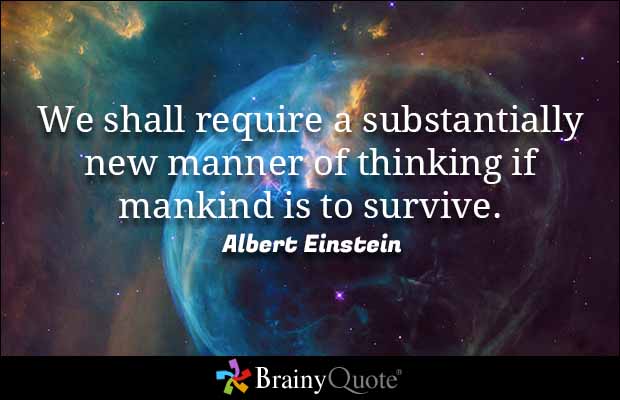
We shall require a substantially new manner of thinking if mankind is to survive.
That essay from George Monbiot was published yesterday and is shared with you all with Mr. Monbiot’s full permission.
It is an essay that deserves being read slowly and carefully. Please take time aside to so do because it really does offer a new manner of thinking.
ooOOoo
Circle of Life
13th April 2017
By reframing the economy, Kate Raworth’s Doughnut Economics changes our view of who we are and where we stand.
By George Monbiot, published in the Guardian 12th April 2017
So what are we going to do about it? This is the only question worth asking. But the answers appear elusive. Faced with a multifaceted crisis – the capture of governments by billionaires and their lobbyists, extreme inequality, the rise of demagogues, above all the collapse of the living world – those to whom we look for leadership appear stunned, voiceless, clueless. Even if they had the courage to act, they have no idea what to do.
The most they tend to offer is more economic growth: the fairy dust supposed to make all the bad stuff disappear. Never mind that it drives ecological destruction, that it has failed to relieve structural unemployment or soaring inequality, that, in some recent years, almost all the increment in incomes has been harvested by the top 1%. As values, principles and moral purpose are lost, the promise of growth is all that’s left.
You can see the effects in a leaked memo from the UK’s foreign office: “Trade and growth are now priorities for all posts … work like climate change and illegal wildlife trade will be scaled down.” All that counts is the rate at which we turn natural wealth into cash. If this destroys our prosperity and the wonders that surround us, who cares?
We cannot hope to address our predicament without a new worldview. We cannot use the models that caused our crises to solve them. We need to reframe the problem. This is what the most inspiring book published so far this year has done.
In Doughnut Economics: seven ways to think like a 21st-century economist, Kate Raworth reminds us that economic growth was not, at first, intended as a measurement of well-being. Simon Kuznets, who standardised the measurement of growth, warned: “the welfare of a nation can scarcely be inferred from a measure of national income.” Economic growth, he pointed out, measures only annual flow, rather than stocks of wealth and their distribution.
Raworth points out that economics in the 20th Century “lost the desire to articulate its goals.” It aspired to be a science of human behaviour: a science based on a deeply flawed portrait of humanity. The dominant model – “rational economic man”, self-interested, isolated, calculating – says more about the nature of economists than it does about other humans. The loss of an explicit objective allowed the discipline to be captured by a proxy goal: endless growth.
The aim of economic activity, she argues, should be “meeting the needs of all within the means of the planet.” Instead of economies that need to grow, whether or not they make us thrive, we need economies that “make us thrive, whether or not they grow.” This means changing our picture of what the economy is and how it works.
The central image in mainstream economics is the circular flow diagram. It depicts a closed flow of income cycling between households, businesses, banks, government and trade, operating in a social and ecological vacuum. Energy, materials, the natural world, human society, power, the wealth we hold in common: all are missing from the model. The unpaid work of carers – principally women – is ignored, though no economy could function without them. Like rational economic man, this representation of economic activity bears little relationship to reality.
So Raworth begins by redrawing the economy. She embeds it in the Earth’s systems and in society, showing how it depends on the flow of materials and energy, and reminding us that we are more than just workers, consumers and owners of capital.
The Embedded Economy. Graphic by Kate Raworth and Marcia Mihotich
This recognition of inconvenient realities then leads to her breakthrough: a graphic representation of the world we want to create. Like all the best ideas, her Doughnut model seems so simple and obvious that you wonder why you didn’t think of it yourself. But achieving this clarity and concision requires years of thought: a great decluttering of the myths and misrepresentations in which we have been schooled.
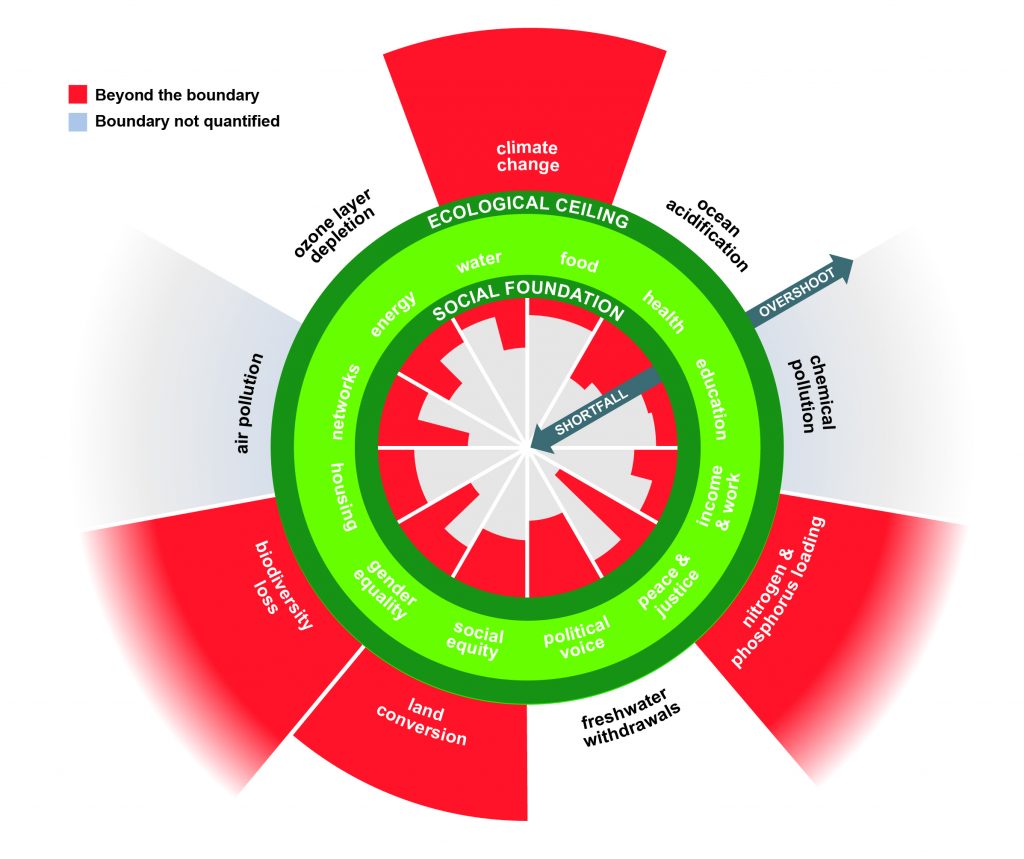
The diagram consists of two rings. The inner ring of the doughnut represents a sufficiency of the resources we need to lead a good life: food, clean water, housing, sanitation, energy, education, healthcare, democracy … . Anyone living below that line, in the hole in the middle of the doughnut, is in a state of deprivation.
The Doughnut. Graphic by Kate Raworth and Christian Guthier/The Lancet Planetary Health
The outer ring of the doughnut consists of the Earth’s environmental limits, beyond which we inflict dangerous levels of climate change, ozone depletion, water pollution, loss of species and other assaults on the living world. The area between the two rings – the doughnut – is the “ecologically safe and socially just space” in which humanity should strive to live. The purpose of economics should be to help us enter that space and stay there.
As well as describing a better world, the doughnut model allows us to see, in immediate and comprehensible terms, the state in which we now find ourselves. At the moment we transgress both lines. Billions of people still live in the hole in the middle. We have breached the outer boundary in several places.
Where we are now. Graphic by Kate Raworth and Christian Guthier/The Lancet Planetary Health
An economics that helps us to live within the doughnut would seek to reduce inequalities in wealth and income. Wealth arising from the gifts of nature would be widely shared. Money, markets, taxation and public investment would be designed to conserve and regenerate resources rather than squander them. State-owned banks would invest in projects that transform our relationship with the living world, such as zero-carbon public transport and community energy schemes. New metrics would measure genuine prosperity, rather than the speed with which we degrade our long-term prospects.
Such proposals are familiar, but without a new framework of thought, piecemeal solutions are unlikely to succeed. By rethinking economics from first principles, Raworth allows us to integrate our specific propositions into a coherent programme, and then to measure the extent to which it is realised. I see her as the John Maynard Keynes of the 21st-Century: by reframing the economy, she allows us to change our view of who we are, where we stand, and what we want to be.
Now we need to turn her ideas into policy. Read her book, then demand that those who wield power start working towards its objectives: human prosperity within a thriving living world.
I wish I understood where my fascination with the night sky came from. Not that I am anything other than an amateur gazer (of the night sky, I should hasten to add!). I have never taken the trouble to gain any real knowledge.
Yet, some of the most serene moments of my life have been when I have been alone at sea under a night sky.
OK, that’s enough wallowing for anyone!
The last week has been an important one for those that take an interest in the planets in our solar system, or to be specific, take an interest in Jupiter.
Today – April 8, 2017 – the planet Jupiter is closest to Earth for this year.
Yet yesterday was Jupiter’s opposition, when Earth flew between Jupiter and the sun, placing Jupiter opposite the sun in our sky. You’d think Jupiter was closest to Earth for 2017 yesterday as well … and yet it wasn’t. It’s closest to Earth for 2017 today, April 8, coming to within 414 million miles (666 million km).
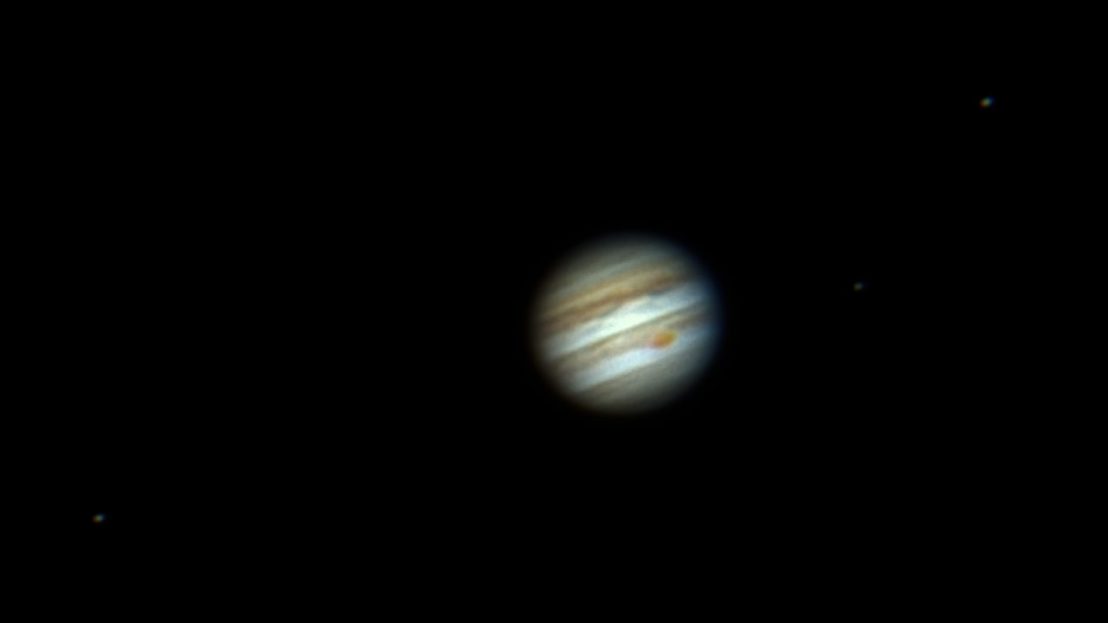
EarthSky also included this image:
Jupiter at its April 7, 2017 opposition with the Great Red Spot and moons Io, Europa, and Ganymede (L to R). Photo by Rob Pettengill in Austin, Texas.
During the month of April, Jupiter will be in opposition, meaning the planet is at its closest point to Earth. Thanks to the sun, it’s during this window that astronomers can enjoy a particularly close-up photo session that can help reveal how the planet’s atmosphere has changed over time by comparing it with previous such photos of the gas giant.
This photo of Jupiter was taken on April 3 by the Hubble Space Telescope when the enormous planet was 670 million kilometers (or about 416 million miles) from Earth. The photo shows the Great Red Spot, but it also shows something new: a weather feature called the Great Cold Spot, which is almost as large as its more well-known cousin.
“The Great Cold Spot is much more volatile than the slowly changing Great Red Spot, changing dramatically in shape and size over only a few days and weeks, but it has reappeared for as long as we have data to search for it, for over 15 years,” Tom Stallard, a planetary astronomer at the University of Leicester in the U.K. and lead author of the study, said in a statement.
The cold spot is nearly 15,000 miles by about 7,500 miles in size, and it’s dubbed the “cold” spot because it’s 200 degrees Kelvin (about 400 degrees Fahrenheit) cooler than the surrounding atmosphere.
The article included this stunning image of Jupiter.
Photo: A. Simon (GSFC)/NASA, ESA
Jaymi went on to write:
Here’s what some of the other details in the image mean:
The NASA/ESA Hubble Space Telescope reveals the intricate, detailed beauty of Jupiter’s clouds as arranged into bands of different latitudes. These bands are produced by air flowing in different directions at various latitudes. Lighter coloured areas, called zones, are high-pressure where the atmosphere rises. Darker low-pressure regions where air falls are called belts. Constantly stormy weather occurs where these opposing east-to-west and west-to-east flows interact. The planet’s trademark, the Great Red Spot, is a long-lived storm roughly the diameter of Earth. Much smaller storms appear as white or brown-coloured ovals. Such storms can last as little as a few hours or stretch on for centuries.
The Great Red Spot is an anticyclonic storm that is so large that Earth would fit inside it. That stormy spot — which is actually shrinking, though astronomers don’t know why — gives us a great perspective for understanding just how huge Jupiter is compared to our own blue dot in the solar system.
It’s been 27 years since the Hubble Space Telescope went into orbit, and the geriatric observatory is still going strong. When the telescope recently trained its sights on the solar system’s largest planet, the results were spectacular—proof that for the stellar spectator, age is but a number.
The image above is the latest picture of Jupiter. The snapshot was taken by Hubble on April 3 with the help of the telescope’s Wide Field Camera 3, a high-res instrument that lets the telescope observe using different wavelengths. It combines light on the visible, ultraviolet, and infrared spectrum to create an image of a massive planet in constant atmospheric flux.
In a press release, the European Space Agency, which co-runs Hubble with NASA, said that Hubble was able to take advantage of the planet’s current opposition with Earth to take the close-up. At the moment, Jupiter is lined up perfectly with the sun, and Earth is lined up with both the sun and Jupiter. Think of it as a truly heavenly photographic opportunity—a chance to look at the planet head-on. Better yet, Jupiter’s position relative to the sun means that it’s brighter than at any other time of year, which lets telescopes trained on the gigantic planet see even more detail than usual.
AsThe Washington Post’s Amy B. Wang notes, there were no new discoveries in the picture per se, but that doesn’t mean there’s nothing to look at. As ESA explains, scientists will compare the photo to previous views of the planet to hopefully learn more about the atmosphere. And for the rest of us, there’s a strangely soothing view of Jupiter’s layered cloud bands and impressive vortices.
The gas giant is thought to have sucked up most of the space debris left over after the sun formed, grabbing dust and gas with gravity. Scientists think it has two times as much debris as all of the other bodies in the solar system combined—and all of that material swirls through cloud layers in its quickly-rotating atmosphere.
Since Jupiter doesn’t exactly have a surface, it has nothing to slow the spots and vortices that appear in its atmosphere. The most famous, the Great Red Spot, is thought to have been swirling around for more than 150 years, and even though it’s unclear which gases give it that red hue, it’s the planet’s most recognizable feature. As NASA writes, the cloudiness of Jupiter’s atmosphere makes it hard to understand what might be contributing to it. But that doesn’t decrease its allure.
Want to delve even further into the mesmerizing bands of a huge planet’s atmosphere? A high-res version of the snapshot is available online. And if you prefer seeing things live, it’s a great time to check out Jupiter through in the night sky. You can find Jupiter in the east right after the sun goes down—a massive mystery that’s brighter than any star.
Namely, that the universe came into existence some 13.82 billion years ago. The power of natural evolution that came with that event eventually brought along homo sapiens some 200,000 years ago. 200,000 is 0.0000145 of 13.82 billion.
Or to put it another way, we humans have only been a part of this universe for 1/10th of 1% of the life of said universe! (Oh, and dogs came along 100,000 years ago!)
According to the ASPCA, animal shelters take in 7.6 million dogs and cats each year. Unfortunately, only 2.7 million animals are adopted each year. I’d love to see that number increase.
I’ve been a pet owner for decades. I know the seemingly infinite joy and love that comes from having a pet. But I also remember how nervous I was when I adopted my first dog.
To ease first-time and potential pet owners’ anxiety about caring for a pet, I would love to offer advice on how to be a great pet parent. Tips will be culled from my own experience and the experience of my blog’s (OurBestFriends.pet) contributors.
Can I write a guest article for your readers? My hope is that the piece will encourage folks to adopt a loving animal. The content will be completely original and free of charge. Please let me know if you’d like to take part.
What a wonderful email and, of course, I was only too pleased to receive Jessica’s article.
Here it is:
ooOOoo
Survival Guide for First-Time Pet Owners: How to Be a Great Pet Parent
By Jessica Brody, 6th April, 2017
If you’re considering adopting a four-legged friend for the first time, you’re about to embark on an amazing journey. From learning your new pet’s unique personality traits to navigating the demands of providing the best care for your new family member, adopting a pet is a learning experience, but an enriching one. Here are a few essential tips to help you transition your new furry friend seamlessly into your family.
Make Arrangements for Regular Exercise
Dogs, in particular, require regular exercise. They say that a tired dog is a well-behaved dog. If you work long hours, consider hiring a dog walker who can take your pup out for a mid-day potty break and walk. Make sure your new pet – dog or cat – has plenty of toys to keep them occupied while you’re working or otherwise unable to devote your full attention to them while you’re at home.
From bones and dental chews to balls, bells, and feathers, there’s no shortage of unique and intriguing toys on the market to keep your pet entertained and healthy.
If you own your own home, you might also consider installing a fence around a section of your yard. That way your new pet will have a place to run and play without having to be on a leash. You can also use the space for training.
Choose a Veterinarian You Trust
First and foremost, your new pet will need to see a veterinarian. If you’re adopting from a shelter or rescue organization, your pet may come with veterinary records and may already be spayed or neutered. If you’re adopting a new pet from a pet store or breeder, however, you’ll most likely need to take care of initial vetting on your own.
Ask friends and family members for vet recommendations and call around to inquire about office policies and prices to make an informed decision. It’s important that you find a veterinarian that you trust to provide top-notch care for your beloved pet.
Choose a Quality Pet Food
All pet food is not created equal. If you want your pet to live a long, healthy life, you should choose a top-quality pet food that contains healthy ingredients and has a solid track record. There have been many pet food recalls in recent years, with some causing serious illness and even death in pets.
Do your research to determine what foods are the best and safest for your dog’s stage of life and health history. Puppies require different food than older dogs, for instance, and dogs with certain health conditions have special dietary requirements. Talk to your vet if you’re uncertain.
Establish Rules and Routines
Adopting a new pet for the first time requires a bit of playing by ear, as you don’t know exactly what your pet’s quirks will be. However, it’s a good idea to establish some general ground rules from the start. For example, what will you do to keep your pet out of storage areas where dangerous substances, such as yard care chemicals,anti-freeze, or pool chemicals are kept? Will you allow your dog on the furniture? Will your dog or cat sleep in your bed with you? Will you crate your dog while you’re at work?
Your pet will surely have a mind of her own, but knowing what general boundaries you want to set before introducing her to your home will help you be consistent with training.
Give Your Pet Plenty of Affection
While all of these tips are essential steps for being the best pet parent you can be, perhaps the most important is to give your pet plenty of love and affection. Dogs thrive on attention, while cats tend to be quite varied in their preferences. Some are lap cats, hopping on the nearest warm lap they can find; others are loners and generally prefer to be left to their own devices. Get to know your pet’s personality and make sure to shower him with as much love and affection as he wants.
Being a great pet parent isn’t hard, but these important tips will help you integrate your new furry friend into your family with ease. Setting boundaries and rules from the beginning with consistent reinforcement, making sure your pet gets plenty of exercise and has enough toys and activities to keep her engaged, and choosing top-quality pet food and a veterinarian you can trust will ensure that you and your pet can enjoy many joyful years together.
Naturally, I asked Jessica to write a few words about herself. This is what she sent me.
Jessica is the creator of OurBestFriends.pet. Jessica lives in Dallas, Texas with her loving family (which includes 2 dachshunds and a black lab). She is a certified dog lover, and believes dogs are just about the greatest creatures on earth. She loves collecting and sharing photos of them.
I know many will agree with me when I say that it would be good to receive some more articles from Jessica.
Last Tuesday, I published a guest post that had been sent to me by my sister, Eleanor, who lives in Johannesburg in South Africa.
Then a day later I read on the Care2 site about a therapy dog that alerted a group of schoolchildren to potentially very unsafe drinking water. I must share that with you as well.
ooOOoo
Therapy Dog Helps Alert School District to Lead in Water
A therapy dog belonging to a San Diego elementary school teacher proved to be a potential lifesaver – but not for what you might think.
When the teacher filled his bowl with water from the classroom sink on Jan. 26, the dog refused to drink it. The teacher took a good look at the water in his bowl and noticed a sheen on its surface. Concerned, she notified school officials.
After testing samples from around Emerson-Bandini Elementary and the San Diego Co-Operative Charter School 2, which share a campus, results showed the water was contaminated with lead, exceeding the allowable level in the state of California.
School officials contacted the City of San Diego Public Utilities Department, which supplies the water. Because that therapy dog that refused to drink it, the city is now testing the water at each of the school district’s 187 campuses.
The tests, however, won’t begin until April 4, San Diego Unified Chief Operations Officer Drew Rowlands announced last week. In the meantime, students are getting bottled drinking water.
A notice sent to the schools’ staff and parents said the water is safe for handwashing. Since cafeteria meals aren’t prepared on campus, they’re not affected by the contaminants in the water, according to the notice.
The testing of the water, which is expected to be completed by the end of the school year in June, will take place early in the morning, before school starts. At each campus, up to five samples will be taken from water fountains and cafeterias where food is prepared. The test results will be posted online.
If excessive lead is discovered, the contamination source will be determined and school district staff will take “appropriate action on a case-by-case basis,” said San Diego Unified Chief Operations Officer Drew Rowlands. Those appropriate actions could include replacing plumbing fixtures and making repairs.
Making Drinking Water Safe for Schoolchildren
Coincidentally, just one month before the therapy dog refused to drink the San Diego school’s water, the State Water Resources Control Board (SWRCB) Division of Drinking Water launched a program that requires water providers to test for lead in the drinking water at all K-12 schools in California.
“Recent events in the United States have shown that lead in drinking water remains an ongoing public health concern, particularly for children,” the SWRCB stated on its website.
How does lead end up in school water fountains? Although lead rarely occurs naturally in California’s drinking water sources, it can contaminate water that flows through old plumbing fixtures or the solder connecting them. It’s less likely that the water came from a contaminated source, as was the case in Flint, Mich.
Children younger than six are especially susceptible to the effects of lead poisoning. According to the Centers for Disease Control (CDC), about half a million children between the ages of one and five have blood lead levels above 5 micrograms per deciliter, the level at which the CDC recommends the initiation of public health actions – although no “safe” blood lead level in children has been identified.
A problem with lead poisoning is that there are no obvious symptoms. By the time children show the signs, such as weight loss, irritability and lack of appetite, dangerous amounts of lead may have accumulated in their bodies.
This is a compelling reason for more states to follow California’s lead and require water to be tested in schools. Thanks to a teacher’s therapy dog, students at two San Diego schools got a jump start on having safer water available.
A skipping Jack Russell and her owner have set a new world record.
Eight-year-old Jessica and her owner Rachael Grylls, from Lewdown in Devon, clocked up 59 skips in one minute.
The owner of a skipping Jack Russell dog says she is “really, really, really pleased” she and her pet have set a new world record.
Rachael said: “It’s quite hard to keep jumping, talking and rewarding her at the same time. I think I’m more unfit than Jessica!”
Lovely to see this news item from my old County of Devon.
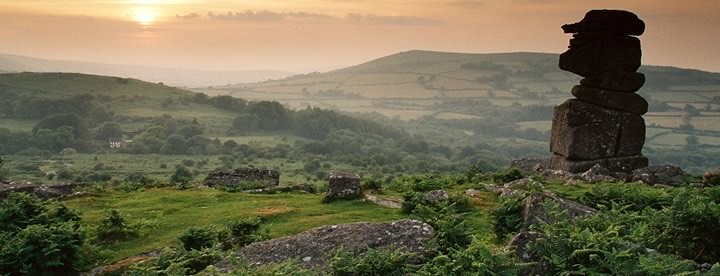
You see, I used to live just a few miles out of Totnes in Devon; in the village of Harberton. Lewdown is also in Devon, as the news item reported, but it is the other side of Dartmoor. In other words, North-West of Dartmoor as opposed to Totnes being to the South-East of Dartmoor.
But if any of you dear readers fancy a vacation in the UK you should make a point of going to see Dartmoor. It’s a very beautiful place. (Sue, you have probably been to Dartmoor? Yes?)
I have two sisters: Elizabeth and Eleanor. Elizabeth lives in Tokyo, Japan and Eleanor lives in Johannesburg, South Africa. They are both dear sisters and we all love each other as brothers and sisters should!
Anyway, Eleanor’s husband, Warwick, has a brother and this story is about Warwick’s brother’s step-daughter, Stacey Maguire.
It was Eleanor who sent this story to me to be published in this place.
ooOOoo
My dog saves my life every day
Stacey Maguire’s life is always in danger.
A severe Type 1 Diabetic, her body doesn’t produce the insulin it needs to control her blood sugar, leaving her vulnerable to catastrophic changes in sugar levels. But as long as her dog, Gretchen, is around she has nothing to fear. For Gretchen is a trained Diabetic Assist Dog (DAD).
Gretchen is a Swiss Shepherd who saves her owner’s life on a daily basis by warning her whenever her blood sugar is at a dangerous level. Incredibly, Gretchen does this by smell.
Stacey’s chronic condition is so severe that she’s on the best monitoring technology in South Africa. But before Gretchen came into her life, and even with that monitoring technology, Stacey still experienced hypoglycemic episodes and seizures at least once a week when changes in her blood sugar levels weren’t detected in time.
Thus when Gretchen arrived from America her sole objective was sniffing out the problem as fast as possible. And Gretchen does that – a full hour ahead of that best available technology!
Her method? An urgent paw to the knee, followed by a bark. Gretchen takes no nonsense, delivering the testing kit to Stacey’s hand if her response is sluggish. If anything goes wrong Gretchen, as a trained service animal is taught to so do, sounds an alarm or alerts the nearest person to the danger. Stacey couldn’t ask for better care.
Stacey is the first South African to benefit from a Diabetic Assist Dog. Stacey Maguire’s dream is to start a facility to train more dogs to help diabetics like her. That’s something South Africa can get behind.
ooOOoo
Eleanor also added the following by way of background:
We found a phenomenal lady called Diane Marquette in Minnesota who agreed to train a dog for export – her first time for such an undertaking.
A three-year-old white Swiss Alsatian called Gretchen made the grade for the initial training after which Di started the diabetic training. In preparation, whenever Stacey felt unwell she spat into cotton-wool and put these samples into the freezer. When Stacey had collected a bundle she sent them via courier to Di who then trained Gretchen on Stacey’s scent.
This process took ten months. Then Stacey flew to Minnesota to meet Gretchen, to be bonded with Gretchen, to be trained and, finally, to sit and pass a very stringent exam before being allowed to bring Gretchen back home. Ten days later we met them at Cape Town International, after twenty-one hours of flying for Stacey with Gretchen at her feet in the aeroplane. SA’s first DAD had landed!
In an email to me, Eleanor included:
Stacey and Gretchen have now been together for several years with their bond just strengthening and strengthening! Gretchen alerts Stacey continuously and in recent times has started alerting at night too. Thus even accounting for the fact that, as with all dogs, Gretchen sleeps at night coinciding, unfortunately, with when Stacey is most vulnerable to shocking lows, this fabulous dog maintains awareness of Stacey’s body scents during the night hours.
Stacey’s wish is to bring trainer Di of Scent Angels to Cape Town to train trainers, and then to roll this life-saving program out to fellow diabetics.
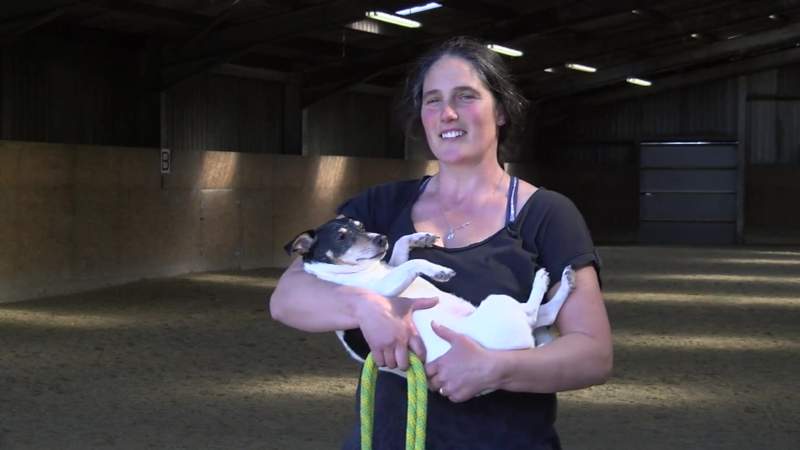
Diane Marquette
Eleanor also included the link to the website for Scent Angels. I shall pass on the link to this post to Diane Marquette with the request that she might allow me to share some more stories of these incredible dogs with you all.
OK, in many cases I’m sure it is because dogs are watching too much television; especially the news!
OK: Only kidding!
Some may be surprised that dogs can express sadness and suffer from depression but it is true.
Only a few days ago there was a bit of a ‘punch up’ between Brandy and Ruby. Ruby was feeding and Brandy approached her food bowl. Ruby gave a short, throaty “stay away from my food” growl and the next instant Brandy had Ruby’s face in his mouth and it was quickly turning into a Grade A dog fight.
Luckily Jean and I were on hand and had the two of them separated within seconds. But it was still sufficient time for Brandy to have drawn blood from a small bite to the side of Ruby’s face.
However, the point I was coming to was that since that incident Ruby has clearly been very depressed and withdrawn.
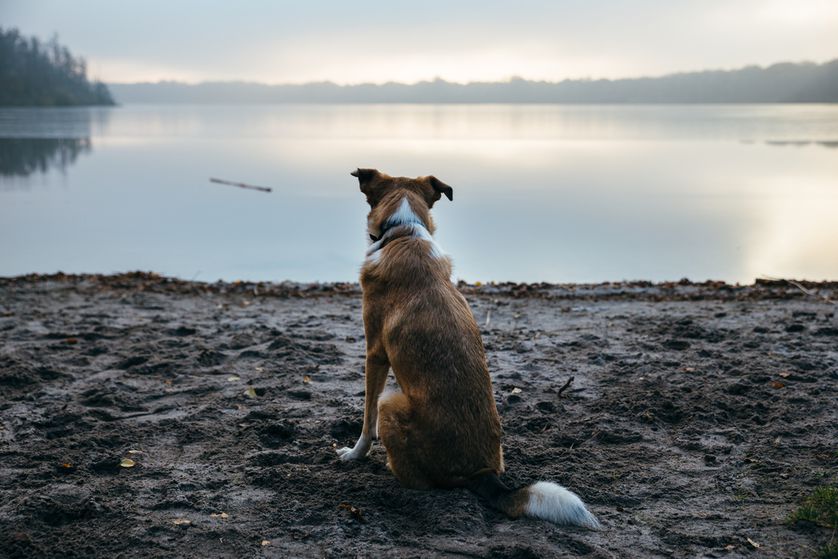
Dogs can get the doldrums. But there are ways to help them come out of it with a wagging tail. (Photo: Iuliubo/Shutterstock)
Yes, dogs can get depressed. Whether or not it’s the same as what humans experience, we may never know since we can’t ask a dog. But there are signs and symptoms from a dog’s behavior that reveal when a dog is in the doldrums. If you’ve noticed a sudden change in your four-legged friend’s behavior and are worried, you may need to see if the change is a clue that your dog needs some psychological TLC.
Common triggers for dog depression
Dogs are creatures of habit, activity and loyalty. A sudden change that affects their world can cause a dog to have a spat of depression. Triggers include:
The addition of a new person or pet to the family
A sudden drop in attention from an owner or family members
A sudden change in the household schedule
The loss of an owner or companion
Moving to a new home
A traumatic injury
Dogs may also suffer from Seasonal Affective Disorder, or SAD, during the winter months. Stanley Coren reports in Psychology Today: “Do dogs suffer from SAD? Some data comes from a survey conducted by a leading veterinary charity in the UK. PDSA (The People’s Dispensary for Sick Animals) found that approximately 40 percent of dog owners saw a considerable downturn in their pet’s moods during the winter months. In addition, half of the dog owners felt that their dogs slept longer, with around two in five reporting their pets to be less active overall.”
Some dogs may suffer depression simply for not having a job to do. The Guardian notes:
“In the not too distant past, dogs mostly had to work for a living and were probably very often physically and mentally fatigued at the end of the day – which is why we have the expression ‘dog-tired’. Could the stress of being made redundant be the source of this apparent unhappiness? Dog behaviourist Penel Malby told me: ‘Dogs live very differently to the way they used to. Lots more dogs, lots more people, lots more stress for everyone, I think. If you think back even just 50 years, dogs were allowed to roam free every day, socialise with their neighbourhood friends. Now they either go out with a dog walker or go out for an hour if they’re lucky, and the rest of the time is spent at home.'”
The upside is that canine depression usually isn’t permanent, or even necessarily long-lived, and there are ways to combat it to help your dog get back to normal in due time.
What are the warning signs?
Watch for warning signs of depression so you can catch the trouble early and help your dog recover. (Photo: DREIDREIEINS Foto/Shutterstock)
The most common symptoms dogs display when they’re depressed mirror those that humans experience during a depression. They include:
Sleeping much more than usual
A change in eating habits, including a loss or gain in appetite and in weight
A refusal to drink water
A lack of interest in usual energetic activities like going for walks or playing
Excessive licking of their paws
Excessive shedding
Become withdrawn or hiding in the house
Suddenly showing signs of aggression or anxiety
Unfortunately, these symptoms also occur with a range of other medical issues. A dog might have a change in appetite because of a thyroid or kidney issue, or the dog might not want to go on a walk because of joint pain or arthritis flaring up. So if you notice any changes in your dog’s behavior, the first thing to do is visit the vet to rule out any serious health-related issues before assuming it comes down to depression.
How to help your dog out of a depression
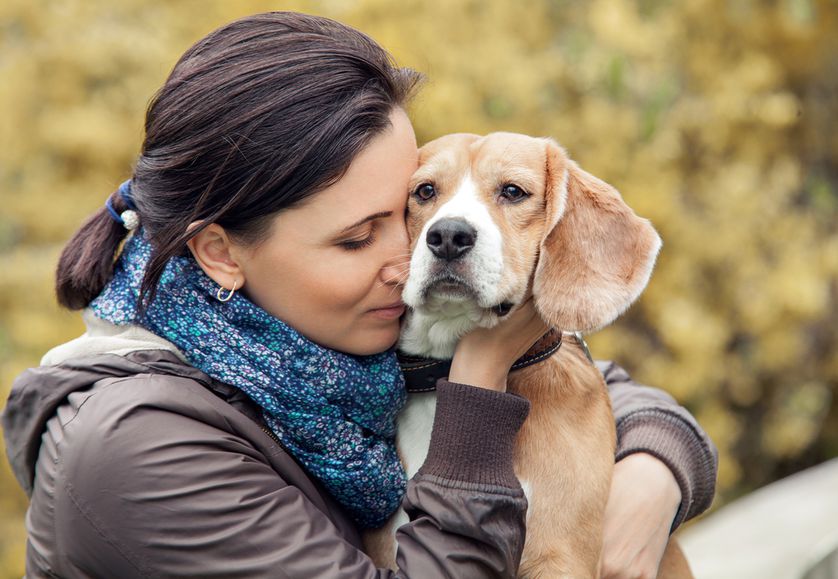
Sometimes time, extra love and a steady routine is all that’s needed. (Photo: Soloviova Liudmyla/Shutterstock)
If you have determined your dog is feeling depressed, there are many things you can do to help them pull out of it.
– Take your dog on more frequent walks during the day to favorite places, allowing them to sniff around and enjoy the scenery. It’s also helpful to do this first thing in the morning to start the day out with a bit of fresh air and energy.
– Try to keep a schedule as much as possible. Dogs are creatures of habit and having a predictable routine can be an enormous source of comfort for a stressed or depressed dog, especially if the trigger for the depression was a sudden change in routine.
– Reward your dog when he shows signs of improved mood or energy. Rather than babying the dog during the down times — which reinforces that behavior — reward him with extra special treats or a favorite toy when he shows a bit of enthusiasm about life to amplify the mood even more.
– Bring home a new toy, such as a squeaker or puzzle toy that stimulates the senses and encourages play.
– If the cause of depression is the loss of a companion, like another household pet, consider adopting another dog that can be a companion. However, only do this if you’ve seriously considered the needs of your household and your depressed dog. It isn’t an option to be taken lightly.
As a last resort, medication could be an option. There are antidepressants for dogs that you can discuss with your veterinarian. However, catching depression early on and trying for behavioral changes first is the best solution. Bonnie Beaver, DVM, notes in a WebMD article, “[I]t can take up to two months for drugs to become effective. But unlike people, who often remain on antidepressants for years, most dogs can get better in six to 12 months and then be taken off the drugs.”
And finally, give it time. As Wag Walking notes, “Be Patient: Sometimes — especially if the issue was a loss of a companion or master — the only thing that will heal a dog’s heart is time. It may be as few as a couple days or as much as a few months, but most dogs will be able to pull themselves out of depression with a little time and understanding.”
ooOOoo
May you, your family and all your wonderful animals have a wall-to-wall happy weekend!
As is the way of the Internet and Blogging it is inevitable that connections are made in all four corners of the globe. Some connections are transient, others become long-term. The connection between author John Zande and this blog fits the latter description.
If, dear reader, you have read my posts of the last two days, then that connection between John and me will be clear.
Now despite the fact that I awarded the book five stars on Amazon I can’t tell you that it is an easy read. Nor, to that fact, is it a comfortable read.
For John’s book played around with my head in so many ways that I am still far from returning to a settled mind. Indeed, I have a sneaky suspicion that On the Problem of Good represents another one of those turnstiles in life where once through the ‘gate’ there is no returning to the past way of seeing things.
It played with my mind in the sense of forcing me, albeit with a very small ‘f’, to truly comprehend the consequences of unanticipated outcomes. You know that old saying: “Never underestimate the power of unanticipated consequences“.
Here’s an example.
In 1889 a total of 26 road deaths were recorded in the United States. By 2013 that number had exploded to approximately 35,500. Globally, the number stands at 1.24 million and the World Health Organisation predicts the body of carnage will grow to 1.9 million by 2020. (p.44)
That is just one of the many examples that John uses to support his premise that “good simply does not exist”.
But it goes deeper than that. For John reveals the incalculable, unstoppable force of evolution. Going right back to the very origins of matter. How hydrogen fused into the more complex helium that, in turn, fused into the still heavier and more complex carbon, then along came the fusing of helium and carbon to make oxygen. Then the journey of evolution of atoms. From single atoms to simple compounds, binding to produce double compounds and on to molecules. Then the marriage between molecules to produce amino acids, and on and on to proteins and enzymes and … well, you get the idea!
That continuum from simple to complex organisms and on and on to air-breathing animals (including wolves and then dogs!) and all the way to the likes of yours truly sitting in front of a modern computer writing the review of another person’s book.
All the time, since 13.82 billion years ago, the evolutionary force being a one-way street. A one-way street where John, with some degree of persuasiveness, demonstrates that everything that might, at that time, be seen as a good is not fundamentally a good because it is inextricably connected to a resulting evil.
The Problem of Good is a word problem. It is a lexical glitch, a squabble in temporal, fleshy definitions, and nothing more.
There is no disagreement or antipathy because there is no problem.
Good does not exist. (p.29)
See what I mean about this not being a comfortable book to read!
Nevertheless, you are waiting to hear from me as to whether or not you should read this book?
In answer, here’s a part of what I wrote for my review of the book on Amazon:
If you ever pause for a moment and wonder about the meaning of life, better written as The Meaning of LIFE, then this book is for you. More than that. For if you never ponder about the meaning of life then this really, really is the book for you.
Because for most of us, for most of the time, we live in the land of the blind.
So, thank goodness, that from time to time along comes a person who is the one-eyed King.
I have just finished reading John’s recently published book On the Problem of Good. I am writing a review of the book that, fingers crossed, I will publish on Friday. But many of you that are recent converts to this blog (you poor, lost souls!) will not remember my review of John’s first book and my reaction to that book when I was only just into it.
So, for both today and tomorrow I am republishing two blog posts. Today, one that was originally published on the 16th September, 2015, and tomorrow the post that was first published on 1st October, 2015.
ooOOoo
Of paradoxes, and headaches!
The interconnectedness of everything – even beyond our wildest imagination.
A while ago John Zande signed up to follow Learning from Dogs. Naturally, I went across to John’s blog to thank him. There I discovered that John is an animal lover and an author. For he states, referring to his book, that, “BUY IT. ALL PROCEEDS GO TO ANIMAL RESCUE AND SHELTER IN BRAZIL”. Fabulous!
(I did buy the book, am about 20% through it and finding it very stimulating, – if you would like to buy it then click the image of the book on John’s home page.)
Anyway, a few days later we watched the BBC Horizon programme on multiple universes. Here’s how the BBC introduced the programme:
Which Universe Are We In?
Horizon, 2014-2015 Episode 17 of 19
Imagine a world where dinosaurs still walk the earth. A world where the Germans won World War II and you are president of the United States. Imagine a world where the laws of physics no longer apply and where infinite copies of you are playing out every storyline of your life.
It sounds like a plot stolen straight from Hollywood, but far from it. This is the multiverse.
Until very recently the whole idea of the multiverse was dismissed as a fantasy, but now this strangest of ideas is at the cutting edge of science.
And for a growing number of scientists, the multiverse is the only way we will ever truly make sense of the world we are in.
Horizon asks the question: Do multiple universes exist? And if so, which one are we actually in?
Horizon is always great to watch but this episode was incredibly stimulating and interesting. Later, in a exchange of comments to one of John’s posts, where I referred to that programme, John wrote:
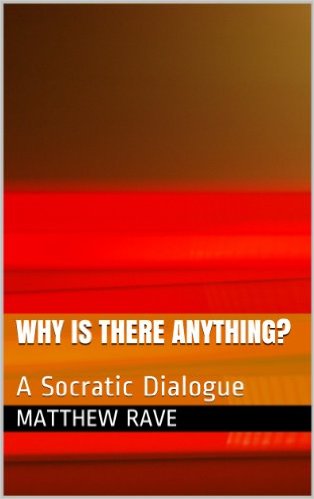
The mulitverse is actually the more reasonable explanation for why there is something, and although I don’t understand the maths, the people who do say its simplistically beautiful. Matt Rave is an associate professor of physics and comments here regularly. He has a great book on it all, Why is There Anything?
That lead me to purchasing Matthew Rave’s book that, likewise, is a most fascinating and unusual approach to this topic. His Amazon author’s page reveals that, “Dr. Matthew Rave is an assistant professor of physics at Western Carolina University, in the mountains of North Carolina. His research interests include interpretations of quantum mechanics, the geometric phase, solid state physics, and physics education.” Matthew Rave’s blogsite is here.
Matthew Rave’s book further illustrates the paradox, to my mind, that comes from thinking about why are we here, are we here and, if so, how do we know we are here?
So if that isn’t enough for you and me, then very recently The Conversation blogsite published the following from Geraint Lewis who is Professor of Astrophysics at the University of Sydney. It is republished here within the terms of The Conversation. Did I mention paradoxes and headaches!
To a human, the universe might seem like a very inhospitable place. In the vacuum of space, you would rapidly suffocate, while on the surface of a star you would be burnt to a crisp. As far as we know, all life is confined to a sliver of an atmosphere surrounding the rocky planet we inhabit.
But while the origin of life on Earth remains mysterious, there are bigger questions to answer. Namely: why do the laws of physics permit any life at all?
Hang on, the laws of physics? Surely they are a universal given and life just gets on with it?
But remember that the universe is built of fundamental pieces, particles and forces, which are the building blocks of everything we see around us. And we simply don’t know why these pieces have the properties they do.
There are many observational facts about our universe, such as electrons weighing almost nothing, while some of their quark cousins are thousands of times more massive. And gravity being incredibly weak compared to the immense forces that hold atomic nuclei together.
Why is our universe built this way? We just don’t know.
But what if…?
This means we can ask “what if” questions. What if the electron was massive and quarks were fleeting? What if electromagnetism was stronger than the nuclear strong force? If so, what would that universe be like?
Let’s consider carbon, an element forged in the hearts of massive stars, and an element essential to life as we know it.
Initial calculations of such stellar furnaces showed that they were apparently inefficient in making carbon. Then the British astronomer Fred Hoyle realised the carbon nucleus possesses a special property, a resonance, that enhanced the efficiency.
But if the strength of the strong nuclear force was only fractionally different, it would wipe out this property and leave the universe relatively devoid of carbon – and, thus, life.
The story doesn’t end there. Once carbon is made, it is ripe to be transmuted into heavier elements, particularly oxygen. It turns out that oxygen, due to the strength of the strong nuclear force, lacks the particular resonance properties that enhanced the efficiency of carbon creation.
This prevents all of the carbon being quickly consumed. The specific strength of the strong force has thus resulted in a universe with an almost equal mix of carbon and oxygen, a bonus for life on Earth.
Death of a universe
This is but a single example. We can play “what if” games with the properties of all of the fundamental bits of the universe. With each change we can ask, “What would the universe be like?”
The answers are quite stark. Straying just a little from the convivial conditions that we experience in our universe typically leads to a sterile cosmos.
This might be a bland universe, without the complexity required to store and process the information central to life. Or a universe that expands too quickly for matter to condense into stars, galaxies and planets. Or one that completely re-collapses again in a matter of moments after being born. Any complex life would be impossible!
The questions do not end there. In our universe, we live with the comfort of a certain mix of space and time, and a seemingly understandable mathematical framework that underpins science as we know it. Why is the universe so predictable and understandable? Would we be able to ask such a question if it wasn’t?
Our universe appears to balance on a knife-edge of stability. But why?
We appear to be very lucky to live in a universe that accommodates life. Zdenko Zivkovic/Flickr, CC BY
One of a multiverse
To some, science will simply fix it all. Perhaps, if we discover the “Theory of Everything”, uniting quantum mechanics with Einstein’s relativity, all of the relative masses and strengths of the fundamental pieces will be absolutely defined, with no mysteries remaining. To others, this is little more than wishful thinking.
Some seek solace in a creator, an omnipotent being that finely-tuned the properties of the universe to allow us to be here. But the move from the scientific into the supernatural leaves many uncomfortable.
There is, however, another possible solution, one guided by the murky and confused musings at the edge of science. Super-strings or M-theory (or whatever these will evolve into) suggest that the fundamental properties of the universe are not unique, but are somehow chosen by some cosmic roll of the dice when it was born.
This gives us a possible explanation of the seemingly special properties of the universe in which we live.
We are not the only universe, but just one in a semi-infinite sea of universes, each with their own peculiar set of physical properties, laws and particles, lifetimes and ultimately mathematical frameworks. As we have seen, the vast majority of these other universes in the overall multiverse are dead and sterile.
They only way we can exist to ask the question “why are we here?” is that we happen to find ourselves in a universe conducive to our very existence. In any other universe, we simply wouldn’t be around to wonder why we didn’t exist.
If the multiverse picture is correct, we have to accept that the fundamental properties of the universe were ultimately dished out in a game of cosmic roulette, a spin of the wheel that we appear to have won.
Let me give way to Hariod Brawn and part of an extensive comment she left back then:
John Zande is most certainly one of the most thoughtful, perceptive, well-informed and sharp-witted bloggers I have ever come across, and I wish him well with his book, which by the way, appears so far to have been met only with a deluge of 5-star reviews on Amazon. I daresay that you and I will both lengthen that list.





 Gretchen is a Swiss Shepherd who saves her owner’s life on a daily basis by warning her whenever her blood sugar is at a dangerous level. Incredibly, Gretchen does this by smell.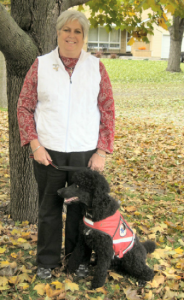





 Learning from Dogs