At-home DNA kits have become a popular way to learn more about one’s ancestry and genetic makeup—and the handy tests aren’t just for humans, either. Dog owners who want to delve into their fluffy friends’ family history and uncover the risks of possible diseases can choose from a number of services that screen doggie DNA.
As Kitson Jazynka reports for National Geographic, one of these services, Embark Veterinary, Inc., recently analyzed user data to unlock an enduring canine mystery: How did Siberian huskies get their brilliant blue eyes?
Piercing peepers are a defining trait of this beautiful doggo. According to the new study, published in PLOS Genetics, breeders report that blue eyes are a common and dominant trait among Siberian huskies, but appear to be rare and recessive in other breeds, like Pembroke Welsh corgis, old English sheepdogs and border collies. In some breeds, like Australian shepherds, blue eyes have been linked to patchy coat patterns known as “merle” and “piebald,” which are caused by certain genetic mutations. But it was not clear why other dogs—chief among them the Siberian husky—frequently wind up with blue eyes.
Hoping to crack this genetic conundrum, researchers at Embark studied the DNA of more than 6,000 pooches, whose owners had taken their dogs’ saliva samples and submitted them to the company for testing. The owners also took part in an online survey and uploaded photos of their dogs. According to the study authors, their research marked “the first consumer genomics study ever conducted in a non-human model and the largest canine genome-wide association study to date.”
The expansive analysis revealed that blue eyes in Siberian huskies appear to be associated with a duplication on what is known as canine chromosome 18, which is located near a gene called ALX4. This gene plays an important role in mammalian eye development, leading the researchers to suspect that the duplication “may alter expression of ALX4, which may lead to repression of genes involved in eye pigmentation,” Aaron Sams of Embark tells Inverse’s Sarah Sloat.
The genetic variation was also linked to blue eyes in non-merle Australian shepherds. Just one copy of the mutated sequence was enough to give dogs either two blue eyes, or one blue and one brown eye, a phenomenon known as “heterochromia.” It would seem, however, that duplication on chromosome 18 is not the only factor influencing blue eye color: Some dogs that had the mutation did not have blue eyes.
More research into this topic is needed to understand the genetic mechanisms at work when it comes to blue-eyed dogs. But the study shows how at-home DNA kits can be highly valuable to scientists, providing them with a wealth of genetic samples to study.
“With 6,000 people getting DNA samples from their dogs and mailing them to a centralized location and then filling out a website form detailing all the traits of their dog—that’s a game-changer for how genetics is being done in the 21st century,” Kristopher Irizarry, a geneticist with the College of Veterinary Medicine at Western University of Health Sciences, tells National Geographic’s Jazynka.
The benefits of having access to such huge troves of data go further than uncovering nifty insights into our canine companions. Scientists are also teaming up with at-home DNA test companies to learn more about human genetics and behavior.
ooOOoo
There’s such a wide range of information about our lovely dogs!
I can do no better than republish in full the following:
(Simply because I scarcely understand it!)
ooOOoo
Why the number 137 is one of the greatest mysteries in physics
Famous physicists like Richard Feynman think 137 holds the answers to the Universe.
By PAUL RATNER, 31st October, 2018.
The fine structure constant has mystified scientists since the 1800s.
The number 1/137 might hold the clues to the Grand Unified Theory.
Relativity, electromagnetism and quantum mechanics are unified by the number.
Does the Universe around us have a fundamental structure that can be glimpsed through special numbers?
The brilliant physicist Richard Feynman (1918-1988) famously thought so, saying there is a number that all theoretical physicists of worth should “worry about”. He called it “one of the greatest damn mysteries of physics: a magic number that comes to us with no understanding by man”.
That magic number, called the fine structure constant, is a fundamental constant, with a value which nearly equals 1/137. Or 1/137.03599913, to be precise. It is denoted by the Greek letter alpha – α.
What’s special about alpha is that it’s regarded as the best example of a pure number, one that doesn’t need units. It actually combines three of nature’s fundamental constants – the speed of light, the electric charge carried by one electron, and the Planck’s constant, as explains physicist and astrobiologist Paul Davies to Cosmos magazine. Appearing at the intersection of such key areas of physics as relativity, electromagnetism and quantum mechanics is what gives 1/137 its allure.
Physicist Laurence Eaves, a professor at the University of Nottingham, thinks the number 137 would be the one you’d signal to the aliens to indicate that we have some measure of mastery over our planet and understand quantum mechanics. The aliens would know the number as well, especially if they developed advanced sciences.
The number preoccupied other great physicists as well, including the Nobel Prize winning Wolfgang Pauli (1900-1958) who was obsessed with it his whole life.
“When I die my first question to the Devil will be: What is the meaning of the fine structure constant?” Pauli joked.
Pauli also referred to the fine structure constant during his Nobel lecture on December 13th, 1946 in Stockholm, saying a theory was necessary that would determine the constant’s value and “thus explain the atomistic structure of electricity, which is such an essential quality of all atomic sources of electric fields actually occurring in nature.”
One use of this curious number is to measure the interaction of charged particles like electrons with electromagnetic fields. Alpha determines how fast an excited atom can emit a photon. It also affects the details of the light emitted by atoms. Scientists have been able to observe a pattern of shifts of light coming from atoms called “fine structure” (giving the constant its name). This “fine structure” has been seen in sunlight and the light coming from other stars.
The constant figures in other situations, making physicists wonder why. Why does nature insist on this number? It has appeared in various calculations in physics since the 1880s, spurring numerous attempts to come up with a Grand Unified Theory that would incorporate the constant since. So far no single explanation took hold. Recent research also introduced the possibility that the constant has actually increased over the last six billion years, even though slightly.
If you’d like to know the math behind fine structure constant more specifically, the way you arrive at alpha is by putting the 3 constants h,c, and e together in the equation —
As the units c, e, and h cancel each other out, the “pure” number of 137.03599913 is left behind. For historical reasons, says Professor Davies, the inverse of the equation is used 2πe2/hc = 1/137.03599913. If you’re wondering what is the precise value of that fraction – it’s 0.007297351.
ooOOoo
Now, as I said in my introduction, I don’t understand this. But it doesn’t stop me from marvelling at the figure.
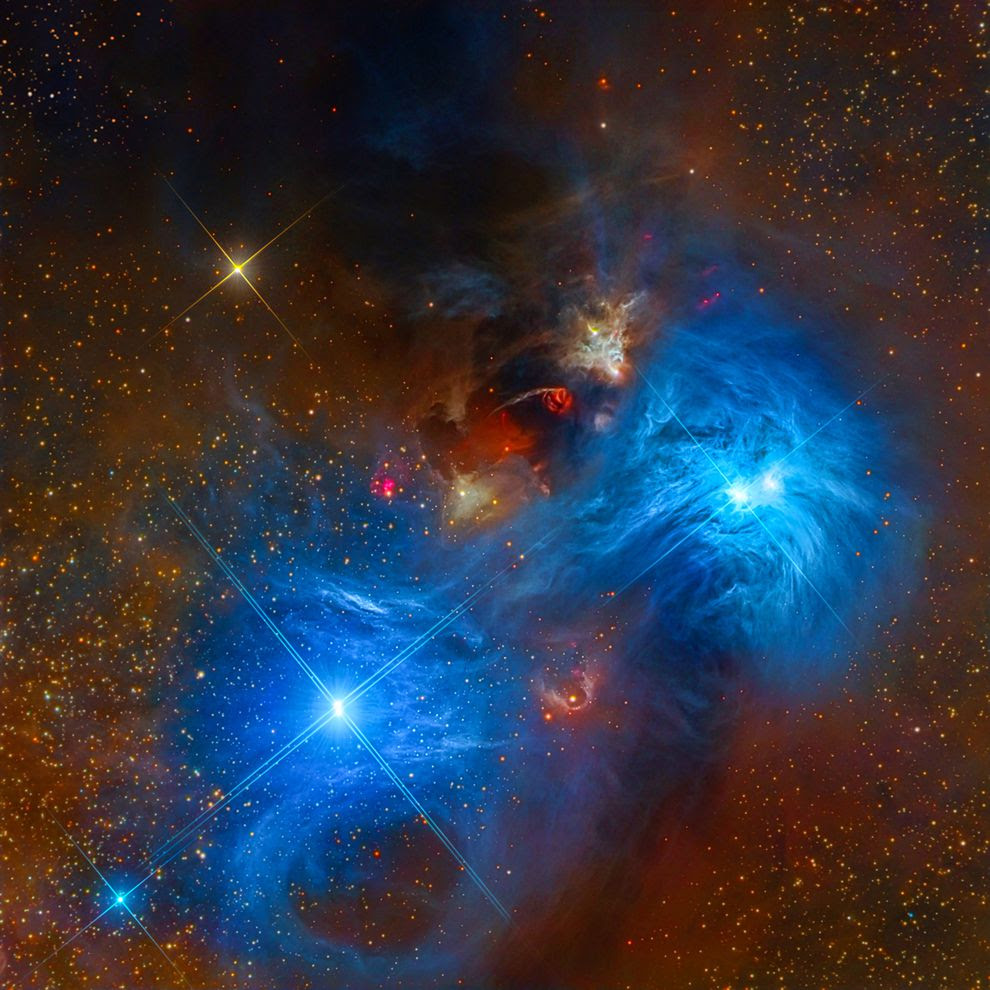
‘Rigel and the Witch Head Nebula’ (Photo: Mario Cogo)
An aurora borealis that lights up the night sky in Iceland. The Milky Way that illuminates in a remote area in Australia. Even nebulae that display dazzling colors. All these phenomena have delighted astronomy enthusiasts for years, and many people travel the globe to capture such events.
The Astronomy Photographer of the Year competition honors amateur astronomy photographers who capture stunning images of space. The organization released several dozens images out of the more than 4,200 entries it received ahead of its announcement this October of this year’s winners. The competition began in 2009 and is organized by the Royal Observatory Greenwich in the United Kingdom.
The photographers featured here are a mixture of amateurs and professionals, but their images are universally stunning.
The photo above entitled “Rigel and the Witch Head Nebula” was taken by Mario Cogo in Namibia. “The dark Namibian sky was the perfect location to capture the wonder of the Witch Head Nebula and Rigel,” said Cogo in his submission. “The Witch Head Nebula is a very faint molecular gas cloud which is illuminated by supergiant star Rigel, the seventh brightest star of the sky and the brightest star in the constellation of Orion.”
The caption listed below each photo was written by the photographer and provides additional context.
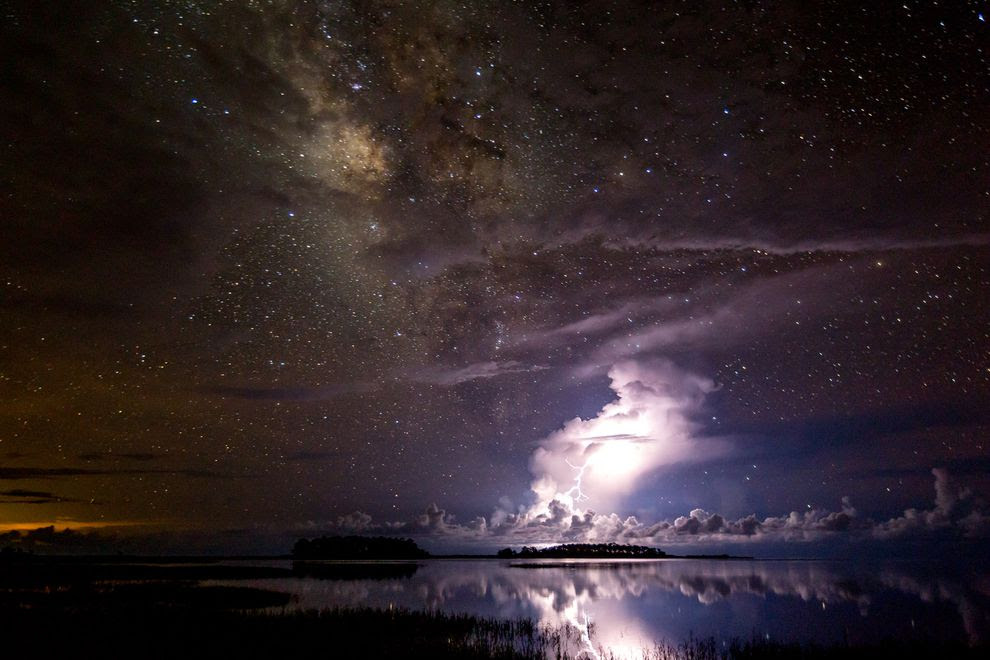
‘Thunderstorm under milky way’ (Photo: Tianyuan Xiao)
“A glorious Milky Way looms over a thunderstorm that lights up the Florida sky. The photographer wanted to show the great contrast between stable (Milky Way) and moving (thunderstorm) objects in the sky.” — Tianyuan Xiao
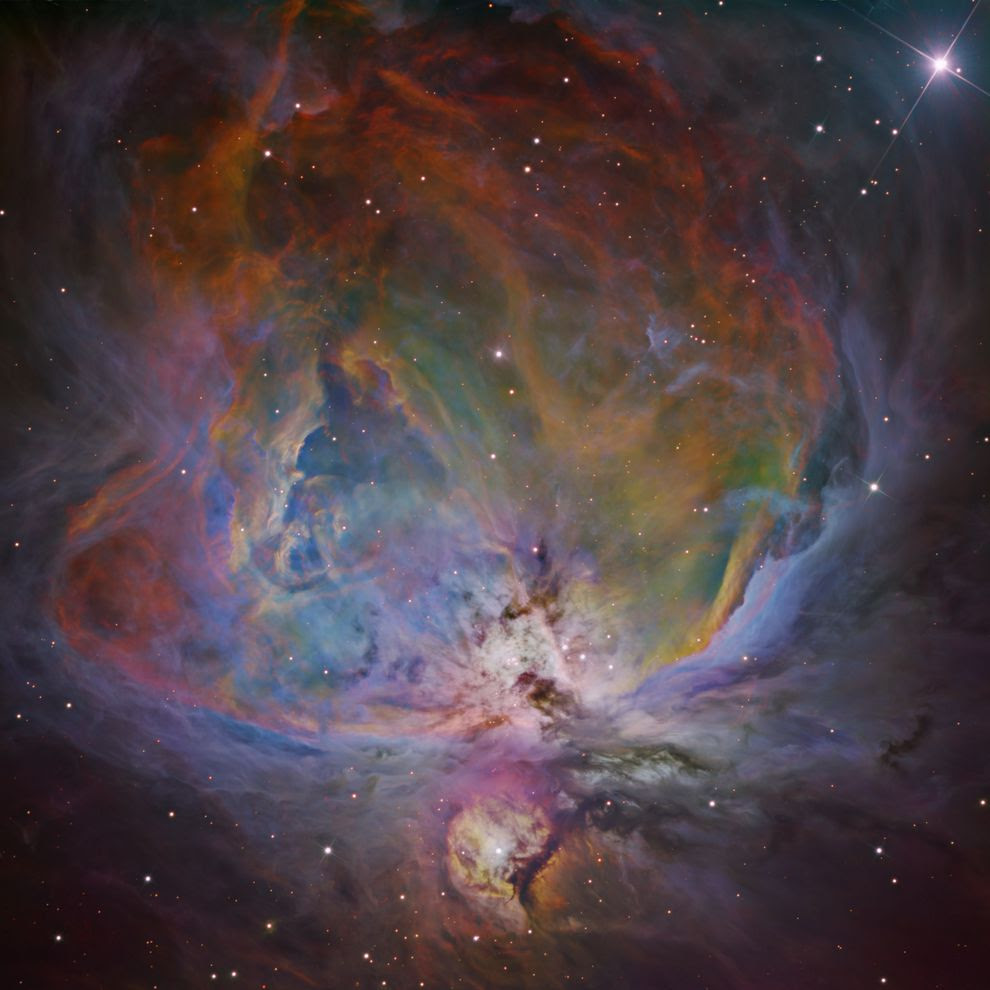
‘The Orion Nebula in 6-Filter Narrowband’ (Photo: Bernard Miller)
“One of the brightest nebulae, the M42 or the Orion Nebula, is located in the Milky Way south of Orion’s belt. It is an emission nebula about 1500 light years away in the constellation Orion. This image was produced by combining 36 hours of total exposure using six different filters; Ha, SII, OIII, Red, Green, and Blue. The central Trapezium cluster of the nebula is so bright that it is usually over exposed with the long exposures needed for the nebula. In this image a series of short 3-second exposures in each filter were blended with the long exposures to create a high dynamic range image that produces detail in the faint nebula and bright Trapezium.” — Bernard Miller
The neglected neighbour’ (Photo: Kfir Simon)
“Taken from Tivoli Southern Sky Guest Farm in Namibia, the great Horsehead nebula is overlooking the striking and often overlooked Nebula NGC 2023. At 4 light years in diameter it is one of the largest reflection nebulae ever discovered.” — Kfir Simon
‘The Hidden Galaxy’ (Photo: Tom O’Donoghue and Olly Penrice)
“Camelopardalis, also known as the Hidden Galaxy is one of the largest Galaxies visible from the Northern Hemisphere; however it is also obscured by foreground stars and dust, as it lies in the Milky Way plane. The photographer added a Ha filter to this LRGB image in order to enhance the emission nebula regions in the galaxy and after stacking single exposures (subs) the brilliant spiral arms at the core were revealed.” — Tom O’Donoghue and Olly Penrice
‘The Eagle nebula’ (Photo: Marcel Drechsler)
“The Eagle Nebula, also known as Messier 16, is a young open cluster of stars, surrounded by hot hydrogen gas in the constellation Serpens and lies at a distance of 7,000 light years from Earth. Taken at the Baerenstein Observatory in Germany, the photo is a RGB-Ha-OIII image and shows off the radiant red and blue colours of the nebula. In the centre you can spot the famous Pillars of Creation.” — Marcel Drechsler
‘Stars over Sacred Mongolian Ovoo’ (Photo: Qiqige Zhao)
“Taken during a summer night in Mingantu in Inner Mongolia, star trails are sweeping over the colourful and extraordinary sacred altars, called Ovoo, creating a spectacular painting.” — Qiqige Zhao
‘NGC 6726 and NGC 6727’ (Photo: Mark Hanson, Warren Keller, Steve Mazlin, Rex Parker, Tommy Tse, David Plesko, Pete Proulx)
“These spectacular reflection nebulae in the Corona Australis constellation depict the characteristic vivid blue color produced by the light of hot stars, reflected by silica-based cosmic dust. A rare high resolution view of the cores NGC 6726 and 6727 is captured on camera. The data was acquired by Star Shadows Remote Observatory at CTIO’s PROMPT2, using LRGB filters, stacked with CCDStack and post-processed in Photoshop and PixInsight.” — Mark Hanson, Warren Keller, Steve Mazlin, Rex Parker, Tommy Tse, David Plesko and Pete Proulx
‘Mosaic of the Great Orion & Running Man Nebula’ (Photo: Miguel Angel García Borrella and Lluis Romero Ventura)
“The Orion Nebula, also known as Messier 42, M42, or NGC 1976, is a diffuse nebula situated in the Milky Way, south of Orion’s Belt in the constellation of Orion. It is one of the brightest nebulae and is visible to the naked eye during a clear night sky. M42 is 1270 light years from our planet and is the closest region of massive star formation to Earth. It is estimated to be 24 light years across and it has a mass of about 2,000 times more than that of the Sun. This image is the result of the efforts of two astrophotographers using different equipment from their observatories. Located hundreds of kilometres away from each other, they chose the Orion Sword are as a common target to render. The software suites used in this image are Maxim DL, Pixinsight and Photoshop CC 2017.” — Miguel Angel García Borrella and Lluis Romero Ventura
‘Milky Way shining over Atashkooh’ (Photo: Masoud Ghadiri)
“The Milky Way stretches across the night sky between four columns in the ancient Atashkooh Fire Temple near Mahllat city in Iran. The camera was placed on the ground in the centre of the four columns, and with no use of any other equipment, the photographer managed to capture our magnificent galaxy using just one image.” — Masoud Ghadiri
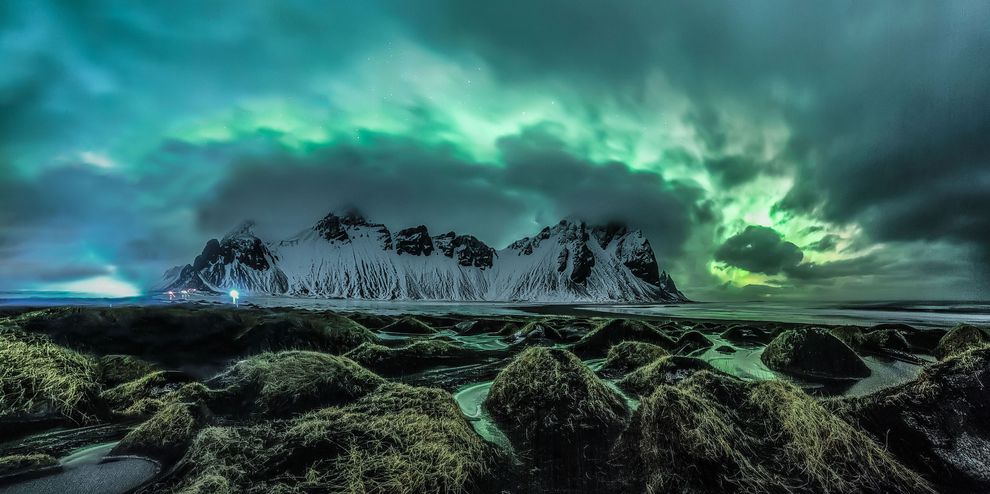
‘Magic’ (Photo: Jingyi Zhang)
“The magical Aurora Borealis explodes from the clouds and looms over the mountains in Stokknes on the south coast of Iceland. Snow has melted and created pools of water between the dunes, creating a perfect foreground for this image.” — Jingyi Zhang
‘Kynance cove by night’ (Photo: Ainsley Bennett)
“On a family trip to Cornwall after visiting Kynance Cove, on the Lizard Peninsula, the beautiful landscape seemed to be the ideal place for the photographer to capture the glimmering stars and the striking colours of the Milky Way illuminating the beautiful rocky coastline. This is a composition of two separate exposures, one for the sky and one for the foreground blended together post-processing to achieve the desired result, producing a more even exposure.” — Ainsley Bennett
‘Keeper of the Light’ (Photo: James Stone)
“The Milky Way rises above an isolated lighthouse in Tasmania. The photographer planned his position to shoot the perfect composition positioning the Milky Way in conjunction with the lighthouse and observing how to best light the tower for artistic effect. This image is part of a time-lapse sequence, allowing the photographer some time to climb the tower into the lantern room of the lighthouse and reflect on the hard and lonely, yet incredible life the former lighthouse keepers would have lived.” — James Stone
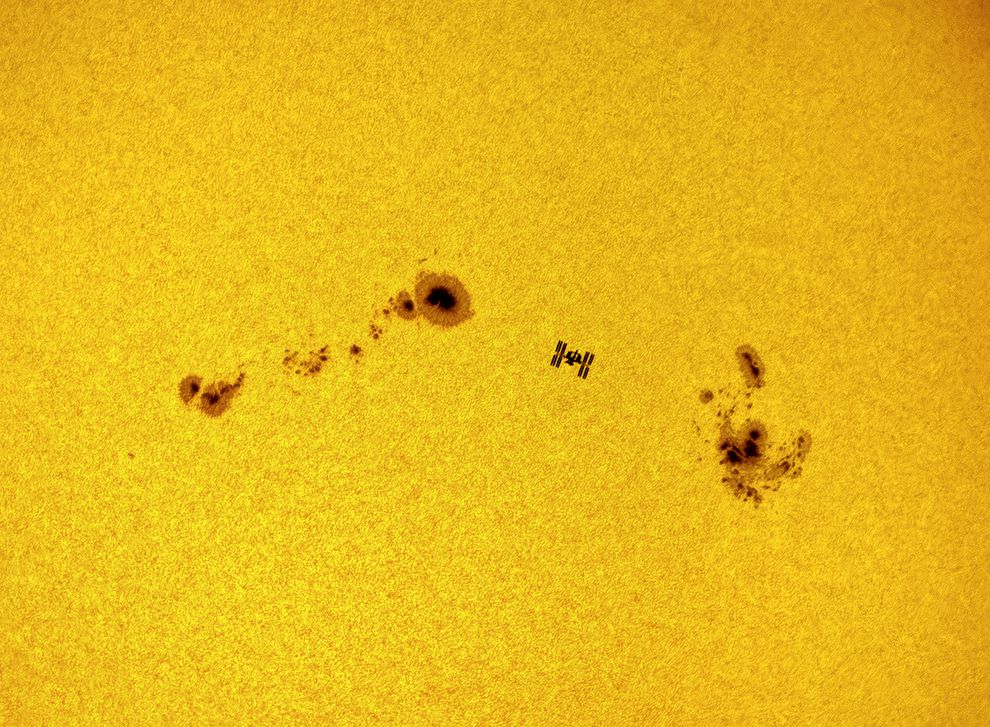
“The International Space Station (ISS) was captured between two massive sunspots, the AR 12674 and AR 12673, during its solar transit. The image was taken in Madrid and it took ISS less than a second to cross the solar disk.” — Dani Caxete
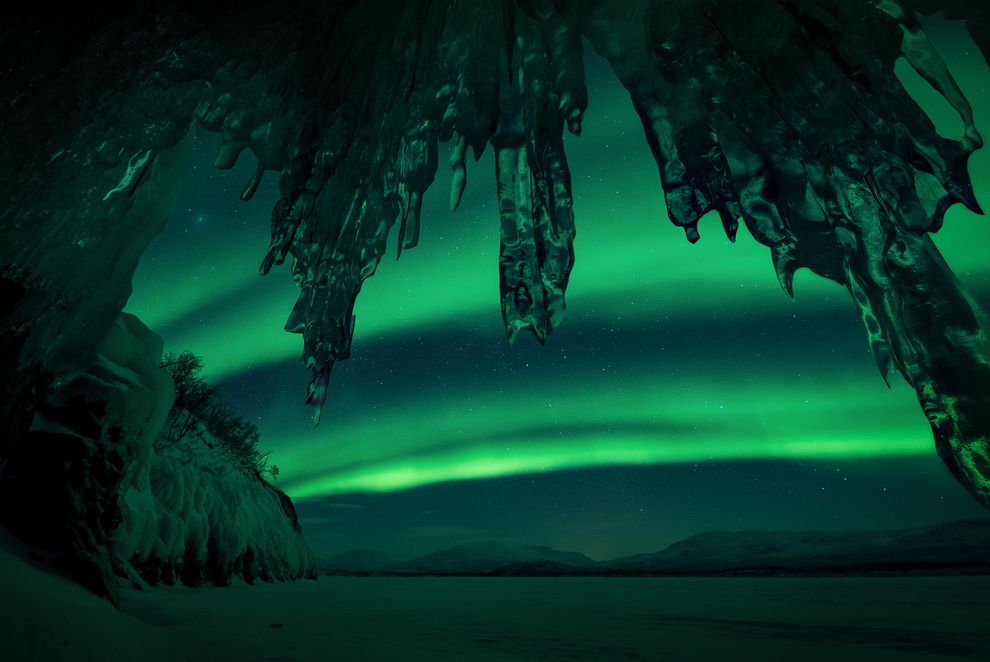
‘Ice Castle’ (Photo: Arild Heitmann)
“A remarkable display of the Northern Lights reflecting shades of green and yellow on the snow. Squeezed into a tiny cave on Lake Torneträsk, in Swedish Lapland, in minus 26 degrees with the camera lens just a few centimeters away from the icicles, it was a challenge well worth it for the photographer.” — Arild Heitmann
‘Holy Light II’ (Photo: Mikkel Beiter)
“The Black Church at Búðir in Iceland beneath the stripes of the Aurora Borealis and the bright stars in the night sky. Fighting the worst weather the photographer had ever encountered in Snæfellsnes Peninsula and with strong gale winds around 30 meters per second on the night the image was taken, his hard work paid off.” — Mikkel Beiter
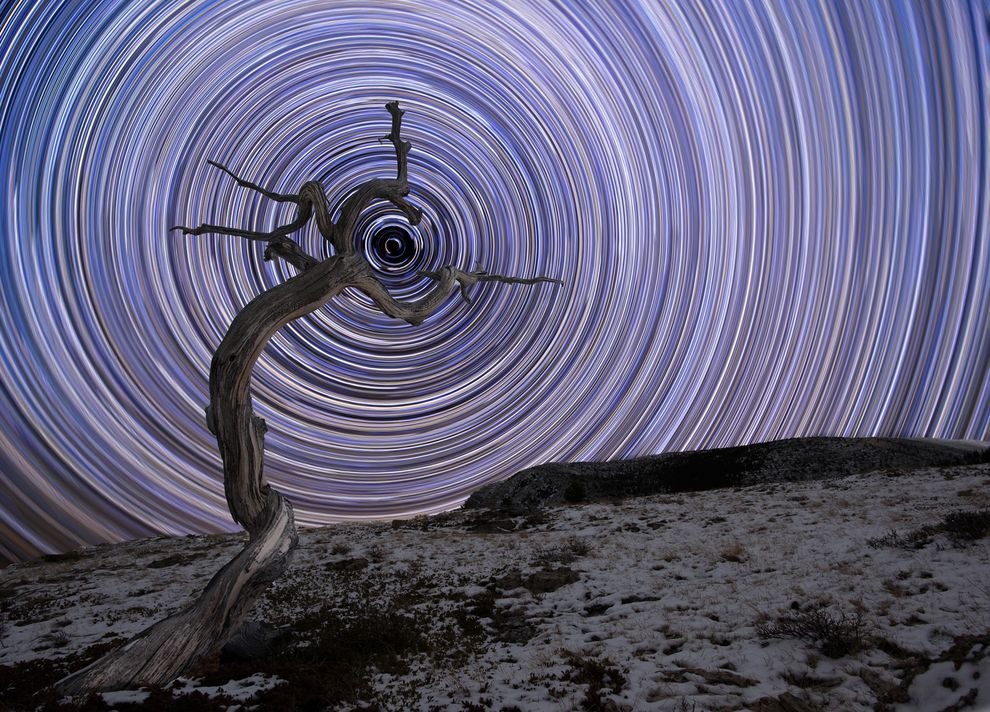
‘Holding Due North’ (Photo: Jake Mosher)
“A weathered juniper tree in Montana’s northern Rocky Mountains is filled with arced star trails and in the centre sits Polaris, the brightest star in the constellation of Ursa Minor. It took several test frames of long exposures to make sure that Polaris was in the right position, but eventually things lined up and the Moon provided enough light to the foreground, yet plenty of dark skies to allow a high enough ISO to capture lots of stars.” — Jake Mosher
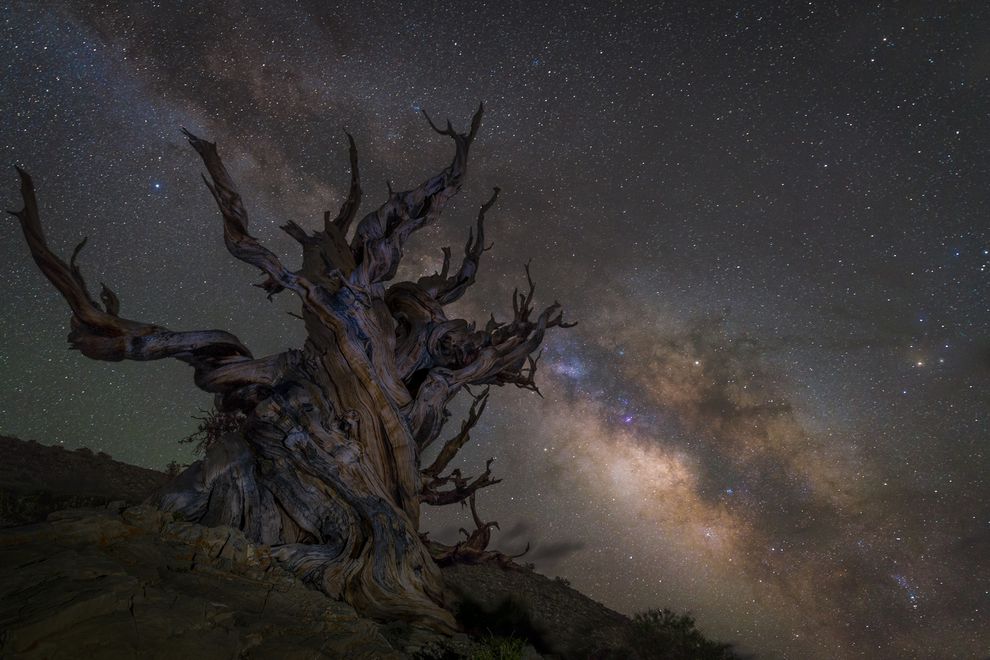
‘Guarding the galaxy’ (Photo: Jez Hughes)
“The Milky Way rises over some of the oldest trees on Earth in the Ancient Bristlecone Pine Forest, set within the Inyo National Forest along the White Mountains in California. Growing at altitudes of over 10,000 feet, these trees can live for over 4,000 years. The high elevation also results in thin air and incredibly dark skies on display. This photograph was taken in between rolling thunderstorms which were passing through the Eastern Sierras, leaving time for only a few exposures.” — Jez Hughes
Guardian of Tre Cime’ (Photo: Carlos F. Turienzo)
“This panoramic image, composed out of eight photos, depicts the Milky Way emerging over the rocky Dolomites in Tre Crime on the left and on the right the lights from a house illuminating the beautiful terrain. The photographer noted that the image represents sharing unforgettable moment with the ones you love.” — Carlos F. Turienzo
‘First Impressions’ (Photo: Casper Kentish)
“After a few days of cloudy skies the photographer finally got the chance to use his birthday present, a new telescope. The clouds were moving fast so there was not much time to capture the Moon. With the help of his grandfather who kept moving the telescope and trying to keep an iPad at the right position, he managed to capture this wonderful and artistic image of his first viewing of our Moon.” — Casper Kentish
‘Expedition to Infinity’ (Photo: Jingpeng Liu)
“The photographer captured the splendor of our galaxy in Badlands National Park, in South Dakota and is a panoramic view of a 6-shot composite, three for the sky and three for the foreground, all of which were taken successively using the same gear and equivalent exposure settings, from the same location, within a short period. The raw files were initially processed in Lightroom for lens correction only, followed by merging to panorama in Photoshop. Final retouching was applied back in Lightroom, including WB correction, basic toning and local adjustments.” — Jingpeng Liu
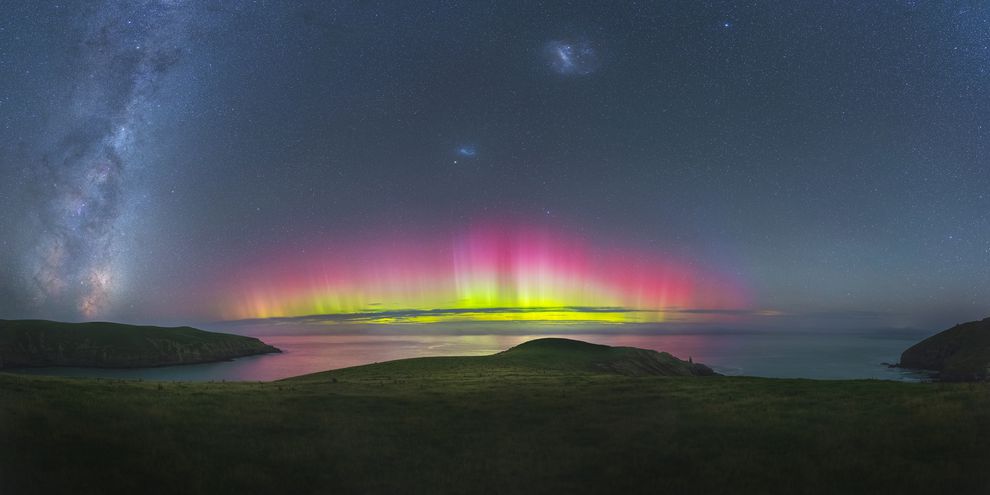
‘Empyreal’ (Photo: Paul Wilson)
“A flared up Aurora reflects bright pink and yellow colours on the water at Southern Bays near Christchurch, New Zealand. The incredible combination of the radiant Aurora colours, the wide green fields and the dark blue, starry night sky paint a spectacular picture and accentuates the wonders of our galaxy.” — Paul Wilson
‘Earth Shine’ (Photo: Peter Ward)
“During a solar eclipse, the brightness of the solar corona hides the details of the moon. By layering 9 exposures ranging from 2 seconds to 1/2000th of a second and with Extreme High Dynamic Range photography or XHDR the image shows not just the radiant solar corona, but the newest possible of new moons, seen here illuminated by sunlight reflecting off the earth.” — Peter Ward
‘Deep Space’ (Photo: Dave Brosha)
“Exploring the remarkable underbelly of the Breiðamerkurjökull glacial tongue in Iceland. With this image the photographer wanted to pay tribute to the serenity and wonder he felt while he spent some time in this peaceful and magnificent place.” — Dave Brosha
‘Daytime Moon’ (Photo: Helen Schofield)
“Earth’s only natural satellite is situated above the horizon of our planet so it is visible during daytime and the waxing gibbous phase can clearly be seen in the sky. The photographer captured this imposing image in Malaga, Spain while vacationing with her children.” — Helen Schofield
Color-Full Moon’ (Photo: Nicolas Lefaudeux)
“A phenomenal image depicting the incredible colours and details of the surface of the Moon. The photographer applied a similar procedure he used for capturing the solar eclipse and noted that this lit up the full Moon like a Christmas tree ornament, with a great variety of hues and shades.” — Nicolas Lefaudeux
‘Cable Bay’ (Photo: Mark Gee)
“The magnificent Milky Way stretches across the night sky reflecting on the Cable Bay near Nelson, New Zealand. The photographer had to take the picture before the light washed out the sky. 42 individual images were stitched in to a large multi row panorama to create this image.” — Mark Gee
‘Aurorascape’ (Photo: Mikkel Beiter)
“The conditions the night the image was taken were not ideal because of the bright moon lighting up the sky. The photographer managed to overcome this obstacle and capture the incredible Aurora Borealis above the fjord at Haukland in the gorgeous Lofoten archipelago, Northern Norway. The small pool of water with rocks made the perfect foreground and a natural leading line into the frame.” — Mikkel Beiter
‘Aurora Borealis on the coast of the Barents sea’ (Photo: Michael Zav’yalov)
“From the city of Yaroslavl in Russia to the coast of the Barents Sea in the Arctic Circle, a party of three travelled 2000 kilometers to capture the magnificent Northern Lights. The photographer stayed in the village of Teriberka in the Murmansk Oblast district for five days. After four days of bad weather, with heavy snow and thick clouds the sky finally cleared on the last day and the Northern Lights appeared in all their glory.” — Michael Zav’yalov
‘AR 2665 and Quiescent Prominence’ (Photo: Łukasz Sujka)
“The sunspot AR2665 was one of the most active regions in 2017 on the right you can see a phenomenal quiescent prominence extending from our star, the Sun. This type of prominence lasts for a very long time and its structure is quite stable. The photo is a composition of two images: one of the magnificent prominence and one of the Sun’s surface. The surface is much brighter than the prominence so it is a negative to reveal details of Sun chromosphere (spicules and filaments).” — Łukasz Sujka
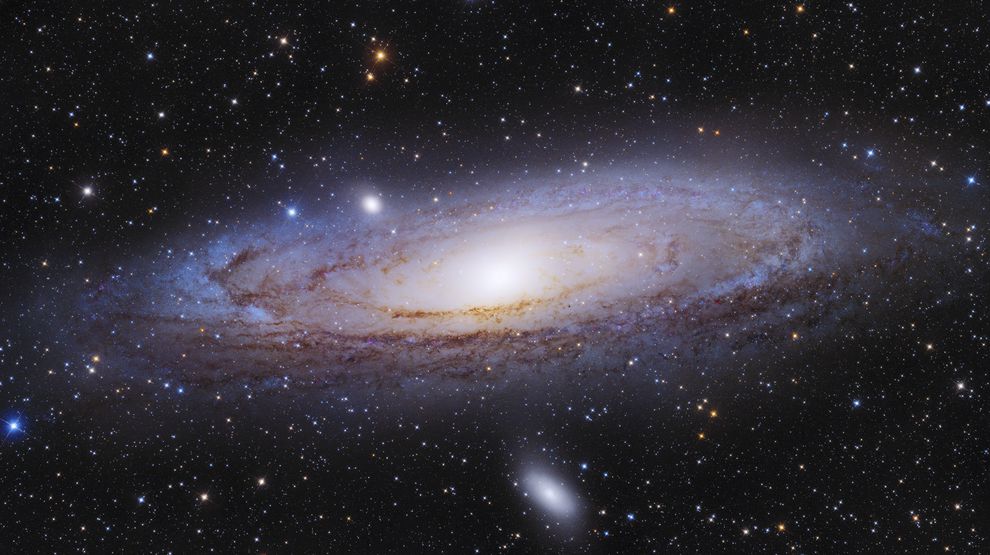
‘Andromeda Galaxy’ (Photo: Péter Feltóti)
“Andromeda Galaxy has always amazed the photographer. The dust lanes and bright star clusters in its arms, the emblematic galaxy shape of it, and the magnificent look of this great star city make it one of his most desired objects to photograph. This image was taken using a 200mm mirror and creating a three panel mosaic.” — Péter Feltóti
‘A Magnificent Saturn’ (Photo: Avani Soares)
“In high resolution planetary photography having a good view of a planet is a key factor but also completely out of a photographer’s control. In this image the photographer was lucky to capture our second largest planet, Saturn, in all its glory. After stacking 4,000 out of 10,000 frames we can admire details such as the beautiful polar hexagon, the Encke Division and even the crepe ring.” — Avani Soares
ooOOoo
These are the most beautiful images of the cosmos that I have ever seen!
Dawn breaks over Moskey Basin, at Isle Royale National Park, Michigan. Canadian wolves colonized the island in 1949. (Photo: Steve Lagreca/Shutterstock)
The American people’s relationship with top predators — especially wolves — is complex and ever-evolving. About three decades ago, it was mostly just animal-rights groups and their supporters who fought for the wolves’ right to exist; they were often considered a nuisance. But now there’s plenty of scientific evidence proving what’s good for wolves is good for their prey, the plants those prey eat, and indeed, positively affects the entire ecosystem. That’s ultimately good for humans too — unless you’re competing with the wolves, like a rancher who grazes animals or a hunter who wants to shoot the same deer or moose that wolves need to eat. But at this point, even some ranchers and hunters have come over to the pro-predator side.
Much of that change in the perception of predators is down to studies that have proven how precisely cougars, wolves, bears, tigers, lions, bald eagles, alligators and other apex predators affect the land around them. None have been studied longer than the wolves and moose in Isle Royale National Park, a Guam-sized island in Lake Superior. For almost 60 years, the populations of these two groups have been tracked — as well as their effects on the plants and other animal communities on the island. (You can read the reports here, including the recent 59th annual report.)
As the video above explains, there used to be as many as 50 wolves on Isle Royale; however, that number has dwindled, mostly due to inbreeding that caused a debilitating spinal condition to proliferate among the too-closely-related wolves. Just 10 years ago, there were still around 30 wolves but by 2015, there were only three wolves left. Now, there are just two, a closely related male-female pair that probably won’t breed. (The female of the pair has aggressively fought back when the male attempted to breed with her.)
Already, the moose population on the island has boomed, “undoubtably because of lack of predation,” John Vucetich, a wildlife ecologist from Michigan Technological University told Science magazine, adding that the two remaining wolves are now “… swimming in moose.” Despite the wolves’ regular predation on moose, there’s been a 20 percent increase in moose in just one year, which scientists estimate is about five to 10 times higher than on mainland areas. Beaver populations have also risen sharply. There’s just not enough wolves to keep either population in check.
So what’s so bad about so many moose? Well, as most ungulates do, moose spend their days browsing on vegetation, so the more moose, the more food they need — and the plants on the island can only take so much nibbling. An aquatic plant, which was found in abundance just six years ago, is now only found in places where moose are not. Long-term, this means the island will soon run out of food to keep the ever-larger moose population alive, and many will starve once food becomes scarce. Previously, the wolves have kept moose populations low enough so they didn’t overeat the vegetation, keeping the system in balance.
A plan to rebalance the ecosystem
This female wolf arrived at Isle Royale on Oct. 2, 2018. (Photo: NPS/Jim Peaco)
This is why some people think the best solution is to bring a fresh influx of wolves to Isle Royale National Park. The plan is to release 25-30 wolves over the next three to five years. So far, park officials have trapped four wolves on the mainland beginning in late September and released them on the island. Three of the wolves are female — with the hope they will successfully breed.
This new blood would potentially rebalance the predator-prey relationship and the idea is that the rest of the ecosystem would follow. Introducing so many wolves over several years is hardly natural either, others argue, saying that humans should just be hands off and let nature take its course. The original 50 wolves had found their way to the island on their own, having moved in from Canada; perhaps they could do so again if given the chance.
Editor’s note: This article has been updated since it was originally published in April 2017.
Just the view at night from one small planet, the one that I happen to live on, Planet Earth, reveals millions upon millions of stars. It is then beyond inconceivable that there are not, in turn, countless numbers of other planets.
Extending this line of thought and recognising that a ‘mere’ billion years after the formation of our solar system and Planet Earth, some 4.54 billion years ago, the earliest life appeared, we can’t surely be alone!
Granted it was only cyanobacteria, as in blue-green algae, but, but, but ……… that this evolution of life on Planet Earth, and that evolution eventually leading to intelligent life, including the gift to us humans of the genetic separation of the dog from the wolf some 100,000 years ago, has not occurred on other planets is also totally inconceivable.
So, dear Mr. Cosmos, why have we not detected any signs of that intelligent life. Where are they?
Are we alone in the universe? New Drake equation suggests yes
A fresh take on the decades-old Drake equation incorporates new factors and greater uncertainty, suggesting a high likelihood that humanity is alone in the universe.
At the Los Alamos National Laboratory in 1950, physicist Enrico Fermi famously posed to his colleagues a simple question borne of complex math: ‘Where are they?’
He was asking about aliens—intelligent ones, specifically. The Italian-American scientist was puzzled as to why mankind hasn’t detected any signs of intelligent life beyond our planet. He reasoned that even if life is extremely rare, you’d still expect there to be many alien civilizations given the sheer size of the universe. After all, some estimates indicate that there is one septillion, or 1,000,000,000,000,000,000,000,000, stars in the universe, some of which are surrounded by planets that could probably support life.
So, where are they, and why aren’t they talking to us?
Now, as the article reveals, there is a lot to tackling this question, much of it involving statistics and mathematics, but it does prove one very important fact: Finding another planet as good for life and humanity as this one is just about impossible.
This is our only home!!
My wish, dear Mr. Cosmos, to you is this: That before I die it becomes clear beyond question that the peoples of this sweet Planet, from the lone individual living on some island out in the wilderness to the Governments of the most powerful nations on Earth, understand that nothing is more important than loving, caring for and looking after Planet Earth.
I remain, dear Mr. Cosmos, your respectful servant.
The last in this recent series on me examining my navel!
Dear Mr. Cosmos,
Clearly, I have no idea how many letters you receive from us funny inhabitants on Planet Earth. Can’t imagine you get floods of them but then neither can I imagine that this is the first one you have ever received.
Why can I not imagine this is to be your first? Simply, because us funny folk on this incredible planet of yours have been around for quite a while. I mean that over in that country we folk call Israel there has been found evidence of “control of fire by humans nearly 790,000 years ago.”
Whoops!
Just realised that me saying “quite a while” and writing of “790,000 years ago” will be utterly meaningless, in terms of scale, to how you describe your past. Just as it is utterly meaningless for me to contemplate that in cosmological terms the ‘Big Bang”, generally recognised as the start of your Universe, was, give or take, some 13.8 billion years ago.
I wish I could really get an idea of what a million years feels like, let alone a billion years. Ah well!
Let me stay with this notion of stuff being meaningless.
My dear, long-time friend Dan Gomez sent me a link to an item that had been published on the Science Alert website. It was about how the NASA Hubble space telescope had recently embarked on a new mission. Or in the words of that article:
Hubble Just Revealed Thousands of Hidden Galaxies in This Jaw-Dropping Photo
By Michelle Starr, September 13th, 2018
Hubble has embarked on a new observation mission: to study the farthest reaches of the Universe, using some of the most massive objects in the Universe – galaxy clusters.
And this newly released picture shows how.
At the centre is Abell 370, a cluster of a few hundred galaxies located around 4 billion light-years from Earth. And arrayed around it, never seen before, are thousands of galaxies, out even farther in the depths of space.
The reason we can see them now is because of Abell 370. All those hundreds of galaxies, clustered so close together, and the associated dark matter, create an immense field of gravity.
When the light behind that field passes through it, the gravitational force is so strong that it bends the path of the light. This creates a magnifying effect called gravitational lensing, allowing us to see objects we usually can’t.
Abell 370 is the first of these clusters.
Here is one of those photographs,
(NASA, ESA, A. Koekemoer, M. Jauzac, C. Steinhardt, and the BUFFALO team)
And an explanation of what we are looking at:
In the image, you can see the galaxies in Abell 370. The brightest yellowish white ones are huge, containing hundreds of billions of stars. The bluer ones are smaller, spiral galaxies, like the Milky Way, with younger populations of stars. And the dimmer, yellower galaxies are older, with ageing star populations.
The galaxies behind Abell 370 appear as smeared lines of light. The most spectacular, to the lower left of the centre, is nicknamed the Dragon (possibly for its resemblance to a Chinese dragon), with its head to the left. It’s made up of five images of the same spiral galaxy, magnified and stretched by the gravitational lens.
Mr. Cosmos, you know a little earlier I was remarking about how it is impossible to comprehend the age of the Universe. Well, dear Sir, it’s just as impossible to comprehend your distances.
Take Abell 370 out there some 4 billion light years from Planet Earth! I really wanted to have a go at understanding that distance.
First, I looked up the distance in miles that is represented by one light-year. Answer: one light year is a tad under six trillion miles.
Just one, let alone some 4 billion of them!
Next, I looked up the distance of our very familiar Big Dipper constellation. You must have heard of it? This one!
The Big Dipper. Image Credit & Copyright: Jerry Lodriguss
Turns out that even this very familiar sight in our night sky ranges from 78 to 123 light years away. Average that as 100 light years and, bingo, you are looking at this familiar cluster of stars that is 590 trillion miles away!
So, dear Mr. Cosmos, that puts your Abell 370 constellation about a distance that is 10 million times more distant than our Big Dipper!
I wrote above that “I really wanted to understand that distance.” In reference to how far that Abell 370 constellation truly was. My conclusion is that I will never, ever understand that distance.
Anyone able to help?
Tomorrow, Mr. Cosmos, the closing page two of my letter to you.
I found it very interesting and wanted to share it with you.
ooOOoo
Scientists have been drilling into the ocean floor for 50 years – here’s what they’ve found so far
September 26, 2018
By Professor Suzanne O’Connell, Professor of Earth & Environmental Sciences, Wesleyan University
The scientific drilling ship JOIDES Resolution arrives in Honolulu after successful sea trials and testing of scientific and drilling equipment. IODP, CC BY-ND
It’s stunning but true that we know more about the surface of the moon than about the Earth’s ocean floor. Much of what we do know has come from scientific ocean drilling – the systematic collection of core samples from the deep seabed. This revolutionary process began 50 years ago, when the drilling vessel Glomar Challenger sailed into the Gulf of Mexico on August 11, 1968 on the first expedition of the federally funded Deep Sea Drilling Project.
I went on my first scientific ocean drilling expedition in 1980, and since then have participated in six more expeditions to locations including the far North Atlantic and Antaractica’s Weddell Sea. In my lab, my students and I work with core samples from these expeditions. Each of these cores, which are cylinders 31 feet long and 3 inches wide, is like a book whose information is waiting to be translated into words. Holding a newly opened core, filled with rocks and sediment from the Earth’s ocean floor, is like opening a rare treasure chest that records the passage of time in Earth’s history.
Over a half-century, scientific ocean drilling has proved the theory of plate tectonics, created the field of paleoceanography and redefined how we view life on Earth by revealing an enormous variety and volume of life in the deep marine biosphere. And much more remains to be learned.
Technological innovations
Two key innovations made it possible for research ships to take core samples from precise locations in the deep oceans. The first, known as dynamic positioning, enables a 471-foot ship to stay fixed in place while drilling and recovering cores, one on top of the next, often in over 12,000 feet of water.
Anchoring isn’t feasible at these depths. Instead, technicians drop a torpedo-shaped instrument called a transponder over the side. A device called a transducer, mounted on the ship’s hull, sends an acoustic signal to the transponder, which replies. Computers on board calculate the distance and angle of this communication. Thrusters on the ship’s hull maneuver the vessel to stay in exactly the same location, countering the forces of currents, wind and waves.
Another challenge arises when drill bits have to be replaced mid-operation. The ocean’s crust is
The re-entry cone is welded together around the drill pipe, then lowered down the pipe to guide reinsertion before changing drill bits. IODP, CC BY-ND
composed of igneous rock that wears bits down long before the desired depth is reached.
When this happens, the drill crew brings the entire drill pipe to the surface, mounts a new drill bit and returns to the same hole. This requires guiding the pipe into a funnel shaped re-entry cone, less than 15 feet wide, placed in the bottom of the ocean at the mouth of the drilling hole. The process, which was first accomplished in 1970, is like lowering a long strand of spaghetti into a quarter-inch-wide funnel at the deep end of an Olympic swimming pool.
Confirming plate tectonics
When scientific ocean drilling began in 1968, the theory of plate tectonics was a subject of active debate. One key idea was that new ocean crust was created at ridges in the seafloor, where oceanic plates moved away from each other and magma from earth’s interior welled up between them. According to this theory, crust should be new material at the crest of ocean ridges, and its age should increase with distance from the crest.
Part of a core section from the Chicxulub impact crater. It is suevite, a type of rock, formed during the impact, that contains rock fragments and melted rocks. IODP, CC BY-ND
The only way to prove this was by analyzing sediment and rock cores. In the winter of 1968-1969, the Glomar Challenger drilled seven sites in the South Atlantic Ocean to the east and west of the Mid-Atlantic ridge. Both the igneous rocks of the ocean floor and overlying sediments aged in perfect agreement with the predictions, confirming that ocean crust was forming at the ridges and plate tectonics was correct.
Reconstructing earth’s history
The ocean record of Earth’s history is more continuous than geologic formations on land, where erosion and redeposition by wind, water and ice can disrupt the record. In most ocean locations sediment is laid down particle by particle, microfossil by microfossil, and remains in place, eventually succumbing to pressure and turning into rock.
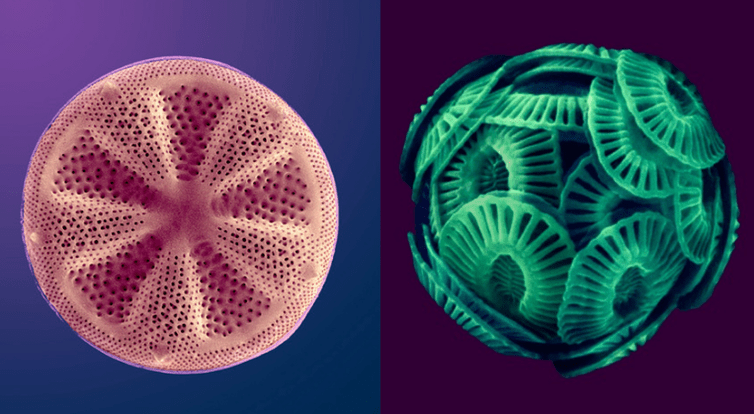
Microfossils (plankton) preserved in sediment are beautiful and informative, even though some
are smaller than the width of a human hair. Like larger plant and animal fossils, scientists can use these delicate structures of calcium and silicon to reconstruct past environments.
The resulting acidification of the ocean from the release of carbon into the atmosphere and ocean caused massive dissolution and change in the deep ocean ecosystem.
This episode is an impressive example of the impact of rapid climate warming. The total amount of carbon released during the PETM is estimated to be about equal to the amount that humans will release if we burn all of Earth’s fossil fuel reserves. Yet, an important difference is that the carbon released by the volcanoes and hydrates was at a much slower rate than we are currently releasing fossil fuel. Thus we can expect even more dramatic climate and ecosystem changes unless we stop emitting carbon.
Enhanced scanning electron microscope images of phytoplankton (left, a diatom; right, a coccolithophore). Different phytoplankton species have distinct climatic preferences, which makes them ideal indicators of surface ocean conditions. Dee Breger, CC BY-NC-ND
Today scientists from 23 nations are proposing and conducting research through the International Ocean Discovery Program, which uses scientific ocean drilling to recover data from seafloor sediments and rocks and to monitor environments under the ocean floor. Coring is producing new information about plate tectonics, such as the complexities of ocean crust formation, and the diversity of life in the deep oceans.
This research is expensive, and technologically and intellectually intense. But only by exploring the deep sea can we recover the treasures it holds and better understand its beauty and complexity.
ooOOoo
Did the phrase in the first paragraph of the article jump out for you as it did for me?
This one: “…we know more about the surface of the moon than about the Earth’s ocean floor.”
Doesn’t Mr. Neptune hold his cards close to his chest.
Your oceans of the world are truly breath-taking. The power you can display in the odd wave or million through to the tranquility you so often also display defy rational explanations.
I have had the profound experience of sailing upon your waters, dear Mr. Neptune, over a number of years sailing back and forth between Cyprus and Turkey. Not a long distance but still sufficient to experience being solo on a yacht day and night.
Tradewind 33 – Songbird of Kent. My home for five years.
Then on my way sailing back to Plymouth, SW England, the magical, almost primeval, feeling of being alone on the Atlantic Ocean. Looking up at the night sky, feeling so insignificant, so infinitesimally minute with 500 miles of open ocean in all directions and those stars above my head.
No question, that practically everything about your oceans is beyond the understanding of us humans. Indeed, I had to look up online how much water there is on Earth to discover there is:
It’s roughly 326 million cubic miles (1.332 billion cubic kilometers), according to a recent study from the U.S. Geological Survey.
Because I simply didn’t have a clue.
And knowing there are approximately 326 million cubic miles of water doesn’t help because I am still left not having a clue as to what that means!
So, thank goodness, Mr. Neptune this is all a ‘walk in the park’ for you!
But I do have a question for you.
What do you make of this?
The image is cropped from the following:
The description of these figures is:
Figure. (upper) Change in global upper-level (0–2000 m) ocean heat content since 1958. Each bar shows the annual mean relative to a 1981–2010 baseline. (lower) Annual mean ocean heat content anomaly in 2017 relative to a 1981–2010 baseline.
And it was taken from research undertaken by Lijing Cheng and Jiang Zhu and found on the web here.
Ocean Heat Content
Owing to its large heat capacity, the ocean accumulates the warming derived from human activities; indeed, more than 90% of Earth’s residual heat related to global warming is absorbed by the ocean (IPCC, Cheng et al. 2017). As such, the global ocean heat content record robustly represents the signature of global warming and is impacted less by weather-related noise and climate variability such as El Niño and La Niña events (Cheng et al. 2018). On the other hand, ocean thermal expansion due to ocean temperature change contributes substantially (30%~50%) to the sea level change, which can considerably influence human populations in coastal and island regions and marine ecosystems. Therefore, monitoring the OHC changes and understanding its variation are crucial for climate change.
Is it possible, Mr. Neptune, that even you as the master of all our oceans is worried about the future?
I shall cut my waffling and just say that I saw this item on The Smithsonian ‘Smart News’ section last week and just knew it should be shared with you!
ooOOoo
Who’s a Good Archaeologist? Dog Digs Up Trove of Bronze Age Relics
While on a walk outside a small Czech village, Monty the dog and his owner found nearly two dozen 3,000-year-old artifacts
Monty, the dog that found the Bronze Age relics, unearthed 13 sickles, two spear points, three axes and several bracelets. (Hradec Králové Region)
Some archaeologists carry tools and painstakingly chip away at historic sites. Others might have fluffy bodies, keen senses of smell and an affinity for digging stuff up.
As Tom McEnchroe reports for Radio Praha, a very good dog named Monty recently unearthed a rare trove of Bronze Age artifacts near the Czech village of Kostelecké Horky. Monty was walking with his human, identified as “Mr. Frankota,” in a field when he began pawing frenetically at the ground. Soon, thanks to Monty’s hard work, metallic objects began to emerge in the soil.
The cache of relics includes 13 sickles, two spear points, three axes and several bracelets. The objects have been dated to the Urnfield period around 3,000 years ago. This late European Bronze Age culture is marked by the transition from inhumation burials to cremations; the remains of the dead were interred in urns, giving the era its name. According to Encyclopaedia Britannica, Urnfield culture first appeared in east-central Europe and northern Italy, but eventually spread “to Ukraine, Sicily, Scandinavia, and across France to the Iberian peninsula.”
It is rare to find a cluster of intact Urnfield objects, according to a press release. “The culture that lived here at the time normally just buried fragments, often melted as well,” Martina Beková, an archaeologist at the Museum and Gallery of Orlické who studied the artifacts after they were discovered by Monty, tells McEnchroe. So she suspects that the relics were tied to a ritual—“most likely a sacrifice of some sorts,” Beková says.
Additional evidence could help pin down the function of the objects, and according to Michelle Starr of Science Alert, local archaeologists have been searching the area in the hopes of finding more relics. They haven’t uncovered anything yet, but Sylvie Velčovská, a spokeswoman for the region, tells McEnchroe that there have been, “considerable changes to the surrounding terrain over the centuries, so it is possible that the deeper layers are still hiding some secrets.”
The newly uncovered objects will be on display at the Museum and Gallery of Orlické Mountains in the town of Rychnov until October 21, after which point they will undergo conservation and be moved to a permanent exhibition in the village of Kostelec.
Frankota, Monty’s owner, was awarded 7860 Czech Koruna (around $360) for his role in alerting archaeologists to the ancient treasures. One can only hope that Monty was given many treats and pets for his superb fieldwork
Brigit Katz is a freelance writer based in Toronto. Her work has appeared in a number of publications, including NYmag.com, Flavorwire and Tina Brown Media’s Women in the World.


 ‘Rigel and the Witch Head Nebula’ (Photo: Mario Cogo)























 Learning from Dogs
