Category: Science

A most beautiful animal

From a discussion on Ugly Hedgehog

As regular readers know, I subscribe to Ugly Hedgehog, a photography forum.

Once again, I want to share with you all a most stunning photograph.

It is this:

So what animal is it?

Back to that item on Ugly Hedgehog:

Whistletown Wilds, the author of the post, said:

Good boy! Call it what you will; Coydog, Eastern Coyote, or Coymolf. Up close and personal, Taken in East Lyme Ct.

Ecologist and evolutionary biologist Javier Monzón analyzed the DNA of eastern coyotes and found the genes contain all three canids — dog, wolf, and coyote.

According to Monzón’s research, about 64% of the eastern coyote’s genome is coyote (Canis latrans), 13% gray wolf (Canis lupus), 13% Eastern wolf (Canis lycaon), and 10% dog (Canis familiaris).

Later on he added:

All my bird and nature photos are taken in South Eastern Ct. most with a Canon 7D Mark II or 5D Mark IV and Canon 100 to 400II THANK YOU. About 20 yards.

Then followed in response to my request for permission to republish:

Feel free, no problem!

Whatever happens to me in the next year, I truly hope I can continue to share such incredibly photographs with you.

Nature in all her glory!

Tomorrow is Christmas Day and I will be taking a short break, probably back on December 27th.

You all have a wonderful, peaceful holiday.

It’s a New Year!

Well we have passed the Solstice!

Each year I try and promote the fact that we are in a New Year.

This year’s December Solstice took place at the moment this post was published: 20:19 PST .

Or in the words of EarthSky.org:

ooOOoo

All you need to know: December solstice

Posted by in | December 15, 2019

December solstice 2019 arrives on December 22 at 4:19 UTC.

That’s December 21 for much of North America. High summer for the Southern Hemisphere. For the Northern Hemisphere, the return of more sunlight!

Ian Hennes in Medicine Hat, Alberta, Canada, created this solargraph between a June solstice and a December solstice. It shows the path of the sun during that time period.

Late dawn. Early sunset. Short day. Long night. For us in the Northern Hemisphere, the December solstice marks the longest night and shortest day of the year. Meanwhile, on the day of the December solstice, the Southern Hemisphere has its longest day and shortest night. The 2019 December solstice takes place on Sunday, December 22, at 04:19 UTC (That’s December 21 at 10:19 p.m. CST; translate UTC to your time).

No matter where you live on Earth’s globe, a solstice is your signal to celebrate.

When is the solstice? The solstice happens at the same instant for all of us, everywhere on Earth. In 2019, the December solstice comes on December 21 at 10:19 p.m. CST. That’s on December 22 at 04:19 Universal Time (UTC). It’s when the sun on our sky’s dome reaches its farthest southward point for the year. At this solstice, the Northern Hemisphere has its shortest day and longest night of the year.

To find the time in your location, you have to translate to your time zone. Click here to translate Universal Time to your local time.

Just remember: you’re translating from 04:19 UT on December 22. For example, if you live in Perth, Australia, you need to add 8 hours to Universal Time to find out that the solstice happens on Sunday, December 22, at 12:19 p.m. AWST (Australian Western Standard Time).

Day and night sides of Earth at the instant of the December 2019 solstice (December 22, 2019, at 04:19 UTC). Image via EarthView.

What is a solstice? The earliest people on Earth knew that the sun’s path across the sky, the length of daylight, and the location of the sunrise and sunset all shifted in a regular way throughout the year. They built monuments such as Stonehenge in England – or, for example, at Machu Picchu in Peru – to follow the sun’s yearly progress.

But we today see the solstice differently. We can picture it from the vantage point of space. Today, we know that the solstice is an astronomical event, caused by Earth’s tilt on its axis and its motion in orbit around the sun.

Because Earth doesn’t orbit upright, but is instead tilted on its axis by 23 1/2 degrees, Earth’s Northern and Southern Hemispheres trade places in receiving the sun’s light and warmth most directly. The tilt of the Earth – not our distance from the sun – is what causes winter and summer. At the December solstice, the Northern Hemisphere is leaning most away from the sun for the year.

At the December solstice, Earth is positioned in its orbit so that the sun stays below the North Pole horizon. As seen from 23 1/2 degrees south of the equator, at the imaginary line encircling the globe known as the Tropic of Capricorn, the sun shines directly overhead at noon. This is as far south as the sun ever gets. All locations south of the equator have day lengths greater than 12 hours at the December solstice. Meanwhile, all locations north of the equator have day lengths less than 12 hours.

For us on the northern part of Earth, the shortest day comes at the solstice. After the winter solstice, the days get longer, and the nights shorter. It’s a seasonal shift that nearly everyone notices.

Earth has seasons because our world is tilted on its axis with respect to our orbit around the sun. Image via NASA.

Where should I look to see signs of the solstice in nature? Everywhere.

For all of Earth’s creatures, nothing is so fundamental as the length of daylight. After all, the sun is the ultimate source of all light and warmth on Earth.

If you live in the Northern Hemisphere, you can notice the late dawns and early sunsets, and the low arc of the sun across the sky each day. You might notice how low the sun appears in the sky at local noon. And be sure to look at your noontime shadow. Around the time of the December solstice, it’s your longest noontime shadow of the year.

In the Southern Hemisphere, it’s opposite. Dawn comes early, and dusk comes late. The sun is high. It’s your shortest noontime shadow of the year.

Around the time of the winter solstice, watch for late dawns, early sunsets, and the low arc of the sun across the sky each day. Notice your noontime shadow, the longest of the year. Photo via Serge Arsenie on Flickr.
Meanwhile, at the summer solstice, noontime shadows are short. Photo via the Slam Summer Beach Volleyball festival in Australia.

Why doesn’t the earliest sunset come on the shortest day? The December solstice marks the shortest day of the year in the Northern Hemisphere and longest day in the Southern Hemisphere. But the earliest sunset – or earliest sunrise if you’re south of the equator – happens before the December solstice. Many people notice this, and ask about it.

The key to understanding the earliest sunset is not to focus on the time of sunset or sunrise. The key is to focus on what is called true solar noon – the time of day that the sun reaches its highest point in its journey across your sky.

In early December, true solar noon comes nearly 10 minutes earlier by the clock than it does at the solstice around December 22. With true noon coming later on the solstice, so will the sunrise and sunset times.

It’s this discrepancy between clock time and sun time that causes the Northern Hemisphere’s earliest sunset and the Southern Hemisphere’s earliest sunrise to precede the December solstice.

The discrepancy occurs primarily because of the tilt of the Earth’s axis. A secondary but another contributing factor to this discrepancy between clock noon and sun noon comes from the Earth’s elliptical – oblong – orbit around the sun. The Earth’s orbit is not a perfect circle, and when we’re closest to the sun, our world moves fastest in orbit. Our closest point to the sun – or perihelion – comes in early January. So we are moving fastest in orbit around now, slightly faster than our average speed of about 18.5 miles per second (30 kilometers per second). The discrepancy between sun time and clock time is greater around the December solstice than the June solstice because we’re nearer the sun at this time of year.

Solstice sunsets, showing the sun’s position on the local horizon at December 2015 (left) and June 2016 (right) solstices from Mutare, Zimbabwe, via Peter Lowenstein.

The precise date of the earliest sunset depends on your latitude. At mid-northern latitudes, it comes in early December each year. At northern temperate latitudes farther north – such as in Canada and Alaska – the year’s earliest sunset comes around mid-December. Close to the Arctic Circle, the earliest sunset and the December solstice occur on or near the same day.

By the way, the latest sunrise doesn’t come on the solstice either. From mid-northern latitudes, the latest sunrise comes in early January.

The exact dates vary, but the sequence is always the same: earliest sunset in early December, shortest day on the solstice around December 22, latest sunrise in early January.

And so the cycle continues.

Solstice Pyrotechnics II by groovehouse on Flickr.

Bottom line: The 2019 December solstice takes place on Sunday, December 22, at 04:19 UTC (that’s December 21 at 10:19 p.m. CST; translate UTC to your time). It marks the Northern Hemisphere’s shortest day (first day of winter) and Southern Hemisphere’s longest day (first day of summer). Happy solstice, everyone!

ooOOoo

Well for many in the Northern Hemisphere the worst of the winter weather is yet to come.

But at least the days are drawing longer.

Welcome to the start of a New Year!

What your pet dogs need to eat! Eat meat!

A fascinating article on vegetarian diets for our dogs.

We are non-meat eaters here at home. Have been for a while. Our diet is essentially vegan most of the time with some fish thrown in as well. It seems to be doing us well!

But what does us good is not what does dogs good. Not at all!

You know that dogs need meat but there was a recent article on Mother Nature Network which went into details:

ooOOoo

Is a vegetarian diet safe for my dog?

By Jessica Knoblauch
June 3, 2019.

Experts say plant-based diets don’t always give dogs the nutrition they need. (Photo: Stickler/Shutterstock)

More people are forgoing meat in their diets for a whole spectrum of reasons — from environmental to philosophical — and now vegetarians are taking a second look at their dogs’ meat-based diets too. As a result, more owners are putting their dogs on a vegetarian or even vegan diet to bypass the health and ethical dilemmas that come with a side of beef, pork or chicken in their pet’s kibble.

“I’ve been vegan for more than two years now, and I don’t wish to contribute to the slaughterhouse or factory farm industry for my own food nor for my dogs’,” explains Debra Benfer, who together with her husband owns three vegan dogs. “If people really read what ingredients are put in dog food, I believe more people would understand why a vegetarian diet is the way to go.”

Some of those ingredients include meat from animals deemed unfit for human consumption, known in the pet food industry as the 4 Ds — dead, dying, diseased or disabled animals. In addition, many commercial pet foods contain “meat meal” or “byproducts,” which can include various animal parts and slaughterhouse waste that don’t exactly match the idyllic pictures of juicy meat chunks often seen on a bag or can of dog food. Much like commercial meat for humans, meat used in pet food can contain hormones, pesticides and antibiotics, a concern that has led many dog owners to seek alternative diets.

“If someone is saying it’s OK to give my dog these things, I would add a 5th ‘D’ to that equation and say ‘don’t,’” says Jill Howard Church, president of the Vegetarian Society of Georgia. “As a vegetarian, I know what’s in human meat and since the meat that falls below the human standard is what goes into pet food, it gives me cause for concern.”

Church’s two dogs were on a vegetarian diet for their entire lives and lived to be a healthy 15 and 19 years old. Church currently has a 3-year-old black Labrador retriever that’s also thriving on a vegetarian diet.

Church and Benfer’s positive experience with vegetarian dog diets is mirrored in hundreds of testimonials found on the internet from owners who have successfully switched their dogs to a vegetarian diet. Some owners have bypassed the dog food industry altogether by cooking their own wholesome vegetarian dog meals.

“People are taking control of their animals’ diet back into their own hands instead of relying on the pet food industry so much,” says Greg Martinez, author of “Dog Dish Diet: Sensible Nutrition for Your Dog’s Health“. “We’ve all been held hostage by industry a little bit.”

In addition to decreasing a dog’s carbon pawprint (meat production is a major contributor to greenhouse gas emissions), owners say that putting their dogs on a vegetarian diet has resulted in everything from longer life spans and shinier coats to decreased aggression.

‘It is truly unnatural for them’

It would be smart to consult with a veterinary nutritionist before switching to a vegetarian diet for your dog. (Photo: Rasulov/Shutterstock)

However, there are those who worry that vegetarian dogs may not be able to get adequate nutrition from a plant-based diet. Dogs, like humans, are omnivores, meaning they can survive on a diet of either plant or animal origin, but owners must be careful to ensure that their dogs are getting the proper nutrients from plant-based ingredients. (Cats, on the other hand, are strictly carnivores.)

According to the Association of American Feed Control Officials (AAFCO), a non-regulatory industry group that establishes pet food standards, dog food for an average adult dog should contain about 18% protein, an amount deemed necessary for good health and proper growth and development. But since every protein source contains different levels of amino acids, which are protein’s building blocks, all protein is not created equal. Some proteins are better for pets than others. For example, egg and cottage cheese are considered quality sources of protein for dogs.

“Vegetarian proteins tend not to have all the amino acids, so you have to do multiple combinations of varying types of sources of protein to get the right amino acids, which can get a little tricky to manage,” says Dr. Jessica Waldman, a veterinarian who operates a full-time pet rehabilitation clinic in Santa Monica, California. Waldman says she steers her clients away from vegetarian diets because she believes they are unnatural.

“Although I think it would be possible to put a dog on a vegetarian diet, it is truly unnatural for them,” says Waldman. “There are still dogs in the wild and they eat a vast majority of animal protein, so I think that keeping your pet’s diet as close to natural is best for limiting disease and promoting health.”

Other vets disagree, arguing that dogs can successfully be vegetarians as long as their diet is balanced and they are able to get proteins from varying sources.

Dr. Jennifer Larsen, a veterinary nutritionist at the University of California-Davis, says that both commercial and home-cooked vegetarian diets “can be used safely and can provide adequate nutrition if carefully and appropriately formulated” and as long as owners pay special attention to providing their dogs with the proper protein and amino acids.

Commercial vegetarian diets and home-cooked options are prescribed by veterinarians for dogs with specific diseases, but there currently isn’t much extensive research to prove or disprove their healthfulness. One survey conducted by PETA found that 82% of dogs that had been vegan for five years or more were in good to excellent health and that the longer a dog remained on a vegetarian or vegan diet, the greater the likelihood that the dog would have overall good to excellent health.

The study, however, also found that vegetarian dogs may be more prone to urinary tract infections as well as a form of heart disease known as dilated cardiomyopathy, which can be caused by a deficiency of the amino acids L-carnitine or taurine. But as the researchers pointed out, DCM isn’t just a problem for vegetarian dogs since L-carnitine and taurine also can be washed away in the processing of meat in commercial dog food.

To help bypass this problem, some commercial dog food companies like V-dog, a high protein vegan dog food, have added taurine and L-carnitine to their formulas to insure quality health that “exceeds the nutrient profiles established by the AAFCO,” says V-dog President David Middlesworth.

Though putting dogs on a vegetarian diet may remain controversial until further studies are conducted, veterinarians and vegetarian dog owners can agree that people considering putting their dog on a vegetarian diet should first do their own research to determine what’s best for their individual dog’s needs and/or consult their veterinarian.

Jennifer Adolphe, an animal nutritionist at the University of Saskatchewan, told The Washington Post that pet owners should do research. She advises pet owners to do “some homework to find out who is behind the company, if it employs a full-time qualified nutritionist, what kind of quality control measures do they use.”

“It just takes research and the willingness to stick by your reasons for having your dogs on a vegetarian diet,” says Benfer, who often makes homemade dog food for her three vegan dogs. “I get strange looks when I let people know my dogs are vegan, but it’s only because they aren’t educated about dogs being vegetarian and don’t realize how easy and possible it really is to do.”

Editor’s note: This story has been updated with new information since it was published in August 2010.

ooOOoo

Well not much to add from me. This article is completely clear to my mind.

Dogs need meat!

Into Diamonds

A rare post about a commercial concern.

On December 1st, David Miller emailed me with this:

Hi Paul
We feel honored that you mentioned us in your 2017 article titled “Let Us Always Remember Them”! https://learningfromdogs.com/2017/12/05/let-us-remember-them/

“Susan Combs” has published this post for us, but I was wondering if we could have a new guest post and pay the fees for that post directly to you? We would ghostwrite this, so it would have to published under your name.

Do let me know what you think and what you would charge for this!<

David

I then replied:

David,

I write my blog purely for pleasure, there is no charge.

Having said that, I also try hard not to promote commercial concerns and I’m unsure whether or not this applies to your goodself, I suspect not.

Please give me some further details about your intended article plus some information about yourself.

Regards,

Paul

Well the article came through a couple of days ago and it is a commercial, profit-seeking, company. I’m also in the unknown as to whether there are others in the same vein out there.

But I decided to publish it anyway because, who knows, there may be some out there who are interested in the service.

ooOOoo

A company turns people and pet’s ashes and hair into diamonds

By Melodie Beattie, a motivational author.

These powerful words ring true for the staff at Heart in Diamond (HID), where they make the impossible happen by taking cremated ashes or hair from a loved one or pet and turning it into diamonds.

Heartache led Anita to work with Heart in Diamond to help others

In particular, there is one employee at Heart in Diamond that can personally attest to this quote, and that is Anita Bolton. In 2011, Anita suffered the loss of her beloved husband. She was completely devastated following his death and Central England Cooperative Funeral Care was there to help her make the necessary plans for a memorial service and cremation for him.

Not only did the organization take care of all the arrangements for her, but they also informed her about Heart in Diamond, which is a company that allows people to pay tribute to the deceased by having a diamond created from some of their cremated ashes or a lock of hair. Anita talks about her first introduction to HID:

“I went to collect the ashes and that was when I was given a Heart in Diamond leaflet. I thought it was a beautiful way for me to remember my husband. I had never heard of the process at all. I had a white diamond created and my young son had a blue diamond.”

Anita also said that the beautiful white diamond ring has filled her with love, happiness, and it has created an everlasting bond. She believes that clients who reach out to the company to have their very own cremation diamond made will look at it and be reminded of their eternal love and it will become a treasured keepsake for many generations to come.

The company made such a great impact on Anita, that she decided to work with Heart in Diamond and became the business operations manager. In this role, she actually works very closely with the good people at Central England Cooperative Funeral Care, who are the same ones who helped her in those very dark and dreary days in her life. When talking about the work she does for Heart in Diamond, Bolton says:

“I’m very proud that Heart in Diamond has given me the opportunity to share my experience in a product I truly believe in and work within a dedicated professional caring team.”

If you would like to learn more about Anita, feel free to visit her employee page at the Heart in Diamond website.

HID is committed to providing personalized service

With an incredible combination of genuine love for people and an unerring passion for doing a good job, the team of dedicated professionals at Heart in Diamond was formed in 2005 when it set out to provide an extraordinary experience to every client they serve. According to the company’s About Us page:

“We pride ourselves by offering a personal service for your commemorative diamond.”

All the individuals that make up the HID team share a common vision and passion to demonstrate real care and love, inherent in each and every diamond they create. Some of the guiding principles of the company include:

  • We treat all samples with respect
  • Every customer is an individual and not a number
  • We provide personal service to each customer
  • We are committed to delivering a product of the highest quality
  • We are committed to delivering the best price on the market
  • We are committed to providing the shortest production time
  • We guarantee a genuine product through our unique authentication program.

Creating everlasting bonds worldwide since 2005

Heart in Diamond is a UK-based company that is also recognized as a world-renowned manufacturer of laboratory diamonds. If you or a loved one is dealing with grief from the loss of a close friend, spouse, family member, or even a pet, Heart in Diamond can provide you with unique tribute gifts that last a lifetime.

Carbon is extracted from either the ashes or hair of pets or people. Then, it is exposed to a laboratory-controlled environment that mimics the natural processes deep within the earth in order to grow the sample into a diamond. Lab-grown diamonds from HID are identical to mined diamonds in terms of physical, chemical, and optical properties, but they cost 20 to 30 percent less on average and they are a more ethical choice than conflict diamonds.

When you buy a commemorative diamond from HID, you not only receive a high-quality gem, but your cremation jewelry also serves as a living memory you can pass on to generation after generation.

ooOOoo

I then went across to the website hoping to get some pictures to share with you but they are not clear enough to view here.

But there’s a great deal of information that you may want to consider.

And, to state the obvious, I did not receive any compensation for publishing this.

Murmuration!

Alex and Lisa have put together a remarkable video

Yesterday, in came an email from my son, Alex, about an amazing starling murmuration at the Royal Society for the Protection of Birds (RSPB).

Lisa took the video and together they uploaded it to YouTube.

Enjoy!

Having watched the amazing video I then did a little bit of research. I came quickly across the science of murmuration and have included it below.

Murmuration refers to the phenomenon that results when hundreds, sometimes thousands, of starlings fly in swooping, intricately coordinated patterns through the sky.

Maybe you’ve seen a murmuration video before. But this one is especially beautiful. It was shot earlier this month in Wales, at Cosmeston Lakes in the Vale of Glamorgan, and posted on Facebook by the BBC Cymru Wales. (It’s not included, Ed.)

It’s all about science. Just how do the starlings manage to fly in such an amazingly coordinated way?

A few years ago, George F. Young and his colleagues investigated starlings’ “remarkable ability to maintain cohesion as a group in highly uncertain environments and with limited, noisy information” — a nice description of what goes on in a murmuration.

Going in, Young et al. already knew that starlings pay attention to a fixed number of their neighbors in the flock, regardless of flock density — seven, to be exact. Their new contribution was to figure out that “when uncertainty in sensing is present, interacting with six or seven neighbors optimizes the balance between group cohesiveness and individual effort.”

Young et al. analyzed still shots from videos of starlings in flight (flock size ranging from 440 to 2,600), then used a highly mathematical approach and systems theory to reach their conclusion. Focusing on the birds’ ability to manage uncertainty while also maintaining consensus, they discovered that birds accomplish this (with the least effort) when each bird attends to seven neighbors.

Wonderful!

Now here’s a sight!

Walking improves vision!

Dogs are the masters of being on four legs. And, presumably, their sight benefits from being so active.

I have been following Tony who writes the blog One Regular Guy Writing about Food, Exercise and Living Past 100 for some time. Here is what he says about himself.

I’m Tony
I have been interested in eating healthy for more than 35 years. Unfortunately,  my actions haven’t always matched my aims. As Mae West said, “I used to be Snow White, but I drifted.”

I drifted too, for a long time, but after writing posts for this blog for nearly 10 years, I have gotten good at it. I used the Lose It! App for a while (iPhone, iPad, Touch) a calorie counter that also breaks down nutrients and gives you a daily weight chart to demonstrate your progress. It’s not the only tool like this around, but it’s a good one. I think you are better off using a tool than not using one, especially if you are just embarking on a weight loss program.

Using that tool and practicing some self discipline I now have complete confidence in my ability to maintain a healthy body weight. I still need to work on the lean muscle mass thing, though. I love riding my bicycle and have no problem logging lots of miles and putting calories into the bank to free up my eating. I average around 100 miles a week.  That covers a multitude of sins at the table. Biking is a wonderful cardio workout. Few people realize, however, it is also very stimulating for the brain. It’s a lot more fun than working with weights, but ya gotta do that, too. I write about the benefits of cardio exercise on the brain often in this blog as it is usually misunderstood and/or completely overlooked in most fitness writing. I had an aunt who died of Alzheimer’s, my mother who suffered from dementia in her final years, and my grandfather on my father’s side also had cognitive problems in his later years, so I am dead serious about protecting myself from mental decline. Check out my Page – Important facts about your brain – and exercise to read more about it.

I retired 19 years ago. I spent 20 years as a Reuters Correspondent and Editor after starting my career in men’s magazines. I taught journalism at Medill for a while and then wrote in the investment department of a major U.S. philanthropy where I spent my last few years managing $900 million in bond investments.

Now that I am retired, I have complete control over what I eat. My heart goes out to you folks who go to work every day. It is much harder to control your caloric intake. There are business lunches and dinners to attend, late days at the office, working through lunch as well as traveling. I think if I were still working I would seriously consider bringing lunch from home a day or two each week to keep a handle on my intake. With a fridge and microwave where you work, you are good to go.

When I started writing for this blog in March of 2010 I weighed 165 pounds, the lowest I had been in 15 years. I thought I had arrived at fitness and health. Now, in 2019, I weigh 155 pounds. That’s right, I have melted off a further 10 pounds from my best weight in years. My resting heart rate is under 50 beats per minute (bpm), a result of my cycling, but significantly under the ‘normal’ of 65 to 90 bpm for a guy in his upper 70’s. I have less than 16 percent body fat and a 31 inch waist (the first time since high school). I have reached this state of fitness and health following the ideas and techniques I write about in this blog. You can, too

When the blog started, I was talking the talk, over nine years later I am walking the walk. You can do the same. I am just a regular guy. If I can do it you can, too. Check out my page  How to Lose Weight and Keep it Off for a start. Lots of excellent, practical principles there that I have learned and now apply to my daily life.

Just over 20 years ago my weight got out of control and I ballooned over 220 pounds. I took off 50 pounds in a year, but that only got me down to the mid-170’s. You can read How I lost 50 pounds in 52 weeks if you want chapter and verse.

When I retired, I started taking courses from The Great Courses. They include “Nutrition Made Clear” by Professor Roberta Anding. She has an MS in Nutrition and is a registered Dietitian and a certified specialist in sports dietetics. Another superb course is “Lifelong Health: Achieving Optimum Well-Being at any Age” by Doctor Anthony Goodman. He also teaches “The Myths of Nutrition and Fitness.” By now, in 2019, I have probably taken more than a dozen courses on mental and physical health and wellness as well as  healthy aging.

I have about 40 games of backgammon going on the web. I was born January 26, 1940. I am an Aquarius and a senior citizen. At 79 years of age, I am healthier by far than I was over 20 years ago when I was in the work force and a relatively young man in my 50’s.

As a senior who presently is winning the war of the waistline,  I am also grappling with the experience of aging. As part of this blog’s focus on good health I look seriously into aging and what can be done about it. I know there is no fountain of youth, but there are techniques for aging gracefully and, more importantly, retaining one’s mental powers. I promise to share with you everything I can find out about it.

The masthead photo is a shot of me taken 40 years ago by a girlfriend when we were bike riding by the lakefront in Chicago. I had a lot more hair then.

Tony

Now Tony recently published a post that I found so interesting.

It’s all about improving one’s vision.

ooOOoo

Walking improves vision – Study.

By Tony, November 25th, 2019

As a big fan of walking I was thrilled to learn of this further benefit to the Cinderella of the exercise world. Walking leads to an increase of peripheral visual input, according to a study from the University of Wurzburg.

How do we perceive our environment? What is the influence of sensory stimuli on the peripheral nervous system and what on the brain? Science has an interest in this question for many reasons. In the long term, insights from this research could contribute to a better understanding of diseases such as ADHD and Parkinson’s disease.

The topography of the EEG response (l) and its localization in the brain (r) show visual sensory processing during the walking conditions slow and normal – green and red, and standing – black. The image is credited to Barbara Händel.

Perception and the underlying neuronal activities are usually measured while subjects are sitting or lying, for example while doing magnetic resonance imaging. As a rule, the head is fixed and people are encouraged not to blink. The measurements therefore take place under well-controlled but rather unnatural conditions.

Shift of visual preference

When processing visual stimuli, however, it makes a difference whether the person is sitting or moving: When walking around, the peripheral part of the visual field shows enhanced processing compared to the central part. This can be proven both by the behaviorally measured perception of the test persons and by their brain response.

This shift in visual preference makes sense. “It is above all the peripheral visual input that provides information about the direction and speed of our movement and thus plays an important role for navigation,” says Dr. Barbara Händel. The neuroscientist from Julius-Maximilians-Universität (JMU) Würzburg in Bavaria, Germany, and her colleague Dr. Liyu Cao have published their findings in PLOS Biology

“It was known from animals that increased body movements lead to an increased firing rate in visual areas of the brain,” says Dr. Händel. So far, there are only a few behavioural experiments available for humans that investigate the influence of movement on sensory brain areas. However, there is evidence that cognitive processes are linked to the behavioural state. “For example, some studies show that people learn better when they move,” says the JMU researcher. However, the underlying neuronal mechanisms have not yet been tested in detail.

Mobile EEG, sensors and video glasses

It is precisely such gaps in knowledge that Barbara Händel wants to close with her work. In order to explore the link between movement and perception, sophisticated technical equipment is necessary. While the test subjects walk around, they wear electrode caps and a small amplifier that records their brain waves. The EEG data are sent wirelessly to a laptop, which the subjects carry in a backpack. Motion sensors, video glasses, and a mobile device for recording eye movements complete the setting.

Quite an effort. “But we have to take this step if we want to understand human perceptual strategies during natural behavior,” says Dr. Händel. Research into perception during movement is still in its infancy. It is now up to science to ask clever questions and find out which of them can be answered with mobile technical equipment.

Many exciting research questions

Next, the JMU scientist wants to further investigate the effect of altered perception during movement. Does it only occur for visual input or possibly also in other sensory areas? Does it, in addition to navigation, perhaps also play a role in other cognitive processes such as memory and creativity?

All this is possible: experiments with rats have shown that these animals learn better, when they are in motion. And the idea that walking increases creativity has existed since ancient times. “For example, the Peripatetics, a philosophical school around Aristotle, usually were discussing while walking, from which their name derives,” says Barbara Händel.

There is also a connection between creativity and eye movements: “It is known that people blink more often the more creatively they solve a task. And we found that people also blink more often when they walk around compared to being at rest.” Obviously, there are many connections between the movements of the body, the eyes and the mental performance. Their research could reveal many more interesting aspects.

To read further on the benefits of walking, check out my Page – Why you should walk more.

Tony

ooOOoo

I find this a very valuable article.

It shows that the benefits of walking are much more than the pure exercise.

I wonder if it applies to bike riding?

Finally, here’s wishing every one of you a Happy and Peaceful Thanksgiving Day!


More calculating your dog’s age.

Another trip round the buoy!

When I first published the post How old is your dog? I found it a little confusing plus the Input-Output section was screwed up.

So I was pleased when the Smithsonian Smart News published a different version of what is the same news.

Here it is:

ooOOoo

Calculate Your Dog’s Age With This New, Improved Formula

A study of the epigenetic clock in Labradors shows calculating a dog’s age is much more complicated than just multiplying by seven.

The study involved 104 Labrador retrievers between four weeks and 16 years old. (Herwig Kavallar via Wikimedia Commons under Public Domain)

By Jason Daley
smithsonian.com
November 19, 2019

One dog year is not equivalent to seven human years, despite widespread use of the ratio for calculating the age of canine companions. Presumably, the ratio is based on the average lifespan of dogs being 10 years and humans being 70 years, it’s not quite so simple. The formula is not based on any real science and it was debunked by veterinarians years ago.

But geneticists digging into the mysteries of ageing have developed a new calculation to understand how our canine companions’ ages correspond to our own.

(You will probably have to go across to the original article for this to work. PH)

To understand how dogs age, the team looked at a phenomenon called DNA methylation. As mammals get older, their DNA picks up methyl groups that “stick” to their DNA. While these groups don’t change the DNA itself, they attach to the genetic molecule and can turn certain genes on or off, which is an important part of epigenetics, or the way environmental factors cause certain genes to express themselves.

Methlyation occurs at a relatively steady rate as humans age, which allows researchers to estimate a person’s age, a process they’ve dubbed the “epigenetic clock.”

In the new paper on dog years, which has yet to be peer reviewed and is currently posted on the preprint server bioRxiv, a team led by Tina Wang of the University of California, San Diego, compared the epigenetic clocks in people to canines to better understand the genes associated with aging. They picked dogs because most live in the same environments as humans and also receive some degree of medical care, like humans do.

The team looked at methylation rates in 104 Labrador retrievers between the ages of four weeks and 16 years old, reports Michelle Starr at Science Alert. They then compared them to published methylation profiles of 320 humans from age one to 103. (They also compared both to 133 mice methylation profiles.)

It turns out some parts of a dog’s life follows the same pattern as humans, though other longevity milestones don’t link up quite as nicely. For instance, the methylation rate showed a seven-week-old pup corresponds to a 9-month-old human baby, and both species begin to get their first teeth at this time.

But the comparison breaks down after early puppyhood. The dog clock ticks much faster with pups speeding through puberty and reaching sexual maturity within their first year. Then, the dog’s epigenetic clock slows down as the dog ages, and begins to match up with humans again in its later years.

Overall, the average 12-year lifespan of a Labrador lined up with the average worldwide lifespan of humans, which is about 70 years.

While the study complicates the concept of “dog years,” it does show that the animals experience similar methylation processes as humans.

“We already knew that dogs get the same diseases and functional declines of aging that humans do, and this work provides evidence that similar molecular changes are also occurring during aging,” Matt Kaeberlein, a biogerontologist at the University of Washington who was not involved in the study, tells Virginia Morell at Science. “It’s a beautiful demonstration of the conserved features of the epigenetic age clocks shared by dogs and humans.”

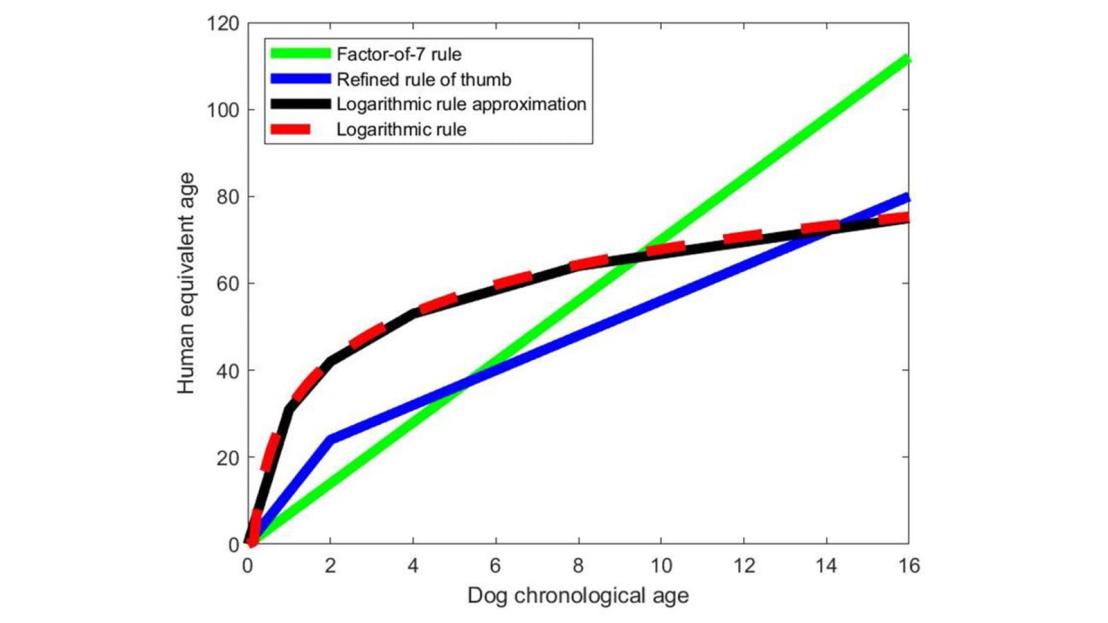
The new formula for a dog’s ages based on the study requires a little more math than multiplying by seven. You multiply the natural logarithm of a dog’s age by 16, then add 31 [human_age = 16ln(dog_age) + 31].

According to the formula, a 2-year-old dog is the equivalent of a 42-year-old human, but things slow down after that. A 5-year-old dog is the equivalent of a 56.75 year old human, and a 10-year-old dog is the equivalent of 67.8-year-old person.

Evolutionary biologist Steve Austad of the University of Alabama in Birmingham, who was not involved in the study, tells Morell that he’s not too surprised that the epigenetic clock applies to dogs, too. He says that by studying different dog breeds with different lifespans the researchers may find some interesting results.

This formula is not the last word on dog years, however, especially since it only looked at one breed. Erika Mansourian, writing for the American Kennel Club, reports that the American Veterinary Medical Association says the accurate way to calculate dog years for a medium-sized dog is to assume the first year is equivalent to 15 years and age two adds another nine years. After that, each year of a dog’s life is equivalent to five human years. It doesn’t perfectly line up with the new formula, but both acknowledge that dogs age rapidly in their first years of life.

Whatever the case, dogs’ lives are all too short. That may be why people are excited about a project by the Dog Aging Project, which is currently recruiting 10,000 pets and their owners to participate in a new study that will look at the dogs’ health, gut microbes, diet and exercise to understand aging. And 500 lucky dogs will test out a new drug that may help slow the aging process, which could help us someday, too.

ooOOoo

I hope you found it worthwhile to publish what is, in essence, a duplication of the same story!

How old is your dog?

Dan sends me a more accurate calculation.

Dear Dan and I recently had an email ‘conversation’ about the conversion of dog years to human years. Then, yesterday,  as in Thursday, he sent me the following article from ZME Science.

Enjoy!

ooOOoo

Here’s a better way to calculate dog years – backed by science.

Lets’s face it, 1 for 7 years is not accurate.

November 21, 2019

By Mihai Andrei

The formula is about mid-way through the article, and it includes a simple calculator.

We learn, as kids, to approximate dog age thusly: one dog year for seven human years. That’s a decent approximation in some cases, but the more you think about it, the more it starts to fall apart.

All dog breeds tend to follow a similar pattern: they reach puberty at 10 months old. Right off the bat, it’s clear that the approximation doesn’t work here, as humans don’t really reach puberty at 6 years. Dogs can also reach 20 years or even more, and 140 years has never been recorded for a human. All in all, while it can give a ballpark estimate, the 7-for-1 approach falls short in many regards.

But now, researchers have come up with a much more accurate formula to assess dog age in human years. This one, at least, is backed by science.

It started as a way to detect factors associated with dog aging, and it focused on a relatively new concept: DNA methylation. The idea is that as we age, our DNA undergoes chemical modifications which can be used as a sort of genetic clock. It’s a way of looking at our body’s wear and tear, as the influence of diseases and unhealthy lifestyle can also be observed (to an extent) with this approach.

It’s not just humans that have epigenetic clocks. Other species have them too — including dogs. Geneticist Trey Ideker of the University of California, San Diego, and colleagues, analyzed the DNA methylation patterns in the genomes of 104 dogs (all golden retrievers), ranging from 4 weeks to 16 years of age. Although just golden retrievers were analyzed, the patterns are very similar for all breeds.

There were remarkable similarities between the DNA methylation of dogs and humans. Although the two species diverged a very long time ago, dogs live in similar environments to humans, and they even have access to similar healthcare.

Simply put, the patterns of DNA methylation in young dogs tended to be similar to those in young humans — the same goes for older dogs and older humans.

Finally, the study also demonstrates that these patterns can be used to translate the age-related physiology of one organism (in this case, dogs) to another organism (humans).

The formula is not linear, and is not exactly simple, but here it is:

Human Years = 16 ln(Dog Years) + 31,

where ln is the natural logarithm.

Inputs

Dog_years:

Outputs

Human_years:

-∞

Powered by JSCalc.io


Logarithmic function for epigenetic translation from dog age (x-axis) to human age (y-axis). Tom Hanks for scale. Image credits: Wang et al

The natural logarithm is used because dogs and humans don’t age similarly. Dogs seem to age very quickly in the first part of their life (which is why the age of young pups seem very weird translated into human years), but their ageing process slows down massively compared to that of humans. So the translation dog to human years cannot be linear — it is logarithmic. When your dog is 1 year old, he’s approximately 30 in human years. When he’s 2 years old, he’s 42. He’s around 60 human years by the time he’s 6, but only 70 by the time he’s 12.

It’s a weird thing to wrap your mind around and it is definitely not a perfect translation from dog years to human years, but it works much better than all existing alternatives. It also works to explain why some dogs reach sexual adolescence as early as 6 months old — the onset for that is around 10-14 years for humans. Dogs are adolescent until about 2 years, which in humans lasts until 25 years old. Then, maturity for dogs is around 2-7 years, and for humans around 25-50 years. Similar calculations (but with a slightly different formula) can be carried out for other animals, including cats and mice, researchers conclude.

The study can be read in its entirety for free on biorXiv.

ooOOoo

M’mmm, I think I need a little more time to absorb that!

Vibrations!

The mind-body debate!

This is a republication of a recent article that appeared on The Conversation site. In a sense, it has nothing to do with dogs. Yet in another sense, it does!

You be the judge.

Meanwhile, I have finished the draft of my book, have printed it out and now have the gargantuan task of reading and editing it before it goes to an independent proof reader. All 56,657 words.

Oh well, if you can’t take a joke, you shouldn’t have joined!

ooOOoo

Could consciousness all come down to the way things vibrate?

November 9th, 2019

By

Affiliate Guest in Psychology, University of California, Santa Barbara

Why is my awareness here, while yours is over there? Why is the universe split in two for each of us, into a subject and an infinity of objects? How is each of us our own center of experience, receiving information about the rest of the world out there? Why are some things conscious and others apparently not? Is a rat conscious? A gnat? A bacterium?

These questions are all aspects of the ancient “mind-body problem,” which asks, essentially: What is the relationship between mind and matter? It’s resisted a generally satisfying conclusion for thousands of years.

The mind-body problem enjoyed a major rebranding over the last two decades. Now it’s generally known as the “hard problem” of consciousness, after philosopher David Chalmers coined this term in a now classic paper and further explored it in his 1996 book, “The Conscious Mind: In Search of a Fundamental Theory.”

Chalmers thought the mind-body problem should be called “hard” in comparison to what, with tongue in cheek, he called the “easy” problems of neuroscience: How do neurons and the brain work at the physical level? Of course they’re not actually easy at all. But his point was that they’re relatively easy compared to the truly difficult problem of explaining how consciousness relates to matter.

Over the last decade, my colleague, University of California, Santa Barbara psychology professor Jonathan Schooler and I have developed what we call a “resonance theory of consciousness.” We suggest that resonance – another word for synchronized vibrations – is at the heart of not only human consciousness but also animal consciousness and of physical reality more generally. It sounds like something the hippies might have dreamed up – it’s all vibrations, man! – but stick with me.

How do things in nature – like flashing fireflies – spontaneously synchronize? Suzanne Tucker/Shutterstock.com

All about the vibrations

All things in our universe are constantly in motion, vibrating. Even objects that appear to be stationary are in fact vibrating, oscillating, resonating, at various frequencies. Resonance is a type of motion, characterized by oscillation between two states. And ultimately all matter is just vibrations of various underlying fields. As such, at every scale, all of nature vibrates.

Something interesting things happen when different vibrating things come together: They will often start, after a little while, to vibrate together at the same frequency. They “sync up,” sometimes in ways that can seem mysterious. This is described as the phenomenon of spontaneous self-organization.

Mathematician Steven Strogatz provides various examples from physics, biology, chemistry and neuroscience to illustrate “sync” – his term for resonance – in his 2003 book “Sync: How Order Emerges from Chaos in the Universe, Nature, and Daily Life,” including:

  • When fireflies of certain species come together in large gatherings, they start flashing in sync, in ways that can still seem a little mystifying.
  • Lasers are produced when photons of the same power and frequency sync up.
  • The moon’s rotation is exactly synced with its orbit around the Earth such that we always see the same face.

Examining resonance leads to potentially deep insights about the nature of consciousness and about the universe more generally.

External electrodes can record a brain’s activity. vasara/Shutterstock.com

Sync inside your skull

Neuroscientists have identified sync in their research, too. Large-scale neuron firing occurs in human brains at measurable frequencies, with mammalian consciousness thought to be commonly associated with various kinds of neuronal sync.

For example, German neurophysiologist Pascal Fries has explored the ways in which various electrical patterns sync in the brain to produce different types of human consciousness.

Fries focuses on gamma, beta and theta waves. These labels refer to the speed of electrical oscillations in the brain, measured by electrodes placed on the outside of the skull. Groups of neurons produce these oscillations as they use electrochemical impulses to communicate with each other. It’s the speed and voltage of these signals that, when averaged, produce EEG waves that can be measured at signature cycles per second.

Each type of synchronized activity is associated with certain types of brain function. artellia/Shutterstock.com

Gamma waves are associated with large-scale coordinated activities like perception, meditation or focused consciousness; beta with maximum brain activity or arousal; and theta with relaxation or daydreaming. These three wave types work together to produce, or at least facilitate, various types of human consciousness, according to Fries. But the exact relationship between electrical brain waves and consciousness is still very much up for debate.

Fries calls his concept “communication through coherence.” For him, it’s all about neuronal synchronization. Synchronization, in terms of shared electrical oscillation rates, allows for smooth communication between neurons and groups of neurons. Without this kind of synchronized coherence, inputs arrive at random phases of the neuron excitability cycle and are ineffective, or at least much less effective, in communication.

A resonance theory of consciousness

Our resonance theory builds upon the work of Fries and many others, with a broader approach that can help to explain not only human and mammalian consciousness, but also consciousness more broadly.

Based on the observed behavior of the entities that surround us, from electrons to atoms to molecules, to bacteria to mice, bats, rats, and on, we suggest that all things may be viewed as at least a little conscious. This sounds strange at first blush, but “panpsychism” – the view that all matter has some associated consciousness – is an increasingly accepted position with respect to the nature of consciousness.

The panpsychist argues that consciousness did not emerge at some point during evolution. Rather, it’s always associated with matter and vice versa – they’re two sides of the same coin. But the large majority of the mind associated with the various types of matter in our universe is extremely rudimentary. An electron or an atom, for example, enjoys just a tiny amount of consciousness. But as matter becomes more interconnected and rich, so does the mind, and vice versa, according to this way of thinking.

Biological organisms can quickly exchange information through various biophysical pathways, both electrical and electrochemical. Non-biological structures can only exchange information internally using heat/thermal pathways – much slower and far less rich in information in comparison. Living things leverage their speedier information flows into larger-scale consciousness than what would occur in similar-size things like boulders or piles of sand, for example. There’s much greater internal connection and thus far more “going on” in biological structures than in a boulder or a pile of sand.

Under our approach, boulders and piles of sand are “mere aggregates,” just collections of highly rudimentary conscious entities at the atomic or molecular level only. That’s in contrast to what happens in biological life forms where the combinations of these micro-conscious entities together create a higher level macro-conscious entity. For us, this combination process is the hallmark of biological life.

The central thesis of our approach is this: the particular linkages that allow for large-scale consciousness – like those humans and other mammals enjoy – result from a shared resonance among many smaller constituents. The speed of the resonant waves that are present is the limiting factor that determines the size of each conscious entity in each moment.

As a particular shared resonance expands to more and more constituents, the new conscious entity that results from this resonance and combination grows larger and more complex. So the shared resonance in a human brain that achieves gamma synchrony, for example, includes a far larger number of neurons and neuronal connections than is the case for beta or theta rhythms alone.

What about larger inter-organism resonance like the cloud of fireflies with their little lights flashing in sync? Researchers think their bioluminescent resonance arises due to internal biological oscillators that automatically result in each firefly syncing up with its neighbors.

Is this group of fireflies enjoying a higher level of group consciousness? Probably not, since we can explain the phenomenon without recourse to any intelligence or consciousness. But in biological structures with the right kind of information pathways and processing power, these tendencies toward self-organization can and often do produce larger-scale conscious entities.

Our resonance theory of consciousness attempts to provide a unified framework that includes neuroscience, as well as more fundamental questions of neurobiology and biophysics, and also the philosophy of mind. It gets to the heart of the differences that matter when it comes to consciousness and the evolution of physical systems.

It is all about vibrations, but it’s also about the type of vibrations and, most importantly, about shared vibrations.

ooOOoo

This may require more than one read. Because, if you are interested in the subject I’m sure you will wish to read it again.

But the underlying premise is that, as was said earlier,: “all matter is just vibrations of various underlying fields.

Beautiful!


Now a cat recall!

This is self-explanatory!

ooOOoo

Dear Fellow Dog Lover,

I’m pleased to report there have been no recalls since September 26.
However, for the many dog owners who also own a cat…

Go Raw is recalling one lot of its “Quest Beef Cat Food”… because it may be contaminated with Salmonella.
Missed any of the 11 other recalls we’ve sent since early July? Be sure to visit our Dog Food Recalls page for full details.
6 Best Dog Food Lists Updated
The Dog Food Advisor has recently updated the following best dog food pages:

  • Best Dry Dog Foods
  • Best Puppy Foods
  • Best Dog Food for Allergies
  • Best Grain-Free Dog Foods
  • Best Senior Dog Foods
  • Best Dog Food for Weight Loss

Click here to see our Best Dog Foods for November 2019

Please be sure to share this news with other pet owners.

Mike Sagman, Editor
The Dog Food Advisor
Saving Good Dogs From Bad Dog Food
P.S. Not yet on our recall notification list? Click here to get FREE lifesaving recall alerts by email. No spam. Cancel anytime.

ooOOoo

This is a brilliant service!