It never fails to amaze me at the potential for friendship between cats and dogs.
This comes from The Dodo website. It’s one of a number of sites that I follow. I should really say more but am lost for words so here it is!
ooOOoo
Cat Makes Sure His Dog Friend Is OK During Thunderstorm
Photo Credit: Mary Barnes
When things get scary, we all need a friend to let us know that everything’s going to be OK.
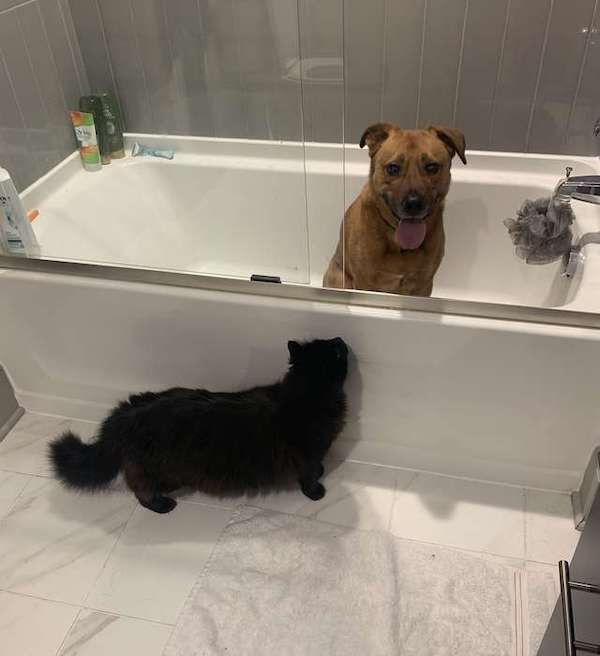
For a pittie mix named Moose, that friend is a cat named Marvin.
Mary Barnes rescued Marvin six months ago, hoping that the fearless kitty would become a playmate for her 7-year-old dog.
“I didn’t know how Moose and Marvin would get along because Moose had never really interacted with cats, but she’s the absolute sweetest and most gentle girl so I had faith,” Barnes told The Dodo.
Photo Credit: Mary Barnes
“They very quickly became best friends,” she added. “Marvin has the personality of a dog so they nap and play together all day.”
When Barnes moved into an apartment in downtown Detroit, she began to notice that Moose was becoming more and more sensitive to loud noises. Every time the pup heard fireworks or thunderstorms, she would immediately tremble and hide.
“I try to give her treats and keep her busy when it’s storming but she usually ends up going into the bathroom and hiding in the shower,” Barnes said. “She’s always hidden in the shower — it’s her safe place.”
Photo Credit: Mary Barnes
Marvin doesn’t have the same fear of thunder shaking the windows. But Barnes never could have guessed the loving cat would step up and comfort Moose in her time of need.
“Last night was the first really big, long storm we’ve gotten in Detroit since Marvin has been with us,” Barnes said. “He was very curious and concerned about his big sister.”
Marvin knew Moose was suffering and he wasn’t going to let her sit alone.
Photo Credit: Mary Barnes
“He went back and forth to her in the shower to check in,” Barnes said. “It distracted [Moose] from the storm for a little bit because she leaned down to give him kisses!”
The storm eventually passed, and Moose and Marvin quickly got back to playing and relaxing together.
If there’s one thing they both know, it’s that having a best friend can make getting through hard times a whole lot easier.
ooOOoo
The thing about this story is that our pet dogs and cats have a number of emotions and they recognise the need to comfort other animals in the same house.
I suspect that a wide range of animals also have a number of emotions.
I allowed myself to do a quick web search on the subject – there’s loads!
Emotion is defined as any mental experience with high intensity and high hedonic content.[1] The existence and nature of emotions in animals are believed to be correlated with those of humans and to have evolved from the same mechanisms. Charles Darwin was one of the first scientists to write about the subject, and his observational (and sometimes anecdotal) approach has since developed into a more robust, hypothesis-driven, scientific approach.[2][3][4][5]Cognitive bias tests and learned helplessness models have shown feelings of optimism and pessimism in a wide range of species, including rats, dogs, cats, rhesus macaques, sheep, chicks, starlings, pigs, and honeybees.[6][7][8]Jaak Panksepp played a large role in the study of animal emotion, basing his research on the neurological aspect. Mentioning seven core emotional feelings reflected through a variety of neuro-dynamic limbic emotional action systems, including seeking, fear, rage, lust, care, panic and play.[9] Through brain stimulation and pharmacological challenges, such emotional responses can be effectively monitored.[9]
Emotion has been observed and further researched through multiple different approaches including that of behaviourism, comparative, anecdotal, specifically Darwin’s approach and what is most widely used today the scientific approach which has a number of subfields including functional, mechanistic, cognitive bias tests, self-medicating, spindle neurons, vocalizations and neurology.
While emotions in animals is still quite a controversial topic it has been studied in an extensive array of species both large and small including primates, rodents, elephants, horses, birds, dogs, cats, honeybees and crayfish.
There’s much more and it is a comprehensive article.
My how the years go by!
Back in 2010 I wrote about the Hubble, wishing it Happy Birthday!
Now here we are in 2020 and, again, I want to feature this most amazing space telescope ever.
The thirtieth anniversary of the launch of the Hubble Space Telescope was on the 24th April, 2020, just three days ago.
The challenge is that the photographs that go with the article are not permitted to be shared with you. So I have grabbed some others that, apparently, are alright.
ooOOoo
How the Hubble Space Telescope opened our eyes to the first galaxies of the universe
April 24, 2020
By Professor Rodger Thompson, Professor of Astronomy, University of Arizona
The Hubble Space Telescope launched on the 24th of April, 30 years ago. It’s an impressive milestone especially as its expected lifespan was just 10 years.
One of the primary reasons for the Hubble telescope’s longevity is that it can be serviced and improved with new observational instruments through Space Shuttle visits.
When Hubble, or HST, first launched, its instruments could observe ultraviolet light with wavelengths shorter than the eye can see, as well as optical light with wavelengths visible to humans. A maintenance mission in 1997 added an instrument to observe near infrared light, which are longer wavelengths than people can see. Hubble’s new infrared eyes provided two new major capabilities: the ability to see farther into space than before and see deeper into the dusty regions of star formation.
I am an astrophysicist at the University of Arizona who has used near infrared observations to better understand how the universe works, from star formation to cosmology. Some 35 years ago, I was given the chance to build a near infrared camera and spectrometer for Hubble. It was the chance of a lifetime. The camera my team designed and developed has changed the way humans see and understand the universe. The instrument was built at Ball Aerospace in Boulder, Colorado, under our direction.
Seeing further and earlier
Edwin Hubble, HST’s namesake, discovered in the early 1900s that the universe is expanding and that the light from distant galaxies was shifted to longer, redder wavelengths, a phenomenon called the redshift. The greater the distance, the larger the shift. This is because the further away an object is, the longer it takes for the light to reach us here on Earth and the more the universe has expanded in that time.
The Hubble ultraviolet and optical instruments had taken images of the most distant galaxies ever seen, known as the Northern Hubble Deep Field, or NHDF, which were released in 1996. These images, however, had reached their distance limit due to the redshift, which had shifted all of the light of the most distant galaxies out of the visible and into the infrared.
One of the new instruments added to Hubble in the second maintenance mission has the awkward name, the Near Infrared Camera and Multi-Object Spectrometer, NICMOS, pronounced “Nick Moss.” The near infrared cameras on NICMOS observed regions of the NHDF and discovered even more distant galaxies with all of their light in the near infrared.
Astronomers have the privilege of watching things happen in the past which they call the “lookback time.” Our best measurement of the age of the universe is 13.7 billion years. The distance that light travels in one year is called a light year. The most distant galaxies observed by NICMOS were at a distance of almost 13 billion light years. This meant that the light that NICMOS detected had been traveling for 13 billion years and showed what the galaxies looked like 13 billion years ago, a time when the universe was only about 5% of its current age. These were some of the first galaxies ever created and were forming new stars at rates that were more than a thousand times the rate at which most galaxies form stars in the current universe.
Hidden by dust
Although astronomers have studied star formation for decades, many questions remain. Part of the problem is that most stars are formed in clouds of molecules and dust. The dust absorbs the ultraviolet and most of the optical light emitted by forming stars, making it difficult for Hubble’s ultraviolet and optical instruments to study the process.
The longer, or redder, the wavelength of the light, the less is absorbed. That is why sunsets, where the light must pass through long lengths of dusty air, appear red.
The near infrared, however, has an even easier time passing through dust than the red optical light. NICMOS can look into star formation regions with the superior image quality of Hubble to determine the details of where the star formation occurs. A good example is the iconic Hubble image of the Eagle Nebula, also known as the pillars of creation.
The optical image shows majestic pillars which appear to show star formation over a large volume of space. The NICMOS image, however, shows a different picture. In the NICMOS image, most of the pillars are transparent with no star formation. Stars are only being formed at the tip of the pillars. The optical pillars are just empty dust reflecting the light of a group of nearby stars.
The dawning of the age of infrared
When NICMOS was added into the HST in 1997 NASA had no plans for a future infrared space mission. That rapidly changed as the results from NICMOS became apparent. Based on the data from NICMOS, scientists learned that fully formed galaxies existed in the universe much earlier than expected. The NICMOS images also confirmed that the expansion of the universe is accelerating rather than slowing down as previously thought. The NHDF infrared images were followed by the Hubble Ultra Deep Field images in 2005, which further showed the power of near infrared imaging of distant young galaxies. So NASA decided to invest in the James Webb Space Telescope, or JWST, a telescope much larger than HST and completely dedicated to infrared observations.
On Hubble, a near infrared imager was added to the third version of the Wide Field camera which was installed in May of 2009. This camera used an improved version of the NICMOS detector arrays that had more sensitivity and a wider field of view. The James Webb Space Telescope has much larger versions of the NICMOS detector arrays that have more wavelength coverage than the previous versions.
The James Webb Space Telescope, scheduled to be launched in March 2021, followed by the Wide Field Infrared Survey Telescope, form the bulk of future space missions for NASA. These programs were all spawned by the near infrared observations by HST. They were enabled by the original investment for a near infrared camera and spectrometer to give Hubble its infrared eyes. With the James Webb Space Telescope, astronomers expect to see the very first galaxies that formed in the universe.
The Eagle Nebula in visible light. NASA, ESA and the Hubble Heritage Team (STScI/AURA)
oooo
The spiral galaxy NGC 2008 sits centre stage, its ghostly spiral arms spreading out towards us, in this image captured by the NASA/ESA Hubble Space Telescope. This galaxy is located about 425 million light-years from Earth in the constellation of Pictor (The Painter’s Easel). Discovered in 1834 by astronomer John Herschel, NGC 2008 is categorised as a type Sc galaxy in the Hubble sequence, a system used to describe and classify the various morphologies of galaxies. The “S” indicates that NGC 2008 is a spiral, while the “c” means it has a relatively small central bulge and more open spiral arms. Spiral galaxies with larger central bulges tend to have more tightly wrapped arms, and are classified as Sa galaxies, while those in between are classified as type Sb. Spiral galaxies are ubiquitous across the cosmos, comprising over 70% of all observed galaxies — including our own, the Milky Way. However, their ubiquity does not detract from their beauty. These grand, spiralling collections of billions of stars are among the most wondrous sights that have been captured by telescopes such as Hubble, and are firmly embedded in astronomical iconography.
oooo
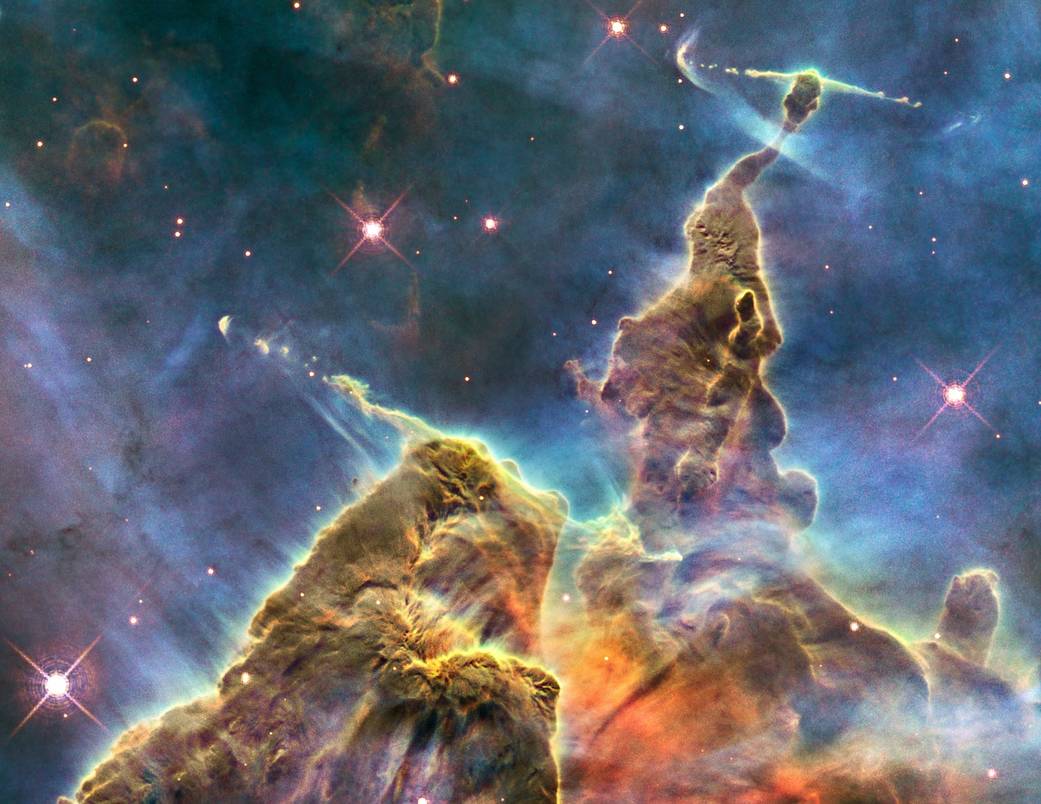
The NASA/ESA Hubble Space Telescope has revisited one of its most iconic and popular images: the Eagle Nebula’s Pillars of Creation. This image shows the pillars as seen in infrared light, allowing it to pierce through obscuring dust and gas and unveil a more unfamiliar — but just as amazing — view of the pillars. In this ethereal view the entire frame is peppered with bright stars and baby stars are revealed being formed within the pillars themselves. The ghostly outlines of the pillars seem much more delicate, and are silhouetted against an eerie blue haze. Hubble also captured the pillars in visible light.
Rodger I. Thompson was the Principal Investigator for the Near Infrared Camera and Multi-Object Spectrometer, NICMOS. He was responsible for the execution of a contract to Arizona Board of Regents from NASA to deliver NICMOS as a Hubble Space Telescope Instrument and carry out a scientific investigation with it. Prof. Thompson received summer salary from this contract at his University pay rate during the execution of the contract which ended in 2004. Prof. Thompson is not currently receiving any external funding.
ooOOoo
Now for two YouTube videos.
The first is a celebration of the 30th anniversary.
And the second is slightly longer but conveys images taken from the telescope. I have no doubt that you will love them as we did!
Both these videos are beyond words! That we are alive today and can share these videos on this blog is stupendous!
I don’t know what is was that engaged me; to the point that I have written this blog post.
We rise around 4:30 am, thanks to the dogs, and after they have been out we retire to the bedroom and lay on the top of the bed and have a couple of cups of tea. Come 5am, week days, we listen to BBC Radio 4 and the World at One. Then immediately after the World at One, at the moment, is a fascinating series on A History Of The World in 100 objects.
A few days ago, after the end of the programme, I drifted off into some form of introspective gaze about the past. I mean the past big time!
The Universe
When and how did it all start? That seems to be the Big Bang. The Big Bang was an incredibly long time ago, some 14 billion years ago (rounding it up!).
The current measurement of the age of the universe is around 13.8 billion years (as of 2015[1]) – 13.799±0.021billion years within the Lambda-CDM concordance model.[2] The uncertainty has been narrowed down to 20 million years, based on a number of studies which all gave extremely similar figures for the age.
That’s 13.8 times 10 to the power of 9!
Our solar system
Again, pretty old by human standards; 4.6 billions years ago.
The Solar System formed 4.6 billion years ago from the gravitational collapse of a giant interstellar molecular cloud. The vast majority of the system’s mass is in the Sun, with the majority of the remaining mass contained in Jupiter. The four smaller inner planets, Mercury, Venus, Earth and Mars, are terrestrial planets, being primarily composed of rock and metal. The four outer planets are giant planets, being substantially more massive than the terrestrials. The two largest, Jupiter and Saturn, are gas giants, being composed mainly of hydrogen and helium; the two outermost planets, Uranus and Neptune, are ice giants, being composed mostly of substances with relatively high melting points compared with hydrogen and helium, called volatiles, such as water, ammonia and methane. All eight planets have almost circular orbits that lie within a nearly flat disc called the ecliptic.
So our solar system came along 9 billion years after the formation of the Universe.
Planet Earth
Our planet formed not long after our solar system. That’s pretty obvious if you ask me.
Thus Planet Earth formed 4.5 billion years ago. Again, thanks to Wikipedia.
Life on Planet Earth
Southampton University have published an extremely interesting chart of the timeline of the human condition. In it is revealed that the earliest atmospheric oxygen was 3.5 billion years ago, a necessary prerequisite to air-breathing life. But it took an extremely long time before monkeys appeared; some 36 million years ago. That’s 36 times 10 to the power of 6, or 383 times shorter than the start of the universe.
The earliest hominins (Australopithecus spp) among the hominids in Africa, bipedal, larger brain came along some 4.2 million years ago.
Among them were humans using stone tools, some 2.5 million years ago. Then 2 million years ago came the earliest direct ancestor of modern humans, Homo erectus (South Africa), co-habiting with Australopithecus and Paranthropus.
Then 40,000 years ago Neanderthals make flutes from bone, then 14,000 years ago the domestication of dogs in China, 7,000 years ago the world population passed 5 million souls, and 3,500 years ago the earliest alphabet (North Semitic, Palestine and Syria).
3,000 years ago the world population passed 50 million.
Come forward to just 195 years ago and the first public railway for steam locomotives (George Stephenson, UK, 1825) came into existence. In 1945, Alan Turing created the world’s first programmable calculator which lead directly to the first computer.
Then just 34 years ago the total population passed 5 billion souls (1986).
This and much more in the timeline which really is a fascinating read. Put together by C. Patrick Doncaster, 7 April 2020, one of the then 7,641,557,720 (rising by 148 per minute, 77 million per year).
A quark (/kwɔːrk, kwɑːrk/) is a type of elementary particle and a fundamental constituent of matter. Quarks combine to form composite particles called hadrons, the most stable of which are protons and neutrons, the components of atomic nuclei.[1] Due to a phenomenon known as color confinement, quarks are never directly observed or found in isolation; they can be found only within hadrons, which include baryons (such as protons and neutrons) and mesons.[2][3] For this reason, much of what is known about quarks has been drawn from observations of hadrons.
So, to put it in layman’s terms, the fact that I am sitting here at a computer trying to make sense of it all and failing is just down to luck. The observable universe and my perception of it comes down to matter as opposed to antimatter!
I’ve got a headache!
N.B. It’s a little after 12:30 am (PDT) on the Saturday and I am going to leave this post up as the latest for tomorrow as well. There have been so many wonderful comments.
Once again, I am having a struggle to come up with something original. Once again it is at these times of life that I am very grateful for the offer of a guest post. Take Bryony for example. This is not the first time that I have presented her work but I am grateful to her.
This is her article on scent dogs.
ooOOoo
The making of a scent dog.
By Bryony Ravate, January 2nd, 2020
If you’ve been lucky enough to be around dogs, you will have probably noticed how their noses are always moving. By possessing a nose up to 15x times more sensitive than our own, with 600,00 neurones, they can sniff out different components in every room. When you’re cooking a meal, you will be able to recognise the smell of a dish. But when your dog smells the meal, he can smell each individual spice and seasoning, the oils, the crockery and even any water.
You can use your dogs’ keen sense of smell for play – laying out different scents for them to explore. But their noses can also be used for working environments– such as in airports, with the police and in search and rescue missions. They can track down suitcases hiding illegal substances, follow the suspect of a crime and sniff out the victims of a snowstorm. To become scent dogs, the canines go through vigorous training. However, although all dogs have an exceptional sense of smell, not all dogs make it through training.
It makes sense to analyse what leads to success and failure in scent dog training. So, a keen researcher at University College Cork, Ireland performed a literature review in which factors behind success and failure in scent dog training were analysed. A literature review is the process whereby you search a database full of information (usually research articles published in reputable journals) and you extrapolate the information to create your own source. Here, I’m going to pull together some of the points I found the most interesting, points you may not think would affect the making of a scent dog.
Personality
Dogs with strong motivation to play or search, dogs which were bold rather than shy, and dogs which can adapt and cope with stressful stimuli are more likely to become scent dogs. High motivation to play or search, makes a dog easier to train. Play can be used as a reward, by allowing the dog to pull on a chew toy after being successful in a trial. Finding scents may be perceived as a game to the dog, increasing his motivation to engage. Bold dogs are less unnerved by new surroundings and situations. A nervous dog may be hesitant about pursuing an unknown scent – but a bold dog will take little hesitation. Adaptable dogs may be able to apply their knowledge to different situations and they will be unphased by commotions and will keep working when faced with distractions.
Housing Standards
Dogs that live in enriched environments throughout their training have increased ability in trials. Like children, the more opportunities you offer your dogs to learn, explore and interact with their environment, the more it allows them to develop and grow. Dogs should feel secure in their home environment when not working; keeping them with other dogs and in bright rooms without using loud cleaning equipment (such as hoovers) will make them less anxious, leading to better accuracy in scent trials.
The Human Partner
Dogs emotions are often intertwined with their handlers. When a dog’s owner gets angry, the stress hormones in the dog increase as a result. If a dog handler is happy, the dogs will perform better. The bond between dogs and their handlers can affect the accuracy of scent trials. If the dog lives at the owners’ home when he’s not working, obedience and accuracy are increased. Although the bond between scent dog and handler is important, they must be independent thinkers. When faced with a problem- solving task, they must be able to manipulate the environment themselves to find a solution, rather than looking at their handler for cues about the answer.
These are some factors which can alter the likelihood of a dog being a successful, as reviewed by Camille A Trosi and her team. What we must keep in mind is that all dogs are individuals. We cannot use this information to ensure all dogs in the future will pass scent dog training. However, we can use this knowledge to give potential scent dogs the best possible start to life; providing enrichment, an affectionate bond with their handler, and a suitable home environment. Canine personalities are not always determined by genetics, and a suitable environment can give a dog a metaphorical push in the right direction to ensure he is the best he can be, whether that be as a scent dog, a guide dog or even a lap dog.
Original Source : Troisi, C. A., Mills, D. S., Wilkinson, A. and Zulch, H. E. 2019. Behavioral and Cognitive Factors That Affect the Success of Scent Detection Dogs. Comparative Cognition & Behavior Reviews, 14, pp. 51-76. doi: 10.3819/ccbr.2019.140007
ooOOoo
Now what I haven’t done before but intend to do straightaway is to reproduce an extract from Bryony’s CV.
I currently hold a Pass with Distinction in MSc Animal Behaviour and Welfare from Queen’s University Belfast. I also have a BSc in Animal Behaviour and Welfare from Plymouth University. As well as holding two degrees relevant to the field, I currently have 2+ years of work experience. I possess the core attributes required when pursuing a career in the scientific industry; dedication, independence and initiative. I am highly passionate and believe that with my unique skillset I can have a valuable impact in the field of Science Communication.
Plus Bryony has her own blog, BrynsteinScience, and is also on Instagram, of the same name.
We wish Bryony much success in her work life and in her caring and interest for animals in general and dogs in particular!
There is an extensive article on Wikipedia in the UK on scent dog and the link to that article is here.
Finally to close with this wonderful photograph of a scent dog.
About the position of our pet dogs and cats in this current pandemic.
So many of us are spending time at home. Lots of time!
And so many are asking questions about CORVID-19 and out pets.
Therefore I think it’s worthwhile to republish this article that appeared on Mother Nature Network yesterday.
ooOOoo
Removed because of an alleged copyright infringement.
ooOOoo
Now it is quite a long article but then again you probably have much more time to read this post! And, frankly, there is a lot of good information contained within it!
Please make a note and share the details if you can.
ooOOoo
Icelandic Plus Dog and Cat Treats Recall
March 23, 2020 — IcelandicPlus LLC of Ft. Washington, PA, is recalling its Capelin Dog and Cat Treats because some of the fish have exceeded FDA guidelines for fish larger than 5 inches… which has the potential to cause botulism poisoning.
What’s Recalled?
The affected products are sold in a clear plastic package or tube… and marked Icelandic+ Capelin WHOLE FISH, PURE FISH TREATS FOR DOGS, or PURE FISH TREATS FOR CATS.
UPC codes include 8 5485400775 9; 8 5485400711 7; and 8 5485400757 5.
Related products are packaged in a 2.5 ounce tube or a 1.5 or 2.5 ounce bag (lot numbers 02/2020 to 02/2022).
What Caused the Recall?
The FDA has determined that salt-cured, dried, or fermented un-eviscerated fish larger than 5 inches have been linked to outbreaks of botulism poisoning in humans between 1981 and 1987 and again in 1991.
Since some IcelandicPlus Capelins are larger than 5 inches there is a possible health risk.
To date, no illnesses of dogs, cats, or persons are reported in connection with the treats. Nor have there been any positive test results for Clostridium botulinum from any IcelandicPlus Capelin.
However, because of the potential risk, the company has decided to announce this product recall.
About Botulism Poisoning
Clostridium botulinum toxin can cause severe clinical signs including death in both animals consuming the pet treat and humans handling the pet treat or coming in contact with contact areas that have been exposed to the product.
Common symptoms may include dizziness, blurred or double vision, trouble with speaking or swallowing, difficulty breathing, muscle weakness, abdominal distension, and constipation.
Consider that several of the listed symptoms, such as double vision, cannot be easily assessed in animals or conveyed by an animal.
Pets or persons experiencing these symptoms should seek immediate medical attention.
Where Was the Product Sold?
The affected product was shipped to distributors for sale to consumers by independent pet specialty stores throughout all U.S. states.
Message from the Company
IcelandicPlus is family owned and run by pet parents who take the safety and wellbeing of its consumers and clients with the utmost importance, as such we are conducting this voluntarily recall to further protect our customers.
Additionally, we are changing our Capelin supplier to ensure that the fish in our product are consistently less than 5 inches, or if larger, they will be completely eviscerated.
What to Do?
Distributors, retailers and consumers who have purchased IcelandicPlus Capelin can return it to the location where it was purchased for a refund.
Consumers with questions may contact the company at 857-246-9559, Monday through Friday, 8 am to 5 pm ET.
U.S. citizens can report complaints about FDA-regulated pet food products by calling the consumer complaint coordinator in your area.
Some dogs just like the taste of grass. (Photo: Tanja Esser/Shutterstock)
No walk around the neighborhood is complete without my dog Lulu eating grass. Even on a full stomach, she likes to hunt for the perfect blades and chew away. Left unattended, I’m sure she could mow down a small lawn. Since lawns today have any number of herbicides and pesticides, many pet parents wonder if it’s OK to let their dogs eat grass.
Here’s what the experts say about these grass-eating habits. It’s yummy: It’s normal for dogs to chew on the green stuff because they like the taste of grass, says Dr. Jennifer Monroe of Eagles Landing Veterinary Hospital in Georgia. Some pooches even develop preferences that range from fresh leaves to drier weeds or even a particular species of grass. What they cannot discern is whether grass has been chemically treated. Use caution when walking on a neighbor’s lawn and stick with greener products in your own yard. Monroe recommends nontoxic treatment options.
“You do have to be careful if you have a dog that is a chronic grass eater,” she says. “We do have a lot of clients who bring pets in for vomiting and wonder if it’s from something the yard was treated with.”
Nutritional deficiency: Most commercial dog foods offer a balanced diet, so many experts say its unlikely that your dog isn’t getting the nutrition he needs from his dinner. Instead, dogs with certain intestinal diseases don’t necessarily digest food properly and have trouble absorbing minerals, which can lead to grazing, says Monroe. Anemia and bleeding in the gastrointestinal tract also cause dogs to eat dirt.
Some dogs eat grass because they need to throw up. (Photo: smerikal [CC by-SA 2.0]/Flickr)They are trying to induce vomiting: When dogs are eating something that doesn’t agree with them, they often have an upset stomach and eat grass to induce vomiting. If eating grass causes your dog to vomit twice a week or more, call your veterinarian because there could be another underlying health issue. She also recommends a visit if there is any doubt that your dog may be ill; better safe than sorry.
Some dogs nibble the lawn and are fine, while others are always eating grass and vomiting. It may just be the grass tickling their throat and stomach lining that causes them to vomit, says PetMD, or it could be something more serious. That’s why it’s key for dog owners to make sure their pets aren’t sick. Keep track of how often your dog vomits and let your vet know.
Instinct: One theory is that this unusual dog behavior is just instinct. Dogs in the wild are natural omnivores who eat meat and plants, so domesticated dogs naturally gravitate towards plant material too, says Purdue University College of Veterinary Medicine. Another theory is that wild dogs would eat plant material in the stomach of their prey, so they developed a taste for it.
Behavioral issues: Dogs can develop obsessive-compulsive disorder (OCD) regarding the grass. (I suspect that my Lulu falls into this category. She’s pretty determined during those lawn-gobbling excursions.) In the majority of cases, Monroe says this is no reason for concern. To correct the behavior, she recommends reducing your dog’s grazing time.
Basket muzzles restrict grass guzzling, too. In severe cases, she recommends consulting a certified veterinary behaviorist for advice. Otherwise, let them stop to smell — and chomp — the greenery.
“If not they are not vomiting and not destructive, I say let them enjoy it,” Monroe says.
Editor’s note: This story has been updated with new information since it was first published in October 2013.
ooOOoo
All very straightforward it seems.
But I suspect there may be just a few who found this post revealing.
I’m not going to do anything other than launch straight into this post. Taken from EarthSky.
ooOOoo
Curiosity rover on Mars snags highest-resolution panorama yet
Posted by Eleanor Imster in Space | Today’s Image|March 5, 2020
This just in … a new super-cool composite from Curiosity on Mars. The panorama contains more than 1,000 images taken last Thanksgiving and assembled over the past few months … 1.8 billion new pixels of Martian landscape!
Yesterday (March 4, 2020) NASA released a panoramic image of the Martian surface captured by the Curiosity rover. It’s the highest-resolution panorama yet of the planet’s surface.
Composed of more than 1,000 images taken during the 2019 Thanksgiving holiday and carefully assembled over the ensuing months, the composite contains 1.8 billion pixels of Martian landscape. The rover’s Mast Camera, or Mastcam, used its telephoto lens to produce the panorama; meanwhile, it relied on its medium-angle lens to produce a lower-resolution, nearly 650-million-pixel panorama that includes the rover’s deck and robotic arm.
The panorama showcases Glen Torridon, a region on the side of Mount Sharp that Curiosity is exploring. They were taken between November 24 and December 1, 2019, when the mission team was out for the Thanksgiving holiday. NASA said:
Sitting still with few tasks to do while awaiting the team to return and provide its next commands, the rover had a rare chance to image its surroundings from the same vantage point several days in a row.
| NASA’s Curiosity rover captured its highest-resolution panorama of the Martian surface between November 24 and December 1, 2019. Image via NASA/ JPL-Caltech/ MSSS.| Along with an almost 1.8-billion-pixel panorama that doesn’t feature the rover, NASA’s Curiosity also captured a 650-million-pixel panorama that features the rover itself. Image via NASA/ JPL-Caltech/ MSSS.
It required more than 6 1/2 hours over the four days for Curiosity to capture the individual shots. Mastcam operators programmed the complex task list, which included pointing the rover’s mast and making sure the images were in focus. To ensure consistent lighting, they confined imaging to between noon and 2 p.m. local Mars time each day.
In 2013, Curiosity produced a 1.3-billion-pixel panorama using both Mastcam cameras; its black-and-white Navigation Cameras, or Navcams, provided images of the rover itself.
Bottom line: Highest-resolution yet panorama of Martian surface by Mars Curiosity rover.
Eleanor Imster has helped write and edit EarthSky since 1995. She was an integral part of the award-winning EarthSky radio series almost since it began until it ended in 2013. Today, as Lead Editor at EarthSky.org, she helps present the science and nature stories and photos you enjoy. She also serves as one of the voices of EarthSky on social media platforms including Facebook, Twitter and G+. She and her husband live in Tennessee and have two grown sons.
ooOOoo
When one stops and reflects one can’t hide the scale of progress that humans have achieved. It is incredible!
It is also a struggle to take the situation so expertly spoken about by George Monbiot in yesterday’s post and square it with the achievement covered in today’s post.
Today and tomorrow I am posting essays that have nothing to do with dogs! Today, I am sharing George’s gloom about the future, tomorrow I am sharing our human capacity for incredible ingenuity and technology.
Because I sense we are a species of two extremes; the very mad and the very clever!
I don’t have an answer but I can share these two essays.
Our legal action against the government aims to shut down fossil fuels
By George Monbiot, published in the Guardian 4th March 2020
Our survival is not an afterthought. The defence of the living planet cannot be tacked retrospectively onto business as usual. Yet this is how almost all governments operate. They slap the word “sustainable” on damaging projects they have already approved, then insist this means they’ve gone green. If we are to survive and prosper, everything must change. Every decision should begin with the question of what the planet can withstand.
This means that any discussion about new infrastructure should begin with ecological constraints. The figures are stark. A paper published in Nature last year showed that existing energy infrastructure, if it is allowed to run to the end of its natural life, will produce around 660 gigatonnes of CO2. Yet, to stand a reasonable chance of preventing more than 1.5°C of global heating, we can afford to release, in total, no more than 580 gigatonnes. In other words, far from building new fossil power plants, the survival of a habitable planet means retiring the damaging projects that have already been built. Electricity plants burning coal and gas and oil will not secure our prosperity. They will destroy it.
But everywhere special interests dominate. Construction projects are driven, above all, by the lobbying of the construction industry, consultancies and financiers. Gigantic and destructive schemes, such as the Oxford-Cambridge Expressway, are invented by lobbyists for the purpose of generating contracts. Political support is drummed up, the project achieves its own momentum, then, belatedly, a feeble attempt is made to demonstrate that it can somehow become compatible with environmental promises. This is what destroys civilisations: a mismatch between the greed of economic elites and the needs of society.
But last week, something momentous happened. The decision to build a scheme with vast financial backing and terrible environmental impacts was struck down by the Court of Appeal. The judges decided that government policy, on which planning permission for a third runway at Heathrow was based, had failed to take account of the UK’s climate commitments, and was therefore unlawful. This is – or should be – the end of business as usual.
On Tuesday, we delivered a “letter before action” to the Treasury solicitor. We’ve given the government 21 days to accept our case and change its policy to reflect the climate commitments agreed by Parliament. If it fails to do so, we shall issue proceedings in the High Court to have the policy declared unlawful. We’ll need money, so we’ve launched a crowdfunding appeal to finance the action.
It’s hard to see how the government could resist our case. The Heathrow judgement hung on the government’s national policy statement on airports. This, the judges found, had not been updated to take account of the Paris climate agreement. New fossil fuel plants, such as the gas burners at Drax in Yorkshire the government approved last October, are enabled by something very similar: the national policy statements on energy infrastructure. These have not been updated since they were published in 2011. As a result, they take no account of the Paris agreement, of the government’s new climate target (net zero by 2050, as opposed to an 80% cut) or of Parliament’s declaration of a climate emergency. The main policy statement says that the European Emissions Trading System “forms the cornerstone of UK action to reduce greenhouse gas emissions from the power sector”. As we have left the EU, this, obviously, no longer holds. The planning act obliges the government to review its national policy statements when circumstances change. It has failed to do so. It is disregarding its own laws.
These outdated policy statements create a presumption in favour of new fossil fuel plants. Once a national policy statement has been published, there is little objectors can do to prevent damaging projects from going ahead. In approving the Drax plant, the secretary of state for business and energy at the time (Andrea Leadsom) insisted that the policy statement came first, regardless of the climate impacts. Catastrophic decisions like this will continue to be made until the statements change. They are incompatible with either the government’s new climate commitments or a habitable planet.
While we are challenging the government’s energy policies, another group – the Transport Action Network – is about to challenge its road building schemes on the same basis. It points out that the national policy statement on road networks is also outdated and incompatible with the UK’s climate commitments. The policy statement, astonishingly, insists that “any increase in carbon emissions is not a reason to refuse development consent“, unless the increase is so great that the road would prevent the government from meeting its national targets. No single road project can be disqualified on these grounds. But the cumulative effect of new road building ensures that the UK will inevitably bust its carbon targets. While carbon emissions are officially disregarded, minuscule time savings are used to justify massive and damaging projects.
Transport emissions have been rising for the past five years, partly because of road building. The government tries to justify its schemes by claiming that cars will use less fossil fuel. But because they are becoming bigger and heavier, new cars sold in the UK now produce more carbon dioxide per kilometre than older models.
The perverse and outdated national policy statement locks into place such damaging projects as the A303 works around Stonehenge, the A27 Arundel scheme, the Lower Thames crossing, the Port of Liverpool access road, the Silvertown tunnel in London and the Wensum Link road in Norfolk. A government seeking to protect the lives of current and future generations would immediately strike down the policy that supports these projects, and replace it with one that emphasised walking, cycling and public transport.
A third action has been launched by Chris Packham and the law firm Leigh Day, challenging HS2 on similar grounds. Its carbon emissions were not properly taken into account, and its environmental impacts were assessed before the government signed the Paris agreement.
Already, the Heathrow decision is resonating around the world. Now we need to drive its implications home, by suing for survival. If we can oblige governments to resist the demands of corporate lobbyists and put life before profit, humanity might just stand a chance.






 Learning from Dogs