I have referred yesterday to the series on the BBC hosted by Professor Brian Cox called Wonders of the Universe. Well we managed to watch the last episode last night, entitled Messengers. Like the other three episodes, it was breath-taking.
In this last episode, Prof. Cox speaks of the universe still expanding with the outer edge, if edge is the appropriate word, being about 8.7 billion light years away. Thus the age of the Universe is about that; 8.7 billion light years. Note: NASA has a piece that suggests that this figure may not be confirmed. But let’s not worry too much about the precise value. But we will take a short detour to understand a little more about the ‘light year’.
So to measure really long distances, people use a unit called alight year. Light travels at 186,000 miles per second (300,000 kilometers per second). Therefore, a light second is 186,000 miles (300,000 kilometers). A light year is the distance that light can travel in a year, or:
A light year is 5,865,696,000,000 miles (9,460,800,000,000 kilometers). That’s a long way!
That is a single light-year. Now reflect on the outer edge of the universe being, say, 8,700,000,000 multiplied by 5,865,696,000,000 miles away. Don’t know about your mind, but my mind has no ‘feel’ for that distance whatsoever.
OK, next proposition put forward by Prof. Cox. That is that scientists believe that ‘The Big Bang’ was the instant that the universe erupted, if that’s an appropriate word, from a single point, smaller than the size of a grain of sand.
That has no rational meaning whatsoever. Now my mind just goes into la, la land! But at the level of magic, mysticism, the spiritual, then one does experience the deep meaning of the creation. Our creation. For we are part of the universe and the universe is part of us.
Just like the rose. Trying to describe it cuts nothing compared to closing one’s eyes and simply breathing in the perfume.
Here is that last episode, in four parts from YouTube. Watch and prepared to be transformed.
Brought forward as a result of the Japanese earthquake.
I had this item scheduled for publication on Friday 18th March, the day before this month’s full moon. But recent events in Japan made me decide to bring it forward to today for reasons that will be clear when this Post is read further.
The world is set to experience the biggest full moon for almost two decades when the satellite reaches its closest point to Earth next weekend.
On 19 March, the full moon will appear unusually large in the night sky as it reaches a point in its cycle known as ‘lunar perigee’.
Stargazers will be treated to a spectacular view when the moon approaches Earth at a distance of 221,567 miles (356,577 km) in its elliptical orbit – the closest it will have passed to our planet since 1992.
The full moon could appear up to 14% bigger and 30% brighter in the sky, especially when it rises on the eastern horizon at sunset or is provided with the right atmospheric conditions.
Moon apogee and perigee
This phenomenon has reportedly heightened concerns about ‘supermoons’ being linked to extreme weather events – such as earthquakes, volcanoes and tsunamis. The last time the moon passed close to the Earth was on 10 January 2005, around the time of the Indonesian earthquake that measured 9.0 on the Richter scale.
Hurricane Katrina in 2005 was also associated with an unusually large full moon.
Previous supermoons occurred in 1955, 1974 and 1992 – each of these years experienced extreme weather events, killing thousands of people.
However, an expert speaking to Yahoo! News today believes that a larger moon causing weather chaos is a popular misconception.
Dr Tim O’Brien, a researcher at the Jodrell Bank Centre for Astrophysics at the University of Manchester, said: “The dangers are really overplayed. You do get a bit higher than average tides than usual along coastlines as a result of the moon’s gravitational pull, but nothing so significant that will cause a serious climatic disaster or anything for people to worry about.”
But according to Dr Victor Gostin, a Planetary and Environmental Geoscientist at Adelaide University, there may be a link between large-scale earthquakes in places around the equator and new and full moon situations.
He said: “This is because the Earth-tides (analogous to ocean tides) may be the final trigger that sets off the earthquake.”
Volcanoes have reportedly erupted in Japan, Indonesia, and Kamchatka Russia today, presumably due to the massive Japanese earthquake. There have been no reports of damage from the eruptions.
Yesterday, I included Parts One and Two of a recent BBC television programme put out under the Horizon banner that had found their way onto YouTube.
Nothing more to say in this Post than to let you watch the concluding parts. As I wrote yesterday, this may change forever the way you look at everything!
There’s that wonderful quote from American comedian, Woody Allen, “What if everything is an illusion and nothing exists? In that case, I definitely overpaid for my carpet.”
But that quote may not be as silly as it first appears if I made sense of a programme that we watched recently. That was a documentary broadcast by the BBC under their fabulous science series known as Horizon. As an aside, the range of programmes covered over the years under the Horizon banner is fantastic as this web page from March 2008 demonstrates. An in-depth history of this BBC series is available on WikiPedia and the ‘Home’ page of the current Horizon website is here.
Anyway, back to this particular programme, What is Reality? Rather than me natter on about a subject that I don’t understand, despite being captivated by it, let me allow you to watch the programme courtesy of YouTube! Here is the first half of the programme split into two YouTube videos; the last half will be posted tomorrow.
Do yourself a favour and settle down to watch them undisturbed – as the programme says you may never look at the world around you in quite the same way again!
Continuing the review of Lester Brown’s book World on the Edge.
Regular readers will be aware that I have been summarising each chapter of this pivotal book. Chapters 2, 3 and 4 are part of the section that Lester Brown calls A Deteriorating Foundation. But I am aware that wall-to-wall gloom is often too much for people to take in so I wanted to let you know that the third section, The Response: Plan B, is very much a realistic and pragmatic approach to the alternative, a planet that will let countless future generations live in harmony and sustainably.
So please take in the dire situation that we are in by reading these summaries or, better still, buy the book!
Chapter Four, Rising Temperatures, Melting Ice, and Food Security.
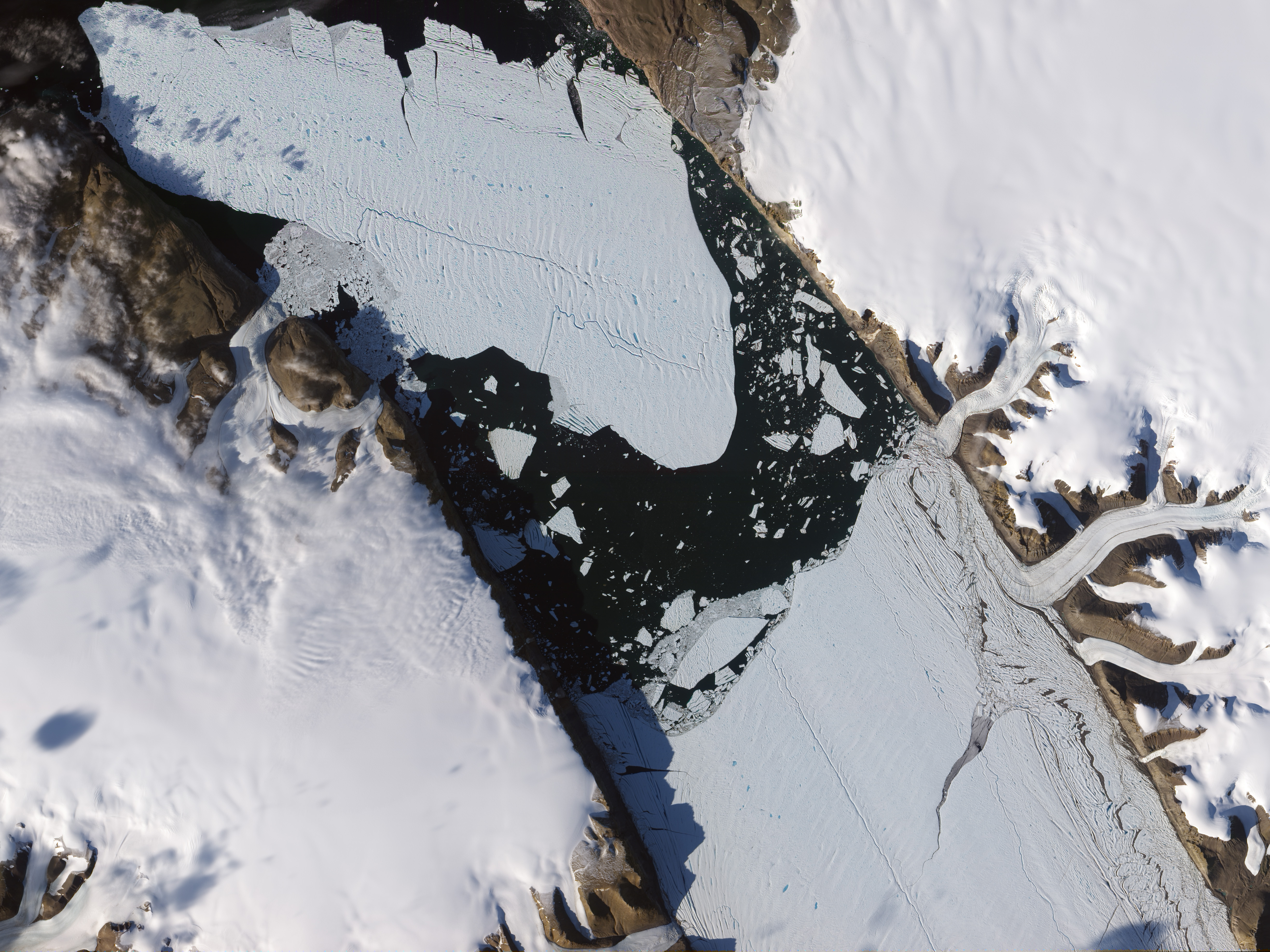
The Petermann Glacier calves an iceberg that covered 97 square miles on August 5th, 2010.
Scientists for some years have been reporting that the Greenland ice sheet was melting at an accelerating rate.
Richard Bates, from the University of St Andrews, part of a team monitoring Greenland ice melt, was reported as saying:
Dr Richard Bates, who is monitoring the ice alongside researchers from America, said the expedition had expected to find evidence of melting this year after “abnormally high” temperatures in the area. Climate change experts say that globally it has been the warmest six months globally since records began.
But he was “amazed to see an area of ice three times the size of Manhattan Island had broken off.
“It is not a freak event and is certainly a manifestation of warming. This year marks yet another record breaking melt year in Greenland; temperatures and melt across the entire ice sheet have exceeded those in 2007 and of historical records.”
A temperate rise of between 2C and 7C would cause the entire Greenland ice mass to melt – raising sea-levels world-wide by 23 feet (7 metres)!
In the United States last year saw record hot temperatures on the East Coast.
On September 27th Los Angeles recorded an all-time high of 113 degrees F, then the official thermometer broke.
A nearby thermometer survived to register a temperature of 119 degrees F, a record for the region.
Crop ecologists use a rule of thumb that for each 1-degree-Celsius rise in temperature above the optimum during the growing season, we can expect a 10-percent decline in grain yields.
Temperatures are rising much faster in the Arctic than elsewhere. Winter temperatures in the Arctic, including Alaska, western Canada and eastern Russia, have climbed by 4-7 degrees F. over the last half-century.
This record rise in temperatures in the Arctic region could lead to changes in climate patterns that will affect the entire planet.
Even a 3-foot rise in sea level would sharply reduce the rice harvest in Asia. It would inundate Bangladesh, a country of 164 million people, submerge part of the Mekong Delta ( a region that produces half of Viet Nam’s rice).
That’s enough from me, simply because although this chapter in the book continues with many more frightening facts, I can’t continue to list them in this particular Post. If the above doesn’t cause you to think and want to change, then a couple of dozen more facts aren’t going to do it either.
Just look at the photograph below and ponder on what we are leaving our children and our grand-children. Indeed, if you are, say 50 years or younger, ponder on what the next few decades could offer for you.
We have to break our addiction with our modern way of living – or Planet Earth will do it for us.
A mother of an iceberg!
On Aug. 5, 2010, an enormous chunk of ice, roughly 97 square miles (251 square kilometers) in size, broke off the Petermann Glacier, along the northwestern coast of Greenland. The Canadian Ice Service detected the remote event within hours in near real-time data from the Moderate Resolution Imaging Spectroradiometer (MODIS) on NASA’s Aqua satellite. The Petermann Glacier lost about one-quarter of its 70-kilometer (40-mile) long floating ice shelf, said researchers who analyzed the satellite data at the University of Delaware. Taken from here.
It started when someone we know in Payson, Peter N, posted an item on Facebook about dogs being able to smell out cancer. The Facebook item referred to an article in Natural News. That item here went as follows:
(NaturalNews) The mainstream media is suddenly reporting on the idea that dogs can sniff out cancer in human beings. This concept is no surprise to NaturalNews readers, of course, as we’ve talked about this before, but until now the idea that cancer patients could be detected by smelling them was considered pure quackery by conventional doctors.
Of course, conventional doctors are once again wrong:Cancer patients do have a particular smelldue to the metabolic off-gassing of cancer cell tumors. But here’s the real story the mainstream media isn’t telling you: It’s not just dogs that can smell cancer — manyhealth practitionerscan also smell cancer patients.
I’ve personally spoken to numerous natural health practitioners who say they can smell cancer in patients. It’s not really a difficult thing to do, it turns out. With a bit of training, I believe most doctors could even be trained to do it, much like this dog in Japan which correctly identified cancer from stool samples 37 out of 38 times.
It doesn’t mean doctors have to sniff patients’ poo, either: You can also smell cancer on someone’s breath, so just talking to a patient can give a doctor an opportunity to do that. (Historically, by the way, physicians use to taste patients’ urine, from which they could diagnose a number of diseases, especially diabetes.)
This particular research on dogs’ ability to sniff out cancer was conducted by researchers at the Kyushu University in Japan. Dr Hideto Sonoda, who conducted the research, told the BBC, “The specific cancer scent indeed exists, but the chemical compounds are not clear. Only the dog knows the true answer.”
An important point in all this is thatthe cancer-sniffing dogs were able to detect early-stage bowel cancer— something that is extremely difficult for modern medical technology to detect. And it only takes a dog a few seconds — at virtually zero cost — to make the assessment.
Now, of course, medical scientists are busy trying to build an electronic device to replace the dog, because conventional medicine can’t stand the fact that something built by nature (the dog’s nose) might be better than some million-dollar electronic gizmo they come up with that can be billed out at $500 a test. So rather than just using dogs who can already detect cancer right now, they’re going to wait around a few years and try to create some high-tech equipment that will probably be a poor replacement for the dog.
That’s how modern medicine works: It steals good ideas from nature and replicates them, but the results are almost always a poor imitation of what Mother Nature has provided for free. Here’s how the end results would likely stack up:
CANCER-SNIFFING DOG
Accuracy: 98%
Cost: One dog biscuit and a pat on the head
CANCER-SNIFFING HIGH-TECH MACHINE
Accuracy: 60%
Cost: $500 billed to Medicare [the US medical system for those unfamiliar with the term. Ed.]
Gee, which one do you think conventional medicine will end up using?
In fact, a quick web search finds much information on the topic including these YouTube videos.
Now how to get our dogs to tell us ……… we’re OK; assuming we are!
The British Medical Journal published a ground-breaking research reporting how dogs have been trained to detect bladder cancer by its smell in urine, bringing together dogs’ exceptional sense of smell, with the theory that cancer produces chemicals with distinctive odours. (on September 24th, 2004 )
Six dogs, none of which had any prior experience in scent discrimination, were trained over seven months to distinguish between urine samples from bladder cancer patients and those from healthy people and individuals with non-cancerous diseases. For the final tests, each dog was offered a set of seven urine samples, and their task was to determine which of them was from a patient with bladder cancer. All of the samples used in the tests were completely new and unfamiliar to the dogs.
The dogs, comprising three spaniels, one papillon, one Labrador and one mongrel, correctly selected the bladder cancer urine on 22 out of 54 occasions – an average success rate of 41% compared to the 14% which would have been expected if the dogs had randomly selected a sample each time. This was statistically significant.
The research was undertaken by a unique partnership of medical scientists, including a statistician, and dog trainers. An orthopaedic surgeon from Buckinghamshire, Mr John Church, brought together colleagues from the Department of Dermatology, Buckinghamshire Hospitals NHS Trust (funded by the Erasmus Wilson Dermatological Research Fund) to develop and supervise the scientific protocol for the research, and Hearing Dogs for Deaf People (based near Princes Risborough) for the purpose of training the dogs for the trial.
“We were flattered to be asked to assist in this study on the basis of our reputation in the field of training dogs,” Claire Guest, Operations Director at Hearing Dogs said, “although we have been very careful not to let this project affect our normal work which involves training dogs for deaf people. The four of us who trained these cancer detection dogs did so using our own pet dogs, in our own homes, in our own spare time.”
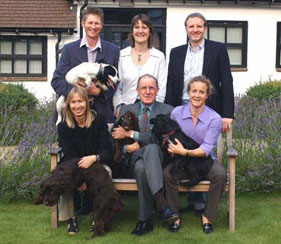
Back row: And Cook, Claire Guest, Martin Church. Front row: Carolyn Willis, John Church, Susannah Church
I rather loved the quote from John Church, “I am a passionate believer that animals have a huge amount to teach us, and I have heard many stories of people who have been alerted to the presence of cancer in their bodies by their pet dogs. I was delighted to find that the two charities were open-minded enough to participate in this study, so that we could really examine this phenomenon scientifically.”
As I keep going on about – we really can learn from dogs!
Mixed emotions about those other worlds out there.
In recent times, Learning from Dogs has been reflecting on the magic, and fragility, of the planet we all live on.
There was the photograph of the Earthrise that attracted quite a few comments. That was followed up by the amazing photograph of the Earth from Voyager 1 taken in 1990 from 3,762,136,324 miles away! Then the lovely poem from Sue.
So it was interesting to note my mixed emotions to a piece on the BBC News website yesterday. Here’s a flavour.
Worlds away
Astronomers have identified some 54 new planets where conditions may be suitable for life.
Five of the candidates are Earth-sized.
The announcement from the Kepler space telescope team brings the total number of exoplanet candidates they have identified to more than 1,200.
The data release also confirmed a unique sextet of planets around a single star and 170 further solar systems that include more than one planet circling far-flung stars.
Read the rest of the item here. (and there’s a fuller version on NetworkWorld)
So here are those mixed emotions.
Man has been, and still continues to be, wonderfully curious to the point of spending huge sums of money on projects that appear to do nothing more than satisfy that curiosity. (The (Kepler) mission‘s life-cycle cost is estimated at US$600 million, including funding for 3.5 years of operation, from here.) That’s a beautiful trait, in my humble opinion.
Homo Sapiens is a wonderfully innovative and creative species, as so wonderfully presented by Alan Alda on a recent PBS Programme called The Human Spark. (See the YouTube intro at the end of this Post.)
Look at all the inventions and incredible advances to our species that are all around us – including the PC I am using and the World Wide Web that is aiding this message!
For such an intelligent species as us, why is it that we are treating Planet Earth in such a suicidal manner through greed, pollution and over-consumption!
As was reported yesterday, we could be on the verge of total and utter chaos in terms of food. Then also yesterday was a small item about food prices reaching a new global record.
It always struck me as absurd to conclude that this planet is the only habitable planet in the universe – ‘Astronomers estimate there are 1021 stars in the universe. With a conservative estimate of three planets per star (some could have many more, some would have none at all) this puts the estimated number of planets into millions of billions.‘ From here.
So the data coming in from Kepler is truly astounding and, personally, underlines this era as a great time to be alive.
But there simply is no choice in that for decades ahead, if not centuries ahead, Planet Earth is all there is for us. So why do we do it so much harm!
Our civilisation is likely to go to the very limits of survivability before the message that the existing ‘model’ is broken is picked up by every major political party in the world. That is very, very scary to contemplate.
So it looks as though, soon, mankind will face the ultimate decision of all time. Give up and let the chaos overwhelm us all, or … or what? In other words millions of us will have to live with the consequences of our greed.
The ‘or what?’ can only be a faith that it will be OK.
A faith that mankind will use the power of dreams, imagination and energy to create a new future that will, at long last, be a new dawn of democratic and just, integrous existence.
And maybe, just maybe, that could be the Second Coming and maybe, just maybe, the world’s Churches and religions will be our saving grace.
But of that day and hour knoweth no man, no, not the angels of heaven, but my Father only. Matthew 24:36
Fascinating times – a Chinese proverb, ‘It’s better to be a dog in a peaceful time than be a man in a chaotic period.’
Finally, here’s that video of the series preview to The Human Spark.
More close to man for more years than one could ever imagine.
A week ago, there was an article on Learning from Dogs entitled What is the dog? It was primarily based on the work of Dr. George Johnson; his details are here.
Anyway, last Thursday Pete N who is incredibly helpful in passing me items of interest, passed me a link to a series of videos that come under the collective name of Dogs Decoded. They were on the website Top Documentary Films itself an interesting site.
It looks as though the videos are due to be released as a single film later on this year, as this link suggests. Here’s how the three videos are introduced.
Dogs Decoded reveals the science behind the remarkable bond between humans and their dogs and investigates new discoveries in genetics that are illuminating the origin of dogs – with surprising implications for the evolution of human culture.
Other research is proving what dog lovers have suspected all along; dogs have an uncanny ability to read and respond to human emotions.
Humans, in turn, respond to dogs with the same hormone responsible for bonding mothers to their babies. How did this incredible relationship between humans and dogs come to be? And how can dogs, so closely related to fearsome wild wolves, behave so differently?
No more from me. Just find a quiet corner and watch the three videos by clicking on each link in turn. They will blow your mind.
Yesterday’s post It’s all we have showing the famous Earthrise picture taken from Apollo 8 generated a lovely follow-up.
One of the comments was from Mike Turner who wrote,
It’s all we have and it’s so insignificant!
The Pale Blue Dot
Mike included a link to an entry on WikiPedia about the tiny, small dot of light in the universe that is Earth, shown in a photograph taken by spaceship Voyager 1 from the edge of the Solar System on February 14th, 1990. Here’s that photograph,
Planet Earth from 3,762,136,324 miles
Can you see our planet home? Earth appears as a tiny dot (the blueish-white speck approximately halfway down the brown band to the right) within the darkness of deep space. In a 2001 article by Space.com, STScI‘s Ray Villard and JPL‘s Jurrie Van der Woude selected this photograph as one of the top ten space science images of all time.
Carl Sagan later wrote about his deep feelings about this photograph. That was almost 20 years ago and, as I reflected just a few days ago, human insanity still seems alive and well; it’s about time that the majority of us recognised the fragility and vulnerability of where we live.
Sagan’s words are reproduced here and should be read by every inhabitant of this planet.
From this distant vantage point, the Earth might not seem of particular interest. But for us, it’s different. Look again at that dot. That’s here, that’s home, that’s us. On it everyone you love, everyone you know, everyone you ever heard of, every human being who ever was, lived out their lives. The aggregate of our joy and suffering, thousands of confident religions, ideologies, and economic doctrines, every hunter and forager, every hero and coward, every creator and destroyer of civilization, every king and peasant, every young couple in love, every mother and father, hopeful child, inventor and explorer, every teacher of morals, every corrupt politician, every “superstar,” every “supreme leader,” every saint and sinner in the history of our species lived there – on a mote of dust suspended in a sunbeam.The Earth is a very small stage in a vast cosmic arena. Think of the rivers of blood spilled by all those generals and emperors so that, in glory and triumph, they could become the momentary masters of a fraction of a dot. Think of the endless cruelties visited by the inhabitants of one corner of this pixel on the scarcely distinguishable inhabitants of some other corner, how frequent their misunderstandings, how eager they are to kill one another, how fervent their hatreds.
Our posturings, our imagined self-importance, the delusion that we have some privileged position in the Universe, are challenged by this point of pale light. Our planet is a lonely speck in the great enveloping cosmic dark. In our obscurity, in all this vastness, there is no hint that help will come from elsewhere to save us from ourselves. [my italics, Ed]
The Earth is the only world known so far to harbor life. There is nowhere else, at least in the near future, to which our species could migrate. Visit, yes. Settle, not yet. Like it or not, for the moment the Earth is where we make our stand.
It has been said that astronomy is a humbling and character-building experience. There is perhaps no better demonstration of the folly of human conceits than this distant image of our tiny world. To me, it underscores our responsibility to deal more kindly with one another, and to preserve and cherish the pale blue dot, the only home we’ve ever known.




 Learning from Dogs