The powerful anti-democratic forces that will threaten civilisation.
In one sense this post today carries an underlying political message – and in another sense, it does not. It does in the sense that if every American voter truly understood the risks of a continued relationship with oil then the tar-sands projects wouldn’t have a prayer of a chance of being allowed.
In the other sense, it does not. Because the influence and power of ‘behind-the-scenes’ oil and money is beyond imagination and, just possibly, outside the reach of democracy.
So what’s got me so agitated?
Well first is that I have been quietly reading The Transition Handbook by Rob Hopkins, he of Transition Totnes fame. Most readers will be aware that Totnes was the first Transition Town in the world and started what is becoming the greatest social movement of the 21st century.
In Rob’s book, on page 51, there is a diagram showing the relative energy returns from the energy invested to produce that energy – hope that makes sense! Let me explain further. For example, for every unit of energy invested in building tidal-range generators, there are eighty-seven units of energy returned. I.e. this is a great investment for mankind in terms of the net benefit.
If we look at the generation of electricity from solar photo-voltaic (PV) panels then the return is about eight units from every unit invested.
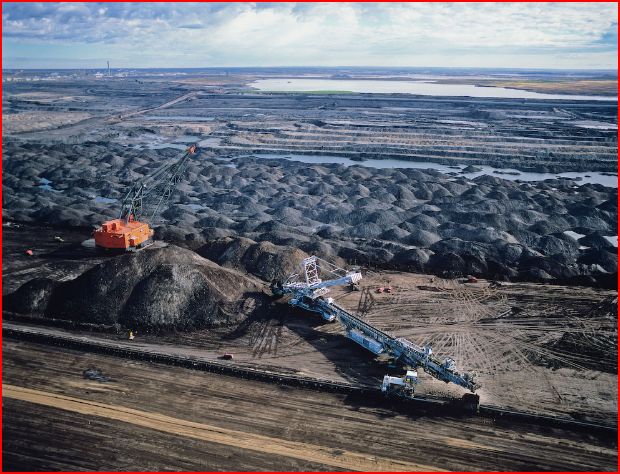
The worst return of them all is from Tar sands: just one unit returned from every unit invested. Investment and humanitarian madness!
Then next I came across this item about Tar sands on The Ecologist magazine website,
Emissions from tar sands seriously underestimated
Governments and companies making no effort to quantify the real climate impacts
Greenhouse gas emissions from tar sands operations are being significantly under-reported according to new research by Global Forest Watch Canada.
The report, ‘Bitumen and Biocarbon‘, says oil companies and governments are not accounting for emissions from deforestation. It says that when boreal forest is destroyed for tar sands development, significant amounts of greenhouse gases are emitted.
‘Governments and companies are working hard to downplay the impacts of tar sands operations, but it turns out that they don’t even know the full extent of the problem,’ said Christy Ferguson, Greenpeace climate and energy coordinator.
‘What’s worse, they’re doing nothing to find out. Denial is not a climate strategy.’
In addition, the report shows that biological carbon stored in living and decaying plants is lost when natural ecosystems are disturbed or destroyed through mining of bitumen and construction of roads, pipelines or facilities.
‘Peatlands are one of the world’s most important storehouses of soil carbon. Industrial activity in the tar sands is destroying peatlands, releasing carbon and eliminating a crucial natural mechanism.
‘Even if peatlands are reclaimed, the carbon released through industrialisation won’t be replaced for thousands of years,’ said Ferguson.
Finally, today (25th) I received in my in-box the latest TomDispatch offering. (I am indebted to Tom Engelhardt for, once again, giving me permission to reproduce in full this TomGram.)
Tom’s latest piece is written by Bill McKibben (with an introduction by Tom) and I strongly urge you to read it – the implications are global. If you read an earlier TomDispatch article by Bill re-published on Learning from Dogs on the 18th July, The Great American Carbon Bomb, today’s piece will surely make you sit up and fume; as it did me! Here it is in full.
Tomgram: Bill McKibben, Jailed Over Big Oil’s Attempt to Wreck the Planet
What might have happened if John McCain had won the presidency in 2008? One thing is certain: there would have been a lot more protest from Democrats, progressives, and the left. Take it as an irony of his election, but Barack Obama has proved remarkably effective in disarming the antiwar movement, even as the use of war in American policy in the Greater Middle East has only grown. That Obama, the supposed anti-warrior of the 2008 campaign, has paid less than no attention to his antiwar critics is no news at all. It’s now practically a cliché as well that he seems to feel no need to feed his political “base” and that, generally speaking (and explain it as you will), his base has not yet pushed back.
This has been particularly true of Obama’s wars, especially the disastrous, never-ending one in Afghanistan. Had Afghanistan been “McCain’s war,” you would surely have seen growing waves of protest, despite the way 9/11 ensured that the Afghan War, unlike the Iraq one, would long be the unassailable “good war.” Still, as American treasure surged into the ill-starred enterprise in Afghanistan, while funds for so much that mattered disappeared at home, I think the streets of Washington would have been filling. What protest there has been, as John Hanrahan of the Nieman Watchdog website reported recently, tends to be remarkably ill-covered in the mainstream media.
Obama, only two points ahead of Ron Paul in the latest Gallup Poll in the race for 2012, is a beyond-vulnerable candidate. (Somewhere there must be some Democratic pol doing the obvious math and considering a challenge, mustn’t there?) Fortunately, in another area at least as crucial as our wars, demonstrators against a Big Oil tar-sands pipeline from Canada that will help despoil the planet are now out in front of the White House — you can follow them here — and they haven’t been shy about aiming their nonviolent protests directly at Obama. Will he or won’t he act like the climate-change president that, on coming into office, he swore he would be? Time will tell. Meanwhile, let Bill McKibben, TomDispatch regular, an organizer of the protests, and just out of a jail cell, fill you in. Tom
Arrested at the White House
Acting as a Living Tribute to Martin Luther King
By Bill McKibben
I didn’t think it was possible, but my admiration for Martin Luther King, Jr., grew even stronger these past days.
As I headed to jail as part of the first wave of what is turning into the biggest civil disobedience action in the environmental movement for many years, I had the vague idea that I would write something. Not an epic like King’s “Letter from a Birmingham Jail,” but at least, you know, a blog post. Or a tweet.
Heros
But frankly, I wasn’t up to it. The police, surprised by how many people turned out on the first day of two weeks of protests at the White House, decided to teach us a lesson. As they told our legal team, they wanted to deter anyone else from coming — and so with our first crew they were… kind of harsh.
We spent three days in D.C.’s Central Cell Block, which is exactly as much fun as it sounds like it might be. You lie on a metal rack with no mattress or bedding and sweat in the high heat; the din is incessant; there’s one baloney sandwich with a cup of water every 12 hours.
I didn’t have a pencil — they wouldn’t even let me keep my wedding ring — but more important, I didn’t have the peace of mind to write something. It’s only now, out 12 hours and with a good night’s sleep under my belt, that I’m able to think straight. And so, as I said, I’ll go to this weekend’s big celebrations for the openingof the Martin Luther King Jr. National Memorial on the Washington Mall with even more respect for his calm power.
Preacher, speaker, writer under fire, but also tactician. He really understood the power of nonviolence, a power we’ve experienced in the last few days. When the police cracked down on us, the publicity it produced cemented two of the main purposes of our protest:
Eaarth
First, it made Keystone XL — the new, 1,700-mile-long pipeline we’re trying to block that will vastly increase the flow of “dirty” tar sands oil from Alberta, Canada, to the Gulf of Mexico — into a national issue. A few months ago, it was mainly people along the route of the prospective pipeline who were organizing against it. (And with good reason: tar sands mining has already wrecked huge swaths of native land in Alberta, and endangers farms, wild areas, and aquifers all along its prospective route.)
Now, however, people are coming to understand — as we hoped our demonstrations would highlight — that it poses a danger to the whole planet as well. After all, it’s the Earth’s second largest pool of carbon, and hence the second-largest potential source of global warming gases after the oil fields of Saudi Arabia. We’ve already plumbed those Saudi deserts. Now the question is: Will we do the same to the boreal forests of Canada. As NASA climatologist James Hansen has made all too clear, if we do so it’s “essentially game over for the climate.” That message is getting through. Witness the incredibly strong New York Times editorial opposing the building of the pipeline that I was handed on our release from jail.
Second, being arrested in front of the White House helped make it clearer that President Obama should be the focus of anti-pipeline activism. For once Congress isn’t in the picture. The situation couldn’t be simpler: the president, and the president alone, has the power either to sign the permit that would take the pipeline through the Midwest and down to Texas (with the usual set of disastrous oil spills to come) or block it.
Barack Obama has the power to stop it and no one in Congress or elsewhere can prevent him from doing so. That means — and again, it couldn’t be simpler — that the Keystone XL decision is the biggest environmental test for him between now and the next election. If he decides to stand up to the power of big oil, it will send a jolt through his political base, reminding the presently discouraged exactly why they were so enthused in 2008.
That’s why many of us were wearing our old campaign buttons when we went into the paddy wagon. We’d like to remember — and like the White House to remember, too — just why we knocked on all those doors.
But as Dr. King might have predicted, the message went deeper. As people gather in Washington for this weekend’s dedication of his monument, most will be talking about him as a great orator, a great moral leader. And of course he was that, but it’s easily forgotten what a great strategist he was as well, because he understood just how powerful a weapon nonviolence can be.
The police, who trust the logic of force, never quite seem to get this. When they arrested our group of 70 or so on the first day of our demonstrations, they decided to teach us a lesson by keeping us locked up extra long — strong treatment for a group of people peacefully standing on a sidewalk.
No surprise, it didn’t work. The next day an even bigger crowd showed up — and now, there are throngs of people who have signed up to be arrested every day until the protests end on September 3rd. Not only that, a judge threw out the charges against our first group, and so the police have backed off. For the moment, anyway, they’re not actually sending more protesters to jail, just booking and fining them.
And so the busload of ranchers coming from Nebraska, and the bio-fueled RV with the giant logo heading in from East Texas, and the flight of grandmothers arriving from Montana, and the tribal chiefs, and union leaders, and everyone else will keep pouring into D.C. We’ll all, I imagine, stop and pay tribute to Dr. King before or after we get arrested; it’s his lead, after all, that we’re following.
Our part in the weekend’s celebration is to act as a kind of living tribute. While people are up on the mall at the monument, we’ll be in the front of the White House, wearing handcuffs, making clear that civil disobedience is not just history in America.
We may not be facing the same dangers Dr. King did, but we’re getting some small sense of the kind of courage he and the rest of the civil rights movement had to display in their day — the courage to put your body where your beliefs are. It feels good.
So perhaps you understand why every American reading this should make sure your voice is heard. And in the last few minutes – 1.30pm MT 25th August – Reuters have just put out this news release,
Nation’s Leading Environmental NGOs Unified Against Tar Sands Pipeline
Update on Day 5 of Tar Sand Pipeline Protest at the White House
See past update and background.
275 people have been arrested so far and many have been released. Today, the largest environmental groups in the US joined to send a letter to President Obama voicing their unified opposition to the Keystone pipeline and asking him to block it.
Why is this important? “For those of us out there in front of the White House, the best thing about this ringing statement is that the administration won’t be able to play one group off against another by making small concessions here and there”; says protest organizer Bill McKibben.
“There’s only one way to demonstrate to the environmental base the rhetoric of Obama’s 2008 campaign is still meaningful – and that’s to veto this pipeline. Since he can do it without even consulting Congress, this is one case where we’ll be able to see exactly how willing he is to match the rhetoric of his 2008 campaign.”
The letter says:
Dear President Obama,
Many of the organizations we head do not engage in civil disobedience; some do. Regardless, speaking as individuals, we want to let you know that there is not an inch of daylight between our policy position on the Keystone Pipeline and those of the very civil protesters being arrested daily outside the White House.
This is a terrible project – many of the country’s leading climate scientists have explained why in their letter last month to you. It risks many of our national treasures to leaks and spills. And it reduces incentives to make the transition to job-creating clean fuels.
You have a clear shot to deny the permit, without any interference from Congress. It’s perhaps the biggest climate test you face between now and the election.
If you block it, you will trigger a surge of enthusiasm from the green base that supported you so strongly in the last election. We expect nothing less.
Sincerely,
Fred Krupp, Environmental Defense Fund
Michael Brune, Sierra Club
Frances Beinecke, Natural Resources Defense Council
Phil Radford, Greenpeace
Larry Schweiger, National Wildlife Federation Erich Pica, Friends of the Earth
Rebecca Tarbotton, Rainforest Action Network
May Boeve, 350.org
Gene Karpinski, League of Conservation Voters
Margie Alt, Environment America
New York Times Also Opposes Pipeline
In an August 21 editorial, the NY Times took a opposition against the pipeline, citing two main concerns: the risk of oil spills along the pipeline, which would traverse highly sensitive terrain, and the fact that the extraction of petroleum from tar sands creates far more greenhouse emissions than conventional production does.
Building the pipeline would clear the way for Canada to double tar sands production over the next decade to more than 1.8 million barrels a day. To do that, some 740,000 acres of boreal forest – a natural carbon reservoir – would be destroyed.
In addition to the emissions produced by tar sands extraction, would be emissions from the loss of this vast, crucial carbon sink, [editor’s note: not to mention the biodiversity it harbors.] Read the editorial:
Website: here with permission from Sustainable Business
One thousand, nine hundred and thirty-two years ago, today, there was a loud bang in Italy!
On the 24th August, in the year 79 A.D. the residents of Pompeii would undoubtedly had very little time to ponder on the consequences of a volcanic eruption just five miles away.
Try to imagine huge, billowing, gray-black clouds like those at Mount St. Helens rushing toward you at a hundred miles an hour. That is probably what the ancient Romans saw just before they were entombed by hot ash.
There is much material available for those that wish to read more about the devastating effects of that volcanic eruption, so superfluous to add much more here. The Classroom of the Future link is as good a place to start as any. What I would like to comment on is this – but first a picture,
Vesuvius and nearby cities
What is worth noting that in 2009 the CIA Factbook records that the population of Naples was 2,270,000 people. Naples is very close to Vesuvius. As WikiPedia puts it,
Mount Vesuvius (Italian: Monte Vesuvio, Latin: Mons Vesuvius) is a stratovolcano on the Bay of Naples, Italy, about 9 kilometres (5.6 mi) east ofNaples and a short distance from the shore. It is the only volcano on the European mainland to have erupted within the last hundred years, although it is not currently erupting.
There is a saying in Italy that goes ‘vedi Napoli e poi muori’. Translated, this means ‘see Naples and die’. The actual meaning of this refers to being overwhelmed by what a beautiful and an incredible city Naples is. (although some may argue that what it really means that Naples is such a dangerous and chaotic city that it will kill you!)
H’mmm. Get the timing wrong and that saying could have a literal meaning way beyond the ancient author’s intent! I quote from the website Geology.com,
Starting in 1631, Vesuvius entered a period of steady volcanic activity, including lava flows and eruptions of ash and mud. Violent eruptions in the late 1700s, 1800s and early 1900s created more fissures, lava flows, and ash-and-gas explosions. These damaged or destroyed many towns around the volcano, and sometimes killed people; the eruption of 1906 had more than 100 casualties. The most recent eruption was in 1944 during World War II. It caused major problems for the newly-arrived Allied forces in Italy when ash and rocks from the eruption destroyed planes and forced evacuations at a nearby airbase.
But for all it’s power, the Vesuvius eruption of the 24th August, 79 was a squib compared to the Toba eruption some 73,000 years ago. More on that one in a few days perhaps.
Yesterday, I introduced a 50-minute film concerning the famous biologist E O Wilson, Lord of the Ants which, as well as being a wonderful tribute to Prof. Wilson, also allowed us humans to have a better understanding of our deeper human issues.
Coincidentally, around the same time of watching that film, I saw an article on the Grist website that referred to some research published in Nature magazine. This what I read, first from Grist, reprinted with the kind permission of Libby S., Senior Marketing Manager of Grist.
Scientists have been doing studies for years that show you are more likely to suffer from mental illness if you live in a city. What they haven’t figured out is why.
Now, researchers in Germany have conducted experiments that they believe might begin to get at the neuroscience behind the crazy-making nature of urban areas.
Publishing in the journal Nature, a group led by Andreas Meyer-Lindenberg of the University of Heidelberg’s Central Institute of Mental Health in Mannheim, Germany, looked at how social stress affected the minds of subjects, some city-dwellers and some not.
If we then turn to that article in Nature (to get access you will need to arrange prior free sign-up) we get to read this,
City living marks the brain
Neuroscientists study social risk factor for mental illness.
Epidemiologists showed decades ago that people raised in cities are more prone to mental disorders than those raised in the countryside. But neuroscientists have avoided studying the connection, preferring to leave the disorderly realm of the social environment to social scientists. A paper in this issue of Naturerepresents a pioneering foray across that divide.
Using functional brain imaging, a group led by Andreas Meyer-Lindenberg of the University of Heidelberg’s Central Institute of Mental Health in Mannheim, Germany, showed that specific brain structures in people from the city and the countryside respond differently to social stress (see pages 452 and 498). Stress is a major factor in precipitating psychotic disorders such as schizophrenia.
The work is a first step towards defining how urban life can affect brain biology in a way that has a potentially major impact on society — schizophrenia affects one in 100 people. It may also open the way for greater cooperation between neuroscientists and social scientists. “There has been a long history of mutual antipathy, particularly in psychiatry,” says sociologist Craig Morgan at the Institute of Psychiatry in London. “But this is the sort of study that can prove to both sides that they can gain from each others’ insights.”
I feel uncomfortable about reproducing more of this fascinating study without some formal permission to do so, therefore, if you want to read the full article then do sign up for access at the Nature website.
Back to the article from Grist written by Sarah Goodyear, Grist’s cities editor,
I called Dr. Meyer-Lindenberg to ask him more about the implications of his experiment, and what he thought might be the cause of heightened sensitivity to social stress among urban dwellers.
“On the neural level, we find two things,” he told me. “A, the neural effects are completely dissociated, so current urban living only affects the amygdala, urban upbringing only affects the cingulate. And B, these areas are associated with these illnesses. The amygdala is sort of a danger center, and it’s critically important for fear. And it is clear that the amygdala is a major player in depression. The cingulate is a prefrontal area regulating negative emotion, and it’s known to be one of the earliest areas affected by schizophrenia.”
So what accounts for the hyperactivity of the amygdala-cingulate circuit in urban dwellers? “That exact circuit that we found hyperactive has also shown to be activated when someone comes too close to you and crowds your personal space,” Meyer-Lindenberg told me.
But he cautioned against inferring that mere density of population is at fault. “It’s still speculation,” he said. “There could be myriad components of the urban experience that might or might not be bad for you from the point of your risk for mental illness. No one really knows. People are annoyed by noise or by traffic, or it could also be lead, or air pollution, but there’s no evidence base to say this is an important factor, this is not an important factor. Therefore there’s no basis for urban planning that’s grounded in human biology, at least with regard to mental illness.”
Later in the Grist article, Dr. Meyer-Lindenberg told Sarah Goodyear,
“Social status is closely linked to socioeconomic variables. What we found in our imaging studies is that if your social status becomes labile, and especially if you are in danger of losing it, a very similar brain circuit becomes active. There is a convergence of socially relevant risk factors on that circuit.”
Different types of urban environments might also affect people in different ways. “It’s very different if you live in Manhattan and you sort of live in a series of overlapping villages, if you will, or if you live in a city like Sao Paolo, in which no such microstructure is immediately available to you, or if you live in a large spread-out area,” said Meyer-Lindberg.
The social connections that are fostered in more walkable neighborhoods could help city dwellers from losing it. “A previous study found that that the size of your social support network is actually correlated to the size of the exact brain circuit we found in this study,” Meyer-Lindenberg said. “So that’s a protective factor. The more friends you have, the bigger those brain structures are.”
Already, more than half the human population lives in cities. That proportion will only increase. New cities are springing up all over the developing world, some built to order, some completely unplanned. The form they take could be crucial.
More knowledge about what exactly drives people could lead to concrete solutions that would make for better mental health — the same way the discovery of how disease was spread by waterborne germs finally ended the scourge of cholera in London.
“I think it would be important to make cities better, given that we can’t escape cities, given the dynamics of urbanization,” said Meyer-Lindenberg. “That’s a reality that we’re not going to get rid of.”
Fascinating article made doubly interesting by E O Wilson’s lifetime study of ants!
A passing visit to the American biologist, E. O. Wilson
E O Wilson
Edward Osborne Wilson was born in June 1929 thus making him, at this time of writing, just into his 82 year. His biological specialty is myrmecology. Got that? Myrmecology. And if you, like me, didn’t have a clue as to what myrmecology is and had to look it up, it is the study of ants. Blow me down, there is even a myrmecology blogsite!
So where is this all heading?
One of the things that we do know about dogs, especially if we go way back into the dim and distant times when they behaved more like the grey wolf, from which the species ‘dog’ genetically originates 100,000 years ago, is that their social order, their pack behaviour, was highly stable. As an aside, when Jean was rescuing dogs in San Carlos, Mexico during the years that she lived there with her late husband she readily observed that the stray dogs, of which there were too many, had a natural propensity to group up into their historic pack formations. (And as an aside to my aside, Jean’s close friend of many years, Dan’s sister Suzann, today carries on the splendid work of looking after stray dogs from her San Carlos house!)
OK, back to the plot!
E O Wilson’s study of ants has revealed much about social order and organisation. The following YouTube video was from a PBS programme, aired in May, 2008, from which I quote (that is the PBS website),
Program Description
At age 78, E.O. Wilson is still going through his “little savage” phase of boyhood exploration of the natural world. In “Lord of the Ants,” NOVA profiles this soft-spoken Southerner and Harvard professor, who is an acclaimed advocate for ants, biological diversity, and the controversial extension of Darwinian ideas to human society.
Actor and environmentalist Harrison Ford narrates this engaging portrait of a ceaselessly active scientist and eloquent writer, who has accumulated two Pulitzer Prizes among his many other honors. Says fellow naturalist David Attenborough: “He will go down as the man who opened the eyes of millions ’round the world to the glories, the values, the importance of—to use his term—biodiversity.”
It’s a fascinating film, truly engaging, so do settle down for a relaxing 53 minutes and watch,
Now there’s more to this and I do want to continue with the theme of this Post tomorrow.
So for now, look in on the E O Wilson Biodiversity Foundation’s website and I’ll see you tomorrow.
Dogs have that wonderful ability to savour the moment and just enjoy the present. Seems to me that there is just a bit too much going on at the moment in the big wide world and we could do a lot worse than take a chair out into the garden, or wherever, and enjoy the majesty of one of the light shows that the universe can put on.
But first an acknowledgement to Mike Shedlock, more details here. I subscribe to his daily newsletter and it was there that, rather uncharacteristically for an economic blog, I saw the reference to the Perseids meteor shower which, annually, provides vivid viewing for us earth-bound creatures this time of the year.
A celestial traffic jam may be on tap this week as two meteor showers combine forces to put on a brilliant sky show.
One of the best shooting star events of the year is the annual August Perseid meteor shower. (See Perseids pictures.) However this year’s peak, on August 12, happens to coincide with a bright full moon—drastically cutting down the number of meteors visible to the naked eye.
Yet while the main event might be blocked out by the blinding moonlight, the opening act promises to be much better.
This year the lesser known Delta Aquarid meteor shower is expected to peak on Friday night, when the Delta Aquarids’ more productive Perseid cousin is just starting to ramp up.
Together the showers will produce anywhere between 15 and 30 shooting stars per hour under clear, dark skies.
If this tickles your fancy then go to that article and read how best to view this wonderful sky show.
We haven’t seen them from this part of the world (i.e. Payson, Arizona), but down in South-West England it was easy to get up onto the moors (Dartmoor). Sunset at this time of the year down in Devon is around 7pm local time and by 8pm there was often a beautiful cloudless night sky.
Wikipedia has some good background information on the Perseid meteor shower including, what I didn’t realise, that,
The Perseid meteor shower has been observed for about 2000 years, with the earliest information on this meteor shower coming from the Far East. Some Catholics refer to the Perseids as the “tears of St. Lawrence“, since 10 August is the date of that saint’s martyrdom.
I think most people are aware, again from Wikipedia, that,
The shower is visible from mid-July each year, with the peak in activity being between August 9 and 14, depending on the particular location of the stream. During the peak, the rate of meteors reaches 60 or more per hour. They can be seen all across the sky, but because of the path of Swift-Tuttle’s orbit, Perseids are primarily visible in the northern hemisphere. As with all meteor showers, the rate is greatest in the pre-dawn hours, since the side of the Earth nearest to turning into the sun scoops up more meteors as the Earth moves through space.
But to come back to the National Geographic piece, as above, this year could be better than normal. As I wrote,
This year the lesser known Delta Aquarid meteor shower is expected to peak on Friday night, when the Delta Aquarids’ more productive Perseid cousin is just starting to ramp up.
Together the showers will produce anywhere between 15 and 30 shooting stars per hour under clear, dark skies.
So I know it could be a tough choice – politics or standing in awe under a night sky – but, go on, force yourself!
Yesterday, I wrote about how science was coming up with some pretty strong evidence that humans do have the ability to communicate in a way that might be called ‘telepathic’.
If (and that’s a big ‘if’) I have any understanding of the science, I believe it has much to do with quantum physics. So I thought it fun to take a small diversion in today’s Post and give you some material on this very strange world of the very, very small.
That’s an easy one: it’s the science of things so small that the quantum nature of reality has an effect. Quantum means ‘discrete amount’ or ‘portion’. Max Planck discovered in 1900 that you couldn’t get smaller than a certain minimum amount of anything. This minimum amount is now called the Planck unit.
Why is it weird?
Niels Bohr, the father of the orthodox ‘Copenhagen Interpretation’ of quantum physics once said, “Anyone who is not shocked by quantum theory has not understood it“.
To understand the weirdness completely, you just need to know about three experiments: Light Bulb, Two Slits, Schroedinger’s Cat.
Two Slits
The simplest experiment to demonstrate quantum weirdness involves shining a light through two parallel slits and looking at the screen. It can be shown that a single photon (particle of light) can interfere with itself, as if it travelled through both slits at once.
Light Bulb
Imagine a light bulb filament gives out a photon, seemingly in a random direction. Erwin Schroedinger came up with a nine-letter-long equation that correctly predicts the chances of finding that photon at any given point. He envisaged a kind of wave, like a ripple from a pebble dropped into a pond, spreading out from the filament. Once you look at the photon, this ‘wavefunction’ collapses into the single point at which the photon really is.
Schroedinger’s Cat
In this experiment, we take your pet cat and put it in a box with a bottle of cyanide. We rig it up so that a detector looks at an isolated electron and determines whether it is ‘spin up’ or ‘spin down’ (it can have either characteristic, seemingly at random). If it is ‘spin up’, then the bottle is opened and the cat gets it. Ten minutes later we open the box and see if the cat is alive or dead. The question is: what state is the cat in between the detector being activated and you opening the box. Nobody has actually done this experiment (to my knowledge) but it does show up a paradox that arises in certain interpretations.
To conclude I will offer this quotation reputed to be from the great master himself, Albert Einstein,
The more success the quantum theory has, the sillier it looks.
Those of you who have come across Rupert Sheldrake and, in particular his book Dogs That Know When Their Owners Are Coming Home will really not be surprised at what is coming, in terms of the rest of this Post. Because most dog owners know, from countless observations, that dogs have an uncanny ability to see the world around them in a more deeper and intuitive manner than we can explain.
I wrote of Sheldrake’s book on the 1st June including touching on a report of Mason, a small terrier mix …
On April 27th, Mason was hiding in his garage in North Smithfield when the storm picked him up and blew him away. His owners couldn’t find him and had about given up when they came back Monday to sift through the debris, and found Mason waiting for them on the porch.
A few evenings ago, we watched a documentary from the website Top Documentary Films from the series Through The Wormhole. This particular documentary was entitled Is There a Sixth Sense? Here’s how that film was introduced,
Sight, hearing, smell, taste and touch are the tools most of us depend on to perceive the world. But some people say they also can perceive things that are outside the range of the conventional senses, through some other channel for which there is no anatomical or neurological explanation. Scientific researchers who study such abilities call them extrasensory perception (ESP), but lay people often refer to them as the sixth sense.
Either term really is a catch-all for a variety of different purported abilities that vary from person to person. Some people claim the power of telepathy – that is, the ability to perceive others’ thoughts, without having them communicated verbally or in writing. Others claim to have the power of clairvoyance, which is the ability to perceive events and objects that are hidden from view because of barriers or distance. Still others claim to be gifted with precognition, which enables them to look into the future and glimpse what hasn’t yet occurred.
The belief in ESP or the sixth sense dates back thousands of years. The Greek historian Herodotus wrote that Croesus, who ruled a kingdom in what is now Turkey in the sixth century B.C., consulted oracles – that is, groups of priests claimed to be able to predict the future — before he went to war. In ancient India, Hindu holy men were believed to possess the power to see and hear at a distance, and to communicate through telepathy.
In the late 1700s, the Viennese physician Franz Mesmer claimed that he could give people ESP powers by hypnotizing them. Just before his assassination in 1865, President Abraham Lincoln told friends that he’d dreamed of his own body lying in state in the White House. In the 20th century, Edgar Cayce and Jean Dixon attracted wide followings by claiming that they could foresee future events. During the Cold War, U.S. military and intelligence agencies, spurred by reports that the Soviets had psychics at their disposal, even tried to utilize clairvoyants who claimed remote-viewing powers for espionage purposes.
As well as watching it directly from the Top Documentary Films website, it is also available from YouTube. Here are the four links. It is a most fascinating review of the scientific findings in this area. If you have a dog with you when you watch the videos, don’t be surprised if he or she fall asleep! Nothing new for dogs in all this!
William Rees discussing the disconnect between economics and ecology.
Yesterday, I wrote about Paul Gilding’s book The Great Disruption. In a sense today’s article continues the theme; the idea that the future is going to be very different to the past, indeed has to be if mankind is to have a viable future.
Dr. Bill Rees
Dr. William Rees is Professor at the University of British Columbia’s School of Community and Regional Planning. More details of Dr. Rees here.
The world economy is depleting the earth’s natural resources, and economists cling to models that make no reference whatsoever to the biophysical basis that underpins the economy. That’s why ecological economics is needed, says William Rees in this INET interview.
Standard economics portrays the economy as a circular flow: households pay money to firms in exchange for goods and services, and firms pay wages to households in exchange for labor. Textbooks describe this circular flow as self-perpetuating, capable of infinite expansion. William Rees argues that the textbooks get it wrong; he says the production of our goods and services depends on the extraction of material from ecosystems, causing resource depletion on the one hand, and excess pollution on the other.
William Rees, best known in ecological economics as the originator and co-developer of ‘ecological footprint analysis’, says the United States is using four or five times its fair share of the world’s total bio-capacity. In order to bring just the present world population up to the material standards enjoyed by North Americans, we would need the biophysical equivalent of about three additional planet earths.
There has been no time in history where income growth hasn’t been accompanied by increased material and energy consumption, Rees cautions. He says technologies exist that would enable us to enjoy our current lifestyles with perhaps as little as 20 percent of our current energy and material consumption, but we do not have the incentives in place to force that decoupling to take place.
Rees is as pessimistic on current culture and politics as he is optimistic on the technology. The global culture remains in denial, and people with vested interests in the status quo wield enormous power.
Want more from Dr. Rees? Over at the website West Coast Climate Equity is an eight-part series where Dr. Rees sets out the proposition that humanity’s survival depends on an 80% reduction in energy use.
Finally, on the Post Carbon Institute website there’s a link to an audio speech given by Dr. Rees summarised as follows.
Bill Rees speech to Vancouver World Federalist meeting on Radio Ecoshock Show
This is a speech by Dr. Bill Rees delivered April 15th at the World Federalist meeting in Vancouver. It goes a long way to explaining why we fail to act, even as the facts become clear and indisputable. He covers the three brain theory, the limits of evolution, memes, Peak Oil, and cultural myths, plus some thoughts on solutions – mostly contraction and convergence. Rees is one of the few academics more or less calling for a planned economic collapse.
The 53 minute speech is featured in this week’s Radio Ecoshock show, broadcast by 20 college and community radio stations in the U.S. and Canada, plus Green 960 AM in San Francisco.
A powerful and insightful essay from Bill McKibben about our love affair with carbon-based energy.
Introduction
I subscribe to a number of Blogs and one of them is TomDispatch. Here’s how Tom describes what the writings are all about.
Tom Engelhardt launched Tomdispatch in November 2001 as an e-mail publication offering commentary and collected articles from the world press. In December 2002, it gained its name, became a project of The Nation Institute, and went online as “a regular antidote to the mainstream media.” The site now features Tom Engelhardt’s regular commentaries and the original work of authors ranging from Rebecca Solnit, Bill McKibben, and Mike Davis to Chalmers Johnson, Michael Klare, Adam Hochschild, Robert Lipsyte, and Elizabeth de la Vega. Nick Turse, who also writes for the site, is associate editor and research director.
Tomdispatch is intended to introduce readers to voices and perspectives from elsewhere (even when the elsewhere is here). Its mission is to connect some of the global dots regularly left unconnected by the mainstream media and to offer a clearer sense of how this imperial globe of ours actually works.
I read the TomDispatch essay from Bill McKibben on the 14th. It caught my eye, not only because of the power of Bill’s conclusions, but also because I was deeply impressed with Bill’s book ‘eaarth’, which I reviewed on Learning from Dogshere and here.
Tom Engelhardt has given written permission for that TomDispatch to be re-published in full on Learning from Dogs. It now follows.
First the introduction by Tom Engelhardt,
The Great American Carbon Bomb
These days, even ostriches suffer from heat waves. More than 1,000 of them reportedly died from overheating on South African farms during a 2010 drought. As for American ostriches, the human variety anyway, at the moment it should be increasingly hard for them to avoid extreme-weather news. After all, whether you’re in sweltering heat, staggering drought, a record fire season, or a massive flood zone, most of us are living through weird weather this year. And if you’re one of the lucky few not in an extreme-weather district of the USA, you still won’t have a problem running across hair-raising weather stories, ranging from the possible loss of one out of every ten species on this planet by century’s end to the increasing inability of the oceans to soak up more atmospheric carbon dioxide.
Then, of course, there are those other headlines. Here’s a typical one: “As Water Rises, Florida Officials Sit on Their Hands” (a former member of the just abolished Florida Energy and Climate Commission points out that, thanks to Republican governor Rick Scott and the legislature in the part of the country most vulnerable to rising sea levels, “there is no state entity addressing climate change and its impact”). And here’s another: “Economy Keeps Global Warming on the Back Burner for 2012” (American climate-change “skeptics” are celebrating because “the tide of the debate — at least politically — has turned in their favor” and “political experts say that… concerns over global warming won’t carry much weight in the 2012 election”). And then there are the polls indicating Americans are confused about the unanimity of the scientific consensus on climate change, surprisingly dismissive of global-warming dangers, worry less about it than they did a decade ago, and of major environmental issues, worry least about it.
It’s true, of course, that no weird-weather incident you experience can definitively be tied to climate change and other factors are involved. Still, are we a nation of overheating ostriches? It’s a reasonable enough conclusion, and in a sense, not so surprising. After all, how does anyone react upon discovering that his or her way of life is the crucial problem, that fossil fuels, which keep our civilization powered up and to which our existence is tethered, are playing havoc with the planet?
TomDispatch regular Bill McKibben, author most recently of Eaarth: Making a Life on a Tough New Planet, is a man deeply committed to transforming us from climate-change ostriches to climate-change eagles. Perhaps it’s time, he suggests, for the environmental movement to get one heck of a lot blunter. Tom
Here’s the essay from Bill,
Will North America Be the New Middle East?
It’s Yes or No For a Climate-Killing Oil Pipeline — and Obama Gets to Make the Call
By Bill McKibben
The climate problem has moved from the abstract to the very real in the last 18 months. Instead of charts and graphs about what will happen someday, we’ve got real-time video: first Russia burning, then Texas and Arizona on fire. First Pakistansuffered a deluge, then Queensland, Australia, went underwater, and this spring and summer, it’s the Midwest that’s flooding at historic levels.
The year 2010 saw the lowest volume of Arctic ice since scientists started to measure, more rainfall on land than any year in recorded history, and the lowest barometric pressure ever registered in the continental United States. Measured on a planetary scale, 2010 tied 2005 as the warmest year in history. Jeff Masters, probably the world’s most widely read meteorologist, calculated that the year featured the most extreme weather since at least 1816, when a giant volcano blew its top.
Since we’re the volcano now, and likely to keep blowing, here’s his prognosis: “The ever-increasing amounts of heat-trapping gases humans are emitting into the air put tremendous pressure on the climate system to shift to a new, radically different, warmer state, and the extreme weather of 2010-2011 suggests that the transition is already well underway.”
There’s another shift, too, and that’s in the response from climate-change activists. For the first two decades of the global-warming era, the suggested solutionsto the problem had been as abstract as the science that went with it: complicated schemes like the Kyoto Protocol, or the cap-and-trade agreement that died in Congress in 2010. These were attempts to solve the problem of climate change via complicated backstage maneuvers and manipulations of prices or regulations. They failed in large part because the fossil-fuel industry managed, at every turn, to dilute or defang them.
Clearly the current Congress is in no mood for real regulation, so — for the moment anyway — the complicated planning is being replaced by a simpler rallying cry. When it comes to coal, oil, and natural gas, the new mantra of activists is simple, straightforward, and hard to defang: Keep it in the ground!
Two weeks ago, for instance, a few veteran environmentalists, myself included, issued a call for protest against Canada’s plans to massively expand oil imports from the tar sands regions of Alberta. We set up a new website, tarsandsaction.org, and judging from the early response, it could result in the largest civil disobedience actions in the climate-change movement’s history on this continent, as hundreds, possibly thousands, of concerned activists converge on the White House in August. They’ll risk arrest to demand something simple and concrete from President Obama: that he refuse to grant a license for Keystone XL, a new pipeline from Alberta to the Gulf of Mexico that would vastly increase the flow of tar sands oil through the U.S., ensuring that the exploitation of Alberta’s tar sands will only increase.
Forget the abstract and consider the down-and-dirty instead. You can undoubtedly guess some of the reasons for opposition to such a pipeline. It’s wrecking native lands in Canada, and potential spills from that pipeline could pollute some of the most important ranchlands and aquifers in America. (Last week’s Yellowstone River spill was seen by many as a sign of what to expect.)
There’s an even bigger reason to oppose the pipeline, one that should be on the minds of even those of us who live thousands of miles away: Alberta’s tar sands are the continent’s biggest carbon bomb. Indeed, they’re the second largest pool of carbon on planet Earth, following only Saudi Arabia’s slowly dwindling oilfields.
If you could burn all the oil in those tar sands, you’d run the atmosphere’s concentration of carbon dioxide from its current 390 parts per million (enough to cause the climate havoc we’re currently seeing) to nearly 600 parts per million, which would mean if not hell, then at least a world with a similar temperature. It won’t happen overnight, thank God, but according to the planet’s most important climatologist, James Hansen, burning even a substantial portion of that oil would mean it was “essentially game over” for the climate of this planet.
Halting that pipeline wouldn’t solve all tar sands problems. The Canadians will keep trying to get it out to market, but it would definitely ensure that more of that oil will stay in the ground longer and that, at least, would be a start. Even better, the politics of it are simple. For once, the Republican majority in the House of Representatives can’t get in the way. The president alone decides if the pipeline is “in the national interest.” There are, however, already worrisome signs within the Obama administration. Just this week, based on a State Department cable released by WikiLeaks, Neela Banerjee of the Los Angeles Timesreported that, in 2009, the State Department’s “energy envoy” was already instructing Alberta’s fossil-fuel barons in how to improve their “oil sands messaging,” including “increasing visibility and accessibility of more positive news stories.” This is the government version of Murdochian-style enviro-hacking, and it leads many to think that the new pipeline is already a done deal.
Still, the president can say no. If he does, then no pipeline — and in the words of Alberta’s oil minister, his province will be “landlocked in bitumen” (the basic substance from which tar-sands oil is extracted). Even energy-hungry China, eager as it is for new sources of fossil fuels, may not be able to save him, since native tribes are doing a remarkable job of blocking another proposed pipeline to the Canadian Pacific. Oil, oil everywhere, and nary a drop to sell. (Unfortunately that’s not quite true, but at least there won’t be a big new straw in this milkshake.)
An Obama thumbs-down on the pipeline could change the economics of the tar sands in striking ways. “Unless we get increased [market] access, like with Keystone XL, we’re going to be stuck,” said Ralph Glass, an economist and vice-president at AJM Petroleum Consultants in Calgary.
Faced with that prospect, Canada’s oilmen are growing desperate. Earlier this month, in a classic sleight of hand, they announced plans for a giant “carbon capture and sequestration” scheme at the tar sands. That’s because when it comes to global warming, tar sands oil is even worse than, say, Saudi oil because it’s a tarry muck, not a liquid, and so you have to burn a lot of natural gas to make it flow in the first place.
Now, the oil industry is proposing to capture some of the extra carbon from that cooking process and store it underground. This is an untested method, and the accounting scheme Alberta has adopted for it may actually increase the province’s emmissions. Even if it turns out to work perfectly and captures the carbon from that natural gas that would have escaped into the atmosphere, the oil they’re proposing to ship south for use in our gas tanks would still be exactly as bad for the atmosphere as Saudi crude. In other words, in the long run it would still be “essentially game over” for the climate.
The Saudis, of course, built their oil empire long before we knew that there was anything wrong with burning oil. The Canadians — with American help, if Obama obliges the oil lobby — are building theirs in the teeth of the greatest threat the world has ever faced. We can’t unbuild those Saudi Arabian fields, though happily their supplies are starting to slowly dwindle. What we can still do, though, is prevent North America from becoming the next Middle East.
So there will be a battle, and there will be nothing complicated or abstract about it. It will be based on one question: Does that carbon stay in the earth, or does it pour into the atmosphere? Given the trillions of dollars at stake it will be a hard fight, and there’s no guarantee of victory. But at least there’s no fog here, no maze of technicalities.
The last climate bill, the one the Senate punted on, was thousands of pages long. This time there’s a single sheet of paper, which Obama signs… or not.
Guess what I read about on the BBC News website on the 15th, the day that I put this article together? I read about a fabulous new ship about to start construction at the Samsung Heavy Industries shipyard in South Korea. When launched and loaded, at 600,000 tonnes, it will be the world’s largest ship. Wow that’s impressive!
Now read here as to what is the purpose of this ‘ship’. Here’s a flavour of that BBC news item,
Shell has unveiled plans to build the world’s first floating liquefied natural gas (FLNG) platform. The 600,000-tonne behemoth – the world’s biggest “ship” – will be sited off the coast of Australia. But how will it work?
Deep beneath the world’s oceans are huge reservoirs of natural gas. Some are hundreds or thousands of miles from land, or from the nearest pipeline.
Tapping into these “stranded gas” resources has been impossible – until now.
At Samsung Heavy Industries’ shipyard on Geoje Island in South Korea, work is about to start on a “ship” that, when finished and fully loaded, will weigh 600,000 tonnes.
That is six times as much as the biggest US aircraft carrier.
By 2017 the vessel should be anchored off the north coast of Australia, where it will be used to harvest natural gas from Shell’s Prelude field.
Yes, it’s more technology to enable us to use more carbon! As the article (just) touches on,
But there has been opposition from environmentalists. Martin Pritchard from Environs Kimberley says he is concerned about the potential for “oil leaks and spills”.
WWF Western Australia, [my inserted link, Ed.] meanwhile, argues that the underwater wellheads and pipelines will harm the tropical marine environment, and estimates the project will emit more than two million tonnes of greenhouse gases per year.
Sort of reminds me of that old Devonshire saying (and you need to imagine hearing it in that wonderful dialect that just still exists in this far part of SW England)
“All the world’s a little queer except thee and me …. and I have me doubts about thee!”
Two recent videos highlight the mystery and fascination of determining what, exactly, is consciousness.
Before I get started, it crossed my mind that some readers on Learning from Dogs might struggle finding any link between the the title of the Blog and such esoteric topics as consciousness. Let me try and explain. On the home page of this Blog is written,
But 10,000 years of farming the planet’s plant and mineral resources have brought mankind to the edge of extinction, literally as well as metaphorically.
Dogs know better! Time again for man to learn from dogs!
Here’s a recent comment I made to an article on Naked Capitalism,
In a much broader sense, it feels to me as though we have been partying on the edge of a global volcano for years and years. Greece is surely a metaphor for the craziness of so many countries.
Continuing that broader sense, the period that we are in, from political, economical, societal, environmental and ethical perspectives, seems bust. Good will eventually come out of this transition, of that I have no doubt, but what a fascinating period in which to be alive!
I firmly believe that the period we are presently living through is a transition between the last, say 30 years (in a sense, many more decades than that) and a more aware, sensitive period where mankind embraces a deeper, sustainable, relationship with the planet that is home and life to all of us. Frankly, there is no choice!
Thus the nature of consciousness, our awareness of self, is a crucial element of the future. The greater our self-awareness, the greater our self-understanding and from that better self-understanding comes all hope of recognising our attitudes and knowing that it is our attitudes that drive our behaviours.
So here follow two videos. Settle back and be entranced!
The first is the last episode in a brilliant BBC series broadcast in 2007, probably one of the best TV series on psychology and neuroscience ever produced. The full series is on Top Documentary Films but the last episode called The Final Mystery is all about consciousness. Beware you are going to never see the world in quite the same way!
Here it is, The Final Mystery presented by neuroscientist Susan Greenfield.
The second video is from Season Two of the Through the Wormhole series. It is called Is there Life after Death? and also explores the deeper aspects of consciousness. As the introduction to the video says,
In the premiere episode of the second season of Through the Wormhole, Morgan Freeman dives deep into this provocative question that has mystified humans since the beginning of time.
Modern physics and neuroscience are venturing into this once hallowed ground, and radically changing our ideas of life after death.
Freeman serves as host to this polarized debate, where scientists and spiritualist attempt to define what is consciousness, while cutting edge quantum mechanics could provide the answer to what happens when we die.
Here’s the film; same health warning applies! You are going to see the world differently after watching this!
Finally, do you have a dog at home? If you do, ponder on how their conscious world engages them. If science can’t explain human consciousness then all we have is our own intuition with regard to animals. Not sure about you but when one is feeling a little low and a dog comes up and lays a head across you I feel a very strong conscious connection.




 Learning from Dogs