Category: Politics

Chancellor Angela Merkel

Important lessons from former East Germans.

Have you ever noticed how the most ardent supporters of capitalism and free markets are those who’ve experienced a world without them?

How those who speak out most poignantly against health care reform in the U.S. are those who’ve experienced nationalized health care?  No?

Angela Merkel
Angela Merkel

If you can, then, take a moment and think back to the coverage, the news, the sound bites.  Take a look, perhaps a second look, behind the headlines and I venture that you will find endless examples of this phenomenon.    It is those who have done without freedom of choice, free markets, and self-determination who treasure it most, who most understand its value, who’ve lived with the consequences of its absence.

We need look no further than Chancellor Angela Merkel and her recent victory in Germany’s national election.

Chancellor Merkel grew up in communist East Germany and is now leading Germany out of recession with tax cuts and reduced government spending.

We should be listening to what the world is telling us.  Very hard, and very quickly.  We don’t want to have to lose it before we appreciate what we have.

By Sherry Jarrell

Share

Septembers

How clear, crisp September days echo 1940.

I was born in London some 6 months before the end of World War II.  The echoes of that tragic event in human history rang around the torn roadways and ripped buildings of London for many years, certainly for sufficiently long that I was able to remember as a young boy, away on his bicycle, the bomb sites and and the gaps where once buildings had stood.

Sometimes, when the September weather is as it was during the Battle of Britain, it’s almost as though those echoes can still be faintly heard.  Maybe all Londoners over a certain age hear them?

Read more about September days

The G20 summit.

Baseline Scenario publishes an interesting post and triggers a wise comment.

Regular readers of Learning from Dogs will know that we greatly admire the job done by Simon Johnson, James Kwak and others over at Baseline Scenario in debating this global economic crisis.

The comments that flow in are fascinating and often deeply educational.  Not surprising! Baseline Scenario has nearly 12,000 readers!  But many of them show the level of anger and frustration felt by so many.

Anyway, a Post published by them on September 24th reminded me that hope is so much a more profitable emotion than anger.  The Post starts like this,

Read more of this Post

The smallest hint of oil surplus leads to a real fall in oil prices

The fragility of the economy shows in many areas.

Last Thursday, the mere hint of a fairly insignificant surplus in U.S. oil reserves pushed down current oil prices and energy-related futures and other speculative plays.

Oil prices have fallen sharply as weak US home sales data and high US oil inventories prompted doubts about a potential recovery in fuel demand. Source: BBC News, 24th September.

Can you imagine the reaction to an announcement of a new source of U.S. oil reserves?  Or of renewed off-shore drilling capacity?  Relaxed EPA standards? Additional refinery capacity?Oil field

Our energy prices would be cut in half and we’d be so much less likely to war with oil-rich nations on whom we now depend for the functioning of our economy and who, indirectly or not, limit our economic and personal freedoms.

By Sherry Jarrell

Unemployment, Part Three

How much is “too much” Unemployment?

How much unemployment “should” our economy have?  How much unemployment is too much, and how much is just right?  How high does the unemployment rate have to go before significant changes are made in government policy and approaches?

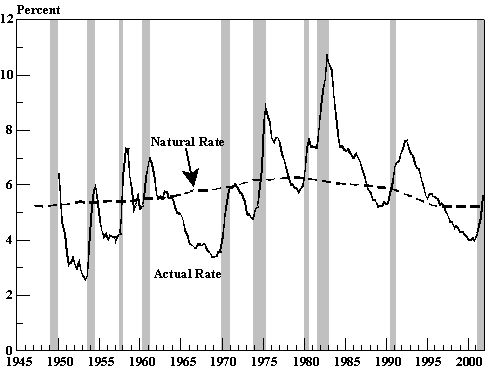
The question of the optimal level of unemployment has generally been answered by reference to the so-called “natural rate” of unemployment.  The natural rate of unemployment is measured as the long-run average rate of actual unemployment in an economy over time; it is a “trend line,” as seen in this graph below:

unemployment3

Read more of this Essay

Understanding unemployment, Part Two

Examining unemployment in more depth.

In an earlier post, I explained how the reported U.S. unemployment rate, which was 9.6% in August of 2009, is unemployedmeasured. This post will explore the reported unemployment rate in more depth, distinguishing between the short-term, temporary sources of unemployment and the long-term, more structural, and troubling aspects of the unemployment rate.


The 9.6% U.S. unemployment rate remains the same next month if no one changes their employment status.  But the rate also remains unchanged if the same number of people hired get fired.  In truth, the U.S. unemployment rate nets out enormous flows of people into and out of the labor force and, for those in the labor force, between being employed and unemployed.

A representative month in the unemployment statistic tells the story.

Read more about unemployment

Patrice Ayme, 9/11 anniversary thought

This is not comfortable reading.

Patrice published a Post on his Blog last September 11th.  Not being an American it felt wrong to echo that publication by linking to the Post on the 11th as well.  No logic, just the way it felt!

But it is so deeply interesting, that not to highlight the Post would be wrong.  This Blog, after all, is about integrity.  In that process, if the truth is uncomfortable, so be it.  And if others think that Patrice doesn’t speak truthfully then they must speak otherwise.  You see, integrity is really the pursuit of truth.

Patrice’s subject title is: Why France Is Bad: Profits Define Goodness.

Read an extract from Patrice’s Post

Lehman – 1 year on.

Exactly a year ago, Lehman Brothers filed for bankruptcy.

I shall avoid the temptation of pontificating on the subject as many, many others, far better qualified, will be doing so!Leyman

But two published articles seem to me to be worth visiting, one from October of 2008 from The Economist, and one from The New York Times.

Lastly, a personal comment from friend Dan that shows powerfully how the last year has affected him.

Read more of this Post

Now you see it, now you don’t!

Bermeja (Mexican Gulf) – anyone seen my island?

There’s a wonderful story in last week-end’s The Sunday Times, a British newspaper, written by Matthew Campbell concerning the loss of an important island that has been used previously to define the limits of Mexico’s maritime

Old map with Bermeja

border (read oil!).  Here’s an extract:

The mystery has come to haunt Mexico as unrelentingly as one of its beloved soap operas: where is Bermeja, an island off the Yucatan coast that appears to have vanished without trace?

The disappearance of Bermeja is no laughing matter – it would allow Mexico to extend its maritime border some 55 miles further north, helping it to fight off what it sees as American encroachment on its claims to potentially vast oil reserves in the Mexican Gulf.

Read more of this Post

Now this makes sense, not!

US Government Policy encourages next round of foreclosures!

Call me crazy but I thought that the sudden rise in single-family home mortgage foreclosures that began a year or so back was one of the main causes of the current financial crisis.

And that many of these foreclosures resulted from families over-extending themselves, taking on too much debt given debttheir income and other financial obligations, in part because of incentive programs designed to reduce the upfront cost of the home and the monthly mortgage payments during the first several years of home ownership.

So why is Washington pushing to expand and extend the first-time home buyer tax credit?

Read more of this Post