Category: Politics

This Month’s PAFF Award

Bob Dylan  a serious threat to ….. only China knows!

Congratulations China. You win this month’s Paranoid Fascist Fatuosity award by refusing to allow an ageing Bob Dylan to perform in Beijing and Shanghai.

It seems you are concerned that he might inspire people, and no doubt mostly your youth, to revolt. And (apart from political freedom of course) revolution is the last thing on your mind, even though a revolution spawned you 60 years ago.

So Dylan will live on for Asians only on CD, but thank goodness for that! Michael Jackson may have been the self-styled “King of Rock”, but Dylan was astonishingly and iconically original and unique.

I say “was” of course not out of disrespect to today’s version, but with those amazing years of the 60s in mind when protest was in our very soul and played its part in the revolutions of 1968 and later the big one, the fall of the Berlin Wall and the end of the USSR.

On second thoughts, perhaps the Chinese Communist Party is not so paranoid after all. As my psychiatrist once said to me: “No Mr Snuggs, you’re not paranoid; they really are out to get you.”

Still, what a pity. What a sad reflection on the so far failure of “globalisation” to penetrate far into CPP mindset. Where is the Chinese “Glasnost”? Where lurks the Chinese Gorbachev?

Just in case you’d forgotten, here are some of the words that apparently strike such fear into the Forbidden City. Just as in the British civil service, “change” is not something welcomed with open arms:

Come mothers and fathers throughout the land,
And don’t criticise what you can’t understand.
Your sons and daughters are beyond your command,
Your old road is rapidly aging.
Please get out of the new one if you can’t lend a hand,
For the times, they are a-changing.

The line it is drawn, the curse it is cast.
The slow one now will later be fast,
As the present now will later be past.
The order is rapidly fading,
And the first one now will later be last,
For the times, they are a-changing.

PS Most “serious” western newspapers did in fact report that the tour was cancelled because permission was refused by the authorities. However, just because the CPP is fascist – and of course all fascists maintain strong censorship – it doesn’t necessarily mean they are ALWAYS guilty. “The truth” is sometimes an elusive quantity. Well, re the Dylan tour, here is an alternative version of what happened …. perhaps the last page has not been told.

Bob Dylan

By Chris Snuggs

Today’s Quiz

The British General Election is really hotting up, with mud flying in all directions.

Mr Pott. Your proposal to keep NI (National Insurance contributions for employers and employed)  as it is rather than putting it up as we propose (as usual) will leave a black hole in the country’s finances.

Mr Kettle: a Black hole? YOU are worried about a black hole??? Ha, Ha, Ha ……

Your quiz question: Who are the real Mr Pott and Mr Kettle?

Answers soon …..

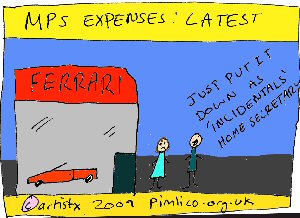
Perkins and the Dodgy Expenses

It’s not really the public’s money, is it!

MP's expenses
[This cartoon is licensed under a Creative Commons Attribution-Noncommercial-No Derivative Works 3.0 Unported License.You can use it on your own site under the relevant useage rule.]

Good morning, Sir ….

Is it, Perkins?

Oh Dear …. what’s happened now, Sir?

It’s this dratted expenses nonsense.

Nonsense, Sir? Then why are the police involved again?

Again?

Yes, Sir. They’re also investigating the mysterious unthinking think-tank remember?

Oh yes, I’d forgotten that.

There’s a rumour going round the canteen that the police are going to set up an incident room on the terrace of the House of Commons, Sir.

On the terrace?

Yes Sir. The idea is to save time going to and fro’ the house; deal with the criminals, sorry MPs, in batches – benefit from economies of scale sort of thing ….

Perkins! That’s the kind of silly rumour started by malicious gossips. I’m surprised you even listen to such tittle-tattle.

But you must admit it’s a rum do, Sir – using public money to finance his son’s university education!

But Perkins, it was only his expenses that he used!

That money is supposed to be used – if I may say so – for expenses, Sir.

But those WERE expenses, Perkins! Goodness, you are being obtuse, today. When your son goes to university you certainly have expenses, I can tell you!

I meant his parliamentary expenses, Sir.

Oh really, Perkins. If we’re going to start nit-picking over every pound in every expense account in the House of Commons then where will we be?

I don’t know where we’ll be, Sir, but I know where the police will be and where half of our illustrious MPs will end up ……..

But Perkins, we’re talking about money already earmarked for expenses. Once it’s allocated then it doesn’t really exist any more; it’s virtually spent!

Well, it seems this money was actually spent, Sir – and after all, it was public money, Sir!

Public money? What on earth are you talking about, Perkins! It was the government’s money!

But it came from the public, Sir!

Aha! Got you there, Perkins. Granted it WAS the public’s money originally but once it left their bank accounts it became Government money! Surely you can see the distinction?

I’m sorry, Sir. I didn’t go to public school ….

By Chris Snuggs

Alistair Cooke

A tribute to Alistair Cooke of Letter from America

Many, many people of a certain age will remember with very fond affection the weekly BBC Radio broadcasts of Alistair Cooke under the title of Letter from America.

Alistair’s broadcast title, Letter from America, came to mind because I have been thinking for a couple of weeks about what to call my impressions about moving to Payson in Arizona.

Payson Perceptions? Pictures of Payson? Payson Profile?  No!  They all seemed naff!

But would it be too presumptuous to echo Cooke’s hugely famous programme title?  Hopefully not.

(And regular readers will know that yesterday, the first Letter from Payson was published.)

I did a Google search on Alistair Cooke and immediately found the BBC web page devoted to him.  For those that don’t know Cooke here are a few details from WikiPedia.

Born in 1908 in Salford, Lancashire, England, Cooke first started broadcasting for the BBC in 1946 and continued until the 20th February, 2004, a total of 58 years and making Letter from America the longest-running speech radio show in the world.

I hope the BBC will forgive me in reproducing here on Learning from Dogs the obituary that is on the Alistair Cooke website.  He was a wonderfully interesting man and his weekly Letter from America seems to have been part of my complete life (in a sense it was).

——————-

Reading Letter from America in the 1950s

He read his Letter from America for 58 years

Esteemed writer and BBC broadcaster Alistair Cooke, famed for his programme Letter From America, has died aged 95. BBC News Online looks back at his long and respected career.

For more than half a century, Alistair Cooke’s weekly broadcasts of Letter from America for BBC radio monitored the pulse of life in the United States and relayed its strengths and weaknesses to 50 countries.

His retirement from the show earlier this month after 58 years, due to ill health, brought a flood of tributes for his huge contributing to broadcasting.

Born in Salford, near Manchester, northern England, Alistair Cooke’s father was an iron-fitter and Methodist lay-preacher.

Alistair Cooke

Alistair Cooke: Consummate broadcaster

Winning a scholarship to Jesus College, Cambridge he read English, edited the undergraduate magazine, Granta, and founded the Cambridge University Mummers.

Alistair Cooke made his first visit to the United States in 1932, on a Commonwealth Fund Fellowship which took him to both Yale and Harvard universities.

Following his return to Britain, he became the BBC’s film critic and, in 1935, London correspondent for America’s National Broadcasting Corporation.

He returned to the United States in 1937 to work as a commentator on American affairs for the BBC. He made his home there and, in 1941, became an American citizen.

Alistair Cooke

A passion for jazz

March 1946 saw the first edition of American Letter, which became Letter from America in 1949.

The series was the longest-running series in history to be presented by a single person.

Alistair Cooke never decided what he was going to talk about until he wrote the script, made no notes during the preceding week and preferred to rely on his memory.

In an interview given at the time of the 3,000th edition of Letter from America, he appeared to have mixed feelings about the future of the United States.

“In America,” he said, “the race is on between its decadence and its vitality, and it has lots of both.”

Addressing Congress in 1973

He addressed Congress in 1973

Cooke led his listeners through the American vicissitudes of Korea, Kennedy, Vietnam, Watergate, Nixon’s resignation and Clinton’s scandals.

In all of this, Cooke pulled no punches. The lyricism of his broadcasting and the urbanity of his voice did not disguise his fears for America which he saw becoming a more violent society.

A liberal by nature, he reserved particular dislike for what he saw as the shallow flag-waving of the Reagan presidency.

Alongside working for the BBC and The Guardian, for which he wrote from 1945 to 1972, he developed a passion for jazz and golf and, as a film critic, he mixed with Hollywood stars.

As a commentator on history, Cooke was sometimes an eyewitness too. He was just yards away from Senator Bobby Kennedy when the latter was assassinated in 1968.

He was never as comfortable on television as radio but, by the 1970s, his hugely successful television series America recounted his personal history of his adopted homeland and won international acclaim, two Emmy Awards and spawned a million-selling book.

British or American?

The Queen awarded him an honorary knighthood in 1973 and the following year, for a journalist, he received the ultimate recognition – he was asked to address the United States Congress on its 200th anniversary.

He told his audience he felt as if he was in a dream, standing naked before them and there was only one thing he could find to say.

Teasing, he exclaimed to the assembled legislators, “I gratefully accept your nomination for President of the United States!”

Naturally, he brought the house down.

Many Britons thought he was American, but to the Americans he was the quintessential Brit, the man who brought them the best of British television as presenter of Masterpiece Theatre. For his part, he explained, “I feel totally at home in both countries.”

He impressed both audiences with his high quality work. With his unquenchable curiosity, Alistair Cooke remained for decades the consummate broadcaster, an elegant writer and a man of enormous wit and charm who made sense of the American Century.

By Paul Handover (still missing Letter from America on the radio.)

The Age of Pledge and Spin

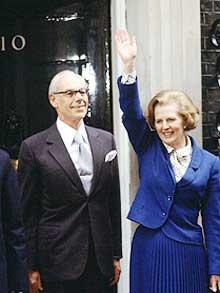
Mrs Thatcher and hubby

A dream that, perhaps, one day politicians will be truthful.

British General Elections are always fascinating occasions. On the one hand they are deadly serious. Mrs Thatcher’s win in 1979 set up the country for 18 years of Tory rule with massive changes and frequent social conflict whose effects are still felt today.

It was either a total social and economic disaster or a great leap forward into modernity depending on your point of view. Her victory of course also consigned Labour to 18 years of impotent pfaffing about in the political wilderness.

But on the other hand they always cause a great deal of hilarity to the student of human behaviour, as day after day nonsensical, fatuous, spinladen pronouncements are made by those desperate to get their hands on power.

And these pronouncements of future intentions (often delivered with the word “pledge” attached – as if that were somehow more weighty than “promise”) are often based not on reason or good planning but on how they will go down with the public!

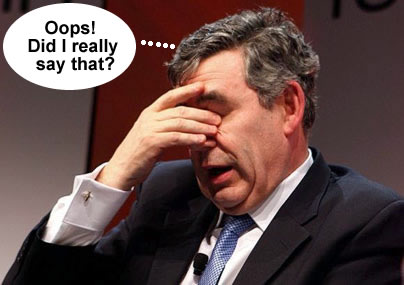
And amazingly, they often seem to be made without any great thought about the consequences. Brown has got some stick only today because he promised (or if you like “pledged”) that there would be no VAT imposed on the Simon Cowell charity record for Haiti, yet EU rules prohibit such gestures and so the Treasury is having after all to charge VAT and is now promising to pay this back with increased aid as a workaround.

Foot in mouth - again!

The increased aid could have been given in the first place without his headline-grabbing “pledge” to make it VAT-free.

As ex Chancellor, Brown should have KNOWN that removing VAT from individual items on a whim is not allowed, but he clearly spoke without thinking, the headline-potential of declaring the record VAT-free being irresistible.

Gordon Brown has also got himself into “another fine mess” by trying out a variation of  his trick of the 1994 election.

During the pre-election campaign then he solemnly pledged NOT to raise income tax. No,  not he. He was not the man to steal the public’s hard-earned cash by raising income tax; that would be most unsporting.

Meanwhile the poor old honest and hopelessly-naive spinfree Lib-Dems promised to put one measly pence onto income tax to pay for more education. Naturally, in the election they got slaughtered as wild spenders. You couldn’t make it up!

As for Gordon Brown, he kept his word. Income Tax remained as untouched as the virgin snow. But he had a cunning plan; as soon as he got his hands on our money, he vastly raised National Insurance (NI) instead. It actually comes down to the same thing, but of course the SPIN was different. That was how Brown’s management of our finances began, and so it has gone ever since.

Well, it’s hard not to repeat a winning formula, as many crooks have found out to their cost.  Putting up National Insurance of course (even if this time you TELL the people you’re going to do it) can be sold as much more  socially responsible than simply putting up income tax. The former can be spun as essential to pay for hospitals, pensions and the like whereas the latter seems more often like Robin Hood in reverse. The silly thing is that it’s ALL MONEY TAKEN FROM OUR PAYPACKETS, so what difference does it make?

Well, to the wage-earner, none at all, but to the employer quite a lot, and this is where Brown is batting on a sticky wicket. Increasing National Insurance certainly IS a “tax on jobs”. Let’s look across the English Channel ……

They have a VERY high level of NI (French = “charges”) in France. The result is that:

  • Employers bend over backwards NOT to employ anyone; it is so expensive.
  • Productivity in France is very high (higher than in the US – fewer workers than in many other countries do the same amount of work).
  • Unemployment is also consistently very high.

In Denmark it is much cheaper and easier to hire and fire people than in France. Oh Dear! Horrible, nasty, capitalist,  Denmark and wonderful, caring, socialist France!!

Errmmm … No, actually; unemployment in Denmark is usually around 4% (I just checked; it is TODAY despite all the economic chaos just 4.1%) and in France endemically nearer 10%.

Rocket science it ain’t. Sad for the otherwise-could-be-employed it certainly is.

Well, even the plebs are not quite as gullible as 25 years ago. The negative effects on employment are blindingly-obvious to employers but as it is such an easy thing to understand (though not apparently for the entire French government or for Mr Brown) ordinary people are beginning to understand it, too. Brown’s statement that he will raise NI isn’t doing his election campaign any good at all.

However, as it is currently business leaders in particular who are bleating about this, perhaps it will be spun as: “Don’t worry chaps – it’s just those capitalist business-chief bastards whinging again”. That’s one thing you can rely on in an election; there will be endless spinning, quoting of statistics and rubbishing of the enemy ….

By Chris Snuggs

The State of the Union?

A view of the Union from across the Pond

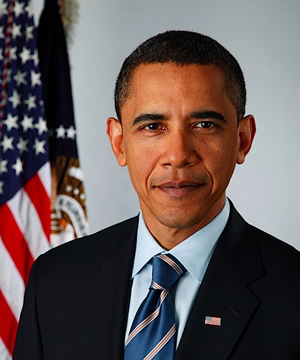
Dr Sherry Jarrell commented recently on her disappointment with President Obama, with two specific criticisms:

A) the way he speaks to the people, or perhaps to some of the people

B) his handling of the economy

With this in mind and given that the President has now been in office for long enough for a judgement to be made, here is a view from this side of the water.

HOME

How he speaks to the people. I can’t judge this; I don’t currently have a television, let alone one with access to all the US media; And “yes”, I know this is a bit bizarre, but there you go …

What does surprise me is that during the election he showed himself to be an orator of considerable talent. Indeed, without this talent to inspire people it seems unlikely that he could have got elected in the first place. So what has gone wrong? Do the people he is speaking badly to perhaps deserve it?

The economy? Dr Jarrell is the expert. However, I just caught sight of a headline about US growth, which seems to be picking up surprisingly well.

Surely it is not all gloom, even if unemployment is high at nearly 10%. However, if you think this is bad you should visit Spain.

Health? As a European, one struggles to understand why he has been criticized by some on this issue. The US can’t afford it? Well, perhaps the bankers should be giving up some of their vast salaries and bonuses to help pay for it.

Priorities? How can the USA possibly NOT have a universal health system, when poor little Cuba has one? As I understand it, health consumes about 17% of US GDP, which is WAY above other comparable nations.

Something is wrong here. Have the medical profession and pharmaceutical companies got Americans by the short and curlies? And even this 17% didn’t until now include tens of millions of people. I would really like to have someone’s take on this.

The Republicans? Well, are we seeing a great party beginning to implode? The hysteria over the health reforms is astonishing. The “Tea Party” group has issued all kinds of threats and complaints that even senior members of the Republican party have not criticized. What is going on here?

Do they have no understanding of how modern, civilised societies work? As a friend of mine put it (as it happens a strong supporter of the Cuban regime, which I certainly am NOT) “You judge a society by the way it treats its poorest and weakest members.” On this score, the Republicans are living on another planet.

I read a fascinating take on this the other day in the New York Times.  In essence, Frank Rich claims that the Tea Party hysteria is nothing to do with the health system, but concerns the fact that WASPs feel threatened as they will soon be in a minority in the USA.

Yup – hard to believe for a British kid brought up on John Wayne, the Pilgrim Fathers, New England and all that … but true. Even so, if the Republicans are not to become a laughing-stock they need to find some more statesmanlike leaders. Sarah Palin just doesn’t cut the mustard I’m afraid.

Oil & Energy? Well, he is cracking down on gas-guzzlers. He has to have points there, surely? It is both essential and long overdue. On the other hand, he has sanctioned oil exploration in hitherto off-limits areas, the  idea being to reduce dependency on imported oil. Very commendable, but the aim of all nations is to reduce consumption, isn’t it?

AWAY

As a European, whatever impression one has of the USA has to be tempered by remembering that one does not live there. One simply cannot pick up the real mood of the country unless one has feet on the ground, and so all the above comments are impressions, possibly misplaced.

But on INTERNATIONAL affairs one is on slightly firmer ground, and of course what the US does internationally also concerns us more directly. When he took office, I decided I would judge him on one thing in particular ……

Palestine: There has been precious little movement since 9/11. Lots of “talks”, “negotiations” and proposals of course, but underlying it all the feeling that the Israelis are not going to give up anything at all.

The present government in particular seems like an immovable object on many key issues that must – frankly – be resolved by compromise on all sides. This is where an irresistible force comes in, and this can only be Obama.

Well, there have been positive signs, but I have yet to see evidence that pressure on Israel will be both real and sustained. Sometimes “negotiations” and “frank-talking” are just NOT enough, and this is one of them. The jury has retired with some recent positive feelings, but it is still out, and very sceptical.

Iran/China?: Obama has tried to be nice to these people, but – as with Israel – being nice sometimes doesn’t do it. There is I feel serious trouble ahead with China, one way or the other. Will Obama be tough enough to deal with it? The jury is still out on that one, too.

SUMMARY: Humans tend to be optimistic folk: we believe there is a solution out there somewhere. We believed Obama might be it.

We were as ever hopelessly-idealistic. Nevertheless, I am mindful that this is an extremely inexperienced President, chosen by Americans for his youth, optimism and charisma more than his long experience as a statesman.

He will need time. Unlike some Americans – who already think he is the anti-Christ (those strange Republicans again) – I am prepared to wait a bit longer to make a final judgement.

By Chris Snuggs

U.S. unemployment remains at 9.7%

Little reason for celebration

The official unemployment rate of the U.S. economy remains at 9.7%,  and the underemployment rate increased to 16.9%.  These numbers represent a real tragedy for many Americans.

While the White House tries to celebrate the creation of 162,000 new jobs last month, at least 48,000 of these new jobs are government jobs, specifically temporary census workers, who are doing unproductive work and are being paid with taxes collected from the rest of the private economy.

Unemployment

Employment also increased in temporary help services and healthcare, but continued to decline in financial activities and in information, which is interesting given the recent comments by President Obama that the government takeover of the student loan program tucked into the health care bill “took $68 billion from banks and financial institutions.”(Obama’s  April 1 remarks)  That’s a lot of jobs, Mr. President.

Seems like there is more concrete evidence that, rather than creating jobs, the President’s policies are costing the economy jobs.

by Sherry Jarrell

Morality and Trading Relations

Morning Perkins ….

Perkins? I know that look … what’s up?

Whitehall Ministry

Well Sir, it’s this Gulagov case, Sir.

Oh, you mean that child abuse thing …

Well, that seems an inadequate description, Sir.

Now come on Perkins. You know that these things happen down there in the underclass.

But this is more than the usual knocking-about of wives and kids that goes on Sir.

But it doesn’t do to over-sentimentalize things, Perkins.

I’m sorry, Sir, but do you actually know the details?

Details? Good God, man! I’m far too preoccupied with the broad sweep of politics to worry about details!

But it seems this tyrannical father actually starved several of his kids to death …

Goodness me, and there were we thinking New Labour had abolished poverty.

And there were apparently three other kids locked up in perpetuity; one of them subjected to horrendous torture ….

Locked up? What had they done?

They apparently answered back, Sir?

Answered back?

Yes, Sir …. and there’s more ….

There usually is with you Perkins.

Those who weren’t starved to death or locked up were subjected to a life of deprivation, misinformation and misery, Sir.

You mean they were British voters? (just a joke, Perkins …)

It’s not a laughing matter Sir. They had no access to proper food or health provision.

Sounds pretty normal for the mob to me, Perkins …

And then they were brainwashed; they could only see and hear what their father wanted them to see … they have no idea what is going on in the outside world, Sir ….

But the mob have always lived like that, Perkins – they do read “The Daily Mail” after all …

But you haven’t heard the worst, Sir!

Oh dear …

Last week two of the kids ran away. They managed to climb across the fence into the grounds of a major company on a neighbouring industrial estate. But a guard caught them and took them back to the tyrannical father, even though they were crying, emaciated and showed signs of malnutrition and harsh punishment ….

Goodness Perkins …. this does sound bad.

I’ve been investigating, Sir, and it seems that it is this has happened before and it is company’s policy to hand the kids back instead of trying to help them.

Well, one can’t interfere in private family matters, Perkins …. come on, let’s have a cup of tea and get on with the preparations for the election …

But I found out more, Sir …

Oh Dear, Perkins …. all right, tell me the worst!

Well Sir, it was all very well concealed, but I discovered that this large company that handed back the cruelly-treated children is the government’s largest supplier of cheap, rubbishy goods ……

Perkins! For goodness sake! They are NOT cheap and rubbishy … cheap perhaps …

So you KNOW about this company, Sir?

Of course Perkins …. as you said, they are our main supplier.

But they connive with child abuse, Sir …

Look Perkins, if we were to have a crisis of conscience over every single case of abuse we’d hardly be able to import anything, except from Canada, Switzerland, Germany and Sweden, and have you seen their prices?

But it’s not moral, Sir …

We try to avoid using this word in politics, Perkins. We would be on a sticky wicket on thin ice if we didn’t ….

But back in 1994 Robin Cook said that the new Labour Government would have an ethical policy on abuse …

Perkins, let me explain the difference between heady, overblown, post-election rhetoric and the real world of pragmatism … besides, Robin Cook died …..

So our pragmatism outweighs our morality?

Well, doing it the other way would only mean shooting ourselves in the wallet, Perkins ….

But it’s very sad, Sir!

Indeed, Perkins, but not for us, and that’s the main thing after all …. come on – put the kettle on ….

[For Gulagova family read North Korea; for large trading company read China, Ed.]

By Chris Snuggs

Elliot’s schooling

Elliot Engstrom – Guest Author

Elliot was ‘exposed’ to the Learning from Dogs readership on the 22nd March as our first Guest author.  He wrote about the US Government and Poverty.

Elliot has one important distinction with respect to the other authors of this Blog; he is the right side of 30 years old!

He is going to use this perspective to reflect on schooling, something that most of us ‘aged’ peeps take for granted, assuming we can remember our school days! 😉

It promises to be a fascinating reflection.

———————————–

Setting the scene

I’ve had a plethora of experiences over the past 17 years of my life. I’ve made and lost friends, had romantic

Elliot Engstrom

relationships, read, traveled all around the world, lived in France, and done countless other things that I consider myself immeasurably blessed to have experienced.

Despite the fluidity of where these different experiences have taken me, my entire life since the age of four has had one characteristic in common – I have been a school student.

In the spirit of “Learning from Dogs,” I thought it might be interesting to reflect a bit upon the core dynamic between education (not learning, which is a far broader topic) and schooling.

I often ask myself just how effective the modern US schooling system is as a tool of education, and whether or not its costs outweigh its benefits. I hope to have at least a rough answer to this question in the final post of this series.

In the following three posts, I will examine three topics:

In what ways does the modern schooling system function as a positive tool for education?

What costs involved in modern schooling hinder its ability as an educative tool, and even make it a negative influence on students?

Considering the analyses put forth in the first two posts, do the costs or benefits or this system outweigh the other? On the whole, are school and education complements or antagonists?

This series is going to be exciting for me because, to be quite frank, I have no idea what my final answer is going to be. I guess I’ll just have to stay tuned to see where my brain takes me – and so for you!

By Elliot Engstrom

So what next in the global merry-go-round?

Well, it is a Chinese saying, “May you live in interesting times”!

A couple of weeks ago on Learning from Dogs, there was an article reminding readers that the web has been around for 20 years and Sir ‘Tim’ Berners-Lee is still hard at it in terms of Internet innovations. And to support this, today accompanying this Post is one on what the BBC is doing to commemorate the event.

The Internet has completely reformed the way that ordinary people get access to information.  Stratfor is a great example.

From their web site:

STRATFOR’s global team of intelligence professionals provides an audience of decision-makers and sophisticated news consumers in the U.S. and around the world with unique insights into political, economic, and military developments. The company uses human intelligence and other sources combined with powerful analysis based on geopolitics to produce penetrating explanations of world events. This independent, non-ideological content enables users not only to better understand international events, but also to reduce risks and identify opportunities in every region of the globe.

One can subscribe to a range of free reports and it came to pass that a Stratfor report on China came into my in-box.

Stratfor generously allow free distribution of this report and because the relationship between China and the USA has so many global implications, the report is published in full, as follows:

Read the Stratfor report