I was a client for many years but had to terminate that client relationship when residence in the USA became highly likely! Very happy with the service and advice provided – extremely so! (I have no relationship at any level with that firm now!).
Anyway, David publishes what he calls Contrary View from time to time. His latest is reproduced with his permission.
No. 074 9th August 2010 A statistical impression
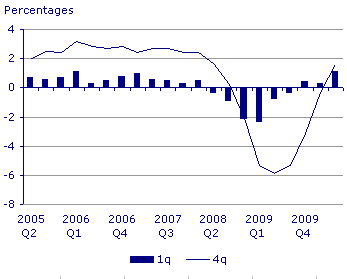
Over the last few weeks a number of graphs have appeared showing how the economy has apparently picked up to where it was before the credit crunch started. Such graphs invariably show a ‘U’ shaped curve demonstrating perfect recovery. This is the impression easily formed by a glance at such a graph, but it is the wrong assumption to make.
National Statistics reports Gross Domestic Product (GDP) as two different measures, both estimates showing a decline in GDP. Here are the latest figures (estimated), taken from their website last week:
3rd Qtr 2008 Index 102.6
2nd Qtr 2010 Index 99.0
This GDP index shows a permanent loss of output.
Detailed figures are also available (Table 1.02 of the UK economic accounts) and on the same estimating basis, seasonally adjusted, report:
3rd Qtr 2008 GDP £340,780 million
2nd Qtr 2010 GDP £328,766 million
No matter how you look at these figures, there has been a permanent loss of output of just over 3.5% in this period.
This loss of output means less work, so debts are more difficult to service. Why do the press produce graphs showing an apparently perfect recovery? The answer is that the graphs are taken from the National Statistics press release, for example on 23rd July 2010. The graph that is offered is a rate of change, not the level of output, and may simply have been copied without consideration of the impression formed.
WARNING: The firm can only be responsible for action taken on our advice given personally and specifically to be suitable for each individual. Statements on this site do not, on their own, constitute advice. Please note that UK regulatory requirements prevent us commenting on your existing investments or giving specific advice, unless you first sign one of our portfolio service agreements.
As I mentioned in a comment to a regular reader of Learning from Dogs:
To me, sufficiently old to have watched Governments for some decades now, the most striking thing about the present circumstances is the terrible decline in political integrity.
Sometimes looking down the other end of the telescope reveals more, much more!
Afghanistan - where is it leading?
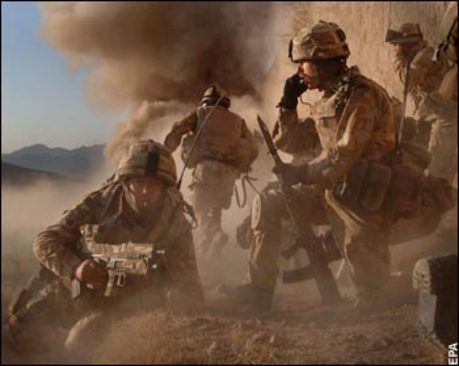
Now that coalition forces have just recently suffered their deadliest month yet in the conflict in Afghanistan, it now has become more crucial than ever to rethink the strategy of the United States and its allies in the region. Currently, the cornerstone of this strategy rests upon two key factors – winning over the local peoples of the region, and training local forces to carry the burden when, and if, coalition forces leave the region.
At least on the exterior, these goals in Afghanistan do make some sense. The only possible way to succeed via a continued military occupation of Afghanistan is to attain and bank on the support of the local peoples. Also, if western powers are ever to withdraw from the region, local forces will have to be able to maintain whatever structure these forces leave in their wake.
However, while this strategy is not completely outlandish and does show some merit on the part of military strategists in that they are leaning more towards localized models that entail comprehension of diverse local factors, the question still must be asked – is this strategy actually possible to carry out and have the sought-after effects in the region? Can the United States and its allies actually win over the peoples of Afghanistan and western Pakistan, and can these same powers possibly train forces that will remain peacekeepers in the years to come?
Despite the fact that I admire the intentions of the military’s current strategy in this region, I do not think that their plan is in fact possible. It seems to me that rather we are fighting an unwinnable war to win over a people that we do not and cannot understand, and that by funding the Afghani security forces of today, we are inevitably funding our enemy of tomorrow, just as our nation has mistakenly done so many times in the past in this very region.
I cannot foretell the future. Nor can anyone else. However, I can comment on what is likely to occur. And, in constructing such a model, two of the most important subjects to understand are history and praxeology, or human behavior.
An attempt by the United States to make Afghanistan a stable, western-friendly state is by no means a new happening. The date of the beginnings of our intervention in the region could be debated, but a decent starting point is the late 1970’s when President Carter put forth the Carter Doctrine, which stated that the United States would defend its interests in the Middle East.
This doctrine just barely preceded the Soviet invasion of Afghanistan, and it was this invasion that saw the beginnings of American forces, at this point being mostly CIA and other such agencies, which were attempting to hamper the Soviet forces by funding the Afghani resistance.
Now, there is no room here for a history of American involvement in Afghanistan. However, what must be noted is that during the 1980’s and 1990’s, a pattern developed in the Middle East – the United States would fund a group in the hope of combating some common enemy, and then in later years the group funded with American taxpayer money would inevitably end up turning against the United States.
A few prominent examples of this are Al Qaeda, who received $6 billion from the United States from 1989 to 1992, the Afghani Taliban, who was receiving US foreign aid up to the very minute American forces entered their country (and continues to receive US foreign aid through Pakistani backchannels) and Saddam Hussein, who received chemical weapons from the US during the Iraq-Iran War of the 1980’s, weapons he later used to kill American soldiers.
This, though briefly put, is the history, or the “what.” So now must come an examination of the “why,” or the element of praxeology. For obviously, our attempts to forge friendships in the region in the past have failed. Our friends have become our enemies, in fact our worst enemies.
There are several possible explanations for why this occurs. However, mine is quite simple – we do not understand these people, we do not understand this region, we do not understand Islamic culture, and, to be quite blunt, we never will. It is not a wrongdoing by the West to look at the Middle East through Western eyes. Rather, it is the only way that a westerner possibly can look at the Middle East.
On top of this extremely problematic misunderstanding of the Middle East by Western peoples then comes another layer of problems, these being the base problems of intervention in any context, amplified by the extreme foreignness and instability of the Middle East as a whole. The consequences of intervention in any scenario are so unpredictable, so many, and so far-reaching that no one can possibly intervene and successfully fulfil their objectives without in the process creating a dozen new problems. This is seen with the federal government intervening in states in their own country – how much greater then are the problems when intervening in a region like the Middle East?
All this now brings us back to the point on considering the future. As I mentioned previously, I cannot say what the future holds. However, I can make an educated guess. And, based on analyses of both history and human behavior, it is safe to say that by both indirectly and directly funding the training of a new military force in Afghanistan, we very likely are creating our enemy of tomorrow. For when these people that we are now training realize that the United States is not leaving, that they are not in fact a free state, that they have become a part of the American empire, and that if they want to live culturally independent of western influence they will have to forcibly remove Western elements within their borders, it seems extremely probable that they will do exactly that.
To say that we are creating a force that will do what we expect it to do in the future is a wish at best. The reality is that we do not and cannot understand what is truly a foreign mindset, and our best course of action would be to distance ourselves from what is and will be for many years of region of perpetual conflict.
I don’t know Ms. Romer personally but I certainly know her work both in and out of the White House. I can only hope that the inconsistency between her work as a truth-seeking academic and as an Obama apologist finally got to her and is, at least in part, one of the reasons she resigned as chair of the White House Council of Economic Advisers.
It will be very interesting to see how her writings progress from here.
Just a couple of items from disparate sources came together last Friday to demonstrate just how possibly corrupt it has been over the last so many years! But there is a golden lining to this stuff.
That is the ever increasing spread and reach of all forms of digital communications, from the humble email through to Wikileaks, is making it increasingly difficult for those that wish to cheat and lie their way through their lives, at the expense of others, to do so without detection.
Anyway, back to the theme of the Post.
The first item is from here (thanks to Naked Capitalism for the link):
A news story today provides further confirmation of the rule by the banking classes in the US, with only token gestures to the rule of law.
(and after an in-depth review closes with:)
The message seems pretty clear. Sarbox [Sarbanes-Oxley Act. Ed]was intended to curtail phony corporate accounting in the wake of Enron. But why resort to complicated transactions like the energy company’s famed Raptors when Citi shows that mere lying will produce the same results with much less fuss?
All three years of the revision period were revised down. Again, if a mistake or inaccuracy (as opposed to intentional falsehood) is responsible for errors, one would expect them to be normally distributed – that is, some would be positive, some negative. This is obviously not the case.
Is there any good news in the report? Well, yes – there was a material uptick in non-residential fixed investment, centered around equipment and software. How much of this is a normal replacement cycle (deferred last year) and how much signifies real expansion is an open question and one not easily answered. However, I wouldn’t call this particularly “robust”, despite the pump monkey characterization this morning in the media.
The drops in some of the previously-published numbers were, however, simply stunning. For example, PCE (personal consumption) was previously reported for Q1/2010 as 2.13. The revision is 1.33, a thirty percent downward revision. That’s not an error, it was a falsehood.
Worse was the services false report. The previous reported number for Q1/2010 was 0.69. Revised was 0.03, a downward revision of ninety-five percent.
The services revision backward was truly sickening – the entirety of 2009 was negative with the exception of the fourth quarter, where all but the first was previously reported positive, and the changes were ridiculous. First quarter was revised down from -0.13% to -0.75%, second from +0.09% to -0.79%, and so on. Again,that’s not an error, it’s a lie.
Needless to say when I get all my graph source data updated, it’s going to look worse than it did – including my “government ponzi support” graph, one of my favorites.
The futures are diving on the report, as well they should. Not because it’s bad – but because the entirety of the 2009 data set was a bald-faced lie.
Frankly, I’m much less interested in what is happening to Western economies – my views have been regularly reported on Learning from Dogs.
What appals me is how far we seem from those famous words in the Gettysburg Address given by President Abraham Lincoln on the afternoon of Thursday, November 19, 1863 (my emphasis):
It is rather for us to be here dedicated to the great task remaining before us—that from these honored dead we take increased devotion to that cause for which they gave the last full measure of devotion—that we here highly resolve that these dead shall not have died in vain—that this nation, under God, shall have a new birth of freedom—and that government of the people, by the people, for the people, shall not perish from the earth.
Pres. Lincoln's words
P.S. As it happens, after finishing this article last Friday, Jean and I watched the film The Verdict in the evening. The words used by the lawyer Frank Galvin (Paul Newman) in his summation struck me so powerfully that I have made them a separate Post for tomorrow. By Paul Handover
A modern Greek tragedy – that could have been foreseen.
As I tried to point out in a recent Learning From Dogs post, foreign policy is an extremely complicated thing. This sounds self-evident, but it’s amazing the extent to which certain officials think they can control events occurring around the world.
I like to characterize US foreign policy in the Middle East as throwing rocks at a hornet’s nest, and then expecting to be
Unintended consequences
able to control the hornets when they emerge. The consequences of intervention are so many, so widespread, so complicated, and so unforeseen that no one can hope to be able to manage them, without inevitably intervening even more and thus fueling even more unintended consequences. (You can see a strong parallel between the overconfidence of government officials in the area of foreign policy and their attitude in areas of attempted economic control. But, that’s a separate discussion.)
Thanks to the wonderful (in my opinion) people at WikiLeaks, we have been able to see a much more realistic picture of the war in Afghanistan than has so far been available. CNN reports on one element of these reports that is none other than one of these most unintended of consequences — some of the most advanced military technology in our country’s arsenal falling into the hands of…well we’re not really sure who. CNN reports:
When unmanned aircraft crash in Afghanistan, scavenger hunters frequently aren’t far behind, U.S. military incident reports published by WikiLeaks suggest.
On several occasions, military units sent to recover the aircraft — known as tactical unmanned aerial vehicles — have arrived to find the aircraft stripped of valuable parts.
In April 2007, a parachute deployed on one that had maintenance issues, one report says. Troops sent to recover the aircraft couldn’t reach it until the next day, when they discovered it was missing some of its electronic components and its payload.
Is this a surprise? For me, no!
For those who oversimplify foreign policy to international powers moving on a chess board, yes. Government officials often forget that at the end of the day we are not dealing simply with “the Taliban” or “Al Qaeda” — we are dealing with individual human beings.
And while the Taliban and Al Qaeda as groups may seem predictable, individual human beings are essentially the most advanced supercomputers ever to exist on this planet. To think that one can predict the actions of human beings on the other side of the world, especially human beings whose culture and background one hardly understandings, is nothing but the highest form of hubris.
And, just like in Greek tragedy, the hubris comes just before the fall, when it turns out that the prideful character did not have everything under control, and in fact is the victim of consequences that he was too prideful to foresee or even consider as a possibility.
It is probably a bit non-PC [PC = politically correct, Ed] to say anything negative about the World Cup, but I sense that the importance of being PC is beginning to wane; not that it ever bothered me anyway.
Let’s look at the positives, since almost everything has some positives somewhere; Stalin, Hitler, Pol Pot and the North Korean regime being obvious exceptions.
They built world-class stadia on time.
The foreign visitors who were there generally got to venues on time and the matches all started on time.
Inside the stadia (despite the obvious occasional sillinesses for which we can blame FIFA), everything went tickety-boo. According to some pundits, the atmosphere was “the best ever”, despite (or because of?) the hideous vuvuzela.
There was no major crime wave, no terrorism, no significant disasters of any kind.
The South Africans were reportedly very hospitable.
Opposing fans celebrated together; the England fans totally restored their reputations; reports of drunken English mobs were distinguishable by their absence. (they probably couldn’t afford to get there.)
South Africa took pride in its ability to put on the World Cup, which many had suspected it incapable of.
For a month the nation forgot all its problems; most people had a big party, even if the South African team (and Africa in general) was made to realize the enduring gulf between its standard of football and that of the other continents.
So, all’s well that ends well, then? Unfortunately not ….
The country paid around 10 billion rand to put the event on, three times more than original estimates. Where did all the money go?
The country is left with giant stadia that may never again be filled, the so-called “white-elephants” typical of almost all these major events. Apparently even the wondrous “Birds-nest” stadium in Beijing used for the opening ceremony of the Olympics has only been used once since 2008.
Only half the number of expected foreign tourists came, as the organisers over-priced everything. Organisers claim the extra income generated will pay for the costs, but nobody believes them …..
Preparations for the World Cup provided jobs, but those workers are now back on the street. The ordinary people of South Africa benefited little from the event, except in terms of “national pride”.
And there of course is an interesting animal; “national pride”. In a grown-up world, you’d have hoped that national pride would be best achieved through one of the following:
the building of suitable housing for the population
the setting-up of an affordable and accessible national health system (fat chance, even the USA hasn’t got that!!)
the diminution and ending of corruption
the creation of a fair society
the development of the economy to provide jobs and create wealth to allow ordinary people to live decently and comfortably
Any of these and other things could be seen as deserving of “national pride”, but the ability to put on at vast expense a four-week jamboree that mostly benefited the political elite, other nations, FIFA and the international television networks is a dubious contender for “pride”.
But of course it depends which side of the coin you are looking at. For some, all the expense justifies the “putting of South Africa on the map.” The politicians as usual will have been the most happy; four weeks in the spotlight strutting about on the world stage, loads of media coverage, hundreds of journalists hanging on their every word …
As for the real ethos behind the World Cup, the bits that don’t hit the glitzy headlines, two in particular struck me as symbolic of Man’s capacity for self-delusion; Africa’s attitude to its poor and the obscene power of international non-governmental monopolies such as FIFA.
These have been variously described in excellent articles written by proper journalists. The first example is from Globalpost. I find it pretty depressing.
Green Point Stadium, Cape Town: In Cape Town, Green Point Stadium is covered in a sheath of woven fiberglass so that it glows at night like a floating bowl. But its location on six city blocks in a prime real estate area has also created controversy. In 2006, the city’s government published a study that found the stadium’s location offered the least amount of economic gain to Cape Town’s resident. In fact, repairs to several older stadiums in the surrounding area could have led to savings that could have paid for 250,000 new homes for the city’s poor, according to researchers.
But FIFA wanted a stadium that would sit between South Africa’s iconic Table Mountain and Robben Island, according to reports, causing the football federation’s president, Sepp Blatter, to come under fire.
“I really think that we’re going into Green Point because Sepp Blatter says: ‘I like Green Point,’ not because it is the best thing for South Africans,” Cape Town’s then-mayor, Helen Zille, said in 2006.
Sepp Blatter will take his $2 BILLION profit away with him to some lush office somewhere, while the ordinary residents of Cape Town pick up their lives as before. How long “national pride” will sustain them is a moot point.
Roadside waterseller in Gabon, West Africa
The Marketing Bonanza:If you’ve been to Africa and driven around a bit, you’ll know that there are street traders everywhere. These are desperately poor people who will try to flog you anything and everything. They wander up and down lines of cars carrying their pathetic wares. In the ferocious midday heat women often carry large heavy buckets full of water bottles on their heads. Many do this all day every day to earn a pittance.
But of course, like beggars in the big city, they don’t really create the right “image” and “ambiance” for a major international event with its glitz and invasion of well-off foreigners. So, as reported in “The Guardian” they were simply banned whenever the authorities considered it appropriate. So much for the World Cup “improving the lives of ordinary Africans”.
But not just anyone will be allowed to participate in what President Jacob Zuma calls “the greatest marketing opportunity of our time“. Informal traders – a significant part of the working poor – are subject to a verbatim “exclusion zone” from the bonanza in the fan parks, fan walks and stadiums. For them, the World Cup may as well be happening on another continent.
I have personal experience of something similar in Gabon. When the wife of President Bongo died, the whole country was ordered to do a week’s mourning. Street trading was banned. This of course did not affect the elite, but for many of the rest it meant the difference between eating and going hungry. When a few daring and desperate people dared to try to sell their pitiful produce in some locations the police confiscated it and trashed their stands.
And FIFA? It is reported to have made $2 BILLION in tax-free profits. Who controls this money? Why is it tax-free? How will it be spent? To whom is FIFA really accountable? Ah, to national Football Associations? You mean like the British one, which pays £6 million per annum to a failed manager, which is three times more than the German Coach gets?
These vast sums swilling about leave a nasty taste in the mouth. Of course, any organisation’s primary concern is usually to its own self-aggrandizement, so nothing new there. Even the European Union refuses to get its accounts signed off properly, so what faith the common man can have in the honesty of these vast international organisations is questionable.
Well, the World Cup has come and gone and it provided much entertainment for those watching the games. The long-term legacy for the ordinary people of South Africa (43% of whom live on less than $2 per day) is another matter, so forgive me if my rejoicing is muted.
PS The Vuvuzuela …. nothing to me more clearly illustrates Man’s stupidity. The sound output of this instrument is 113db, which can apparently become harmful to the hearing after only 90 seconds. Those in the stadia (including the players, by the way – did anyone ask THEM what they felt?) were subject to nearly TWO HOURS of continuous multiple vuvuzuelae. Many of those people will have had their hearing IRREPARABLY DAMAGED. This will only become clearer to them in LATER YEARS.
For me it is a symbol of our stupidity. All the above health risks are clear and known. Did FIFA ban the damned thing? OF COURSE NOT!! That would have diminished the “local colour” so vital for the international media, which gives Blatter his $2 billion profit. Who gives a damn about ordinary people’s hearing? I doubt whether Sepp Blatter exposed himself overmuch to the bloody things, though he seems pretty deaf already.Once again, for a transient thrill or benefit we do ourselves lasting damage, no different from the way we often treat the planet of course.
Well, as predicted, North Korea has totally got away with the murder of 40 odd South Korean sailors. The UN has issued a totally anaemic comment that does not blame North Korea for the sinking of the Cheonan, even though a multi-national investigation concluded beyond reasonable doubt that NK was guilty. This has enabled the gruesome NK regime to crow “victory”.
It seems that China insisted on no blame being attached to North Korea as a condition of the UN statement being issued.
One can only conclude that A) China is ignoring and/or condoning this murder, and is therefore complicit in it and B), the free world doesn’t really give a damn because their business with China overrides all else, in particular morality.
They – and Obama in particular – seem not to understand that A) you never cower before bullies and B) China needs us as much as if not more than we need them.
The North Korea regime is an obscene and tyrannical scar on the planet and has brought unimaginable suffering to its people for long decades. Many of its citizens have been born and died without ever knowing freedom, either of travel or of the mind. If the free world cannot make a firm and principled stand over this then it shames all of us.
Obama is a major disappointment. Here, as in US relations with Israel, I see no intention of standing up for what is right, i.e. freedom, democracy, self-determination and justice. How long must we wait for real statesmanship in the free world?
Congratulations to Martin Wolf of the Financial Times
An article was published in the FT on the 29th June that beautifully describes the ways in which we are all being so beautifully ‘screwed’ by the world of finance. (Note, you may need to register to see this article, but please do. Registration is free and the FT is full of great content.)
It starts like this:
This global game of ‘pass the parcel’ cannot end well
By Martin Wolf
Published: June 29 2010 23:31 | Last updated: June 29 2010 23:31
Paul here. Pass the parcel is a game for kids’ parties that involves passing a multi-wrapped ‘present’ around where the kid holding the parcel when the music stops gets to unwrap one sheet, then passes it on, etc., etc., until the kid holding the parcel with just one wrapper on it when the music stops gets the present.
Martin continues:
Our adult game of pass the parcel is far more sophisticated: there are several games going on at once; and there are many parcels, some containing prizes; others containing penalties.
So here are four such games. The first is played within the financial sector: the aim of each player is to ensure that bad loans end up somewhere else, while collecting a fee for each sheet unwrapped along the way. The second game is played between finance and the rest of the private sector, the aim being to sell the latter as much service as possible, while ensuring that the losses end up with the customers. The third game is played between the financial sector and the state: its aim is to ensure that, if all else fails, the state ends up with these losses. Then, when the state has bailed it out, finance can win by shorting the states it has bankrupted. The fourth game is played among states. The aim is to ensure that other countries end up with any excess supply. Surplus countries win by serially bankrupting the private and then public sectors of trading partners. It might be called: “beggaring your neighbours, while feeling moral about it”. It is the game Germany is playing so well in the eurozone.
It’s an article that really does need to be read in full. Martin concludes thus:
Yet it is quite clear that an isolated discussion of the need to reduce fiscal deficits will not work. These cannot be shrunk without resolving the overindebtedness of damaged private sectors, reducing external imbalances, or both.
The games we have been playing have been economically damaging. We will be on the road to recovery, when we start playing better ones.
Now I really don’t want Learning from Dogs to focus on ‘doom and gloom’. There’s more than enough of that to go round twice and thrice.
But when someone writes in such a great clarifying way – then it deserves the widest promulgation. The more we all know about the games being played, the better we can change the rules to benefit society. Well done, Martin.
Financial crises can be very difficult events to understand. Even for those who have spent a great deal of time studying such areas as finance and economics, comprehension of these disasters can be elusive. However, analyzing shared elements in the recent American and Greek financial crises can help give even the economic layman insight into their common causes.
One word can be used to sum up the basic concept behind both of these crises – overextension. Both the American and Greek governments attempted to take on a much heavier economic load than either could handle. While, in both cases, this has been painted by some as a noble, humanitarian effort to help those in need, methods such as inflationary monetary policy tantamount to theft and the disguising of massive budgetary deficits (in both cases with the help of Goldman Sachs) would not justify the means employed even had these efforts been successful, and certainly should be taken to task considering the disastrous ramifications of these actions.
In both cases, many are citing unrestrained spending as the source of the problem. For example, CNN wrote of the Greek crisis that “years of unrestrained spending, cheap lending and failure to implement financial reforms…whisked away a curtain of partly fiddled statistics to reveal debt levels and deficits that exceeded limits set by the Eurozone.”
Without suggesting that CNN was attempting to be deceptive in this explanation, as the points made certainly are important, it must be noted that things like unrestrained spending, cheap lending, and fiddled statistics are merely symptoms of the deeper disease. Instead of asking the government to spend less, tighten lending laws, and implement financial reform, one should instead ask the deeper question – how does the government even have the power to cause such problems in the first place, and why are the results of such government power so often much more hurtful than helpful?
This deeper problem, whose symptoms we are now dealing with, is central banking. The Federal Reserve System and its Greek counterpart, the Bank of Greece, each had a heavy hand in their respective nations’ financial collapses. This is due to these banks’ attempts at economic manipulation – the Federal Reserve directly sets interest rates, while the Greek system uses more indirect methods to do nearly the same thing. Note that it is due to their attempts at economic manipulation, as attempting to set economic law is about as useful as attempting to set gravity.
Consider this metaphor of setting gravity. A man claims to be able to set the force of gravity on the earth. He tells a stunt biker that he can set gravity to be half as much as normal. So, the biker attempts to jump a distance that is much longer than he normally would attempt. Upon jumping, the biker finds that, obviously, the first man never was able to set the nature of gravity at all, and he falls to the ground long before reaching his destination.
This is exactly what happened due to the actions of central banks in the cases of both the United States and Greece. Interest rates and other natural economic restrictions were said to be more flexible than they truly were. Thus, individuals who based their actions on this information ended up engaging in activities that were far more risky than usual. However, once they had “jumped,” so to speak, they found that, in fact, economic law was as strict as ever, and they “fell.”
However, if the answer is so obvious, why are we not hearing more about it? Each of these financial crises is extremely complicated, and the above described scene is, it must be admitted, an oversimplification. This is not to say that it is not accurate, but rather that this nature of the crises’ root cause is not immediately apparent to all upon examining the situation.
For example, a person who has been educated their entire life in an economic school that praises central banking, deficit spending, and government action in general would certainly seek to find another cause for the crisis, perhaps by blaming business owners for making risky investments or stating that government controls were not strict enough. However, a person who has studied and understands the damage done by central banking and government economic controls will be quick to realize what has occurred.
People with such knowledge are becoming more and more common in both the United States and around the world. “Even today, with an economic crisis raging, the response by our government and the Federal Reserve has been characteristic,” Ron Paul writes in his recent book, End the Fed. “Interest rates are driven to zero and trillions of dollars are pushed into the economy with no evidence that any problems will be solved. The authorities remain oblivious to the fact that they are only making our problems worse in the long run.”
While he may be one of the most popular adversaries of central banking, it is not just Ron Paul, or even Austrian economists, who are calling out government for its role in these financial crises. In an e-mail to supporters, Democratic congressman Dennis Kucinich cited “the 1913 Federal Reserve Act, the banks’ fractional reserve system and our debt-based economic system” as major factors in the American crisis.
Such complex and important issues as economic crises need all the attention we can give them, and it is impossible here to provide the in-depth analysis that these situations merit. It also must be noted that while both the United States and Greece have to an extent both engaged in central banking to their detriments, each country does have a different system. Still, the general principles hold, always returning us to that first word – overextension. As long as nations attempt to manipulate the laws of economics to engage in far grander pursuits than they can sustain, we can expect to see such economic crises as have been seen in the United States and Greece in the future.
Amazed they don’t just tax Fun and leave it at that!
Lemonade isn't a substitute!
Once again the British Politically Correct nanny-state lobby seems about to pounce by reducing the drink-driving limit to 50 mg. This is yet another fatuous knee-jerk “Let’s give the image that we are responsible and doing something” initiative.
No, I do NOT favour driving while drunk, but at 80 mg per ml you are not “drunk” or even impaired. The introduction of the 80 mg limit was a great step, but more would be a mg too far.
I know for an absolute fact that if I drink one pint of beer I am in no way more dangerous than if I drink nothing. Don’t ask me how I know; I just do. I’ve been driving all over Europe for 40 years; and experience counts for something after all.
Yes, I do want to see road accidents reduced, but let’s see something REALISTIC and EFFECTIVE. Why are most accidents caused? (apart from people way over the limit, unlicenced or driving unroadworthy cars and so on)
arrogance and lack of imagination: “It can’t happen to me.”
impatience: overtaking dangerously to save 45 seconds on a two-mile journey
driving too fast in the wrong place at the wrong time.
driving without consideration for others
not driving as if every other driver was an idiot
failing to give yourself enough of a margin for error
failing to understand statistics
The last two points are perhaps crucial. Drive on the périphérique in Paris and you’ll see examples of both. Of course, the French are, in general, brilliant drivers and 99.9% of the time they can get away with driving up someone’s boot, but statistics tell us that there is 0.01% of the time when this will NOT be OK.
What steps COULD be taken instead of clobbering the one pinter?
Start with the apparent ONE MILLION people in Britain driving either unlicensed and/or in uninsured or unroadworthy cars.
Ban rich Daddy’s boys from driving high-powered sports cars: nobody under 25 should be able to drive anything over 80 bhp for a start.
Where is the logic in manufacturing cars that can drive at three times the speed limit? BAN THEM. BE LOGICAL.
Make the viewing of video of the aftermath of accidents a compulsory part of the driving test so that people came reeling out of the room white and vomiting at the sight of accident victims with their faces smashed up and/or their heads severed. This is the REALITY of accidents. Let’s GET REAL.
Prevent people from driving for TOO LONG. Tiredness is a MAJOR factor in accidents, but there is ABSOLUTELY NO CONTROL over the hours that private motorists can drive. Modern technology could do something here.
Make the punishments for careless and/or dangerous driving SEVERE.
Make people AFRAID of causing an accident.
The truth is that a car is as dangerous as a gun and people should treat them as such. Sadly, familiarity breeds contempt and people too often forget the basic principles.
Every time I get in my car I tell myself the following:
Drive with as much care as when you first drove so nervously and gingerly on your first trip with your new licence.
Every journey could be your last. Just because the last n days have been trouble-free it doesn’t mean that today will. (statistics again)
There could be an idiot around the next corner, so drive defensively. (there is always a percentage of idiots, so statistically you are CERTAIN to meet one now and again)
Going too fast in the wrong place and/or conditions isn’t worth the risk. (stats again)
You have no right to maim or kill anyone else by bad driving and causing “an accident”‘.
Be afraid – think of what a serious injury or even your death would mean to your family.
It’s no good being “sorry” afterwards ……
Let’s hope the new British government has a bit of commonsense about this.
PS The Police could do their bit, too. A significant number of people are killed by policemen rushing about.
By Chris Snuggs
IAM Logo
A P.P.S. from the Editor. In fact, one of the best things that could be done is create an
incentive for passing the Institute of Advanced Driving driving test. I passed the test in 1966 and it has been the best investment I have ever made.
Why doesn’t the UK Government give a free year’s road-tax for every person who passed the IAM test. All this proposed change in the drink/drive limit will do is to put yet more British pubs out of business. G’rrr.