The powerful anti-democratic forces that will threaten civilisation.
In one sense this post today carries an underlying political message – and in another sense, it does not. It does in the sense that if every American voter truly understood the risks of a continued relationship with oil then the tar-sands projects wouldn’t have a prayer of a chance of being allowed.
In the other sense, it does not. Because the influence and power of ‘behind-the-scenes’ oil and money is beyond imagination and, just possibly, outside the reach of democracy.
So what’s got me so agitated?
Well first is that I have been quietly reading The Transition Handbook by Rob Hopkins, he of Transition Totnes fame. Most readers will be aware that Totnes was the first Transition Town in the world and started what is becoming the greatest social movement of the 21st century.
In Rob’s book, on page 51, there is a diagram showing the relative energy returns from the energy invested to produce that energy – hope that makes sense! Let me explain further. For example, for every unit of energy invested in building tidal-range generators, there are eighty-seven units of energy returned. I.e. this is a great investment for mankind in terms of the net benefit.
If we look at the generation of electricity from solar photo-voltaic (PV) panels then the return is about eight units from every unit invested.
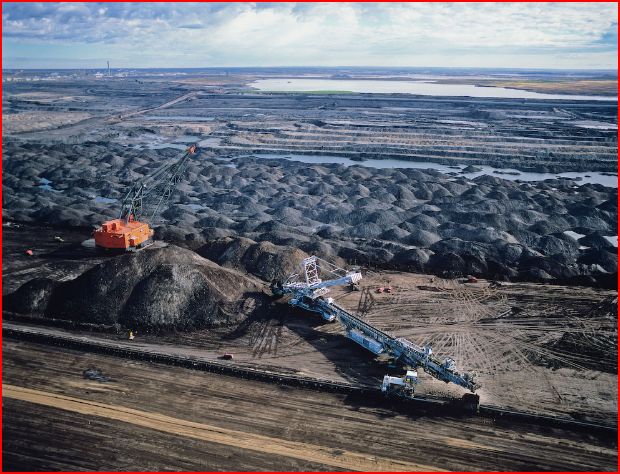
The worst return of them all is from Tar sands: just one unit returned from every unit invested. Investment and humanitarian madness!
Then next I came across this item about Tar sands on The Ecologist magazine website,
Emissions from tar sands seriously underestimated
Governments and companies making no effort to quantify the real climate impacts
Greenhouse gas emissions from tar sands operations are being significantly under-reported according to new research by Global Forest Watch Canada.
The report, ‘Bitumen and Biocarbon‘, says oil companies and governments are not accounting for emissions from deforestation. It says that when boreal forest is destroyed for tar sands development, significant amounts of greenhouse gases are emitted.
‘Governments and companies are working hard to downplay the impacts of tar sands operations, but it turns out that they don’t even know the full extent of the problem,’ said Christy Ferguson, Greenpeace climate and energy coordinator.
‘What’s worse, they’re doing nothing to find out. Denial is not a climate strategy.’
In addition, the report shows that biological carbon stored in living and decaying plants is lost when natural ecosystems are disturbed or destroyed through mining of bitumen and construction of roads, pipelines or facilities.
‘Peatlands are one of the world’s most important storehouses of soil carbon. Industrial activity in the tar sands is destroying peatlands, releasing carbon and eliminating a crucial natural mechanism.
‘Even if peatlands are reclaimed, the carbon released through industrialisation won’t be replaced for thousands of years,’ said Ferguson.
Finally, today (25th) I received in my in-box the latest TomDispatch offering. (I am indebted to Tom Engelhardt for, once again, giving me permission to reproduce in full this TomGram.)
Tom’s latest piece is written by Bill McKibben (with an introduction by Tom) and I strongly urge you to read it – the implications are global. If you read an earlier TomDispatch article by Bill re-published on Learning from Dogs on the 18th July, The Great American Carbon Bomb, today’s piece will surely make you sit up and fume; as it did me! Here it is in full.
Tomgram: Bill McKibben, Jailed Over Big Oil’s Attempt to Wreck the Planet
What might have happened if John McCain had won the presidency in 2008? One thing is certain: there would have been a lot more protest from Democrats, progressives, and the left. Take it as an irony of his election, but Barack Obama has proved remarkably effective in disarming the antiwar movement, even as the use of war in American policy in the Greater Middle East has only grown. That Obama, the supposed anti-warrior of the 2008 campaign, has paid less than no attention to his antiwar critics is no news at all. It’s now practically a cliché as well that he seems to feel no need to feed his political “base” and that, generally speaking (and explain it as you will), his base has not yet pushed back.
This has been particularly true of Obama’s wars, especially the disastrous, never-ending one in Afghanistan. Had Afghanistan been “McCain’s war,” you would surely have seen growing waves of protest, despite the way 9/11 ensured that the Afghan War, unlike the Iraq one, would long be the unassailable “good war.” Still, as American treasure surged into the ill-starred enterprise in Afghanistan, while funds for so much that mattered disappeared at home, I think the streets of Washington would have been filling. What protest there has been, as John Hanrahan of the Nieman Watchdog website reported recently, tends to be remarkably ill-covered in the mainstream media.
Obama, only two points ahead of Ron Paul in the latest Gallup Poll in the race for 2012, is a beyond-vulnerable candidate. (Somewhere there must be some Democratic pol doing the obvious math and considering a challenge, mustn’t there?) Fortunately, in another area at least as crucial as our wars, demonstrators against a Big Oil tar-sands pipeline from Canada that will help despoil the planet are now out in front of the White House — you can follow them here — and they haven’t been shy about aiming their nonviolent protests directly at Obama. Will he or won’t he act like the climate-change president that, on coming into office, he swore he would be? Time will tell. Meanwhile, let Bill McKibben, TomDispatch regular, an organizer of the protests, and just out of a jail cell, fill you in. Tom
Arrested at the White House
Acting as a Living Tribute to Martin Luther King
By Bill McKibben
I didn’t think it was possible, but my admiration for Martin Luther King, Jr., grew even stronger these past days.
As I headed to jail as part of the first wave of what is turning into the biggest civil disobedience action in the environmental movement for many years, I had the vague idea that I would write something. Not an epic like King’s “Letter from a Birmingham Jail,” but at least, you know, a blog post. Or a tweet.
Heros
But frankly, I wasn’t up to it. The police, surprised by how many people turned out on the first day of two weeks of protests at the White House, decided to teach us a lesson. As they told our legal team, they wanted to deter anyone else from coming — and so with our first crew they were… kind of harsh.
We spent three days in D.C.’s Central Cell Block, which is exactly as much fun as it sounds like it might be. You lie on a metal rack with no mattress or bedding and sweat in the high heat; the din is incessant; there’s one baloney sandwich with a cup of water every 12 hours.
I didn’t have a pencil — they wouldn’t even let me keep my wedding ring — but more important, I didn’t have the peace of mind to write something. It’s only now, out 12 hours and with a good night’s sleep under my belt, that I’m able to think straight. And so, as I said, I’ll go to this weekend’s big celebrations for the openingof the Martin Luther King Jr. National Memorial on the Washington Mall with even more respect for his calm power.
Preacher, speaker, writer under fire, but also tactician. He really understood the power of nonviolence, a power we’ve experienced in the last few days. When the police cracked down on us, the publicity it produced cemented two of the main purposes of our protest:
Eaarth
First, it made Keystone XL — the new, 1,700-mile-long pipeline we’re trying to block that will vastly increase the flow of “dirty” tar sands oil from Alberta, Canada, to the Gulf of Mexico — into a national issue. A few months ago, it was mainly people along the route of the prospective pipeline who were organizing against it. (And with good reason: tar sands mining has already wrecked huge swaths of native land in Alberta, and endangers farms, wild areas, and aquifers all along its prospective route.)
Now, however, people are coming to understand — as we hoped our demonstrations would highlight — that it poses a danger to the whole planet as well. After all, it’s the Earth’s second largest pool of carbon, and hence the second-largest potential source of global warming gases after the oil fields of Saudi Arabia. We’ve already plumbed those Saudi deserts. Now the question is: Will we do the same to the boreal forests of Canada. As NASA climatologist James Hansen has made all too clear, if we do so it’s “essentially game over for the climate.” That message is getting through. Witness the incredibly strong New York Times editorial opposing the building of the pipeline that I was handed on our release from jail.
Second, being arrested in front of the White House helped make it clearer that President Obama should be the focus of anti-pipeline activism. For once Congress isn’t in the picture. The situation couldn’t be simpler: the president, and the president alone, has the power either to sign the permit that would take the pipeline through the Midwest and down to Texas (with the usual set of disastrous oil spills to come) or block it.
Barack Obama has the power to stop it and no one in Congress or elsewhere can prevent him from doing so. That means — and again, it couldn’t be simpler — that the Keystone XL decision is the biggest environmental test for him between now and the next election. If he decides to stand up to the power of big oil, it will send a jolt through his political base, reminding the presently discouraged exactly why they were so enthused in 2008.
That’s why many of us were wearing our old campaign buttons when we went into the paddy wagon. We’d like to remember — and like the White House to remember, too — just why we knocked on all those doors.
But as Dr. King might have predicted, the message went deeper. As people gather in Washington for this weekend’s dedication of his monument, most will be talking about him as a great orator, a great moral leader. And of course he was that, but it’s easily forgotten what a great strategist he was as well, because he understood just how powerful a weapon nonviolence can be.
The police, who trust the logic of force, never quite seem to get this. When they arrested our group of 70 or so on the first day of our demonstrations, they decided to teach us a lesson by keeping us locked up extra long — strong treatment for a group of people peacefully standing on a sidewalk.
No surprise, it didn’t work. The next day an even bigger crowd showed up — and now, there are throngs of people who have signed up to be arrested every day until the protests end on September 3rd. Not only that, a judge threw out the charges against our first group, and so the police have backed off. For the moment, anyway, they’re not actually sending more protesters to jail, just booking and fining them.
And so the busload of ranchers coming from Nebraska, and the bio-fueled RV with the giant logo heading in from East Texas, and the flight of grandmothers arriving from Montana, and the tribal chiefs, and union leaders, and everyone else will keep pouring into D.C. We’ll all, I imagine, stop and pay tribute to Dr. King before or after we get arrested; it’s his lead, after all, that we’re following.
Our part in the weekend’s celebration is to act as a kind of living tribute. While people are up on the mall at the monument, we’ll be in the front of the White House, wearing handcuffs, making clear that civil disobedience is not just history in America.
We may not be facing the same dangers Dr. King did, but we’re getting some small sense of the kind of courage he and the rest of the civil rights movement had to display in their day — the courage to put your body where your beliefs are. It feels good.
So perhaps you understand why every American reading this should make sure your voice is heard. And in the last few minutes – 1.30pm MT 25th August – Reuters have just put out this news release,
Nation’s Leading Environmental NGOs Unified Against Tar Sands Pipeline
Update on Day 5 of Tar Sand Pipeline Protest at the White House
See past update and background.
275 people have been arrested so far and many have been released. Today, the largest environmental groups in the US joined to send a letter to President Obama voicing their unified opposition to the Keystone pipeline and asking him to block it.
Why is this important? “For those of us out there in front of the White House, the best thing about this ringing statement is that the administration won’t be able to play one group off against another by making small concessions here and there”; says protest organizer Bill McKibben.
“There’s only one way to demonstrate to the environmental base the rhetoric of Obama’s 2008 campaign is still meaningful – and that’s to veto this pipeline. Since he can do it without even consulting Congress, this is one case where we’ll be able to see exactly how willing he is to match the rhetoric of his 2008 campaign.”
The letter says:
Dear President Obama,
Many of the organizations we head do not engage in civil disobedience; some do. Regardless, speaking as individuals, we want to let you know that there is not an inch of daylight between our policy position on the Keystone Pipeline and those of the very civil protesters being arrested daily outside the White House.
This is a terrible project – many of the country’s leading climate scientists have explained why in their letter last month to you. It risks many of our national treasures to leaks and spills. And it reduces incentives to make the transition to job-creating clean fuels.
You have a clear shot to deny the permit, without any interference from Congress. It’s perhaps the biggest climate test you face between now and the election.
If you block it, you will trigger a surge of enthusiasm from the green base that supported you so strongly in the last election. We expect nothing less.
Sincerely,
Fred Krupp, Environmental Defense Fund
Michael Brune, Sierra Club
Frances Beinecke, Natural Resources Defense Council
Phil Radford, Greenpeace
Larry Schweiger, National Wildlife Federation Erich Pica, Friends of the Earth
Rebecca Tarbotton, Rainforest Action Network
May Boeve, 350.org
Gene Karpinski, League of Conservation Voters
Margie Alt, Environment America
New York Times Also Opposes Pipeline
In an August 21 editorial, the NY Times took a opposition against the pipeline, citing two main concerns: the risk of oil spills along the pipeline, which would traverse highly sensitive terrain, and the fact that the extraction of petroleum from tar sands creates far more greenhouse emissions than conventional production does.
Building the pipeline would clear the way for Canada to double tar sands production over the next decade to more than 1.8 million barrels a day. To do that, some 740,000 acres of boreal forest – a natural carbon reservoir – would be destroyed.
In addition to the emissions produced by tar sands extraction, would be emissions from the loss of this vast, crucial carbon sink, [editor’s note: not to mention the biodiversity it harbors.] Read the editorial:
Website: here with permission from Sustainable Business
In Paul Gilding’s book, The Great Disruption, there is a chapter called When the Dam of Denial Breaks. On page 121 Paul Gilding writes this,
To argue we are naturally greedy and competitive and can’t change is like arguing that we engage naturally in murder and infanticide as our forebears the chimps do and therefore as we did. We have certain tendencies in our genes, but unlike other creatures we have the proven capacity to make conscious decisions to overcome them and also the proven ability to build a society with laws and values to enshrine and, critically, to enforce such changes when these tendencies come to the surface.
So don’t underestimate how profoundly we can change. We are still capable of evolution, including conscious evolution. This coming crisis is perhaps the greatest opportunity in millennia for a step change in human society.
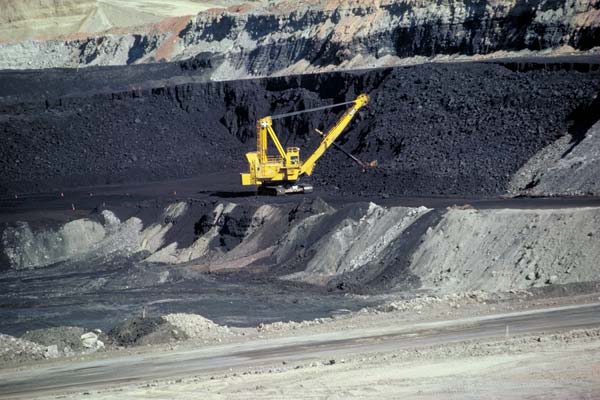
The United States of America gets a lot of stick, rightly so, for it’s greedy consumption of energy, especially the use of coal. According to the World Coal Association, the USA in 2010 produced 932 million tons of hard coal, second in the world to China that produced 3,162 million tons.
Coal mine in Wyoming
But the one thing that the USA has shown time and time again is that it has the capacity to change very quickly, especially when the country, from its leaders to its entrepreneurs, senses a global leadership opportunity. With that in mind, read the latest release from the Earth Policy Institute, reproduced below,
AUGUST 10, 2011 A Fifty Million Dollar Tipping Point?
Lester R. Brown
At a press conference on July 21, New York City Mayor Michael Bloomberg announced that he was contributing $50 million to the Sierra Club’s Beyond Coal Campaign. Michael Brune, head of the Sierra Club, called it a “game changer”. It is that, but it also could push the United States, and indeed the world, to a tipping point on the climate issue.
It is one thing for Michael Brune to say coal has to go, but quite another when Michael Bloomberg says so. Few outside the environmental community know who Michael Brune is, but every business person knows Michael Bloomberg as one of the most successful business entrepreneurs of his generation.
The Sierra Club’s Beyond Coal Campaign has two main goals. The first is to prevent the permitting and construction of new coal-fired power plants. So far 153 proposed power plants have been taken off the board. The second goal is to close the 492 existing plants. The Sierra Club lists 71 plants already scheduled for total or partial closure, most of them by 2016.
The efforts to stabilize climate will be won or lost with coal, the world’s largest source of carbon emissions. The effort to phase out coal is now well under way in the United States, the world’s second ranking coal user after China.
There are likely to be many ripple effects from the Bloomberg grant. To begin with, it may encourage other philanthropists to invest in climate stabilization.
The prospect for investment in coal, already deteriorating, will weaken even faster. In August 2010, the Rainforest Action Network (RAN) announced that several leading U.S. investment banks, including Bank of America and J.P. Morgan, had ceased lending to companies involved in mountaintop removal coal mining. Now with Bloomberg’s opposition, investors will be even more wary of coal.
The Bloomberg-Sierra initiative again focuses attention on the 13,200 lives lost each year in the United States due to air pollution from burning coal. If deaths from black lung disease among coal miners are included the number climbs even higher. The number of coal-related deaths in one year dwarfs total U.S. fatalities in the Iraq and Afghanistan wars. We invest heavily in protecting the lives of our troops in the Middle East, and rightly so. Bloomberg is saying let’s do the same for our people at home.
In addition, this initiative brings attention to the health care costs to society of burning coal. These are currently estimated at more than $100 billion per year, roughly $300 for every person in the United States or $1,200 for a family of four. These costs are real, but it is the American people, not the coal companies, who shoulder the burden.
Further reinforcing the urgency of phasing out coal are the more extreme weather events that climate scientists have been warning about for decades. During the first half of 2011 we watched TV news channels become weather channels. First it was a record number of tornadoes in one month, including the one that demolished Tuscaloosa, Alabama. Then, a few weeks later, an even more powerful tornado demolished Joplin, Missouri. As drought and heat sparked record or near-record wildfires in Arizona, New Mexico, and Texas, the lower Mississippi Basin was flooding. Searing heat waves scorched the southern Great Plains, the Midwest, and the East Coast. Intense heat has continued to break records across the country as Texas suffers its most severe one-year drought on record.
For coal, the handwriting is on the wall. Between 2007 and 2010, coal use in the United States dropped 8 percent. (See data.) Meanwhile, more than 300 new wind farms came online, totaling over 23,000 megawatts of generating capacity—the electricity output equivalent of 23 coal-fired power plants.
When people were asked in a national poll where they would like to get their electricity from, only 3 percent opted for coal. Despite the coal industry’s heavy expenditures to promote “clean coal,” it is still a loser in the public mind.
In addition to the Sierra Club, RAN, and a talented team of Earthjustice lawyers, the anti-coal movement also has allies in Friends of the Earth and Greenpeace, the latter with its highly developed capacity to focus public attention on environmental issues. This was evident in May when a Greenpeace team of eight daring activists scaled the 450-foot Fisk coal plant smokestack located in Chicago and painted “Quit Coal” on it. They were drawing public attention to the deadly air pollution in the city coming from the plant.
As the United States closes its coal-fired power plants, it sends a message to the world. With Michael Bloomberg’s grant bolstering the Sierra Club’s well-organized program to phase out coal, we can now imagine a coal-free United States on the horizon. The United States could again become a world leader, this time in stabilizing climate.
“The United States could again become a world leader, this time in stabilizing climate.” That would be a dream come true, a dream of unimaginable consequences.
“Everyone thinks of changing the world, but no one thinks of changing himself.” Leo Tolstoy
I am going to refer to some ideas before explaining from whom they came, and when.
Try this: the term “future shock” is defined as a certain psychological state of individuals and entire societies. The shortest definition for the term is a personal perception of “too much change in too short a period of time”.
Or try this: society is undergoing an enormous structural change, a revolution from an industrial society to a “super-industrial society”. This change will overwhelm people, the accelerated rate of technological and social change leaving them disconnected and suffering from “shattering stress and disorientation” – future shocked. It was stated that the majority of social problems were symptoms of the future shock.
Stay with me a little longer as I pose a few questions. How do you feel at the moment? Slightly unsure of where the world is going right now? Feeling a little unsettled?
Why those questions? With the Dow Jones index heading down through 11,130 (at the time of writing on the 8th) and ‘chaos across markets’ headlines all over the place these are very unsettling times
Last week’s edition of The Economist had five pages about the present uncertain times in the USA.
The numbers keep being revised inexorably downwards
The rough news did not end there. The Bureau of Economic Analysis (BEA) revised its numbers back through the recession, revealing a downturn more serious than previously understood. The BEA’s first estimate of output in the fourth quarter of 2008, published in January of 2009, showed a contraction of 3.8%, later revised to a 6.8% drop. The new numbers change the figure yet again, to a shocking 8.9% fall in GDP. For 2009 as a whole, the American economy shrank by 3.5% rather than the previously reported 2.6%. American output has yet to reattain its 2007 peak. On a per-person basis, inflation-adjusted GDP stands at virtually the same level as in the second quarter of 2005. America is six years into a lost decade. [my emphasis]
So back to those comments about ‘future shock’. They come from a gentleman known across the world for his writings as a futurist, Alvin Toffler. His website is here and there is a good review of the man and his works on Wikipedia.
Alvin Toffler, born 1928
Toffler’s book, Future Shock, from 1970 was prescient in forecasting …. well here’s how it is written on Wikipedia,
Toffler argues that society is undergoing an enormous structural change, a revolution from an industrial society to a “super-industrial society“. This change will overwhelm people, the accelerated rate of technological and social change leaving them disconnected and suffering from “shattering stress and disorientation” – future shocked. Toffler stated that the majority of social problems were symptoms of the future shock. In his discussion of the components of such shock, he also popularized the term “information overload.”
But there’s an aspect that wasn’t even on the horizon when Toffler was writing that book in the late 60s – the end of growth. That is creating a whole new level of change and ‘information overload’, in my opinion.
Just a few days ago, I reviewed the Paul Gilding book The Great Disruption. I quoted this extract from the very start of the book,
This means things are going to change. Not because we will choose change out of philosophical or political preference, but because if we don’t transform our society and economy, we risk social and economic collapse and the descent into chaos. The science on this is now clear and accepted by any rational observer. While an initial look at the public debate may suggest controversy, any serious examination of the peer-reviewed conclusions of leading science bodies shows the core direction we are heading in is now clear. Things do not look good.
These challenges and the facts behind them are well-known by experts and leaders around the world, and have been for decades. But despite this understanding, that we would at some point pass the limits to growth, it has been continually filed away to the back of our mind and the back of our drawers, with the label “Interesting – For Consideration Later” prominently attached. Well, later has arrived.
Indeed, ‘later’ has arrived. The ‘future’ is now here!
Watch the first 10 minutes of the Future Shock film made back in 1972 and ponder.
The following four parts are easily found on YouTube.
God grant me the serenity to accept the things I cannot change, the courage to change the things I can, and the wisdom to know the difference. Reinhold Niebuhr
Unlike my recent review of Capt. Luis Montalvan’s book Until Tuesday which came about as a result of an invitation from the UK publishers, Headline Publishing, this review of Mr. Gilding’s book is totally off my own bat. I should also declare that I have recently been in email contact with Paul Gilding with some pleasant outcomes. To the review.
The way ahead.
Regular readers of Learning from Dogs will know that I have been making recent references to this book, which I have now finished reading. On the 25th I quoted from the book in a post that I called The blame game. I used a quote from Chapter 5, Addicted to Growth, namely “Growth goes to the core of the society we have built because it is the result of who we are and what we have decided to value.”
Then the next day again when writing about Tim Bennett’s movie, What a Way To Go, when I reflected on Paul Gilding’s opinion that, ” the quicker that mankind recognises the massive levels of denial presently in place, the quicker that mankind will commit to the scale of change that is required“.
Now if mankind’s efforts to change to a sustainable way of life were proportional to the number of books, films and essays written about the subject then, frankly, the task would be complete. There’s an awful lot out there! Here’s a list of the books that I have read in the last few years:
The Human Side of Enterprise – Douglas McGregor
Motivation and Personality – Abraham Maslow
The Power of Pause – Terry Hershey
Earth in the Balance – Al Gore
The Spectrum of Consciousness – Ken Wilber
Politics Lost – Joe Klein
Why America Doesn’t Work – Chuck Colson & Jack Eckerd
The Art of Happiness – HH Dalai Lama & Howard C Cutler
Eaarth – Bill McKibben
Stabilizing an Unstable Economy – Hyman P. Minsky
The Next 100 Years – George Friedman
World of the Edge – Lester Brown
and finally
The Great Disruption – Paul Gilding
And, of course, this doesn’t even scratch the number of online journals, essays and articles that have been read in conjunction with writing hundreds of posts on this Blog.
So what’s the point?
On p.260, Chapter 20 Guess Who’s in Charge?, Paul Gilding writes,
We need to fully acknowledge the challenging times and inevitable suffering ahead but stay focused and determined to move forward and past this. Easy to say, harder to do.
So yes, it is challenging to know how to respond to all this and what to do personally. It is easy to see what the world should do, but what should you do?
but what should you do? Talk about a thump on the back of the head!
This is about me!
Of all the books that have influenced how I see the world and my opinions, the one book that has rammed home to me that this is about me, about my attitudes and behaviours, is The Great Disruption. For a long time I haven’t needed convincing that man is screwing up the planet. For ages, I’ve been sure that our greed and materialism were fundamentally incompatible with the planet. I have been so good at ‘talking the talk’ ….. but ….
But the way that Mr. Gilding has so comprehensively approached every aspect of how my past behaviours have been incompatible with the future needs of my little grandson, Morten, (and all the grandchildren in the world) is powerfully inspiring. I now totally and utterly believe that only I am in charge of making a difference.
Why The Great Disruption touched me in this way when so many other books and articles haven’t done so isn’t clear. Perhaps it was in the opening paragraphs?
The earth is full.
[skip one paragraph]
This means things are going to change. Not because we will choose change out of philosophical or political preference, but because if we don’t transform our society and economy, we risk social and economic collapse and the descent into chaos. The science on this is now clear and accepted by any rational observer. While an initial look at the public debate may suggest controversy, any serious examination of the peer-reviewed conclusions of leading science bodies shows the core direction we are heading in is now clear. Things do not look good.
These challenges and the facts behind them are well-known by experts and leaders around the world, and have been for decades. But despite this understanding, that we would at some point pass the limits to growth, it has been continually filed away to the back of our mind and the back of our drawers, with the label “Interesting – For Consideration Later” prominently attached. Well, later has arrived.
I nodded silently in agreement when reading that.
Was it the opening paragraph to Chapter 4, Beyond the Limits – The Great Disruption?
The plans we have been making for our economies, our companies, and our lives have all been based on a key assumption that is clearly wrong. This assumption is that our current economic model will carry on unless we choose to change it – in other words, no action means more of the same.
This resonated strongly with me because I happen to believe, without any specialist economic skills to my name – just a gut sense, that the economic situation now afflicting so many economies across the world is not cyclical but the start of a breakdown of the policies and behaviours of the last 20 years or more. In other words, the Great Disruption was in my face already! As is written on p. 87 in Chapter 6, Global Foreshock – The Year That Growth Stopped,
My view, firmly held at the time and since, is that 2008 was the year that growth stopped. It was the year, as Thomas Friedman said, “when Mother Nature and Father Greed hit the wall at once”.
The Power of a New Future
But, in the end, the real power that I found in this book was the strength of Gilding’s argument that we will change, that seeing the future as hopeless is wrong, that man has the ability to commit to huge change when there is no alternative. Ergo, p121 Chapter 9 When the Dam of Denial Breaks,
To argue we are naturally greedy and competitive and can’t change is like arguing that we engage naturally in murder and infanticide as our forebears the chimps do and therefore as we did. We have certain tendencies in our genes, but unlike other creatures we have the proven capacity to make conscious decisions to overcome them and also the proven ability to build a society with laws and values to enshrine and, critically, to enforce such changes when these tendencies come to the surface.
So don’t underestimate how profoundly we can change. We are still capable of evolution, including conscious evolution. This coming crisis is perhaps the greatest opportunity in millennia for a step change in human society.
This quote is towards the end of the last chapter that spells out, as so many other books have done, that our global society Has a Very Big Problem. Thus from page 123 onwards, slightly less than half-way through the book, Paul Gilding devotes huge detail to describing how we will change. Frequently, the comparison used is World War II,
British poster from 1940
When Great Britain went to war in World War II, do you think they had clarity on all the details of transitioning into a war economy before they made the decision to act? Of course they considered it, as we must, but it wasn’t a determining issue because there was no choice. Do you think President Roosevelt calculated the United States could win the war by increasing military spending to 37 percent of U.S. GDP and producing a nuclear bomb before he decided to enter the war? Of course not: he just knew they had to succeed and so they would. He had confidence in human ingenuity delivering under pressure, when it’s given defined parameters and political support, and so must we.
From p. 164, Chapter 12 Creative Destruction on Steroids.
That’s what ended up being the real inspiration for me. That it’s not about the complex problems looming large; as so many that Jean and I chat to here in Payson, AZ, readily admit to being worried. It’s not news! The majority of the world’s citizens know the trends are not good.
No, what really socked me between the eyes was reading all the many and varied ways that we are changing (note present tense), that the Great Disruption is, in fact, mankind moving to a new era. One where we will have less inequality, less poverty, be happier, have extended life-spans and a future that goes on for thousand of years.
The Future is Here.
The phrase ‘life-changing’ is often used but this book is truly life-changing. The book will motivate you in ways that you can’t imagine. It will inspire you but, above all, it will show you the way ahead. Read it.
I am about a third into Paul Gilding’s book The Great Disruption. It’s proving to be a very-thought provoking read that I will review in more detail over the coming weeks.
However, I just wanted to quote from the start of Chapter 5, Addicted to Growth,
Indeed, as argued by economist Kenneth Boulding: “Anyone who believes exponential growth can go on forever in a finite world is either a madman or an economist.”
Very little that can be argued about that statement. It rather puts into context a couple of items read recently. Both from the blogsite New Economic Perspectives. The first on June 10th by Stephanie Kelton,
Earlier this week, President Obama talked about the weakening state of the economy, telling us that he’s not worried about a double-dip recession and that the nation should “not panic.” It’s hard to imagine a more alarming assessment at this juncture.
The recovery is faltering. Our economy is growing at annual rate of just 1.8 percent. Manufacturing just grew at its slowest pace in 20 months. More than 44 million Americans – one in seven – rely on food stamps. Employers hired only 54,000 new workers in May, the lowest number in eight months. Jobless claims increased to 427,000 in the week ended June 4. The unemployment rate rose to 9.1 percent. Nearly half of all unemployed Americans have been without work for more than 6 months. About 25% of all teenagers who are looking for work are unemployed. Eight-and-a-half million Americans are underemployed – i.e. working part-time because their hours have been cut or because they can’t find full-time work. There are, on average, 4.6 unemployed people for every 1 job opening. And even if all the open positions were filled, there would still be 10.7 million people looking for work.
Today’s unemployment data suggests that we are experiencing something far worse than a mere “bump in the road”, as our President described it last month. In fact, if last month was the time to panic, as Stephanie Kelton argued here, then today’s data should create real palpitations in the White House. This isn’t just a “bump,” but a fully-fledged New York City style pot hole.
First the headline number everyone looks at: non-farm payrolls. Up 18,000 in June, the increase was 100,000 less than expectations. In addition the prior two month payroll increases were revised down by -44,000 overall. That’s weak – but not terrible.
Dig a bit deeper into the data and it looks absolutely awful: The household measure of employment fell by -445,000. Okay, it’s a noisy number. But, as Frank Veneroso has pointed out to me in an email correspondence, this measure of employment which is never revised now shows no employment growth over the last five months and very negative employment growth over the last three.
But it gets worse: The work week was down one tenth. Overtime was down one tenth. The labor participation rate at 64.1% was the lowest since 1984. The broad U6 unemployment rate rose from 15.8% to 16.2%. In other words, as Frank suggested to me this morning, “many other employment indicators in this report confirm the deep disappointment in the payroll series and the much more negative message of the household series.”
Now here’s the latest item published by Paul Gilding in his Blog, The Cockatoo Chronicles. (I have republished it in full, hopefully without upsetting Mr. Gilding – couldn’t see advice on reproduction – but copyright remains, of course, fully with Paul Gilding.)
Like a Grenade in a Glasshouse
June 29, 2011
It’s going to hit hard and it’s going to hurt – made worse because most aren’t expecting it. They think the world is slowly returning to our modern “normal” – steadily increasing growth, with occasional annoying but manageable interruptions. After all, the global recession wasn’t so bad was it? Sure there was pain and things got shaky but Governments responded, bailed out companies, stimulated economies, got things back on track. While it’s still a bit bumpy, Greek wobbles, US debt, extreme weather, high oil and food prices etc, it’ll work out. It always does….
If only it were so. In fact we are blindly walking towards the next in a series of inevitable system shaking and confidence sapping crises, deluded in the belief that the worst is behind us.
Each crisis will be a little worse than the last. Each one will shake our denial a little more. This is what happens when systems hit their limits. They don’t do so smoothly, but bump up against the wall, hitting hard, then bouncing off equally hard. It is the behaviour of a system trying to break through. But if the limits are solid, as is the case with our economic system hitting the limits of the planet – defined by unchangeable physical capacity and the laws of physics, chemistry and biology – then it can’t find its way through. So eventually, when the pain of hitting the wall gets too much, it stops.
Then it will hit. Like a grenade in a glasshouse, shattering denial and delusion and leaving it like a pile of broken glass on the floor of the old economic model. Then we’ll be ready for change.
I’ve been arguing the inevitability of this moment since 2005, mostly inside the business community. Before the 2008 financial crisis hit, the idea was almost universally rejected, with a belief in the indomitable power of globalised markets to overcome all challenges and keep growth on track. Most audiences believed that while markets always wobbled, they also always recovered. My suggestion, that this level of arrogance was the hallmark of empires before they fell, landed on deaf ears. They were the masters of the universe and markets and growth would always reign supreme.
Now the response is different. The financial crisis saw many break off from the pack and start to ask the difficult questions. I now find as I tour the world speaking about The Great Disruption to community gatherings, corporate executives and policy makers that minds are increasingly open. While not the dominant view, the previous confidence in the inevitably of growth has become shaky and the group asking the challenging questions is rapidly expanding.
As I argue in the book, the fundamental cause of what’s coming is resource constraint and environmental breakdown, which when combined with an overstretched financial system and high levels of debt puts unbearable tension into the global economy. While no one can know what event will pull the pin out of the grenade, the underlying pressures make that moment inevitable. Yes, the dominant commentary still blames each individual problem on unique circumstances, but the underlying systemic causes are clear for those who wish to look.
The continued level of denial still surprises me, especially given the pressures driving this are not esoteric and can be measured in clear economic indicators. A good example was recently published by one of the more interesting voices to join the growing chorus that we have a system-wide problem. The legendary contrarian and fund manager Jeremy Grantham is co-founder of the Boston based firm GMO, with over $100 billion of assets under management. So this guy is a solid capitalist and market advocate, pursuing wealth for the wealthy. But he sees the data and is raising the alarm, calling this moment “one of the giant inflection points in economic history” – referring to the end of a 100-year steady decline in commodity prices. His views were echoed by Stephen King, group chief economist at HSBC, who wrote in the FT: “After the biggest meltdown since the Great Depression, economic theory tells us that world commodity prices should not be this high. But they are and the West quickly needs to wake up to this new economic reality. Commodity prices are now permanently higher.”
Grantham provides the detail, pointing out that the 100 year trend of falling prices in the 33 most important commodities, except for oil, were wiped out with a price surge from 2002 to 2010 – a surge even greater than experienced in WW2. We have now reached what Grantham calls the Great Paradigm shift; not a price spike but a new reality. Within this new reality, Grantham says: “if we maintain our desperate focus on growth, we will run out of everything and crash.”
This is why hitting the wall is inevitable – because limits are not philosophies, they are limits. We can understand what to expect – and why the grenade will shatter the glasshouse of economic growth – by going back to how systems behave when they hit their limits. Our economic system first hit the wall in 2008 – that was when The Great Disruption began with food and oil prices hitting record highs and a credit crisis driven by reckless monetary policy pursuing growth at all costs. The resulting recession meant we backed away from those limits (bouncing off the wall), and then borrowed massive amounts of money from our children (think Greece) to try to get the economy moving again.
Now that the global economy is slowly entering a so-called “recovery”, the prices of commodities (representing our use of earth’s resources for food and materials) are on the way up, accelerated, in the case of food, by climate change. Of course if significant growth kicks in, the prices of oil, food and other commodities will surge, this timestarting from near record highs. Then we will bounce back into recession and prices will back off again. Hit the wall, bounce off. Hit the wall, bounce off. Ouch.
By itself this would pose enough of a challenge to growth. But now we also have the debt we used to get the economy moving again. This debt can only be paid off with significant economic growth – but such significant growth is impossible as outlined above. So the debt itself becomes an enormous additional tension in the system, as argued by Richard Heinberg in his important forthcoming book The End of Growth. With the global economy and ecosystem now both burdened by unmanageable debt, effective global default is only a matter of time.
So we’re living in a glass house with the grenade sitting there for all to see. Who knows what will pull the pin. It could be Greece, a Chinese food crisis, peak oil or any number of other triggers. But it’s coming.
The question to ask yourself is simple. Are you ready?
Back to Kenneth Boulding: “Anyone who believes exponential growth can go on forever in a finite world is either a madman or an economist.”
A powerful and insightful essay from Bill McKibben about our love affair with carbon-based energy.
Introduction
I subscribe to a number of Blogs and one of them is TomDispatch. Here’s how Tom describes what the writings are all about.
Tom Engelhardt launched Tomdispatch in November 2001 as an e-mail publication offering commentary and collected articles from the world press. In December 2002, it gained its name, became a project of The Nation Institute, and went online as “a regular antidote to the mainstream media.” The site now features Tom Engelhardt’s regular commentaries and the original work of authors ranging from Rebecca Solnit, Bill McKibben, and Mike Davis to Chalmers Johnson, Michael Klare, Adam Hochschild, Robert Lipsyte, and Elizabeth de la Vega. Nick Turse, who also writes for the site, is associate editor and research director.
Tomdispatch is intended to introduce readers to voices and perspectives from elsewhere (even when the elsewhere is here). Its mission is to connect some of the global dots regularly left unconnected by the mainstream media and to offer a clearer sense of how this imperial globe of ours actually works.
I read the TomDispatch essay from Bill McKibben on the 14th. It caught my eye, not only because of the power of Bill’s conclusions, but also because I was deeply impressed with Bill’s book ‘eaarth’, which I reviewed on Learning from Dogshere and here.
Tom Engelhardt has given written permission for that TomDispatch to be re-published in full on Learning from Dogs. It now follows.
First the introduction by Tom Engelhardt,
The Great American Carbon Bomb
These days, even ostriches suffer from heat waves. More than 1,000 of them reportedly died from overheating on South African farms during a 2010 drought. As for American ostriches, the human variety anyway, at the moment it should be increasingly hard for them to avoid extreme-weather news. After all, whether you’re in sweltering heat, staggering drought, a record fire season, or a massive flood zone, most of us are living through weird weather this year. And if you’re one of the lucky few not in an extreme-weather district of the USA, you still won’t have a problem running across hair-raising weather stories, ranging from the possible loss of one out of every ten species on this planet by century’s end to the increasing inability of the oceans to soak up more atmospheric carbon dioxide.
Then, of course, there are those other headlines. Here’s a typical one: “As Water Rises, Florida Officials Sit on Their Hands” (a former member of the just abolished Florida Energy and Climate Commission points out that, thanks to Republican governor Rick Scott and the legislature in the part of the country most vulnerable to rising sea levels, “there is no state entity addressing climate change and its impact”). And here’s another: “Economy Keeps Global Warming on the Back Burner for 2012” (American climate-change “skeptics” are celebrating because “the tide of the debate — at least politically — has turned in their favor” and “political experts say that… concerns over global warming won’t carry much weight in the 2012 election”). And then there are the polls indicating Americans are confused about the unanimity of the scientific consensus on climate change, surprisingly dismissive of global-warming dangers, worry less about it than they did a decade ago, and of major environmental issues, worry least about it.
It’s true, of course, that no weird-weather incident you experience can definitively be tied to climate change and other factors are involved. Still, are we a nation of overheating ostriches? It’s a reasonable enough conclusion, and in a sense, not so surprising. After all, how does anyone react upon discovering that his or her way of life is the crucial problem, that fossil fuels, which keep our civilization powered up and to which our existence is tethered, are playing havoc with the planet?
TomDispatch regular Bill McKibben, author most recently of Eaarth: Making a Life on a Tough New Planet, is a man deeply committed to transforming us from climate-change ostriches to climate-change eagles. Perhaps it’s time, he suggests, for the environmental movement to get one heck of a lot blunter. Tom
Here’s the essay from Bill,
Will North America Be the New Middle East?
It’s Yes or No For a Climate-Killing Oil Pipeline — and Obama Gets to Make the Call
By Bill McKibben
The climate problem has moved from the abstract to the very real in the last 18 months. Instead of charts and graphs about what will happen someday, we’ve got real-time video: first Russia burning, then Texas and Arizona on fire. First Pakistansuffered a deluge, then Queensland, Australia, went underwater, and this spring and summer, it’s the Midwest that’s flooding at historic levels.
The year 2010 saw the lowest volume of Arctic ice since scientists started to measure, more rainfall on land than any year in recorded history, and the lowest barometric pressure ever registered in the continental United States. Measured on a planetary scale, 2010 tied 2005 as the warmest year in history. Jeff Masters, probably the world’s most widely read meteorologist, calculated that the year featured the most extreme weather since at least 1816, when a giant volcano blew its top.
Since we’re the volcano now, and likely to keep blowing, here’s his prognosis: “The ever-increasing amounts of heat-trapping gases humans are emitting into the air put tremendous pressure on the climate system to shift to a new, radically different, warmer state, and the extreme weather of 2010-2011 suggests that the transition is already well underway.”
There’s another shift, too, and that’s in the response from climate-change activists. For the first two decades of the global-warming era, the suggested solutionsto the problem had been as abstract as the science that went with it: complicated schemes like the Kyoto Protocol, or the cap-and-trade agreement that died in Congress in 2010. These were attempts to solve the problem of climate change via complicated backstage maneuvers and manipulations of prices or regulations. They failed in large part because the fossil-fuel industry managed, at every turn, to dilute or defang them.
Clearly the current Congress is in no mood for real regulation, so — for the moment anyway — the complicated planning is being replaced by a simpler rallying cry. When it comes to coal, oil, and natural gas, the new mantra of activists is simple, straightforward, and hard to defang: Keep it in the ground!
Two weeks ago, for instance, a few veteran environmentalists, myself included, issued a call for protest against Canada’s plans to massively expand oil imports from the tar sands regions of Alberta. We set up a new website, tarsandsaction.org, and judging from the early response, it could result in the largest civil disobedience actions in the climate-change movement’s history on this continent, as hundreds, possibly thousands, of concerned activists converge on the White House in August. They’ll risk arrest to demand something simple and concrete from President Obama: that he refuse to grant a license for Keystone XL, a new pipeline from Alberta to the Gulf of Mexico that would vastly increase the flow of tar sands oil through the U.S., ensuring that the exploitation of Alberta’s tar sands will only increase.
Forget the abstract and consider the down-and-dirty instead. You can undoubtedly guess some of the reasons for opposition to such a pipeline. It’s wrecking native lands in Canada, and potential spills from that pipeline could pollute some of the most important ranchlands and aquifers in America. (Last week’s Yellowstone River spill was seen by many as a sign of what to expect.)
There’s an even bigger reason to oppose the pipeline, one that should be on the minds of even those of us who live thousands of miles away: Alberta’s tar sands are the continent’s biggest carbon bomb. Indeed, they’re the second largest pool of carbon on planet Earth, following only Saudi Arabia’s slowly dwindling oilfields.
If you could burn all the oil in those tar sands, you’d run the atmosphere’s concentration of carbon dioxide from its current 390 parts per million (enough to cause the climate havoc we’re currently seeing) to nearly 600 parts per million, which would mean if not hell, then at least a world with a similar temperature. It won’t happen overnight, thank God, but according to the planet’s most important climatologist, James Hansen, burning even a substantial portion of that oil would mean it was “essentially game over” for the climate of this planet.
Halting that pipeline wouldn’t solve all tar sands problems. The Canadians will keep trying to get it out to market, but it would definitely ensure that more of that oil will stay in the ground longer and that, at least, would be a start. Even better, the politics of it are simple. For once, the Republican majority in the House of Representatives can’t get in the way. The president alone decides if the pipeline is “in the national interest.” There are, however, already worrisome signs within the Obama administration. Just this week, based on a State Department cable released by WikiLeaks, Neela Banerjee of the Los Angeles Timesreported that, in 2009, the State Department’s “energy envoy” was already instructing Alberta’s fossil-fuel barons in how to improve their “oil sands messaging,” including “increasing visibility and accessibility of more positive news stories.” This is the government version of Murdochian-style enviro-hacking, and it leads many to think that the new pipeline is already a done deal.
Still, the president can say no. If he does, then no pipeline — and in the words of Alberta’s oil minister, his province will be “landlocked in bitumen” (the basic substance from which tar-sands oil is extracted). Even energy-hungry China, eager as it is for new sources of fossil fuels, may not be able to save him, since native tribes are doing a remarkable job of blocking another proposed pipeline to the Canadian Pacific. Oil, oil everywhere, and nary a drop to sell. (Unfortunately that’s not quite true, but at least there won’t be a big new straw in this milkshake.)
An Obama thumbs-down on the pipeline could change the economics of the tar sands in striking ways. “Unless we get increased [market] access, like with Keystone XL, we’re going to be stuck,” said Ralph Glass, an economist and vice-president at AJM Petroleum Consultants in Calgary.
Faced with that prospect, Canada’s oilmen are growing desperate. Earlier this month, in a classic sleight of hand, they announced plans for a giant “carbon capture and sequestration” scheme at the tar sands. That’s because when it comes to global warming, tar sands oil is even worse than, say, Saudi oil because it’s a tarry muck, not a liquid, and so you have to burn a lot of natural gas to make it flow in the first place.
Now, the oil industry is proposing to capture some of the extra carbon from that cooking process and store it underground. This is an untested method, and the accounting scheme Alberta has adopted for it may actually increase the province’s emmissions. Even if it turns out to work perfectly and captures the carbon from that natural gas that would have escaped into the atmosphere, the oil they’re proposing to ship south for use in our gas tanks would still be exactly as bad for the atmosphere as Saudi crude. In other words, in the long run it would still be “essentially game over” for the climate.
The Saudis, of course, built their oil empire long before we knew that there was anything wrong with burning oil. The Canadians — with American help, if Obama obliges the oil lobby — are building theirs in the teeth of the greatest threat the world has ever faced. We can’t unbuild those Saudi Arabian fields, though happily their supplies are starting to slowly dwindle. What we can still do, though, is prevent North America from becoming the next Middle East.
So there will be a battle, and there will be nothing complicated or abstract about it. It will be based on one question: Does that carbon stay in the earth, or does it pour into the atmosphere? Given the trillions of dollars at stake it will be a hard fight, and there’s no guarantee of victory. But at least there’s no fog here, no maze of technicalities.
The last climate bill, the one the Senate punted on, was thousands of pages long. This time there’s a single sheet of paper, which Obama signs… or not.
Guess what I read about on the BBC News website on the 15th, the day that I put this article together? I read about a fabulous new ship about to start construction at the Samsung Heavy Industries shipyard in South Korea. When launched and loaded, at 600,000 tonnes, it will be the world’s largest ship. Wow that’s impressive!
Now read here as to what is the purpose of this ‘ship’. Here’s a flavour of that BBC news item,
Shell has unveiled plans to build the world’s first floating liquefied natural gas (FLNG) platform. The 600,000-tonne behemoth – the world’s biggest “ship” – will be sited off the coast of Australia. But how will it work?
Deep beneath the world’s oceans are huge reservoirs of natural gas. Some are hundreds or thousands of miles from land, or from the nearest pipeline.
Tapping into these “stranded gas” resources has been impossible – until now.
At Samsung Heavy Industries’ shipyard on Geoje Island in South Korea, work is about to start on a “ship” that, when finished and fully loaded, will weigh 600,000 tonnes.
That is six times as much as the biggest US aircraft carrier.
By 2017 the vessel should be anchored off the north coast of Australia, where it will be used to harvest natural gas from Shell’s Prelude field.
Yes, it’s more technology to enable us to use more carbon! As the article (just) touches on,
But there has been opposition from environmentalists. Martin Pritchard from Environs Kimberley says he is concerned about the potential for “oil leaks and spills”.
WWF Western Australia, [my inserted link, Ed.] meanwhile, argues that the underwater wellheads and pipelines will harm the tropical marine environment, and estimates the project will emit more than two million tonnes of greenhouse gases per year.
Sort of reminds me of that old Devonshire saying (and you need to imagine hearing it in that wonderful dialect that just still exists in this far part of SW England)
“All the world’s a little queer except thee and me …. and I have me doubts about thee!”
Just a few recent items to underline what a strange species we are!
This is being written on the 8th, not too many hours after the successful launch of the very last Shuttle space flight. Forget the [valid] question of cost, this launch sufficiently inspired nearly a million people to travel to the Kennedy Space Center to watch this historic flight. That adventuring drive is a wonderful aspect of mankind.
Now to another view of mankind.
Washington’s Blog of the 3rd July, 2011 has an in-depth review of how “the Japanese government, other governments and nuclear companies have covered up the extent of the Fukushima crisis.” In that excellent piece, there is a reference to material in the British Guardian newspaper (I’m taking the liberty of re-publishing quite a long extract from Washington’s Blog).
British Shenanigans
It’s not just the Japanese. As the Guardian notes:
British government officials approached nuclear companies to draw up a co-ordinated public relations strategy to play down the Fukushima nuclear accident just two days after the earthquake and tsunami in Japan and before the extent of the radiation leak was known.
Internal emails seen by the Guardian show how the business and energy departments worked closely behind the scenes with the multinational companies EDF Energy, Areva and Westinghouse…
Officials stressed the importance of preventing the incident from undermining public support for nuclear power.
***
The Conservative MP Zac Goldsmith, who sits on the Commons environmental audit committee, condemned the extent of co-ordination between the government and nuclear companies that the emails appear to reveal.
***
The official suggested that if companies sent in their comments, they could be incorporated into briefs to ministers and government statements. “We need to all be working from the same material to get the message through to the media and the public.
***
The office for nuclear development invited companies to attend a meeting at the NIA’s headquarters in London. The aim was “to discuss a joint communications and engagement strategy aimed at ensuring we maintain confidence among the British public on the safety of nuclear power stations and nuclear new-build policy in light of recent events at the Fukushima nuclear power plant”.
Other documents released by the government’s safety watchdog, the office for nuclear regulation, reveal that the text of an announcement on 5 April about the impact of Fukushima on the new nuclear programme was privately cleared with nuclear industry representatives at a meeting the previous week. According to one former regulator, who preferred not to be named, the degree of collusion was “truly shocking”.
The release of 80 emails showing that in the days after the Fukushima accident not one but two government departments were working with nuclear companies to spin one of the biggest industrial catastrophes of the last 50 years, even as people were dying and a vast area was being made uninhabitable, is shocking.
***
What the emails shows is a weak government, captured by a powerful industry colluding to at least misinform and very probably lie to the public and the media.
***
To argue that the radiation was being released deliberately and was “all part of the safety systems to control and manage a situation” is Orwellian.
And – as the Guardian notes in a third article – the collusion between the British government and nuclear companies is leading to political fallout:
“This deliberate and (sadly) very effective attempt to ‘calm’ the reporting of the true story of Fukushima is a terrible betrayal of liberal values. In my view it is not acceptable that a Liberal Democrat cabinet minister presides over a department deeply involved in a blatant conspiracy designed to manipulate the truth in order to protect corporate interests”. -Andy Myles, Liberal Democrat party’s former chief executive in Scotland
“These emails corroborate my own impression that there has been a strange silence in the UK following the Fukushima disaster … in the UK, new nuclear sites have been announced before the results of the Europe-wide review of nuclear safety has been completed. Today’s news strengthens the case for the government to halt new nuclear plans until an independent and transparent review has been conducted.” -Fiona Hall, leader of the Liberal Democrats in the European parliament
It’s us, all of us, that create the systems, the political and government systems that are at the heart of this approach to life.
But it’s also us, all of us, that ‘write’ such beautiful stories as this one from NPR Music.
Paul Simon has brought joy to so many for so long, but on this night he made Rayna Ford’s dream come true. During a show in Toronto on May 7, Rayna Ford, a fan from Newfoundland, called out for Simon to play “Duncan,” and said something to the effect that she learned to play guitar on the song. In a moment of astonishment and disbelief, Paul Simon invited her on stage, handed her a guitar and asked her to play it for the crowd. When she strapped on the guitar, the audience went crazy. In a few strums, the band played along, tears ran down Rayna Ford’s cheeks and Simon stood by her side in smiles.
It was an absolute moment of sobbing joy for Ford and for the crowd. It was a moment so beautiful, so human, it could almost be a story in a Paul Simon song. Excuse me while I wipe my own tears. Go Rayna and all the Raynas out there with dreams. As the song says:
Oh, oh, what a night
Oh, what a garden of delight
Even now that sweet memory lingers
I was playing my guitar
Lying underneath the stars
Just thanking the Lord
For my fingers,
For my fingers
I suspect very few of you regular readers will recall that in 2009 (24th June to be precise) I ran a very short article under a similar title. This is what was published.
A simple heading but, in truth, a very complex subject. This was brought home by a recent article in The Economist by Bagehot. That is “Politicians frequently lie. So does everyone else. Why all the fuss?”
Bagehot writes a Blog so those who don’t read the newspaper can read the rest of his thesis here.
Here’s some of that essay by Bagehot,
On lying
Jun 30th 2009, 14:43 by Bagehot
THE WORD “lie” means something very specific. It doesn’t mean a misleading statement, or an exaggeration, or a half-truth: it is a falsehood advanced intentionally and knowingly. That is why, in my column last week, I wrote that probably only Tony Blair and his crew could know whether they “lied” about Iraq’s weapons of mass destruction. Only they can know what was in their heads, and how far their public utterances diverged from their inner convictions. For that reason the question of lying over Iraq seems to me a bit of a red herring and distraction. What can be proved about their sloppiness and embellishments, and has been, is bad enough.
Lying is back in the news this week. Gordon Brown stands accused by various newspapers and columnists of deliberately misleading the public about the government’s fiscal position. Ditto Ed Balls, the prime minister’s henchman, who evidently doesn’t take kindly to having his integrity impugned in this way. David Cameron is a bit more periphrastic, knowing that in political parlance the “l” word is a nuclear accusation; but he came pretty close to it yesterday with his talk of “a thread of dishonesty” running through Mr Brown’s premiership.
There are (at least) two big questions provoked by this revived interest in lying. First and most obviously, are Mr Brown, Mr Balls and others really and indisputably liars? Do the fiscal figures they cite and twist in any way support the interpretation they put on them–at least enough to make it credible that they believe what they are saying, even if no-one else does? If so, they may not be lying. They may be over-optimistic, incompetent or deluded. But they are not obviously liars.
Just re-read those last few sentences, “Do the fiscal figures they cite and twist in any way support the interpretation they put on them–at least enough to make it credible that they believe what they are saying, even if no-one else does? If so, they may not be lying. They may be over-optimistic, incompetent or deluded. But they are not obviously liars.”
Delay your judgement for just a few minutes while we go to this next item. This next item is a recent essay from John Maudlin, the financial expert, about the latest jobs report in the US.
The US jobs report came out this morning, and it was simply dismal. This week we look at not only the jobs report but also “what-if” proffers for the US and global economies. There’s a lot to cover, so let’s jump in.
First, there were only 18,000 jobs created in June, the lowest since September 2010. While private employment rose by 57,000, government workers dropped by 39,000, continuing a trend as governments at all levels work to cut their budgets. Long-time readers know I think it is important to look at the direction of the revisions, and we got no help. May was revised down by 29,000 jobs and April a further down 15,000.
I saw some headlines and talking heads in the mainstream media saying the poor number was due to “seasonals,” and I just shook my head. If you are that reflexively bullish when presented with what was clearly a bad report, how can you be taken seriously? You know who you are. And then Philippa Dunne of the Liscio Report sent the following note. She is one of the best data mavens there is on jobs and employment.
John M. then includes quite a long extract from Philippa’s note. You can read it and the rest of John’s article here. Here’s how that extract from Philippa Dunne ends,
Also, there is no adjustment to the headline number – the sectors are adjusted separately (96 different industries at the 3-digit NAICS level, to be precise) and the total is the sum of those components. The whole argument is bogus.
Notice that last sentence, “The whole argument is bogus.” [My emboldening, Ed.]
OK, clearly not lying, in the strict definition of the term. But still delay your judgement.
Back on the 25th June this year, I wrote a piece with the title of Lying is OK, that’s official! Duh! I stated very clearly that lying is wrong! Mind you, one could at least congratulate Jean Claude Juncker for honestly admitting being a liar. (Jean Claude Juncker is the Prime Minister of Luxembourg and the head of the Eurogroup council of eurozone finance ministers.) Here’s that video clip with Juncker admitting that when it’s serious one has to lie! (Listen carefully, the words are quietly spoken.)
Finally, I have long followed Yves Smith’s excellent Blog, Naked Capitalism. Just yesterday, Yves wrote a powerful piece,
Not only is Obama assuring that he will go down as one of the worst Presidents in history, but for those who have any doubts, he is also making it clear that his only allegiance is to the capitalist classes and their knowledge worker arms and legs.
It’s an angry essay that has, at it’s heart, an anger at the lack of true representative government, remember the one that Abraham Lincoln had in mind when he wrote, “Government of the people, by the people, for the people, shall not perish from the Earth.”
Yves concludes in that article thus,
Even knowing how dedicated to bad ends Obama is, I still feel like I’ve walked into a parallel universe. He’s now determined to make these horrific entitlement cuts a sign of his manhood. This is “Change” for sure, to a more brutal, grasping, dog eat dog society, all administered by self serving elites. They will in the end reap the whirlwind they are creating, but not before it mows a path of destruction through our social order.
Right, time to draw it all together.
Despite my chest-beating on the subject of politicians and leaders deliberately lying in that recent piece about Juncker, there’s something much more fundamental. What defines lying is really not that important. It’s whether or not we trust that our leaders are doing their best for their constituents, to the best of their abilities.
Whether you support left-leaning or right-leaning policies is unimportant; indeed political differences and the ability to vote for one’s beliefs is at the heart of an open democracy.
But if we don’t trust that our leaders are doing their best for our country then that causes the destruction of faith. If we do not have faith in those that lead us then the breakdown of a civilised social order becomes a very real risk.
These are such difficult times impacting us across so many fronts. Scarily, one seems to find many who have lost much faith in their leaders.
[Note: Part Two of The Trap is available to watch in my post of the 7th where one can also link back to Part One. Ed.]
This is another brilliant Adam Curtis documentary originally produced for the BBC. It talks about the modern political realities, where the policies came from and the massive failures of those ideals and how they have ended up exactly where they did not want to be. What is discussed in this episode is the alternative idea to freedom that currently exists and traps the western societies in which we live.
Part One of The Trap is available to watch in my Post of the 4th, US Independence Day. It also provides some background thoughts. It really is a most powerful set of programmes so, if you haven’t already done so, best to watch Part One first.
This is Part 2 of the brilliant Adam Curtis documentary originally produced for the BBC. It talks about the modern political realities, where the policies came from and the massive failures of those ideals and how they have ended up exactly where they did not want to be. This episode focuses on the 1990’s and how the politicians decided to apply the model of a free market economy to the rest of society and consequences of these actions being felt all over the world in western democracies.




 Learning from Dogs