Category: Politics

More on that democratic deficit.

Improving democracy through deliberation.

Yesterday, I introduced the essay by George Monbiot, Why Politics Fails.  He opened his essay with the sub-heading: Nothing will change until we confront the real sources of power.

His last paragraph read:

So I don’t blame people for giving up on politics. I haven’t given up yet, but I find it ever harder to explain why. When a state-corporate nexus of power has bypassed democracy and made a mockery of the voting process, when an unreformed political funding system ensures that parties can be bought and sold, when politicians of the three main parties stand and watch as public services are divvied up by a grubby cabal of privateers, what is left of this system that inspires us to participate?

And who would disagree with those closing sentiments!

Then just four days ago there was an item on Permaculture News that continued where Mr. Monbiot left off.  It was an interview by Marcia Gerwin of Professor Lyn Carson that sets out a positive approach to correcting the widely-acknowledged issue so well articulated by George Monbiot.

Professor Lyn Carson, is a Professor at the University of Sydney.  As Professor Carson’s website Active Democracy explains:

Hi, I’m Lyn Carson, welcome to my website. I hope to provide easy access to information which individuals, groups or organisations can use to enhance citizens’ involvement in the activities of local, state or federal government.

I’m currently a professor with the Business Programs Unit at the University of Sydney, Australia. I’m researching in the fascinating area of community engagement and deliberative democracy. I’m teaching ‘critical thinking’ which will have resonance for those familiar with public deliberation.

Democracy, for me, is active, interactive, deliberative and genuinely representative of the wider population. It’s as valid to speak of a democratic personality (Gould, 1988) as it is to speak of a democratic workplace or a democratic society. We can enact in microcosm what we imagine for the level of nation state. We need not restrict our thinking to systems of government—we can do democracy at any time, any place.

Like C. Douglas Lummis, I see democracy as the antithesis of centralised power:

…democracy is one of those beautiful, absolute clear principles… that poses a maddening, tantalizing puzzle to humankind and launches us on the historic project of seeking to realize it in our collective life (Lummis, 1982).

I note the words of Frances Moore Lappé (2006): “To save the democracy we thought we had, we must take it to where it’s never been.” One way of saving democracy—or causing a democratic breakout (Blaug, 1999)—is to involve citizens in political decision making.

I’ve written numerous articles on public participation in decision making—from setting up citizens’ juries to improving community consultation in your local council. Go to Publications if you’d like to download some of my written works. Your feedback is warmly encouraged after you have roamed around this site.

Here is that article that was published on Permaculture News.

Marcin Gerwin: There are many people who are disappointed in the way the democratic system works. They see politicians arguing and making decision in the interest of their political parties rather than the common good. What is wrong with modern democracy?

Lyn Carson: The difficulties that relate to modern democracy probably start with the use of that term. We have begun to believe that the system of

Professor Lyn Carson

representative government that is pervasive in both the West and increasingly in other locations is actually a democracy. I think we do well to reflect on the origins of democracy, and how democracy was first conceived. We know it was a very different system. We also know that representative government was designed during periods of the French, the American and the English revolutions to perpetuate elites. It was certainly designed to ensure that those who had money, who had property — usually men in the early days — would have their power maintained. I think what we have are the remnants of that.

Democracy is a beautiful ideal in its true sense of people power or the ability for people to make decisions about their own destinies, about things that affect them. In locations where we’ve been able to replicate at least of some of the qualities of ancient Athens, which was the cradle of democracy, then I think we can say that democracy can take root and can actually deliver its promise. It may serve us better not to use the word, I would suggest, to describe what it is that we have, which is far from the notion of genuine democracy. If we call it representative government or even an oligarchy we might start to realise what it is that we have.

MG: I think politicians will not be happy to hear that. They like to present themselves as democrats and some of them don’t acknowledge that there is a problem with a political system.

LC: Scholars are increasingly using the term “democratic deficit” to describe what is happening in the world. There is a widening gap between the governed and those who are doing the governing. There is a crisis of trust, and a growing mistrust because of what is called short-termism — political parties, because of the system, have an eye on the next election and not on the long-term needs of either humans or the even bigger picture, the environment and planetary survival. What we try to create in deliberative democracy are circumstances where all of the voices are in the room, where we can create what we call a “miniature population” or “mini-public” that resembles the entire population so it can achieve what we call a descriptive representation.

At the moment we have representation in parliaments, but it’s not descriptive of the wider population. In Australian parliament there is an inordinate number of lawyers, policy advisers, unionists — usually male — and they don’t resemble the entire population. As deliberative democrats what we are trying to do is to tune into the wider population. We can’t ask the entire population constantly. We can certainly ask what their opinions are but we actually want their judgment, which can only be arrived through a process of very deep deliberation, through a lot of education, through a lot of sharing of information, experience and stories. We want to achieve a very different democratic space than anything that we see in parliaments.

MG: Do you think that mini-publics could be used for actual decision-making instead of public consultations only?

LC: In deliberative democracy we talk about three ideals. That’s the notion of inclusion, or representativeness — that’s the principle of the miniature population. The second ideal is deliberation — you need people to be able to really wrestle with the complexity of an issue, to be fully informed, to argue it out, to use reason, to use storytelling, including emotion. The third ideal is the notion of influence. It is incredibly important that it is attached to decision-making. The NewDemocracy Foundation, that I’m a director of, deals only with projects that have influence. We have continually proved that we can achieve representativeness and deliberation, but the most difficult to achieve is influence. And that’s because elected representatives don’t want to give up power. They believe that they have a mandate to govern and they are disinclined to do so.

But there have been some fantastic examples where elected representatives have done just that. We’ve had a premier of a state in Western Australia who promised to act on the decisions of mini-publics. As Minister for Planning and Infrastructure she stood by citizens’ recommendations. We’ve had a participatory budget in New South Wales with Canada Bay Council. The local government agreed to abide by its decisions. It was the only reason we agreed to be involved. So it is happening. It’s not happening enough, but it’s certainly possible. I would suggest that none of us should proceed with mini-publics anymore unless it has the imprimatur of the decision-maker. It’s a little wearisome to keep proving that we can do these robust processes and then have the decision-makers ignoring the recommendations.

MG: What does the participatory budgeting work like in Australia?

LC: In the case of Canada Bay people were randomly selected, we had a group of 40 who came together face to face over five weekends. They deliberated on the entire budget of the council, they listened to expert speakers, they spent many hours having discussions. They split into small working parties to consider different aspects of the budget and they worked hard to deliver their recommendations to council and it was considered in a council meeting.

MG: Five weekends is a lot of time. Did the citizens receive a compensation for being involved in participatory budgeting?

LC: They received compensation, but it was a very small amount, something like 50 dollars a day or a weekend. It’s not huge and people don’t actually need a lot of money. They don’t want the equivalent of their salary. It’s an honorarium, a way to say “we value your participation”.

MG: If it was possible to change the law, would you like to have the decisions made by mini-public binding just like those made in referendums?

LC: That’s certainly my dream and there’s no reason why it can’t be so. A couple of examples exist. In Denmark there was a Danish Board of Technology which routinely convened mini-publics and fed those recommendations into the parliament. The parliament had to say why it wasn’t going to abide by those recommendations. That’s in a way the closest we’ve come to it. There’s a law in Tuscany in Italy, it’s called the Tuscan Law 69 which had a trigger mechanism which said that if there was a controversial issue it had to go to a deliberative process and again the regional government had to say why it would not act on those recommendations.

If I had a dream it would be to say that we would routinely convene policy juries to consider issues like education, health, transport and so on. You wouldn’t want to do it for everything. The whole point is to use these processes when and where appropriate, otherwise you would be bogging down the decision-making process which is often working quite well just through the current mechanisms that we have. It’s only when controversy emerges or long-term decisions have to be made, or when politicians are reluctant to act.

MG: What about the referenda? Are they a good way of making decisions?

LC: I’m not a fan of referenda. The reason is that they lack the deliberative element. We’ve had many referenda in Australia. I think we’ve had 44 and 36 of them was unsuccessful. That’s because the issue tends to become very polarized unless it has bi-partisan support, from the two major parties. They are inevitably rejected by the population because it’s so easy to run a negative campaign. Australian governments provide a lot of information when there is a referendum. But this can be quite confusing and citizens need an opportunity to deliberate on them, as they do in Oregon with the Citizens Initiative Review, or to have serious discussions with other people. A referendum for me without that deliberative component is nothing more than an opinion poll. It’s absolutely destined to failure unless you have all the major parties supporting it.

The citizen-initiated referendum sounds good on the surface because there is a groundswell of support, but what I would like to see is the groundswell of support demanding a deliberative process and then letting that deliberative process make a decision instead of putting it to a referendum.

MG: For some people it may be hard to accept that only those who are chosen by lot are going to make a decision instead of everybody as in referenda.

LC: That’s going to vary from country to country. In Australia we have a great deal of faith in random selection because it’s fair. Everyone has an equal opportunity to be selected. We also have an independent Australian Electoral Commission that has earned public confidence and it could have oversight of such lotteries. As long as you have faith in the process there shouldn’t be a problem. The difficulty is that it is not a routine to do that, although in Australia it is quite a routine to do that through criminal juries — people are randomly selected to sit on those juries. So actually we understand that process and we have faith in it to make very binding decisions about whether or not someone is guilty or not guilty, whether they should go to jail for life. We actually give that power to citizens at the moment. If that process doesn’t exist in a country, then yes, it needs to become a routine in order for trust to develop.

OOOO

Wouldn’t be at all surprised to find that many, if not all, that read that interview had heads nodding in agreement.

Back on Lyn Carson’s website you can find an interesting selection of her publications.  I, for one, will be browsing through them.

The democratic deficit.

The widespread failure of politics.

With the NaNoWriMo book completed, it’s back to normal in terms of postings on Learning from Dogs. Subscribers will also be receiving in 30 minutes time Chapter Sixteen with subsequent chapters coming out on Monday, Wednesday and Friday for the next three weeks.

George Monbiot
George Monbiot

Next, I have long admired the writings of George Monbiot and today’s essay is a classic example of both his perception of the world around us and his clear and direct way of expressing same.  In these unsettling times we need observers, such as G. Monbiot, who will challenge what is happening in our societies and ask the questions we would all wish to ask. That George frequently reports for  the highly regarded Guardian newspaper is no surprise.

A couple of weeks ago, I wrote to George asking for permission to republish his essay on Why Politics Fails.  I was delighted not only to receive that permission but also a general permission to republish his essays, with one condition.  That is that they appear in digital format only and not in print.  Could I ask anyone who is thinking of reposting from Learning from Dogs to respect and honour that condition.  Thank you.

Finally, there have been a number of new subscribers during the month of November when I have been distracted by the NaNoWriMo event. It felt a good time again to explain to my newer followers why this blog for most of the time isn’t about dogs; well not directly.

I use the qualities of dogs as metaphors for the qualities that, to a great extent, appear to have been overlooked by man in the last 100 years or so.  Many of the behaviours of dogs that were of critical importance to the species before domestication are still very much in evidence in the family pet dog. I’m speaking of behaviours like unconditional love, living in the present, respecting boundaries, faithfulness, loyalty, honesty and forgiveness.  A group of behaviours that one could define in a single word: integrity.

Dhalia - domesticated but still the wild dog shows through.
Dhalia – domesticated but still the wild dog shows through.

So, hope that makes sense.  My posts predominantly illustrate both what is wrong with our 21st C. society and examples of how we can correct our ways.

OK, to George Monbiot.

oooOOOooo

Why Politics Fails

November 11, 2013

Nothing will change until we confront the real sources of power.

By George Monbiot, published in the Guardian 12th November 2013

It’s the reason for the collapse of democratic choice. It’s the source of our growing disillusionment with politics. It’s the great unmentionable. Corporate power. The media will scarcely whisper its name. It is howlingly absent from parliamentary debates. Until we name it and confront it, politics is a waste of time.

The political role of corporations is generally interpreted as that of lobbyists, seeking to influence government policy. In reality they belong on the inside. They are part of the nexus of power that creates policy. They face no significant resistance, from either government or opposition, as their interests have now been woven into the fabric of all three main parties.

Most of the scandals that leave people in despair about politics arise from this source. On Monday, for example, the Guardian revealed that the government’s subsidy system for gas-burning power stations is being designed by an executive from the company ESB, who has been seconded into the energy department(1). What does ESB do? Oh, it builds gas-burning power stations.

On the same day we learnt that a government minister, Nick Boles, has privately assured the gambling company Ladbrokes that it needn’t worry about attempts by local authorities to stop the spread of betting shops(2). His new law will prevent councils from taking action.

Last week we discovered that G4S’s contract to run immigration removal centres will be expanded, even though all further business with the state was supposed to be frozen while allegations of fraud are investigated(3). Every week we learn that systemic failures on the part of government contractors are no barrier to obtaining further work, that the promise of efficiency, improvements and value for money delivered by outsourcing and privatisation have failed to materialise(4,5,6). The monitoring which was meant to keep these companies honest is haphazard(7), the penalties almost non-existent(8), the rewards stupendous, dizzying, corrupting(9,10). Yet none of this deters the government. Since 2008, the outsourcing of public services has doubled, to £20bn. It is due to rise to £100bn by 2015(11). This policy becomes explicable only when you recognise where power really lies. The role of the self-hating state is to deliver itself to big business. In doing so it creates a tollbooth economy: a system of corporate turnpikes, operated by companies with effective monopolies.

It’s hardly surprising that the lobbying bill – now stalled by the Lords – offered almost no checks on the power of corporate lobbyists, while hogtying the charities who criticise them. But it’s not just that ministers are not discouraged from hobnobbing with corporate executives: they are now obliged to do so.

Thanks to an initiative by Lord Green, large companies have ministerial “buddies”, who have to meet them when the companies request it. There were 698 of these meetings during the first 18 months of the scheme, called by corporations these ministers are supposed be regulating(12). Lord Green, by the way, is currently a government trade minister. Before that he was chairman of HSBC, presiding over the bank while it laundered vast amounts of money stashed by Mexican drugs barons(13). Ministers, lobbyists – can you tell them apart?

That the words corporate power seldom feature in the corporate press is not altogether surprising. It’s more disturbing to see those parts of the media that are not owned by Rupert Murdoch or Lord Rothermere acting as if they are.

For example, for five days every week the BBC’s Today programme starts with a  business report in which only insiders are interviewed. They are treated with a deference otherwise reserved for God on Thought for the Day. There’s even a slot called Friday Boss, in which the programme’s usual rules of engagement are set aside and its reporters grovel before the corporate idol. Imagine the outcry if Today had a segment called Friday Trade Unionist or Friday Corporate Critic.

This, in my view, is a much graver breach of BBC guidelines than giving unchallenged airtime to one political party but not others, as the bosses are the people who possess real power: those, in other words, whom the BBC has the greatest duty to accost. Research conducted by the Cardiff school of journalism shows that business representatives now receive 11% of airtime on the BBC’s 6 o’clock news (this has risen from 7% in 2007), while trade unionists receive 0.6% (which has fallen from 1.4%)(14). Balance? Impartiality? The BBC puts a match to its principles every day.

And where, beyond the Green Party, Plaid Cymru, a few ageing Labour backbenchers, is the political resistance? After the article I wrote last week, about the grave threat the transatlantic trade and investment partnership presents to parliamentary sovereignty and democratic choice(15), several correspondents asked me what response there has been from the Labour party. It’s easy to answer: nothing.

Blair and Brown purged the party of any residue of opposition to corporations and the people who run them. That’s what New Labour was all about. Now opposition MPs stare mutely as their powers are given away to a system of offshore arbitration panels run by corporate lawyers.

Since Blair’s pogroms, parliament operates much as Congress in the United States does: the lefthand glove puppet argues with the righthand glove puppet, but neither side will turn around to face the corporate capital that controls almost all our politics. This is why the assertion that parliamentary democracy has been reduced to a self-important farce has resonated so widely over the past fortnight.

So I don’t blame people for giving up on politics. I haven’t given up yet, but I find it ever harder to explain why. When a state-corporate nexus of power has bypassed democracy and made a mockery of the voting process, when an unreformed political funding system ensures that parties can be bought and sold, when politicians of the three main parties stand and watch as public services are divvied up by a grubby cabal of privateers, what is left of this system that inspires us to participate?

www.monbiot.com

References:

1. http://www.theguardian.com/environment/2013/nov/10/gas-industry-employee-energy-policy

2. http://www.theguardian.com/society/2013/nov/10/planning-law-changes-help-bookmakers-minister

3. http://www.theguardian.com/business/2013/nov/08/g4s-expand-contract-freeze-government-work

4. http://www.theguardian.com/commentisfree/2013/aug/05/privatisation-public-service-users-bill

5. http://www.telegraph.co.uk/news/politics/9742685/Total-chaos-after-pet-dog-counted-on-translators-database.html

6. http://www.theguardian.com/society/2013/jul/22/disabled-benefits-claimants-test-atos

7. http://www.theguardian.com/society/2013/nov/07/government-outsourcing-problems-g4s-serco-a4e

8. http://www.theguardian.com/public-leaders-network/2013/jul/17/ifg-government-outsourcing-privatisation-skills

9. http://www.theguardian.com/commentisfree/2013/jan/09/financial-transparency-privatised-nhs

10. http://www.theguardian.com/commentisfree/2013/nov/04/rail-privatisation-train-operators-profit

11. http://www.theguardian.com/commentisfree/2013/feb/07/public-sector-outsourcing-shadow-state

12. http://www.theguardian.com/politics/2013/jan/18/buddy-scheme-multinationals-access-ministers

13. http://www.theguardian.com/business/2012/jul/24/lord-green-hsbc-scandal

14. http://downloads.bbc.co.uk/bbctrust/assets/files/pdf/our_work/breadth_opinion/content_analysis.pdf

15. http://www.theguardian.com/commentisfree/2013/nov/04/us-trade-deal-full-frontal-assault-on-democracy

oooOOOooo

I’m staying with this theme tomorrow when I want to discuss a recent interview with Lyn Carson who is a professor with the Business Programs Unit at the University of Sydney.  The interview is on the subject of Improving Democracy Through Deliberation.

Voices of reason.

Tried hard to avoid a grim reality post, but failed!

As last week, I thought that wall-to-wall book chapters were a bit much and that Wednesdays should be a break.  Ideally, a light-hearted break.  But failed!  Sorry!

For a long time, I have followed George Monbiot’s writings.  Like a number of other correspondents that come to mind, Mr. Monbiot writes with a clarity and intellect that takes some beating.  Rather tentatively I wrote to him asking if I might republish some of his essays, including those that are published in the UK newspaper, The Guardian.  To my great pleasure, George replied that so long as his essays did not appear in print then permission was given.
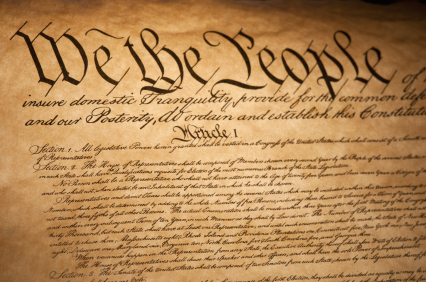
us-constitution

Before going on, it may do no harm to remind me and so many millions of others, of the opening preamble of the US Constitution:

We the People of the United States, in Order to form a more perfect Union, establish Justice, insure domestic Tranquility, provide for the common defence, promote the general Welfare, and secure the Blessings of Liberty to ourselves and our Posterity, do ordain and establish this Constitution for the United States of America.

Whatever the country, the concept of ‘by the people, of the people, for the people’ takes one hell of a lot of beating.

So to the essay. I was struck by a recent essay from George Monbiot that seemed to touch on something that more and more ordinary folk sense; that many so-called democratic political systems are not functioning in the interests of the people. Thus with no further ado, here it is.

oooOOOooo

Why Politics Fails

November 11, 2013
Nothing will change until we confront the real sources of power.

By George Monbiot, published in the Guardian 12th November 2013

It’s the reason for the collapse of democratic choice. It’s the source of our growing disillusionment with politics. It’s the great unmentionable. Corporate power. The media will scarcely whisper its name. It is howlingly absent from parliamentary debates. Until we name it and confront it, politics is a waste of time.

The political role of corporations is generally interpreted as that of lobbyists, seeking to influence government policy. In reality they belong on the inside. They are part of the nexus of power that creates policy. They face no significant resistance, from either government or opposition, as their interests have now been woven into the fabric of all three main parties.

Most of the scandals that leave people in despair about politics arise from this source. On Monday, for example, the Guardian revealed that the government’s subsidy system for gas-burning power stations is being designed by an executive from the company ESB, who has been seconded into the energy department(1). What does ESB do? Oh, it builds gas-burning power stations.

On the same day we learnt that a government minister, Nick Boles, has privately assured the gambling company Ladbrokes that it needn’t worry about attempts by local authorities to stop the spread of betting shops(2). His new law will prevent councils from taking action.

Last week we discovered that G4S’s contract to run immigration removal centres will be expanded, even though all further business with the state was supposed to be frozen while allegations of fraud are investigated(3). Every week we learn that systemic failures on the part of government contractors are no barrier to obtaining further work, that the promise of efficiency, improvements and value for money delivered by outsourcing and privatisation have failed to materialise(4,5,6). The monitoring which was meant to keep these companies honest is haphazard(7), the penalties almost non-existent(8), the rewards stupendous, dizzying, corrupting(9,10). Yet none of this deters the government. Since 2008, the outsourcing of public services has doubled, to £20bn. It is due to rise to £100bn by 2015(11).

This policy becomes explicable only when you recognise where power really lies. The role of the self-hating state is to deliver itself to big business. In doing so it creates a tollbooth economy: a system of corporate turnpikes, operated by companies with effective monopolies.

It’s hardly surprising that the lobbying bill – now stalled by the Lords – offered almost no checks on the power of corporate lobbyists, while hogtying the charities who criticise them. But it’s not just that ministers are not discouraged from hobnobbing with corporate executives: they are now obliged to do so.

Thanks to an initiative by Lord Green, large companies have ministerial “buddies”, who have to meet them when the companies request it. There were 698 of these meetings during the first 18 months of the scheme, called by corporations these ministers are supposed be regulating(12). Lord Green, by the way, is currently a government trade minister. Before that he was chairman of HSBC, presiding over the bank while it laundered vast amounts of money stashed by Mexican drugs barons(13). Ministers, lobbyists – can you tell them apart?

That the words corporate power seldom feature in the corporate press is not altogether surprising. It’s more disturbing to see those parts of the media that are not owned by Rupert Murdoch or Lord Rothermere acting as if they are.

For example, for five days every week the BBC’s Today programme starts with a  business report in which only insiders are interviewed. They are treated with a deference otherwise reserved for God on Thought for the Day. There’s even a slot called Friday Boss, in which the programme’s usual rules of engagement are set aside and its reporters grovel before the corporate idol. Imagine the outcry if Today had a segment called Friday Trade Unionist or Friday Corporate Critic.

This, in my view, is a much graver breach of BBC guidelines than giving unchallenged airtime to one political party but not others, as the bosses are the people who possess real power: those, in other words, whom the BBC has the greatest duty to accost. Research conducted by the Cardiff school of journalism shows that business representatives now receive 11% of airtime on the BBC’s 6 o’clock news (this has risen from 7% in 2007), while trade unionists receive 0.6% (which has fallen from 1.4%)(14). Balance? Impartiality? The BBC puts a match to its principles every day.

And where, beyond the Green Party, Plaid Cymru, a few ageing Labour backbenchers, is the political resistance? After the article I wrote last week, about the grave threat the transatlantic trade and investment partnership presents to parliamentary sovereignty and democratic choice(15), several correspondents asked me what response there has been from the Labour party. It’s easy to answer: nothing.

Blair and Brown purged the party of any residue of opposition to corporations and the people who run them. That’s what New Labour was all about. Now opposition MPs stare mutely as their powers are given away to a system of offshore arbitration panels run by corporate lawyers.

Since Blair’s pogroms, parliament operates much as Congress in the United States does: the lefthand glove puppet argues with the righthand glove puppet, but neither side will turn around to face the corporate capital that controls almost all our politics. This is why the assertion that parliamentary democracy has been reduced to a self-important farce has resonated so widely over the past fortnight.

So I don’t blame people for giving up on politics. I haven’t given up yet, but I find it ever harder to explain why. When a state-corporate nexus of power has bypassed democracy and made a mockery of the voting process, when an unreformed political funding system ensures that parties can be bought and sold, when politicians of the three main parties stand and watch as public services are divvied up by a grubby cabal of privateers, what is left of this system that inspires us to participate?

http://www.monbiot.com

References:

1. http://www.theguardian.com/environment/2013/nov/10/gas-industry-employee-energy-policy

2. http://www.theguardian.com/society/2013/nov/10/planning-law-changes-help-bookmakers-minister

3. http://www.theguardian.com/business/2013/nov/08/g4s-expand-contract-freeze-government-work

4. http://www.theguardian.com/commentisfree/2013/aug/05/privatisation-public-service-users-bill

5. http://www.telegraph.co.uk/news/politics/9742685/Total-chaos-after-pet-dog-counted-on-translators-database.html

6. http://www.theguardian.com/society/2013/jul/22/disabled-benefits-claimants-test-atos

7. http://www.theguardian.com/society/2013/nov/07/government-outsourcing-problems-g4s-serco-a4e

8. http://www.theguardian.com/public-leaders-network/2013/jul/17/ifg-government-outsourcing-privatisation-skills

9. http://www.theguardian.com/commentisfree/2013/jan/09/financial-transparency-privatised-nhs

10. http://www.theguardian.com/commentisfree/2013/nov/04/rail-privatisation-train-operators-profit

11. http://www.theguardian.com/commentisfree/2013/feb/07/public-sector-outsourcing-shadow-state

12. http://www.theguardian.com/politics/2013/jan/18/buddy-scheme-multinationals-access-ministers

13. http://www.theguardian.com/business/2012/jul/24/lord-green-hsbc-scandal

14. http://downloads.bbc.co.uk/bbctrust/assets/files/pdf/our_work/breadth_opinion/content_analysis.pdf

15. http://www.theguardian.com/commentisfree/2013/nov/04/us-trade-deal-full-frontal-assault-on-democracy

oooOOOooo

Nothing that I can add to Mr. Monbiot’s essay, that’s for sure.

Think differently.

“Before we change the world, we need to change the way we think.”

That quote comes from the sub-heading of an article in the magazine The New Statesman, Britain’s current affairs magazine.  In fact, written by Russell Brand from the week that he is guest editor for the magazine. Hence it following on from yesterday.

Guest editor for a week.

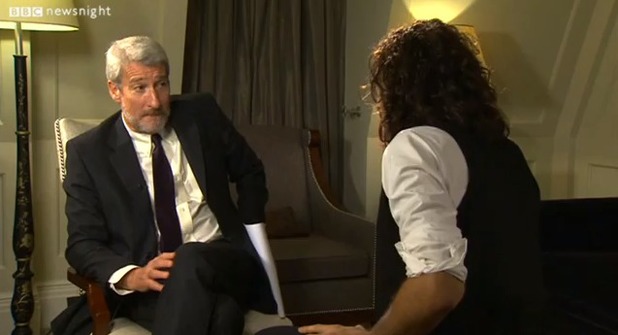
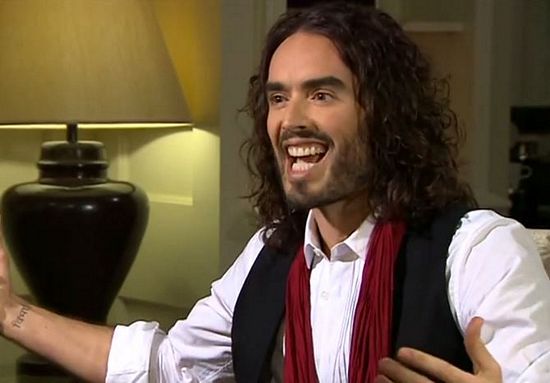
To remind readers, my post yesterday A powerful brand of truth centred around the interview on BBC Newsnight of Russell Brand by Jeremy Paxman.

Thus for today I wanted to offer some further thoughts from Russell Brand together with the film made by Dr Nafeez Ahmed. You will possibly recall that Dr. Ahmed was the author of the Guardian article that I quoted from yesterday.

Russell Brand’s New Statesman article spoke powerfully and eloquently of the issues that he covered in his BBC Newsnight interview.  With The New Statesman’s permission let me offer a few extracts:

First from where Brand is speaking about “young people, poor people, not-rich people”.

They see no difference between Cameron, Clegg, Boris, either of the Milibands or anyone else. To them these names are as obsolete as Lord Palmerston or Denis Healey. The London riots in 2011, which were condemned as nihilistic and materialistic by Boris and Cameron (when they eventually returned from their holidays), were by that very definition political. These young people have been accidentally marketed to their whole lives without the economic means to participate in the carnival. After some draconian sentences were issued, measures that the white-collar criminals who capsized our economy with their greed a few years earlier avoided, and not one hoodie was hugged, the compliance resumed. Apathy reigned.

There’s little point bemoaning this apathy. Apathy is a rational reaction to a system that no longer represents, hears or addresses the vast majority of people. A system that is apathetic, in fact, to the needs of the people it was designed to serve.

Russell Brand is also no slouch when it comes to offering solutions, as in:

These problems that threaten to bring on global destruction are the result of legitimate human instincts gone awry, exploited by a dead ideology derived from dead desert myths. Fear and desire are the twin engines of human survival but with most of our basic needs met these instincts are being engaged to imprison us in an obsolete fragment of our consciousness. Our materialistic consumer culture relentlessly stimulates our desire. Our media ceaselessly engages our fear, our government triangulates and administrates, ensuring there are no obstacles to the agendas of these slow-thighed beasts, slouching towards Bethlehem.

For me the solution has to be primarily spiritual and secondarily political. This, too, is difficult terrain when the natural tribal leaders of the left are atheists, when Marxism is inveterately Godless. When the lumbering monotheistic faiths have given us millennia of grief for a handful of prayers and some sparkly rituals.

By spiritual I mean the acknowledgement that our connection to one another and the planet must be prioritised. Buckminster Fuller outlines what ought be our collective objectives succinctly: “to make the world work for 100 per cent of humanity in the shortest possible time through spontaneous co-operation without ecological offence or the disadvantage of anyone”. This maxim is the very essence of “easier said than done” as it implies the dismantling of our entire socio-economic machinery. By teatime.

Towards the end of the article, or manifesto as Brand calls it, he speaks about the change that is required:

We are still led by blithering chimps, in razor-sharp suits, with razor-sharp lines, pimped and crimped by spin doctors and speech-writers. Well-groomed ape-men, superficially altered by post-Clintonian trends.

We are mammals on a planet, who now face a struggle for survival if our species is to avoid expiry. We can’t be led by people who have never struggled, who are a dusty oak-brown echo of a system dreamed up by Whigs and old Dutch racists.

We now must live in reality, inner and outer. Consciousness itself must change. My optimism comes entirely from the knowledge that this total social shift is actually the shared responsibility of six billion individuals who ultimately have the same interests. Self-preservation and the survival of the planet. This is a better idea than the sustenance of an elite. The Indian teacher Yogananda said: “It doesn’t matter if a cave has been in darkness for 10,000 years or half an hour, once you light a match it is illuminated.”

Then shortly thereafter:

The only systems we can afford to employ are those that rationally serve the planet first, then all humanity. Not out of some woolly, bullshit tree-hugging piffle but because we live on it, currently without alternatives. This is why I believe we need a unifying and in – clusive spiritual ideology: atheism and materialism atomise us and anchor us to one frequency of consciousness and inhibit necessary co-operation.

With the article/manifesto concluding:

But we are far from apathetic, we are far from impotent. I take great courage from the groaning effort required to keep us down, the institutions that have to be fastidiously kept in place to maintain this duplicitous order. Propaganda, police, media, lies. Now is the time to continue the great legacy of the left, in harmony with its implicit spiritual principles. Time may only be a human concept and therefore ultimately unreal, but what is irrefutably real is that this is the time for us to wake up.

The revolution of consciousness is a decision, decisions take a moment. In my mind the revolution has already begun.

It’s a powerful and very personal response to the issues facing all of humanity now and I can’t recommend too strongly reading the article in full.

So on to another powerful and personal analysis of the issues facing humanity. This time in a film made by Dr Nafeez Ahmed.  The film is called The Crisis of Civilization and shows, oh so clearly, the interconnectedness of the many issues we are facing these days. It’s nearly an hour-and-a-half long but eminently watchable.

Author and international security analyst Dr Nafeez Mosaddeq Ahmed on The Crisis of Civilization. Dr Ahmed is author of A User’s Guide to the Crisis of Civilization: And How to Save It, and co-producer of The Crisis of Civilization.

It often seems that different crises are competing to devastate civilization. The Crisis of Civilization argues that financial meltdown, environmental degradation, dwindling oil reserves, terrorism and food shortages need to be considered as part of the same ailing system.

Most accounts of our contemporary global crises focus on one area, or another, to the exclusion of others. The Crisis of Civilization suggests that the unwillingness of experts to look outside their own fields explains why there is so much disagreement and misunderstanding about the nature of the global threats we face. The Crisis of Civilization attempts to investigate all of these problem areas, not as isolated events, but as trends and processes that belong to a single global system. We are therefore not dealing with a ‘clash of civilizations’ as Samuel Huntington argued. Nor have we witnessed ‘the end of history’ that Francis Fukuyama prematurely declared. Rather, we are dealing with the end of the industrial age, a fundamental crisis of civilization itself.

oooOOOooo

OK, that’s the end of the serious stuff for this week.  Things are going to be very different here on Learning from Dogs for the month of November.

Tune in tomorrow and I’ll explain!

A powerful brand of truth!

Russell Brand speaks the truth to wide applause.

Yesterday’s post here on Learning from Dogs looked at the utter insanity, the greed, the short-sightedness of extracting oil in greater and more varied ways; as if the future for all of life on this planet just didn’t matter.  I guess the truth is that for those who stand to benefit from this wealth, the future of the planet just doesn’t matter.

Revealing the obvious!

The recent interview on BBC Newsnight by Jeremy Paxman of British comedian Russell Brand has gone viral.  At the time of writing this post, YouTube report 7,661,280 viewings!  It’s not surprising because what Russell Brand is saying is obvious to millions of people all around the world.  What Brand is expressing is as clear as a lone, lighted beacon at midnight on the darkest Winter night one could imagine.

The UK’s Guardian newspaper published an article about the interview last Friday.  It was called: Russell Brand takes on the crisis of civilisation. But what now?  Here’s how that article opened:

During his Wednesday night interview with Jeremy Paxman on BBC Newsnight, comedian and actor Russell Brand said what no politician or pundit would ever dare say: that without dramatic, fundamental change, the prevailing political and economic system is broken, and hell-bent on planetary-level destruction:

With Dr Ahmed, the author of that Guardian article, concluding:

And in doing so, we might begin to realise that it is precisely the lack of a single, top-down manifesto that is our greatest strength – because, unlike the old, dying, fossil fuel dependent paradigm of endless growth for its own sake for the corporate few, the new, emerging post-carbon paradigm will be co-created by people themselves from the ground up.

That is why Brand’s answer for the way forward is so compelling:

“We shouldn’t destroy the planet. We shouldn’t create massive economic disparity. We shouldn’t ignore the needs of the people.”

If we want our children to inherit a habitable planet, rather than bashing Brand for not having a more coherent solution, we need to start being part of it.

Dr Nafeez Ahmed is executive director of the Institute for Policy Research & Development and author of A User’s Guide to the Crisis of Civilization: And How to Save It among other books. Watch his film, The Crisis of Civilization, for free. Follow him on Twitter @nafeezahmed

“We need to start being part of it.”

You know what!  The incredible response to that Paxman-Brand interview shows the millions of us who are already “part of it.”  Yes, it really does feel that the time is now.  That time that so very many of us, in a myriad of different ways, are fighting for our beautiful planet from the ground up.

Finally, if you want to read that interview between Paxman and Brand in detail, then over on Corrente there is a full transcript of the exchange between them.

Long may this run!

Passion for speaking the truth about our present times!

Will the last person to leave turn the lights out!

It’s really terribly easy  – we just have to leave the oil in the ground!

The current issue of The Economist has an article on page 43, under The Americas section, headed Cheap at the price.

It’s a review of the biggest oil auction this year.

A single bid for a vast field shows the weakness of Brazil’s state-led approach to developing its oil reserves

SIX years after discovering giant offshore“pré-sal” oil deposits, so called because they lie beneath a thick layer of salt under the ocean bed, Brazil has finally auctioned the rights to develop some of its deeply buried wealth. On October 21st the Libra field, off Rio de Janeiro’s coast (see map), was sold to a consortium led by Petrobras, Brazil’s state-controlled oil firm, and including France’s Total, Anglo-Dutch Shell and China’s state-owned CNOOC and CNPC. Libra’s estimated 8 billion-12 billion barrels of recoverable oil make it the biggest oil prospect in the world to be auctioned this year. Once it reaches peak production, sometime in the next decade, it should increase Brazil’s output from 2.1m to about 3.5m barrels per day.

Libra oil field

The article was critical of the way Brazil managed the auction resulting in just one consortium bidding, against the expectation there would be strong competition for the oil from possibly 40 companies despite the huge costs in extracting it from over 6,000 metres (nearly 20,000 feet) below sea-level.  The article didn’t even hint at the madness of even thinking it should be extracted but I guess that’s The Economist for you.

So with that in mind, let me turn to a recent essay from TomDispatch by world-renown climate-change activist Bill McKibben.  As regular readers will be aware Tom Engelhardt of the TomDispatch blog has given blanket permission for TD essays to be republished here on Learning from Dogs.

oooOOOooo

Tomgram: Bill McKibben, Can Obama Ever Stand Up to the Oil Industry?

Posted by Bill McKibben at 4:34pm, October 27, 2013.
Follow TomDispatch on Twitter @TomDispatch.

Recently, “good” news about energy has been gushing out of North America, where a cheering crowd of pundits, energy experts, and government officials has been plugging the U.S. as the “Saudi Arabia” of the twenty-first century.  You know, all that fracking and those luscious deposits of oil shale and gas shale just waiting to be pounded into shape to fill global gas tanks for an energy-rich future.  And then, of course, just to the north there are those fabulous Canadian tar sands deposits whose extraction is reportedly turning parts of Alberta into an environmental desert.  And that isn’t all.

From the melting Arctic, where the Russians and others are staking out energy claims, to the southernmost tip of South America, the dream of new energy wealth is being pursued with a fervor and avidity that is hard to take in.  In distant Patagonia, an Argentinean government not previously known for its friendliness to foreign investment has just buddied up with Chevron to drill “around the clock in pursuit of a vast shale oil reservoir that might be the world’s next great oil field.”  Huzzah and olé!

And can you even blame the Argentinean president for her choice?  After all, who wants to be the country left out of the global rush for new energy wealth?  Who wants to consider the common good of the planet, when your country’s finances may be at stake? (As with the Keystone XL pipeline protest movement here, so in Argentina, there actually are environmentalists and others who are thinking of the common good, but they’re up against the state, the police, and Chevron — no small thing.)  All of this would, of course, be a wondrous story — a planet filled with energy reserves beyond anyone’s wildest dreams — were it not for the fact that such fossil fuel wealth, such good news, is also the nightmarish bad news of our lives, of perhaps the lifetime of humanity.

There is an obvious disconnect between what is widely known about climate change and the recent rush to extract “tough energy” from difficult environments; between the fires — and potential “mega-fire” — burning wildly across parts of overheated Australia and its newly elected government run by a conservative prime minister, essentially a climate denier, intent on getting rid of that country’s carbon tax. There is a disconnect between hailing the U.S. as the new Saudi Arabia and the recent report of the prestigious Intergovernmental Panel on Climate Change warning that fossil fuel reserves must be kept in the ground — or else. There is a disconnect between what our president says about climate change and the basic energy policies of his administration. There is a disconnect between what the burning of fossil fuels will do to our environment and the urge of just about every country on this planet to exploit whatever energy reserves are potentially available to it, no matter how “dirty,” no matter how environmentally destructive to extract.

Somewhere in that disconnect, the remarkable Bill McKibben, whose new book, Oil and Honey: The Education of an Unlikely Activist, is at the top of my personal reading list, has burrowed in and helped to create a global climate change movement. In this country, it’s significantly focused on the Keystone XL pipeline slated, if built, to bring tar sands oil from Canada to the Gulf Coast.  For the last several years at TomDispatch, McKibben has kept us abreast of the most recent developments in that movement. Here is his latest report from the tar sands front. Tom

X-Ray of a Flagging Presidency 
Will Obama Block the Keystone Pipeline or Just Keep Bending?
By Bill McKibben

As the battle over the Keystone XL pipeline has worn on — and it’s now well over two years old — it’s illuminated the Obama presidency like no other issue. It offers the president not just a choice of policies, but a choice of friends, worldviews, styles. It’s become an X-ray for a flagging presidency. The stakes are sky-high, and not just for Obama. I’m writing these words from Pittsburgh, amid 7,000 enthusiastic and committed young people gathering to fight global warming, and my guess is that his choice will do much to determine how they see politics in this country.

Let us stipulate at the start that whether or not to build the pipeline is a decision with profound physical consequences. If he approves its construction, far more of the dirtiest oil on Earth will flow out of the tar sands of Alberta, Canada, and reach the U.S. Gulf Coast. Not just right away or for a brief period, but far into the future, since the Keystone XL guarantees a steady flow of profits to oil barons who have their hearts set on tripling production in the far north.

The history of oil spills and accidents offers a virtual guarantee that some of that oil will surely make its way into the fields and aquifers of the Great Plains as those tar sands flow south.  The greater and more daunting assurance is this, however: everything that reaches the refineries on the Gulf Coast will, sooner or later, spill into the atmosphere in the form of carbon, driving climate change to new heights.

In June, President Obama said that the building of the full pipeline — on which he alone has the ultimate thumbs up or thumbs down — would be approved only if “it doesn’t significantly exacerbate the problem of carbon pollution.”  By that standard, it’s as close to a no-brainer as you can get.

These days, however, as no one will be surprised to hear, brainless things happen in Washington more often than not, and there’s the usual parade of the usual suspects demanding that Keystone get built. In mid-October, a coalition that included Exxon, Chevron, ConocoPhillips, and Royal Dutch Shell, not to mention the U.S. Chamber of Commerce, the National Association of Manufacturers, and the Business Roundtable, sent Obama a letter demanding that he approve Keystone in order to “maintain investor confidence,” a phrase almost guaranteed to accompany bad ideas. A report last week showed that the Koch brothers stood to earn as much as $100 billion in profits if the pipeline gets built (which would come in handy in helping fund their endless assault on unions, poor people, and democracy).

But don’t think it’s just Republican bigwigs and oil execs rushing to lend the pipeline a hand. Transcanada, the pipeline’s prospective builder, is at work as well, and Obama’s former communications director Anita Dunn is now on the Transcanada dime, producing TV ads in support of the pipeline.  It’s a classic example of the kind of influence peddling that knows no partisan bounds. As the activists at Credo put it: “It’s a betrayal of the commitments that so many of us worked so hard for, and that Dunn herself played a huge role in shaping as top strategist on the 2008 campaign and communications director in the White House.”

Credo’s Elijah Zarlin, who worked with Dunn back in 2008, wrote that attack on her. He was the guy who wrote all those emails that got so many of us coughing up money and volunteering time during Obama’s first run for the presidency, and he perfectly exemplifies those of us on the other side of this divide — the ones who actually believed Dunn in 2008, the ones who thought Obama was going to try to be a different kind of president.

On energy there’s been precious little sign of that. Yes, the Environmental Protection Agency has put in place some new power plant regulations, and cars are getting better mileage. But the president has also boasted again and again about his “all of the above” energy policy for “increasing domestic oil production and reducing our dependence on foreign oil.” It has, in fact, worked so well that the United States will overtake Russia this year as the biggest combined oil and natural gas producer on the planet and is expected to pass Saudi Arabia as the number one oil producer by 2017.

His administration has okayed oil drilling in the dangerous waters of the Arctic and has emerged as the biggest backer of fracking.  Even though he boasts about marginal U.S. cuts in carbon emissions, his green light to fracking means that he’s probably given more of a boost to releases of methane — another dangerous greenhouse gas — than any man in history. And it’s not just the environment.  At this point, given what we know about everything from drone warfare to NSA surveillance, the dream of a progressive Obama has, like so many dreams, faded away.

The president has a handy excuse, of course: a truly terrible Congress. And too often — with the noble exception of those who have been fighting for gay rights and immigration reform — he’s had little challenge from progressives. But in the case of Keystone, neither of those caveats apply: he gets to make the decision all by himself with no need to ask John Boehner for a thing, and people across the country have made a sustained din about it. Americans have sent record numbers of emails to senators and a record number of comments to the State Department officials who oversee a “review” of the pipeline’s environmental feasibility; more have gone to jail over this issue than any in decades. Yet month after month, there’s no presidential decision.

There are days, in fact, when it’s hard to muster much fire for the fight (though whenever I find my enthusiasm flagging, I think of the indigenous communities that have to live amid the Mordor that is now northern Alberta). The president, after all, has already allowed the construction of the southern half of the Keystone pipeline, letting Transcanada take land across Texas and Oklahoma for its project, and setting up the beleaguered communities of Port Arthur, Texas, for yet more fumes from refineries.

Stopping the northern half of that pipeline from being built certainly won’t halt global warming by itself. It will, however, slow the expansion of the extraction of tar sands, though the Koch brothers et al. are busy trying to find other pipeline routes and rail lines that would get the dirtiest of dirty energy out of Canada and into the U.S. via destinations from Michigan to Maine.  These pipelines and rail corridors will need to be fought as well — indeed the fights are underway, though sometimes obscured by the focus on Keystone. And there are equally crucial battles over coal and gas from the Appalachians to the Pacific coast. You can argue that the president’s people have successfully diverted attention from their other environmental sins by keeping this argument alive long past the moment at which it should have been settled and a decision should have been made.

At this point, in fact, only the thought of those 900,000 extra barrels a day of especially nasty oil coming out of the ground and, via that pipeline, into refineries still makes the fight worthwhile. Oh, and the possibility that, in deciding to block Keystone, the president would finally signal a shift in policy that matters, finally acknowledge that we have to keep most of the carbon that’s still in the ground in that ground if we want our children and grandchildren to live on a planet worth inhabiting.

If the president were to become the first world leader to block a big energy project on the grounds of its effects on climate, it might help dramatically  reset the international negotiations that he allowed to go aground at Copenhagen in 2009 — the biggest foreign policy failure of his first term.

But that cascade of “ifs” depends on Obama showing that he can actually stand up to the oil industry. To an increasingly disillusioned environmental movement, Keystone looks like a last chance.

Bill McKibben is Schumann Distinguished Scholar at Middlebury College, founder of the global climate campaign 350.org, a TomDispatch regular, and the author of a new book, Oil and Honey: The Education of an Unlikely Activist.

Follow TomDispatch on Twitter and join us on Facebook or Tumblr. Check out the newest Dispatch book, Nick Turse’s The Changing Face of Empire: Special Ops, Drones, Proxy Fighters, Secret Bases, and Cyberwarfare.

Copyright 2013 Bill McKibben

oooOOOooo

President Obama turned 52-years-old on August 4th this year. Michelle, his wife, will be 50-years-old next January, 17th.  Their children, Malia and Sasha, are aged 15 and 12 respectively.

Thus this family of four are all sufficiently young to be alive when the consequences of burning all this oil will be very painfully obvious, when all the power and money in the world will come to naught.

So it strikes me that young Malia and Sasha should be shown where Planet Earth’s master circuit-breaker is located.  Would be such a shame to leave the lights on when there’s no-one at home.

North America burning bright - an image from NASA.
North America burning bright – an image from NASA.

Patterns and ripples.

It’s not just the climate change that is unsustainable!

Early in yesterday’s post I wrote:

My post last Monday, The lure of patterns, appears to have resonated far and wide.  In the sense of many echoes reinforcing the perilous nature of our present times and the desperately uncertain decades ahead.  Tomorrow I shall be writing specifically about those echoes.

Those echoes, as I chose to call them, were kicked off by a recent item on the blog Economic Populist.  The item was called Maps of Economic Disaster and had some sickening information.  Such as:

Today 15% of Americans live in poverty.  Below is a county map showing the previous year’s poverty rate and we see once again the South has high concentrations.

povertymap

People are living on the edge.  People living in liquid asset poverty is a whopping 43.9%.  This means 132.1 million people lack the savings to cover basic expenses for three months if they lose their job, have a medical emergency or some other sort of crisis.  The below map** breaks down that percentage state by state.  Pretty much half the country is living on the edge, paycheck to paycheck.

** I’ve not included that map but it may be seen here.  However, I did want to republish the closing map.

Finally, the next map shows how income inequality has grown in United States over time.  The gini index is a measure of income inequality, the higher then index gets, the worse income inequality is. If there is ever a map which shows the the destruction of the U.S. middle class, it is this one.

[N.B. The following map is an automated GIF so just left-click on it to see the sequence.  That sequence is essentially a coloured graphical image of each year, from 1977 through to 2012.  Don’t struggle with it.  All you have to note are the changing colours.  More colours towards the green end of the spectrum indicate a worsening gini index, i.e. a worsening measure of income inequality. ]

Gini map

America is clearly in dire straights and the above maps it all out.  Why then has this government, this Congress not put wages and jobs as jobs #1 is a good question.  Why America hasn’t outright revolted, demanding this government do so is a better one.

oooo

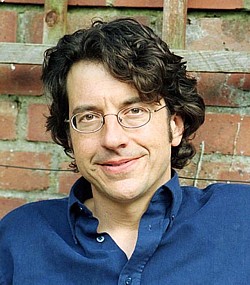
George Monbiot.
George Monbiot.

Let me now turn to George Monbiot, a British writer known for his environmental and political activism.  WikiPedia describes Mr. Monbiot, in part, as:

He lives in MachynllethWales, writes a weekly column for The Guardian, and is the author of a number of books, including Captive State: The Corporate Takeover of Britain (2000) and Bring on the Apocalypse: Six Arguments for Global Justice (2008). He is the founder of The Land is Ours, a peaceful campaign for the right of access to the countryside and its resources in the United Kingdom.

On his own website, he offers us this:

Here are some of the things I love: my family and friends, salt marshes, arguments, chalk streams, Russian literature, kayaking among dolphins, diversity of all kinds, rockpools, heritage apples, woods, fishing, swimming in the sea, gazpacho, ponds and ditches, growing vegetables, insects, pruning, forgotten corners, fossils, goldfinches, etymology, Bill Hicks, ruins, Shakespeare, landscape history, palaeoecology, Gavin and Stacey and Father Ted.

Here are some of the things I try to fight: undemocratic power, corruption, deception of the public, environmental destruction, injustice, inequality and the misallocation of resources, waste, denial, the libertarianism which grants freedom to the powerful at the expense of the powerless, undisclosed interests, complacency.

Here is what I fear: other people’s cowardice.

There was a recent essay concerning the UK’s energy strategy posted by George Monbiot published in the Guardian on the 22nd October.  It is also on his website.

The essay opens, thus [my emphasis]:

Fiscal Meltdown

The government is betting the farm on a nuclear technology that might soon look as hip as the traction engine.

Seven years ago, I collected all the available cost estimates for nuclear power. The US Nuclear Energy Institute suggested a penny a kilowatt hour. The Royal Academy of Engineering confidently predicted 2.3p. The British government announced that in 2020 the price would be between 3 and 4p. The New Economics Foundation guessed that it could be anywhere between 3.4 and 8.3p. 8.3 pence was so far beyond what anyone else forecast that I treated it as scarcely credible. It falls a penny short of the price now agreed by the British government.

Mr. Monbiot’s essay concludes:

An estimate endorsed by the chief scientific adviser at the government’s energy department suggests that, if integral fast reactors were deployed, the UK’s stockpile of nuclear waste could be used to generate enough low-carbon energy to meet all UK demand for 500 years. These reactors would keep recycling the waste until hardly any remained: solving three huge problems – energy supply, nuclear waste and climate change – at once. Thorium reactors use an element that’s already extracted in large quantities as an unwanted by-product of other mining industries. They recycle their own waste, leaving almost nothing behind.

To build a plant at Hinkley Point which will still require uranium mining and still produce nuclear waste in 2063 is to commit to 20th-Century technologies through most of the 21st. In 2011 GE Hitachi offered to build a fast reactor to start generating electricity from waste plutonium and (unlike the Hinkley developers) to carry the cost if the project failed. I phoned the government on Monday morning to ask what happened to this proposal. I’m still waiting for an answer.

That global race the prime minister keeps talking about? He plainly intends to lose.

NB. I edited out the links to a comprehensive set of references to make the essay easier to read off the screen.  But all the facts reported by Mr. Monbiot may be seen here.

oooo

Just two more or less random pieces of writing that have graced my ‘in-box’. Nothing scientific about my selection; just the sense that they are representative of the reams and reams of articles, essays and reports coming in on an almost daily basis from right across the world showing an ever-increasing credibility gap between the peoples of many nations and those who purport to serve those peoples in their respective Governments.

Frankly, I can’t even imagine how or when we will ‘transition’ out of this present period.  But one thing I am sure about. This schism between us, the people, and those who govern us is unsustainable!

Fascinating times! (I think!)

Need to go and hug a dog!

Come here, Hazel! I need some loving!

The lure of patterns.

Is this present era really coming to an end?

Somewhere in my aged brain cells is the memory of having heard that humans are great lovers of patterns.  In other words, patterns are deemed to be very important for the progress and evolution of homo sapiens.  Of course, it is not just humans who learn from patterns; I’m sure most of the animals who live around us are great pattern matchers.  To support that proposition, anyone who has owned a dog or cat will have spotted how quickly they learn patterns.  (As an aside, some months ago our puppy German Shepherd, Cleo, work me at around 4am because she needed to go outside for a ‘call of nature’.  I now get woken every single night variously between 2am and 5am for Cleo’s benefit!)

The British mathematician G. H. Hardy who lived from the last quarter of the 19th Century well into the 20th Century, reputedly said (and I cheated and looked it up!):

A mathematician, like a painter or poet, is a maker of patterns. If his patterns are more permanent than theirs, it is because they are made with ideas.

So why has this post opened with the theme of patterns?  Because, call it coincidence or what, within the last couple of weeks there have been three articles, each from very a different source, predicting that the present levels of inequality in society are both unsustainable and the beginning of the end.

First, on Michael Robert’s blog there was a post eleven days ago about global wealth inequality. From which I quote:

Global wealth inequality: top 1% own 41%; top 10% own 86%; bottom half own just 1%

—–

Just 8.4% of all the 5bn adults in the world own 83.4% of all household wealth (that’s property and financial assets, like stocks, shares and cash in the bank).  About 393 million people have net worth (that’s wealth after all debt is accounted for) of over $100,000, that’s 10% own 86% of all household wealth!  But $100,000 may not seem that much, if you own a house in any G7 country without any mortgage.  So many millions in the UK or the US are in the top 10% of global wealth holders.  This shows just how little two-thirds of adults in the world have – under $10,000 of net wealth each and billions have nothing at all.

This is not annual income but just wealth – in other words, 3.2bn adults own virtually nothing at all.  At the other end of the spectrum, just 32m people own $98trn in wealth or 41% of all household wealth or more than $1m each.  And just 98,700 people with ‘ultra-high net worth’ have more than $50 million each and of these 33,900 are worth over $100 million each.  Half of these super-rich live in the US.

Michael Robert’s essay closes:

All class societies have generated extremes of inequality in wealth and income.  That is the point of a rich elite (whether feudal landlords, Asiatic warlords, Incan and Egyptian religious castes, Roman slave owners, etc) usurping control of the surplus produced by labour.  But past class societies considered that normal and ‘god-given’. Capitalism on the other hand talks about free markets, equal exchange and equality of opportunity.  But the reality is no different from previous class societies.

Secondly, just last Friday I was drawn to an essay on, of all places, The Permaculture Research Institute blog.  The essay, by Chris Hedges (**), was called On Inequality and the Collapse of Globalization.  Chris Hedges opened his essay, thus:

The uprisings in the Middle East, the unrest that is tearing apart nations such as the Ivory Coast, the bubbling discontent in Greece, Ireland and Britain and the labor disputes in states such as Wisconsin and Ohio presage the collapse of globalization. They presage a world where vital resources, including food and water, jobs and security, are becoming scarcer and harder to obtain. They presage growing misery for hundreds of millions of people who find themselves trapped in failed states, suffering escalating violence and crippling poverty. They presage increasingly draconian controls and force—take a look at what is being done to Pfc. Bradley Manning—used to protect the corporate elite who are orchestrating our demise.

We must embrace, and embrace rapidly, a radical new ethic of simplicity and rigorous protection of our ecosystem—especially the climate—or we will all be holding on to life by our fingertips. We must rebuild radical socialist movements that demand that the resources of the state and the nation provide for the welfare of all citizens and the heavy hand of state power be employed to prohibit the plunder by the corporate power elite. We must view the corporate capitalists who have seized control of our money, our food, our energy, our education, our press, our health care system and our governance as mortal enemies to be vanquished.

The PRI editor’s preamble to the Chris Hedges essay included a couple of videos that he recommended watching.  One was a talk by Robert Reich: How Unequal Can America Get Before We Snap?

The other one was a recent TED Talk by Richard Wilkinson (his profile is here).

Mr. Wilkinson explains that for the majority of people there is an instinctive feeling that societies with huge income gaps and corresponding high levels of social inequality are somehow going wrong. He charts the hard data on such economic inequality and shows what gets worse when rich and poor are too far apart: ergo, the very real effects on health, lifespan, and even such basic values as trust.

Just 16 minutes long, it’s a very revealing talk.  Do watch it.

oooo

The final, third piece of the pattern was me coming across an essay on the blog DeflationLand, not a blog I had come across before, on the same day that I saw the PRI article.  This essay, published just two days before the PRI article, was about patterns; the patterns of the centuries.  More specifically, how the characteristics of a century generally evolve to a new culture within the first 10 to 15 years of the following century.  It was a most interesting proposition and, to my delight, I was given permission to republish that essay here on Learning from Dogs.  So here it is.

oooOOOooo

Why I stopped worrying and learned to love the currency collapse

For the past 300 years, the historical pattern has been for the era marked by a century to continue into the following century by fourteen or fifteen years. Let me explain.  Everyone knows that the 19th Century, its uprightness, its optimism and sense of purpose, the halcyon days of British Empire, came to an end with World War I, starting in 1914 and building to a nasty crescendo by 1916.  The 20th Century had arrived, and it had some real horrors in store for us.

Germans before Kraftwerk

But if we return back another hundred years, we notice that the 18th Century ends in 1815 with the final defeat of Napoleon, that final project of the Enlightenment and of the French Revolution.  With the Congress of Vienna in 1814-1815, we have a new Europe along the lines of Metternich’s plan, and the 19th Century at last is here.

"Sorry, guys.  My bad."
“Sorry, guys. My bad.”

In 1713 and 1714, we have the Treaties of Utrecht, Baden, and Rastatt, bringing an end to the era of Spain as a major power, and the rise of the Habsburgs.  Louis XIV dies in 1715, after reigning for 72 years.  The Baroque period is over, and we are now firmly in the 18th Century.

War of Spanish Succession

We still live in the 20th Century.  Nothing much significant has changed in our lives in the past twenty years.  Symptoms of a deeper rot are appearing here and there, foreshadowing a larger crisis, but the crisis itself has not arrived yet.  We still live in an era of Pax Americana, the old republic very much a strained and tired Empire now, with the U.S. Dollar as the world’s reserve currency.

That is going to change.

The next task for History is to dismantle the untenable structures and institutions put in place by late Modernity, which have been extended now as far as they can go.  Our debt-based monetary system will collapse, our unbacked fiats will be worthless.  The debts and unmeetable obligations will all default.

There are ironies and great contradictions as the former home and hope of Liberty becomes viciously unfree and increasingly despotic.  Our leaders no longer govern, but try instead to rule us — they are less legitimate with each passing day, their laws corrupt or worse.  They are nearly finished, and will be swept away with the tide.

Just as in 1914, the internationalist system will break down, dashing the hopes of the would-be first-world nations.  We will probably have a pretty good war as well, or many local ones worldwide.  These transitions tend to involve war.

Deflation first — it clears the way for the complete loss of faith and hyperinflation that will follow.  The next big wave down in the financial markets is the battering ram.  The U.S. national debt is about faith, so is quantitative easing, and so is the very idea of magical coins that could ever be “worth” a trillion dollars.  When this faith breaks, in concert with loss of faith in perpetual growth and unlimited cheap energy, then things will move very, very quickly.

There is nothing any of us can do at this point, except navigate the rapids as well as possible, and to stay out of the way of a dying empire, which is still very dangerous in its death throes.  We are actually very privileged to be alive and witnessing this next transition, to what we do not know just yet.  But what an honor to live at this time, not in ignorance but with an existential resolve to come out of it alive and much the wiser.

Ass Americana.
Ass Americana.

oooOOOooo

** Chris Hedges is a Pulitzer Prize–winning author and former international correspondent for the New York Times. His latest book is The World As It Is: Dispatches on the Myth of Human Progress.

I am neither a scientist nor a historian; just someone who has lived in and observed the world for coming on for 60 years.

So you have to understand that my prediction is hardly worth the ‘paper I write upon’ (which certainly dates me!).  But, undaunted, here are my predictions for the 21st Century:

  • That the power of internet communications will allow more people, more quickly, to find their soul-mates wherever they are on this planet.
  • That the realisation of how dysfunctional many Governments are, of how truly poorly they serve the majorities of their citizens, will lead to mass rejections of these so-called Governments’ policies.  Such rejections predominantly peaceful, as in taking the horse to water but being unable to make it drink.
  • That there will be a new form of localism.  At two levels.  Literally, people geographically close to each other creating 21st C. versions of local communities.  Virtually, those local communities linking to other like-minded communities right across the world resulting in highly effective and innovative learning, accelerated common-sense, (call it wisdom if you wish), and extraordinarily efficient and sustainable ways of living on this planet.

What do you think?

Truth, Justice, Sanity and Brotherhood.

plus ça change, plus c’est la même chose

The more it changes, the more it’s the same thing.” Apparently an epigram by Jean-Baptiste Alphonse Karr in the January 1849 issue of his journal Les Guêpes (“The Wasps”). Source.

Both the heading and the sub-heading to today’s post reflect strong connections to Chris Snuggs.  Chris has featured previously several times on Learning from Dogs and, I’m sure, my association with Chris has been mentioned.  An association going back too many years to the time when Chris invited me to run a course on sales and marketing for the students at the French Institute ISUGA in Quimper, France.  It became a regular event and Chris and I got to know each other well.

Chris has his own blogsite Nemo Insula Est from where one learns this about him:

A retired teacher, I am very worried about the state and future of the world. One thing may help, a determination to communicate and state the truth as one sees it, which is what I seek to do. I try to see things objectively; my horror of being brainwashed or motivated by some dogma or partisan viewpoint is absolute.

I salute the free press which has a good record of unearthing nepotism, corruption, dishonest and lunacy. However, the nepotists, the despots, the corrupt, the dishonest and the lunatics often have a lot of power, money and therefore influence. This allied to the fact that the lumpenmass is too busy toiling away to survive and often shrugs its shoulders in hopelessness means that the aforementioned get away with it.

Anyway, enough of me waffling on!  In my email in-box earlier today was an email from Chris offering me a couple of links to his posts on Nemo Insula Est.  One was very funny and one was decidedly less so.  The latter is being republished here today, with Chris’s permission.  It is called The State of America.

oooOOOooo

The State of America

A Blog post from the “Daily Telegraph” on October 3rd, 2013 by:

Ghislane400

I haven’t got time to verify all of these statistics, but I assume they are accurate. I have added some from Nicholas Kristoff at the end.

As far as I understand, the only reason the USA is not totally bankrupt right now is because the rest of the world keeps lending to it, believing that it is “too big to fail.” Many countries and Empires in history have believed they are too big and important to fail, France being yet another one ………. On that point, see:  The Life Cycle of a Democracy, which is rather sobering!

After DECADES of bad decisions, America is now dangerously in debt!  Obama has crippled America since he was re-elected, and his ineptitude is highlighted by the facts below: 

  • 30 years ago the US national debt stood at about one trillion dollars.  Today it stands at almost 17 TRILLION DOLLARS!
  • About 40 years ago the TOTAL debt stood at about 2 trillion dollars, today it is more than 56 TRILLION DOLLARS!  
  • At the same time as they have run up all of this debt, their economic infrastructure and their ability to create wealth has been completely gutted.  Since 2001, America has lost more than 56,000 manufacturing facilities and millions of jobs have been moved overseas. 
  • Their share of the global GDP declined from 31.8% in 2001 to 21.6% in 2011.
  • The percentage of self-employed Americans is at an all time low whilst the amount of them on benefits is at a record high.
  • During Obama’s first term, the federal government accumulated more debt than it did under the first 42 U.S presidents combined.
  • If they started to pay off the new debt accumulated under Obama at the rate of $1 per second, it would take them 184,000 years to pay it off.
  • Every hour of every day, the federal government steals more than 100 MILLION DOLLARS from their children and your grandchildren.
  • America has dropped in global economic competitiveness for the past 4 years running. 
  • According to “The Economist”, America was the best place to be born in 1988; now they tie for 16th place.
  • There are fewer Americans working in manufacturing today than in 1950, despite the fact that their population has doubled since then.
  • In Detroit alone, there are over 70,000 abandoned buildings.
  • When NAFTA was pushed through American Congress in 1933, they had a trade surplus with Mexico of 1.6 billion dollars.  They had a trade DEFICIT with them of 61.6 billion dollars come 2010.
  • Their trade deficit with China was 6 MILLION DOLLARS in 1985 for the entire year.  In 2012 their trade deficit with China was 315 BILLION DOLLARS.  This is the largest trade deficit between nations in the history of the world.  
  • America also loses half a million jobs to China annually. Fewer than 65% of all men in America have jobs. 53% of American male workers make less than $30,000 a year! Only 7% of all non-farm workers in the States are self-employed.  This is an all time low.
  • 146 million Americans are either ‘poor’ or ‘low income’.  49% of them live in a home that receives benefits from the federal government, according to the U.S Census Bureau. One in every 6 Americans is on Medicaid and Obamacare will add another 16 million to the Medicaid rolls; this will be a total of 73.2 million come 2025. This will increase liabilities of 38 trillion dollars to Medicare over the next 75 years, which equates to $328,404.00 for every single household in the United States.
  • Of the 56 million Americans collecting Social Security benefits now, by 2035 that will soar to an astounding 91 MILLION!  That is a 134 trillion dollar shortfall over the next 75 years.
  • Americans on Social Security Disability exceed the population of Greece, and those on food stamps exceed the population of Spain.
  • 45% of all children in Miami now live in poverty, more than 50% of all children in Cleveland live in poverty, 60% of all children in Detroit live in poverty.  
  • More than 1 million public school students in America are HOMELESS.  This is the first time in American history this has ever happened.
  • Since Obama got back in, those Americans on food stamps have risen from 32 million to 47 million.  That number exceeds the combined populations of Alaska, Arkansas, Connecticut, Delaware, District of Colombia, Hawaii, Idaho, Iowa, Kansas, Maine, Mississippi, Montana, Nebraska, Nevada, New Hampshire, New Mexico, North Dakota, Oklahoma, Oregon, Rhode Island, South Dakota, Utah, Vermont, West Virginia and Wyoming!

What a spiffing good job Obama is doing of bankrupting America!  Anyone would think he hates the States!  Seriously, anyone who voted for him owes an apology to the children of America, for whom a terrible country full of debt has been created by the biggest clown one could imagine.

AND, from Nicholas Kristoff in “The New York Times”:

  • The richest 1 percent of Americans now take home almost 24 percent of income, up from almost 9 percent in 1976. As Timothy Noah of Slate noted in an excellent series on inequality, the United States now arguably has a more unequal distribution of wealth than traditional banana republics like Nicaragua, Venezuela and Guyana.
  • C.E.O.’s of the largest American companies earned an average of 42 times as much as the average worker in 1980, but 531 times as much in 2001. Perhaps the most astounding statistic is this: From 1980 to 2005, more than four-fifths of the total increase in American incomes went to the richest 1 percent.

POSTSCRIPT:

The fact that we are here today to debate raising America’s debt limit is a sign of leadership failure. It is a sign that the U.S. Government can’t pay its own bills. It is a sign that we now depend on on-going financial assistance from foreign countries to finance our Government’s reckless fiscal policies. … Increasing America’s debt weakens us domestically and internationally. Leadership means that “the buck stops here.” Instead, Washington is shifting the burden of bad choices today onto the backs of our children and grandchildren. America has a debt problem and a failure of leadership. Americans deserve better.

Want to know who said that, and when? ……

Senator Barack Obama on March 20, 2006.

oooOOOooo

Just a footnote on that level of US inequality reported by Nicholas Kristoff using an extract from a recent post on Learning from DogsOur broken ways:

OK, that’s enough ‘copying’ from me so please go and read more about the plight of those poor billionaires.  But if the NYT and Paul Krugman will forgive me, here’s the paragraph towards the end of the Krugman essay that makes me sick [my emboldening]:

The thing is, by and large, the wealthy have gotten their wish. Wall Street was bailed out, while workers and homeowners weren’t. Our so-called recovery has done nothing much for ordinary workers, but incomes at the top have soared, with almost all the gains from 2009 to 2012 going to the top 1 percent, and almost a third going to the top 0.01 percent — that is, people with incomes over $10 million.

(Patrice Ayme has a parallel essay on this topic.)

There will be hundreds of thousands, if not millions, who share my view that this dimming of America’s historic beacon of truth and justice is a failure not just for the United States of America but for the rest of the world.

It seems appropriate to remind all you dear readers as to why I write this Blog.  Most easily encapsulated in what appears on my Welcome page:

Dogs live in the present – they just are!  Dogs make the best of each moment uncluttered by the sorts of complex fears and feelings that we humans have. They don’t judge, they simply take the world around them at face value.  Yet they have been part of man’s world for an unimaginable time, at least 30,000 years.  That makes the domesticated dog the longest animal companion to man, by far!

As man’s companion, protector and helper, history suggests that dogs were critically important in man achieving success as a hunter-gatherer.  Dogs ‘teaching’ man to be so successful a hunter enabled evolution, some 20,000 years later, to farming,  thence the long journey to modern man.  But in the last, say 100 years, that farming spirit has become corrupted to the point where we see the planet’s plant and mineral resources as infinite.  Mankind is close to the edge of extinction, literally and spiritually.

Dogs know better, much better!  Time again for man to learn from dogs!

Pharaoh, as with all dogs, is an integrous creature – man has much to learn from him, and all dogs.

Each and every one of us must fight for truth, justice, sanity and brotherhood!

Heads I win: Tails you lose!

How the foreclosure crisis was a boon for the super wealthy.

For some time now, must be quite a few years, I have subscribed to Yves Smith’s Naked Capitalism blog.  I do so for a number of reasons.

Thus it was that a few days ago I read with a mixture of anger and disgust an article about the consequences of the foreclosure crisis on the wealthy.  Within a few hours of me requesting by email permission to republish that article on Learning from Dogs came the reply from Yves granting such permission.

Try not to get too angry!

oooOOOooo

SUNDAY, OCTOBER 6, 2013

How the Foreclosure Crisis Made the Rich Even Richer

This is Naked Capitalism fundraising week. 53 donors [now well over 400, Ed.] have already invested in our efforts to shed light on the dark and seamy corners of finance. Join us and participate via our Tip Jar or another credit card portal, WePay in the right column, or read about why we’re doing this fundraiser and other ways to donate, such as by check, as well as our current goal, on our kickoff post.

It’s a welcome departure to see Adam Davidson’s weekly column in the New York Times, which usually puts a happy face on how the 1% are winning the class war in America, have a guest writer look at the other side of the story.

Catherine Rampell has a short but compelling piece on how the foreclosure crisis was wealth transfer from lower and middle income families to the rich. Her points are simple: the typical person who lost their home wasn’t a greedhead who bought too much house or refied to buy flat panel TVs and go on cruises (if you hang out with mortgage types, you’ll get a big dose of profligate consumer urban legend). The people who were like that (and there were some) for the most part were in subprime loans that reset in 2007 and 2008 and were in the early wave of foreclosures. The people who’ve lost their homes in later foreclosures were overwhelmingly people who had the bad fortune to buy late in the housing bubble (so when the bust hit, they had negative equity and couldn’t use lower rates to refi into cheaper payments) and took economic hits as a direct result of the crisis (hours cuts and job losses; other people who were hurt were in the more typical “shit happens” categories, like suffering medical problems, with their situation made much worse by their inability to sell or refinance their home).

Rampell’s contribution is to look at the phenomenon of investors, both big and small, and how they’ve bought properties at foreclosure and then flipped them. Separately, Josh Rosner recently released the astonishing statistic: that sales of owner-occupied properties showed only a 1% gain in the last 12 months. The gains that have been driving the indexes were all in investor owned properties. Some flipped to other investors. In hot markets, local investors have been doing “mini-bulks,” acquiring small portfolios to sell to private equity investors, some without renovating them, others with modest fix-ups. Others sold them to homebuyers.

Rampell uses the example of a couple who believed that renting was throwing away their money, and had the bad luck to buy a moderately-priced fixer-upper in early 2007. Each wage earner saw their income drop and unable to get a loan modification, they lost their home. Their $309,000 Seattle home went to an investor for $155,000 in the summer of 2011. That investor just sold it to a homeowner for $290,000, not far below what the hapless couple paid for it. But the new buyer paid all cash.

Rampell tells us:

Of the 87,062 foreclosures in the last five years that were bought by corporate investors and have been flipped, about a quarter were sold for at least $100,000 more than what the investor originally paid, according to [an online real estate listings site] Redfin (Although it’s impossible to know how much investors spent on upgrades or renovations.)….

The boom-bust-flip phenomenon is just one of the most obvious ways that research suggests the financial crisis has benefited the upper class while brutalizing the middle class. Rents have risen at twice the pace of the overall cost-of-living index, partly because middle-class families can’t get the credit they need to buy. That means “landlords can raise rents with impunity,” says Glenn Kelman, chief executive of Redfin. And according to a report by David Autor, the M.I.T. economist, job losses during and after the recession were concentrated in midskilled and midwage jobs, like white-collar sales, office and administrative jobs; and blue-collar production, craft, repair and operative jobs. Employment for higher-skilled workers, on the other hand, has grown substantially.

There is a second way foreclosures have served as a wealth transfer to the capitalist classes. Foreclosures don’t necessarily result in evictions. Banks often leave properties in a “zombie” state, starting foreclosures but not completing them, leaving the owner who thought he was foreclosed on still on the hook for property taxes. Another variant which is much less damaging is to leave the homeowner in place. I recently met an investor who is acquiring homes in Atlanta. The day after he buys a house, he goes to introduce himself to the former homeowner to see if he can work out a deal to keep them in place as tenant. In the overwhelming majority of cases, he can. “They were paying $1100 on their mortgage and the bank wouldn’t give them a mod. I’ll let them rent for $700, which is way above what they’d have gotten if they wrote the principal down to the price at which I bought the house. And I tell the tenants I’d be happy to sell the home to them.” We didn’t discuss details, but it sounded as if he’d be willing to structure rent to own deals (where part of the rent would go to a down payment on the house).

He was clear that his business depended on what he saw as value destroying behavior by banks. He described how he’d recently bought a home and when he went for his usual visit to the house, a well-dressed black man met him and invited him in, saying he’d be out in 30 days and assumed it wasn’t a problem. The new owner saw the house was in impeccable shape. He chatted with the owner a bit and found out he was a bodybuilder with a high-end training business. He asked the homeowner: “You look like you take good care of yourself and the house. You’d been paying on time. What happened?”

The trainer told him that he’d bought the house at the peak of the cycle for $160,000. The house was clearly now worth way less. He tried to get the bank to modify it to a principal balance of $100,000. The bank wouldn’t consider it. “So I bought a house which is comparable to this one for $50,000 and gave this one up.”

In this case, the homeowner had enough cash to arbitrage himself. The investor told me he’d bought the foreclosed home for $40,000. Had the bank cut a deal for $100,000 (and who knows, the homeowner might have accepted a higher number), it would have come out way ahead. But that also assumes that the bank owned the mortgage. It’s pretty much a given that the bank was a servicer, and as we’ve seen again and again, servicers don’t have the incentives or the infrastructure to do mods. So investor in the mortgages lose, homeowners lose. The winners are the banks as inefficient looters (the money they skim off the servicing is chump change relative to the damage done by negligent and predatory servicing) and the investors who profit by picking up the pieces. This is isn’t a well-functioning economic system, it’s rentier capitalism. And it’s looking more and more like a doomsday machine for what remains of the middle class.

oooOOOooo

Can’t add anything polite to this!  Except, to say it’s a very long way from integrity!