Category: Poetry

Returning to Nature

The power of serendipity!

Why the choice of this sub-heading?  Well, just because a number of quite separate articles and essays have come together to offer a powerful, cohesive argument for reconsidering the role of Nature in the future of mankind.

Of course, my use of words in that preceding sentence is completely ludicrous; the suggestion that ‘Nature’ is disconnected from ‘mankind’.  Yet millions of us, to a greater or lesser degree, do behave as if we are the masters of the world.

So let me dip into what has been ‘crossing my desk’ in recent times.

On May 28th, George Monbiot published in The Guardian newspaper an essay entitled A Manifesto for Rewilding the World.  (The link takes you to the article on the Monbiot blogsite.)  Here’s how that essay opened,

Until modern humans arrived, every continent except Antarctica possessed a megafauna. In the Americas, alongside mastodons, mammoths, four-tusked and spiral-tusked elephants, there was a beaver the size of a black bear: eight feet from nose to tail(1). There were giant bison weighing two tonnes, which carried horns seven feet across(2).

The short-faced bear stood thirteen feet in its hind socks(3). One hypothesis maintains that its astonishing size and shocking armoury of teeth and claws are the hallmarks of a specialist scavenger: it specialised in driving giant lions and sabretooth cats off their prey(4). The Argentine roc (Argentavis magnificens) had a wingspan of 26 feet(5). Sabretooth salmon nine feet long migrated up Pacific coast rivers(6).

During the previous interglacial period, Britain and Europe contained much of the megafauna we now associate with the tropics: forest elephants, rhinos, hippos, lions and hyaenas. The elephants, rhinos and hippos were driven into southern Europe by the ice, then exterminated around 40,000 years ago when modern humans arrived(7,8,9). Lions and hyaenas persisted: lions hunted reindeer across the frozen wastes of Britain until 11,000 years ago(10, 11). The distribution of these animals has little to do with temperature: only where they co-evolved with humans and learnt to fear them did they survive.

I’m not going to reproduce the bulk of the article; just hoped that I have tickled your curiousity sufficient for you to read it in full here. But will just show you how it closed:

Despite the best efforts of governments, farmers and conservationists, nature is already beginning to return. One estimate suggests that two thirds of the previously-forested parts of the US have reforested, as farming and logging have retreated, especially from the eastern half of the country(23). Another proposes that by 2030 farmers on the European Continent (though not in Britain, where no major shift is expected) will vacate around 30 million hectares (75 million acres), roughly the size of Poland(24). While the mesofauna is already beginning to spread back across Europe, land areas of this size could perhaps permit the reintroduction of some of our lost megafauna. Why should Europe not have a Serengeti or two?

Above all, rewilding offers a positive environmentalism. Environmentalists have long known what they are against; now we can explain what we are for. It introduces hope where hope seemed absent. It offers us a chance to replace our silent spring with a raucous summer.

Then further research for this post brought to light an interview with David Suzuki in February.  Widely reported, I picked the version published on Straight.com, from which comes:

In December, Canadian specialty TV channel Business News Network interviewed me about the climate summit in Copenhagen. My six-minute interview followed a five-minute live report from Copenhagen, about poor countries demanding more money to address climate change and rich countries pleading a lack of resources. Before and after those spots were all kinds of reports on the Dow Jones Industrial Average, the price of gold and the loonie, and the implications of some new phone technology.

For me, this brought into sharp focus the inevitable failure of our negotiating efforts on climate change. BNN, like the New York-based Bloomberg channel, is a 24-hour-a-day network focused completely on business. These networks indicate that the economy is our top priority. And at Copenhagen, money dominated the discussions and the outcome.

But where is the 24-hour network dealing with the biosphere? As biological creatures, we depend on clean air, clean water, clean soil, clean energy, and biodiversity for our well-being and survival. Surely protecting those fundamental needs should be our top priority and should dominate our thinking and the way we live. After all, we are animals and our biological dependence on the biosphere for our most basic needs should be obvious.

The economy is a human construct, not a force of nature like entropy, gravity, or the speed of light or our biological makeup. It makes no sense to elevate the economy above the things that keep us alive. But that’s what our prime minister does when he claims we can’t even try to meet the Kyoto targets because that might have a detrimental effect on the economy.

This economic system is built on exploiting raw materials from the biosphere and dumping the waste back into the biosphere. And conventional economics dismisses all the “services” that nature performs to keep the planet habitable for animals like us as “externalities”. As long as economic considerations trump all other factors in our decisions, we will never work our way out of the problems we’ve created.

Concluding:

Nature is our home. Nature provides our most fundamental needs. Nature dictates limits. If we are striving for a truly sustainable future, we have to subordinate our activities to the limits that come from nature. We know how much carbon dioxide can be reabsorbed by all the green things in the oceans and on land, and we know we are exceeding those limits. That’s why carbon is building up in the atmosphere. So our goal is clear. All of humanity must find a way to keep emissions below the limits imposed by the biosphere.

The only equitable course is to determine the acceptable level of emissions on a global per capita basis. Those who fall below the line should be compensated for their small carbon footprint while those who are far above should be assessed accordingly. But the economy must be aligned with the limits imposed by the biosphere, not above them.

Quite clearly, if we continue to turn our backs on Nature, the consequences won’t be long in tapping us on the shoulder.

So, going to close it today with this, seen nearly a month ago on the PRI website:

oooo

Plant a Tree

Trees — by Kristof Nordin May 27, 2013
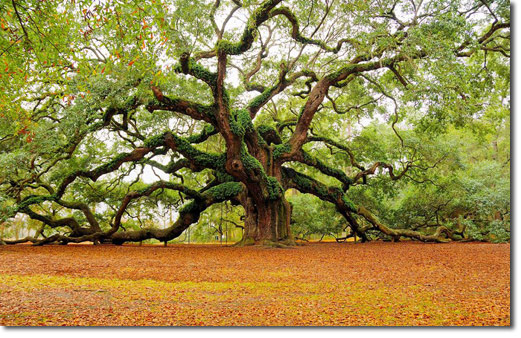
angel-tree

Imagine the type of world we could see
If instead of saying ‘pray,’ we said, ‘plant a tree’.
With this one little change so much more could be done
To protect all living things found under the sun.

We could ‘plant a tree’ for our troops sent away into war
So when they return they’d come home to find more.
We could ‘plant a tree’ at our churches with our husband or wife
To praise the Creator through a celebration of life.

We could ‘plant a tree’ for the needy and for those with no food
We could even plant in public without seeming rude.
The government would not have to introduce rules,
And most likely we could ‘plant a tree’ at our schools.

If we took it to task to ‘plant trees’ for the poorest,
We would all soon be reaping the wealth of a forest.
We could plant freely with those of all religions and creeds,
The improvement of earth would be based on these deeds.

We could plant with our neighbours, our family, and friends,
And ‘plant a tree’ with our enemies to help make amends.
If we ‘plant a tree’ for the sick to show them we care,
We would also be healing the soil, water, and air.

We could ‘plant a tree’ to observe when two people wed,
And plant one with our kids each night before bed.
Throughout the history of the whole human race
We find respect for the ‘tree’ has always had a place.

The great Ash of the Norse was their tree of the World,
And on a tree in the Garden is where the serpent once curled.
It was in groves of Oaks that the Druid priests wandered,
And under the Bodhi where the great Buddha pondered.

In the Bible it’s clear that we have all that we need:
‘All the trees with their fruits and plants yielding seed’.
Despite all these lessons that the past has taught
Now days, it seems, we cut our trees without thought.

This is confirmed by the Koran, for in it we read:
‘Many are the marvels of earth, yet we pay them no heed’.
We all have a duty, no matter what nation
To perform our part in protecting Creation.

Just think what we’d have if we had picked up a spade
Every time each one of us bowed our heads and prayed.

Further Reading:

oooOOOooo

The theme continues tomorrow.

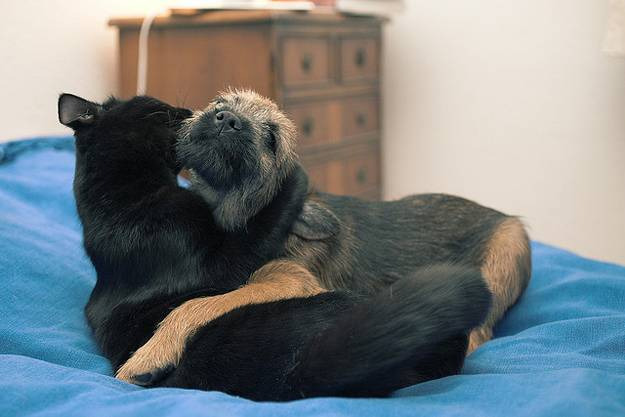
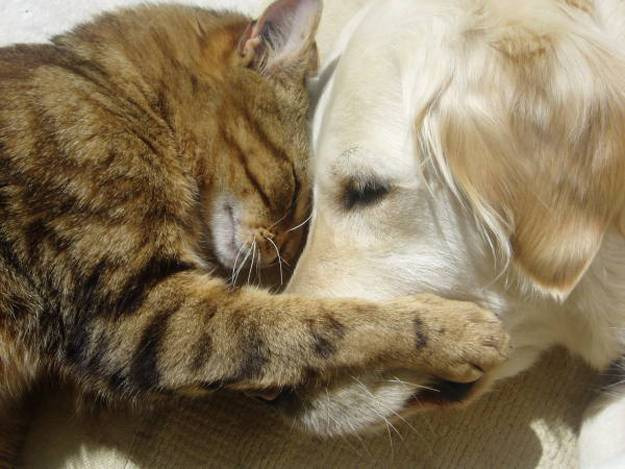
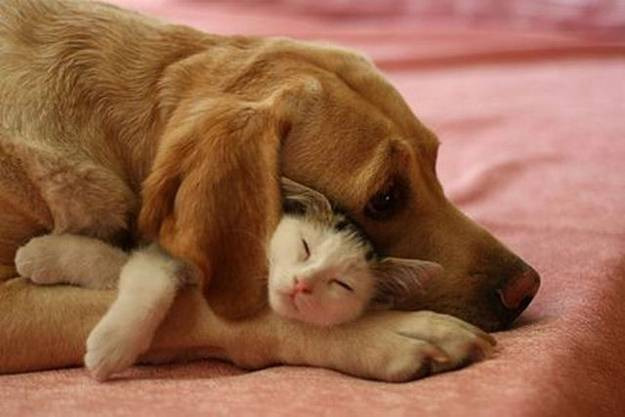
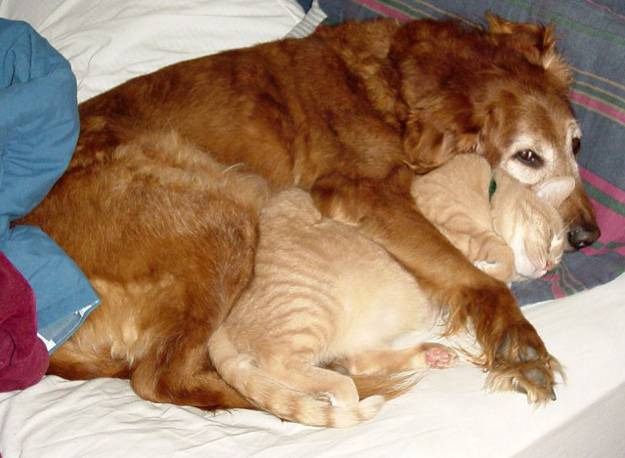
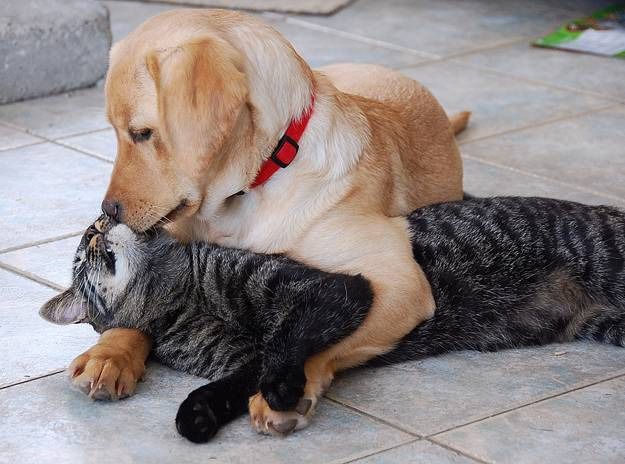
Every dog should have its cat!

Another gem from John Hurlburt.

dogcat1

oooo

dogcat2

oooo

dogcat3

oooo

dogcat4

oooo

dogcat5

oooo

dogcat6

oooo

dogcat7

oooo

dogcat8

oooo

dogcat9

oooo

It came to me that every time I lose a dog,
they take a piece of my heart with them….
And every new dog who comes into my life,
gifts me with a piece of their heart.
If I live long enough, all the components of
my heart will be dog …
and maybe
I will become as generous and loving as they are.

Unknown author.

I cry for the wolves.

This is so wrong.

Like thousands of others I have been supporting the efforts to ensure that the US Government did not proceed with the proposal to remove wolves from endangered species protection.

Wolves are the animals that enabled early man to ‘progress’ from hunter-gatherer to the life of farming, and thence to our modern world.  As I write elsewhere on Learning from Dogs,

There is no hard evidence about when dogs and man came together but dogs were certainly around when man developed speech and set out from Africa, about 50,000 years ago.

So it utterly breaks my heart to republish a recent post on The Sand County, Jeremy Nathan Marks wonderful and evocative blog.  Here it is, republished with Jeremy’s kind permission.

oooOOOooo

I used to believe

As some of you may have heard, late last week the Obama Administration officially delisted gray wolves from endangered species protection. This means that 40 years of wolf recovery efforts have come to an end. Wolves only occupy a tiny fraction of their former habitat and with anti-wolf governments occupying the state houses in the few places that still have wolf populations, states like Montana, Wyoming, Idaho and Wisconsin, it is hard to imagine that wolves have a bright future in the lower 48 states.

I am deeply, profoundly saddened by this decision. I have learned over time how wolves -like so many other species- just don’t register on the list of national concerns and priorities. A great many people oppose the delisting, in fact one gets the impression that the effort to remove these protections has consistently been guided by political pressures and a political agenda and not by a true commitment to a sustainable and enduring wolf recovery. I know that I am hardly alone in registering my disappointment and voice of protest.

I cannot let this sad milestone pass without acknowledging it here on this blog. If you do not like wolves -if you feel hatred or resentment towards them or are pleased at what has recently transpired, I respectfully request that you refrain from sharing your feelings here. I seldom offer any “directives” like this, but if you are a reader of this blog then you know how strongly I feel about this issue. I am sharing these thoughts because I want to not only draw attention to what has happened, but also because I feel the need to mourn it. I tremble at the thought of a United States -or a North America- without wolves. Defenders of the administration and the Department of Interior’s position will say that the United States Government is committed to protecting wolves and ensuring their future but I am afraid I see things quite differently. This is not a partisan political issue: Democratic and Republican administrations alike are behind this stance towards wolves.

I would like to share a poem which I feel is very incomplete and does not begin to adequately draw upon the well of feelings, concerns and thoughts I have on this subject. But I would be remiss I think if I did not mark what has just happened.

I used to believe

I used to believe that one day
I might live carefully, cooperatively
beside the wolves

I would go to them but respect their
space; wait for their return and tend
my garden with local mind, open my windows

When they moved off I would wait
and make a space; I would lock my guns
in bolted cabinets to honor and not to intrude

I used to believe that there was a chance
of this because there were others who saw
in wolves the same uncertainties and histories

And we, a new community, would redraw
the map, eradicate “the frontier” and perhaps
expunge that word altogether from our plans

It is ironic really how a word, a concept,
one invisible line can have more tendrils
and seeds than a weed, more pups than a pack.

Jeremy Nathan Marks

oooOOOooo

The Center for Biological Diversity has been incredibly active in fighting for the continued protection of the wolf. The Press Release about the loss of protection is here.  Do read it and do everything you can to help. PLEASE!

Let me share some of my special feelings about wolves.

Back in September, 2009, I wrote about An amazing true story of a relationship between a wild wolf and a man, from which this picture is taken.

Luna, the wild wolf, sleeping with Tim and Tim's dog, taken in 2006.
Luna, the wild wolf, with Tim and Tim’s dog; taken in 2006.

Then in February this year, I wrote about Oregon and the wolf.  The following picture was in that Post.

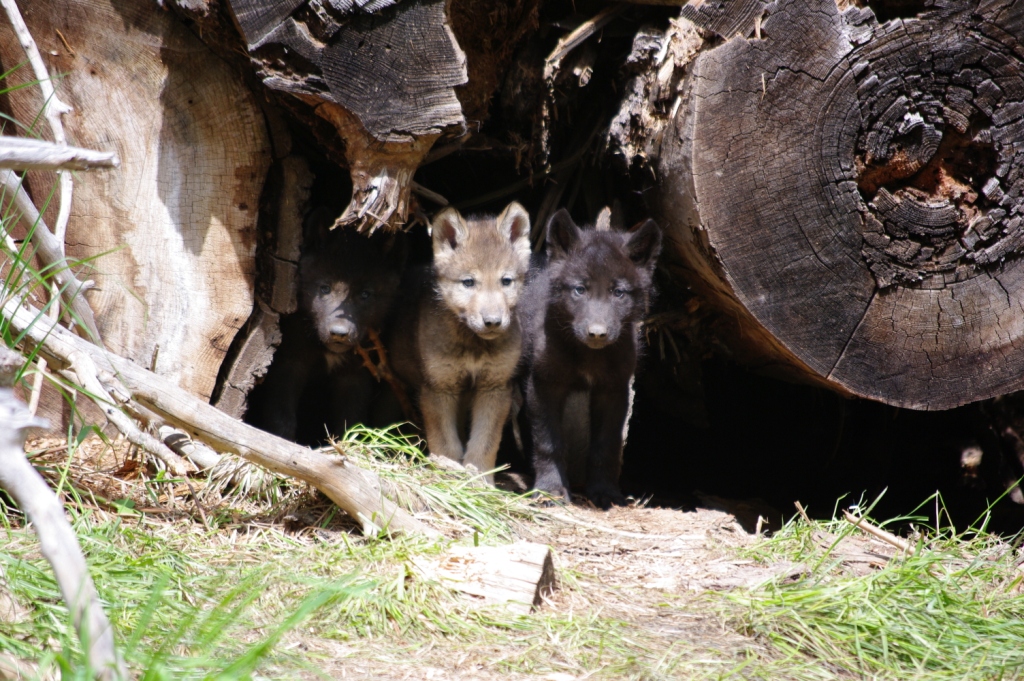
These wolf pups born to the Wenaha Pack in 2012 helped get recovery back on track. But their future remains tenuous (photo courtesy ODFW)

Please now listen to this:

So you can see that I have written frequently about wolves; indeed just a few days ago did so and included this photograph.

Wolf greets man.
Wolf greets man.

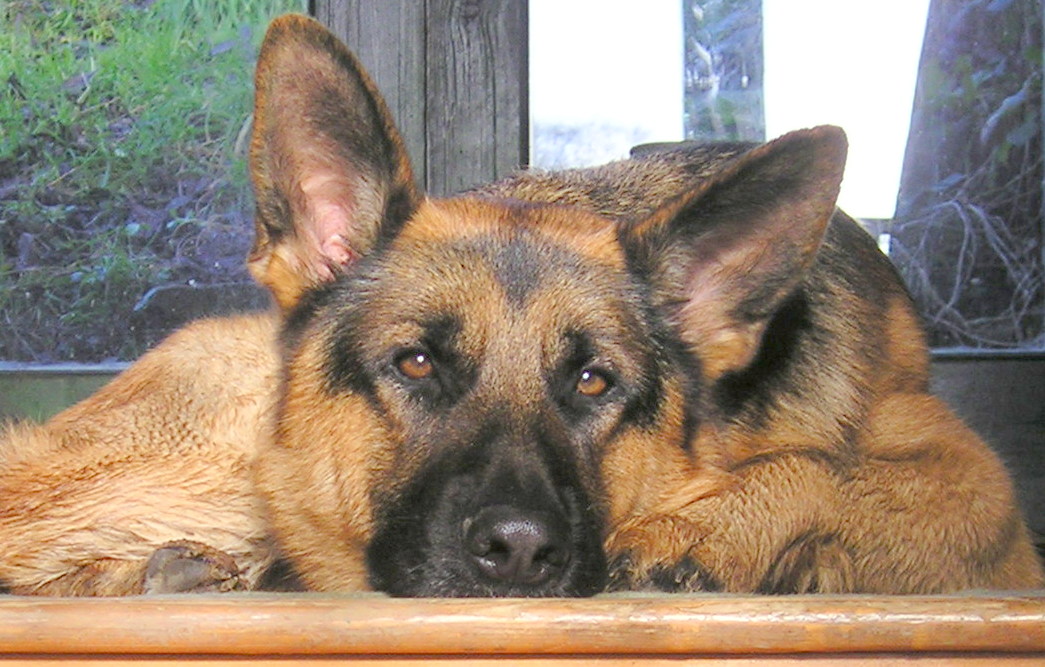
Now just look at those eyes of the Grey Wolf above and compare them to the eyes of the German Shepherd dog below and tell me that wolves aren’t as close to man as dogs.

OLYMPUS DIGITAL CAMERA

Finally, feel free to share this post as far and wide as you can.  Learning from Dogs is published under a Creative Commons License. This link covers how to share my material.

Please do something to help these ancient animals who, more than any other creature, helped put mankind ‘on the map’.

Thank you.

Anam cara

Love as seen through the Celtic spiritual belief of bonding souls.

Who hasn’t lifted their eyes to the skies above and become lost in themselves?  Whether the drama of a turbulent daytime sky or the deep mystery of an endless, clear night, sky?  Doesn’t matter who we are or where we have or haven’t been in our lives, experiencing that shift from ‘reality’ to a place of souls is familiar to all.

Right at the front of Richard Bach’s lovestory book The Bridge Across Forever, there’s this quotation from E.E. Cummings:

 – how fortunate are you and I, whose home

is timelessness: we who have wandered down

from fragrant mountains of eternal now

to frolic in such mysteries as birth

and death a day (or maybe even less)

Then on page 9, Richard Bach writes as part of his introduction:

We think, sometimes, there’s not a dragon left. Not one brave knight, not a single princess gliding through secret forests, enchanting deer and butterflies with her smile.

We think sometimes that ours is an age past frontiers, past adventures.  Destiny, it’s way over the horizon; glowing shadows galloped past long ago, and gone.

What a pleasure to be wrong.  Princesses, knights, enchantments and dragons, mystery and adventure …. not only are they here-and-now, they’re all that ever lived on earth!

Our century, they’ve changed clothes, of course.  Dragons wear government-costumes, today, and failure-suits and disaster-outfits.  Society’s demons screech, whirl down on us should we lift our eyes from the ground, dare we turn right at corners we’ve been told to turn left.  So crafty have appearances become that princesses and knights can be hidden from each other, can be hidden from themselves.

Yet masters of reality still meet us in dreams to tell us that we’ve never lost the shield we need against dragons, that blue fire voltage arcs through us now to change our world as we wish.  Intuition whispers true: We’re not dust, we’re magic!

Copyright (1984) Richard Bach.

Richard Bach’s hugely popular lovestory is widely summarised, thus:

‘Did you ever feel that you were missing someone you had never met?’.

Haunted by the ghost of the wise, mystical, lovely lady who lives just around the corner in time, Richard Bach begins his quest to find her, to learn of love and immortality not in the here-after, but in the here and now. Yet caught in storms of wealth and success, disaster and betrayal, he abandons the search, and the walls he builds for protection become his prison. Then he meets the one brilliant and beautiful woman who can set him free, and with her begins a transforming journey, a magical discovery of love and joy.

Just pause and listen. Hear your intuition whispering to you: You are not dust, you are magic!

oooOOOooo

Now let’s turn to another author: John O’Donohue.  WikiPedia has an entry that starts:

John O’Donohue (1 January 1956 – 4 January 2008) was an Irish poet, author, priest, and Hegelian philosopher. He was a native Irish speaker, and as an author is best known for popularizing Celtic spirituality.

His death in January 2008 just a few days past his 52nd birthday was a huge and tragic loss.  Not just to his family and all who knew him, but to all those in the world who dream the spiritual bonding with another person.

anamcara
John O’Donohue’s book is no better appreciated than by hugging the meaning of that Celtic phrase anam cara, assuming you aren’t a Celtic speaker!  A quick web search finds an explanation typically like this:

In the Celtic Spiritual tradition, it is believed that the soul radiates all about the physical body.  What some refer to as an aura. When you connect and become completely open and trusting with another person, your two souls begin to flow together. The forming of that deep bond is described as having found your anam cara or soul friend.

Your anam cara always accepts you as you truly are, holding you in beauty and light. Inevitably, to appreciate this relationship, you must first recognize your own inner light and beauty. This is not always easy to do! The Celts believed that forming an anam cara friendship would help you awaken to your own inner light and beauty, as a pathway to experiencing the joys of others.

According to John O’Donahue, an accomplished Irish poet, philosopher and Catholic priest, “…You are joined in an ancient and eternal union with humanity that cuts across all barriers of time, convention, philosophy and definition. When you are blessed with an anam cara, the Irish believe, you have arrived at that most sacred place: home.

Do you sense how the writings of Richard Bach and John O’Donohue are two hues from the same rainbow?

Take a few minutes and explore the John O’Donohue website that has much to remember about this wonderful man.  Embrace such profound insights on the universal themes of friendship, solitude, love, and death as:

  • Light is generous
  • The human heart is never completely born
  • Love as ancient recognition
  • The body is the angel of the soul
  • Solitude is luminous
  • Beauty likes neglected places
  • The passionate heart never ages
  • To be natural is to be holy
  • Silence is the sister of the divine
  • Death as an invitation to freedom

I’m going to offer two videos.  They are both of John O’Donohue.  One is 51 minutes and one is 5 minutes.  Do watch them both but if for whatever reason you cannot do that, then please watch the shorter one.


Now read this quotation from the book.

Your beloved and your friends were once strangers. Somehow at a particular time, they came from the distance toward your life. Their arrival seemed so accidental and contingent. Now your life is unimaginable without them. Similarly, your identity and vision are composed of a certain constellation of ideas and feelings that surfaced from the depths of the distance within you. To lose these now would be to lose yourself.

and recognising this post is day three of writing about love, here’s another quotation:

If you send out goodness from yourself, or if you share that which is happy or good within you, it will all come back to you multiplied ten thousand times. In the kingdom of love there is no competition; there is no possessiveness or control. The more love you give away, the more love you will have.

oooOOOooo

Are Jean and I touched by the spirit of anam cara?  Leave you, dear reader, to judge that.  In fact, leave you with the sign that is on our front gate!

P1130347

Feelings across the universe

If you can’t feel it, you can’t write it!

This saying was offered in a creative writing class that Jean and I attended when we were living in Payson, Arizona.  It came to me spontaneously as I started today’s post.  Because feeling what is going on around us is the only way to write it, to share it, to bring it to the attention of all.

These are tough times for so many that love the world around us and having the odd weep is a perfectly rational, and healthy, thing to happen.

So as you listen to the following just feel it. And if a tear comes to your eye … embrace it.

Hopefully, you listened to the full seven minutes before reading on!  Because to end the post at this point would be to leave out some great connections.

The first being that the inspiration for today’s post came from Peter Sinclair’s blog Climate Denial Crock of the Week, to which I subscribe.  The post was called Music Break: Across the Universe:

Put this on in the background and let it creep up on you.

Elizabeth Shepherd performs Live-to-Air with Michael Occipinti’s Shine On: The Universe of John Lennon
Toronto, June 1, 2012 CBC Radio

UPDATE: by popular demand, the original below.

Secondly, a quick dip into WikiPedia reveals that the song was recorded by the Beatles in February 1968 at the famous Abbey Road studios and released on the 12th December, 1969. It was written by John Lennon, and credited to Lennon–McCartney.

abbey road studios
Abbey Road Studios, 3 Abbey Road, St. John’s Wood, London

Thirdly, that Wikipedia reference includes the background to the composition of the song, some of which I will share here:

One night in 1967, the phrase “words are flowing out like endless rain into a paper cup” came to Lennon after hearing his ex-wife Cynthia, according to Lennon, “going on and on about something.” Later, after “she’d gone to sleep—and I kept hearing these words over and over, flowing like an endless stream,” Lennon went downstairs and turned it into a song. He began to write the rest of the lyrics and when he was done, he went to bed and forgot about them.

I was lying next to my first wife in bed, you know, and I was irritated, and I was thinking. She must have been going on and on about something and she’d gone to sleep and I kept hearing these words over and over, flowing like an endless stream. I went downstairs and it turned into a sort of cosmic song rather than an irritated song, rather than a “Why are you always mouthing off at me?”[1]… [The words] were purely inspirational and were given to me as boom!. I don’t own it you know; it came through like that.[2]

The flavour of the song was heavily influenced by Lennon’s and the Beatles’ interest in Transcendental Meditation in late 1967 – early 1968, when the song was composed. Based on this he added the mantra “Jai guru deva om” (Sanskrit: जय गुरुदेव ) to the piece, which became the link to the chorus. The Sanskrit phrase is a sentence fragment whose words could have many meanings. Literally it approximates as “glory to the shining remover of darkness,”[3] and can be paraphrased as “Victory to God divine”, “Hail to the divine guru”, or the phrase commonly invoked by the late Maharishi Mahesh Yogi in referring to his spiritual teacher “All Glory to Guru Dev.”[4]

Finally the lyrics.

“Across The Universe”

Words are flowing out like endless rain into a paper cup
They slither wildly as they slip away across the universe
Pools of sorrow, waves of joy are drifting through my open mind
Possessing and caressing me
Jai Guru Deva OM

Nothing’s gonna change my world

Images of broken light which dance before me like a million eyes
They call me on and on across the universe
Thoughts meander like a restless wind inside a letter box
They tumble blindly as they make their way across the universe
Jai Guru Deva OM

Nothing’s gonna change my world

Sounds of laughter shades of live are ringing through my open ears
Inciting and inviting me
Limitless undying love which shines around me like a million suns
It calls me on and on, across the universe
Jai Guru Deva OM

Nothing’s gonna change my world

Jai Guru Deva
Jai Guru Deva
Jai Guru Deva
Jai Guru Deva
Jai Guru Deva [fade out]

Footnote

The title of the song was given a new dimension when NASA beamed the song into space.

“On 4 February 2008, at 00:00 UTC, NASA transmitted the Interstellar Message “Across the Universe” in the direction of the star Polaris, 431 light years from Earth. The transmission was made using a 70m antenna in the Deep Space Network’s Madrid Deep Space Communication Complex, located outside of Madrid, Spain. It was done with an “X band” transmitter, radiating into the antenna at 18 kW. This was done to celebrate the 40th anniversary of the song’s recording, the 45th anniversary of the Deep Space Network (DSN), and the 50th anniversary of NASA. The idea was hatched by Beatles historian Martin Lewis, who encouraged all Beatles fans to play the track as it was beamed to the distant star. The event marked the first time a song had ever been intentionally transmitted into deep space, and was approved by McCartney, Yoko Ono, and Apple Corps.”

Thus those feelings so beautifully expressed in the song will be echoing around the universe for time immemorial. Now that is a legacy!

Spring is sprung!

Spring is sprung, the grass is ris.
I wonders where the birdies is.
They say the bird is on the wing.
But that’s absurd?
I always thought the wing was on the bird.

Ah, that feels better!

I was drawn to this wonderful piece of doggerel because it is exactly the sort of humour that dear friend Richard and I have been silly with for 40 years.

The relevance of that is that Richard and his lovely lady Jules have arrived in North America and are coming to stay with us in Oregon for a few days, arriving Saturday. Naturally, we are scurrying around getting the house tidy!  So what with that and wanting to enjoy their company for the next week I shall be posting either light-hearted items or repostings from elsewhere.

Richard is no stranger to Learning from Dogs because like others who take pity on me publishing a daily post, he has sent me material for LfD.  For example, there was Understanding Europe last September, the Euro according to Blackadder and English, as she is spoken, both April this year.

Also last September, Richard sent me the following.  It was published last year but it deserves another airing!

oooOOOooo

An elderly man is stopped by the police around 2 a.m. and is asked where he is going at this time of night.

He replies, “I’m on my way to a lecture about alcohol abuse and the effects it has on the human body, as well as smoking and staying out late.

The police officer asks, “Oh really! Who’s giving that lecture at this time of night?

My wife.

oooOOOooo

Future uncertainties!

Prediction is very difficult, especially if it’s about the future. Niels Bohr

I love this saying from Mr. Bohr and often repeat it, albeit at times with my own twist to it.  I was reminded of this uncertainty of the future from some comments to a recent post over at Lack of Environment.  The particular post was called Can technology save us? and was a reflection of Martin Lack, the blog’s author, watching a recent BBC Horizon special called Tomorrow’s World.  (There’s the YouTube of the broadcast at the end of this post.) Martin opened his post by saying:

I happened to stumble across a BBC TV Horizon special, entitled ‘Tomorrow’s World’ last Thursday.  It begins with a fascinating review of humankind’s history of – and propensity for – invention. It also explains some truly fascinating – and inspiring – developments in the spheres of space exploration, nanotechnology, biotechnology, and power generation.

In the introduction, the programme presenter and narrator Liz Bronnin explains how, after 100’s of thousands of years of technological stagnation, the fast-moving world of technological innovation is very definitely a modern invention.

Then a little later Martin goes on to say:

After about 32 minutes, Bronnin introduces the power of the Internet to promote innovation – crowd-sourcing research funding and the concept of open-source technology – the complete abrogation of intellectual copyright… It is a fundamental challenge to globalised Capitalism; but it may well be the solution to many of our problems…

However, to me, the final third of the programme is by far the most fascinating… It looks at the challenges of finding a replacement for fossil fuels. It provides a very clear message that this is a technological challenge driven by the reality of physics – not by ideology.

But, overall, Martin lets us know his perspective with his final paragraphs:

Re-engineering nature for our benefit will, without doubt, be very very useful. However, I still think the optimism of the comment at the very end of the programme “…I never worry about the future of the human race, because I think we are totally capable of solving problems…” is very unwise. This is because anthropogenic climate disruption is a problem that is getting harder to solve the longer we fail to address it effectively.

Bronnin concludes by saying that, “it is an exciting time to be alive…” However, I remain very nervous. This is because, as Professor Peter Styles of Keele University – a strong supporter of the hydraulic fracturing industry – recently acknowledged, it will be impossible for carbon capture and storage to remove enough CO2 from the atmosphere to prevent very significant changes to our climate. This is because of the collective hypnosis that deludes most people into seeing perpetual economic growth as the solution to all our problems.

In short, I am certain that technology alone cannot save us. In order to avoid the ecological catastrophe that all but the most ideologically-prejudiced and wilfully-blind can see developing all around us… we need to modify our behaviour: This primarily means that we need to acknowledge the injustice of a “use it up and wear it out” mentality and, as individuals, all learn to use an awful lot less energy.

Climate change “sceptics” have picked a fight with history and science – primarily with the concept of Entropy – and they will lose. The only question that remains is this: Are we going to let them put us all in (what xraymike79 recently called) ‘the dustbin of failed evolutionary experiments’.

Now Jean and I also watched the Horizon special and, to be perfectly frank, found it both uplifting and inspiring.  It seemed a great counter to the overwhelming volume of commentary these days along the lines of ‘The end of the world is nigh!‘ some of that coming from yours truly! That’s not to make light of the huge hurdles ahead.

But it was a couple of comments on Martin’s post from Patrice Ayme that got me thinking.  Here’s the exchange that went between Patrice and Martin following on from a comment from Thomas Foster.

Considering that it is technology which has enabled us to “conquer” nature and thus the degradation of the environment which is a consequence of that it seems most unlikely to this writer that the cause will also bring about a cure. Thomas Foster

—–

The genus Homo has been technological for 5 million years. Give or take two million. Homo is the cure for life. Patrice Ayme

—-

If we Homo Sapiens have been technological for 5 million years, we have spent most of that time being very unsuccessful; and have spent the rest being far too successful. Is there no scope for just living in harmony with our environment (as opposed to being at war with it)? Martin Lack

—-

Hominids have been masters of the environment for at least three million years. By a million years ago, only Homo was left (but for places like Flores). Dozens of megafauna species got annihilated. Homo’s technology has extended to the entire Earth for at least a million years. The Earth itself was turned into a tool. A tool we are not at war with, but that we use. Patrice Ayme

—-

A utilitarian attitude to Nature is one that does not recognise its inherent value (i.e. which it would have even if we did not exist). Seeing ourselves as superior to Nature rather than as part of it has resulted in our not living in harmony with it. This is, by definition, equivalent to being at war with Nature. QED. Refer: Nature is not your enemyMartin Lack

—-

Call it what you want, Martin. Man manipulates nature, and that nature one calls nature has not been “natural” for more than a million years. Except if one views man as part of nature! Patrice Ayme

Patrice is a very clear thinker even if, at times, pretty hard-hitting.  But this exchange confirmed in my mind that clearly looking out to the future must always be hard.  Most certainly in this period of mankind’s evolution predicting the future is especially difficult.  Hence my contribution to Martin’s post:

Jean and I watched the Horizon special a couple of evenings ago. To be honest, I’m not entirely sure what my overall thoughts are in response to your post, Martin. What does come to mind is that old saying, “Never underestimate the power of unintended consequences.

So it may be that we are at a particular point in time, or more likely an era, where seeing clearly into the future is challenging.

The one aspect of modern life that is a game-changer is what we are doing now. Sharing ideas and thoughts across a far-flung net. Not only as the Horizon programme illustrated but as ordinary people trying to make sense of the world.

These are incredibly uncertain times.  Undoubtedly not the first in man’s long history as an historian will explain (cue to Alex!).   But to all of us alive today, these are the most uncertain times we have ever experienced!

No wonder so many of us feel lost at times in today’s world.

Here’s that BBC Horizon, courtesy of YouTube.

I will close with this thought from one masterly ‘wordsmith’, William Wordsworth.

“Life is divided into three terms – that which was, which is, and which will be. Let us learn from the past to profit by the present, and from the present, to live better in the future.”

Making sense of life?

“I accept chaos, I’m not sure whether it accepts me.”  Bob Dylan.

Lost and Confused Signpost

Started this week with an essay from John Hurlburt. Likewise, finishing with these thoughts from John.

Are We Confused?

Egotistically, the objective is self.
Financially, the objective is profit.
Corporately, the objective is control.

Biologically, the objective is growth.
Physically, the objective is change.
Morally, the objective is equality.

Psychologically, the objective is integrity.
Philosophically, the objective is truth.
Scientifically, the objective is fact.

Intellectually, the objective is reason.
Emotionally, the objective is balance.
Spiritually, the objective is Unity.

an old lamplighter

A smile for ‘Boxing Day’.

Sent to me a few weeks ago by Bob Derham.

(The younger ones won’t make any sense of this at all!)

bottle-of-pills-and-bottle

A Poem for the Mature

A row of bottles on my shelf
Caused me to analyze myself.

One yellow pill I have to pop
Goes to my heart so it won’t stop.

A little white one that I take
Goes to my hands so they won’t shake.

The blue ones that I use a lot
Tell me I’m happy when I’m not.

The purple pill goes to my brain
And tells me that I have no pain.

The capsules tell me not to wheeze
Or cough or choke or even sneeze.

The red ones, smallest of them all
Go to my blood so I won’t fall.

The orange ones, very big and bright
Prevent my leg cramps in the night.

Such an array of brilliant pills
Helping to cure all kinds of ills.

But what I’d really like to know

Is what tells each one where to go!

House of cards.

A more philosophical view of recent years.

I admit to being too free with my silly clichés including, “I can predict anything unless it involves the future!”  So now that millions of informed people have the benefit of “20:20 hindsight“, why is it years since the banking crisis first erupted and we are still without a root and branch overhaul of the governance of the industry?

Did you see Per Kurowski’s interview with a leading regulator on Learning from Dogs yesterday?  Aren’t we so slow to learn!

Anyway, I waffle on!  Let me get to the point of today’s post.

Back on the 1st September, there was a post called Understanding Europe. One of the resulting commentators was Pendantry who is author of a blog called Wibble.  He included a link to a poem that he wrote on the 28th February, 2009!  The fact that the poem is still so relevant (and when we see what’s happening in Europe perhaps even more relevant now!) is truly shocking.  I wanted to republish it which I do with the kind permission of Pendantry.  Here it is.

oooOOOooo

House of cards

When the inevitable strikes,
when the house falls down,
do you patch up the walls,
fix the holes in the roof,
shore it all up,
splash it with paint?

No.

You learn from the mistakes.
You start from scratch.
You call in the architects.
You rebuild the foundations.
You use new materials;
replace wattle and daub
with a sounder design.

Unless:

Because you’re lost outside the box,
and your mates demand
to regain their riches (and, now!):
You set up the same as before,
perhaps with a few bells and whistles
(spun to persuade that they’ll work).

And… in the end, we’ll believe
that your clothing is not invisible.

“Who is more foolish?
The fool, or the fool who follows him?”

oooOOOooo

Written over three years and five months ago. Shame on us all!