Category: Poetry

Enjoy the ride

Two moving films.

I am indebted to Merci O. who regularly comments on Learning from Dogs for sending me the first film, see below.  In my efforts to find a YouTube link (there didn’t appear to be one) I came across the second film.  Both are good for the soul.

So click here to watch the first film.  The film is comprised of a series of slides melded together with a beautiful music track. Do watch and listen.

Then here is the YouTube video, Morcheeba’s Enjoy The Ride.

Have a peaceful day wherever you are in the world.

Transfiguration

A return to the beautiful writings of Irishman, John O’Donohue

Last week, I published a Post about John O’Donuhue‘s book Anam Cara, entitled Soul friend, the meaning of anam cara in Gaelic.  There were a number of lovely responses, both as comments to the Post, and as emails sent to me.  I thought I would share another essay with you.  First, some reflections about transfiguration or, perhaps a better word for today’s challenging times is ‘change’.

I have made no secret of my belief that we are in a period of great change, perhaps greater than mankind has faced before.  Possibly that is slightly hyperbolic, but looked at from the perspective of the extinction of homo sapiens then perhaps it is no exaggeration.  The vast majority of people, who stop and reflect, sense that on several fronts it is change or die!

A classic behavioural attribute of modern man is to see ‘change’ as something that others should do, rather than change coming from within.  From time to time, I have quoted this,

For today, I am in charge of my life.

Today, I choose my thoughts,

Today, I choose my attitudes,

Today, I choose my actions and behaviours,

With these, I create my life and my destiny.

Much, much easier to say, and write, than to undertake.  But it does underscore the obvious – change flows from our journey inwards.  Let’s turn to John O’Donohue’s inspirational words about this subject.

From the John O’Donohue website

Spirituality of transfiguration

Spirituality is the art of transfiguration. We should not force ourselves to change by hammering our lives into any predetermined shape. We do not need to operate according to the idea of a predetermined programme or plan for our lives. Rather, we need to practise a new art of attention to our inner rhythm of our days and lives. This attention brings a new awareness of our own human and divine presence. A dramatic example of this kind of transfiguration is the one all parents know. You watch your children carefully, but one day they surprise you; you still recognise them, but your knowledge of them is insufficient. You have to start listening to them all over again.

It is far more creative to work with the idea of mindfulness rather than with the idea of will. Too often people try to change their lives by using the will as a kind of hammer to beat their life into proper shape. The intellect identifies the goal of the programme, and the will accordingly forces the life into that shape. This way of approaching the sacredness of one’s own presence is externalistic and violent. It brings you falsely outside your own self and you can spend years lost in the wilderness of your own mechanical, spiritual programmes. You can perish in a famine of your own making.

If you work with a different rhythm, you will come easily and naturally home to your self. Your soul knows the geography of your destiny. Your soul alone has a map of your future, therefore you can trust this indirect, oblique side of your self. If you do, it will take you where you need to go, but more importantly it will teach you a kindness of rhythm in your journey. There are no general principles for this art of being. Yet the signature of this unique journey is inscribed deeply in each soul. If you attend to your self and seek to come into your own presence, you will find exactly the right rhythm for your life. The senses are generous pathways which can bring you home.

A renewal, indeed a complete transfiguration of your life, can come through attention to your senses. Your senses are the guides to take you deep into the inner world of your heart. The greatest philosophers admit that to a large degree all knowledge comes through the senses. The senses are our bridge to the world. Human skin is porous; the world flows through you. Your senses are large pores which let the world in. Through attunement to the wisdom of your senses, you will never become an exile in your own life, an outsider lost in an external spiritual place which your will and intellect have constructed.

John O’Donohue Anam Ćara

 (c) John O’Donohue. All rights reserved. Used by permission. http://www.johnodonohue.com

Please just read those words from John again.  Re-read the last paragraph.  Then go one paragraph up and read that again, “Your soul knows the geography of your destiny. Your soul alone has a map of your future, therefore you can trust this indirect, oblique side of your self.  If you do, it will take you where you need to go, but more importantly it will teach you a kindness of rhythm in your journey.

Each of us taking us to where we need to go, and one by one, each of us taking our world to where it needs to go.

I must down to the seas again

History repeating itself in terms of the commercial sailing ship.

Tea clipper 'Cutty Sark'

Most Brits have heard of the tea clipper Cutty Sark.  As the Cutty Sark website explains,

Cutty Sark has travelled across the world, sailing under both the Red Ensign and the Portuguese flag, visiting every major port in the world through the course of her working life. In admiration of her beauty and in recognition of her fame, she was preserved for the nation by Captain Wilfred Dowman in 1922.

Since then, the old clipper has been berthed in Falmouth and Greenhithe, finally arriving at her current resting place in Greenwich in 1954.

And elsewhere on that website,

Cutty Sark matters because:
  • She is the epitome of the great age of sail.
  • She is the only surviving extreme clipper, and the only tea clipper still in existence.
  • Most of her hull fabric survives from her original construction and she is the best example of a merchant composite construction vessel.
  • She has captured the imagination of millions of people, 15 million of whom have come on board to learn the stories she has to tell.
  • She was preserved in Greenwich partly as a memorial to the men of the merchant navy, particularly those who lost their lives in both world wars.
  • She is one of the great sights of London.

I mention the Cutty Sark because it seems a historic connection with something very relevant to today’s world that was the subject of a recent item on Rob Hopkin’s Transition Culture blogsite.  In it Rob presents his first podcast, the topic being the sailing ship Tres Hombres, that is being used for commercial sea transport.  The link to the Transition Culture story is here, and the podcast follows, (just click on the link to listen to the fascinating 14 minutes audio story about the ship Tres Hombres.)

Tres Hombres podcastfinal

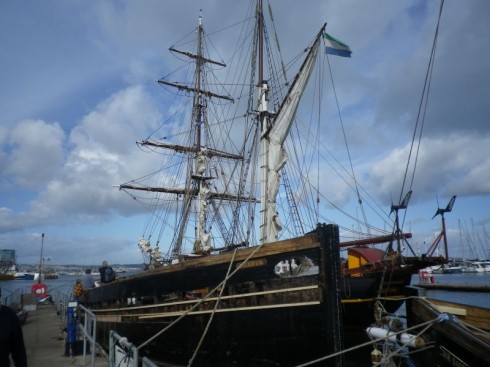
Sailing ship Tres Hombres

The first Transition podcast! A visit to the Tres Hombres, tasting a revolution in shipping

Last week I did a course with the Media Trust on how to make podcasts (highly recommended).  So, here, with some fanfare, is the first ‘Transition podcast’, I hope you like it.  If so, do embed it in other places.  It means I spent the time I would spend writing editing pieces of audio.  Let me know what you think.  So, the podcast is about a fascinating morning I spent visiting the sailing ship Tres Hombres which visited Brixham earlier this week.  It explores the potential of sail-powered shipping as the price of oil rises and the economy tightens.  It’s an exciting story.

Finally, let me close with a very well-known poem about sailing the big ships.

“Sea-Fever”

I must down to the seas again, to the lonely sea and the sky,
And all I ask is a tall ship and a star to steer her by,
And the wheel’s kick and the wind’s song and the white sail’s shaking,
And a grey mist on the sea’s face, and a grey dawn breaking.

I must down to the seas again, for the call of the running tide
Is a wild call and a clear call that may not be denied;
And all I ask is a windy day with the white clouds flying,
And the flung spray and the blown spume, and the sea-gulls crying.

I must down to the seas again, to the vagrant gypsy life,
To the gull’s way and the whale’s way where the wind’s like a whetted knife;
And all I ask is a merry yarn from a laughing fellow-rover
And quiet sleep and a sweet dream when the long trick’s over.

By John Masefield (1878-1967).
(English Poet Laureate, 1930-1967.)

Soul friend

Reflections on the Irish poet and author, John O’Donohue.

John O'Donohue

While many will have heard the name of this wonderfully inspirational man, John O’Donohue is not a name known to the masses.  Yet his writings are, without fail, beautifully moving.  Indeed, this Post was prompted by me coming across a piece from his first book, Anam Cara, meaning ‘soul friend’ in Gaelic, and, as any dog owner will attest, dogs are the animal example of a soul friend to a human.

John tragically died well before his time, in January 2008, just three days after his 56th birthday.  As the John O’Donohue website reveals,

John O’Donohue vanished from among us on January 4, 2008 as physical presence, but it is impossible to write about John as someone who “was”; he so thoroughly “is”. In the context of the immense presence of his absence, the following biographical facts and dates can serve only as time-bound points of orientation for those who wish to try and locate history.

John was born in January 1956, the first of four children to Patrick and Josie O’Donohue. At the age of 18, John entered the novitiate at Maynooth where he completed his BA in English and Philosophy in 1977 and his degree in Theology, in 1980. He was ordained to the priesthood in 1982, received his MA in 1982 and, in 1986 began work on a doctorate at the University of Tubingen in Germany. John was awarded his Ph.D in Philosophical Theology in 1990. In his dissertation, Person als Vermittlung, (published in Germany in 1993), John developed a new concept of Person through a re-interpretation of the philosophy of Hegel. The prestigious Review of Metaphysics commended him for “breaking new ground in our thinking about consciousness . . . [with] a richer and deeper notion of Personhood.” In John’s words: “Hegel struck me as someone who put his eye to the earth at a most unusual angle and managed to glimpse the circle toward which all things aspire.”

There is so much more to say and write about this lovely man, but for another time.  Let me close by publishing this extract from Anam Cara. But a plea!  Before you plunge ahead and read these words, just slow yourself down.  The thoughts behind the words below are profound, romantic and applicable to all, yes, every one of us.  They offer peace and calmness – embrace them with a peaceful and calm mind.

The eye celebrates Motion

The human eye adores movement and is alert to the slightest flicker. It enjoys great moments of celebration when it beholds the ocean as the tide comes in, and tide upon tide repeats its dance against the shore. The eye also loves the way light moves; summer light behind a cloud crawling over a meadow. The eye follows the way the wind shovels leaves and sways trees. The human person is always attracted to motion. As a little baby you wanted to crawl, then to walk, and as an adult you feel the continuous desire to walk into independence and freedom.

Everything alive is in movement. This movement we call growth. The most exciting form of growth is not mere physical growth, but the inner growth of one’s soul and life. It is here that the holy longing within the heart brings one’s life to motion. The deepest wish of the heart is that this motion does not remain broken or jagged, but develops sufficient fluency to become the rhythm of one’s life.

The secret heart of time is change and growth. Each new experience which awakens in you adds to your soul and deepens your memory. The person is always a nomad, journeying from threshold to threshold, into ever different experiences. In each new experience, another dimension of the soul unfolds. It is no wonder that from ancient times the human person has been understood as a wanderer. Traditionally, these wanderers traversed foreign territories and unknown places. Yet, Stanislavsky, the Russian dramatist and thinker, wrote: “The longest and most exciting journey is the journey inwards.”

There is a beautiful complexity of growth within the human soul. In order to glimpse this, it is helpful to visualise the mind as a tower of windows. Sadly, many people remain trapped at one window, looking out every day at the same scene in the same way. Real growth is experienced when you draw back from one window, turn and walk around the inner tower of the soul and see all the different windows that await your gaze. Through these different windows, you can see new vistas of possibility, presence and creativity. Complacency, habit and blindness often prevent you from feeling your life. So much depends on the frame of vision – the window through which we look.

Think about the times we live in, challenging times for so many.  Then realise that what we see (and feel) is so dependent on how we look.  Let me repeat those last few lines, “Through these different windows, you can see new vistas of possibility, presence and creativity. Complacency, habit and blindness often prevent you from feeling your life. So much depends on the frame of vision – the window through which we look.”

Being Present!

Being in the present is the key message that we can learn from dogs. Why is this so important?

‘Drink your tea slowly and reverently, as if it is the axis
on which the world earth revolves – slowly, evenly, without
rushing toward the future. Live the actual moment.
Only this moment is life.’ ~Thich Nhat Hanh

[my blue emboldening]

Unlike Jon, I muse as an ‘amateur’ when I sense that the human psyche is attracted to fear.  I use that word ‘attracted’ simply because some stimuli that touch our consciousness seem to have more force than others. Ergo, the response to the simple question of asking someone how they are, is likely to me more engaging if they come up with some form of crisis reply than by saying, “Everything’s fine, thanks!”  Look at how the news media use the power of fear to capture our attention.

There is a strong biological explanation for this.  From the Science daily website,

The amygdala (Latin, corpus amygdaloideum) is an almond-shape set of neurons located deep in the brain’s medial temporal lobe. Shown to play a key role in the processing of emotions, the amygdala forms part of the limbic system.

In humans and other animals, this subcortical brain structure is linked to both fear responses and pleasure. Its size is positively correlated with aggressive behaviour across species.  In humans, it is the most sexually-dimorphic brain structure, and shrinks by more than 30% in males upon castration.

Conditions such as anxiety, autism, depression, post-traumatic stress disorder, and phobias are suspected of being linked to abnormal functioning of the amygdala, owing to damage, developmental problems, or neurotransmitter imbalance.

For more information about the topic Amygdala, read the full article at Wikipedia.org

I am going to get to the point of this article but stay with me a little longer.  Let’s look some more at the ‘fight or flight’ aspect of our brains.  From the website, How Stuff Works,

It’s dark out, and you’re home alone. The house is quiet other than the sound of the show you’re watching on TV. You see it and hear it at the same time: The front door is suddenly thrown against the door frame.  Your breathing speeds up. Your heart races. Your muscles tighten.

An instant later, you know it’s the wind. No one is trying to get into your home.

For a split second, you were so afraid that you reacted as if your life were in danger, your body initiating the fight-or-flight response that is critical to any animal’s survival. But really, there was no danger at all. What happened to cause such an intense reaction? What exactly is fear? In this article, we’ll examine the psychological and physical properties of fear, find out what causes a fear response and look at some ways you can defeat it.

What is Fear?
Fear is a chain reaction in the brain that starts with a stressful stimulus and ends with the release of chemicals that cause a racing heart, fast breathing and energized muscles, among other things, also known as the fight-or-flight response. The stimulus could be a spider, a knife at your throat, an auditorium full of people waiting for you to speak or the sudden thud of your front door against the door frame.

The brain is a profoundly complex organ. More than 100 billion nerve cells comprise an intricate network of communications that is the starting point of everything we sense, think and do. Some of these communications lead to conscious thought and action, while others produce autonomic responses. The fear response is almost entirely autonomic: We don’t consciously trigger it or even know what’s going on until it has run its course.

Because cells in the brain are constantly transferring information and triggering responses, there are dozens of areas of the brain at least peripherally involved in fear. But research has discovered that certain parts of the brain play central roles in the process:

  • Thalamus – decides where to send incoming sensory data (from eyes, ears, mouth, skin)
  • Sensory cortex – interprets sensory data
  • Hippocampus – stores and retrieves conscious memories; processes sets of stimuli to establish context
  • Amygdala – decodes emotions; determines possible threat; stores fear memories
  • Hypothalamus – activates “fight or flight” response

Now I originally called this article Present Perfect but WordPress quickly indicated that the title had already been used. Once again, the old memory cells are failing me!  In fact the post of the name Present Perfect was published on the 8th June, just a couple of months ago.  Glad that I was reminded because from that article in June,

Did you see Mr. Holland’s Opus? About Glenn Holland’s lifetime of teaching music to a high school band. In one scene he is giving a private lesson to Gertrude. She is playing clarinet, making noises that can only be described as other-worldly. He is clearly frustrated. As is she. Finally Mr. Holland says, “Let me ask you a question. When you look in the mirror what do you like best about yourself?”

“My hair,” says Gertrude.

“Why?”

“Well, my father always says that it reminds him of the sunset.”

After a pause, Mr. Holland says, “Okay.  Close your eyes this time. And play the sunset.”

And from her clarinet? Music. Sweet music.

Sometime today, I invite you to set aside the manual, or the list, or the prescription.

Take a Sabbath moment. . . close your eyes and play the sunset.

Mary Oliver describes such a moment this way, “. . .a seizure of happiness. Time seemed to vanish. Urgency vanished.”

Because, in such a moment, we are in, quite literally, a State of Grace.  In other words, what we experience here is not as a means to anything else.

If I am to focused on evaluating, I cannot bask in the moment.

If I am measuring and weighing, I cannot marvel at little miracles.

If I am anticipating a payoff, I cannot give thanks for simple pleasures.

If I am feeling guilty about not hearing or living the music, I cannot luxuriate in the wonders of the day.

Beautiful thoughts all woven around the power of focusing on the moment (if you want to catch up on the full article it is here).

Jon’s article last Monday was all about the way forward in a positive, well-being sense.  In that article Jon showed the Maslow Hierarchy of Needs pyramid.  It’s reproduced again below; spend a few moments absorbing the nature and sense of each level in that hierarchy.

Now ponder on that fear – ‘fight or flight’ – response.  Most likely it’s going to be initiated in the ‘Safety’ level but flick straight down one level to the ‘Physiological’ layer.  All very primitive stuff and utterly out of our control!  Remember from the extract above, “The fear response is almost entirely autonomic.

Even modest amounts of these fear responses is very wearying, very unsettling.  Remember Jon touched on that when he wrote,

The point I’m trying to make is that the same panic I notice in many of the companies I work in, and in me, is based on fear of the unknown and on a lack of trust in all its forms.  I’ve deliberately underlined that last phrase because it is so incredibly important. The truth is that we get more of what we focus on. So we can choose to focus on the constant news of more difficulties, hardship and redundancies, or we can focus on what is working.

So because our fear response is entirely autonomic and because there is so much out there, all around us, pulling those autonomic strings we have to actively, quite deliberately, do what dogs (and many other animals) do quite naturally.  We deliberately have to focus on spending time being in the present!

There was a recent piece from Leo Babauta about being in the present.  While he doesn’t touch on the underlying biology of why we humans are so ‘attracted’ to fear, he does offer some excellent advice about being in the present.

No matter how out-of-control your day is, no matter how stressful your job or life becomes, the act of being present can become an oasis. It can change your life, and it’s incredibly simple.

Look at Lorraine’s website (a recent visitor to Learning from Dogs).  In particular this piece, from which I quote,

3. The Serenity Prayer – all about accepting the things I cannot change and changing the things I can.

4. People are always more important than things. Things can mostly be replaced but people cannot.

5. Do it now – if there is something to be done, then what is stopping me from doing it straight away?

6. If I appreciate and look after what I have now, there will be a positive flow back to me in the future. If I am neglectful and ungrateful with what I have now, I cannot expect to be rewarded with more in the future.

7. Be quiet and keep breathing – no one will know how crazy I feel inside :-)

8. Don’t hold on to people or things too tightly. Be open to letting go and letting be.

9. It is really important to let others know that I love them. They need to know now and often. Love isn’t just a beautiful feeling – show it by how I act and speak with those I love.

10. I can’t make anyone love me and I can’t fix anyone by loving them. I may have a script for how life should be but I have no control over other people, places or things. Go with the flow and accept what is.

(The blue emboldening is mine – highlighting the power of now.)

Grandson Morten - peace in the present

Live the actual moment. Only this moment is life.”

Tess, be in peace

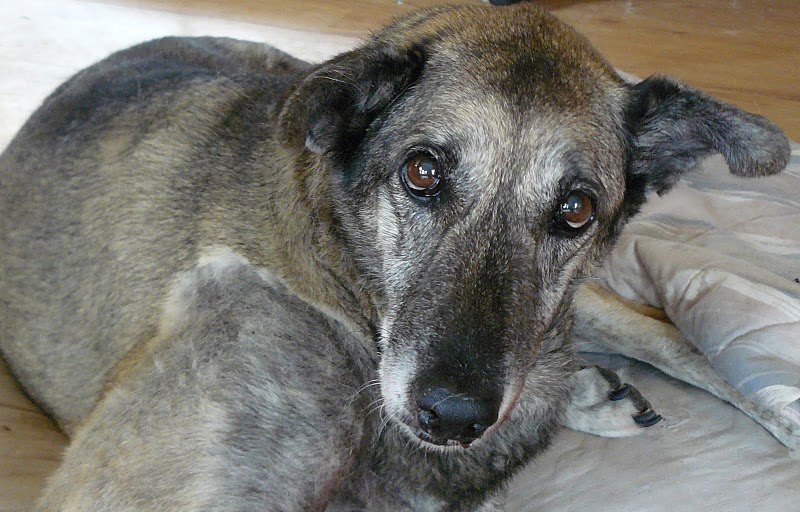
The sad loss of our dog, Tess.

Over a couple of months ago, Tess was diagnosed with bone cancer, in the shoulder joint of her right front leg.  The vet thought that she might have only a very few weeks to live, this particular form of cancer being aggressive.

As it happened, Tess kept going for much, much longer.  But this morning (Wednesday at the time of writing) Jean made the agonising decision to end the pain for Tess.  Despite a daily dose of strong pain-killer tablets, this morning Tess was breathing more laboriously and showing clear signs of tiring.  It was time.

For me it was the first time that I had been with a loved animal that had to be euthanised and it was hard.

A few pictures to keep her memory alive.

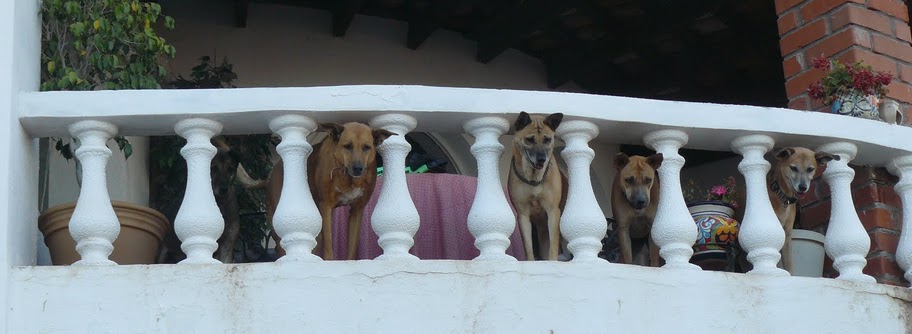
Tess, far left (next to the plant pot), and friends
Jean & Tess, a few moments before leaving.
Dear Tess, you are out of pain and at peace.

Let me close with the same poem that was published when we lost our little Poppy,

“There is one best place to bury a dog.
“If you bury him in this spot, he will
come to you when you call – come to you
over the grim, dim frontier of death,
and down the well-remembered path,
and to your side again.

“And though you call a dozen living
dogs to heel, they shall not growl at
him, nor resent his coming,
for he belongs there.

“People may scoff at you, who see
no lightest blade of grass bent by his
footfall, who hear no whimper, people
who may never really have had a dog.
Smile at them, for you shall know
something that is hidden from them,
and which is well worth the knowing.

“The one best place to bury a good
dog is in the heart of his master.”

Ben Hur Lampman —
from the Portland Oregonian Sept. 11, 1925

The peculiar nature of H. sapiens

Just a few recent items to underline what a strange species we are!

This is being written on the 8th, not too many hours after the successful launch of the very last Shuttle space flight.  Forget the [valid] question of cost, this launch sufficiently inspired nearly a million people to travel to the Kennedy Space Center to watch this historic flight.  That adventuring drive is a wonderful aspect of mankind.

Now to another view of mankind.

Washington’s Blog of the 3rd July, 2011 has an in-depth review of how “the Japanese government, other governments and nuclear companies have covered up the extent of the Fukushima crisis.”  In that excellent piece, there is a reference to material in the British Guardian newspaper (I’m taking the liberty of re-publishing quite a long extract from Washington’s Blog).

British Shenanigans

It’s not just the Japanese. As the Guardian notes:

British government officials approached nuclear companies to draw up a co-ordinated public relations strategy to play down the Fukushima nuclear accident just two days after the earthquake and tsunami in Japan and before the extent of the radiation leak was known.

Internal emails seen by the Guardian show how the business and energy departments worked closely behind the scenes with the multinational companies EDF Energy, Areva and Westinghouse…

Officials stressed the importance of preventing the incident from undermining public support for nuclear power.

***

The Conservative MP Zac Goldsmith, who sits on the Commons environmental audit committee, condemned the extent of co-ordination between the government and nuclear companies that the emails appear to reveal.

***

The official suggested that if companies sent in their comments, they could be incorporated into briefs to ministers and government statements. “We need to all be working from the same material to get the message through to the media and the public.

***

The office for nuclear development invited companies to attend a meeting at the NIA’s headquarters in London. The aim was “to discuss a joint communications and engagement strategy aimed at ensuring we maintain confidence among the British public on the safety of nuclear power stations and nuclear new-build policy in light of recent events at the Fukushima nuclear power plant”.

Other documents released by the government’s safety watchdog, the office for nuclear regulation, reveal that the text of an announcement on 5 April about the impact of Fukushima on the new nuclear programme was privately cleared with nuclear industry representatives at a meeting the previous week. According to one former regulator, who preferred not to be named, the degree of collusion was “truly shocking”.

The Guardian reports in a second article:

The release of 80 emails showing that in the days after the Fukushima accident not one but two government departments were working with nuclear companies to spin one of the biggest industrial catastrophes of the last 50 years, even as people were dying and a vast area was being made uninhabitable, is shocking.

***

What the emails shows is a weak government, captured by a powerful industry colluding to at least misinform and very probably lie to the public and the media.

***

To argue that the radiation was being released deliberately and was “all part of the safety systems to control and manage a situation” is Orwellian.

And – as the Guardian notes in a third article – the collusion between the British government and nuclear companies is leading to political fallout:

“This deliberate and (sadly) very effective attempt to ‘calm’ the reporting of the true story of Fukushima is a terrible betrayal of liberal values. In my view it is not acceptable that a Liberal Democrat cabinet minister presides over a department deeply involved in a blatant conspiracy designed to manipulate the truth in order to protect corporate interests”. -Andy Myles, Liberal Democrat party’s former chief executive in Scotland

“These emails corroborate my own impression that there has been a strange silence in the UK following the Fukushima disaster … in the UK, new nuclear sites have been announced before the results of the Europe-wide review of nuclear safety has been completed. Today’s news strengthens the case for the government to halt new nuclear plans until an independent and transparent review has been conducted.” -Fiona Hall, leader of the Liberal Democrats in the European parliament

It’s us, all of us, that create the systems, the political and government systems that are at the heart of this approach to life.

But it’s also us, all of us, that ‘write’ such beautiful stories as this one from NPR Music.

Paul Simon has brought joy to so many for so long, but on this night he made Rayna Ford’s dream come true. During a show in Toronto on May 7, Rayna Ford, a fan from Newfoundland, called out for Simon to play “Duncan,” and said something to the effect that she learned to play guitar on the song. In a moment of astonishment and disbelief, Paul Simon invited her on stage, handed her a guitar and asked her to play it for the crowd. When she strapped on the guitar, the audience went crazy. In a few strums, the band played along, tears ran down Rayna Ford’s cheeks and Simon stood by her side in smiles.

It was an absolute moment of sobbing joy for Ford and for the crowd. It was a moment so beautiful, so human, it could almost be a story in a Paul Simon song. Excuse me while I wipe my own tears. Go Rayna and all the Raynas out there with dreams. As the song says:

Oh, oh, what a night
Oh, what a garden of delight
Even now that sweet memory lingers
I was playing my guitar
Lying underneath the stars
Just thanking the Lord
For my fingers,
For my fingers

What a strange lot we are!

The Power of the Dog

An incredible moving account of man’s special relationship with the dog.

(Reproduced in full with the very kind written permission of the author, Laban T. where it was first published on UK Commentators.)

The Power of the Dog

Ross’s dog is gravely ill.

 I suppose if you don’t have a dog it is hard to understand why anyone would be so upset (that isn’t an insult or a judgement just a statement of fact) and if you do there isn’t much need to explain.

 As so often he’s spot-on. I remember in my teens a girlfriend walking through the door one Saturday morning and bursting into floods of tears – and it wasn’t the state of my room.

What’s the matter ?

They’ve taken her to the vet to be put down!” – ‘her’ being the companion of her childhood, a thousand walks and a hundred days out in the country with parents. But I didn’t think like that at the time – I was properly sympathetic and held her till my shoulders were soaked in tears – but it was only a dog, a nice enough dog, but still a dog. At this distance memory fails, but I probably assumed it was just a girl thing, what with being more emotionally open and all that.

The same blindness afflicted me with regard to the effect of children, although I think I wasn’t alone in this. Our single lives were so endlessly fascinating, what friends were doing, who was with whom, the places to go, the people, the parties, that we looked on people who’d got children slightly pityingly, as if they’d been afflicted with a crippling disease (and it IS crippling to a wild social life, although I know a few exceptional people and couples who have just carried on – I’m just not exceptional) which not only curtailed their social life but made them talk about children an awful lot – as if that topic was of any interest at all compared to the important things.

You live and learn. Hopefully. Now I feel more that becoming a parent is gaining access to the secret heart of life and the long chain of familial links down the generations. Not that it doesn’t have its many, many drawbacks. Susan and I looked at each other one day after #2 had arrived and said “whatever did we do with all that time we had?”.

I digress. So I finally learned about why parents are interested in kids, but still didn’t get the dog thing. Our neighbours were childless but treated their dogs like their children – they slept upstairs and their doings were part of our everyday chats. Most odd, we thought.

Dog lovers …

I’d taken my firstborn up to visit his grandpa, and grandpa and I were out walking with grandpa’s dog and the pushchair plus baby. I loved that new dad bit, with bonny boy getting cooed over by all and sundry … the checkout queue turning into a little love fest … and he WAS a beautiful baby – he’s 21 now and six foot.

Lady approaching on the pavement, breaks into happy smile :

Oh, what a beautiful …

(Dad smiles modestly… he’s getting used to this …)

Dog!”

(Smile vanishes instantly)

Then our youngest went off to Big School, and it left a bit of a gap in Susan’s life. Suddenly there were no babies to care for – and she likes caring for things. One day she went off and returned with this chap (and promptly had him snipped, to my horror). Apparently Labradors were very even tempered, good with children and an all round ideal first dog for a family with no dog-owning history on either side, at least since our great-grandparents were on the farm. What’s impressive is that AFAIK, apparently all dogs are descended from domesticated wolves. Just shows what breeding will do.

The dog.

The kids were thrilled, promised to walk him etc., etc., – didn’t last and soon Mum and Dad were doing most of the walks. But the exercise is great – he and we usually get about three miles a day in – it’s good for an ageing chap with a desk job. I’ve learned most of the footpaths and circular routes round the house.

Labradors seem to eat anything – three week old bird carcases, stones, deer poo, sheep poo, horse poo – and they roll in fox poo, which is not a nice smell and means an hour shampooing him in the garden (then a shower and complete change of clothes). On the good side they love apples, blackberries, plums, the farmer’s turnips – healthy eaters.

He once found a rotting, rank dead rabbit inside a plastic bag, scoffed it, then sat in his crate in the kitchen and disgorged the lot some hours later. Not a nice clean-up job – the smell at close quarters was truly evil.

They’re meant to have more acid in their stomachs than humans to enable digestion of bad food – but ours pushes that way beyond the limits. The Muslims are right enough when they consider dogs unclean. They’re filthy, dirty creatures.

But they have a way of wrapping themselves round the heart. Always pleased to have human company, playful, cheery.  All the family quickly grew to love him – even grandma, very much a non-dog person, has a soft spot.

October last year, grandma is round for Sunday tea/dinner, I’m just out in the garden using the last of the light at ten to six.

Can he stay out here with you? ”

OK

The call for tea. I call him – he’s not anywhere in the garden. Round the house – no sign.

Has he come in?”

No

He’s not in the garden

Poor grandma. She was left alone in the house while everyone emptied into the darkening garden, calling, then after a quick conference and grabbing of mobiles, two cars head slowly in opposite directions, and the boys are in the local wood with torches. Daughter and I take the car across rough farm tracks, along the routes of his favourite walks, stopping, scanning the gloomy fields, calling him, on again, repeat.

Forty minutes later it’s pitch black and the cars are back. The boys have been right through the woods to the fields on the other side, which we’ve also scanned from the cars as best we could, then back again. Up and down the village – again – half expecting to see a limp form in the headlights. Not a sight or sound.

Tea at seven in almost total silence. The only thing I can compare it with was the first family Christmas without my grandmother.

Eight o’clock. He’s been gone two hours. We’ve been out in the garden and around the house again. Nothing. The feeling that he’s gone for good starts to solidify.

Nine o’clock. My daughter’s standing at the back door, calling his name. Nothing. I feel she’s wasting her time, but in solidarity I go to the side door to call. Open it – he’s standing on the step.

God knows where he’d been. One moment of tremendous pleasure – calling my daughter into the kitchen, without telling her who was there, then watching the ecstatic reunion – the boys hearing the noise and tumbling in, happy uproar. “For he was lost, and is found“.

Once again Mr Kipling has the words :

There is sorrow enough in the natural way
From men and women to fill our day;
And when we are certain of sorrow in store,
Why do we always arrange for more?
Brothers and sisters, I bid you beware
Of giving your heart to a dog to tear.

Buy a pup and your money will buy
Love unflinching that cannot lie
Perfect passion and worship fed
By a kick in the ribs or a pat on the head.
Nevertheless it is hardly fair
To risk your heart to a dog to tear.

When the fourteen years which Nature permits
Are closing in asthma, or tumour, or fits,
And the vet’s unspoken prescription runs
To lethal chambers or loaded guns,
Then you will find – it’s your own affair
But … you’ve given your heart to a dog to tear.

When the body that lived at your single will,
With its whimper of welcome, is stilled (how still!)
When the spirit that answered your every mood
Is gone – wherever it goes – for good,
You will discover how much you care,
And will give your heart to a dog to tear.

We’ve sorrow enough in the natural way,
When it comes to burying Christian clay.
Our loves are not given, but only lent,
At compound interest of cent per cent.
Though it is not always the case, I believe,
That the longer we’ve kept ’em, the more do we grieve:
For, when debts are payable, right or wrong,
A short-term loan is as bad as a long
So why in Heaven (before we are there)
Should we give our hearts to a dog to tear?

Day of rest!

Apologies to all the readers of Learning from Dogs but it’s been a busy week since returning from the UK and it feels right to take the day off!

As Ralph Waldo Emerson said, “Let us be silent, that we may hear the whispers of the gods.”

Ralph Waldo Emerson

And spend a few moments watching this 

Disconnected.

Travelling the 5,200 miles, give or take, between Payson (AZ) and London (UK)

Apologies for a slightly reduced service over the next 10 days but Monday 6th June finds me travelling from Phoenix to Dallas, and then Dallas to London Heathrow.  This as a result of the U.S. Citizenship and Immigration Service (USCIS) granting me permanent residence (the Green Card) in April and thus me being able to travel back to England to see my new grandson for the first time.

So just a few thoughts, courtesy of Terry Hershey.  I subscribe to his weekly Sabbath Moment and they always contain some beautiful sayings and other gems.  Take these for example, from his Sabbath Moment of the 30th May.

Anything I’ve ever done that ultimately was worthwhile. . .initially scared me to death.  Betty Bender

Betty Bender

Or what about this?

To dare is to lose one’s footing momentarily. To not dare is to lose oneself. Soren Kierkegaard

A quick search reveals from the Stanford Encyclopaedia of Philosophy that,

Soren Kierkegaard

Søren Aabye Kierkegaard (b. 1813, d. 1855) was a profound and prolific writer in the Danish “golden age” of intellectual and artistic activity. His work crosses the boundaries of philosophy, theology, psychology, literary criticism, devotional literature and fiction. Kierkegaard brought this potent mixture of discourses to bear as social critique and for the purpose of renewing Christian faith within Christendom. At the same time he made many original conceptual contributions to each of the disciplines he employed. He is known as the “father of existentialism”, but at least as important are his critiques of Hegel and of the German romantics, his contributions to the development of modernism, his literary experimentation, his vivid re-presentation of biblical figures to bring out their modern relevance, his invention of key concepts which have been explored and redeployed by thinkers ever since, his interventions in contemporary Danish church politics, and his fervent attempts to analyse and revitalise Christian faith.

OK, dear readers, from somewhere over who knows where!