Ice caves are temporary structures that appear at the edge of glaciers. They look amazingly beautiful from the inside. This particular cave is located on the frozen lagoon of the Svínafellsjökull glacier in Skaftafell, Iceland. The centuries old ice coming down the slopes of Öræfajökull via Svínafellsjökull glacier has metamorphosed into highly pressurized glacier ice that contains almost no air bubbles. The lack of air means that it absorbs almost all visible light, apart from the blue fraction which is then visible to the naked eye. However, this blue ice can be seen only under certain circumstances. It can be seen in winter after long periods of rain when the surface layer of the glacier has been washed away. It can be seen in ice-caves like this one and on floating icebergs that have recently rolled over.
This cave in the glacier ice is the result of glacial mill, or Moulin where rain and melt water on the glacier surface are channeled into streams that enter the glacier at crevices. The waterfall melts a hole into the glacier while the ponded water drains towards lower elevations by forming long ice caves with an outlet at the terminus of the glacier. The fine grained sediments in the water along with wind blown sediments cause the frozen meltwater stream to appear in a muddy colour while the top of the cave exhibits the deep blue colour. Due to the fast movement of the glacier of about 1 m per day over uneven terrain, this ice cave cracked up at its end into a deep vertical crevice, called cerrac. This causes the indirect daylight to enter the ice cave from both ends resulting in homogeneous lighting of the ice tunnel.
There are many beautiful photographs available if you conduct a web search. Here are some examples.
We crawl slowly on hands & knees into a long frozen chamber, under a brilliant cathedral of crystal blue waves. Superman would feel right at home in this ice cave.
When the Man of Steel wants to get away from the hustle & bustle of Metropolis, he flies to his “Fortress of Solitude” hidden in the Arctic. A magnificent crystal castle built using Krypton alien technology.
What if I told you Superman’s crystal fortress is real?
Deep under Iceland’s massive Vatnajökull Glacier, beautiful caves of ice are formed by rivers of meltwater.
Too dangerous to visit in the spring & summer due to a threat of collapse, cold winter temperatures strengthen the ice and make exploration possible.
A fellow photographer convinced me to go during my Iceland road trip.
So many who devote so much time and energy, and money no doubt!
Let me state quite clearly my position with regard to hunting wild animals – I abhor it! Technically speaking if someone’s only means of feeding themselves, as in staying alive, is through hunting then I guess that is acceptable. But hunting for any other purposes is beyond the pale. I know that many people, including friends, who live in this part of America would heartedly disagree with my position on hunting. So be it.
Thus when Jean and I look at those who work so hard to protect, sustain and support wild animals we are almost speachless with our admiration for them.
So what’s brought all this on today?
For a long time I have been a follower of the blogsite Canis Lupus 101. On the home page of Canis Lupus 101, on the left-hand sidebar, one can read a plea from Maggie Caldwell, Press Secretary for @Earthjustice, that, in part, says:
For centuries, wolves have been viewed with suspicion and hostility, based in humankind’s deep-rooted fear of the unknown and need to control the natural world.
The film offers an abbreviated history of the relationship between wolves and people—told from the wolf’s perspective—from a time when they coexisted to an era in which people began to fear and exterminate the wolves.
The return of wolves to the northern Rocky Mountains has been called one of America’s greatest conservation stories. But wolves are facing new attacks by members of Congress who are gunning to remove Endangered Species Act protections before the species has recovered.
Our millions of magnificient and adorable dogs owe their place in today’s world to the wolf. The fact that those who care are still fighting hard to save the wild wolf shows how disgraceful it is for those that see no harm in hunting wolves. Hunting a wolf in my book is hardly any different than going out and hunting a dog!
So with all that out of me, now read about the following glorious efforts to save the wild Mexican wolf. Originally published over on Canis Lupus 101.
ooOOoo
Thursday, January 28, 2016
Poaching slows Mexican wolf population recovery (video)
Brandon Loomis, The Republic | January 27, 2016
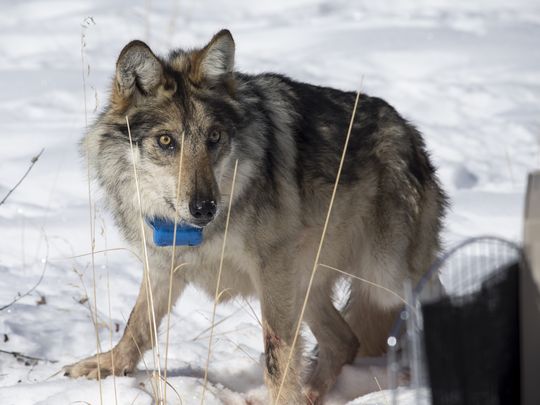
The annual Mexican gray wolf population survey in Alpine, Ariz., shows that poaching is slowing the species’ recovery.
After the wild Mexican wolf population tops 100 for the first time, 15 illegal shootings may slow recovery.
(Photo: Mark Henle, Mark Henle/The Republic)
ALPINE — Biologists hauled a 60-pound Mexican gray wolf from the chopper on Monday, limp but healthy with a lush winter mane. They called it the wolf’s worst day in months — dazed from having been darted from above, still rapidly licking his nose through a blindfold muzzle — but the male wolf was one of the fortunate among a divisive and still-embattled breed that has weathered an especially perilousyear of poachings.
Unknown shooters have illegally killed at least 15 Mexican wolves since officials reported a year ago that a record 110 were roaming wild in eastern Arizona and western New Mexico, according to a lead state biologist on the recovery program.
The poaching losses tripled from 2014, and were likely unprecedented in the 18 years since the first captive-bred lobos brought their once-exiled howls back to the Blue Range spanning the Apache and Gila national forests.
Wolf-recovery specialists, like those in Alpine this week, are working to make sure the survivors flourish instead of backsliding to a more critically endangered status.
The team of federal and state biologists carried Wolf No. M1342 on a mesh sling. They brought the wolf inside their pine-ringed Alpine field station and slid him onto a slab wooden table for a checkup and shots to keep him robust for an important breeding season this spring. They injected a second sedative that would put the wolf out cold for about an hour.
The scientists gathered round the Elk Horn pack’s would-be alpha male, prodding veins for intravenous fluids and pushing an oxygen tube up his black nostrils.They were counting on the wolf to return healthy to his young mate on snowy Escudilla Mountain, and produce their first successful litter to help extend recent annual gains in a slow-recovering population.
AZCENTRAL
As recently as five years ago, there were an estimated 50 Mexican wolves in the wild, less than half of last year’s count. Whether this year’s survey finds the population continuing to grow will depend on the 40 or so pups observed since last spring. Historically, about half of pups have survived their first year.
Besides the wolves that were shot, about a dozen more adults are missing, “fate unknown.”
M1342 was lucky to have a dart dangling from his paw, and not a trail of lead fragments through his chest. Shootings have always been a key threat since the 1998 reintroduction.
The anti-wolf mentality commonly known as “shoot, shovel and shut up” is hard to combat. Bullets typically pass through a wolf’s body and leave little useful evidence, said Jeff Dolphin, Mexican wolf field supervisor for the Arizona Game and Fish Department. “You just can’t be everywhere at once,” Dolphin said.
Only a handful of what may be dozens of shooters have faced charges related to killing one of the protected wolves since 1998. Federal, state and non-governmental organizations offer a combined reward of up to $58,000 for information leading to the arrest and conviction of a wolf poacher.
A controversial task
Susan Dicks, a U.S. Fish and Wildlife veterinarian examines Wolf No. M1342. (Photo: Mark Henle/The Republic)
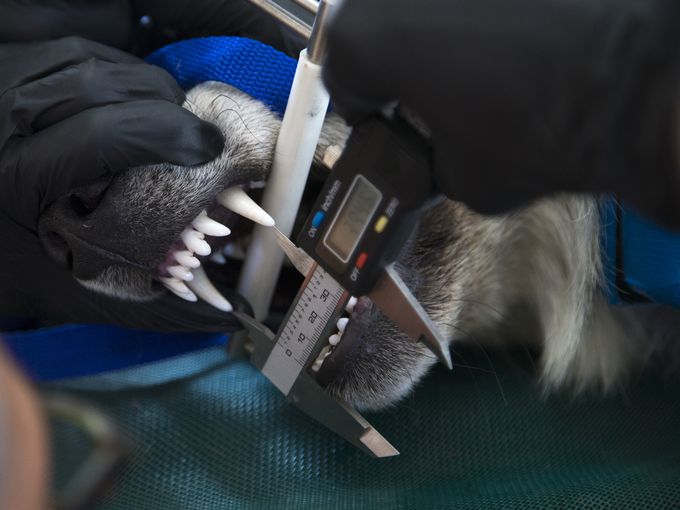
U.S. Fish and Wildlife Service veterinarian Susan Dicks coached the team of biologists and field technicians tending to M1342: how to draw blood for DNA and other tests; where to inject a rabies vaccine; how to determine age by measuring teeth; how to increase fluids or pour cooling alcohol on the paws if his temperature rises past 103 or so.
Besides the preventive medicine and data collection, the prime objective for M1342’s capture during a yearly aerial wolf survey was to fit it with a new transmitter collar. The collar he had received in a similar operation last year hadn’t functioned, so biologists only knew the wolf’s whereabouts by occasional observation. Uncollared wolves are difficult to track to ensure they’re not getting into trouble, such as by attacking livestock.
Not every wild Mexican wolf is collared, but scientists like to have them on a wolf of every generation in a pack. Last year’s survey counted 19 packs, including eight known to have a breeding pair.
AZCENTRAL
Studies show that these free-ranging wolves eat elk upward of 80 percent of the time, but cows are also occasionally on the menu. A government and non-profit fund pays for the losses. So far, the wolf program has paid out $68,000 for 50 confirmed livestock losses in 2015, and another $25,000 in claims is awaiting action by a compensation council. “It’s such a controversial program, and (people) want us to manage these animals,” Dicks explained. “The way we manage is with that collar. It communicates and tells us what they’re doing.”
The latest in a string of political struggles over the lightweight cousin of more plentiful northern gray wolves involves where they should be allowed.
Wolf advocates say they need unoccupied territory such as the forests around the Grand Canyon to sustain a population large and dispersed enough to withstand sudden die-offs. The governors of Arizona, New Mexico, Colorado and Utah recentlyco-signed a letter to the federal program opposing such a northern expansion into previously undocumented wolf territory and instead backing a push south into Mexico.
The number of wolves needed to ensure long-term survival also is in dispute. Some want to hold the line around today’s numbers, but others say at least a sevenfold increase is needed.
Mexican wolf biologist Julia Smith carries Wolf No. M1342 from the helicopter to the Alpine field station. He was darted from a helicopter to have his radio collar replaced.
Federal recovery effort
Mark Henle/The Republic Arizona is a partner in the federal recovery effort within a recovery zone that stretches from New Mexico and onto the Mogollon Rim. Officials say the state has spent $3 million since the recovery program began with captive animals in the 1980s.
This week, the team said one wolf had roamed west to within 35 miles of Payson, though it was unclear whether it was wandering alone. Others were prowling below the Rim, south of Alpine.
M1342’s gray-brown fur was thick, with no signs of mange or fleas, but Dicks squeezed an anti-parasite lotion onto the skin between the shoulders as an extra precaution. The team slid the wolf into a large dog crate and set the wolf outside to recover his senses for a truck ride back up the mountain to freedom. “We’re trying to help them out before breeding season,” Dicks said. “The population is so small.”
The subspecies had dropped to seven holdouts in Mexico during the late 20th century, survivors of private and government hunters who cleared the region of what had commonly been considered a menace. They were removed from the wild and stocked a captive breeding program that at last count fostered more than 250 wolves at 55 sites in the U.S. and Mexico.
AZCENTRAL
A few years ago, the population struggled to stay atop 50 from one year to the next, hindered not just by illegal shootings or natural causes, but by government agents shooting or removing to captivity wolves that attacked livestock. Since then, the program has focused its efforts on conflict-avoidance, said John Oakleaf, field coordinator for the U.S. Fish and Wildlife Service.
With help from partners such as Defenders of Wildlife, the government has enlisted ranchers who accept payment for the wolves’ presence but also get help from range riders protecting cattle. It may have kept the number of illegal shootings from climbing even higher. “In the end,” Oakleaf said, “the tolerance of humans for wolves is what allows them to persist or not persist in the wild. It’s what drove them to extinction, or near extinction, and it’s what’s driving them toward recovery now.”
Final numbers next month
The Fish and Wildlife Service will release the final numbers from this year’s count next month. Until then, total deaths aren’t officially tallied, but Oakleaf acknowledged the illegal shootings will be “as high as we’ve ever documented.”
Dolphin put the number at 15, and said he doubts the population estimate will remain above 100 this year. Still, he’s optimistic after years of bigger struggles to stabilize the population.
All of the wolves now in the wild were born out there, which may make them better adapted than their parents were to hunting and surviving on game. A recent experiment showed that it’s possible to drop a captive-bred pup or two in with newborn wild litters, and the wild packs will raise them as their own. “The urgent thing is to get more wolves with genetically diverse backgrounds on the ground as quickly as possible.”
Wolf advocates are also cautiously optimistic, though they believe the packs need more territory, and more of a boost from now-rare releases of captive pairs in new haunts. “If you put (captive-bred) pups in the dens of existing packs, you may be increasing the number of animals,” Center for Biological Diversity wolf specialist Michael Robinson said, “but you’re not increasing their distribution.”
A common complaint of wolf proponents is that Mexican wolves, coming from such a limited breeding stock, lack genetic diversity and pay for it with smaller litters than other wolves have. “The urgent thing is to get more wolves with genetically diverse backgrounds on the ground as quickly as possible,” Robinson said.
Returning groggily to the wild
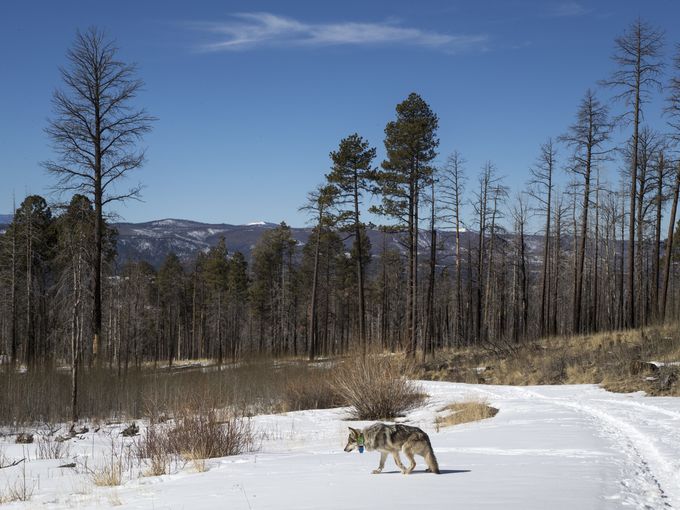
Wolf No. M1342 is released at Escudilla Mountain. (Photo: Mark Henle/The Republic)
After M1342 had regained enough of his senses to lift his head and sit up in the crate, Arizona Game and Fish biologist Brent Wolf and two colleagues loaded the crate onto a four-wheel-drive pickup and drove him back up Escudilla Mountain.
They drove as far as the truck would take them without getting stuck in the snow, getting as near as possible to the spot where the helicopter crew had darted M1342 and then set down to take the male from his mate.The return crew set the crate down at the edge of a snowy alpine meadow surrounded by scraggly willows and fat ponderosa pines, many of them torched and left bare by the massive 2011 Wallow Fire.
The groggy wolf took a few minutes to crawl out, then sat in the snow for several more. His golden-brown eyes stared toward the crew inside the pickup, and he licked the dart wound while waiting for the sedation to free his hind legs. The wolf walked slowly across the meadow, likely to be reunited with his mate once he heard a howl.
The two are believed to have mated last year, but did not produce any surviving pups, Wolf said. That’s common among first-timers, he said, and their experience should help them when they try again. “I’d be shocked if they didn’t have pups this spring,” Wolf said while reversing and turning the truck to head back down the mountain.
GALLERY
Mexican wolf biologist Julia Smith carries Wolf No. M1342 from the helicopter to the Alpine field station. He was darted from a helicopter to have his radio collar replaced. Mark Henle/The RepublicJulia Smith holds Wolf No. M1342 on his way to the Alpine field station. Mark Henle/The RepublicMexican wolf biologist Brent Wolf weighs Wolf No. M1342 in the Alpine field office. Mark Henle/The RepublicWolf No. M1342’s teeth are measured. Mark Henle/The RepublicMeasurements are taken of Wolf No. M1342’s paws. Mark Henle/The RepublicWolf No. M1342 is 3 years old and a member of the Elk Horn Pack. Mark Henle/The RepublicWolf No. M1342 got a checkup and shots to keep him robust for the important breeding season this spring. Mark Henle/The RepublicFrom left, Dr. Susan Dicks and intern Rowan Converse carry Wolf No. M1342’s kennel. Mark Henle/The RepublicFrom left, interns Hannah Manninen and Becca Thomas-Kuzilik release Wolf No. M1342 at Escudilla Mountain. Mark Henle/The RepublicWolf No. M1342 walked slowly across the meadow, likely to be reunited with his mate once he heard a howl. Mark Henle/The RepublicWolf No. M1342 and his mate are believed to have mated last year, but did not produce any surviving pups. Researchers say their experience should help the wolves when they try again. Mark Henle/The Republic
ooOOoo
Golly, I so do admire the good people who undertake this caring work on behalf of the wolves. And great photographs Mark Henle of The Republic.
The way we can reach out to others in these modern times.
A fellow local author, Constance Frankland, who has been mentioned previously here on Learning from Dogs followed up last Sunday’s Picture Parade with a comment on my Facebook page:
You might enjoy the site of Dr. Charles Bergman. I was privileged to take writing classes from him when his features were just breaking into Audubon and National Geographic. He was researching the thought-to-be-extinct Trumpeter Swan when survivors were found. (“Wild Echoes: Encounters With the Most Endangered Animals”) http://www.charlesbergman.com/
It was then the matter of a moment to hop across to that website address and read this on the home page:
Charles Bergman
A writer, photographer and speaker who lives in the beautiful Pacific Northwest and is a prof at Pacific Lutheran University in Tacoma, Washington.
He’s twice been a Fulbright Scholar in Latin America–Mexico and Ecuador–traveled extensively around the world, especially in Latin America from Mexico to Tierra del Fuego. He writes and publishes extensively on animals, nature, and sustainability–with many cover stories in such magazines as Smithsonian, Audubon, All Animals (Humane Society),, Defenders, and many more. His photographs accompany his articles. He has written three books, and has won the Washington State Book Award, Southwest Book Award, and the Benjamin Franklin Book Award. He was a finalist for the PEN USA Literary Award.
He loves animals and wildlife of all kinds, and has developed a new-found love for Antarctica and Africa.
There seemed to be many interesting articles & essays on his site and despite the fact that Mr. Bergman is currently in Uganda, his reply to my request for permission to republish some of his posts came through promptly:
Greetings from Uganda! I’m here working in the Uganda Wildlife Education Center, back shortly. Yes, you may certainly republish my materials. I’ll be very interested to follow the process.
Warmly,
Charles Bergman
You can count on me picking out some of Professor Bergman’s writings to share with you soon.
This reaching to others, friends and strangers, is a wonderful aspect of present times.
Yesterday, a wonderful number of readers ‘Liked’ my set of photographs on the theme of being a wildlife photographer. Thus it was providential, when deliberating on what to write for today’s post, to see that George Monbiot had published an article covering his recent interview with Sir David.
Before republishing that interview, let’s take a look at the man; Sir David that is!
Wikipedia has a comprehensive and fulsome description of him, that opens, thus:
He is best known for writing and presenting the nine Life series, in conjunction with the BBC Natural History Unit, which collectively form a comprehensive survey of animal and plant life on the planet. He is also a former senior manager at the BBC, having served as controller of BBC Two and director of programming for BBC Television in the 1960s and 1970s. He is the only person to have won BAFTAs for programmes in each of black and white, colour, HD, and 3D.
From across YouTube, Twitter and Facebook, we’ve taken your comments during #AttenboroughWeek and made this video as a thank you to everyone who got involved. Click on the annotations to see each of the clips in full.
Now on to the George Monbiot interview, republished here with Mr. Monbiot’s kind and generous permission.
ooOOoo
Rare Specimen
23rd January 2016
My interview, in his 90th year, with Sir David Attenborough
By George Monbiot, published in the Guardian 23rd January 2016
You cannot meet David Attenborough without reflecting on the lottery of life. He bounces into the room unaccompanied, a little stiff in the lower back perhaps, but otherwise breezy and lithe. He is sound in wind and limb, vision and hearing, his eyes sparkle, his face is scarcely rumpled by time. Yet in three months he will celebrate his 90th birthday.
While other people’s worlds tend to shrink with age, his seems to expand. His curiousity ranges as widely as ever. His ability to understand and assimilate new information seems unabated. “Oh, I forget things,” he claims. When I press him for examples, he tells me, “Well, where I put my glasses, I had them about three minutes ago and they have simply evaporated, they’ve dematerialised. Oh yeah, and I forget engagements.”
But these, surely, are afflictions suffered by anyone immersed in the world of ideas. He has no diffulty remembering the things that fascinate him. When I ask him about his new project, his body bundles up with excitement.
“Luminous earthworms! Did you know about luminous earthworms? Aaah, aaah, yes, very interesting. I’m doing a thing on bioluminescence … and with a little research we discovered that there are earthworms in France that are luminous – in the earth! Why? Yes, why?! Well at the moment I am just thinking about it. As you well know there’s a gene for luminosity and it’s very widespread, and so you would like to suppose that it has some antiquity. So maybe luminosity was a by-product of digestive processes or energy processes or something.
“And if it is, the exciting thing is – what about all those graptolites, what if they were luminous?! In which case, now you suddenly realise that trilobites have bloody good eyes, so maybe they were there too! Wow!” (Graptolites and trilobites are long-extinct marine animals).
I mention his latest film, which will air on Sunday, about the excavation and reconstruction of the skeletons of Titanosaurs, the biggest terrestrial animals known to have walked the Earth. Why, I ask, do dinosaurs exert such a grip, especially on the minds of children?
“Partly because nearly all the adults have got it wrong. It’s one of the easiest subjects for a kid – or it was when I was a kid – for you to expose your parents, because you had just read the new cigarette card and there was a name there, a polysyllabic name, your parents had never heard of.”
And there he still was, I realised, the boy with his cigarette cards, his excitement about creatures that lived many millions of years ago undimmed by the passage of mere decades.
So this is what must have happened. On one of his early expeditions through a remote tract of rainforest, he stumbled across the elixir of life. He has been hoarding it ever since and surreptitiously sipping a little every day. Either that, or he is simply the luckiest man alive: fit, bright, relevant, in love with life, the last man standing.
He has the decency to be aware of his luck. “People sitting in corners doing nothing aren’t there because they want to sit in the corner doing nothing. They would much rather be doing [things]. And I am lucky enough to be able to do them. It would be very ungrateful to have that facility and not use it.” He has, of course, no intention of retiring.
There is only one lifeform he is reluctant to discuss, the scientific curiosity known as Sir David Attenborough. He created a powerful sense, when talking, of intimacy and candour, leaning in, holding my gaze, twinkling and gurning, speaking in his confidential whisper. But when I came to read the transcript of our interview I found that what had felt like frank confession was nothing of the kind. What he said with his body bore no relation to what he said with his words.
I pressed him several times on an issue with which I have long been struggling. How do those of us who love the natural world cope with its loss? He must have seen more than his fair share of devastation.
“Oh yes, of course. You go to Borneo and see oil palms everywhere where there was forest. You see people everywhere where there weren’t people.”
“And how does it affect you, seeing those changes?”
“Well you feel apprehensive for the future, of course you do.”
“So how do you cope?”
“I don’t have a rosy view of life, of the future, I look at my grandchildren and think ‘what are they going to have to deal with?’, of course I do. How could you not?”
But what about the emotional impact? Does he not get depressed? Does he have a mechanism for avoiding depression? He answered by bouncing the issue onto someone else.
“I once asked exactly the same question of Peter Scott [the great British conservationist, who died in 1989]. And he said, ‘Well you can only do what you can do.’ So what I do is what I can, but I wish to goodness I had done a tenth of what Peter did.”
While his self-deprecation is charming, it also seems defensive. I pictured those two quintessentially English men stroking their chins and repeating “you can only do what you can do” to each other, and thought of a scene in Monty Python’s The Meaning of Life. An army captain pays a call on one of his men, who is lying in bed, nonchalently reading a book. “What’s all the trouble, then?”. “Bitten, sir. During the night”. “Hmm. Whole leg gone, eh … Any idea how it happened?”. “None whatsoever. Complete mystery to me. Woke up just now, one sock too many.” Monty Python made their television debut on BBC2, commissioned by the controller at the time, a certain David Attenborough.
When talking in general terms, he uses the word “I”. When asked to talk about his feelings, he says “you”. Some of this is perhaps generational: it was once considered vulgar to discuss such matters. But perhaps his great fame has also obliged him to develop a carapace. I asked whether his public life has blurred the boundaries of his private self.
“There has always been the private and the public thing in you, in everybody”, he replies. “You are different things to different people, to your children, to your television producer.”
Can he go anywhere in public without being mobbed?
“I have to confess the ubiquity of the selfie is, er – On occasion when they say ‘do you mind’, I say ‘well, I am off duty at the moment’, and they say ‘oh are you?’, by which time I’m three yards down the road. But I do have to remember that they are the people who … listen to me, you know, and so you try not to be rude.”
I asked him if he ever gets lonely. His wife, Jane Oriel, died almost 20 years ago.
“Hmm? Oh. My daughter lives in the same house as me now and has done for many years. So once a day I see her, she runs my business affairs and, you know, I’m very lucky.”
He is just as discreet about the politics surrounding his work. On the day I met him, the controller of BBC2 and BBC4, Kim Shillinglaw, lost her post. He was plainly delighted, chuckling and winking and grinning when he asked me whether I had read that morning’s news. But he was careful to say nothing quotable. Television producers I know expressed intense frustration at her instant and unexplained dismissal of programmes they proposed on environmental themes.
But the problem, as I perceive it, is much wider than that: has there not been a systemic failure by television to cover the great crisis of our age: the gradual collapse of the Earth’s living systems?
“I am absolutely certain that the general public at large is more aware of the natural world than it was even before the industrial revolution,” he replies, “and that people are well informed about not only what the world contains but the processes that go on. Television has made a contribution to that. … I greatly regret the fact that there are no or very few regular – ”
He stops himself, and plunges into a more general discussion of scheduling. Surely, I persist, there’s a real problem here? Entire years have passed without a single substantial programme on environmental issues.
“Well,” he says, more crisply than at any other time in the interview, “you’ll have to take that up with the controllers.”
I suggest that his own interest in the state of the world appears to have intensified in recent years.
“That’s not an interest. I wish I didn’t have it. I wish there was no need to have it. It’s not an interest, it’s an obligation.”
But he has surely been more prominent as an environmental voice in the past twenty years than he was before?
“Well yeah, and that is very simple in that I have been in the BBC all my working life, practically, and you knew very well … that if you said something, just because you are on the damn box people thought it was true and you’d better be bloody well sure that it is true.”
(I used to curse this reticence, willing him to get off the fence and denounce the destruction of all he loved.)
He explains that his views on climate change crystallised when he attended a lecture – he could tell me when it was if he had his diary to hand – by the president of the US National Academy of Sciences, Ralph Cicerone. After that, he made two programmes, called Are We Changing Planet Earth? and Can We Save Planet Earth?
Attenborough is not just a master of the art of television, but also one of the medium’s pioneers, producing programmes almost from its launch in this country, and guiding the development of some of its treasured strands, first as controller of BBC2 (from 1965 to 1969), and then as the BBC’s director of programmes (until 1973). Has he helped to create a monster?
“Well it depends how you define a monster. And are all monsters malign?”
Has it not encouraged us to be more sedentary, I ask: to spend less time engaging with the world about us? He laughs and winks: “And we gave up sitting in pubs for three or four hours a day! How awful!”. Would he lay any ills at the door of television? “Oh yes, of course. Adipose tissue.” Anything else? “What you might call visual chewing gum, in that it stops you thinking about anything else. But then I feel that about music. I mean I cannot understand how people want to go round with -” he mimes a pair of headphones and shifts the conversation onto a safer subject.
I was packing my things after saying goodbye when suddenly he sprang back into the room, this time wearing his glasses and holding a small leather filofax. “I’ve found the details of that lecture by Ralph Cicerone. I thought you’d want to know.” He showed me the address and the date: 2004. The old scientific habit – record your facts, check your facts – had not deserted him. As I marvelled at his recollection that he had left something hanging, and his determination to resolve it, this remarkable specimen of life on earth skipped away to his next appointment.
So let me continue on a little more by offering a short clip of Sir David as millions will have seen him from the wonderful animal partnerships BBC series.
Then it’s only natural for this blog to offer this item:
Then I am going to close today’s post by presenting a video that was first shown in this place back in September 2012.
If you need a reminder of how beautiful our planet is (and I’m sure the majority of LfD readers don’t require that reminder) then go back and watch David Attenborough’s video and voice-over to the song What a Wonderful World. This short but very compelling video shows why the planet is so worth protecting. Enjoy!
So make a diary note to celebrate Sir David’s 90th birthday on May 8th.
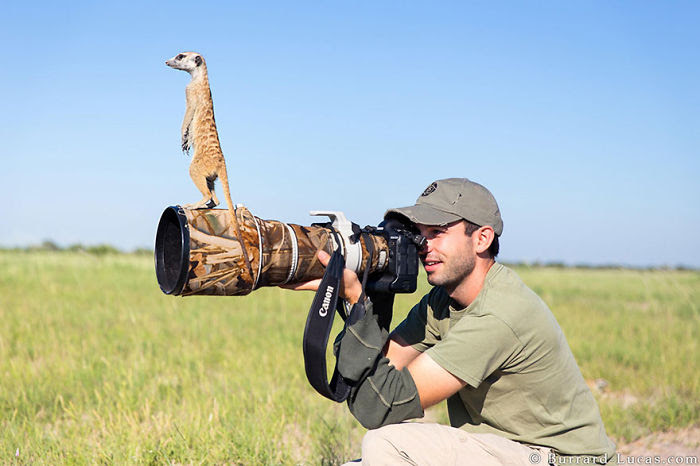
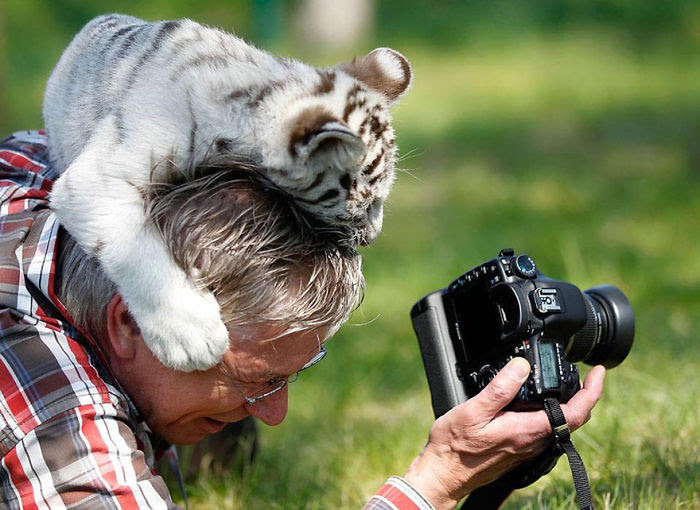
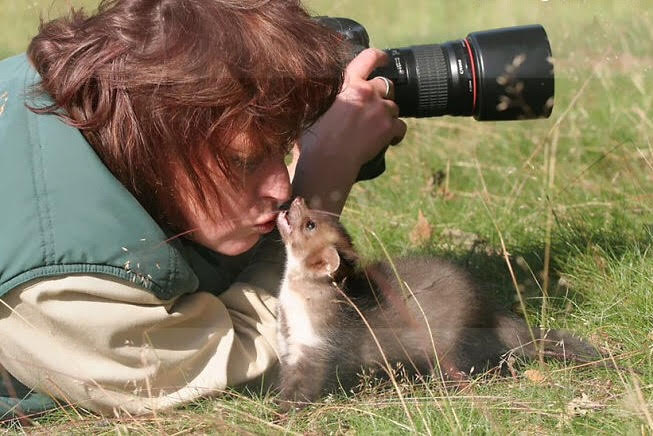
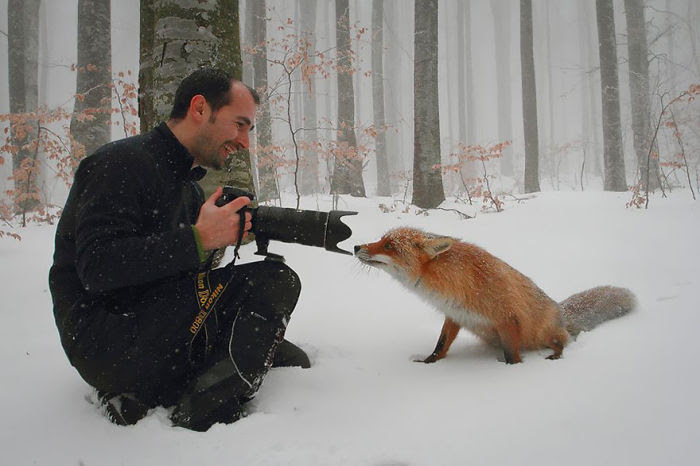
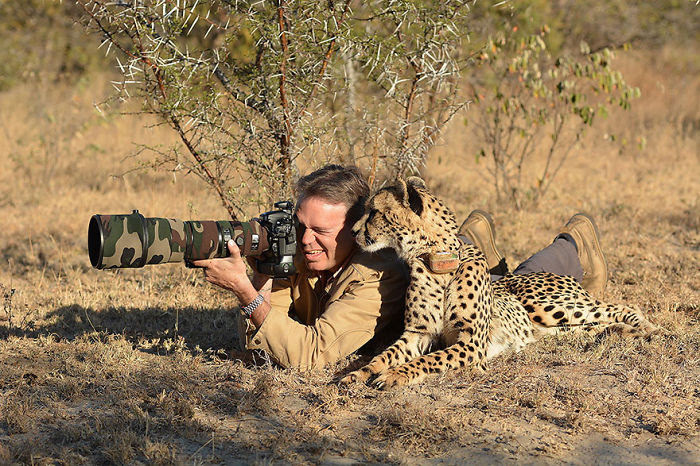
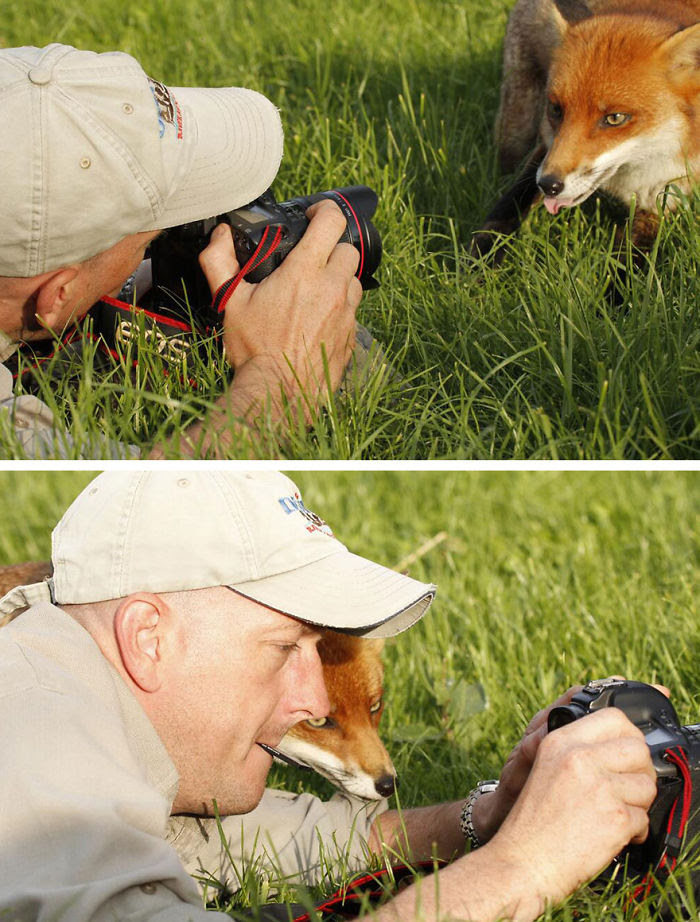
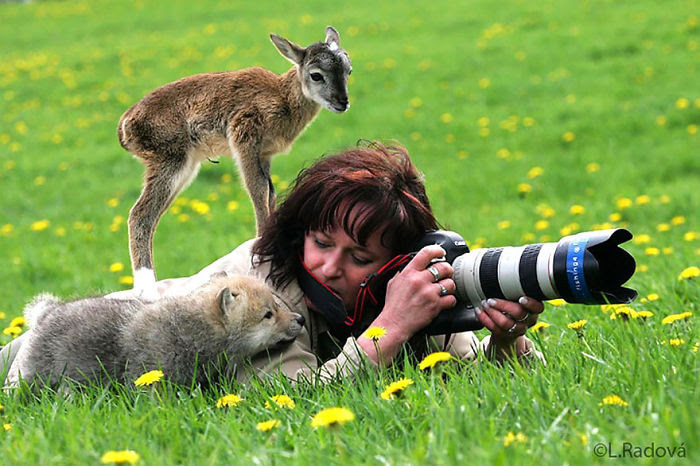
Why Being a Wildlife Photographer Is the Best Job in the World
These photographs were originally sent to me by Marg from Tasmania and they are just wonderful. Upon querying with Marg where they originally came from she found the source on a blog site called deMilked. That site explained:
You have to really love animals to go into nature photography. After all, it requires more patience to catch some deer in your lens than to photograph a mountain. Mountains don’t run away! Some animals don’t run either. In fact, some of them are really curious and come closer to check out the photographer. Quis custodiet ipsos custodes? Apparently, foxes and squirrels.
So here is the first batch of these gorgeous photographs.
I was looking up stories on German Shepherds, a breed we just adore, and quite by chance came across a lovely follow-up to my post last Tuesday Dogs and Dolphins.
Published on Mar 9, 2012
This is a video of a German Shepherd jumping in on some dolphins while we were underway in our boat. I guess he wanted to play with the dolphins lol
Thanks for watching
After that video had come to an end, YouTube then automatically went on to this one:
(The soundtrack quality is poor but, nevertheless, it was been viewed over six million times!)
We never planned to come and live in Southern Oregon. It was the result of a bizarre dream about our well running dry when we were living back in Payson, Arizona. Someone who was staying with us at the time, upon hearing about my strange dream, responded: “If you’re worried about water go and live in Oregon.”
So we did!
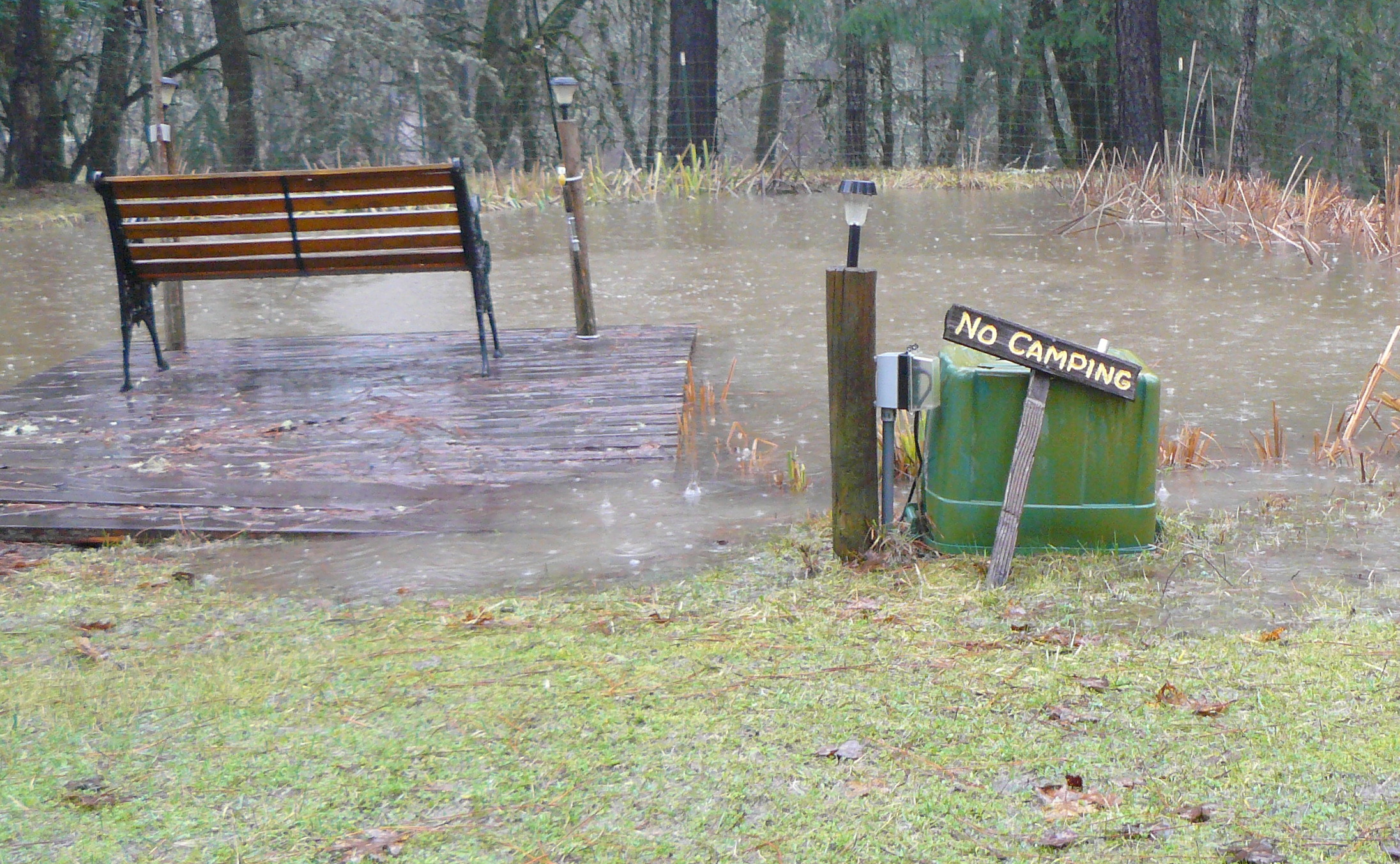
At the time of writing this post (2pm yesterday) our weather station that we have at home had recorded a total of 7.78 inches of rain for January that brought the total for December and January to 25.66 inches. Two days ago we had 2.48 inches in a single day, as these photographs bear out.
Not even 11am and already 1.8 inches has fallen since midnight.
oooo
A very wet landscape.
oooo
Bummer Creek in full flow (the central pier is from a previous bridge.)
Anyway, all this is a preface to a lovely item about living in Oregon that was sent to me by Janet, a neighbour of ours.
ooOOoo
If someone in a Home Depot store offers you assistance and they don’t work there, you live in Oregon.
If you’ve worn shorts, sandals and a parka at the same time, you live in Oregon.
If you’ve had a lengthy telephone conversation with someone who dialed the wrong number, you live in Oregon.
If you measure distance in hours, you live in Oregon.
If you know several people who have hit a deer more than once, you live in Oregon.
If you have switched from ‘heat’ to ‘A/C’ and back again in the same day, you live in Oregon.
If you install security lights on your house and garage but leave both doors unlocked, you live in Oregon.
If you can drive 75 mph through 2 feet of snow during a raging blizzard without flinching, you live in Central, Southern or Eastern Oregon.
If you design your kid’s Halloween costume to fit over 2 layers of clothes or under a raincoat, you live in Oregon.
If driving is better in the winter because the potholes are filled with snow and ice, you live in Oregon.
If you know all 4 seasons: almost winter, winter, still winter, and road construction, you live in Oregon.
If you feel guilty throwing aluminum cans or paper in the trash, you live in Oregon.
If you know more than 10 ways to order coffee, you live in Oregon.
If you know more people who own boats than air conditioners, you live in Oregon.
If you stand on a deserted corner in the rain waiting for the “Walk” signal, you live in Oregon.
If you consider that if it has no snow or has not recently erupted, it is not a real mountain, you live in Oregon.
If you can taste the difference between Starbucks, Seattle’s Best, and Dutch Bros, you live in Oregon.
If you know the difference between Chinook, Coho and Sockeye salmon, you live in Oregon.
If you know how to pronounce Sequim, Puyallup, Clatskanie, Issaquah, Oregon, Umpqua, Yakima and Willamette, you live in Oregon.
If you consider swimming an indoor sport, you live in Oregon.
If you know that Boring is a city and not just a feeling, you live in Oregon.
If you can tell the difference between Japanese, Chinese and Thai food, you live in Oregon.
If you never go camping without waterproof matches and a poncho, you live in Oregon.
If you have actually used your mountain bike on a mountain, you live in Oregon.
If you think people who use umbrellas are either wimps or tourists, you live in Oregon.
If you buy new sunglasses every year, because you cannot find the old ones after such a long time, you live in Oregon.
If you actually understand these jokes and forward them to all your OREGON friends, you live or have lived in Oregon.
ooOOoo
Picking up that point about never go camping without waterproof matches and a poncho, let me close today’s post by returning to Oregon rain. Or more accurately, to a photograph that I took back last Sunday over at our neighbour’s property.
![Skaftafell-ice-cave-1[2]](https://learningfromdogs.com/wp-content/uploads/2016/02/skaftafell-ice-cave-12.jpg) Seen originally here.
Seen originally here. This one above was originally seen here.
 And my final photograph is taken from here, together with the opening paragraphs.
Fortress Of Solitude: Unbelievable Crystal Ice Caves In Iceland










![Image[147]](https://learningfromdogs.com/wp-content/uploads/2016/01/image147.jpg)
![Image[148]](https://learningfromdogs.com/wp-content/uploads/2016/01/image148.jpg)
![Image[150]](https://learningfromdogs.com/wp-content/uploads/2016/01/image150.jpg)
![Image[151]](https://learningfromdogs.com/wp-content/uploads/2016/01/image151.jpg)
![Image[152]](https://learningfromdogs.com/wp-content/uploads/2016/01/image152.jpg)
![Image[153]](https://learningfromdogs.com/wp-content/uploads/2016/01/image153.jpg)
![Image[154]](https://learningfromdogs.com/wp-content/uploads/2016/01/image154.jpg)
![Image[155]](https://learningfromdogs.com/wp-content/uploads/2016/01/image155.jpg)
![Image[149]](https://learningfromdogs.com/wp-content/uploads/2016/01/image149.jpg)
 Learning from Dogs