The sad story of the death of Lonesome George, a giant tortoise.
When you’re gone, you’re gone, it is said. But in the case of this example of the beauty of Mother Nature, the idea of being gone is as final as it comes; George was the last of his species.
Staff at the Galapagos National Park in Ecuador say Lonesome George, a giant tortoise believed to be the last of its subspecies, has died.
Scientists estimate he was about 100 years old.
Park officials said they would carry out a post-mortem to determine the cause of his death.
With no offspring and no known individuals from his subspecies left, Lonesome George became known as the rarest creature in the world.
For decades, environmentalists unsuccessfully tried to get the Pinta Island tortoise to reproduce with females from a similar subspecies on the Galapagos Islands.
Park officials said the tortoise was found dead in his corral by his keeper of 40 years, Fausto Llerena.
While his exact age was not known, Lonesome George was estimated to be about 100, which made him a young adult as the subspecies can live up to an age of 200.
Lonesome George was first seen by a Hungarian scientist on the Galapagos island of Pinta in 1972.
Environmentalists had believed his subspecies(Chelonoidis nigra abingdoni) had become extinct.
Lonesome George became part of the Galapagos National Park breeding programme.
After 15 years of living with a female tortoise from the nearby Wolf volcano, Lonesome George did mate, but the eggs were infertile.
He also shared his corral with female tortoises from Espanola island, which are genetically closer to him than those from Wolf volcano, but Lonesome George failed to mate with them.
He became a symbol of the Galapagos Islands, which attract some 180,000 visitors a year.
Galapagos National Park officials said that with George’s death, the Pinta tortoise subspecies has become extinct.
They said his body would probably be embalmed to conserve him for future generations.
Tortoises were plentiful on the Galapagos islands until the late 19th century, but were later hunted for their meat by sailors and fishermen to the point of extinction.
Their habitat furthermore suffered when goats were introduced from the mainland.
The differences in appearance between tortoises from different Galapagos islands were among the features which helped the British naturalist Charles Darwin formulate his theory of evolution.
Some 20,000 giant tortoises of other subspecies still live on the Galapagos.
Continuing the tribute, Chris Mazzarella had some stunning photographs on his wonderful photographic blogsite Fast Forward. (Do take a look!) I held my breath and asked Chris for permission to republish his article and was delighted to be given his approval. Thanks Chris, thanks very much.
oooOOOooo
An Ode To George
To pay tribute to our late friend Lonesome George, I thought it would be appropriate to write a post in celebration of turtles. George was the last tortoise of the subspecies Chelonoidis nigra abingdoni from Pinta Island in the Galapagos. Sadly George passed yesterday at the tender age of 100 years. This could be considered middle aged for the tortoise who’s counterparts can live beyond 200 years.
This is easily the smallest one I’ve seen all year. To give you some perspective, this lily pad is about eight inches across.
In Vermont, we have seven species of turtles, and I run into many of them while kayaking around the state. The one I see most often is the painted turtle. I spot these guys by the dozen basking in the sun while I’m paddling throughout the northeast. They are very cooperative subjects, but will head for a swim if you get too close. I don’t like spoiling anyone’s sunbath so I do my best to keep a respectable distance out on the water.
You can check out the biggest turtle I’ve seen all year in an April post entitled Snappers.
I’ve read that snapping turtles are the most common turtle in Vermont, yet I do not see quite as many in my travels. When I do see them, they are usually trolling underwater, covered in algae.
I have encountered a few snappers above the surface this year. I found this old guy lounging on a log in Bradford, Vermont a few days ago.
One of the rarer species of turtle I encountered this spring was a wood turtle in Magalloway Brook. I didn’t have much time to prepare for this shot before he launched off the log and into the water. It was a brief meeting, but certainly a memorable one as this is the only wood turtle I’ve ever photographed.
While turtles are not known for their speed they do offer unique challenges for photographers, particularly when shooting in the sun. Their reflective carapace makes them easy to spot, but difficult to expose for. A polarizing filter is sometimes necessary to reduce the glare on their wet shells. While this will help, the ideal situation is to shoot them under overcast skies.
Another thing to keep in mind is the angle of your shot. The kayak makes a great vehicle for wildlife photography because it keeps you low on the water. I often try to shoot wildlife at eye level. This gives you the same perspective from which the animal views the world. It’s much more interesting than a bird’s eye view, for example, and embodies the subject with the sense of pride that it deserves.
George’s passing marks the end of an important legacy, as the Galapagos turtles played a very important role in the foundation of Darwin’s theory of Natural Selection.
A further reflection on what has clearly been a wonderful occasion.
Last Sunday, I published a piece about The Queen’s Diamond Jubilee. Today, I wanted to add a couple of perspectives to this glorious and historic event.
The grand perspective
As seen by someone watching the 1,000 boats on the River Thames to mark The Queen’s Diamond Jubilee.
Then in stark contrast …
The local perspective
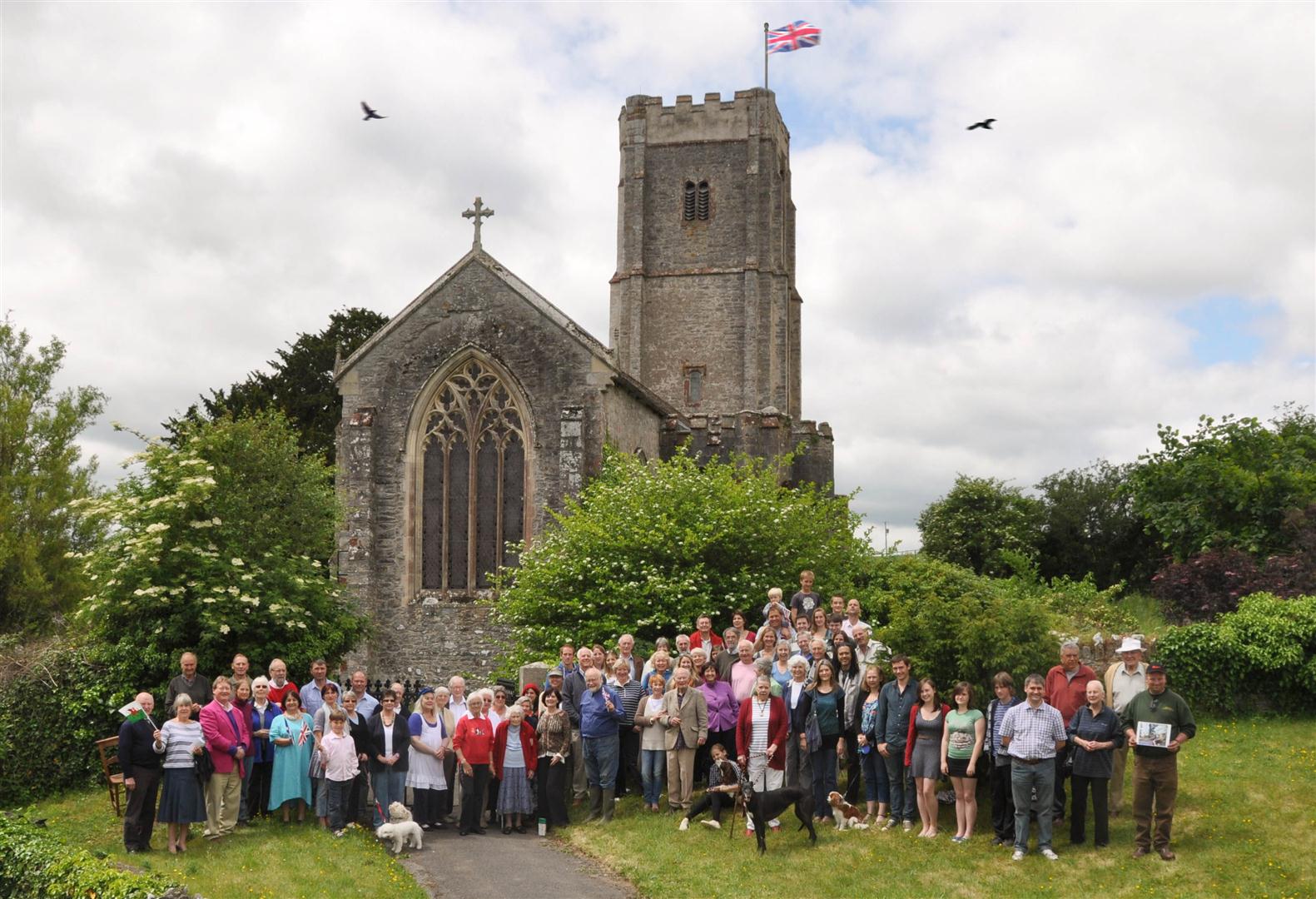
… as seen by the camera’s eye in the little village of Littlehempston, South Devon with many of the population of some 200 persons in front of Littlehempston Church.
Picture by Neil Kelly, standing to the right of John, see footnote.
Footnote: Not only is Littlehempston just a few miles from the village of Harberton where I used to live, before my new life with Jean here in Arizona, but both my sister and brother-in-law are in this photo; my sister, Corinne, is the first woman in from the right in the front row, and my brother-in-law, John, is standing just behind her (wearing the white hat).
Update:
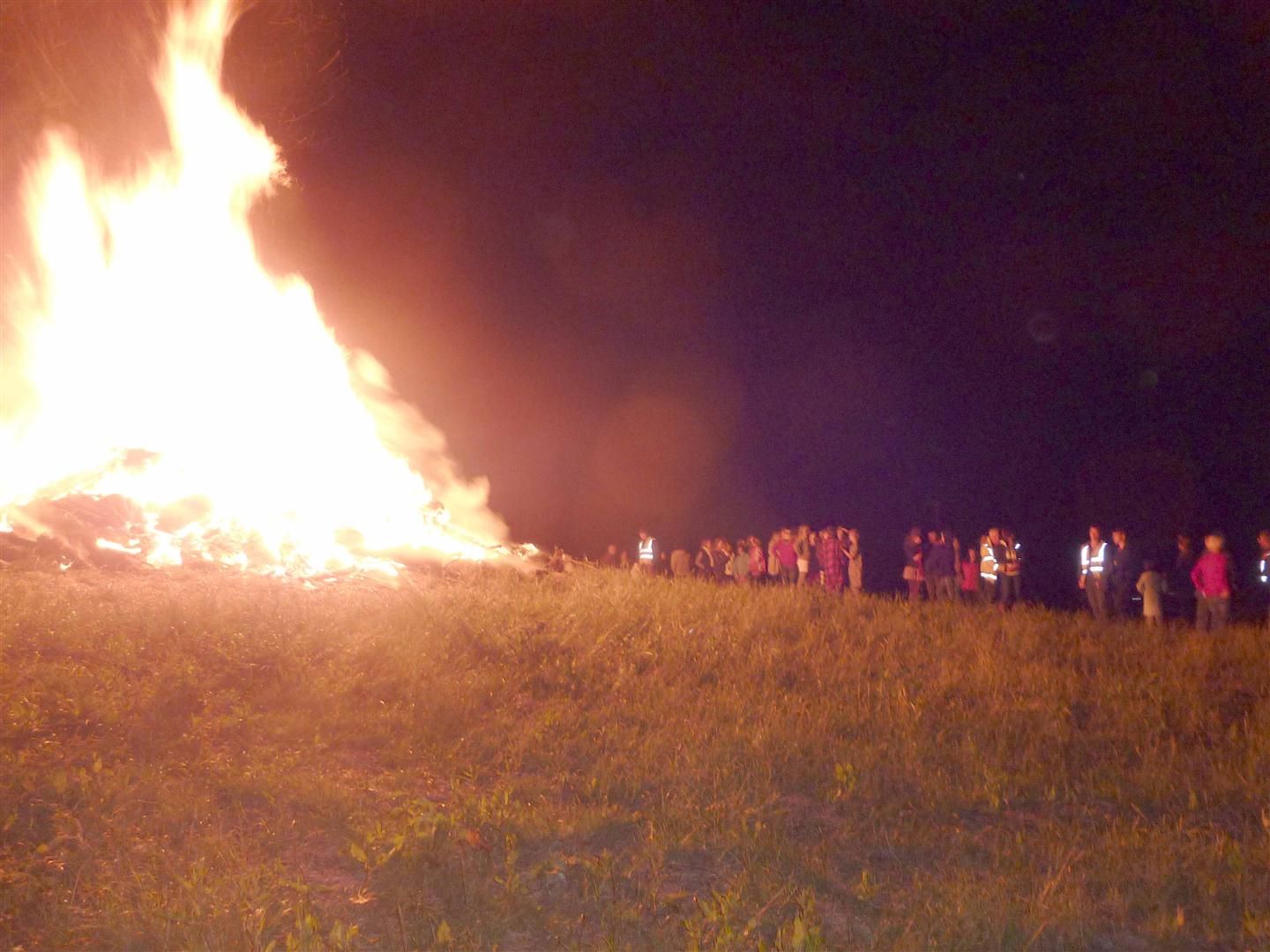
Neil sent me a further picture below of the village beacon alight for the Jubilee.
The full quotation is “This sight…is by far the noblest astronomy affords…” and was reputed to have been made by Sir Edmond Halley of Halley’s Comet fame, see here. But today’s Post is about Venus.
Venus has been referred to as the sister or even twin to Earth by many because of its similar chemical composition, density and size. That, however, is where the similarities end. Venus is not only the hottest planet in the solar system, but also the brightest. Both of these characteristics are the result of the atmosphere that surrounds the planet, which is mainly composed of carbon dioxide and some sulfuric acid. This composition allows for the greenhouse effect to be astronomical causing the planet to have a constant temperature of 864°F. The planet is the brightest because the clouds, composed of sulfur dioxide and sulfuric acid, are highly reflective. The pressure of the atmosphere that surrounds Venus is 90 times that of the atmosphere around Earth, crushing any probes that land on Venus in a matter of hours.
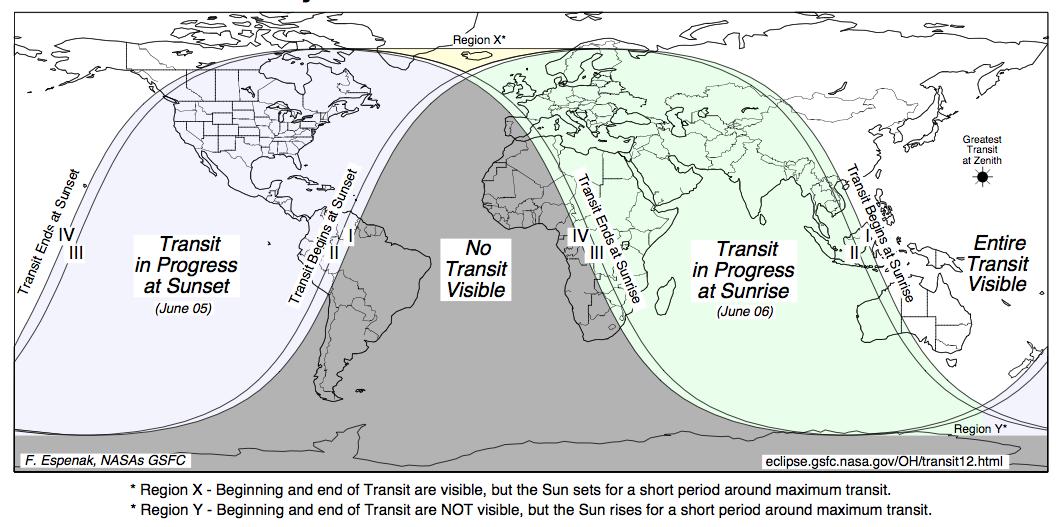
Depending on where you live on Planet Earth you will see the transit on the 5th June, the 6th June or not at all!
Courtesy of Fred Espenak (NASA GSFC), who provides additional transit of Venus data from NASA.
(That additional data referred to above may be found here.)
That transit diagram plus mounds of other interesting stuff is on the Transit of Venus website and on that website this page has the details allowing you to work out what day and time the transit occurs depending on where you are.
To close let me be a little cheeky and reproduce, in full, what appeared on the Science Daily website on the 1st May.
Venus to Appear in Once-In-A-Lifetime Event
ScienceDaily (May 1, 2012) — On 5 and 6 June this year, millions of people around the world will be able to see Venus pass across the face of the Sun in what will be a once-in-a-lifetime experience.
It will take Venus about six hours to complete its transit, appearing as a small black dot on the Sun’s surface, in an event that will not happen again until 2117.
In this month’s Physics World, Jay M Pasachoff, an astronomer at Williams College, Massachusetts, explores the science behind Venus’s transit and gives an account of its fascinating history.
Transits of Venus occur only on the very rare occasions when Venus and Earth are in a line with the Sun. At other times Venus passes below or above the Sun because the two orbits are at a slight angle to each other. Transits occur in pairs separated by eight years, with the gap between pairs of transits alternating between 105.5 and 121.5 years — the last transit was in 2004.
Building on the original theories of Nicolaus Copernicus from 1543, scientists were able to predict and record the transits of both Mercury and Venus in the centuries that followed.
Johannes Kepler successfully predicted that both planets would transit the Sun in 1631, part of which was verified with Mercury’s transit of that year. But the first transit of Venus to actually be viewed was in 1639 — an event that had been predicted by the English astronomer Jeremiah Horrocks. He observed the transit in the village of Much Hoole in Lancashire — the only other person to see it being his correspondent, William Crabtree, in Manchester.
Later, in 1716, Edmond Halley proposed using a transit of Venus to predict the precise distance between Earth and the Sun, known as the astronomical unit. As a result, hundreds of expeditions were sent all over the world to observe the 1761 and 1769 transits. A young James Cook took the Endeavour to the island of Tahiti, where he successfully observed the transit at a site that is still called Point Venus.
Pasachoff expects the transit to confirm his team’s theory about the phenomenon called “the black-drop effect” — a strange, dark band linking Venus’s silhouette with the sky outside the Sun that appears for about a minute starting just as Venus first enters the solar disk.
Pasachoff and his colleagues will concentrate on observing Venus’s atmosphere as it appears when Venus is only half onto the solar disk. He also believes that observations of the transit will help astronomers who are looking for extrasolar planets orbiting stars other than the Sun.
“Doing so verifies that the techniques for studying events on and around other stars hold true in our own backyard.. In other words, by looking up close at transits in our solar system, we may be able to see subtle effects that can help exoplanet hunters explain what they are seeing when they view distant suns,” Pasachoff writes.
Not content with viewing this year’s transit from Earth, scientists in France will be using the Hubble Space Telescope to observe the effect of Venus’s transit very slightly darkening the Moon. Pasachoff and colleagues even hope to use Hubble to watch Venus passing in front of the Sun as seen from Jupiter — an event that will take place on 20 September this year — and will be using NASA’s Cassini spacecraft, which is orbiting Saturn, to see a transit of Venus from Saturn on 21 December.
“We are fortunate in that we are truly living in a golden period of planetary transits and it is one of which I hope astronomers can take full advantage,” he writes.
Editors note: Looking directly at the sun can cause severe and permanent eye damage. Do not look directly at Venus’ transit of the sun.
I’m going to republish this in full on Monday, 4th June at the usual Learning from Dogs release time of 0700 UTC so to increase the odds of all my readers who would like to see the Transit having the information in good time!
Back on April 2nd this year, I posted a piece called I am your dog! The item was motivated by coming across a personal reflection of the relationship that I had, and still have, with Pharaoh, my German Shepherd dog, back in 2007 when I was still living in England; I met Jean in Mexico Christmas 2007!
Among the many comments was one from Perfect Stranger who writes the fabulous blog Dogs of Doubt. He said in his comment,
Hi Paul, I do believe this comment belongs on this post … two videos, part of a true story about an Aussie dog, a modern day “Dog on the Tucker Box”, a true blue friend to an entire town who eventually ended up building him a statue … yeah, not “it” but “HIM”.
First video shows you how tough Aussies animals are ,, watch the fight, it’s awesome, I laugh every time I watch it. they say it really happened. 🙂
Second video is the trailer for “Red Dog” – The Pilbara Wanderer! , hope you get to see the movie
I promised to make that comment a post all on it’s own right – then promptly forgot! So apologies and here are those two movies.
There are a number of news stories about this extra-special full moon but I’ve chosen to republish some of what appeared on the Mother Nature Network website.
In terms of the timing of this full moon, rather than give you times for various places around the world, as this website does, I will simply offer the UTC/GMT time:
Sunday 6th May 2012 at 03:35:06 am
If you want to covert that to your local time wherever you are on this beautiful planet The World Time Server is as good a website as any.
BIGGER THAN YOUR AVERAGE MOON: Skywatcher Tim McCord of Entiat, Washington caught this amazing view of the March 19, 2011 supermoon. (Photo: Tim McCord)
Skywatchers take note: The biggest full moon of the year is due to arrive this weekend. And because this month’s full moon coincides with the moon’s perigee — its closest approach to Earth — it will also be the year’s biggest.
The moon will swing in 221,802 miles (356,955 kilometers) from our planet, offering skywatchers a spectacular view of an extra-big, extra-bright moon, nicknamed a supermoon.
And not only does the moon’s perigee coincide with full moon this month, but this perigee will be the nearest to Earth of any this year, as the distance of the moon’s close approach varies by about 3 percent, according to meteorologist Joe Rao, SPACE.com’s skywatching columnist. This happens because the moon’s orbit is not perfectly circular.
The full Moon will be up to 14% larger and 30% brighter than others during the year. The reason for this phenomenon is that the Moon becomes full on its closest approach to Earth on May 5, 2012, also known as the perigee full Moon.
So enjoy this most beautiful sight if you are somewhere on this planet where the moon will be visible at night. And double-check the time and the day so you don’t miss it! Finally, let me close by ‘spoiling’ my many readers in Arizona, and to serve as a good reminder for yours truly by saying that anyone on US Mountain Standard Time will see this moon at:
Saturday, 5th May 2012 at 20:35:06
“Aim for the moon. If you miss, you may hit a star.” W. Clement Stone.











 Learning from Dogs