Category: Photography

Gnawing on a bone!

Dogs’ evolution shows why they ‘love’ gnawing on bones.

This is the second article on the BBC Nature website following yesterday’s item about why dogs enjoy a healthy breakfast.

oooOOOooo

Dogs’ evolution shows why they ‘love’ gnawing on bones

By Victoria Gill
Science reporter, BBC Nature, Ottawa, Canada

Social living drove dogs to evolve the “tools” for chewing bones, scientists say

Scientists say they have discovered why dogs love to eat meat and bones.

Ancient canines adopted pack-living about eight million years ago, to hunt larger prey, according to researchers.

The resulting evolution of their jaws gradually turned the ancestors of modern wolves, and ultimately our own pets, into “hypercarnivores”.

Dr Joao Munoz-Doran presented the findings at the First Joint Congress for Evolutionary Biology in Ottawa, Canada.

He and his colleagues from the National University of Colombia have created a canine “family tree”, piecing together the relationships between each of the more than 300 dog species.

“We compared species that have very different diets,” Dr Munoz-Doran explained to BBC Nature. “So we classified them as carnivores, hypercarnivores [animals that eat more than 70% meat] and omnivores [animals that eat meat and vegetation].”

The ancestors of modern wolves belong to this hypercarnivorous group.

The team’s analysis showed that the skull features that now distinguish a wolf – strong jaw muscles and enlarged canine teeth – first started to develop when their ancestors first began hunting in groups.

“We found a common evolutionary history for these traits,” Dr Munoz-Doran explained. “Eight million years ago was when [less forested, more] open habitats were spreading through Asia, Europe and North America. And when there are open habitats, the big prey group together. So there will be more eyes watching for a predator.”

The only way that dogs roaming the open plains could snatch very large prey from a herd was to work together.

“And after many generations of this grouping behaviour, there are new selective pressures on their [skull shape],” said the researcher.

This pressure meant that animals with larger teeth and stronger jaws were more likely to succeed in hunting, and to survive to pass on their large-toothed, strong-jawed genes to the next generation.

Animals with stronger jaws and larger canine teeth would have been more successful hunters

“They developed strength in their muscles – especially the muscles that close their mouth,” said Dr Munoz-Doran. “And bones that are more resistant to bending, so they could support the mechanical strains of biting the prey. “Over time, they became adapted to be ‘hypercarnivorous’.”

The researcher pointed out that domestic dogs had “very good evolutionary reasons to enjoy chewing a bone”.

“They have the tools to do that,” he told BBC Nature, “and they want to use their tools.”

oooOOOooo

Finally, to the side of that BBC Nature webpage were a few canine facts, as follows:

  • Common canines: Foxes, wolves, jackals, coyotes and dingoes are all members of this well-known group
  • Familiar faces: Wild canids are found on every continent except Antarctica
  • Communication is key: Previous studies of dog evolution have revealed that calls were essential for forming social groups and hunting larger prey
  • Pets’ past: All domestic dogs are descendants of the grey wolf

And don’t close without going here and listening to Steve Backshall howling with a wolf pack – (it’s a video as well – unmissable).

Sunrises for ever!

This first published on the 4th November, 2009 when we were living in Mexico.

Here in San Carlos, Mexico, we have good sunrises most mornings.  But this one made me grab my camera. The picture is unedited. Very simple things can provide a huge amount of pleasure.

Sunrise

Taken at 06:15 local time (GMT -7hrs)  Camera is a Panasonic Lumix DMC-FZ8

In the sky with diamonds!

A fascinating item recently published by Yale University.

Apologies, time pressure allows me little more than to repeat this in full.  But still no less interesting.

oooOOOooo

Nearby super-Earth likely a diamond planet

Illustration of the interior of 55 Cancri e — an extremely hot planet with a surface of mostly graphite surrounding a thick layer of diamond, below which is a layer of silicon-based minerals and a molten iron core at the center. (Image by Haven Giguere)

October 11, 2012

New research led by Yale University scientists suggests that a rocky planet twice Earth’s size orbiting a nearby star is a diamond planet.

“This is our first glimpse of a rocky world with a fundamentally different chemistry from Earth,” said lead researcher Nikku Madhusudhan, a Yale postdoctoral researcher in physics and astronomy. “The surface of this planet is likely covered in graphite and diamond rather than water and granite.”

The paper reporting the findings has been accepted for publication in the journal Astrophysical Journal Letters.

The planet — called 55 Cancri e — has a radius twice Earth’s, and a mass eight times greater, making it a “super-Earth.” It is one of five planets orbiting a sun-like star, 55 Cancri, that is located 40 light years from Earth yet visible to the naked eye in the constellation of Cancer.

The planet orbits at hyper speed — its year lasts just 18 hours, in contrast to Earth’s 365 days. It is also blazingly hot, with a temperature of about 3,900 degrees Fahrenheit, researchers said, a far cry from a habitable world.

The planet was first observed transiting its star last year, allowing astronomers to measure its radius for the first time. This new information, combined with the most recent estimate of its mass, allowed Madhusudhan and colleagues to infer its chemical composition using models of its interior and by computing all possible combinations of elements and compounds that would yield those specific characteristics.

Star map showing the planet-hosting star 55 Cancri in the constellation of Cancer. The star is visible to the naked eye, though better through binoculars. (Image by Nikku Madhusudhan; created using Sky Map Online

Astronomers had previously reported that the host star has more carbon than oxygen, and Madhusudhan and colleagues confirmed that substantial amounts of carbon and silicon carbide, and a negligible amount of water ice, were available during the planet’s formation.

Astronomers also thought 55 Cancri e contained a substantial amount of super-heated water, based on the assumption that its chemical makeup was similar to Earth’s, Madhusudhan said. But the new research suggests the planet has no water at all, and appears to be composed primarily of carbon (as graphite and diamond), iron, silicon carbide, and, possibly, some silicates. The study estimates that at least a third of the planet’s mass — the equivalent of about three Earth masses — could be diamond.

“By contrast, Earth’s interior is rich in oxygen, but extremely poor in carbon — less than a part in thousand by mass,” says co-author and Yale geophysicist Kanani Lee.

The identification of a carbon-rich super-Earth means that distant rocky planets can no longer be assumed to have chemical constituents, interiors, atmospheres, or biologies similar to those of Earth, Madhusudhan said. The discovery also opens new avenues for the study of geochemistry and geophysical processes in Earth-sized alien planets. A carbon-rich composition could influence the planet’s thermal evolution and plate tectonics, for example, with implications for volcanism, seismic activity, and mountain formation.

“Stars are simple — given a star’s mass and age, you know its basic structure and history,” said David Spergel, professor of astronomy and chair of astrophysical sciences at Princeton University, who is not a co-author of the study. “Planets are much more complex. This ‘diamond-rich super-Earth’ is likely just one example of the rich sets of discoveries that await us as we begin to explore planets around nearby stars.”

In 2011, Madhusudhan led the first discovery of a carbon-rich atmosphere in a distant gas giant planet, opening the possibility of long-theorized carbon-rich rocky planets (or “diamond planets”). The new research represents the first time that astronomers have identified a likely diamond planet around a sun-like star and specified its chemical make-up. Follow-up observations of the planet’s atmosphere and additional estimates of the stellar composition would strengthen the findings about the planet’s chemical composition.

The authors of the paper are Madhusudhan, Lee, and Olivier Mousis, a planetary scientist at the Institut de Recherche en Astrophysique et Planetologie in Toulose, France.

The paper is titled “A Possible Carbon-rich Interior in Super-Earth 55 Cancri e.”

The research was supported by the Yale Center for Astronomy and Astrophysics (YCAA) in the Yale Department of Physics through Madhusudhan’s YCAA postdoctoral prize fellowship.

oooOOOooo

Dead easy to know how to finish this post off!

The best and the worst of mankind – the worst.

This makes me so sick I can’t find an appropriate heading!

Just read this from the October edition of The National Geographic magazine!

Ivory Worship

Thousands of elephants die each year so that their tusks can be carved into religious objects. Can the slaughter be stopped?

By Bryan Christy

Photographs by Brent Stirton, Reportage by Getty Images

IN JANUARY 2012 A HUNDRED RAIDERS ON HORSEBACK CHARGED OUT OF CHAD INTO CAMEROON’S BOUBA NDJIDAH NATIONAL PARK, SLAUGHTERING HUNDREDS OF ELEPHANTS—entire families—in one of the worst concentrated killings since a global ivory trade ban was adopted in 1989. Carrying AK-47s and rocket-propelled grenades, they dispatched the elephants with a military precision reminiscent of a 2006 butchering outside Chad’s Zakouma National Park. And then some stopped to pray to Allah. Seen from the ground, each of the bloated elephant carcasses is a monument to human greed. Elephant poaching levels are currently at their worst in a decade, and seizures of illegal ivory are at their highest level in years. From the air too the scattered bodies present a senseless crime scene—you can see which animals fled, which mothers tried to protect their young, how one terrified herd of 50 went down together, the latest of the tens of thousands of elephants killed across Africa each year. Seen from higher still, from the vantage of history, this killing field is not new at all. It is timeless, and it is now.

The full terrible article is here – if you have the stomach to read it.

Photograph by Brent Stirton, Reportage by Getty Images
To keep the ivory from the black market, a plainclothes ranger hacks the tusks off a bull elephant killed illegally in Kenya’s Amboseli National Park. In the first half of this year six park rangers died protecting Kenya’s elephants; meanwhile, rangers killed 23 poachers.

The best and the worst of mankind – the best

An extraordinary view of the Universe

I first saw this report on the BBC News website,

The Hubble Space Telescope (HST) has produced one of its most extraordinary views of the Universe to date.

Called the eXtreme Deep Field, the picture captures a mass of galaxies stretching back almost to the time when the first stars began to shine.

But this was no simple point and snap – some of the objects in this image are too distant and too faint for that.

Rather, this view required Hubble to stare at a tiny patch of sky for more than 500 hours to detect all the light.

“It’s a really spectacular image,” said Dr Michele Trenti, a science team member from the University of Cambridge, UK.

Then while the BBC News item had that stunning picture, over on the NASA website there was the following image together with more information.

Called the eXtreme Deep Field, or XDF, the photo was assembled by combining 10 years of NASA Hubble Space Telescope photographs taken of a patch of sky at the center of the original Hubble Ultra Deep Field. The XDF is a small fraction of the angular diameter of the full moon.

The Hubble Ultra Deep Field is an image of a small area of space in the constellation Fornax, created using Hubble Space Telescope data from 2003 and 2004. By collecting faint light over many hours of observation, it revealed thousands of galaxies, both nearby and very distant, making it the deepest image of the universe ever taken at that time.

The new full-color XDF image is even more sensitive, and contains about 5,500 galaxies even within its smaller field of view. The faintest galaxies are one ten-billionth the brightness of what the human eye can see.

Magnificent spiral galaxies similar in shape to our Milky Way and the neighboring Andromeda galaxy appear in this image, as do the large, fuzzy red galaxies where the formation of new stars has ceased. These red galaxies are the remnants of dramatic collisions between galaxies and are in their declining years. Peppered across the field are tiny, faint, more distant galaxies that were like the seedlings from which today’s magnificent galaxies grew. The history of galaxies — from soon after the first galaxies were born to the great galaxies of today, like our Milky Way — is laid out in this one remarkable image.

Hubble pointed at a tiny patch of southern sky in repeat visits (made over the past decade) for a total of 50 days, with a total exposure time of 2 million seconds. More than 2,000 images of the same field were taken with Hubble’s two premier cameras: the Advanced Camera for Surveys and the Wide Field Camera 3, which extends Hubble’s vision into near-infrared light.

“The XDF is the deepest image of the sky ever obtained and reveals the faintest and most distant galaxies ever seen. XDF allows us to explore further back in time than ever before”, said Garth Illingworth of the University of California at Santa Cruz, principal investigator of the Hubble Ultra Deep Field 2009 (HUDF09) program.

The universe is 13.7 billion years old, and the XDF reveals galaxies that span back 13.2 billion years in time. Most of the galaxies in the XDF are seen when they were young, small, and growing, often violently as they collided and merged together. The early universe was a time of dramatic birth for galaxies containing brilliant blue stars extraordinarily brighter than our sun. The light from those past events is just arriving at Earth now, and so the XDF is a “time tunnel into the distant past.” The youngest galaxy found in the XDF existed just 450 million years after the universe’s birth in the big bang.

Before Hubble was launched in 1990, astronomers could barely see normal galaxies to 7 billion light-years away, about halfway across the universe. Observations with telescopes on the ground were not able to establish how galaxies formed and evolved in the early universe.

Hubble gave astronomers their first view of the actual forms and shapes of galaxies when they were young. This provided compelling, direct visual evidence that the universe is truly changing as it ages. Like watching individual frames of a motion picture, the Hubble deep surveys reveal the emergence of structure in the infant universe and the subsequent dynamic stages of galaxy evolution.

The infrared vision of NASA’s planned James Webb Space Telescope will be aimed at the XDF. The Webb telescope will find even fainter galaxies that existed when the universe was just a few hundred million years old. Because of the expansion of the universe, light from the distant past is stretched into longer, infrared wavelengths. The Webb telescope’s infrared vision is ideally suited to push the XDF even deeper, into a time when the first stars and galaxies formed and filled the early “dark ages” of the universe with light.

The Hubble Space Telescope is a project of international cooperation between NASA and the European Space Agency. NASA’s Goddard Space Flight Center in Greenbelt, Md., manages the telescope. The Space Telescope Science Institute (STScI) in Baltimore, Md., conducts Hubble science operations. STScI is operated by the Association of Universities for Research in Astronomy, Inc., in Washington.

What a fabulous achievement.  Just think that “The faintest galaxies are one ten-billionth the brightness of what the human eye can see.” and “The history of galaxies — from soon after the first galaxies were born to the great galaxies of today, like our Milky Way — is laid out in this one remarkable image.”  Plus, “The youngest galaxy found in the XDF existed just 450 million years after the universe’s birth in the big bang.

Do you know what crosses my mind looking at the picture?  All those galaxies with, presumably, tens of thousands of planets and, surely, the near certainty that intelligent life must be teeming across those trillions of miles!

Let me close with this YouTube video brought to my attention thanks to Peter Sinclair of Climate Crocks.

Watch this and other space videos at http://SpaceRip.com

We’ve all seen pictures of Earth from space, but have we really taken the time to appreciate what our planet looks like against the starscapes of the Milky Way galaxy? Here, we beckon viewers to see Earth in its cosmic context, which includes the stars, interstellar gases, the moon, the sun, and the solar winds. Be sure to watch in full HD, 1080p, and imagine you’re an astronaut aboard the International Space Station with a little time on your hands.

A planet worth protecting

This is our beautiful planet.

There have been a couple of hard-hitting posts this week, first about the implications of climate, with respect to the massive drought across the USA this year, and the efforts of Polly Higgins of the Eradicating Ecocide movement to make ecocide a crime against humanity.

This short but very compelling video shows why the planet is so worth protecting. Enjoy!

In memory of Neil.

There will only ever be one Neil Armstrong.

Like millions of others on this planet, I was held spellbound by the historic and epic moment of man placing his mark on another heavenly body, the Moon.  I had been so wrapped up in NASA’s space missions that I took a holiday from work (I was working at the time for ICIANZ in Sydney, Australia) for the week of July 16th, 1969.

It was, of course, July 16th when the Apollo 11 Mission launched from the Kennedy Space Center culminating at precisely 20:17:39 UTC on July 20, 1969, the moment when the Lunar Module made lunar contact.

But in terms of me writing my own obituary for Neil, what could I offer?

Then a couple of items changed my mind.

Neil Armstrong (August 5, 1930 – August 25, 2012)

The first was reading the obituary printed in The Economist.  I have long admired the many, many beautiful obituaries that have been published by this newspaper and this one was no exception.  Take this extract from the Neil Armstrong obituary,

He had an engineer’s reserve, mixed with a natural shyness. Even among the other astronauts, not renowned for their excitability, he was known as the “Ice Commander”. Mike Collins, one of his crew-mates on the moon mission, mused that “Neil never transmits anything but the surface layer, and that only sparingly.” He once lost control of an unwieldy contraption nicknamed the Flying Bedstead that was designed to help astronauts train for the lunar landing. Ejecting only seconds before his craft hit the ground and exploded, he dusted himself off and coolly went back to his office for the rest of the day. There was work to be done.

Then the beautiful words that bring the obituary to a close,

Earth’s beauty

Over half a century, the man who never admitted surprise was surprised to observe the fading of America’s space programme. The Apollo project was one of the mightiest achievements of the potent combination of big government and big science, but such enterprises came to seem alien as well as unaffordable. Mr Armstrong, who after his flight imagined bases all over the moon, sadly supposed that the public had lost interest when there was no more cold-war competition.

Yet the flights had one huge unintended consequence: they transformed attitudes towards Earth itself. He too had been astonished to see his own planet, “quite beautiful”, remote and very blue, covered with a white lace of clouds. His reserve, after all, was not limitless. One photograph showed him in the module after he and Buzz Aldrin had completed their moon-walk, kicking and jumping their way across the vast, sandy, silver surface towards the strangely close horizon. He is dressed in his spacesuit, sports a three-day beard, and is clearly exhausted. On his face is a grin of purest exhilaration.

” … they transformed attitudes towards Earth itself. He too had been astonished to see his own planet, “quite beautiful”, remote and very blue, covered with a white lace of clouds.”   For that reason alone, we need to celebrate the achievement of the Apollo 11 mission for putting our own planet into perspective within the enormity of the universe.

The second item that persuaded me to write this was a wonderful historic insight into how a potential catastrophy on the surface of the Moon would have been handled by President Nixon.  This historic item was published on Carl Milner’s blog the other day, the specific item being  What if the Moon Landing Failed?  Republished with the very kind permission of Carl.

What if the Moon Landing Failed?

Posted on September 1, 2012 by 

When Richard Nixon was the President of the United States, they had a speech ready for him to deliver to the world just in case the 1969 moon landing had ended in disaster. In fact many experts believed there was a big chance that Neil Armstrong and Edwin ‘Buzz’ Aldrin could have really gotten stuck on the moon. It’s something we don’t really think about now because we all know it was such a success. American Archives have unearthed the speech that would have been delivered if the late great Armstrong and Aldrin had never made it back to earth. This is such a great piece of history that I thought I might never see.

Give it a read, It’s such a moving and well prepared speech, and such a good thing that President Nixon never had to delivered it.

So, as with millions of others, I am delighted that this speech remained unspoken and instead we experienced: “At 5:35 p.m. (US EDT), Armstrong and Aldrin successfully docked and rejoined Collins, and at 12:56 a.m. on July 22 Apollo 11 began its journey home, safely splashing down in the Pacific Ocean at 12:50 p.m. on July 24.

Neil Armstrong’s legacy is not only being part of the wonderful team that allowed man to make the first footprint on the Moon but also bringing into our human consciousness that this blue, wonderful planet we all live on is the only home we have.

First Full-View Photo of Earth
Photograph courtesy NASA Johnson Space Center
This famous “Blue Marble” shot represents the first photograph in which Earth is in full view. The picture was taken on December 7, 1972, as the Apollo 17 crew left Earth’s orbit for the moon. With the sun at their backs, the crew had a perfectly lit view of the blue planet.

Strikes me that celebrating July 20th each year as Blue Planet Day might not be a bad idea!  Any takers?  Now that would be a legacy for Neil!

The nose of the dog!

The incredible power of smell that dogs have.

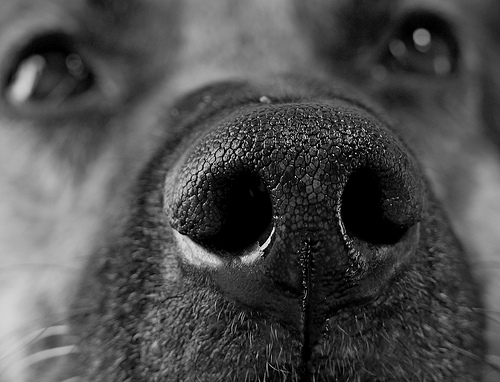
The nose of a German Shepherd dog!

Regular readers will know that I subscribe to the blog Naked Capitalism masterminded by Yves Smith.  Some time ago, there was a link on NK to a story about how a tiny Chihuahua dog rescued some missing girls.  It seemed like a good opportunity to take a closer look at this most magical aspect of a dog’s qualities.

First to that story.

I saw it on the Care2 website, from which I quote the following:

Bell

Hero Chihuahua Finds Missing Girls in the Woods

by  August 2, 2012

A 3-year-old chihuahua named Bell is an unexpected hero after finding three young girls who became lost for hours in the woods in Newnan, Georgia, on Monday.

CBS Atlanta reports that, on Monday, 8-year-old Carlie and 5-year-old Lacey Parga went for a walk with their dog Lucy down a cul-de-sac on trails near their neighborhood.

What started as a casual stroll became an unintended, and at times frightening, experience. As Carlie tells CBS, ‘”We tried to find our way out of the woods. We kept following paths and stuff and we got lost.” Indeed, they became scared that they were only to get more and more lost.

Carlie’s father, David Parga, noted that it wasn’t characteristic of them to wander off and, after searching for them but not hearing them respond, he contacted police and firefighters. Neighbors joined them including Carvin Young who thought to take Bell, who plays with the girls every day and knew their scent. Bell was able to lead searchers to the girls.

The full story on the Care2 website is here and on the CBS website here.

So what is it about the nose of the dog?  A dog has more than 220 million olfactory receptors in its nose, while humans have only five million, making dogs’ sense of smell a thousand times greater.  Frankly, trying to get one’s intellect around precisely what having a sense of smell one thousand times greater than a human means is tough!  So on to another story.

The Bark and Clark blogsite reported an item in February that had been seen in the K9 Magazine.

17 Dogs, 3 Generations, 70 Years.
There’s one constant…
…the family dog.

After moving to Wellesley, Massachusetts for an anchor job with a major television sports network, Kevin began taking his German Shepherd, Beverly, for walks in the surrounding neighborhoods. They developed a route that included historic Atwood Street. Beverly kept veering toward one house in particular that had also caught Kevin’s eye previously, thinking it looked familiar but not knowing the reason.

After talking to a close family relative who had also once lived in Wellesley, Kevin was shocked to discover that the memorable house had once been a childhood home to his father, Bob Walsh, before WWII. After digging through old family photos that had been tucked away for years, Kevin uncovered a picture of his father as a toddler with his family on the house’s front porch, complete with their first family dog, Dee Dee.

Kevin’s father had been writing short stories about all of their family dogs through the years, but never knew about the photo. Its discovery was the pivotal moment that offered proof that the Walsh family’s journey with dogs had come back to the exact place where it started.

They’ve turned this story, along with other dog tales, into a book called Follow the Dog Home: How a Simple Walk Unleashed an Incredible Family Journey.

Dog’s nose leads family to back long lost old home, site unseen. German Shepherd, Beverly, is chronicled on WCVB TV’s news magazine show Chronicle. 70 years later, the family goes back “home” for stunning reunion and photograph.

Slightly late on duty!

A stirring set of pictures from the Queen’s Jubilee

At the end of June, pilot friend Bob Derham sent me an email which contained all of what follows.  I ‘filed’ it away and then forgot I had received it!  My apologies.  But as Europe was the subject of yesterday’s post, then maybe this can be seen as remaining on theme.  Enjoy.

oooOOOooo

One last look back at those amazing Jubilee celebrations . . . as seen by the ‘Tail-end Charlie’ in Britain’s last airworthy Lancaster

Incredible footage has been released showing the bird’s eye view enjoyed by the crew aboard a Lancaster bomber flying over London for the Queen’s Diamond Jubilee celebrations.

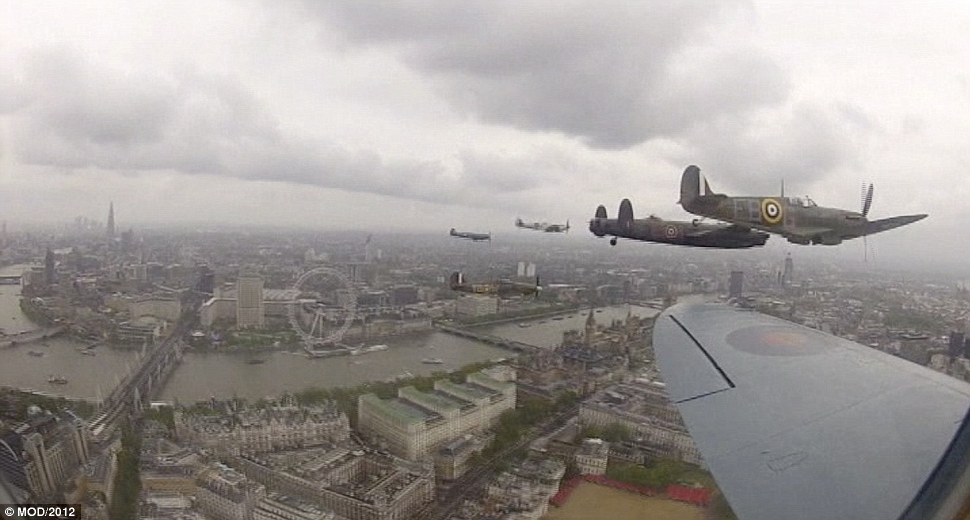
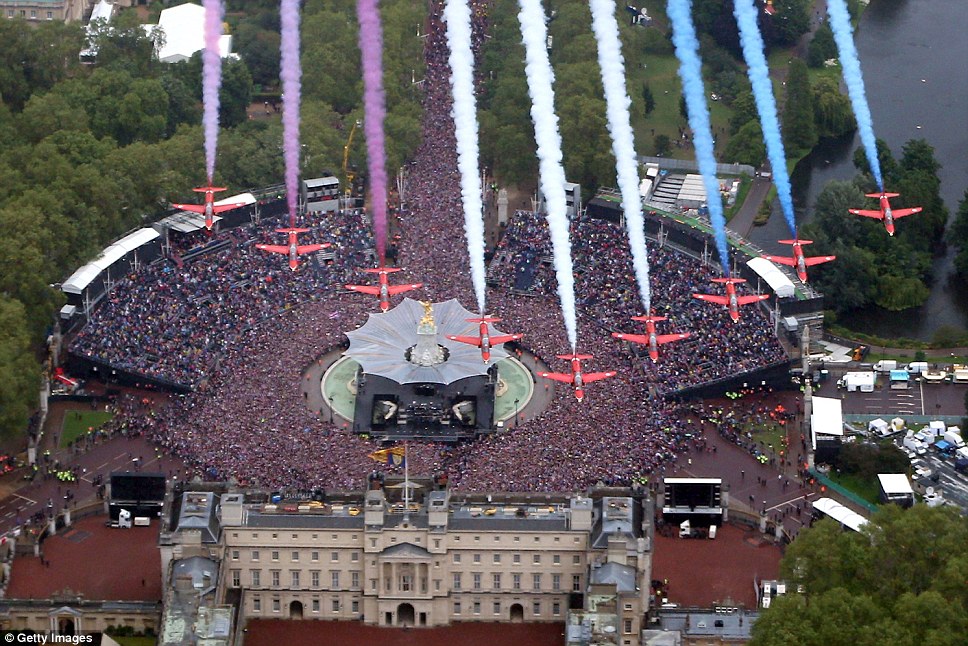
The aeroplane, which is part of the RAF’s Battle of Britain Memorial Flight (BBMF), flew in formation with aircraft including a Spitfire, Hurricane and Dakota transport aircraft down The Mall, followed by the Red Arrows aerobatic team – to the delight of crowds and the Royal Family at Buckingham Palace below.

As well as preserving a fleet of priceless aircraft and keeping them in tip-top flying condition, the BBMF reminds the nation of the sacrifices made during World War Two.

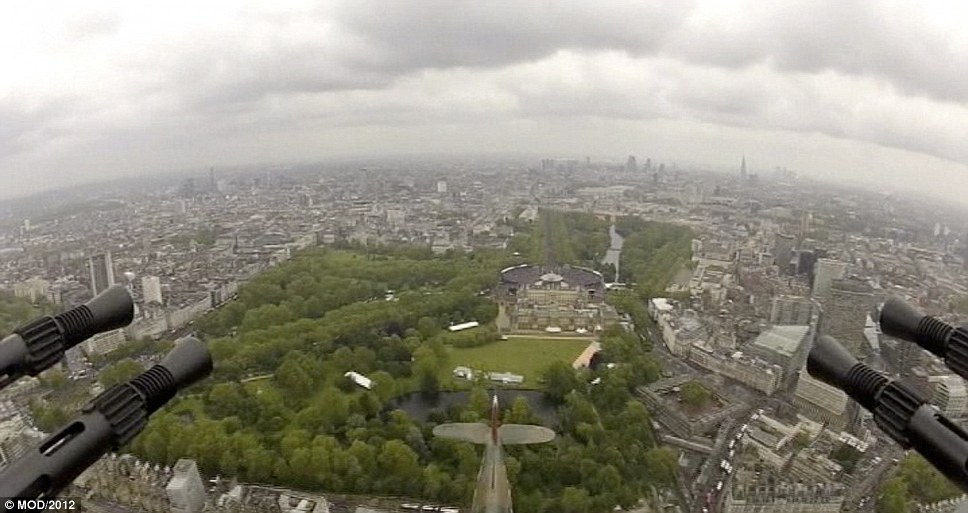
Spectacular: The tail gunner’s view from the Lancaster bomber, as it completed the Diamond Jubilee flypast. Buckingham Palace Gardens can be seen behind the tail of a Hurricane fighter, also of the Battle of Britain Memorial Flight, which flew in formation with the Lancaster
Final approach: Having lined up on The Mall, the RAF Battle of Britain Memorial Flight Lancaster flies towards Buckingham Palace with St James’ Park on the left and Birdcage Walk beyond.
The nose of the Lancaster passes over the Memorial to Queen Victoria in front of Buckingham Palace.

The BBMF is based at RAF Coningsby in Lincolnshire with many of its personnel, including pilots, acting as volunteers; the flight costs about £3m a year to run.

Squadron Leader Ian Smith, who is in charge of the BBMF, is the only permanent member, with all of the remaining pilots, navigators, air engineers and other crew coming from different airbases and ordinarily flying several different types of aircraft; from Typhoon fighters to the huge Hercules transport plane.

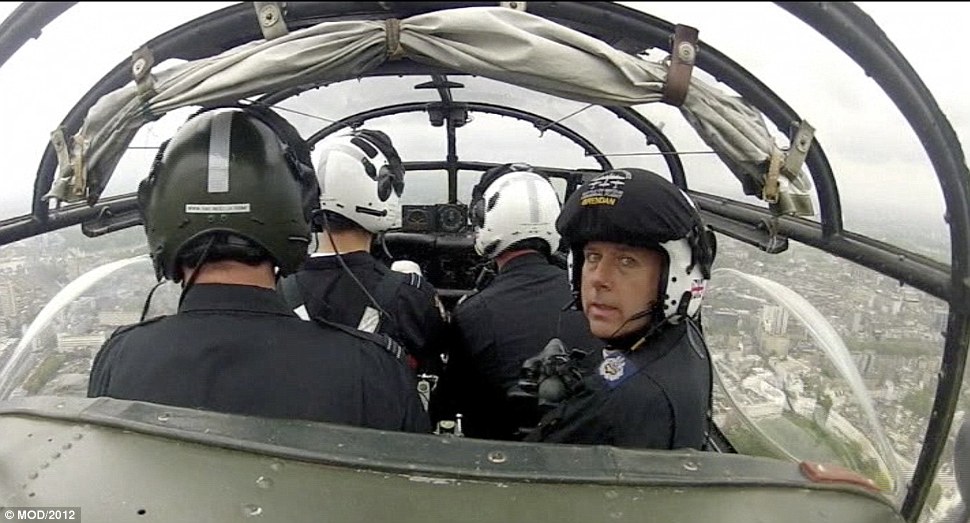
Cramped: The footage shows just how tight a fit it can be aboard a vintage aircraft and what a tight squeeze it is for the crew aboard the Lancaster bomber.

The aircrew give up three out of every four weekends from May to the end of September in order to fly and display the historic aircraft.

The footage, released by the Ministry of Defence, shows just how tight a fit it can be aboard a vintage aircraft, with the crew – clearly eager to catch a glimpse of the Queen – taking up most of the available space.

The historic flight includes the Lancaster, which first saw service in 1942. The ‘Lanc’ was the most famous of the Second World War bombers and gained renown for its starring role in the momentous ‘Dambuster’ raid on Germany’s Ruhr Valley in 1943.

Carrying a payload of 22,000lb and with a 1,500-mile range, the RAF bomber wreaked havoc on Germany. Some 3,500 were lost in action during the war.

The view of Buckingham Palace and The Mall beyond from the Lancaster bomber.
In formation: Incredible footage has been released showing the view enjoyed by crew aboard a Lancaster bomber flying over London for the Queen’s Diamond Jubilee celebrations.

Hurricane single-seater fighters played a crucial role in the Battle of Britain. Heavier and slower than the Spitfire, it was considered the RAF’s ‘workhorse’ against the Luftwaffe.

A remarkable total of 14,533 Hurricanes were built and served operationally on every day and in every theatre during the war. Only 12 are still airworthy worldwide.

The Spitfire is the iconic fighter that won legendary status against the Luftwaffe in the Battle of Britain. It possessed a top speed of 378mph, an altitude of 35,000ft and armed with two 20mm cannons, four Browning machine guns and two 250lb bombs.

One of the four that flew yesterday was P7350 – the oldest airworthy Spitfire in the world and the only one which actually fought in the Battle of Britain. It was shot up by a Messerschmitt 109 during combat in October 1940 but its wounded Polish pilot Ludwik Martel managed to crash-land it, wheels up, near Hastings.

The pride of Britain: The vintage planes – all powered by classic World War Two Merlin engines – roar across the London sky.
Flypast: The Duchess of Cornwall, the Prince of Wales, the Queen, the Duke and Duchess of Cambridge and Prince Harry watch the aerial action.
Aerobatic aces: The Red Arrows display team fly in formation over Buckingham Palace.
Stirring image: The Lancaster, centre, was accompanied by two Spitfires on both flanks and tailed by a Hurricane.

oooOOOooo

A wonderful and incredibly nostalgic set of photographs.  Finally, let me close with a short piece of video of that Lancaster Bomber in flight.

The patience of dogs

Patience, yet something else we can learn from dogs!

My friend, Neil, of many years back in South Devon, England, recently sent me a link to a website called Patient Dogs.  From where one can view the following.


As I said, more lovely examples to be seen here.  Thanks Neil!