Category: Philosophy

What is freedom? Part Two

The Trap – 2 – The Lonely Robot

Part One of The Trap is available to watch in my Post of the 4th, US Independence Day.  It also provides some background thoughts.  It really is a most powerful set of programmes so, if you haven’t already done so, best to watch Part One first.

This is Part 2 of the brilliant Adam Curtis documentary originally produced for the BBC. It talks about the modern political realities, where the policies came from and the massive failures of those ideals and how they have ended up exactly where they did not want to be. This episode focuses on the 1990’s and how the politicians decided to apply the model of a free market economy to the rest of society and consequences of these actions being felt all over the world in western democracies.

What is freedom?

As a US resident since just mid-April, perhaps no better day than July 4th to pose this question.

As a British citizen, born in London towards the end of WWII, I am well aware that Britain has had a long tradition of ‘owning’ colonies.  In 1770 explorer James Cook charted the East coast of Australia and returned to Britain recommending colonisation in the area that became known as Botany Bay, now part of Sydney.  Britain’s response was to set up a penal colony in 1778.

In 1617 the British East India Company was given permission by an Indian rajah to trade in India.  Via lots of convolutions that I don’t understand, that led to the British Crown taking over in 1857.

So far as America is concerned, the British ended up with 13 colonies along the Eastern seaboard during the period 1607 to 1733.  Then we had the British West Indies and Canada and …… well, you get the message!

Wikipedia has a summary of the US independence timetable,

During the American Revolution, the legal separation of the Thirteen Colonies from Great Britain occurred on July 2, 1776, when the Second Continental Congress voted to approve a resolution of independence that had been proposed in June by Richard Henry Lee of Virginia.  After voting for independence, Congress turned its attention to the Declaration of Independence, a statement explaining this decision, which had been prepared by a Committee of Five, with Thomas Jefferson as its principal author. Congress debated and revised the Declaration, finally approving it on July 4. A day earlier, John Adams had written to his wife Abigail:

The second day of July, 1776, will be the most memorable epoch in the history of America. I am apt to believe that it will be celebrated by succeeding generations as the great anniversary festival. It ought to be commemorated as the day of deliverance, by solemn acts of devotion to God Almighty. It ought to be solemnized with pomp and parade, with shows, games, sports, guns, bells, bonfires, and illuminations, from one end of this continent to the other, from this time forward forever more.

Adams’s prediction was off by two days. From the outset, Americans celebrated independence on July 4, the date shown on the much-publicized Declaration of Independence, rather than on July 2, the date the resolution of independence was approved in a closed session of Congress.

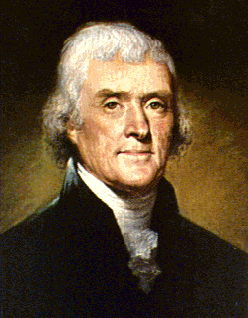
Thomas Jefferson April 13, 1743 – July 4, 1826

Thomas Jefferson became the third President of the United States of America.  As one of the founding fathers, Jefferson envisioned America as an “Empire of Liberty”.

So it came to pass that Independence Day is annually celebrated on July 4.   The celebrations have deep roots in the American tradition of political freedom.

Reflect then on that notion of liberty and freedom as you watch the first episode from a most compelling series from Adam Curtis that was broadcast by the BBC in 2007. The series is called The Trap, the first programme entitled “F**k You Buddy” (11 March 2007)

Individual freedom is the dream of our age. It’s what our leaders promise to give us, it defines how we think of ourselves and, repeatedly, we have gone to war to impose freedom around the world. But if you step back and look at what freedom actually means for us today, it’s a strange and limited kind of freedom.

Politicians promised to liberate us from the old dead hand of bureaucracy, but they have created an evermore controlling system of social management, driven by targets and numbers. Governments committed to freedom of choice have presided over a rise in inequality and a dramatic collapse in social mobility. And abroad, in Iraq and Afghanistan, the attempt to enforce freedom has led to bloody mayhem and the rise of an authoritarian anti-democratic Islamism. This, in turn, has helped inspire terrorist attacks in Britain. In response, the Government has dismantled long-standing laws designed to protect our freedom.

The Trap is a series of three films by Bafta-winning producer Adam Curtis that explains the origins of our contemporary, narrow idea of freedom. It shows how a simplistic model of human beings as self-seeking, almost robotic, creatures led to today’s idea of freedom. This model was derived from ideas and techniques developed by nuclear strategists during the Cold War to control the behavior of the Soviet enemy.

Part Two of this article is being published on the 7th, next Thursday, and Part Three next Monday, the 11th.

The Trap, Adam Curtis

This coming next couple of weeks is going to see me reflecting on some of the powerful messages that flow from three one-hour documentaries by Adam Curtis during a series of programmes for the BBC in 2007.

For today, just enjoy the BBC trailer. (Assuming ‘enjoy’ is the right expression!)

Day of rest!

Apologies to all the readers of Learning from Dogs but it’s been a busy week since returning from the UK and it feels right to take the day off!

As Ralph Waldo Emerson said, “Let us be silent, that we may hear the whispers of the gods.”

Ralph Waldo Emerson

And spend a few moments watching this 

Paws of love

They are such wonderful, amazing creatures – man’s longest and best friend, the dog.

A couple of events caused me to be reminded about the preciousness of our relationship with the dog.  The first was coming across this article in The Boston Globe.  It is entitled, A friendly paw to a veteran and is all about how therapy dogs bring relief and joy to veterans.  Incidentally, the story was written by good friend to Learning from Dogs, Daniela Caride who has her own blog, The Daily Tail.  Here’s how that article opens,

NORTHAMPTON — Carter the Chesapeake Bay retriever, Sassy the Pomeranian, and Spyder the German shepherd spend most of their time playing, begging for treats, and getting belly rubs just like other pet dogs. But their unconditional love gains a purpose every time their owners take them to the hospital to visit veterans.

They are therapy dogs — canines trained to give affection to strangers — and they are becoming more popular in veteran facilities. An increasing number of dog owners are willing to volunteer at VA homes and hospices, where 6 million veterans get treated for acute and chronic health conditions. The service they provide is invaluable, health care specialists say.

Read the rest of it here.

The second event was coming across something that I wrote nearly three years ago.  Here it is in full.

The knowing eyes of your best friend

Pharaoh

(Based on an article sent to me, unfortunately from an unknown author, and modified to reflect the special relationship that I have with my 4 year old German Shepherd, Pharaoh. Paul Handover, 14 September, 2007.)

I am your dog and have something I would love to whisper in your ear. I know that you humans lead very busy lives. Some have to work, some have children to raise, some have to do this alone. It always seems like you are running here and there, often too fast, never noticing the truly grand things in life.

Look down at me now. While you sit at your computer. See the way my dark, brown eyes look at yours.

You smile at me. I see love in your eyes. What do you see in mine? Do you see a spirit? A soul inside who loves you as no other could in the world? A spirit that would forgive all trespasses of prior wrong doing for just a single moment of your time?  That is all I ask.  To slow down, if even for a few minutes, to be with me.

So many times you are saddened by others of my kind passing on. Sometimes we die young and oh so quickly, so suddenly that it wrenches your heart out of your throat. Sometimes, we age slowly before your eyes that you may not even seem to know until the very end, when we look at you with grizzled muzzles and cataract-clouded eyes. Still the love is always there even when we must take that last, long sleep dreaming of running free in a distant, open land.

I may not be here tomorrow. I may not be here next week. Someday you will shed the water from your eyes, that humans have when grief fills their souls, and you will mourn the loss of just ‘one more day’ with me. Because I love you so, this future sorrow even now touches my spirit and grieves me. I read you in so many ways that you cannot even start to contemplate.

We have now together. So come and sit next to me here on the floor and look deep into my eyes. What do you see? Do you see how if you look deeply at me we can talk, you and I, heart to heart. Come not to me as my owner but as a living soul. Stroke my fur and let us look deep into the other’s eyes and talk with our hearts.

I may tell you something about the fun of working the scents in the woods where you and I go. Or I may tell you something profound about myself or how we dogs see life in general. I know you decided to have me in your life because you wanted a soul to share things with. I know how much you have cared for me and always stood up for me even when others have been against me. I know how hard you have worked to help me be the teacher that I was born to be. That gift from you has been very precious to me. I know too that you have been through troubled times and I have been there to guard you, to protect you and to be there always for you. I am very different to you but here I am. I am a dog but just as alive as you.

I feel emotion. I feel physical senses. I can revel in the differences of our spirits and souls. I do not think of you as a dog on two feet; I know what you are. You are human, in all your quirkiness, and I love you still.

So, come and sit with me. Enter my world and let time slow down if only for a few minutes. Look deep into my eyes and whisper in my ears. Speak with your heart and I will know your true self. We may not have tomorrow but we do have now.

There is no question that one of the important aspects of life that we can surely learn from dogs is the ability to stay in the present as much as we can.  Easier to write than accomplish, of course.  But letting go of the past (because it’s gone) and making the best of today as opposed to worrying about the future (because that interferes in the joy of today) is still a powerful reminder of that we would do well to keep close to our heart.

Summer Solstice 2011

Let’s all pause for a moment (and my apologies for the late posting!)

The precise time of the summer solstice today is 17.16 Greenwich Mean Time (GMT/UTC).

Our sun, giver of life

In terms of local times that will be 10.16 here in Arizona and also in California, 13.16 in New York, 18.16 in London, and 03.16 (Wed) in Sydney, Australia, to pick just a few places.

What a year it has been so far!

So let’s just pause for a moment, as the Sun appears to pause, and put out our combined thoughts across this wonderful Planet Earth and pray for peace and tranquillity for all during the rest of this ‘interesting’ year.

Consciousness, science or God?

More of Peter Russell’s insightful ideas.

It was back in March, the 8th to be precise, when I first wrote about Peter Russell.  Well just over a week ago, I came across another article by Russell from the Huffington Post.  It was then a moment’s work to find it on Peter Russell’s own website.  (This links to various essays on the topic.)

Here’s a ‘taste’ from the first essay.

The Anomaly of Consciousness

Excerpted from book From Science to God

Science has had remarkable success in explaining the structure and functioning of the material world, but when it comes to the inner world of the mind science falls curiously silent. There is nothing in physics, chemistry, biology, or any other science that can account for our having an interior world. In a strange way, scientists would be much happier if there were no such thing as consciousness.

David Chalmers, professor of philosophy at the University of Arizona, calls this the “hard problem” of consciousness. The so-called “easy problems” are those concerned with brain function and its correlation with mental phenomena: how, for example, we discriminate, categorize, and react to stimuli; how incoming sensory data are integrated with past experience; how we focus our attention; and what distinguishes wakefulness from sleep.

It would be wrong to publish anything more so if you are interested in more, then go here and pick away or better still buy the book!

If you have a quiet 30 minutes, settle down and watch these videos

Part One

Part Two

Part Three

Disconnected.

Travelling the 5,200 miles, give or take, between Payson (AZ) and London (UK)

Apologies for a slightly reduced service over the next 10 days but Monday 6th June finds me travelling from Phoenix to Dallas, and then Dallas to London Heathrow.  This as a result of the U.S. Citizenship and Immigration Service (USCIS) granting me permanent residence (the Green Card) in April and thus me being able to travel back to England to see my new grandson for the first time.

So just a few thoughts, courtesy of Terry Hershey.  I subscribe to his weekly Sabbath Moment and they always contain some beautiful sayings and other gems.  Take these for example, from his Sabbath Moment of the 30th May.

Anything I’ve ever done that ultimately was worthwhile. . .initially scared me to death.  Betty Bender

Betty Bender

Or what about this?

To dare is to lose one’s footing momentarily. To not dare is to lose oneself. Soren Kierkegaard

A quick search reveals from the Stanford Encyclopaedia of Philosophy that,

Soren Kierkegaard

Søren Aabye Kierkegaard (b. 1813, d. 1855) was a profound and prolific writer in the Danish “golden age” of intellectual and artistic activity. His work crosses the boundaries of philosophy, theology, psychology, literary criticism, devotional literature and fiction. Kierkegaard brought this potent mixture of discourses to bear as social critique and for the purpose of renewing Christian faith within Christendom. At the same time he made many original conceptual contributions to each of the disciplines he employed. He is known as the “father of existentialism”, but at least as important are his critiques of Hegel and of the German romantics, his contributions to the development of modernism, his literary experimentation, his vivid re-presentation of biblical figures to bring out their modern relevance, his invention of key concepts which have been explored and redeployed by thinkers ever since, his interventions in contemporary Danish church politics, and his fervent attempts to analyse and revitalise Christian faith.

OK, dear readers, from somewhere over who knows where!

The ballad of a burnt biscuit

Striving to be better is a key lesson of life!

I’m normally pretty cautious about promoting the sorts of emails that circulate around the virtual globe carrying universal lessons for all and sundry but this one is an exception.  It was sent to me last Monday by my dear friend, Dan G. from Southern California, with whom I have had the great honour and pleasure to be close friends for forty years.  Here it is.

Burned Biscuits-author unknown

When I was a kid, my Mom liked to make breakfast food for dinner every now and then. And I remember one night in particular when she had made breakfast after a long, hard day at work. On that evening so long ago, my Mom placed a plate of eggs, sausage and extremely burned  biscuits in front of my dad. I remember waiting to see if  anyone noticed! Yet all
my dad did  was reach for his biscuit, smile at my Mom and ask me how my day was at school. I don’t remember what I told him that night, but I do remember watching him smear butter and jelly on that  biscuit and eat every bite!

When I got up from the table that evening, I remember hearing my Mom apologize to my dad for burning the biscuits. And I’ll never forget what he said: “Honey, I love burned biscuits.” Later that night, I went to kiss Daddy good night and I asked him if he really liked his biscuits burned. He wrapped me in his arms and said, “Your Momma put in a hard day at work today and she’s real tired. And besides – a  little burned biscuit never hurt anyone!”

Life is full of imperfect things and imperfect people. I’m not the best at hardly anything, and I forget birthdays and anniversaries just like everyone else. But what I’ve learned over the years is that learning to accept each others faults – and choosing to celebrate each others differences – is one  of the most important keys to creating a healthy, growing, and lasting relationship.

And that’s my prayer for you today. That you will learn to take the good, the bad, and the ugly parts of your life and lay them at the feet of God.  Because in the end, He’s the only One who will be able to give you a relationship where a burnt biscuit isn’t a deal-breaker!

We could extend this to any relationship. In fact, understanding is the base of any relationship, be it a husband-wife or parent-child or friendship!

Don’t put the key to your happiness in someone else’s pocket – keep it in your own.

So, please pass me a biscuit, and yes, the burned one will do just fine. Be kinder than necessary because everyone you meet is fighting some kind of battle.

Thanks Dan for sharing that.

Believe nothing but …

Just a snippet for this Sunday.
Nipper - the listening dog.

Believe nothing just because a so-called wise person said it. Believe nothing just because a belief is generally held. Believe nothing just because it is said in ancient books. Believe nothing just because it is said to be of divine origin. Believe nothing just because someone else believes it. Believe only what you yourself test and judge to be true. From the sayings of the Buddha.

You all have a great week ahead.