Category: Philosophy

Isn’t anyone going to find me?

The most beautiful story of a dog rescue.

It’s been a while since Sue of Dreamwalker’s Sanctuary and I started following each other’s Blogs and from time to time Sue sends me an email with something for Learning from Dogs.  On the 20th March, I published a guest post from Sue called the Winds of Change.  If you didn’t read her wonderful poem then do go there and read it.

Anyway, just a couple of days ago Sue sent me an email with a link to a YouTube video.  Put aside a few minutes and be entranced.

So you have just watched the video.  How do you feel?  I bet that your feelings are not a million miles from the realisation that, like Fiona the dog, being ‘lost‘ is an uncomfortable, unsettling but necessary step along the journey of being ‘found‘.  As I wrote in the concluding part of my story Night messages, “The message from the night, as clear as the rays of this new day’s sun, the message to pass to all those he loved. If you don’t get lost, there’s a chance you may never be found.”

When the bond between a human and a dog is expressed as deep love, as it so often is, we relearn the most important lesson of all creation.  That mankind’s only hope for the future comes from the pool of love.

No better portrayed than by the photograph below that I presented in a Post on the 17th March, Change out of Hope.

The power of love.

The one absolutely unselfish friend that man can have in this selfish world, the one that never deserts him, the one that never proves ungrateful or treacherous, is his dog.“ Samuel Coleridge

Optimistically unrealistic!

A reflection of our unconscious minds – and the potential perils ahead.

Last Monday, March 12th, the BBC aired a programme under their excellent Horizon science series.  This programme was entitled, Out of Control?  Here’s how the programme was introduced,

We all like to think we are in control of our lives – of what we feel and what we think. But scientists are now discovering this is often simply an illusion.

Surprising experiments are revealing that what you think you do and what you actually do can be very different. Your unconscious mind is often calling the shots, influencing the decisions you make, from what you eat to who you fall in love with. If you think you are really in control of your life, you may have to think again.

The whole 60 minute programme was fascinating right from the start when Professor Nobre introduced the secret world of our unconscious mind.  Professor Anna Nobre heads The Brain & Cognition Laboratory, a cognitive neuroscience research group at the Department of Experimental Psychology in the University of Oxford.

For starters, how much of your mind do you think is your conscious mind as opposed to your unconscious mind?  Watch this clip and be amazed!

“Are you in control of your unconscious, or is it in control of you?”

So let me link how our mind works to something more relevant today than possibly any other aspect of life.

I’m thinking of the fundamental question that bothers me and, perhaps millions of others.  That question being: “Why, with the overwhelming scientific evidence that man is critically threatening the planet’s biosphere upon which we all depend, is there not an equally overwhelming global commitment for change to a sustainable way of life?

Take, for example, this compelling story.

Last Saturday the BBC News website published a report by Richard Black, the BBC’s Environment correspondent, that opened thus,

An eminent UK engineer is suggesting building cloud-whitening towers in the Faroe Islands as a “technical fix” for warming across the Arctic.

Scientists told UK MPs this week that the possibility of a major methane release triggered by melting Arctic ice constitutes a “planetary emergency“. [my emboldening]

The Arctic could be sea-ice free each September within a few years.

and later goes into this detail (do please read it all, it’s only a few minutes of quiet reading),

On melting ice

The area of Arctic Ocean covered by ice each summer has declined significantly over the last few decades as air and sea temperatures have risen.

For each of the last four years, the September minimum has seen about two-thirds of the average cover for the years 1979-2000, which is used a baseline. The extent covered at other times of the year has also been shrinking.

What more concerns some scientists is the falling volume of ice.

Analysis from the University of Washington, in Seattle, using ice thickness data from submarines and satellites, suggests that Septembers could be ice-free within just a few years.

Data for September suggests the Arctic Ocean could be free of sea ice in a few years

“In 2007, the water [off northern Siberia] warmed up to about 5C (41F) in summer, and this extends down to the sea bed, melting the offshore permafrost,” said Peter Wadhams, professor of ocean physics at Cambridge University.

Among the issues this raises is whether the ice-free conditions will quicken release of methane currently trapped in the sea bed, especially in the shallow waters along the northern coast of Siberia, Canada and Alaska.

Methane is a much more potent greenhouse gas than carbon dioxide, though it does not last as long in the atmosphere.

Several teams of scientists trying to measure how much methane is actually being released have reported seeing vast bubbles coming up through the water – although analysing how much this matters is complicated by the absence of similar measurements from previous decades.

Nevertheless, Prof Wadhams told MPs, the release could be expected to get stronger over time.  “With ‘business-as-usual’ greenhouse gas emissions, we might have warming of 9-10C in the Arctic.  That will cement in place the ice-free nature of the Arctic Ocean – it will release methane from offshore, and a lot of the methane on land as well.”

This would – in turn – exacerbate warming, across the Arctic and the rest of the world.

Abrupt methane releases from frozen regions may have played a major role in two events, 55 and 251 million years ago, that extinguished much of the life then on Earth.

Meteorologist Lord (Julian) Hunt, who chaired the meeting of the All Party Parliamentary Group on Climate Change, clarified that an abrupt methane release from the current warming was not inevitable, describing that as “an issue for scientific debate”.

But he also said that some in the scientific community had been reluctant to discuss the possibility.

“There is quite a lot of suppression and non-discussion of issues that are difficult, and one of those is in fact methane,” he said, recalling a reluctance on the part of at least one senior scientists involved in the Arctic Climate Impact Assessment to discuss the impact that a methane release might have.

Reams of other factual evidence shows that mankind may have only a few years left to stop the planet going into a runaway condition that would then extinguish much of the life on Earth!

So what’s stopping us?

Dr. Sharot

Well back to that Horizon programme.  In the programme, Dr. Tali Sharot of University College London explains how we are all optimists despite the risks.  I.e. our unconscious mind deliberately prevents negative information from affecting our conscious mind, our conscious judgment.

In an experiment, an individual is asked to guess the likelihood of a whole range of outcomes, 80 in all.  Ergo, you see a gentleman guessing the likelihood of cancer as 18%, of a bone fracture as 10%, of Alzheimer’s as 2%, and so on.

In some cases he guessed a pessimistic probability, in others an optimistic probability.  After each guess he was shown the correct probability.  E.g. cancer 30% vs his estimate of 18%, for a bone fracture 34% vs his guess of 10%, and the risk in reality of Alzheimer’s is 10% versus his instinct of just 2%.   I’ve just quoted his optimistic guesses, in many questions his guess was a pessimistic view, i.e. he guessed a higher likelihood than the statistical reality.

Then he was asked all 80 questions again, having seen the accurate probability compared to his intuitive guess.

So here’s the fascinating outcome.

Where his instinct was a negative guess versus the statistical probability then he adjusted his mind and was able to quote a more accurate figure the second time around.  But where the reality was more pessimistic than his first guess, then that adjusted knowledge wasn’t retained.  In other words, our beliefs only change when we can adjust to a more positive view of the future.

I just hope I have made that clear.  Readers may like to view an article written by Dr. Sharot published in TIME Magazine in May, 2011, called The Optimism Bias or read the introduction to a lecture given in Seattle in June, 2011;  “A sunny outlook doesn’t just make you a more pleasant companion: Tali Sharot argues that optimism is a tool for survival and happiness that gets us through hard times—even an economic recession. Sharot, author of The Optimism Bias, uncovers myths about optimism, illuminates the ways it can affect our lives, examines why optimism is necessary for us to function, and illustrates how the human brain is extremely adept at turning lead into gold.

A summary of a publication, Sharot, T. (2011). The optimism bias. Curr Biol 21(23), R941-R945, reads,

The ability to anticipate is a hallmark of cognition. Inferences about what will occur in the future are critical to decision making, enabling us to prepare our actions so as to avoid harm and gain reward. Given the importance of these future projections, one might expect the brain to possess accurate, unbiased foresight. Humans, however, exhibit a pervasive and surprising bias: when it comes to predicting what will happen to us tomorrow, next week, or fifty years from now, we overestimate the likelihood of positive events, and underestimate the likelihood of negative events. For example, we underrate our chances of getting divorced, being in a car accident, or suffering from cancer. We also expect to live longer than objective measures would warrant, overestimate our success in the job market, and believe that our children will be especially talented. This phenomenon is known as the optimism bias, and it is one of the most consistent, prevalent, and robust biases documented in psychology and behavioral economics.

More fascinating information can be found at the Affective Brain Lab.

So here’s the crunch!

Our bias towards an optimistic future is a “tool for survival and happiness that gets us through hard times.”  But if that ancient bias is preventing mankind from recognising just how close we may be to some form of ‘tipping point’ then this tool for survival may be our undoing.

But if on the other hand, we now unite in changing our ways, first by community then by town then by country our future is incredibly optimistic.

 “A single candle may light a thousand others and they in turn many thousands more” – Buddha

The mystery of nature.

Spellbinding!

English starling

Ginger I. who works at the Payson branch of the Humane Society of Central Arizona recently sent me the following video on the magic of a flock of starlings.  It’s … well, you watch it and fill in the rest of the sentence; I ran out of words.

A short film that follows the journey of two girls in a canoe on the River Shannon and how they stumble across one of nature’s greatest phenomenons; a murmuration of starlings.

A murmuration is a…

/merr’meuh ray”sheuhn/, n.

1. an act or instance of murmuring.

2. a flock of starlings.

Ginger also included the following in her email,

A mystery of nature:

No one knows why they do it. Yet each fall, thousands of starlings dance in the twilight above England and Scotland. The birds gather in shape-shifting flocks called murmurations, having migrated in the millions from Russia and Scandinavia to escape winter’s frigid bite.

Scientists aren’t sure how they do it, either. The starlings’ murmurations are manifestations of swarm intelligence, which in different contexts is practised by schools of fish, swarms of bees and colonies of ants. As far as I am aware, even complex algorithmic models haven’t yet explained the starlings’ aerobatics, which rely on the tiny birds’ quicksilver reaction time of under 100 milliseconds to avoid aerial collisions—and predators—in the giant flock.

Despite their tour de force in the dusky sky, starlings have declined significantly in the UK in recent years, perhaps because of a decline in suitable nesting sites. The birds still roost in several of Britain’s rural pastures, however, settling down to sleep (and chatter) after their evening ballet.

Two young ladies were out for a late afternoon canoe ride and fortunately one of them remembered to bring her video camera. What they saw was a wonderful murmuration display, caught in the short video above. Watch the variation of colour and intensity of the patterns that the birds make in close proximity to one other.

I also quickly found a second video on YouTube that seemed worthy of including in this Post.

This astonishing sequence was filmed by wild life cameraman and travel journalist Dylan Winter who is currently sailing around the UK in an 18 foot boat. You can follow his journey and see more of his work at www.keepturningleft.co.uk.

Now I know that as I get older I seem to be turning into an emotional mess!  But a very happy mess!  I mention this because both films had me in tears.  Why?  Not really sure.  But I sense that when one looks at such beauty, such real pure magical beauty, and then reflects on the stupidity, greed and shortsightedness of mankind the contrast is almost too much to handle!

Mr Carter’s amazing photo.

A poetic response from reader Marcia G.

This is in response to the item that I republished last Thursday, originally on Nakib’s blogsite, Freedom to Survive.  Do visit it.  Marcia in response sent in the following poem.

The Onlooker

He stood across the street and sadly saw
The little match girl standing in the rain;
She looked as if she didn’t have a prayer.
He wondered why there wasn’t yet a law
To spare her from unnecessary pain,
And how could people just walk by her there?

He raised his head toward Heav’n in awe and fear
And let the raindrops hit his youthful face,
While speaking toward the softly weeping sky,
“Dear God, why haven’t you done something here?
“I have the faith that You’re nearby some place,
“But there’s no sign that you’ve been helping; why?”

Then God replied, “I have…it’s nothing new;
“For such a purpose I created you.”

Thank you, Marcia.

When I see how this new, virtual world connects us across the world with so many others that know what is truly important, I do have hope for the future.

Words of wisdom

Leaning on a recent item from Terry Hershey

As many of you will appreciate, this has been a bit of a week.  It started last Sunday with my contribution to the national ‘preach-in’ for the health of our planet, and ended with the sad loss of Phoebe.  I normally post something light-hearted or trivial for the week-end but seem to be in a more reflective mood just now (Friday).

For some time I have subscribed to the weekly spiritual offering from Terry Hershey and am going to republish a story that came out from Terry Hershey on the 13th.

Letting go and walking

February 13, 2012

Some of us think holding on makes us strong, but sometimes it is letting go. Herman Hesse.

Uncertainty is the only certainty there is, and knowing how to live with insecurity is the only security. John Allen Paulos

When you let go of trying to get more of what you don’t really need, it frees up oceans of energy to make a difference with what you have. Lynne Twist

And now the story,

There is a Tibetan story about an earnest young man seeking enlightenment. (Earnest people must think this quite unfair–since they play a central role in most parables and stories about enlightenment.)

A famous sage passes through the man’s village. The man asks the sage to teach him the art of meditation. The sage agrees. He tells the man, “Withdraw from the world. Mediate every day in the specific way I will teach you. Do not waver and you will attain enlightenment.”

The earnest man follows the sage’s instructions to the letter. Time passes–and no enlightenment. Two years, five, ten, twenty pass.

It happens that the sage once again passes through the man’s village. The man seeks him out, grumbling that despite his best intentions and devotion and diligent efforts, he does not achieve enlightenment. “Why?”

The sage asks, “What type of meditation did I teach you?
The man tells him.

The sage says, “Oh, what a terrible mistake I made! That is not the right meditation for you. You should have done another kind altogether. Too bad, for now it is too late.”

Disconsolate, the man returns to his cave. Staking his life on the sage’s instructions, and now believing he is without hope, the man abandons all his wishes and efforts and need to control his road to enlightenment. He does not know what to do. So, he does what knows best: he begins meditating. And in a short while, much to his astonishment, his confusion begins to dissolve, and his inner world comes to life. A weight falls away and he feels lighter, and regenerated. When he walks out of the cave, the sky is bluer, the snow capped mountains whiter, and the world around him more vivid.

There is no doubt that all too often, our efforts–to succeed or achieve or attain–get in the way of our living. It brings to mind my favorite Robert Capon quote, “We live life like ill-taught piano students. So inculcated with the flub that will get us in dutch, we don’t hear the music, we only play the right notes.”

I understand. I was weaned on a spirituality that predicated itself on artifice. In other words, the importance is placed upon appearance, rather that just being. (It was vital to “look spiritual.” Which begs the question, “What do spiritual people look like?” As a boy, I always thought the “spiritual people” looked as if some part of their clothing was a size too small.)

What is it we are holding on to–so rigid, so firm, white-knuckled in our determination?  At some point, we’ve got to breathe.  Just breathe.  Without realizing it (and after the sage’s disheartening news), the man in the story “let go.”

He let go of the need to see life as a problem to be solved.
He let go of the need to have the correct answers (or experiences) for his “enlightenment.”
He let go of the need to see his spiritual life in terms of a formula.
He let go of the restraints that come from public opinion.

Abandon your masterpiece, sink into the real masterpiece.
Leonard Cohen

Without realizing it, he took Leonard Cohen’s advice. He abandoned his “masterpiece”–the perception of what he needed to accomplish, or how he needed to appear, or what he needed to feel–in order to allow himself to sink down into this life, this moment, even with all of its uncertainty and insecurity.

So a big thank you to Terry Hershey for those words of wisdom.


Reaching out across nations.

An unanticipated reward from Blogging.

When I started writing Learning from Dogs, way back on July 15th 2009, I didn’t have a clue as to the world I was entering, figuratively speaking.  But there have been many unanticipated rewards including the great pleasure of the way that this strange virtual world of the Internet brings people together.  One connection recently made was with a young Bangladeshi living in the city of Dhaka, more of his background here.

Nakib recently published a powerful and moving Post and has been gracious in allowing me to republish it, as follows:

The vulture that waited for the child to die

Given below is the 1994 Pulitzer price-winning photograph taken by Kevin Carter during the Sudan famine of 1994.

The photo shows a famine-stricken child crawling towards a United Nations food camp, which was located at least one kilometer away from the place shown. The vulture on the other hand is waiting eagerly for the child to die so that it can devour it.

I do not know what message the photograph revokes on your head but every time I look at it I feel blessed that I have been provided enough at least to satisfy my hungry stomach and keep me energetic enough to write blogs. I feel small and humble when I think of all the people suffering out there— homeless and starved— yet trying their best to make some sense of the complex notion known as life. It tells me that I have been blessed for a reason, for a purpose, and whatever I have been provided with should not go in vain. I can infer that my powers should be used well, at least for that little kid on the above photograph for whom Fate had sealed a quicksand of reality too hard to acknowledge for many of us hedonists out here.

Most importantly, to me the photograph conveys an emotion; a reality that many of us are too blind to grasp. I think of how people throughout the world are suffering to no ends yet amidst everything trying again and again to find the silver lining associated with the black cloud. I realize that there is a lot happening outside my comfortable apartment and Biology textbook that needs looking after, that there is a lot of people who strive hard yet achieve nothing in return. It amazes me when I try to ponder God’s sense of justice and egalitarianism.

So is it okay for the blessed 25% of the population in this world to waste everything that life has given them while the the rest 75% live amidst severe poverty, oppression and inequality?  Is it okay to go overboard with New Year parties while exactly at the same hour millions of people across the globe are suffering from the fangs of social deprivation? Is it okay to let things be as they are and forget about everything so as to harmoniously embrace useless ambitions and lustful desires?

Have we all truly forgotten to share our wealth and about the latent human being that exists inside everyone of us? Have we truly gottten rid of all those emotions that make us human beings? Is this what the world is for: for some to live lavishly while for the rest to suffer endlessly?

Three months after he took the photograph Kevin Carter, after suffering from several periods of depression, committed suicide.

Dated on the day the photo was taken, the following note was found from his diary:

Dear God, I promise I will never waste my food no matter how bad it can taste and how full I may be. I pray that He will protect this little boy, guide and deliver him away from his misery. I pray that we will be more sensitive towards the world around us and not be blinded by our own selfish nature and interests. I hope this picture will always serve as a reminder to us that how fortunate we are and that we must never ever take things for granted.

As for the child, no one really knows what happened to him; not even the South African photographer who had left the place immediately after the photo was taken. I try to appease myself by saying that the child never existed in the first place. God simply intended to provide us with a glimpse of the truth of life, to remind us how blessed we are. I hope this is true.

oooOOOooo

Very, very moving and beautifully expressed.

Ecology and faith

The National Preach-In held the week-end of February 11th/12th.

Some while ago, I signed up for a week-end organised by the Arizona Interfaith Power & Light.  It was part of a national programme inviting faith leaders from across the country to give sermons and reflections on climate change over the weekend of February 10-12, 2012.  My interest was simply to learn more about the week-end.

Then I quickly discovered that Father Dan from our church, St. Paul’s, had also signed up.  In my innocence I offered to help in any way which was quickly met by a response that bowled me over, “Well, you can be the homilist and give the sermon!”  Thus it came about that at yesterday’s 8am and 10am services yours truly rather uncertainly delivered the sermon.  John H., who with my dear wife Jeannie, did so much to turn my rambling thoughts into a coherent theme, encouraged me to publish the sermon as today’s Post on Learning from Dogs.  It now follows.

oooOOOooo

St. Paul’s Episcopal Church, Payson, Arizona

The 6th Sunday after the Epiphany

Year B

February 12th, 2012

2 Kings 5:1-14 X Psalm 30 1:13 X 1 Corinthians 9:24-27 X Mark 1:40-45

It was just a photograph. OK, one taken 43 years ago but, so what! Well, the late Galen Rowell, the famous Californian wilderness photographer called it, “the most influential environmental photograph ever taken.”

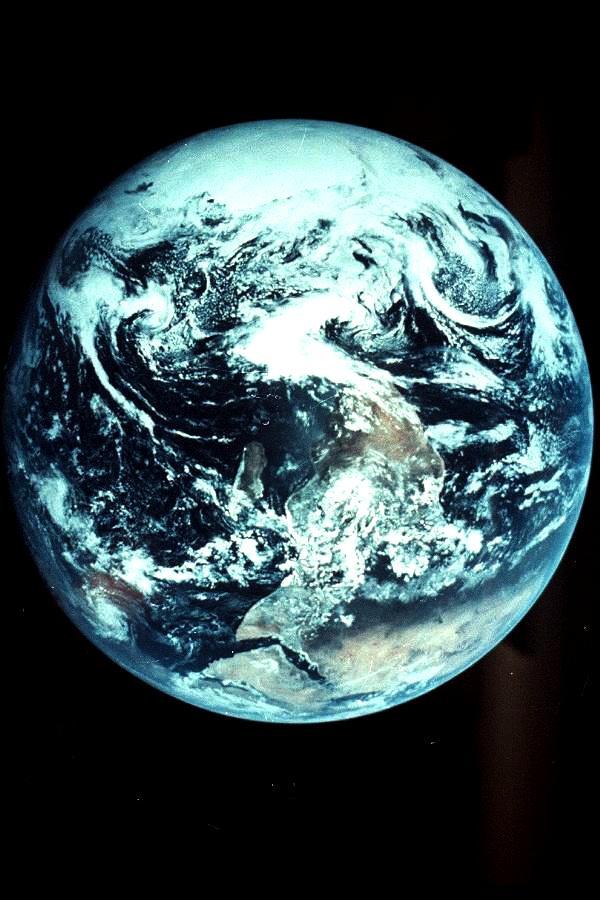
We are talking about the photograph called ‘Earthrise’ taken from Apollo 8 on December 24th, 1968 during the first manned mission to the Moon. Each of you should have a copy of that picture close by. Look at it now and let your imagination be carried back to that Apollo 8 capsule and that momentous experience.

As the Earth rose above the horizon of the moon, NASA astronaut Frank Borman uttered the words, “Oh my God! Look at that picture over there! Here’s the Earth coming up. Wow, is that pretty.” Bill Anders then took the ‘unscheduled’ photograph.

Then recall that evening, Christmas Eve 1968, when the three NASA crew members took turns reading from the book of Genesis to what was probably the biggest audience ever in the history of television, Frank Borman finishing with the words, “God called the dry land earth, and the gathering of the waters He called seas; and God saw that it was good.

Our planet is good, and so beautiful, and so precious to life. Life that arose in just a fraction of time after the Solar System formed 3.7 billion years ago; the oldest traces of life have been found in fossils dating back 3.4 billion years. That miracle of life.

Who hasn’t gazed into a clear, Arizonan, night sky and been lost in the beauty above our heads. Or felt the wind, flowing across ancient lands, kiss our face. We stand so mite-like, so insignificant in all this immensity of creation; God’s creation.

Our dreams, our hopes and failures, everything we are, have ever been and ever will be, nothing more than a swirl of dust across a desert track.

Jeremiah was called to be a prophet in 626 BC, some 2,638 years ago. In Jeremiah 12:4 he wrote, “How long will the land mourn, and the grass of every field wither? For the wickedness of those who live in it, the animals and the birds are swept away…

Words from so long ago! But Jeremiah would, surely, have gasped with disbelief had he realised how, some 2,600 years later, ‘the land now mourns and the grasses so wither’.

Jeremiah reveals much that we all could learn about ourselves. The other prophets couldn’t be accused of hiding behind their work but Jeremiah, out of all of them, allowed us to see the evidence of his own spiritual condition. He was a man of deep feelings and sensibilities and in his book there are five laments over the serious spiritual and moral condition of God’s people. That’s us, by the way!

In that time of Jeremiah, the world population was 100 million persons; slightly less than the population of Mexico today.

Some 1,350 years later, 1,000 A.D., the global population was 265 million.

But by the year 2,000 A.D., our population had increased to 6,000 millions! Put another way, that’s an increase of 5.7 million people every year for a 1,000 years !

Any guesses on the increase in the last 12 years, since 2,000? Well, the global population has increased by 990 million. About 90 million every year!

It is utterly unsustainable at present levels of Western consumption, let alone with poorer nations trying to ‘catch up’.

Last September, our House of Bishops issued A Pastoral Teaching. Our Bishops believe those ancient words of Jeremiah describe these present times. They call us to repentance, to change.

That Pastoral Teaching, in part, says, “Christians cannot be indifferent to global warming, pollution, natural resource depletion, species extinctions, and habitat destruction, all of which threaten life on our planet. Because so many of these threats are driven by greed, we must also actively seek to create more compassionate and sustainable economies that support the well-being of all God’s creation.

Our bishops refer to The Anglican Communion Environmental Network that calls to mind the dire consequences that our environment faces, again I quote: “We know that we are now demanding more than the earth is able to provide. Science confirms what we already know: our human footprint is changing the face of the earth and because we come from the earth, it is changing us too. We are engaged in the process of destroying our very being. If we cannot live in harmony with the earth, we will not live in harmony with one another.

Let those words enter our souls: “If we cannot live in harmony with the earth, we will not live in harmony with one another.” Planet Earth mirrors our souls! Nothing new about that. In 1975, Berkeley physicist Fritjof Capra wrote in his book The Tao of Physics, “we can never speak of nature without, at the same time, speaking about ourselves”.

Fr. Dan reflected in his January 22nd sermon on the questions, “Am I really free? Can I really change?” ….. and continued with the words from Jesus, “The time is fulfilled, the Kingdom of God has come near, Repent.” Fr. Dan reminded us that the word ‘repent’ indicates that we can change. We can change, we must, and we will.

Otherwise we will learn the truth of that Cree prophecy, “When all the trees have been cut down, when all the animals have been hunted, when all the waters are polluted, when all the air is unsafe to breathe, only then will you discover you cannot eat money.

OK, from out of the mouths of North American Braves to out of the mouths of English babes.

The ‘eat money’ phrase reminds me of a story I heard years ago, back in England. You need to imagine a dilapidated, rural Anglican church with a dwindling congregation. A young boy was given a five pound note to put in the collection plate. When the offering came around, he didn’t put it in. However, after the end of the service, he went up to the vicar, shook his hand and gave him the five pound note. The vicar asked him, “Why are you giving me this money? Why didn’t you put it in the collection plate?”

The young boy answered, “Because my Mummy told me you’re the poorest vicar we’ve ever had!”

Let me stay in Britain. Martin Rees is a British cosmologist and astrophysicist and has been Britain’s Astronomer Royal since 1995.

Sir Martin Rees, indeed Lord Rees as he is now, has been Master of Trinity College, Cambridge since 2004 and was President of the Royal Society between 2005 and 2010.

In a presentation in 2005, he said this, “We can trace things back to the earlier stages of the Big Bang, but we still don’t know what banged and why it banged.

Lord Rees continued, “But the unfinished business for 21st-century science is to link together cosmos and micro-world with a unified theory. And until we have that synthesis, we won’t be able to understand the very beginning of our universe. You want to not only synthesise the very large and the very small, but we want to understand the very complex. And the most complex things are ourselves, midway between atoms and stars.”

Hang on to that word ‘midway’ as I continue reading from Rees’ presentation.

We depend on stars to make the atoms we’re made of. We depend on chemistry to determine our complex structure. We clearly have to be large, compared to atoms, to have layer upon layer of complex structure. We clearly have to be small, compared to stars and planets — otherwise we’d be crushed by gravity.

And in fact, we are midway. It would take as many human bodies to make up the sun as there are atoms in each of us. The geometric mean of the mass of a proton and the mass of the sun is 50 kilogrammes (110 lbs), within a factor of two of the mass of each person here. Well, most of you anyway!

Back to me! Just reflect on the magnificence of that fact! Science and poetry so beautifully woven together. We, as in humankind, the poetic manifestations of God’s unbelievable creation. Our relationship with the atoms perfectly balanced with our relationship with the sun. Brings a whole new meaning to seeing starlight in the eyes of the one you love!

It is all so beautiful, so magical, so spiritual, so God-like. It is also so fragile and vulnerable.

There is a copy of that Pastoral Teaching available for you on your way out of Church. I implore you to read it, nay more than read it, hold it close to your heart. Within that teaching all of us are invited to join our Bishops in a 5-point commitment for the good of our souls and the life of the world, our beautiful planet; the essence of those 5 points being:

That we, as brothers and sisters in Christ, commit ourselves:

  • To repent all acts of greed, over-consumption, and waste;
  • To pray for environmental justice, for sustainable development;
  • To practice environmental stewardship and justice, energy conservation, the use of clean, renewable sources of energy; and wherever we can to reduce, reuse, and recycle;
  • To uproot the political, social, and economic causes of environmental destruction and abuse;
  • To advocate for a “fair, ambitious, and binding” climate treaty, and to work toward climate justice through reducing our own carbon footprint and advocating for those most negatively affected by climate change.

As our Bishops wrote, “May God give us the grace to heed the warnings of Jeremiah and to accept the gracious invitation of the incarnate Word to live, in, with, and through him, a life of grace for the whole world, that thereby all the earth may be restored and humanity filled with hope.”

I started with the taking of a photograph 43 years ago that forever changed our view of our planet. Now is the time to change our relationship with our planet, to love it and cherish it; it’s the only one we have. Otherwise, we may not have another 43 years left.

Or in the words from today’s Psalm, “O LORD my God, I cried out to you, and you restored me to health.

Amen.

Rupert Sheldrake

An opportunity to watch a new video of Rupert Sheldrake talking about his new book The Science Delusion

I have written or referred to Rupert Sheldrake many times previously on Learning from Dogs. I have also read the book by Mr. Sheldrake, Dogs That Know When Their Owners Are Coming Home. (The linked title takes you to something I published about the book and the author on the 9th May, 2011 and also links to other articles about Rupert Sheldrake.)

Rupert Sheldrake

Previously, I had written about what Rupert Sheldrake calls morphic resonance and morphic fields, see my article here.

Yesterday, I received an email promoting Sheldrake’s new book.  This is what it said,

From Rupert Sheldrake
London January 30th, 2012

In my last newsletter I said that the UK launch of my new book The Science Delusion would be streamed live from Kings College, London University, on January 17, but unfortunately the internet connection at King College broke down, so this did not happen.

Clearly they were able to film that launch and that video link is available, but only until February 7th, 2012!  So if you want to watch the video then please go here.  I am not able to embed that into this Post.  You will be going to the video of this:

ONLINE VIDEO STREAM

THE SCIENCE DELUSION: FREEING THE SPIRIT OF INQUIRY

January 17, 2012, 7pm – 8:30pm (GMT), 2pm – 3:30pm (EST)
Venue: Great Hall King’s College London, Strand, London WC2R 2LS

In addition, that email newsletter carried the link to a review of the new book in the British Guardian newspaper, by Mary Midgley.  It starts thus,

The unlucky fact that our current form of mechanistic materialism rests on muddled, outdated notions of matter isn’t often mentioned today. It’s a mess that can be ignored for everyday scientific purposes, but for our wider thinking it is getting very destructive. We can’t approach important mind-body topics such as consciousness or the origins of life while we still treat matter in 17th-century style as if it were dead, inert stuff, incapable of producing life. And we certainly can’t go on pretending to believe that our own experience – the source of all our thought – is just an illusion, which it would have to be if that dead, alien stuff were indeed the only reality.

If you want to read the review in full then it is here. (If you are a follower of Rupert Sheldrake, best not to take the comments to Mary’s article too seriously!)

Also, the Guardian blog carried a piece by Mark Vernon, that opened thus,

Werner Heisenberg, one of the founding fathers of quantum physics, once observed that history could be divided into periods according to what people of the time made of matter. In his book Physics and Philosophy, published in the early 60s, he argued that at the beginning of the 20th century we entered a new period. It was then that quantum physics threw off the materialism that dominated the natural sciences of the 19th century.

Of materialism, he wrote:

“[This] frame was so narrow and rigid that it was difficult to find a place in it for many concepts of our language that had always belonged to its very substance, for instance, the concept of mind, of the human soul or of life. Mind could be introduced into the general picture only as a kind of mirror of the material world.”

Today we live in the 21st century, and it seems that we are still stuck with this narrow and rigid view of the things. As Rupert Sheldrake puts it in his new book, published this week, The Science Delusion: “The belief system that governs conventional scientific thinking is an act of faith, grounded in a 19th-century ideology.”

Mark Vernon closes the fascinating piece with these tantalising words.

The analogy has the benefit of naturalising extrasensory perception, Watts notes. But it also raises problems. For example, how would it be possible mentally “to touch” objects that don’t exist, as would happen when contemplating a centaur? Watts concludes: “An adequate account of the mind must encompass both first- and third-person description whereas the idea of a ‘field’, along with the other spatial descriptions that Sheldrake uses, seem to be exclusively third-person type descriptions.” Oddly, this is a strikingly 19th century attitude to have.

Nonetheless, Sheldrake must welcome such serious engagement with his work. He may not be right in the details. But he is surely right, with Heisenberg, in insisting that the materialist world view must go.

Don’t rely on my short excerpts, read the article in full here.

For my money, this will be a book that I won’t miss reading!

Another reflection

Thanks to family member Freyja D. for this piece.

I saw this on Freyja’s Facebook account and thought it would be appropriate for a Saturday reflection along with Random Notes 2.  I’m sure many have seen it already but it was new to me!

There was a blind girl who hated herself because she was blind. She hated everyone except her loving boyfriend. He was always there for her. She told her boyfriend, ” If I could see the world, I’d marry you”.

One day someone donated eyes to her. When the bandages came off, she was able to see everything, including her boyfriend. He asked her, “Now that you can see the world, will you marry me?”

The girl looked at her boyfriend and saw that he was blind. The sight of his closed eyelids shocked her. She hadn’t expected that.  The thought of looking at him for the rest of her life led her to refuse his offer of marriage.  Her boyfriend left her in tears and days later wrote a note to her saying; “Take good care of your eyes, my dear, for before they were yours, they were mine.”

Having just cut and pasted that from the Facebook page, I thought that I would do a web search on ‘There was a blind girl who hated herself‘ and the first link on the results page was Stories from the Heart from the A View on Buddhism website.  So that was a lovely find and a web site that deserves more browsing.

At the top of the ‘Home Page’ was the following quote:

Don’t try to use what you learn from Buddhism to be a Buddhist;
use it to be a better whatever-you-already-are.

His Holiness the 14th Dalai Lama

Nothing much to argue with there!

May our eyes open our heart.

Random Notes 2.

More reflections for this Saturday.

Some of you may remember that this ‘series’ started on the 24th with the first of John H.’s delightful collection of humour and reflective thoughts.  Here’s number two!  Have a great week-end.

Tsunami” wasn’t a common word in the 1950’s.

Imagination energizes creativity

We live within natural rhythms.

Collective insanity is destructive in proportion to species growth.

The struggle is not between good and evil

It’s between self and Self.