Within today’s world, we are seeing many truths now being exposed, as those whom we are supposed to look up to, are now finding their own Lies, echoing back to find them out.
We all of us at times join in the gossip train, that travels out, gaining momentum and speed, stopping at various destinations, it gathers on board more passengers, who add their own little flourish to the journey.
I caught myself on this journey only the other week, which led me to stop my inner chatter, for our thoughts, like our words, are also powerful, and travel out, to create their vibration.. Which is why I wrote
Are you listening to your Inner Chatter?
What you are focused upon really matters
The power of your thoughts is what we create
Take a moment, to Pause, and Meditate.
I hope you pause, and take a moment to see what thoughts are being sent out.. For believe me.. They Echo right back to the source of their creation, it may not be straight away.. As the train timetables vary.. So Listen to the Echoes of your Heart.. I hope we have all made a start… Hold your vision for the World..
Thus, good people, I shall be distracted for much of the month because despite the fact that book number two is a non-fiction book, as was my first, I am still using National Novel Writing Month (NaNoWriMo) as my motivational tool to achieve 50,000 words before the 1st December. Ergo, November’s focus is on writing an average of 1,666 words a day, not blogging.
Last time, with my book Learning from Dogs, I did share much of what I was writing each day both in 2014 and 2015. This time I will not.
However, I would like to share the draft Introduction to this second book that I wrote yesterday.
ooOOoo
Introduction
It was a beautiful late-October evening. Not a breath of wind stirred the branches of the tall pines that soared up into the night sky around our house. Even a half-moon high in that sky out to the South didn’t diminish the mystery and magic of the stars that seemed to go on forever. It never ceased to fascinate me how wonderful it was to lose one’s mind in a dark night sky and ponder on the fact that in that instant, in that moment of my life, I was seeing the light from a star that had been travelling for hundreds or thousands of years.
Thus it was this evening around 9:30pm when I had gone outside with all our dogs for their nightly leg-stretch before bedtime. Our six most beautiful dogs: Ruby; Cleo; Sweeny; Pedy; Oliver; and Brandy. There I was utterly oblivious to the sniffing and rustling in the piles of newly fallen Autumn leaves that were everywhere because so quickly once outside the house I had looked up above my head to that night sky and become lost.
But to be returned to this very sweet present moment when ever so gently I felt Brandy’s soft shoulder touch my lower left thigh and then lean into me in what was so characteristic of him.
I lent forward and placed the side of my face alongside Brandy’s warm, furry face and became as lost as I was in that starry sky. Now, however, it was as real and tangible a loss, if one could describe it as such, as that night sky above was as unreal and mysterious. For it was me being lost in the love that Brandy was sending me, in his breathing, in his posture, in his closeness to me, in his whole demeanour and in my own deep emotional loving reply to Brandy.
Then it clicked. A philosophical click that was as bright and clear as that fabulous half-moon.
This is how I would introduce my book. The book that I had committed to write in the month of November. The book that I was going to start writing the next day but hitherto hadn’t a clue as to how I was going to set the scene.
For my next book was an exploration into the relationships that dogs and humans form with each other.
Brandy’s story since he had been part of my life, and the life of my sweet, dear Jean, was a story of just how incredible, glorious and special the love between a human and a dog can be. How the weeks and months since that fateful day on the 9th April, 2016 when we first met Brandy had given me the inspiration to go as far as I could in describing and understanding what having a dog in one’s life truly meant.
Welcome to The Dog And I.
ooOOoo
So hope all you good people will understand if my blogging activity is varied and replies to responses likewise a bit ‘up and down’. It is likely I will be re-posting quite frequently items that have previously been shown on Learning from Dogs.
Science shows that animals, including dogs, do dream!
I wanted to republish a recent and serious article written by George Monbiot but couldn’t bear to push back against the wonderful video of yesterday. Those loving ripples are still spreading across my consciousness and, I’m sure, that’s the same for you.
Consciousness, sleep, and dreaming are fascinating states of the mind. Previously thought exclusively the states of human minds. But not so!
The electric eel exhibit at the New England Aquarium has a feature that makes it a favorite. Whenever the eel is hunting or stunning prey, the charge powers a voltmeter above his tank. It lights up when the eel is using his electricity, and allows you to see the invisible—like magic.
One day I saw another magical thing happen in the tank. Thanks to the voltmeter, I was able to watch the eel dream.
It happened when I was standing in front of the exhibit with Scott Dowd, the lead aquarist for the freshwater gallery, watching the eel resting motionless at the bottom of the tank. “I think he’s asleep,” I said to my companion.
“Yes, that eel is catching some serious z’s,” he agreed.
Being hard-core fish enthusiasts, we continued to watch transfixed while the electric eel slept. And that’s when it happened: A big flash shot across the voltmeter display—and another and another.
Electric eels hunt while swimming forward, wagging their heads to and fro, sending out electric signals that bounce back to them, sort of like a dolphin’s echolocation. But he was still motionless. So what was the flash for?
“I thought the eel was asleep!” I said to Dowd.
“He is asleep,” he replied.
We realized at once what we were almost surely witnessing. The electric eel was dreaming.
“It would appear that not only do men dream,” Aristotle wrote in History of Animals, “but horses also, and dogs, and oxen; aye, and sheep and goats. . . .”
It was obvious: Like most of us, Aristotle had watched sleeping dogs twitch their ears, paddle their paws, and bark in their sleep. Surely other animals dreamed as well.
But since Aristotle’s day, more “modern” thinkers denied that animals could dream. Complex and mysterious, dreams were considered the exclusive province of so-called higher minds.
As brain research advanced, however, researchers were forced to concede that Aristotle was right. Animals do dream.
And now we are even able to glimpse what they dream about.
Since the 1960s scientists have understood that our dreams happen during the rapid eye movement (REM) phase of the sleep cycle. During this time our muscles are normally paralyzed by the pons of the brain stem, so that we don’t act out our dreams. In 1965 researchers removed the pons from the brain stems of cats.* They discovered the cats would get up and walk around, move the head as if to follow prey, and pounce as if on invisible mice—all
while asleep.
By 2007 we would get an even more vivid picture of animals’ dreams. Massachusetts Institute of Technology scientists Matthew Wilson and graduate student Kenway Louie recorded the activity of rats’ brains while the animals were running a maze. Neurons fire in distinct patterns while a rat in a maze performs particular tasks. The researchers repeatedly saw the exact same patterns reproduced while the rats slept—and they saw this so clearly they could tell what point in the maze the rat was dreaming about and whether an individual rat was running or walking in his dreams.
The rats’ dreams arose from the hippocampus, the same area in the brain that seems to drive humans’ dreams. It’s an area known to record and store memories, and that supports the notion that one important function of dreams is to help us remember what we have learned. Of course, it’s important to a lab rat to remember the right way to run a maze.
So if rats dream of running mazes, what do birds dream about? Singing.
University of Chicago professor Daniel Margoliash conducted experiments on zebra finches. Like most birds, zebra finches aren’t born knowing their songs; they learn them, and young birds spend much of their days learning and rehearsing the song of their species. While awake, neurons in the forebrain known as the robustus archistrialis fire when the bird sings particular notes. The researcher was able to determine the individual notes based on the firing pattern of the neurons. While the birds were asleep, their neurons fired in the same order—as if they were singing in their dreams.
Much less work has been done on fish than on mammals and birds. No one has found REM sleep in fish—yet. But that does not mean they don’t dream. Interestingly, no one has discovered REM sleep in whales, either. But whales almost surely dream. They are long-lived, social animals with very big brains much like our own, and for whom long-term memory consolidation is crucial.
And if you were looking for rapid eye movement in sleeping owls, you’d never see it—because owls’ eyes are fixed in their sockets. That’s why they need to turn their heads around, Exorcist-style. Yet owls’ brain waves show they dream, too.
Fish do sleep, however—that much is well known. It’s been carefully documented that if zebra fish are deprived of sleep (because pesky researchers keep waking them up), they have trouble swimming the next day—just as a person would have trouble concentrating after a dreamless night.
What might an electric eel dream about? The voltmeter at the New England Aquarium showed us the answer: hunting and shocking prey.
*Care2 stands firmly against animal testing and believes it to be a cruel and unnecessary practice for which there are viable alternatives, such as computer modeling.
ooOOoo
A young Pharaoh asleep, and dreaming?? September, 2003.
I am far from certain but I have this notion in my head that ‘Common Land’ is an English thing. Here’s a Wikipedia extract:
Common land is land owned collectively by a number of persons, or by one person, but over which other people have certain traditional rights, such as to allow their livestock to graze upon it, to collect firewood, or to cut turf for fuel.[1]
A person who has a right in, or over, common land jointly with another or others is called a commoner.[2]
This article deals mainly with common land in England, Wales and Scotland. Although the extent is much reduced due to enclosure of common land from the millions of acres that existed until the 17th century, a considerable amount of common land still exists, particularly in upland areas, and there are over 7,000 registered commons in England alone.[3][4]
Despite the idea of common land having an English ‘ring’ to it common land is also found in the USA. Back to that Wikipedia reference:
Common land, an English development, was used in many former British colonies, for example in Ireland and the United States. The North American colonies adopted the English laws in establishing their own commons. A famous example is the New Haven Green in New Haven, Connecticut.
When I was living in Devon it was not unusual to take a walk with Pharaoh on some very famous open access land: Dartmoor.
Dartmoor: English countryside at its best.
So where the devil am I going with today’s post?
Last Thursday week, the 12th, I published my review of George Monbiot’s valuable book Out Of The Wreckage.
This book struck me as the most important book I have ever read in my lifetime. Why? Because it gets to the heart of what is happening today. But it offers even more than that. For instead of a shrug of the shoulders or eyes turned skywards from a friend when one mutters about the fact that we are living in ‘interesting times’, George Monbiot offers hope and guidance.
The day after I published my review George Monbiot published an article in The Guardian newspaper that threw more light on the commons philosophy and why, as in his book, he “offers hope and guidance”.
It is republished here with Mr. Monbiot’s generous permission. Yes, the focus is on British politics but GM’s core message applies equally to the USA and other countries.
ooOOoo
Labouratory
13th October 2017
We should use the political space being opened by the Labour resurgence to develop a new, participatory economy
By George Monbiot, published in the Guardian 11th October 2017
We are still living in the long 20th Century. We are stuck with its redundant technologies: the internal combustion engine; thermal power plants; factory farms. We are stuck with its redundant politics: unfair electoral systems; their capture by funders and lobbyists; the failure to temper representation with real participation.
And we are stuck with its redundant economics: neoliberalism, and the Keynesianism still proposed by its opponents. While the latter system worked very well for 30 years or more, it is hard to see how it can take us through this century, not least because the growth it seeks to sustain smacks headlong into the environmental crisis.
Sustained economic growth on a planet that is not growing means crashing through environmental limits: this is what we are witnessing, worldwide, today. A recent paper in Nature puts our current chances of keeping global heating to less than 1.5°C of at just 1%, and less than 2° at only 5%. Why? Because while the carbon intensity of economic activity is expected to decline by 1.9% a year, global per capita GDP is expected to grow by 1.8%. Almost all investment in renewables and efficiency is cancelled out. GDP, the index that was supposed to measure our prosperity, instead measures our progress towards ruin.
But the great rupture that began in 2008 offers a chance to change all this. The challenge now is to ensure that the new political movements threatening established power in Britain and elsewhere create the space not for old ideas (such as 20th Century Keynesianism) but for a new politics, built on new economic and social foundations.
There may be a case for one last hurrah for the old model: a technological shift that resembles the Second World War’s military Keynesianism. In 1941, the US turned the entire civilian economy around on a dime: within months, car manufacturers were producing planes, tanks and ammunition. A determined government could do something similar in response to climate breakdown: a sudden transformation, replacing our fossil economy. But having effected such a conversion, it should, I believe, then begin the switch to a different economic model.
The new approach could start with the idea of private sufficiency and public luxury. There is not enough physical or environmental space for everyone to enjoy private luxury: if everyone in London acquired a tennis court, a swimming pool, a garden and a private art collection, the city would cover England. Private luxury shuts down space, creating deprivation. But magnificent public amenities – wonderful parks and playgrounds, public sports centres and swimming pools, galleries, allotments and public transport networks – create more space for everyone, at a fraction of the cost.
Wherever possible, I believe such assets should be owned and managed by neither state nor market, but by communities, in the form of commons. A commons in its true form is a non-capitalist system, in which a resource is controlled in perpetuity by a community, for the shared and equal benefit of its members. A possible model is the commons transition plan commissioned by the Flemish city of Ghent.
Land value taxation also has transformative potential. It can keep the income currently siphoned out of our pockets in the form of rent – then out of the country and into tax havens – within our hands. It can reduce land values, bringing down house prices. While local and national government should use some of the money to fund public services, the residue can be returned to communities.
Couple this with a community right to buy, enabling communities to use this money to acquire their own land, with local commons trusts that possess powers to assemble building sites, and with a new right for prospective buyers and tenants to plan their own estates, and exciting things begin to happen. This could be a formula for meeting housing need, delivering public luxury and greatly enhancing the sense of community, self-reliance and taking back control. It helps to create what I call the Politics of Belonging.
But it doesn’t stop there. The rents accruing to commons trusts could be used to create a local version of the citizens’ wealth funds (modelled on the sovereign wealth funds in Alaska and Norway) proposed by Angela Cummine and Stewart Lansley. The gain from such funds could be distributed in the form of a local basic income.
And the money the government still invests? To the greatest extent possible, I believe it should be controlled by participatory budgeting. In the Brazilian city of Porto Allegre, the infrastructure budget is allocated by the people: around 50,000 citizens typically participate. The results – better water, sanitation, health, schools and nurseries – have been so spectacular that large numbers of people now lobby the city council to raise their taxes. When you control the budget, you can see the point of public investment.
In countries like the UK, we could not only adopt this model, but extend it beyond the local infrastructure budget to other forms of local and even national spending. The principle of subsidiarity – devolving powers to the smallest political unit that can reasonably discharge them – makes such wider democratic control more feasible.
All this would be framed within a system such as Kate Raworth’s doughnut economics which, instead of seeking to maximise growth, sets a lower bound of wellbeing below which no one should fall, and an upper bound of environmental limits, that economic life should not transgress. A participatory economics could be accompanied by participatory politics, involving radical devolution and a fine-grained democratic control over the decisions affecting our lives – but I will leave that for another column.
Who could lead this global shift? It could be the UK Labour Party. It is actively seeking new ideas. It knows that the bigger the change it offers, the greater the commitment of the volunteers on which its insurgency relies: the Big Organising model that transformed Labour’s fortunes at the last election requires a big political offer. (This is why Ed Miliband’s attempts to create a grassroots uprising failed).
Could Labour be the party that brings the long 20th Century to an end? I believe, despite its Keynesian heritage, it could. Now, more than at any other time in the past few decades, it has a chance to change the world.
Not that long ago I received an email out-of-the-blue from Linley Achtenhagen. Linley wanted to tell me, and all of you, what having a dog had meant to her.
ooOOoo
How It All Started
by Linley Achtenhagen
Before I start talking about all of the things I have learned from having a dog, I should probably tell the story of how this crazy journey started.
My sophomore year of college was probably one of the most difficult years I’ve had. I was struggling with anxiety issues and I had just quit basketball, which was the hardest decision I’ve ever made. Why? Well, I had been playing basketball from the time I could walk and the day that I decided I was done was a very difficult, yet relieving day.
Me playing basketball had become unhealthy for me and caused me so much stress and anxiety that it was hurting me more than it was helping me, but that’s a different story.
Anyways, once I was done playing college basketball I felt relieved, but also empty. All I had really ever known was basketball, so now I felt like I wasn’t doing anything with my life other than going to school and studying things that I didn’t care about. I knew that something was missing!
I have always been an animal lover. Growing up we had everything from cats, to dogs, to horses and even a pet bird. Dogs were my favorite though (sorry cat lovers) and I thought, “why not see if there’s a dog that needs a home”.
So I went online and of course, I found, literally, thousands of dogs that needed homes. After months of searching and convincing my parents that I could do this, I adopted Luna.
Luna came from a high-kill shelter in Missouri, meaning that if she wasn’t adopted in a certain time frame she was going to be put to sleep. Lucky for me, Tiny Paws Small Dog Rescue in Milwaukee, Wi transported her and about 10 other dogs from the shelter up to Wisconsin.
Luna was about 15 pounds underweight and for a 40-pound dog that’s dangerously skinny. When I would pet her I could feel every single bone on her body. She was skinny, shy, and had patches of fur missing, yet the trust this animal gave me right from the start was amazing. This animal had gone through only God knows what, and trusted me immediately. It was an eye-opening thing to watch.
Now, I’m not going to lie and say that it was all butterflies and rainbows when I adopted Luna. The first few days I was panicked and thought, “what on earth did I get myself into”. But I knew that I had made a commitment to this dog and I couldn’t give her away. I have always hated change, in fact, it is one of the things that gives me pretty bad anxiety, and I knew that giving Luna back would be the easy way out. Sure enough, in about a week, this dog became my best friend and it’s like we had a mutual understanding that we were in this together.
Since getting Luna I went from not knowing what I wanted to do with my life to declaring my major as entrepreneurship and knowing that one day I want to open my own pet supply store.
I want to share all of the knowledge that I have gained about dogs from having Luna with other pet and dog lovers. I have found that big, franchise pet stores just don’t have the same knowledge that small, local pet stores do. I am also not saying that I know everything there is to know about dogs because I still learn new things every single day. But I want to share everything I have learned with dog owners and help them give their pet the best life possible. I also hope to learn new things from all the people that (hopefully) come in and out of my store every day.
In the posts to come, I will share everything I have learned about life, love, animals, and everything in between from my life with Luna.
ooOOoo
If only all decisions in life were as easy as me wanting to publish Linley’s account of her meeting Luna!
All we now need is a photograph of the happy couple!
The article was brought to my attention by Julie back in England who sent me the above link.
ooOOoo
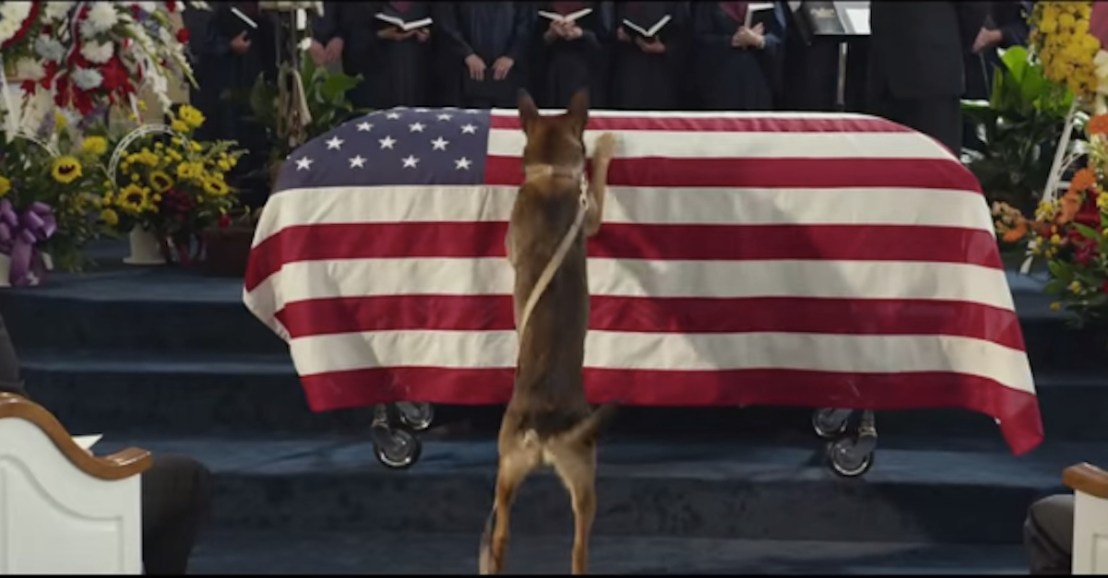
A Marine Died In Battle, But What His Dog Did After The Funeral? I’m Speechless!
A dog is the only thing on earth who loves you more than he loves himself – so imagine a soldier dog’s mourning when his handler dies in the line of duty!
Max, a feature film by the producers of the doggie classic Marley and Me, intends to explore a soldier dog’s journey that doesn’t end with this heartbreaking image of a pup chasing down his fallen brother, but rather begins with it.
Max, a precision-trained military dog, loses his handler Kyle in Afghanistan. Max is too troubled to continue to fight, and the only human willing to take the dog in is the late Kyle’s little brother, Justin. Fortunately, Justin is able to relate to the troubled pup because he has problems of his own.
This isn’t the first time we’ve seen military dogs do great things after their time serving our country overseas – and I’m sure it won’t be the last.
Watch the trailer for the full-length feature below, and tell us in the comments: Would you watch the film Max?
Please SHARE this powerful story of a soldier dog’s heroic journey after war with all of your friends! Military dogs deserve to be treated like heroes both during and after wartime.
ooOOoo
OK, it’s a plea for people to watch the film and, frankly, why not!
Max, a Malinois used to help U.S. Marines in Afghanistan, is handled by Kyle Wincott (Robbie Amell) (Marine MWD). Kyle is questioned when weapons seized by his squad go missing. Realizing his friend Tyler Harne (Luke Kleintank) is among those involved with the shady dealings, he warns Tyler that he cannot cover for him. The two then go into the battlefield with their squad, with Max on point. While advancing on a suicide bomber, Max is injured by an explosion. In the ensuing gunfight, Kyle is shot and killed.
Kyle’s brother Justin (Josh Wiggins), who makes money selling illegally copied video games, their mother Pamela (Lauren Graham) and their father Ray (Thomas Haden Church) are informed of his death. After Kyle’s body is brought home for burial, the other Marines notice that Max is only calm when he is around Justin, apparently sensing that he is Kyle’s brother. The family adopts the dog, who would otherwise be euthanized for his disturbed behavior. Justin initially wants little to do with Max but eventually warms up to him. While meeting up with his friend Chuy (Dejon LaQuake), Justin meets Chuy’s cousin Carmen (Mia Xitlali), who offers to go to his house and show him some handling tricks for Max. Little by little, Max’s behavior improves around other people.
Tyler visits the Wincott’s one evening, provoking an aggressive response by Max. Later, after the Fourth of July, Ray asks Tyler what really happened. Tyler implies that Max turned on Kyle and caused him to discharge his weapon on himself, leading to his death. Justin decides to investigate the matter. Calling on one of Kyle’s old friends, Sergeant Reyes, for help, he is given a DVD of Kyle training Max that moves him to tears.
There is also a movie trailer on YouTube; presented here for you.
Whatever one thinks about this specific film, or films like this in general, that doesn’t alter the fact that all of us who live with dogs understand the capacity of dogs to offer unconditional love to us.
From time to time I have let it be known that I had a second book stewing on the back burner. The title that had first come to me was: ‘Of Pets … And Of People’. The book idea and initial title had come to me from visits to our local Lincoln Road Vet Clinic where I had sat in on both Dr. Jim Goodbrod and Dr. Russel Codd as they saw pet patients. As I described it in my original post when I introduced the idea in June:
Some time ago, when we were visiting Lincoln Road, it struck me that the detail of what takes place ‘behind the counter’ of a busy vet clinic is most likely not commonly appreciated by those that visit said clinic.
I asked Russel one day if I might be allowed to spend time watching and listening to what goes on behind the scenes; so to speak. Russel said that he would be delighted for me to do that.
Dr. Jim at work
I subsequently started publishing posts under the general title of Visiting the Vet.
Back to the book.
Recently it came to me that the title was wrong. Because it didn’t speak directly to the potential reader about dogs.
So I came up with a different name: An Insight into Dogs and Owners.
Here is the Vision for this next book:
An examination of the world of the veterinary clinic including those who care professionally for our dogs and an insight into those people, from many varied backgrounds and circumstances, who have dogs in their own lives.
The first section, dipping into the extraordinary work that goes on in a modern vet’s clinic, is inspired by my belief that the majority of dog owners have very little idea of such work and the skills displayed by DVMs.
But let me move on by sharing with you the Introduction to the book. Firstly, these paragraphs:
There’s a tiny amount of domesticated wolf in all of us. The relationship between canids and humans goes back nearly 40,000 years, when dogs split away from wolves. With our dogs, we have traveled the ancient track from hunter-gatherers to modern humans. That track that in this 21st century sees us having untold numbers of dogs in our lives. In the USA alone there are: “In 2017, a total of about 89.7 million dogs lived in households in the United States as pets. In comparison, some 68 million dogs were owned in the United States in 2000.” 1
Yet a surprising number of those who have dogs as pets and are lovers of those same dogs admit to not really understanding what goes on behind the scenes in a busy veterinarian clinic. Yes, they know what happens when they take their dog to their vet but that view is almost certainly from the perspective of that dog and the specific reason why that animal had to to be seen by a vet.
An Insight into Dogs and Owners seeks to broaden the understanding of the reader to the range of treatments and procedures that are undertaken in a modern veterinarian clinic.
OK! More or less what I explained earlier on in this post.
But!!
But here’s where I do believe (fingers tightly crossed) many of you dear readers can help.
Back to the remaining part of that introduction:
But just as dogs do not live in isolation then nor do we humans. So the book sets out to explore the range of relationships that humans have with dogs. Perhaps better put as the book exploring the range of human circumstances that have led to people having a dog in their life. The homeless, those disabled persons who care for their dog, the service dogs that are, for example, the eyes and ears of the partially sighted and the hard-of-hearing. But not excluding exploring the relationship between police dogs and their handlers, those who work with cancer-sniffing dogs, and all the way through to Mr. and Mrs. Joe Public having a pet dog or two.
“.. explore the range of relationships that humans have with dogs.”
If, dear reader, you fancy working with me and can comfortably reply to the following questions, then I want to hear from you!
Where were you born?
Were there dogs in your family home from an early age?
When did you first have a direct relationship with a dog?
Describe that relationship.
Do you presently have a dog in your life?
And if so, what is the name of your dog and how did this dog come into your life?
Finally, can you articulate more or less in a single sentence just what having a dog in your life means to you?
These questions can apply equally to persons who have a dog in their life as part of the family and to those who work with dogs in their professional lives, those who train dogs, hunt with dogs, and those who care for dogs.
If all of this hasn’t put you off then email me at paulhandover (…at…) gmail (…dot…) com putting ‘Book Two’ in the email title. I will then contact you directly looking at the best way to listen and record your answers to those questions.
The smoke from the forest fires in Oregon and California has been thick in the air here in Merlin for days.
As can be seen in the photograph below. The photograph is as it was captured by the camera at 7:15 am yesterday morning. No changes by me made at all. The middle tree line is at the Eastern end of our property about a 1/4 mile away.
We are fed up with the smoke and the terrible air conditions.
But what drew me to grab the camera and take the photograph was that the image had some sort of, Oh, I don’t know, some sort of end of the world feeling about it.
It also seemed a most apt image to be an introduction to the latest essay from George Monbiot. It is republished here with Mr. Monbiot’s kind permission.
ooOOoo
Don’t Look Now
2nd September 2017
The media avoids the subject of climate breakdown – to do otherwise is to bring the entire infrastructure of thought crashing down
By George Monbiot, published in the Guardian 29 August 2017
It is not only Donald Trump’s government that censors the discussion of climate change; it is the entire body of polite opinion. This is why, though the links are clear and obvious, the majority of news reports on Hurricane Harvey have made no mention of the human contribution.
In 2016, the United States elected a president who believes that human-driven global warming is a hoax. It was the hottest year on record, in which the US was hammered by a series of climate-related disasters. Yet the total combined coverage for the entire year on the evening and Sunday news programmes on ABC, CBS, NBC and Fox News amounted to 50 minutes. Our greatest predicament, the issue that will define our lives, has been blotted from our minds.
This is not an accident. But nor (with the exception of Fox News) is it likely to be a matter of policy. It reflects a deeply ingrained and scarcely conscious self-censorship. Reporters and editors ignore the subject because they have an instinct for avoiding trouble. To talk about climate breakdown (which in my view is a better term than the curiously bland labels we attach to this crisis) is to question not only Donald Trump, not only current environmental policy, not only current economic policy, but the entire political and economic system.
It is to expose a programme that relies on robbing the future to fuel the present, that demands perpetual growth on a finite planet. It is to challenge the very basis of capitalism; to inform us that our lives are dominated by a system that cannot be sustained, a system that is destined, if it is not replaced, to destroy everything.
To claim that there is no link between climate breakdown and the severity of Hurricane Harvey is like claiming that there is no link between the warm summer we have experienced and the end of the last ice age. Every aspect of our weather is affected by the fact that global temperatures rose by around 4° between the ice age and the 19th Century. And every aspect of our weather is affected by the 1° of global warming caused by human activities. While no weather event can be blamed solely on human-driven warming, no weather event is unaffected by it.
We know that the severity and impact of hurricanes on coastal cities are exacerbated by at least two factors: higher sea levels, caused primarily by the thermal expansion of seawater, and greater storm intensity, caused by higher sea temperatures and the ability of warm air to hold more water than cold air.
Before it reached the Gulf of Mexico, Harvey had been demoted from a tropical storm to a tropical wave. But as it reached the Gulf, whose temperatures this month have been far above average, it was upgraded first to a tropical depression, then to a category 1 hurricane. It might have been expected to weaken as it approached the coast, as hurricanes churn the sea, bringing cooler waters to the surface. But the water it brought up from 100 metres and more was also unusually warm. By the time it reached land, Harvey had intensified to a category 4 hurricane.
We were warned about this. In June, for example, Robert Kopp, a professor of earth sciences, predicted that “In the absence of major efforts to reduce emissions and strengthen resilience, the Gulf Coast will take a massive hit. Its exposure to sea-level rise – made worse by potentially stronger hurricanes – poses a major risk to its communities.”
To raise this issue, I’ve been told on social media, is to politicise Hurricane Harvey. It is an insult to the victims and a distraction from their urgent need. The proper time to discuss it is when people have rebuilt their homes, and scientists have been able to conduct an analysis of just how great the contribution from climate breakdown might have been. In other words, talk about it only when it’s out of the news. When researchers determined, 9 years on, that human activity had made a significant contribution to Hurricane Katrina, the information scarcely registered.
I believe it is the silence that’s political. To report the storm as if it were a entirely natural phenomenon, like last week’s eclipse of the sun, is to take a position. By failing to make the obvious link and talk about climate breakdown, media organisations ensure that our greatest challenge goes unanswered. They help push the world towards catastrophe.
Hurricane Harvey offers a glimpse of a likely global future; a future whose average temperatures are as different from ours as ours are from those of the last ice age. It is a future in which emergency becomes the norm and no state has the capacity to respond. It is a future in which, as a paper in the journal Environmental Research Letters notes, disasters like Houston’s occur in some cities several times a year. It is a future that, for people in countries such as Bangladesh, has already arrived, almost unremarked by the rich world’s media. It is the act of not talking that makes this nightmare likely to materialise.
In Texas, the connection could scarcely be more apparent. The storm ripped through the oil fields, forcing rigs and refineries to shut down, including those owned by some of the 25 companies that have produced over half the greenhouse gas emissions humans have released since the start of the Industrial Revolution. Hurricane Harvey has devastated a place in which climate breakdown is generated, and in which the policies that prevent it from being addressed are formulated.
Like Donald Trump, who denies human-driven global warming, but who wants to build a wall around his golf resort in Ireland to protect it from the rising seas, these companies, some of which have spent millions sponsoring climate deniers, have progressively raised the height of their platforms in the Gulf of Mexico, in response to warnings about higher seas and stronger storms. They have grown from 40 feet above sea level in 1940, to 70ft in the 1990s, to 91ft today.
This is not, however, a story of mortal justice. In Houston, as everywhere else, it is generally the poorer communities, that are least responsible for the problem, who are hit first and hit worst. But the connection between cause and effect should appeal to even the slowest minds.
The problem is not confined to the United States. Across the world, the issue that hangs over every aspect of our lives is marginalised, except on the rare occasions on which world leaders gather to discuss it in sombre tones (then sombrely agree to do almost nothing), whereupon the instinct to follow the machinations of power overrides the instinct to avoid a troubling subject. When they do cover the issue, they tend to mangle it. In the UK, the BBC distinguished itself in customary fashion this month, by yet again inviting the climate change denier Lord Lawson onto the Today programme, in the mistaken belief that impartiality requires a balance between correct facts and false ones. They seldom make such a mess of other topics, because they take them more seriously.
When Trump’s enforcers instruct officials and scientists to purge any mention of climate change from their publications, we are scandalised. But when the media does it, without the need for a memo, we let it pass. This censorship is invisible even to the perpetrators, woven into the fabric of organisations that are constitutionally destined to leave the major questions of our times unasked. To acknowledge this issue is to challenge everything. To challenge everything is to become an outcast.
Dear people, I sat staring at the screen for 10 minutes and then went off when Jeannie called lunchtime. Returned to the screen a little after 2pm yesterday and still couldn’t come up with a closing thought that merited being shared with you all.





 Learning from Dogs