Category: Philosophy

Shit Happens!

A very inspirational essay from George Monbiot.

It is said that there are only two certainties in life: Death and Taxes.

I think that is one short: The Unexpected. As in Death, Taxes and The Unexpected!

As evidence of The Unexpected, one could put falling off one’s bike or being diagnosed with Parkinson’s Disease. Or the many other ‘hiccups’ that are an attribute of the real world that we humans live in. Put in the words of the street: Shit Happens!

Now read this very inspirational essay from George Monbiot. Republished here with Mr. Monbiot’s very kind permission.

ooOOoo

Unprostrated

16th March 2018

I have prostate cancer, but I’m happy. Here’s how.

By George Monbiot, published in the Guardian 14th March 2018

It came, as these things often do, like a gunshot on a quiet street: shocking and disorienting. In early December, my urine turned brown. The following day I felt feverish and found it hard to pee. I soon realised I had a urinary tract infection. It was unpleasant, but seemed to be no big deal. Now I know that it might have saved my life.

The doctor told me this infection was unusual in a man of my age, and hinted at an underlying condition. So I had a blood test, which revealed that my prostate specific antigen (PSA) levels were off the scale. An MRI scan and a mortifying biopsy confirmed my suspicions. Prostate cancer: all the smart young men have it this season.

On Monday, I go into surgery. The prostate gland is buried deep in the body, so removing it is a major operation: there are six entry points and it takes four hours. The procedure will hack at the roots of my manhood. Because of the damage that will be caused to the surrounding nerves, there’s a high risk of permanent erectile dysfunction. Because the urethra needs to be cut and reattached to the bladder, I will almost certainly suffer urinary incontinence for a few months, and possibly permanently. Because the removal of part of the urethra retracts the penis, it appears to shrink, at least until it can be stretched back into shape.

I was offered a choice: radical surgery or brachytherapy. This means implanting radioactive seeds in the parts of the prostrate affected by cancer. Brachytherapy has fewer side effects, and recovery is much faster. But there’s a catch. If it fails to eliminate the cancer, there’s nothing more that can be done. This treatment sticks the prostate gland to the bowel and bladder, making surgery extremely difficult. Once you’ve had one dose of radiation, they won’t give you another. I was told that the chances of brachytherapy working in my case were between 70 and 80%. The odds were worse, in other words, than playing Russian roulette (which, with one bullet in a six-chambered revolver, gives you 83%). Though I have a tendency to embrace risk, this was not an attractive option.

It would be easy to curse my luck and start to ask “why me?”. I have never smoked and hardly drink; I have a ridiculously healthy diet and follow a severe fitness regime. I’m 20 or 30 years younger than most of the men I see in the waiting rooms. In other words, I would have had a lower risk of prostate cancer only if I had been female. And yet … I am happy. In fact, I’m happier than I was before my diagnosis. How can this be?

The reason is that I’ve sought to apply the three principles which, I believe, sit at the heart of a good life. The first is the most important: imagine how much worse it could be, rather than how much better.

When you are diagnosed with prostate cancer, your condition is ranked on the Gleason Score, which measures its level of aggression. Mine is graded at 7 out of 10. But this doesn’t tell me where I stand in general. I needed another index to assess the severity of my condition, so I invented one: the Shitstorm Scale. How does my situation compare to those of people I know, who contend with other medical problems or family tragedies? How does it compare to what might have been, had the cancer had not been caught while it is still – apparently – confined to the prostate gland? How does it compare to innumerable other disasters that could have befallen me?

When I completed the exercise, I realised that this bad luck, far from being a cause of woe, is a reminder of how lucky I am. I have the love of my family and friends. I have the support of those with whom I work. I have the NHS. My Shitstorm Score is a mere 2 out of 10.

The tragedy of our times is that, rather than apply the most useful of English proverbs – “cheer up, it could be worse” – we are constantly induced to imagine how much better things could be. The rich lists and power lists with which the newspapers are filled, our wall-to-wall celebrity culture, the invidious billions spent on marketing and advertising, create an infrastructure of comparison that ensures we see ourselves as deprived of what others possess. It is a formula for misery.

The second principle is this: change what you can change, accept what you can’t. This is not a formula for passivity. I’ve spent my working life trying to alter outcomes that might have seemed immovable to other people. The theme of my latest book is that political failure is, at heart, a failure of imagination. But sometimes we simply have to accept an obstacle as insuperable. Fatalism in these circumstances is protective. I accept that my lap is in the lap of the gods.

So I will not rage against the morbidity this surgery might cause. I won’t find myself following Groucho Marx who, at the age of 81, magnificently lamented, “I’m going to Iowa to collect an award. Then I’m appearing at Carnegie Hall, it’s sold out. Then I’m sailing to France to pick up an honour from the French government. I’d give it all up for one erection.” And today there’s viagra.

The third principle is this: do not let fear rule your life. Fear hems us in, stops us from thinking clearly and prevents us from either challenging oppression or engaging calmly with the impersonal fates. When I was told that this operation has an 80% chance of success, my first thought was “that’s roughly the same as one of my kayaking trips. And about twice as good as the chance of emerging from those investigations in West Papua and the Amazon”.

There are, I believe, three steps to overcoming fear: name it, normalise it, socialise it. For too long, cancer has been locked in the drawer labelled Things We Don’t Talk About. When we call it the Big C, it becomes, as the term suggests, not smaller, but larger in our minds. He Who Must Not Be Named is diminished by being identified, and diminished further when he becomes a topic of daily conversation.

The super-volunteer Jeanne Chattoe, whom I interviewed recently for another column, reminded me that, just 25 years ago, breast cancer was a taboo subject. Thanks to the amazing advocacy of its victims, this is almost impossible to imagine today. Now we need to do the same for other cancers. Let there be no more terrible secrets.

So I have sought to discuss my prostate cancer as I would discuss any other issue. I make no apologies for subjecting you to the grisly details: the more familiar they become, the less horrifying. In doing so, I socialise my condition. Last month, I discussed the remarkable evidence suggesting that a caring community enhances recovery and reduces mortality. In talking about my cancer with family and friends, I feel the love that I know will get me through this. The old strategy of suffering in silence could not have been more misguided.

I had intended to use this column to urge men to get themselves tested. But since my diagnosis, we’ve discovered two things. The first is that prostate cancer has overtaken breast cancer to become the third biggest cancer killer in the UK. The second is that the standard assessment (the PSA blood test) is of limited use. As prostate cancer in its early stages is likely to produce no symptoms, it’s hard to see what men can do to protect themselves. That urinary tract infection was a remarkably lucky break.

Instead, I urge you to support the efforts led by Prostate Cancer UK to develop a better test. Breast cancer has attracted twice as much money and research as prostate cancer, not because (as the Daily Mail suggests) men are the victims of injustice, but because women’s advocacy has been so effective. Campaigns such as Men United and the Movember Foundation have sought to bridge this gap, but there’s a long way to go. Prostate cancer is discriminatory: for reasons unknown, black men are twice as likely to suffer it as white men. Finding better tests and treatments is a matter of both urgency and equity.

I will ride this out. I will own this disease but I won’t be defined by it: I will not be prostrated by my prostate. I will be gone for a few weeks but when I return, I do solemnly swear I will still be the argumentative old git with whom you are familiar.

http://www.monbiot.com

ooOOoo

It appears to be a unique aspect of the human mind. I am referring to our ability to worry about the future, to struggle to break away from ‘habitual’ responses to unanticipated crap coming along, to see the glass as half full as opposed to half empty, and so on, and so on.

Oh, to be like our dear, sweet, wise dogs.

Just let the world roll by!
What a great man he was!

I am, of course, referring to the recent death of Stephen Hawking.

There’s no way that I can add anything to the widespread reporting of the very sad death of the theoretical physicist, cosmologist and author Professor Stephen Hawking.

Except, possibly, this interesting quirk of fate.

For this great man died yesterday: March 14th.

The very same day that another very famous man, the German-born Albert Einstein, was born. As in March 14th. Albeit, Stephen Hawking’s death being 139 years after the birth of the 1921 winner of the Nobel Prize in Physics.

Did you also know that Professor Hawking was a great dog lover!

I was very pleased that The Conversation blog site released a wonderful tribute to Stephen Hawking. The item opens, thus:

ooOOoo

Acclaimed British theoretical physicist, cosmologist and author Stephen Hawking has died aged 76. Hawking is best known for his work on black holes, which revolutionised our understanding of the universe.

Hawking passed away today peacefully at his home in Cambridge, his family confirmed in a statement:

We are deeply saddened that our beloved father passed away today. He was a great scientist and an extraordinary man whose work and legacy will live on for many years.

His courage and persistence with his brilliance and humour inspired people across the world. He once said, “It would not be much of a universe if it wasn’t home to the people you love.” We will miss him forever.


Read more: A timeline of Stephen Hawking’s remarkable life


Hawking was born on January 8, 1942, in Oxford, England. In 1963 he was diagnosed with ALS, a form of Motor Neurone Disease, and later confined to a wheelchair and forced to communicate via a computerised voice. But he continued his theoretical work and was outspoken on many things over much of his life.

Tributes have been pouring in on social media for the scientist, who made complex science accessible to everyone in his 1988 bestselling book A Brief History of Time.

ooOOoo

Do read the rest of that article. I will take the tribute from Alice Gorman that closes The Conversation article to close today’s post.

ooOOoo

Alice Gorman, Senior Lecturer in archaeology and space studies, Flinders University

There are few scientists who reach as far into popular culture as Stephen Hawking did. His research tackled the biggest of big questions – the nature of time, space and the universe we live in.

Sometimes it feels like science is losing ground in the modern world, but people still look to the stars for answers about who we are and how we come to be here.

Hawking’s bestselling A Brief History of Time made cosmology accessible to people and brought black holes out of the shadows and into the public imagination.

Personally I’ll miss his appearances on The Big Bang Theory, where he could out-nerd the nerds, and also provide some often necessary common sense. It was always great to see a world-class scientist just having fun.

ooOOoo

What a very great man he was!

Beating depression without pills!

The value of a loving dog is not to be over estimated!

Returning to the theme of how dogs can help us humans fight off depression.

A delightful guest post from Taylor who recently asked if she could share a post from her own blog. I was delighted to have been asked.

oooooh

Dogs Can Help Decrease Symptoms of Anxiety and Depression.

by Taylor G. February 23rd. 2018.

I have always been a huge animal person. But mostly, a dog person/mom. I have two pups, and I am a dog walker in my neighboring towns. But I also suffer from depression and anxiety. Doctors always rush to prescribe medicine, but I have found that dogs can help as well. This post will be describing how dogs can help people suffering with depression and anxiety.

  1. Exercise- For all you dog owners out there, you know how much exercise your furry friends require. Since becoming a dog walker, I am forced to exercise and walk everyday. While it hasn’t cured my mental illnesses, it has decreased some of my symptoms. I am forced to get out of bed and do something. In recent studies, they have found that dog owners are a lot more likely to meet daily exercise requirements then none dog owners!
  2. Sense of Purpose- When you know that there is another living being that relies solely on you,
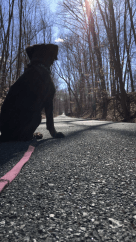
    Koda and I on a walk.

    you get a sense of worthiness. I know I struggle with feeling needed, but as soon as I schedule a dog walk, I know that that dog needs me. That the dog is waiting for me to walk it. It makes me feel needed in this world. It has increased my self worth and makes me feel like I have a purpose.

  3. Structure/Daily Routine- Many people who suffer with depression and anxiety know the struggle of having a routine. All we want is structure in our lives in a world where everything is hectic and last minute. Having a dog/being a dog walker, gives you a routine. Most dogs get up to do their business at the same time every morning and they know when its walk/feeding time. Trust me 🙂 It has given me a set schedule and has helped me feel more structured and less crazy!
  4. Forever Companion- Dogs will steal your heart, but you will also steal theirs. They are one of the most loving and caring animals out there. They sense your emotions and will be there for you through your good and bad days. I know that when I have a bad day, I always have my happy little furry babies to come home to. They are my friends when my depression tells me I have none.
  5. Petting Reduces Stress- It is proven, that the ‘motion’ and the ’emotion’ the goes into petting,
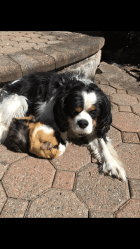
    Chloe with my Guinea Pig Daisy

    actually releases oxytocin (hormone related to anxiety relief), which can help reduce blood pressure!

  6. Mindfullness- For people who are trying to practice mindfulness (anxiety/depression technique that keeps you in the current moment), having a dog will help you do that! They keep you distracted from the bad things that are going on, and make you concentrate on their cute shenanigans.
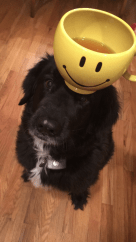
  7. Koda with a cup on his head.

    Help with Isolation- For those days when your depression gets the best of you, they help you feel less lonely and less isolated. They will be there for you when no one else is, and knowing that always makes me feel better.

  8. They allow me to smile- Last year, when my depression and anxiety were at its peak, I forgot how to smile. The only time I smiled was when I was in the presence of my dogs. They taught me how to smile again, and I am so grateful to them.

My dogs have helped give me my life back. While I am still fighting my

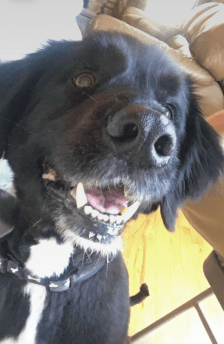
Koda smiling.

depression and anxiety, I am definitely proof that dogs can help in this fight against mental illness. While they also may be a huge responsibility, they are also a huge help in the war with mental illness.

ooOOoo

I will close by stating the obvious.

That is that everyone who has a dog or two in their life and has times of feeling depressed knows without question what it means to hug a dog.

Those who do not have a dog in their life and have experienced depression should find their own dog to hug – pronto!

The mists of the mind

Those inner voices inside our heads!

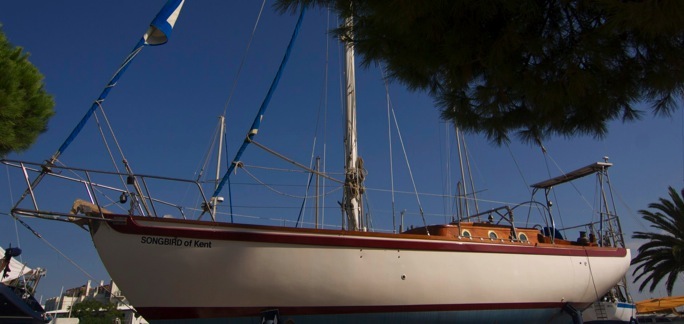
The photograph below is the yacht that I lived on for 5 years, from 1987 though to 1992. My base was Larnaca Marina in the Greek ‘sector’ of the Island of Cyprus although I cruised over much of the Mediterranean during the warm summer months. (Long-term readers, you poor souls, will realise that this isn’t the first time I have spoken of sailing and Tradewinds…)

Songbird of Kent
Tradewind 33 – Songbird of Kent

As I explain over on my ‘author’s’ blog:

During this period Paul became much more aware of the importance of marketing strategy, becoming a Chartered Member of the British Institute of Marketing, and the raft of competencies that deliver entrepreneurial success. In 1986, Paul accepted an offer to sell the Dataview group of companies. (Regrettably, this period also saw the failure of Paul’s marriage to Britta and their subsequent divorce.)

Again, chance intervened in that an Autumn vacation in 1986 to Larnaca in Cyprus resulted in Paul meeting a couple who wanted to sell their yacht, a Tradewind 33, and return to England. Thus very early in 1987, Paul left Essex and became a full-time ‘yachtie’ living on that Tradewind Songbird of Kent in Larnaca marina. Paul was then exposed to the life of an ocean-going sailor returning to Plymouth, Devon via The Azores onboard Songbird of Kent in 1992.

I purchased this Tradewind 33, designed by Englishman John Rock by the way, because somewhere in my soul was a dream to do some solo ocean sailing. Probably inspired by reading too many books written by famous British solo yacht-persons. Such as Robin Knox-Johnston, Chay Blyth, Naomi James, Ellen MacArthur, Pete Goss and the king of them all: Sir Francis Chichester who was the first person ever to sail around the world single-handed.

But it remained a dream for almost all those 5 years. Reason? Because at the start of the summer cruising period each year I slipped out of Larnaca and sailed along the southern coast of Cyprus, up the Western coast and then the open sea crossing to a nearby Turkish harbour, such as Anamur or Alanya. At the end of the summer I would repeat the solo trip in reverse. But I still haven’t said what the core reason was for not being braver and planning a solo ocean voyage.

Because that sailing voyage twice a year, that took me about four days to accomplish, and was undertaken alone, really scared me. I mean scared with a capital ‘S’! For it was impossible to accomplish without many hours of solo sailing at night!

Fast forward a number of years and one day, when I was living on Songbird at Larnaca Marina into the vacant berth next to me came a new visitor to Cyprus. His name was Les Powells and he very quickly explained that he was on his way back to England on his third solo circumnavigation of the world!

imagesInevitably Les and I got chatting over a couple of beers during our evenings together and Les asked me about my sailing ambitions noting that I lived on a yacht that most people purchased for ocean sailing purposes.

I explained my miserable experiences each year going to and fro between Cyprus and Turkey.

Les heard me out and then threw his head back and roared with laughter.

“Paul, what you are experiencing is the adjustment from a land-based life, as in living here in Larnaca, to a water-based life.

I suffer just the same adjustment stress as you have detailed.”

My face conveyed both my amazement and my yearning to learn more.

“Yes, Paul, every time I go to sea solo the first three or four days are hell! I hate them! I only stick with it because there is always a point, (Les really emphasised the word always) usually under a glorious night sky, when I truly become attuned to the life of a solo yachtsman far out from the nearest land and wouldn’t swap it for anything”

“You have to trust this and set out on a solo voyage of more than, preferably much more than, four days sailing.”

Thus in time that’s what happened.

In the Autumn of 1972 I returned to Plymouth in England, via the Azores, sailing solo on Songbird of Kent. Indeed, I was going to republish an article about lighthouses in Oregon but I’m changing tack in mid-stream; so to speak!

I am going to close today’s post by republishing an experience of being alone on the Atlantic Ocean that first graced these blog pages in October 2015. Lighthouses will have to wait.

ooOOoo

There is a place in my mind to which I can so easily travel; a memory of a dark night out in the Atlantic. But first let me set the scene from almost fifty years ago.

The call of the open ocean

Those first few hours were utterly absorbing as I went through the whole business of clearing the yacht harbour at Gibraltar and heading out to the South-West hugging this unfamiliar coastline of Southern Spain. It was tempting to move out to deeper waters but the almost constant flow of large ships through the Straights of Gibraltar soon quashed that idea. Thankfully, the coastal winds were favourable for me and my single-masted sailing yacht.

After such a long time sailing in the relatively confined waters of the Mediterranean, it was difficult for me to imagine that in a few hours time the southern-most point of Spain would pass me by and the vastness of the Atlantic ocean would be my home for the next few weeks.

Soon the city of Tarifa was past my starboard beam and the Spanish coastline was rapidly disappearing away to the North-West. The horizon ahead of me was already approaching 180 degrees of raw, open ocean.  There was just a flicker of a thought that whispered across my mind: “Oh Paul, what have you gone and done” as slowly but persistently the coastlines of Spain to the North and of Africa to the South became more and more distant and fuzzy.  It was at 15:30 that I made an entry in my yacht’s log: “No land in sight in any direction!

Now was the time to make sure that my bunk was made up, flashlights to hand, and my alarm clock ready and set. Alarm clock? Set to go off every twenty minutes during the night! For this was the only way to protect me and my yacht from being hit by one of those gigantic container ships that seemed to be everywhere. It took at least twenty minutes from the moment a ship’s steaming lights appeared above the horizon to crossing one’s path!

It was in the early hours of my first morning alone at sea, when once again the alarm clock had woken me and I was looking around an ocean without a single ship’s light to be seen that more of Les’ words came to me. I remembered asking Les: “What’s the ­appeal of sailing?” Les replied without a moment’s hesitation: “It’s the solitude. When you’re out at sea on your own, there’s no government or bankers to worry about. You’re not ­responsible to anyone but yourself.

Yes, I could sense the solitude that was all around me but it was an intellectual sense not an emotional one. That would come later. Inside, I was still afraid of what I had let myself in for.

Remarkably quickly however, the pattern of solo life aboard a thirty-three-foot yacht became my world. Frankly, it staggered me as to how busy were my days. Feeding myself, navigating, trying to forecast the winds, staying in touch with other yachties via the short-wave radio, keeping the boat tidy and a zillion other tasks meant the first few days and nights just slipped by.

But it was a sight on my fourth night at sea that created the memory that would turn out to remain with me for all my life. The memory that I can go to anytime in my mind.

That fourth night I was already well into the routine of waking to the alarm clock, clipping on my harness as I climbed up the three steps that took me from my cabin into the cockpit, scanning the horizon with my eyes, checking that the self-steering had the boat at the correct angle to the wind and then, if no ships’ lights had been seen, slipping back down into my bunk and sleeping for another twenty minutes. Remarkably, I was not suffering from any long-term tiredness during the day.

It was a little after 3am that fourth night when the alarm clock had me back up in the cockpit once again. Then it struck me.

Songbird was sailing beautifully. There was a steady wind of around ten knots from the south-east, almost a swell-free ocean, and everything set perfectly.  Not a sign of any ship in any direction.

Then I lifted my eyes upwards. There was not a cloud in the night sky, not a single wisp of mist to dim a single one of the million or more stars that were above my head. For on this dark, moonless night, so far removed from any shore-based light pollution, the vastness, yet closeness of the heavens above was simply breath-taking. I was transfixed. Utterly unable to make any rational sense of this night splendour that glittered in every direction in which I gazed. This dome that represented a vastness beyond any meaning other than a reminder of the magic of the universe.

This magic of the heavens above me that came down to touch the horizon in all directions. Such a rare sight to see the twinkling of stars almost touching the starkness of the ocean’s horizon at night. A total marriage of this one planet with the vastness of outer space.

I heard the alarm clock go off again and again next to my bunk down below. But I remained transfixed until there was a very soft lightening of the skyline to the east that announced that another dawn was on its way.

I would never again look up at the stars in a night sky without being transported back to that wonderful night and the memory of a lonely sea and sky.

ooOOoo

Dear, dear Les is still alive and still living on his yacht Solitaire in an English marina. A very close mutual friend, Bob Derham, arranges to visit Les on a very regular basis and take him out for shopping trips and a leisurely pub lunch.

Bob follows this blog and I hope will have the chance to read out today’s post to Les. For my closing sentence is directed to Les, and Les alone: “Dear Les, thank you from the bottom of my heart for the gift you gave me. For it is a rare night when here in rural Oregon when I go outside at the end of the evening and above my head is a clear, black night sky, full of stars, that I am not transported back to that night alone in the Atlantic ocean. I am still rendered speechless in awe of such night skies.”

The deep, dark, wonderful mists of the mind!

Lateral thinking

In debt to Edward de Bono.

One of the great differences between us humans and our beloved dogs is that frequently we think too much! But it’s worse than that. We think too much and get caught up in some spiral from which we can’t think ourselves back out. Perhaps that can be likened to a dog worrying away at something that the dog thinks is being overlooked by it’s human friend, or over-licking a wound or such.

A very quick web search will bring up the background information on Dr. de Bono who was responsible for overturning the way we think. It was de Bono who attended an IBM Office Products management course that I was attending, far too many moons ago, when I was promoted from being a salesman to the first rung of the management ladder; the position of Marketing Manager. It was during de Bono’s talk that I first learned of lateral thinking and what de Bono called the “PO” moment.

Just watch the first minute of this talk to get an appreciation of what the PO moment is. Seriously, the video starts with Simon Middleton defining a PO moment. It’s relevant to the rest of this post.

As you all know Jean has Parkinson’s Disease (PD). We have come to understand that PD affects different people in different ways, albeit there are some aspects that many PD sufferers share.

Take this symptom as described on the APDA website:

Many individuals report difficulties in multitasking and organizing daily activities.

In recent weeks I noticed I was becoming frustrated because although I was suggesting to Jeannie a number of what I thought were pleasant things to do in and around our property they weren’t being done.

As much as I tried to say to myself to chill out, this is all down to Jean’s PD, I couldn’t push out of sight the growing frustration that my help was being rejected, and I know I have a problem dealing with rejection! I really didn’t want my frustration to build up to anger.

Eventually, one morning last week after I came back to the bedroom from having fed the horses and the deer I blurted out, rather clumsily I admit, this frustration that was close to becoming a real annoyance.

At first Jean was upset by what I said, understandably so, but then we settled down to examining each suggestion of mine and where I was coming from. Then the conversation became very productive and in a moment of creative thinking I suggested what turned out to be a ‘PO’ moment. In other words, we had both agreed that while we acknowledged the fact that Jean was not motivated to do the things I was suggesting nonetheless it was important that we choose another day and time to discuss how I should remind Jean of these ‘overlooked’ suggestions and, more importantly, how it could be done in a loving and constructive manner.

It was a fascinating outcome and I immediately jumped out of bed, went to my office room next to the bedroom, grabbed a new, unused notebook and came back to the bedroom.

“Jean, let’s write this down in the book as a reminder of something we need to return to and resolve in a creative way! Let’s call these reminders Pharaoh moments!”

Jean very happily agreed!

I then explained to Jean that this felt very much like one of de Bono’s PO moments and calling it a Pharaoh moment was a beautiful way of remembering our wonderful dog.

It was beyond doubt an example of Jean and me thinking laterally.

So thank you, dear Edward, your legacy still endures.

I will close today’s post by inviting you to watch either or both of these talks by de Bono.

The first is a little over 4 minutes long.

Or a longer video that is still highly recommended:

Published on 22 Oct 2015

Edward de Bono is the originator of the concept of Lateral Thinking, which is now a firm entry in the Oxford English Dictionary. Dr de Bono was born in Malta. As a well-established academic, de Bono was a Rhodes Scholar at Oxford and holds an MA in psychology and physiology from Oxford. He is a Professor at many leading institutions around the world. He is an author of many best-selling books, and is known as the world’s leading authority on thinking.
I write this post as a very happy man who has lived the value and benefits of not bottling up one’s feelings!

Inward thoughts.

Reflections on being gentle to yourself.

There are three reasons why I wrote this post. A post that runs across today and tomorrow.

Firstly, this post is inspired by love! The supreme love that I receive from my darling Jeannie and the love that I sense practically twenty-four hours a day that flows from the beautiful dogs that we have here. But also from the wonders of the rural world in which I live. From sights like the one below to being visited by wild deer every single morning when I go out to feed the horses.

The view from our bedroom window any cloudless morning. (This photo taken October 18th, 2015.)

The second reason for writing this post is a direct result of the love that flows in from so, so many of you precious readers. You are like one big online family that I live in. And, as one hopes to do within a family, from time to time you want to open up your inner feelings.

The third and final reason for this post is wanting to explore how one might find some peace from the chaos that seems to be spread so far and wide across this planet that we all call home.

It’s a very personal journey and I suggest that if this is not your ‘cup of tea’ that you call back another day!

OK! Now that’s off my chest, here we go!

Life’s beauty is inseparable from it’s fragility.

Pause awhile and just let those words float around your mind.

It is a quotation taken from a TED Talk that Jean and I watched a few days ago.

The speaker is Susan David and is described on that TED Talk page as follows:

Psychologist Susan David shares how the way we deal with our emotions shapes everything that matters: our actions, careers, relationships, health and happiness. In this deeply moving, humorous and potentially life-changing talk, she challenges a culture that prizes positivity over emotional truth and discusses the powerful strategies of emotional agility. A talk to share.
This talk was presented at an official TED conference, and was featured by our editors on the home page.

If you want to watch the talk it is a little over 16 minutes long and may be viewed on the TED Talk site here.

Let me return to that quotation. For there is no question that life, at whatever scale, from the personal to the global, is fragile. Fragile with a capital “F“!

Whether it’s the madness of our politics and governments, or nature presenting us with extreme hurricanes, volcanoes, earthquakes and floods, or the frustrations of life itself, especially when one is the wrong side of 65, or numerous other aspects of being human it’s terribly easy to become frustrated, or worse, with oneself.  I speak from a very personal perspective as my short-term recall is now pathetic!

STOP! (You see, I wrote the word “pathetic” without thinking. Demonstrating how  quickly I come down on myself. Without automatically and unconsciously being gentle on myself and being very grateful that this old Brit, born in 1944, is still able to string a few words together!)

One of the great, possibly the greatest, things that we can learn from our dogs is to be gentle on ourselves. So very often our dogs take time out to relax, to be happy and to spread their joy around the home. Look at the following photograph!

Oliver demonstrating the art of being very gentle on himself and on Pedi. (Picture taken November, 2015.)

Being gentle on yourself!

But for us humans that seems a great deal more easier to say than to practice!

Yet the argument for being gentle to yourself is compelling. And the first step in that personal journey towards being kinder to yourself is to be better aware of oneself when it comes to our emotions.

I shall be continuing this inward journey tomorrow but today, holding on to that idea of how we manage our emotions, I want to close with another TED Talk. Just 18 minutes long but invaluable to watch.

The talk is given by Professor Lisa Feldman Barrett, PhD who is Distinguished Professor of Psychology at Northeastern University,and has positions in psychiatry and radiology at Massachusetts General Hospital and Harvard Medical School.

As I was reading the draft of this post it did cross my mind that you do know I write from a purely personal perspective. I hold no qualifications whatsoever in the fields of psychiatry, psychology or any related disciplines. If you have found yourself to be affected to the point where you think you need proper counselling then, please, do seek help.

Part Two coming along tomorrow!

One paw in front of the other

A just delightful guest post!

Came from an online exchange.

ooOOoo

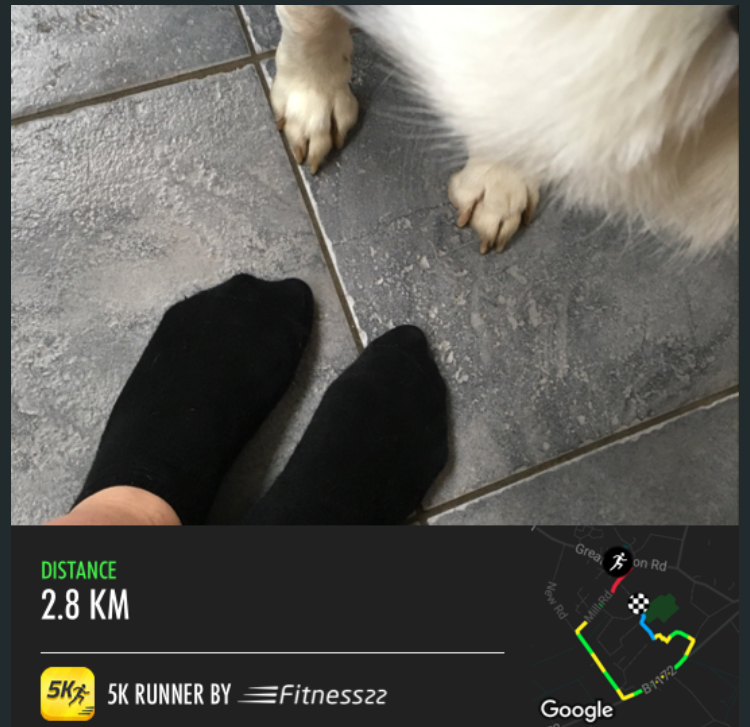
So today was the day for me. And I done it with the help of my wonderful dog.

I had been dreaming all night of running and depression and failing miserably.
I was woken at 6:30am by the sound of my dad coming back in after he had been for his normal morning walk around the village with our dog Riley. I was also disturbed by my boyfriend coughing and spluttering up god knows what, and I laid and tossed and turned as I thought oh my god today I’m going to go for a run, followed by don’t be so stupid of course your not you can’t even run down the stairs.

As the early morning light started to come in through the sides of my blinds, I pulled out my eye patches and fell back to a disturbed sleep until…. midday. I couldn’t believe it.

You lazy shit I thought, so much for your run, what a joke you are. Jumping out of bed at the thought of what my mother might say, I went downstairs and put the kettle on, I turned to my dog who had followed me down and said: “I’m going to take you out don’t worry.”

I couldn’t have put it off for any longer if I tried! I hoovered, steam cleaned, made tea, ate beans on toast, tidied my bedroom, anything but get ready to go for a run. Truth is I was terrified!

After not physically being able to tidy much more, I got ready, and put on my new Nike running shoes I had bought in the New Years sales. Riley stretched his tail wagging as he sensed that it was time.

The next twenty or so minutes were the most emotional, and longest, twenty minutes of my life I have ever experienced. I put my new running band on with my phone and beats headphones, and a Spotify playlist that played the most god awful dubstep but I didn’t care. I downloaded the couch to 5k app as I have not really ran in years and pressed start and off me and Riley headed around the village.

The walking was fine, then the lady popped up in her American accent start to run, and so I did.  I started to develop a stitch in my stomach, pain in my chest and the most overwhelming urge to cry. I battled constant thoughts in my head that I could do it … blah! blah! blah!, but Riley was with me. We done it together.

Slow down and start to walk” the voice spoke. I was glad someone knew what I was doing as I didn’t have a clue. I suddenly became awfully aware of the cars going past and thoughts of people looking at me and what they might think: she doesn’t look great; she looks like she is struggling; she must be mad. So with my fave down unable to break a smile or lift my frown I carried on with lead in hand and my faithful dog by my side. I spoke to him, praised him at how well he was doing but I can’t bring to praise myself not yet.

The dubstep tracks blasting in my ears the lyrics started on this train with no destination. And I thought this is how depression and anxiety have made me feel, I have been on a slow and steady train down to rock bottom and I can’t seem to get back up, but I feel today was a start. A little positive I suppose that I can add to my negative.

As it started to snow I thought wow I really am mad, I can’t even run these twenty mins , let a lone a 5k, 10k or yet alone this bloody great north run.

Freezing cold and following my dog in front I made it home and put the kettle straight on and slumped down waiting to make my cup of tea.
For the first time in a long time, I think I see a little light, a little tiny speck of light at the end of my long dark tunnel!

ooOOoo

I asked Catherine for permission to republish this because I was very moved when I read it over at her place. It seemed to say to me that this very honest and open account of what Catherine was experiencing might resonate somewhere out there with you dear readers.

Thank you, Catherine!

More importantly, thank you, Riley. Dogs do so much for us. Even saving our souls!

The Role of Pets in Depression and Bullying in Kids

Another great guest post from Emily Ridgewell!

Both Emily’s previous guest posts were received very well by you. There was Four-legged Gardening, published here last October 24th, and Return To The Movies that came out on the 4th of that same month.

Now Emily writes about something that is never far away from us these days, irrespective of age: depression. And the strongly positive role of pets. Great guest post but first let me re-introduce you to Emily.

Emily Ridgewell is an arts professional and a pet enthusiast from sunny LA. Emily has a creative energy and an aesthetic sense of living, where everything beautiful is worth sharing. She loves her yorkie Olivia and writes original and fun articles on ways to learn and improve your pet-best friend’s life. She finds exciting new things to explore and experience! Don’t forget to connect with her on Twitter: @ridgewell_j

ooOOoo

The Role of Pets in Depression and Bullying in Kids

Kids today are faced with more stress and worry than ever, and childhood depression is on the rise because of it. Recent studies have shown almost 10% of children and adolescents experience depression. One of the main sources of depression among children is being the victim of bullying. Unfortunately, bullying doesn’t discriminate and can happen to boys and girls of any ethnic, racial, religious, or socio-economic background. Lasting effects of being bullied include having low self-esteem and negative self-image, unhappiness at school and difficulty focusing, and trouble establishing healthy relationships with peers.

Interestingly enough, these side effects are found in the bullies as well as their victims. Both are more likely to experience depressive symptoms than those who have never been involved in bullying. They also are more likely to have coexisting mental health issues, such as Oppositional Defiance Disorder, Attention Deficit Disorder, and Clinical Depression and Anxiety. If left unaddressed, these feeling of depression and low self-worth can lead to chronic levels of mental health issues, isolation, and even suicidal ideation.

The first line of defense for parents is arming themselves with strategies to help their children cope with feelings of depression and address them when they first appear. First and foremost, they need to recognize the signs of depression. Then they need to put their heads together and come up with a plan to help their child combat it. Use resources such as your pediatrician, teachers, and school counselors to help develop a long term plan. In the meantime, one of the most effective and immediate ways to help them at home is by getting a pet.

Pets have several benefits that help combat depression and help your child feel happier, more whole, and well connected. First of all, they offer uncomplicated, unconditional love. They don’t say hurtful things, get angry over petty misunderstandings, or hold grudges. They simply love and express joy every time they see their owners. They also offer constant companionship. Having a pet means never having to feel alone or isolated. Additionally, the act of petting a dog or cat (or any other pet, for that matter) offers physical touch and provides comfort, creating a soothing effect and releasing feel-good endorphins in the brain. In turn, this reduces stress and anxiety and helps your child feel calmer and more emotionally balanced.

Further, having a pet means your child will have an added responsibility. Contrary to what you may originally think, a new responsibility provides a distraction and offers a positive focus instead of what’s bothering him.. Plus, he’ll feel good about himself for taking care of something that needs him. He will feel capable, and this bolsters self-esteem and causes a ripple effect in all aspects of her life. It’s a win-win situation.

If you opt for a dog, part of the responsibilities will be walking it. This earns another point in the fight against depression for a couple of reasons. It will make your child be physically active, a well-known tool for negating depressive symptoms. It also is an excellent way to increase social interaction. People are always wanting to touch a puppy, and this leads to a natural conversation when they ask permission. Even if your child is anxious about talking to new people, dogs and pets are automatic ice breakers. Talking about their pet can easily guide the conversation with very little pressure on your child to generate small talk. If they are engaging in conversation, they are less likely to feel isolated and will benefit mentally from the interaction.

Of course, pet ownership isn’t something you should jump into lightly. Be sure to choose the right pet for your child and teach him the right way to handle and care for it. With care and supervision, your child and her pet will become fast friends in no time. While there is no quick fix for depression, owning a pet has multiple benefits which will show their impact quickly. Having an unconditional friend to love can work wonders for building confidence and self-esteem and combatting the negative effects of bullying and depression.

ooOOoo

Emily is spot on. Pets, especially dogs, are the epitome of loving us humans unconditionally and that connection is precious beyond words. Being able to hug or cuddle a dog, frequently as an ad-hoc impulse, is about as comforting a place that us humans, well certainly this human, can get.

Sitting in front of the television of an evening and having a cat snuggle up next to one and start purring is a very close second-best!

Great post from Emily!

This is home!

It continues to feel very special!

Last Wednesday I was signed off in terms of being over my medical challenge and the good doctor said I was clear to return to driving; I drove home that afternoon from Eugene to Merlin.

I wanted to offer you good people a sense of what being home, more or less compus mentus , feels like.

I offer you this YouTube video.

It is a very beautiful world!

Let us always remember them.

Another wonderful guest post from Susan Combs

Some eighteen months ago I published a guest post from Susan entitled: How To Meet The Nutritional Needs Of Pregnant Dogs

I am delighted to offer another guest post from Susan.

ooOOoo

7 Wonderful Ways to Cherish and Honor the Memories of Your Beloved Dog

by Susan Combs.

Our relationship with our dogs is arguably the most genuine and pious one. The shear nature of dogs to shower unconditional love to their owners makes them no less a family member. Their honesty, faithfulness and a deep sense of belonging to their families is the reason as to why they are so adored across all the cultures, communities and societies.

Since it is also the hard truth that dogs tend to live much shorter lives than their owners; which renders the relationship end abruptly in their passing away. This is certainly not a happy stage for any pet owner either.

Therefore, losing a beloved pet, especially a dog is one of the most painful situations for owners. Their affection towards owners in the times of adversity is the most nostalgic part of their memories long after they have gone. By being together through thick and thin with relentless love their owners’ lives are impacted in many ways, and their absence is deeply felt.

If you are also mourning the loss of your dog, it must be difficult for you to cope with this undesirable situation. However, we have some wonderful ways with which you can cherish and honor the memories of your beloved dog.

Here are they:

  1. Plant a tree in his honor

Planting a tree in the honor of your dog is an excellent way to let his legacy live on for a long time to come. Choose a nice spot in your garden or backyard and plant a young tree, preferably an eternity plant. As the day will pass, it will grow up signifying a new life form from the previous one. Eventually, you will witness a sapling grow into a beautiful and strong tree. Till the time you live, this tree will remind you about that special bond with your canine friend.

  1. Make jewelry with his ashes

If you want to keep your furry pal all the time with you, creating jewelry with his remains would be a perfect idea. You can turn his ashes into diamond and wear it in the form of a ring. So there cannot be a better way to pacify his soul than this. Whether you make a ring or wear it as a locket, the shine of the diamond will keep on reflecting his memories. Your friends will also see in awe that the sparkle of the diamond was once your dog himself.

  1. Donate in the name of your dog

You dog meant everything to you, he still does. So, what else would be more heart-felt gesture than to donate for a good cause in the name of your dog? It is also a great way to give back what your dog gave you unflinchingly. You can give money to animal shelters because donating to these organizations is the best possible way to support the lives of other pets. In the situation of cash crunch, you can still donate another valuable asset: time. You can be there, spend some time with them and take care of them. Helping an animal in need is the best chance to remember your beloved dog.

  1. Create a picture book

Since you spent a lot of time with your dog, you must also have taken plenty of pictures of his. So collect all the past photos of your dog at one place; you can also ask your friends and family members if in case they had also taken his pictures. With these photographs you can either create a photo album or a picture book by forming a large collage. It would be better if you take printouts of these pictures and cut & paste them on the wall.

  1. Write an obituary

Didn’t you ever think to pen down the journey of your dog since he was cute little puppy? Now is the time since he is not there with you anymore. So document an insightful journey from the moment when you took him in your hands for the first time to his final moments. Write down how you used to spend time with him, how you used to play with him, what activities did he do at home, and whose life did he touch besides yours. You can post this personal obituary online.

  1. Bury him with honor

From giving him a memorable funeral to making his cemetery, your dog deserves honor in his last rites. Gather all your friends and family in order to say final goodbye to him.

You can also often visit his burial site whenever you like. You can place a gravestone at this spot and write your message for him or whatever you used to feel about him.

  1. Adopt again

If the pain of separation is not endurable for you or if you do not want to let go off your happy life with him, adopting again is the only option for you. This is also a good way to pay your tribute to him as he would also want to pass on a chance to another dog in need.

ooOOoo

As was mentioned in Susan’s previous guest post here again is her background:

Susan works as a Pet Health and Safety Expert and holds expertise in the area of animal/pet care. She has over 6 years of experience in pet healthcare and is a pet parent to a dog named chilly.

Finally, I would like to add a wonderful way of my own to remember our dear dogs. That is write up your own memories of your dog and post them to the special section on this blog: We Shall Not Forget Them.