Just the view at night from one small planet, the one that I happen to live on, Planet Earth, reveals millions upon millions of stars. It is then beyond inconceivable that there are not, in turn, countless numbers of other planets.
Extending this line of thought and recognising that a ‘mere’ billion years after the formation of our solar system and Planet Earth, some 4.54 billion years ago, the earliest life appeared, we can’t surely be alone!
Granted it was only cyanobacteria, as in blue-green algae, but, but, but ……… that this evolution of life on Planet Earth, and that evolution eventually leading to intelligent life, including the gift to us humans of the genetic separation of the dog from the wolf some 100,000 years ago, has not occurred on other planets is also totally inconceivable.
So, dear Mr. Cosmos, why have we not detected any signs of that intelligent life. Where are they?
Are we alone in the universe? New Drake equation suggests yes
A fresh take on the decades-old Drake equation incorporates new factors and greater uncertainty, suggesting a high likelihood that humanity is alone in the universe.
At the Los Alamos National Laboratory in 1950, physicist Enrico Fermi famously posed to his colleagues a simple question borne of complex math: ‘Where are they?’
He was asking about aliens—intelligent ones, specifically. The Italian-American scientist was puzzled as to why mankind hasn’t detected any signs of intelligent life beyond our planet. He reasoned that even if life is extremely rare, you’d still expect there to be many alien civilizations given the sheer size of the universe. After all, some estimates indicate that there is one septillion, or 1,000,000,000,000,000,000,000,000, stars in the universe, some of which are surrounded by planets that could probably support life.
So, where are they, and why aren’t they talking to us?
Now, as the article reveals, there is a lot to tackling this question, much of it involving statistics and mathematics, but it does prove one very important fact: Finding another planet as good for life and humanity as this one is just about impossible.
This is our only home!!
My wish, dear Mr. Cosmos, to you is this: That before I die it becomes clear beyond question that the peoples of this sweet Planet, from the lone individual living on some island out in the wilderness to the Governments of the most powerful nations on Earth, understand that nothing is more important than loving, caring for and looking after Planet Earth.
I remain, dear Mr. Cosmos, your respectful servant.
The idea of writing a letter to the moon is not a new one and it came to me when listening to an item yesterday morning, Pacific Time, broadcast by the BBC on Radio 4. The item was the news that Elon Musk has announced that:
Elon Musk’s company SpaceX has unveiled the first private passenger it plans to fly around the Moon.
Japanese billionaire and online fashion tycoon Yusaku Maezawa, 42, announced: “I choose to go to the Moon.”
The mission is planned for 2023, and would be the first lunar journey by humans since 1972.
On September 18, 1977, as it headed toward the outer solar system, Voyager 1 looked back and acquired a stunning image of our Earth and moon.
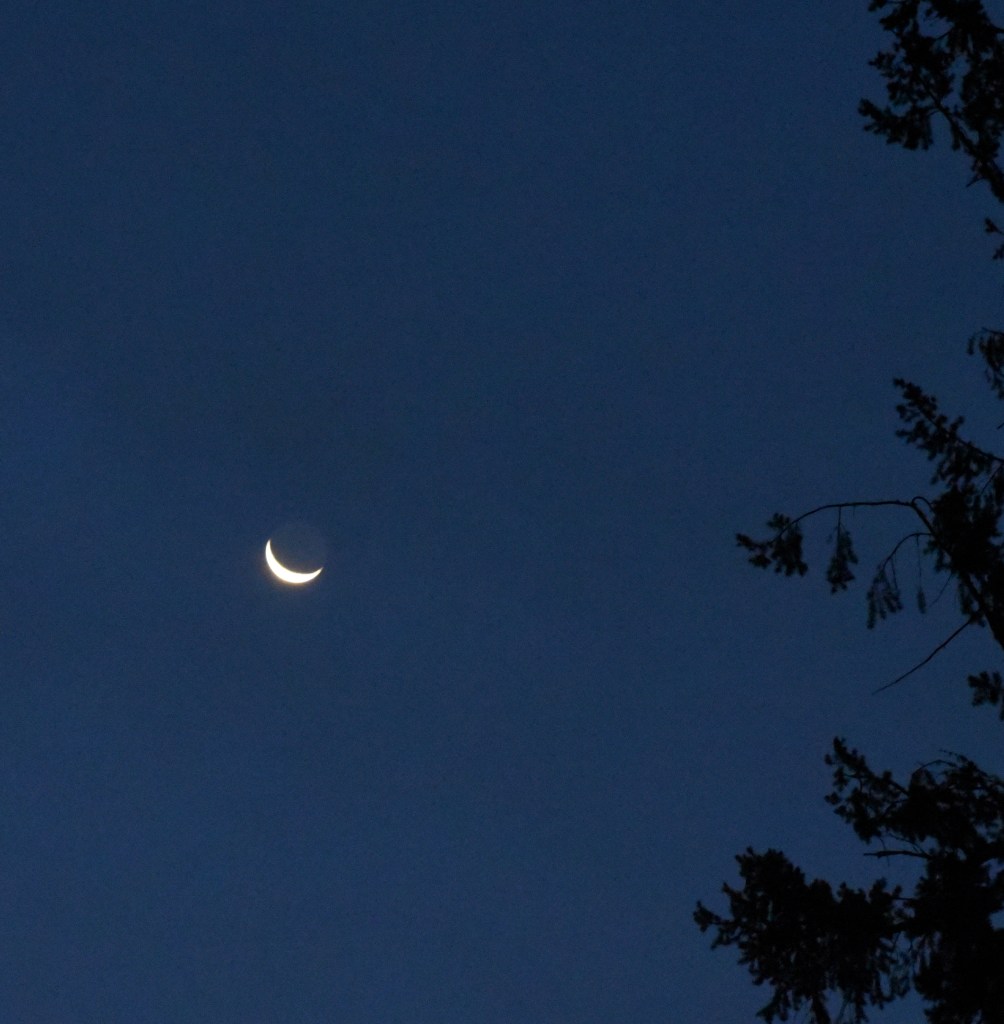
You will surely remember that first image taken of the Planet Earth and your good self in the same frame.
Here is the 1st-ever photo of the Earth and moon in a single frame. Voyager 1 took the photo on September 18, 1977, when it was 7.25 million miles (11.66 million km) from Earth. Image Number: PIA00013 via NASA/JPL.
Now here we are some 41 years later and, my, how things have changed.
But something, dear Mr. Moon, has never changed for you. That is the sight of our most beautiful planet. Plus, I would go so far as to venture that what makes our planet such a beautiful sight, one that has captivated us humans when we have gone into space and looked back at home, is the magic of our atmosphere.
Picture taken by a NASA satellite orbiting the earth some 200 miles above the planet’s surface.
So, so thin …. and so, so fragile.
It is akin to the thinness of the skin of an onion.
In fact, Mr. Moon, that layer that we earthlings call the troposphere, the layer closest to Earth’s surface varies from just 4 miles to 12 miles (7 to 20 km) thick. It contains half of our planet’s atmosphere!
Everything that sustains the life of air-breathing creatures, human and otherwise, depends on the health of this narrow layer of atmosphere above our heads. Now the thickness of that layer varies depending on the season and the temperature of the air. But let’s use an average thickness of 8 miles (say, 13 km) because I want to explore in my letter to you some comparisons.
In your infinite gaze down upon your mother planet you will have seen the arrival of H. sapiens, out of ancestral H. erectus, that took place roughly 315,000 years ago.
You will also have seen from your lofty vantage point the growth of both CO2 levels in the planet’s atmosphere and the average land-ocean temperature. Forgive me quoting something at you, but:
OBSERVABLE CHANGES IN THE EARTH
SINCE THE INDUSTRIAL REVOLUTION
While politicians have been busy debating the merits of climate science, the physical symptoms of climate change have become increasingly apparent: since the industrial revolution, sea level has grown by 0.9 inches, the atmospheric concentration of carbon dioxide has risen to unprecedented levels, average global temperatures have increased by about 1.0 degree Celsius and, to top it off, the global population has jumped by nearly 600 percent; 15 of the 16 hottest years on record occurred in the 21st century, and 2016 is likely to be the warmest year ever recorded.
Now the Industrial Revolution was all but over back in 1840 and the last 178 years have seen an explosion in the way we use energy, in all its forms. Plus we have to accept that back then the global population was around 1 billion persons. It is now over 7 billion.
Between 1900 and 2000, the increase in world population was three times greater than during the entire previous history of humanity—an increase from 1.5 to 6.1 billion in just 100 years.
So on to my comparisons.
The radius of our beautiful planet is about 3,959 miles (6,371 km). The average thickness of the troposphere is 8 miles (13 km).
Thus the ratio of thickness of our liveable atmosphere to the radius of the planet is 8 divided by 3,959. That is a figure of 0.002! Our atmosphere is 1/1000th of the size of the radius of our planet.
Hang on that figure for a moment.
In the last 178 years humanity has transformed our consumption of energy and especially carbon-based fuels. H. sapiens has been around for 315,000 years.
Thus the ratio of these present ‘modern’ times (the last 178 years) to the arrival of us back then (315,000 years ago) is 178 divided by 315,000. That is a (rounded) figure of 0.0006. Our modern times are just 1/10,000th of the time that so-called modern man has been on this planet.
So, dear Mr. Moon, you must despair that in so short a number of years, proportionally ten times smaller than the ratio of the troposphere to the radius of our planet, we funny creatures have done so much damage to what we all depend on to stay alive – clean air!
Or maybe, my dear companion of the night sky, because you are celebrating your 4.1 billionth year of existence, what we humans are doing is all a bit of a yawn.
Sincerely,
This old Brit living in Oregon.
ooOOoo
My dear friends (and I’m now speaking to you dear reader, not the moon!) when you reflect on the fragility of our atmosphere, well the layer we depend on for life, you realise without doubt that each and every one of us must make this pledge.
“I promise to do everything possible to reduce my own personal CO2 output and to ensure that both to my near friends and my political representatives I make it clear that we must turn back – and turn back now!”
Or, as George Monbiot writes in closing a recent essay (that I am republishing tomorrow): “Defending the planet means changing the world.”
Venturing into strange lands.
A collection of items has been crossing my ‘in-box’ in recent weeks and while many of the topics are, on the face it, not connected, for reasons I am not entirely sure about they seem to fall under the same umbrella; as in being of the same coherent theme.
Let me list some of these topics: the age of the universe; climate change; CO2 levels; the certainty of death; the history of the last half-million years; what our dogs teach us; and more!
Naturally, Jeannie and I have been kicking around these topics, aided and abetted by Dan Gomez, my Californian friend of some 40 years (and my ‘Best Man’ when Jean and I were married in 2010 and, more or less directly, the catalyst of me and Jean meeting in 2007!)
But I get the sense that many of you wonderful people that follow this place also scratch your head not infrequently and ponder on these ‘interesting’ times.
I don’t have any answers. But I do want to share how, over the last few weeks, I have been seeking some meaning, some peace, to the big issues that have the potential to make these times pretty uncomfortable if not a tad scary.
I shall not be extending this introspection each day but probably ( and I’m guessing) a couple of times a week I shall be dipping into the barrel!
Starting off with climate change, maybe tomorrow or Wednesday.
But what of today!
Today I am publishing another Dog Food Recall alert that came out late last week!
ooOOoo
Performance Dog Pet Food Recall
September 12, 2018 — Bravo Packing, Inc. of Carneys Point, New Jersey, is recalling all Performance Dog products, a frozen raw pet food, because they have the potential to be contaminated with Salmonella.
What’s Recalled?
The following products are affected by the recall:
Performance Dog
Package Size: 2-pound plastic sleeve
Mfg Date Code: 071418
Performance Dog
Package Size: 5-pound plastic sleeve
Mfg Date Code: 071418
Performance Dog comes frozen in 2-pound and 5-pound plastic sleeves.
The recalled product has manufacture date code 071418.
The manufacture date codes are printed on the boxes that contain the plastic sleeves, but not on the individual plastic sleeves.
Therefore, if the cardboard box has been discarded, there are no unique identification numbers on the individual sleeves that allow customers to determine that they possess the recalled products.
If you purchased this product since July 14, 2018 and cannot determine whether it is affected by the recall, the FDA recommends that you exercise caution and throw the product away.
About Salmonella
Salmonella can cause illness in animals eating the products, as well as people who handle contaminated pet products, especially if they have not thoroughly washed their hands after having contact with the products, infected animals or any surfaces exposed to these products.
Healthy people infected with Salmonella should monitor themselves for some or all of the following symptoms: nausea, vomiting, diarrhea or bloody diarrhea, abdominal cramping and fever.
Rarely, Salmonella can result in more serious ailments, including arterial infections, endocarditis (an infection of the heart muscle), arthritis, muscle pain, eye irritation and urinary tract symptoms.
People who have these symptoms after having contact with this product or an animal that has eaten this product should contact their healthcare providers.
Pets with Salmonella infections may be lethargic and have diarrhea or bloody diarrhea, fever, and vomiting.
Some pets will have decreased appetite, fever and abdominal pain.
Pets exposed to contaminated food can be infected without showing symptoms.
If your pet has consumed the recalled product and has these symptoms, please contact your veterinarian.
Infected animals can also shed Salmonella through their feces and saliva, spreading pathogens into the home environment and to humans and other animals in the household.
No human or animal illnesses have been reported to date.
What Caused the Recall?
Bravo Packing, Inc. is voluntarily recalling this product after a sample of Performance Dog, collected during an FDA inspection, tested positive for Salmonella.
Performance Dog generally works with the distributor Tefco, located in Brooklyn , New York, that fills orders to brick-and-mortar retail stores or to consumers directly.
What to Do?
Consumers with questions should contact Bravo Packing, Inc. at 856-299-1044 (Monday thru Friday, 6 AM to 2 PM, Saturday 4 AM to 9 AM ET) or through the company’s website at http://www.bravopacking.com.
U.S. citizens can report complaints about FDA-regulated pet food products by calling the consumer complaint coordinator in your area.
Or go to http://www.fda.gov/petfoodcomplaints.
Canadians can report any health or safety incidents related to the use of this product by filling out the Consumer Product Incident Report Form.
Science confirms what we instinctively understand!
That the way a dog looks deep into our eyes is more than emotional froth!
Follower of this blog, Anita, left a comment to yesterday’s post. This is what she wrote (my emphasis):
This has been a wonderful compilation of awesome photos. You must do it again sometime. Dogs are so wonderful and such great companions. They do have eyes that see straight through our very souls and ready to love us at the drop of a hat.
One of our dogs here at home, Oliver, has those eyes. When he stares into my own eyes it feels as though at some mystical level Oliver and I are connected.
Young Oliver and those eyes! (Taken 1st March, 2018.)
So imagine my surprise when reading yesterday the lead essay in The Smithsonian about the evolution of the domesticated dog and me coming across this:
The relationship has become so close that even our brains are in sync. Witness a study showing that dogs hijack the human brain’s maternal bonding system. When humans and dogs gaze lovingly into one another’s eyes, each of their brains secretes oxytocin, a hormone linked to maternal bonding and trust.
In other words, science confirms what I experience as being real!! (Undoubtedly shared by many of you!)
Long ago, before your four-legged best friend learned to fetch tennis balls or watch football from the couch, his ancestors were purely wild animals in competition—sometimes violent—with our own. So how did this relationship change? How did dogs go from being our bitter rivals to our snuggly, fluffy pooch pals?
The new drama Alpha answers that question with a Hollywood “tail” of the very first human/dog partnership.
Europe is a cold and dangerous place 20,000 years ago when the film’s hero, a young hunter named Keda, is injured and left for dead. Fighting to survive, he forgoes killing an injured wolf and instead befriends the animal, forging an unlikely partnership that—according to the film—launches our long and intimate bond with dogs.
Just how many nuggets of fact might be sprinkled throughout this prehistoric fiction?
We’ll never know the gritty details of how humans and dogs first began to come together. But beyond the theater the true story is slowly taking shape, as scientists explore the real origins of our oldest domestic relationship and learn how both species have changed along canines’ evolutionary journey from wolves to dogs.
When and where were dogs domesticated?
Pugs and poodles may not look the part, but if you trace their lineages far enough back in time all dogs are descended from wolves. Gray wolves and dogs diverged from an extinct wolf species some 15,000 to 40,000 years ago. There’s general scientific agreement on that point, and also with evolutionary anthropologist Brian Hare’s characterization of what happened next. ’The domestication of dogs was one of the most extraordinary events in human history,” Hare says.
But controversies abound concerning where a long-feared animal first became our closest domestic partner. Genetic studies have pinpointed everywhere from southern China to Mongolia to Europe.
Scientists cannot agree on the timing, either. Last summer, research reported in Nature Communications pushed likely dates for domestication further back into the past, suggesting that dogs were domesticated just once at least 20,000 but likely closer to 40,000 years ago. Evolutionary ecologist Krishna R. Veeramah, of Stony Brook University, and colleagues sampled DNA from two Neolithic German dog fossils, 7,000 and 4,700 years old respectively. Tracing genetic mutation rates in these genomes yielded the new date estimates.
“We found that our ancient dogs from the same time period were very similar to modern European dogs, including the majority of breed dogs people keep as pets,” explained Dr. Veeramah in a release accompanying the study. This suggests, he adds, “that there was likely only a single domestication event for the dogs observed in the fossil record from the Stone Age and that we also see and live with today.”
End of story? Not even close.
In fact, at least one study has suggested that dogs could have been domesticated more than once. Researchers analyzed mitochondrial DNA sequences from remains of 59 European dogs (aged 3,000 to 14,000 years), and the full genome of a 4,800-year-old dog that was buried beneath the prehistoric mound monument at Newgrange, Ireland.
Comparing these genomes with many wolves and modern dog breeds suggested that dogs were domesticated in Asia, at least 14,000 years ago, and their lineages split some 14,000 to 6,400 years ago into East Asian and Western Eurasian dogs .
But because dog fossils apparently older than these dates have been found in Europe, the authors theorize that wolves may have been domesticated twice, though the European branch didn’t survive to contribute much to today’s dogs. Greger Larson, director of the Wellcome Trust Palaeogenomics & Bio-Archaeology Research Network at Oxford University, suggests that the presence of older fossils in both Europe and Asia, and the lack of dogs older than 8,000 years in between those regions, supports such a scenario.
“Our ancient DNA evidence, combined with the archaeological record of early dogs, suggests that we need to reconsider the number of times dogs were domesticated independently. Maybe the reason there hasn’t yet been a consensus about where dogs were domesticated is because everyone has been a little bit right,′ Larson said in a statement accompanying the study.
Perhaps more intriguing than exactly when or where dogs became domesticated is the question of how. Was it really the result of a solitary hunter befriending an injured wolf? That theory hasn’t enjoyed much scientific support.
One similar theory argues that early humans somehow captured wolf pups, kept them as pets, and gradually domesticated them. This could have happened around the same time as the rise of agriculture, about 10,000 years ago. The oldest fossils generally agreed to be domestic dogs date to about 14,000 years, but several disputed fossils more than twice that age may also be dogs or at least their no longer entirely wolf ancestors.
Since more recent genetic studies suggest that the date of domestication occurred far earlier, a different theory has gained the support of many scientists. “Survival of the friendliest” suggests that wolves largely domesticated themselves among hunter-gatherer people.
“That the first domesticated animal was a large carnivore, who would have been a competitor for food—anyone who has spent time with wild wolves would see how unlikely it was that we somehow tamed them in a way that led to domestication,” says Brian Hare, director of the Duke University Canine Cognition Center.
But, Hare notes, the physical changes that appeared in dogs over time, including splotchy coats, curly tails, and floppy ears, follow a pattern of a process known as self-domestication. It’s what happens when the friendliest animals of a species somehow gain an advantage. Friendliness somehow drives these physical changes, which can begin to appear as visible byproducts of this selection in only a few generations.
“Evidence for this comes from another process of domestication, one involving the famous case of domesticated foxes in Russia. This experiment bred foxes who were comfortable getting close to humans, but researchers learned that these comfortable foxes were also good at picking up on human social cues,” explains Laurie Santos, director of the Canine Cognition Center at Yale University. The selection of social foxes also had the unintended consequence of making them look increasingly adorable—like dogs.
Hare adds that most wolves would have been fearful and aggressive towards humans—because that’s the way most wolves behave. But some would have been friendlier, which may have given them access to human hunter-gatherer foodstuffs..
“These wolves would have had an advantage over other wolves, and the strong selection pressure on friendliness had a whole lot of byproducts, like the physical differences we see in dogs,” he says. “This is self-domestication. We did not domesticate dogs. Dogs domesticated themselves.”
A study last year provided some possible genetic support for this theory. Evolutionary biologist Bridgette von Holdt, of Princeton University, and colleagues suggest that hypersocial behavior may have linked our two species and zero in on a few genes that may drive that behavior.
“Generally speaking, dogs display a higher level of motivation than wolves to seek out prolonged interactions with humans. This is the behavior I’m interested in,” she says.
Von Holdt’s research shows that the social dogs she tested have disruption to a genomic region that remains intact in more aloof wolves. Interestingly, in humans genetic variation in the same stretch of DNA causes Williams-Beuren syndrome, a condition characterized by exceptionally trusting and friendly behaviors. Mice also become more social if changes occur to these genes, previous studies have discovered.
The results suggest that random variations to these genes, with others yet unknown, may have played a role in causing some dogs to first cozy up with humans.
“We were able to identify one of the many molecular features that likely shape behavior,” she adds.
How have dogs changed since becoming our best friends?
Though the origins of the dog/human partnership remain unknown, it’s becoming increasingly clear that each species has changed during our long years together. The physical differences between a basset hound and wolf are obvious, but dogs have also changed in ways that are more than skin (or fur) deep.
One recent study shows how by bonding with us and learning to work together with humans, dogs may have actually become worse at working together as a species. Their pack lifestyle and mentality appear to be reduced and is far less prevalent even in wild dogs than it is in wolves.
But, Yale’s Laurie Santos says, dogs may have compensated in other interesting ways. They’ve learned to use humans to solve problems.
“Several researchers have presented dogs and wolves with an impossible problem (e.g., a puzzle box that can’t be opened or a pulling tool that stops working) and have asked how these different species react,” Santos explains. “Researchers have found that wolves try lots of different trial and error tactics to solve the problem— they get at it physically. But at the first sign of trouble, dogs do something different. They look back to their human companion for help. This work hints that dogs may have lost some of their physical problem-solving abilities in favor of more social strategies, ones that rely on the unique sort of cooperation domesticated dogs have with humans. This also matches the work showing that dogs are especially good at using human social cues.”
The relationship has become so close that even our brains are in sync. Witness a study showing that dogs hijack the human brain’s maternal bonding system. When humans and dogs gaze lovingly into one another’s eyes, each of their brains secretes oxytocin, a hormone linked to maternal bonding and trust. Other mammal relationships, including those between mom and child, or between mates, feature oxytocin bonding, but the human/dog example is the only case in which it has been observed at work between two different species.
The intimacy of this relationship means that, by studying dogs, we may also learn much about human cognition.
“Overall, the story of dog cognitive evolution seems to be one about cognitive capacities shaped for a close cooperative relationship with humans,” Santos says. “Because dogs were shaped to pick up on human cues, our lab uses dogs as a comparison group to test what’s unique about human social learning.” For example, a recent Yale study found that while dogs and children react to the same social cues, dogs were actually better at determining which actions were strictly necessary to solve a problem, like retrieving food from a container, and ignoring extraneous “bad advice.” Human kids tended to mimic all of their elders’ actions, suggesting that their learning had a different goal than their canine companions’.
We may never know the exact story of how the first dogs and humans joined forces, but dogs have undoubtedly helped us in countless ways over the years. Still, only now may we be realizing that by studying them, they can help us to better understand ourselves.
I can do no better than to repeat those last two sentences of the essay by Brian Handwerk:
We may never know the exact story of how the first dogs and humans joined forces, but dogs have undoubtedly helped us in countless ways over the years. Still, only now may we be realizing that by studying them, they can help us to better understand ourselves.
For, boy of boy, do we humans need help when it comes to better understanding ourselves!
I wasn’t planning to publish a post for today. But then a recent post from Patrice Ayme spurred me to so do.
Let me explain.
Our nearest town, Grants Pass, has the wonderful Rogue River flowing through it and alongside it there is Riverside Park. To quote:
Riverside Park in Grants Pass was set aside by our founders for the enjoyment of our citizens and guests.
People come from all over to Riverside Park to watch the majestic Rogue River as it courses its’ way through our city.
As you can see it is a popular place for ducks and geese.
Last Tuesday, we had a contractor completing some new guttering for the house. Terry, the owner of TC Gutters, ran out of the coated aluminium he was folding into the correct shape using a rather cute machine!
Terry apologised and said that he would need to run back into Grants Pass to pick up some more of the sheeting.
He returned a little later and I went over to chit-chat with him.
He was unexpectedly downcast.
“Terry, is there a problem?”
“Paul, when I was in town, down at the bottom of 6th Street near the bridge, there was a flock of ducks crossing the road.”
Terry paused for quite a while; I stood there next to him with not a clue as to what was coming.
He sighed, and continued: “Instinctively, I slowed down along with a number of other drivers. But what really upset me was the fact that a few drivers were clearly gleefully driving into the ducks and killing them!”
It hurt me to hear that; very much so!
Is it too strong for me to regard those drivers who thought it great fun to drive into those ducks as being evil?
It was the fickle finger of fate that led me to the arms, metaphorically speaking, of a core process psychotherapist back in Devon in the first half of 2007. That counselling relationship that revealed a deeply hidden aspect of my consciousness: a fear of rejection that I had had since December, 1956. That finger of fate that took me to Mexico for Christmas 2007 and me meeting Jean and all her dogs. That finger of fate that pointed me to the happiest years of my life and a love between Jeannie and me that I could previously never ever have imagined.
Here’s the full account. (But this is quite a long post and has the potential to cause some pain. Of course, I don’t intend that. But it’s best to mention that now.)
First we need to go back to that evening of December 19th, 1956. I had turned 12 on November, 8th and had just completed my first term at a nearby Grammar School. Then the family, as in Mum, Dad, me and my younger sister Elizabeth, were living comfortably in a detached house in Toley Avenue, a road off the main street that comprises Preston Road.
Preston Road is one of the outer suburbs of London to the North-West, sandwiched between Wembley, closer in to London, and Harrow, a little further out.
Anyway, on that evening of the 19th my mother came into my bedroom, located at the front of the house and next to Mum and Dad’s bedroom, at the usual time to say ‘Good night’ to me.
But while it was the usual time for Mum to be saying goodnight to me, clearly something was different this particular evening.
Mum sat down on the edge of my bed, just where my knees were, looked at me, and said, with pain in her voice: “Paul, you do know your father isn’t very well. He may not live for much longer.”
To be honest, all these many years later, I have no recollection as to whether or not I was aware that my father wasn’t very well.
Mum then leaned over to me, gave me my goodnight kiss, got up, and went out of my bedroom switching off the room light as she closed the door. As she always did and no different to any other evening.
Likewise, as with any other evening, I went off to sleep within a few minutes.
However, when I awoke the following morning, the morning of December 20th, it was clear that something terrible had happened during the night. Let me explain that my father had had two daughters with his first wife, prior to meeting Mum, and I loved them both and saw them as elder sisters. The eldest was Rhona and she was a registered nurse (SRN). (My other ‘sister’ was Corinne.) Of course, Rhona was helping Mum care for Dad.
I got up and went downstairs. There was Rhona in the kitchen. Rhona came up to me and held me very tightly and then quietly told me that our father had died during the night. Rhona went on to add that Mum had thought it best not to wake me and Elizabeth and somehow arranged not only for the doctor to come in to certify Dad’s death but also for our father’s body to be removed from the home. Elizabeth and I had slept through it all!
I don’t recall having any emotional reaction to Rhona’s news; not even crying. It was if it was all just too unreal to take in.
A few days later, Mum, very clearly in her own mind doing her best to protect me and Elizabeth from pain, subsequently thought it wise that we didn’t go to our father’s funeral and cremation.
Now I have not the slightest doubt that many, if not all, of you will have cringed on reading the above.
Once back at school for the first term of 1957, I soon became aware of being the target of a degree of bullying, presumably because I was showing my grief through my behaviour and attitude, that my academic performance rapidly fell apart leading on to me leaving school before I went on to the Sixth Form.
The other thing that I was aware of in 1957, and for every December 20th thereafter, that this day was always a tough one. A day when I remembered with a degree of sadness and emotional pain that fateful night and morning in 1956.
Nevertheless, my adult life really was (is!) a wonderful journey for me. It included a period working as a freelance journalist out in Australia in the late 1960s, becoming an Office Products salesman for IBM UK after returning from Australia to England and then in 1978 starting my own company, Dataview Ltd., in the early days of the personal computer revolution. Then after eight whirlwind years with Dataview growing in leaps and bounds each year, being approached in 1986 by a group of investors who wished to buy me out: I said “Yes”. That resulted in me going to live on a yacht, Songbird of Kent, a Tradewind 33, out in Cyprus (Larnaca Marina).
Tradewind 33 – Songbird of Kent. My home for five years.
While in Cyprus I got to know really well the wonderful, inspiring Les Powells, a three-times solo circumnavigator on his yacht Solitaire, and that thanks directly to Les offering me some very good advice, me experiencing the beauty, and the fear, of solo sailing out in The Atlantic and returning to Plymouth, in Devon, England, via Horta in The Azores, on the 16th June, 1994.
But! But! But!
But there was another part of my adult life that wasn’t such a wonderful journey. My relationships with the opposite sex! Culminating in my third wife, Julie, announcing on the day of the 50th anniversary of my father’s death, as in December 20th, 2006, that she was leaving me. (The reality of what she did to me was not pretty but I will spare you the details.)
Let me explain a little more.
After I had returned to England, sailing into Plymouth, in 1994, I subsequently sold Songbird of Kent and purchased a small house in the little village of Harberton, just a few miles out of Totnes, in South Devon. An easy decision to stay in South Devon because both Rhona and Corinne had their family homes close to Totnes.
Upper Barn, My home in Harberton.
I quickly became involved in the local business community undertaking a variety of coaching roles under the umbrella of Sales and Marketing; I was then a Chartered Member of the Institute of Marketing. In turn, Julie and I met each other and we became married.
In the Autumn of 2006, a Core Process Psychotherapist came to me seeking some business advice. ‘J’ had had many years of coaching individuals one-to-one but had the idea, the good idea to my mind, of coaching the directors of companies in the whole process of listening to their employees and offering advice and guidance whenever there was the potential of conflict. If the employees worked more effectively together then ‘J’ believed the company as a whole would be more effective in reaching their goals.
‘J’ had no idea how companies worked, for want of a better term, and my role was teach ‘J’ the fundamentals of operating the sort of company that was common to South Devon.
That’s what I was doing up to that fateful day of December 20th, 2006.
Because upon hearing the news that my then wife was leaving me, I simply blew apart emotionally. In the most terrible manner that I had never experienced before.
Very early on in January, 2007 I felt that I was descending into some bottomless pit of despair. In desperation I rang ‘J’ and explained what had happened on the 20th. ‘J’ listened and then said, quite properly, that he couldn’t see me as his client because we already had a working relationship. I pleaded and pleaded with ‘J’ to allow me to be his psychotherapy client. Finally, ‘J’ agreed but on the very strict condition that if he thought the counselling relationship wasn’t working then we would terminate it. He asked, and received, my understanding and agreement to that condition.
It wasn’t long thereafter before ‘J’ was asking me a little of my early experiences and I recounted that night of December 19th-20th and how I had not been able to say ‘Goodbye’ to my father.
‘J’ was quiet for a few minutes and then said:
“Paul, you have a son don’t you?”
I silently nodded.
“How do you think Alex would react if your death was handled for him in the same manner as your mother handled it for you?”
I gasped, conscious of how much I loved Alex, and Maija my daughter, and could hardly get the words out of my mouth: “He, he, … he would think he had been emotionally rejected ….”, continuing, “Oh my goodness! Oh! Oh! Oh! Oh, my sainted aunt! That’s it! I interpreted what happened back then when father died as rejection. That I wasn’t important to my father. So that’s what I have been experiencing all my adult life – a fear of rejection! But until now that fear has been completely submerged in my subconscious! Wow!”
That is the reason why, not to sound too immodest, I have been successful in all matters to do with my working life: I did everything to be accepted by my customers, my managers, my associates, and so on.
But it was also the reason why I had been so unsuccessful in my many, many relationships with women. Why I was unfaithful to my first wife. Why I could never say “No” to an emotional relationship with a woman, whether or not that woman had the potential to be a good long-term companion. Because I behaved in ways that minimised the chances of that woman rejecting me. That was why my last wife, Julie, before I met Jean, so gravely affected me when she chose, quite deliberately, to tell me she was leaving me on the 50th anniversary of my father’s death.
So that’s how ‘J’ held my hand, metaphorically speaking, and walked me into the light of how the past had affected me.
Dear, dear reader of Learning from Dogs, I do hope this makes sense and possibly in some small way this post holds out a hand to you.
I will close with this. Heard on a film that Jean and I recently watched.
Unless you understand yourself, can you be truthful to yourself?
The journey inwards is the most important and rewarding journey we can take!
The journey inwards is the most challenging and yet the most rewarding of all!
This post is essentially a reposting of an item that I published nearly three years ago. It came to me as a result of some delightful exchanges following my post last Thursday: How well our dogs read us!
Tomorrow I will go into more details of that fateful event in my past: December 20th, 1956.
ooOOoo
Further musings on dogs, women and men.
Published on Learning from Dogs, August 6th, 2015
A few weeks ago, I read a book entitled The Republican Brain written by Chris Mooney and to quote WikiPedia:
The Republican Brain: The Science of Why They Deny Science — and Reality is a book by the journalist Chris Mooney that is about the psychological basis for many Republicans’ rejection of mainstream scientific theories, as well as theories of economics and history.
On page 83, Chris Mooney writes (my emphasis):
Here also arises a chief liberal weakness, in Lakoff’s view (*), and one that is probably amplified by academic training. Call it the Condorcet handicap, or the Enlightenment syndrome. Either way, it will sound very familiar: Constantly trying to use factual and reasoned arguments to make the world better and being amazed to find even though these arguments are sound, well-researched, and supported, they are disregarded, or even actively attacked by conservatives.
When glimpsed from a bird’s eye view, all the morality research that we’re surveying is broadly consistent. It once again reinforces the idea that there are deep differences between liberals and conservatives – differences that are operating, in many cases, beneath the level of conscious awareness, and that ultimately must be rooted in the brain.
(*) George Lakoff, Berkeley Cognitive Linguist and author of the book Moral Politics.
What Chris Mooney is proposing is that the difference between liberals and conservatives could be genetically rooted, at least in part.
That underlines in my mind how each of us, before even considering our gender differences, is truly a complex mix of ‘nature and nurture’ with countless numbers of permutations resulting.
That there are deep differences, apart from the obvious ones, between man and woman goes without saying. In earlier times, these differences were essential in us humans achieving so much and leading to, in the words of Yuval Noah Harari from yesterday’s post., ” … few would disagree that humans dominate planet Earth; we’ve spread to every continent, and our actions determine the fate of other animals (and possibly Earth itself).”
Speaking of earlier times, let me turn to dogs, for it is pertinent to my post, and I would like to quote an extract from what Doctor of Veterinarian Medicine, Jim Goodbrod, writes in the foreword of my forthcoming book:
But what exactly is this human-dog bond and why do we feel such an affinity for this species above all others? My feeling is that it may be associated with our deep but subconscious longing for that age of simple innocence and innate human goodness that we supposedly possessed before we became truly “human”: that child-like innocence or what Rousseau referred to as the “noble savage”, before being corrupted by civilization, before we were booted out of the Garden of Eden. We humans, for better or worse, somewhere along that evolutionary road acquired consciousness or so-called human nature and with it we lost that innocence. What we gained were those marvelous qualities that make us uniquely human: a sense of self-awareness, an innate moral and ethical code, the ability to contemplate our own existence and mortality, and our place in the universe. We gained the ability to think abstract thoughts and the intellectual power to unravel many of the mysteries of the universe. Because of that acquired consciousness and humans’ creative and imaginative mind we have produced the likes of Shakespeare, Mozart, and Einstein. We have peered deep into outer space, deciphered the genetic code, eradicated deadly diseases, probed the bizarre inner world of the atom, and accomplished thousands of other intellectual feats that hitherto would not have been possible without the evolution of our incredible brain and the consciousness with which it is equipped.
No other living species on this planet before or since has developed this massive intellectual power. But this consciousness was attained at what cost? Despite all the amazing accomplishments of the human race, we are the only species that repeatedly commits genocide and wages war against ourselves over political ideology, geographic boundaries, or religious superstition. We are capable of justifying the suffering and death of fellow human beings over rights to a shiny gold metal or a black oily liquid that powers our cars. We are the only species that has the capability to destroy our own planet, our only home in this vast universe, by either nuclear warfare, or more insidiously by environmental contamination on a global scale. Was it worth it? No matter what your or my opinion may be, Pandora’s Box has been opened and we cannot put the lid back on.
What can we do now to reverse this trend and help improve the quality of life for humanity and ensure the well-being of our planet? I think, if we recognize the problem and look very critically at ourselves as a unique species with awesome powers to do both good and bad, and put our collective minds to the task, it may be possible to retrieve some of the qualities of that innocence lost, without losing all that we have gained.
Dogs represent to me that innocence lost. Their emotions are pure. They live in the present. They do not suffer existential angst over who or what they are. They do not covet material wealth. They offer us unconditional love and devotion. Although they certainly have not reached the great heights of intellectual achievement of us humans (I know for a fact that this is true after having lived with a Labrador retriever for several years), at the same time they have not sunk to the depths of depravity to which we are susceptible. It could be argued that I am being overly anthropomorphic, or that dogs are simply mentally incapable of these thoughts. But nevertheless, metaphorically or otherwise, I believe that dogs demonstrate a simple and uncorrupted approach to life from which we all could benefit. I think the crux of Paul’s thesis is that, within the confines and limitations of our human consciousness, we can (and should) metaphorically view the integrity of the dog as a template for human behavior.
“Dogs demonstrate a simple and uncorrupted approach to life …”
I closed yesterday’s post with these words, “It is my contention that humankind’s evolution, our ability to “cooperate flexibly in large numbers”, is rooted in the gender differences between man and woman.”
The premise behind that proposition is that until, say one hundred years ago, give or take, that co-operation between large numbers of humans was critically important in so many areas: health; science; medicine; physics; exploration; outer space and more. (And whether one likes it or not: wars.) My proposition is that it is predominantly men who have been the ‘shakers and movers’ in these areas. Of course not exclusively, far from it, just saying that so many advances in society are more likely to have been led by men.
But (and you sensed a ‘but’ coming up, perhaps) these present times call for a different type of man. A man who is less the rational thinker, wanting to set the pace, and more a man capable of expressing his fears, exploring his feelings, defining his fear of failure, and more. I don’t know about you but when I read Raúl Ilargi Meijer words from yesterday, “And if and when we resort to only rational terms to define ourselves, as well as our world and the societies we create in that world, we can only fail.”, it was the male of our species that was in my mind. As in, “And if and when we [males] resort to only rational terms to define ourselves …”.
Staying with Raúl Meijer’s words from yesterday (my emphasis), “And those should never be defined by economists or lawyers or politicians, but by the people themselves. A social contract needs to be set up by everyone involved, and with everyone’s consent.”
Dogs demonstrate a simple and uncorrupted approach to life but that doesn’t extend to them making social contracts. Women do understand social contracts, they are predominantly caring, social humans. Less so for men. But for that social contract to be successfully set up by everyone it must, of course, include men. And that requires men, speaking generally you realise, to find safe ways to get in touch with their feelings, to tap into their emotional intelligence, using positive psychology to listen to their feelings and know the truth of what they and their loved ones need to guarantee a better future. What they need in terms of emotional and behavioural change. And, if I may say, sensing when they might need the support of subject experts to embed and sustain those behavioural changes.
It was the fickle finger of fate that led me to the arms, metaphorically speaking, of a core process psychotherapist back in Devon in the first half of 2007. That counselling relationship that revealed a deeply hidden aspect of my consciousness: a fear of rejection that I had had since December, 1956. That finger of fate that took me to Mexico for Christmas 2007 and me meeting Jean and all her dogs. That finger of fate that pointed me to the happiest years of my life and a love between Jeannie and me that I could hitherto never ever have imagined.
However, as much as I love and trust Jean, wholeheartedly, it comes back to dogs.
For when I curl up and wrap myself around a dog and sense that pure unconditional love coming back to me, I have access to my inner feelings, my inner joys and fears, in a way unmatched by anything else.
Where learning from dogs is a gateway to learning from me.
Pharaoh – more than just a dog!
ooOOoo
I will never be able to look at those eyes of Pharaoh, looking into my eyes, without feeling terrible pangs of loss. For he was the most amazing, the most wise, the most deep-thinking dog that I have ever known. Correction: that Jean and I have ever known!
You will just love this story about Terri and Zero.
Enough said!
ooOOoo
My Heart Dog
So what is a “heart dog”? I have heard this saying in the past and was never sure of exactly what it meant. I found a great description and definition from the site Jenna and Snickers. Here is what she writes…
“In my opinion, your heart dog is that once in a lifetime – maybe twice if you’re truly blessed – soul mate dog. He or she is the one you click with similarly to, but different from, how people in love click. There’s an understanding, a bond stronger than most, and a special level of communication. Your heart dog “gets” you and you get him or her right back.”
This is so me and Zero! I have had a couple of dogs in the past when I was growing up, but none have been my dog … my heart dog … like Zero has.
So how did I end up with this amazing dog in my life?
When my son ,Dylan, was younger he started going through that phase of wanting a little brother or a sister. Well, since I wasn’t even dating at the time, I knew that wasn’t going to happen so I figured it was time for a dog!
Side Note: I often joke that if I had the dog first, I might not have had the kid. I mean, if I tell Zero to sit, she just sits…right then…no questions, no complaining, no whining, she just does it. So much easier! LOL
We found Zero at our local Humane Society. She was just under a year and a half old and had been picked up as a stray so they didn’t know anything about her. When we got her out of her kennel and into the big yard so we could see her more, she hardly even came over to us. There was just something about her, though, and we knew she was the one.
We brought her home and the next day when we took her to the vet, learned that she had heart worms…bad. My mom reminded me that the humane society said they would take her back if it was within 72 hours but I just couldn’t do that. First, I was afraid nobody else would adopt her knowing she had heart worms, and second, she was my dog. Like we already totally bonded and I just knew she was my dog.
Long story short, we put her though the pretty intensive heart worm treatment, killed all those little buggers off and she was healthy!
We also learned that she was a pretty fearful dog…scared of so much. She would not walk up the stairs to our apartment so I had to carry her up and down for about a month until we finally coaxed her to walk up and down the entire flight by herself. She had no idea what the TV was and would hide behind my chair whenever it was on. She had no idea how to play with toys. When I would try to teach her fetch and I would throw the ball she would just look at me like, “well, that was stupid…why did you do that?”. She had no idea of anything.
To help socialize her more and build her confidence, we put her in agility with Dylan as the handler. They did great! He was about nine at the time and they even competed and won a couple of times! After that she continued to blossom. She learned how to play with toys, learned a ton of commands (she’s so super smart!) and she even got her CGC (Canine Good Citizen) certificate.
It was so great seeing her come out of her shell and watch her confidence grow. Also during this time she was becoming closer and closer to Dylan and I. We were her pack and she was not happy unless we were all together. In fact, when Dylan would run her in agility trials, I would have to go hide because if she saw me she would stop in the middle of her run and charge over to me. Same would happen if I ran her…she would have to search for Dylan. She likes it when all three of us are together.
Now she is thirteen years old and still going strong. The vet even told me at Zero’s last check up that she can’t believe Zero is thirteen and would never guess she was that old by looking at her. She “checks out” to appear much younger. That is 100% okay with me. I have already told Zero she cannot get any older and she must live forever.
She truly is my heart dog. We just know what the other one is thinking. We have our routine, our habits, and our quirks. She loves me unconditionally and I love her back just the same.
Zero Facts:
What type of breed is she? I don’t know for sure. Someone asked me once if she was a kelpie. I had not even heard of that breed before so I looked it up and found pictures online that I could swear were Zero! So, by looks alone yes, I would think she is kelpie. What do you think?
ooOOoo
Of course, I was interested in Terri’s background and this what she wrote me:
As far as my background…had many jobs in the past but the longest was most recent when I worked as a personal trainer. I was in the fitness industry for about 10 years. Got a little burned out and was trying to figure out what’s next. Knew I wanted to roam and when my son moved out I figured now is the time, so I started planning. Zero and I will be taking off in mid-August to roam and explore the US in my Honda Civic and a tent. Can’t wait!!
Plus Terri explained how Zero took on that name:
One of our favorite movies at the times was ‘The Nightmare Before Christmas’ (I still jam out to that soundtrack #soGood). The main character (Jack Skellington) has a dog named…yep…you guessed it…Zero.
With Terri going on to add the commands and tricks that Zero has learnt.
Sit
Stay
Bang aka Play Dead
Be a bear (stands up on back feet)
Be sneaky (crawls with her belly on the floor)
Shake Hands
High Five
Roll Over
Here (Runs to me and sits at my feet)
Then a list of Zero’s favorite games:
Hide and Seek (with me and/or Dylan)
Find It : basically hide and seek except I hide her toy and make her find it
Keep Away with her frisbee (Dylan and I throw her frisbee back and forth and she’s in the middle jumping up and trying to get it..she freaking loves that game!)
Fetch with her tennis ball
Finally, Terri offers some random facts [Ed: “she” being Zero not Terri!!]:
She likes apples but wont eat a piece unless it’s peeled #soPicky
She looks up at the sky more than any dog I’ve ever seen. She loves gazing at the sky day or night.
She does not like any delivery truck. Fed Ex, UPS, Mailman, etc…Other trucks are fine
She hates storms and shakes like a leaf when there’s thunder
She’s awesome at soccer and it’s almost impossible to get the ball past her
Her favorite toy is her tennis ball
Her middle name is “Marie”. Not sure why, it just slipped out of my mouth one day when she was in trouble..lol….Zero Marie…
She would always help me get Dylan up in the mornings by burrowing under him and raising him up out of bed
So there you have it; a little bit about my heart dog and my best friend. I really can’t imagine life without her. She’s my protector, my companion, my best friend, my partner in crime … pretty much my everything. She makes my life so much better and I have learned as much from her as she has me.
(All the photographs are by Terri.)
ooOOoo
There are millions out there that have the most beautiful and loving relationships with their dogs.
There are far, far fewer who can articulate just what that love means to the level that Terri has done!
In addition, Dr. Lee said to always THINK BIG! Big in voice, big in attitude, big in stature.
Finally, let me share with you what was posted on the Visible Procrastinations blog back in 2009. Reposted with the author’s permission.
Change.
Change is unavoidable for everyone one of us. Some changes are certainly wonderfully positive ones. Others not quite so. But the thing about change is that whatever the reason in one’s life for having to experience change it has a disruptive effect.
Today’s post leans heavily on that Visible Procrastinations (VP) post but the main theme is fully endorsed by yours truly!
Some notes from My Change Journey: This workshop is designed to help you understand your emotional and psychological needs during times of change and strategies you can use to take control of your own change journey. It also focuses on creating opportunities and seeing possibilities in the new world of work.
change – an event that occurs when something passes from one state or phase to another;
transition – the act of passing from one state or place to the next
Seeing the Big Picture
Many times we do not always see the bigger picture.
There are two examples of that; the first is this rather delightful 5-minute video that is just a bit of fun to watch. The second comes along shortly.
Experiencing Transitions
When change is implemented at any level in an organisation or personally, people typically respond by moving through a series of phases. People will spend different times in each phase. This is a crucial thing to understand and is at the heart of why change is always disruptive and frequently unsettling.
Take a few moments to reflect on the next item; this three-phase framework.
William Bridges (1995) Bridges’ three-phase transition framework: The first phase, the Ending phase, is about letting go of an old identity, an old reality or an old strategy. The Neutral Zone is akin to crossing the wilderness between the old way and the new. The final phase is making a new beginning and functioning effectively in a new way.
I am going to reinforce this message because it underpins everything to do with us understanding the business of change. Especially when we have to deal with unsettling events!
Ending – Letting go of what has been.
Neutral Zone or The Bridge – yes, it does feel like a ‘wilderness’ in some circumstances. Give it time!
Starting – Embracing the new way and making it work really well for you.
The key is to allow each phase plenty of time to take effect; frequently much longer than one senses!
The Process of Transition
John Fisher’s model of personal change – The Transition Curve – is an excellent analysis of how individuals deal with personal change.
“You should only worry about things that are within your sphere of influence.”
This is such a key message. So take a long hard look at the things that make you anxious or worry you. Then clearly identify those things over which you have no or very little control. Then walk away from them!
There’s a great book: The Seven Habits of Highly Effective People, from which is taken:
You should only worry about things in your “sphere of influence.” If you have no control over certain aspects of your life, why bother worrying about them?
Mental Models: our way of seeing the world
(NB. This includes the second example of seeing the bigger picture)
Mental models are usually tacit, existing below the level of awareness. Another way of thinking about them is as a paradigm. This is a big topic and I am going to return to it by way of a separate post, probably one day next week.
But this second example of not seeing the bigger picture is also stirring the deeper waters of one particular personal paradigm.
Take 1000
add 40 to it
Now add another 1000
Now add 30
Add another 1000
Now add 20
Now add another 1000
Now add 10
What is the total? Did you get 5000?The correct answer is actually 4100.
P.S. The number of times I did this, adding it up in my head, and finding it came to 5000. Then I did it on a calculator and it came to 4100. Talk about the eyes looking but not seeing!!
But there’s an important message. If you, as me and Jeannie did first time around, made it 5000 then you are demonstrating that what your eyes see, interpreted by your brain, isn’t necessarily correct.
So if it’s important: Give it a coating or two of thought!
Ethical work and life learning (Free online education for ethical work, business, career and life learning; training materials for entrepreneurs, organizations, seflf-development, business management, sales, marketing, project management, communications, leadership, time management, team building and motivation) www.businessballs.com
More evidence that supports the sense, the very great sense, in going vegan!
Some three weeks ago, on June 15th to be exact, I published a post called On Veganism. Jean and I had just watched a film What The Health and what it presented in terms of eating chicken and fish convinced us to immediately go the final step, as in going from being vegetarians to vegans.
Many of you offered kind words and encouragement. Colette Bytes included a link to a blog post that she published in April, 2017. It is called Vegan Future and with her kind permission that post is republished today.
It is chock full of information and videos so do settle down and let all the information provided by Colette ‘speak’ to you! This is really worthy of an evening spent watching all the videos!
ooOOoo
Vegan Future
by Colette Bytes, April 21st 2017
Seventeen percent of human caused greenhouse gases, come from meat and dairy production. It is actually a greater figure than all CO2 produced by global transportation!
Posted by The Daily Conversation
But is it enough, just to reduce our animal consumption, or should we look at the compelling evidence that we need a Vegan future!
Animal and Environmental Ethics
On a previous blog, I mention the documentary ‘Earthlings’ narrated by Hollywood actor, and lifelong Vegan, Joachim Phoenix. ‘Earthlings’ is the definitive Vegan film on exposing the meat and dairy industry in the US. And while other countries may not have factory farming on such a broad scale, many of the same procedures occur on a smaller scale. No member of the general public is allowed into the kill sections of slaughter houses for a very good reason. It is horrendous to watch a fear-ridden animal that wants to live, face its painful death.
This filmed reaction of a viewer watching ‘Earthlings’ is an average reaction. It is a moving experience for anyone with compassion. Posted by Raw Vegan, Fruitarian, Michael Lanfield, it is worth watching if you cannot bring yourself to actually watch the devastating, but common images of the meat, dairy and egg industry.
Switching your food intake to a plant-based Vegan diet, (eliminating all meat, dairy, egg and seafood), is the biggest change with the most impact that you can possibly make to reduce climate warming, land and water degradation, extinction rates, deforestation, pollution, human and animal suffering, and war (often over lack of food and water resources). And It is the number one thing you can do to improve your own health. It can also cut the cost of your food bill while you continue to eat a healthy diet.
There is no downside to this change if you keep your diet healthy and balanced. You can even eat processed plant-based, meat-like products if you want, but they may cost a similar amount to having meat in your diet.
The United Nations has already stated that we need to switch to a plant based diet if we are to survive.
Australian, James Aspey, a survivor of thyroid cancer, has become a Vegan Speaker (on ending animal cruelty) with his own Youtube channel, but he is also one of an exponentially growing number of people who have improved their own health through a plant based diet switch.
Lots of new Ethical, Healthy Vegan Ready Made meals like this brand are appearing now on Super market shelves. So even if you don’t ‘do cooking’ you can still find nutritious Vegan options. And Vegan restaurants, holidays and lifestyles are all available now.
And new research is beginning to show that meat and dairy are actually toxic to our body.
Meat is a neurotoxin, Posted by 8/10/10 in London
And for when you have time, do listen to this amazing and life changing Cardiologist’s 1:20:00 hrs talk…on your likelihood of developing heart disease, diabetes, and other life threatening diseases on a meat based diet…and also look at doctor Greger’s work and videos too (links below)
Robert Ostfeld, Cardiologist and Director of a US Cardiology Centre. Posted by Jeanne Schumacher, ‘Plant Power’ YouTube channel
Elite Athletes and Hollywood Icons
You’d be surprised how many top athletes eat a vegan diet just to be at the top of their sport…Names like Serena and Venus Williams, Novak Djokovic, and Andy Murray, are all Vegans. Winner of the world Strongman competition is Vegan. Many top boxers eat vegan. Look at PlantBased News on YouTube for lots of informative videos on who is Vegan. And see their 100 countdown of awesome Vegan celebrities.
Top 2017 Vegans posted by PlantBased News
Making the change to Vegan
Eating junk plant-based foods is not advisable as it will lead to nutrient deficiencies…and ultimately a disease state, so you can’t survive on potato crisps, popcorn, and bread….there is a responsibility to eat a balanced fresh food diet to be healthy.
You do need to eat proteins (nuts, legumes, grains, beans, some veggies). You will need to supplement with Vitamin B12, a soil- based, active nutrient essential for our brain & nervous system which we do not get in our diet as we no longer forage and eat unwashed food like our ape ancestors. And you may need to supplement Vit D3 for bone health as we no longer spend enough time outside in the sunshine. Essential oil, Omega 3 can be obtained from flax and hemp seeds. The rest, you should be able to get from a ‘good’ Vegan diet with lots of vegetables, fruits, legumes, beans, grains and nuts. Just 15 grams of nuts per day will give you enough protein to be healthy. Eating Kale and other dark leafy plants, beans, whole grain rice, legumes and some nuts, sweet potatoes are all sources of Calcium. The key to health is to have a full, varied selection of whole plant-based food!
Meat and Dairy Industry Scare Tactics
The Meat and Dairy industry packers are worried that they will lose their industry and are fighting back with their political power and disinformation campaigns designed to scare us, but the smart companies will begin to think about how they can profit from exponential growth in the Vegan food industry.
Corporate Panick, posted by PlantBased News Research
There are so many online sources to help you buy, and cook a healthy plant-based diet. Just type ‘Vegan Recipies’ into a search engine and you will find fantastic yummy recipes. You will love the variety and the taste of your new diet. And if you are not into cooking, mainstream supermarkets are now starting to stock a growing variety of vegan ready made meals, and starting to label Vegan choices.
An all round informative website on Vegan trends, news headlines, and increasing popularity of healthy lifestyles including a plant- based diet. Medical based RESOURCES on how to stay healthy on a Vegan diet
Dr Michael Greger, MD, author of Best Seller, ‘How Not to Die’ and distributer of free videos and research on how plant based diets affect us. I have followed his work for years and he backs it all up with science based studies…his short videos and reports are packed with hundreds of supportive reports for a plant based diet.
Vegan Junction list of Plant-Based Diet health professionals More Videos
Open Your Eyes – Toronto Pig Save posted by Bite-Size-Vegan
How not To Die – plant based diet by Dr Michael Greger Latest documentaries to look up
Carnage (only on BBC iPlayer)
The Game Changers
Eating our way to Extinction
What the Health!
Plant Pure Nutrition
And there are so many more resources out there ! Join the growing trend to make this a better world for everyone, by making the biggest difference you can when you shop for food. Pick whole, plant-based, foods and kick the ‘animal eating’ habit to be healthy, stop animal cruelty, and save the environment and reduce global greenhouse gases. What could be a more worthy goal?
This is so much more than just a blog post from Colette. It is a fantastic source of information, from a variety of sources, about why it makes such good sense to become a vegan.
I shall include it as a link from the home page of Learning from Dogs so it may serve as a reference long after it was republished today.
Then what about dogs eating a vegan diet? Sounds a bit strange? Maybe not! I shall be exploring that option with Halo, a company based in Florida, who claim:
Can dogs be vegan? Unlike cats, who are obligate carnivores, dogs can be fed a vegan diet as long as it’s high quality and nutritionally balanced like Halo®Garden of Vegan® dog food.
More on this next week.
In the meantime, I’m taking a day off tomorrow but please do read George Monbiot’s latest post, being republished here on Friday, 6th July.




 Toley Avenue, a road off the main street that comprises Preston Road.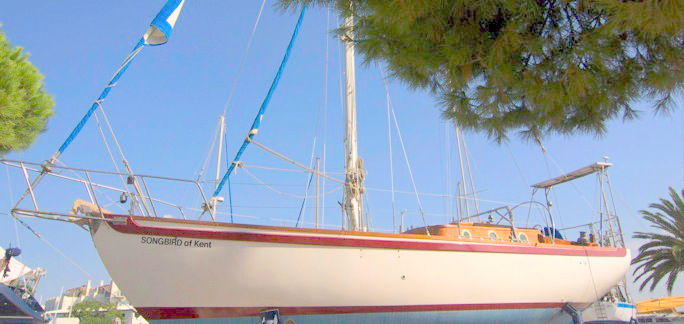


 We found Zero at our local Humane Society. She was just under a year and a half old and had been picked up as a stray so they didn’t know anything about her. When we got her out of her kennel and into the big yard so we could see her more, she hardly even came over to us. There was just something about her, though, and we knew she was the one.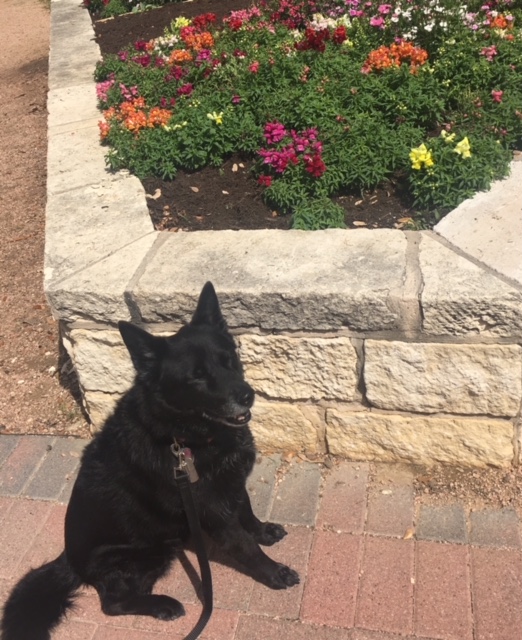
 William Bridges (1995) Bridges’ three-phase transition framework: The first phase, the Ending phase, is about letting go of an old identity, an old reality or an old strategy. The Neutral Zone is akin to crossing the wilderness between the old way and the new. The final phase is making a new beginning and functioning effectively in a new way.

 Learning from Dogs