This is no conundrum: a direct contrast to yesterday.
The benefits of having a dog or two (or nine) are boundless and have been documented for thousands of years. Indeed, a quick web search revealed that Alexander Pope, the 18th-century English poet, is the attributed author of the quote, “Histories are more full of examples of the fidelity of dogs than of friends.”
Nevertheless, it was still a joy to come across the documentary film Dogs On The Inside.
Filmed in a Massachusetts prison, DOGS ON THE INSIDE follows the birth of a relationship between abandoned rescue dogs and prison inmates as they work together toward a second chance at a better life. Giving a voice to a forgotten dog and a forgotten man, the film is a life-affirming testament to the power of second chances.
The film was released in February 2014, and here is the trailer.
In general, it seems to have gathered good reviews with this one from Amazon being typical of what I have seen.
I had tears in my eyes during several segments of this film. Such a lovely connection between the rescue workers and the dogs. Then, the inmates and the dogs. And, finally, the photos of their forever homes and families. Bravo to all at Don’t Throw Us Away. People like you, who work to save and rehab these animals, are amazing.
You are also recommended to read the review that is on the Ecorazzi website. Here’s a flavour of that review:
Two parties neglected and forgotten become the powerful emotional center of an uplifting new documentary, Dogs on the Inside.
We’re taken to Massachusetts, where there exists a unique, mutually-beneficial rehabilitation program that finds rescue dogs paired with prison inmates.
This documentary, from directors Brean Cunningham and Douglas Seirup, follows a handful of inmates at a correctional facility involved in Don’t Throw Us Away, a program that partners them with neglected dogs. For the animal, benefits include exercise, attention, and care while shelters remain crowded. For the prisoners, they have a chance to form connections and work towards parole.
It’s fascinating throughout watching both sides – scared dogs and (emotionally) guarded inmates – warm to one another, seemingly leaving their past behind.
That’s at the heart of this illuminating, heartwarming film: second chances. Early on, it’s easy to see the parallels between these two groups – with the comparisons handled tactfully throughout a film that never strays from its simple, honest goal. Dogs never preaches or calls for political or social change; it more so asks the viewer to be willing to forgive and welcome in those which have been cast aside. When an inmate says, ‘they come from a bad life, they haven’t seen love in while,’ he isn’t necessarily talking just about the dog.
Let me close with this heart-stirring photograph that was included in the above review.
So much to learn from our precious, gorgeous dogs!
Some of you may have noticed a reply left by Marg (aka MargfromTassie) to my post yesterday. In part, this is what Marg wrote:
By the way Paul, you’re 71 now. If you reverse it, and were 17 again – what is the major thing, if any, that you would do differently with your life – knowing what you know now? ( or is this just too difficult?)
In turn, I replied:
What would I do differently? What a fascinating question. Rather than dump the first thing that comes to mind, let me reflect on the question for a while. Who knows? Maybe make it tomorrow’s post?
At first it was very clear what I would have done differently. Namely, had I had the awareness at a much earlier age of the psychological and emotional impact of my father’s death back in December 1956, just six weeks after I had had my twelfth birthday, I would have been a much more emotionally settled person and, in time, a better father to my son and daughter.
Then almost immediately I recognised the conundrum in what I was thinking.
For that subconscious fear of rejection that I carried all the way through my life until 2007, when a local Devon psychotherapist exposed that fear (thank you, J), had both strong positive and negative consequences. The positive consequences far outweighed the negative ones, that were mainly to do with uncertainty over relationships with women.
Because if my previous wife hadn’t announced in December 2006, fifty years to the day after my father died, that she had been unfaithful, I wouldn’t have sought J’s help, wouldn’t have gained the self-awareness that is so vital for all of us, and wouldn’t have met Jean in December 2007. And that has been a positive consequence of unimaginably beautiful measure.
So dear Marg, thank you for your fascinating question but, in the end, if I had the chance I would repeat my life exactly the same way again.
With apologies to any readers who have regarded the above as excessive navel-gazing! But my justification for writing this is to underline the supreme importance of knowing oneself!
Consequently, writing a blog post for today wasn’t high on my list of things to do.
So this is to offer my thanks to everyone who sent me greetings; it was wonderful to hear from so many friends, old and new.
Thus my post today is to share three items that came from family back in England.
First, my mother, who is still teaching piano and oboe at the age of 95, sent me this:
Secondly, my son, Alex, and his long-term partner, Lisa, sent me this in an card chosen from the Friends of the Earth selection:
(All dog owners know, I’m sure, that dogs must never eat chocolate.)
Lastly, my grandson, Morten, who despite being just five-years-old, is already a dab hand with an iPhone and sent me the following picture of himself with Dad in the background:
Finally, my love and gratitude to Jeannie for making me feel special yesterday, as she has done every day since we first met.
What is happening in beautiful Indonesia is beyond imagination.
I am indebted to John Zande for introducing me to the word kakistocracy, that he explained means: “government by the worst persons; a form of government in which the worst persons are in power.”
For what is happening in Indonesia could well be an awful example of kakistocracy in action.
Like numerous others I knew that there were fires burning in Indonesia and that it was all somehow caught up in illegal logging, but knew little over and above that. And that is the crux of the title of a recent essay from George Monbiot: Nothing to See Here. It really is a “must read” essay and is republished below with Mr. Monbiot’s very kind permission. As with most of his essays, they are published in the Guardian newspaper. In this case, the Guardian version includes photographs that vividly underline the terrible situation out there. I agonised about copying them from the Guardian article, without explicit permission to so do, but have nevertheless done so on the basis of this story needing to make the maximum impact on readers. The photographs are inserted in Monbiot’s essay very closely to the format that is presented in the Guardian article.
ooOOoo
Nothing to See Here
30th October 2015
‘Children are being prepared for evacuation in warships already some have choked to death. Species are going up in smoke at an untold rate.’ Photograph: Ulet Ifansasti/Getty Images
In the greatest environmental disaster of the 21st Century (so far), Indonesia has been blotted out by smoke. And the media.
By George Monbiot, published in the Guardian 30th October 2015.
I’ve often wondered how the media would respond when eco-apocalypse struck. I pictured the news programmes producing brief, sensational reports, while failing to explain why it was happening or how it might be stopped. Then they would ask their financial correspondents how the disaster affected share prices, before turning to the sport. As you can probably tell, I don’t have an ocean of faith in the industry for which I work.
What I did not expect was that they would ignore it.
A great tract of the Earth is on fire. It looks as you might imagine hell to be. The air has turned ochre: visibility in some cities has been reduced to 30 metres. Children are being prepared for evacuation in warships; already some have choked to death. Species are going up in smoke at an untold rate. It is almost certainly the greatest environmental disaster of the 21st Century – so far.
[NB: The video that is embedded in the Guardian version is without sound. I have added one that is also a Greenpeace video, with sound, further on in the post.]
And the media? It’s talking about the dress the Duchess of Cambridge wore to the James Bond premiere, Donald Trump’s idiocy du jour and who got eliminated from the Halloween episode of Dancing with the Stars. The great debate of the week, dominating the news across much of the world? Sausages: are they really so bad for your health?
What I’m discussing is a barbeque on a different scale. Fire is raging across the 5000-kilometre length of Indonesia. It is surely, on any objective assessment, more important than anything else taking place today. And it shouldn’t require a columnist, writing in the middle of a newspaper, to say so. It should be on everyone’s front page.
It is hard to convey the scale of this inferno, but here’s a comparison that might help: it is currently producing more carbon dioxide than the US economy. In three weeks the fires have released more CO2 than the annual emissions of Germany.
‘The great debate of the week, dominating the news across much of the world? Sausages: are they really so bad for your health?’ Photograph: Abdul Qodir/AFP/Getty
But that doesn’t really capture it. This catastrophe cannot be measured only in parts per million. The fires are destroying treasures as precious and irreplaceable as the archaeological remains being levelled by Isis. Orang utans, clouded leopards, sun bears, gibbons, the Sumatran rhinoceros and Sumatran tiger, these are among the threatened species being driven from much of their range by the flames. But there are thousands, perhaps millions, more.
One of the burning islands is West Papua, a nation that has been illegally occupied by Indonesia since 1963. I spent six months there when I was 24, investigating some of the factors that have led to the current disaster. At the time, it was a wonderland, rich with endemic species in every swamp and valley. Who knows how many of those have vanished in the past few weeks? This week I have pored and wept over photos of places I loved, that have now been reduced to ash.
Nor do the greenhouse gas emissions capture the impact on the people of these lands. After the last great conflagration, in 1997, there was a missing cohort in Indonesia of 15,000 children under the age of three, attributed to air pollution. This, it seems, is worse. The surgical masks being distributed across the nation will do almost nothing to protect those living in a sunless smog. Members of parliament in Kalimantan (Indonesian Borneo) have had to wear face masks during debates. The chamber is so foggy that they must have difficulty recognising each other.
It’s not just the trees that are burning. It is the land itself. Much of the forest sits on great domes of peat. When the fires penetrate the earth, they smoulder for weeks, sometimes months, releasing clouds of methane, carbon monoxide, ozone and exotic gases like ammonium cyanide. The plumes extend for hundreds of miles, causing diplomatic conflicts with neighbouring countries.
Why is this happening? Indonesia’s forests have been fragmented for decades by timber and farming companies. Canals have been cut through the peat to drain and dry it. Plantation companies move in to destroy what remains of the forest to plant monocultures of pulpwood, timber and palm oil. The easiest way to clear the land is to torch it. Every year, this causes disasters. But in an extreme El Niño year like this one, we have a perfect formula for environmental catastrophe.
The current president, Joko Widodo, is – or wants to be – a democrat. But he presides over a nation in which fascism and corruption flourish. As Joshua Oppenheimer’s documentary The Act of Killing shows, leaders of the death squads that helped murder around a million people during Suharto’s terror in the 1960s, with the approval of the West, have since prospered through other forms of organised crime, including illegal deforestation.
They are supported by a paramilitary organisation with three million members, called Pancasila Youth. With its orange camo-print uniforms, scarlet berets, sentimental gatherings and schmaltzy music, it looks like a fascist militia as imagined by JG Ballard. There has been no truth, no reconciliation; the mass killers are still greeted as heroes and feted on television. In some places, especially West Papua, the political murders continue.
Those who commit crimes against humanity don’t hesitate to commit crimes against nature. Though Joko Widodo seems to want to stop the burning, his reach is limited. His government’s policies are contradictory: among them are new subsidies for palm oil production that make further burning almost inevitable. Some plantation companies, prompted by their customers, have promised to stop destroying the rainforest. Government officials have responded angrily, arguing that such restraint impedes the country’s development. That smoke blotting out the nation, which has already cost it some $30 billion? That, apparently, is development.
Our leverage is weak, but there are some things we can do. Some companies using palm oil have made visible efforts to reform their supply chains; but others seem to move slowly and opaquely. Starbucks, PepsiCo, Kraft Heinz and Unilever are examples. Don’t buy their products until they change.
On Monday, Widodo was in Washington, meeting Barack Obama. Obama, the official communiqué recorded, “welcomed President Widodo’s recent policy actions to combat and prevent forest fires”. The ecopalypse taking place as they conferred, that makes a mockery of these commitments, wasn’t mentioned.
Governments ignore issues when the media ignores them. And the media ignores them because … well there’s a question with a thousand answers, many of which involve power. But one reason is the complete failure of perspective in a deskilled industry dominated by corporate press releases, photo ops and fashion shoots, where everyone seems to be waiting for everyone else to take a lead. The media makes a collective non-decision to treat this catastrophe as a non-issue, and we all carry on as if it’s not happening.
At the climate summit in Paris in December, the media, trapped within the intergovernmental bubble of abstract diplomacy and manufactured drama, will cover the negotiations almost without reference to what is happening elsewhere. The talks will be removed to a realm with which we have no moral contact. And, when the circus moves on, the silence will resume. Is there any other industry that serves its customers so badly?
A quick web search will offer endless pictures of this great tragedy but I will leave you with three; two showing the extent of the smoke and one that is much more an intimate photograph of the suffering animals.
oooo
oooo
In this Thursday, March 1, 2012, Indonesian veterinarian Yenni Saraswati, top center, of Sumatran Orangutan Conservation Programme (SOCP) examines the condition of an injured Sumatran orangutan found by environmental activists at a palm oil plantation in Rimba Sawang village, Aceh province, Indonesia. Conservationists say fires in an Indonesian swamp forest may have killed a third of the rare Sumatran orangutans living there and all of them may be lost this year. Binsar Bakkara, Associated Press.
Monbiot wrote: “Those who commit crimes against humanity don’t hesitate to commit crimes against nature.”
One cannot avoid reflecting that this would not have happened if there hadn’t been, “government by the worst persons; a form of government in which the worst persons are in power.”
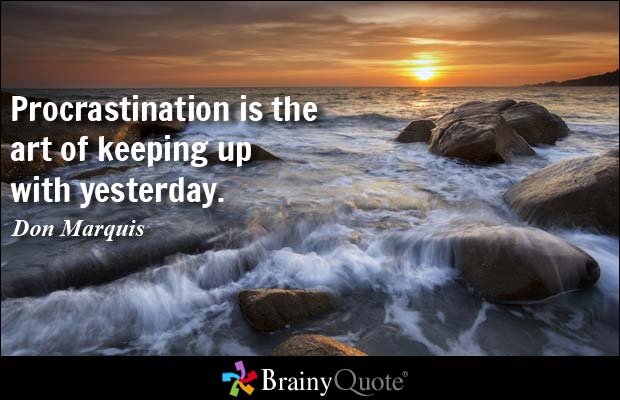
Procrastination is the art of keeping up with yesterday.
Can’t claim credit for the sub-heading; it was taken from BrainyQuote.
However, the reason I went looking for a quotation on procrastinating was that I’m doing research for a fairly “heavy” post for tomorrow, and was looking for something quick and easy for today.
My blog folder came up with an essay from The Conversation website that is rather fun. It is republished here on Learning from Dogs within the terms of The Conversation.
ooOOoo
The psychological origins of procrastination – and how we can stop putting things off
October 7, 2015
Authors: Elliot Berkman, Assistant Professor, Psychology, University of Oregon, and Jordan Miller-Ziegler, PhD Candidate in Psychology, University of Oregon.
“I love deadlines,” English author Douglas Adams once wrote. “I love the whooshing noise they make as they go by.”
We’ve all had the experience of wanting to get a project done but putting it off for later. Sometimes we wait because we just don’t care enough about the project, but other times we care a lot – and still end up doing something else. I, for one, end up cleaning my house when I have a lot of papers to grade, even though I know I need to grade them.
So why do we procrastinate? Are we built to operate this way at some times? Or is there something wrong with the way we’re approaching work?
These questions are central to my research on goal pursuit, which could offer some clues from neuroscience about why we procrastinate – and how to overcome this tendency.
To do, or not to do
It all starts with a simple choice between working now on a given project and doing anything else: working on a different project, doing something fun or doing nothing at all.
The decision to work on something is driven by how much we value accomplishing the project in that moment – what psychologists call its subjective value. And procrastination, in psychological terms, is what happens when the value of doing something else outweighs the value of working now.
This way of thinking suggests a simple trick to defeat procrastination: find a way to boost the subjective value of working now, relative to the value of other things. You could increase the value of the project, decrease the value of the distraction, or some combination of the two.
For example, instead of cleaning my house, I might try to focus on why grading is personally important to me. Or I could think about how unpleasant cleaning can actually be – especially when sharing a house with a toddler.
It’s simple advice, but adhering to this strategy can be quite difficult, mainly because there are so many forces that diminish the value of working in the present.
The distant deadline
People are not entirely rational in the way they value things. For example, a dollar bill is worth exactly the same today as it is a week from now, but its subjective value – roughly how good it would feel to own a dollar – depends on other factors besides its face value, such as when we receive it.
The tendency for people to devalue money and other goods based on time is called delay discounting. For example, one study showed that, on average, receiving $100 three months from now is worth the same to people as receiving $83 right now. People would rather lose $17 than wait a few months to get a larger reward.
Other factors also influence subjective value, such as how much money someone has recently gained or lost. The key point is that there is not a perfect match between objective value and subjective value.
Delay discounting is a factor in procrastination because the completion of the project happens in the future. Getting something done is a delayed reward, so its value in the present is reduced: the further away the deadline is, the less attractive it seems to work on the project right now.
Studies have repeatedly shown that the tendency to procrastinate closely follows economic models of delay discounting. Furthermore, people who characterize themselves as procrastinators show an exaggerated effect. They discount the value of getting something done ahead of time even more than other people.
Not only can completing a project be devalued because it happens in the future, but working on a project can also be unattractive due to the simple fact that work takes effort.
This leads to the interesting prediction that people would procrastinate more the harder they expect the work to be. That’s because the more effort a task requires, the more someone stands to gain by putting the same amount of effort into something else (a phenomenon economists call opportunity costs). Opportunity costs make working on something that seems hard feels like a loss.
Sure enough, a group of studies shows that people procrastinate more on unpleasant tasks. These results suggest that reducing the pain of working on a project, for example by breaking it down into more familiar and manageable pieces, would be an effective way to reduce procrastination.
Your work, your identity
When we write that procrastination is a side effect of the way we value things, it frames task completion as a product of motivation, rather than ability.
In other words, you can be really good at something, whether it’s cooking a gourmet meal or writing a story, but if you don’t possess the motivation, or sense of importance, to complete the task, it’ll likely be put off.
It was for this reason that the writer Robert Hanks, in a recent essay for the London Review of Books, described procrastination as “a failure of appetites.”
The source of this “appetite” can be a bit tricky. But one could argue that, like our (real) appetite for food, it’s something that’s closely intertwined with our daily lives, our culture and our sense of who we are.
So how does one increase the subjective value of a project? A powerful way – one that my graduate students and I have written about in detail – is to connect the project to your self-concept. Our hypothesis is that projects seen as important to a person’s self-concept will hold more subjective value for that person.
It’s for this reason that Hanks also wrote that procrastination seems to stem from a failure to “identify sufficiently with your future self” – in other words, the self for whom the goal is most relevant.
Because people are motivated to maintain a positive self-concept, goals connected closely to one’s sense of self or identity take on much more value.
Connecting the project to more immediate sources of value, such as life goals or core values, can fill the deficit in subjective value that underlies procrastination.
ooOOoo
So there; glad that’s clear for us all.
Mustn’t delay – I need to write down a list of all the things I’m not doing today!
Asteroid 2015 TB145 will pass by Planet Earth – just!
Back in my old country, Halloween is not celebrated in the same style that it is here in America. The Brits tend to favour the evening of November 5th and Guy Fawkes Night. That evening, Bonfire Night, sees fireworks parties in many places.
However, if one starts to think of the dimensions and distances of outer space then our planet is just being spared the firework show to beat all other shows.
I’m referring to Asteroid TB145, a huge asteroid, that will pass Earth at 310,000 miles (498,896 km) or 1.3 times the Earth-moon distance.
UPDATE OCTOBER 30, 2015. A newly found asteroid of notable size – known as asteroid 2015 TB145 – will safely pass Earth on October 31, 2015, according to clocks in North America. It should be visible moving in front of the stars, with the help of a telescope, tonight (October 30). It is the biggest known asteroid that will come this close to Earth until 2027. The asteroid – found as recently as October 10 – will fly past Earth at a safe distance, or about 1.3 times the moon’s distance. Closest approach to Earth will be October 31 at 1 p.m. EDT (1700 UTC). Translate to your time zone here.
Paul Chodas, manager of the Center for Near Earth Object Studies at NASA’s Jet Propulsion Laboratory, Pasadena, California, said:
The trajectory of 2015 TB145 is well understood. At the point of closest approach, it will be no closer than about 300,000 miles – 480,000 kilometers or 1.3 lunar distances. Even though that is relatively close by celestial standards, it is expected to be fairly faint, so night-sky Earth observers would need at least a small telescope to view it.
So how big is this asteroid?
Scientists are continuing to estimate the size at 1,300 feet (400 meters) wide.
If the size is correct, the new found asteroid is 28 times bigger in diameter than the Chelyabinsk meteor that penetrated the atmosphere over Russia in February, 2013. An incoming asteroid’s potential to do damage on Earth depends on various factors, including its size, its angle of entry, and the point on Earth over which it enters the atmosphere. The shock wave from the 2013 Chelyabinsk meteor broke windows and did other damage to some 7,200 buildings in six Russian cities. Some 1,500 people were injured seriously enough to seek medical treatment, mainly from broken glass from windows.
For those of you that want to catch a glimpse of TB145, then:
Asteroid position at 3:50 a.m. ET (0750 UTC) Point a Go To computerized telescope to HIP 24197 or SAO 94377) a naked-eye star with a magnitude of 5 in Orion. At 3:50 a.m. ET on October 31 (Saturday morning), the space rock passes close to this star. The asteroid will appear as a slowly moving ‘star’ passing very close to this star. By this time the asteroid should appear to move faster because it will be closer to Earth than earlier on the night of October 30. This illustration shows a half degree field of view (about the size of a full moon). A pair of double stars visible in this area should confirm you are pointing at the correct direction. Alternatively, you can point your telescope to these coordinates: RA 05h 11m 41.6s / DEC +16º 02′ 44.5″. Illustration by Eddie Irizarry using Stellarium.
Full details and answers to most of your questions may be found here.
All I can say is I hope the number crunchers have got their sums right!
If not, then it’s goodnight from her and goodnight from me.
It was nice knowing you all!
P.S. If you think this is all a bit far-fetched, then this video sent to me by Dan Gomez will bring you down to earth.
I feel a little guilty at just dropping this full article in your path, and running away, so to speak, but yesterday was one of those days where Jean and I were “full on” for most of the day, and then out from the house from 4pm onwards.
It doesn’t lessen the interest, in my humble opinion, of this essay, that was recently published by The Conversation, and is republished within their terms.
ooOOoo
New DNA analysis says your pooch’s ancestors were Central Asian wolves
October 20, 2015
Author: Laura Shannon, Postdoctoral Research Associate in Biological Sciences, Cornell University
Dogs’ origin story goes something like this: sometime between 16,000 and 30,000 years ago, there were some stressed-out hungry wolves whose hunting territory had been encroached upon by humans. Luckily, these wolves were resourceful and they noticed human beings have a tendency to leave delicious things lying around. Scavenging leftovers seemed significantly easier than going out and hunting, so they hung around the people.
Wolves make unnerving neighbors. However, some are less unnerving than others. The humans were a lot more inclined to tolerate the proximity of less aggressive, more people-oriented wolves. As an added bonus, other predators are less likely to harass you when you are surrounded by wolves. So the people and the nicest wolves came to an agreement – the people tolerated and fed the tamest and most helpful wolves.
Smart, tame wolves have smarter, tamer wolf cubs, and so over time the wolves became more and more pleasant to have around. Obviously, friendly, helpful wolves hanging around people and eating leftovers aren’t really wolves; we have a word for those things – they’re dogs.
That’s biologists’ reasonable guess for how dogs came about. We have some idea when it all happened, but it’s been harder to figure out where. Who first took in scavenging gray wolves and turned them into dogs?
Dogs still know a good thing when they see it – warmth and food with people ‘round the campfire. Camping image via http://www.shutterstock.com.
However, the oldest dog bones anyone has found are from the other end of Eurasia, all the way in Northern Europe. Furthermore, the mitochondria of modern dogs are closely related to the mitochondria of ancient European wolves.
Finally, Middle Eastern wolves share the most genetic sequences with today’s dogs, which makes it seem like maybe Middle Eastern wolves are the ancestral wolf population.
All these threads of evidence broadly agree that dogs are from somewhere in Eurasia. But my colleagues and I wanted to narrow that down a bit – and to do that, we decided we needed DNA from as many dogs as possible for our new study.
Team members sampling a village dog in the Pacific Islands. Adam Boyko, CC BY-ND
Modern dogs cover the globe
Dogs are found almost everywhere people are, and over time we have bred them to do everything from guarding livestock to going fishing. The breeds we’ve created come in many shapes and sizes, ranging from tiny Chihuahuas to giant Great Danes. The vast majority of these breeds are less than 200 years old and come from Europe. But these purebred dogs or even mixes of these breed dogs are the minority of dogs on the planet.
Most dogs are free-ranging village dogs, which live around and among people but aren’t necessarily what you’d think of as pets. You can learn more about ancient dogs by studying these village dogs (as compared to studying breed dogs) because village dogs have more genetic diversity; the number of different versions of the same genes in village dogs is higher than it is in breed dogs.
All dogs were formed from a select group of wolves, and therefore have a subset of the genetic diversity found in wolves. But breeds were formed from a subset of dogs so they have only a further subset of the diversity found in dogs.
In the cradle of dogkind? Coss and Johanna, CC BY-NC
Tracing the trail through DNA sequences
Members of our lab traveled to collect blood or spit from dogs in a variety of locales, and collaborators sent us fluids from places to which we didn’t manage to travel. Village dogs are fairly easy to find for researchers carrying food. In total, we extracted DNA from the fluids of 549 dogs from 38 countries spanning the majority of the globe as well as 4,676 purebred dogs. Our lab at Cornell is conveniently located in the same building as a veterinary hospital, so most of our purebred dogs were patients.
Once we had our samples, we then determined each dog’s genotype at about 180,000 distinct points in the genome. This is the largest data set anyone has used to address the question of dog origins so far.
We were looking for a very specific pattern of historical genetic diversity. When a select group of wolves became dogs, those dogs contained only the genetic diversity present in that subset of wolves. When people took some of the dogs and moved on to new regions of the globe, or traded dogs with people in other regions, they took only a subset of the total dogs, and by extension a subset of the total diversity.
Therefore, we expect the original population of dogs to be the most diverse. There would be a gradient of decreasing diversity in all populations as they move away from the center of origin.
And this is the pattern we observed when we compared the genetics of dogs from different populations. Dogs from Central Asia, Mongolia and Nepal are the most diverse, with genomes that correspond to the early, original variation in the population right after domestication happened. When we look at the same DNA markers in dogs from neighboring regions, diversity decreases. It decreases further corresponding to the location’s increasing distance from Central Asia. This is the pattern we would expect if the people who first took in scavenging gray wolves and turned them into dogs were located in Central Asia.
Even dogs we sampled in the Pacific Islands traced their forebears back to Central Asia. Adam Boyko, CC BY-ND
Looking at the largest data set of dogs amassed so far, we observe a very clear signal that most dogs alive today descended from dogs in Central Asia. However, we only looked at dogs alive right now. We have no information about historical populations of dogs that have no living descendants. Furthermore, the patterns of diversity we observe are reflective of the origins of dogs but also of everything that has happened to dog populations since domestication.
Other research groups are extracting DNA from bones of ancient dogs, and these sequences will provide exciting new insights from time points closer to domestication. However, ancient DNA studies are limited by the availability of ancient dog bones – which is affected by many factors other than the distribution of historic populations; for instance, some environments are more conducive to the preservation of bone and DNA than others, some regions have been more extensively investigated by archaeologists than others, and so on. If we see similar patterns in ancient and modern dogs, that will add clarity to the history of dogs and the people who love them.
ooOOoo
Ultimately, it doesn’t matter one hoot, in a non-scientific sense, from where our dogs are descended. Just that they did evolve.
For human life without our dogs would be unthinkable.
Communicating with written words may be older than we can possibly imagine. Yet, despite the very modern world of digital communications, the power of communicating with written words is probably more widespread than ever before. Let’s just dip into the world of blogging, or more accurately put, let’s dip into the world of WordPress blogging. The quickest of web searches revealed that:
74.6 Million Sites Depend on WordPress
Yep, you read that right. 74,652,825 sites out there are depending on good ol’ WordPress. That’s one site per person in Turkey.
Around 50% of this figure (close to 37 million) is hosted on the free WordPress.com.
Or try this amazing fact:
6 New WordPress.com Posts Every Second
That’s right. Every second, close to 6 (the actual figure is 5.7) new posts are published on WordPress.com blogs. That averages out to 342 posts per minute. Just above 20,000 per day. And a grand total of 7.49 million annually.
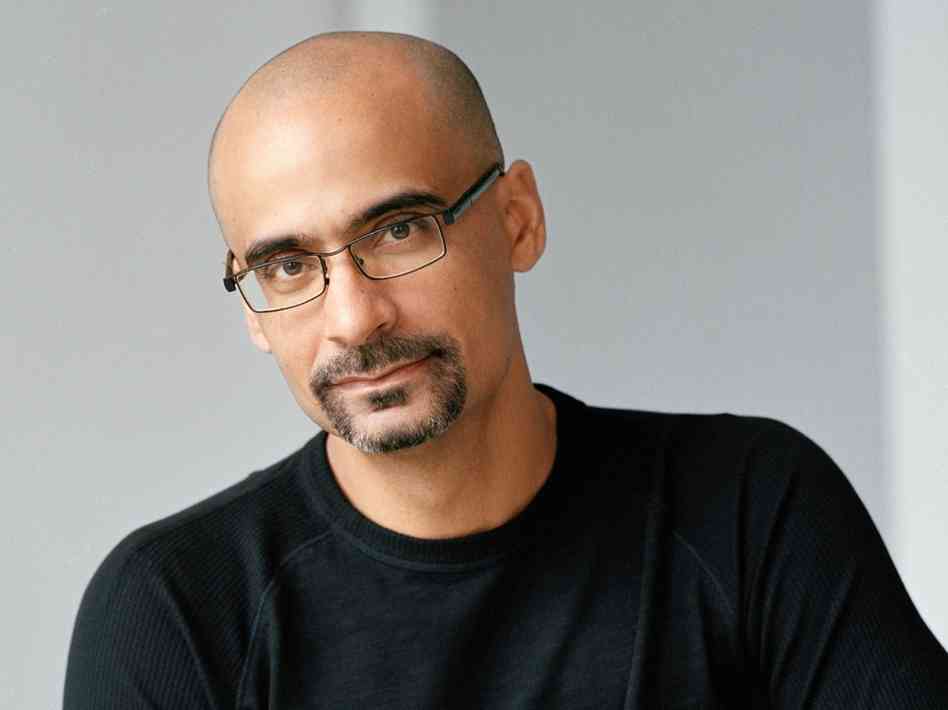
If you are wondering what brought on this rash of discovery, it was me wanting to find a way of introducing a talk that was recently given by Junot Díaz. Wikipedia explains that:
Junot Díaz (born December 31, 1968) is a Dominican American writer, creative writing professor at Massachusetts Institute of Technology (MIT), and fiction editor at Boston Review. He also serves on the board of advisers for Freedom University, a volunteer organization in Georgia that provides post-secondary instruction to undocumented immigrants. Central to Díaz’s work is the immigrant experience. He received the Pulitzer Prize for Fiction for his novel The Brief Wondrous Life of Oscar Wao, in 2008. He is a 2012 MacArthur Fellow.
Junot Díaz
Recently, the Big Think blog had an article by Díaz that I wanted to share with you dear readers of Learning from Dogs. For it struck me as a wonderful reminder of the power of writing and, especially, the power of writing fiction.
For reasons that I don’t understand the video in that Big Think piece is longer than the version that is on YouTube. So, watch the YouTube version coming up now, and if you want more then click the link just below that YouTube insertion.
Literature, explains Pulitzer-winning writer Junot Díaz, is the closest that we’ve come to telepathy. It’s through literature that we educate our souls by transporting ourselves into some other character’s mind. It builds empathy. It allows for new perspectives. It triggers provocation in all the best ways. Novels aren’t as popular a medium today as something like Twitter, but that doesn’t mean they’re not still hugely important.
The summary posted above was taken from the Big Think site, and if you go there you can read more, and watch the full 4-minute version of the video.
Finally, this coming Sunday is the 1st November, and November is the month for National Novel Writing Month. Whether or not you wonder if you have a full novel inside you, even if you have the slightest curiousity, pop over to the NaNoWriMo website and get involved!
The terrible shooting here in Oregon back on the 1st October doesn’t need to be reminded of. Or does it?
For there was a beautiful story that came out of that terrible event that I want to share with you, some three weeks after that tragic day. The story was sent to me by Dan Gomez and appeared on AKC News.
ooOOoo
OREGON SHOOTING VICTIM’S SERVICE DOG STAYED BY HER SIDE UNTIL THE VERY END
By: Mara Bovsun
Sarena Moore’s dream was to someday open a ranch where she would train horses as therapy animals for handicapped children.
She was pursuing that dream as a business student at Oregon’s Umpqua Community College on October 1, when Christopher Harper-Mercer, 26, burst into her classroom and started shooting, killing nine. Moore, 44, was among them.
She was in her wheelchair, which she needed for debilitating back pain, and her service dog, Bullet, was by her side, when Harper-Mercer burst into their classroom. He ordered the teacher and students to get on the floor. When Moore complied, eyewitness Tracy Heu told the New York Times, the gunman told her to climb back into the chair. She then became his first victim.
Travis Dow, Moore’s fiancé, learned that Moore was among the dead in the massacre, and assumed the dog was gone, too. The next day, he learned that the killer had spared Bullet when police came to his door with the bewildered dog on a leash.
Bullet stayed by Moore’s side through the ordeal, witnesses said, as he had been trained to do.
“He knows she ain’t coming home because he was there when the fatal day happened,” Dow told CNN. Bullet had lived with the couple for seven months and she had trained him to be her helper.
In a statement released by her family, Moore was remembered as a lifelong animal lover. During her teens, she practiced gymnastics on horseback. At the same time, she also raised money to help disabled people learn to ride. “She had a caring heart that was bigger than life itself,” the family wrote. Her Facebook page was filled with images of animals, most recently there were many pictures of her new service dog.
Now, as Dow and Bullet face the world without the kind woman with the bright smile, they’ll lean on one another for strength. “[Bullet] was her world. He was not only her dog, [but] her best friend, beside me” Dow told CNN.
In the wake of the tragedy, other canine comforters traveled to Roseburg, Oregon, to help the community cope. Here’s their story.
ooOOoo
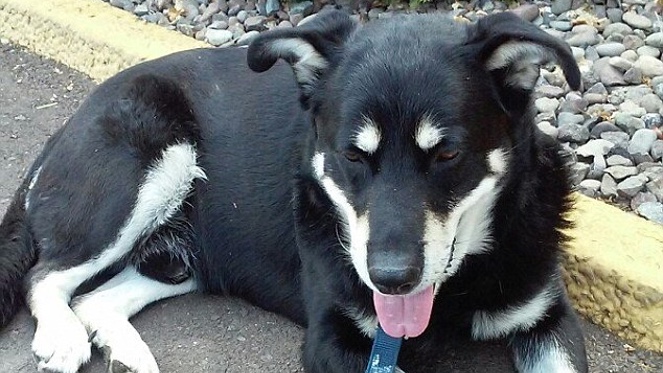
I can do no better than to close today’s post with a photograph of Bullet.