Continuing our journey downstream the Rogue River.
Now we are rafting!
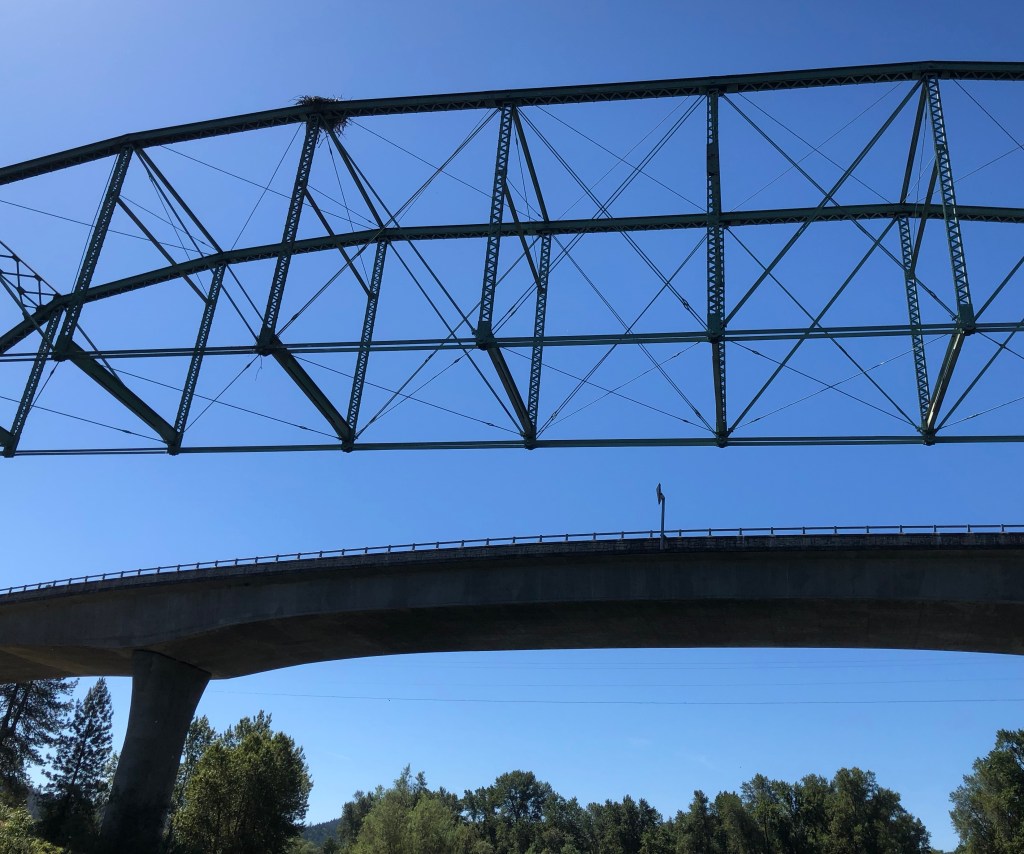
Fairly quickly we pass under Robertson Bridge.
In fact there are two bridges; the old metal one and the modern concrete one.
But way on top of the metal bridge is an osprey’s nest.
We continue.
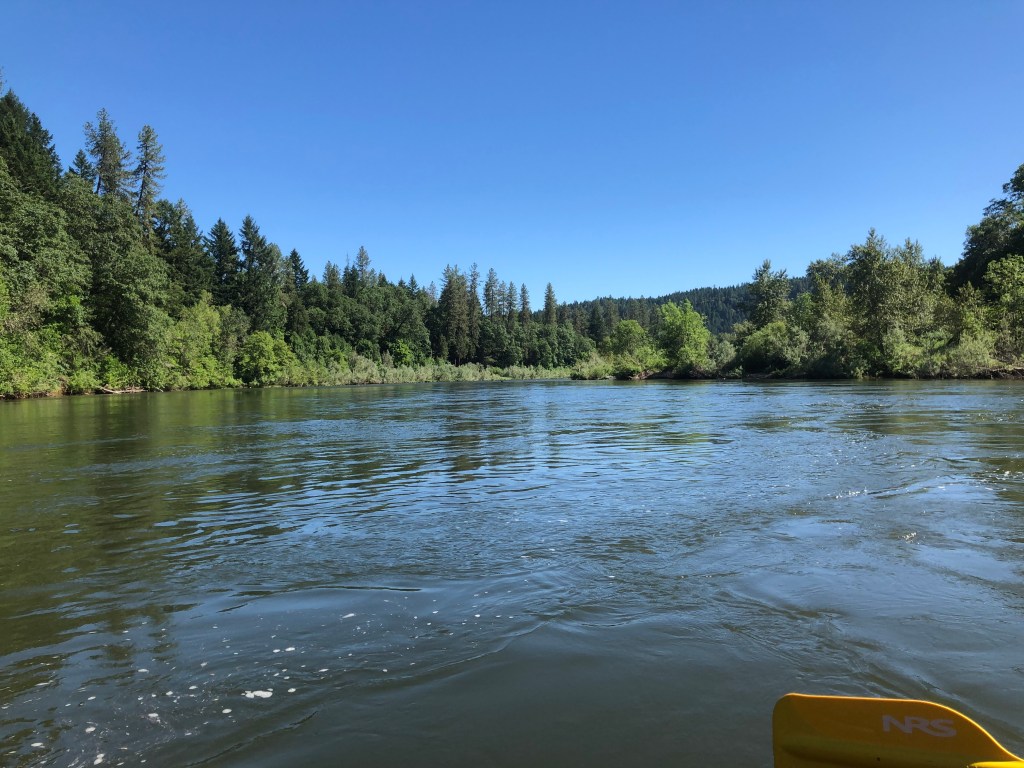
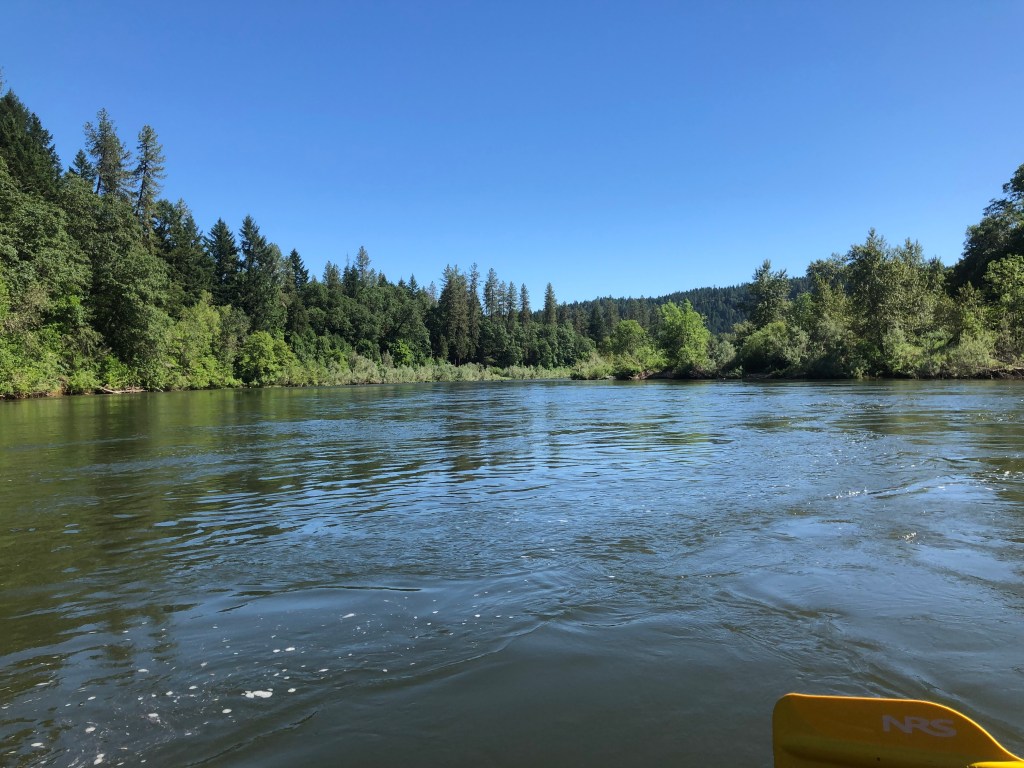
The river, flowing at 2,800 cubic feet per second we are told, flows into the gorge.
Behind us are the two kayaks. The one on the left is permanently manned by Christian, one of the guides, and the other one is available for anyone who wants to have a go.
Deeper into the gorge we go.
It is wild country.
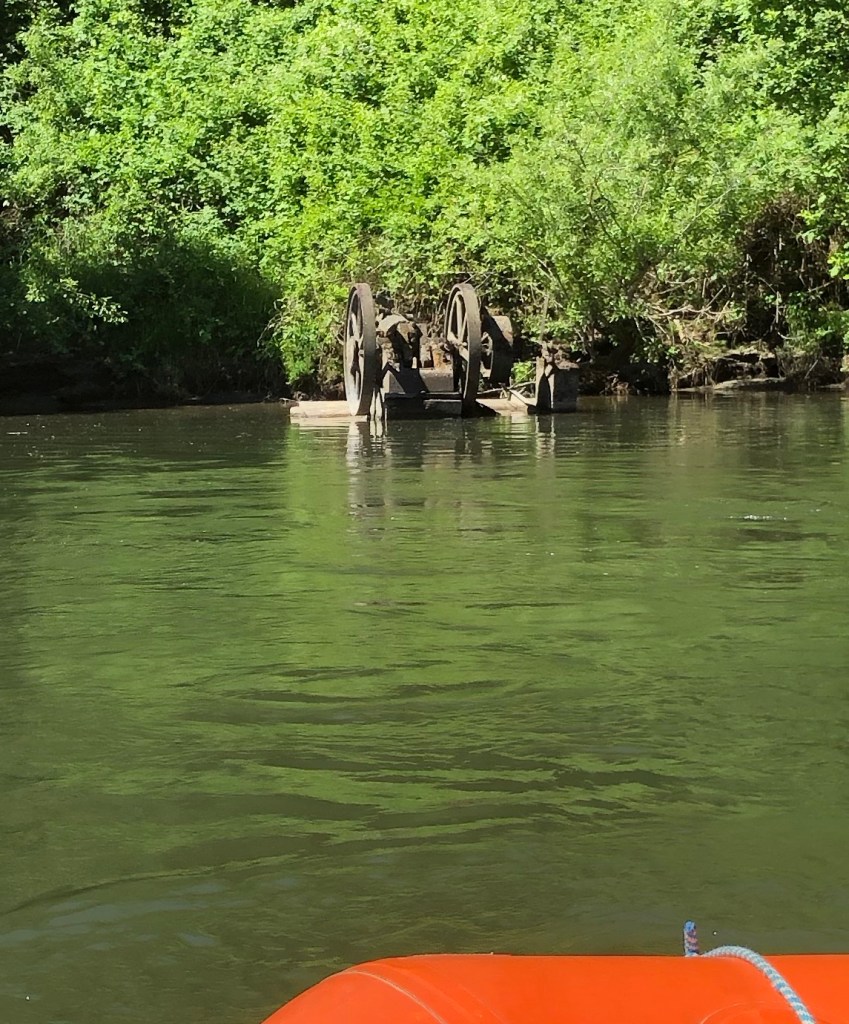
We pass an old pump that some years ago was displaced by a flooding Rogue!
And as the gorge narrows the flow of the river becomes more agitated and the start of the white-water section beckons.
The experience of rafting downstream the Rogue River.
It is Tuesday, 4th June. It is 08:45.
We are early because we are excited and because the location that we have to go to is just four miles from home.
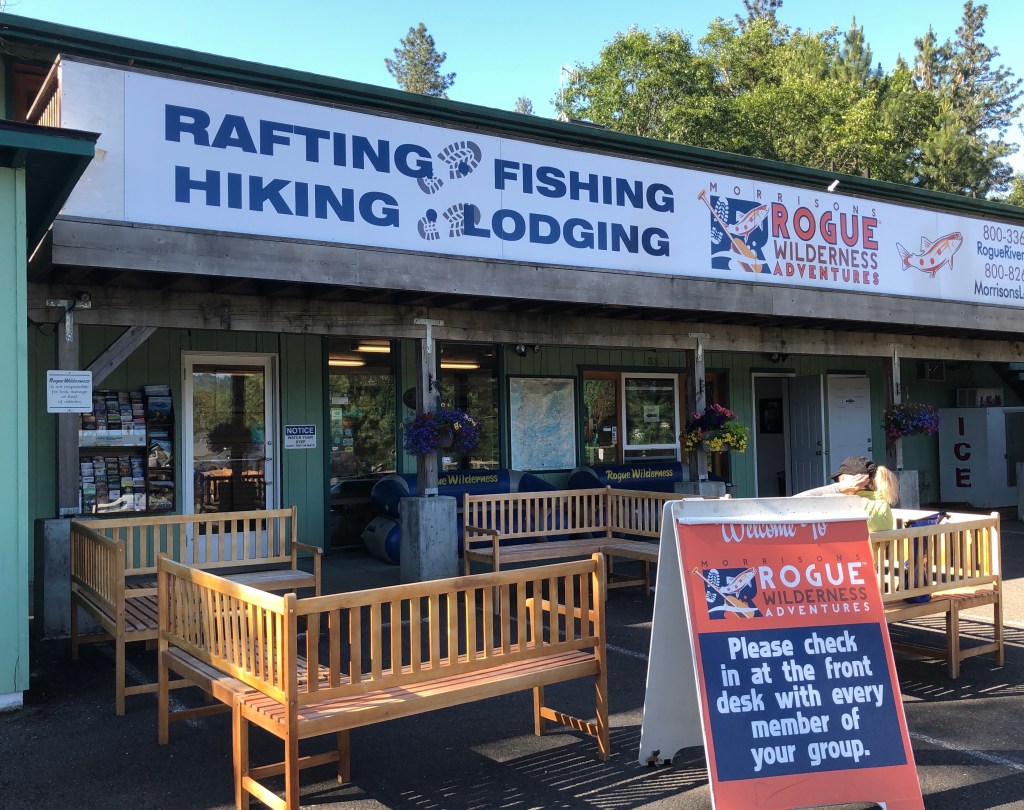
Morrisons Rafting
Neither of us have done anything like this before. But we decided to book just a half-day trip because a) the weather was warm but not roasting, and b) it was a local event and we would be back home by lunchtime to let the dogs out.
Inevitably we are early so I can’t resist wandering around the back to where the guides were loading up the truck.
Then it is time to check in.
Almost immediately we are fitted with the appropriately sized personal buoyancy protector.
Jean is ready to go!
At first we thought we were the only people going on the 9:30 trip but then a family booked in but they were going for an all-day rafting trip. But all of us on the same first raft.
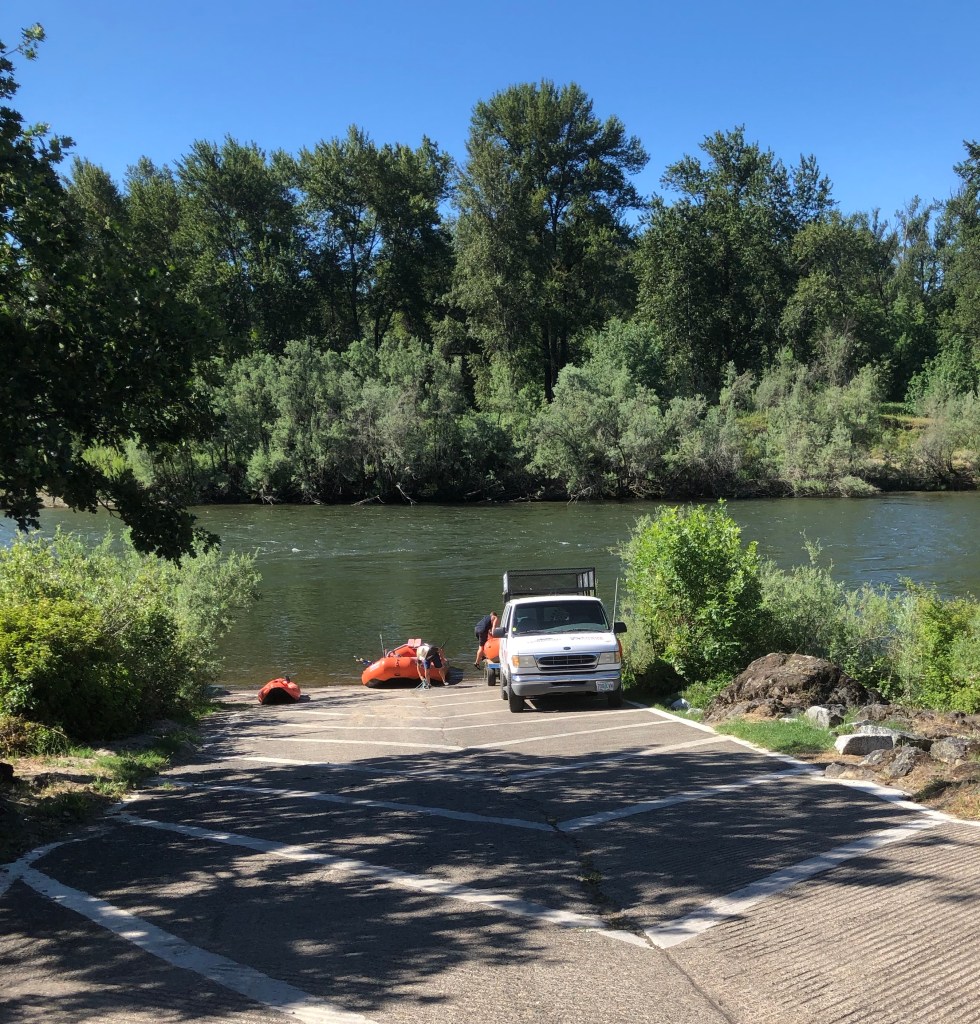
The coach towing the dinghies and kayaks, and carrying all of us, left Merlin and in about 15 minutes time came down to Robertson Bridge boat jetty where we all stepped out and assembled at the head of the ramp while the crew unshipped the dinghies and kayaks and got them ready for boarding.
oooo
We were all going in a single dinghy and the other one was, I guess, a spare. It was put to one side. But the two kayaks were coming.
It’s all too easy to forget that a dog can’t cope with hot weather.
As in too hot. Especially in a car!
I want to republish a post that appeared on The Dodo blog site recently. It is about a dog trapped in a car when it was far too hot.
ooOOoo
Guy Sees Puppy In Hot Car And Realizes What He Has To Do
Photo Credit: Jason Minson
Jason Minson, an Army veteran who runs a landscaping business, was out on a job in Norfolk, Virginia, on Tuesday when the first of several unusual things happened.
Minson was inspecting a tree in a yard when he heard a bang on the street.
When he went to check, he realized that a car driving by had bumped another car parked on the street. If that hadn’t happened, Minson probably never would have approached the parked car and discovered what was inside.
A black Labrador puppy was sprawled out on the floor of the vehicle — the noise and shudder seemed to have woken him up for a moment.
And he was incessantly panting.
“It was the kind of panting that was the last effort a dog does to try to cool himself off,” Minson told The Dodo.
Photo Credit: Jason Minson
Minson immediately called 911.
The police dispatched a unit to come help the dog — but they also informed Minson that breaking the window of the car to free the dog is a crime. (The law varies depending where you are.)
Minson watched the panting puppy from behind the pane of glass. He brought one bottle of water to the sliver of opened window and the dog jumped up on the seat and started drinking from it.
The dog went through the whole bottle. And then another.
“I’m usually a pretty cool, level-headed person but I was kind of fed up,” Minson said.
Photo Credit: Jason Minson
An animal control officer arrived and she started to try to pry the door open, but it wasn’t working. And nearly 20 minutes had passed since Minson had found the dog — and he was worried they were already out of time.
“The dog had laid back down on the floor of the car and wasn’t panting as quickly,” Minson said.
“I honestly didn’t think this pup was going to make it,” Minson wrote.
That’s when he took matters into his own hands.
“Charge me,” he can be heard saying in one of the videos he shot, “I don’t give a sh*t at this point.”
Using the baton from the animal control officer, Minson smashed the window and opened the door.
The animal control officer rushed the dog over to her van and took him to the vet for urgent care. And the owner of the dog was charged by the police. Minson received a call from the police, too — but to be a witness at the hearing about the incident.
The following day, Minson went to visit the pup at the facility where he’s recovering. Already, the dog seemed to be much stronger.
Photo Credit: Jason Minson
Minson, who has a Great Dane, hopes that if someone saw his dog in trouble in any way that they would do something about it.
“This is REAL talk people,” Minson wrote on Facebook after the dog was saved. “It’s hot out and if you leave an animal in your car [he’s] going to die from the heat … Take care of your fur babies.”
ooOOoo
I can’t think of a more dramatic way of telling you about the perils of dogs in cars in hot weather!
This was read quickly towards the end of the day, as in yesterday, but I thought it well worthwhile rescheduling my doggie article until Saturday and putting this in for today.
Later on yesterday it was read more thoroughly and it is full of fascinating information such as the weight of meteorites that fall onto Planet Earth each day. I wasn’t aware of that.
Anyway, hope you too find it of interest.
ooOOoo
The tell-tale clue to how meteorites were made, at the birth of the solar system
Assistant Professor of Earth and Environmental Sciences, Wesleyan University
June 6th, 2019.
April 26, 1803 was an unusual day in the small town of L’Aigle in Normandy, France – it rained rocks.
Over 3,000 of them fell out of the sky. Fortunately no one was injured. The French Academy of Sciences investigated and proclaimed, based on many eyewitness stories and the unusual look of the rocks, that they had come from space.
The Earth is pummeled with rocks incessantly as it orbits the Sun, adding around 50 tons to our planet’s mass every day. Meteorites, as these rocks are called, are easy to find in deserts and on the ice plains of Antarctica, where they stick out like a sore thumb. They can even land in backyards, treasures hidden among ordinary terrestrial rocks. Amateurs and professionals collect meteorites, and the more interesting ones make it to museums and laboratories around the world for display and study. They are also bought and sold on eBay.
Despite decades of intense study by thousands of scientists, there is no general consensus on how most meteorites formed. As an astronomer and a geologist, we have recently developed a new theory of what happened during the formation of the solar system to create these valuable relics of our past. Since planets form out of collisions of these first rocks, this is an important part of the history of the Earth.
This meteor crater in Arizona was created 50,000 years ago when an iron meteorite struck the Earth. It is about one mile across. W. Herbst, CC BY-SA
The mysterious chondrules
Drew Barringer (left), owner of Arizona meteor crater, his wife, Clare Schneider, and author William Herbst in the Van Vleck Observatory Library of Wesleyan University, where an iron meteorite from the crater is on display. W. Herbst
About 10% of meteorites are pure iron. These form through a multi-step process in which a large molten asteroid has enough gravity to cause iron to sink to its center. This builds an iron core just like the Earth’s. After this asteroid solidifies, it can be shattered into meteorites by collisions with other objects. Iron meteorites are as old as the solar system itself, proving that large asteroids formed quickly and fully molten ones were once abundant.
The other 90% of meteorites are called “chondrites” because they are full of mysterious, tiny spheres of rock known as “chondrules.” No terrestrial rock has anything like a chondrule inside it. It is clear that chondrules formed in space during a brief period of intense heating when temperatures reached the melting point of rock, around 3,000 degrees Fahrenheit, for less than an hour. What could possibly account for that?
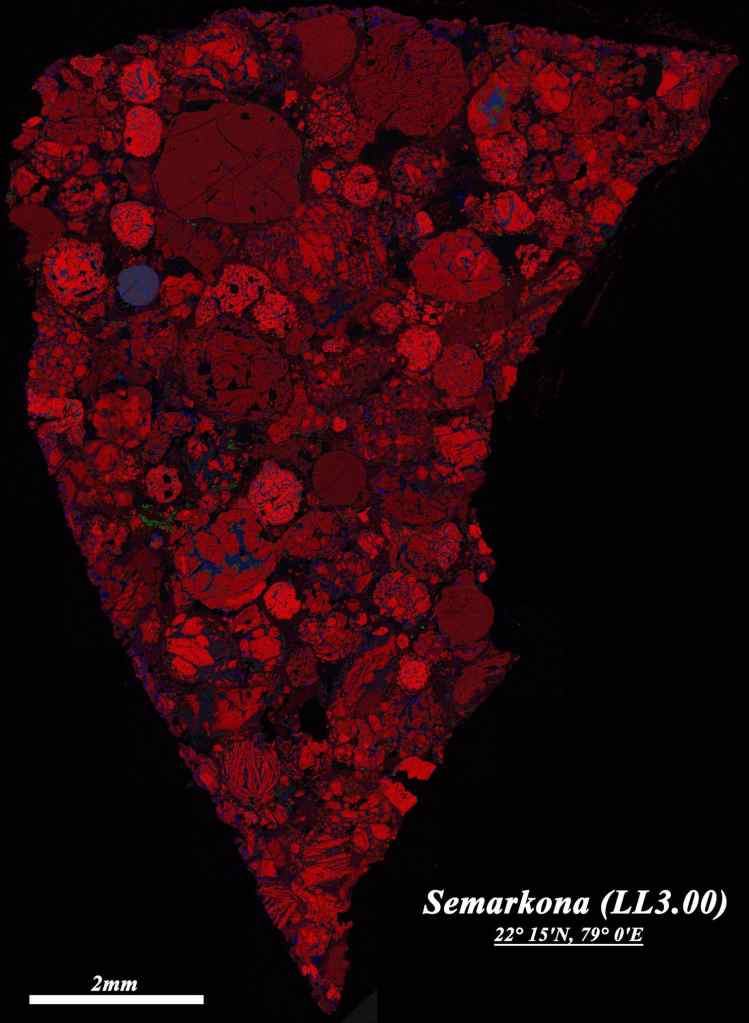
A closeup of the Semarkona meteorite showing dozens of chondrules. Kenichi Abe
Researchers have come up with many hypotheses through the last 40 years. But no consensus has been reached on how this brief flash of heating happened.
The chondrule problem is so famously difficult and contentious that when we announced to colleagues a few years ago that we were working on it, their reaction was to smile, shake their heads and offer their condolences. Now that we have proposed a solution we are preparing for a more critical response, which is fine, because that’s the way science advances.
The flyby model
Our idea is quite simple. Radioactive dating of hundreds of chondrules shows that they formed between 1.8 and 4 million years after the beginning of the solar system – some 4.6 billion years ago. During this time, fully molten asteroids, the parent bodies of the iron meteorites, were abundant. Volcanic eruptions on these asteroids released tremendous amounts of heat into the space around them. Any smaller objects passing by during an eruption would experience a short, intense blast of heat.
To test our hypothesis, we split up the challenge. The astronomer, Herbst, crunched the numbers to determine how much heating was necessary and for how long to create chondrules. Then the geologist, Greenwood, used a furnace in our lab at Wesleyan to recreate the predicted conditions and see if we could make our own chondrules.
Laboratory technician Jim Zareski (top) loads a programmable furnace as co-author Jim Greenwood looks on, in his laboratory at Wesleyan University. This is where the synthetic chondrules are made. W. Herbst
The experiments turned out to be quite successful.
We put some fine dust from Earth rocks with compositions resembling space dust into a small capsule, placed it in our furnace and cycled the temperature through the predicted range. Out came a nice-looking synthetic chondrule. Case closed? Not so fast.
Two problems emerged with our model. In the first place, we had ignored the bigger issue of how chondrules came to be part of the whole meteorite. What is their relationship to the stuff between chondrules – called matrix? In addition, our model seemed a bit too chancy to us. Only a small fraction of primitive matter will be heated in the way we proposed. Would it be enough to account for all those chondrule-packed meteorites hitting the Earth?
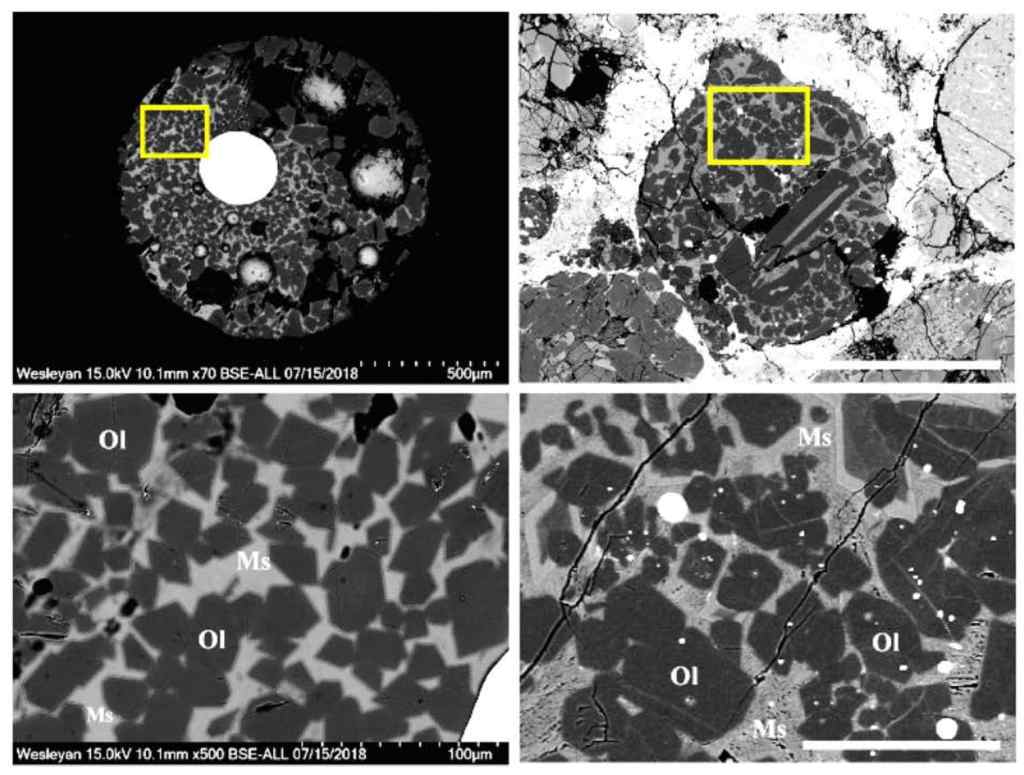
A comparison of a synthetic chondrule (left) made in the Wesleyan lab with a heating curve from the flyby model, with an actual chondrule (right) from the Semarkona meteorite. The crystal structure is quite similar, as shown in the enlargements (bottom row). J. Greenwood
Making whole meteorites
To address these issues, we extended our initial model to consider flyby heating of a larger object, up to a few miles across. As this material approaches a hot asteroid, parts of it will vaporize like a comet, resulting in an atmosphere rich in oxygen and other volatile elements. This turns out to be just the kind of atmosphere in which chondrules form, based on previous detailed chemical studies.
We also expect the heat and gas pressure to harden the flyby object into a whole meteorite through a process known as hot isostatic pressing, which is used commercially to make metal alloys. As the chondrules melt into little spheres, they will release gas to the matrix, which traps those elements as the meteorite hardens. If chondrules and chondrites form together in this manner, we expect the matrix to be enhanced in exactly the same elements that the chondrules are depleted. This phenomenon, known as complementarity, has, in fact, been observed for decades, and our model provides a plausible explanation for it.
The authors’ model for forming chondrules. A small piece of rock (right) — a few miles across or less — swings close to a large hot asteroid erupting lava at its surface. Infrared radiation from the hot lava briefly raises the temperature on the small piece of rock high enough to form chondrules and harden part of that object into a meteorite. W. Herbst/Icarus
Perhaps the most novel feature of our model is that it links chondrule formation directly to the hardening of meteorites. Since only well-hardened objects from space can make it through the Earth’s atmosphere, we would expect the meteorites in our museums to be full of chondrules, as they are. But hardened meteorites full of chondrules would be the exception, not the rule, in space, since they form by a relatively chancy process – the hot flyby. We should know soon enough if this idea holds water, since it predicts that chondrules will be rare on asteroids. Both Japan and the United States have ongoing missions to nearby asteroids that will return samples over the next few years.
If those asteroids are full of chondrules, like the hardened meteorites that make it to the Earth’s surface, then our model can be discarded and the search for a solution to the famous chondrule problem can go on. If, on the other hand, chondrules are rare on asteroids, then the flyby model will have passed an important test.
We took a rafting trip down the Rogue River yesterday (the 4th) and when I have finished transferring the photographs from my iPhone to my computer I will write a post on the journey.
But for today’s post I want to republish an item that appeared also yesterday in EarthSky.
“Mud ball” meteorites – full of clays, organics and water – are unique among space rocks. And a lot of them fell in April 2019 on a small town in Costa Rica, much to the delight of scientists.
This meteorite from the fall at Aguas Zarcas, Costa Rica, in April hit a doghouse. Luckily, the dog – Rocky – was unharmed. Image via Michael Farmer/ASU.
Meteorite falls on Earth are fairly common, but not all meteorites are the same. Some of them are “mud balls,” rich in clays, organic compounds and water-bearing minerals, called carbonaceous chondrites. They are of great interest to scientists, due to their unique composition, and now a bunch more prime specimens have been found, which rained down after a large fireball was seen over Aguas Zarcas, a small town in Costa Rica, on April 23, 2019.
The fireball was a meteor, or space rock, entering the Earth’s atmosphere that broke apart into hundreds of smaller pieces. When the pieces of this rock hit the ground, their name changed to meteorite. One meteorite fragment weighed about two pounds and smashed through the roof of a house, destroying the owner’s dining table. Another one crashed through the roof of a dog house, narrowly missing a sleeping dog. Close calls!
The doghouse with the hole in its roof from the April 2019 meteorite in Costa Rica. The dog, Rocky, was sleeping in the doghouse at the time; he was unharmed, but probably surprised! Image via Michael Farmer/ASU.
Several of the meteorites were collected and sent to Arizona State University (ASU) for study, donated by meteorite collector Michael Farmer. ASU will also be able to purchase additional meteorites from the fall, thanks to a private donor. This is the first time in 50 years that the university has had a chance to analyze such pristine samples of extraterrestrial mud balls. As Laurence Garvie, a research professor at ASU and a curator for its Center for Meteorite Studies, said:
Many carbonaceous chondrites are mud balls that are between 80 and 95 percent clay. Clays are important because water is an integral part of their structure. These had to be collected quickly and before they got rained on. Because they are mostly clay, as soon as these types of meteorites get wet, they fall apart.
Luckily, the researchers were able to collect their samples before it rained again, and they got a nice little haul, too, about 55 pounds (25 kilograms) of the precious space rocks.
A composite element map from one of the meteorites showing the distribution of different minerals. Orange-yellow colors show tochilinite, deep-blue colors represent olivine, and red colors are pentlandite and pyrrhotite. Image via ASU.
Analysis of the meteorites was carried out at ASU’s campus in Tempe, Arizona. According to Garvie:
I was in the lab by 5 a.m. the next morning after picking up the samples to get them ready for the initial analyses. Classification of new meteorites can be like a race with other institutions, and I needed ASU to be first so that we’ll have the recognition of being the collection that holds and curates the type specimen material.
Air-sensitive meteorites like these are kept in special nitrogen cabinets. The nitrogen gas helps to preserve the meteorites, which can degrade easily due to their composition. As Garvie explained:
If you left this carbonaceous chondrite in the air, it would lose some of its extraterrestrial affinities. These meteorites have to be curated in a way that they can be used for current and future research, and we have that ability here at ASU.
This mud ball meteorite fragment from April’s meteorite fall in Aguas Zarcas, Costa Rica, looks a bit like an arrowhead. Image via ASU.
The classification of these meteorites is part of a broader international classification effort. Garvie is also working with Karen Ziegler from the Institute of Meteoritics at the University of New Mexico. They studied the oxygen isotopes of the meteorites, to determine how similar they are to other carbonaceous chondrites.
Sandra Pizzarello, an organic chemist from ASU’s School of Molecular Sciences, is also involved in the studies, focusing on the organic content of the meteorites. These kinds of organics could have provided the material needed for life to begin on Earth.
Additional scientific analysis will follow later, but first the meteorites need to be approved, classified and named by The Meteoritical Society‘s nomenclature committee. This group of 12 scientists is responsible for approving all meteorite samples for study.
These new meteorite samples are currently on display at ASU’s Tempe campus in the Center for Meteorite Studies collection.
So, why are mud ball carbonaceous chondrite meteorites so significant?
They are thought to originate from asteroids that are leftovers from early planetesimals, planets that started to form in the early solar system billions of years ago but now no longer exist. Those planets had organic materials and water, making them places where the chemical precursors to life could have started. In the case of the asteroid that these new meteorites originated from, Garvie said:
It formed in an environment free of life, then was preserved in the cold and vacuum of space for 4.56 billion years, and then dropped in Costa Rica last week.
Carbonaceous chondrites are relatively rare among meteorites but are some of the most sought-after by researchers because they contain the best-preserved clues to the origin of the solar system. This new meteorite represents one of the most scientifically significant additions to our wonderful collection in recent years.
Because these meteorites contain so much mineral-bound water, they could also be useful in learning how water can be extracted from asteroids, a great resource for future astronauts. According to Garvie:
Having this meteorite in our lab gives us the ability, with further analysis, to ultimately develop technologies to extract water from asteroids in space.
Location of Aguas Zarcas in Costa Rica. Image via Google Maps.
The last time a carbonaceous chondrite meteorite fall similar to this one occurred was in 1969 near Murchison, Australia. Those meteorites were curated by another ASU professor and founding director of ASU’s Center for Meteorite Studies, Carleton Moore.
The meteorites in Aguas Zarcas have also been found to be similar in composition to asteroid Bennu, now being explored by NASA’s OSIRIS-REx spacecraft. Bennu is thought to be a remnant carbonaceous chondrite planetesimal. OSIRIS-REx is carrying ASU’s Phil Christensen-designed Thermal Emissions Spectrometer (OTES) instrument, which is being used to make mineral and temperature maps of the asteroid.
Garvie and other scientists will be studying these mud ball meteorites for years to come, unlocking more secrets as to how our solar system formed and evolved, and how the ingredients of life originated and were spread throughout the solar system, including to Earth.
Bottom line: This new meteorite fall in Costa Rica has provided scientists with a great opportunity to study multiple mud ball meteorites, one of the most unusual kinds of meteorites known to exist, and one that could help answer the question of how life started on Earth.
I don’t know about you but I found this very interesting indeed. I guess I hadn’t looked at meteorites as different entities, depending on the source, before.
Fascinating!
Must repeat that closing paragraph again: “Garvie and other scientists will be studying these mud ball meteorites for years to come, unlocking more secrets as to how our solar system formed and evolved, and how the ingredients of life originated and were spread throughout the solar system, including to Earth.”
This has nothing to do with dogs but it’s a beautiful story none the less!
I follow the Daily Dodo as it most frequently relays lovely stories about dogs.
But not always.
On the 28th May Lily Feinn wrote about the way that dozens of motorists avoided a bald eagle on the freeway and one in a particular, Dandon Miller, a motorcyclist, did much more than that. He saved her!
ooOOoo
Guy Sees A Bald Eagle Caught In Traffic — And Saves Her Life
“It was just amazing to hold that bird and for her to be calm like that.”
BY LILY FEINN
PUBLISHED ON 05/28/2019
Dandon Miller’s favorite piece of clothing is a red and black flannel. He’s had the shirt for eight years and wears it all the time — but he never thought it would one day come in handy when saving a life.
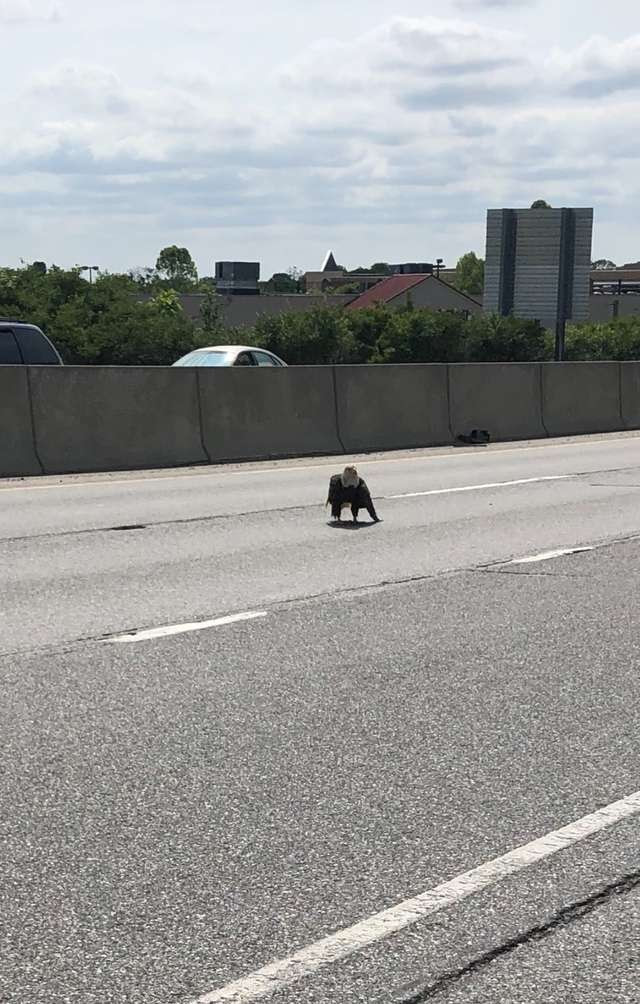
On Saturday of Memorial Day weekend, Miller was on his way home from Philadelphia when traffic slowed in front of him. Miller pulled his motorcycle off to the side of the two-way highway and was shocked when he realized what was causing the traffic jam.
“I looked down to see why everyone was stopping and there was a bald eagle in the middle of the road,” Miller told The Dodo. “Another person was there and they kind of nudged her a little bit to see if she would walk off the road or fly away. She spread her wings open and was not going to go anywhere.”
Dandon Miller
An avid animal lover, Miller knew he had to help the injured bird get out of harm’s way.
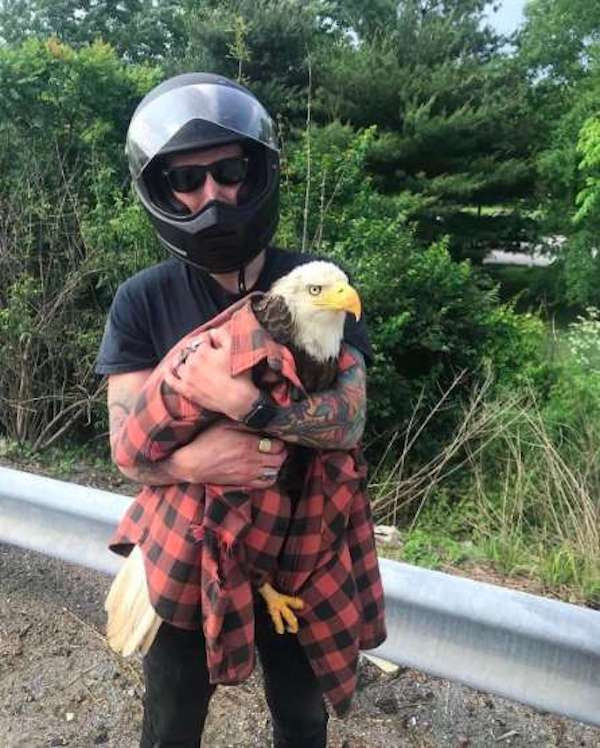
The large animal was too hurt to fly, but her powerful talons were reason enough for Miller to take off his favorite flannel and throw it over her. To Miller’s surprise, the eagle remained sedate as he wrapped her in the shirt.
“I picked her up and she was very calm,” Miller said. “She got a little worked up when people started wanting to take pictures, but we were able to get that under control.”
Dandon Miller
Once Miller moved the eagle out of the road, he called 911 and eventually got in touch with Tri-State Bird Rescue and Research, a local rehabilitation center for wild birds. Miller held the 15-pound bird for about 45 minutes while waiting for rescue staffers to arrive. But the time seemed to pass quickly.
Dandon Miller
“I wasn’t really thinking about it when I was holding her,” Miller said. “I was just trying to keep her calm and make sure she knows she’s secure, and I wasn’t going to drop her or anything.”
“It was just amazing to hold that bird and for her to be calm like that,” Miller added. “Just amazing.”
Dandon Miller
After a few days of treatment, the rescue is confident that the bald eagle will eventually be able to be released into the wild.
“She had a mild injury to one eye and soft tissue injuries, but no broken bones,” Rebecca Stansell with Tri-State Bird Rescue and Research told The Dodo. “Her wounds were treated by our wildlife veterinarian while the eagle was under anesthesia. The unexpected can always happen, but we are optimistic that she will make a full recovery.”
As for Miller’s favorite flannel, it has certainly seen better days.
The shirt now has a few large talon holes in it, but Miller knows it was for the best cause — and he will definitely be wearing it again.
I can’t really imagine what it felt like to hold that eagle in your arms for 45 minutes. Especially with all the traffic rushing past. But for sure it felt more than amazing. A beautiful wild eagle!
One can’t have too many opportunities to meld with the natural world.
I am a member of AAAS, the American Association for the Advancement of Science, and pulled a story from their Science journal and to my amazement found that I did this nearly a year ago.
The article, by Linda Goodman and Elinor K. Karlsson, is unavailable for complete republishing owing to copyright.
But on the AAAS website there is a summary, as follows:
Summary
Few traces remain of the domesticated dogs that populated the Americas before the arrival of Europeans in the 15th century. On page 81 of this issue, Ní Leathlobhair et al. (1) shed light on the origins of the elusive precontact dog population through genetic analysis of ancient and modern dogs. Building on earlier work, they show that American dogs alive today have almost no ancestry from precontact dogs, a monophyletic lineage descended from Arctic dogs that accompanied human migrations from Asia. Instead, the authors found that their closest remaining relative is a global transmissible cancer carrying the DNA of a long-deceased dog. It remains unclear why precontact dogs survived and thrived for thousands of years in the Americas only to swiftly and almost completely disappear with the arrival of Europeans.
From the article I would add:
It is unclear why there is so little evidence today of this thriving precontact dog population. Early European colonists may have discouraged the sale and breeding of native dogs, or even actively persecuted them (10). Yet, cultural preferences alone seem insufficient to explain their rapid decline. Most dogs worldwide are free-breeding scavengers, with minimal human control and high reproductive rates (11); native American dogs were likely similar.
There is a chart in the same article that shows the first human sites in the Americas were about 15,000 years ago with the oldest dog remains, also in America, being about 10,000 years ago.
smithsonian.com
May 17, 2019
Smushed-up faces are what make certain dog breeds, like French and English bulldogs or pugs, so ugly-cute. But those good looks come with a cost. Many dogs in these breeds suffer from a disease called Brachycephalic Obstructive Airway Syndrome (BOAS). The compact architecture of their skull results in deformation, which make their nostrils or soft palate too small, obstructing airflow and leaving the pups gasping for breath. Researchers long thought that the main cause was their shortened faces. But genes found in another breed suggest that the shortness of breath might be in their DNA, according to a new study published in the journal PLOS Genetics.
Ed Cara at Gizmodo reports that veterinarians began to notice that another small breed of dog, the Norwich terrier, was increasingly coming down with similar respiratory symptoms, a disease called upper airway obstructive syndrome. Unlike flat-faced pugs and bulldogs, however, the Norwich—bred for chasing rodents—has a nice, proportional skull. That got study author Jeffrey Schoenebeck, a veterinary scientist at the University of Edinburgh, wondering if the breathing problems in all the small dogs were genetic.
“That made us wonder if there was something similar shared across these different breeds, or if we were seeing two different diseases that just looked very similar,” he says.
Schoenebeck and his team decided to dig into the terrier’s DNA to find out. The team assessed 401 Norwich terriers for signs of the airway syndrome and also examined their genomes. Cassie Martin at Science News reports the researchers discovered one gene mutation in particular, ADAMTS3, was associated with the breathing disorder. Dogs with two copies of the mutation showed signs of fluid retention and swelling around the lungs. They had worse breathing scores than dogs with just one copy of the mutation or the normal gene.
When the team examined the genome of bulldogs and pugs, they also found that ADAMTS3 was common, meaning their funky faces might not be the only cause of BOAS.
“BOAS is a complex disease. Although skull shape remains an important risk factor, our study suggests that the status of ADAMTS3 should be considered as well,” Schoenebeck says in a press release. “More studies are needed to dissect the complex nature of this devastating disease.”
Cara reports that Norwich terrier breeders are already inadvertently combating the mutation. In Switzerland, Schoenebeck’s team has been working with breeders to give dogs breathing tests, identifying pups likely to develop the disease. As a result, the younger generation of terriers is less like to develop the disease than older dogs.
“In the 90s, something like 80 percent of the Norwich terriers that came into their clinic had poor breathing and this mutation,” Schoenebeck tells Cara. “But it’s decreasing further and further over time. They didn’t know it at the time, but they were actually selecting against this thing that we think is causing this disease.”
The genetic finding means that researchers can now screen directly for the mutation, and perhaps rid the terrier population of the disease.
The problem in flat-faced breeds may not be quite as simple to deal with. Wonky skull shape still makes the risk of developing BOAS higher, and the gene mutation adds to that risk. The team needs to do a similar study with bulldogs to figure out how much of their breathing problems come from their genes and how much comes from their cute little smushed-up skulls.
Smushed-up faces are what make certain dog breeds, like French and English bulldogs and pugs, so ugly-cute. But those good looks come with a cost. Many dogs in these breeds suffer from a disease called Brachycephalic Obstructive Airway Syndrome (BOAS). The compact architecture of their skull results in deformation, that make the nostrils or soft palate too small, obstructing airflow and leaving the pups gasping for breath. Researcher long thought that the main cause was their shortened faces. But genes found in another breed suggest that the shortness of breath might be in their DNA.
Ed Cara at Gizmodo reports that veterinarians began to notice that another small breed of dog, the Norwich Terrier, was increasingly coming down with similar respiratory symptoms, a disease called Upper Airway Syndrome. Unlike flat-faced pugs and bulldogs, however, the Norwich, bred for chasing rodents, has a nice, proportional skull. That got Jeffrey Schoenebeck of the Roslin Institute at the University of Edinburghand and lead author of the study in the journal PLOS Geneticswondering if the breathing problems in all the small dogs were genetic.
“That made us wonder if there was something similar shared across these different breeds, or if we were seeing two different diseases that just looked very similar,” he says.
Schoenebeck and his team decided to dig into the terrier’s DNA to find out. The team assessed 401 Norwich Terriers for signs of the airway syndrome and also examined their genomes. Cassie Martin at Science Newsreports the researchers discovered one gene mutation in particular, ADAMTS3, was associated with the breathing disorder. Dogs with two copies of the mutation showed signs of fluid retention and swelling around the lungs. They had worse breathing scores than dogs with just one copy of the mutation or the normal gene.
When the team examined the genome of bulldogs and pugs, they also found that ADAMTS3 was common, meaning their funky faces might not be the only cause of BOAS.
“BOAS is a complex disease. Although skull shape remains an important risk factor, our study suggests that the status of ADAMTS3 should be considered as well,” study leader Jeffrey Schoenebeck says in a press release. “More studies are needed to dissect the complex nature of this devastating disease.”
Cara reports that Norwich Terrier breeders are already inadvertently combating the mutation. In Switzerland, Schoenebeck’s co-authors have been working with breeders to give dogs breathing tests, identifying doggos likely to develop the disease. As a result, the younger generation of terriers is less like to develop the disease than older dogs.
“In the 90s, something like 80 percent of the Norwich Terriers that came into their clinic had poor breathing and this mutation,” Schoenebeck tells Cara. “But it’s decreasing further and further over time. They didn’t know it at the time, but they were actually selecting against this thing that we think is causing this disease.”
The genetic finding means that researchers can now screen directly for the mutation, and perhaps rid the terrier population of the disease.
The problem in flat-faced breeds may not be quite as simple to deal with. Wonky skull shape still makes the risk of developing BOAS higher, and the gene mutation adds to that risk. The team needs to do a similar study with bulldogs to figure out how much of their breathing problems come from their genes and how much comes from their cute little smushed-up skulls.
Jason Daley is a Madison, Wisconsin-based writer specializing in natural history, science, travel, and the environment. His work has appeared in Discover, Popular Science, Outside, Men’s Journal, and other magazines.
ooOOoo
How great it would be if the problem facing these flat-faced breeds was slowly done away with.
Cities in the United States are getting less segregated and, according to a recent national survey, most Americans value the country’s racial diversity.
But the demographic integration of a neighborhood doesn’t necessarily mean that neighbors of different races are socializing together.
I spent 18 months studying Creekridge Park, a diverse and mixed-income area of Durham, North Carolina, to understand how black, white and Latino residents interacted with each other. Between 2009 and 2011, I interviewed 63 residents, attended neighborhood events and conducted a household survey.
I learned that white, black and Latino residents led rather separate social lives in Creekridge Park. Eighty-six percent of white people said their closest friends were white, and 70% of black residents surveyed reported that their best friends were black.
One black resident lamented that neighbors weren’t as “friendly as I had hoped and thought that they would be – or at least, this image I had in my head of what ‘friendly’ would be like.”
White, black and Latino people in Creekridge Park even had different experiences with something as seemingly innocuous as pet ownership.
Many white residents described friendships growing as a result of walking their dogs around the neighborhood, with chance encounters on the sidewalk turning into baseball games, dinners and even vacations together.
“It’s the dogs that are our connectors,” said Tammy, a white homeowner in her fifties. “That’s how a lot of us have gotten to know each other.”
Such positive interactions did not necessarily happen across racial boundaries. More often, I found, dogs reinforced boundaries.
When Jerry, a black homeowner in his sixties, stopped to chat with some dog-owning customers, who were white, in the outdoor seating area of a neighborhood bakery, the staff asked him to leave.
“I owned some dogs like that at one particular time. And I was just speaking to them. All of a sudden, I’m a panhandler,” Jerry said, incredulous and hurt.
Jerry is a black disabled veteran who was wearing his old army uniform that day. He figures they thought he was begging for money.
The dogs didn’t create the interracial boundaries at the bakery, which caters to a primarily white, middle-class clientele. In fact, the dogs presented an avenue to connect black and white neighbors. But they gave bakery staff a reason to intervene, to maintain interracial boundaries.
Neighborhood Watch
The treatment of dogs in Creekridge Park also divided neighbors of different races.
Tammy, the same resident who said dogs served as “connectors” in the neighborhood, disliked that her Latino neighbors wouldn’t let their dog into the house, leaving her tied up in the backyard.
Tethering dogs is a common practice in Durham, NC.
One day, when she heard her neighbor’s dog barking, she decided to monitor their backyard with binoculars, to make sure the dog was OK. When the father spotted her doing her surveillance, Tammy lied. She said she was looking at a different dog.
Tammy was not, however, embarrassed when recounting this story. She felt she was justified in considering the dog’s well-being. She offered the family a bigger dog house and began to take the dog on hour-long walks twice a day. Eventually, she adopted the dog as her own.
Tammy said that she always intervened whenever she saw dogs mistreated in the neighborhood. However, the only examples she shared during our interview involved Latino families.
Latino families are not the only Creekridge Park residents who tied up their dogs. The practice is common enough across Durham that a local group was formed in 2007 to build free dog fences.
Police Come ‘Almost Immediately’
Several white residents of Creekridge Park have even reported their neighbors to the police for suspected animal abuse.
Emma, a white homeowner in her thirties, called the police when she thought her neighbors were involved in dog fighting.
They “came almost immediately,” she said.
Generally, Emma told me, if she knows her neighbors, she will confront them directly about problems she perceives. Otherwise, she prefers to call the police.
Given how segregated friendship networks are in Creekridge Park, this seemingly non-racial distinction between “known” and “unknown” neighbors means that in practice Emma involved police in conflicts only with black and Latino neighbors.
Dogs can connect neighbors – but they can also divide them. Shutterstock
How White People Enforce Their Rules
This white willingness to report non-white neighbors for “unruly” behavior recalls numerous recent incidents nationwide in which white people have called the police on black people for perfectly legal activities.
In July 2018 a white woman in San Francisco threatened an 8-year-old black girl for “illegally selling water without a permit.” A few months before, a white woman dubbed by internet users as “BBQ Becky” called the cops on a black family barbecuing in an Oakland park for using an “unauthorized” charcoal grill.
In U.S. neighborhoods, middle- and upper-class white residents enjoy a privileged social position by virtue of their race and class. They understand that police, local businesses and government agencies exist to serve them – the same social institutions that often underserve or even target racial minorities.
By drawing arbitrary lines between right and wrong, insider and outsider – even good pet owner and bad – white people like Tammy and BBQ Becky use that power to try to shape diverse neighborhoods into their preferred mold.
As a result of white residents’ focus on their own comfort in diverse places, racial inequality can pervade everyday life – even, my research shows, when walking the dog.
ooOOoo
I have to say that it’s not entirely clear if dog ownership leads to social cohesion or the opposite.
I need to read the article again but what do readers offer.



















 Learning from Dogs