Category: People

Eating organic food!

The jury is still out with regard to organic food being better for you, but …

Jeannie has been a vegetarian for years and I subscribed as soon as we met some eleven years ago.  About two years ago we became vegan and non-dairy.

But that doesn’t necessarily mean that being vegetarian or vegan means eating organically; it’s an assumption.

Now as it happens we also do our best to eat organically.

Is it healthier, all things being equal?

Well The Conversation recently published a post exploring this subject.

ooOOoo

Organic food health benefits have been hard to assess, but that could change

By

Assistant Professor, Boise State University

August 16th, 2019

“Organic” is more than just a passing fad. Organic food sales totaled a record US$45.2 billion in 2017, making it one of the fastest-growing segments of American agriculture. While a small number of studies have shown associations between organic food consumption and decreased incidence of disease, no studies to date have been designed to answer the question of whether organic food consumption causes an improvement in health.

I’m an environmental health scientist who has spent over 20 years studying pesticide exposures in human populations. Last month, my research group published a small study that I believe suggests a path forward to answering the question of whether eating organic food actually improves health.

What we don’t know

According to the USDA, the organic label does not imply anything about health. In 2015, Miles McEvoy, then chief of the National Organic Program for USDA, refused to speculate about any health benefits of organic food, saying the question wasn’t “relevant” to the National Organic Program. Instead, the USDA’s definition of organic is intended to indicate production methods that “foster cycling of resources, promote ecological balance, and conserve biodiversity.”

While some organic consumers may base their purchasing decisions on factors like resource cycling and biodiversity, most report choosing organic because they think it’s healthier.

Sixteen years ago, I was part of the first study to look at the potential for an organic diet to reduce pesticide exposure. This study focused on a group of pesticides called organophosphates, which have consistently been associated with negative effects on children’s brain development. We found that children who ate conventional diets had nine times higher exposure to these pesticides than children who ate organic diets.

Our study got a lot of attention. But while our results were novel, they didn’t answer the big question. As I told The New York Times in 2003, “People want to know, what does this really mean in terms of the safety of my kid? But we don’t know. Nobody does.” Maybe not my most elegant quote, but it was true then, and it’s still true now.

Studies only hint at potential health benefits
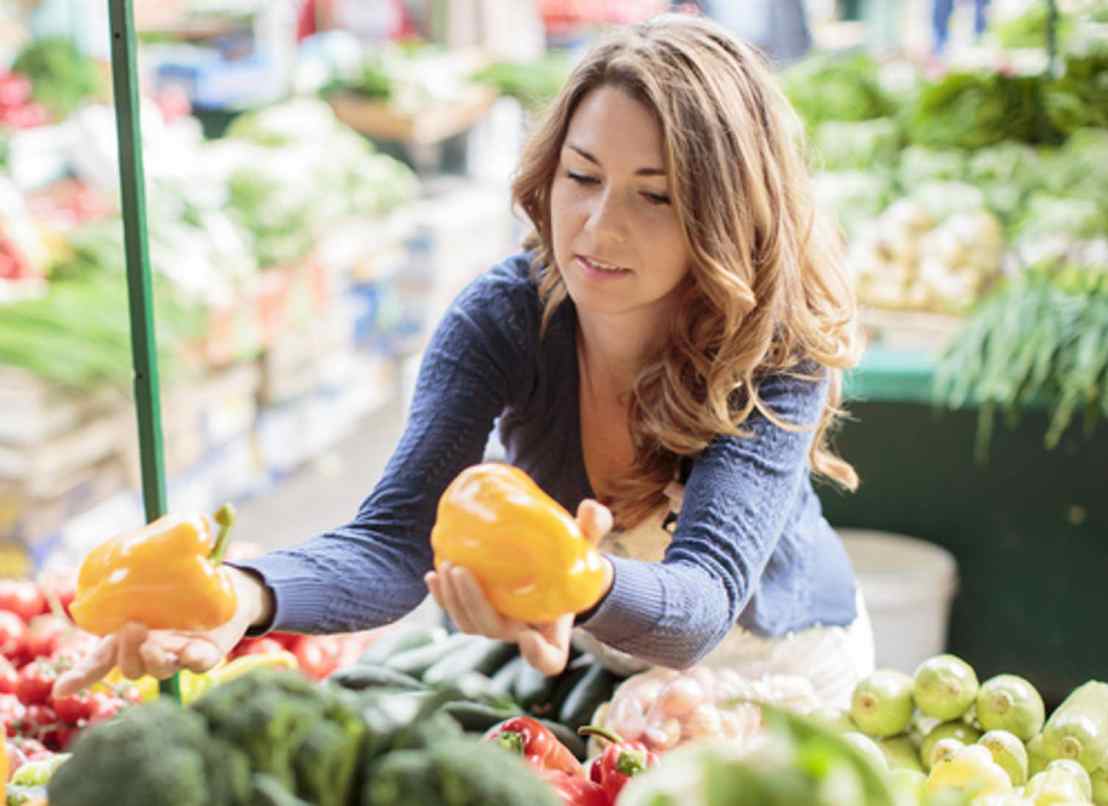
Health-conscious people want to buy organic for its health benefits, but it’s not yet clear whether such benefits exist. Goran Bogicevic/Shutterstock.com

Since 2003, several researchers have looked at whether a short-term switch from a conventional to an organic diet affects pesticide exposure. These studies have lasted one to two weeks and have repeatedly shown that “going organic” can quickly lead to dramatic reductions in exposure to several different classes of pesticides.

Still, scientists can’t directly translate these lower exposures to meaningful conclusions about health. The dose makes the poison, and organic diet intervention studies to date have not looked at health outcomes. The same is true for the other purported benefits of organic food. Organic milk has higher levels of healthy omega fatty acids and organic crops have higher antioxidant activity than conventional crops. But are these differences substantial enough to meaningfully impact health? We don’t know. Nobody does.

Some epidemiologic research has been directed at this question. Epidemiology is the study of the causes of health and disease in human populations, as opposed to in specific people. Most epidemiologic studies are observational, meaning that researchers look at a group of people with a certain characteristic or behavior, and compare their health to that of a group without that characteristic or behavior. In the case of organic food, that means comparing the health of people who choose to eat organic to those who do not.

Several observational studies have shown that people who eat organic food are healthier than those who eat conventional diets. A recent French study followed 70,000 adults for five years and found that those who frequently ate organic developed 25% fewer cancers than those who never ate organic. Other observational studies have shown organic food consumption to be associated with lower risk of diabetes, metabolic syndrome, pre-eclampsia and genital birth defects.

The problem with drawing firm conclusions from these studies is something epidemiologists call “uncontrolled confounding.” This is the idea that there may be differences between groups that researchers cannot account for. In this case, people who eat organic food are more highly educated, less likely to be overweight or obese, and eat overall healthier diets than conventional consumers. While good observational studies take into account things like education and diet quality, there remains the possibility that some other uncaptured difference between the two groups – beyond the decision to consume organic food – may be responsible for any health differences observed.

What next?

Often, new medical and health knowledge comes from carefully designed clinical trials, but no such trial has been conducted for organic food. Anyaivanova/Shutterstock.com

When clinical researchers want to figure out whether a drug works, they don’t do observational studies. They conduct randomized trials, where they randomly assign some people to take the drug and others to receive placebos or standard care. By randomly assigning people to groups, there’s less potential for uncontrolled confounding.

My research group’s recently published study shows how we could feasibly use randomized trial methods to investigate the potential for organic food consumption to affect health.

We recruited a small group of pregnant women during their first trimesters. We randomly assigned them to receive weekly deliveries of either organic or conventional produce throughout their second and third trimesters. We then collected a series of urine samples to assess pesticide exposure. We found that those women who received organic produce had significantly lower exposure to certain pesticides (specifically, pyrethroid insecticides) than those who received conventional produce.

On the surface, this seems like old news but this study was different in three important ways. First, to our knowledge, it was the longest organic diet intervention to date – by far. It was also the first to occur in pregnant women. Fetal development is potentially the most sensitive period for exposures to neurotoxic agents like pesticides. Finally, in previous organic diet intervention studies, researchers typically changed participants’ entire diets – swapping a fully conventional diet for a fully organic one. In our study, we asked participants to supplement their existing diets with either organic or conventional produce. This is more consistent with the actual dietary habits of most people who eat organic food – occasionally, but not always.

Even with just a partial dietary change, we observed a significant difference in pesticide exposure between the two groups. We believe that this study shows that a long-term organic diet intervention can be executed in a way that is effective, realistic and feasible.

The next step is to do this same study but in a larger population. We would then want to assess whether there were any resulting differences in the health of the children as they grew older, by measuring neurological outcomes like IQ, memory and incidence of attention-deficit disorders. By randomly assigning women to the organic and conventional groups, we could be sure any differences observed in their children’s health really were due to diet, rather than other factors common among people who consume organic food.

The public is sufficiently interested in this question, the organic market is large enough, and the observational studies suggestive enough to justify such a study. Right now, we don’t know if an organic diet improves health, but based on our recent research, I believe we can find out.

ooOOoo

Fingers crossed that new research takes place.

Because good health at any age is precious!
From Montana!

One of my most favourite blog sites!

There is a blog site, primarily for all those interested in photography. It is called Ugly Hedgehog! Seriously! But UHH, as it is known, also has room for general non-photographic chat so it really does cater for all.

I have been a member since July, 2017, and have been amazed at how quickly the time has gone.

Anyway, the home page of Ugly Hedgehog is here, it’s free, and if you have any interest in photography I strongly recommend it.

This item came in a couple of weeks ago and I’m taking the liberty of sharing it with you.

ooOOoo

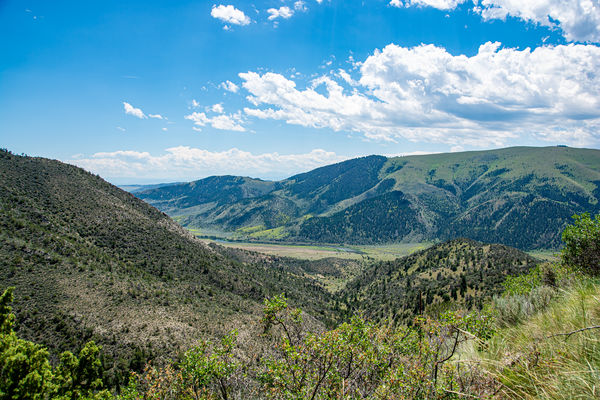
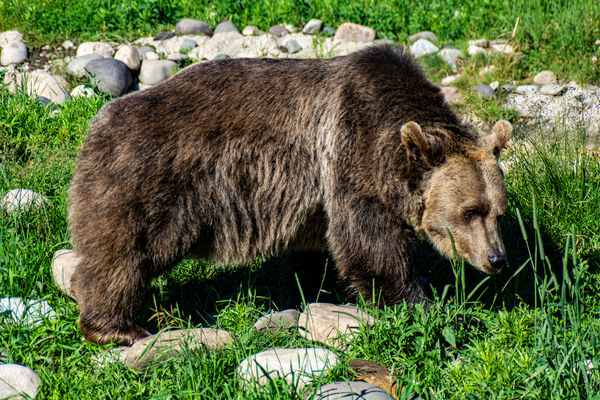
Spent a few days in Bozeman Montana visiting my youngest son and daughter in law before heading out to Southern California. A couple of images from my trip to Montana…

ooOOoo

Incredible country!

Margaret Heffernan

Margaret who?

I must admit that I hadn’t heard of Margaret Heffernan before.

But in browsing TED Talks one evening recently we came across a TED Talk by her. And it was riveting!

Here’s how it was introduced:

The more we rely on technology to make us efficient, the fewer skills we have to confront the unexpected, says writer and entrepreneur Margaret Heffernan. She shares why we need less tech and more messy human skills — imagination, humility, bravery — to solve problems in business, government and life in an unpredictable age. “We are brave enough to invent things we’ve never seen before,” she says. “We can make any future we choose.”

Later on it explains: “The former CEO of five businesses, Margaret Heffernan explores the all-too-human thought patterns that lead organizations and managers astray.

In doing more research I came upon this:

Margaret Heffernan was born in Texas, grew up in the Netherlands and was educated at Cambridge University. She produced drama and documentary programs for the BBC for 13 years, then moved back to the US where she became a serial entrepreneur and CEO in the early days of the internet.

All of Heffernan’s work challenges accepted wisdom about good lives and good work. Willful Blindness: Why We Ignore the Obvious at Our Peril, named one of the most important business books of the decade by the Financial Times, looked at how our most cherished beliefs, behaviors and rules blind us to what matters most.

In 2015, she was awarded the Transmission Prize for A Bigger Prize: How We Can Do Better than the Competition, a book that upended the idea that competition forces the best to the top, arguing that it mostly proves wasteful and destructive where collaboration is more sustainable and creative.

In 2015, TED published Beyond Measure: The Big Impact of Small Changes which argued that organizational change can, and should, happen at all levels.

Her forthcoming book, Uncharted: How to Map the Future will be published in February 2020 in the UK and May 2020 in the US. It addresses the fundamental unpredictability of life, challenges technological determinism and asks how we can find in ourselves the freedom and imagination to create the futures we want. An early reader called it “Karl Popper for the 21st century.”

As lead faculty for the Forward Institute’s Responsible Leadership Programme, Heffernan mentors CEOs and senior executives of major global organizations.

Trust me, you will find this talk fascinating.

Helping dogs with cancer, and a bonus!

This item from The Conversation website is very interesting!

Cancer touches so many people.

My father died of lung cancer in 1956. My step-father in turn died of cancer much later on (I can’t recall what cancer it was and when he died).

It’s a terrible disease.

Key facts. Cancer is the second leading cause of death globally, and is responsible for an estimated 9.6 million deaths in 2018. Globally, about 1 in 6 deaths is due to cancer. Approximately 70% of deaths from cancer occur in low- and middle-income countries.

Cancer – World Health Organization

But then this comes along and offers hope.

The Conversation

Published on Jul 23, 2019

Cheryl London, a professor of veterinary medicine at Tufts University, practices “comparative oncology,” or testing cancer treatments in animals for potential use in humans. Her trials give sick pets a chance at a longer life – and could help contribute to new therapies for people.

That seems like it’s good for dogs and good for us!

Bravo!

Those puppy eyes

A revisit to the science of the evolution of dogs’ eyes.

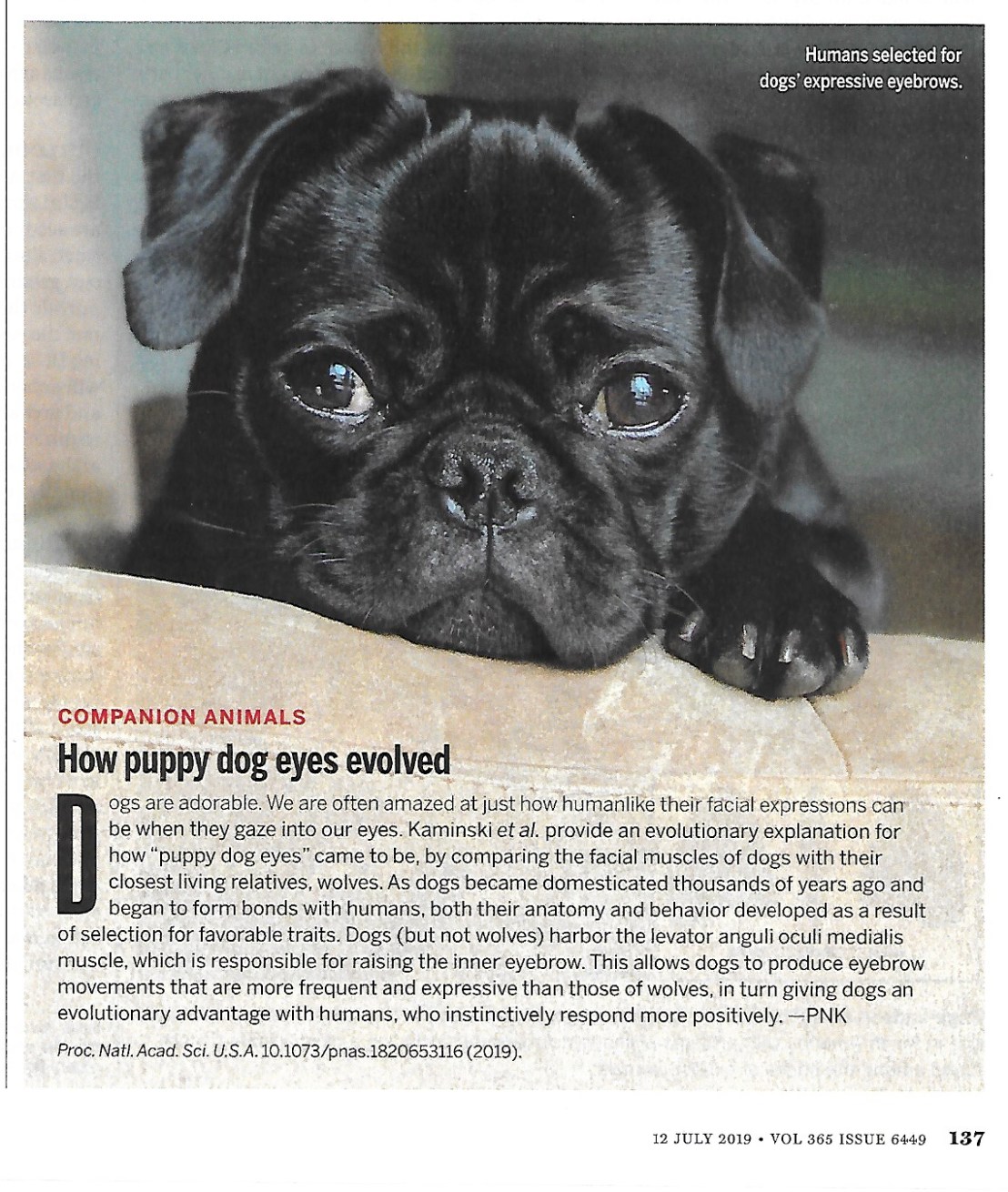
I presented a fairly long explanation of how dogs evolved in a recent post Those Eyes. It was based on an article in The Atlantic magazine.

The AAAS magazine Science, 12th July 2019, VOL 365 Issue 6449, also had an item.

It is reproduced below and I hope it sufficiently clear that you can read the text.

If the text is not clear let me know and I will amend this post by including the above text as a typed addition.

What if Reporters Covered the Climate Crisis

Like Murrow Covered World War II?

The new Covering Climate Now project will help media “tell the story so people get it.”

This is how the speech by Bill Moyers is introduced in this issue of The Nation:

The following is an abridged version of the speech by the iconic TV newsman Bill Moyers, as prepared for delivery at a conference at the Columbia Journalism School on April 30. A video of the speech can be seen at TheNation.com/moyers-speech.

Well, we have the advantage of going straight to the video.

What is journalism for, if not to awaken the world to looming catastrophes?

Picture Parade Two Hundred and Ninety-Five

That Chilean eclipse!

From EarthSky:

More amazing images of the July 2 eclipse

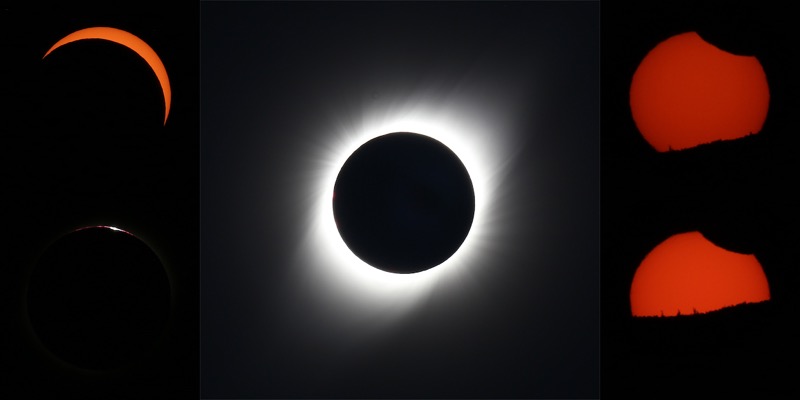
Some called it the “astronomer’s eclipse” because it passed near major observatories in Chile. Check out these beautiful images of the July 2, 2019, total solar eclipse.

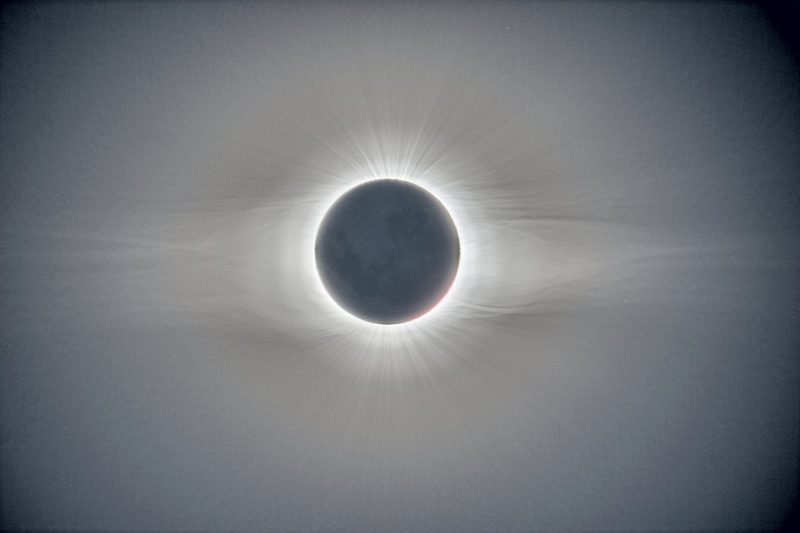
This composite image captures the drama of totality during the July 2, 2019, total solar eclipse. When – as seen from Earth – the moon passes directly in front of the sun, the sun’s light is blocked and its extended atmosphere or corona can be seen. The processing of this image highlights the intricate detail of the corona, its structures shaped by the sun’s magnetic field. Some details of the lunar surface can also be seen. The image – via European Space Agency (ESA) – was created by the ESA-CESAR team observing the eclipse from ESO’s La Silla Observatory in Chile, South America.
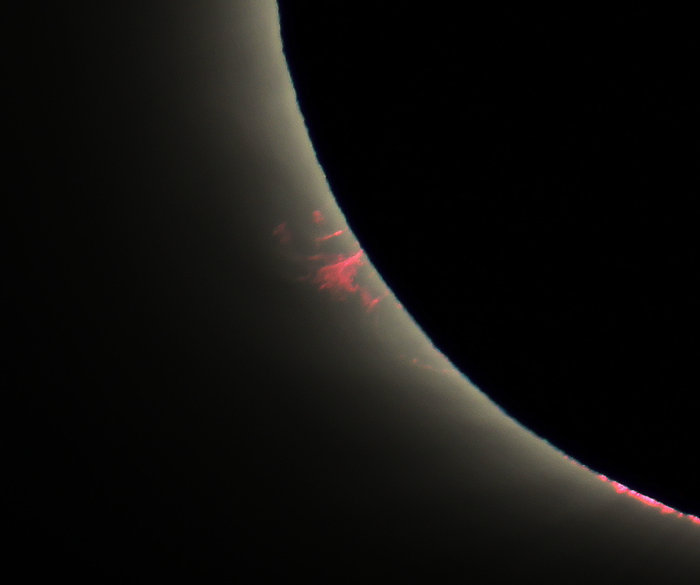
A prominence seen in the sun’s chromosphere during the July 2, 2019, total solar eclipse. Prominences are made of tangled magnetic field lines that keep dense concentrations of solar plasma suspended above the sun’s surface. They are anchored to the sun’s visible surface and extend outwards through the chromosphere and out into the corona. The red hue of the chromosphere is only apparent during an eclipse. This image – via ESA – was taken by the ESA-CESAR team observing the eclipse from ESO’s La Silla Observatory in Chile, South America.
View at EarthSky Community Photos. | Total solar eclipse over Vicuna, Chile, on July 2, 2019 from Alexander Krivenyshev of the website WorldTimeZone.com.
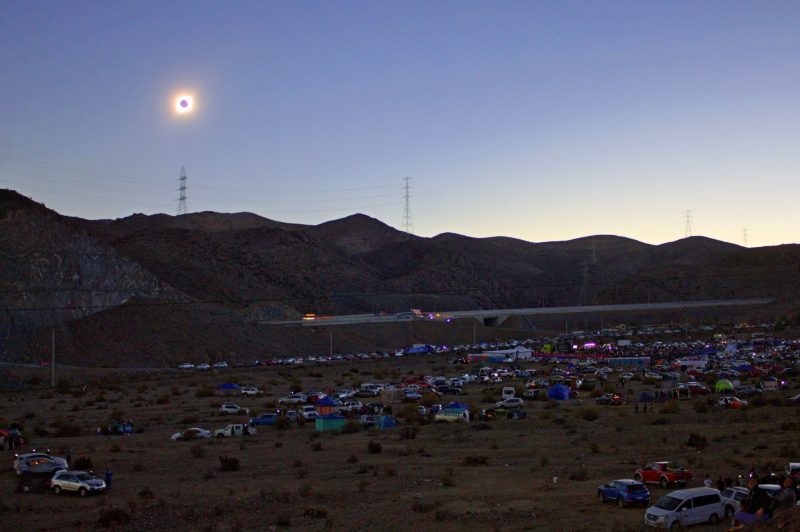
View at EarthSky Community Photos. | Pablo Goffard caught the July 2 total solar eclipse from Incahuasi, Chile. He wrote: “This is just a photo, a tiny part of the experience. Incahuasi is a small town in the Atacama desert. Here it’s seen the camp installed especially for the eclipse.”
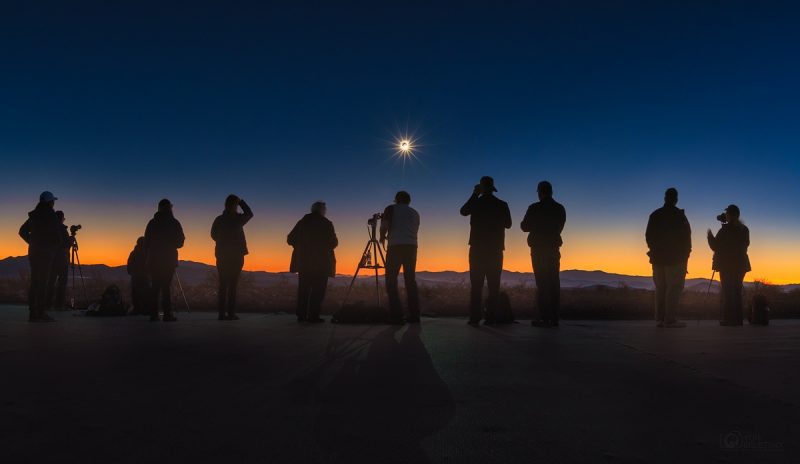
This image of eclipse-watchers was taken by a frequent EarthSky contributor, Yuri Beletsky, on the Chilean coast. It was chosen as an Astronomy Picture of the Day for July 4, 2019. Congratulations on a wonderful photo, Yuri! Note that diffraction spikes (apparent rays from the sun) are effects from the camera lens aperture.

While some observers on the southern part of Earth saw a total solar eclipse, the European Space Agency’s PROBA-2satellite’s SWAP imager in space saw a partial eclipse, as shown in the video below. The images are in ultraviolet light, revealing the turbulent nature of the sun’s surface and corona. ESA said:

During this eclipse the satellite was passing through the South Atlantic Anomaly at the time of the largest occultation [covering of the sun]. In this region the spacecraft is exposed to higher levels of radiation. The increased flux of energetic particles falling on the satellite’s detector is the cause for all the bright dots and streaks in the images.

Bottom line: More amazing images of the July 2, 2019, total solar eclipse.

There is more, much more, on the Smithsonian magazine website. Do go across and see the images.

July 4th!

A cool idea from Austin.

I was at the Club NorthWest yesterday wearing my ‘U.S.’ shorts and Piper Cub T-shirt, something that I exercise in regularly, and Austin, my trainer, said why don’t you wear them tomorrow.

But then I couldn’t put a photograph in a post that came out at midnight, Oregon summer time, so I busied myself with a camera yesterday afternoon.

Here are the results!

And one to show the colours of the shorts a little better.

Well that’s all from me for today.

Happy July 4th!

Picture Parade Two Hundred and Ninety-Four

About as far away from dogs as one can get!

ooOOoo

Best photos of the Mercury-Mars conjunction

Posted by in ASTRONOMY ESSENTIALS | TODAY’S IMAGE June 23, 2019

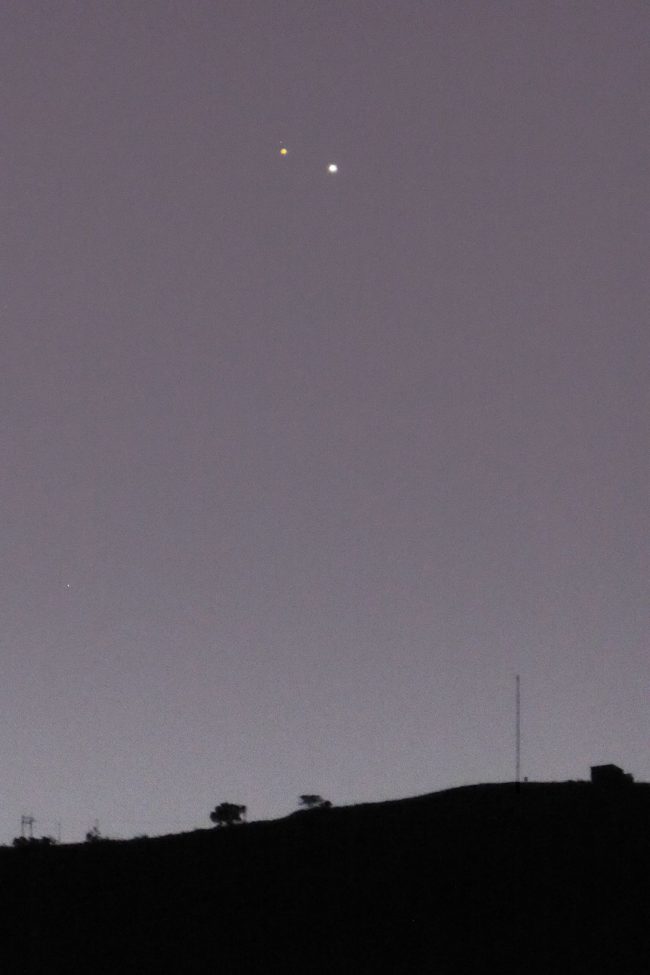
It was the closest conjunction of 2 planets in 2019, between Mercury and Mars. It happened low in the evening twilight – and was best seen from Earth’s Southern Hemisphere. Check out these photos from EarthSky Community members.

Dr Ski in Valencia, Philippines, caught Mars and Mercury on the day following their conjunction, June 19, 2019. The nearby stars Castor and Pollux in the constellation Gemini are a great comparison. Those 2 stars are noticeable for being bright and close together. Mercury and Mars were much closer! Thanks, Dr Ski!
Wow! You can really see the color difference between red Mars (on the left) and Mercury in this photo from the day of the conjunction – June 18, 2019 – by Peter Lowenstein in Mutare, Zimbabwe. Thanks, Peter!
Here’s a June 17 photo from Jose Lagos in Vaals, Netherlands. He wrote, “This was the last image I could get before June 18, when it was too cloudy near the horizon, but you can see that the conjunction is nearly perfected. It was beautiful to behold even this much of it. Thank you for your time and your great work at Earth Sky.” Thank you for your photo and kind words, Jose!
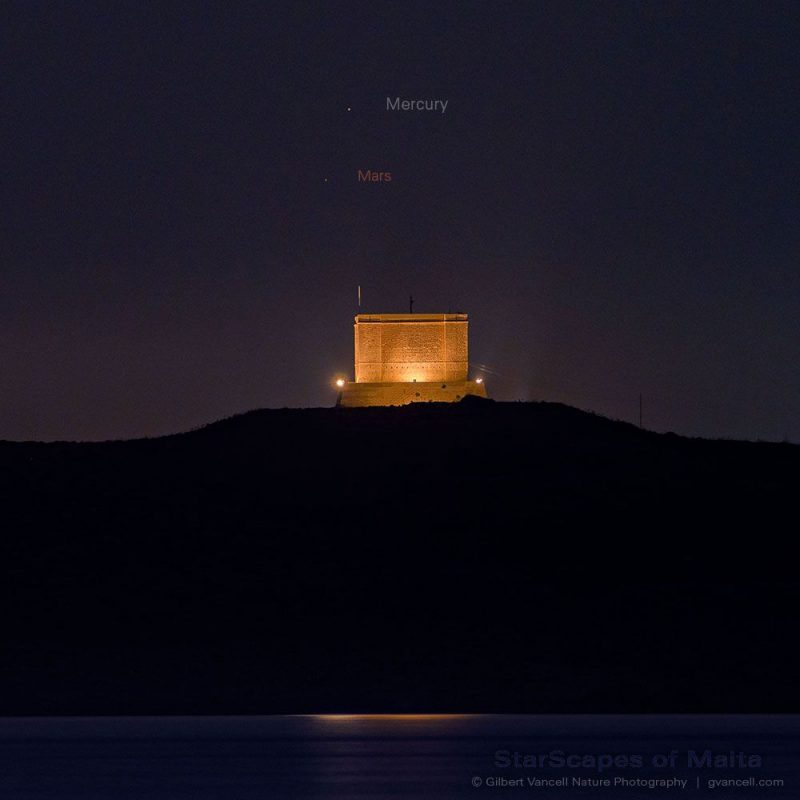
Gilbert Vancell caught the planets on June 18, too, and wrote: “Mercury (top) and Mars setting behind Comino Tower. Shot from Armier, Malta.”
Helio C. Vital captured in Rio de Janeiro, Brazil, on June 18, 2019. He wrote, “Despite the fact that many clouds were floating over my western horizon this evening, I could get some photos of Mercury and Mars only 14 arcminutes apart over Rio de Janeiro at dusk (from 17:45 to 18:30 UTC-3h, June 18, 2019).Forming a beautiful close pair through binoculars, Mercury was an easy naked-eye target while Mars (4.4 times dimmer) required the use of averted vision to be briefly spotted. Hope my images can help give you an idea of what the interesting event looked like.”

Bottom line: Photos from the night of and around the June 18, 2019, conjunction of Mercury and Mars, closest conjunction of two planets this year.

ooOOoo

I hope a few of you enjoyed today’s Picture Parade.

Here’s to July!

The power of a photograph

No words to say how I feel!

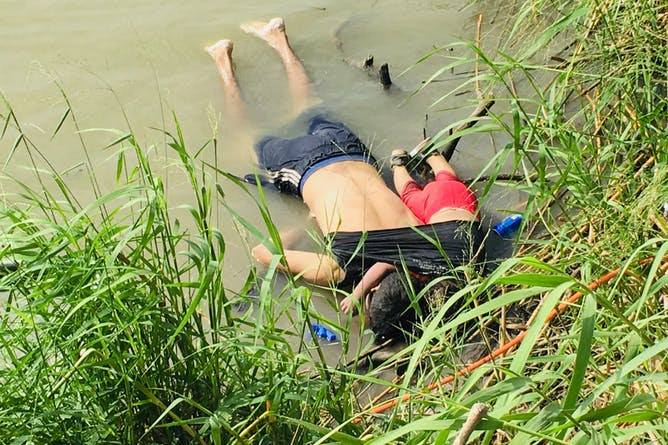
The bodies of Salvadoran migrant Oscar Alberto Martínez Ramírez and his daughter lie on the bank of the Rio Grande in Matamoros, Mexico. AP Photo/Julia Le Duc

This is a terrible photograph. It has been widely shown but that doesn’t make it any less terrible.

Patrice Ayme recently wrote about the tragedy but for today I am republishing the article in The Conversation.

ooOOoo

How much power can one image actually have?

By

Associate Professor, School of Journalism and Communication, University of Oregon

Professor of Psychology, University of Oregon

When the Associated Press published Julia Le Duc’s photograph of a drowned Salvadoran man, Óscar Alberto Martínez Ramírez, and his 23-month old daughter Valeria, it sparked outrage on social media. According to Le Duc, Ramírez had attempted to cross the Rio Grande after realizing he couldn’t present himself to U.S. authorities to request asylum.

But beyond raising awareness via Twitter and Facebook feeds, does an image like this one have the power to sway public opinion or spur politicians to take action?

As journalism and psychology scholars interested in the effects of imagery, we study the ability of jarring photos and videos to move people from complacency to action. While graphic imagery can have an immediate impact, the window of action – and caring – is smaller than you’d think.

A political catalyst?

Photographs and videos – through their perceived authenticity – can have an effect on people.

Research suggests that the graphic photo of slain Emmett Till in his open casket served as a “political catalyst” in mobilizing Americans to action in the civil rights movement. Similarly, news images have been credited as playing an important role in ending the Vietnam War.

But not all scholars agree. A recent article argued that it was a “myth” that the iconic “napalm girl” photo swayed public opinion and hastened the end of the Vietnam War.

Did the ‘napalm girl’ significantly shift public opinion on the Vietnam War? manhhai/flickr, CC BY

We must also look to psychology to understand the impacts of emotional news content. Research demonstrates that audiences need an emotional connection – and not merely a “just-the-facts” reporting approach – as “prerequisite for political action” when it comes to appreciating the importance of distant mass suffering. And imagery can trigger this emotional connection by overcoming the psychic numbing that occurs when casualties mount, images blur and lost lives become merely dry statistics.

Images from Syria

In April 2017, gut-wrenching images seem to have awakened the world to the human atrocities happening in Syria. Following a chemical bomb attack in the town of Khan Sheikhoun, graphic photos and videos documented the horrific effects of the banned nerve agent sarin. Millions bore witness to excruciating human suffering: gasping, choking, writhing and dying. More than 500 people were injured, with at least 86 deaths, including 28 children.

The vivid, closeup images of sarin attack victims were resonant enough to break through the complacency of people and politicians accustomed to bad news emerging from the war-torn nation. In President Trump’s response – which included a retaliatory missile strike – he seemed to recognize the value of the Syrian lives depicted in the horrific photos and videos.

Syrian doctors treat a child following a suspected chemical attack in the town of Khan Sheikhoun, northern Idlib province, Syria. Edlib Media Center, via AP, File

“When you kill innocent children,” he said during a news conference, “that crosses many, many lines, beyond a red line – many, many lines.”

The limits of an image

Nonetheless, even though the attacks may have briefly heightened U.S. concerns over the wars in Syria, the photographic documentation of the suffering in Syria wasn’t new.

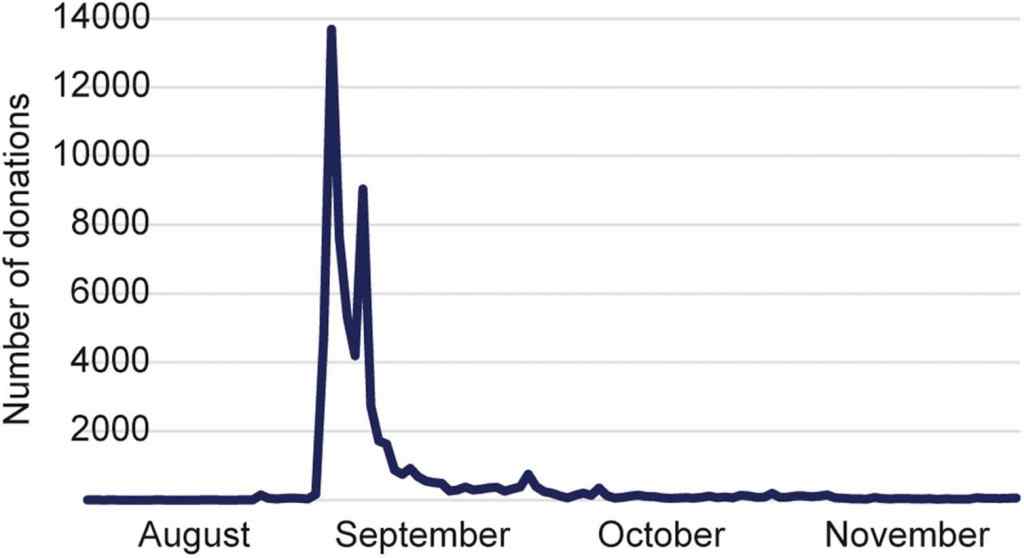
The 2015 photos of a tiny Syrian boy’s lifeless body resting face down in the sand similarly stirred the world’s collective consciousness. Within hours of its release, the photo had reached 20 million people through Twitter, with many more millions seeing it on the front pages of newspapers the next day. Afterwards, government restrictions on accepting refugees were loosened while private donations to organizations like the Red Cross spiked dramatically.

A year later haunting images of a young boy in the back of an ambulance, caked in dirt and blood, galvanized the world.

But the emotional and compassionate responses to both photographs were short-lived. The bombing of civilians in Syria continued. Refugees continued risking their lives to escape the war zone.

After a photograph of a dead Syrian boy went viral in 2015, the number of daily donations to a Swedish Red Cross campaign designated specifically for aiding Syrian refugees spiked dramatically – but only for a brief window. Proceedings of the National Academy of Sciences of the United States of America, CC BY-SA

Since the publication of Le Duc’s photo of the dead migrants, supportive politicians may feel emboldened to sound the alarm on the plight of Central American migrants. Donations to immigrant aid organizations might briefly spike.

But it seems that a photograph, no matter how emotionally devastating, can only do so much.

Yes, it can create a window of time when we’re motivated to act, and we’ll usually do so if we have effective options to pursue. This could mean a charitable donation at the individual level or, collectively, a surge of political will. However, psychology research from the “arithmetic of compassion” suggests that sympathy for distant human suffering declines when we’re presented with rising body counts. Sometimes we’re discouraged by the scope of the problem and this stops us from doing things that actually make a difference – even if partial solutions can save lives. Other times, if the options for helping others seem too narrow or ineffective, we’ll turn away and stop caring.

Images can alert us to the horrors of violence, mass migration and poverty. But as we have seen time and again, photographs and news footage of human suffering generally precipitate a short-term emotional reaction, rather than a sustained humanitarian response.

ooOOoo

As one reads the article it is much more than a comment on a single image despite how terrible that photograph may be.

The two scientists set out to show that the period that we are alarmed or terrified or just plain sad at the state of nations is rather short.

Maybe it’s the self-protective nature of our species that does this.

But it still doesn’t diminish the horror of that top photograph.