Ten things we don’t understand about being human, from New Scientist magazine.
Thanks to Naked Capitalism for pointing me towards this fascinating piece in New Scientist. The article discusses 10 outwardly frivolous behaviours and attributes that have scientists scratching their head. They are:
Blushing
Laughter
Pubic hair
Teenagers’ behaviours
Dreams
Altruism
Art
Superstition
Kissing, and
Nose-picking
The article links each of the above to a further examination of why it is so strange. It’s a good read and the accompanying photograph heading up the article, reproduced across, is rather clever.
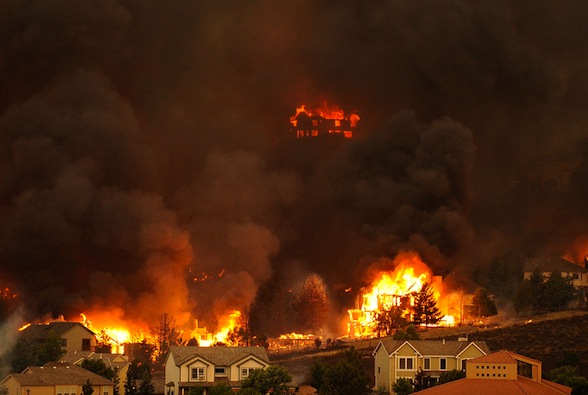
This summer has seen nature visiting on man a series of catastrophes. To name just a few, we have the record-breaking rainfall in Britain in June, the Colorado wildfires and the 1,400,000 storm-struck households in the eastern US.
Colorado burning
Inevitably, many wonder if this is connected to climate change as a result of mankind’s behaviours. Many now believe so.
But we have to stand on the rock of science.
So it was great to come across a recent article on Grist that led me to this organisation, Climate Communication. As they say on the About Us page,
Climate Communication is a non-profit science and outreach project funded by the Rockefeller Brothers Fund and the ClimateWorks Foundation. Climate Communication operates as a project of the Aspen Global Change Institute, a non-profit organization dedicated to furthering the scientific understanding of Earth systems and global environmental change.
That review on Climate Communication includes the following video,
Not convinced?
Then try this evidence from an interview with Kevin Trenberth of the National Center for Atmospheric Research shown on PBS Newshour,
Want more? Go for it!
The PBS video came from the British Guardian newspaper (link thanks to Naked Capitalism). The Guardian reported,
Is it now possible to blame extreme weather on global warming?
Wildfires, heatwaves and storms witnessed in the US are ‘what global warming looks like’, say climate scientists
Posted by Leo Hickman
Tuesday 3 July 2012
Whenever an episode of extreme weather – heatwave, flood, drought, etc – hits the headlines, someone somewhere is sure to point the finger of blame at human-induced climate change.
Such claims are normally slapped down with the much-aired mantra: “You cannot blame a single episode of bad weather on global warming.” But with the on-going record high temperatures affecting large parts of the US, there seems to be a noticeable reduction in such caveats and notes of caution.
This week, scientists have been queuing up, it seems, to explain how the wildfires in Colorado, the heatwave across the eastern seaboard, and the “super derecho” are all indicative of “what global warming looks like“. Most pulled back, though, from directly blaming global warming for such weather events.
“In the future you would expect larger, longer more intense heat waves and we’ve seen that in the last few summers,” Derek Arndt of NOAA Climate Monitoringtold the Associated Press.” The same report added: “At least 15 climate scientists told the Associated Press that this long hot US summer is consistent with what is to be expected in global warming.”
So, can we now say, or not, that specific extreme weather events are caused, or at least exacerbated, by global warming? Has anything changed in climate scientists’ understanding of the attribution – or “anthropogenic fingerprint” – of such events? Are they now more confident about making such links?
I put this question to a number of climate scientists ….
Leo Hickman then reports the assessments of eight leading scientists. Go and read their words here. If you can do it now!
The science is solid!
So as you watch these scientists talking about the meaning of climate extremes think what you can do today to reduce your own impact on this planet. Just as importantly, think how you can influence those around you and those that represent you that now is the time to wake up to the fact that nature is telling us to slow down!
The growth in awareness of what we are doing to the planet is astounding. There is hope, we have to promote hope and we have to acknowledge that hope is a powerful agent of change.
An original idea that shouldn’t be regarded as innovative.
We live in interesting times! Whenever I use that phrase, and it seems to slip from my lips too often these days, I am reminded of the ancient Chinese curse, “May you live in interesting times!”
There are a goodly number of countries that have legislation that ‘impose’ a minimum wage for employees. Here in the USA, the Federal level for 2012 is $7.25 per hour but it isn’t necessarily the same across all States. Based on a 40-hour working week, 50 weeks a year, that comes to a gross of $14,500 for the full year.
Let’s contrast that with a person who has been in the news recently, Mr. Bob Diamond, Chief Executive of Barclays.
Mr Diamond has said he will not take a bonus for this year as a result of the scandal.
It is not the first time the 60-year-old Boston-born former academic – he began his career as a university lecturer – has made the headlines.
Mr Diamond was previously best-known for his huge wealth: last year he topped the list of the highest-paid chief executives in the FTSE 100.
‘Unacceptable face’
In 2011 Mr Diamond earned £20.9m, comprising salary, bonuses and share options, and he is reported to have a personal wealth of £105m.
There has long been controversy about the amount he earns.
In 2010, Lord Mandelson described him as the “unacceptable face of banking”, saying he had taken a £63m salary for “deal-making and shuffling paper around”.
Barclays dismissed the figure as “total fiction” saying that his salary as head of Barclays Capital was actually £250,000.
BBC business editor Robert Peston said he believed Mr Diamond had earned £6m in 2009 from a long-term incentive scheme and £27m from selling his stake in a Barclays-owned business that had been sold.
So whether he earns £20.9m, £6m or even £250,000 frankly makes no difference to the fact that the gap between what the poorest may earn and the sorts of monies that are given to Mr. Diamond and his like is just plain wrong. [And since writing this on Monday, the news broke on Tuesday morning that Mr. Diamond is now unemployed.] Don’t often quote the bible in Learning from Dogs but 2 Corinthians 8:13-15 is irresistible (King James Version),
Our desire is not that others might be relieved while you are hard pressed, but that there might be equality. At the present time your plenty will supply what they need, so that in turn their plenty will supply what you need. The goal is equality, as it is written: “The one who gathered much did not have too much, and the one who gathered little did not have too little.” [my emphasis]
I subscribe to Naked Capitalism and the other day there was a deeply interesting article about France pushing for a maximum wage. Let me take the liberty of quoting all of it,
SUNDAY, JULY 1, 2012
France Pushing for a Maximum Wage; Will Others Follow?
A reader pointed out a news item we missed, namely, that the new government in France is trying to implement a maximum wage for the employees of state-owned companies. From the Financial Times:
France’s new socialist government has launched a crackdown on excessive corporate pay by promising to slash the wages of chief executives at companies in which it owns a controlling stake, including EDF, the nuclear power group.
In a departure from the more boardroom-friendly approach of the previous right-of-centre administration, newly elected president François Hollande wants to cap the salary of company leaders at 20 times that of their lowest-paid worker.
According to Jean-Marc Ayrault, prime minister, the measure would be imposed on chief executives at groups such as EDF’s Henri Proglio and Luc Oursel at Areva, the nuclear engineering group. Their pay would fall about 70 per cent and 50 per cent respectively should the plan be cleared by lawyers and implemented in full…
France is unusual in that it still owns large stakes in many of its biggest global companies, ranging from GDF Suez, the gas utility; to Renault, the carmaker; and EADS, parent group of passenger jet maker Airbus.
Of course, in the US, we have companies feeding so heavily at the government trough that they hardly deserve the label of being private, but the idea that the public might legitimately have reason to want to rein in ever-rising executive pay is treated as a rabid radical idea.
For those, however, receiving bailouts, deposit insurance, government guarantees, tax breaks, tax credits, other forms of public financing, government contracts of any sort – and so on – the top paid person cannot receive more than twenty-five times the bottom paid person. This ratio, by the way, is what business visionary Peter Drucker recommended as most effective for organization performance as well as society. It also echoes Jim Collins who, in his book Good To Great, found that the most effective top leaders are paid more modestly than unsuccessful ones. And, critically, it is a ratio that is in line with various European and other nations that have dramatically lower income inequality than the United States.
In other words, the French proposal isn’t that big a change from existing norms, at least in most other advanced economics (ex the UK, which has also moved strongly in the direction of US top level pay). But despite the overwhelming evidence that corporate performance is if anything negatively correlated with CEO pay, the myth of the superstar CEO and the practical obstacles to shareholder intervention (too fragmented; too many built in protections for incumbent management, like staggered director terms; major free rider problems if any investor tries to discipline extractive CEO and C level pay, which means it’s easier to sell than protest) means ideas like this are unlikely to get even a hearing in the US. Let the looting continue!
As Patrice Ayme commented on that Naked Capitalism article, “France will pass the 20 to 1 law, as the socialists control the entire state, senate, National Assembly, Regions, big cities, etc. Only the French Constitutional Court could stop it. That’s unlikely, why? Because one cannot have a minimum wage, without a maximum wage. It’s not a question of philosophy, but of mathematics.”
Let me go back and requote this,
…. the top paid person cannot receive more than twenty-five times the bottom paid person. This ratio, by the way, is what business visionary Peter Drucker recommended as most effective for organization performance as well as society. It also echoes Jim Collins who, in his book Good To Great, found that the most effective top leaders are paid more modestly than unsuccessful ones. And, critically, it is a ratio that is in line with various European and other nations that have dramatically lower income inequality than the United States.
Thus if society was to embrace this approach to fairness, in America the top paid person in 2012 in the USA would be on 25 times the minimum wage level of $14,500 a year or, in other words, $362,500 a year.
I’m not a raving liberal but I am bound to say that this sits pretty well with me. How about you?
As I opened, an original idea that shouldn’t be regarded as innovative.
The Declaration of Independence, CONGRESS, July 4, 1776.
The unanimous Declaration of the thirteen united States of America,
When in the Course of human events, it becomes necessary for one people to dissolve the political bands which have connected them with another, and to assume among the powers of the earth, the separate and equal station to which the Laws of Nature and of Nature’s God entitle them, a decent respect to the opinions of mankind requires that they should declare the causes which impel them to the separation.
We hold these truths to be self-evident, that all men are created equal, that they are endowed by their Creator with certain unalienable Rights, that among these are Life, Liberty and the pursuit of Happiness.–That to secure these rights, Governments are instituted among Men, deriving their just powers from the consent of the governed, –That whenever any Form of Government becomes destructive of these ends, it is the Right of the People to alter or to abolish it, and to institute new Government, laying its foundation on such principles and organizing its powers in such form, as to them shall seem most likely to effect their Safety and Happiness. Prudence, indeed, will dictate that Governments long established should not be changed for light and transient causes; and accordingly all experience hath shewn, that mankind are more disposed to suffer, while evils are sufferable, than to right themselves by abolishing the forms to which they are accustomed. But when a long train of abuses and usurpations, pursuing invariably the same Object evinces a design to reduce them under absolute Despotism, it is their right, it is their duty, to throw off such Government, and to provide new Guards for their future security.–Such has been the patient sufferance of these Colonies; and such is now the necessity which constrains them to alter their former Systems of Government. The history of the present King of Great Britain is a history of repeated injuries and usurpations, all having in direct object the establishment of an absolute Tyranny over these States. To prove this, let Facts be submitted to a candid world.
He has refused his Assent to Laws, the most wholesome and necessary for the public good.
He has forbidden his Governors to pass Laws of immediate and pressing importance, unless suspended in their operation till his Assent should be obtained; and when so suspended, he has utterly neglected to attend to them.
He has refused to pass other Laws for the accommodation of large districts of people, unless those people would relinquish the right of Representation in the Legislature, a right inestimable to them and formidable to tyrants only.
He has called together legislative bodies at places unusual, uncomfortable, and distant from the depository of their public Records, for the sole purpose of fatiguing them into compliance with his measures.
He has dissolved Representative Houses repeatedly, for opposing with manly firmness his invasions on the rights of the people.
He has refused for a long time, after such dissolutions, to cause others to be elected; whereby the Legislative powers, incapable of Annihilation, have returned to the People at large for their exercise; the State remaining in the mean time exposed to all the dangers of invasion from without, and convulsions within.
He has endeavoured to prevent the population of these States; for that purpose obstructing the Laws for Naturalization of Foreigners; refusing to pass others to encourage their migrations hither, and raising the conditions of new Appropriations of Lands.
He has obstructed the Administration of Justice, by refusing his Assent to Laws for establishing Judiciary powers.
He has made Judges dependent on his Will alone, for the tenure of their offices, and the amount and payment of their salaries.
He has erected a multitude of New Offices, and sent hither swarms of Officers to harrass our people, and eat out their substance.
He has kept among us, in times of peace, Standing Armies without the Consent of our legislatures.
He has affected to render the Military independent of and superior to the Civil power.
He has combined with others to subject us to a jurisdiction foreign to our constitution, and unacknowledged by our laws; giving his Assent to their Acts of pretended Legislation:
For Quartering large bodies of armed troops among us:
For protecting them, by a mock Trial, from punishment for any Murders which they should commit on the Inhabitants of these States:
For cutting off our Trade with all parts of the world:
For imposing Taxes on us without our Consent:
For depriving us in many cases, of the benefits of Trial by Jury:
For transporting us beyond Seas to be tried for pretended offences
For abolishing the free System of English Laws in a neighbouring Province, establishing therein an Arbitrary government, and enlarging its Boundaries so as to render it at once an example and fit instrument for introducing the same absolute rule into these Colonies:
For taking away our Charters, abolishing our most valuable Laws, and altering fundamentally the Forms of our Governments:
For suspending our own Legislatures, and declaring themselves invested with power to legislate for us in all cases whatsoever.
He has abdicated Government here, by declaring us out of his Protection and waging War against us.
He has plundered our seas, ravaged our Coasts, burnt our towns, and destroyed the lives of our people.
He is at this time transporting large Armies of foreign Mercenaries to compleat the works of death, desolation and tyranny, already begun with circumstances of Cruelty & perfidy scarcely paralleled in the most barbarous ages, and totally unworthy the Head of a civilized nation.
He has constrained our fellow Citizens taken Captive on the high Seas to bear Arms against their Country, to become the executioners of their friends and Brethren, or to fall themselves by their Hands.
He has excited domestic insurrections amongst us, and has endeavoured to bring on the inhabitants of our frontiers, the merciless Indian Savages, whose known rule of warfare, is an undistinguished destruction of all ages, sexes and conditions.
In every stage of these Oppressions We have Petitioned for Redress in the most humble terms: Our repeated Petitions have been answered only by repeated injury. A Prince whose character is thus marked by every act which may define a Tyrant, is unfit to be the ruler of a free people.
Nor have We been wanting in attentions to our Brittish brethren. We have warned them from time to time of attempts by their legislature to extend an unwarrantable jurisdiction over us. We have reminded them of the circumstances of our emigration and settlement here. We have appealed to their native justice and magnanimity, and we have conjured them by the ties of our common kindred to disavow these usurpations, which, would inevitably interrupt our connections and correspondence. They too have been deaf to the voice of justice and of consanguinity. We must, therefore, acquiesce in the necessity, which denounces our Separation, and hold them, as we hold the rest of mankind, Enemies in War, in Peace Friends.
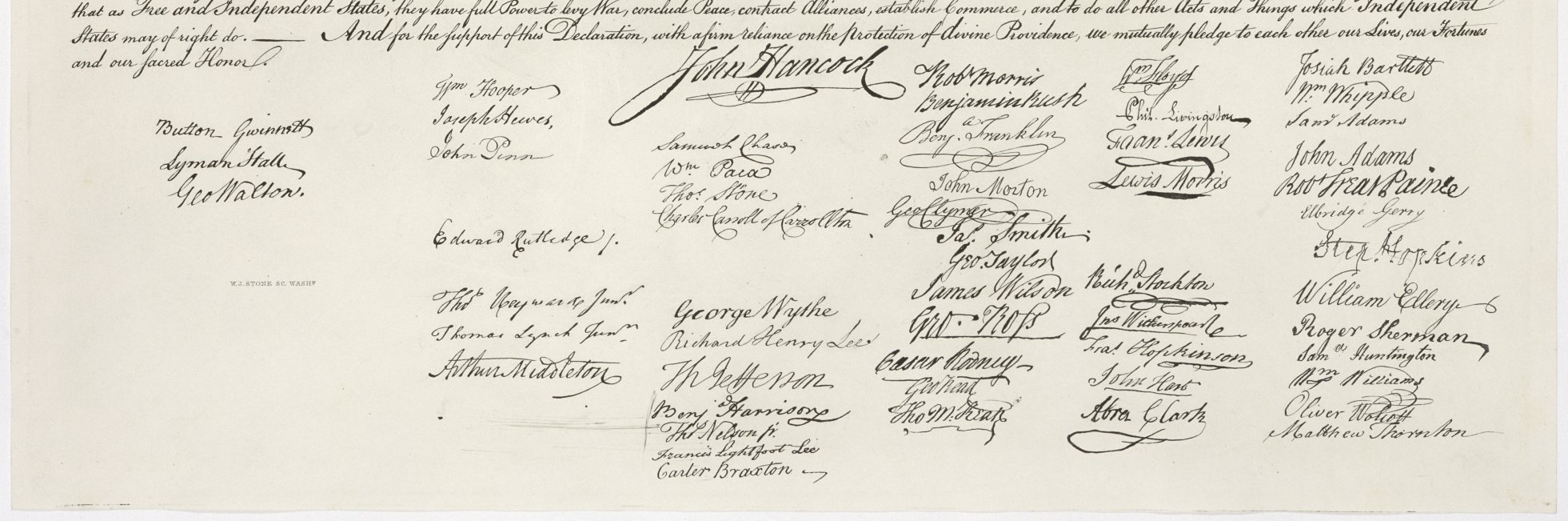
We, therefore, the Representatives of the united States of America, in General Congress, Assembled, appealing to the Supreme Judge of the world for the rectitude of our intentions, do, in the Name, and by Authority of the good People of these Colonies, solemnly publish and declare, That these United Colonies are, and of Right ought to be Free and Independent States; that they are Absolved from all Allegiance to the British Crown, and that all political connection between them and the State of Great Britain, is and ought to be totally dissolved; and that as Free and Independent States, they have full Power to levy War, conclude Peace, contract Alliances, establish Commerce, and to do all other Acts and Things which Independent States may of right do. And for the support of this Declaration, with a firm reliance on the protection of divine Providence, we mutually pledge to each other our Lives, our Fortunes and our sacred Honor.
The 56 signatures on the Declaration of Independence
Don Tapscott presents what might just be humanity’s salvation.
Millions of us, of all ages, are linked together in this new ‘wired’ world. For old crusties such as myself, it’s all too easy to recall the days when the mention of the word ‘chip’ immediately brought to mind fried fish! But we struggled into this new world and now can’t imagine how it was in those earlier days – anyone want to buy my old quill pen? 😉
There are huge benefits to this wonderful networked world and most days I read something on a website here or a blog there that opens my mind in unfathomable ways. Not only that, but the number of friends, new and old, who co-operate with my attempts to show how integrity is the only way forward is humbling.
Thus it was that an old friend of many years, Lee C., sent me a link to a recent TED talk that revealed in just 17 minutes a message of hope for all of us. It reminded me that our younger generation have their own knowledge, their own aspirations, their own fears and dreams.
Without more ado, watch it now!
The recent generations have been bathed in connecting technology from birth, says futurist Don Tapscott, and as a result the world is transforming into one that is far more open and transparent. In this inspiring talk, he lists the four core principles that show how this open world can be a far better place.
And weren’t those flocks of starlings just breathtaking?
Lee also sent me this:
Don Tapscott’s recent TED talk ends with footage of starlings in vast numbers which is referred to as a ‘murmuration’. I watched it just two nights or so ago. Tonight I went outside for a breath of fresh air (ok a call of nature) and this is part of what I saw. So pleased to have had my mobile phone in my shirt pocket.
Finally, I hadn’t come across Don Tapscott before but thanks again to this amazing world of shared information, a quick Google search finds Don’s own website here.
It’s some ago that I read Lester Brown’s book World on the Edge but I still recall the effect it had on me. Namely, this is not some environmentalist’s ‘willy waving’ but something that has the potential to hurt, I mean HURT! Since the book was published the stream of information and evidence has turned into a flood of awareness that if we don’t change our ways soon then we, as in the vastness of human life, will go over the edge.
So it was a good reminder to come across a recent extract on the Earth Policy Institute website that is republished in full, as follows:
No previous civilization has survived the ongoing destruction of its natural supports. Nor will ours. Yet economists look at the future through a different lens. Relying heavily on economic data to measure progress, they see the near 10-fold growth in the world economy since 1950 and the associated gains in living standards as the crowning achievement of our modern civilization. During this period, income per person worldwide climbed nearly fourfold, boosting living standards to previously unimaginable levels. A century ago, annual growth in the world economy was measured in the billions of dollars. Today, it is measured in the trillions. In the eyes of mainstream economists, our present economic system has not only an illustrious past but also a promising future.
Mainstream economists see the 2008–09 global economic recession and near-collapse of the international financial system as a bump in the road, albeit an unusually big one, before a return to growth as usual. Projections of economic growth, whether by the World Bank, Goldman Sachs, or Deutsche Bank, typically show the global economy expanding by roughly 3 percent a year. At this rate the 2010 economy would easily double in size by 2035. With these projections, economic growth in the decades ahead is more or less an extrapolation of the growth of recent decades.
But natural scientists see that as the world economy expanded some 20-fold over the last century, it has revealed a flaw—a flaw so serious that if it is not corrected it will spell the end of civilization as we know it. At some point, what had been excessive local demands on environmental systems when the economy was small became global in scope.
A study by a team of scientists led by Mathis Wackernagel aggregates the use of the earth’s natural assets, including carbon dioxide overload in the atmosphere, into a single indicator—the ecological footprint. The authors concluded that humanity’s collective demands first surpassed the earth’s regenerative capacity around 1980. By 2007, global demands on the earth’s natural systems exceeded sustainable yields by 50 percent. Stated otherwise, it would take 1.5 Earths to sustain our current consumption. If we use environmental indicators to evaluate our situation, then the global decline of the economy’s natural support systems—the environmental decline that will lead to economic decline and social collapse—is well under way.
How did we get into this mess? Our market-based global economy as currently managed is in trouble. The market does many things well. It allocates resources with an efficiency that no central planner could even imagine, much less achieve.
However the market, which sets prices, is not telling us the truth. It is omitting indirect costs that in some cases now dwarf direct costs. Consider gasoline. Pumping oil, refining it into gasoline, and delivering the gas to U.S. service stations may cost, say, $3 per gallon. The indirect costs, including climate change, treatment of respiratory illnesses, oil spills, and the U.S. military presence in the Middle East to ensure access to the oil, total $12 per gallon. Similar calculations can be done for coal.
We delude ourselves with our accounting system. Leaving such huge costs off the books is a formula for bankruptcy. Environmental trends are the lead indicators telling us what lies ahead for the economy and ultimately for society itself. Falling water tables today signal rising food prices tomorrow. Shrinking polar ice sheets are a prelude to falling coastal real estate values.
Beyond this, mainstream economics pays little attention to the sustainable yield thresholds of the earth’s natural systems. Modern economic thinking and policymaking have created an economy that is so out of sync with the ecosystem on which it depends that it is approaching collapse. How can we assume that the growth of an economic system that is shrinking the earth’s forests, eroding its soils, depleting its aquifers, collapsing its fisheries, elevating its temperature, and melting its ice sheets can simply be projected into the long-term future? What is the intellectual process underpinning these extrapolations?
We are facing a situation in economics today similar to that in astronomy when Copernicus arrived on the scene, a time when it was believed that the sun revolved around the earth. Just as Copernicus had to formulate a new astronomical worldview after several decades of celestial observations and mathematical calculations, we too must formulate a new economic worldview based on several decades of environmental observations and analyses.
The archeological record indicates that civilizational collapse does not come suddenly out of the blue. Archeologists analyzing earlier civilizations talk about a decline-and-collapse scenario. Economic and social collapse was almost always preceded by a period of environmental decline.
For past civilizations it was sometimes a single environmental trend that was primarily responsible for their decline. Sometimes it was multiple trends. For Sumer, rising salt concentrations in the soil, as a result of an environmental flaw in the design of their otherwise extraordinary irrigation system, led to a decline in wheat yields. The Sumerians then shifted to barley, a more salt-tolerant crop. But eventually barley yields also began to decline. The collapse of the civilization followed.
For the Mayans, it was deforestation and soil erosion. As more and more land was cleared for farming to support the expanding empire, soil erosion undermined the productivity of their tropical soils. A team of scientists from the National Aeronautics and Space Administration has noted that the extensive land clearing by the Mayans likely also altered the regional climate, reducing rainfall. In effect, the scientists suggest, it was the convergence of several environmental trends, some reinforcing others, that led to the food shortages that brought down the Mayan civilization.
Although we live in a highly urbanized, technologically advanced society, we are as dependent on the earth’s natural support systems as the Sumerians and Mayans were. If we continue with business as usual, civilizational collapse is no longer a matter of whether but when. We now have an economy that is destroying its natural support systems, one that has put us on a decline and collapse path.
The reality of our situation may soon become clearer for mainstream economists as we begin to see some of the early economic effects of overconsuming the earth’s resources, such as rising world food prices. On the social front, the most disturbing trend is spreading hunger.
As rapid population growth continues, cropland becomes scarce, wells go dry, forests disappear, soils erode, unemployment rises, and hunger spreads. As environmental degradation and economic and social stresses mount, the more fragile governments are losing their capacity to govern. They become failing states—countries whose governments can no longer provide personal security, food security, or basic social services, such as education and health care. As the list of failing states grows longer each year, it raises a disturbing question: How many states must fail before our global civilization begins to unravel?
How much longer can we remain in the decline phase, whether measured in natural asset liquidation, spreading hunger, or failing states, before our global civilization begins to break down? We are dangerously close to the edge. Peter Goldmark, former Rockefeller Foundation president, puts it well: “The death of our civilization is no longer a theory or an academic possibility; it is the road we’re on.”
Adapted fromWorld on the Edge by Lester R. Brown. The message is clear.
But if you haven’t read the book it’s available online, for free! Just go here and not only will you find the link to the book but also links to other valuable materials.
Founder and President of the Earth Policy Institute, Lester Brown, speaks about his new book World on the Edge: How to Prevent Environmental and Economic Collapse. The issues, says Brown, are critical — and the big question is whether we can change direction before “we go over the edge.” Among his points: solar, wind and geothermal energy, with energy efficiency, can provide all the power we need, but a massive effort must be made now to fully shift to these clean, safe, renewable energy technologies. He strongly rejects nuclear power.
Some of us think holding on makes us strong; but sometimes it is letting go. Hermann Hesse
Nuneaton in Warwickshire is a town about 100 miles North-West of London. It’s firmly in that part of England known as the Midlands, encircled by such places as Birmingham, Coventry, Rugby and Leicester. It is also the home of the Nuneaton & Warwickshire Wildlife Sanctuary So what, you might ask?
Watch this!
On the Wildlife Sanctuary’s website, there is the story of Jasmine,
Jasmine was a rescue dog who lived at the sanctuary until her passing in 2011. She was no ordinary rescue dog, she was the most amazing greyhound in the world!
She was only a young pup when she was locked in a shed and abandoned. When she was discovered by the police many days later she was emaciated, mange ridden and terrified. She was taken to the RSPCA quarters in Coventry where Geoff just happened to be visiting several weeks later. They were introduced and as they say ‘the rest is history’. She came to live with Geoff at the sanctuary. Each day her confidence grew and her personality flourished. But the most amazing thing was yet to come….
It turned out Jasmine was a natural ‘Mother hen’. One day a young fox cub was brought in to the sanctuary. She had been tied to railings and left to die. She was very small and weak and the outlook wasn’t bright. That was until Jasmine sauntered over to the fox cub’s basket and started to lick her. Geoff was immediately concerned, followed by bemusement, followed by amazement as he saw before his eyes the fox responding to Jasmine’s touch. He quickly realised that Jasmine was acting in the same way the fox cub’s mother would have done in the wild!
Over the next few days Jasmine continued to ‘mother’ the fox cub who Geoff had named Roxy. Roxy grew strong and grew up. She lives at the sanctuary with Jasmine who is mum and best friend all rolled into one.
Jasmine was truly one of a kind. She mothered many of the sanctuary’s residents back to health including Bramble the roe deer, Humbug the badger and two of the other sanctuary dogs, just to mention a few.
Sadly Jasmine passed away in 2011. She is greatly missed by all at the sanctuary.
So what’s Geoff’s story? That is beautifully explained here,
In February 2001, an injured swan was taken to a veterinary clinic in Warwickshire. The swan was injured, but needed only a week of rest before it was able to be released back into the wild. However, there was nowhere in the area for the swan to rest and receive care, so it was put to sleep. This was when Geoff decided to set up the sanctuary.
Geoff had worked as a security guard for many years but was injured at work and forced to retire. He used his savings to transform his garden into a haven for wildlife and has never looked back.
Geoff, all the caring people in the world salute you!
As of 2011, the Sanctuary has been open for ten years, and has had 6,500 birds and 4,250 animals.
The Sanctuary relies on the work of our dedicated team of volunteers; who accompany us on fundraising events, talks, and shows to help raise money for the Sanctuary.
So let me close by thanking Suzann for sending me the video link to this beautiful story. And do make a note to look in on Learning from Dogs next Saturday to marvel at yet another example of the way dogs (and Geoff!) throw off their pasts and rejoice in the present.
Before going to a recent BBC report about this important subject, let me offer a personal anecdote.
A couple of months ago I had cause to be seen by a neurologist. I wanted to get a professional opinion as to whether a degree of forgetfulness that I was experiencing was normal for a person of my age (68 next birthday). Dr. G. not only confirmed that there was absolutely no sign of dementia but that my forgetfulness was perfectly normal for someone of my age who had been through some major life changes in the last few years.
Dr. G. stressed (probably not the best word but you know what I mean!) that me worrying about forgetting stuff and the resulting anxiety was a self-feeding issue. I had to stop being anxious. Indeed, Dr. G. said the following (and this I haven’t forgotten!):
Anxiety is the killer of good bodies and the killer of good brains!
So with those words ringing in your ears, have a read of this recent report from the BBC News website.
Role of stress in dementia investigated
By Michelle Roberts, Health editor, BBC News online
UK experts are to begin a study to find out if stress can trigger dementia.
The investigation, funded by the Alzheimer’s Society, will monitor 140 people with mild cognitive impairment or “pre-dementia” and look at how stress affects their condition.
The researchers will take blood and saliva samples at six-monthly intervals over the 18 months of the study to measure biological markers of stress.
They hope their work will reveal ways to prevent dementia.
The results could offer clues to new treatments or better ways of managing the condition, they say.
Dementia triggers
People who have mild cognitive impairment are at an increased risk of going on to develop dementia – although some will remain stable and others may improve.
And past work suggests mid-life stress may increase a person’s risk of Alzheimer’s disease.
A Swedish study that followed nearly 1,500 women for a period of 35 years found the risk of dementia was about 65% higher in women who reported repeated periods of stress in middle age than in those who did not.
Scottish scientists, who have done studies in animals, believe the link may be down to hormones the body releases in response to stress which interfere with brain function.
Prof Clive Holmes, from the University of Southampton, who will lead the study, said: “All of us go through stressful events. We are looking to understand how these may become a risk factor for the development of Alzheimer’s.
“Something such as bereavement or a traumatic experience – possibly even moving home – are also potential factors.
“This is the first stage in developing ways in which to intervene with psychological or drug-based treatments to fight the disease.
“We are looking at two aspects of stress relief – physical and psychological – and the body’s response to that experience.”
Dr Simon Ridley, of Alzheimer’s Research UK, said: “We welcome any research that could shed new light on Alzheimer’s disease and other causes of dementia.
“Understanding the risk factors for Alzheimer’s could provide one piece of the puzzle we need to take us closer to a treatment that could stop the disease in its tracks.”
The sad story of the death of Lonesome George, a giant tortoise.
When you’re gone, you’re gone, it is said. But in the case of this example of the beauty of Mother Nature, the idea of being gone is as final as it comes; George was the last of his species.
Staff at the Galapagos National Park in Ecuador say Lonesome George, a giant tortoise believed to be the last of its subspecies, has died.
Scientists estimate he was about 100 years old.
Park officials said they would carry out a post-mortem to determine the cause of his death.
With no offspring and no known individuals from his subspecies left, Lonesome George became known as the rarest creature in the world.
For decades, environmentalists unsuccessfully tried to get the Pinta Island tortoise to reproduce with females from a similar subspecies on the Galapagos Islands.
Park officials said the tortoise was found dead in his corral by his keeper of 40 years, Fausto Llerena.
While his exact age was not known, Lonesome George was estimated to be about 100, which made him a young adult as the subspecies can live up to an age of 200.
Lonesome George was first seen by a Hungarian scientist on the Galapagos island of Pinta in 1972.
Environmentalists had believed his subspecies(Chelonoidis nigra abingdoni) had become extinct.
Lonesome George became part of the Galapagos National Park breeding programme.
After 15 years of living with a female tortoise from the nearby Wolf volcano, Lonesome George did mate, but the eggs were infertile.
He also shared his corral with female tortoises from Espanola island, which are genetically closer to him than those from Wolf volcano, but Lonesome George failed to mate with them.
He became a symbol of the Galapagos Islands, which attract some 180,000 visitors a year.
Galapagos National Park officials said that with George’s death, the Pinta tortoise subspecies has become extinct.
They said his body would probably be embalmed to conserve him for future generations.
Tortoises were plentiful on the Galapagos islands until the late 19th century, but were later hunted for their meat by sailors and fishermen to the point of extinction.
Their habitat furthermore suffered when goats were introduced from the mainland.
The differences in appearance between tortoises from different Galapagos islands were among the features which helped the British naturalist Charles Darwin formulate his theory of evolution.
Some 20,000 giant tortoises of other subspecies still live on the Galapagos.
Continuing the tribute, Chris Mazzarella had some stunning photographs on his wonderful photographic blogsite Fast Forward. (Do take a look!) I held my breath and asked Chris for permission to republish his article and was delighted to be given his approval. Thanks Chris, thanks very much.
oooOOOooo
An Ode To George
To pay tribute to our late friend Lonesome George, I thought it would be appropriate to write a post in celebration of turtles. George was the last tortoise of the subspecies Chelonoidis nigra abingdoni from Pinta Island in the Galapagos. Sadly George passed yesterday at the tender age of 100 years. This could be considered middle aged for the tortoise who’s counterparts can live beyond 200 years.
This is easily the smallest one I’ve seen all year. To give you some perspective, this lily pad is about eight inches across.
In Vermont, we have seven species of turtles, and I run into many of them while kayaking around the state. The one I see most often is the painted turtle. I spot these guys by the dozen basking in the sun while I’m paddling throughout the northeast. They are very cooperative subjects, but will head for a swim if you get too close. I don’t like spoiling anyone’s sunbath so I do my best to keep a respectable distance out on the water.
You can check out the biggest turtle I’ve seen all year in an April post entitled Snappers.
I’ve read that snapping turtles are the most common turtle in Vermont, yet I do not see quite as many in my travels. When I do see them, they are usually trolling underwater, covered in algae.
I have encountered a few snappers above the surface this year. I found this old guy lounging on a log in Bradford, Vermont a few days ago.
One of the rarer species of turtle I encountered this spring was a wood turtle in Magalloway Brook. I didn’t have much time to prepare for this shot before he launched off the log and into the water. It was a brief meeting, but certainly a memorable one as this is the only wood turtle I’ve ever photographed.
While turtles are not known for their speed they do offer unique challenges for photographers, particularly when shooting in the sun. Their reflective carapace makes them easy to spot, but difficult to expose for. A polarizing filter is sometimes necessary to reduce the glare on their wet shells. While this will help, the ideal situation is to shoot them under overcast skies.
Another thing to keep in mind is the angle of your shot. The kayak makes a great vehicle for wildlife photography because it keeps you low on the water. I often try to shoot wildlife at eye level. This gives you the same perspective from which the animal views the world. It’s much more interesting than a bird’s eye view, for example, and embodies the subject with the sense of pride that it deserves.
George’s passing marks the end of an important legacy, as the Galapagos turtles played a very important role in the foundation of Darwin’s theory of Natural Selection.




 Learning from Dogs