Category: People

AGW – summing up.

“If there’s any doubt, there’s no doubt!”

I opened the first post on Monday with the sub-heading: “Certainty is perfect knowledge secure from error or doubt.” going on to write that, “Whatever your views on the effect of man’s behaviours on our planet’s climate, it’s a long way from the logical idea of ‘2 + 2‘!”

Within that very strict definition, I remain unmoved.  The argument that mankind is the cause of the present change in the climate of Planet Earth is not certain!

However, if only life was that simple! The change in our planet’s atmosphere is possibly the most emotionally-laden topic of all time.  For some reason that quotation attributed to Hiram Johnson comes to mind, “The first casualty when war comes is truth.” because the supporters and deniers of AGW are engaged in what amounts to a verbal war.

Each side can draw on much information.

For example, a very recent article in The New York Times by their Justin Gillis offered this:

The rise in the surface temperature of earth has been markedly slower over the last 15 years than in the 20 years before that. And that lull in warming has occurred even as greenhouse gases have accumulated in the atmosphere at a record pace.

The slowdown is a bit of a mystery to climate scientists. True, the basic theory that predicts a warming of the planet in response to human emissions does not suggest that warming should be smooth and continuous. To the contrary, in a climate system still dominated by natural variability, there is every reason to think the warming will proceed in fits and starts.

But given how much is riding on the scientific forecast, the practitioners of climate science would like to understand exactly what is going on. They admit that they do not, even though some potential mechanisms of the slowdown have been suggested. The situation highlights important gaps in our knowledge of the climate system, some of which cannot be closed until we get better measurements from high in space and from deep in the ocean.

As you might imagine, those dismissive of climate-change concerns have made much of this warming plateau. They typically argue that “global warming stopped 15 years ago” or some similar statement, and then assert that this disproves the whole notion that greenhouse gases are causing warming.

Rarely do they mention that most of the warmest years in the historical record have occurred recently. Moreover, their claim depends on careful selection of the starting and ending points. The starting point is almost always 1998, a particularly warm year because of a strong El Niño weather pattern.

Dan Gomez, a long-time friend of over 40 years and a regular contributor to items on Learning from Dogs, wrote in a recent email,

I’m not sure what is meant by “believer”, Paul.  The Universe unfolds as it should.  Because many have been led to “believe” that AGW is inevitable and that all the facts are the ‘Truth”, we’ve created a religious substitute, almost a new “industry” with significant “tithing” obligations, etc. (e.g. Cap and Trade). Presumptions and facts are being manipulated to fulfill the prophecy.

Interesting to note in our daily lives, that weather prediction is very good 24-36 hrs out.  This drops precipitously just a few days out.  More than 7-10 days is nearly impossible. Even though both Europe and the USA have decreased CO2 levels by multiple percentage points over the last 20 years, the rest of the world does not care and the impact is very problematic.  Recently, CO2 gas has increased overall but heat has not. In the past, warming has occurred followed by CO2 levels increasing. Global politics and redistribution of wealth schemes continue to interfere with common sense.

Let’s just deal with the facts as Science reveals its secrets. New information is discovered every day about the interaction of the  Earth/Sun/Atmosphere/Lithosphere/Hydrosphere. New information is learned every day about the Universe.  These are not closed subjects. Climatology, meteorology, geology and solar system dynamics will continue to shape the Earth’s future for millennia to come whether Man is involved or not.

There is much in what Dan writes that has me nodding my head; stimulates my recollection of what Luther Haave and Derek Alker wrote in 2009:

With the explosion of knowledge, particularly in the past 100 years, each of us has found it a requirement for being successful, and to being able to earn a living, to concentrate our knowledge in an ever increasingly narrow field. Just as we have come to expect others to defer to our expertise in our narrow area, we have come to assume that we need to defer to others who have a deeper comprehension of seemingly complex topics such as the science related to climate change. [Apologies, can’t find the web link for this.]

However, if we broaden the perspective from that tight definition of certainty to an analysis of probabilities, then it all changes for me and I can embrace the views so strongly put forward by Martin Lack.

For example, Martin left a comment on Monday, “ACD is not a matter of opinion or belief; it is a matter of probability. As such, all that matters now is the extremely high probability that the scientific consensus is real, reasonable and reliable.”  That comment included a link to a discussion on the website Skeptical Science, Is the science settled? Let me quote from that:

Some aspects of the science of AGW are known with near 100% certainty. The greenhouse effect itself is as established a phenomenon as any: it was discovered in the 1820s and the basic physics was essentially understood by the 1950s. There is no reasonable doubt that the global climate is warming. And there is also a clear trail of evidence leading to the conclusion that it’s caused by our greenhouse gas emissions. Some aspects are less certain; for example, the net effect of aerosol pollution is known to be negative, but the exact value needs to be better constrained.

What about the remaining uncertainties? Shouldn’t we wait for 100% certainty before taking action? Outside of logic and mathematics, we do not live in a world of certainties. Science comes to tentative conclusions based on the balance of evidence. The more independent lines of evidence are found to support a scientific theory, the closer it is likely to be to the truth. Just because some details are still not well understood should not cast into doubt our understanding of the big picture: humans are causing global warming.

In most aspects of our lives, we think it rational to make decisions based on incomplete information. We will take out insurance when there is even a slight probability that we will need it. Why should our planet’s climate be any different?

That, ultimately, delivers for me what truly counts.

I am not a scientist; just a Brit living in Southern Oregon trying to make sense of the world while I still have a functioning head and body – time is not on my side! 😉  The powerful common-sense in the sentence, “Outside of logic and mathematics, we do not live in a world of certainties.” is beyond argument.

In the year 2012, the total number of passengers carried by US Airlines and other carriers in and out of the USA was a staggering 815 million people. 815,000,000 people!

Remember the sub-heading from the start of this post!  “If there’s any doubt, there’s no doubt!” Years ago I heard that from Bob Derham, a long-time friend and a commercial airline Captain since the time God was a boy!  It’s that cautious, safety-focused attitude that has made airline transport such an amazing mode of transport for all those millions of passengers.

Should we not travel with the same cautious, safety-focused attitude on the ‘vehicle’ that carries every man, woman and child; every animal, plant and living thing: Planet Earth!

The answer is obvious – more than obvious!

AGW certainty, Part Two

Continuing the examination of two views on AGW.

Readers will recall that this post opened yesterday.  That Part One closed with Martin writing this:

Martin Lack

Much of what Oakwood writes is an attack upon the Hockey Stick graph of palaeoclimatic temperature reconstructions first produced in 1998 (MBH98).

However, the fatal flaws in Oakwood’s scepticism regarding MBH98 are as follows:

  1. MBH98 has been validated by at least 14 other reconstructions (as cited in IPCC AR4 in 2007) using a wide variety of other proxy data(see Wikipedia for relevant links)
  2. Hockey Stick-shaped graphs turn up in reconstructions of CO2 levels and temperature – now going back over thousands of years – because they are not ‘statistical noise’ –
  3. Arguments about splicing instrumental data onto proxy data only serve to challenge the extent to which the speed of late 20th Century warming is unprecedented.
  4. Such arguments do not invalidate the conclusion that it is now almost certainly warmer than it has been at any time since the last Ice Age (i.e. a period of relative climate and sea level stability that has made agriculture, urbanisation and civilisation possible).

However, this is no reason for us to be complacent because, as Oakwood must know, the 50 to 100 metres of sea level rise that will be caused by the melting of terrestrial ice sheets will necessitate the mass migration of millions of people. This makes his concerns about current poverty and starvation (i.e. the main reason he eventually cites for not believing action is yet necessary) look very trivial indeed.

So continuing ….

Oakwood

The argument that the ‘divergence problem’ does not bring into question proxy studies is just one example of supposed ‘settled’ evidence in the case for AGW. There are others which collectively bring down the case to one of opinion.

Martin Lack

After a lengthy attempt to assert that the “hide the decline” controversy was or is significant, Oakwood eventually moves onto attack the significance of MBH98; and to claim that ACD is no more than a matter of opinion. It is only possible to reach this conclusion by dismissing the majority of climate scientists as being stupid, sloppy, or sinister.

Oakwood

Here are a few others:

  • Mann et al’s original hockey stick (1998) (as well as a number of other studies) shows an unprecedented temperature rise in the first half of the 20th century, a temperature change that most climate scientists believe can be explained by natural phenomena, such as the Sun (while failing to reproduce the man-made rise in the 2nd half of the century, due to the divergence problem explained above).

Martin Lack

However, Climategate and, more especially Climategate 2.0 merely served to demonstrate how deliberate and organised are the attempts to discredit climate science and derail international attempts to tackle the ACD problem.

Oakwood

Thus, we are expected to believe there was both an unprecedented NATURAL temperature rise and unprecedented MAN-MADE rise in the same century. Not impossible, but statistically highly unlikely.

Martin Lack

Oakwood suggests that assertions about early 20th Century warming are statistically highly unlikely (i.e. that climate scientists are stupid to make them). However, the real statistically highly unlikely suggestion is that 30 years of monthly average temperatures exceeding their long-term average values could be a consequence of natural variation. Unlike early 20th Century warming, this is definitely not capable of being explained by natural causes (such as cyclical solar activity or random volcanic eruptions).

Oakwood

  • The ‘record’ (in just 35 years) of minimum summer ice in the Arctic is repeatedly presented as evidence for impending doom. However, the record MAXIMUM ice cover in the ANTarctic, at the same time, is dismissed with ‘we have another explanation for that’.

Martin Lack

Trying to shift the focus away from the accelerating rate of ice loss in the Arctic is very lame indeed. The Arctic is surrounded by land and (now) increasing amounts of warming water. The reasons for the ice loss are well understood and it is happening faster than was predicted even 5 years ago. The Antarctic is surrounded by a huge expanse of cold ocean and is also being kept cold by the human caused hole in the ozone layer. The reasons why its ice is not melting so fast are therefore also well understood. In addition, it should be noted that the Antarctic Peninsula is the fastest warming place in the southern hemisphere.

Oakwood

  • Whatever the weather, blame global warming. A few years ago, milder winters and earlier springs in the UK were hailed as evidence of AGW. But now we get lots of snow, and appalling spring, cooler summers, etc, and guess what, its due to global warming.
  • Hot/dry weather and floods around the world are routinely highlighted as ‘more evidence’ whereas as cold weather extremes and records are dismissed as ‘just natural variation’ – again, and again and again.

Martin Lack

Oakwood‘s remarks about extreme events are also very misleading. The number of records being broken for hot and/or dry events is many times greater than the number of records being broken for cold and/or wet events. As Hansen et al explained last year, in their review of historical data for the last five decades, natural variability does not explain the steady shift in average temperatures and the broadening of the range of conditions experienced in any one place.

I really can’t believe that Oakwood is so parochial in his outlook that he dares to mention the cold weather the UK has experienced recently. We may have had the coldest Spring for 50 years, but, that does not change the fact that global average temperatures are still the highest ever in recorded history. Furthermore, it does not change the fact that the analysis of Hansen et al (2012) continues to be validated by events such as those in Central Europe at the moment – where 1 in 100 year flood events have recurred after only 10 years. Not impossible – just statistically highly unlikely.

Oakwood

Those who highlight the lack of rising temperature for the past 10-15 years are routinely dismissed as deniers and liars. We’re told, ‘but the last decade is the warmest in a 100 years’. No-one disputes that. Given the world warmed by 0.8 degC in 100 years, that’s perfectly reasonable, and is not a defence against the fact that warming has at least paused.

  • We’re told: ‘but the heat is going into the ice caps and the deep oceans and atmospheric heat is just a small percentage of the total’, How convenient. In the 1980s and 1990s, atmospheric temperature was enough for ‘proof’ of serious AGW. We didn’t hear anything about ocean heat then. No-one suggested that perhaps the warming was due to a release of previously ‘hidden’ ocean heat. Or that we shouldn’t read too much into a small atmospheric temperature rise.
  • We see again and again, whatever happens, whatever the data show, the theory is revised to ‘show’ that nothing has changed. This is simply not plausible science.
  • We’re told, the physics of CO2-induced global warming is just that, ‘physics’, and we can’t change that however much we dispute it. No-one disputes the physics. But, the atmosphere (believe it or not) is very complicated. We have the physics that says aerosols reflect the Sun’s heat, that clouds may increase and also reflect more heat. We now hear the relationships with the oceans is very important (which we didn’t hear before). Thus the debate is not about the reality of the CO2-global warming physics. Its about the sensitivity of the system and which physical phenomena will dominate.

Martin Lack

Given the massive inertia in the climate system (which guarantees decades of future temperature rise even if CO2 emissions were completely halted today), there is no reason for us to be complacent about the fact that we have only seen a rise of 0.8C since the Industrial Revolution. The scientific consensus remains that equilibrium climate sensitivity is somewhere in excess of 2C and that such a rise in temperature will not be good for the vast majority of life on Earth. On the evidence of the ACD that we are already experiencing, I think there is very good reason to agree with that conclusion.

Again, I am astonished that Oakwood even dares to mention the ‘global warming has stopped’ canard. This misconception has been debunked so many times; there are even debates about who has written written the best rebuttals.  Here is a summary: Whilst surface warming may have paused, the warming of the ocean (which is driving the increased frequency of extreme weather events of all kinds) has continued. Given that oceans cover two thirds of the Earth’s surface, is this something really worth arguing about?

Climate scientists are therefore not changing their story to accommodate inconvenient new data. Only climate change sceptics do that. The only implausible science on offer today is that which seeks to explain all the data without acknowledging that CO2 is the main driver. Sure, CO2 does not explain everything but, you cannot explain all the data unless the primacy of CO2 is accepted.

Oakwood

Some will respond: ‘but all of these arguments have been debunked many times’. All they really mean is another opinion or speculation has been given by an AGW believer. Nothing wrong with these, but don’t claim they represent settled science.

Martin Lack

However, I should like to re-iterate the importance of the recently-published results of investigations at a lake in the NE of Arctic Russia. What this new 3.6 million year continuous palaeoclimatic record tells us is that current warmth is not unprecedented (if you go back to an era in which humans did not exist – 400 or 1,100 thousand years ago). This demonstrates that good scientists do not change their story when they get unexpected results.

Oakwood

I have no problem with scientists believing in AGW and believing it a serious threat. But when so much of their case is based on weak arguments, I do have a problem with claiming the case is ‘settled’ and that anyone who questions or challenges it is a liar, denier, conspiracy theorist, etc.

Both sides of the debate have their extremists and nutters. My interest is in the rational middle ground. To suggest an ‘eccentric’ like Christopher Monckton is ‘typical’ of all AGW-sceptics is just like claiming all Conservative voters are fascist and all Labour voters communist. It has no place in informed and educated debate.

Martin Lack

Oakwood claims arguments for concern over ACD are “weak” but, in making this assertion, the only information he has referred to is very much out-of-date (such as IPCC AR4 in 2007). Oakwood moves on to discuss unhelpful labels such as “liar” and “denier”.

I do not think I have ever suggested that anyone who professes to be ‘sceptical’ is lying. However, I do think that, just like the tobacco executives whose ‘modus operandi’ they are copying, the executives of fossil fuel companies know more than they care to admit. There is also a great deal of evidence to indicate that climate change ‘scepticism’ is in fact being driven by unscientific economists aided in their anti-science cause by a handful of friendly scientists who tell them what they want to hear. This is not scepticism, it is ideological prejudice.

Oakwood

The term “denier” was introduced with the intention of associating AGW-sceptics with Holocaust Deniers. That is to say, AGW-sceptics are putting millions of lives at risk through their lies and ignorance. Given the weakness of the AGW case, the use of the labels ‘denier’, ‘deny’, denial’ seems to represent an insult to every victim of the Holocaust.

Martin Lack

I agree that use of the term ‘denier’ is generally not helpful, but, given all the evidence that conflicts with their position, I do think that those who remain ‘sceptical’ about the primary cause of ongoing climate change are being irrational. If your beliefs require you to dismiss any and all evidence that conflicts with them, that is not scepticism, it is wilful blindness; it is what Young Earth Creationists have to do in order to protect themselves from wicked and ungodly scientific ideas.

Therefore, even if Oakwood does not do it, many who are ‘sceptical’ do rely upon conspiracy theories to dismiss all the evidence that conflicts with their beliefs. This includes dismissing most scientists as stupid, sloppy or sinister.

Oakwood

And why is it not time to act now? I am an environmentalist and see many environmental and social problems that need addressing. In particular, the need for ‘sustainability’ in all we do. There remain millions dying each year from such things as malnutrition, lack of safe drinking water, malaria, etc.

These are hard facts with zero room for any doubt. Given the weakness in the AGW-case, it is not a priority. I see some benefits in acting. For example, in many cases a reduction in CO2 emissions leads to much improved energy-efficiency, and less pollution. However, the case is not made for diverting money and effort from the more immediate priorities, covering pristine countryside in wind farms to satisfy urban energy demands, or using more biofuels at the expense of more hunger.

Martin Lack

Having wasted so much time trying to falsify MBH98, Oakwood finally gets round to the important bit of my question: Why does he think the time to act has not yet arrived?

Failing to address the point that a wide range of industrial, political and economic organisations now agree that it is time to act, Oakwood opts instead to simply re-state his belief that attempts to mitigate the ACD problem will do more harm than good. All the evidence I have seen suggests that he is mistaken. To-date, I think the most compelling evidence is that contained in the IIED’s 2009 report , ‘Assessing the costs of Adaptation to Climate Change: A review of UNFCCC and other recent estimates’ (PDF available here), which begins with the following very sobering executive summary:

Several recent studies have reported adaptation costs for climate change, including for developing countries. They have similar-sized estimates and have been influential in discussions on this issue.

However, the studies have a number of deficiencies which need to be transparent and addressed more systematically in the future. A re-assessment of the UNFCCC estimates for 2030 suggests that they are likely to be substantial under-estimates. The purpose of this report is to illustrate the uncertainties in these estimates rather than to develop new cost estimates, which is a much larger task than can be accomplished here.

The main reasons for under-estimation are that: (i) some sectors have not been included in an assessment of cost (e.g. ecosystems, energy, manufacturing, retailing, and tourism); (ii) some of those sectors which have been included have been only partially covered; and (iii) the additional costs of adaptation have sometimes been calculated as ‘climate mark-ups’ against low levels of assumed investment. In some parts of the world low levels of investment have led to a current adaptation deficit, and this deficit will need to be made good by full funding of development, without which the funding for adaptation will be insufficient. Residual damages also need to be evaluated and reported because not all damages can be avoided due to technical and economic constraints.

There is an urgent need for more detailed assessments of these costs, including case studies of costs of adaptation in specific places and sectors.

Oakwood

Thus, belief in AGW is not a simple moral argument which some would want to believe – good vs evil, or capitalist vs environmentalist, etc.

Martin Lack

Oakwood says he does not think this is a good-vs- evil or a capitalist-vs- environmentalist issue. I would agree. However:

  • I am not the one who is allowing my political beliefs to prejudice my approach to the science;
  • I am not the one who is accusing most scientists of being stupid, sloppy or sinister in order to dismiss what they are telling me; and
  • I am not the one changing my story or my preferred argument whenever something I have formerly relied upon is shown to be unreasonable.

Although it is a shame that he is part of a minority within the UK’s current Coalition Government, I will conclude by quoting from a recent speech by the Secretary of State for Energy and Climate Change, Edward Davey:

Of course there will always be uncertainties within climate science and the need for research to continue… We make progress by building on what we know, and questioning what we don’t. But some sections of the press are giving an uncritical campaigning platform to individuals and lobby groups who reject outright the fact that climate change is a result of human activity. Some who even deny the reality of climate change itself… By selectively misreading the evidence, they seek to suggest that climate change has stopped so we can all relax and burn all the dirty fuel we want without a care…

Oakwood says he opposes action to curb ACD because there are bigger problems we need to solve. If this were likely to be true, it would be an admirable position to take. Unfortunately, the bulk of the evidence suggests that ACD is a problem unlike any other and, unless we make serious attempts to minimise it, its consequences will dwarf all other problems we face.

This is because basic physics tells us that allowing the Earth to warm up will cause terrestrial ice to melt and sea levels to rise. It was predicted and it is now happening. The time to act to stop it is now. Millions of people cannot and will not adapt to having their land and their cities submerged under water.

oooOOOooo

Well I think that the agreement of Oakwood and Martin to set out their positions is fabulous and very worthy.

If readers will forgive me, tomorrow I will offer my own personal reflections on what has been offered by Martin and Oakwood today and yesterday.

Exploring the certainty of AGW!

“Certainty is perfect knowledge secure from error or doubt.”

You may wonder what this post is all about opening, as it does, with a definition of ‘certainty’.

What that definition might imply is that ‘certainty’ is a tantalising ‘will of the wisp’ creature.  Excepting for pure mathematics, of course! “Pure mathematics is, in its way, the poetry of logical ideas.” – Einstein quotation.

Whatever your views on the effect of man’s behaviours on our planet’s climate, it’s a long way from the logical idea of ‘2 + 2‘!  So when Oakwood, a reader of Learning from Dogs, submitted a long, carefully written comment rejecting Anthropogenic Global Warming (AGW), the idea came to me that perhaps this comment should stand on its own two feet, so to speak, as a separate post.  I asked Martin Lack, a passionate believer in AGW, to counter the points set out by Oakwood.  Both Martin and Oakwood are scientists; both hydrogeologists.

Now please take a moment to read and assimilate the next few sentences.  The length of the ‘dialogue’ runs to two posts.  Making it without question the longest post that has ever been published on Learning from Dogs.  It is also the most important!  If there is one question above all others for these times, it is the question of whether or not mankind is changing the climate of this planet; the only one we have.

These posts are not an easy read.  They can’t be skim read. They don’t have pictures! But I hope with all my heart that you will settle down today and tomorrow and read each post carefully to the end.

Now to some background information on the two gentlemen.  ‘Oakwood’ is a nom-de-plume.  However, he and I have exchanged emails and I support his need for anonymity. This is how Oakwood describes himself:

  • I am an Earth systems scientist
  • I have followed the AGW scientific arguments on both sides for many years
  • Hydrogeology (my field) and climate science have quite a lot in common, the main one being they require some knowledge and expertise in a wide range of disciplines. It’s not a simple case of saying ‘you are an expert or not’.
  • For example, I need to know quite a bit about chemistry, although I am not an ‘expert chemist’.
  • I am experienced in studying long-time period data, and judging its credibility (this also in common with climate science). Many of the key AGW arguments are based on data and statistics.
  • There are many reasons for being an AGW-sceptic, needing many pages. I give one main example: The ‘divergence problem’ applies to tree ring proxy temperature graphs. Most (perhaps all), proxy graphs cannot reproduce modern temperature data from about the 1980s onwards (in fact the very period of detectable man-made global warming). Because of this, we cannot rely on proxy graphs to conclude now is warmer than the past. Although climate scientists claim the divergence problem is only a modern thing, and does not affect historic data, this is purely a statement or belief. There is no convincing science to back that view.
  • For that reason, I am sceptical of the value of proxy graphs to show current temperatures are unprecedented.
  • I list a number of other brief examples.
  • I do not believe in conspiracy theories and have no problem with climate scientists believing in AGW. But in view of the examples I give, I do have a problem in them saying ‘the science is settled’.
  • There are some benefits from acting on the AGW scare now, such as improved energy efficiency and reduced pollution. There are also negatives, such as wind-farms on pristine countryside and biofuels causing increased hunger.
  • Too much focus on the AGW threat (based on relatively weak scientific arguments) diverts effort and money from more immediate and certain problems.
  • I am an environmentalist who cares about the future of our planet and sustainability. My views on AGW are based purely on the science.

Martin‘s background is encapsulated on his Blog, from which I extract:

I have 25 years of professional work experience, as a geologist and hydrogeologist, in both public and private sectors.

Education:
St Albans School, Hertfordshire, 1976-1983.
BSc (Hons) in Geology (Portsmouth), 1983-1986.
MSc in Hydrogeology (Birmingham), 1989-1990.
Postgrad. Cert. in Education (Keele), 1998-1999.
MA in Environmental Politics (Keele), 2010-2011.

Professional Qualifications:
Fellow of the Geological Society (FGS) since 1992.
Chartered Geologist (CGeol) since 1998.
Member of Chartered Institution of Water and Environmental Management (MCIWEM) since 2000.

Martin’s MA dissertation topic was “A Discourse Analysis of Climate Change Scepticism in the UK“  An abstract of that dissertation may be read here.

So two highly professional persons with diametrically different views.  Here’s the ‘debate’.

oooOOOooo

Oakwood

I have been posed a couple of questions [by Martin Lack, Ed.] which Paul has invited me to respond to.

  1. Why do you think the vast majority of relevantly-qualified and active researchers in earth systems science have reached the conclusion that we need to stop pumping CO2 into the atmosphere as fast as we possibly can because it will get harder to avoid excessive climate change the longer we take to do so?
  2.  Explain why you think the time to act has not yet arrived?

If I may, I’m going to treat those questions more like this:

  1. Why do the majority of climate scientists claim to believe man-made climate change (AGW)  is significant and serious?
  2. Why am I an AGW-sceptic?

Martin Lack

I am grateful to Paul for inviting me to respond to Oakwood’s thesis.

My carefully constructed question was:

Why do you think the vast majority of relevantly-qualified and active researchers in earth systems science have reached the conclusion that we need to stop pumping CO2 into the atmosphere as fast as we possibly can because it will get harder to avoid excessive climate change the longer we take to do so?

I am very pleased to see that Oakwood does not dispute the reality of a scientific consensus regarding AGW although I prefer – because it is more accurate – to call it anthropogenic climate disruption (ACD). Sadly, however, he does not appear to accept its validity. Although I asked Oakwood not to deconstruct the question, he clearly felt it necessary to both deconstruct it and re-word it (emphasis here is mine):

  1. Why do the majority of climate scientists claim to believe man-made climate change is significant and serious?
  2. Why am I an AGW-sceptic?

Right from the start, therefore, Oakwood appears to suggest that the majority of climate scientists are either being stupid, unprofessional, or deceitful. I say this because, by replacing my “have reached the conclusion” with his “claim to believe”, Oakwood would appear to think that the majority of climate scientists have reached a conclusion that is:

  1. Reasonable when it is in fact unreasonable; or
  2. Highly-probable when it is highly-improbable; or
  3. Near-certain when they know it is very uncertain.

Bearing this in mind, let us look at the arguments Oakwood then uses to justify his ‘scepticism’.

Oakwood

I am an ‘earth-systems’ scientist with degrees in Geophysics and Hydrogeology and around 25 years working experience in both those fields, but mostly hydrogeology.

Note: working scientists are every bit as important to our advancement as academics and researchers. Academia is a career choice available to the better scientists. (Though a few ‘duds’ manage to survive by playing the right games.) But many excellent scientists and engineers choose to work in the ‘real world’ where science is applied which often includes active research, written up in reports, but not necessarily in peer-reviewed journals. Those scientists and engineers often have a far more immediate level of responsibility in terms of the quality and implications of their work.

If an academic ‘gets it wrong’, the worst things that may happen are embarrassment, loss of research grant or even loss of job. If a working scientist or engineer gets it wrong, then bridges may collapse, planes may crash, people may be poisoned, etc. Also ‘peer review’ doesn’t mean its right, but just that it adds to the debate.

I have followed the scientific debate for many years, reading much that is written on both sides, including a big proportion of the IPCC reports.

Martin Lack

Oakwood starts by attacking academics for being detached from the real world and suggesting that some  may be “duds” that are just playing games, (although he does not say whom exactly)!

He then attacks the peer review process but fails to provide any reasonable explanation as to why only 24 out of nearly 14 thousand articles about ongoing climate change do not consider human activity to be its primary cause (unless the science is of course near certain).

Oakwood claims to have read a big proportion of IPCC reports (more than me I suspect) but, even so, fails to address the reality that IPCC reports have consistently under-reported the scale and urgency of the problems we face. The AR5 report due out later this year will also do this because it still does not include positive feedback mechanisms causing current rates of change to accelerate.

Oakwood

Very much like hydrogeology, climate science is a multi-disciplinary science dependent on a level of knowledge and expertise in a whole range of disciplines. For example, I need to understand quite a lot about chemistry, although I don’t have a degree in chemistry.

I have to keep learning; by reading, researching, learning from expert colleagues, etc. I also need to know something of maths, statistics, fluid mechanics, weather patterns, computer modelling, microbiology, water treatment, etc.

There are better experts in each one of those subject areas, but that’s their focus and they would not normally be able to pull things together to develop a ‘conceptual model’ of a hydrogeological system.

Martin Lack

Oakwood highlights the similarities between hydrogeology and climate science but fails to mention that both make extensive use of probabilistic computer models (of the kind used by climate scientists). These are models that deal with uncertainty in modelled parameters by being run hundreds if not thousands of times using parameter values picked at random from within user-defined ranges. This produces a range of modelled outcomes with accompanying probabilities of being realised.

Oakwood

There is much overlap between scientific disciplines, especially in ‘Earth systems’. Therefore, to suggest you must be a ‘climate scientist’ to understand all of the scientific and statistical arguments, is incorrect. For example, the hockey stick tree ring studies are principally statistical exercises rather than ‘climate science’, and require an understanding of how the Earth’s climate has changed in the past, which geologists are only too aware of.

As a hydrogeologist, I am very experienced in studying time-series data, and judging whether conclusions drawn from them are plausible and reliable. Of course, my conclusions may not always be correct. Others may disagree with me. But that’s how science develops.

It would take me pages to explain all my reasons for being an AGW-sceptic, so instead I will focus on one key example of where I find a key conclusion unreliable.

THE DIVERGENCE PROBLEM IN TREE-RING TEMPERATURE PROXY STUDIES

I will refer to a ‘typical’ paper by Michael Mann et al, 2008, Proxy-based reconstructions of hemispheric and global surface temperature variations over the past two millennia, Proceedings of the National Academy of Sciences of the United States of America – PNAS.

Its main conclusions are:

Recent warmth appears anomalous for at least the past 1,300 years whether or not tree-ring data are used. If tree-ring data are used, the conclusion can be extended to at least the past 1,700 years, but with additional strong caveats. The reconstructed amplitude of change over past centuries is greater than hitherto reported, with somewhat greater Medieval warmth in the Northern Hemisphere, albeit still not reaching recent levels.

Thus, they claim their work shows current temperatures are unprecedented in at least the past 1,300 years, including the Medieval Warm Period (MWP). This is extremely important. If current temperatures are not warmer than the MWP, then there is far less reason for alarm about the current climate. For example, we don’t have records of such things as droughts, hurricanes, tornadoes, etc.,  being noticeably worse or more common during the MWP. (I know, some will respond: ‘regardless of whether its warmer now, predictions are it will get much worse’. But that is a separate argument). Thus, it seems to be very important to the AGW-case that current temperatures are unprecedented, and changing more quickly than in the past 1,000 to 2,000 years.

Despite, their stated conclusions, their work does not show that now is warmer than the MWP. On their graphs in their Figure 3, current temperatures show as warmer. But the proxy data themselves do not show this. The only data that do are the instrumental data. So if proxy data do not align with instrumental data since the 1980’s onwards, how can we rely on them to show us the MWP was cooler than now? We can’t.

They try to address this with the following statement:

The observed warming rises above the error bounds [ie., the highest possible temperature indicated by proxy data – my words] of the estimates during the 1980s decade, consistent with the known ‘‘divergence problem’’, wherein the temperature sensitivity of some temperature-sensitive tree-ring data appears to have declined in the most recent decades. Interestingly, although the elimination of all tree-ring data from the proxy dataset yields a substantially smaller divergence bias, it does not eliminate the problem altogether. This latter finding suggests that the divergence problem is not limited purely to tree-ring data, but instead may extend to other proxy records.

If you look around at other literature, despite what we hear about ‘settled science’ nobody knows the cause of the ‘divergence’ problem. There is only speculation that it might be something to do with modern air pollution or perhaps CO2 itself.

Here’s what SkepticalScience says:

The divergence problem is a physical phenomenon – tree growth has slowed or declined in the last few decades, mostly in high northern latitudes. The divergence problem is unprecedented, unique to the last few decades, indicating its cause may be anthropogenic. The cause is likely to be a combination of local and global factors such as warming-induced drought and global dimming. Tree-ring proxy reconstructions are reliable before 1960, tracking closely with the instrumental record and other independent proxies.

So, the proxies are “reliable before 1960’s”. But back until when? Around 1880, when temperatures were cooler. There is no evidence whatsoever that the proxies were reliable at other periods of higher temperatures. And we are expected to accept this as ‘settled science’.

In fact, it is possible the divergence problem happens every time it’s warmer. They certainly don’t know this is not the case. The real answer is from very basic statistics:

If the proxy data cannot reproduce the higher temperatures of today, we cannot rely on them to compare with other warmer periods in the past. I don’t care if 99.9% of climate scientists tell me this is acceptable science, I will not agree with them, unless they can produce convincing scientific evidence (not just speculation) to back it up.

(I’ve seen one very comical response more than once: ‘We don’t need recent proxy data to be accurate because we have instrumental data to tell us the temperature.’ For example, a John Havery Samuel says: “A technical concern with one proxy since 1960, when we have perfectly good temperature records already, is an irrelevance.” This COMPLETELY misses the point (and I don’t know whether through ignorance or deliberate distortion). Accurate proxy data today are needed, not to tell us the temperature, but to demonstrate that proxy data are reliable for understanding historical temperatures. That’s simple, basic science. )

Martin Lack

Much of what Oakwood writes is an attack upon the Hockey Stick graph of palaeoclimatic temperature reconstructions first produced in 1998 (MBH98).

However, the fatal flaws in Oakwood’s scepticism regarding MBH98 are as follows:

  1. MBH98 has been validated by at least 14 other reconstructions (as cited in IPCC AR4 in 2007) using a wide variety of other proxy data(see Wikipedia for relevant links)
  2. Hockey Stick-shaped graphs turn up in reconstructions of CO2 levels and temperature – now going back over thousands of years – because they are not ‘statistical noise’ –
  3. Arguments about splicing instrumental data onto proxy data only serve to challenge the extent to which the speed of late 20th Century warming is unprecedented.
  4. Such arguments do not invalidate the conclusion that it is now almost certainly warmer than it has been at any time since the last Ice Age (i.e. a period of relative climate and sea level stability that has made agriculture, urbanisation and civilisation possible).

However, this is no reason for us to be complacent because, as Oakwood must know, the 50 to 100 metres of sea level rise that will be caused by the melting of terrestrial ice sheets will necessitate the mass migration of millions of people. This makes his concerns about current poverty and starvation (i.e. the main reason he eventually cites for not believing action is yet necessary) look very trivial indeed.

oooOOOooo

Part two continues tomorrow.

Wonder and Awe.

Sometimes applause seems just … oh, I don’t know  …. just so inadequate!

If you, like me, was entranced by the music then thanks to a comment left by one Eugene Karry on the YouTube website, all is explained.

Eugene explained that the instrument is called the Armenian Duduk and that Armenian Duduk music is recognized by UNESCO.

It was only a quick search on the UNESCO website to find this:

The duduk, the Armenian oboe, is a single or double reed wind instrument made of the wood of the apricot tree and has a warm, soft, slightly nasal timbre. The duduk or tsiranapokh, which is also called the apricot tree pipe, belongs to the organological category of areophones, which also includes the balaban played in Azerbaijan and Iran, the duduki common in Georgia and the ney in Turkey. The soft wood is the ideal material to carve the body of the instrument. The reed, called ghamish or yegheg, is a local plant growing alongside the Arax river.

img

The roots of Armenian duduk music go back to the times of the Armenian king Tigran the Great (95-55 BC). The instrument is depicted in numerous Armenian manuscripts of the Middle Ages. The duduk accompanies popular Armenian traditional songs and dances of the various regions and is played at social events, such as weddings and funerals. Although there are also famous duduk soloists, among them Gevorg Dabaghyan and Vache Sharafyan, the duduk is mainly played by two musicians. One player creates the musical environment for the lead melody by playing a continual drone that is held by circular breathing, while the other player develops complex melodies and improvisations.

There are four major types of duduk, varying in length from 28 to 40 cm and in sound, ranging from one to fourth or third octaves. Therefore, the sound of the duduk can express various moods depending on the content of the piece and the playing context. The 40-cm long duduk, for example, is regarded as most appropriate for love songs, whereas the smaller one usually accompanies dances. Today, duduk craftsmen continue to create and experiment with different forms of duduks. Many Armenians consider the duduk as the instrument that most eloquently expresses warmth, joy and the history of their community.

Over recent decades, the popularity of Armenian duduk music has decreased, in particular in the rural areas where it originated. At present, most duduk players are concentrated in Yerevan. The duduk instrument is played less and less in social festivities, but more often by professionals as a staged performance. Duduk music risks losing its viability and traditional character and becoming just another facet of “high culture”.

Back to Eugene, who went on to write that Jivan Gasparyan and Gevorg Dabaghyan are famous duduk players among many others. The musical pieces played on the duduk are mostly armenian folk or spiritual tunes; many of them sad songs. Nowadays the duduk is very often played during funerals among Armenians but there are some dance songs as well.

Finally, Eugene offered these further hauntingly beautiful pieces of music.

——-

——-

——–

oooOOOooo

Just beautiful.

Common-sense from HRH The Prince of Wales

Reinforcing my long-time respect for Prince Charles.

HRH The Prince of Wales, more familiarly known as Prince Charles, is a man I have longed admired and respected.

Many years ago, I worked as a volunteer teacher/mentor with what was then known as The Prince’s Youth Business Trust (PYBT).  Later, it became incorporated into The Prince’s Trust.  The PYBT enjoyed passionate and active support from HRH, and with good cause.  Essentially, the PYBT offered socially-disadvantaged youngsters, who had very little chance of getting a job, the opportunity to be mentored on the skills of being an entrepreneur.  Many of those youngsters went on to get decent jobs and many others started their own businesses, some with considerable success.  Simply because thinking like an entrepreneur is impossible if you don’t have faith in your own abilities.  That self-confidence shows in so many walks of life, especially when one is going through a job interview!

The Prince has also long been known for his concerns over the way we treat our planet, going right back to the days when it was regarded rather quaint by the mainstream media.  But as Wikipedia reveals, “He has long championed organic farming and sought to raise world awareness of the dangers facing the natural environment, such as climate change. As an environmentalist, he has received numerous awards and recognition from environmental groups around the world.”

So it was lovely, but no great surprise, to see how well a recent speech was received on the subject of Regional Food Security given at Langenburg Castle in Baden-Wurttenberg, Germany.  The full text is available on The Prince of Wales website.  Let me give you a taste (whoops, pun unintended!) of what The Prince said,

Prinz Charles Langenburg

Ladies and Gentlemen, if I may say so, this is a very important conference. I am sure what you have heard so far about the problems we face and the obstacles to tackling them has given you a clear context in which to be able to consider what comes next this afternoon.

The aim here is to think through how we might create a much more local model of food production and distribution. But also, how that might fit with producing healthy food using far more sustainable methods and how we might do all of this without damaging business. Indeed, how this could improve business.

As you have heard, the urgency for this comes from the fact that there is not sufficient resilience in the system as it currently stands. It may appear that things are well. Big global corporations may appear to be prospering out of operating on a global monocultural scale but, as I hope you have seen, if you drill down into what is actually happening, things are not so healthy. Our present approach is rapidly mining resilience out of our food system and threatening to leave it ever more vulnerable to the various external shocks that are becoming more varied, extreme and frequent.

Some of the stories about food that have been making the news are simply disgraceful, if not downright madness.  Take this one: Meat scrap leftovers now being reprocessed into ice cream: The dismal future of food!

Or try this one: GMO feed turns pig stomachs to mush! Shocking photos reveal severe damage caused by GM soy and corn.

So see the relevance of The Prince’s speech as he continued:

The drive to make food cheaper for consumers and to earn companies bigger profits is sucking real value out of the food production system – value that is critical to its sustainability. I am talking here about obvious things like the vitality of the soil and local eco-systems, the quality and availability of fresh water and so on, but also about less obvious things, like local employment and people’s health. It is, as I fear you know only too well, a complex business.

The aggressive search for cheaper food has been described as a “drive to the bottom”, which I am afraid is taking the farmers with it. They are being driven into the ground by the prices they are forced to expect for their produce and this has led to some very worrying short cuts. The recent horsemeat scandals are surely just one example, revealing a disturbing situation where even the biggest retailers seem not to know where their supplies are coming from. And it has also led to a very destructive effect on farming. We are losing farmers fast. Young people do not want to go into such an unrewarding profession. In the U.K., I have been warning of this for some time and recently set up apprenticeship schemes to try to alleviate the problem; but the fact remains that at the moment the average age of British farmers is fifty-eight, and rising.

One more extract from the speech:

In the U.K., as elsewhere – but particularly I think in the U.S. – the consequences of this are ever more apparent in the deteriorating state of our public health. We all know that Type 2 Diabetes and other obesity-related conditions are rapidly on the increase. The public bill for dealing with these is already massive and I am told it could become completely unaffordable if we do not see a shift in emphasis. And, of course, it will be cities that carry the heaviest part of that burden. It is a peculiar trend.

Am I alone, ladies and gentlemen, in wondering how it is that those who are farming according to organic, or agro-ecological principles – in other words, sustainably, for the long-term, by operating in a way that reduces pollution and contamination of the natural environment to a minimum and maximizes the health of soil, biodiverse ecosystems and humanity – are then penalized? They find that their produce is considered too expensive and too “niche market” to be available to everyone. How is it, then, that systems of farming which do precisely the opposite – with increasingly dire and damaging effects on both the terrestrial and marine environments, not to mention long-term human health – are able to sell their products in mass markets at prices that in no way reflect the immense and damaging cost to the environment and human health? A cost that then has to be paid for over and over again elsewhere – chiefly, in all probability, by our unfortunate children and grandchildren, whose welfare I happen to care about. Surely this is a truly perverse situation which, you would have thought, could be turned on its head to make genuinely sustainably-produced food accessible to everyone, and the polluter to pay the real costs for the side effects of industrialized food? It is to be wondered at how this state of affairs persists – and yet to suggest standing it on its head and transforming the situation is to invite the predictable chorus of vitriolic accusations that you are anti-science, anti-progress, out of touch with commercial pressures and not living in the “real world.”

The full speech may be read here, and please do!

Well done, Sir!  As someone once said, “We are what we eat!

The power of the present moment.

A reminder of the beauty of the present moment.

Yesterday, I wrote a post I cry for the wolves. A comment from Jeremy Nathan Marks included this:

I have learned slowly that being an adult means learning to face and acknowledge the many horrors of our world. It also means -for me, anyway- recognizing that love is the one saving grace, the one remaining hope, the one promise that might be kept. And I mean love in the hear and now and not in any afterlife. Love is what animates beauty for me -a beauty that is about more than aesthetics.

Some people would perhaps think I am ridiculous for saying that I feel that wolves are my kin. But they are. To be kin doesn’t mean we have to think the same thoughts, speak the same spoken language, or even move through the world in precisely the same way. Being kin to me means that we recognize the life lived in one another. I see that life and its light and love in wolves, just as you have beautifully described. And I know people who have lived and worked with wolves have seen that mutuality in their encounters and interactions with wolves and their packs.

That is such a profound reflection.

Unwittingly, before I read that comment from Jeremy, I had added this comment:

Around 7am I went down to our pond just to enjoy the world Jean and I live in and there was a young deer grazing the field grass near the water. Slowly, I moved towards a bench seat by the edge of the pond and sat down. The deer strolled away, perhaps some 30 feet, and continued to graze. Thanks to Dordie and Bill this young, beautiful creature was perfectly comfortable with my presence.

I sat there and my mind wander back to some far-off time when a curious young wolf might have let curiousity compell it to come a little closer to a human, perhaps nibble at the bone that the human threw in its direction.

There’s a theme here.  “Love in the here and now ..” from Jeremy and me being lost watching that deer; the love of that moment.

A couple of evenings ago, Jean and I watched a truly wonderful and inspiring film.  The film was called What about me? 1 Giant Leap  The embedded link takes you to the website for the film.

Here’s the trailer.

Following the success of their first double Grammy nominated film & album, What About Me? is the latest offering from 1 Giant Leap. This visionary project took Jamie Catto and Duncan Bridgeman to over 50 locations as they explore through music, the complexities of human nature on a global scale, and aims to reveal how we are all connected through our creativity and beliefs, but most of all through our madness.

Through music and film, “1 Giant Leap” explores the universal complexities of human nature. Jamie Catto (Faithless co-founder) and Duncan Bridgeman set out on their journey recording musical jewels and words of wisdom with the cream of the world’s thinkers, writers and entertainers along the way. The duo traveled to the farthest corners of the planet, to ensure immense cultural diversity in this time capsule of humanity at its most inspirational.

Covering universal topics such as God, Sex, Death and Money, What About Me? features an incredibly diverse collection of collaborators from Noam Chomsky to Will Young, Maxi Jazz to Tim Robbins, Billy Connolly to Michael Stipe, Eckhart Tolle to Baaba Mal, among many others.

Encompassing a TV series, film and album, this is a poignant, emotional and entertaining time capsule of humanity at its most inspirational.

I can’t recommend too strongly that you watch the full-length film – I doubt that you will watch it and remain unchanged.

I cry for the wolves.

This is so wrong.

Like thousands of others I have been supporting the efforts to ensure that the US Government did not proceed with the proposal to remove wolves from endangered species protection.

Wolves are the animals that enabled early man to ‘progress’ from hunter-gatherer to the life of farming, and thence to our modern world.  As I write elsewhere on Learning from Dogs,

There is no hard evidence about when dogs and man came together but dogs were certainly around when man developed speech and set out from Africa, about 50,000 years ago.

So it utterly breaks my heart to republish a recent post on The Sand County, Jeremy Nathan Marks wonderful and evocative blog.  Here it is, republished with Jeremy’s kind permission.

oooOOOooo

I used to believe

As some of you may have heard, late last week the Obama Administration officially delisted gray wolves from endangered species protection. This means that 40 years of wolf recovery efforts have come to an end. Wolves only occupy a tiny fraction of their former habitat and with anti-wolf governments occupying the state houses in the few places that still have wolf populations, states like Montana, Wyoming, Idaho and Wisconsin, it is hard to imagine that wolves have a bright future in the lower 48 states.

I am deeply, profoundly saddened by this decision. I have learned over time how wolves -like so many other species- just don’t register on the list of national concerns and priorities. A great many people oppose the delisting, in fact one gets the impression that the effort to remove these protections has consistently been guided by political pressures and a political agenda and not by a true commitment to a sustainable and enduring wolf recovery. I know that I am hardly alone in registering my disappointment and voice of protest.

I cannot let this sad milestone pass without acknowledging it here on this blog. If you do not like wolves -if you feel hatred or resentment towards them or are pleased at what has recently transpired, I respectfully request that you refrain from sharing your feelings here. I seldom offer any “directives” like this, but if you are a reader of this blog then you know how strongly I feel about this issue. I am sharing these thoughts because I want to not only draw attention to what has happened, but also because I feel the need to mourn it. I tremble at the thought of a United States -or a North America- without wolves. Defenders of the administration and the Department of Interior’s position will say that the United States Government is committed to protecting wolves and ensuring their future but I am afraid I see things quite differently. This is not a partisan political issue: Democratic and Republican administrations alike are behind this stance towards wolves.

I would like to share a poem which I feel is very incomplete and does not begin to adequately draw upon the well of feelings, concerns and thoughts I have on this subject. But I would be remiss I think if I did not mark what has just happened.

I used to believe

I used to believe that one day
I might live carefully, cooperatively
beside the wolves

I would go to them but respect their
space; wait for their return and tend
my garden with local mind, open my windows

When they moved off I would wait
and make a space; I would lock my guns
in bolted cabinets to honor and not to intrude

I used to believe that there was a chance
of this because there were others who saw
in wolves the same uncertainties and histories

And we, a new community, would redraw
the map, eradicate “the frontier” and perhaps
expunge that word altogether from our plans

It is ironic really how a word, a concept,
one invisible line can have more tendrils
and seeds than a weed, more pups than a pack.

Jeremy Nathan Marks

oooOOOooo

The Center for Biological Diversity has been incredibly active in fighting for the continued protection of the wolf. The Press Release about the loss of protection is here.  Do read it and do everything you can to help. PLEASE!

Let me share some of my special feelings about wolves.

Back in September, 2009, I wrote about An amazing true story of a relationship between a wild wolf and a man, from which this picture is taken.

Luna, the wild wolf, sleeping with Tim and Tim's dog, taken in 2006.
Luna, the wild wolf, with Tim and Tim’s dog; taken in 2006.

Then in February this year, I wrote about Oregon and the wolf.  The following picture was in that Post.

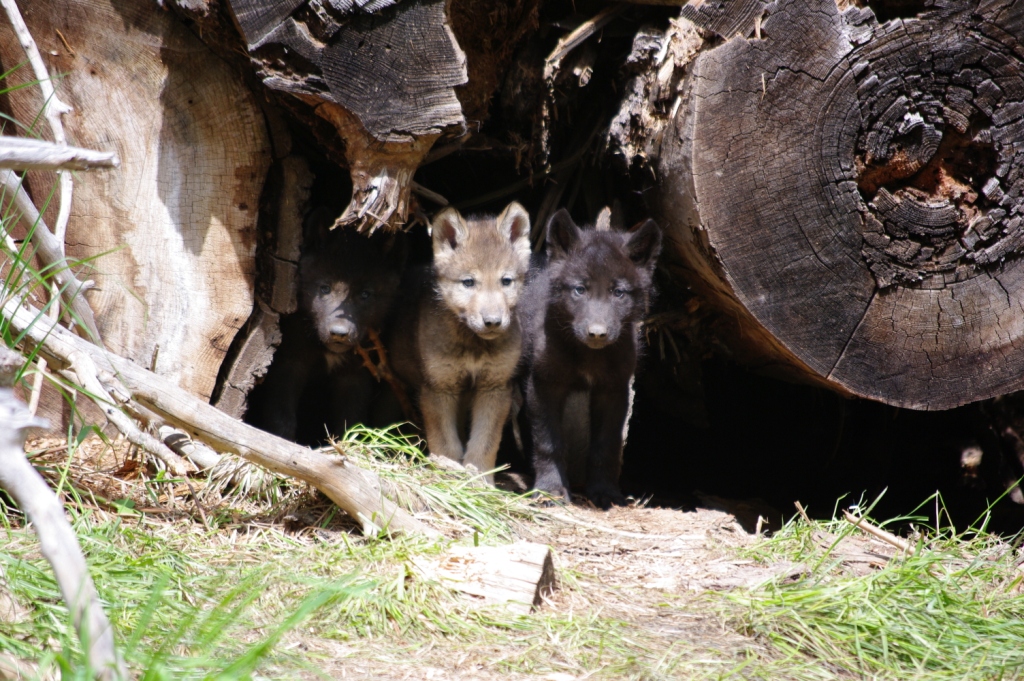
These wolf pups born to the Wenaha Pack in 2012 helped get recovery back on track. But their future remains tenuous (photo courtesy ODFW)

Please now listen to this:

So you can see that I have written frequently about wolves; indeed just a few days ago did so and included this photograph.

Wolf greets man.
Wolf greets man.

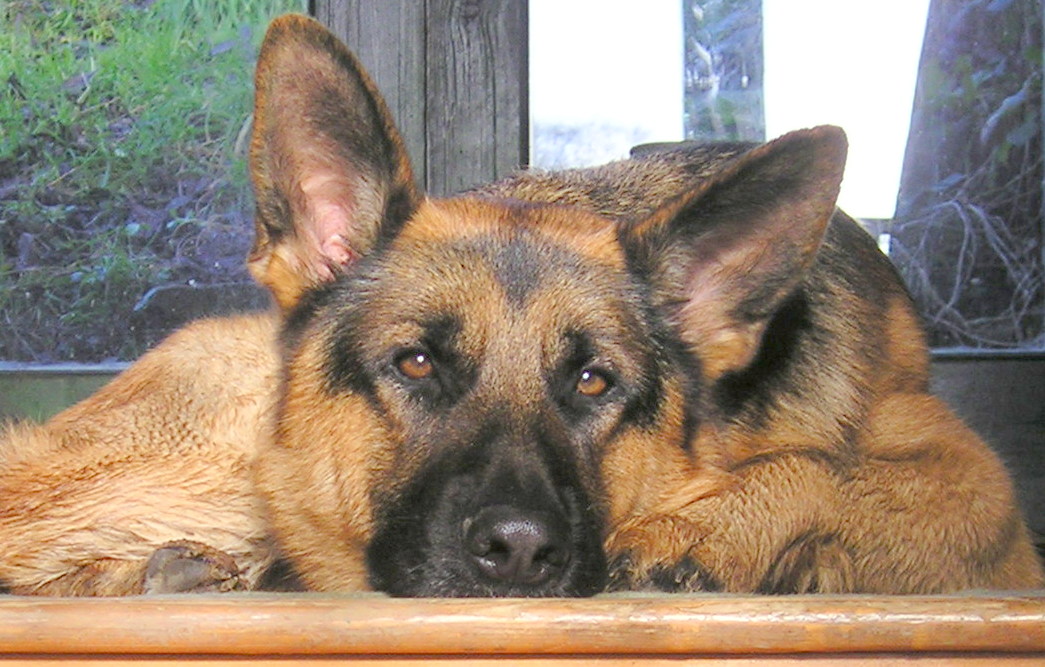
Now just look at those eyes of the Grey Wolf above and compare them to the eyes of the German Shepherd dog below and tell me that wolves aren’t as close to man as dogs.

OLYMPUS DIGITAL CAMERA

Finally, feel free to share this post as far and wide as you can.  Learning from Dogs is published under a Creative Commons License. This link covers how to share my material.

Please do something to help these ancient animals who, more than any other creature, helped put mankind ‘on the map’.

Thank you.

Very, very long odds!

Looks like being a Dan Gomez weekend.

Dan sent me an email with a link to a most astounding video.  But before we get to that, just take a look at these images.  Here are the first three from the set of eight.

Eight breathtaking images of baby stars

MNN1

1. Beautiful newborns

In a universe of fantastic images, a newborn star is a mystical masterpiece. Cradled within the dusty arms of a nebula, a baby star seems to blink its way to a new life. The lifespan of a star is a series of sequences. A star may spend most of its life in a “main sequence phase” where nuclear fusion of hydrogen into helium is happening in its core. But before this happens, it lives as a protostar, or baby star.

Thanks to NASA’s advanced infrared space telescopes such as Hubble and Spitzer, we are able to view these star births as never before. Pictured here are newborn stars peeking out “from beneath their natal blanket of dust” in the Rho Ophiuchi dark cloud as seen by the Spitzer Space Telescope. (Text: Katherine Butler)

MNN2

2. Young stars in Serpens

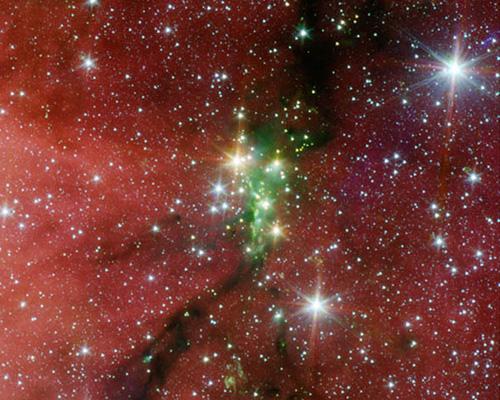
Here the Spitzer Space Telescope reveals the Serpens South star cluster, in which 50 or so young stars exist. They are seen as the “green, yellow, and orange-tinted specks sitting atop the black dust lane.” A supernova or galaxy collision can cause a star to form when huge clouds of hydrogen and helium collapse under mutual gravity. As the cloud collapses, it heats up and starts to spin. Since protostars are covered in dust, they can be seen only through infrared telescopes like Hubble and Spitzer. As Universe Today writes, “After about 100,000 years or so, the protostar stops growing and the disk of material surrounding it is destroyed by radiation.” Then this star, now called a T Tauri or pre-main sequence star, is visible from Earth.

MNN3

3. Bubbly little star

We are used to images of babies blowing bubbles, and it looks like the infants of the cosmos do the same. This image, taken by the Spitzer Space Telescope, shows the HH 46/47 baby star blowing bubbles into space via powerful jets of gas. Located about 1,140 light-years from Earth, HH 46/47 is the bright white star at the middle of the image. Two bubbles reach out in opposite directions and are formed when the jets collide with the dust and gas surrounding the star. As Universe Today reports, “Astronomers think that young stars accumulate material by gravitationally pulling in gas and dust. This process ends when the star gets large enough to create these jets. Any further material is just blown away into space.”

Go and view the remaining five stunning images here.

Now to what was sent by Dan.

Check out this mind-bending video that talks about the “Hubble Ultra Deep Field” image captured by NASA astronomers nearly a decade ago — a photograph that some call “the most important image ever taken.”

It all started back in 1996 when a group of astronomers pointed the Hubble Space Telescope at an empty patch in the sky close to the Big Dipper in hopes of seeing something, anything. At the time, it was considered to be a risky move, given that demand for use of the telescope was so high. What if the experiment yielded no results? What if nothing but an empty image was the final result?

After ten full days of exposing the telescope’s CCD camera sensor to this seemingly vacuous patch of sky, a breathtaking image was produced. Over three thousand galaxies appeared in one image — some as dots, others as spirals. It was a visual reminder of just how big our universe really is. The photo is called the “Hubble Deep Field“:

A Mind Bending Look at the Hubble Ultra Deep Field Photo of the Universe hdf

In 2004, astronomers pointed Hubble near constellation Orion and opened the shutter for a whopping 11 days. Using sensitive detectors and specialized filters, the telescope was able to capture an image with over 10,000 galaxies. This image became known as the “Hubble Ultra Deep Field.”

A Mind Bending Look at the Hubble Ultra Deep Field Photo of the Universe hudf

Scientists later used redshift calculations of the galaxies to turn the photograph into a “fly-thru” view of the photo:

It didn’t end there. Last year, NASA scientists created the Hubble Extreme Deep Field, which has an equivalent exposure time to 23 days and features. It’s the “deepest image of the sky ever obtained” that reveals “the faintest and most distant galaxies ever seen”:

A Mind Bending Look at the Hubble Ultra Deep Field Photo of the Universe deepest

And just think: scientists created these photos by pointing their mega-camera at a tiny speck of the night sky that appears to be completely devoid of visible stars!

oooOOOooo

… a tiny speck of the night sky that appears to be completely devoid of visible stars!

Dan said in his email, “Are we really here?  What are the chances?”

You really have to wonder!  Incredibly long odds.  Both to us being here and to us being the only conscious, intelligent species in the universe.

From small acorns do great oaks grow.

Reflections on the launch of George Monbiot’s new book Feral.

In my recent post, Dealing with Madness, where I referred to the launch of this new book there were comments from Jules that included him saying:

George is appearing at the Hay Festival to sell his book and do a talk this Saturday and it is only a few miles away so may be I will pop in and buy the book.

all the best

Jules

Jules, who has his own blog Bollocks2012, did go across to the Hay Festival and most generously agreed to write up his visit as a guest post.

So I am delighted to offer you Jules’ report today.

oooOOOooo

George at Hay

by Jules Bywater-Lees, 1st June, 2013

The small Welsh border town of Hay-on-Wye in Powys is just a few miles from where I live. It went from a little backwater with a failing rural economy to become, in the words of Bill Clinton, ‘the Woodstock of the mind’.  All through the vision of eccentrics!

Hay-on-Wye
Hay-on-Wye

The town of Hay-on-Wye is pretty.  It is set in the most beautiful Welsh countryside and even has its own tumble-down castle.  However, back in the 70’s, like so many other small market centres, the town was in decline.  That was until an eccentric bibliophile moved into the castle. The name of that eccentric was Richard Booth.

Richard Booth established a second-hand bookshop in town and, as a publicity stunt, on 1st April 1977 proclaimed himself King of Hay and Head of this new Independent Kingdom!  Hay-on-Wye subsequently became a magnet for the second-hand book lover and trader, and now every other shop is a bookshop giving the town a healthy economy serving the many visitors.

Books, books and more books!

The Hay Literary Festival was devised by Norman and Peter Florence in 1988 and had become sufficiently established internationally for the highlight of Bill Clinton being a speaking guest in 2001. It is rather a corporate festival now attracting big names but the town has developed fringe events, that are both cheaper and more fun.

The reason this back story is relevant is that Hay-on-Wye has always been a gateway town between the urban English and rural Welsh. It is only a few hours drive from London and the nearest ‘wilderness’ for day trippers and holiday makers. A few miles further west and the uplands, or mountains as we call them (few are higher than 1000 feet), are considered by most people to be wild.

George Monbiot lives another 60 miles away to the West on the coast in what is considered deepest Wales where the hills have a barren beauty and the locals speak Britain’s ancient first language. But it is not all that it seems; the moors and hilltops are not natural they are a product of over-grazing. They are the degraded shells of a natural ecosystem. A shadowland; a ghostly memory of a former landscape.

View from Hay Bluff
View from Hay Bluff, just a few miles from Hay-on-Wye, and a powerful example of a bald hill.

Back to this year’s Festival. I coughed up the £8 ticket price and went with friends to have a day of culture. Those friends who came to hear George Monbiot speak were sceptical; for them the hills are beautiful and it is the denuded ‘wildness’ and prancing Spring lambs that gives the landscape so much value.

George makes frequent appearances on television and is very much a leading commentator on the environment and climate change, and his Guardian articles, see postscript, cover his views well so I wasn’t expecting any surprises. If anything I felt sceptical! You see while in principle I agreed with Monbiot’s message of rewilding and supportive of his views on the wide range of subjects he covers, the concept of rewilding appeared to be woolly and vague and lacking the practicalities of how this vision would be achieved. I even prepared a question for the session after his presentation.

Britain is a little country and our national parks are not the same as those elsewhere in the world, a better description would be regulated areas of private ownership. There are a few parks in Wales notable Snowdonia, which amounts to 2,200 square Kilometres (850 square miles), Brecon Beacons, 1,300 Km2 (502 SqM) and larger ones in Scotland such as the Cairngorms of 4,500 Km2 (1,737 SqM). But all of these are tiny compared to Yellowstone National Park with its 9,000 km2 (3,475 SqM and about 100 wolves!). Is it possible to have viable populations of wild animals in such a small area?

My concern is that Britain actually does have a wild landscape of both international importance and scale, with mega fauna, diversity and rare ecosystems that put it on par with the rainforest. It is truly huge with a conservative estimate of 50 to 100 thousand Km2 in area (19,305 to 38,610 square miles) but it is hidden: It is the 31,000 Km (19,260 miles) of coastline and the waters that extend from it. Surely we should be concentrating on its protection rather than allowing the hill tops to grow pretty common native woodland that could support a few hundred wolves, Lynx and beavers at best?

George live, as it were, was a lot more engaging than his appearance on telly and his spoken words a lot more passionate than his written words. I was surprised, and interested.  Like all good story tellers he started off with a mystery. Why do British native trees appear to thrive when they are hacked about into hedges, why do blackthorn trees have thorns so tough and sharp they spike industrial leather gloves and why does the yew and holly have roots so extensive they could hold up a tree twice as big? The answer: Elephants!

Much of what he spoke about is found in his last three Guardian articles so I will spare you the detail but what struck me was his passion. Initially the cynic within wondered if George was just another celebrity seeking a cause.  But such thoughts were dispelled as soon as George started to speak. What was communicated resonated strongly with this idealistic former self who was sufficiently passionate about nature enough to have studied zoology and yearned a human desire for wilderness and, indeed, danger but whose life has otherwise been engaged in more civilised necessities.

Such was the passion expressed by Mr. Monbiot that even I could overlook the practicalities and details; they can be sorted out when they need to be. My friends were impressed and even they were able to see that letting the hills go wild or a least a few of them would enhance their appreciation of our countryside.

But I didn’t buy a signed copy of the book! At £20 for the hardback version I thought it best to order one from my local library or at least wait for the paperback edition on Amazon.

Postscript

Those Guardian articles mentioned are:

My manifesto for rewilding the world, Guardian Newspaper, 27th May.

Until modern humans arrived, every continent except Antarctica possessed a megafauna. In the Americas, alongside mastodons, mammoths, four-tusked and spiral-tusked elephants, there was a beaver the size of a black bear: eight feet from nose to tail. There were giant bison weighing two tonnes, which carried horns seven feet across.

Why Britain’s barren uplands have farming subsidies to blame, Guardian Newspaper, 22nd May

Even before you start reading the devastating State of Nature report, published today, you get an inkling of where the problem lies. It’s illustrated in the opening pages with two dramatic photographs of upland Britain (p6). They are supposed to represent the natural glories we’re losing. In neither of them (with the exception of some distant specks of scrub and leylandii in the second) is there a tree to be seen. The many square miles they cover contain nothing but grass and dead bracken. They could scarcely provide a better illustration of our uncanny ability to miss the big picture.

It’s time we challenged agricultural hegemony, Guardian Newspaper, 6th June

The dam is beginning to crack, faster than I would have believed possible. Britain, one of the world’s most zoophobic nations, is at last considering the return of some of its extinct and charismatic mammal species.

While wolves, lynx, bears, bison, moose, boar and beavers have been spreading across the continent for decades, into countries as developed and populous as ours, and while they have been widely welcomed in those places, here we have responded to this prospect with unjustified horror.

Why the lynx effect would send Scotland wild, Guardian Newspaper, 2nd June

As Edinburgh Zoo’s panda freakshow continues to captivate the witless and the infantile, a real Scottish animal has been allowed to die. Under the noses of Scottish Natural Heritage, which likes to be known as the nation’s leading conservation body, the Scottish wildcat has all but been extinguished from the Highlands. The importance of this news may be deemed worthy of a mere footnote on the schedule of important issues with which Scotland is grappling but it ought to rank much higher. For the wildcat’s demise seems to be part of the neutering and emasculating of our wildest places. That which was previously held to be a quintessential part of what Scotland was originally meant to look like and smell like and sound like is now, it seems, unimportant.

Britain’s paradise has been lost – but there’s still hope for our wildlife, Guardian Newspaper, 24th May

I never imagined being 52. As I grew up catching lizards and newts, rummaging through hedges to find birds’ nests, or prodding flattened hedgehogs with my scuffed Clarks lace-ups, the world was ripe with natural riches. Every scrap of wasteland revealed yet more gems: tadpoles, fox cubs and a confetti of butterflies. And when at the weekends the family Ford Anglia trundled off to the countryside, I strode in shorts into a wildlife nirvana, a utopia, and I explored what I imagined would be a never-ending world of beautiful and exotic creatures.

oooOOOooo

Finally, back to me and all I want to add is that the blogsite for more information on the book Feral is here.

So how to close?  Well having given this post the title of a well-known saying, let me close with one perhaps less familiar but, boy oh boy, so relevant.

“When the oak is felled the whole forest echoes with it fall, but a hundred acorns

are sown in silence by an unnoticed breeze.”

Thomas Carlyle

Being tied to that mast!

What an expanse of learning is out there in this modern interconnected world!

I try to limit my following to those organisations and writers who offer me the opportunity of learning.  Whether something I was previously unaware of or a sight of the world from an unfamiliar perspective, it’s a rare day when something doesn’t ‘pass my screen’ that offers an ‘Ah, ha’ moment.

Such as the following essay by Dave Nussbaum that recently appeared on the Big Think website.  Cheekily, I asked permission to republish and promptly and generously both Dave and Daniel Honan, managing editor of Big Think, said yes.  Thank you, gentlemen.

A quick web search finds that Dave Nussbaum is Adjunct Assistant Professor of Behavioral Science, University of Chicago Booth School of Business.  (I couldn’t avoid wondering if the learned Professor requires extra-large business cards! Sorry for that!)  To fill in a little more about the Professor, one can easily read that:

nausbaum

I am currently an Adjunct Assistant Professor of Behavioral Science at the University of Chicago Booth School of Business. I received my PhD in Social Psychology from Stanford in 2008, working primarily with Claude Steele and Carol Dweck. I recently completed a SSHRC Post-Doctoral Fellowship at the University of Waterloo with Steve Spencer. My research is primarily focused on how people manage and defend their self-image in the face of threats, and how this affects their beliefs and behavior. I also explore how social contexts and psychological processes can either exacerbate threats to self-image or attenuate them. I have found that defensively managing self-image threats can often lead to negative consequences, including academic disidentification, missed learning opportunities, the avoidance of important medical tests, and persistence in failing investments. I believe that by identifying contexts and processes that attenuate threat, individuals and organizations can employ strategies to prevent these maladaptive outcomes.

So moving on past my quip about the length of Professor Nussbaum’s title, the summary above shows that this is one smart cookie!  Just go back and reread “My research is primarily focused on how people manage and defend their self-image in the face of threats, and how this affects their beliefs and behavior.” Then reflect on the range and scale of ‘threats’ facing millions of us across the world.  So research into “how social contexts and psychological processes can either exacerbate threats to self-image or attenuate them“, seems particularly appropriate for these times.

OK, without further ramblings from yours truly, here is that essay.

oooOOOooo

Odysseus Nudged: How Limiting Our Choices Can Give Us More Freedom

by Dave Nussbaum – May 27, 2013

Odysseus

According to legend, the Sirens were beautiful women whose voices were so alluring that when sailors heard their song they could not resist approaching and were drowned on the rocky shores of the island where the Sirens sang. No sailor had heard their song and lived until Odysseus, who, on the counsel of the goddess Circe, had his crew tie him to the mast of his ship. When he heard the Sirens’ song he begged to be released, but his crew, their ears plugged with beeswax, would not unbind him and saved him from his own desires. Odysseus was lucky – he knew that he would be unable to resist the Sirens and had himself bound – but people often have difficulty foreseeing their weakness from a distance. Sometimes they need help.

I love watching my not-quite-two-year-old son learn about the world from his mistakes. I look on with sympathy at his falls and bumps and spills and I try to restrain myself from interceding. But when he’s about to tumble down a flight of stairs I step in. It is difficult to balance preserving his freedom to explore and make his own mistakes with the desire to keep him safe. There’s a lot to be said for giving kids autonomy and letting them learn from experience, but sometimes you have to behave paternalistically and tie them to the mast (or at least install safety gates).

When you start treating grown men and women like you’re their father, though, the charge of paternalism becomes a more serious one. There may be cases in which a heavy-handed approach is necessary (particularly when people’s actions harm others), but we should be careful about using it. A more circumspect approach is libertarian paternalism, described by Richard Thaler and Cass Sunstein in Nudge (and re-articulated more recently by Sunstein in his Simpler) as a way of influencing people to make decisions that they themselves would consider beneficial, without restricting their freedom.

Here, we are not tying Odysseus to the mast – the more appropriate analogy would be to the beeswax that Odysseus had his sailors put in their ears. The wax prevented the sailors from hearing the Sirens’ song and saved them from being lured to their deaths, but it also left them free to remove the wax if that is what they wanted to do. This sort of intervention is an acknowledgment that the sailors’ freedom is important, but also that people are not always perfectly rational. As Carnegie Mellon economist (and psychologist) George Loewenstein recently explained to me, “When people have problems exercising self-control, restricting their choices can, in some cases, leave them more freedom to choose.”

On its face, Loewenstein’s claim may seem paradoxical – isn’t a person most free when presented with all her options and allowed to choose among them? But as the mythical Sirens make clear, there are some options that we are not truly free to resist. Without beeswax in their ears Odysseus’ crew would have been doomed; the wax gave them the freedom to choose.

Take the recent attempt by New York City Mayor, Michael Bloomberg, to forbid stores from displaying cigarettes to their customers. Just like the beeswax did not prevent the sailors’ from choosing to hear the Sirens’ song, hiding cigarettes from view doesn’t prevent people from buying them. But, as Loewenstein explains, it makes it easier for those who may be trying to quit to avoid being lured back in.

When we pass laws that forbid the sale of cigarettes to minors we are being paternalistic. We are tying Odysseus to the mast, whether he likes it or not. But when we ban cigarette advertising that targets children – as the FTC did when it banned Joe Camel ads – we’re not tying anyone down. We are merely acknowledging that children are vulnerable to influences that may lead them to act contrary to their own interests and that they may not be in a position to resist these influences. Banning the display of cigarettes in stores is merely acknowledging that children aren’t the only ones who are vulnerable. The cigarettes, like the sirens, draw us in against our will. Putting them out of sight is like putting wax in our ears – we can easily still give in to temptation if we choose to, but we’re less at its mercy.

You can visit Dave Nussbaum’s blog at www.davenussbaum.com and follow Dave on Twitter at @davenuss79

Images courtesy of Wikimedia Commons and Shutterstock.

oooOOOooo