OK, I accept that the sub-heading is slightly provocative but so what!
The fascination in truly knowing who we are is endless!
Back in January of this year, I penned an essay under the title of 20:20 self-awareness. Here’s a snippet from that post:
“The single biggest problem in communication is the illusion that it has taken place.” George Bernard Shaw is reputed to have once said!
Today’s essay on the challenges of speaking clearly to another, perhaps better described as communicating in a clear and unambiguous fashion, came out of a recent conversation with Jon Lavin, a good friend from my Devon days. (Jon offers services for business owners and entrepreneurs under his business banner of The People Workshop.)
Jon was explaining that the number one hurdle for businesses that are managing change, and for so many businesses managing change is practically a constant, is having clear communications within the team.
The essence of that, and other posts over the years, is that knowing others, communicating with others, is so much easier when we know ourself well.
Not just relevant to us humans, by the way. Dogs love knowing us sufficiently well that they can trust and understand our behaviours.
So all of that is an introduction to an article that was recently on the website of London-based Harley Therapy. The article is called How to Be Your Authentic Self. I have taken the liberty of republishing it in full here on Learning from Dogs. (See copyright statement at the end.)
ooOOoo
It’s a little after 6am.
I awoke this morning with the terrible realisation that I didn’t have permission to republish that article and, therefore, have ‘amended’ today’s post and removed the item..
This week is taking on a life of it’s own, so far as Learning from Dogs is concerned!
For when I penned Monday’s post, Running on Empty, I had not yet read George Monbiot’s essay Are We Bothered?. When I did so, it struck me as the perfect sequel to Monday’s post and formed the crux of yesterday’s post The nature of delusions. That second post also included a personal account of my delusion with regard to ocean sailing and seemed sufficiently wordy not to be extended by my further reflections.
Thus the decision to run over to a third day!
Let me offer, first of all, my own reflections to George Monbiot’s concerns. That I distill, using his words, to: “The more we consume, the less we care about the living planet.” Expanded in his concluding paragraph:
So the perennially low level of concern, which flickers upwards momentarily when disaster strikes, then slumps back into the customary stupor, is an almost inevitable result of a society that has become restructured around shopping, fashion, celebrity and an obsession with money. How we break the circle and wake people out of this dreamworld is the question that all those who love the living planet should address. There will be no easy answers.
When I first read Mr. Monbiot’s essay, I found myself nodding in agreement. Yet, upon further reflection, I became less sure that “a society that has become restructured around shopping, fashion, celebrity and an obsession with money.” was the core of the issue. I think it is a symptom.
Stay with me awhile I take a small deviation. To dogs, and other animals.
Many creatures have a powerful and instinctive means of assessing danger. One only needs to observe the wild black-tailed deer that frequent our property to know that the slightest hint of danger or the unknown has them dashing away to safety.
A young black-tailed deer seen at home last September.
Dogs are the same in that they will run early on from a danger.
Humans also have the propensity to be cautious about a clear and present danger. However, it’s my proposition that when the danger is unclear and when that danger threatens the very essence of who we are and the world that we have constructed around us, we can be blind to the point of madness. I can think of many examples in support of that thesis and I’m sure you can too.
Yes, we have “a society that has become restructured around shopping, fashion, celebrity and an obsession with money.” But I contend only because of the power of capitalism, of the power of modern marketing and advertising and the allure of being ‘one of the crowd’.
So back to my proposition. It is this.
That when our lives are threatened by something unclear, complex and, ultimately, of devastating impact, we are very reluctant to embrace it and even more reluctant to both embrace it and escape to safety; whatever the latter implies.
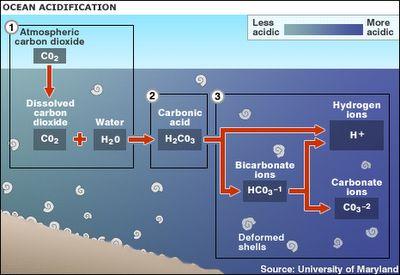
Mankind’s effect on the environment, the rising CO2 levels in the atmosphere, the increasing acidification of the oceans, the growing concerns about global weather, and on and on, are the most unclear, the most complex and the most devastating of futures to embrace.
(Thanks to Patrice for referring to this recently.)
So it really is no surprise to see mankind in general behaving as though this is a bit of a hangover, and an aspirin and a good night’s sleep will sort it! Especially when there is so much money and control invested in selling the same message; the message that there really is nothing to worry about.
There will be a so-called ‘tipping point’. A point in our awareness where the urgency to prevent the destruction of the biosphere will be paramount. And it will be a miracle if when that point arrives it isn’t far too late to save us.
I truly hope that I am wrong.
oooo
Remember what I wrote in yesterday’s post? About experiencing an Atlantic gale?
Fewer than 48-hours before my estimate of coming into Horta Marina on the Azores island of Faial, Songbird of Kent was struck by an early, fierce Winter gale. I seem to recall it was touching Force 10 Beaufort Scale (54 – 63 mph or 48 – 55 knots).
Anyway, it just about finished me off: literally as well as psychologically! I was so frightened, so utterly scared that I could think of nothing else other than getting to Horta and never going sailing again.
It revealed my delusion!
That was my ‘tipping point’ when it came to ocean sailing.
The gale subsided and I motor-sailed the 150-odd miles to Horta without any break for sleep or rest. Came into the harbour early in the morning after the second night since the gale. As soon as I was securely berthed, I closed the boat up and found a local hotel where a hot shower and a clean bed could restore a part of me.
Within a week, I had engaged a crew to sail the boat to Plymouth in South-West England and I flew back to England on a commercial airline.
Once Songbird of Kent arrived at Plymouth, she was put up for sale at a price that wouldn’t delay matters and that was that!
Oh, and I have never read any more books about single-handed ocean sailing. (But see my P.S.!)
oooo
P.S.
In yesterday’s post, I referred to Les Powells. Remember when I was in Larnaca, Cyprus? This is what I wrote:
Living on a boat close to me was Les Powles. Many will not have heard of Les but this quiet, softly-spoken man knows a thing or two about solo ocean sailing. As an article in The Guardian newspaper explained (in part):
In the 1980s and 90s a British man called Les Powles sailed three times round the world – always single-handedly, once non-stop. He couldn’t afford a radio transmitter, and on his greatest adventure he didn’t speak to anyone for 329 days. At 84, his circumnavigating days are now behind him, but he still lives on his boat, the Solitaire. What’s the appeal of sailing, I asked him. “It’s the solitude. When you’re out at sea on your own, there’s no government or bankers to worry about. You’re not responsible to anyone but yourself.”
Three times around the world – solo!
Thus getting to know Les was a great inspiration in getting me over the hurdle of can I really do this! (Les once said to me “the first three days are the worst!”)
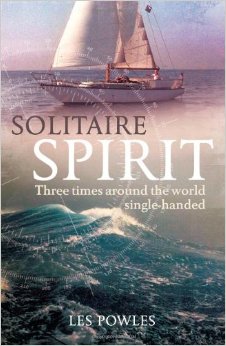
Anyway, I have discovered that Les is living happily on his boat in Lymington, England and has written a book about his sailing life.
It has been ordered and arrives today. This one will be read – from the comfort and safety of our rural home in Oregon!
Yesterday, I wrote a post under the title of Running on empty!I listed just a few recent items that had left me feeling very dispirited. Trust me, not a familiar place!
I also raised the question ……
All of this is sending out a message. The message that if we are not very, very careful this could be the end-game for human civilisation on this Planet.
But do you know what really puzzles me?
It’s that this message is increasingly one that meets with nods of approval and words of agreement from more and more people that one sees going about one’s normal life.
…… then didn’t expand on what was puzzling me!
Let me come at this again; in full!
But do you know what really puzzles me? It is the terrible lethargy across so many societies. The lack of any substantial social and political force for change. Especially, when so many scientists involved in climate research are warning we are leaving it dangerously late.
I’m no psychologist; far from it. But I want to recount a true story that gave me an insight into one of my own delusions. Please stay with me because it does have a message at the end of it! 😉
oooo
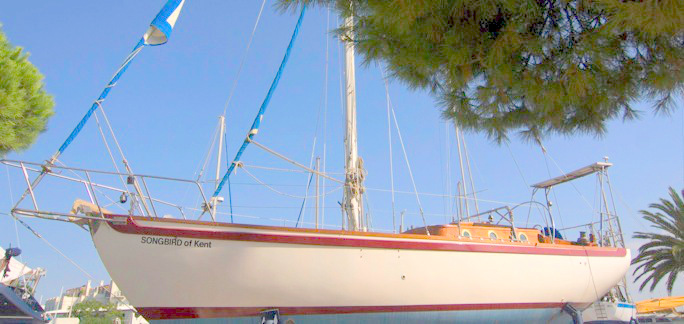
Many years ago, I spent 5 years living on a boat in Larnaca in Cyprus. My boat was a wonderful heavy-displacement ocean-going yacht. A type known as a Tradewind 33. Here is a picture of my boat.
Tradewind 33 – Songbird of Kent.
For years I had devoured all the books written by the great yacht sailors who had sailed the oceans, many of them completing solo circumnavigations of the world. Part of me wanted to sail the oceans.
Living on a boat close to me was Les Powles. Many will not have heard of Les but this quiet, softly-spoken man knows a thing or two about solo ocean sailing. As an article in The Guardian newspaper explained (in part):
In the 1980s and 90s a British man called Les Powles sailed three times round the world – always single-handedly, once non-stop. He couldn’t afford a radio transmitter, and on his greatest adventure he didn’t speak to anyone for 329 days. At 84, his circumnavigating days are now behind him, but he still lives on his boat, the Solitaire. What’s the appeal of sailing, I asked him. “It’s the solitude. When you’re out at sea on your own, there’s no government or bankers to worry about. You’re not responsible to anyone but yourself.”
Three times around the world – solo!
Thus getting to know Les was a great inspiration in getting me over the hurdle of can I really do this! (Les once said to me “the first three days are the worst!”)
Thus it came about that I departed Larnaca and worked my way Westwards along the Mediterranean, eventually arriving in Gibraltar. After a few days getting ‘Songbird’ ready for my first ocean leg, Gibraltar to the Azores, I took a deep breath and headed West out into the Atlantic Ocean. Frankly, I was a tad too late to be starting out but the thought of spending a Winter in and around Gibraltar was too much to contemplate and, anyway, it was only 8 or 9 days sailing to the Azores; a distance of 1,125 land miles or 980 nautical miles.
Fewer than 48-hours before my estimate of coming into Horta Marina on the Azores island of Faial, Songbird of Kent was struck by an early, fierce Winter gale. I seem to recall it was touching Force 10 Beaufort Scale (54 – 63 mph or 48 – 55 knots).
Anyway, it just about finished me off: literally as well as psychologically! I was so frightened, so utterly scared that I could think of nothing else other than getting to Horta and never going sailing again.
It revealed my delusion!
It proved that I had been in love with the courageousness of those many ocean sailors that I had read about. In love with the idea of a solo Atlantic crossing and being seen as a courageous hero. But, in truth, utterly in denial about what ocean sailing was really about!
So with the theme of delusion in your head, have a read of a recent post by George Monbiot. The post is called Are We Bothered? It is republished with the kind permission of George.
ooOOoo
Are We Bothered?
May 16, 2014
The more we consume, the less we care about the living planet.
By George Monbiot, published on the Guardian’s website, 9th May 2014
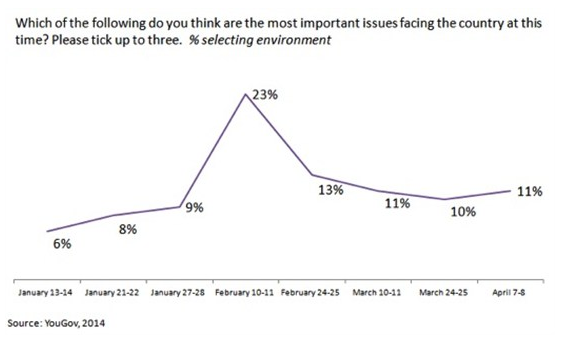
That didn’t take long. The public interest in the state of the natural world stimulated by the winter floods receded almost as quickly as the waters did. A YouGov poll showed that the number of respondents placing the environment among their top three issues of concern rose from 6% in mid-January to 23% in mid-February. By early April – though the Intergovernmental Panel on Climate Change had just published two massive and horrifying reports – the proportion had fallen back to 11%.
Sustaining interest in this great but slow-burning crisis is a challenge no one seems to have mastered. Only when the crisis causes or exacerbates an acute disaster – such as the floods – is there a flicker of anxiety, but that quickly dies away.
Why is it so difficult to persuade people to care about our wonderful planet, the world that gave rise to us and upon which we wholly depend? And why do you encounter a barrage of hostility and denial whenever you attempt it (and not only from the professional liars who are paid by coal and oil and timber companies to sow confusion and channel hatred)?
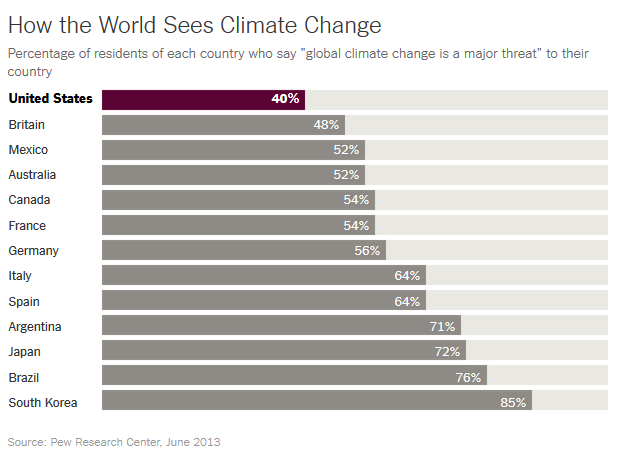
The first thing to note, in trying to answer this question, is that the rich anglophone countries are anomalous. In this bar chart (copied from the website of the New York Times) you can see how atypical the attitudes of people in the US and the UK are. Because almost everything we read in this country is published in rich, English-speaking nations, we might get the false impression that the world doesn’t care very much.
This belief is likely to be reinforced by the cherished notion that we lead the world in knowledge, sophistication and compassion. The bar chart puts me in mind of the famous quote perhaps mistakenly attributed to Gandhi. When asked by a journalist during a visit to Britain, “What do you think of Western civilization?”, he’s reputed to have replied, “I think it would be a good idea.”
Our erroneous belief that we are more concerned about manmade climate change than the people of other nations informs the sentiment, often voiced by the press and politicians, that there’s no point in acting if the rest of the world won’t play its part. For example, last year the Chancellor, George Osborne, remarked:
“I don’t want us to be the only people out there in front of the rest of the world. I certainly think we shouldn’t be further ahead of our partners in Europe.”
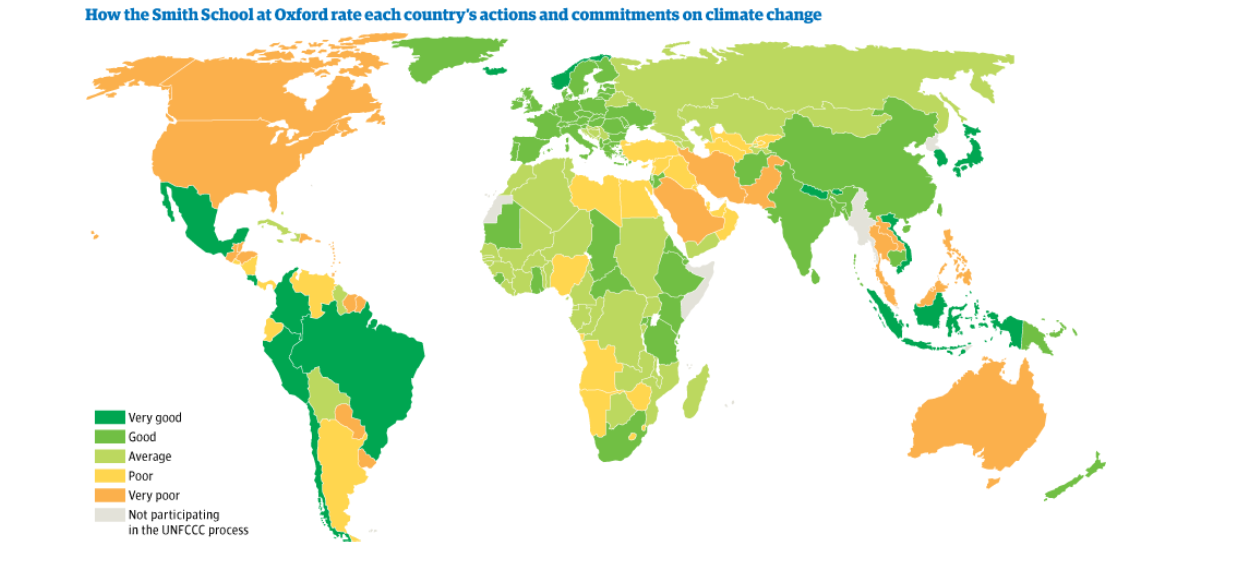
But we’re not “the only people out there in front of the rest of the world.” In fact we’re not in front at all. As this map produced by Oxford University’s Smith School suggests, we are some way behind not only some other rich nations but also a number of countries much poorer than ours.
As for the US, Australia and Canada, they are ranked among the worst of all: comprehensively failing to limit their massive contribution to a global problem. We justify our foot-dragging with a mistaken premise. Our refusal to stop pumping so much carbon dioxide into the atmosphere is pure selfishness.
For years we’ve been told that people cannot afford to care about the natural world until they become rich; that only economic growth can save the biosphere, that civilisation marches towards enlightenment about our impacts on the living planet. The results suggest the opposite.
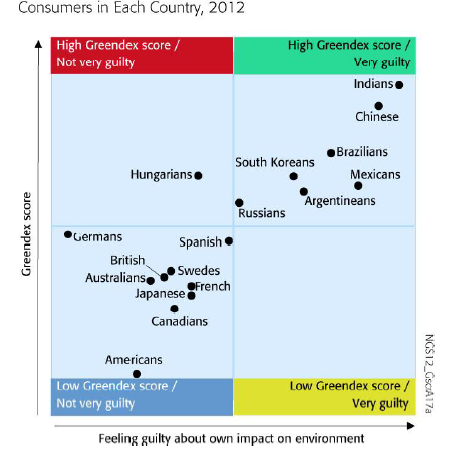
As you can see from the following graph, the people consulted in poorer countries feel, on average, much guiltier about their impacts on the natural world than people in rich countries, even though those impacts tend to be smaller. Of the nations surveyed, the people of Germany, the US, Australia and Britain feel the least consumer guilt; the people of India, China, Mexico and Brazil the most.
The more we consume, the less we feel. And maybe that doesn’t just apply to guilt.
Perhaps that’s the point of our otherwise-pointless hyperconsumption: it smothers feeling. It might also be the effect of the constant bombardment of advertising and marketing. They seek to replace our attachments to people and place with attachments to objects: attachments which the next round of advertising then breaks in the hope of attaching us to a different set of objects.
The richer we are and the more we consume, the more self-centred and careless of the lives of others we appear to become. Even if you somehow put aside the direct, physical impacts of rising consumption, it’s hard to understand how anyone could imagine that economic growth is a formula for protecting the planet.
So what we seem to see here is the turning of a vicious circle. The more harm we do, the less concerned about it we become. And the more hyperconsumerism destroys relationships, communities and the physical fabric of the Earth, the more we try to fill the void in our lives by buying more stuff.
All this is accompanied in the rich anglophone nations with the extreme neoliberalism promoted by both press and politicians, and a great concentration of power in the hands of the financial and fossil fuel sectors, which lobby hard, in the public sphere and in private, to prevent change.
So the perennially low level of concern, which flickers upwards momentarily when disaster strikes, then slumps back into the customary stupor, is an almost inevitable result of a society that has become restructured around shopping, fashion, celebrity and an obsession with money. How we break the circle and wake people out of this dreamworld is the question that all those who love the living planet should address. There will be no easy answers.
The Tragedy of the Soma Mine-Workers: A Crime of Peripheral Capitalism Unleashed
Posted on May 16, 2014 by Yves Smith
Yves here. This post explains how the horrific mine explosion in Western Turkey, which has officially claimed nearly 300 lives as the death count continues to rise, was not an accident but the direct result of privatization and circumvention of safety standards. And unlike the West, where industrial and mining accidents are met with short-term sympathy but little if any real change in working conditions, protests have broken out, not just in the mine town of Soma but also in major cities. As Mark Ames has pointed out, American has airbrushed out much of the history of labor’s struggles for safe workplaces and better pay. Violence against efforts to organize workers was common. Henry Ford had a private army of thugs for just this purpose. The tragedy in Turkey should serve as a reminder of what has been won, and how fragile those gains are.
By Erinç Yeldan, Dean of the faculty of Economics and Administrative Sciences, Yasar University and an executive directors of the International Development Economics Associates. Cross posted from Triple Crisis
One of the greatest work-crimes in mining industry occurred in Soma, a little mining village in Western Turkey. At noon-time on Tuesday, May 13, according to witnesses, an electrical fault triggered a transformer to explode causing a large fire in the mine, releasing carbon monoxide and gaseous fumes. (The official cause of the “accident” was still unknown, at this writing, after nearly 30 hours.) Around 800 miners were trapped 2 km underground and 4 km from the exit. At this point, the death toll has already reached 245, with reports of another 100 workers remaining in the mine, yet unreached.
Turkey has possibly the worst safety record in terms of mining accidents and explosions in Europe and the third worst in the world. Since the right-wing Justice and Development Party (AKP) assumed power in 2002, and up to 2011, a 40% increase in work-related accidents has been reported. The death toll from these accidents reached more than 11,000.
UK Survey Finds High Levels of Depression and Desperation Among the Young
Posted on May 16, 2014 by Yves Smith
If you’ve been keeping half an eye on economic news, the UK has of late been looking pretty spiffy relative to its advanced economy peers, with 2014 growth forecast at 3%. Even though unemployment in the UK is at its lowest level in five years, the young and the long-term unemployed haven’t benefitted to the same degree.
One issue that doesn’t get the attention that it merits is the destructive psychological impact of being out of work. Work doesn’t just provide money, as critical as that is. It provides a way of organizing your time, social interaction, and a place in society, even if that place is not really where you’d like to be. Being unanchored is extremely taxing. Recall that the Japanese get people to quit by giving them a desk and nothing to do. The lack of legitimacy, the implicit shaming of being isolated is sufficiently punitive as to induce workers to give up their pay and being able to tell their families they have a job.
The BBC reports on the results of a survey by the Prince’s Trust called the Macquarie Youth Index, which is based on a survey of roughly 2200 16 to 25 year olds. 13% were what the survey called Neet: not in employment, education, or training.
I will return to the terrible implications of this report after I declare a past interest. Before I left England in 2008, I was an active volunteer with the Prince’s Trust. My years of being associated with the Trust taught me that helping young persons discover their strengths, enable them to maintain and defend a positive self-image, and offer them real hope for their future lives, was and is the most important role of society; without doubt!
Now back to that report:
The survey found high levels of suicidal thoughts and self harm among this group, and high levels of stress among the young generally. Key excerpts from the article:
The report found 9% of all respondents agreed with the statement: “I have nothing to live for”…
Among those respondents classified as Neet, the percentage of those agreeing with the statement rose to 21%.
The research found that long-term unemployed young people were more than twice as likely as their peers to have been prescribed anti-depressants.
One in three (32%) had contemplated suicide, while one in four (24%) had self-harmed.
The report found 40% of jobless young people had faced symptoms of mental illness, including suicidal thoughts, feelings of self-loathing and panic attacks, as a direct result of unemployment.
Three quarters of long-term unemployed young people (72%) did not have someone to confide in, the study found.
Martina Milburn, chief executive of the Prince’s Trust, said: “Unemployment is proven to cause devastating, long-lasting mental health problems among young people.
Then there was the report from the NASA study team that key glaciers in West Antarctica are in an irreversible retreat. First seen by me on the BBC News website, from where the following photograph was taken.
Thwaites Glacier is a huge ice stream draining into the Amundsen Bay.
We imparted acceleration to the biosphere. We are pushing the biosphere around. And we know that the force we are applying is only augmenting. That means the acceleration, and even more the speed of the change, is going to get worse quick. That’s basic dynamics, first quarter of undergraduate physics.
Of course, neither the leaders of France, Great Britain, or the USA has taken such a course: they are basically ignoramuses at the helm (and Angela Merkel, who knows plenty of physics, made a risky bet she seems to be losing).
Clearly, we should instead apply the brakes to the maximum (instead of flooring the accelerator). What would be the price of this cautious? None, for common people: hard work to de-carbonize the world economy would require dozens of millions to be employed that way, in the West alone.
That, of course, is a scary thought for plutocrats, who much prefer us unemployed, impotent, and despondent.
Patrice Aymé
All of this is sending out a message. The message that if we are not very, very careful this could be the end-game for human civilisation on this Planet.
But do you know what really puzzles me?
It’s that this message is increasingly one that meets with nods of approval and words of agreement from more and more people that one sees going about one’s normal life. Perhaps, because there’s more and more reporting from a wider and wider range of sources. Like The Permaculture Research Institute website recently publishing This Collapse is a ‘Crisis of Bigness’. Like Grist publishing Walmart is the last place Obama should be making a clean energy speech.
Main Stream Media (MSM) has been the instrument of control of the People ever since there were oligarchies. It used to be about temples and priests, now it’s more about controlling papers, radio, TV, and the Internet.
and later on:
This crudeness, and vigilance of censorship by the owners [of the New York Times], is why the Obamas, Clintons, Krugmans, and Stiglitzs have to be careful. After all, they are just employees enjoying the perks of the system. Yes, they don’t own it. Ownership is everything. If the servants want to keep on thriving, those “leaders” will have to please the owners. So they “lead” where the real owners are willing us all, the herd, to be led.
Patrice rounds his essay off, thus:
The plutocracy focuses on direct control of the world imperial system, and that means controlling the giants (especially the three military leaders of the West). This is where the propaganda is the thickest.
The New York Times is considered to be the “newspaper of record” in the USA. However, the bottom line is that this is the third century during which it is owned and controlled by a particular family. How can these two elements be compatible? Why is that particular family “of record”?
Even in the Middle Ages, the most absolute kings there were, those of France, actually owned relatively little property. Francois I himself may have worn expensive clothes, but Italian bankers paid for his trips around France. Francois I did not own the media of the time.
What we have now is different. We have an ascending plutocracy that tries to grab the minds ever more. What Putin is doing in Russia is just a particular case, part of a whole.
Hopefully, people will see through this, and get their news from somewhere else than plutocratically owned media, thus bankrupting the MSM (the Internet can support journalists directly: see the successful Mediapart in France).
But I haven’t answered my earlier rhetorical question. “But do you know what really puzzles me?” Implying that a growing number of people sense there is a problem with today’s world.
That question will be answered tomorrow. Do please return.
On May 11th, Patrice Ayme published an essay entitled Science: Progressing Wisdom. I found it deeply engaging. At the same time, I was frustrated because there was a part of me that wanted to know more about “Patrice”.
For some time, I had known that Patrice Ayme was a nom-de-plume and that his, or her, identity was carefully protected. Still that part of me that wanted to relate to the real person, for want of a better description, still wouldn’t quieten down. I offered the following comment:
Patrice, you have demonstrated an amazing breadth of knowledge across your many essays. However, I did wonder if you would be happy to declare your educational experience? As in your specialisation at a degree or Doctorate level (I suspect you do hold a PhD!)? Best wishes, Paul
Patrice’s reply, which you are encouraged to read in full, opened, thus:
You are so funny, Paul! You have an Obsession-Compulsion about “qualifications”.
One of my main ideas, idea #956, is that the authority principle is severely abused. People with Philosophiae Doctor have nothing sacred about them. Goebbels had one (in humanities).
Do you think Goebbels’ authority in humanities is to be “declared”? There were even not just PhDs, but Nobel Laureates, who became Nazis, BEFORE Hitler (who had been sent to spy on them).
No doubt Hitler, a simple caporal, and gifted painter (he lived off it), was super-impressed when he met some of the most educated people in the world, and they were Nazis… Full of PhDs.
One should not confuse the message’s content and her bearer.
This site is about learning to think better. That’s why I go back to the basics.
The idea that, say, those with PhDs is Idionomics, are the only ones qualified to speak about idiocy, is, well, idiotic.
Another reader of Patrice’s essay, gmax, said this, in part:
You have to learn to judge knowledge, not just follow oligarchs like a bleating sheep to learn what’s true and what is not.
That really made me sit up and think! For the first time in my life (I’m 70 later this year), I realised that my own ragged educational experience, as offered yesterday, had left in its wake a personal insecurity over my education, and a consequential weakness in evaluating knowledge with me somehow needing to know the identity of anonymous authors. When Patrice wrote, “Please do not hesitate to make it a post, Paul! I was thinking of it myself, but, as it is, right now, I don’t seem to have the time.“, I couldn’t resist.
Here is my essay.
ooOOoo
Wisdom, knowledge and authority.
Abstract: Wisdom requires clarity of knowledge; no more and no less.
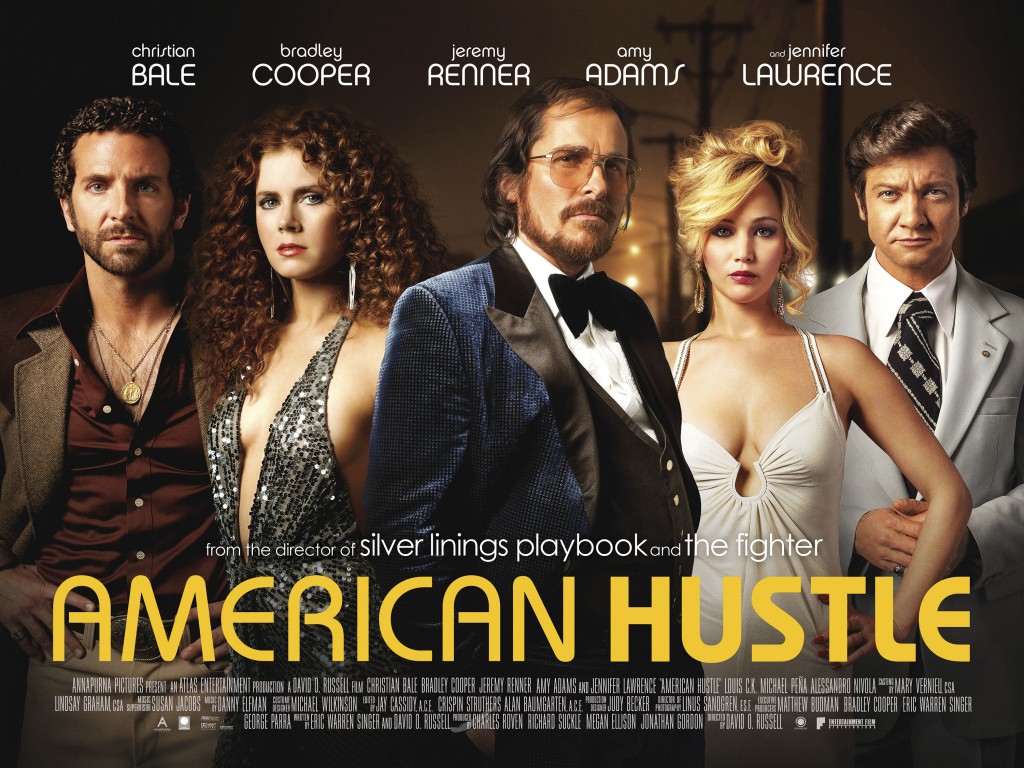
On Tuesday evening, Jean and I rented a movie. We watched the film American Hustle.
The film tells the story of brilliant con man Irving Rosenfeld, who along with his equally cunning and seductive British partner Sydney Prosser is forced to work for a wild FBI agent Richie DiMaso. DiMaso pushes them into a world of Jersey powerbrokers and mafia that’s as dangerous as it is enchanting. Jeremy Renner is Carmine Polito, the passionate, volatile, New Jersey political operator caught between the con-artists and Feds. Irving’s unpredictable wife Rosalyn could be the one to pull the thread that brings the entire world crashing down.
The film has received rave reviews (here’s a typical one in the Guardian newspaper) and was fun to watch; albeit somewhat confusing for much of the first half. At one point towards the end, the hero of the film, Irving Rosenfeld, reflects that, “People see and hear what they want to believe!“.
Bingo!
That is the challenge about accruing wisdom. How to be analytical and wise in learning new thinking and new ideas. In other words, in acquiring knowledge!
If the subject is simple (well on the surface!) as, for example, the effect of the Earth’s gravitational field then that’s fine and dandy. It’s easy to become wise to the fact that falling off a tall building is likely to kill you.
But take an extremely complex, and highly current matter, that of Planet Earth’s changing climate, and it is extremely difficult for the average person without a scientific background to determine the truth. Really, when I use the phrase “to determine the truth” in the context of this essay I should have written ‘to gain knowledge‘.
To illustrate that, my good Californian friend of more than 35 years, Dan Gomez, is highly sceptical about climate change as a product of man’s activities. Recently, I sent him an email with a link to the NBC News report: American Doomsday: White House Warns of Climate Catastrophes. This was Dan’s email reply:
Think about it, Paul.
1. Consider the source and the timing of these new headlines i.e. the left-thinking Obama regime and current unfavorable political challenges.
2. A deflection from mainline issues confronting us today i.e., jobs, economy, healthcare, upcoming elections, Benghazi and IRS political issues.
3. Major opportunity to raise taxes unilaterally without Congress involved.
4. Major opportunity to redistribute corporate wealth from private sector to public sector.
5. Refocus of competitive, free-market energy sector to controlled renewables managed by a few very wealthy political contributors. A lot of money at stake.
6. Man, is empowered via a political party to “save the world” by changing the Weather. The only problem is, there is no solution, no global will and no participants to make anything significant happen i.e., China, Southeast Asia and another billion people scattered about.
7. Euro Zone and USA have already cut CO2 emissions by over 30% each to no avail. In fact, they say it is getting worse after hundreds of billions of dollars already diverted from private sector to public sector with no results. They are now asking for trillions.
8. Average person is not willing to give up his car, nor spend more for battery power (peel back the onion on the battery manufacturing and recycling industry vis a vis CO2 contributions). Much fewer cars, trains, tractors, jets, etc. to make anything work. Sacrifice begins at home.
9. Cows vent 20 times the CO2 emissions in the form of methane than man-made artifacts. Just saying….
10. Check out the bacteria challenge facing Man. This will help put priorities in order for you.
As always, follow the money and you’ll get your answers…..
I am unable to respond to Dan in an analytical and precise manner. I am not sufficiently knowledgeable to so do. Having an emotional response is fine – but it does not advance my personal wisdom.
On the 6th May, I posted an item that featured a TED Talk by scientist Gavin Schmidt, a climate scientist no less. His view is that, “You can’t understand climate change in pieces. It’s the whole, or it’s nothing.” The TED Talk explains how the big picture of climate change illustrates the endlessly complex interactions of small-scale environmental events.
Just a few days ago, Jean and I had the pleasure of a couple of hours at the home of Leon Hunsaker, renowned meteorologist who has claimed that the 1862 Californian flood could happen again.
Leon Hunsaker has done the math, and he thinks Sacramento isn’t prepared for another series of storms like the ones that hit the state in January 1862.
Leon lives less than 5 minutes from us here in Southern Oregon. I asked him what he thought of climate change and he said that the planet’s atmosphere was like a large chocolate cake and man’s activities were no more than the icing on the cake.
So there you are: a range of opinions about this particular, potentially very important, subject. Although in my own (emotional) mind the weight of evidence is in favour of the argument that man is having a deepening and worsening effect on our planet.
Take, for example, the report issued yesterday about significant melting of Antarctica’s glaciers now unstoppable. (Patrice has just released an informative post on the subject!)
“People see and hear what they want to believe!” comes immediately back to mind. Dan wants to believe that the planet is going through normal cycles of change. I want to believe that mankind can make a difference; for the sake of my children and grandson.
Let me turn to the subject of anonymous authors, my Obsession-Compulsion about qualifications!
I have admitted the flaw in my thinking. Here’s the rationale for my change of opinion.
On December 1, 2012, I received my first communication from Edward Snowden, although I had no idea at the time that it was from him.
The contact came in the form of an email from someone calling himself Cincinnatus, a reference to Lucius Quinctius Cincinnatus, the Roman farmer who, in the fifth century BC, was appointed dictator of Rome to defend the city against attack. He is most remembered for what he did after vanquishing Rome’s enemies: he immediately and voluntarily gave up political power and returned to farming life. Hailed as a “model of civic virtue,” Cincinnatus has become a symbol of the use of political power in the public interest and the worth of limiting or even relinquishing individual power for the greater good.
The world now knows what Glenn Greenwald (and Laura Poitras, the documentary filmmaker) knew long before. That Snowden’s anonymity was critically important in the run-up to his knowledge being made widely known.
I was convinced. What is important is not the name and identity of the author of knowledge. What is important is the knowledge itself. No one would deny Snowden’s right to privacy. Indeed, millions of us would opt for email privacy if we fully realised the ease and extent with which our emails, indeed our communications in general, can be intercepted.
Many know that Patrice is a frequent, outspoken voice about the dangers of plutocracy and the slip-sliding away of democracy in the United States. His, or her, personal safety is the highest need of all. Patrice has a perfect right to privacy.
Which leads on to the final, obvious question. If we do not know the identity of the author of knowledge then how can we be certain that the knowledge is valid?
Answer: Through testing!
Of course!
In the best traditions of research, especially scientific research, testing the validity of a claim is the only certain way of determining the validity of knowledge; of being able to derive wisdom from that knowledge.
Let me give you a clear example.
Commercial aviation is incredibly safe. Many countries operate an equivalent to the UK’s Air Accidents Investigation Branch. That UK AAIB website proclaims:
The purpose of the AAIB is:
To improve aviation safety by determining the causes of air accidents and serious incidents and making safety recommendations intended to prevent recurrence …It is not to apportion blame or liability.
Keith Conradi, Chief Inspector
Critical to that purpose of improving safety (aka improving knowledge) is looking for trends. Any trends or patterns would be impossible to discover without testing and debate.
Thus what makes aviation safer is no different to what makes all of knowledge reliable: the testing of ideas and of the hypotheses behind those ideas. The identity of the author of those ideas, per se, is irrelevant.
Thus it is clear to me, clear now beyond doubt, that wisdom is the application of knowledge disconnected from the person who is the author of that knowledge. One might see it as a marriage of knowledge and intellect. Nothing more and nothing less!
All aspects of wisdom depend on trust, on the confidence that the knowledge is ‘reliable‘. Reliability gained from debate and testing.
Never forgetting that in the final analysis, as Patrice wrote it:
“Nature is the only authority worth respecting always.”
ooOOoo
In every which way that one can imagine, we have to return to the principles of fairness and balance so beautifully demonstrated to man by the breadth of Nature. We have to embrace Nature’s wisdom.
A reflection on intelligence, learning and knowledge.
Today’s essay has been prompted by a fascinating exchange of views and comments on a post recently published by Patrice Ayme. More of that tomorrow.
Before getting to the heart of things, I feel compelled to offer a little background on my own educational journey. It is presented today as a preamble to tomorrow’s main essay.
By rights, I should have enjoyed a stunning academic journey as a young man. My mother holds a double degree in French and German from Cambridge University. My father was both a Chartered Architect and Chartered Surveyor and worked for Barclay Perkins & Co at their Anchor Brewery in Southwark, London all his working life. My uncle, Christian Schiller, took up a mathematics scholarship at Sidney Sussex college at Cambridge University and ended up HM Inspector of Schools in the United Kingdom. Notably, he was a promoter of progressive ideas in primary education.
But it was not to be so.
My father died suddenly and with very little warning five days before Christmas in 1956. I had turned 12-years-old some six weeks previously and just completed my first term at Preston Manor County Grammar School. My secure, comfortable young life was thrown into emotional turmoil with one of the consequences being that instead of passing a clutch of GCE ‘O-Level’ exams, I barely managed to pass two subjects and was unable to continue on with a higher level of studying and the consequent sitting of GCE ‘A-Level’ exams, a pre-requisit for university.
Somehow, I then managed to win a place as a student at the Faraday House of Electrical Engineering, in those days based at Southampton Row, London. It was to study for a Diploma in Electrical Engineering. The requirement was that by the end of my first year at Faraday House I should pass two A-level examinations.
I was very happy as a college student. That first year was spent entirely learning about engineering with much time ‘hands-on’ in the engineering workshop. Then came time for me to sit those two A-level exams. I failed both of them! There was no choice but for me to leave the college.
So that’s enough to demonstrate that academic prowess was not my speciality.
However, being unable to jump through the hoops needed for a degree or equivalent didn’t mean that I was a poor learner; far from it.
After my father’s death, my mother remarried and my ‘new’ Dad was very supportive. He had a background in communications and quickly encouraged me to become a radio amateur. I joined the nearby Radio Society of Harrow (still in existence!) and their encouragement enabled me to pass the full set of exams necessary to become a licensed radio amateur and a full member of the Radio Society of Great Britain. My amateur call sign was (and still is) G3PUK. I was 17.
I can still whistle the alphabet in morse code, from A to Z, and the numbers 0 to 9!
Later on, when I was an apprentice at the British Aircraft Corporation’s site in Stevenage, Hertfordshire, one of the commercial staff, Jim Jenner, spent many hours preparing me for the Institute of Advanced Motorists examination. I passed that exam and became a full member of the IAM in May, 1966.
So there’s my background that, hopefully, will set the scene to a wonderful exchange of views and ideas that flowed from Patrice’s blog. Ideas that will be explored tomorrow.
For the reason, the powerful reason, that the intelligence and wisdom of humanity has always been important. But now, in this time of the affairs of man, our collective intelligence and wisdom has never been more important.
I sense the levels of inequity in today’s world reaching crisis levels!
This is the next essay in my irregular series of The Natural order. The last one, on life and death, was published a couple of weeks ago.
Now it would be tempting to rant on at great length about the ‘haves’ and the ‘have-nots’ but there’s a sense of caution about so doing. Because, to be blunt about it, the lifestyle that Jean and I enjoy here on our rural retreat in Southern Oregon is, compared to millions, a blissful luxury.
So all I will do is to refer to some recent articles and essays that seem, to me anyway, to speak volumes about the terrible and growing levels of inequity between the majority of citizens and ‘the 1%‘!
Patrice Ayme of the blog Patrice Ayme’s Thoughts has long written about inequality. I recommend you browse his many essays on the subject of plutocracy but this one, USA: Rich Plutos, Poor People, comes to mind fairly quickly; from which I quote:
Plutocracy is a redistribution of wealth, power, income, from We The People to a small minority of controlling parasites. Plutocracy paralyzes the minds with a warped case of inverted decency. Plutocracy is neither optimal for the society, nor the economy.
Plutocracy affects the USA more than Europe, and the minds, even more than the stomachs. The fact that average Americans feel that they are much better off than in the rest of the world reinforces the plutocratization of the USA. Including astounding tolerance for the amazingly corrupt so-called Supreme Court (Supremely plutocratic!).
I’m “Black”, Mom Was White, & Thus We’re In The Black.
Turning back to this place, not so long ago I published a two-part essay on the loss of democracy. In the first part, I wrote:
But if you think this is an American problem, let me take you back a couple of days to my post that reflected the feeling that it was all getting too much: I just want to throw up! Reason? Because in that post I referred to a recent essay by George Monbiot called The Shooting Party. Here are the opening chapters (and you will have to go here to read the numbered references):
As the food queues lengthen, the government is giving our money to the super-rich.
By George Monbiot, published in the Guardian 29th April 2014
So now you might have to buy your own crutches, but you’ll get your shotgun subsidised by the state. A few days after False Economy revealed that an NHS group is considering charging patients for the crutches, walking sticks and neck braces it issues (1), we discovered that David Cameron has intervened to keep the cost of gun licences frozen at £50: a price which hasn’t changed since 2001 (2).
The police are furious: it costs them £196 to conduct the background checks required to ensure that shotguns are issued only to the kind of dangerous lunatics who use them for mowing down pheasants, rather than to the common or garden variety. As a result they – sorry we – lose £17m a year, by subsidizing the pursuits of the exceedingly rich (3). The Country Land and Business Association – the armed wing of the Conservative party – complains that it’s simply not fair to pass on the full cost of the licence to the owners of shotguns (4); unlike, say, the owners of passports or driving licences, who are charged on the basis of full cost recovery.
Three days later – on Friday – the government announced that it will raise the subsidy it provides for grouse moors from £30 per hectare to £56 (5). Yes, you read that right: the British government subsidises grouse moors, which are owned by 1% of the 1% and used by people who are scarcely less rich. While the poor are being forced out of their homes through government cuts, it is raising the payments – across hundreds of thousands of hectares – that some owners use to burn and cut the land (helping to cause floods downstream), shoot or poison hen harriers and other predators, and scar the hills with roads and shooting butts (6). While the rest of us can go to the devil, the interests of the very rich are ringfenced.
Shortly, I’m going to refer to another Monbiot essay recently published that underscores, once again, the corruption of fairness that is happening in the United Kingdom.
Before that, let me remind all you great readers the lesson we should, and must, learn from Nature. Again, using something recently posted:
OK, I opened today’s post with the sub-heading “Probably just now the most important lesson to be learnt from dogs!” Let me expand on that.
Dogs, like many other ‘pack’ animals, have a relatively flat hierarchy across their group. Typically, a wild dog pack numbered upwards of 30 animals although in modern times we have only the African Wild dog left to study. Nevertheless, the African Wild dog offers mankind the key lesson about cooperation and social equality. Here’s an extract from a National Geographic article [my emphasis]:
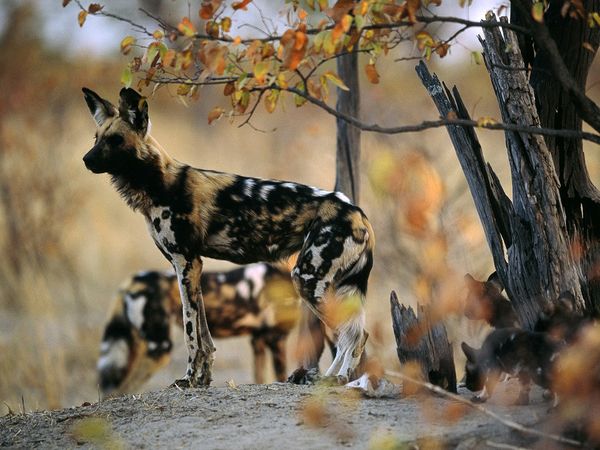
African Wild Dog Lycaon pictus
Known as African wild, painted, or Cape hunting dogs, these endangered canines closely resemble wolves in their pack-oriented social structure. Photograph by Chris Johns
The African wild dog, also called Cape hunting dog or painted dog, typically roams the open plains and sparse woodlands of sub-Saharan Africa.
These long-legged canines have only four toes per foot, unlike other dogs, which have five toes on their forefeet. The dog’s Latin name means “painted wolf,” referring to the animal’s irregular, mottled coat, which features patches of red, black, brown, white, and yellow fur. Each animal has its own unique coat pattern, and all have big, rounded ears.
African wild dogs live in packs that are usually dominated by a monogamous breeding pair. The female has a litter of 2 to 20 pups, which are cared for by the entire pack. These dogs are very social, and packs have been known to share food and to assist weak or ill members. Social interactions are common, and the dogs communicate by touch, actions, and vocalizations.
African wild dogs hunt in formidable, cooperative packs of 6 to 20 (or more) animals. Larger packs were more common before the dogs became endangered.
So back to the domesticated dog. There are just three ‘roles’ to be found: the female alpha dog, the male beta dog and the omega dog that can be of either gender. Even though in a group of dogs (we have eight here at home) the alpha and beta dogs are dominant and will eat first, there is no question of denying the other dogs in the group access to food, water and love from us humans.
The lesson we must learn from dogs is obvious and there’s no need for me to spell it out!
This, then, is the power of the natural order as it applies to animal ‘communities’.
Nature, one way or another, will show us that the natural order is the only ruling order on this natural planet.
So with those tones of mine hopefully ringing in your ears, have a read of this recent Monbiot essay republished with Mr. Monbiot’s kind permission.
ooOOoo
Land of Impunity
May 5, 2014
Politicians and government contractors now seem to be able to get away with almost anything.
By George Monbiot, published in the Guardian 6th May 2014.
What do you have to do to fall out of favour with this government? Last month, the security company G4S was quietly rehabilitated (1). It had been banned in August 2013 from bidding for government contracts (2), after charging the state for tagging 3,000 phantom criminals (3). Those who had died before it started monitoring them presented a particularly low escape risk. G4S was obliged to pay £109m back to the government.
Eight months later, and before an investigation by the Serious Fraud Office has concluded, back it bounces, seeking more government business. Never mind that it almost scuppered the Olympics (4). Never mind Jimmy Mubenga, an asylum seeker who died in 2010 after being “restrained” by G4S guards(5), or Gareth Myatt, a 15-year-old who died while being held down at a secure training centre in 2004(6). Never mind the scandals and crises at Oakwood, the giant prison it runs(7). G4S, recently described by MPs as one of a handful of “privately-owned public monopolies”(8), is crucial to the government’s attempts to outsource almost everything. So it cannot be allowed to fail.
Was it ever banned at all? Six days after the moratorium was lifted, G4S won a new contract to run services for Her Majesty’s Revenue and Customs(9). A fortnight later, it was chosen as one of the companies that will run the government’s Help to Work scheme(10). How did it win these contracts if, in the preceding months, it wasn’t allowed to bid?
When I first worked in Brazil, in the late 1980s, the country was widely described as o pais de impunidade: the land of impunity. What this meant was that there were no political consequences. Politicians, officials and contractors could be exposed for the most flagrant corruption, but they remained in post. The worst that happened was early retirement with a fat pension and the proceeds of their villainy safely stashed offshore. It’s beginning to look a bit like that here.
This is not to suggest that the people or companies I name in this article are crooked or corrupt. It’s to suggest that the political class no longer seems to care about failure.
The failure works both ways of course. As Polly Toynbee has shown, the pilot projects for the Help to Work scheme which G4S will run reveal that it’s a complete waste of time and money(11). Yet the government has decided to go ahead anyway, subjecting the jobless to yet more humiliation and pointlessness. Contrast the boundless forgiveness of G4S to the endless castigation for being unemployed.
A record of failure reflects the environment in which such companies are hired: one in which ministers launch improbable schemes then look the other way when they go wrong. G4S had to pay back so much money for the phantom criminals it wasn’t monitoring because it had been doing it for eight years, and no one in government had bothered to check(12). There is no such thing as failure any more, just lessons to be learnt.
Accountability has always been weak in this country, but under this government you must make spectacular efforts to lose your post. At the Leveson inquiry in April 2012, the relationship between the then culture secretary Jeremy Hunt and the Murdoch empire that he was supposed to be regulating was exposed in gory detail(13,14). Though he was meant to be deciding impartially whether or not to allow the empire to take over the broadcaster BSkyB, he was secretly exchanging gleeful messages with James Murdoch and his staff(15).
We all knew what it meant. The emails, the Guardian observed, were likely to “sever the slim thread connecting Hunt to his cabinet job.”(16) “After this he’s toast … it’s over for Hunt,” wrote Tom Watson MP(17). “He cannot stay in his post,” said Ed Miliband. “And if he refuses to resign, the prime minister must show some leadership and fire him.”(18) We waited. Hunt remained culture secretary for another four months, then he was promoted to secretary of state for health.
On 2 September 2012, the Guardian revealed that the housing minister, Grant Shapps, had founded a business which “creates web pages by spinning and scraping content from other sites to attract advertising”: a process that looks to me like automated plagiarism(19). He had been promoting the business under the name of Michael Green, who claimed to be an internet marketing guru. Again it looked fatal. Two days later, in the same reshuffle that elevated Hunt, he was promoted to Conservative party chairman.
A real Mr Green – Stephen this time – was ennobled by David Cameron and appointed, democratically of course, as minister for trade and investment. In July 2012, a US Senate committee reported that while Lord Green was chief executive and chairman of HSBC, the bank’s compliance culture was “pervasively polluted”(20). Its branches had “actively circumvented US safeguards … designed to block transactions involving terrorists, drug lords, and rogue regimes.” Billions of dollars from Mexican drug barons, from Iran and from “obviously suspicious” travellers’ cheques “benefiting Russians who claimed to be in the used car business” sluiced through its tills(21). Out went dollars and financial services to banks in Saudi Arabia and Bangladesh linked to the financing of terrorists. The Guardian reported that HSBC “continued to operate hundreds of accounts with suspected links to Mexican drug cartels, even after Green and fellow executives were told by regulators that HSBC was one of the worst banks for money laundering.”(22)
Green refused to answer questions and sat tight(23). He remained in post for another 17 months, until he gracefully retired in December 2013.
After it had become obvious to almost everyone that it was impossible for them to remain in the Cabinet, David Cameron refused to sack either Liam Fox or Maria Miller. Forgiveness and redemption, by all means. But they are not unconditional: without contrition or even acknowledgement that wrong has been done, there’s no difference between giving people a second chance and engaging in an almighty cover-up.
There has seldom, in the democratic era, been a better time to thrive by appeasing wealth and power, or to fail by sticking to your principles. Politicians who twist and turn on behalf of business are immune to attack. Those who resist are excoriated.
Here’s where a culture of impossible schemes and feeble accountability leads: to cases like that of Mark Wood, a highly vulnerable man who had his benefits cut after being wrongly assessed by the outsourcing company Atos Healthcare as fit for work, and starved to death(24) – while those who run such companies retire with millions. Impunity for the rich; misery for the poor.











 Learning from Dogs