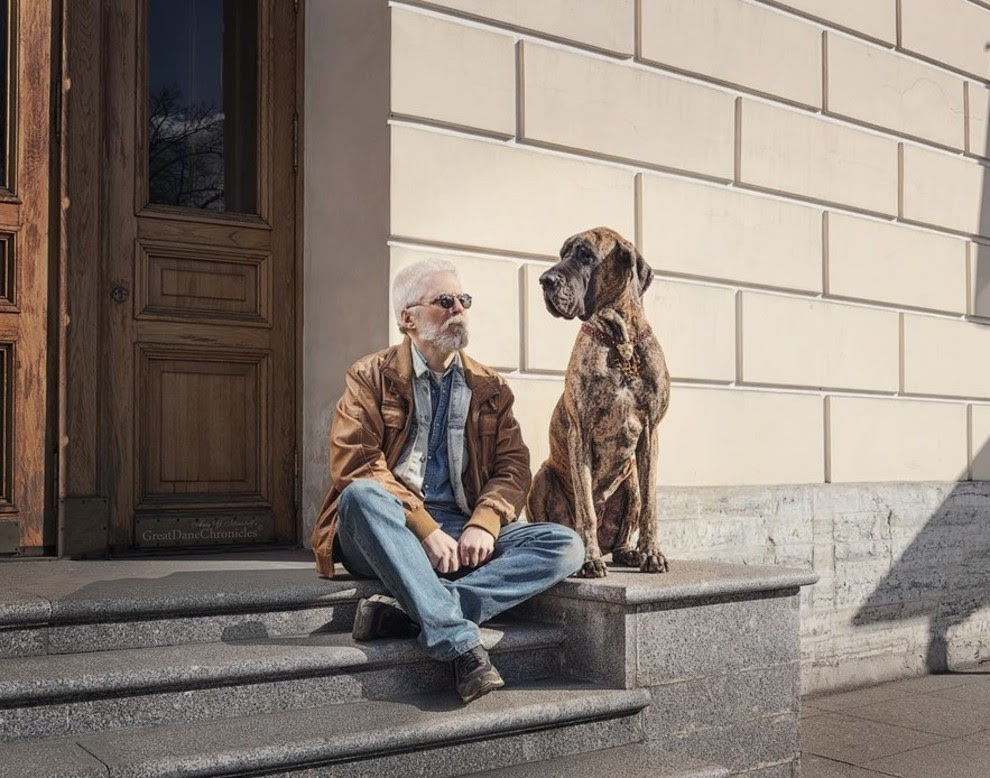
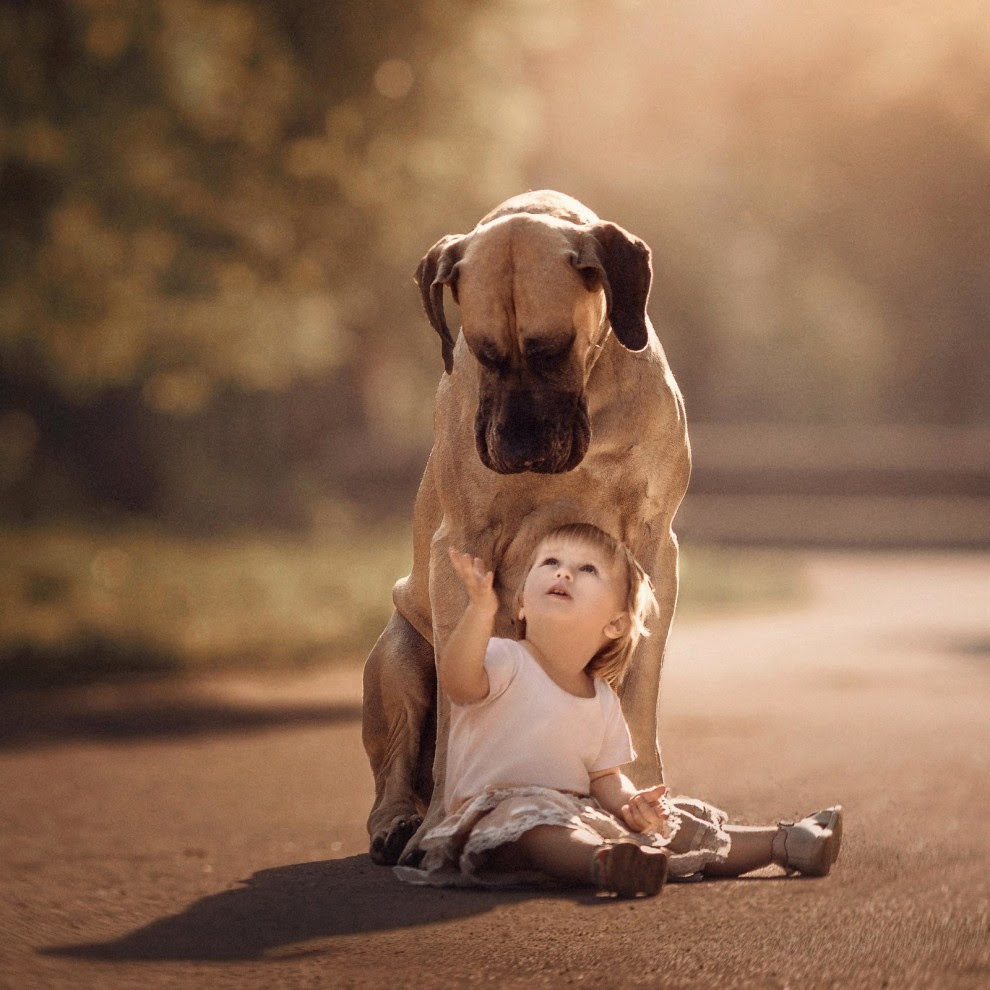
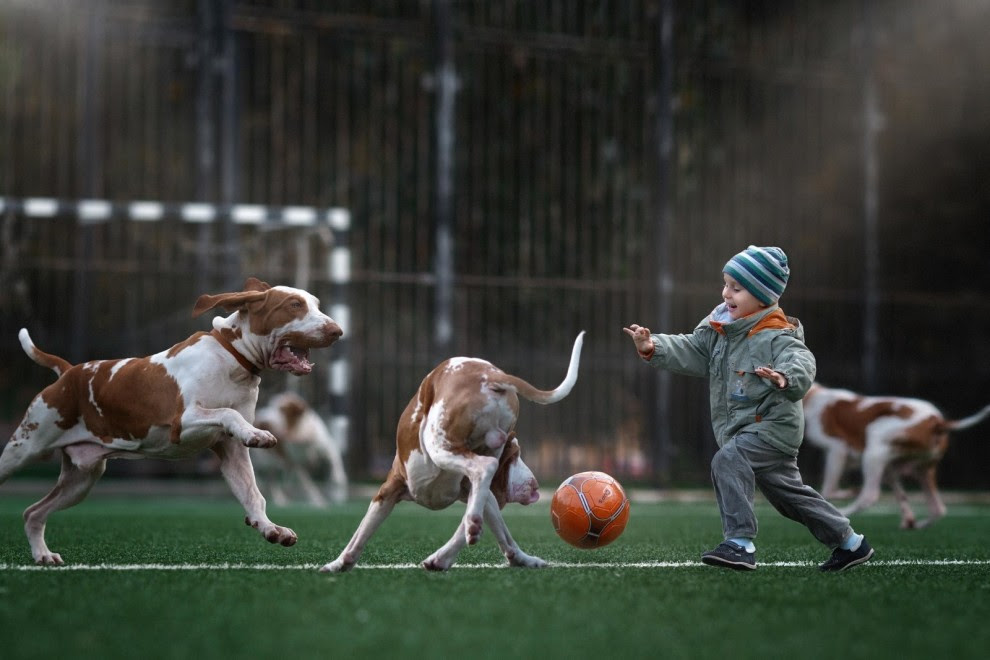
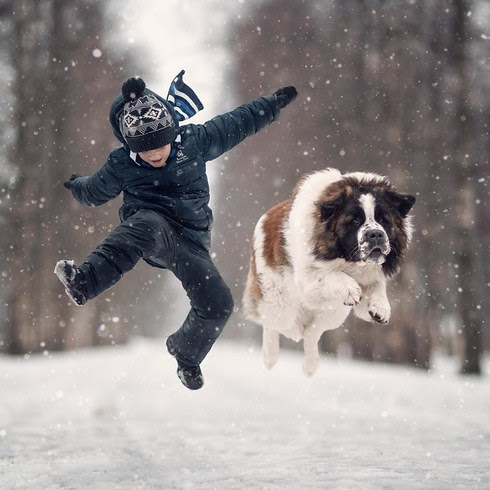
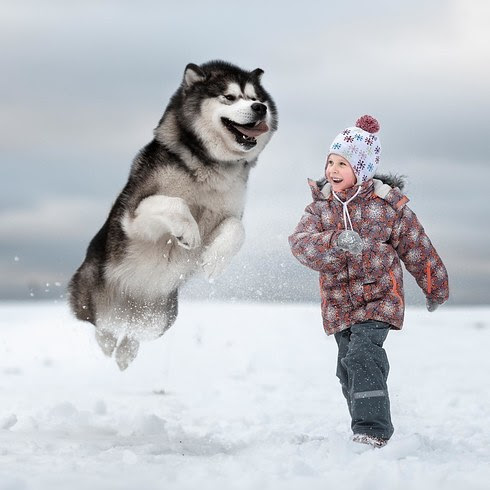
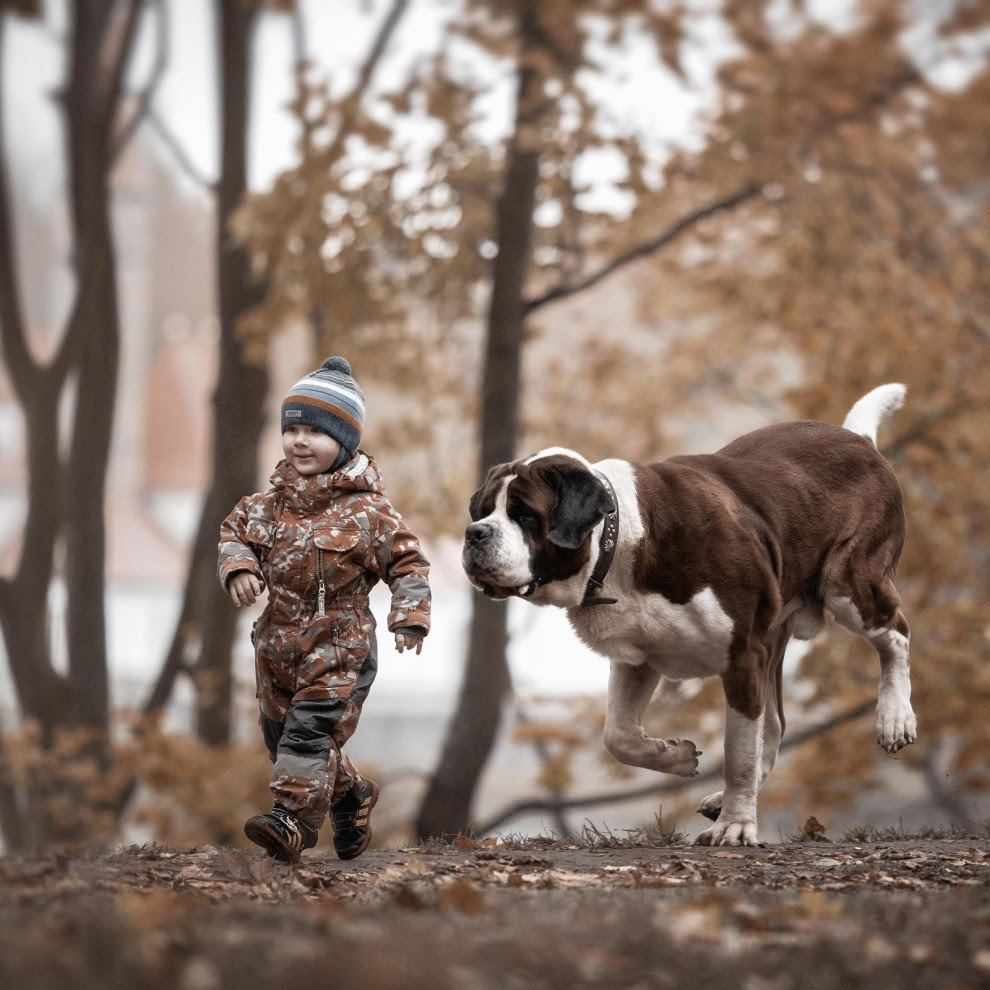
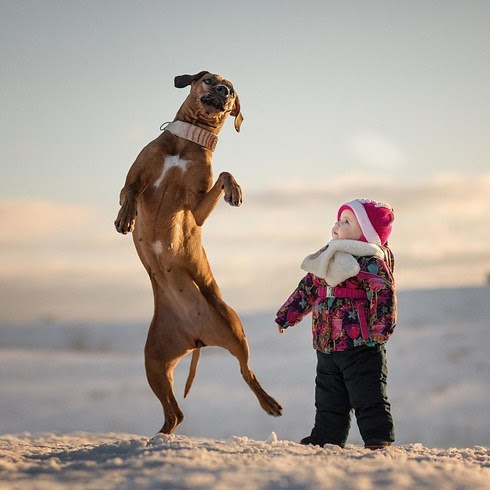
The second set of photographs by Russian photographer Andy Seliverstoff.
The first set of these stunning photographs was last week. I shall repeat the background to the photographer that was also published a week ago.
Little Kids and Big Dogs
Andy Seliverstoff is a 58-year-old professional photographer from St. Petersburg, Russia. A few years ago some of Seliverstoff’s friends asked him to take photos of their daughter Alice in a park. They had their gigantic Great Dane, Sean, with them, so they decided to incorporate him into the photos. After seeing the results, he knew he was on to something special.
Seliverstoff did another shoot with a child featuring big dogs, and told BuzzFeed News that he was “deeply touched” by the work. That was four years ago and he’s been a dog photographer ever since.
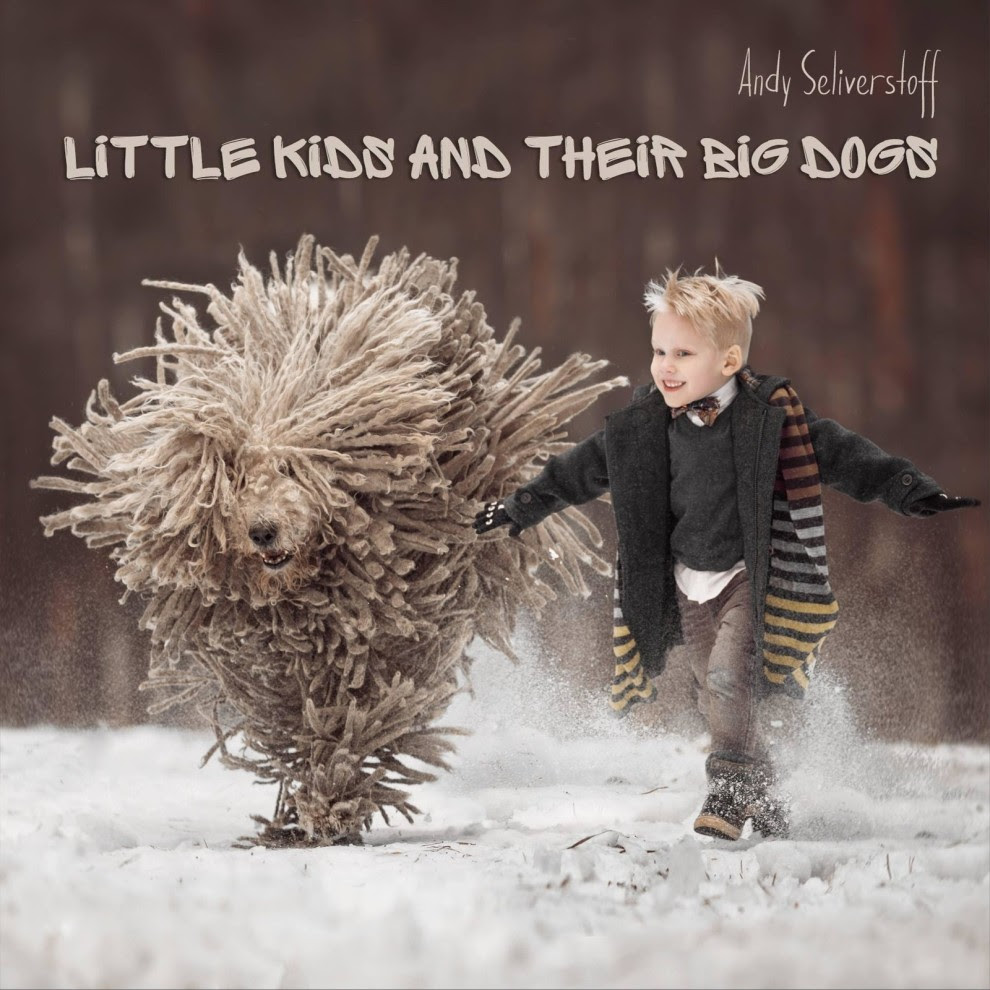
The project has become his passion, which he chronicles in a book called “Little Kids and Their Big Dogs.“
All of the photos are taken in St. Petersburg. Its extensive parks and colder climate help create some spectacular shots.
Seliverstoff said the goal of the series wasn’t just to create beautiful pictures, but to capture the interaction between the children and the animals.
oooo
oooo
oooo
oooo
oooo
oooo
oooo
oooo
oooo
Beautiful almost beyond words! These were sent to me by Dordie from next door. Dearest Dordie has sent me another set of stunningly magical photographs that I will be sharing with you from next Sunday for a few weeks.
This came in late yesterday afternoon, Pacific Time.
This was the email that was sent out.
Evanger’s Dog and Cat Food Company of Wheeling, Illinois, has announced it is voluntarily recalling specific lots of its pet food due to its potential to be contaminated with pentobarbital.
To learn which products are affected, please visit the following link:
If one goes to that Evanger’s Recall Link then this is what you will read. It is republished in full.
ooOOoo
Evanger’s Dog Food Recall of February 2017
February 3, 2017 — Evanger’s Dog and Cat Food Company, Inc. of Wheeling, Illinois, is voluntarily recalling specific lots of its Hunk of Beef product due to potential contamination with the deadly drug, pentobarbital.
Pentobarbital can affect animals that ingest it, and possibly cause side effects such as drowsiness, dizziness, excitement, loss of balance or nausea — or in extreme cases, death.
What’s Being Recalled?
Although pentobarbital was detected in a single lot, the company is recalling all related Hunk of Beef products manufactured the week of June 6 through June 13, 2016.
The affected lots numbers that start with 1816E03HB, 1816E04HB, 1816E06HB, 1816E07HB, and 1816E13HB, and have an expiration date of June 2020.
The second half of the barcode reads 20109, which can be found on the back of the product label.
Where Was the Product Sold?
The affected products were sold both online and also distributed to retail locations only in the following states:
California
Florida
Georgia
Illinois
Indiana
Maryland
Massachusetts
Michigan
Minnesota
New York
Ohio
Pennsylvania
South Carolina
Washington
Wisconsin
About the Recall
The recall affects 5 lots of food that were produced from its supplier’s lot of beef, which is specifically used for the Hunk of Beef product and no other products.
To date, five dogs reportedly became ill. And one of the five dogs died after consuming the product with lot number 1816E06HB13. [Ed: My emphasis]
Evanger’s is proactively issuing a recall so as not to risk potential exposure to pentobarbital in the product.
According to Evanger’s, all suppliers of meat products are USDA approved.
The insists the beef supplier provides the company with beef chunks from cows that are slaughtered in a USDA facility.
Evanger’s continues to investigate how the contaminant entered its raw material supply.
Because it sources its meat products from suppliers that are USDA approved and since no other products have reported any problems, the company is not extending the recall to other supplier lots.
According to Evanger’s, this is the first recall event for the company in its 82 years of manufacturing.
What to Do?
Although it has been verified that little or no product remains on store shelves, consumers are asked to return recalled product to the place of purchase for a full refund.
Consumers with questions may contact the company at 847-537-0102 between 10 AM and 5 PM Central Time, Monday through Friday.
U.S. citizens can report complaints about FDA-regulated pet food products by calling the consumer complaint coordinator in your area.
I will, of course, continue to publish every dog food alert that comes into my in-box. But don’t let that stop you from signing up for recall alerts on your own account.
Finally, if any of you are users of Evanger’s Hunk of Beef dog food and want to share your experiences then I shall be very happy to publish them here for the wider benefit of every single person who loves dogs!
The words of Jim and Janet Goodbrod. It was finally time to say the last goodbye to our old Buddy. Life had become an intolerable burden. His spirit wanted to keep going, but his failing body could not keep up. We ended his suffering and gently nudged him into that deep and eternal sleep last Wednesday.
Rest in peace old man! You made it 16-17 years. You aren’t in pain any longer and can run and play like you used to. We had you for only about 10 months, but loved you and we’re glad we could make your last year a good one. Forget the horrible abuse you suffered as a puppy, and remember only the love and joy you gave us in your last days on this planet.
A Dog’s Plea
Treat me kindly, my beloved friend, for no heart in all the world is more grateful for kindness than the loving heart of me.
Do not break my spirit with a stick, for although I should lick your hand between blows, your patience and understanding will quickly teach me the things you would have me learn.
Speak to me often, for your voice is the world’s sweetest music, as you must know by the fierce wagging of my tail when your footsteps falls upon my waiting ear.
Please take me inside when it is cold and wet, for I am a domesticated animal, no longer accustomed to bitter elements. I ask no greater glory than the privilege of sitting at your feet beside the hearth. Keep my pan filled with fresh water, for I cannot tell you when I suffer thirst.
Feed me clean food that I may stay well, to romp and play and do your bidding, to walk by your side and stand ready, willing and able to protect you with my life, should your life be in danger.
And, my friend, when I am very old, and I no longer enjoy good health, hearing and sight, do not make heroic efforts to keep me going. I am not having any fun. Please see that my trusting life is taken gently. I shall leave this earth knowing with the last breath I draw that my fate was always safest in your hands.
Last year I instigated a new ‘page’ on Learning from Dogs. It was entitled We Shall Not Forget Them. It was introduced by me as follows:
For millions, the relationship between a person and their dog is precious beyond words. Do you still grieve the loss of your wonderful dog? Let us all know what your dog meant to you. Write whatever you want. Leave it as a thought to this page.
Then it became clear that this was not going to work properly. Because each note of remembrance was, in effect, a comment. And I discovered that under WordPress it is not possible to insert a photograph. I struggled to think of a better way of doing it. Then earlier yesterday it came to me.
I will make each message of condolence, each reflection on how special the dog was, a new and separate blog post. In other words, each dog gets their own post for a full day.
Then each time a condolence is sent in, I will update the We Shall Not Forget Them post with the name of the departed dog, the date and a link to the blog post that has the details and memories of the animal.
I hope that makes sense!
To underline how it is going to work, I am starting off with the words of loss, and photographs, of Jim and Janet’s Buddy.
That post will be published in an hour’s time and will be linked to as I described above.
ooOOoo
So I am reaching out to Susan, Asha, Katrina and Whisperofthedarkness – each of you has left a memory as a comment to here.
Please do email me some photographs and any further recollections you would like me to post, and I will do for you as I have done for Buddy.
(Laura, I shall go to that link and republish what you wrote.)
Bob Derham and his wife, Julie, are long-term friends back in the UK.
They recently lost their two dogs.
Bob sent me this:
Millie and Summer both had a fun life.
They were cross breed dogs, partly Springer Spaniel and part Collie. They were born in Wales, but as there are quite a lot of similar dogs there, the owner advertised in a local paper, and brought them up to Dorset one weekend 13 years ago.
Initially we had been looking for only one dog, but it seemed such a shame to separate the two puppies so we decided to take both. Most people were of the opinion that two girls from the same litter was not a good idea, but nevertheless we trained them, and the two animals were always together.
Family holidays, walking the children to the school bus, visiting friends, etc., always included Millie and Summer.
Just over two years ago, Summer became diabetic. Had this been only ten years ago, nothing could have been done for her, but we were able to inject her twice a day, and keep her healthy, apart from failing sight as a result of the insulin. It was not long after that Millie developed the same problem, so both dogs had the same routine.
Summer went to the vets on the right day for her, and was put to sleep peacefully, and two weeks later Millie needed the same choice to be made.
They enjoyed an almost identical lifespan, and we enjoyed them to the full.
Bob and Julie’s daughter Stephanie then made the following video in memory of their two beloved dogs.
Back to me.
Going to close today’s post with this poem by Rudyard Kipling.
ooOOoo
The Power of the Dog
There is sorrow enough in the natural way
From men and women to fill our day;
And when we are certain of sorrow in store,
Why do we always arrange for more?
Brothers and Sisters, I bid you beware
Of giving your heart to a dog to tear.
…
Buy a pup and your money will buy
Love unflinching that cannot lie–
Perfect passion and worship fed
By a kick in the ribs or a pat on the head.
Nevertheless it is hardly fair
To risk your heart for a dog to tear.
…
When the fourteen years which Nature permits
Are closing in asthma, or tumour, or fits,
And the vet’s unspoken prescription runs
To lethal chambers or loaded guns,
Then you will find–it’s your own affair–
But…you’ve given your heart for a dog to tear.
…
When the body that lived at your single will,
With its whimper of welcome, is stilled (how still!);
When the spirit that answered your every mood
Is gone–wherever it goes–for good,
You will discover how much you care,
And will give your heart for the dog to tear.
…
We’ve sorrow enough in the natural way,
When it comes to burying Christian clay.
Our loves are not given, but only lent,
At compound interest of cent per cent.
Though it is not always the case, I believe,
That the longer we’ve kept ’em, the more do we grieve:
For, when debts are payable, right or wrong,
A short-time loan is as bad as a long–
So why in Heaven (before we are there)
Should we give our hearts to a dog to tear?
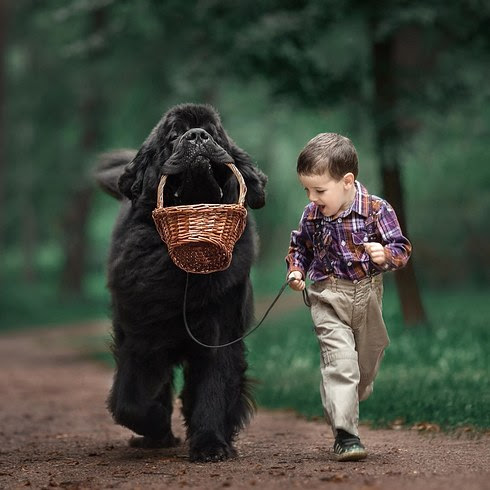
First some background to the pictures that are presented both today and in a week’s time.
Little Kids and Big Dogs
Andy Seliverstoff is a 58-year-old professional photographer from St. Petersburg, Russia. A few years ago some of Seliverstoff’s friends asked him to take photos of their daughter Alice in a park. They had their gigantic Great Dane, Sean, with them, so they decided to incorporate him into the photos. After seeing the results, he knew he was on to something special.
Seliverstoff did another shoot with a child featuring big dogs, and told BuzzFeed News that he was “deeply touched” by the work. That was four years ago and he’s been a dog photographer ever since.
The project has become his passion, which he chronicles in a book called “Little Kids and Their Big Dogs.“
All of the photos are taken in St. Petersburg. Its extensive parks and colder climate help create some spectacular shots.
Seliverstoff said the goal of the series wasn’t just to create beautiful pictures, but to capture the interaction between the children and the animals.
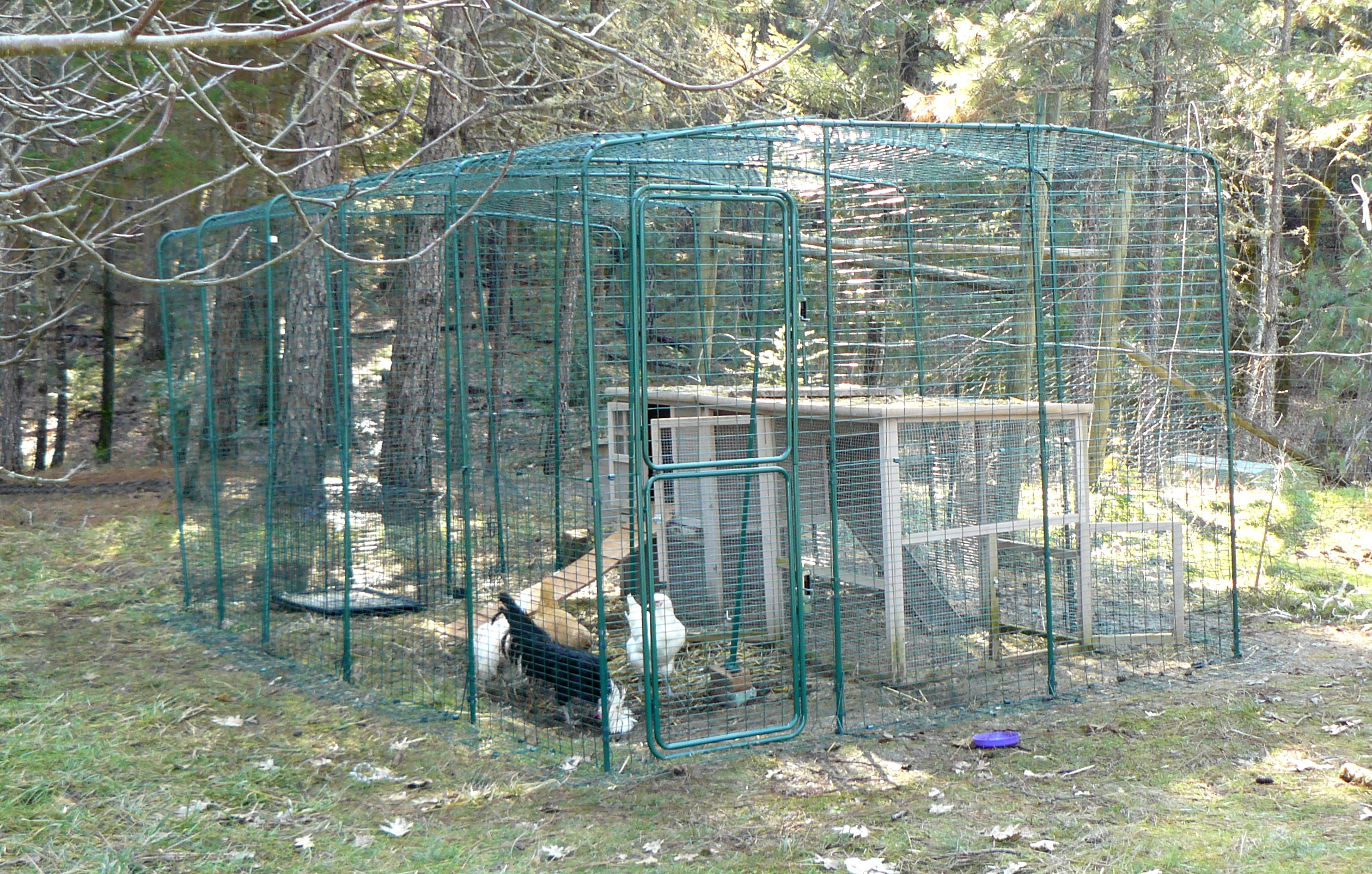
Together with helper Michael plus Jean supplying hot drinks and lunch I was outside from 08:00 until 15:00 (3pm PST in old money!).
We were assembling a new chicken run.
The unit comes from the UK and is known as the Omelet range of pet houses. There is a USA website here and the particular run that Jean and I chose is from here. We particularly wanted a walk-in run.
It was all very straightforward but I am bound to tell you, dear folks, I am knackered!
I have a marvellous blogging friend in New Mexico who has Rufina, a chicken who was shot in the head, sealed in a plastic bag, placed in a freezer for 24hrs, and lived! (albeit now blind).
I have a framed poster of Rufina up in my living room, and even one her feathers perched in one of my many, many, many St. Francis’s
Then in response to me wanting to republish that story replied: “Contact her, she’s wonderful, and her pottery is to die for.”
So I did and, with Laura’s permission here is that story of this most remarkable chicken.
ooOOoo
The Undead Chicken
by Laura Bruzzese, June 24th, 2013
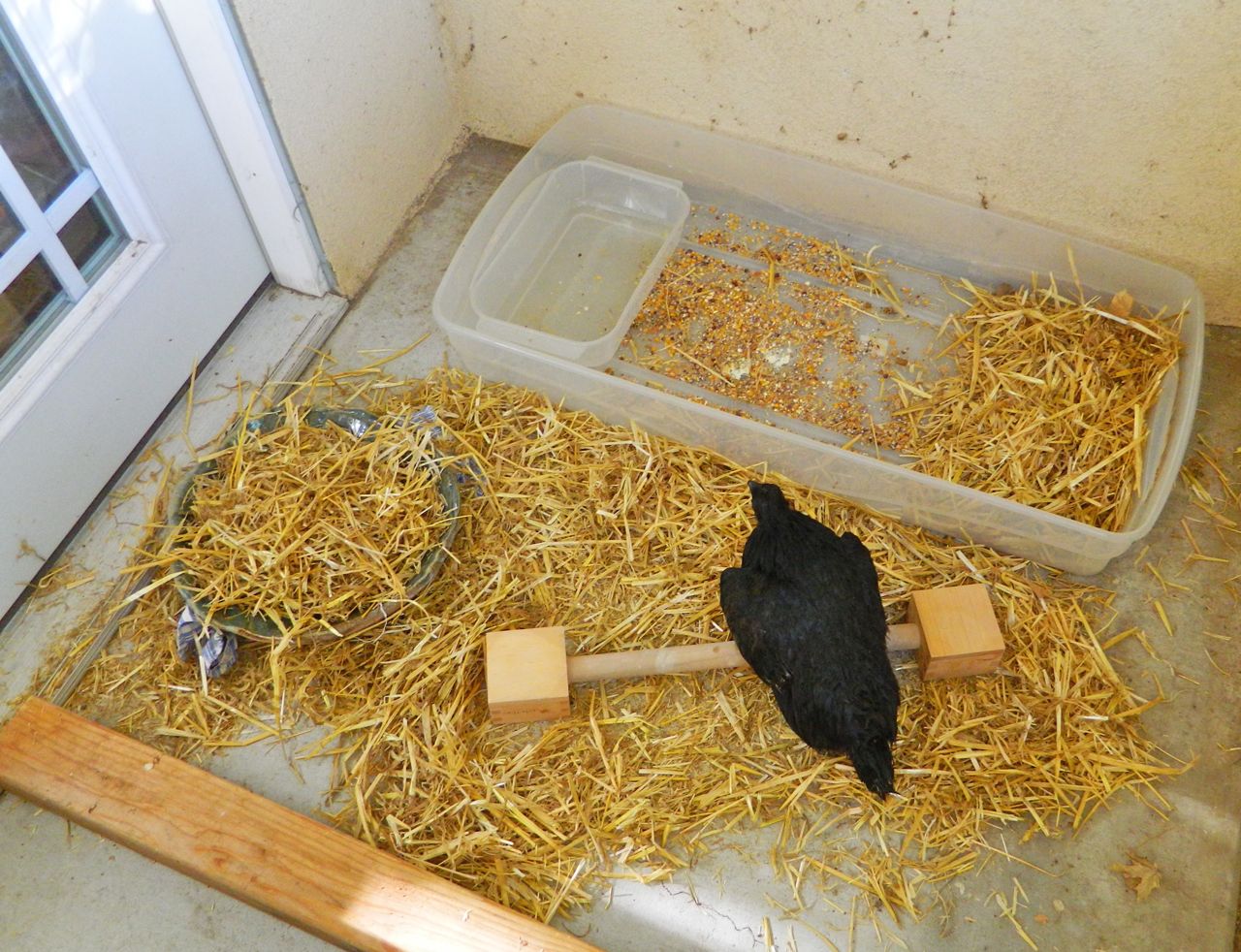
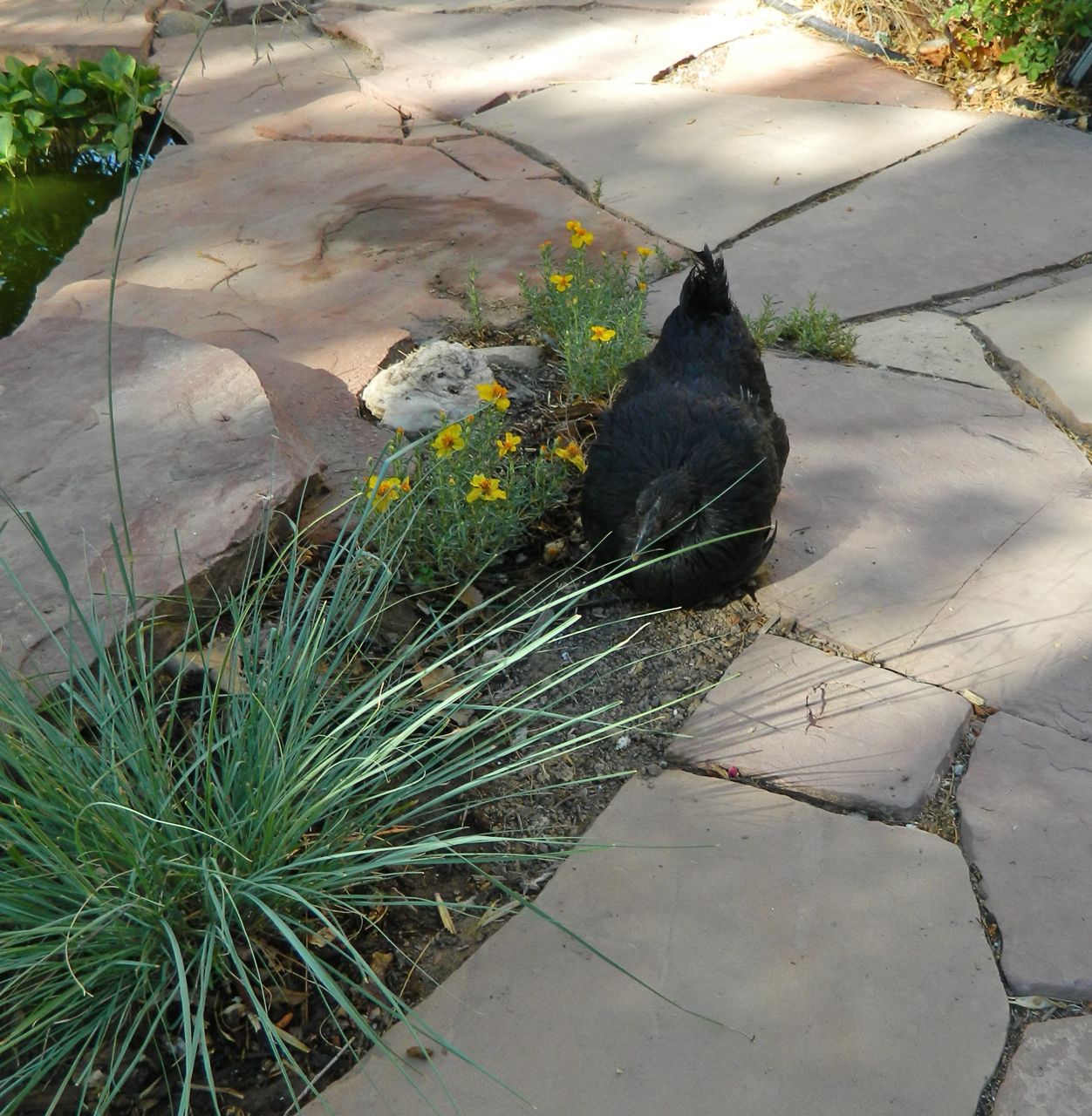
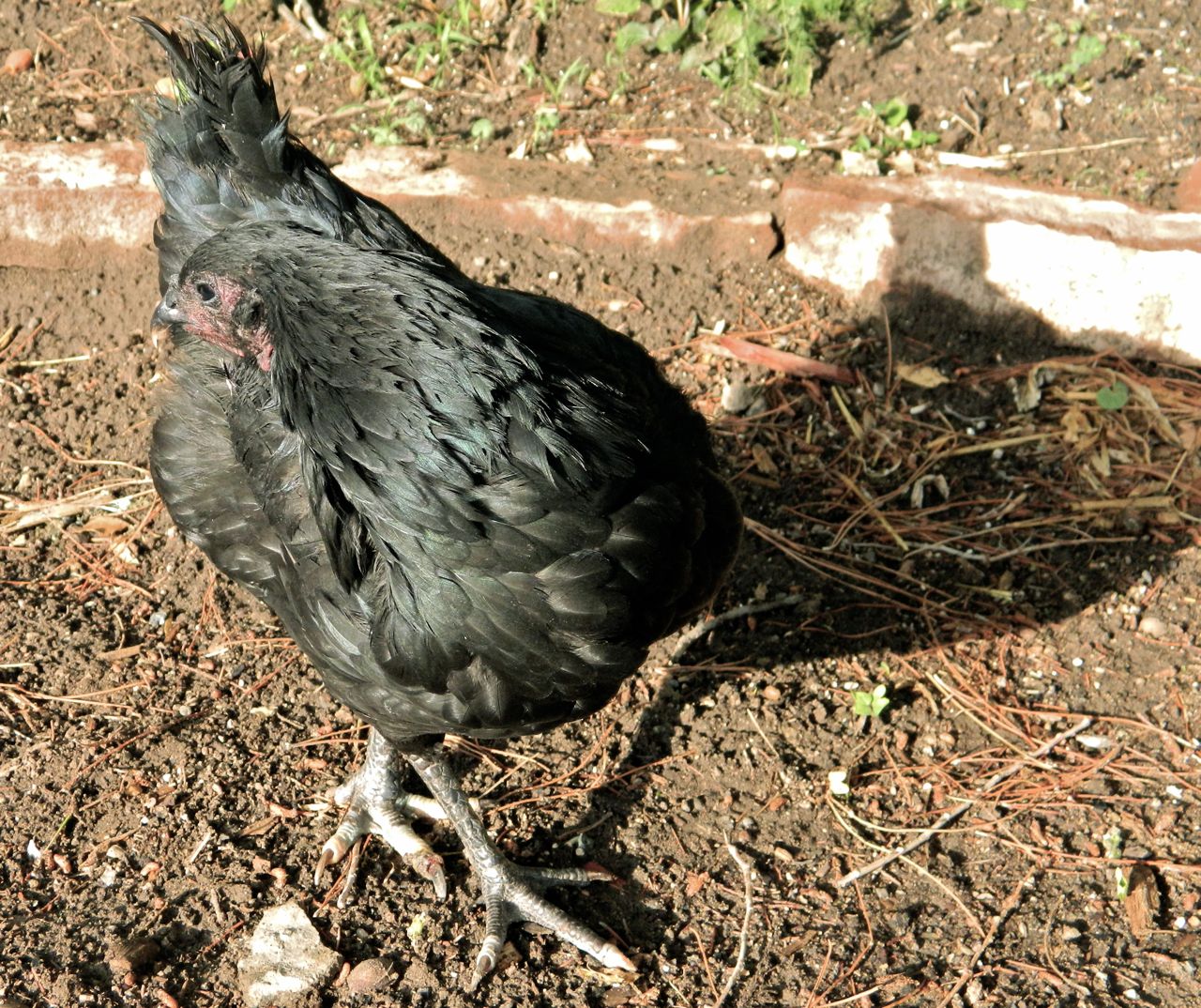
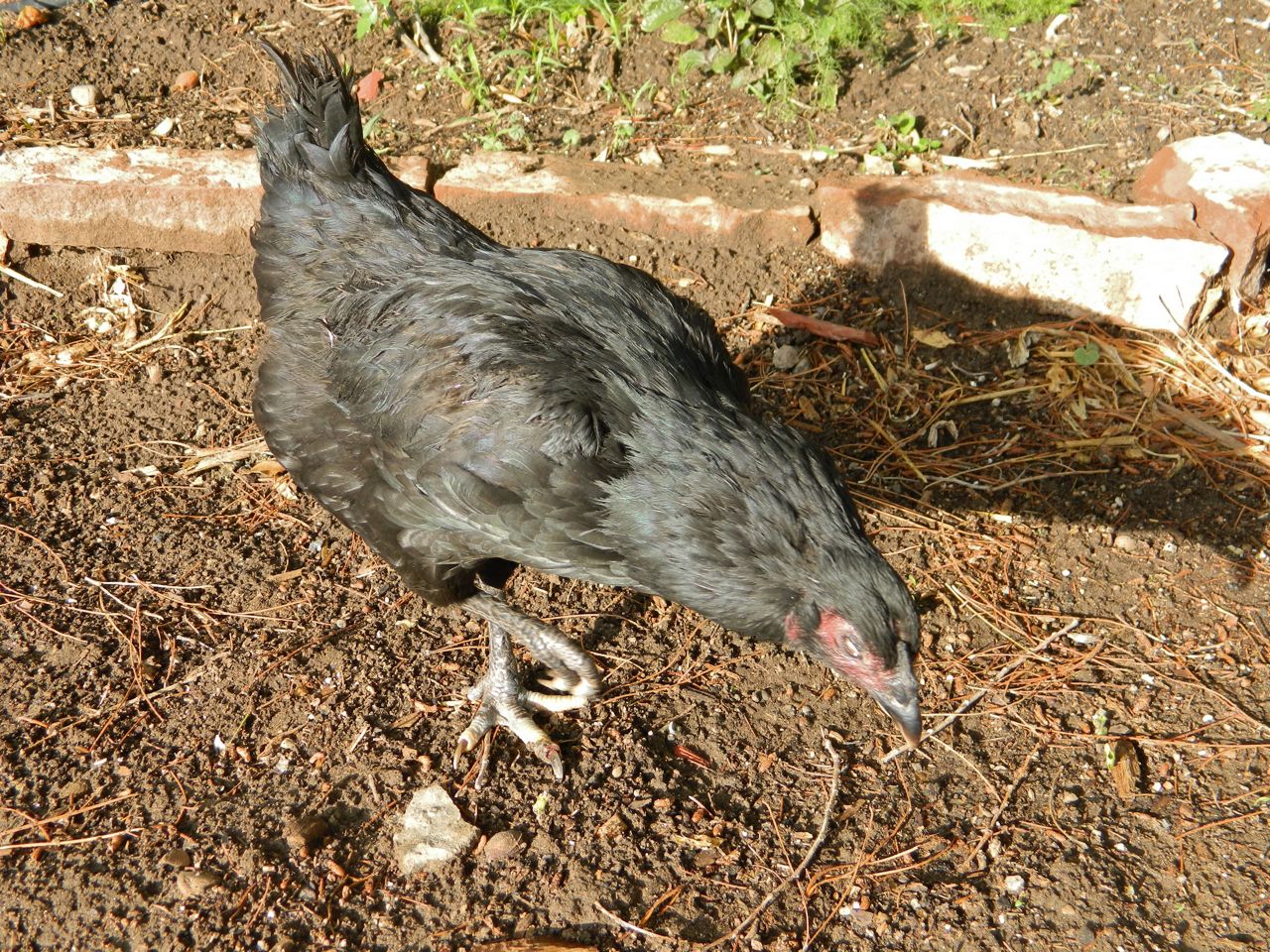
This is Rufina. She’s new to our household.
She’s quiet and doesn’t take up much space, mostly sits on her perch or in her ceramic nest all day. She moves around slowly. If you are really gentle, she lets you pick her up.
We sit by the pond together in the morning, before everyone else gets up.
Last Thursday, I answered a friend’s call on Facebook for someone to take this chicken. Isabella and I drove to my friend’s house in the South Valley, put her in a bin, and brought her home. I didn’t think she’d actually still be alive today.
My friend had posted this story Thursday morning:
The neighbor gave us fresh chickens last night for cooking up. He shot them in the head with gun and handed them over the fence. We bagged them and put in freezer for today. Evan gets home, opens freezer and one bird is perched fully alive, very cold, and pissed off.
Chase ensues… !! We now have a blind undead chicken in our yard.
Anybody want it?
I’m not sure why anyone would shoot chickens in the head.
But when I read the story, I couldn’t help but admire this chicken’s tenacity. She is courageous. She made her way out of a plastic bag inside a freezer and survived for thirty-six hours. After being shot in the head. I figured any animal that fought that hard to live deserved a little help, if only for a day or two.
The chicken hasn’t made any effort to eat like a normal chicken. Because, of course, she can’t see where to peck. (There isn’t much point in force-feeding a blind chicken.) But she does drink, so I’ve started blending up borrowed chicken food and water and giving her that. She seems content, grooming herself sometimes, showing no signs of pain or anxiety. And still, she will die.
But until then, we will enjoy each of her borrowed mornings by the pond, the sound of birds and running water, the sun on her feathers, expecting nothing.
I’m not sure why I have a blind, undead chicken in my studio. But here is one of my favorite poems, by Laura Gilpin.
The Two-Headed Calf
Tomorrow when the farm boys find this
freak of nature, they will wrap his body
in newspaper and carry him to the museum.
But tonight he is alive and in the north
field with his mother. It is a perfect
summer evening: the moon rising over
the orchard, the wind in the grass. And
as he stares into the sky, there are
twice as many stars as usual.
Now if you think that was remarkable then let me share what Laura posted a few weeks later, linked to via her Epilogue above.
ooOOoo
The Miracle of Re-Birth
by Laura Bruzzese, July 11th, 2013
Good news: it’s been three weeks since the attempted murder of Rufina, and she continues to dwell among the living!
After loads of eye care, foot washing, antibiotics, food and vitamins, she has gained weight and is learning to find food and water by herself. Her remaining eye looks normal again but is still blind (I was hoping for a miracle), and the place of its former pair seems to have reached its majority in terms of healing–no eye, but no skin, either. Just a weird, green spot surrounded by red skin that looks not unlike a tiny sun-dried tomato.
But that does not prevent her daily forays into the garden where she walks around with her head craned forward to “feel” where she’s going, and from exhibiting other persisting chicken qualities that seem to evidence a contented life.
I’m still surprised, and slightly in awe of this traumatized chicken who is satisfied to reside indefinitely on my studio porch. Shiny, happy chicken.
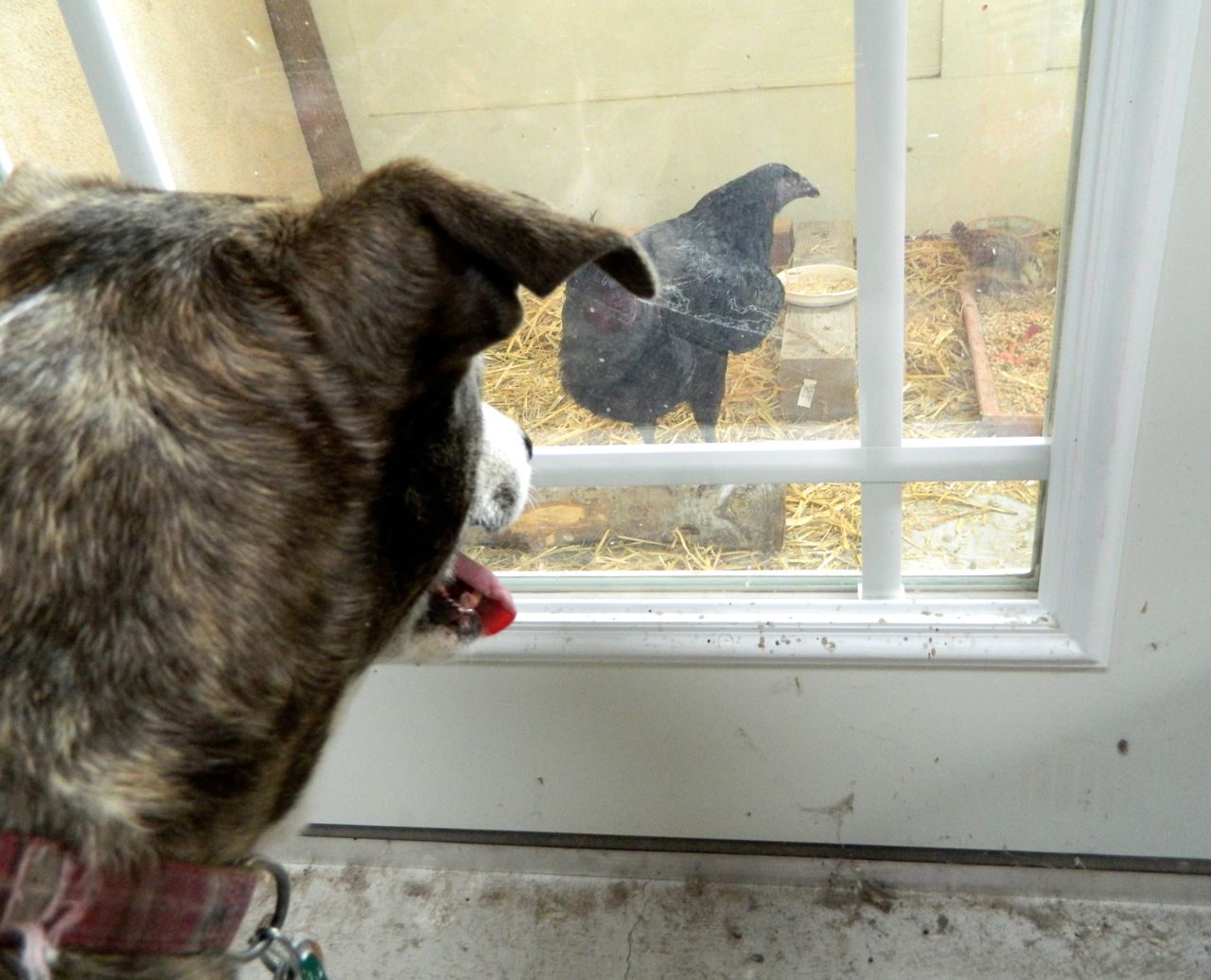
And so far, Velma the Rascally Whippet has not been the nuisance I was afraid she might be, but instead, a proud example of a bird-dog in defiance of her own natural instincts (save for one minor incident involving a tail feather. That was still attached to Rufina.). Perhaps Velma knows they are kindred spirits, she herself having survived a scary encounter with the Great Beyond earlier this year.
Thanks to everyone who has contributed free chicken advice, food, ER and vet consults, and even a couple of adorable, surprise chicks* (!) to keep Rufina company.
*Chicks will unfortunately be dispatched to some other venue because they are exploiting their sighted advantage: stealing food out of Rufina’s mouth, crowding the water dish, and mocking her by constantly blinking and sticking their tongues out. Also, they are filthy little creatures that walk in their own poop and then jump on me.
And finally, what’s in a name? When it became clear that chicken might live, I thought I should name her, and Rufina was the first thing that popped into my head. A few days later, I googled it to see what came up. This is what I found on Wiki:
Saints Justa and Rufina (Ruffina) (Spanish: Santa Justa y Santa Rufina) are venerated as martyrs. They are said to have been martyred at Hispalis (Seville) during the 3rd century.
Their legend states that they were sisters and natives of Seville who made fine earthenware pottery for a living, with which they supported themselves and many of the city’s poor. Justa was born in 268 AD, Rufina in 270 AD, of a poor but pious Christian family. During a pagan festival, they refused to sell their wares for use in these celebrations. In anger, locals broke all of their dishes and pots. Justina and Rufina retaliated by smashing an image of Venus.
The city’s prefect, Diogenianus, ordered them to be imprisoned. Failing to convince them to renounce their faith, he had them tortured on the rack and with iron hooks. This method also having failed, they were imprisoned, where they suffered from hunger and thirst.
They were then asked to walk barefoot to the Sierra Morena; when this did not break their resolve, they were imprisoned without water or food. Justa died first. Her body, thrown into a well, was later recovered by the bishop Sabinus. Diogenianus believed that the death of Justa would break the resolve of Rufina. However, Rufina refused to renounce her faith and was thus thrown to the lions. The lion in the amphitheatre, however, refused to attack Rufina, remaining as docile as a house cat. Infuriated, Diogenianus had Rufina strangled or beheaded and her body burned. Her body was also recovered by Sabinus and buried alongside her sister in 287 AD.
Saint Rufina, by Velázquez. See the likeness?? She’s even carrying a giant feather!
Just another name? Perhaps. Or: a dark-haired Spaniard and a Italian-New Mexican, two Christian potters separated by centuries, a saint, a chicken, and an ordinary human united in an extraordinary coincidence of the undead.
ooOOoo
Follow that!
Well I can’t but John Zande can.
For he was the first to leave a comment to Laura’s Rebirth post:
Here, i feel this song is in order. Listen carefully to the words, and who is singing them.
Delighted to introduce Kevin Davies and his guest post.
Regular followers of this place will know that whenever I can I do offer space for a guest blogger. I regret that so many of the persons that ask if I accept guest posts are trying to flog something to you all!
But not Kevin. Here’s a little about him, as supplied by Kevin.
Life can be quite boring without any pets in your life. They can make your day filled with joy, make you smile when you are sad.
My name is Kevin Davies and I am pet lover. The reason why I started this website (https://petloverguy.com) is that I want to share my experience which I have. I can’t imagine my life without pets.
I have always had them since I was little. The first one me and my family had was a cat. Her name was Jenny. She was a Siamese cat with ocean blue eyes, her head was brown with a little bit of white specks, and the rest of her body was white. She was always nice to me, sat in my lap every day and when I petted her she always purred. I lost Jenny when I was 8 and it made me so sad. Actually it still makes me sad and I have never forgotten about her.
ooOOoo
Should I Shave My Dog for the Summer?
by Kevin Davies
It’s a question I hear all the time from pet parents, especially those with relatively long-haired, thick-coated dogs. Should I shave my dog for the summer? Will it make him more comfortable?
Obviously, if your dog is a Poodle, a Shih Tzu, a Lhasa Apso, or another of the “non-shedding” breeds, it’s perfectly fine to shave your dog. But what about the other breeds that aren’t typically shaved for grooming purposes? Can shaving them during the summer months make them more comfortable or will it create problems for them? We’re talking primarily here about long-haired dogs. Chows are a good example though certainly not the only breed in question. The answer is not clear cut and, likely if you ask six different people, you’ll get six different opinions.
There are two lines of thought in this situation. The first line of thought is that the haircoat acts to trap the cooler hair next to the skin and keep the dog cooler. In other words, it works as insulation. The other line of thought is that the fur simply acts like a coat would for a human, making the dog warmer than is necessary.
Frankly, science doesn’t have all the answers to these questions. What we do know is that dogs loose excess heat primarily through panting rather than through the skin. So your dog won’t “sweat” off excess heat like people do, even if shaved. Of course, that doesn’t mean that shaving your dog might not still provide some welcome relief from the heat.
Obviously, there are differences between breeds when it comes to heat tolerance. Likely, there are differences between individual dogs as well. It’s been postulated that black absorbs heat whereas white reflects it. Therefore, dark colored dogs may be less tolerant to heat than lighter colored dogs. I’m not sure whether there’s any truth to that. There are no scientific studies that I know of to prove or disprove the theory. But, from a logical standpoint, it makes sense (to me, anyway).
What does all this mean to you, the dog owner? Should you shave your dog for summer?
I can’t give you a definitive “yes” or “no” answer. What makes sense to me is finding out what works best for your dog. Try shaving your dog and see if he seems more comfortable that way. The hair will grow back quickly for most dogs (more on that in a moment) and, if shaving doesn’t make your dog more comfortable, you don’t have to do it again.
How close should you shave your dog?
I worry about excess exposure to the sun, which may cause sunburn or even contribute to melanomas and other skin diseases. Therefore, I would leave enough fur to provide some protection rather than shaving your dog all the way down to the skin. How close should you trim? Leave perhaps 1/2 inch to an inch of hair length.
There’s one other thing that you should be aware of before you shave your dog though. In most cases, the hair will grow back perfectly normally after shaving. But, in a small number of cases, it may not. This may be remedied in some dogs with the administration of thyroid hormones and/or melatonin. However, not all dogs will respond favorably to these drugs either.
One last precaution: Even if your dog is shaved, you will still need to tailor your dog’s exercise to your individual dog’s situation. Hard exercise (i.e. marathon running, etc.) in hot temperatures is not appropriate for all dogs. Consider your dog’s physical condition and conformation and don’t overdo in the warm weather.
ooOOoo
Don’t know about you but we found that interesting.
After spending nearly a year on a Georgia animal shelter’s adoption list, Kailey’s time was up. The shy 3-year-old shepherd mix didn’t like to be petted by strangers, which raised a big red flag for potential forever families.
“Her one issue was that something had happened to her in her past, so that if you tried to touch her and she did not know you, she would snap at you,” Jacqueline Berlin, who had fostered Kailey, told FOX 5.
Fortunately, Kailey’s life was spared, and not a moment too soon. Shortly before Kailey was going to be euthanized by DeKalb County Animal Services, Suzy Chandler came across the dog’s video on the DeKalb County Animal Services Facebook page.
“Do you like to be alone or just with a close friend?” the post read. “Is an evening at home surfing the web or cuddling with a loved one watching Netflix your idea of bliss? Does the idea of being grabbed anywhere by someone you don’t know horrifying? Meet your doggie soulmate: Kailey.”
It noted that while Kailey didn’t make the greatest first impression due to her “don’t touch me until I know you” issue, within 24 hours she would be in love with you. Her biggest flaw? She “has no idea of personal space. She is a Velcro dog who wants nothing more than to be with you.”
“The story of what she had been through just pulled on our heartstrings,” Chandler told FOX 5. “We just thought we would be the perfect people for her. It was a perfect match.”
On the morning of Dec. 30, just a couple of weeks after Chandler saved Kailey’s life, the former death-row dog paid it forward.
Kailey started barking and growling at Chandler, trying to get her attention. When Chandler took Kailey outside her house, thinking she needed a potty break, the dog pulled her toward the side yard.
“Right away I smelled overpowering gas and a loud whooshing sound,” Chandler told FOX 5. She called 911.
DeKalb County Fire responded and repaired the ruptured gas line. If Kailey hadn’t alerted Chandler to it, the outcome could have been disastrous. Chandler lives next door to an apartment complex where many children live.
“She’s our hero dog, because we don’t know what the outcome would have been,” Berlin told FOX 5.
Chandler hopes Kailey’s actions will inspire others to adopt pets, despite whatever red flags they may perceive. (“Here, here”, say Jean and Paul)
“If you have the space, you have room in your heart to take in a needy animal, to love on them,” she told FOX 5. “I mean it comes back to you tenfold.”
Kailey isn’t the only rescued dog who has rescued her family. Among these four-legged heroes last year were a pit bull named Leon who alerted his owner to an intruder in the house, a German Shepherd named Haus who protected a little girl from a rattlesnake, and a pug named Earl who, just a week after he was adopted, woke up his new family and saved them from a house fire.
 oooo
oooo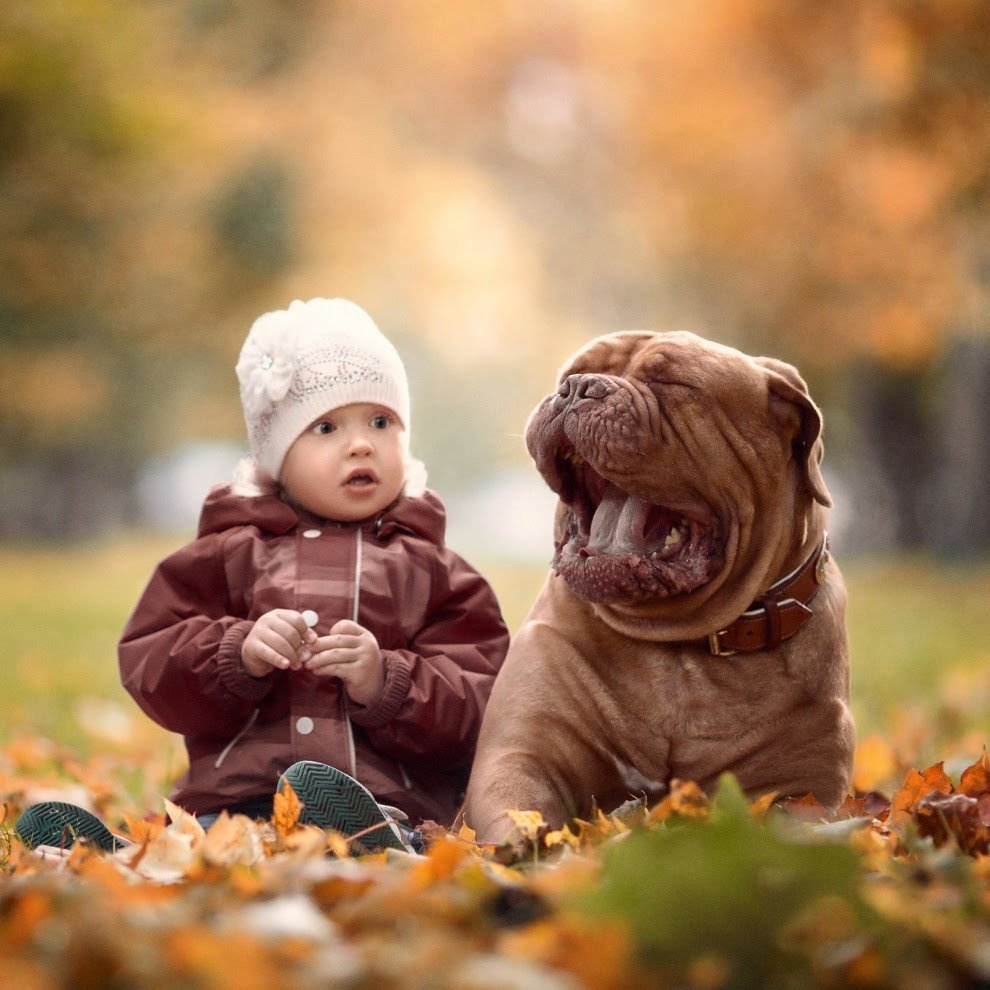 oooo
oooo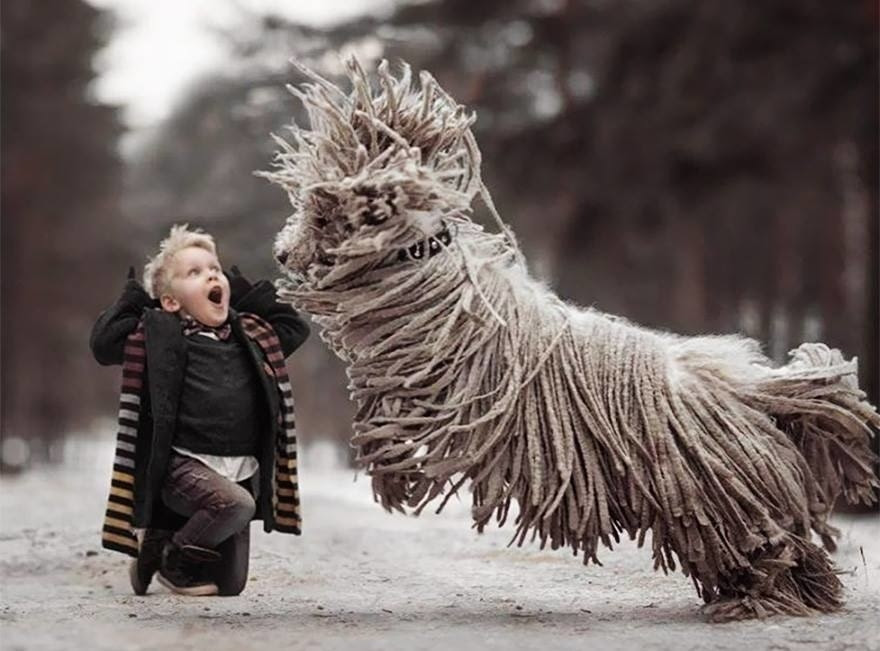 oooo
oooo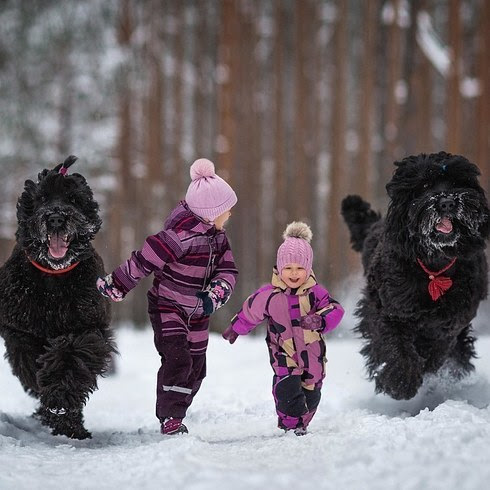 oooo
oooo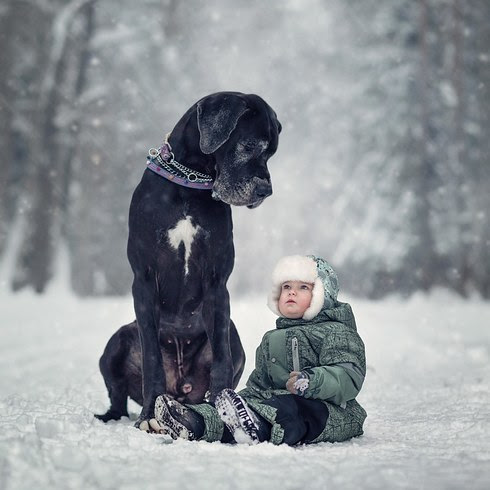 oooo
oooo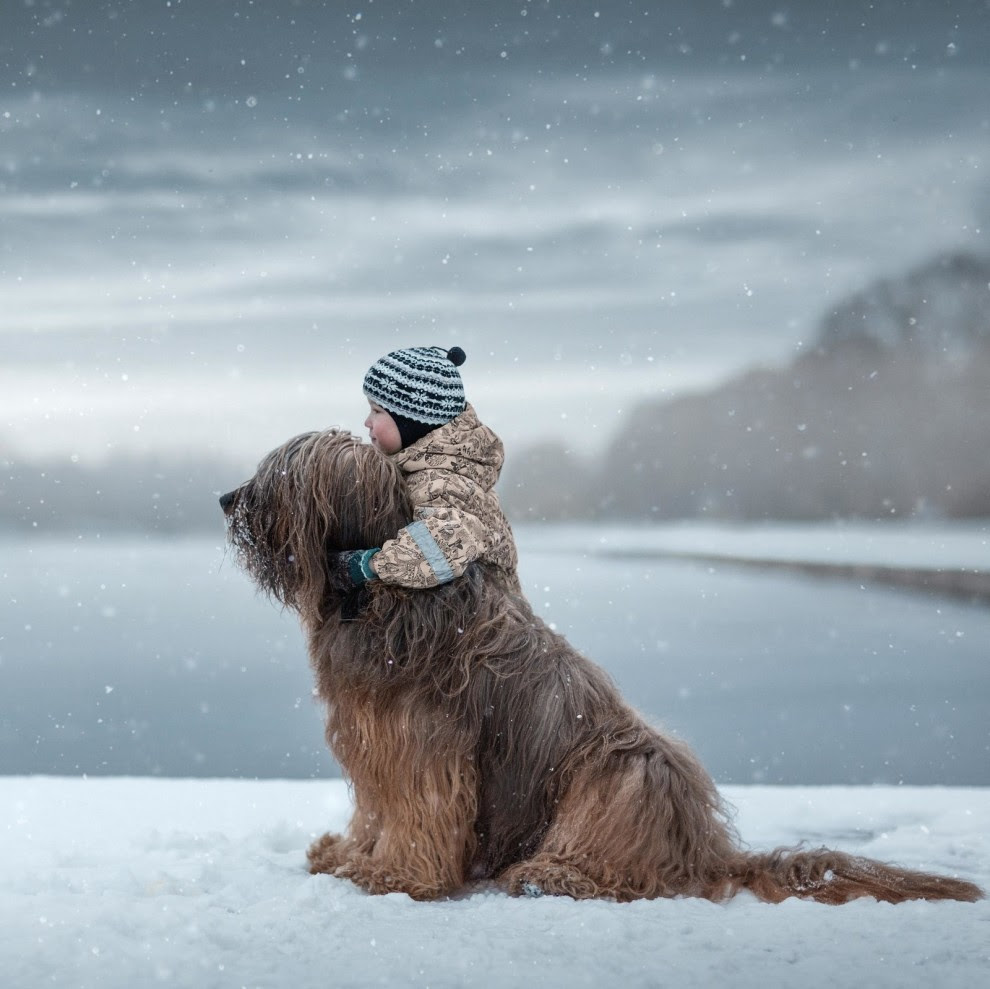 oooo
oooo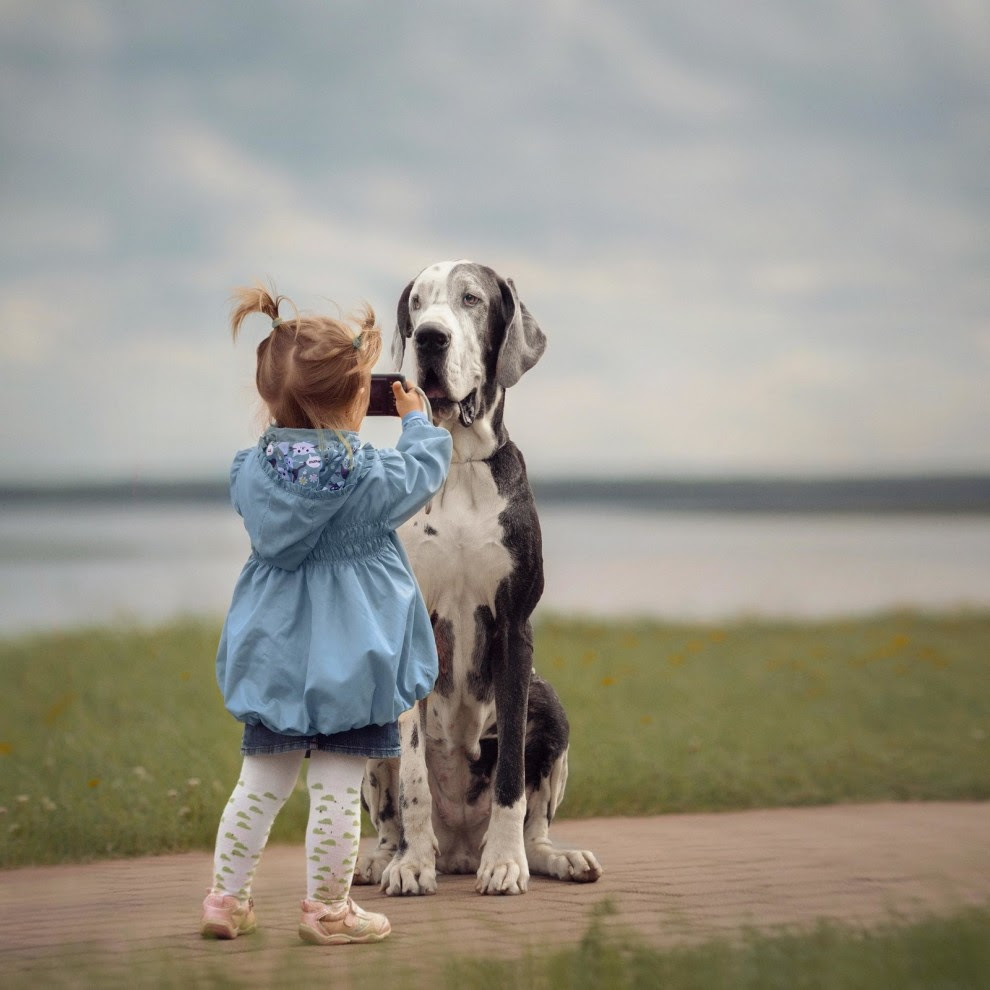 oooo
oooo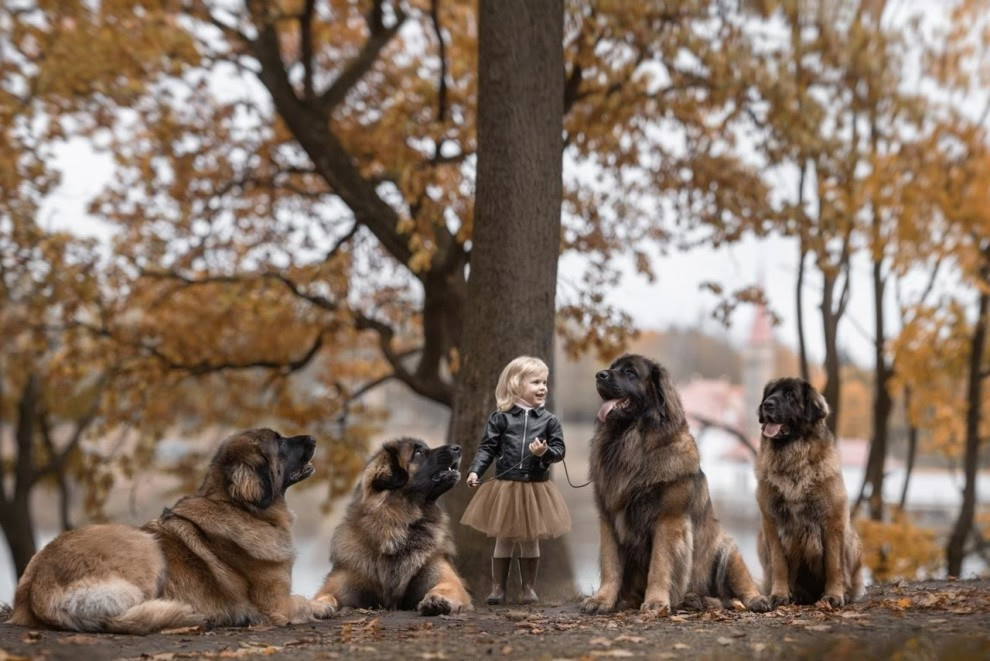 oooo
oooo