Category: People and their pets

The tale of a rescue dog.

We rarely get to know what a rescue dog has been through.

Of the ten dogs that we have here at home, two are pedigree dogs purchased from breeders, that’s Pharaoh and Cleo, two are rescue dogs that came from known sources, Oliver from neighbours who couldn’t cope with him and Pedy from the local Merlin dog pound, and the rest are all ex-rescue dogs that Jean took from the streets of San Carlos, Mexico.

The last rescue dog to be taken in by Jean before we both left Mexico was Hazel who was abandoned outside Jean’s house in San Carlos a few weeks before we left for Arizona. The picture below is of Hazel taken in March 2014.
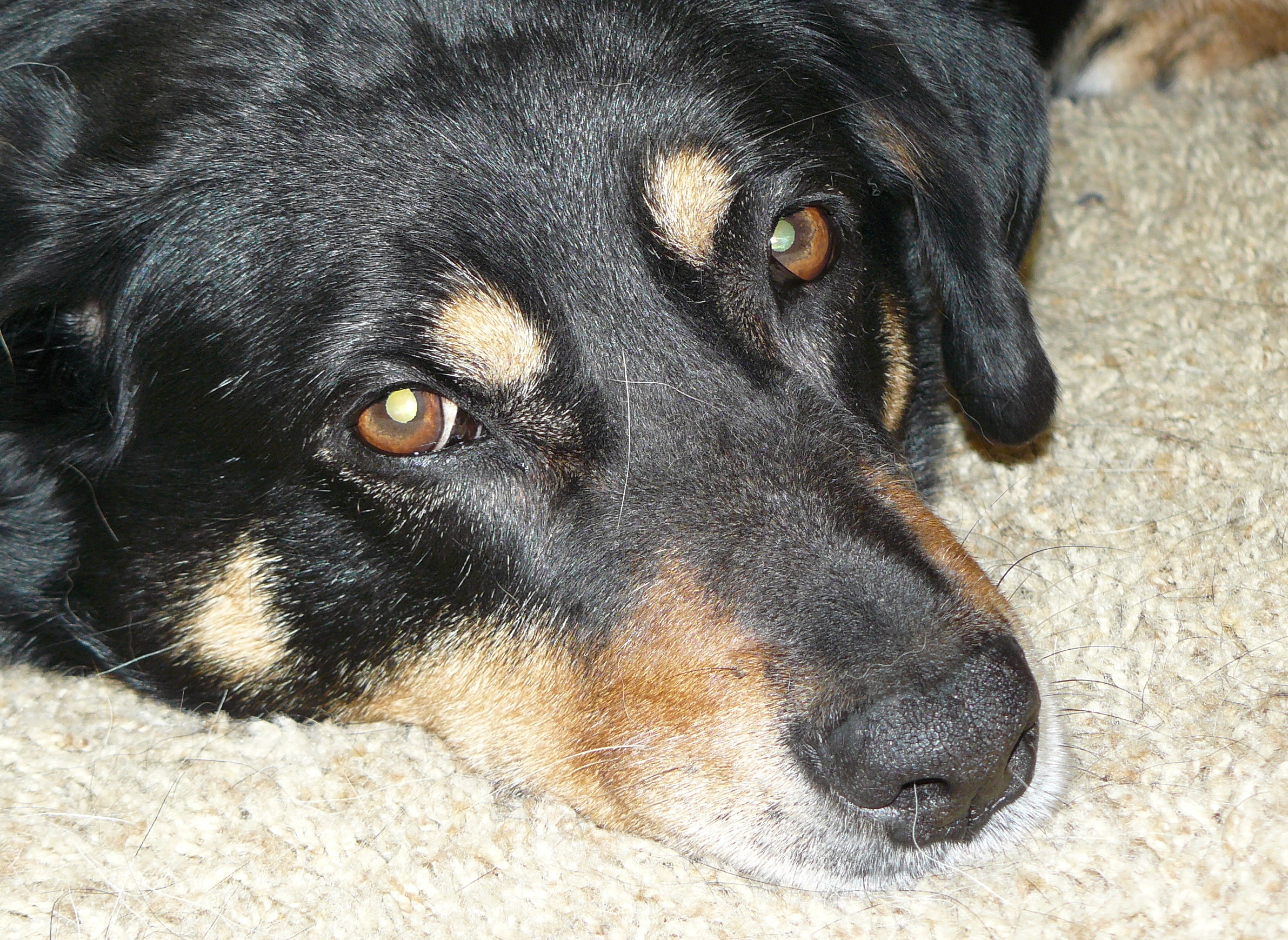
Hazel is the most loving and adorable of dogs and the love that I feel coming from her towards me is real, tangible and precious. Yet this is a mother dog who very shortly before she was deposited in front of Jean’s house in Mexico had had all her puppies removed from her as Hazel was still in milk. (The poor in San Carlos frequently sell young puppies for a few Pesos.) It’s beyond the comprehension of us humans, especially women, to imagine what it must be like for a mother to so catastrophically lose her young babies.

That’s why a recent article over on Mother Nature Network really reached out to me. We never know what homeless dogs have to contend with before they find loving homes.

ooOOoo

Why our Great Dane is so scared to be alone

Most of us will never know what our rescue dogs have been through. We found out.

By: Ali Berman, August 12, 2015
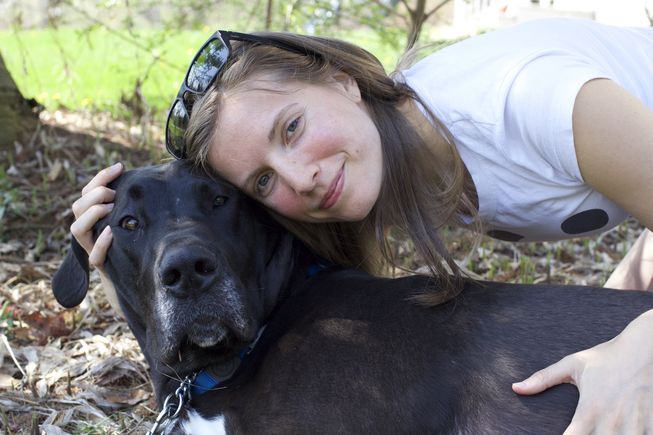
Author Ali Berman discovered she had a new shadow when she met Cooper. (Photo: Ali Berman)

In February 2015, David and Glenda Berman — that’s my mom and dad — drove from New York to Connecticut to meet Cooper, a 13-month-old Great Dane. When they were introduced, 100-pound Cooper rushed over to give them an enthusiastic greeting, burying his head in their legs, leaning on them, and asking to be petted. My mom and dad fell in love, and Cooper took the two-hour drive back to their house, the place that would become his forever home.

During those first few weeks, my parents got to know Cooper. They went for walks in the snow, played together, and snuggled. (He’s a major snuggler.) But, in addition to those normal doggy behaviors, they noticed something else. Cooper was reluctant to leave their sides. If they left the room, he went with them. He took trip after trip to the kitchen, to the bathroom, to the laundry room. When they moved, he moved.

I didn’t believe the extent of it until I got the chance to meet him myself. I traveled back to New York to visit my family in May. For me and Coop, it was love at first sight. We played, we ran, we cuddled, and by the end of the first day, I found myself with a 115-pound shadow. As soon as I showed any sign of movement, his head perked up and he was ready to follow me. In the morning when he opened his eyes, he went directly to my room to wake me up. When I napped in the afternoon, he came with me, opting to sleep right next to the bed. And when I went out to dine with a friend, my parents distracted him so he wouldn’t see that I was leaving.

Now, when a small dog follows you everywhere, it’s not a big deal. But when a Great Dane follows you around, it’s not stealthy. Seeing how much he craved to be near people, I welcomed him wherever I went — even the bathroom. Still, I wondered: Why was he so reluctant to be alone? Did he not believe we’d come back?

If there's a hug going on, Cooper wants to be a part of it. (Photo: Ali Berman)
If there’s a hug going on, Cooper wants to be a part of it. (Photo: Ali Berman)

Thinking we knew the full story behind his upbringing, we all wrote it off as him being a little insecure. In just over a year he had experienced four different homes. After he left the breeder (his first home), Cooper went to live with a young woman who loved him very much. Unfortunately, they learned that while Cooper enjoys meeting other dogs on his walks, he has trouble living with other dogs. He got into fights with another pooch in the house and with great difficulty, the young woman sent Cooper to live with her uncle. As he also had animals at home, the problem repeated itself.

Cooper needed to live with a one-dog family. The uncle — who could easily have sold purebred Cooper for a handsome sum — instead decided to put him up for adoption to find the best family possible. My parents had been looking for a Great Dane to adopt, so they sent their references, along with pictures with their previous Great Dane who had died two years before, and a heartfelt message. They were chosen to be Cooper’s new and final family.

Because Cooper was loved and well treated in all of his homes, my parents thought the insecurity came from the many moves.

But that wasn’t the full story. Not even close.

In an email from the woman who originally took Cooper in, my mother learned the truth. Cooper had been born with the rest of his litter in the home of an Iowa breeder. One night, when the breeders were out bowling, their home caught on fire. Everything went up in flames. Cooper’s mother and siblings all tragically perished. Baby Cooper was found alone in the debris in the yard. In just one night, he had lost his entire family, suffering more trauma in an instant than most experience in a lifetime.

After the fire, the breeders had to rebuild their lives, so they put Cooper up for adoption. That’s when he started to move from house to house, finally finding his perfect match with my parents. Now, he starts out every day with a multi-mile walk, a nap in the office while my dad works, and then Cooper spends an hour or two playing with his friends in the dog park in the afternoon. If he’s not snoozing or walking, he’s out in the garden with my mom soaking up the sun.
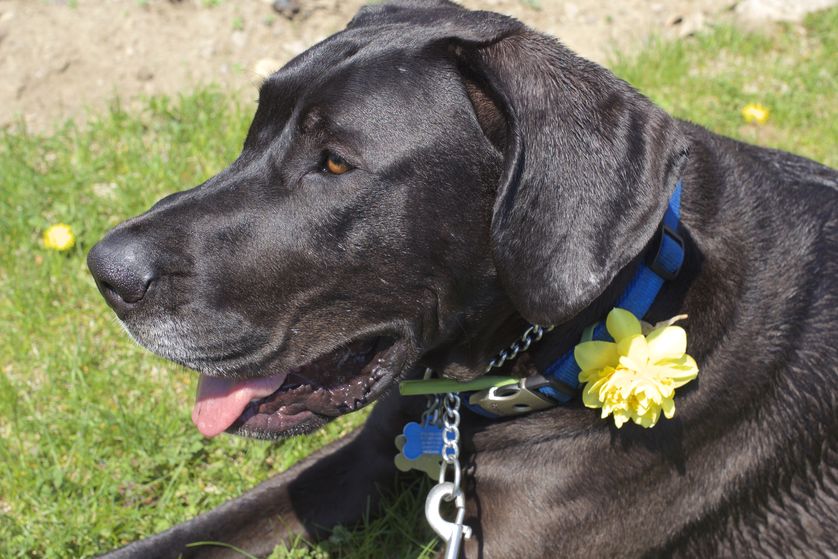
Some serious trauma as a puppy made Cooper never want to be alone. (Photo: Ali Berman)

Just part of the story

When we rescue an animal, most of the time we never get to know their complete history. Why do some cry when their humans leave the house? Or some bark and growl at men who wear hats? Like people, animals remember the various difficulties and tragedies they have suffered. Those scars go through life with them, just like our own scars follow us. The only difference is they can’t tell us their fears, and we can’t explain to them that they are safe. The best we can do is show them they are loved and hope with enough repetition, they’ll get the message.

In an ideal world, every dog would only have good memories. Their first Frisbee catch or trip to the beach, their favorite person who knows how to pet the ears just right, and the safety of a single home where they will live their life right through to ripe old age. That’s not the case for every dog. Some need a little extra help from us as they learn to trust, move on from the past and accept that their new reality is the one they can count on.

With time, Cooper might just learn to keep snoozing while his mom or dad goes to get a cup of tea. Until then, we’ll all keep showing him that he’s loved, and that this home and this family are forever.

ooOOoo

When one thinks of how dogs, Cooper, Hazel and tens of thousands of others, so beautifully offer their unlimited love to us humans it is just a great shame that we humans haven’t emulated our beloved dogs across mankind in such a widespread manner.
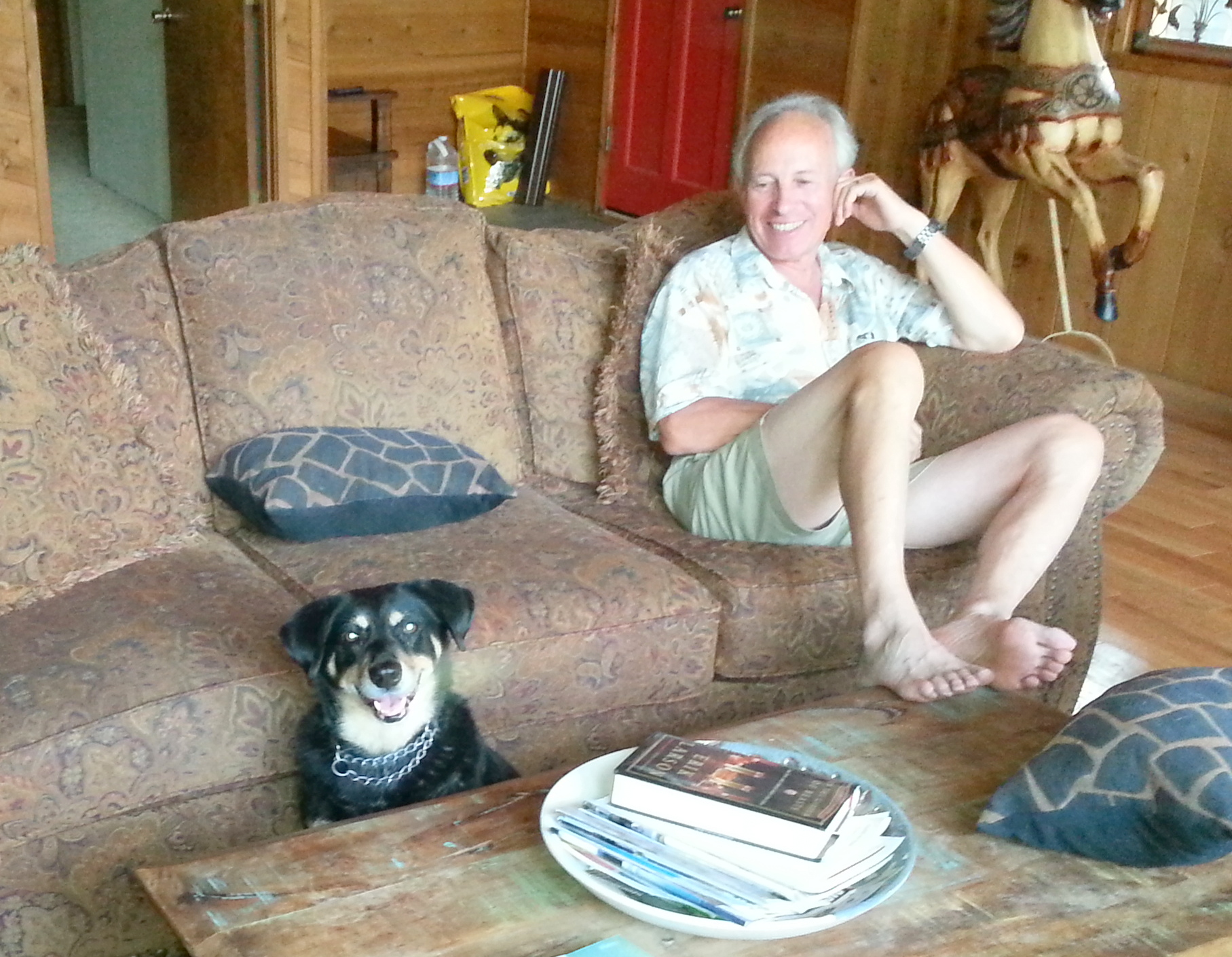
Picture taken by our guest Don Reeve of Hazel (and me) Wednesday afternoon.

Gorgeous Hazel. Who would have thought from that smiling face of hers that she had ever suffered the catastrophic loss of her puppies that she had.


When dark shadows fall across our hearts.

One of the most important lessons we can learn from our dogs: coping with death.

In writing about the lesson of death that we can learn from our dogs I am, of course, speaking of our own death, of the inevitability of our death. That largely unspoken truth that Sharon Salzberg described in her book Faith: “What does it mean to be born in a human body, vulnerable and helpless, then to grow old, get sick and die, whether we like it or not?” [page 34.]

Anyone who has loved a dog has most likely been intimately involved in the end of that dog’s life. It is, to my mind, the ultimate lesson that dogs offer us: how to be at peace when we die and how to leave that peace blowing like a gentle breeze through the hearts of all the people who loved us.

Our beloved dogs have much shorter life spans than us, thus almost everyone who has loved a dog will have had to say goodbye to that gorgeous friend at some point in their lives. Very sadly, perhaps, saying goodbye to more than one loved dog.

All of which is my introduction to a recent essay published on The Conversation blogsite. The essay is written by Bernard Rollin, Professor of Philosophy, Animal Sciences and Biomedical Sciences at Colorado State University. The essay is called: When is it ethical to euthanise your pet?

ooOOoo

When is it ethical to euthanize your pet?

August 12, 2015 6.18am EDT

In the 1960s, I knew people who, before going on vacation, would take their dogs to a shelter to be euthanized. They reasoned that it was cheaper to have a dog euthanized – and buy a new one upon returning – than pay a kennel fee.

Two decades later, I was working at Colorado State’s veterinary hospital when a group of distraught bikers on Harley-Davidsons pulled up carrying a sick chihuahua. The dog was intractably ill, and required euthanasia to prevent further suffering. Afterwards, the hospital’s counselors felt compelled to find the bikers a motel room: their level of grief was so profound that the staff didn’t think it was safe for them to be riding their motorcycles.

These two stories illustrate the drastic change in how animals have been perceived. For thousands of years, humans have kept animals as pets. But only during the past 40 years have they come to be viewed as family.

While it’s certainly a positive development that animals are being treated humanely, one of the downsides to better treatment mirrors some of the problems the (human) health care system faces with end-of-life care.

As with humans, in many cases the lives of pets are needlessly prolonged, which can cause undue suffering for the animals and an increased financial burden for families.

The growth of veterinary medicine and ethics

In 1979, I began teaching veterinary medical ethics at Colorado State University’s veterinary school, the first such course ever taught anywhere in the world.

A year later, the veterinary school hired an oncologist to head up a new program on animal oncology. Soon, our clinic was applying human therapeutic modalities to animal cancer. The visionary head of the veterinary program also hired a number of counselors to help pet owners manage their grief – another first in veterinary circles.

I’d been under the impression that people would be reluctant to spend much money on animal treatments, so I was genuinely shocked when the following April, the Wall Street Journal reported individuals spending upwards of six figures on cancer treatments for their pets.

As a strong advocate for strengthening concern for animal welfare in society, I was delighted with this unprecedented turn of events. I soon learned that concern for treating the diseases of pets besides cancer had also spiked precipitously, evidenced by a significant increase in veterinary specialty practices.

One of the family

So what’s behind the shift in how pets are perceived and treated?

For one, surveys conducted over the last two decades indicate an increasing number of pet owners who profess to view their animals as “members of the family.” In some surveys, the number is as high as 95% of respondents, but in nearly all surveys the number is higher than 80%.

In addition, the breakdown of nuclear families and the uptick of divorce rates have contributed to singles forming tighter bonds with companion animals.

Such attitudes and trends are likely to engender profound changes in societal views of euthanasia. Whereas before, many owners didn’t think twice about putting down a pet, now many are hesitant to euthanize, often going to great lengths to keep sick animals alive.

Vets caught in the middle

However, veterinarians continue to experience extensive stress as they experience two opposite – but equally trying – dilemmas: ending an animal’s life too soon, or waiting too long.

In a paper that I published entitled Euthanasia and Moral Stress, I described the significant stress experienced by veterinarians, veterinary technicians and humane society workers. Many chose their profession out of a desire to improve the lot of animals; instead, they invariably ended up euthanizing large numbers of them, often for unethical reasons.

These ranged from “I got the dog to jog with me, and now it’s too old to run,” to “If I die, I want you to euthanize the animal because I know it can’t bear to live without me.”

In other cases, the animal is experiencing considerable suffering, but the owner is unwilling to let the animal go. With owners increasingly viewing pets as family members, this has become increasingly common, and many owners fear the guilt associated with killing an animal too soon.

Ironically this, too, can cause veterinarians undue trauma: they know the animal is suffering, but there’s nothing they can do about it unless the owner gives them permission.

The consequences are manifest. One recent study showed that one in six veterinarians has considered suicide. Another found an elevated risk of suicide in the field of veterinary medicine. Being asked to kill healthy animals for owner convenience doubtless is a major contribution.

How to manage the decision to euthanize

Here is my suggestion to anyone who is thinking about getting a pet: when you first acquire it, create a list of everything you can find that makes the animal happy (eating a treat, chasing a ball, etc). Put the list away until the animal is undergoing treatment for a terminal disease, such as cancer. At that point, return to the list: is the animal able to chase a ball? Does the animal get excited about receiving a treat?

If the animal has lost the ability to have positive experiences, it’s often easier to let go.

This strategy can be augmented by pointing out the differences between human and animal consciousness. As philosopher Martin Heidegger has pointed out, for humans much of life’s meaning is derived from balancing past experiences with future aspirations, such as wishing to see one’s children graduate or hoping to see Ireland again.

Animals, on the other hand, lack the linguistic tools to allow them to anticipate the future or create an internal narrative of the past. Instead, they live overwhelmingly in the present. So if a pet owner is reluctant to euthanize, I’ll often point out that the animal no longer experiences pleasant “nows.”

In the end, managing euthanasia represents a major complication of the augmented status of pets in society. Ideally, companion animal owners should maintain a good relationship with their general veterinary practitioner, who has often known the animal all of its life, and can serve as a partner in dialogue during the trying times when euthanasia emerges as a possible alternative to suffering.

ooOOoo

So much to learn from these beautiful creatures and so many ways to return the unlimited love we receive from them.

More on those happy dogs.

Indebted, again, to Chris Gomez.

Jean and I were out for much of yesterday resulting in me not sitting down to compose today’s post until nearly 5pm (PDT) in the afternoon. I must admit I didn’t have a clue as to what to write about. Then sitting in my email inbox was another email from Chris Gomez with this short but valuable sentence, “Love is real….Check this out! (via ABC7 Los Angeles local news iOS app) Study reveals scientific reason your dog is happy to see you.” Chris included a link to the ABC7 news item. I’m republishing it here.

ooOOoo

STUDY REVEALS SCIENTIFIC REASON YOUR DOG IS HAPPY TO SEE YOU

A new study explains why your dog gets so happy to see you. (Shutterstock)

Tuesday, August 11, 2015 11:04AM

Is your dog overwhelmed with joy anytime you walk through the door? There’s a scientific reason behind their excitement, a new study shows, and it’s not just because you feed them.

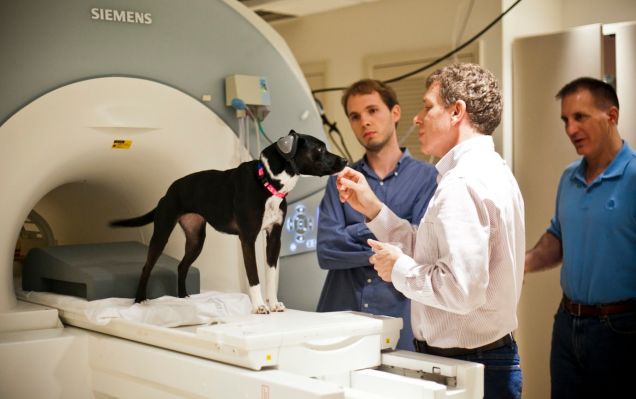
Researchers at Emory University used functional magnetic resonance imaging (fMRI) to scan dogs’ brains for activity when they were shown images of dog faces, human faces and ordinary objects.

The dogs’ temporal lobes lit up “significantly more” when presented with the faces than with the objects. These findings suggest that dogs may recognize both human and dog faces.

Facial recognition causes dog brains to activate in the same areas as in monkey and human brains, the study found. This is separate from the “reward areas” that would be triggered by anticipation of food.

“What we’re finding with the imaging work is that dogs love their humans-and not just for food,” researcher Gregory Berns told io9. “They love the company of humans simply for its own sake.”

“The existence of a face-selective region in the temporal dog cortex opens up a whole range of new questions to be answered about their social intelligence,” the researchers explained, such as whether dogs can understand different facial expressions and whether they can read body language.

This isn’t the first time scientists have explored what makes dogs’ tails wag with excitement when reunited with their owners. A January study that Berns was also involved in found that dogs have a positive reaction to the scent of familiar humans compared with other smells, even those of other dogs.

The results of that study “suggested that not only did the dogs discriminate that scent [of familiar humans] from the others, they had a positive association with it.”

A 2013 behavioral study found that dogs can show when they’re happy to see their owners by lifting their eyebrows. Their left eyebrow went up when they saw their respective owners, the study found. They didn’t have this reaction for other things that may excite them, such as attractive toys.

ooOOoo

Granted there was some overlap with Monday’s post but there was more than enough in the ABC7 article to warrant sharing it with you.

Thanks again, Chris.


The happiness of dogs

Why are dogs so very happy to see us?

When I first started writing this blog, more than six years ago now, I had no idea whatsoever that the community of friends who read and follow Learning from Dogs would develop to the point where the volume of ideas and suggestions sent in are, are by far, the biggest source of creative posts.

Take today’s for example. The link to the article was sent to me by Chris Gomez a little over a week ago and yesterday was the first time that I read the article in full.

It’s a fascinating and incredibly interesting piece.

So with no further ado, besides thanking Chris so much for sending it on, here is: Why Are Dogs So Insanely Happy to See Us When We Get Home?

ooOOoo

Why Are Dogs So Insanely Happy to See Us When We Get Home?

By George Dvorsky

Unlike a certain companion animal that will go unnamed, dogs lose their minds when reunited with their owners. But it’s not immediately obvious why our canine companions should grant us such an over-the-top greeting—especially considering the power imbalance that exists between the two species. We spoke to the experts to find out why.

Call of the Wild

In order to gain an appreciation for dog behavior, it’s important to understand that dogs are descended from wolves (or at least a common wolf-like ancestor). Clearly, the two species, separated by about 10,000 to 15,000 years, share a lot in common.

Like dogs, wolves greet each other with vigorous face licking (Credit: Sander van der Wel CC A-SA 2.0)

But there’s only so much we can extrapolate from wolves; dogs are categorically different by virtue of the fact that their ancestors actively sought out the company of humans. Making matters even more complicated is the realization that Paleolithic era wolves are not the same as the ones around today. Consequently, any inferences we make about dog behavior and how it relates to wolves is pure speculation.

Neuroscientist Gregory Berns, author of How Dogs Love Us, says there’s a fundamental difference between modern wolves and those that lived long ago.

“The most social of those ancestral dogs who were hanging around humans had to have been the most social of those wolves,” he told io9. “They joined humans and eventually evolved to become dogs. The remainder of the wolf population were among the most antisocial of those animals, and did not want to have anything to do with humans.”

That said, however, Berns says we can clearly see behaviors in wolves that are similar to those expressed by dogs. For instance, wolves greet each other by licking each others’ faces. For these pack animals, this licking behavior serves as an important social greeting, but also as a way to check out and determine what the other wolves have brought home in terms of food.

Wolves, says University of Trento neuroscientist Giorgio Vallortigara, greet each other in different ways depending on the type of individual relationships they’ve forged. Feral dogs, he says, behave in similar ways. But the big change in terms of adaptive sociality has been the ability of domesticated dogs to interact with humans using our own communicative signals, such as gazes and gestures.

Dog expert Jessica Hekman, who blogs at DogZombie, has witnessed greeting behaviors among wolves first hand.

“When I’m at Wolf Park in Battle Ground, Indiana, I am always struck by how much some of the specific wolf behaviors resemble behaviors I see in dogs—but so much more ritualized, and sort of writ large,” she told io9. “I witnessed one behavioral study there in which wolves who knew each other well had been separated for a few days and were put back together. The greeting rituals were fascinating, with lots of crouching and chin-licking from the subordinate wolves. You do see these behaviors in dogs, but more sporadically, without such intensity.”

At the same time, dogs exhibit behaviors that are markedly different from wolves. As Hekman explained to me, one of the most dramatic differences between dogs and wolves is the ability of dogs to accept novelty. Simply put, dogs are less fearful than wolves.

“It may sound a little odd to say that a wolf, who can easily kill you, is afraid of you, but that is precisely why they can be dangerous: because they may choose to take proactive measures to protect themselves, using their teeth,” says Hekman. “Dogs are a lot less likely to do this.”

Indeed, given their wolf ancestry, it’s remarkable that dogs get along with humans so well. But as Berns pointed out to me, sociability has turned out to be a rather powerful adaptation, one that has worked a lot better for dogs than it has wolves.

“I mean, look around the world and see how many dogs there are,” he says. “With dogs, it’s proven to be a highly effective evolutionary strategy. There are in the order of tens of millions of dogs in the world, so in many ways, dogs have out-evolved wolves.”

Berns says that whatever the sociality that dogs have evolved, one of the defining traits of a dog is the degree to which they will interact with humans as well as other animals.

How Dogs See Humans

A key aspect of Berns’ brain imaging research is to study how dogs perceive us. We humans know that dogs are a separate species, but are dogs cognizant of this as well? Or do they see us as members of their pack, or as some kind of weird dog?

Callie gets outfitted with ear protection prior to entering the noisy fMRI machine. The research team includes, from left, Andrew Brooks, Gregory Berns and Mark Spivak. (Credit: Bryan Meltz, Emory University)

According to Berns’ research, dogs that are presented with certain smells in scanners can clearly tell the difference between dogs and humans, and also discern and recognize familiar and strange odors. In particular, the scent of a familiar human evokes a reward response in the brain.

“No other scent did that, not even that of a familiar dog,” Berns told io9. “It’s not the case that they see us as ‘part of their pack as dogs,’ they know that we’re something different— there’s a special place in the brain just for us.”

Berns stresses that dogs are social with us not just because of their scavenging tendencies.

“What we’re finding with the imaging work is that dogs love their humans—and not just for food,” he says. “They love the company of humans simply for its own sake.”

Hekman says it’s hard to know what dogs are thinking, but she suspects they understand that we’re not quite like them. As evidence, she points to aggressiveness in dogs as it’s directed to other dogs and humans—differences that aren’t correlated. She says it’s quite common for a dog to have a problem with one and not the other. In other words, dogs appear to perceive other dogs as one group, and humans as a separate group. What’s more, dogs will seek the help of humans and not other dogs—a possible sign that dogs understand that humans have resources that dogs do not, and are thus a different kind of social entity.

But do dogs see us as part of the pack?

“It’s important to note that a pack of wolves is a family—literally, usually mom, dad, puppies, and some young offspring from previous years who haven’t gone off on their own yet,” says Hekman. “Do dogs see us as part of their family? I think they do.”

So Happy to See Us

Virtually all experts agree that the happiness dogs feel is comparable to what humans experience, and that it’s similar to how humans feel towards each other.

One happy dog (Credit: Lars Curfs/CC-A-SA 3.0)

“All the things that we’ve done with the brain imaging—where we present certain things to the dogs and map their reward responses—we see analogous brain responses in humans,” says Berns. “Seeing a person that’s a friend or someone you like, these feelings are exactly analogous to what a dog experiences.”

Berns says that dogs don’t have the same language capacities as humans, and that they’re not capable of representing things in their memory like we can. Because dogs don’t have labels or names for people, he suspects that they have an even purer emotional response; their minds aren’t filled with all sorts of abstract concepts.

It’s also important to consider the dog-human bond and the degree of attachment each feels toward each other. When used with dogs, the “Strange Situation Test” devised by developmental psychologist Mary Ainsworth, suggests that during absence and then at the rejoining with the owners, a dog’s behavior is very similar to that observed in children and mothers in similar situations. As Vallortigara pointed out to me, it’s appropriate and correct to speak of the dyad dog/owner in terms of “attachment.”

A dog’s particular greeting, however, is dependent on several factors, such as the dog’s temperament, the personality of the owner, the nature of their relationship, the level of stress and anxiety, and the dog’s tendency/capacity for self-control.

It’s important to note, however, that stress manifests differently in dogs than it does in humans.

“The separation from the owner for the dog is not voluntary,” says Vallortigara. “It is always unnatural for a dog to detach and abandon the pack.”

Dogs will sometimes go solo on a temporary basis if they’re sufficiently motivated to do so, but they do it knowing that social contact can be resumed at virtually any time.

“The exaggerated level of greeting that can be observed in some dogs is likely due to the fact that they have not yet learned to accept the possibility of non-voluntary detachment,” says Vallortigara.

When trying to appreciate a dog’s over-the-top greeting, Hekman says we need to imagine what it was like for a dog to be alone all day while we were gone.

So bored. (Credit: Pixabay/Pinger/10 images/CC0 Public Domain)

“This dog probably had a pretty boring day without much enrichment, and moreover may have been alone all day, which is unpleasant for a social animal,” she told io9. “So in addition to being glad to see us, they are probably feeling some relief that they will get to do something interesting, like go for a walk, and have someone else around. Some people are able to have a dog walker come in or send their dogs to daycare—this is a great solution to what can otherwise be a difficult lifestyle for a dog.”

And as Berns points out, the greeting ritual is a social bonding mechanism—but it’s also a function of curiosity.

“When they jump up, they’re trying to lick you in the face,” says Berns. “Part of that is a social greeting, but they’re also trying to taste and smell you to figure out where you’ve been and what you’ve done during the day. So some of it is curiosity. If I’ve been with other dogs, for instance, my dogs know it, and they resort to sniffing intensely.”

How to Greet Your Dog Back

It’s obviously important to respond to your dog when you get home, but according to Marcello Siniscalchi, a veterinary physician from the University of Bari, how you should react will depend on the context of the situation and the needs of the dog itself.

“The greeting ritual will vary from dog to dog because any individual dog perceives and reacts to detachment from the owner in a very personal way,” he told io9. “Some dogs need to be greeted, in others it is better to avoid any escalation in the level of excitation, others need to learn strategies for coping with the stress associated with detachment.”

Hekman says there’s definitely a tension between our buttoned-down greeting rituals (“Hi, honey, I’m home!”) and theirs (“I want to lick you on the face repeatedly!”).

happydogs5

“My dog Jenny is a very enthusiastic greeter, and I hate having her jump all over me in her efforts to get at my face,” she says. “So I have taught her to get on a couch when I come home. I generally have to remind her to ‘get on your couch,’ but now she does with great enthusiasm, and waits for me to come over. The couch puts her more on my level, so she doesn’t have to jump, and I can bend forward and let her lick my cheek, which is a very important part of the ritual for her.”

Hekman stresses that, for any dog, it’s important for us not to tell them what not to do (e.g. “don’t jump on me!”), but to tell them what to do.

“Many is the retriever owner who has taught their dog to get a toy when they come home to channel their excitement,” she added.

The main point, she says, is that it’s important for dogs to have the greeting ritual, but it can be redirected in ways to make it easier on the owners such that everyone enjoys it.

ooOOoo

So a huge thank you to all of you that send in remarkable items for Learning from Dogs.

Picture parade one hundred and eight

The last of the perfect puppy pictures.

Theo16


oooo

Theo17

oooo

Theo18

oooo

Theo19

oooo

For those of you that missed the first two sets of these puppy pictures, set number one is here and last week’s set is here.

You all take care out there.

Puppy and cat!

Pixel, 10-week-old french bulldog, tries to reclaim bed from cat.

Big thanks to Chris Snuggs for sending me the links to these two videos.

10-week-old french bulldog Pixel finally got his revenge on the cat, who keeps stealing his bed, even though she has her own. Fun fact: he drags the bed and puts it back in his corner, where he always sleeps.

Picture parade one hundred and seven

Continuing the theme of the Perfect Puppy.

(The background to these pictures was last Sunday.)

Theo9

oooo

Theo10

oooo

Theo11

oooo

Theo12

oooo

Theo13

oooo

Theo14

oooo

Theo15

oooo

Aren’t they just gorgeous!

The final set in a week’s time. You all take care out there.

The Science of Dogs

Not my title but the name of a delightful short film.

The film, from AsapSCIENCE, came to my attention on the EarthSky blogsite and is a delightful video that just asks to be shared.

You all have a great weekend.

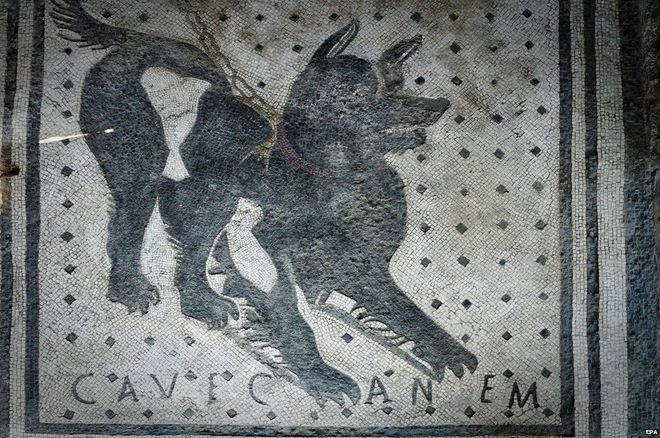
Beware of the Dog – circa AD79

That very ancient relationship between man and dog.

The website Eye Witness to History has a lovely item on Mount Vesuvius:

On August 24, 79 Mount Vesuvius literally blew its top, spewing tons of molten ash, pumice and sulfuric gas miles into the atmosphere. A “firestorm” of poisonous vapors and molten debris engulfed the surrounding area suffocating the inhabitants of the neighboring Roman resort cities of Pompeii, Herculaneum and Stabiae. Tons of falling debris filled the streets until nothing remained to be seen of the once thriving communities. The cities remained buried and undiscovered for almost 1,700 years until excavation began in 1748. These excavations continue today and provide insight into life during the Roman Empire.

An ancient voice reaches out from the past to tell us of the disaster. This voice belongs to Pliny the Younger whose letters describe his experience during the eruption while he was staying in the home of his Uncle, Pliny the Elder. The elder Pliny was an official in the Roman Court, in charge of the fleet in the area of the Bay of Naples and a naturalist. Pliny the Younger’s letters were discovered in the 16th century.

If you are keen to read the full article then it may be found here.

My reason for quoting those opening paragraphs is because they offer a good historical introduction to another item from the BBC News website. That item is about a dog mosaic that is back on show after its restoration at Pompeii.

ooOOoo

Pompeii guard dog mosaic back on show

One of Pompeii's finest mosaics - a guard dog at the entrance to a villa.
One of Pompeii’s finest mosaics – a guard dog at the entrance to a villa.

A vivid Roman dog mosaic is back on show after restoration at Pompeii, despite Italy’s problems funding the historical site’s conservation.

A glass shield now protects the House of the Tragic Poet, where tourists can see the dog with the inscription “Cave Canem” – Latin for “Beware of the dog“.

Frescoes at the house’s entrance were also restored. Ash from a volcanic eruption buried Pompeii in AD79.

A staffing dispute caused long queues at Pompeii on Friday, in searing heat. Pompeii gives visitors an extraordinary insight into everyday life in ancient Rome because many buildings were protected from the elements under the thick blanket of ash from Mount Vesuvius.

_84512369_pompeiidogviewepa
The restored mosaic now has better protection.

The site, near the southern city of Naples, has suffered from funding problems for years. Staff unions at Pompeii have criticised a management reorganisation there.

The House of the Tragic Poet has some of Pompeii’s finest examples of interior decoration, including scenes from Greek mythology.

But the house’s owners remain unknown – they may have died in the eruption along with many other Pompeii citizens.

ooOOoo

Now we all know that the relationship between dogs and man goes way, way back before Pompeii but, nonetheless, it’s rather nice to see dogs commemorated in this way from 1,936 years ago.

Introducing the Shih Tzu

A guest post from Dr. Coleman.

From time to time I receive unsolicited emails asking if I would be interested in publishing posts from this or that particular person. They always strike me as suspicious and receive, in turn, a polite ‘no thank you’.

However, a few weeks ago, the following came in:

My name is Intan and I am a community team member at ShihTzu Web, a website dedicated to providing breed-specific information just for shih tzu owners. We share articles regularly about shih tzu grooming, training, and health.

We would love to help provide some free high-quality content for the shih tzu owners in your audience with a guest blog post. We have two specialist writers for our blog: veterinarian Jill Coleman, who writes about shih tzu health topics, and Sally Gutteridge, who writes about shih tzu grooming and training.

That website ShihTzu Web clearly sets out a part commercial proposition but after thinking about the offer, I decided to accept the guest post.

So here is that guest post, authored by Dr. Jill Coleman*:

Jill Coleman
Jill Coleman

ooOOoo

What to Do If Your Dog Is Pregnant

First things first: were you planning on your dog getting pregnant? There are many convincing arguments that until the pet overpopulation problem is under control, there should be no planned canine pregnancies. This article is not going get into that debate (although the last sentence pretty much wraps up my opinion).

Let’s first assume you did NOT mean for your dog to get pregnant. Oops! You will hear about “morning after” shots and pills. None of these are recommended because they all seem to have side effects that are far worse than having a litter of puppies. We’re talking life threatening uterine infections and bone marrow suppression– nasty stuff, so this definitely does not keep your dog healthy. An option if you are planning on spaying your dog anyway, is to have her spayed. Waiting until she is out of heat is a good idea because the surgery is considered safer when they aren’t in heat because they lose less blood.

Now we’ll assume that you either did plan on your dog getting pregnant and/or you just need advice for a pregnant dog: what should you do? Not a lot, really. Dogs have been successfully reproducing with no human intervention for many years. A good quality diet is important. For the first half of their pregnancy a normal adult, high quality diet is fine. Switch to puppy food (sometimes referred to as “growth”) for the second half of the pregnancy and the entire time she is nursing the puppies. Do NOT supplement with any vitamins. Studies have shown that not only is this unnecessary, it is detrimental. Supplementing with calcium for example can make the bitch produce less of her own and thus interfere with her normal milk production.

Dogs are pregnant for approximately 63 days. At about day 55, it’s a good idea to start taking their temperature twice a day. Rectal thermometers are more accurate, but I have never met a dog that enjoys this process. There are many non-rectal thermometers available now that work perfectly for this because even if they read a little low, what you look for is a drop from their normal temperature. So go ahead and get one and establish what “normal” is for your dog well before she is due to whelp. Dog’s temperatures drop about 2 full degrees approximately 24 hours before they give birth. This is a fantastic way to tell when they are about to give birth. A dog’s normal resting rectal temperature is 101.5*F +/- about 1*.

Go ahead and prepare a whelping box that is comfortable and tucked away in a safe, preferably familiar area to the bitch. It is important for it to be quiet to allow her to relax. The less people running around and stressing out the better. You can actually cause your bitch to go out of labor by freaking her out.

As far as exercise, she doesn’t have to be a couch potato but avoid strenuous exercise especially late in her pregnancy. Walks are fine, but be sure she doesn’t overheat. Be careful approaching other dogs, even if she has been fine with them in the past. Most dog’s personalities don’t really change significantly but some will become more aggressive during their pregnancy. (Almost all will become protective of the puppies once they are born.)

Check your flea and tick medications to be sure they are safe. You will probably have to check with your veterinarian because most flea and tick medications are not labeled for use on pregnant or lactating females because they simply didn’t conduct studies on pregnant bitches. Your veterinarian should know which ones are safe if you are having flea and tick issues.

Last but not least and possibly most important is to go ahead and put emergency numbers where you can easily find them. You don’t want to be trying to find the emergency clinics number in the middle of the night if your furry child is having problems.

ooOOoo


*Dr. Jill Coleman, DVM, is a small animal veterinarian with 20 years of clinical experience. She graduated from Furman University with a BA in English in 1991. She graduated with honors from The University of Georgia College of Veterinary Medicine in 1995. She loves small dogs like Shih Tzu and loves writing about them. She shares her experience about Shih Tzu at ShihTzu Web.

I will leave you with this delightful photograph …

ShihTzu-3

… and the following few words from me.

Namely, that I have had no dealings with Shih Tzu Web or the organisation and people behind the website. Please don’t assume that the posting of this guest post offers any endorsement, or otherwise, of Shih Tzu Web. Any relevant feedback would be most welcome.