According to a notice posted at PetSmart retail stores, Hill’s Science Diet is in the process of conducting a voluntary market withdrawal of some of its canned dog food products for unspecified reasons.
To learn which products are affected, please visit the following link:
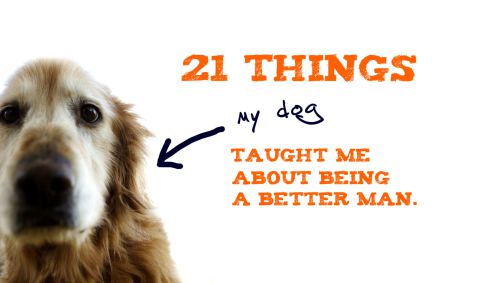
Twenty-one things my dog taught me about being a better man.
June 7, 2010 by Olivier Blanchard
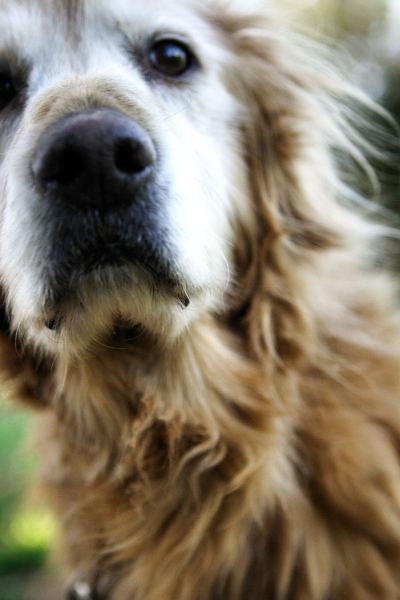
We had to put our golden retriever to sleep this weekend, our friend of fifteen years, our family’s faithful guardian and companion, and one of the kindest, most loyal and giving souls I have ever met. True to her breed, Sasha was courageous, tender and selfless until the end.
I was trying to figure out how to give her a worthy send-off here on The BrandBuilder blog, and settled on some of the things she taught me over the years. Or rather, the things I didn’t realize she had taught me until this past week, much of which I spent caring for her, as she could no longer take care of herself. She and I had some long chats, in our own way, and the old girl was much wiser than I gave her credit for.
Are there business lessons in this list? Yes. There are. But all are deeply human lessons at the core. If being human can make a business better, if it can fuel its soul (or even simply give it one), then yes, let these be business lessons. But don’t ever forget that what makes a business truly great isn’t technology or design or a fancy logo. Those are expressions of something deeper. Something more visceral and powerful and true. What makes a business great, what makes it special, worthy of a connection, worthy of trust and loyalty, admiration and respect, even love, always starts with a beating heart, not a beeping cash register. (One is the cause, and the other one of many effects. Don’t lose sight of that distinction. Horse before cart: Soul drives love. Love drives business.)
It’s so easy to lose sight of what’s important in our lives. And this isn’t me being overly sentimental because I just lost my dog. I mean, yes, sure, okay… But there’s also something to this: That sentimentality, that emotion, these things that make us connect with other souls is at the heart of EVERYTHING this blog has been about these last few years: Business, design, marketing, social media, communications, corporate responsibility, best practices… No company can ever be great unless it can tap into the very essence of what makes us want to connect with each other, and no executive or business manager or cashier can ever truly be great at their jobs unless they also tap into the very thing that makes genuine human connections possible. If ever there was a secret to successfully building a brand, a lovebrand, the kind that people will fight for and whose mark they will tattoo on their bodies, it is this. The rest is merely execution.
If you only walk away with one bit of wisdom from this post, let it be this: You cannot build a better business unless you first become a better human being. Everything that strips you of your humanity, of your empathy, of your ability to connect with others is bad for business. It’s bad practice. It is doomed to fail in the end.
As my good friend John Warner noted yesterday, “If more people were as loyal and loving as dogs the world would be a better place.” (source) And he’s right. How do you become a better human being then? Well, that’s up to you, but if you had asked Sasha, she might have given you a few pointers of her own. Granted, she was never a Fortune 500 C.M.O. She didn’t design the iPad. She didn’t invent the internet or write a book. She never presented at a conference. All she did was hang out with me and Chico. We went on car rides. She watched me work. She lived the simple life of a dog, uncluttered by Twitter followers and Hubspot rankings and the drive to publish and present case studies. She was a dog, and so her perspective is a little different from what you may be used to. At any rate, here are twenty-one she and I discussed at length last week. I hope they will be as valuable to you as they now are to me.
Twenty-one things my dog taught me about being a better man:
1. Be true to your own nature. There’s no point in faking it. A golden retriever isn’t a chihuahua or a pug or a greyhound, and for good reason. Being comfortable in your own skin is 90% of the trick to rocking out your life. Not everyone is meant to be Rintintin or a seeing-eye dog or an Iditarod racer. It’s okay. Find yourself and embrace your nature. That’s always a great place to start.
2. Be true to the ones you love. Your friends, your family, your tribe, your pack. A life lived for others is a life well-lived. Selfish pursuits aside, ambition often grows hollow when turned inwardly instead of outwardly. It’s one thing to want to be pack leader, but there is just as much value and honor in serving than in leading. When in doubt, see item number one.
3. Never say no to a chance to go on a car ride. When the days grow short, I guarantee you’ll wish you’d have gone on more car rides.
4. Leashes are the enemy. Avoid them at all cost.
5. People are strange. So much potential, yet here they are, doing everything they can to complicate rather than simplify their lives. It’s puzzling.
6. Belly scratches.
7. The end isn’t pretty, but if you can face it with dignity and grace, none of your body’s weaknesses will matter. Your heart, your courage, your spirit is what people will see and remember. This isn’t only applicable in your last days and weeks. It’s applicable every day of your life. Adversity happens. It’s how you deal with it that matters.
8. Forgiveness is easier for dogs than for humans, but humans have opposable thumbs and the ability to speak, so it all balances out in the end.
9. Your bark is your own. No one has one quite like yours. Own it. Love it. Project it.
10. Trust your instincts. They rarely steer you wrong. The feeling in your gut though, that’s probably just something you ate.
11. Just because you’re meant to live on land doesn’t mean you can’t feel at home in water. Play outside the safety zone. Swim in the deep end. Dive in. We’re all designed to do more than the obvious.
12. Play more. The game is irrelevant. Just play. Tip: Exploring is play. Having adventures is play. Finding out what’s behind the next hill is play.
13. Your body growing old doesn’t mean you can’t be a puppy at heart. Actually, the first should have no impact on the latter. If you find that it does, take a step back, regroup, and restart. Always be a puppy at heart.
14. Humans aren’t all bad. But they aren’t all good either. Choose yours wisely.
15. Always keep that 20% wolf in you. If you ever give it up, you’re done. A dog without a little wildness in the blood isn’t a dog. It’s a furry robot. The beauty of a great dog doesn’t lie in its obedience but in its loyalty. Loyalty is a choice. Dogs choose to be dogs and not wolves. That’s what makes them so special.
16. Running full bore across a field in the rain.
17. There are no mysteries. Take cats, for example: Half rat, half badger. Crap in a box. Eat rodents. Where’s the mystery in that? If you look hard enough, you can figure most things out for yourself. The world isn’t as complicated as it sometimes seems.
18. Sometimes, you have to back up your growl with a bite. Go with it. Some people like to test your bark-to-bite ratio. With those “inquisitive” types, a little education goes a long way. As much as it sucks to have to go there, it is sometimes necessary. (It’s what the fangs are for.) Your territory, your space, your safety… They’re worth defending. Make a show of it once, and chances are you’ll never have to teach anyone a lesson again.
19. Being alone is no way to go through life. We’re pack animals. Humans, dogs, same thing. We need others to make all of this worthwhile. As an aside, if we live through others, why not also live for others, even if only a little bit? It isn’t that much of a stretch.
20. When you chase the ball, CHASE the fucking ball. Two reasons: a) It’s a chase. You don’t half-ass a chase. You go all out. It’s what you do. It’s the point. b) You don’t want some other mutt to get to the ball before you and slobber it all up, do you?
21. In the end, you will revisit your adventures, your battles, your chases, your voyages and all the excitement of your life with bemused pride, but it’s the quiet moments with loved ones that your mind will settle on. The comfort of those days when all you did was spend lazy hours with them, your head on their lap, their’s on yours, taking in the afternoon sun and the hundreds of fleeting stories carried like whispers on the breeze, those are the memories that will stay with you to the end and beyond.
Never give up on your thirst for life, on the beauty subtle moments, and on chasing that ball as hard and fast as your legs and heart will carry you.
Godspeed, Sasha.
Sasha (1995 – 2010) R.I.P.
ooOOoo
Shortly after completing today’s post, I read the following. It seemed appropriate to include it today.
When you talk, you are only repeating what you know,
I know I did say about taking a day off but this was so easy to share.
ooOOoo
Dear Fellow Dog Lover,
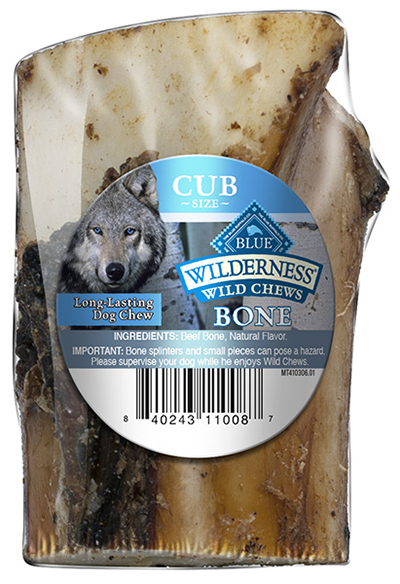
On November 25, 2015, Blue Buffalo announced the recall of one lot of its Cub Size Wilderness Wild dog chews because the product has the potential to be contaminated with Salmonella.
Salmonella is a bacteria that can affect the health of both pets and humans.
Please be sure to share the news of this alert with other pet owners.
Mike Sagman, Editor
The Dog Food Advisor
ooOOoo
That link offers the following:
Blue Buffalo Dog Chews Recall of November 2015
November 25, 2015 — Blue Buffalo Company is voluntarily recalling one lot of its Cub Size Wilderness Wild Chews Bones because it has the potential to be contaminated with Salmonella.
What’s Recalled?
The recalled product comes individually shrink-wrapped in plastic with the UPC number 840243110087 printed on a sticker affixed to the product.
It has an expiration date of November 4, 2017 — printed as “exp 110417” on the shrink-wrap.
Consumers should look at the UPC Code and expiration date on the product package to determine if it is subject to the voluntary recall.
The voluntary recall is limited to the following product and production lot:
Cub Size Wilderness Wild Chews Bone
UPC Code: 840243110087
Expiration Date: November 4, 2017
Where Was It Distributed?
The product was distributed starting November 19, 2015 in PetSmart stores located in the following 9 states:
California
Kansas
Michigan
Minnesota
Montana
Nevada
Oregon
Utah
Washington
What Caused the Recall?
Routine testing at the manufacturing site revealed the presence of Salmonella in the product.
No illnesses have been reported to date and no other Blue Buffalo products are affected.
About Salmonella
Salmonella can affect animals eating the product and there is risk to humans from handling contaminated pet products, especially if they have not thoroughly washed their hands after having contact with the products or any surfaces exposed to these products.
Healthy people infected with Salmonella should monitor themselves for some or all of the following symptoms: nausea, vomiting, diarrhea or bloody diarrhea, abdominal cramping and fever.
Rarely, Salmonella can result in more serious ailments including arterial infections, endocarditis, arthritis, muscle pain, eye irritation and urinary tract symptoms.
Consumers exhibiting these signs after having contact with this product should contact their healthcare provider.
Pets with Salmonella infections may have decreased appetite, fever and abdominal pain. Other clinical signs may include lethargy, diarrhea or bloody diarrhea, and vomiting.
Infected but otherwise healthy pets can be carriers and infect other animals or humans.
If your pet has consumed the recalled product and has these symptoms, please contact your veterinarian.
What to Do?
Consumers who have purchased the product subject to this recall are urged to dispose of the product or return it to the place of purchase for full refund.
Consumers with questions may contact Blue Buffalo at: 888-641-9736 from 8 AM to 5 PM ET Monday through Friday and the weekend of November 28, 2015.
Or by email at Bluebuffalo4260@stericycle.com for more information.
U.S. citizens can report complaints about FDA-regulated pet food products by calling the consumer complaint coordinator in your area.
Those that read my post from yesterday will understand that it was both a busy and wonderful day. Topped off beautifully by arriving home to find four proof copies of The Book!
Four copies of The Book rather hastily assembled under my desk light.
So it was well after 5pm yesterday when I sat down to publish today’s post.
It seemed very appropriate to offer a recent item that appeared on Mother Nature Network and is republished here within MNN’s terms.
(Please note that I didn’t have the time to copy and insert the many interesting links in the original but have coloured the words or phrases to indicate that by going here you can access those links.)
ooOOoo
The science behind how dogs play
When dogs bow or let another dog ‘win’ the wrestling match, there’s a good reason.
By: Laura Moss, October 29, 2015.
If a dog plays too rough, other dogs may exclude him from play. (Photo: Brad Armentor/flickr)
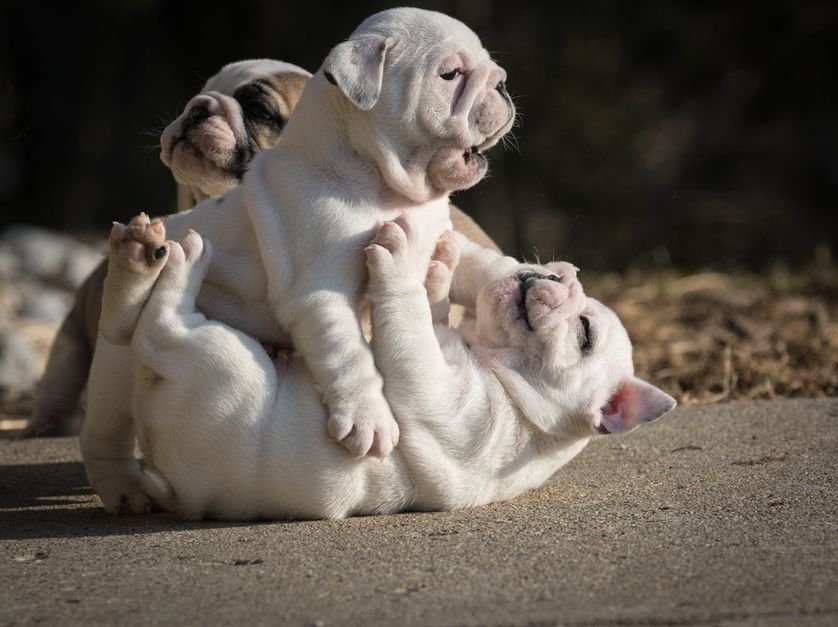
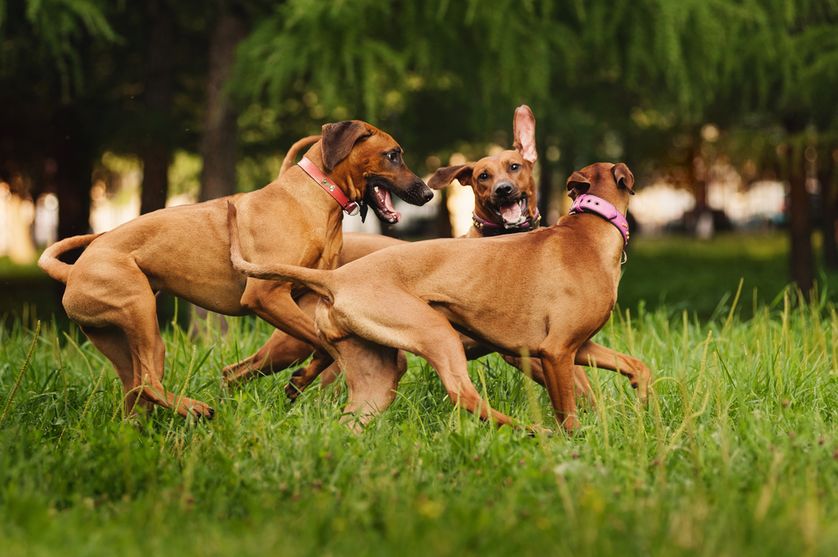
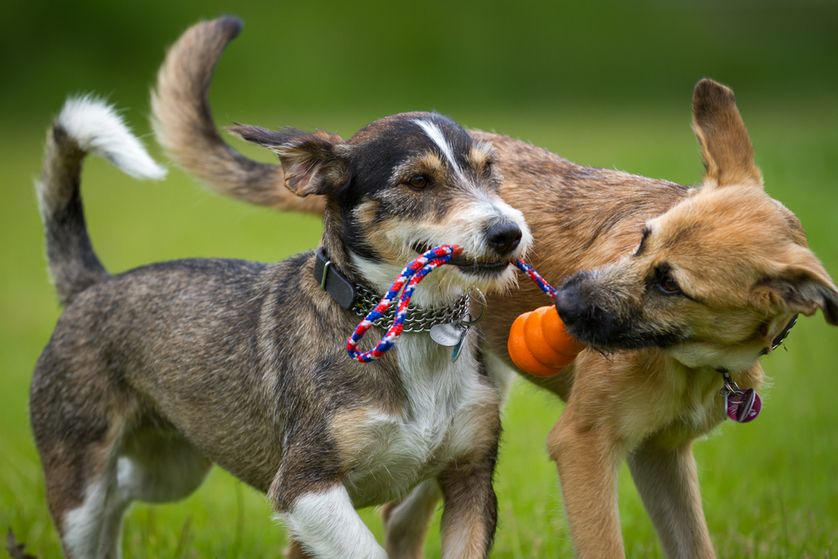
Dogs play by chasing, tackling and nipping at each other, but there’s more to their lively antics than meets the eye. The way dogs interact with one another reveals that dogs have a language as well as a moral code, and they don’t engage in play simply to establish dominance.
Marc Bekoff, professor emeritus at the University of Colorado at Boulder, has been studying animal behavior for more than 40 years. After reviewing four years’ worth of footage of dogs, wolves and coyotes, he discovered that even dogs’ wild relatives play by chasing each other, rolling over and jumping on one another.
“Play is a major expenditure of energy, and it can be dangerous,” Bekoff told The Washington Post. “You can twist a shoulder or break a leg, and it can increase your chances of being preyed upon. So why do they do it? It has to feel good.”
Bekoff and other researchers have conducted numerous studies on how these animals play and what their actions mean. What they’ve found is that dogs’ behavior during play is a language all its own, and every shift of the eyes or wag of the tail is a form of communication.
Play even has a set of rules, and if a dog breaks them — by playing too rough, for example — that dog may be excluded from group play. Bekoff says this response suggests that dogs enforce moral conduct, which means they’re capable of experiencing a range of emotions and even of recognizing these emotions in other canines.
What exactly do their different play behaviors mean?
The bow is a signal for play to commence — but there’s more to it than that. (Photo: Mike McCune/flickr)
Play bow
When a dog lowers the front of its body in a bow-like stance, this is an invitation to play. If your dog often bows to other canines you meet while out on a walk, it’s a good indication that your pup would like a playmate.
However, this stance doesn’t only invite play. It also communicates to other dogs that the jump, nip or roughhousing that follows the bow isn’t an act of aggression. It’s simply a dog’s way of saying, “I’m just playing around.”
See my belly? That has meaning too. (Photo: Eric Sonstroem/flickr)
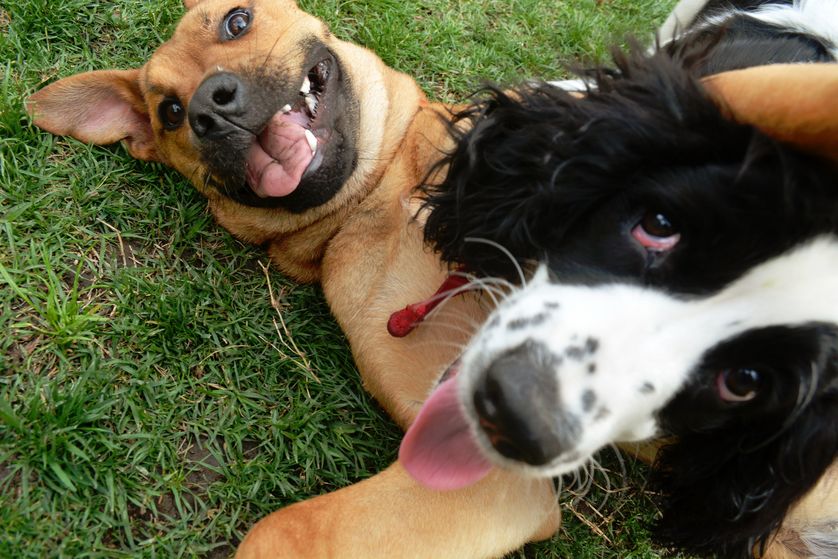
Rolling over
When a dog rolls over onto its back during play, it’s often considered a submissive gesture; however, research suggests it could mean something else entirely.
Earlier this year, scientists at the University of Lethbridge and the University of South Africa observed 33 play sessions between two dogs, and they also studied 20 YouTube videos of dogs playing together.
While not all the dogs rolled over during play, those that did weren’t necessarily the smaller or weaker of the two dogs, nor were the dogs that rolled over exhibiting submissive behaviors such as decreasing play.
In fact, smaller dogs were no more likely to roll over than larger ones, and the pups that did roll over used the position to evade a nip or to get into position to playfully bite the other dog.
The researchers found that none of the 248 rollovers were submissive during play and concluded that rolling over is actually meant to facilitate play.
There’s a lot of communication going on here — though to human watchers it may simply induce giggles. (Photo: WilleeCole Photography/Shutterstock)
Letting female puppies win
A 2008 study found that male puppies frequently let their female puppy playmates win during play, even when the males were bigger and stronger.
The male dogs would even put themselves in positions that left them vulnerable to attack. For example, the male puppies would occasionally lick their playmates’ muzzles, which provided the female puppies with an opportunity to easily bite in return.
Why? Researchers say the act of playing may be more important to the male dogs than winning.
“Perhaps males use self-handicapping with females in order to learn more about them and to form close relationships with them — relationships that might later help males to secure future mating opportunities,” Camille Ward, lead author of the study, told NBC News.
ooOOoo
How lucky we are in this modern world to read and share such interesting essays.
Another day that almost disappeared as a result of my impending book launch soaking up so much time.
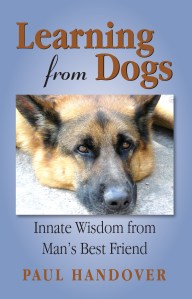
The book should be available for sale by the end of the month, with the launch and book signing taking place locally in Grants Pass on Saturday, December 12th. Followers of this blog will be offered a special discount on the ebook versions once they are released shortly. So if that “rocks your boat” then sign up to follow this blog. Here’s a description of the book:
About the book
There’s a tiny amount of domesticated wolf in all of us. The relationship between canids and humans goes back nearly 40,000 years, when dogs split away from wolves. With our dogs, we have traveled the ancient track from hunter-gatherers to modern humans. However, this track now seems to offer an uncertain future for humankind and society.
Learning from Dogs shows how and why now, more than ever, we humans need to learn from our dogs. At times the book relates personal stories through autobiography, diary, and blog entries. Other times it reinforces a point with speculative and imaginative fictional narrative. Throughout the book, there is a foundation about the history of wolves, dogs, and humans, as the author injects factual research to assist us to more fully understand the importance of this unique relationship.
With just the right blend of humor, story-telling, perception, compassion, and insight, the author shares his unusual perspective and how he came to share what he’s learned through a lifetime of observation and interaction with dogs.
Readers who love dogs, or any animals, will connect with this book and become more fully aware of why our animal friends are valuable to learn from to help us heal the challenges of the 21st century. Occasionally launching into intellectual tangents that will provide intrigue and inspiration for the heart and soul, the book ultimately returns to the central thesis: “What we can (and should) learn from dogs.”
Pat Shipman, retired adjunct professor of anthropology at The Pennsylvania State University, and the author of The Animal Connection and The invaders; How Humans and Their Dogs Drove Neanderthals to Extinction, described the book as, “both wise and thoughtful. It also includes some of the best writing about the intimate and special relationship between dogs and humans I have ever read.”
The Foreword to the book is by well-known local vet, James R. Goodbrod, Master’s Degree, Doctor of Veterinary Medicine.
So with no further ado, here is an informative article that was recently published by Mother Nature News and is republished here with their kind permission.
ooOOoo
Is your dog a playground bully?
What starts out as rambunctious play can quickly turn into a toothy problem.
By: Jaymi Heimbuch, November 12, 2015.
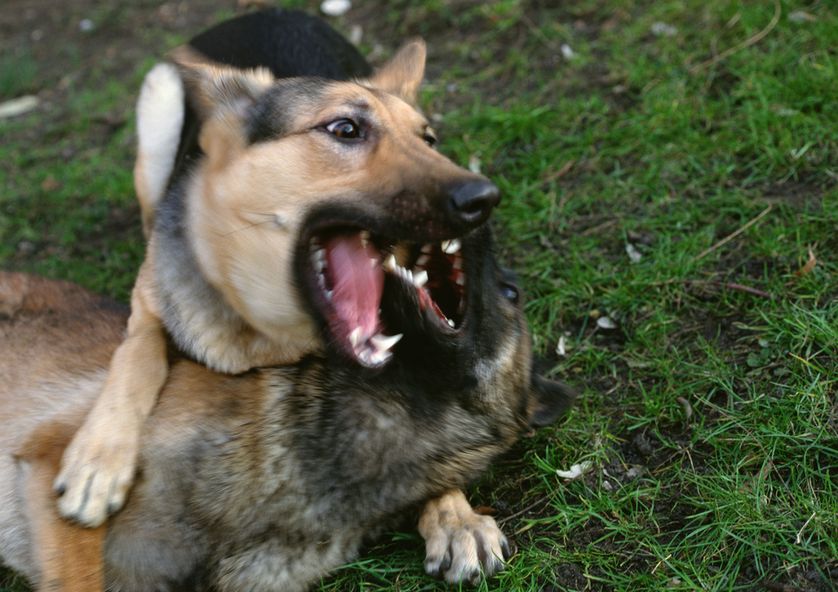
I’m the boss and you’ll do as I say! (Photo: Rita Kochmarjova/Shutterstock)
You’re at the park with your dog as he finds another four-legged buddy to play with. The two dogs seem to be having fun, but something feels amiss. Your dog is extra rambunctious and is really pushing the other dog around. Maybe the other dog is handling your dog’s overly rough-and-tumble attitude with patience. Or perhaps the other dog begins to hide behind or between his owner’s legs, looking for a break from your bossy dog.
Been in this situation? You just might have a bully on your hands.
Bullying behavior is a bigger problem than simply having a rude dog. In the immediate situation, it can lead to an attack or a fight, and in the long run it can cause the dog’s unappreciative play partner to become fear-aggressive, thinking all dogs are bullies. That’s why it’s important to stop bullying behavior the second you see it and train your dog to play appropriately.
Signs of bullying behavior include:
Being overly demanding about getting a toy, attention from people, or other resources
Continually standing over or pinning another dog to the ground
Ignoring signals from a play partner that the play is too rough or unwanted
An escalating intensity when the other dog pushes back or tries to leave
If you have a dog that behaves like a bully on the playground, there are steps you can take to fix the situation, which will benefit both your dog and all the other dogs he wants to play with.
Play can quickly escalate into bullying behavior. Here’s how to keep an eye out for it. (Photo: Photick/Shutterstock)
What causes bullying behavior?
“Over-stimulation often leads to bossy behavior,” says Erin Kramer, an expert dog trainer who specializes in rehabilitating fearful, anxious and aggressive dogs. “This means that as the energy level rises, such as during chasing games, tug of war, or even just enthusiastic wrestling, dogs often become too stimulated and start to ignore signals from other dogs that they are playing too rough or that their interaction is not welcome. Dogs also feed off of each others’ energy, so a group of playing dogs can escalate into over stimulation and bullying behavior faster than a dog would with just one play partner.”
Kramer adds that simply watching how another dog is responding to your dog can tell you if your dog is being a bully. “If the other dogs are attempting to move and stay away, overly submitting by rolling on their backs, or are showing signs of stress or avoidance, that is a good indication your dog may be getting too rough.”
If you aren’t certain if your dog is bullying or if that’s just the play style of the two dogs, Kramer suggests getting a hold of your dog and seeing what happens when you make him take a break from play. If the other dog runs to your dog for more, then the two are getting along fine. But if the other dog maintains space, then the other dog is likely not really enjoying your dog’s rough play behavior and your dog needs to tone it down.
What to do if your dog is the bully
The old advice of letting dogs “work it out themselves” is the source of many problematic behaviors that can take years of training to overcome. Bullies will simply get better at bullying, and the dogs being picked on will likely develop increasingly intense fears about your dog and other dogs. Humans need to step in immediately to break up play that isn’t fun for both dogs, and prevent a bad situation — and bad behavior — from getting worse.
Once you’ve identified that your dog is being unappreciatively assertive with other dogs, it’s important to interrupt the behavior in the moment, then begin training to end the behavior in the long run.
In the moment, call your dog away and have him sit or lie down until he calms down. This can take a long time for a dog easily aroused in a dog park. Your dog is not calm until he can look away from other dogs playing, focus on you and exhibit relaxed body language. If after several minutes, your dog can’t seem to take his eyes off the other dogs and just wants to dive back in, then it’s time to leave the play area as it’s likely your dog won’t be able to tone down his play style.
The next thing is to begin setting your dog up for successful play sessions in such a way that you can easily step in to interrupt bullying behavior the moment it happens.
“If your dog does not have the advanced obedience it takes to perform an off leash ‘come’ out of play — and let’s face it, that’s a really challenging time to respond — then you need to set up your dog to deal with their bullying issues,” advises Kramer. “Have the dog wear a long leash, select a small play area where it’s easy to get control, and practice your obedience training so you are prepared to handle your dog correctly.”
Watch for things that might set your dog into bully mode, including the energy level, the play partner’s personality, and other factors. (Photo: Ksenia Raykova/Shutterstock)
During play, look for the timing of your dog’s bullying behavior and see if there are patterns. Kramer notes to watch if it’s a certain type of play partner, such as a high-energy or confident dog, that brings out the bully in your dog, or perhaps it’s simply that your dog bullies more when he hasn’t had as much exercise or training practice.
“If you can find a pattern to what creates or worsens their bullying behavior, then you can take steps to reduce it from happening and set them up for success by choosing more appropriate play partners or getting them increased exercise before play,” says Kramer.
Taking steps to train your dog to end bullying behavior is important, and Atlanta Humane Society has a great article outlining one way to interrupt and retrain your dog to end bullying over the course of many weeks. In addition to solid training addressing bullying during play, it’s important to have other tools to help your dog take the lessons beyond the dog park.
One lesson that Kramer notes is essential for pushy dogs is concept “Nothing In Life Is Free.” Teach your dog that he only gets the rewards he wants most in life when he thinks about what his human wants. Your dog will then continually check in with you, so he can earn what he wants.
“Demanding dogs are often dogs who need to know, ‘what’s in it for me?'” says Kramer. “Start making an asset list of all the things your dog sees as valuable. Remember that there are things that should go on the list outside of just treats and toys such as going through the front door, playing with friends, greeting strangers, even tummy rubs and snuggle time. Instead of giving away all those valuable rewards, ask your dog to earn them by performing commands like sit, down, stay, come, or doing a trick. Your dog will still get access to all of the things he likes, but he’ll have to earn those things from humans and in doing so, he’ll learn that pushy behavior doesn’t get rewarded. Once they learn this skill, they will be less bully-ish in general, and much more willing to listen to people when you need to get their attention.”
You can also implement a “no reward marker” or NRM, which works in the same way as clicker training, but rather than the marker indicating that a reward is coming, the marker indicates a loss of something is coming. Pat Miller writes in Whole Dog Journal, “My preferred NRM, the one I teach and use if/when necessary, is the word ‘Oops!’ [which] simply means, ‘Make another behavior choice or there will be an immediate loss of good stuff.’ An NRM is to be delivered in a non-punitive tone of voice … Timing is just as important with your NRM as it is with your reward marker. You’ll use it the instant your dog’s bully behavior appears, and if the bullying continues for more than a second or two more, grasp his leash … and remove him from play. Don’t repeat the NRM. Give him at least 20 seconds to calm down, more if he needs it, then release him to go play again.”
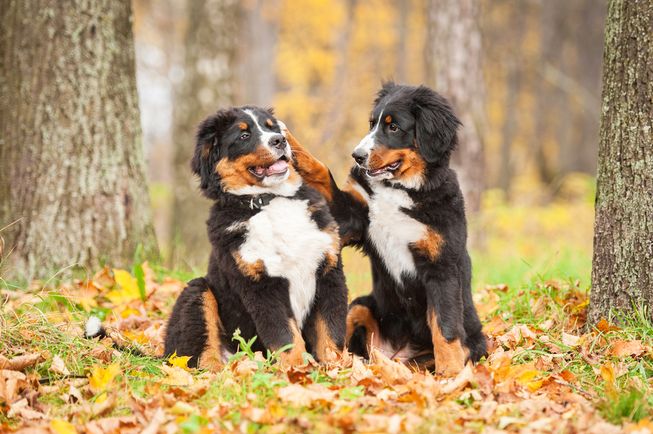
Sharing is caring! (Photo: Bildagentur Zoonar GmbH/Shutterstock)
What to do if your dog is being bullied
You may have an issue with a bullying dog, but it isn’t your dog causing the strife. It’s just as important to step in to interrupt your dog getting picked on. Again, letting dogs “work it out themselves” leads to significant behavioral problems, including a bullied dog becoming excessively fearful or reactive to other dogs because of the bad experience of being bullied.
“This mindset is just much too risky!” says Kramer. “We the humans very often do not know the social skill level of the other dogs involved nor can we successfully know exactly how stressed or scared our own dog is in that situation. I would much rather a dog learn that his humans step in when he is showing signs of discomfort rather than him learning he is forced to defend himself, and that being fear-aggressive is a good strategy to keep himself safe.”
If you see that your dog is getting picked on or is uncomfortable in a play situation, calmly but confidently step in. You can leash your dog and leave, or step between your dog and the other dog to break up play. Staying calm but assertive is key, since your reaction sends a message to your dog. Screaming and yelling at the dogs to break it up tells your dog that this is a scary situation, where as firmly stepping in lets your dog knows that what happened was uncomfortable but nothing to be scared about.
“By demonstrating to your dog that you are responsible and actively engaged in keeping them safe, they will gain confidence in handling tricky social situations and will be less fearful and reactive when negative experiences arise,” says Kramer.
“As a trainer who does a lot of aggression rehabilitation work with dogs who have been bullied or attacked by other dogs, there is a particular joy I get in watching fearful dogs learn that they are no longer responsible for protecting themselves, and that I as their human handler will observe the body language messages they send me and will then take the steps needed to alleviate their discomfort. There is a bond that comes with such a system of partnership that makes a dog a more confident, social, and happy being. Allowing your dog to bully or be bullied means that you are undermining that system, and teaching your dog that they are on their own in learning how to make successful social decisions. With just a bit of observation, intervention and repetition you can help your dog learn the boundaries of positive social interaction and you will not only have a dog who is a better playmate, you will also have a stronger relationship altogether.”
ooOOoo
To my mind, this is a very helpful article and all the links offer a wealth of supporting information.
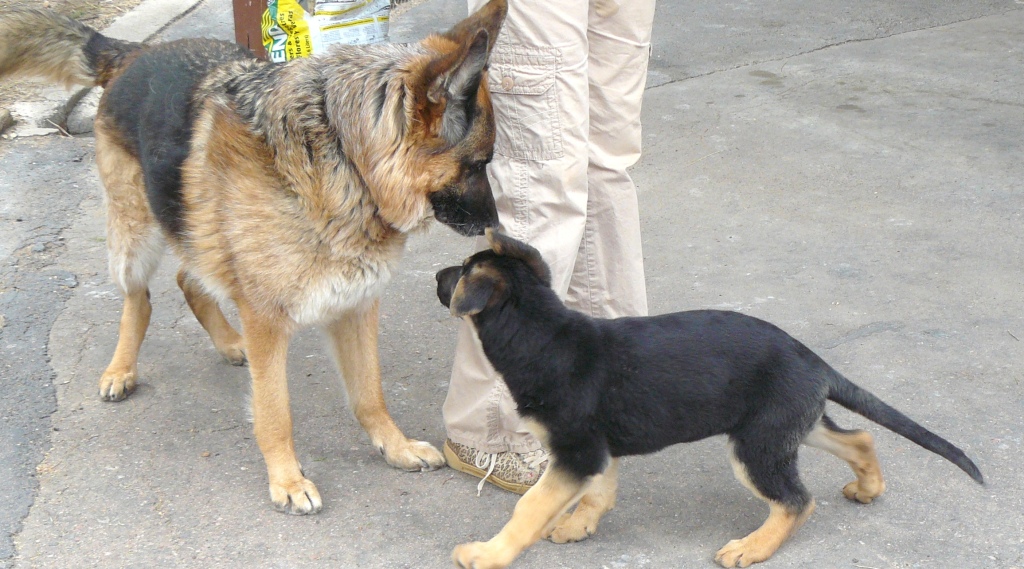
Pharaoh demonstrating his benevolent status with puppy Cleo. April 2012.
In yesterday’s post, I referred to Dunkeswell Airfield in South Devon and the fact that I was part of a group that owned a Piper Super Cub that was based at that airfield.
So while the bulk of this post has been previously published in this place it was over three years ago and, perhaps, may be shown again.
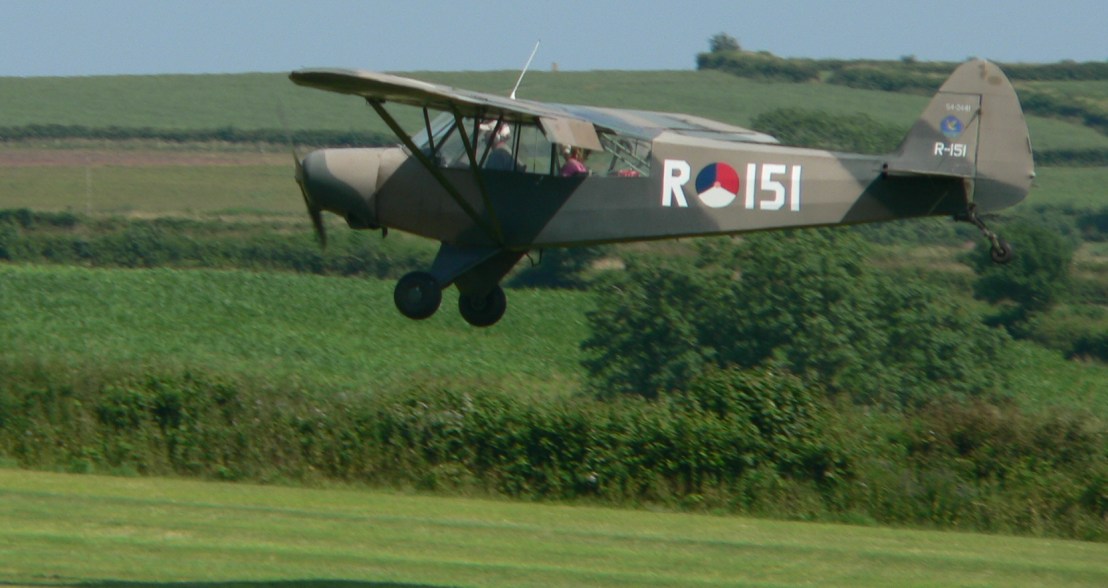
The photograph below was taken in 2006 when Pharaoh was 3 years old. The aircraft, by the way, is an L21B, the military variant of the Piper Super Cub. The aircraft was originally delivered to the Dutch Air Force in 1954 and has dispensation from the UK CAA to retain the original registration and callsign of R151.
More on the aircraft.
Originally when the post was published readers asked for more information on the aircraft.
So here it is.
Piper Super Cub, L-21B, R-151
A/C Construction No. 18-3841, Frame No. 18-3843
Original Engine, Lycoming 135 Type 0-290-D2, 54/2441
Romeo 151 was one of a batch of 298 L-21’s delivered in 1954. There were 584 L-21B’s produced by Piper for military use, the ‘L’ standing for Liaison. The L-21B’s were PA-18-135’s with civil Lycoming 0-290-D2 engines, glasswork as most L-21A’s and L-18’s and a gross weight of 1760 lbs.
This aircraft was delivered to Koninklijke Luchtmacht, Dutch Air Force, on the 1st July, 1954 and registered R-151. After various homes R-151 transferred to the Dutch civil register as PH-GER, 1st April 1976 with 4,458 hours and shortly thereafter was registered to Vlieclub Hoogeveen, Certificate Number 2380.
On the 27th March, 1981 the aircraft was delivered to the UK with a total time of 5,043 hours and in September, 1981 became G-BIYR. In April, 1983 YR was the first of type to be given a Public Transport CofA and was used for training at Tollaton. YR reverted to a Private CofA in January, 1984 when purchased by Mike and Barbara Fairclough at 5,120 hours.
In 1992 YR was re-engined with a Lycoming 150HP, 0320-A2B No. L49809-27A (zero hours). Finally on the 2nd June, 1995 the a/c was repainted in original Dutch insignia and given CAA (UK Civil Aviation Authority) permission to use the original call-sign, Romeo 151.
The aircraft is based in South Devon, England and owned by the five members of the Delta Foxtrot Flying Group.
A few photos of the aircraft.
Approaching home airfield in South Devon, EnglandFlying in the French Alps, Mt Blanc in sight9,300 ft up in the French Alps
With seventeen pets here at home Jean and I should live forever!
Another Saturday and another gentle post about the power of our wonderful pets. (Oh, and who, as I did, missed the fact that yesterday was not only a Friday the Thirteenth but the third one this year!)
Anyway, back to the plot!
Last Monday, Mother Nature Network published an item about how good pets are for our health. It seemed the perfect item to share with all of you this Saturday.
ooOOoo
11 studies that prove pets are good for your health
Check out the ways your 4-legged friends enhance your physical and emotional health.
By: Sidney Stevens, November 9, 2015.
Pets strengthen our hearts, calm our nerves and a whole lot more. (Photo: Juanedc.com /flickr)
If you have pets you already know the joy and love they bring to your life. Now science is confirming just how good they really are for you — both mentally and physically.
How do they help? One theory is that pets boost our oxytocin levels. Also known as the “bonding hormone” or “cuddle chemical,” oxytocin enhances social skills, decreases blood pressure and heart rate, boosts immune function and raises tolerance for pain. It also lowers stress, anger and depression.
No surprise then that keeping regular company with a dog or cat (or another beloved beast) appears to offer all these same benefits and more. Read on to discover the many impressive ways a pet can make you healthier, happier and more resilient.
1. Pets alleviate allergies and boost immune function
One of your immune system’s jobs is to identify potentially harmful substances and unleash antibodies to ward off the threat. But sometimes it overreacts and misidentifies harmless stuff as dangerous, causing an allergic reaction. Think red eyes, itchy skin, runny nose and wheezing. You’d think that having pets might trigger allergies by kicking up sneeze-and-wheeze-inducing dander and fur. But it turns out that living with a dog or cat during the first year of life not only cuts your chances of having pet allergies in childhood and later on but also revs up your immune system and lowers your risk of eczema and asthma. In fact, just a brief pet encounter can invigorate your disease-defense system. In one study, petting a dog for only 18 minutes raised immunoglobulin A (IgA) levels in college students’ saliva, a sign of robust immune function.
2. Pets up your fitness quotient
This one applies more to dog owners. If you like walking with your favorite canine, chances are you’re fitter and trimmer than your non-dog-walking counterparts and come closer to meeting recommended physical activity levels. One study of more than 2,000 adults found that regular dog walkers got more exercise and were less likely to be obese than those who didn’t walk a dog. In another study, older dog walkers (ages 71-82) walked faster and longer than non-pooch-walkers, plus they were more mobile at home.
Dog owners who take their canine companions on walks tend to be trimmer and fitter than their fellow dog-less peers. (Photo: AMatveev/Shutterstock)
3. Pets dial down stress
When stress comes your way, your body goes into fight-or-flight mode, releasing hormones like cortisol to crank out more energy-boosting blood sugar and epinephrine to get your heart and blood pumping. All well and good for our ancestors who needed quick bursts of speed to dodge predatory saber-toothed tigers and stampeding mastodons. But when we live in a constant state of fight-or-flight from ongoing stress at work and the frenetic pace of modern life, these physical changes take their toll on our bodies, including raising our risk of heart disease and other dangerous conditions. Contact with pets seem to counteract this stress response by lowering stress hormones and heart rate. They also lower anxiety and fear levels (psychological responses to stress) and elevate feelings of calmness.
4. Pets boost heart health
Pets shower us with love so it’s not surprising they have a big impact on our love organ: the heart. Turns out time spent with a cherished critter is linked to better cardiovascular health, possibly due to the stress-busting effect mentioned above. Studies show that dog owners have a lower risk of heart disease, including lower blood pressure and cholesterol. Dogs also benefit patients who already have cardiovascular disease. They’re not only four time more likely to be alive after a year if they own a dog, but they’re also more likely to survive a heart attack. And don’t worry, cat owners — feline affection confers a similar effect. One 10-year study found that current and former cat owners were 40 percent less likely to suffer a heart attack and 30 percent less likely to die of other cardiovascular diseases.
5. Make you a social — and date — magnet
Four-legged companions (particularly the canine variety that pull us out of the house for daily walks) help us make more friends and appear more approachable, trustworthy and date-worthy. In one study, people in wheelchairs who had a dog received more smiles and had more conversations with passersby than those without a dog. In another study, college students who were asked to watch videos of two psychotherapists (depicted once with a dog and once without) said they felt more positively toward them when they had a dog and more likely to disclose personal information. And good news for guys: research shows that women are more willing to give out their number to men with a canine buddy.
A dog can make you appear friendlier and more approachable to others. (Photo: CandyBox Images/Shutterstock)
6. Provides a social salve for Alzheimer’s patients
Just as non-human pals strengthen our social skills and connection, cats and dogs also offer furry, friendly comfort and social bonding to people suffering from Alzheimer’s and other forms of brain-destroying dementia. Several canine caregiver programs now exist to assist at-home dementia patients with day-to-day tasks, such as fetching medication, reminding them to eat and guiding them home if they’ve wandered off course. Many assisted-living facilities also keep resident pets or offer therapy animal visits to support and stimulate patients. Studies show creature companions can reduce behavioral issues among dementia patients by boosting their moods and raising their nutritional intake.
7. Enhances social skills in kids with autism
One in nearly 70 American kids has autism (also known as autism spectrum disorder, or ASD), a developmental disability that makes it tough to communicate and interact socially. Not surprisingly, animals can also help these kids connect better to others. One study found that youngsters with ASD talked and laughed more, whined and cried less and were more social with peers when guinea pigs were present. A multitude of ASD animal-assisted therapy programs have sprung up in recent years, featuring everything from dogs and dolphins to alpacas, horses and even chickens.
Animal-assisted therapy helps kids with autism and other developmental disabilities learn social skills. (Photo: UCI UC Irvine/flickr)
8. Dampens depression and boosts mood
Pets keep loneliness and isolation at bay and make us smile. In other words, their creature camaraderie and ability to keep us engaged in daily life (via endearing demands for food, attention and walks) are good recipes for warding off the blues. Research is ongoing, but animal-assisted therapy is proving particularly potent in deterring depression and other mood disorders. Studies show that everyone from older men in a veterans hospital who were exposed to an aviary filled with songbirds to depressed college students who spent time with dogs reported feeling more positive.
9. Defeats PTSD
People haunted by trauma like combat, assault and natural disasters are particularly vulnerable to a mental health condition called post-traumatic stress disorder (PTSD). Sure enough, studies show that the unconditional love — and oxytocin boost — of a pet can help remedy the flashbacks, emotional numbness and angry outbursts linked to PTSD. Even better, there are now several programs that pair specially trained service dogs and cats with veterans suffering from PTSD.
10. Fights cancer
Animal-assisted therapy helps cancer patients heal emotionally and physically. Preliminary findings of an on-going clinical trial by the American Humane Association shows that therapy dogs not only erase loneliness, depression and stress in kids fighting cancer, but canines can also motivate them to eat and follow treatment recommendations better — in other words participate more actively in their own healing. Likewise, new research reveals a similar lift in emotional well-being for adults undergoing the physical rigors of cancer treatment. Even more astounding, dogs (with their stellar smelling skills) are now being trained to literally sniff out cancer.
11. Puts the kibosh on pain
Millions live with chronic pain, but animals can soothe some of it away. In one study, 34 percent of patients with the pain disorder fibromyalgia reported pain relief (and a better mood and less fatigue) after visiting for 10-15 minutes with a therapy dog compared to only 4 percent of patients who just sat in a waiting room. In another study, those who had undergone total joint replacement surgery needed 28 percent less pain medication after daily visits from a therapy dog than those who got no canine contact.
ooOOoo
When I was setting this post up and copying across all the many links I was aware that there was a mountain of information out there. You may want to take some time and explore those links. For example, the link to HABRI- Human-Animal Research Initiative looks incredibly interesting. Then there was the link to the work being undertaken by the American Humane Association, that link being to this video that I am presenting here to close off today’s post.
Wherever you are in the world look after yourself and care for all those lovely pets out there. Love them so dearly!
Staying with the theme of our lives being “rebooted” by our dogs.
Again, as so often occurs, a thought or reply left by someone to a previous post kicked off a new post for me.
So it was yesterday when Hariod commented: “This is the organisation that brought dogs into the care home my father lived in: http://www.petsastherapy.org/”
That website is full of great information and any readers living in the UK who have not come across them before are highly recommended to have a good browse. One item that caught my eye was the Precious Memories link.
The loss of a pet is always a devastating and traumatic experience but even more so for the owner of a PAT dog or cat who has brought much love and companionship to many people, as well as to their owners.
This page contains lasting memorials to some PAT dogs and PAT cats who have given much to society by regularly visiting in Hospitals, Hospices, Residential homes or Day Care Centres.
Baggy was a Finnish Lapphund and a wonderful and loving companion. She enjoyed taking part in many canine events including passing the KCGC Bronze, Silver & Gold awards, agility, showing and heel work to music, Baggy loved to go on a camping trip in the caravan or a trip down the river in our boat.
Baggy had two litters of puppies and two sons one from each litter are PAT dogs and her grand daughter is also a PAT dog. Baggy was my first PAT dog and she loved to go visiting in our local Residential home bringing joy and love to many people.
We love and miss Baggy so much our special sweet little friend.
Sheila Hall
The last aspect of the Pets As Therapy site that I want to refer to is their blog: Dog Dog Dog. Do drop in there and read some of the wonderful stories of those caring dogs.
That very nicely leads on to two videos that I quickly came across.
The first is described, thus:
Published on Dec 19, 2013
Follow Fraser, a black lab-golden mix, who has been a part of HCA Virginia’s unique Pet Therapy program since 2007. For several years, Fraser has spread comfort, compassionate care and joy to the faces of countless patients and staff at Chippenham and Johnston-Willis Hospitals from Tucker Pavilion and the Thomas Johns Cancer Hospital to many other areas. Catch a glimpse of how pet therapy is a source of alternative care for those in need.
While the second is about the therapy dog test.
Published on Dec 16, 2012
Achilles, my German Shepherd Dog, taking the Therapy Dog International test for certification.
Having this certification will allow Achilles and I to visit people in the hospital and other health care facilities.
Achilles is an AKC Obedience trained competitor and was able to pass the TDI test using that training and experience rather than special training for the test.
If you are interested in making your dog a TDI Therapy Dog go to their web site for information on how to accomplish that.










 Learning from Dogs