Category: Musings

Oceans and Minds.

How the linking of minds offers us vast horizons!

I subscribe to two blogs: Pendantry’s Wibble and Christine’s 350 or bust. But a temporary lack of quiet reading time has meant that recent posts from each of them were initially only briefly skimmed.  I made a mental note to read the one from Pendantry, Where oceans meet, because I have always had a love affair with the oceans.  When I did read it, I was blown away, to use the modern vernacular.  Why?  Stay with me.

Where oceans meet opened thus:

I’ve recently been introduced to two things that demonstrate (to my satisfaction, anyway) that the universe is much stranger than I first thought. Mind you, my first thought was quite some time ago, now.

Then after showing a wonderful photograph of where the Indian Ocean meets the Southern Ocean, (this one below) …

Twooceansmerging
Even vast oceans come together.

…. Pendantry goes on:

The other one of those ‘strange universe’ things is something that I find even more surprising: after decades of eating meat, an hour watching just one film has persuaded me to reconsider the habits of a lifetime.

That really jumped off the page at me because Jeannie has been a vegetarian for most of her life and I have been flirting with the idea.

That ‘one film’ was Vegucated.  Here’s the rest of that Wibble post republished with Pendantry’s kind permission.

oooOOOooo

A TED talk highlighted yesterday over on 350orbust (well worth watching — thanks, Christine) included a reference to the film Vegucated. Intrigued, was I, so I trundled off to watch it, and returned a changed man. Well, maybe that’s a bit ambitious, but I do now feel motivated to think more about what I eat, why I’m eating it, and to actively seek out vegan alternatives — something that I have never considered before.

vegucated-meat-means-disease-350_zpsc6ef410f
More meat equals more disease.

Vegucated reinforces the betrayal of a society that has sold us all on the idea of having ‘consumer choice’ — but continues to withhold from us the information necessary to make informed choices. And on that point: don’t just take my word for it that this is a film well worth watching: there are many other reviews and quotes about it.

Einstein deliberated, and chose a vegetarian lifestyle

Our world is changing, and, one way or another, we must change with it. I believe that films like Vegucated are essential to help us to choose to move in the direction of a healthier, happier world.

If slaughterhouses had glass walls, everyone would be vegetarian. “— Paul McCartney.

oooOOOooo

As you can see Pendantry referred to Christine’s recent post on 350orbust.  That post was called Are You A Changemaker?

Naturally I was curious and wandered across to that post.  Here are Christine’s own words,

It’s TED Talk Tuesday on 350orbust, and today’s presenter is Zoe Weil who spoke to the young people who gathered at the TEDx Youth symposium held at Cape Elizabeth, Maine, last December. Ms. Weil is the co-founder and president of the Institute for Humane Education. Ms. Weil’s inspiring talk is entitled “How To Be A Solutionary.” Enjoy!

I tell you what!  That 11 minute presentation by Zoe Weil was not just inspirational, it was one of the most inspirational speeches I have ever heard!  That’s EVER!

Take this quote that comes in less than 2 minutes from the start of the speech, “Never before have we had the capacity to cause the breakdown of so many ecological systems that sustain our life.

Now if that doesn’t have you gagging for the rest of what Zoe talks about, nothing will.  So here it is.

Published on Jan 11, 2013

Zoe Weil is the co-founder and president of the Institute for Humane Education and is considered a pioneer in the comprehensive humane education movement, which provides people with the knowledge, tools, and motivation to be conscientious choicemakers and engaged changemakers for a better world. Zoe created the first Master of Education and Certificate Program in Humane Education in the U.S. covering the interconnected issues of human rights, environmental preservation, and animal protection. She has also created acclaimed online programs and leads workshops and speaks at universities, conferences, and events across the U.S. and Canada. She has taught tens of thousands students through her innovative school presentations, and has trained several thousand teachers through her workshops and programs. Zoe’s most recent book, Most Good, Least Harm: A Simple Principle for a Better World and Meaningful Life, won the 2010 Nautilus silver medal in sustainability and green values. She is the author of several other books including Above All, Be Kind: Raising a Humane Child in Challenging Times for parents; The Power and Promise of Humane Education for educators; and Claude and Medea: The Hellburn Dogs, winner of the Moonbeam gold medal in juvenile fiction, which follows the exploits of two seventh graders who become clandestine activists in New York City, righting wrongs where they find them. Zoe received a Master of Theological Studies from Harvard Divinity School and a Master of Arts from the University of Pennsylvania.

So from the meeting of vast oceans to the meeting of minds.

English, as she are spoken!

Sent to me by Richard Maugham – truly gorgeous.

You think English is easy? Well, we think a retired English teacher was bored and came up with this.

Read all the way to the end and appreciate how much work this took to put it together!

      • The bandage was wound around the wound.
      • The farm was used to produce produce.
      • The dump was so full that it had to refuse more refuse.
      • We must polish the Polish furniture..
      • He could lead if he would get the lead out.
      • The soldier decided to desert his dessert in the desert..
      • Since there is no time like the present, he thought it was time to present the present.
      • A bass was painted on the head of the bass drum.
      • When shot at, the dove dove into the bushes.
      • I did not object to the object.
      • The insurance was invalid for the invalid.
      • There was a row among the oarsmen about how to row.
      • The buck does funny things when the does are present.
      • A seamstress and a sewer fell down into a sewer line.
      • To help with planting, the farmer taught his sow to sow.
      • The wind was too strong to wind the sail.
      • Upon seeing the tear in the painting I shed a tear..
      • I had to subject the subject to a series of tests.
      • How can I intimate this to my most intimate friend?

Let’s face it – English is a crazy language.

There is no egg in eggplant, nor ham in hamburger; neither apple nor pine in pineapple.

English muffins weren’t invented in England or French fries in France . Sweetmeats are candies while sweetbreads, which aren’t sweet, are meat.

We take English for granted. But if we explore its paradoxes, we find that quicksand can work slowly, boxing rings are square and a guinea pig is neither from Guinea nor is it a pig.

And why is it that writers write but fingers don’t fing, grocers don’t groce and hammers don’t ham?

If the plural of tooth is teeth, why isn’t the plural of booth, beeth? One goose, 2 geese. So one moose, 2 meese? One index, 2 indices?

Doesn’t it seem crazy that you can make amends but not one amend? If you have a bunch of odds and ends and get rid of all but one of them, what do you call it?

If teachers taught, why didn’t preachers praught? If a vegetarian eats vegetables, what does a humanitarian eat?

Sometimes I think all the English speakers should be committed to an asylum for the verbally insane. In what language do people recite at a play and play at a recital? Ship by truck and send cargo by ship? Have noses that run and feet that smell?

How can a slim chance and a fat chance be the same, while a wise man and a wise guy are opposites?

You have to marvel at the unique lunacy of a language in which your house can burn up as it burns down, in which you fill in a form by filling it out and in which, an alarm goes off by going on.

English was invented by people, not computers, and it reflects the creativity of the human race, which, of course, is not a race at all.

That is why, when the stars are out, they are visible, but when the lights are out, they are invisible.

PS. – Why doesn’t ‘Buick’ rhyme with ‘quick’?

You lovers of the English language might enjoy this .

There is a two-letter word that perhaps has more meanings than any other two-letter word, and that is ‘UP.’

It’s easy to understand UP, meaning toward the sky or at the top of the list, but when we awaken in the morning, why do we wake UP?

At a meeting, why does a topic come UP?

Why do we speak UP and why are the officers UP for election and why is it UP to the secretary to write UP a report?

We call UP our friends.

And we use it to brighten UP a room, polish UP the silver; we warm UP the leftovers and clean UP the kitchen.

We lock UP the house and some guys fix UP the old car.

At other times the little word has real special meaning.

People stir UP trouble, line UP for tickets, work UP an appetite, and think UP excuses.

To be dressed is one thing, but to be dressed UP is special.

A drain must be opened UP because it is stopped UP.

We open UP a store in the morning but we close it UP at night.

We seem to be pretty mixed UP about UP!

To be knowledgeable about the proper uses of UP, look the word UP in the dictionary.  In a desk-sized dictionary, it takes UP almost 1/4th of the page and can add UP to about thirty definitions.

If you are UP to it, you might try building UP a list of the many ways UP is used.

It will take UP a lot of your time, but if you don’t give UP, you may wind UP with a hundred or more.

When it threatens to rain, we say it is clouding UP. When the sun comes out we say it is clearing UP. When it rains, it wets the earth and often messes things UP. When it doesn’t rain for awhile, things dry UP.

One could go on and on, but I’ll wrap it UP, for now my time is UP, so…….it is time to shut UP!

Now it’s UP to you what you do with this email.

oooOOOooo

What a wonderful exploration with, of course, more beautiful examples yet floating around.  A couple come to my mind.

One is if the English language made any sense, lackadaisical would have something to do with a shortage of flowers.

I will close with a quote reputed to have come from Ronald Reagan, who argued that, “The most terrifying words in the English language are: I’m from the government and I’m here to help.

Vive la différence.

Not saying anything more!

Apologies, forgot who sent me the link to this video.

Which is a little over 5 minutes of watching Mark Gungor speak about the differences between the brains of men and women.  I hadn’t come across Mark Gungor before but his website reveals he is “one of the most sought-after speakers on marriage and family in the country.

Enjoy!


Finding one’s true self.

A personal journey

In some ways, it is surprising that I haven’t written about my own counselling experiences before.  Perhaps it has never felt like the right moment.

But the guest post from Peter Bloch that I had the honour of publishing yesterday so strongly resonated with the ‘Fergus’ inside me that I was compelled to offer my own journey.  So if you are not into bouts of personal introspection, look away and come back tomorrow! 😉

The fickle finger of fate

I was born in Acton, North London, just 6 months before the end of World War II.  Nothing remarkable about that.  Just another one of the millions of soon-to-be post-war babies.  My father was an architect; my mother a teacher.  Indeed, at the age of 93 my mother is still teaching music!

In 1956 when my father was 55 years-old he developed lung cancer.  I and my sister were blissfully unaware of our father’s terminal condition until the evening of December 19th, 1956.  That evening Mum came into my bedroom and said that father was very ill and may not live for very much longer.  To be honest, it didn’t really register and off I went to sleep.  I was 12 and looking forward to Christmas in 5 days time.

My father died in the night hours of December 19th/20th.  I had slept through not even wakening when his body was removed from the house.  On the morning of the 20th he was just gone!

It was felt by the family doctor, who had been attending my father, that it would be too upsetting for me and my younger sister to attend the funeral.  That funeral was a cremation and therefore no grave.

The good and the not so good.

The only obvious effect of the trauma of my father’s death was that I bombed out at school.  I had passed my ’11+’ exams at my primary school and in September, 1956, become a pupil at Preston Manor County Grammar School near Preston Road, Wembley where we were living; Wembley Stadium could be seen from the back windows of the 2nd floor of our house.

I struggled with schooling, the victim of much bullying as I recall, sat 8 ‘O-level’ exams, passed 2, struggled to get another couple of ‘O-levels’ but it was clear that a University place was not going to be for me.

From then on, in stark contrast, I enjoyed a wonderfully varied life, working as a business salesman, freelance journalist and ending up starting my own company in Colchester in 1978 which became surprisingly successful.

But when it came to relationships, that wasn’t so successful.  If I tell you that Jeannie is my 4th wife, you will get the message!

A little more background.

When running my own business back in the 1980s I had a network of overseas distributors.  My US West Coast distributor was Cimarron, a company owned and run by Daniel Gomez out of Los Angeles.  Dan and I became good friends and still are some 35 years later.  I’ll come back to this highly relevant relationship with Dan.

I sold my business in 1986 and went overseas for 5 years, actually living on a boat based in Larnaca, Cyprus.  (The boat was a Tradewind 33 named ‘Songbird of Kent‘.)

In the early 1990s upon returning to England I chose to live in the South Hams area of South Devon, ending up in the small village of Harberton, pop. 300, near Totnes.  Once settled I took up business mentoring.  In previous years, I had gained Chartered Membership of the Institute of Marketing.  In addition, I became a youth mentor with the Prince’s Youth Business Trust, a really fabulous organisation that does so much good for young people.

One of my personal mentees was Jon Lavin, the founder of The People Workshop.  (Yes, and Jon is aware that his website is a tad out-of-date!)

Out of sight, but not out of mind.

In time I became married to wife number three.  Seemingly happy living in a tranquil part of rural Devon, keeping busy, not thinking too much about life.

Pharaoh became an important part of my life in 2003.  At the time, I had no idea how important!

Pharaoh, relaxing in a Devon garden.

On the evening of December 20th, 2006, 50 years to the day that my father died, my wife announced that she had met another man. The implications of this casually delivered bombshell were obvious and catastrophically painful.

I will spare you the details but, trust me, the next few weeks were tough!

High on my priorities were letting close friends know what was happening.  Dan, in characteristic Daniel fashion, said over the phone, “Hey, Handover, you get your arse over to Southern California pronto! Like now!”  I replied that it was much too difficult to do that now but maybe later on in 2007.

Realising that I might need some psychological support, I spoke with Jon Lavin.  However, Jon made it clear that as we already had a working relationship with me as his mentor, he couldn’t now, in turn, be my psychotherapist.  I pleaded with Jon.  He said he would only work with me on the strict understanding that he would terminate the counselling relationship if our past workings interfered.  Of course, I agreed. [See footnote.]

Finding one’s true self after 50 years!

Jon, quite naturally, started into understanding my past experiences. Right back to that fateful day in 1956 when my father died.  And, guess what!

Unbeknownst to me, the lack of time to adjust to my father’s cancer, his sudden death, being unable to ‘say goodbye‘; all had been emotionally interpreted as acute and profound emotional rejection.  Buried deep within me with both strong positive and negative emotional consequences.  Negatively, making me very vulnerable to emotional rejection; positively, causing me to strive for outward success in so many ways.  Those sessions with Jon brought it all to the surface bringing with it deep and peaceful calm.

Yet, the true implications of finding myself were still to come.

In the Summer of 2007, I took up Dan’s offer to ‘get my arse to Southern California!‘  I had a fabulous time with Dan and his dear wife, Cynthia.  It also included a visit to Dan’s sister, Suzann, and her husband, Don, in their home in Los Osos, California.  Su fussed over me restoring my sense of self-worth as Dan and Cynthia had been doing.

One morning over breakfast Suzann said, “Hey Paul, what are you doing for Christmas?

I replied, “Oh, give me a break, Suzann, it’s the middle of June.  Long time before I have to think about dealing with Christmas!

Su then made the offer that was to change my life irrevocably.  “Don and I have a house down in San Carlos, Mexico where we shall be at Christmas.  Why don’t you come and have Christmas with us in Mexico?

And I did.  And it was in San Carlos, Mexico that I met Jean.  Suzann and Jean were great buddies. Jean had been living there since she and her late husband, Ben, had moved there many years ago.  Ben, an American, and Jean had been married for 26 years with Ben, sadly, having died in 2005.

Jean and I spent hundreds of hours chatting and getting to know each other, including the fact that she and I had both been born Londoners within 23 miles of each other.  Jean had been rescuing Mexican feral dogs for years and there were 14 dogs in her house in San Carlos.  So many of those dogs loved me from the start.  It seemed like the most beautiful Christmas I could have wished for.  In such stark contrast to just a year ago.

Mexican sunset! San Carlos, 2nd January, 2008.

In September, 2008 after selling the house in Devon, I moved out to San Carlos, Mexico.  Just me and Pharaoh who had been such a devoted friend, companion and confidant over the previous months.

In 2010, we moved to Payson in Arizona, some 80 miles NE of Phoenix. On November 20th, 2010 Jean and I were married.

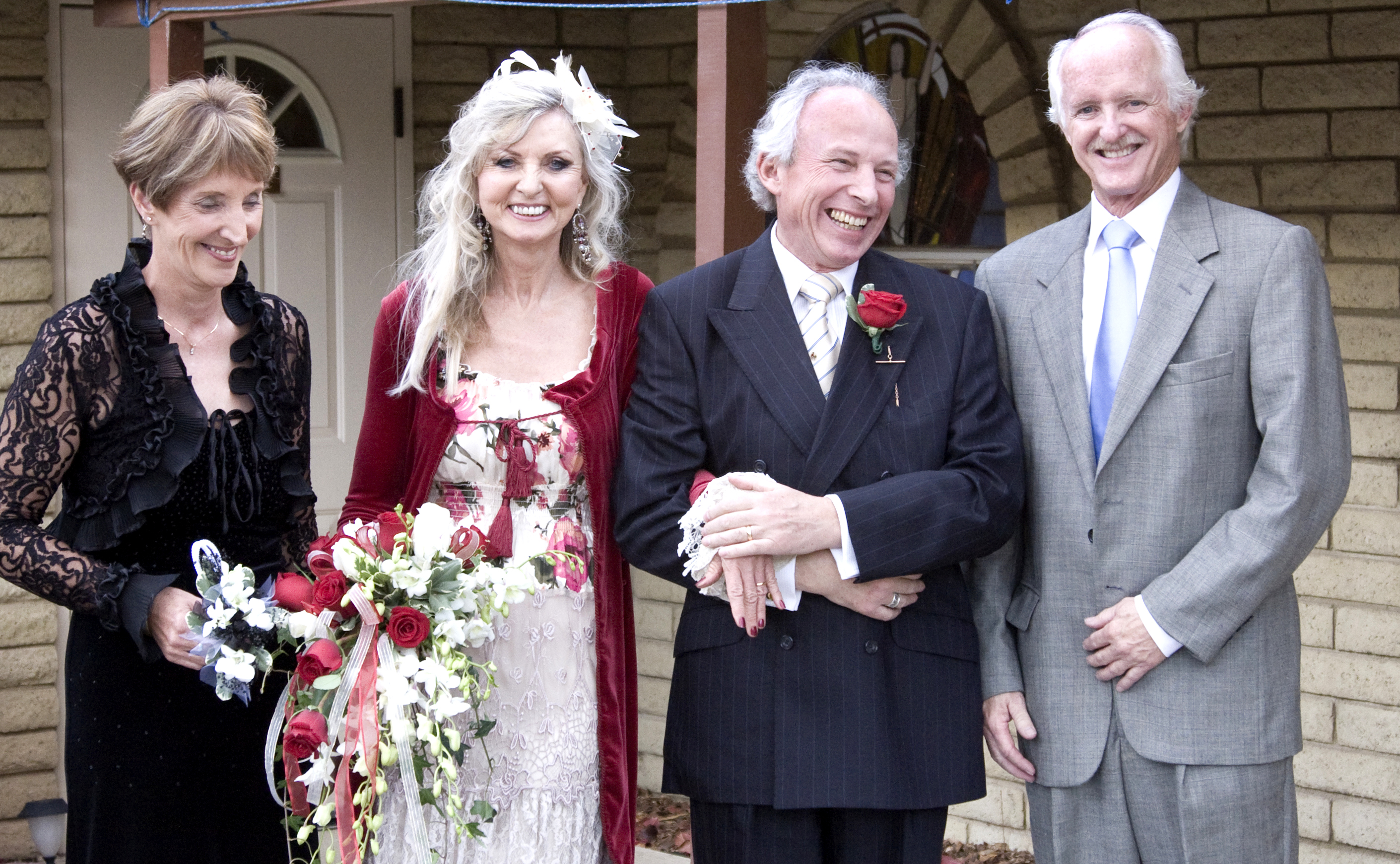
The marriage of Jean and Paul wonderfully supported by Diane, maid of honour, and best man, Dan Gomez.

Releasing the Fergus in me and all of us.

What Peter Bloch wrote yesterday was so true.  A dog can only be a happy, fulfilled dog, if allowed to be the true dog that is in him or her.  Despite the fact that humans are primates and dogs are canids like wolves, coyotes, and foxes, it still holds as true for us humans as it did for Fergus.

We can only be happy, to put it in the words of Fergus, “happy, energised, purposeful and fulfilled in every way.” if we are given the freedom to be our self.

So if you find that you, like Fergus, suffer from digestive problems, possibly have skin disorders and sometimes behave a little strangely take note – you need to find your healer!

oooOOOooo

Footnote

Back in 2008 when Jon Lavin was working with me, I would take Pharaoh and he would lay on the floor behind my seat.  On one occasion Jon was talking about the findings of Dr. David Hawkins and his Scale of Consciousness; from falsehood to truthfulness. (See here and here for more details.)

Anyway that fateful day, Jon mentioned that Dr. Hawkins had measured dogs as being integrous animals.  That notion stayed with me and later I registered the domain name learningfromdogs (dot) com leading to – yes, you guessed it – this blog.  Funny old world.

What I have learned about health and happiness from my dog.

I’m clearly not the only one to believe we really can learn from dogs!

Last Friday, I published a post under the title of The healing power of dogs.  This is how that post opened:

How dogs offer us humans health and happiness.

Many months ago, I was contacted by a Peter Bloch offering to write a guest post on the subject of the healing power of dogs.  Peter had read a post that I had published in July last year which prompted the email dialogue between us.

Not going to say much more at this stage except that today I am republishing that post from last July.  On Monday, I will introduce Peter and his guest post.  Then on Tuesday, I will speak of my own experiences both as entrepreneurial mentor and as a ‘customer’ of a wonderful psychotherapist back in Devon during 2007.

So, as promised, here is that guest post from Peter.

oooOOOooo

Fergus, the Healing Dog.  A sketch by Mrs. Peter Bloch
Fergus, the Healing Dog. A sketch by Mrs. Peter Bloch

My dog Fergus is a philosopher, and the nature of health and happiness is his area of special expertise. When he learned about Paul’s blog he became very excited because he has always been convinced that dogs have so much to teach humans about life. As much as anything to have a little peace from his continual philosophical musings, I agreed to set out his theories here for the benefit of everyone who loves dogs.

Fergus would like it to be known that when he is free to pursue the activities to which his particular breed is most naturally attracted then, as a dog, he feels happy, energised, purposeful and fulfilled in every way. Fergus has also observed that when he is able to participate as a co-operating member of his ‘pack’, he feels safe and secure, is clear about how to proceed with his life, and at night he sleeps like a dog.

But Fergus says that when these conditions do not apply, he can be quite remarkably miserable. As a Greyhound, he loves to run very fast, and he is not at all interested in things like retrieving balls, or wallowing in water.

Fergus doing what he loves - running very fast!
Fergus doing what he loves – running very fast!

However once he was in the care of someone who Fergus thinks we should just call ‘Sarah’.  Sarah has a Labrador and thinks that all dogs really ought to be like her dog, resulting in Fergus being put under considerable pressure to enjoy activities that he could not understand.

That lead to Sarah telling Fergus’ owners that he was a difficult dog when in fact he was just a misunderstood dog. He was amazed how, in just one day, he went from sleeping ‘like a dog‘ to ‘living in the doghouse‘!

Indeed, within a week he was suffering from digestive problems and skin disorders, despite an identical diet, and was found to be engaging in several bizarre neurotic behaviours. Fortunately, when more congenial conditions were restored, Fergus returned to feeling safe and secure.

Fergus often expresses surprise that people often do not understand that the freedom to be himself, the true dog that he is, including living in unifying solidarity with his pack, is a fundamental requirement for his health; in all meanings of the word.

For instance, Fergus noticed that Sarah has a son called Henry, who really wanted to be a designer. But his mother thought that it would be better for him to be a lawyer. In fact, Sarah was so certain that in the end Henry became a lawyer. Fergus observes that Henry is always suffering from digestive problems and skin disorders and sometimes behaves a little strangely.  Doctors have not been able to find out what is wrong with him, despite all sorts of diets and medicines being tried.

But here’s the rub. When Henry goes out for a walk with Fergus, Fergus always runs as fast as he can and his resulting happiness always makes Henry feel so much better.

Henry is convinced that Fergus is a healer! Who could argue with that?

Fergus, the healing dog.

oooOOOooo

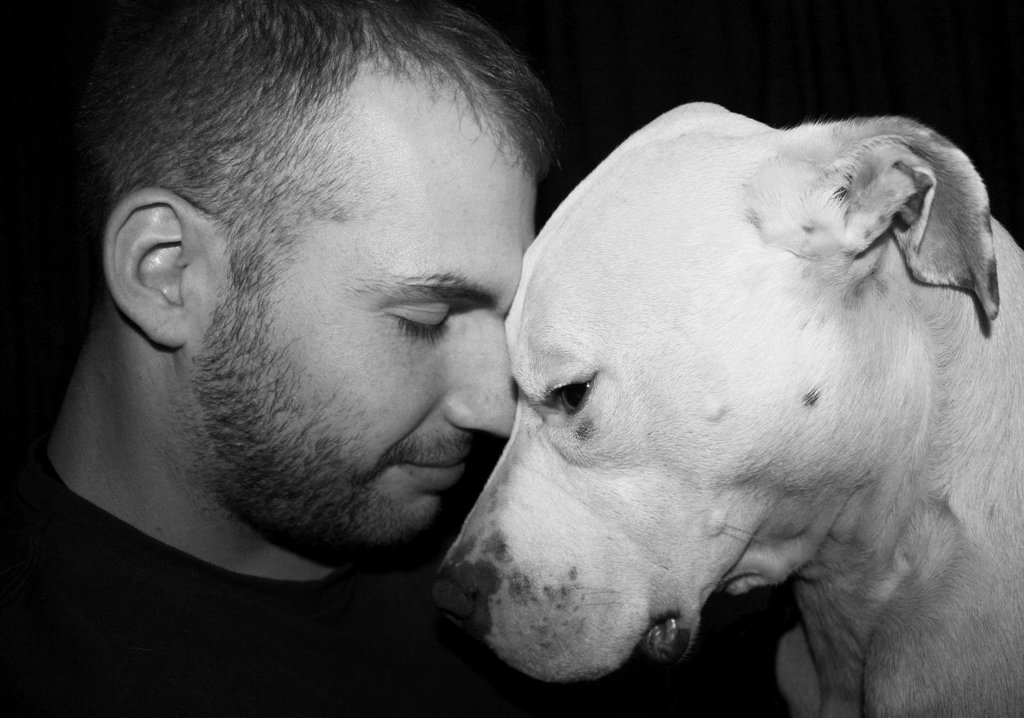
Trust me, when I’m feeling a little down the dogs all know.  All of them allow me to come and bury my face in their fur, or rest my face alongside their face.  Perhaps one of the most powerful gifts from our dogs is their wonderful, unconditional love for us funny humans.

I have no connection with Peter other than being delighted to have this guest post from him (or was it from Fergus??).  Peter offered this brief summary of his work, which I am pleased to include:

Peter Bloch has developed a form of existential and person-centred psychotherapy through touch. In this therapeutic model, health is defined as the ability to be true to oneself and open to genuine relationships with others – qualities that he finds in abundance in his dog.

The healing power of dogs.

How dogs offer us humans health and happiness.

Many months ago, I was contacted by a Peter Bloch offering to write a guest post on the subject of the healing power of dogs.  Peter had read a post that I had published in July last year which prompted the email dialogue between us.

Not going to say much more at this stage except that today I am republishing that post from last July.  On Monday, I will introduce Peter and his guest post.  Then on Tuesday, I will speak of my own experiences both as entrepreneurial mentor and as a ‘customer’ of a wonderful psychotherapist back in Devon during 2007.  Hope that works for you.

So here’s that Learning from Dogs post.

000OOOooo

The bond between dogs and humans

Such a beautiful and mutually-important relationship.

I didn’t plan to write more about this subject thinking that my last two posts, Woof at the Door and Prof. Pat Shipman, more than covered the theme; indeed much more.

But then a flurry of other articles conspired to pass my desk.

In no particular order there was an article on the Big Think website, Do Dogs Speak Human?  As the article opened,

What’s the Big Idea?

Perhaps the better question is, do humans speak dog? Either way, the debate over whether language is unique to humans, or a faculty also possessed by wild and domestic animals from dogs to apes to dolphins, is an interesting one. The answer depends on exactly how we define “language,” and who’s doing the talking, says David Bellos, the Booker prize-winning translator.

The article includes this three-minute video,

and concludes,

Broadly, a language is a mode of expression. “The argument that only human language is language and that animal communication systems, however sophisticated they are — and some of them are quite sophisticated — are not languages because they consist of discrete signals is a circular argument,” he argues. “It’s a self-fulfilling thing. And I think we should be a little bit more interested in the complexity and the variability of animal communication systems and less rigid about this distinction between what is a language and what is not a language.”

For now, we’re happy with this:

The June 30th edition of The Economist had an article entitled, Can dogs really show empathy towards humans? (You may have to register (free) to view this.)  That report ends, as follows,

As they report in Animal Cognition, “person-oriented behaviour” did sometimes take place when either the stranger or the owner hummed, but it was more than twice as likely to occur if someone was crying. This indicated that dogs were differentiating between odd behaviour and crying. And of the 15 dogs in the experiment that showed person-oriented responses when the stranger cried, all of them directed their attention towards the stranger rather than their owner.

These discoveries suggest that dogs do have the ability to express empathetic concern. But although the results are clear enough, Dr Custance argues that more work needs to be done to be sure that such behaviour is true empathy. It is possible, she points out, that the dogs were drawing on previous experiences in which they were rewarded for approaching distressed human companions. Dog-owners, however, are unlikely to need any more convincing.

It was then an easy follow-up to that Animal Cognition article which is available online here; here’s the abstract,

Empathy covers a range of phenomena from cognitive empathy involving metarepresentation to emotional contagion stemming from automatically triggered reflexes.

An experimental protocol first used with human infants was adapted to investigate empathy in domestic dogs. Dogs oriented toward their owner or a stranger more often when the person was pretending to cry than when they were talking or humming. Observers, unaware of experimental hypotheses and the condition under which dogs were responding, more often categorized dogs’ approaches as submissive as opposed to alert, playful or calm during the crying condition. When the stranger pretended to cry, rather than approaching their usual source of comfort, their owner, dogs sniffed, nuzzled and licked the stranger instead.

The dogs’ pattern of response was behaviorally consistent with an expression of empathic concern, but is most parsimoniously interpreted as emotional contagion coupled with a previous learning history in which they have been rewarded for approaching distressed human companions.

It doesn’t get closer than this.

Future uncertainties!

Prediction is very difficult, especially if it’s about the future. Niels Bohr

I love this saying from Mr. Bohr and often repeat it, albeit at times with my own twist to it.  I was reminded of this uncertainty of the future from some comments to a recent post over at Lack of Environment.  The particular post was called Can technology save us? and was a reflection of Martin Lack, the blog’s author, watching a recent BBC Horizon special called Tomorrow’s World.  (There’s the YouTube of the broadcast at the end of this post.) Martin opened his post by saying:

I happened to stumble across a BBC TV Horizon special, entitled ‘Tomorrow’s World’ last Thursday.  It begins with a fascinating review of humankind’s history of – and propensity for – invention. It also explains some truly fascinating – and inspiring – developments in the spheres of space exploration, nanotechnology, biotechnology, and power generation.

In the introduction, the programme presenter and narrator Liz Bronnin explains how, after 100’s of thousands of years of technological stagnation, the fast-moving world of technological innovation is very definitely a modern invention.

Then a little later Martin goes on to say:

After about 32 minutes, Bronnin introduces the power of the Internet to promote innovation – crowd-sourcing research funding and the concept of open-source technology – the complete abrogation of intellectual copyright… It is a fundamental challenge to globalised Capitalism; but it may well be the solution to many of our problems…

However, to me, the final third of the programme is by far the most fascinating… It looks at the challenges of finding a replacement for fossil fuels. It provides a very clear message that this is a technological challenge driven by the reality of physics – not by ideology.

But, overall, Martin lets us know his perspective with his final paragraphs:

Re-engineering nature for our benefit will, without doubt, be very very useful. However, I still think the optimism of the comment at the very end of the programme “…I never worry about the future of the human race, because I think we are totally capable of solving problems…” is very unwise. This is because anthropogenic climate disruption is a problem that is getting harder to solve the longer we fail to address it effectively.

Bronnin concludes by saying that, “it is an exciting time to be alive…” However, I remain very nervous. This is because, as Professor Peter Styles of Keele University – a strong supporter of the hydraulic fracturing industry – recently acknowledged, it will be impossible for carbon capture and storage to remove enough CO2 from the atmosphere to prevent very significant changes to our climate. This is because of the collective hypnosis that deludes most people into seeing perpetual economic growth as the solution to all our problems.

In short, I am certain that technology alone cannot save us. In order to avoid the ecological catastrophe that all but the most ideologically-prejudiced and wilfully-blind can see developing all around us… we need to modify our behaviour: This primarily means that we need to acknowledge the injustice of a “use it up and wear it out” mentality and, as individuals, all learn to use an awful lot less energy.

Climate change “sceptics” have picked a fight with history and science – primarily with the concept of Entropy – and they will lose. The only question that remains is this: Are we going to let them put us all in (what xraymike79 recently called) ‘the dustbin of failed evolutionary experiments’.

Now Jean and I also watched the Horizon special and, to be perfectly frank, found it both uplifting and inspiring.  It seemed a great counter to the overwhelming volume of commentary these days along the lines of ‘The end of the world is nigh!‘ some of that coming from yours truly! That’s not to make light of the huge hurdles ahead.

But it was a couple of comments on Martin’s post from Patrice Ayme that got me thinking.  Here’s the exchange that went between Patrice and Martin following on from a comment from Thomas Foster.

Considering that it is technology which has enabled us to “conquer” nature and thus the degradation of the environment which is a consequence of that it seems most unlikely to this writer that the cause will also bring about a cure. Thomas Foster

—–

The genus Homo has been technological for 5 million years. Give or take two million. Homo is the cure for life. Patrice Ayme

—-

If we Homo Sapiens have been technological for 5 million years, we have spent most of that time being very unsuccessful; and have spent the rest being far too successful. Is there no scope for just living in harmony with our environment (as opposed to being at war with it)? Martin Lack

—-

Hominids have been masters of the environment for at least three million years. By a million years ago, only Homo was left (but for places like Flores). Dozens of megafauna species got annihilated. Homo’s technology has extended to the entire Earth for at least a million years. The Earth itself was turned into a tool. A tool we are not at war with, but that we use. Patrice Ayme

—-

A utilitarian attitude to Nature is one that does not recognise its inherent value (i.e. which it would have even if we did not exist). Seeing ourselves as superior to Nature rather than as part of it has resulted in our not living in harmony with it. This is, by definition, equivalent to being at war with Nature. QED. Refer: Nature is not your enemyMartin Lack

—-

Call it what you want, Martin. Man manipulates nature, and that nature one calls nature has not been “natural” for more than a million years. Except if one views man as part of nature! Patrice Ayme

Patrice is a very clear thinker even if, at times, pretty hard-hitting.  But this exchange confirmed in my mind that clearly looking out to the future must always be hard.  Most certainly in this period of mankind’s evolution predicting the future is especially difficult.  Hence my contribution to Martin’s post:

Jean and I watched the Horizon special a couple of evenings ago. To be honest, I’m not entirely sure what my overall thoughts are in response to your post, Martin. What does come to mind is that old saying, “Never underestimate the power of unintended consequences.

So it may be that we are at a particular point in time, or more likely an era, where seeing clearly into the future is challenging.

The one aspect of modern life that is a game-changer is what we are doing now. Sharing ideas and thoughts across a far-flung net. Not only as the Horizon programme illustrated but as ordinary people trying to make sense of the world.

These are incredibly uncertain times.  Undoubtedly not the first in man’s long history as an historian will explain (cue to Alex!).   But to all of us alive today, these are the most uncertain times we have ever experienced!

No wonder so many of us feel lost at times in today’s world.

Here’s that BBC Horizon, courtesy of YouTube.

I will close with this thought from one masterly ‘wordsmith’, William Wordsworth.

“Life is divided into three terms – that which was, which is, and which will be. Let us learn from the past to profit by the present, and from the present, to live better in the future.”

If only we had an alpha dog!

Yearnings for a new start!

You may wonder about the title of this post?  Stay with me for a moment.

As has been written before on Learning from Dogs, when dogs were living in the wild just three animals had pack roles.  The leader of the pack, always a female animal, was the alpha dog. Second in command was the beta dog, always a dominant male, and the third role was the omega or clown dog.  The wild dog pack was thought to have consisted, typically, of about 50 animals.

Pharaoh
The wisdom of thousands of years showing clearly in Pharaoh’s eyes, our very own beta dog.

As leader of her pack an alpha dog had two primary functions .  One was having first choice as to the male dog she was going to mate with – thus demonstrating how women always choose! 😉

Her second important duty was deciding that her pack’s home range was insufficient for the needs of her ‘family’.  As wolves still do, wild dogs lived within small, well-defined territories when food was abundant.  When food became less abundant then it was time to move to more fertile grounds.  As an aside, research in South Africa as to the area requirements for a small pack of African wild dogs (Lycaon pictus) shows they require from 65 square kilometers (25 square miles) to 150 sq. km. (58 sq. mi.). (See footnote.)

Dogs, like all wild animals, instinctively live in harmony with nature.  So the call from the alpha dog to find a new range didn’t mean they left their old one as a barren disaster area.  You can see where this is heading!

Wild dogs were in contact with early man at least 50,000 years ago. (Just reflect for a moment on the length of that relationship between man and dog.) So each specie has had plenty of time to learn from the other.

Thus, as mankind is on the verge of discovering that our existing ‘territory’ is becoming unsustainable for the healthy life of the species,  one fundamental learning point from dogs appears to have escaped us: Mankind doesn’t have a new range available to our species.

This preamble came to mind when I recently read a short but powerful essay on Alex Jones’ blog The Liberated Way.  The essay was called A global leaky bucket.  Alex has very kindly given me permission to republish it.

A global leaky bucket

Global weather extremes will force people to hard choices.

Nature will have the last word in the debate over sustainability.

I write this in despair, it is snowing again here in Colchester UK.  I admit envy for those of you who live in California or Hong Kong area, I see your photographs where the seasons always seem to be warm and sunny.  The northern Jet Stream refuses to move, Greenland enjoys growing strawberries as the lambs die in the fields of Britain from the winter that refuses to let go.

The extremes of weather are noted in the South of the world as well as the North.  Argentina has had the worst floods in decades last week.  The cause is that the systems such as the Jet Stream are paralysed in one place, thus everyone suffers flood, drought or winter in excess.  Nobody is sure why this paralysis is going on with systems like the Jet Stream, some say it is climate change, the point is that we are experiencing this, and it appears to be more than a temporary issue.

My opinion is that these weather extremes are here to stay for the long duration.  One is then left with a harsh reality of does one seek to control the weather or adapt to the weather? How does one control the weather, a chaotic energy system where even a small change can have great consequences? Perhaps adaptation is the better option, but does one know how huge those adaptations will have to be where drought and flood could be lasting decades?

Lets say food, water and energy are all contained in a bucket.  We take a jug and scoop out from the bucket what we need.  There is a tap that is constantly running filling the bucket with the food, water and energy.  We waste those resources so the bucket leaks.  We disrupt or destroy the renewal systems in the ecosystems so the tap is no longer running as fast as it should.  We are greedy consumers so we take more than we need from the bucket with our jug.  How will the bucket look now? Is this a sustainable future to you?

If our global weather extremes continue as they are it will be like a storm rocking the bucket spilling its contents, will our bucket future look even less sustainable? Extreme weather destroys harvests, kills animals, sends already distressed ecosystems into the abyss.  What happens when the bucket is so empty that people can no longer enjoy their lifestyle of wasteful excess, or worse that people grow cold, hungry and thirsty? Do they sit there and do nothing but die? Will they fight? Who will fight who? As the bucket contents get ever smaller, who will win in the fighting for what is left?

Copyright (c) Alex Jones 2011-2013.

Colchester has a place in my past as I started and ran a business there between the years of 1978 to 1986.  More about that some other day.

Back to Alex’s essay.  It strongly resonated with a recent item on Peter Sinclair’s excellent blog Climate Denial Crock of the Week which I will refer to tomorrow.

So I will leave you with this tragic, emotional thought – where, oh where, is our alpha dog?

Footnote:  The figures for the ranges of wild dogs were taken from a fascinating paper published by Lindsay, du Toit and Mills that may be read here.

Lust, laughter and loyalty!


Something else we really can learn from dogs.

I’m not sure that I should admit that my dearest Jeannie is my 4th wife!  Long story that goes back to when I had just turned 12 years-old, back in 1956. I suffered an event that I interpreted as emotional rejection and promptly buried that deep into my subconscious where it stayed for over 50 years.

Then brought to the surface in 2007 (thanks Jon) after the failure of marriage number 3.  I met Jean some 6 months later, in December 2007, and we were married in Payson, AZ in November, 2010.  Being with Jean has been the happiest days of my life!

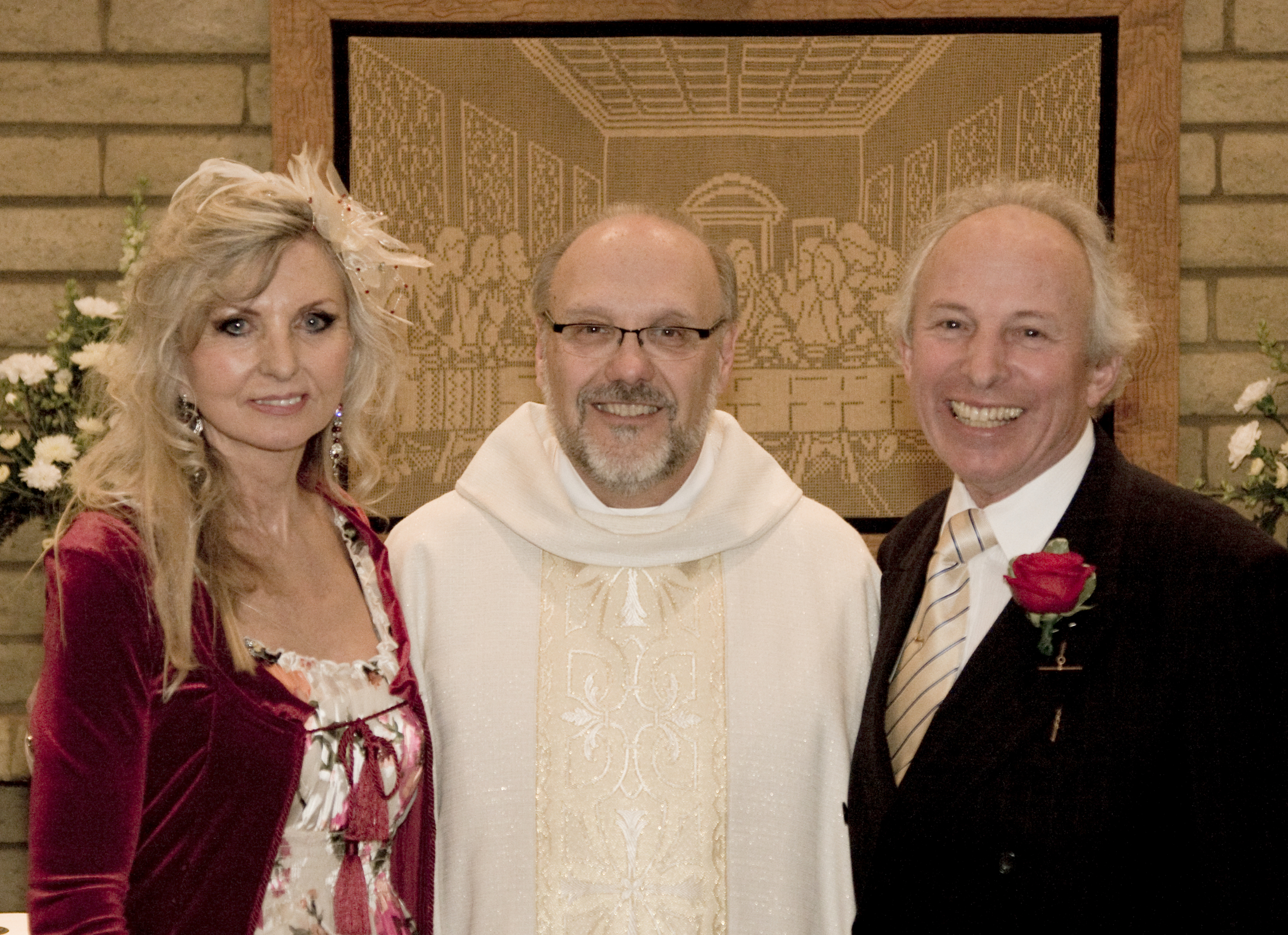
Jean, Father Dan and yours truly. St Paul's Episcopal Church, Payson, AZ. November 20th, 2010.
Jean, Father Dan and yours truly. St Paul’s Episcopal Church, Payson, AZ. November 20th, 2010.

Inevitably, while being married to Jean seems such a natural relationship, one is curious about what makes for a happy, lifelong relationship. Let’s face it, divorce is not uncommon.  In fact, the Divorce Rate website reveals that in 2012, the divorce rate was 3.4 couples per 1,000 population in the USA; the sixth highest in the world.

So it was fascinating to listen to a recent radio programme broadcast under the BBC’s Point of View series.  Just 10 minutes long, this particular programme was a talk by Adam Gopnik: The secret of a happy marriage 29th March 2013.  (Adam Gopnik is an American commentator and writes for The New Yorker.)

You should be able to listen to the programme by going here.  Or you can download the programme by going here, and following the instructions.  (Not sure how long the programme will be available to listen/download, so don’t delay.)

The programme was also featured on the BBC News Magazine Website. From which I quote:

A Point of View: Is there a secret to a happy marriage?

Nobody can explain the secret to a happy marriage, says Adam Gopnik, but it doesn’t stop people trying.

Anyone who tells you their rules for a happy marriage doesn’t have one. There’s a truth universally acknowledged, or one that ought to be anyway.

Just as the people who write books about good sex are never people you would want to sleep with, and the academics who write articles about the disappearance of civility always sound ferociously angry, the people who write about the way to sustain a good marriage are usually on their third.

Nonetheless (you knew there was a nonetheless on its way) although I don’t have rules, I do have an observation after many years of marriage (I’ve promised not to say exactly how many, though the name “Jimmy Carter” might hold a clue).

Later, Adam Gopnik speaks about Charles Darwin whose marriage to Emma he describes “as something close to an ideal marriage.

So what is it we learn from dogs?

So, marriages are made of lust, laughter and loyalty – but the three have to be kept in constant passage, transitively, back and forth, so that as one subsides for a time, the others rise.

Now Adam writes about the special form of loyalty that dogs offer us:

Be lit by lust, enlightened by laughter, settle into loyalty, and if loyalty seems too mired, return to lust by way of laughter.

I have had this formula worked out – and repeated it, waggishly, to friends, producing for some reason an ever more one-sided smile on the face of my beautiful wife.

Until, not long ago, I realised that there was a flaw in this idea. And that was that I had underestimated the reason that loyalty had such magnetic power, drawing all else towards it.

For I had been describing loyalty in marriage as though it were a neutral passive state – a kind of rest state, a final, fixed state at the end of the road of life.

And then, against our better wishes, and our own inner version of our marriage vows, at our daughter’s insistence we got a dog. And this is what changed my view.

“The expense and anxiety of children” indeed. Our daughter’s small Havanese dog, Butterscotch, has instructed us on many things, but above all on the energy that being loyal really implies.

Dogs teach us many things – but above all they teach us how frisky a state loyalty can be.

Dogs, after all – particularly spayed city dogs that have been denied their lusts – have loyalty as an overriding emotion. Ours will wait for hours for one of its family, and then patiently sit right alongside while there is work to be done.

Loyalty is what a dog provides. The ancient joke-name for a dog, Fido, is in truth the most perfect of all dog names – I am faithful. I am loyal. I remain.

Dogs are there to remind us that loyalty is a jumpy, fizzy emotion. Loyalty leaps up at the door and barks with joy at your return – and then immediately goes to sleep at your side. Simple fidelity is the youngest emotion we possess.

The loyalty of a dog. No more to be said.

The love and loyalty of Hazel.

It really is a very simple message!

Repeat after me: We are of this planet!  It’s really very simple!

There are times when I look back at my writings on Learning from Dogs, now well over 1,500 posts (1,633 as of today, to be anal about it!) and ponder if the fundamental message behind the name of the blog often gets overlooked.  The Welcome page states:

As man’s companion, protector and helper, history suggests that dogs were critically important in man achieving success as a hunter-gatherer. Dogs ‘teaching’ man to be so successful a hunter enabled evolution, some 20,000 years later, to farming, thence the long journey to modern man. But in the last, say 100 years, that farming spirit has become corrupted to the point where we see the planet’s plant and mineral resources as infinite. Mankind is close to the edge of extinction, literally and spiritually.

Dogs know better, much better! Time again for man to learn from dogs!

Elsewhere on the blog, I underpin that proposition by listing the attributes of dogs:

Dogs:

  • are integrous ( a score of 210) according to Dr David Hawkins
  • don’t cheat or lie
  • don’t have hidden agendas
  • are loyal and faithful
  • forgive
  • love unconditionally
  • value and cherish the ‘present’ in a way that humans can only dream of achieving
  • are, by eons of time, a more successful species than man.

Now this is all fine and dandy but of what relevance is this to the mess that homo sapiens now finds itself in? Two parts to that answer come to mind.

The first part is that watching a dog out in the open countryside quickly brings home the fact that these animals are part of nature and, if push comes to shove, can live in the wild and fend for themselves.  Not saying that a domestic dog would enjoy the experience but that their wild dog and grey wolf roots still rest somewhere in a dog’s consciousness.

The second part of the answer is that all animals instinctively live in harmony, in balance, with their surroundings; with their environment.

For the incredibly obvious reason that dogs, as with all other animal species, are an evolutionary consequence of the natural history of Planet Earth.  That evolutionary journey from the Grey Wolf (Canis lupus) part of the Canidae family, a family including wolves, coyotes and foxes, thought to have evolved 60 million years ago.  That journey all the way to the domestic dog (Canis lupus familiaris).

That ancient journey where the African wild dog (Lycaon pictuspainted dog) came together with early man. No one knows when but the African wild dog was certainly around when man developed speech and set out from Africa, about 50,000 years ago!

Two vastly different natural species, dog and man, evolving compatibly with each other for so many thousands of years.

Back to the attributes of dogs, in particular a dog’s ability to cherish the present.  Earlier this week I was chatting with Kevin Dick, friend from Payson, AZ days, about the ‘interesting’ times we are living in.  Kevin thought there was a significant difference between the generations born in the 1940’s and 1950’s and those born in later times.  Most people over the age of, say 55, were brought up to save for ‘a rainy day’ and, possibly, be able to leave a legacy to their offspring.  Kevin then went on to reflect that more recent generations exhibit a ‘buy today, don’t delay’ mentality.

A by-product of this materialistic instant gratification approach is that the whole damn consumer machine has created a total disconnect with the fact that we humans are of this planet.

The earth is the mother of all people..

(Chief Joseph 1840 – 1904, leader of the Wallowa band, a Native American tribe

indigenous to the Wallowa Valley in northeastern Oregon)

Humans today fail to comprehend this fundamental fact: Our ability to harm the planet and think that it won’t affect our species is complete madness!  If only we could learn how to cherish the present in the way that our dogs do!

I’m now going to offer an essay from John Hurlburt.  I knew John had written this essay but didn’t get round to reading it properly until I had finished the introduction above.  I’m blown away by the resonance between the two but, as always, John’s words are so much more eloquent.

Inside Out

Climate change, religion, economics, government, politics and social issues are topics which create strong personal opinions and cultural divisions. We have difficulty accepting ideas which may conflict with our personal understandings. As usual, it’s an ego thing. The arrogance of our species is inclusive. We all suffer the consequences.

To counter our ego, we know that everything fits together. We exist in a unified cosmos with fluctuations and diversities that emerge around and through us.

Our present transformative state is as a biological form of energy and matter which possesses a conscious awareness of the natural order. We choose to ignore or deny the essential nature of our being at our own peril. Do we live only for the moment or do we live to insure our species future? That’s our fundamental choice.

Seek the truth and identify the common good.” Zoroaster [also known as Zarathustra, Ed.]

We are a consciously aware component of a living world in an isolated corner of a remote galaxy. Everything within and on the earth has an extraterrestrial origin. We live on an incubator we call the earth. We rarely truly communicate with or fully understand the energy of nature in our lives. Our critical thinking ability has become enveloped by an electronic cloud.

We generally agree that the actions of many religions and most politics are based upon short term human interests rather than upon the long term well being of our planet and its disappearing life forms. The fact is that we only began to emerge as a species about 100,000 years ago. Hubble telescope observations have dated our universal origin to roughly 13,002,000,000 years ago.

Could it be that we only imagine ourselves as independent beings? Could it be that beyond the mind games we play there is a vast reality greater that we can understand with our limited sensory apparatus and our finite minds?

Life is a transformative experience. All species, tribes, races and genders are united by the nature of life. We pass through a period of being selfish and ambitious during our journey. Many of us choose to move into these familiar ruts and furnish them. We do not always walk the way we talk.

Nature favors species which adapt to constant change in an emerging universe.

If we agree that our intelligence is judged by choices we make, there is some question about intelligent human life on earth. A recent Harvard University study of species in relation to change estimates that the life span of the human species is approximately 100,000 years. Sound familiar?

The wisdom of our brief human history tells us that we are on a careless and needless path to self destruction. All that’s necessary to verify this assertion is to turn on the news of the day. The systemic paradigm that has been imprinted on our psyches is in constant flux. As we live and learn, we realize that our purpose is to leave life better than we found it.

A delicate balance is necessary to maintain an even strain of faith in the natural process rather than dwelling upon our self centered fears of losing something we imagine we own or not attaining something we believe we want. The earth heals itself from the inside out. We can do the same as a species. Today is the tomorrow we dreamed of yesterday. What have we done to fulfill the true purpose of our lives?

an old lamplighter

So, yes, we have much to learn from dogs.

I will close as I started. We are of this planet!  It’s really very simple!