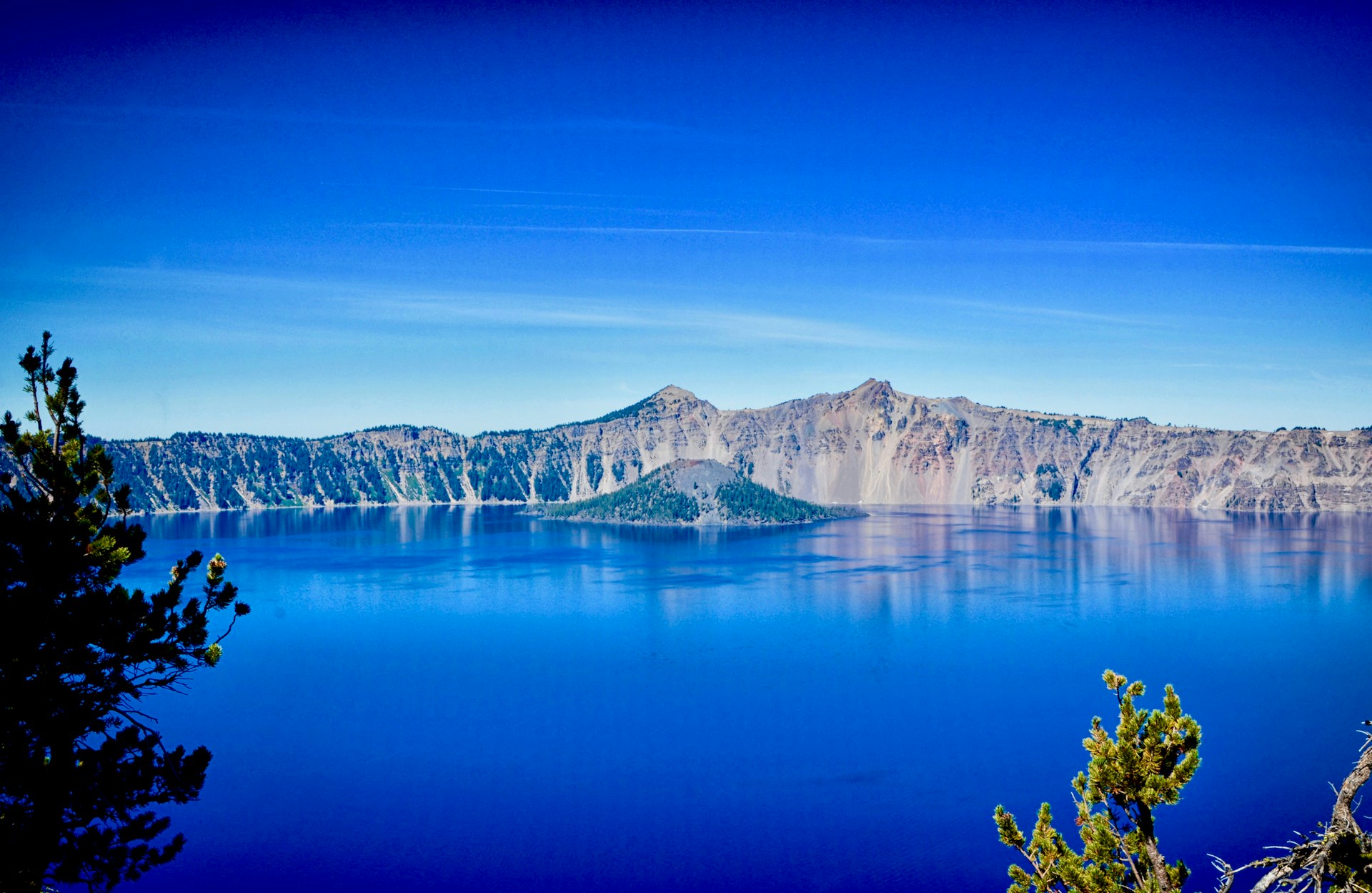
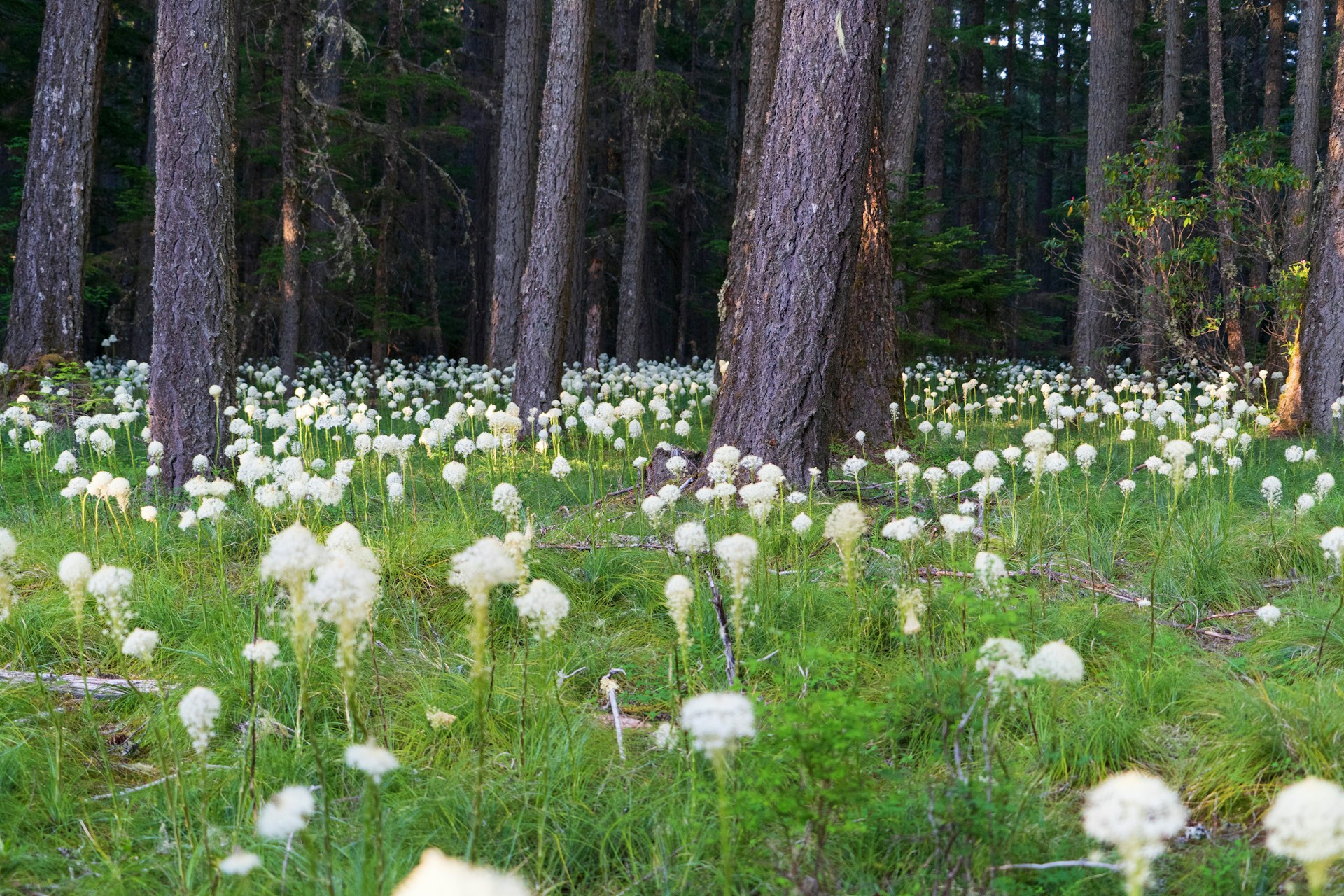
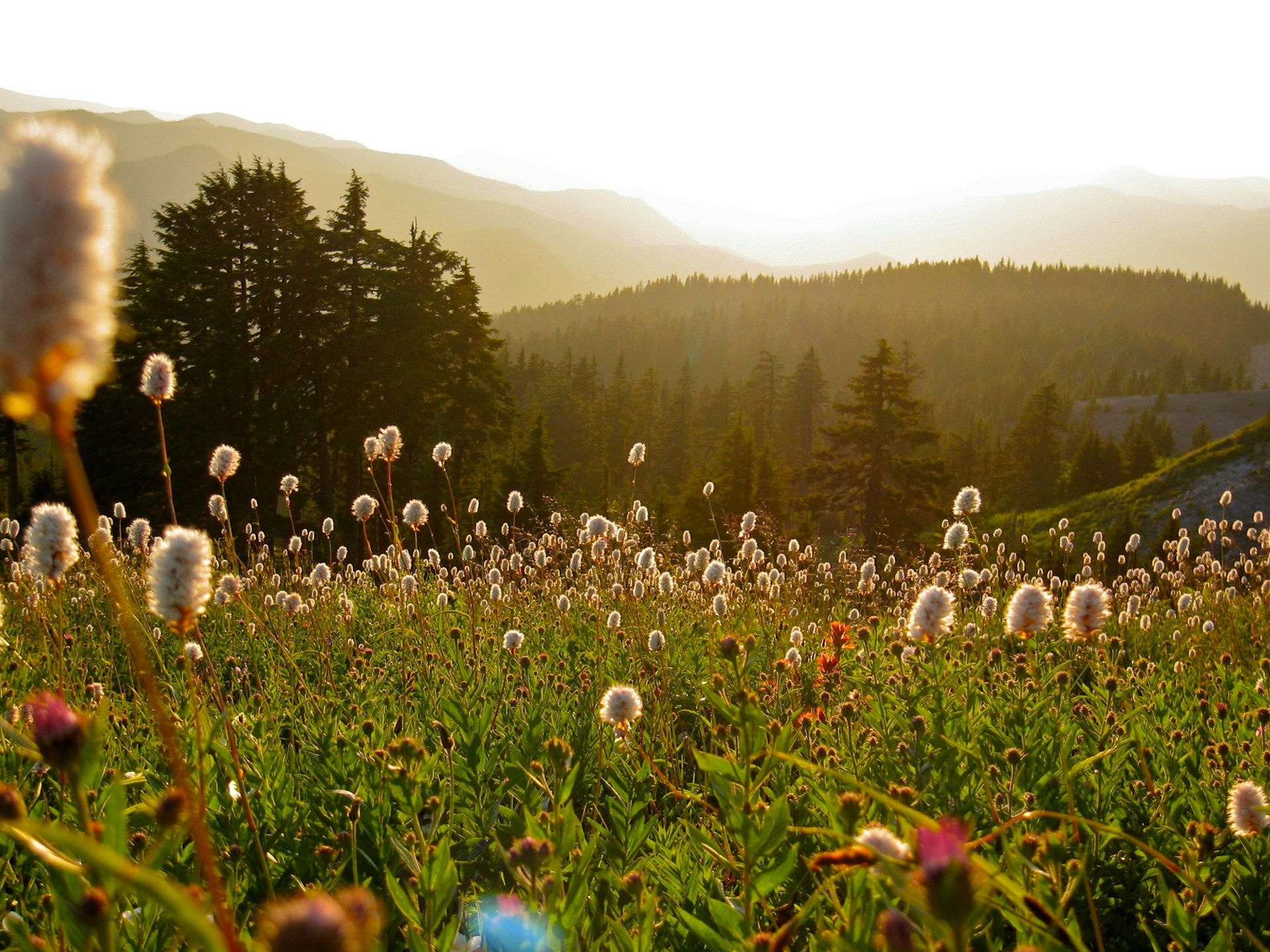
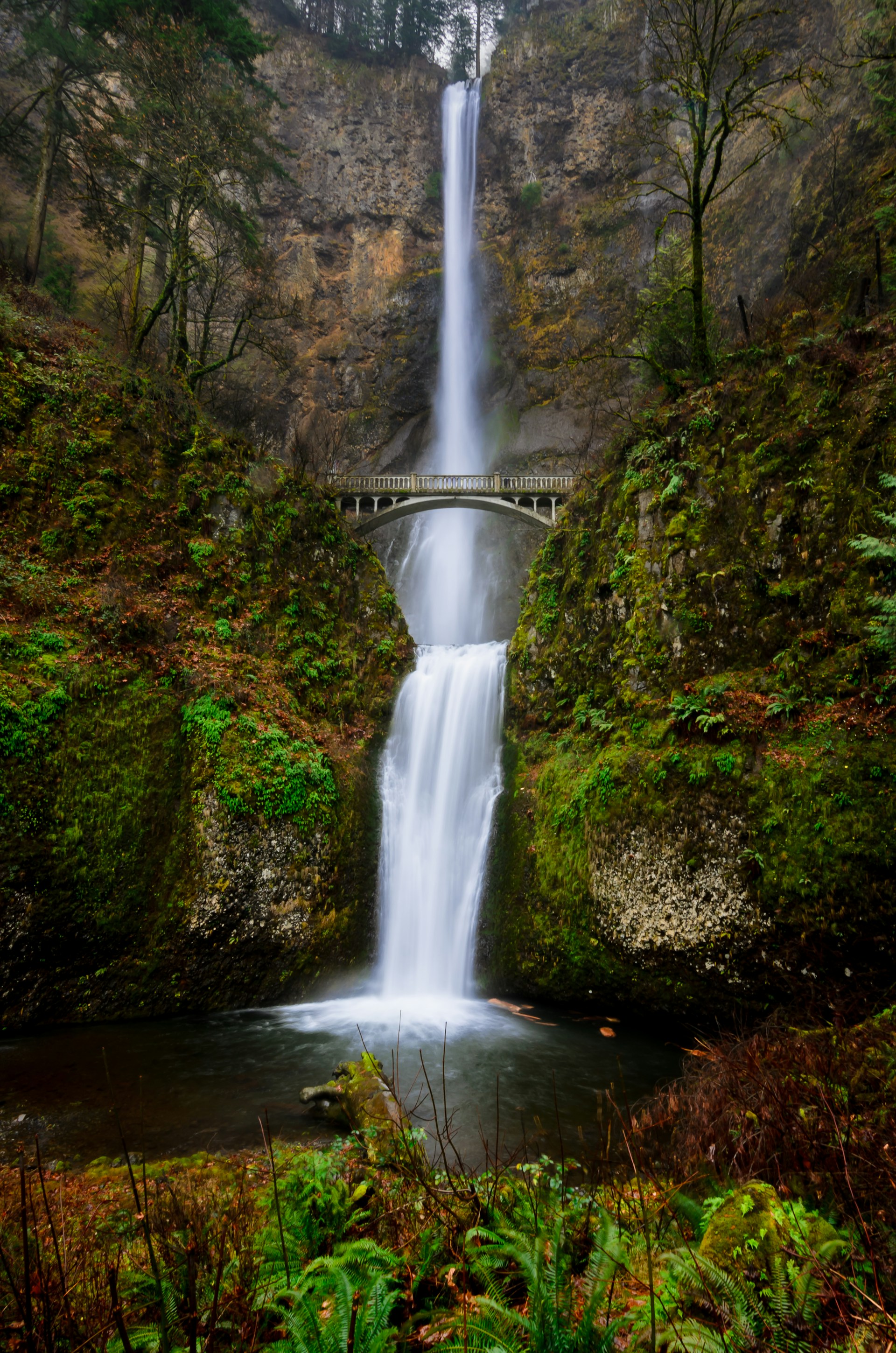
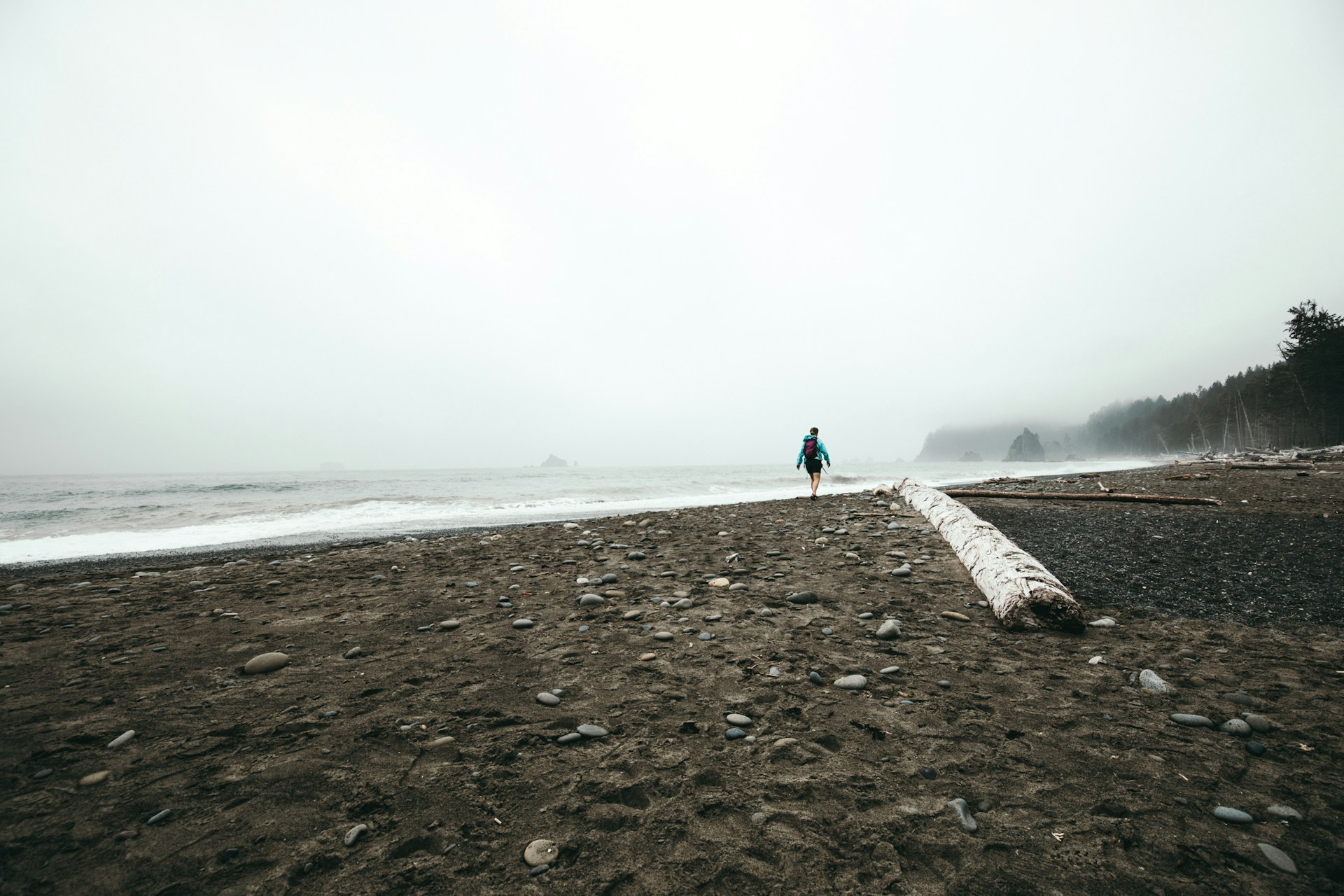
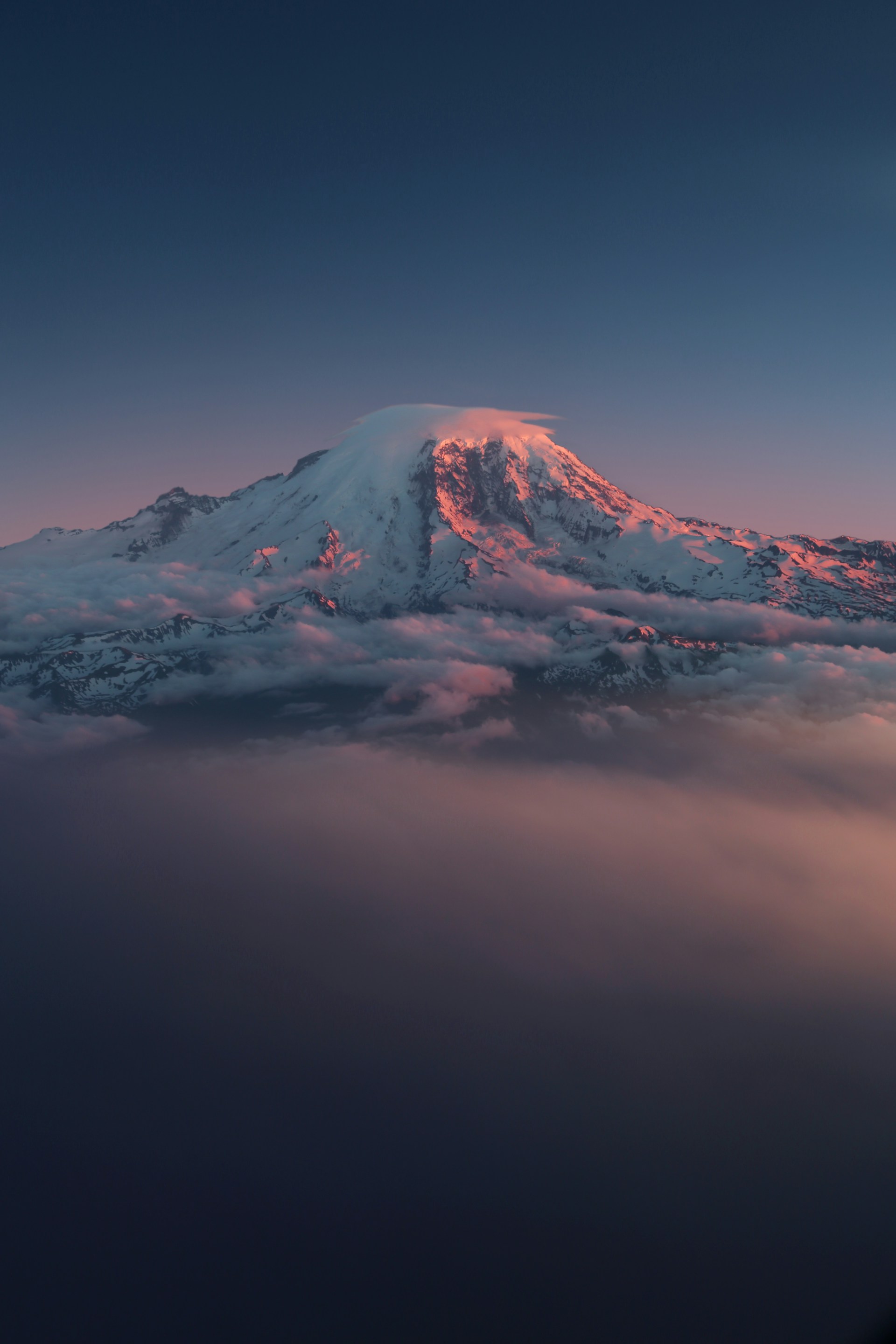
It was formed when this former volcano, “which collapsed on itself during an eruption just 7,700 years ago and slowly filled with melted snow, now stands as Oregon’s only national park.”
At over 2,000 feet deep it is the deepest lake in the United States of America.
There is quite a long introduction but it helps enormously in explaining the background to the photographs.
ooOOoo
This image is released as part of the Early Release Observations from ESA’s Euclid space mission. All data from these initial observations are made public on 23 May 2024 – including a handful of unprecedented new views of the nearby Universe.
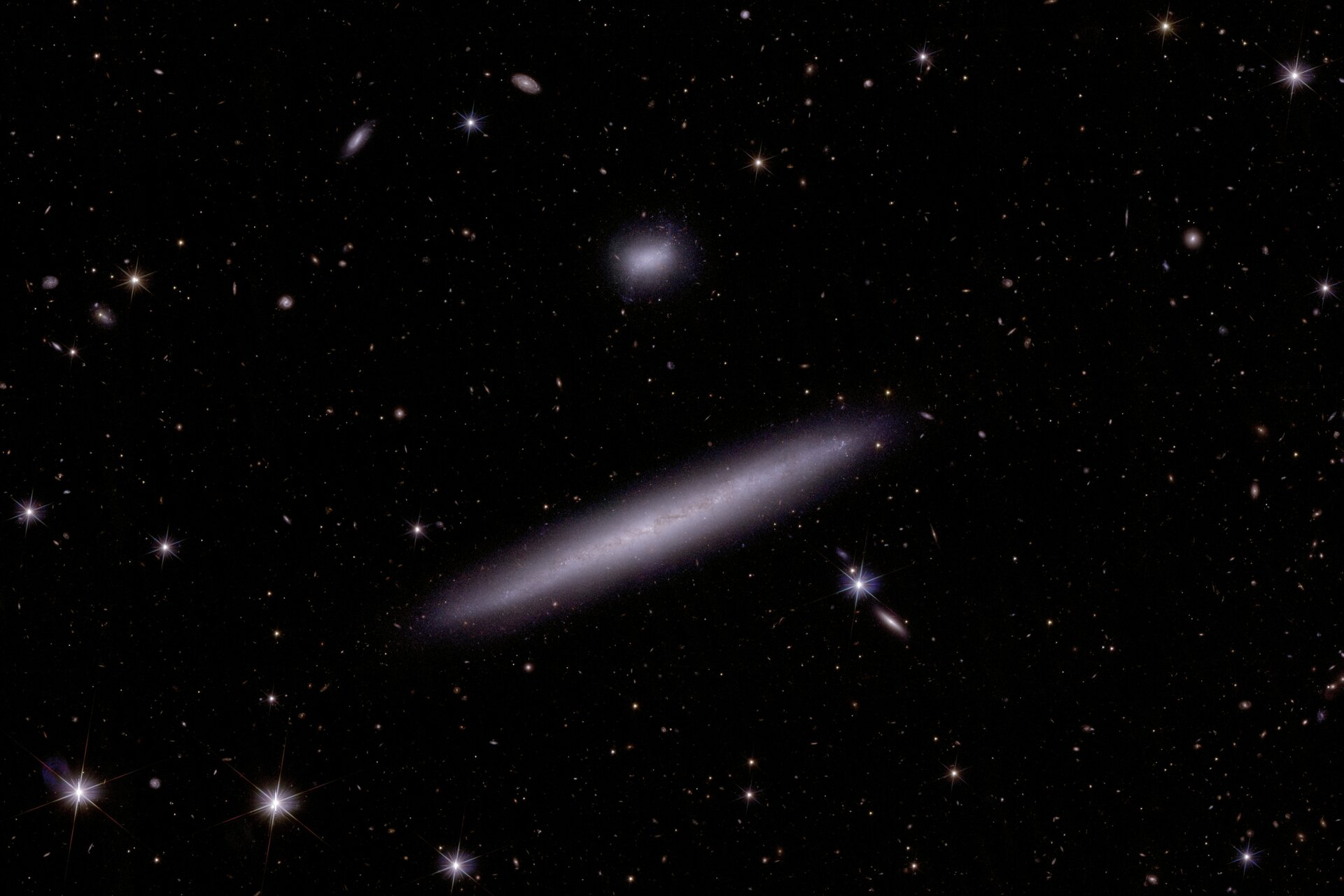
The Dorado Group of galaxies is one of the richest galaxy groups in the southern hemisphere. Here, Euclid captures signs of galaxies evolving and merging ‘in action’, with beautiful tidal tails and shells visible as a result of ongoing interactions. As Dorado is a lot younger than other clusters (like Fornax), several of its constituent galaxies are still forming stars and remain in the stage of interacting with one another, while others show signs of having merged relatively recently. In size, it sits between larger galaxy clusters and smaller galaxy groups, making it a useful and fascinating object to study with Euclid.
This dataset is enabling scientists to study how galaxies evolve and collide over time in order to improve our models of cosmic history and understand how galaxies form within halos of dark matter, with this new image being a true testament to Euclid’s immense versatility. A wide array of galaxies is visible here, from very bright to very faint. Thanks to Euclid’s unique combination of large field-of-view and high spatial resolution, for the first time we can use the same instrument and observations to deeply study tiny (small objects the size of star clusters), wider (the central parts of a galaxy) and extended (tidal merger tails) features over a large part of the sky.
Scientists are also using Euclid observations of the Dorado Group to answer questions that previously could only be explored using painstakingly small snippets of data. This includes compiling a full list of the individual clusters of stars (globular clusters) around the galaxies seen here. Once we know where these clusters are, we can use them to trace how the galaxies formed and study their history and contents. Scientists will also use these data to hunt for new dwarf galaxies around the Group, as it did previously with the Perseus cluster.
The Dorado Group lies 62 million light-years away in the constellation of Dorado.
All images are: ESA/Euclid/Euclid Consortium/NASA, image processing by J.-C. Cuillandre (CEA Paris-Saclay), G. Anselmi
Composite image of five astronomical views, three at the top, two at the bottom. All are dotted with stars and galaxies against a black background. Striking features are three bright glowing structures in the first image. The second image has an orange veil-like structure spanning across. In the third we see a stunning spiral galaxy with many arms. The fourth image features light from galaxies lying behind a bright cluster distorted into arcs. And the fifth image shows a variety of galaxies in all shapes and sizes
An elongated bright cloudy ellipse, tilted at a 45-degree angle in front a black background dotted with small white stars and galaxies. Above the ellipse floats a smaller, cloudy ellipsoid.
A dark orange filamentary structure seems to enclose stars. Centrally, three bright star-forming regions shine brightly through the orange veil in a traffic-light like formation.

The image shows hundreds of stars, some brighter than others. The stars seem to light up their cloud-like surroundings in purple. A darker structure spans the image in an arch from upper left to bottom right. The bottom of this arch runs into dense clouds forming the darkest part of the image.
This breathtaking image features Messier 78 (the central and brightest region), a vibrant nursery of star formation enveloped in a shroud of interstellar dust. This image is unprecedented – it is the first shot of this young star-forming region at this width and depth.
Today, (May 23rd, 2024) ESA’s Euclid space mission releases five unprecedented new views of the Universe. The never-before-seen images demonstrate Euclid’s ability to unravel the secrets of the cosmos and enable scientists to hunt for rogue planets, use lensed galaxies to study mysterious matter, and explore the evolution of the Universe.
ooOOoo
Fabulous. It is an example of just how clever the science is getting!
I can only look at these images in awe. For example, Messier 78 is part of the Orion constellation, has a radius of five light-years, and is only 1,600 light-years from Planet Earth. (Using the figure from below of the distance of a single light-year, that puts Messier 78 as 1,600 times 6 trillion miles from our planet or 9,600 trillion miles.)
And in case you forgot it, one light year is:
The light-year is a measure of distance, not time. It is the total distance that a beam of light, moving in a straight line, travels in one year. To obtain an idea of the size of a light-year, take the circumference of the earth (24,900 miles), lay it out in a straight line, multiply the length of the line by 7.5 (the corresponding distance is one light-second), then place 31.6 million similar lines end to end. The resulting distance is almost 6 trillion (6,000,000,000,000) miles!
“This is far ahead of my knowledge of science. I applaud you for writing this despite me not understanding it”
So it may seem a little strange that I now publish the following. It was published originally on Skeptic. It is quite a long video but, please, settle down and watch it.
ooOOoo
Sean Carroll is creating a profoundly new approach to sharing physics with a broad audience, one that goes beyond analogies to show how physicists really think. He cuts to the bare mathematical essence of our most profound theories, explaining every step in a uniquely accessible way.
Quantum field theory is how modern physics describes nature at its most profound level. Starting with the basics of quantum mechanics itself, Sean Carroll explains measurement and entanglement before explaining how the world is really made of fields. You will finally understand why matter is solid, why there is antimatter, where the sizes of atoms come from, and why the predictions of quantum field theory are so spectacularly successful. Fundamental ideas like spin, symmetry, Feynman diagrams, and the Higgs mechanism are explained for real, not just through amusing stories. Beyond Newton, beyond Einstein, and all the intuitive notions that have guided homo sapiens for millennia, this book is a journey to a once unimaginable truth about what our universe is.
Sean Carroll is Homewood Professor of Natural Philosophy at Johns Hopkins University, and Fractal Faculty at the Santa Fe Institute. He is host of the Mindscape podcast, and author of From Eternity to Here, The Particle at the End of the Universe, The Big Picture, and Something Deeply Hidden. He has been awarded prizes and fellowships by the National Science Foundation, NASA, the American Institute of Physics, the Royal Society of London, and many others. He lives in Baltimore with his wife, writer Jennifer Ouellette. His new book series, The Biggest Ideas in the Universe, includes one volume on Space, Time, and Motion, and this new volume on Quanta and Fields.
Shermer and Carroll discuss:
the measurement problem in physics
wave functions
entanglement
fields
interactions
scale
symmetry
gauge theory
phases
matter
atoms
What is time?
Is math all there is? Is math universal?
double-slit experiment
superposition
metaphors in science
limitations of models and theories of reality
What banged the Big Bang?
Why is there something rather than nothing?
Second Laws of Thermodynamics and directionality in nature
Is there a place for God in scientific epistemology?
many interpretations of quantum mechanics
multiple dimensions and the multiverse
string theory and the multiverse
known unknowables: Are there things we can never know, even in principle?
God
hard problem of consciousness
free will/determinism.
ooOOoo
I’m assuming you have watched the video because in a world that is pre-occupied with the trivial this is just the opposite. Sean shares his physics in a profoundly different and powerful way!
There is no shortage of glorious stories about dogs, and thank goodness for that! Recently I saw an article on The Dodo about a dog and I wanted to share it with you.
ooOOoo
Dog Dumped In Desert Finds Construction Site — Then Begs Workers To Save Her
When Jeanean Gillespie clocked into work at a construction site earlier this month, she expected to see the usual handful of people around. Her office, located on an uninhabited stretch of desert, managed the new housing developments being built — and no one, other than her team of workers, was authorized to be there.
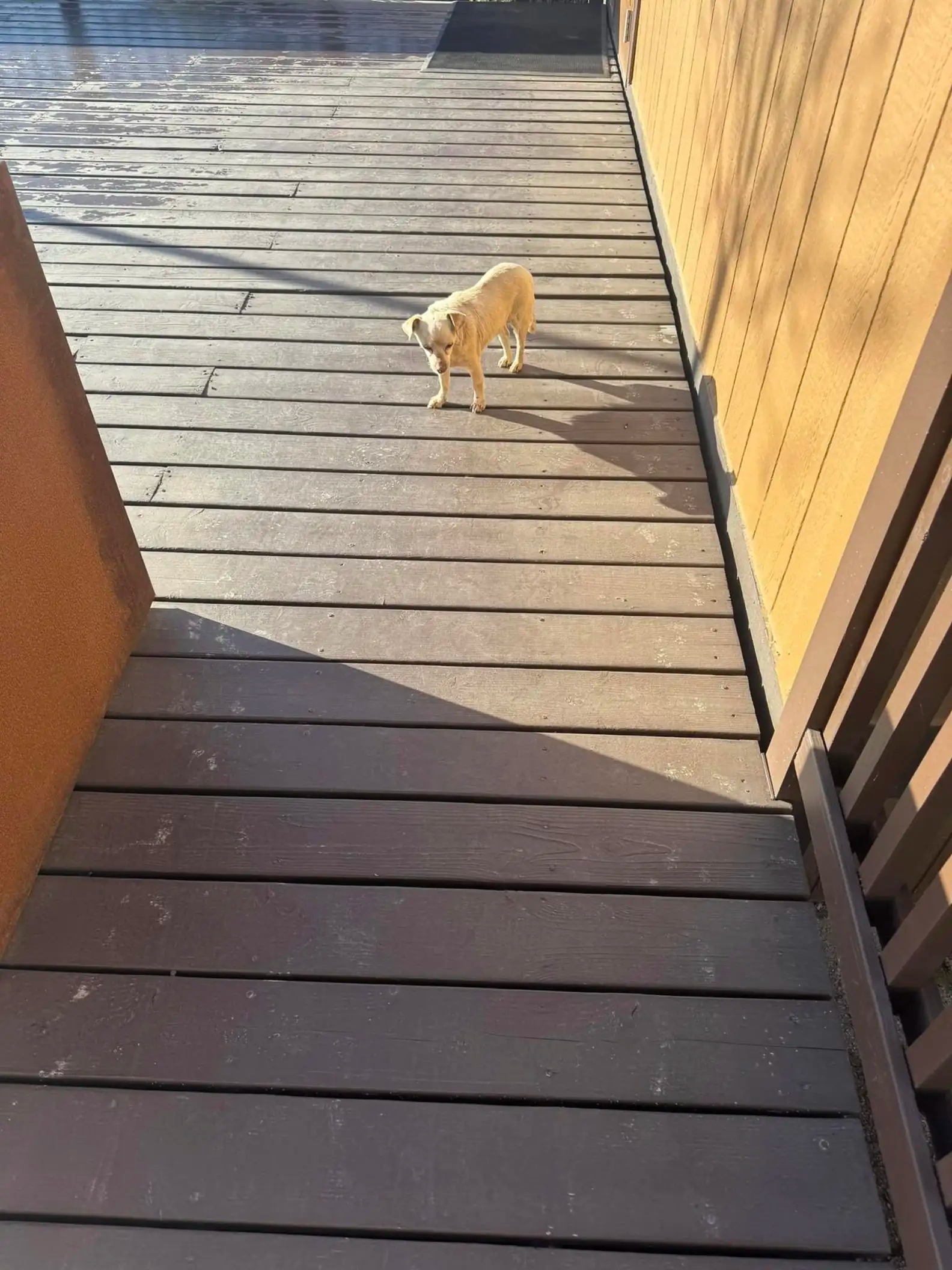
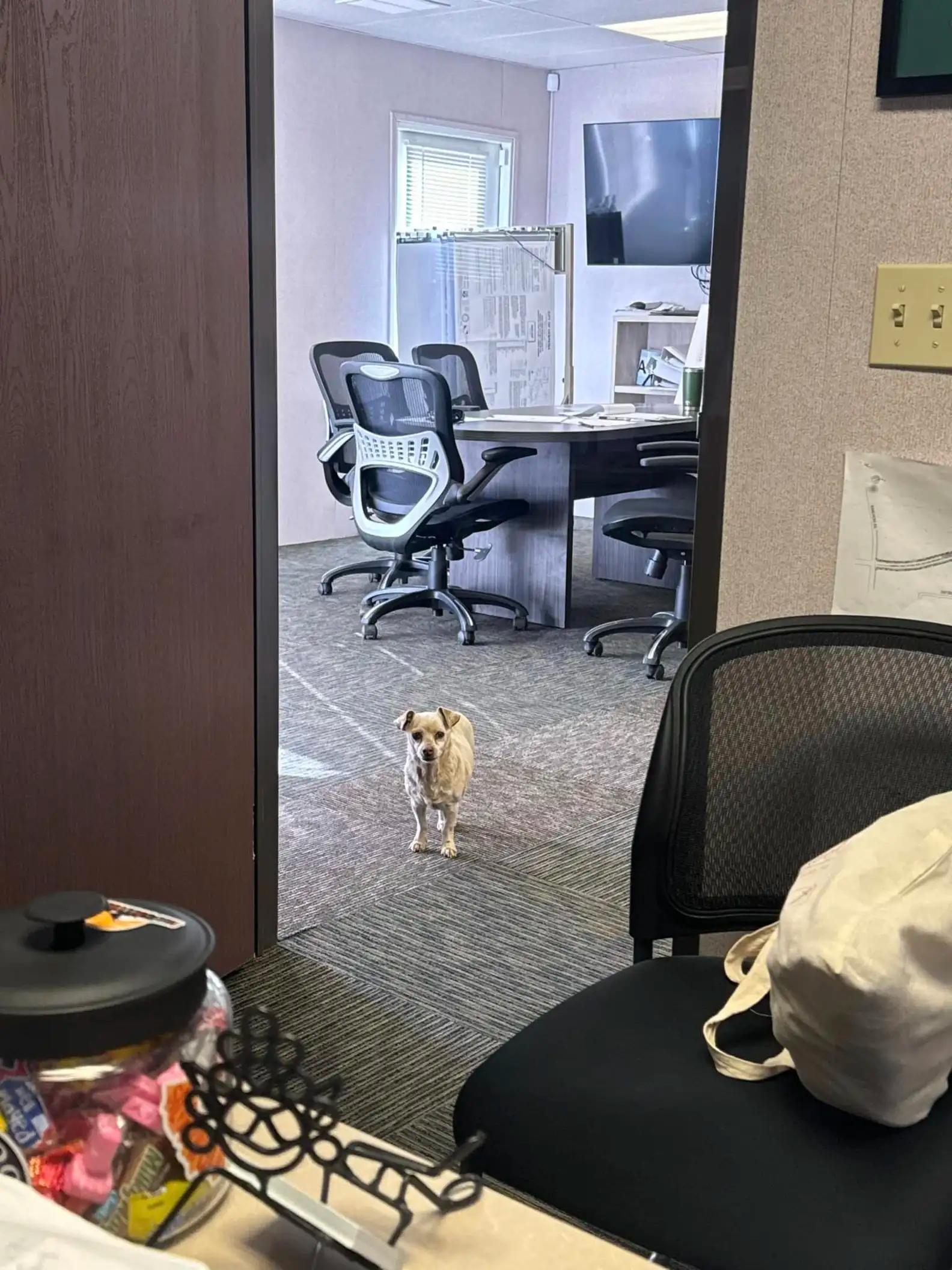
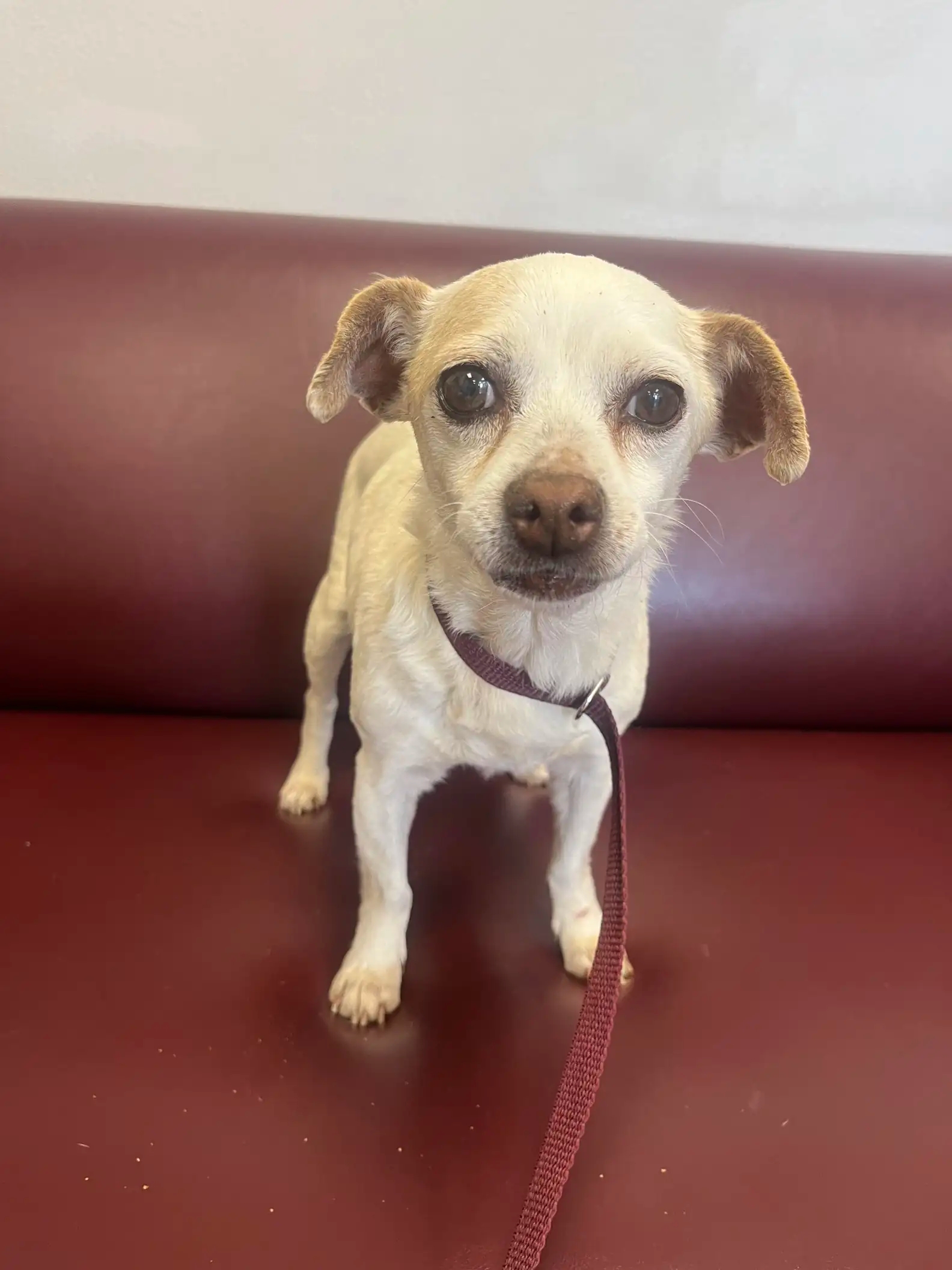
So when she saw two tiny eyes peering at her through her office doorway that morning, she jumped. The tiny pup had seemingly shown up out of nowhere, and she was desperate for someone to see her.
Suzette Hall
“She wanted to be noticed, she wanted help,” Suzette Hall, founder of Logan’s Legacy 29, wrote on Facebook. “Thank goodness my dear, dear friend, Jeanean Gillespie, worked there.”
Gillespie’s heart dropped when she realized the little dog, later named Sage, was all alone in the dangerous desert. With bobcats and coyotes lurking nearby, Gillespie knew time was of the essence to save Sage.
The compassionate worker tried repeatedly to capture Sage, but the scared pup ran away every time. After a few failed attempts, Gillespie called Hall for backup and placed food and water by the door for her in the meantime.
Suzette Hall
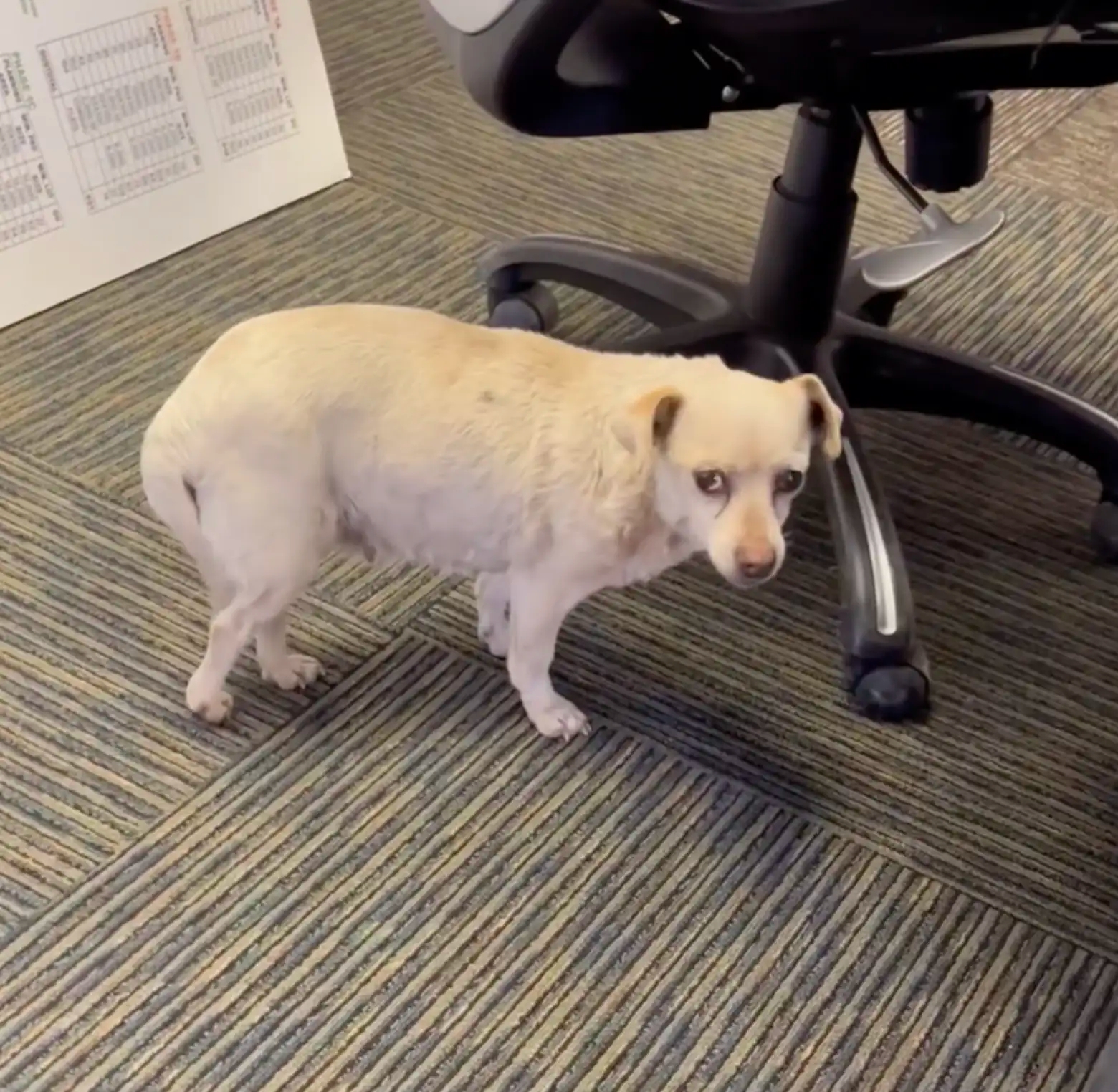
Sage was frightened by her new friends, but she still felt safe in their care. As they came up with a rescue plan, Sage figured out how to get as close as possible to them while still keeping her distance.
“She would sleep outside the office doors at night,” Hall wrote. “They all tried to help her, but she wouldn’t let anyone get close.”
Suzette Hall
Gillespie tried gaining Sage’s trust each day and eventually lured her inside the office. Hall arrived soon after, and the experienced rescuer recognized Sage’s demeanor instantly.
“When I got there, she was so scared, but she wanted to surrender so bad,” Hall said. “She was exhausted.”
Suzette Hall
Hall calmed the skittish dog and successfully scooped her up shortly after arriving. As scared as Sage was, she instantly felt comforted in Hall’s arms.
“[W]ithin minutes, she melted safely into my arms,” Hall wrote. “She knew she was safe from loneliness …”
Suzette Hall
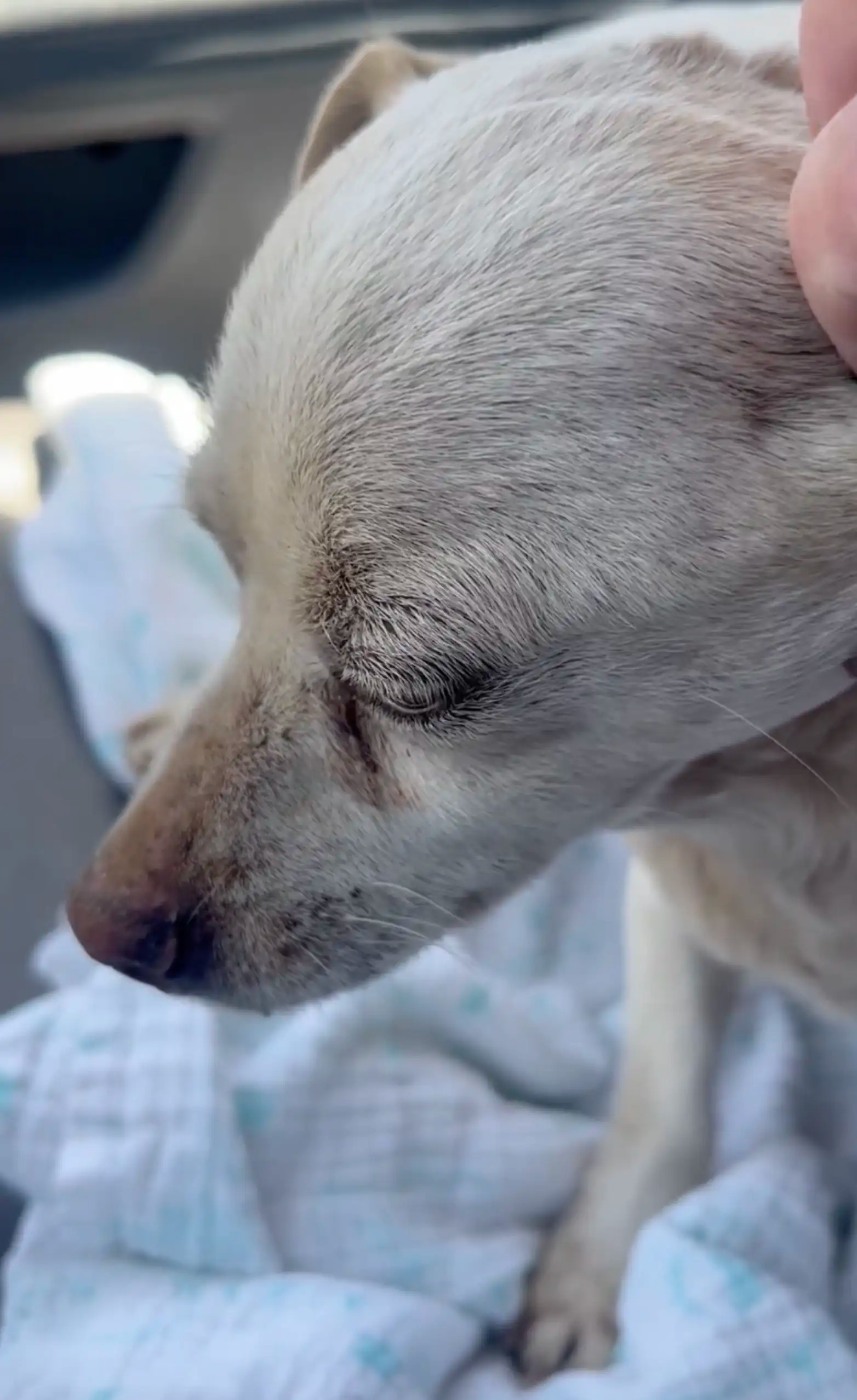
Gillespie waved goodbye to the resilient pup as Hall loaded her into the car and drove off to Camino Pet Hospital. After days of surviving on her own in the desert, Sage got some much-needed rest.
“She fell fast asleep on the drive back,” Hall said. “She closed both eyes for the first time in days. She was rescued and she knew it.”
Suzette Hall
It’s been a couple of weeks since Sage’s rescue, and the survivor pup is still recovering from the ordeal. Aside from needing a growth removed, a dental cleaning and a spay, Sage is overall healthy. But her spirit is still broken.
“Poor Sage is not feeling well … her blood work came back normal, but she is just so sad,” Hall told The Dodo. “She needs love. She is just longing for it.”
Suzette Hall
Sage is scheduled for surgery soon, and Hall hopes to find her an amazing family once she’s feeling better. Until then, she’ll keep showering Sage with the love she’s always deserved.
“She’s such a sweet baby,” Hall said.
ooOOoo
I just love stories like this one. Sweet, sweet Sage!
Dogs in many ways are just like us humans. Scared of being alone and rejected but always deserving of love. Perfect!
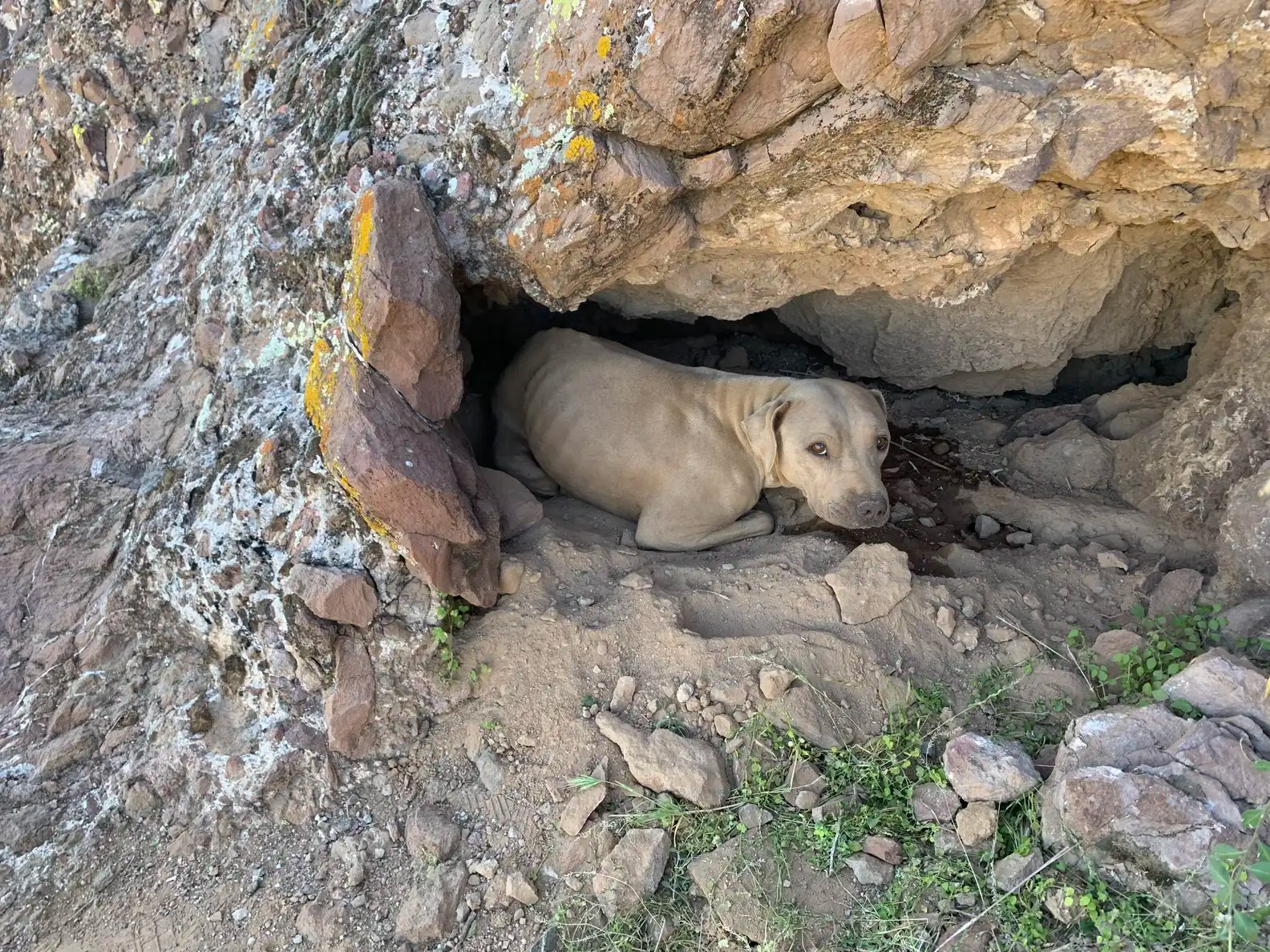
A Good Samaritan was hiking a narrow, slippery trail on Lookout Mountain in Phoenix, Arizona, and was very focused on his hike until something caught his eye. He was about half a mile up the mountain and a little off the beaten path when he caught a glimpse of light reflecting off of something — and was shocked to realize it was a pair of amber eyes.
The eyes belonged to a very scared dog huddled up in a tiny hole in the side of the mountain. She was completely blending in with her surroundings, and if she hadn’t had such piercing eyes, the hiker may not have noticed her. He had no idea how she’d managed to get up there, but it was clear that she’d been stuck for a while and might not be able to last much longer.
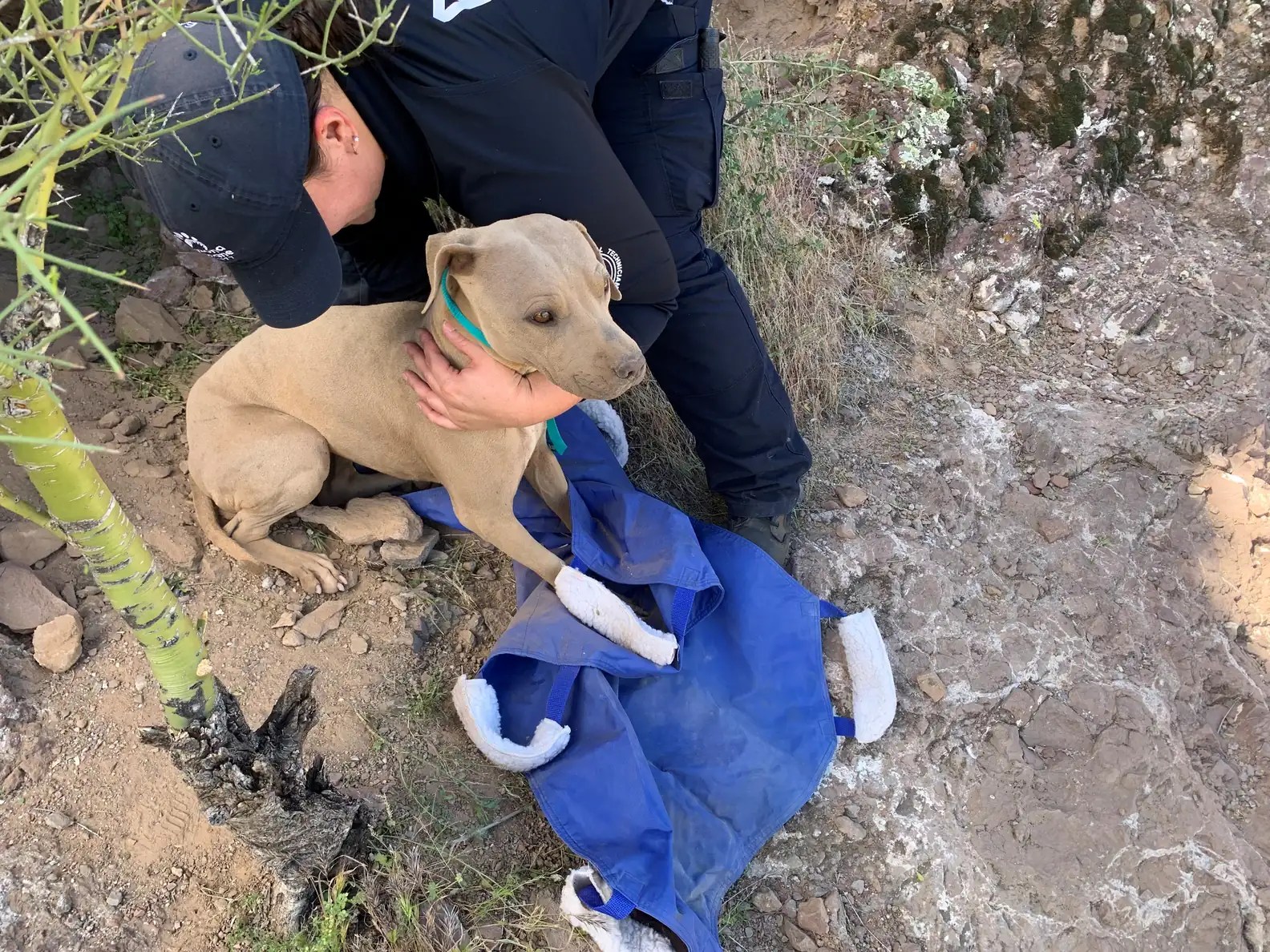
The Good Samaritan quickly contacted the Arizona Humane Society (AHS), who sent two emergency animal medical technicians, Tracey Miiller and Ruthie Jesus, out to help while he waited with the pup until they arrived. The dog was definitely scared but seemed open to getting help.
“This Good Samaritan waited probably almost two hours, and then we found this incredible dog, who incidentally is literally the same color as the dirt,” Jesus said in a press release. “She blends in so much, the complainant told us that he wanted to call her Bright Eyes because when he hiked past her, that was literally the only thing he saw was her amber bright eyes staring back at him.”
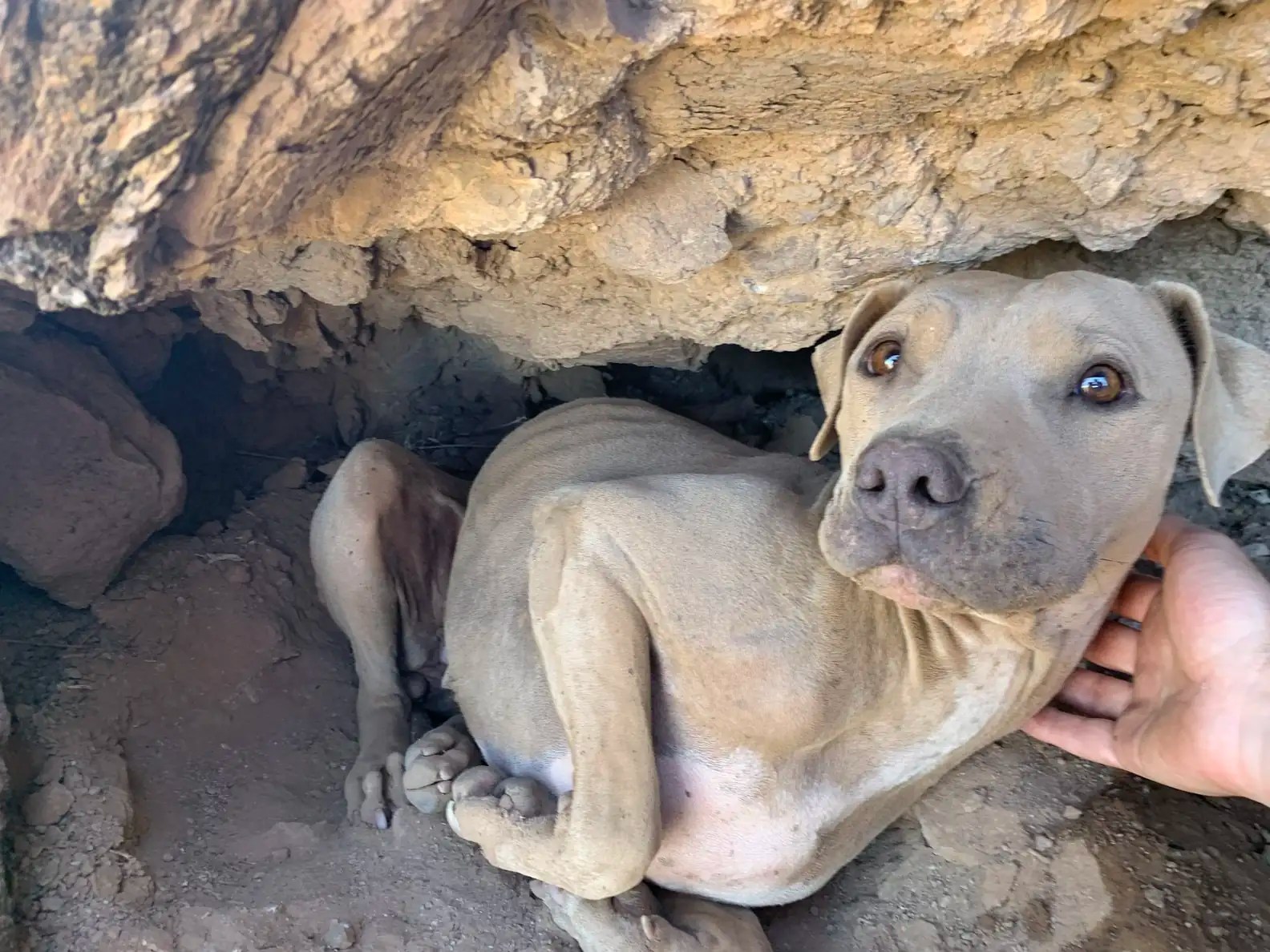
After a quick and careful assessment on the side of the mountain, the technicians determined that Bright Eyes was dangerously dehydrated with cut-up paws and a wound on her rear end.
“She was really sweet and letting me pet her head, but she absolutely did not want to come out of that den, so I kind of had to just sort of pull her out,” Jesus said.
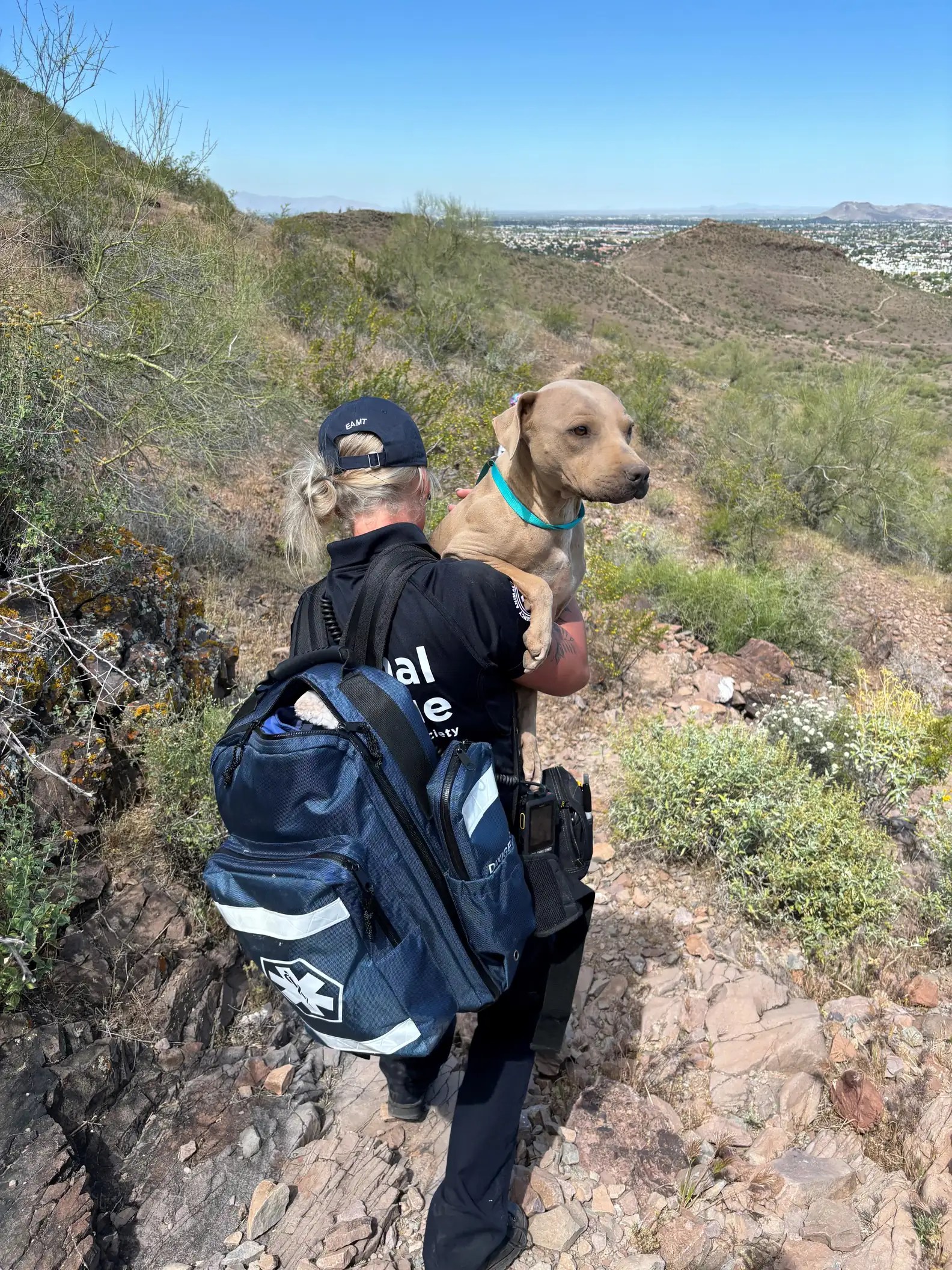
She was definitely too weak to walk with her rescuers down the mountain, so the technicians took turns carrying her until they reached the ambulance. Bright Eyes was calm the whole time, so grateful to finally be safe.
“She actually really just relaxed and seemed to enjoy being carried down the mountain,” Jesus said. “But it was a very teeny-tiny rocky trail that was pretty slick, and so Tracey and I took turns carrying her down the mountain, and she was just an absolute angel. She knew we were getting her to safety.”
It’s still a mystery as to how or why Bright Eyes ended up on the mountain in the first place, but the important thing is someone found her and now she’s getting the care she needs.
“We were so elated to be able to get her,” Jesus said. “She was just so dehydrated. I think she’d probably been up there several days and that was probably her last day, and this Good Samaritan really just saved her life.”
ooOOoo
Frankly, there’s nothing more to add to this account. For it captured all that so many people do for dogs.
I have no excuse for not being better at looking after my teeth, for one of my elder sisters, Corinne, was a dental assistant and when I was in my mid-fifties I moved down to South-West England and bought a home just a few miles from Corinne’s home. Thereafter she looked after my teeth at the dental practice in Totnes.
But I was careless in following Corinne’s advice and it wasn’t until in my seventies, and living in Merlin, Oregon, that I saw the light; so to speak!
Read this!
ooOOoo
Healthy teeth are wondrous and priceless – a dentist explains why and how best to protect them
Yet, in a society where 1 out of 5 Americans ages 75 and up live without their teeth, many people may not realize that teeth are designed to stay with us for a lifetime.
In the process, I have developed reverence for natural teeth and for the complex beauty of these biological and mechanical masterpieces.
Designed for lifelong function
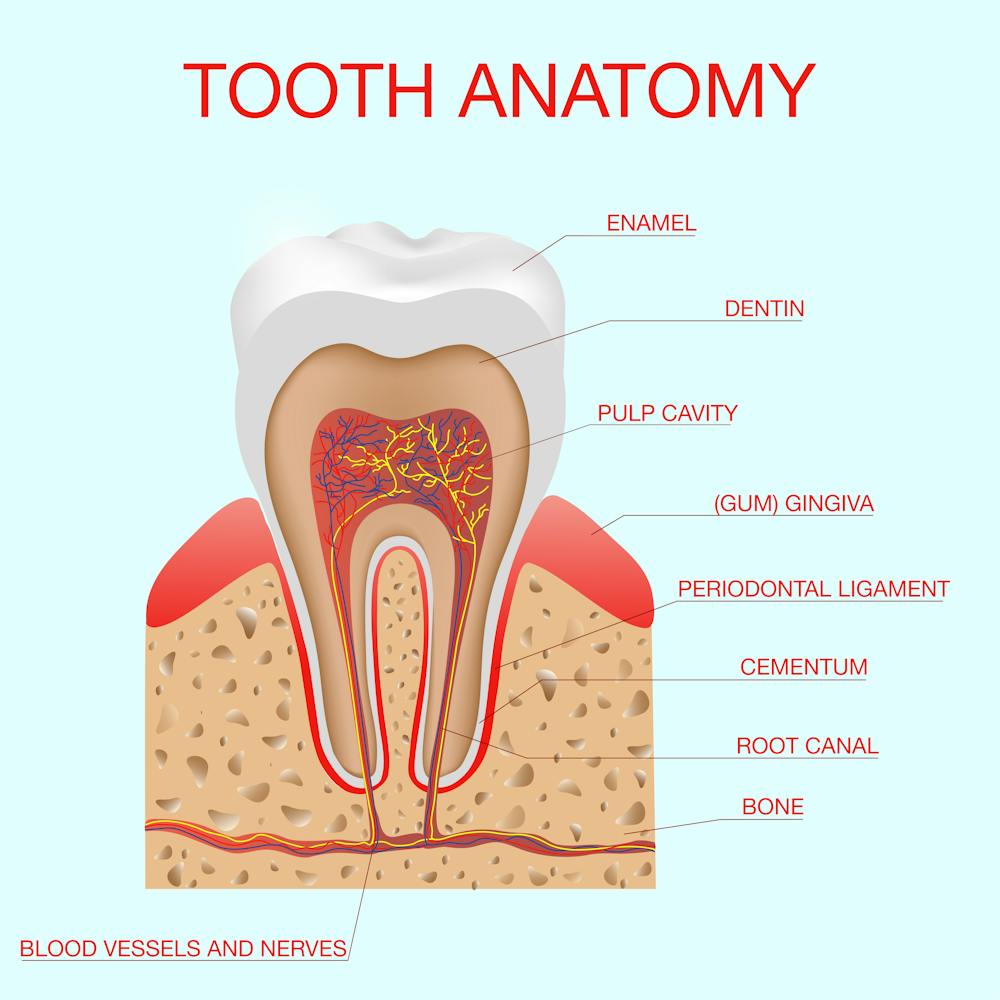
The secret of teeth longevity lies in their durability as well as in how they are anchored to the jaw – picture a hammer and its hand grip. For each tooth, durability and anchorage are functions of the complex interface between six different tissues; each alone is a biological marvel.
For anchorage, the cementum, ligament and bone grip the tooth at its root portion that is buried under the gum. The ligament, a soft tissue that is about 0.2 millimeters wide (about the diameter of four hairs), attaches the cementum of the root on one end to the bone of the jaw on the other end. It serves to anchor the tooth as well as to cushion its movement during chewing.
For durability, however, the secret lies in the enamel, dentin and pulp – our focus in this discussion.
The enamel is the protective shell that covers the visible part of the tooth above the gum. Thanks to its high mineral content, enamel is the hardest tissue in the body. It needs to be, since it acts as a shield against the constant impact of chewing.
Enamel does not contain cells, blood vessels or nerves, so it is nonliving and nonsensitive. Enamel is also non-regenerating. Once destroyed by decay or broken by misuse such as ice chewing, nail biting or bottle opening – or touched by the dental drill – that part of our priceless enamel is gone for good.
Because it interfaces with a germ-laden world, the enamel is also where decay starts. When acid-generating bacteria accumulate on unbrushed or poorly brushed teeth, they readily dissolve the minerals in the enamel.
How bacteria invade the teeth and cause cavities.
Like hair or fingernails, the non-innervated enamel is not sensitive. The decay advances through the 2.5-millimeter thick (tenth of an inch) layer of enamel painlessly. When caught at that phase during a dental checkup visit, the dentist can treat the decay with a relatively conservative filling that hardly compromises the tooth’s structural integrity.
Because of its high mineral content, enamel is stiff. Its lifelong support is provided by the more resilient infrastructure – the dentin.
Dentin and pulp – body and heart
With less mineral content than enamel, dentin is the resilient body of the tooth. It is a living tissue formed of parallel tiny tubes housing fluid and cellular extensions. Both originate from the pulp.
The pulp is the tooth’s soft tissue core. Vastly rich in cells, blood vessels and nerves, it is the life source of the tooth – its heart – and the key to its longevity.
Like smoke detectors communicating with a remote fire station, the cellular extensions within the dentin sense decay as soon as it breaks through the nonsensitive layer of enamel into dentin. Once the extensions communicate the danger signal to the pulp, our tooth sensitivity alarm goes off: The tooth heart is in flames.
The inflamed pulp initiates two protective actions. The first is to secrete an additional layer of dentin to delay the approaching attack. The second is toothache, a call to visit the dentist.
The earlier the visit, the less the drilling and the smaller the filling. If caught in time, most of the tooth’s natural tissues will be preserved and the pulp will likely regain its healthy state. If caught too late, the pulp slowly dies out.
Without its heart, a nonliving tooth has no defense against further decay invasion. Without a hydration source, a dried-out dentin will sooner or later break under the forces of constant chewing. Besides, a tooth that has already lost a significant portion of its natural structure to decay, cavity preparation or root canal instrumentation becomes weak, with limited longevity.
In other words, the tooth is never the same without its heart. Pulpless, the tooth loses its womb-to-tomb endurance and mother nature’s lifelong warranty.
The tooth coming together
More complex – and more precious – than a pearl within an oyster, the formation of a tooth within our jawbone involves layered mineral deposition. As tooth development progresses in a process of ultimate cellular engineering, the cells of the six aforementioned tissues – enamel, dentin, pulp, cementum, ligament and bone – multiply, specialize and mineralize synchronously with each other to form uniquely interlocking interfaces: enamel to dentin, dentin to pulp, cementum to dentin and cementum to ligament to bone.
In a progress akin to 3D printing, the tooth crown grows vertically to full formation. Simultaneously, the root continues its elongation to eventually launch off the crown from within the bone across the gum to appear in the mouth – the event known as teething. It is about that time, around 12 years of age, that our set of adult teeth is complete. These pearls are set to endure a lifetime and are undoubtedly worth preserving.
Save your teeth, visit the dentist
Tooth decay, the most prevalent disease in humans, is both predictable and preventable. The earlier it is caught, the more the tooth integrity can be preserved. Since the process starts painlessly, it is imperative to visit the dentist regularly to keep those insidious germs in check.
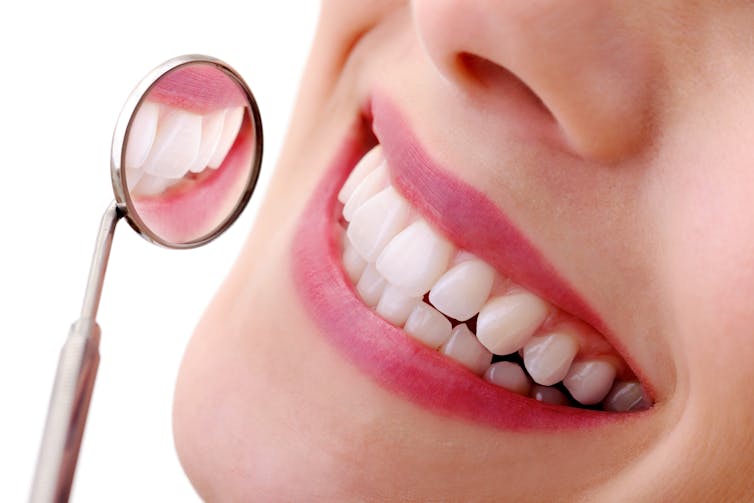
During your checkup visit, the dental professional will clean your teeth and check for early decay. If you are diligent with your daily preventive measures, the good news for you will be no news – enough to make anyone smile.
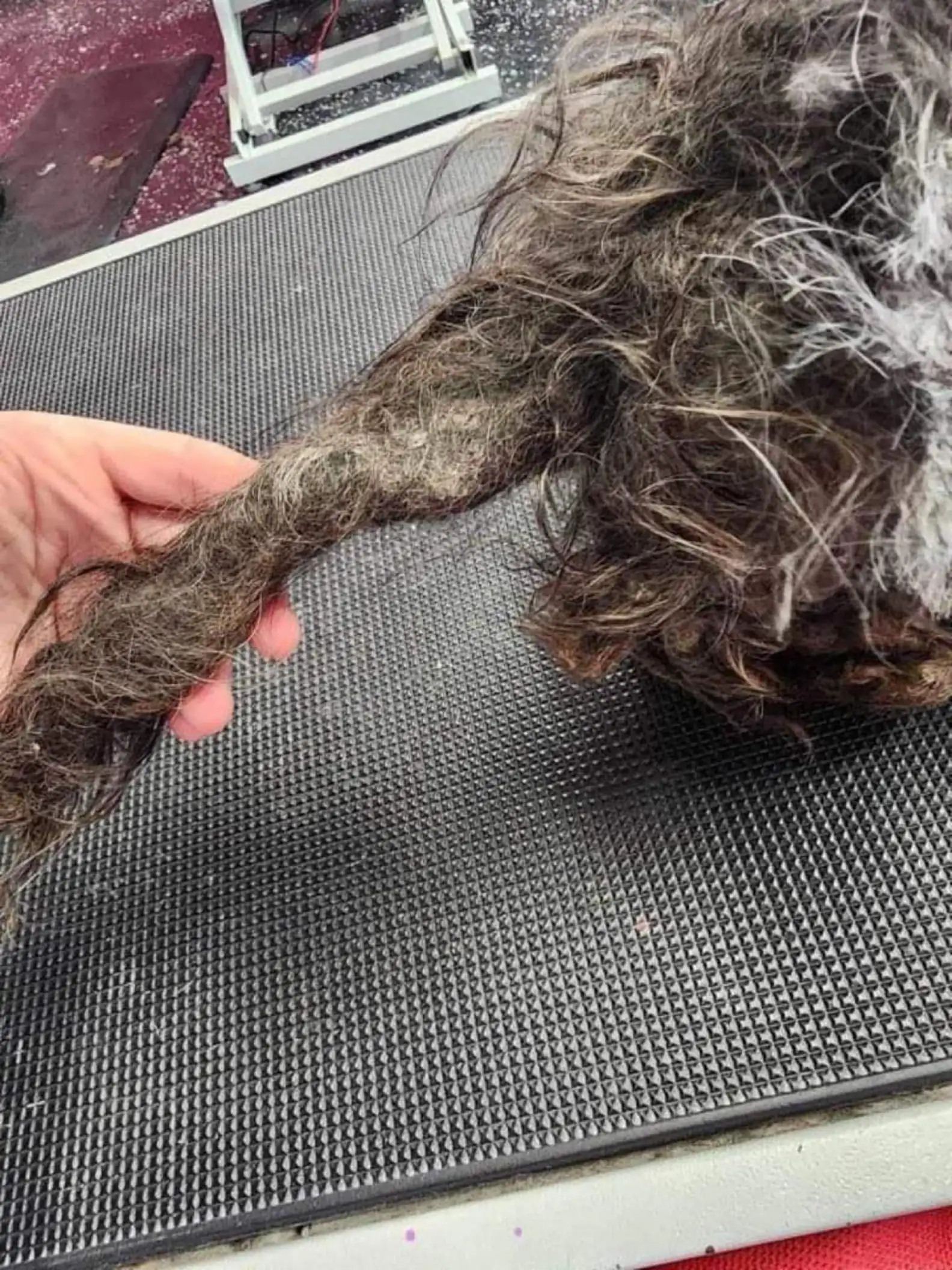
Recently, staff at the Wyandotte Animal Shelter in Michigan took in a dog whose condition was described as among the worst they’d ever seen. Pixie, as the dog is named, had fur so overgrown and matted that she could hardly move.
Gazing upon Pixie, one might never guess that an adorable dog existed beneath it.
Wyandotte Animal Shelter
According to staff at the shelter, Pixie was surrendered by her owner, who, regrettably, had neglected to give her the care and attention she needed — leading to her severely unkempt condition. Ultimately, though, his decision to surrender her is what Pixie needed most.
“He had a hard time letting her go but surrendered her to us so we could ensure she would go to someone who could give her the life she deserved,” the shelter wrote.
With that, Pixie’s world was about to change forever — and it would have to start with a much-needed haircut.
Wyandotte Animal Shelter
Staff at the shelter reached out to The Downriver Grooming Co. for what would be an emergency grooming session to help Pixie escape from her matted prison.
“[They got] her in within minutes of our call, and for [three] hours they spent freeing her from that matted fur,” the shelter wrote.
Wyandotte Animal Shelter
After all was said and done, the real Pixie had emerged.
She was totally unrecognizable from her former self.
Wyandotte Animal Shelter
“This little girl was only 5.5 pounds, but she seemed twice her size due to the matted fur,” the shelter wrote, adding that she was in remarkably good health, despite her ordeal beneath that overgrown coat.
Pixie’s world had changed for the better — but it wouldn’t be long until it improved even more.
Wyandotte Animal Shelter
Within days of Pixie’s transformation, thanks to the kindness of those who’d helped her, the little dog got the second chance she so desperately needed.
“Pixie was adopted,” a spokesperson for the Wyandotte Animal Shelter told The Dodo. “Her new family reports that she is doing very well in her new home.”
ooOOoo
We all need second chances from time to time, humans and dogs.