Category: Musings

The nature of delusions.

Sometimes the truth isn’t so obvious!

Yesterday, I wrote a post under the title of Running on empty!  I listed just a few recent items that had left me feeling very dispirited.  Trust me, not a familiar place!

I also raised the question ……

All of this is sending out a message. The message that if we are not very, very careful this could be the end-game for human civilisation on this Planet.

But do you know what really puzzles me?

It’s that this message is increasingly one that meets with nods of approval and words of agreement from more and more people that one sees going about one’s normal life.

…… then didn’t expand on what was puzzling me!

Let me come at this again; in full!

But do you know what really puzzles me?  It is the terrible lethargy across so many societies. The lack of any substantial social and political force for change. Especially, when so many scientists involved in climate research are warning we are leaving it dangerously late.

I’m no psychologist; far from it. But I want to recount a true story that gave me an insight into one of my own delusions.  Please stay with me because it does have a message at the end of it! 😉

oooo

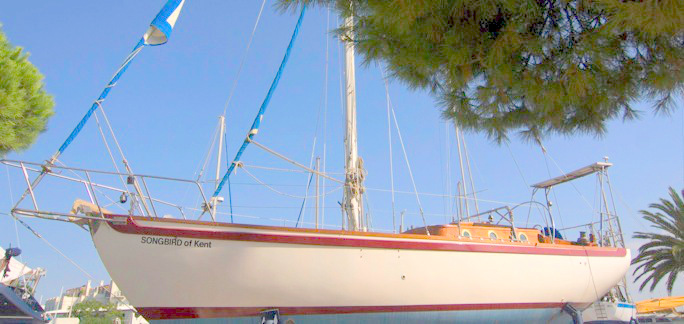
Many years ago, I spent 5 years living on a boat in Larnaca in Cyprus.  My boat was a wonderful heavy-displacement ocean-going yacht.  A type known as a Tradewind 33.  Here is a picture of my boat.

Tradewind 33 - Songbird of Kent.
Tradewind 33 – Songbird of Kent.

For years I had devoured all the books written by the great yacht sailors who had sailed the oceans, many of them completing solo circumnavigations of the world.  Part of me wanted to sail the oceans.

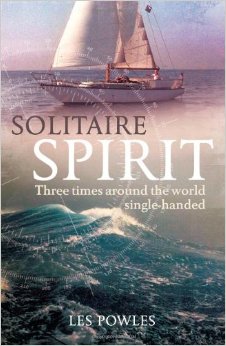
Living on a boat close to me was Les Powles.  Many will not have heard of Les but this quiet, softly-spoken man knows a thing or two about solo ocean sailing. As an article in The Guardian newspaper explained (in part):

In the 1980s and 90s a British man called Les Powles sailed three times round the world – always single-handedly, once non-stop. He couldn’t afford a radio transmitter, and on his greatest adventure he didn’t speak to anyone for 329 days. At 84, his ­circumnavigating days are now behind him, but he still lives on his boat, the Solitaire. What’s the ­appeal of sailing, I asked him. “It’s the solitude. When you’re out at sea on your own, there’s no government or bankers to worry about. You’re not ­responsible to anyone but yourself.”

Three times around the world – solo!

Thus getting to know Les was a great inspiration in getting me over the hurdle of can I really do this!  (Les once said to me “the first three days are the worst!”)

Thus it came about that I departed Larnaca and worked my way Westwards along the Mediterranean, eventually arriving in Gibraltar.  After a few days getting ‘Songbird’ ready for my first ocean leg, Gibraltar to the Azores, I took a deep breath and headed West out into the Atlantic Ocean. Frankly, I was a tad too late to be starting out but the thought of spending a Winter in and around Gibraltar was too much to contemplate and, anyway, it was only 8 or 9 days sailing to the Azores; a distance of 1,125 land miles or 980 nautical miles.

Fewer than 48-hours before my estimate of coming into Horta Marina on the Azores island of Faial, Songbird of Kent was struck by an early, fierce Winter gale.  I seem to recall it was touching Force 10 Beaufort Scale (54 – 63 mph or 48 – 55 knots).

Anyway, it just about finished me off: literally as well as psychologically! I was so frightened, so utterly scared that I could think of nothing else other than getting to Horta and never going sailing again.

It revealed my delusion!

It proved that I had been in love with the courageousness of those many ocean sailors that I had read about. In love with the idea of a solo Atlantic crossing and being seen as a courageous hero. But, in truth, utterly in denial about what ocean sailing was really about!

So with the theme of delusion in your head, have a read of a recent post by George Monbiot. The post is called Are We Bothered? It is republished with the kind permission of George.

ooOOoo

Are We Bothered?

May 16, 2014

The more we consume, the less we care about the living planet.

By George Monbiot, published on the Guardian’s website, 9th May 2014

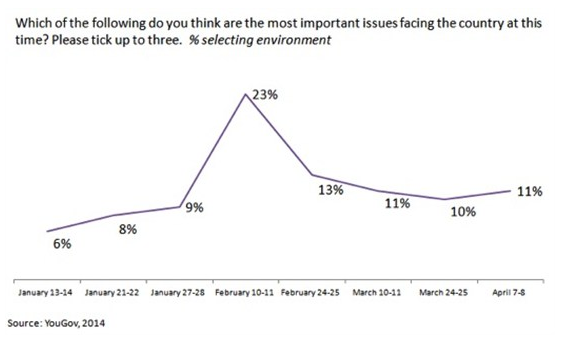
That didn’t take long. The public interest in the state of the natural world stimulated by the winter floods receded almost as quickly as the waters did. A YouGov poll showed that the number of respondents placing the environment among their top three issues of concern rose from 6% in mid-January to 23% in mid-February. By early April – though the Intergovernmental Panel on Climate Change had just published two massive and horrifying reports – the proportion had fallen back to 11%.

CarbonBrief has plotted the results on this graph:

GM1

Sustaining interest in this great but slow-burning crisis is a challenge no one seems to have mastered. Only when the crisis causes or exacerbates an acute disaster – such as the floods – is there a flicker of anxiety, but that quickly dies away.

Why is it so difficult to persuade people to care about our wonderful planet, the world that gave rise to us and upon which we wholly depend? And why do you encounter a barrage of hostility and denial whenever you attempt it (and not only from the professional liars who are paid by coal and oil and timber companies to sow confusion and channel hatred)?

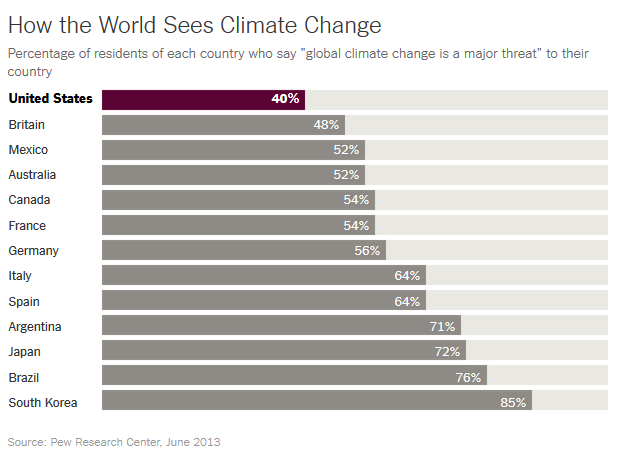
The first thing to note, in trying to answer this question, is that the rich anglophone countries are anomalous. In this bar chart (copied from the website of the New York Times) you can see how atypical the attitudes of people in the US and the UK are. Because almost everything we read in this country is published in rich, English-speaking nations, we might get the false impression that the world doesn’t care very much.

GM2

This belief is likely to be reinforced by the cherished notion that we lead the world in knowledge, sophistication and compassion. The bar chart puts me in mind of the famous quote perhaps mistakenly attributed to Gandhi. When asked by a journalist during a visit to Britain, “What do you think of Western civilization?”, he’s reputed to have replied, “I think it would be a good idea.”

Our erroneous belief that we are more concerned about manmade climate change than the people of other nations informs the sentiment, often voiced by the press and politicians, that there’s no point in acting if the rest of the world won’t play its part. For example, last year the Chancellor, George Osborne, remarked:

“I don’t want us to be the only people out there in front of the rest of the world. I certainly think we shouldn’t be further ahead of our partners in Europe.”

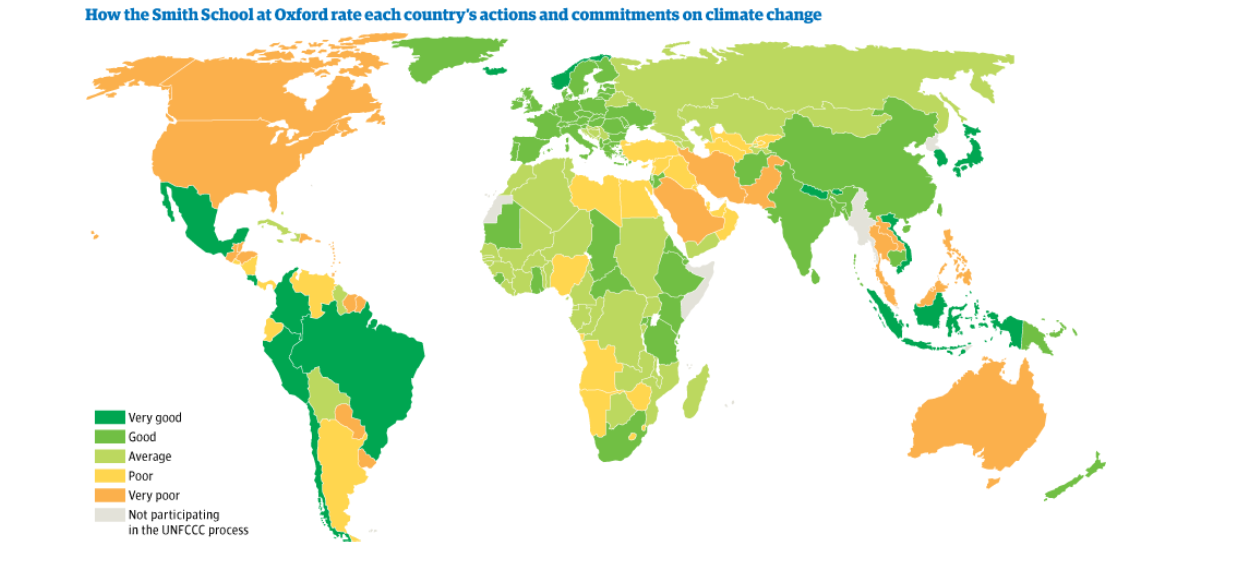
But we’re not “the only people out there in front of the rest of the world.” In fact we’re not in front at all. As this map produced by Oxford University’s Smith School suggests, we are some way behind not only some other rich nations but also a number of countries much poorer than ours.

GM3

As for the US, Australia and Canada, they are ranked among the worst of all: comprehensively failing to limit their massive contribution to a global problem. We justify our foot-dragging with a mistaken premise. Our refusal to stop pumping so much carbon dioxide into the atmosphere is pure selfishness.

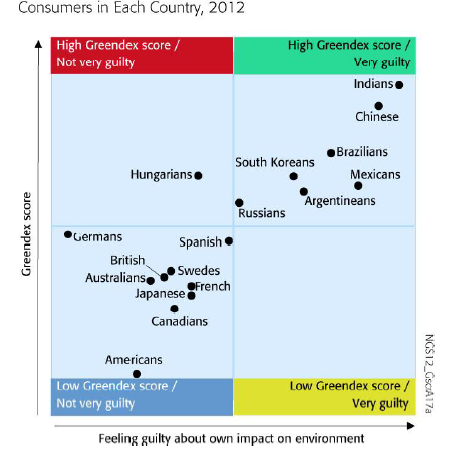
Both the map and the bar chart overlap to some degree with the fascinating results of the Greendex survey of consumer attitudes.

For years we’ve been told that people cannot afford to care about the natural world until they become rich; that only economic growth can save the biosphere, that civilisation marches towards enlightenment about our impacts on the living planet. The results suggest the opposite.

As you can see from the following graph, the people consulted in poorer countries feel, on average, much guiltier about their impacts on the natural world than people in rich countries, even though those impacts tend to be smaller. Of the nations surveyed, the people of Germany, the US, Australia and Britain feel the least consumer guilt; the people of India, China, Mexico and Brazil the most.

GM4

The more we consume, the less we feel. And maybe that doesn’t just apply to guilt.

Perhaps that’s the point of our otherwise-pointless hyperconsumption: it smothers feeling. It might also be the effect of the constant bombardment of advertising and marketing. They seek to replace our attachments to people and place with attachments to objects: attachments which the next round of advertising then breaks in the hope of attaching us to a different set of objects.

The richer we are and the more we consume, the more self-centred and careless of the lives of others we appear to become. Even if you somehow put aside the direct, physical impacts of rising consumption, it’s hard to understand how anyone could imagine that economic growth is a formula for protecting the planet.

So what we seem to see here is the turning of a vicious circle. The more harm we do, the less concerned about it we become. And the more hyperconsumerism destroys relationships, communities and the physical fabric of the Earth, the more we try to fill the void in our lives by buying more stuff.

All this is accompanied in the rich anglophone nations with the extreme neoliberalism promoted by both press and politicians, and a great concentration of power in the hands of the financial and fossil fuel sectors, which lobby hard, in the public sphere and in private, to prevent change.

So the perennially low level of concern, which flickers upwards momentarily when disaster strikes, then slumps back into the customary stupor, is an almost inevitable result of a society that has become restructured around shopping, fashion, celebrity and an obsession with money. How we break the circle and wake people out of this dreamworld is the question that all those who love the living planet should address. There will be no easy answers.

http://www.monbiot.com

ooOOoo

Tomorrow I will offer my own reflection on all of this – and finish off the story of me and ocean sailing!

Do animals fall in love?

Opening our minds to a beautiful concept!

One of the better things about my old home country, the United Kingdom, is The Open University.  As Wikipedia explains:

The OU was established in 1969 and the first students enrolled in January 1971. The University administration is based at Walton Hall, Milton Keynes in Buckinghamshire, but has regional centres in each of its thirteen regions around the United Kingdom. It also has offices and regional examination centres in most other European countries. The university awards undergraduate and postgraduate degrees, as well as non-degree qualifications such as diplomas and certificates or continuing education units.

With more than 250,000 students enrolled, including around 32,000 aged under 25 and more than 50,000 overseas students, it is the largest academic institution in the United Kingdom (and one of the largest in Europe) by student number, and qualifies as one of the world’s largest universities.

For reasons that I am unclear about, I subscribe to the OU’s newsletter.  Thus it was that a few weeks ago, this dropped into my ‘in-box’.

Do animals fall in love?

Do romantic relationships exist in the animal kingdom?

Throughout his lifetime, evolutionist and biologist Charles Darwin researched and wrote about how he felt that love can exist within the animal world. Particularly in his papers ‘The Expression of Emotions in Man and Animals’ and ‘Comparison of the Mental Powers of Man and the Lower Animals’, he explored how animals can display supposed ‘human emotions’ like pleasure, pain, happiness and misery. He investigated how animals could seemingly appear to feel ‘down’ when separated from their companions, and seemed to jump for joy and touch one another in a way similar to a human hug when reunited.

Although monogamy and lifelong pair bonds are generally rare in the animal kingdom, some animals seem to thrive on it. Recent research has shown that Gibbons, who were thought to mate for life, have more complicated relationships, with mates occasionally philandering, and even sometimes dumping a mate, suggesting some similarity to human relationships. Swans also form monogamous pair bonds that last for many years, and occassionally for life. Loyalty to their mates has made them a virtually universal symbol of love. But some researchers believe it isn’t as romantic as it first appears, and that they stay together because spending extra time attracting a new mate has the potential to impact on the otherwise reproductive time.

Darwin’s theories have paved the way for further studies. In this free article, Tim Halliday explores natural selection and evolution in the animal world.

Here is that article.

ooOOoo

Natural Selection and Evolution

Tim Halliday explores natural selection and evolution in the animal world

By: Professor Tim Halliday (Department of Life Sciences, The Open University)*

In the Rules of Life series, and its accompanying CD, Aubrey Manning looks at the behaviour of animals and describes many new discoveries about the way that this is beautifully adapted to meet the challenges which animals face in their daily lives. The scientific study of animal behaviour, or ethology, was founded some 50 years ago by Niko Tinbergen and Konrad Lorenz. Their most significant contribution was to bring together the study of natural history with an understanding of evolution by natural selection. Since then, the numerous studies that have been made of animal behaviour have revealed that animals do many things that challenge many of the ideas that people had about natural selection 50 years ago. Natural selection theory has developed enormously since that time, largely as the result of animal behaviour studies, and a number of popular misconceptions about evolution have been revealed to be false as a result.

One such misconception is embodied in the phrase ‘survival of the fittest’, first coined by Herbert Spencer, and often used to encapsulate the way natural selection works. It is misleading, because ‘survival’ is only part of the story. Evolutionary change comes about because some individuals are more successful in reproduction and so pass on their genes to succeeding generations. As a result, the characteristics that make individuals successful in reproduction become more common in the population. It is thus reproduction that is important in evolution, and survival becomes simply a means to that end.

The importance of this point becomes apparent when we appreciate that, for most animals, reproduction is a very costly and sometimes dangerous activity, as illustrated many times in the series. To engage effectively in reproductive activity requires a great deal of energy and other resources that could otherwise be put towards survival. This is apparent in the common observation that animals show a greatly reduced growth rate, or stop growing altogether, when they reach sexual maturity. The resources that they derive from feeding are diverted from growth to reproduction.

A second common misconception is that natural selection acts ‘for the good of the species’. There are numerous examples of animal behaviour that show that this cannot be the case. For example, African lions live in prides, consisting of several females and their cubs, controlled by a group of two or three males. Other mature males are excluded from living in a pride. From time to time, a coalition of excluded males is formed and they attempt to take over a pride, by attacking and driving away the current pride-holders. If they succeed in doing this, their first act is to kill any cubs in the pride that are still being suckled by their mothers. To kill the young of one’s own species cannot benefit the species. The adaptive value of this behaviour for males is that, deprived of the cubs they have been suckling, the females very quickly come on heat and can conceive cubs fathered by the new pride-holders.

This example illustrates another common misconception about evolution, that, when mating, males and females are acting cooperatively. While it is in the interests of both parents that reproduction is successful, the way that that success comes about is not necessarily the same for the two sexes. For male lions, it is of no reproductive benefit to them to guard females that give birth to cubs fathered by other males. Infanticide is of benefit to them because it ensures that cubs born in the pride are their offspring. Infanticide is costly for females because the considerable time and resources that they have put into producing cubs is wasted. There is thus a conflict between the sexes, even though they have to behave cooperatively if either is to reproduce at all.

The interplay of cooperation and conflict is also apparent in the relationship between parents and offspring. For animals that produce more than one young at a time, it is usually to the advantage of the parent to share food more or less equally among its progeny. For each individual progeny, however, it is to its advantage if it receives more food than its siblings. There is thus a great deal of competition among progeny. This takes a bizarre form in the European Fire Salamander, and in a species of shark described in one of the programmes. In these animals, the young develop within the mother and, as they grow, they eat one another until only one, very large young is left. It may be that producing one offspring at a time is a good strategy from the mother’s point of view, or it could be that she would have higher reproductive success if she produced more; it may be, however that she has no choice in the matter.

The key to understanding evolution by natural selection is to think of it, not in terms of an individual’s survival, but in terms of its effectiveness in passing on its genes, what in the series is referred to as ‘genetic accounting’. Natural selection favours those individuals that pass on the most copies of their genes. This enables us to explain many aspects of animal behaviour that are difficult to explain purely in terms of survival. For example, in many species, particularly among birds, certain adult individuals do not breed themselves, but help other adults to do so, for example by feeding their young. In almost all cases, helpers turn out to be close relatives of the parents they are helping and so they are, in an indirect way, helping to spread those genes that they share with their relatives.

* Tim Halliday is professor of biology at The Open University, where he has worked on newts, toads and frogs since 1977.

ooOOoo

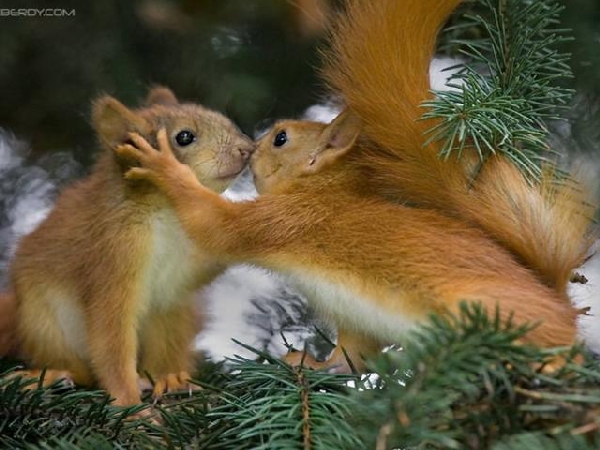
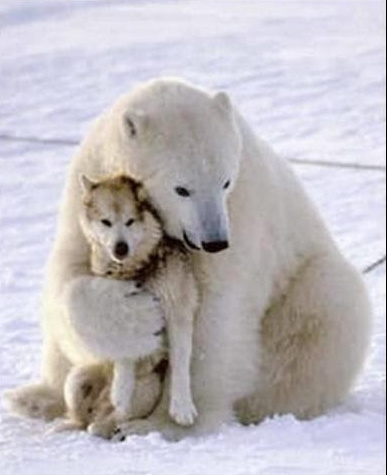
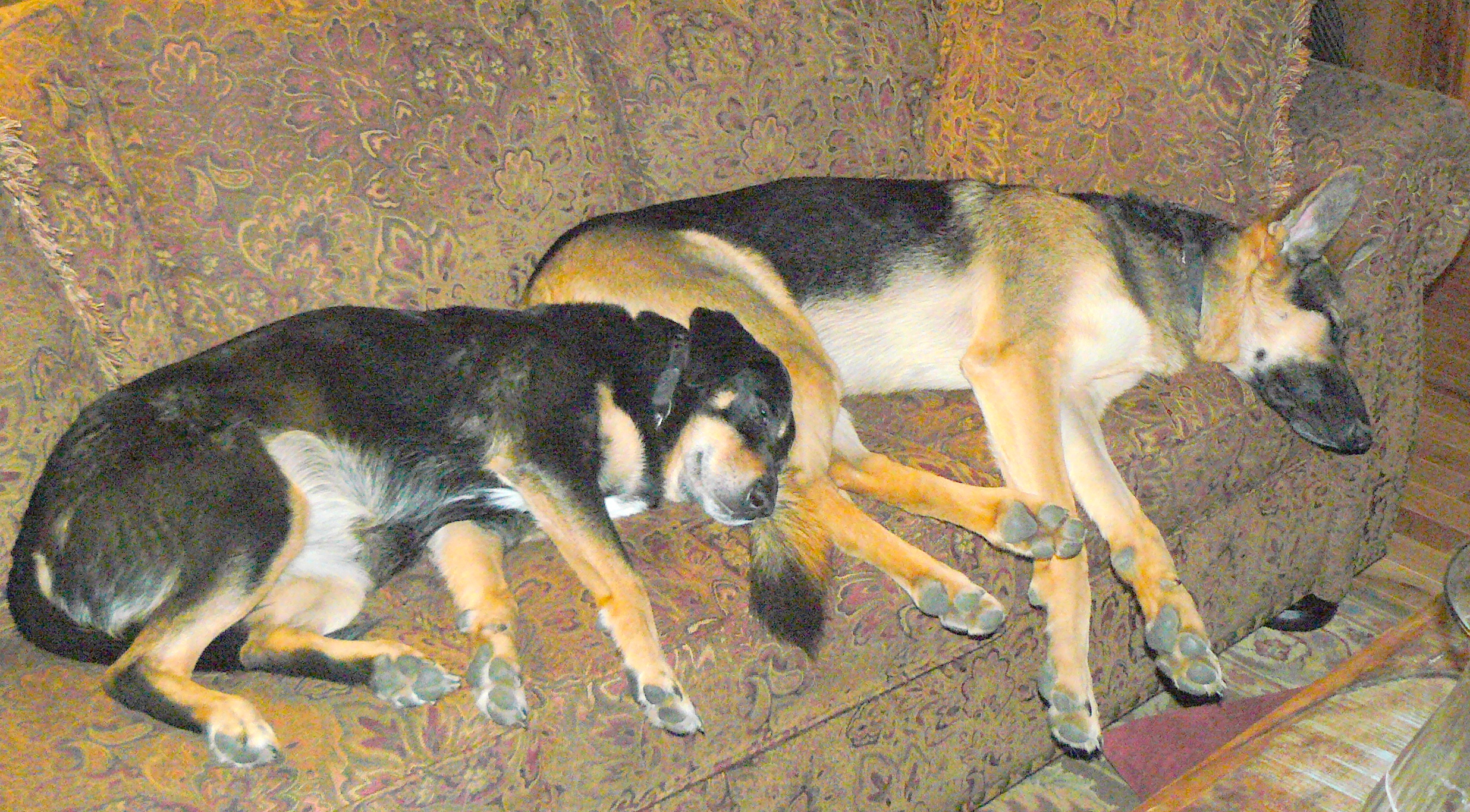
Two photographs that offer my answer to the question: Do animals fall in love?

animallove

oooo

Hazel asleep with her dear friend Cleo. (Hazel to the left.)

Progressing Wisdom – the preamble.

A reflection on intelligence, learning and knowledge.

Today’s essay has been prompted by a fascinating exchange of views and comments on a post recently published by Patrice Ayme.  More of that tomorrow.

Before getting to the heart of things, I feel compelled to offer a little background on my own educational journey. It is presented today as a preamble to tomorrow’s main essay.

By rights, I should have enjoyed a stunning academic journey as a young man.  My mother holds a double degree in French and German from Cambridge University.  My father was both a Chartered Architect and Chartered Surveyor and worked for Barclay Perkins & Co at their Anchor Brewery in Southwark, London all his working life.  My uncle, Christian Schiller, took up a mathematics scholarship at Sidney Sussex college at Cambridge University and ended up HM Inspector of Schools in the United Kingdom. Notably, he was a promoter of progressive ideas in primary education.

But it was not to be so.

My father died suddenly and with very little warning five days before Christmas in 1956.  I had turned 12-years-old some six weeks previously and just completed my first term at Preston Manor County Grammar School.  My secure, comfortable young life was thrown into emotional turmoil with one of the consequences being that instead of passing a clutch of GCE ‘O-Level’ exams, I barely managed to pass two subjects and was unable to continue on with a higher level of studying and the consequent sitting of GCE ‘A-Level’ exams, a pre-requisit for university.

Somehow, I then managed to win a place as a student at the Faraday House of Electrical Engineering, in those days based at Southampton Row, London.  It was to study for a Diploma in Electrical Engineering.  The requirement was that by the end of my first year at Faraday House I should pass two A-level examinations.

I was very happy as a college student.  That first year was spent entirely learning about engineering with much time ‘hands-on’ in the engineering workshop. Then came time for me to sit those two A-level exams. I failed both of them! There was no choice but for me to leave the college.

faradayhouseplaque
So that’s enough to demonstrate that academic prowess was not my speciality.

However, being unable to jump through the hoops needed for a degree or equivalent didn’t mean that I was a poor learner; far from it.

After my father’s death, my mother remarried and my ‘new’ Dad was very supportive.  He had a background in communications and quickly encouraged me to become a radio amateur.  I joined the nearby Radio Society of Harrow (still in existence!) and their encouragement enabled me to pass the full set of exams necessary to become a licensed radio amateur and a full member of the Radio Society of Great Britain.  My amateur call sign was (and still is) G3PUK. I was 17.


G3PUK0001
I can still whistle the alphabet in morse code, from A to Z, and the numbers 0 to 9!

Later on, when I was an apprentice at the British Aircraft Corporation’s site in Stevenage, Hertfordshire, one of the commercial staff, Jim Jenner, spent many hours preparing me for the Institute of Advanced Motorists examination. I passed that exam and became a full member of the IAM in May, 1966.

So there’s my background that, hopefully, will set the scene to a wonderful exchange of views and ideas that flowed from Patrice’s blog. Ideas that will be explored tomorrow.

For the reason, the powerful reason, that the intelligence and wisdom of humanity has always been important.  But now, in this time of the affairs of man, our collective intelligence and wisdom has never been more important.

Thank you – a thousand times!

This blog passes an unbelievable milestone.

Over the week-end Learning from Dogs registered a 1,000 followers. Now I may be tempting fate by writing this but whatever the figure, on a day-to-day basis, the trend is one of a steadily increasing number of subscribers.

Yes, in the grand scheme of things, this is a tiny achievement compared to many of the great blogs out there. But, nonetheless, I feel compelled to write this.

That it is impossible for me to convey the degree of gratitude to all of you followers and the many additional readers who pass this way. Please just know the depth of my feelings in this regard.

Just also know that the community feeling that has grown up around this writing adventure is fabulous. Something of which I had no expectation when I published my first post on July 15th, 2009. Just for fun, here is that first post.

ooOOoo

Parenting lessons from Dogs!

Much too late to make me realise the inadequacies of my own parenting skills, I learnt an important lesson when training my GSD (who is called Pharaoh, by the way).  That is that putting more emphasis into praise and reward for getting it right ‘trains’ the dog much quicker than telling it off.  The classic example is scolding a dog for running off when it should be lots of hugs and praise for returning home.  The scolding simply teaches the dog that returning home isn’t pleasant whereas praise reinforces that home is the place to be.  Like so many things in life, very obvious once understood!

Absolutely certain that it works with youngsters just the same way.

Despite being a very dominant dog, Pharaoh showed his teaching ability when working with other dogs.  In the UK there is an amazing woman, Angela Stockdale, who has proved that dogs (and horses) learn most effectively when being taught by other dogs (and horses).  Pharaoh was revealed to be a Beta Dog, (i.e. second in status below the Alpha Dog) and, therefore, was able to use his natural pack instinct to teach puppy dogs their social skills and to break up squabbles within a pack.

When you think about it, don’t kids learn much more (often to our chagrin!) from other kids than they do from their parents.  Still focusing on giving more praise than punishment seems like a much more effective strategy.

As was read somewhere, Catch them in the act of doing Right!

By Paul Handover.

ooOOoo

So here we are! Within a couple of months of me writing Learning from Dogs for five years!

For those who love numbers and statistics, try these:  2,062 published posts with 8,815 comments approved.

But those numbers mean nothing compared to the joy of having you follow Learning from Dogs.

Thank you!

Pharaoh appreciates the milestone, as well!
Pharaoh appreciates the milestone, as well!  Thanks all you wonderful supporters of this place!

This photograph of Pharaoh was taken yesterday morning. Like his ‘owner’ starting to show his age! (Pharaoh is eleven on June 3rd.)

Here’s another photograph taken same time yesterday morning.

A very, very special friend!

Creative reflections.

The power of re-finding oneself.

Terry Hershey

If you do a search on Learning from Dogs for Terry Hershey you will find that his name comes up from time to time. Way back in March, 2011, I published a post announcing a visit by Terry to Payson, AZ where Jean and I were then living.  Having had the opportunity to listen to Terry speaking and to meet him in person, I have maintained a subscription to his weekly Sabbath Moment ever since.

Thus it was that last Sunday in came the regular missive from Terry.  They are always good but last Sunday’s was spectacularly good. In response to my request to publish the full Sabbath Moment here on Learning from Dogs, there was a prompt reply to the affirmative.

Thus with no further ado, here is Terry’s Sabbath Moment for May 5th, 2014, in full.

ooOOoo

Artists

May 5, 2014

Hershey moon

It seems that in the spiritual world, we do not really find something until we first lose it, ignore it, miss it, long for it, choose, it, and personally find it again–but now on a new level. Richard Rohr

Mystery is at the heart of creativity. That, and surprise. Julia Cameron

I was born fragile, farther said. I was just born that way. He said I was a nervous baby. Just born like that. David Helfgott

I saw the angel in the marble and carved until I set him free. Michelangelo

oooo

Lorraine Hunt Lieberson began her career as an accomplished viola player. While on tour in Europe (in the late 1980s), her viola was stolen. She could have replaced it. As would be imagined, the theft threw her into a state of feeling lost and uncertain. She stopped playing. After awhile, Lorraine began to work with only instrument she had, her voice.

When asked, Lorraine stresses that her decision to go into singing happened quite naturally. “There were a lot of encouragements along the way, but no individual, earth-shaking event that made me change,” she says. “But, back in 1988, when my viola was stolen, I took that as a sort of omen.” (And although she hasn’t yet replaced her stolen viola, she avows that “the viola is always with me in spirit when I sing.”)

Interestingly, Lorraine is shy about being interviewed; she has no press agent. But when she sings she is known for an ever-widening swath of ardor and awe that she leaves in her wake. An intensity. Her voice–her singing–touches hearts and lives. The irony is that the gift–the artistry–she has given us all, began when life turned left.

Ask any class of kindergarten students, “How many of you are artists?
How many raise their hands? Every single one of them.
Ask fourth graders. Maybe half.
Seventh graders. A handful.
Seniors in high school. Maybe one.
It’s quite the educational system we have created.
We begin with artists, and we slowly wean it out of them.

I do know this: it is easy to lose sight of that artist that resides inside of each one of us. Whether lost or buried or stuck or forgotten or dismissed or ignored… or “stolen.” (Whenever I lead a retreat, Crayolas are mandatory–because it is an unwritten spiritual principle that you cannot learn about life unless you color. It is curious then, how many–otherwise secure adults–will say, “I’m not very good at coloring.” I will say, “Who said anything about being ‘good’ at it?” Our mind has already morphed from play and wonder to mastery and proficiency.)

When we tag or label or describe ourselves, “artist” is seldom used. Where I was raised, artist was a phase you went through (a dream), you know, to grow out of, to, move on to something more useful and sensible–in order to get a real job.

Yes, of course we are all inner artists, but the cynical part of me tells me that it all sounds too much like a mantra meant to be chanted standing in a circle at a “be all you can be” conference. Sure, it all sounds good.

But I’m not sure what it really means.

In the opening scenes of Shine, we first meet the middle-aged David Helfgott (played by acclaimed Australian stage actor Geoffrey Rush), babbling to himself incessantly and wandering in the rain, in a state of transition. Behind him is the isolated existence as a child piano prodigy whose emotional turmoil led to a nervous breakdown, and a series of stays in various mental institutions. Ahead of him is his eventual reconnection with the world around him, guided by both love and his virtuoso talent that has been long abandoned. We witness the awakening of the artist. In the movie (and in real life), David eventually moves toward that which gives life.

So, what is this artist? It is the place in our spirit that births…

creativity,
enchantment,
imagination,
play,
risk
and wonder.

There is no doubt that we hide it. We don’t believe it. Or we judge it as inadequate.

But here’s the deal: The artist in David did not reside only in the talent or prodigy or genius, but in the spontaneity, vitality, innocence, passion and delight. And the artist in Lorraine wasn’t detoured by life’s unkindness.

For me, the tragedy is that (in the name of love) David’s father (Peter) squeezes the artist out of the prodigy. But in truth, it doesn’t always require a pathological “love” to hide or extinguish the light.

In the movie rendition, there is a scene that stops my heart. David and his father are walking home after a competition. David has placed second.
(In his father’s eyes, anything other that first is a failure.) The father is seething, and there is no hiding his disgust. David has lived his entire life absorbing his father’s pathology, doing his very best to make his Daddy happy. The father walks ahead, hurried, his spirit heavy. David follows. On the sidewalk, in chalk, there is a hopscotch pattern.The camera follows from behind, and we see young David unconsciously, intuitively, childlike, hopping and skipping and jumping — the joy and the light (and the artistry) of his childhood still alive.

I don’t want to lose sight of that childlike artistry inside of me. I’m home for a week or so, and the garden is abounding and teeming with life and color and enchantment. The peony buds profligate, the bearded iris blooms beguiling, the columbine exquisite. The branches of the Japanese Maple, heavy with spring rain, deferentially bow. I once asked my analyst why I was in therapy. He told me it would make me a better gardener. Gardening can be strong medicine–an elixir that nurtures and shapes the soul. For that reason, it is a tonic seldom taken straight with no ice. Gardening has way of seeping into your soul, and one day you find yourself, in the words of poet May Sarton, spending the first half hour of the morning “enjoying the air and watching for miracles,” the joy and the light still alive.

oooo

I dip my pen in the blackest ink, because I’m not afraid of falling
into my inkpot. Ralph Waldo Emerson

ooOOoo

Hope you all enjoyed this just as much as I did!

But I can’t close without mentioning something that struck me the very first time I read the essay. It is this.

That list that describes artistry: creativity, enchantment, imagination, play, risk and wonder.  It’s not a million miles from describing the way our younger dogs behave when we take them for a walk around the property most days after lunch.

Dogs playing without a care in the world!

Once again, Terry’s website is here.

Pas de deux

The courage of sharing beautiful thoughts.

In a post published last Monday under the title of Having yourself as your best friend, I presented a poem from Kimberly that was published on her blog: Words4jp’s Blog.   As regular readers will recall that poem was an expression of personal sadness.

Then two days later, there was a further poem from Kimberly that just bowled me over with its beauty.  Kimberly generously allowed me to share it with you.

ooOOoo

a pas de deux


The tears of a rhapsody

glide slowly along the strings of a violin

as


He stands…

a single vision

under a dimly lit spot light


He waits…

for an essence of grace

to float by and awaken his spirit


He feels…

the melody

breathing life into his limbs


He hears…

the whisper of satin pointes wafting

from behind


He sees…

gossamer fingers embrace his hand

as


She leads…

him forth into a world which transcends reality.


ooOOoo

Stunningly beautiful.

The Natural order.

Back to the basics of life.

Regular readers of Learning from Dogs will recall that just under a week ago I published an essay under the title of A bedtime story for mankind.  The post centred around an essay from Patrice Ayme.  Patrice’s essay could be summarised as follows: “At the present rate of greenhouse gases emissions, within nine years, massively lethal climate and oceanic changes are guaranteed.

Then just last Sunday, Patrice published a second essay reinforcing that first one.  The subsequent essay was called Ten Years to Catastrophe.  I was minded to republish that but upon reflection thought that there was a better option.  That was to explore the deep, core questions that both of Patrice’s essays raised in my mind and, presumably, must be raised in the minds of countless thousands of others.  Questions along the lines of a comment I submitted to that subsequent post from Patrice.

Do you have an idea, even a sense, of when global leaders, elected Governments, the ‘movers and shakers’ in societies, will truly embrace the global catastrophe that is heading our way?

And a supplementary question: What would be the indicators that Governments were acknowledging the task ahead?

Frankly, they weren’t especially good questions but they were an attempt by me to open up a debate on whether or not this is the “beginning of the end” of life for us humans.  Central to what was going through my mind was the core question of how did it all go wrong?

Welcome to Payson, AZ

On Monday evening, I rang John Hurlburt, a close friend of Jean and me from our Payson, Arizona days and kicked around those questions .  It was a most enlightening conversation.  John is an active founder member of Transition Town Payson and Payson recently welcomed the Great March for Climate Action in their walk from Los Angeles to Washington D.C. (An essay on that event coming soon.)

Anyway, from out of that conversation with John came the idea of a series of essays here on Learning from Dogs about the past, present and future of man’s relationship with Nature.  The aim is to offer an essay on a weekly basis but we’ll see how it goes.  Wherever possible, I will use the essays and posts from other bloggers that reinforce the vision. As always, your feedback in the form of ‘Likes’ or comments will reflect on the value of the essays to you.

After John and I finished the call, he sent me an email with what could be best described as his vision for these essays.  Here is that email [my emphasis].

Integral Vision

Everything fits together. Otherwise, we’d simply be disassociated atoms.

Human beings are a consciously aware component of Nature. We have a DNA-level directive to survive as a species and as individual members of a species …. in that order!

We are consciously aware components of the conscious interaction between energy and matter in a predominently smoothly emerging cyclic universe with departures from time to time into pockets of chaos.

We disconnect from reality when we become self-centered, often during the various stages of our lives. When we are blessed we continue to live and learn.

Issues of ideology, rational thought, economics, politics, religion, history and science become insignificant in comparison to the whelming power of Nature.

Such is life. It comes with the territory. Spirituality, Nature and Science describe the metanexus in which we live.

Maintain an even strain,

an old lamplighter

Ref: Episcopal “Catechism of Creation”

Ideas, feedback and comments, as always, hugely welcomed.

Picture parade forty.

A very suitable set of pictures for today; Easter Sunday.

Thanks to Bob Derham for sending them to me.

ES1

oooo

ES2

oooo

ES3

oooo

ES4

oooo

ES5

oooo

ES6

oooo

ES7

oooo

ES8

oooo

ES9

oooo

ES10

oooo

ES11

oooo

ES12

oooo

ES13

oooo

ES16

oooo

ES17

oooo

ES18

oooo

ES19

oooo

ES20

oooo

ES21

oooo

ES22

oooo

ES23

oooo

ES24

oooo

ES25

oooo

ES26

oooo

ES27

oooo

ES28

oooo

ES29

oooo

ES30

oooo

ES31

oooo

ES32

oooo

ES33

oooo

ES34

oooo

ES35

From Jean and me and all our animals, our Easter wishes for peace to you all.

Ben and Ranger have settled in!

Can’t believe how quickly a month has gone by!

This last Tuesday, the 15th April, was a month to the day after our rescue horses, Ben and Ranger, arrived here in Merlin.  There was a post on the 20th March called Welcome Ranger – and Ben!

Here’s a picture from that day:

Jean leading Ranger; Darla leading Ben.

Here’s a picture of Ben from sadder times:

October 2013: The Sheriff’s department have passed Ben to Darla.

So with no further ado, here are four photographs taken last Tuesday, the 15th April.

Waiting to greet Jean and me in the morning!

oooo

Ranger totally at ease with his 'old Dad!'.
Ranger totally at ease with his ‘old Dad!’.

oooo

Ben, behind Ranger; both loving up to Jean.

oooo

Ranger loving up to yours truly!
Ben loving up to yours truly!

Jean is used to horses from previous times in her life but, for me, horses are not animals that I am familiar with.

But after a month of getting to know Ranger and Ben and them getting to know me, I find them adorable!

Trust, truth and community, Pt. Two.

Musings on truth and the corrosive nature of fear.

Yesterday, in Part One, I explored how easy it is to signal to the public that they are not to be trusted.  I used the case of PayPal’s changes to their ‘privacy’ policy which, as Wolf Richter wrote, only partially tongue-in-cheek perhaps, made “the NSA, which runs the most expansive spying dragnet in history, is by comparison a group of choirboys.

Truth

Again, back to Roget’s Thesaurus.

truth noun

1. Correspondence with fact or truth: accuracy, correctness, exactitude, exactness, fidelity, veraciousness, veracity

2. Freedom from deceit or falseness: truthfulness, veracity

So that’s all clear then!

If only it was that easy.  So many aspects of our modern lives are exposed to complex issues.  None more complex than, of course, the issue of humans having a damaging effect on the planet’s climate.  Or if one wants something more esoteric then try the origins of the universe. (So far as the former is concerned, then my personal belief is that mankind is damaging the global climate.  But do I have the scientific background to support that belief? No Sir!)

However, one thing that our complex society does offer is the opportunity to spread fear. Indeed, fear pervades popular culture and the media.  I picked up that theme from an essay published by David L. Altheide and R. Sam Michalowski of Arizona State University.

Just a random example of the spread of fear.

The link to that essay is here. It opens, thus:

Fear pervades popular culture and the news media. Whether used as a noun, verb, adverb, or adjective, an ongoing study finds that the word “fear” pervades news reports across all sections of newspapers, and is shown to move or “travel” from one topic to another. The use of fear and the thematic emphases spawned by entertainment formats are consistent with a “discourse of fear,” or the pervasive communication, symbolic awareness and expectation that danger and risk are a central feature of the effective environment. A qualitative content analysis of a decade of news coverage in The Arizona Republic and several other major American news media (e.g., the Los Angeles Times, and ABC News) reveals that the word “fear” appears more often than it did several years ago, particularly in headlines, where its use has more than doubled. Comparative materials obtained through the Lexis/Nexis information base also reveals that certain themes are associated with a shifting focus of fear over the years (e.g., violence, drugs, AIDS), with the most recent increases associated with reports about children. Analysis suggests that this use of fear is consistent with popular culture oriented to pursuing a “problem frame” and entertainment formats, which also have social implications for social policy and reliance on formal agents of social control.

No passion so effectually robs the mind of all its powers of acting and reasoning as fear. [my italics]

That last sentence offers the words of Edmund Burke, the Irish statesman and author from over 200 years ago. So, perhaps, nothing changes in this regard!

In my old country, the British press love to sell their newspapers on the back of fear.  Here are some examples of lurid front pages.

horse meat

oooo

meltdown

oooo

autism

However, it doesn’t end there. Fear of the unknown, of forces beyond our control, are behind the incredible number of conspiracy theories, many of them quite famous.  WikiPedia lists dozens of them. One that was voiced by friends of ours concerned HAARP, which is an acronym for High Frequency Active Auroral Research Program.  It was a perfectly legitimate research programme, one that was unclassified, albeit a program that was shut down in July, 2013.

But that didn’t stop it being regarded by many as deeply suspicious, “Many conspiracy theories surround HAARP. Some theorists believe that it is being used as a weather-controlling device that can trigger catastrophic events, such as floods, hurricanes, etc. Others believe that the government uses HAARP to send mind-controlling radio waves to humans.”  Taken from here.

As it happens, this was a programme that I was acquainted with back in my UK days.

OK, time to round this off.

This new, digital world allows the sharing and spreading of information in a manner unimaginable from, say, 25 years ago.  It has many positive attributes, as I will touch upon in tomorrow’s post.  But it also has the power to spread fear and misinformation.  In a world that is becoming more complex and more uncertain year by year, it takes effort by every one of us to stop, think and check on anything that has the potential to upset one.

It takes the power of community to keep us rooted in the stuff of our daily lives, to live calmly and stay in touch with the truth.  More on the power of community tomorrow.