I am going to republish a ‘Meet the dogs” essay that was written and first published February 25th, 2014.
But before doing so, Jean and I would like to extend our very great thanks to all the staff at the Southern Oregon Vet Specialty Center (SOVC) who have been so professional and so loving and caring.
Here is that essay. It is worth noting that we moved from Payson, AZ to Merlin, OR in 2012.
ooOOoo
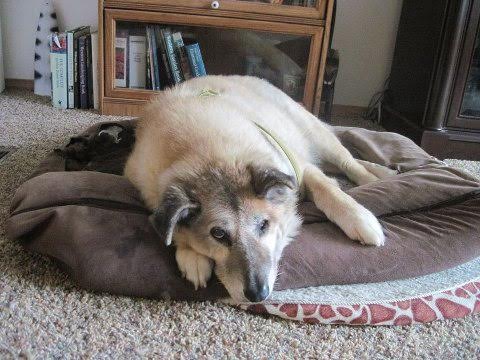
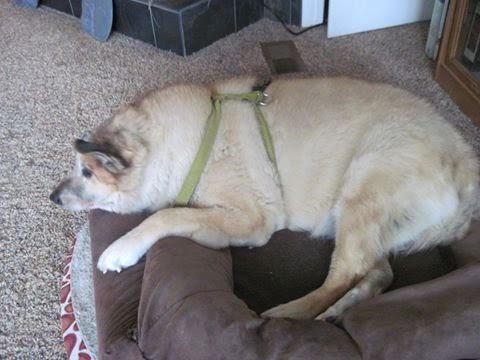
Casey
by Jean Handover.
Casey, at home; picture taken a month ago.
It is 2011.
Every Friday, the Payson Roundup newspaper would devote a full page to the Humane Society, displaying some of the cats and dogs they had for adoption. I would read about each animal and quietly wish I could bring them all home.
I was particularly taken with one dog that had appeared several times in this Friday page. His name was Casey and he was a six-year-old Pit Bull mix. Unfortunately, at home we were ‘maxed out’ with a total of 14 dogs in three different sections of our house. We just couldn’t take Casey.
I had volunteered to be a dog-walker at the Humane Society dog shelter. But after two sessions walking dogs, I just couldn’t look at these sad little faces without breaking down in tears. I switched my efforts to working at the Society’s Thrift Store. That was great fun and, at least, it felt as though I was still helping the animals. Nonetheless, I was very impressed with the animal shelter. They did their utmost to re-home the animals in their care.
Ruby’s ‘pack’ here at home included Phoebe and Tess, rescue dogs from Mexico. Recently, Phoebe had died with leukaemia and Tess with bone cancer leaving Ruby on her own. Ruby was a dog that didn’t mix at all well with the other dogs, as was explained in last week’s post.
The next Friday, the Payson Roundup showed the Society’s ‘lonely hearts club’, highlighting animals that had been in care for a long time. The first dog shown was Casey. I telephone Chandra, the lady responsible for adoptions, and asked if Paul and I could bring Ruby to the shelter to find a companion for her. When we were at the shelter, Chandra asked us if we had anything against Pit Bulls. Of course we didn’t. Ruby was introduced to Casey and, as they say, the rest was history. Casey and Ruby right from the start were just wonderful together.
Ruby behind Casey.
Subsequently, I learned from Chandra that Casey had been in care for over a year and, had we not taken him home, his days were numbered at the shelter. There were many cheers and tears when I signed the adoption paper for Casey.
Fast forward to the year 2012 to when we are now living at Merlin, OR.
Casey now lives in the kitchen group here in Oregon: Paloma, Ruby, Lilly and Casey. As with all our dogs, Casey is so happy to have our 14 acres to play in. He is also the sweetest natures of dogs and will try to climb on to your lap at the first opportunity. I have always been a great advocate of Pit Bulls and Pit Bull mixes and have never come across a mean one.
Thus, if you are in the position to adopt a dog, please consider Pit Bulls and Pit Bull mixes for the Pit Bull is a much-maligned breed.
Casey demonstrating a dog’s focussing skills!
ooOOoo
This is how Casey will be remembered.
Finally, recalling how close and good friends Ruby was with Casey, one couldn’t see a clearer expression on a dog’s face that Casey was being missed than on the face of Ruby. The picture was taken just before 6pm yesterday evening.
Trust me, Ruby’s normal face truly has a smile on it.
I will never, ever tire of the wonderful connections made by this blog!
Connections brought about by the almost universal love for dogs! But not to the exclusion of cats. For we still have three cats, all ex-rescues from our days in Mexico, and it is a cat story that Anne presents for you all today.
It went back to an email that came in to me earlier this February:
Hi Paul,
My name is Annie and I blog at catobsessed.com. Since I am a new-ish blogger (well, my cat site is new but I’ve been writing elsewhere for years), I’m hoping to make connections with more established pet bloggers to help get my name out there.
I love your site Learning From Dogs – although I’m obviously more of a cat person, our family has a mini schnauzer back in Canada. I miss her! Your website vision is very thought-provoking, I hadn’t really considered how much we learn from our pets before. I was wondering if you’d consider accepting a guest post from me?
I was trying to think of a topic that would bridge our two websites and I had an idea – something about pets and human relationships? I met my husband through his cat, to be honest! The fact that he was an animal lover was one of the main reasons I accepted a date with him. The schnauzer in Canada was a gift to his parents too, so I knew he was a keeper!
I haven’t got a strict post outline in mind but I’m excited to ponder more on the topic of cats, dogs and human relationships. Since my husband was a pet owner, I could explain the type of personality traits I inferred from that. We also have the fact that I’m a huuuuge cat person and he is a dog guy so we had to compromise (if having two cats is a compromise LOL)
What do you think? If this doesn’t suit, I could come up with something else 🙂
Looking forward to hearing from you,
Annie
Well, how could one resist such a charming request. Not me!
So it is with great pleasure that I present Anne’s guest post.
ooOOoo
Why Pet Owners Make Good Life Partners.
by Anne Cooper, February 22nd., 2017. First of all, I want to thank Paul for inviting me to share my thoughts on his wonderful blog. Reading through his past posts got me thinking on the topic of pet ownership and human relationships. You see, I met my husband through his cat. It sounds funny I know but let me explain.
Back in 2013, I had just ended a serious long-term relationship. It ended for many reasons but one thing which made me particularly sad is that the guy didn’t want any pets. Animals are one of my top three passions in life. My former partner would get annoyed when I’d bring strays inside for a quick bite to eat and a bowl of water. It didn’t happen that often but what filled me with joy was just an annoyance for him.
So when I was back on the dating market, settling down with an animal lover was a top priority. Sure, I could live without pets, but I’d rather not. They really improve my quality of life, cheer me up when I’m feeling down, and allow me to be part of the lovely pet blogging community online.
Thus, when browsing through dating profiles, one really caught my attention. Not only did he sound like he had a lot in common with me – he actually owned a cat! She was a kitten at the time. A lovely white fluff-ball. I arranged to meet him immediately.
The rest is history. We were married in November 2015 and have now expanded our feline family to two. We’re hoping to add a dog to the mix soon. What I want to talk about here is why I was so eager to set up that first date, and the qualities I inferred from the fact that my future husband owned a cat.
Pet owners are responsible
Unless you own a pet yourself, it’s hard to understand the amount of commitment involved. You can’t just take a weekend away to visit friends anymore. You need to arrange a sitter for the cat, and if you can’t, you’re staying put. You also need to research practical things like pet insurance, safe toys and snacks … the list is almost endless.
They have a nurturing instinct
Taking in an animal – especially a helpless kitten – is an act of kindness. Cats don’t always give much affection back to their owners so I knew that my hubby was a generous and giving soul.
Don’t get me wrong, dogs are amazing too, but there are lots of great reasons to own a dog. They help you get fit by making you walk with them outdoors. They protect you and shower you with love on a daily basis. Cats on the other hand are happy to take your affection but some won’t even sit on your lap! I think it’s safe to say that most cat owners don’t mind giving without receiving.
They don’t mind cleaning up a mess
As much as I love our little Saus, she was a nightmare in her first year. She had a hard time using the litter tray and used to pee all over our house. Shedding fur is an ongoing issue too. Don’t even get me started on fleas and worms! Instead of letting it get out of control, my husband armed himself with a super-powered vacuum cleaner and a cupboard full of pet-friendly solutions and sprays to keep everything spotless. Pet owners aren’t scared of a little mess – I knew I could depend on him to help out around the house.
They don’t let other people’s opinions get to them
I don’t know about where you’re from, but in Ireland where my husband and I met, there’s a massive stigma against cat owners. As a cat lover myself, I was branded with the “crazy cat lady” stereotype. I was openly jeered in work. In the early days of dating my hubby, I turned on the car radio to hear a talk show saying that single men who own cats are basically weirdos. I couldn’t believe it! It makes me so angry, but sadly it’s the pervasive opinion in my home country.
The fact that my husband owned a cat and proudly shared her photos on social media showed me that he was confident and self-assured. Owning and loving a pet is nothing to be ashamed of, and anyone who thinks so can take a hike.
They’re patient
In her early days, Saus loved using her claws and teeth. I was her favorite victim! I don’t think she was being malicious – rather she didn’t know how to play safely. Instead of getting angry with her, my husband was patient. We needed to keep her claws short to prevent damage but using the clipper on her was a battle! We had to wrap her up in a towel to stop her attacking us.
So that’s my take on what makes pet owners so special. What do others think?
Annie Cooper blogs at catobsessed.com. She lives in Australia with her husband and two very fluffy felines. Apart from cats, Anne loves traveling, DIYing and all things cute.
ooOOoo
Wasn’t that a great guest post! Sincerely hope we will be hearing more from the “crazy cat lady”.
P.S. The following photograph was taken here at home last night.
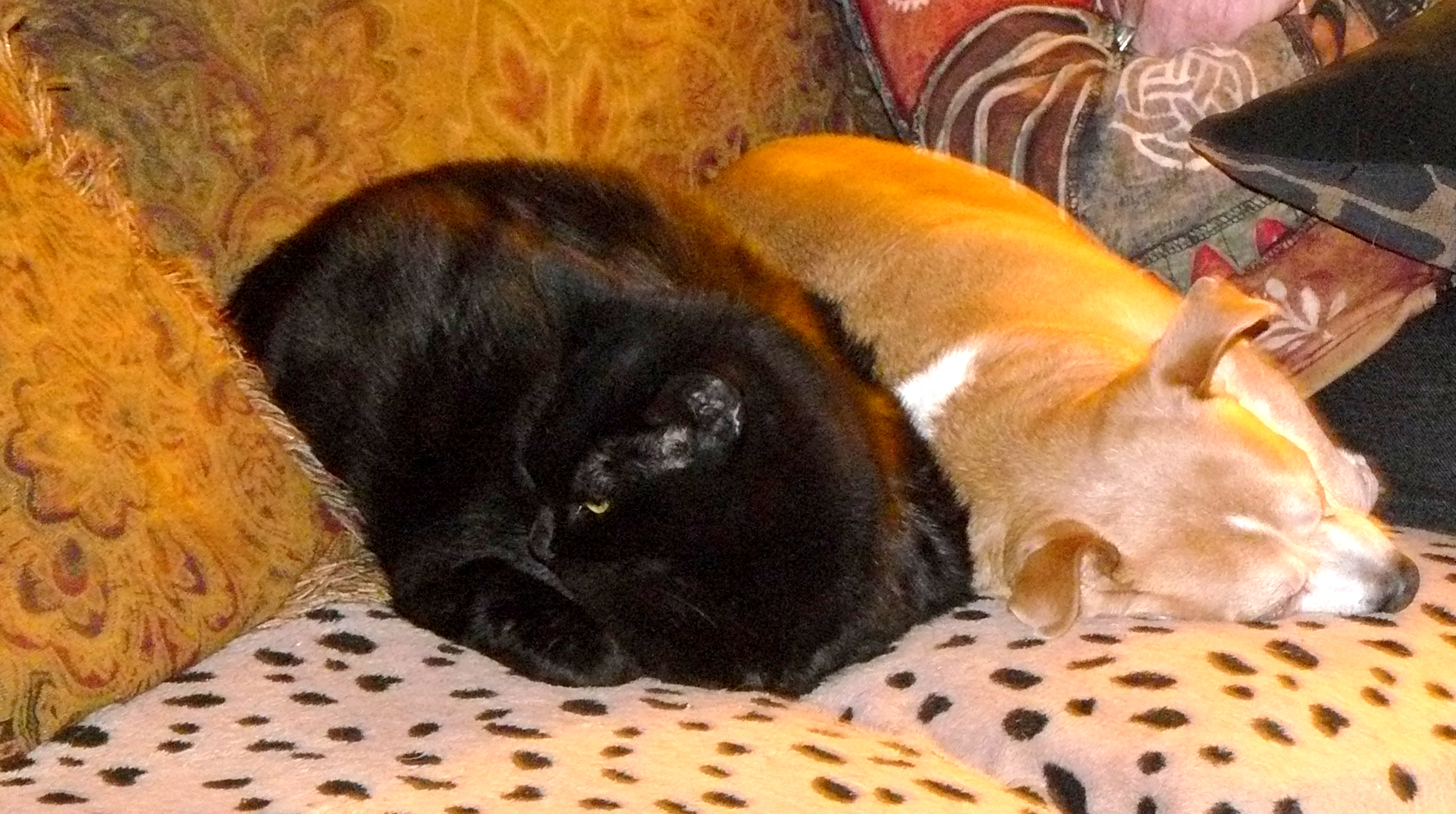
Araña, one of our three cats, sleeping next to Pedy. (Araña is the Spanish word for spider.)
Araña is one of the remaining three cats from the original seven ex-Mexican rescue cats that came with us back in 2010 when we moved from San Carlos, Mx. to Payson in Arizona.
Or, more specifically, do we believe we have free will?
One of the endless benefits of this wired-up, digital world is how easy it is to have one’s mind opened and stretched a little.
Take this, for instance, as an intriguing start to a new day.
Do we have free will?
This isn’t a question I can answer, but what I am interested in is “what happens if we do (or do not) believe in free will?” In other words, does believing in free will matter in your daily life?
Just let one’s mind float around that idea, not only as it applies to us humans but also to the animals that share our human intuition, such as dogs and horses.
So what’s got me bubbling along today? Nothing less than an article that appeared on The Conversation blog-site back last September.
I found it fascinating and hope you do as well. It is republished within the terms of The Conversation site.
ooOOoo
Believing in free will makes you feel more like your true self
September 1, 2016
By Elizabeth Seto, Ph.D. Candidate in Social and Personality Psychology, Texas A&M University .
Do we have free will? This is a question that scholars have debated for centuries and will probably continue to debate for centuries to come.
This isn’t a question I can answer, but what I am interested in is “what happens if we do (or do not) believe in free will?” In other words, does believing in free will matter in your daily life?
My colleagues and I at the Existential Psychology Lab at Texas A&M University study the psychological outcomes of belief in free will. While contemplating my next research project, I realized at some point in our lives, we all want to understand who we are – it’s human nature. So, we decided to explore how believing in free will influences our sense of self and identity.
Free will is generally understood as the ability to freely choose our own actions and determine our own outcomes. For example, when you wake up in the morning, do you hit snooze? Do you put on your workout gear and go for a run? Do you grab a hot cup of coffee? While those are simple examples, if you believe in free will, you believe there are a limitless number of actions you can engage in when you wake up in the morning, and they are all within your control.
Believing in free will helps people exert control over their actions. This is particularly important in helping people make better decisions and behave more virtuously.
For instance, research has found that promoting the idea that a person doesn’t have free will makes people become more dishonest, behave aggressively and even conform to others’ thoughts and opinions. And how can we hold people morally responsible for their actions if we don’t believe they have the free will to act any differently? Belief in free will allows us to punish people for their immoral behaviors.
So, not only is there a value to believing in free will, but those beliefs have profound effects on our thoughts and behaviors. It stands to reason that believing in free will influences how we perceive ourselves.
You might be thinking, “Of course believing in free will influences how I feel about myself.” Even though this seems obvious, surprisingly little research has examined this question. So, I conducted two studies to suss out more about how believing in free will makes us feel.
What believing in free will makes us feel about ourselves
In the first study, I recruited 304 participants from Amazon Mechanical Turk and randomly assigned them to write about either personal experiences reflecting a high belief in free will, like changing career paths or resisting drugs or alcohol, or experiences reflecting a low belief in free will, such as growing up in poverty or working under an authoritative boss. Then, they were all asked to evaluate their sense of self.
Participants who wrote about experiences reflecting low belief in free will reported feeling less “in touch” with their true selves. In other words, they felt like they did not know themselves as well as the participants who wrote about experiences reflecting high belief in free will.
Then, I conducted a follow-up study testing one’s sense of authenticity, the feeling that one is behaving according to their own beliefs, desires and values.
I recruited another group of participants from Amazon Mechnical Turk, and like the first experiment, randomly assigned them to write about personal experiences demonstrating high belief in free will or low belief in free will. Then, they all completed a decision-making task where they had to make a series of choices about whether to donate money to charity or to keep the money for themselves.
Afterwards, participants were asked how authentic they felt while making their decisions. Participants in the low free will group reported feeling less authentic than participants in the high free will group.
Ultimately, when people feel they have little control over their actions and outcomes in life, they feel more distant from their true, authentic selves. They are less in touch with who they are and do not believe their actions reflect their core beliefs and values.
We believe this is because belief in free will is linked to feelings of agency, the sense that we are the authors of our actions and are actively engaged with the world. As you can imagine, this sense of agency is an important part of a person’s identity.
The importance of feeling like you are in charge of your life applies to significant actions like moving or getting a new job or pondering the big questions in life. But it also applies to the minor decisions we make throughout the day.
Here’s one simple, though relatable, decision I am faced with every morning. When I wake up in the morning and decide to put on my workout gear and go for a run instead of hitting snooze, I might feel like I am the primary decision-maker for this morning routine. Additionally, I am most likely acting on the part of me that values physical health.
But what if I wake up, and I feel like I can’t exercise because I have to go to work or some other external factor is making it difficult to go? I might feel as if someone or something else is controlling my behavior, and perhaps, less like my true self.
So, do you have free will? Do any of us? Remember, the question isn’t whether it exists or not, but whether you believe it does.
ooOOoo
Now thinking of dogs having their own free will might seem a little bizarre, but I do not intend it to be seen as such. Many of you will have dogs (and horses) that have ‘minds of their own’.
For our family here at home, if there’s one of our dogs that exhibits free will it is our Brandy.
Our Brandy is a Pyrenean Mastiff!
Without warning or any other indication, he will suddenly decide it is time to go ‘walk-about’. Mainly during the day but sometimes at night, whatever the weather, he will disappear. He will always return but can be wandering around our thirteen acres for up to an hour.
A cap cloud at sunrise over Mount Rainier, spotted from Seattle, Washington, US, by Elaine Thompson (Member 41974).
“Though outwardly a gloomy shroud,
The inner half of every cloud
Is bright and shining:
I therefore turn my clouds about,
And always wear them inside out
To show the lining.”
[From ‘The Wisdom of Folly’ by Ellen Thorneycroft Fowler in Verses, Wise or Otherwise (1895)]
Then to the amazing!
It’s hard to comprehend the sheer size of objects in space, but take 2 minutes and give it a try!
This video is from the European Southern Observatory (ESO) comparing the sizes of Earth, our sun and stars.
Sorry, folks but still a few days away from being back to normal service.
We awoke yesterday morning with Casey sufficiently unwell that Jim Goodbrod recommended taking him to Southern Oregon Veterinary Services (SOVC) down in Medford. There SOVC said that it does look as though Casey has a failure in one of the spinal discs in his neck. First, we have been advised to up the pain medicine before embarking on an MRI and then, possibly, surgery.
In the middle of all this the tube from my catheter into my drainage bag became blocked, evidenced by pee running down my leg!!
SOVC offered me their very comfortable bathroom where I then unblocked the tube using a syringe and sterile water; luckily all brought with me.
Then it was up to Grants Pass to find a solution to my ‘leaking’ catheter only to find that Southern Oregon Medical Equipment, who we thought were in Grants Pass, had moved a year ago from Grants Pass to …… guess?? ……. yes: Medford!
Plus it was raining for most of the day!
Yes, it was one of those days!!
One of those days where one needs a head for the heights that life can throw at one.
No better demonstrated by the following video sent to me by my loving son: Alex!
So will just close by saying that until my catheter is taken out next Tuesday (fingers crossed) I may be ‘distracted’ from Learning from Dogs at times!
No, that subtitle is wrong. It should be: Science brings to light the wonderful history of dogs and humans!
Approximately seven years ago I published a series of posts. Each post was a segment of a BBC Horizon documentary entitled: The Secret Life of the Dog. Inevitably as so often happens when BBC programmes unofficially find their way on to YouTube those videos have long disappeared from sight.
So imagine the joy when Jean and I were browsing the web site Top Documentary Films to find that the full BBC Horizon episode was available.
The documentary is an hour long and is unmissable viewing for anyone who is interested in the history of mankind back in the days of hunting and gathering. If you are also a lover of dogs and you haven’t seen the programme then, in two words WATCH IT!
Here’s a clip from the Horizon episode. A deeply emotional and moving clip.
Now I can’t insert the Top Documentary video as I can with a YouTube video.
But I can link to it, and republish the written introduction.
We have an extraordinary relationship with dogs – closer than with any other animal on the planet. But what makes the bond between us so special?
Research into dogs is gaining momentum, and scientists are investigating them like never before. From the latest fossil evidence, to the sequencing of the canine genome, to cognitive experiments, dogs are fast turning into the new chimps as a window into understanding ourselves.
Where does this relationship come from? In Siberia, a unique breeding experiment reveals the astonishing secret of how dogs evolved from wolves. Swedish scientists demonstrate how the human/dog bond is controlled by a powerful hormone also responsible for bonding mothers to their babies.
Why are dogs so good at reading our emotions? Horizon meets Betsy, reputedly the world’s most intelligent dog, and compares her incredible abilities to those of children. Man’s best friend has recently gone one step further – helping us identify genes responsible for causing human diseases.
Trust me, if you haven’t seen this documentary and you have dogs in your life it will change the way you appreciate and love your wonderful dogs.
I’m going to close this post with a photograph you have seen many times before, via the home page of this blog.
Simply because I know for thousands of you who have dogs in your lives there is nothing more special, nothing more intimate, nothing more magical than the eye-to-eye bond between your dog and you.
Or, more specifically, what Diego meant for Laura Bruzzese. (This will be the second in the series We Shall Not Forget Them.)
ooOOoo
Dog Love In August
August is the start of the dying season. Garden things begin their slow shrink into the earth, the days grow shorter and cooler, lazy ocean- or mint-scented summer days snap into rigid schedules of work and school.
August is also the month that I lost Diego, my first dog. You can get acquainted with Diego here, a post I wrote a few days before he died. But I would like to share a little more now, on the second anniversary of his departure.
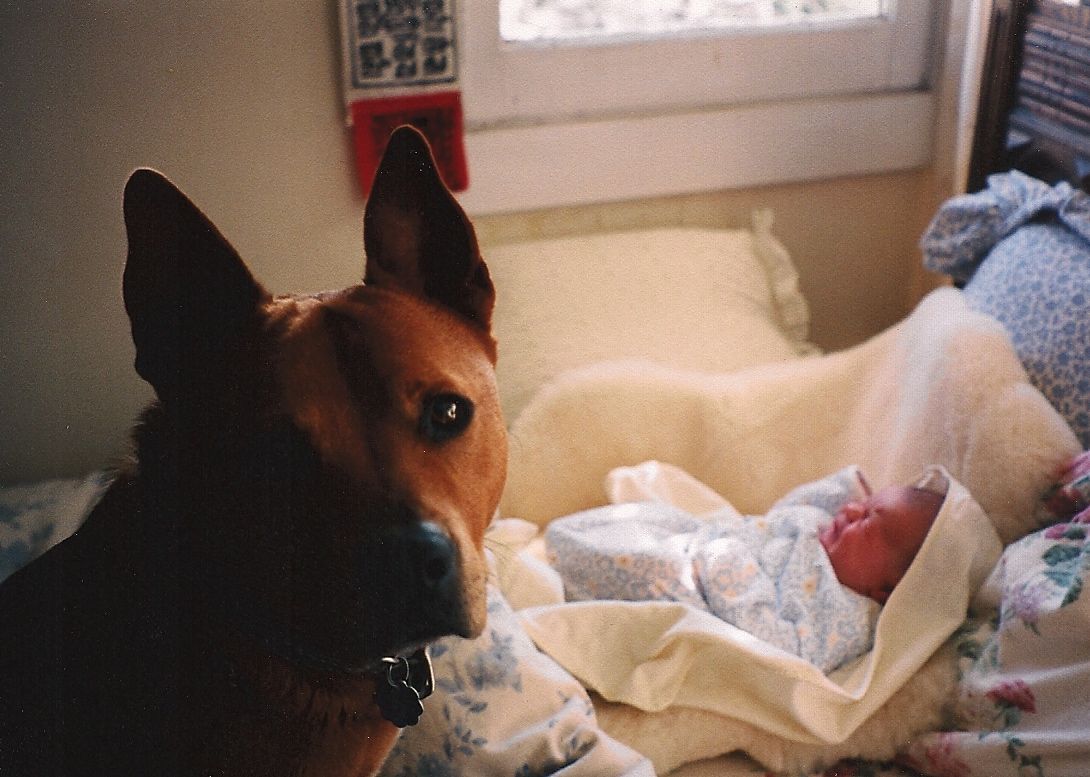
Diego was a poser, in a very literal sense of the word. He loved having his picture taken; in fact, he insisted on it whenever he saw me holding the camera. This picture, for example: it was taken the day I brought my daughter home from the hospital, the day after 21 hours of hard labor produced an eight-and-a-half-pound baby who actually stopped halfway out of my body, looked around, and scowled before resuming her reluctant journey onto the planet. (She was 12, twelve days overdue, FYI all you mothers out there who can surely feel my pain.)
There is something screaming in the bed. Please make it stop before it explodes.
I laid baby Isabella down, stepped back with the camera, looked up, and there he was: Diego, staring. Fifty-eight pounds of solid, unmoving dog. Insisting that I photograph him, too, with this creature that he wasn’t sure if he should guard against or lick. This child who personified the singular emotion of furious for the first nine weeks of her life (if she was not sleeping or eating, she was screaming).
Oh, hi Aunt Rosie. I know you’ve passed on, but I’ll bet you can still hear that screaming baby wherever you are.
When my doula told me that the colic or distemper or petite innards or whatever it was making Isabella so unhappy would resolve itself in about nine weeks, I said oh, that’s nice. But I won’t be alive for nine weeks of this. I’ll be in an asylum acquainting myself with a selection of opiates, or at the bottom of the mighty Rio Grande; so behold, an orphan.
But somehow, I survived. And Diego was part of it.
You see, from the very beginning, it was just us — the two of us, the three of us. I was abandoned by my husband before Isabella was born, a painful time that I don’t often write about.
Within a matter of weeks, the married-and-expecting life I’d known was gone, and I was left to fumble around with the pieces, a wreckage sitting on a pile of broken glass in the dark. The small hours of it were the worst, waking up alone and panicked in the middle of the night wondering how (or if) I would live through the next weeks and years. And Diego was always there, a silent and comforting presence curled at the foot of the bed or coming up to lick my tears if I was crying, which was basically all the time. He was always there.
I have a teenager now and those days seem ancient. While I rebuilt my life, Isabella grew up and Diego grew old. And finally, in his sixteenth year, he began to deteriorate to the point of pain. I knew he wouldn’t be with me much longer and I had already called the vet to ask her how it worked — when do you know it’s time? Do I take him to the office, or do you come to the house? Will he feel anything? I planned to schedule an appointment soon; I hadn’t had to make this decision before and it was a very painful.
On the morning of August 9 before I left for work, I told Diego that we would have to say good-bye soon because his body wasn’t working right anymore. I told him that I loved him and it was okay for him to go. Over and over I told him I loved him.
Less than two hours later, he drowned in the pond.
I think it was his way of avoiding the vet (he hated the clinic), and maybe sparing me that particular pain. I’m not going to say that I wasn’t devastated. But rather than remembering the urgent phone call at work from Isabella, or the vision of him when I got home, or my step-father struggling to carry the terrible weight of him away, I like to imagine Diego simply being received by the fish and toads. Delivered from his pain by warm water, wrapped in a blanket of lilies.
Anyone who has cared for pets perhaps knows that there is one, a special one, who will always occupy the largest piece of real estate in your heart, though others may follow. That was Diego for me.
But now we’re lucky enough to share our lives with another dog, the rascally, neurotic, road trip-loving Velma. I’ll end this post with a short video of her that reminds me of exactly what I love about dogs: their absolute and abundant connection with life, free of judgement, agenda, or desire to be anything other than what they are. That’s what I think of every time I see Velma in her Writhe of Exquisite Happiness. Perfect contentment of being.
ooOOoo
Laura wrote and published this back in August, 2012. But her words, emotions and feelings are those that never age. Indeed, I would add her courageous words.
The words of Jim and Janet Goodbrod. It was finally time to say the last goodbye to our old Buddy. Life had become an intolerable burden. His spirit wanted to keep going, but his failing body could not keep up. We ended his suffering and gently nudged him into that deep and eternal sleep last Wednesday.
Rest in peace old man! You made it 16-17 years. You aren’t in pain any longer and can run and play like you used to. We had you for only about 10 months, but loved you and we’re glad we could make your last year a good one. Forget the horrible abuse you suffered as a puppy, and remember only the love and joy you gave us in your last days on this planet.
A Dog’s Plea
Treat me kindly, my beloved friend, for no heart in all the world is more grateful for kindness than the loving heart of me.
Do not break my spirit with a stick, for although I should lick your hand between blows, your patience and understanding will quickly teach me the things you would have me learn.
Speak to me often, for your voice is the world’s sweetest music, as you must know by the fierce wagging of my tail when your footsteps falls upon my waiting ear.
Please take me inside when it is cold and wet, for I am a domesticated animal, no longer accustomed to bitter elements. I ask no greater glory than the privilege of sitting at your feet beside the hearth. Keep my pan filled with fresh water, for I cannot tell you when I suffer thirst.
Feed me clean food that I may stay well, to romp and play and do your bidding, to walk by your side and stand ready, willing and able to protect you with my life, should your life be in danger.
And, my friend, when I am very old, and I no longer enjoy good health, hearing and sight, do not make heroic efforts to keep me going. I am not having any fun. Please see that my trusting life is taken gently. I shall leave this earth knowing with the last breath I draw that my fate was always safest in your hands.
Last year I instigated a new ‘page’ on Learning from Dogs. It was entitled We Shall Not Forget Them. It was introduced by me as follows:
For millions, the relationship between a person and their dog is precious beyond words. Do you still grieve the loss of your wonderful dog? Let us all know what your dog meant to you. Write whatever you want. Leave it as a thought to this page.
Then it became clear that this was not going to work properly. Because each note of remembrance was, in effect, a comment. And I discovered that under WordPress it is not possible to insert a photograph. I struggled to think of a better way of doing it. Then earlier yesterday it came to me.
I will make each message of condolence, each reflection on how special the dog was, a new and separate blog post. In other words, each dog gets their own post for a full day.
Then each time a condolence is sent in, I will update the We Shall Not Forget Them post with the name of the departed dog, the date and a link to the blog post that has the details and memories of the animal.
I hope that makes sense!
To underline how it is going to work, I am starting off with the words of loss, and photographs, of Jim and Janet’s Buddy.
That post will be published in an hour’s time and will be linked to as I described above.
ooOOoo
So I am reaching out to Susan, Asha, Katrina and Whisperofthedarkness – each of you has left a memory as a comment to here.
Please do email me some photographs and any further recollections you would like me to post, and I will do for you as I have done for Buddy.
(Laura, I shall go to that link and republish what you wrote.)
I was emailed as follows back on the 25th January:
Hi Paul,
I hope all is well with you and Jean and the furry kids. About a month ago, you had mentioned that you would welcome a post about Maggie in honor of her 9th birthday.
Maggie was very enthusiastic about this venture and managed to write a little blog with her advice on aging. I have enclosed the result for your review.
Her birthday is on 2/3. Thank you so much for giving us this opportunity. Take care!
Kind Regards,
Susan & Maggie
Ergo, this coming Friday is Maggie’s birthday.
ooOOoo
Maggie’s Advice on Aging
Hello! My name is Maggie.
I have a much longer AKC registered moniker that Mom & Dad christened me with but it’s ridiculous so I just shortened it.
Anyway, Paul was so gracious to invite me to do a post for all of you good folks at Learning from Dogs. Since I have a birthday coming up (in case you are wondering, I’ll be 9), I thought what better topic to write about than aging.
To me, age is just a number. I know that is a cliché but it’s the truth! I don’t know what other dogs my age do but I’m not ready to just lay down on the couch. Not me! I’ve got too many things to do and way too many places to see.
Here are some of my tips on how you can feel like a puppy:
Take your vitamins – I will admit. After Mom and Dad replaced my favorite brand of fish oil with another one that didn’t taste so good, I refused to take the pill. They would try and hide it in my food but I would just find it and set it to the side. I mean, who do they think they are dealing with? They finally wised up and now I am back to my brand. Some of you might be thinking, fish oil, yuck! Seriously, I swear by it. It promotes heart health and it keeps my coat silky smooth. I also have these tasty Milk Bone vitamins that help me to stay healthy and they even improve joint mobility! That way I will be keeping the ‘rents on their toes for years to come.
Get off the couch – Yes, I like couch time with my Mom and Dad but I love nothing more than to lollygag in our gigantic backyard playing ball. I will do this for hours! My bipeds on the other hand, they have their limits. I also enjoy going for walks in this cool, new park near our house. It’s in the woods and I love all the places I can explore. Just being active is not only good for you but it keeps you engaged and learning new things all the time.
Annual checkups – Going to the vet isn’t fun. I don’t know anyone that enjoys it. However, I know that everything they do for me keeps me healthy. The ‘rents see to it that I get my yearly vaccinations and physical. It keeps me in tip top shape so I will be barking at them for years to come. Mom loves it when I yell at her.
Watch your diet – Okay. I will admit this one bites. If I had my way, I would be chowing down on all kinds of good things like meat, cheese, bacon…. the list goes on and on. I need to watch my girlish figure! I eat the best food with no preservatives and it’s also chockful of vitamins. Believe it or not, I love my yummy meals, they taste good!
It’s the little things – This is what happiness is for me. I love nothing more than playing with the really cool stuffed teddies Dad got me or going for rides in the car with Mom. I really like family time when we watch movies and cuddle on the couch. Just being with my two favorite people in the world keeps me going. We spend quite a bit of time hanging out and I wouldn’t have it any other way!
I hope you found these tips helpful. It was fun spending time with all of you. Take care and give your parents a hug! They deserve it.
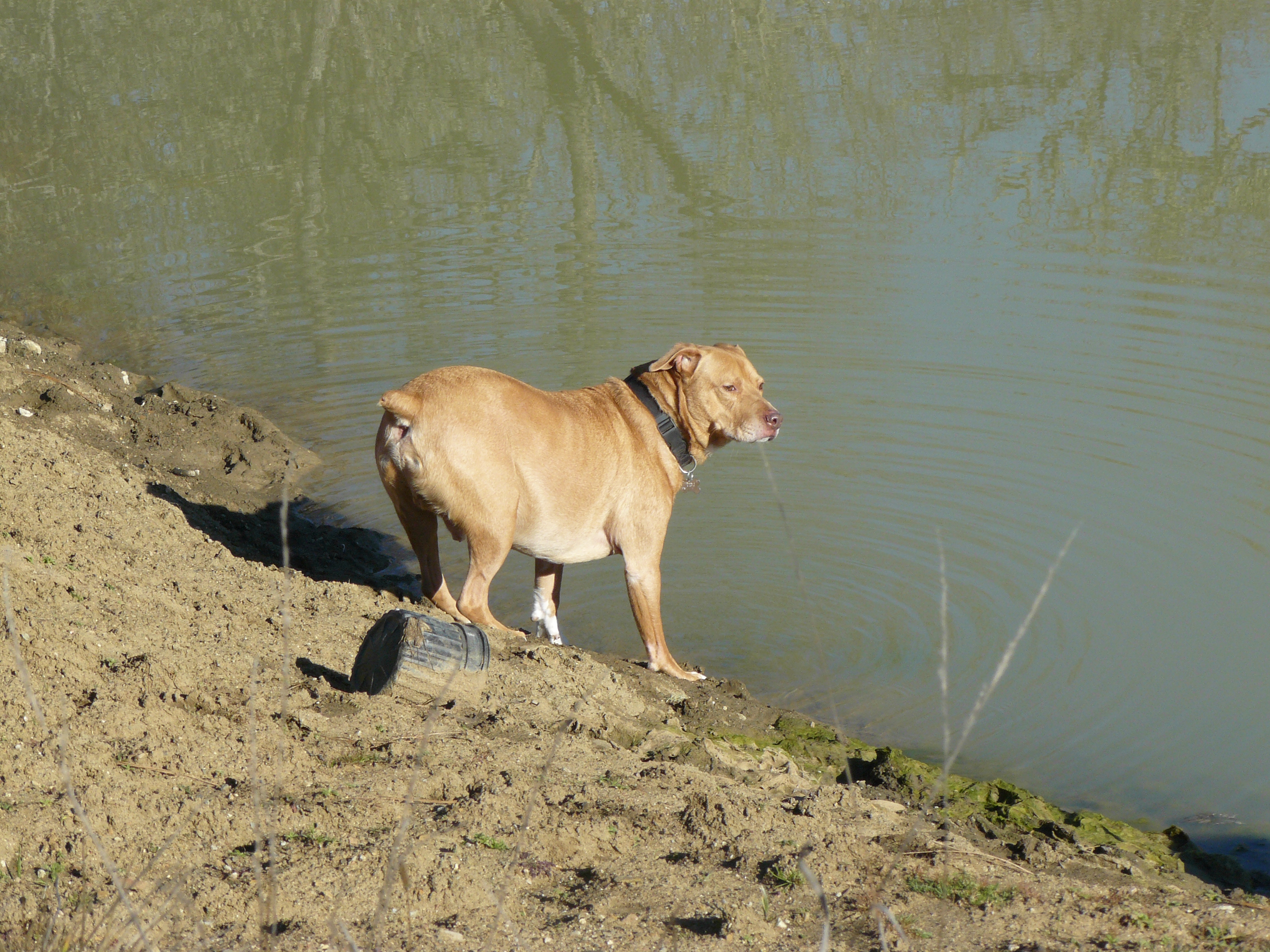
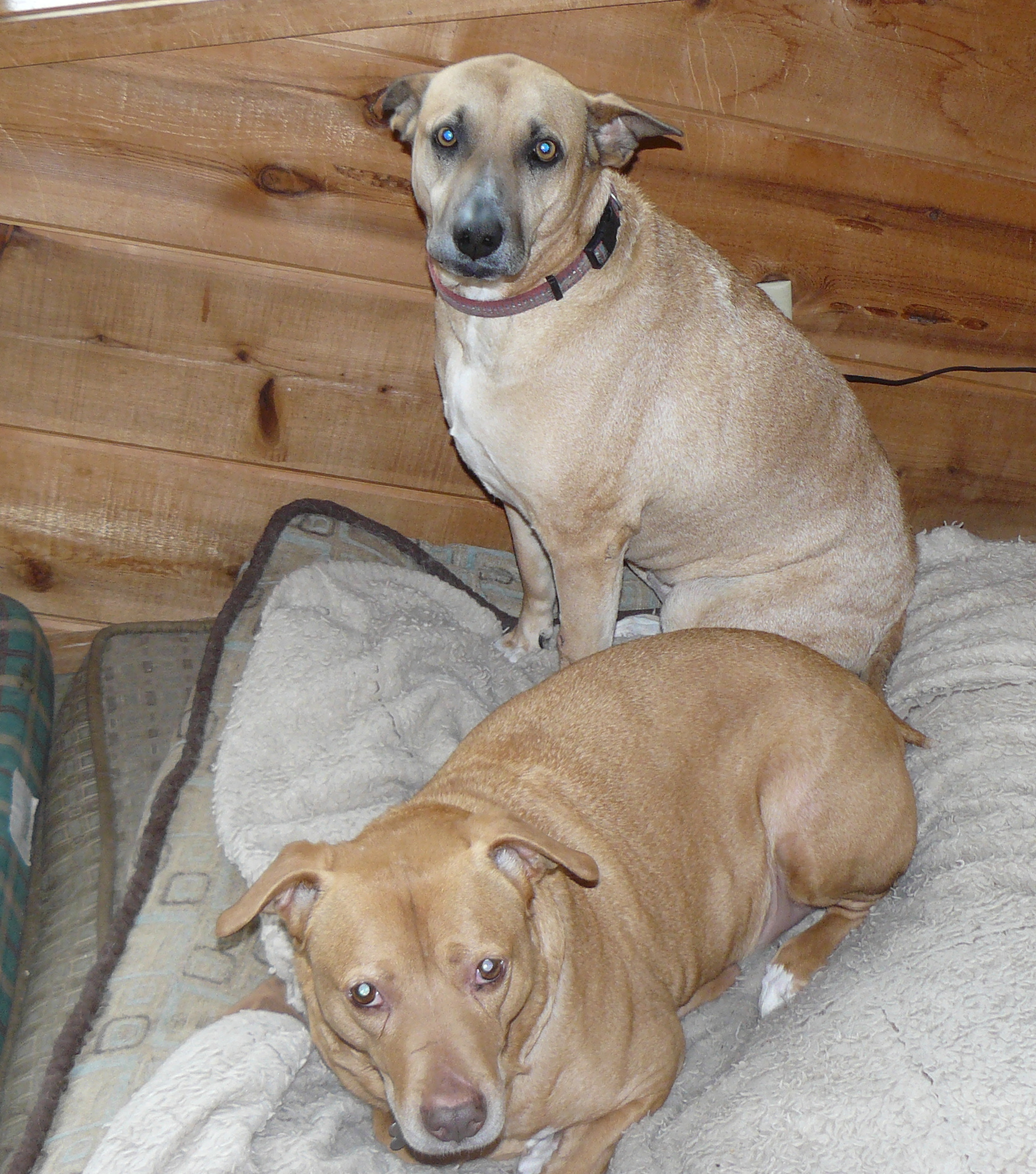
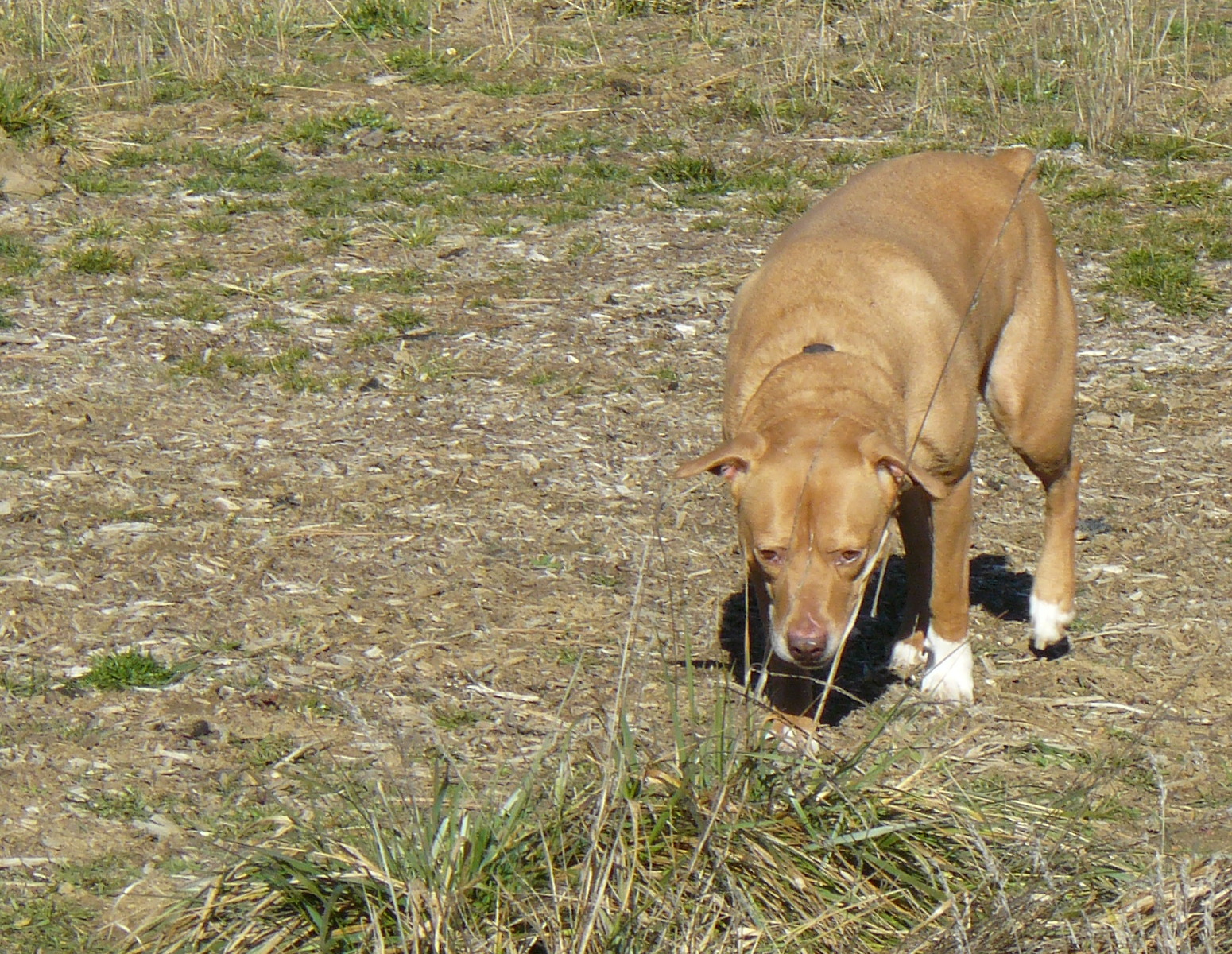
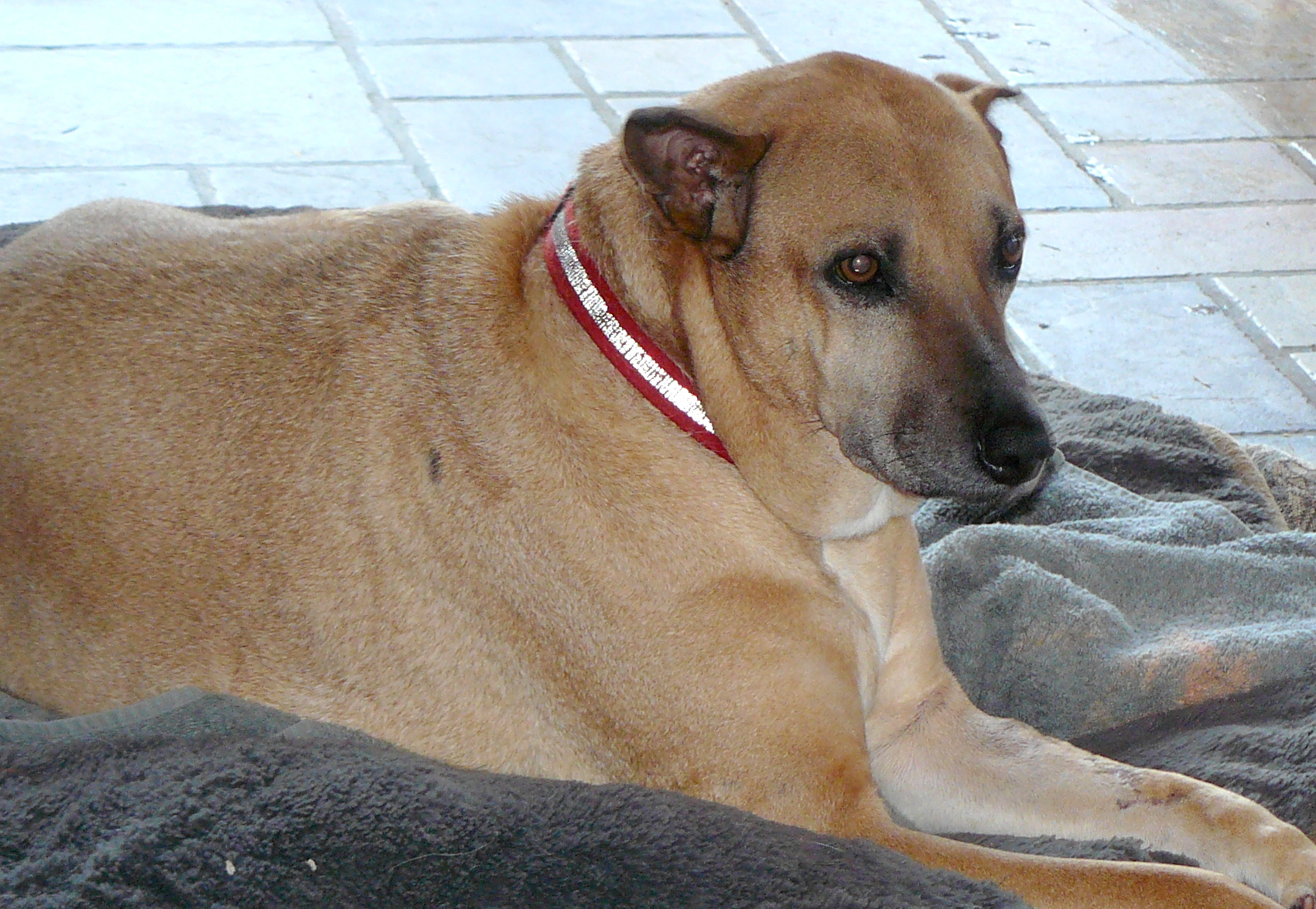 Trust me, Ruby’s normal face truly has a smile on it.