Category: Musings

A new dog food alert.

This came in on Saturday.
Dear Fellow Dog Lover,

Pet Supplies Plus is recalling pig ears dog treats in 33 states because they may be contaminated with Salmonella bacteria.
To learn more including which states are included in the recall, please visit the following link: Pet Supplies Plus Recalls Pig Ears Dog Treats in 33 States

That link is the following.

ooOOoo

Pet Supplies Plus Recalls Pig Ears Dog Treats in 33 States

July 5, 2019 — Pet Supplies Plus is recalling bulk pig ears supplied to over 400 retail stores in 33 states due to potential Salmonella contamination.

Bulk pig ears were distributed to Pet Supplies Plus stores in Alabama, Arkansas, California, Colorado, Connecticut, Delaware, Florida, Georgia, Iowa, Illinois, Indiana, Kansas, Kentucky, Massachusetts, Maryland, Michigan, Minnesota, Missouri, North Carolina, Nebraska, New Hampshire, New Jersey, New York, Ohio, Oklahoma, Pennsylvania, Rhode Island, South Carolina, Tennessee, Texas, Virginia, Wisconsin and West Virginia.

Developing Story

The Pet Supplies Plus recall may or may not be related to another developing story.

On July 3, 2019, the Food and Drug Administration (FDA) announced the Agency is investigating contaminated pig ear dog treats that may be connected to human Salmonella infections that have sickened 45 people in 13 states.

Twelve patients are hospitalized.

In addition, the Centers for Disease Control and Prevention (CDC) is investigating a multistate outbreak of drug-resistant Salmonella infections linked to contact with pig ear treats.

None of the 45 cases are confirmed to be a result of purchasing pig ears from Pet Supplies Plus, according to the company.

The investigation is ongoing. The Dog Food Advisor continues to monitor this developing story.

What’s Recalled?

Bulk pig ear dog treats were stocked in open bins. Prepackaged branded pig ears are not included in this recall.

Because the bulk pig ear dog treats were sold in open bins, the company provided the following image of the related in-store sign.

About Salmonella

Salmonella can affect animals eating the products and there is risk to humans from handling contaminated pet products, especially if they have not thoroughly washed their hands after having contact with the products or any surfaces exposed to these products.

Individuals infected with Salmonella should monitor for some, or all, of the following symptoms: nausea, vomiting, diarrhea or bloody diarrhea, abdominal cramping and fever.

Rarely, Salmonella can result in more serious ailments, including arterial infections, endocarditis, arthritis, muscle pain, eye irritation, and urinary tract symptoms.

Consumers exhibiting these signs after having contact with this product should contact their healthcare providers.

Pets with Salmonella infections may be lethargic and have diarrhea or bloody diarrhea, fever, and vomiting.

Some pets will have only decreased appetite, fever and abdominal pain.

Infected but otherwise healthy pets can be carriers and infect other animals or humans. If your pet has consumed the recalled product and has these symptoms, please contact your veterinarian.

What Caused the Recall?

Testing by the Michigan Department of Agriculture and Rural Development revealed that aging bulk pig ear product in one of Pet Supplies Plus stores tested positive for Salmonella.

The company has removed bulk pig ear product from the shelves at all its stores and has stopped shipping bulk pig ears from its Distribution Center.

PSP is working with the FDA as they continue their investigation into what caused the reported Salmonella outbreak.

What to Do?

Consumers who have purchased bulk pig ears should discontinue use of the product and discard it.

Consumers who have further questions are welcome to contact Pet Supplies Plus Neighbor Service team at 734-793-6564 between Monday and Friday 9 am to 4 pm ET (excluding holidays).

U.S. citizens can report complaints about FDA-regulated pet food products by calling the consumer complaint coordinator in your area.

Or go to https://www.fda.gov/petfoodcomplaints.

Canadians can report any health or safety incidents related to the use of this product by filling out the Consumer Product Incident Report Form.

Get Dog Food Recall Alerts by Email

Get free dog food recall alerts sent to you by email. Subscribe to The Dog Food Advisor’s emergency recall notification system.

ooOOoo

Share this amongst your dog owner friends.

Picture Parade Two Hundred and Ninety-Five

That Chilean eclipse!

From EarthSky:

More amazing images of the July 2 eclipse

Some called it the “astronomer’s eclipse” because it passed near major observatories in Chile. Check out these beautiful images of the July 2, 2019, total solar eclipse.

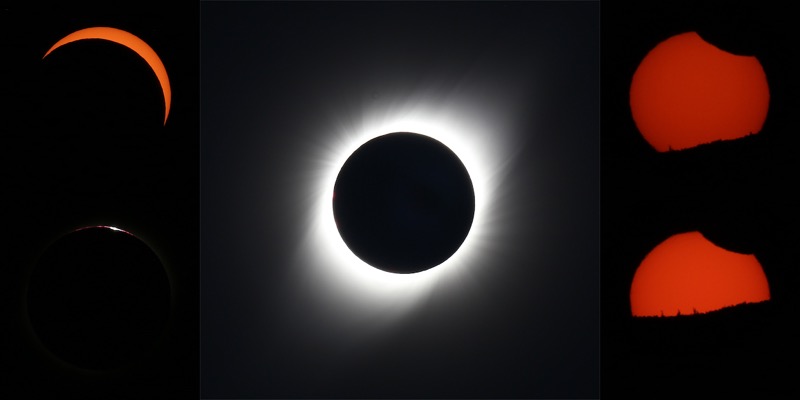
This composite image captures the drama of totality during the July 2, 2019, total solar eclipse. When – as seen from Earth – the moon passes directly in front of the sun, the sun’s light is blocked and its extended atmosphere or corona can be seen. The processing of this image highlights the intricate detail of the corona, its structures shaped by the sun’s magnetic field. Some details of the lunar surface can also be seen. The image – via European Space Agency (ESA) – was created by the ESA-CESAR team observing the eclipse from ESO’s La Silla Observatory in Chile, South America.
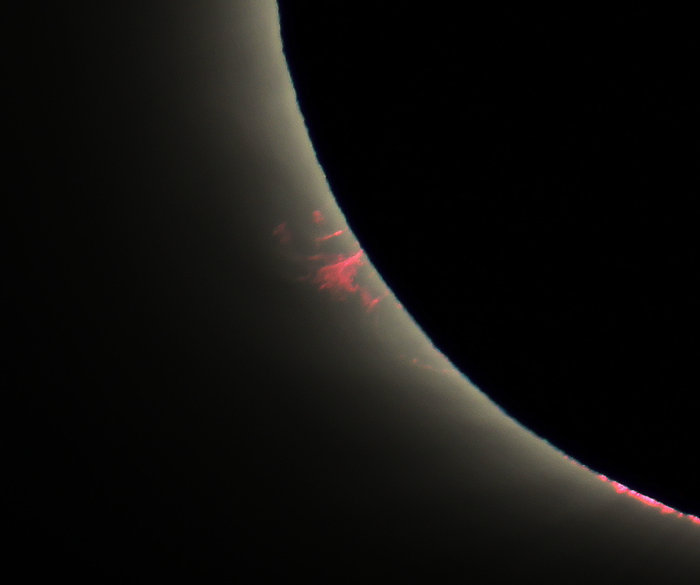
A prominence seen in the sun’s chromosphere during the July 2, 2019, total solar eclipse. Prominences are made of tangled magnetic field lines that keep dense concentrations of solar plasma suspended above the sun’s surface. They are anchored to the sun’s visible surface and extend outwards through the chromosphere and out into the corona. The red hue of the chromosphere is only apparent during an eclipse. This image – via ESA – was taken by the ESA-CESAR team observing the eclipse from ESO’s La Silla Observatory in Chile, South America.
View at EarthSky Community Photos. | Total solar eclipse over Vicuna, Chile, on July 2, 2019 from Alexander Krivenyshev of the website WorldTimeZone.com.
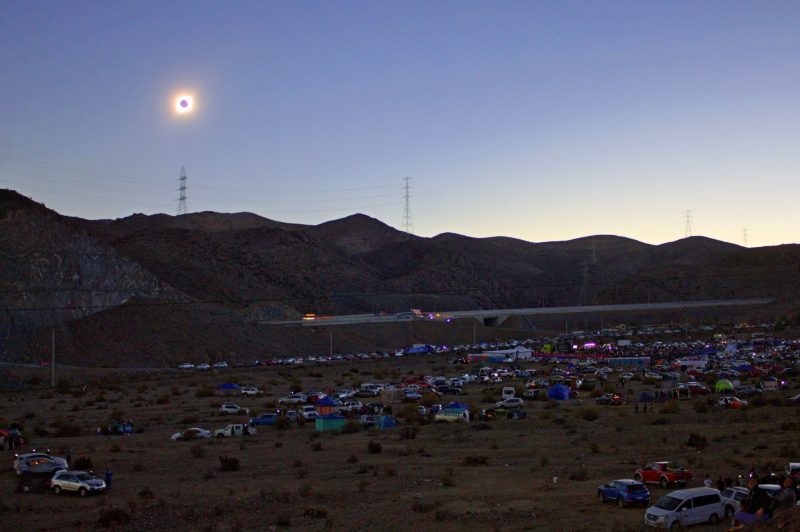
View at EarthSky Community Photos. | Pablo Goffard caught the July 2 total solar eclipse from Incahuasi, Chile. He wrote: “This is just a photo, a tiny part of the experience. Incahuasi is a small town in the Atacama desert. Here it’s seen the camp installed especially for the eclipse.”
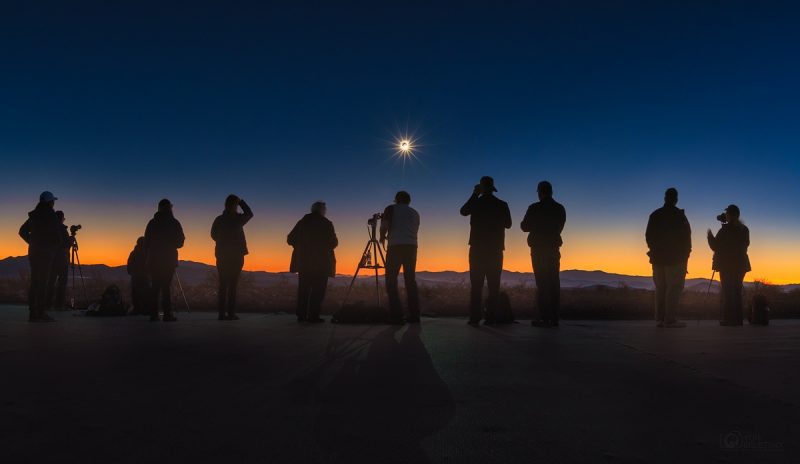
This image of eclipse-watchers was taken by a frequent EarthSky contributor, Yuri Beletsky, on the Chilean coast. It was chosen as an Astronomy Picture of the Day for July 4, 2019. Congratulations on a wonderful photo, Yuri! Note that diffraction spikes (apparent rays from the sun) are effects from the camera lens aperture.

While some observers on the southern part of Earth saw a total solar eclipse, the European Space Agency’s PROBA-2satellite’s SWAP imager in space saw a partial eclipse, as shown in the video below. The images are in ultraviolet light, revealing the turbulent nature of the sun’s surface and corona. ESA said:

During this eclipse the satellite was passing through the South Atlantic Anomaly at the time of the largest occultation [covering of the sun]. In this region the spacecraft is exposed to higher levels of radiation. The increased flux of energetic particles falling on the satellite’s detector is the cause for all the bright dots and streaks in the images.

Bottom line: More amazing images of the July 2, 2019, total solar eclipse.

There is more, much more, on the Smithsonian magazine website. Do go across and see the images.

A plea!

A republication of shared angst

I haven’t been a follower of Cara’s blog Who Will Let The Dogs Out?  for a very long time but her posts are powerful and good. I have every intention of remaining a follower.

Especially when one reads posts this one that speaks of the stream of unwanted animals.

Cara has given me permission to republish it.

ooOOoo

A Neverending Stream of Unwanted Animals

We are home and settled in for the holiday week, but in some ways, I feel like I’m still in Tennessee. The pull is so strong. The stories down there break my heart but they also fire up my desire to fix this situation.

It is SO fixable. It does not need to be happening. There are more than enough of us to help the women struggling to help the dogs in western Tennessee. Once more, there are more than enough homes for those dogs, too.

From Kim Kavin’s excellent, well-researched book, The Dog Merchants:

“The notion that America’s homeless dogs face an ‘overpopulation problem’ does not match up against the available statistics. Supply is not exceeding demand. Americans want about 8 million dogs a year as new pets, while only about 4 million dogs are entering shelters….If just half the Americans already getting a dog went the shelter route, then statistically speaking, every cage in US animal control facilities could be emptied. Right now.”

And Tabi and Amber and Kim and Anne and Laura wouldn’t spend their every waking moment fighting to keep animals alive.

I’m not trying to guilt those of you who chose to buy your dog, particularly if you bought that dog from a reputable breeder and/or intend to show your dog. What I am saying is that if the next time you decide you’d like another pet (especially a cat), you’d consider looking at your local shelter or rescue.

And the next time a friend of yours or just an acquaintance tells you they adopted a dog from a shelter or rescue, thank that person for choosing to save a dog.

I’ve been home for five days now and already I’ve heard of more heartbreaking stories landing in the lap of both Karin’ 4 Kritters and Red Fern. Puppies abandoned and struggling, three dogs rescued by a woman who has them kenneled on her front porch to keep neighbors from poisoning them, dogs and puppies simply dumped. I can’t keep count of how many are in desperate need of rescue, so I asked for a summary from Laura (who handles transports from the area for OPH and many other rescues across our country).

The list here of calls for help in one day is:

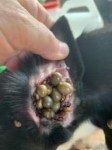
– 3 pups dumped at Red Fern (that may go to Greenfield pound) – the picture of the ear with ticks is one of these puppies.

– 2 choc pups dumped in the country that they put at the city pound for now

– 2 pittie teens they’re being asked to take. (Crockett and Tyke)

– 3 strays in Sharon, TN that a lady caught because the neighbors were threatening to poison them because they’ve been running loose for months.

– pittie pup in Greenfield that the owner wants to surrender because it’s getting to be “too much”

– 2 three month old pups someone is asking her to take

– a 6 month injured beagle. The owner was going to “put it on the street” so her brother went and picked it up but he thinks it has a broken rib and it’s in pain and he doesn’t have money to treat it so he wants to dump it on Tabi.


That’s just in a day. Multiply that times all the little towns and counties all over western Tennessee that rely on rescues like Red Fern and Karin’ 4 Kritters and their minimalist dog pounds. Places where there is no safety net and dogs are suffering and dying daily. Places where there is no real, reasonable, low-cost access to spay/neuter. Places where dogs (and cats) are not valued or loved, and where their local government will not spend money because it’s ‘just a dog’ or ‘just a cat.’

We seem to have ‘solved’ the problem in the northeast and many metropolitan areas, but we are far from a solution in the rural south and Midwest. We cannot forget them.

The need is so real. Something has got to change. Someone has got to let these dogs out.

Thanks for reading and for caring.

Blessings,

Cara

If you’d like to help, page back through these posts for contact information, but if you’d really like to help, TELL someone. Spread the word – I remain convinced, that the problem is not that people don’t care, it’s that they don’t know. Please help us tell them.

ooOOoo

Bear in mind that the above list is for One Day!
Is it true that people don’t know about this?

Well those that read this blog certainly do now.

The power of a photograph

No words to say how I feel!

The bodies of Salvadoran migrant Oscar Alberto Martínez Ramírez and his daughter lie on the bank of the Rio Grande in Matamoros, Mexico. AP Photo/Julia Le Duc

This is a terrible photograph. It has been widely shown but that doesn’t make it any less terrible.

Patrice Ayme recently wrote about the tragedy but for today I am republishing the article in The Conversation.

ooOOoo

How much power can one image actually have?

By

Associate Professor, School of Journalism and Communication, University of Oregon

Professor of Psychology, University of Oregon

When the Associated Press published Julia Le Duc’s photograph of a drowned Salvadoran man, Óscar Alberto Martínez Ramírez, and his 23-month old daughter Valeria, it sparked outrage on social media. According to Le Duc, Ramírez had attempted to cross the Rio Grande after realizing he couldn’t present himself to U.S. authorities to request asylum.

But beyond raising awareness via Twitter and Facebook feeds, does an image like this one have the power to sway public opinion or spur politicians to take action?

As journalism and psychology scholars interested in the effects of imagery, we study the ability of jarring photos and videos to move people from complacency to action. While graphic imagery can have an immediate impact, the window of action – and caring – is smaller than you’d think.

A political catalyst?

Photographs and videos – through their perceived authenticity – can have an effect on people.

Research suggests that the graphic photo of slain Emmett Till in his open casket served as a “political catalyst” in mobilizing Americans to action in the civil rights movement. Similarly, news images have been credited as playing an important role in ending the Vietnam War.

But not all scholars agree. A recent article argued that it was a “myth” that the iconic “napalm girl” photo swayed public opinion and hastened the end of the Vietnam War.

Did the ‘napalm girl’ significantly shift public opinion on the Vietnam War? manhhai/flickr, CC BY

We must also look to psychology to understand the impacts of emotional news content. Research demonstrates that audiences need an emotional connection – and not merely a “just-the-facts” reporting approach – as “prerequisite for political action” when it comes to appreciating the importance of distant mass suffering. And imagery can trigger this emotional connection by overcoming the psychic numbing that occurs when casualties mount, images blur and lost lives become merely dry statistics.

Images from Syria

In April 2017, gut-wrenching images seem to have awakened the world to the human atrocities happening in Syria. Following a chemical bomb attack in the town of Khan Sheikhoun, graphic photos and videos documented the horrific effects of the banned nerve agent sarin. Millions bore witness to excruciating human suffering: gasping, choking, writhing and dying. More than 500 people were injured, with at least 86 deaths, including 28 children.

The vivid, closeup images of sarin attack victims were resonant enough to break through the complacency of people and politicians accustomed to bad news emerging from the war-torn nation. In President Trump’s response – which included a retaliatory missile strike – he seemed to recognize the value of the Syrian lives depicted in the horrific photos and videos.

Syrian doctors treat a child following a suspected chemical attack in the town of Khan Sheikhoun, northern Idlib province, Syria. Edlib Media Center, via AP, File

“When you kill innocent children,” he said during a news conference, “that crosses many, many lines, beyond a red line – many, many lines.”

The limits of an image

Nonetheless, even though the attacks may have briefly heightened U.S. concerns over the wars in Syria, the photographic documentation of the suffering in Syria wasn’t new.

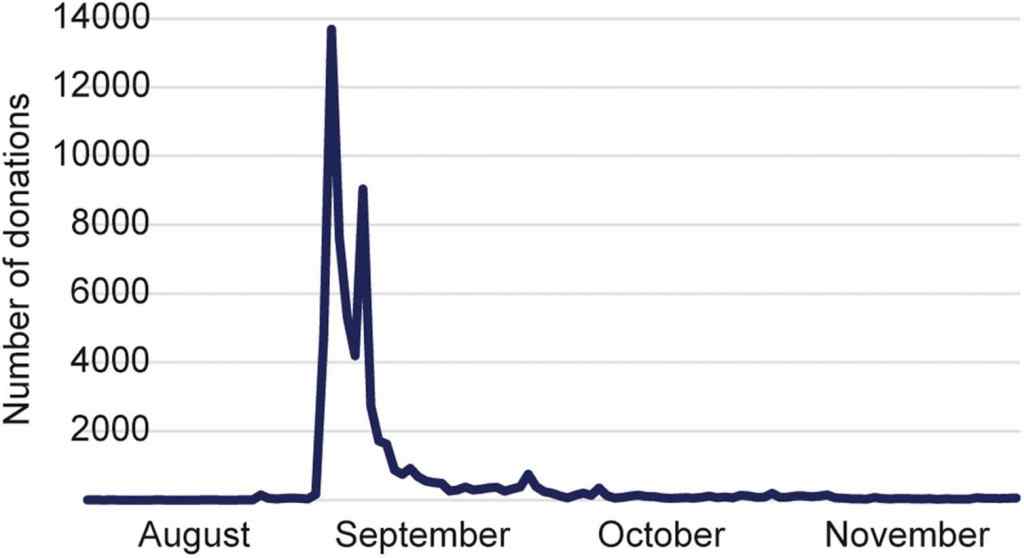
The 2015 photos of a tiny Syrian boy’s lifeless body resting face down in the sand similarly stirred the world’s collective consciousness. Within hours of its release, the photo had reached 20 million people through Twitter, with many more millions seeing it on the front pages of newspapers the next day. Afterwards, government restrictions on accepting refugees were loosened while private donations to organizations like the Red Cross spiked dramatically.

A year later haunting images of a young boy in the back of an ambulance, caked in dirt and blood, galvanized the world.

But the emotional and compassionate responses to both photographs were short-lived. The bombing of civilians in Syria continued. Refugees continued risking their lives to escape the war zone.

After a photograph of a dead Syrian boy went viral in 2015, the number of daily donations to a Swedish Red Cross campaign designated specifically for aiding Syrian refugees spiked dramatically – but only for a brief window. Proceedings of the National Academy of Sciences of the United States of America, CC BY-SA

Since the publication of Le Duc’s photo of the dead migrants, supportive politicians may feel emboldened to sound the alarm on the plight of Central American migrants. Donations to immigrant aid organizations might briefly spike.

But it seems that a photograph, no matter how emotionally devastating, can only do so much.

Yes, it can create a window of time when we’re motivated to act, and we’ll usually do so if we have effective options to pursue. This could mean a charitable donation at the individual level or, collectively, a surge of political will. However, psychology research from the “arithmetic of compassion” suggests that sympathy for distant human suffering declines when we’re presented with rising body counts. Sometimes we’re discouraged by the scope of the problem and this stops us from doing things that actually make a difference – even if partial solutions can save lives. Other times, if the options for helping others seem too narrow or ineffective, we’ll turn away and stop caring.

Images can alert us to the horrors of violence, mass migration and poverty. But as we have seen time and again, photographs and news footage of human suffering generally precipitate a short-term emotional reaction, rather than a sustained humanitarian response.

ooOOoo

As one reads the article it is much more than a comment on a single image despite how terrible that photograph may be.

The two scientists set out to show that the period that we are alarmed or terrified or just plain sad at the state of nations is rather short.

Maybe it’s the self-protective nature of our species that does this.

But it still doesn’t diminish the horror of that top photograph.

How a dog saved a family

This is a story of a very real emergency.

I have taken it from BoredPanda, not a site that I frequent, but this is such a marvellous account of how dogs make, every day, a real difference to the lives of people.

It’s been taken from a Twitter account so my apologies for the ‘staccato’ effect.

ooOOoo

Man Shares A Heartwarming Story About How His Dog Saved His House From Burning Down

Dogs… if only there was a word that would show how much we adore these adorable creatures that we get to call our most loyal friends and also beloved family members. Here at Bored Panda, dogs (amongst other animals) have a very special place, despite the fact that they can do the worst things, we still adore them. Also, today’s story teaches us that just because your puppy did something wrong, don’t be too quick to punish them since they might compensate it by doing something truly heroic.

Recently, one Twitter user shared a heartwarming story about his dog Hank saving his entire family from fire

Hank even got some presents dedicated to his heroic act

People online were not only touched by this story, but they also think Hank deserves to chew all of the shoes in the world.

ooOOoo

What would we do without our dear dogs!

Back to those eyes!

A recent item on Healthy Pets offers some more information.

Yesterday Belinda, who is local to us in Merlin, Oregon, sent me a link to a further article about dogs’ eyes.

In an email to me, Belinda wrote:

I read your blog on a dog’s eyes and now I know why they have such expressive eyes.  I read this and didn’t know if you have any interest in a follow-up to that blog.

Well of course we do! 🙂

The only comment I would make is whether or not Dr. Becker is up-to-date with the latest science.

But here is the article.

ooOOoo

What does it mean when your dog gives you the ‘side-eye’?

by Dr. Karen Shaw Becker

June 25, 2019

Story at-a-glance

  • The term side-eye denotes a greater amount of “white” in a dog’s eyes, which is more pronounced when the dog averts his head slightly, but keeps his eyes fixed on something or someone at the same time
  • Some dogs, particularly brachycephalic dogs (dogs with short muzzles), appear to show the whites of their eyes most of the time, which doesn’t necessarily mean they’re feeling anything in particular
  • The side-eye may be a way for dogs to say “Back off,” and may precede some sort of aggression, especially if they’ve been guarding something like a toy — or food — and suddenly feel threatened
  • In studies of other types of canines, dingoes were found to initiate eye contact with a familiar human more often than wolves, but the duration was found to be shorter than the eye contact between humans and dogs
  • Dogs’ demeanor might appear to be excitement when they bark, whine, pant or pace, so it’s important to know your dog but also assess the situation that might be causing it

It’s been called the “whale eye,” that sidelong glance your dog gives you that communicates very strongly that something’s up. Also called the “side-eye,” it’s when the color white appears in a half-moon shape on either the right or left side of their eyes.

You may have seen dogs and their cute side-eye looks on social media. They can be quite comical, especially when the accompanying expressions match the captions. Nevertheless, it’s wise to know what your dog’s body language is trying to tell you, because as much as dogs might want to speak in human terms, they’re not able to.

So what does the whale eye mean? Trainers are said to use the term to describe a greater amount of “white” in a dog’s eyes as a means to communicate. It’s more pronounced when the dog averts his head slightly, but keeps his eyes fixed on something or someone at the same time.

Some dogs, particularly brachycephalic dogs (dogs with short muzzles), appear to show the whites of their eyes most of the time, which doesn’t necessarily mean they’re feeling anything in particular. Other examples of a dog’s body language, especially if you know what to look for, signify very specific things. Depending on the situation, you might be able to discern what it means fairly quickly.

Side-eye may be a way for dogs to say “Back off,” and usually precedes some sort of aggression, especially if they’ve been guarding something like a toy — or food — and suddenly feel threatened.1 According to Bark Post:

“This is pretty common behavior for dogs to exhibit. Obviously, that doesn’t mean we want them to keep doing it, but it’s important to realize this doesn’t mean you have a defective pup. He’s still the adorable, hilarious, wonderful … little guy or girl you love.

When coming across this sort of behavior, you should definitely give your pup the space they’re asking for. Back up and analyze the situation. Did you get too close to the bone they’ve been hiding for 72 hours?”2

Signs your dog is trying to tell you something

If your dog is giving the side-eye to another person the dog may not be familiar with, experts advise dog owners to be aware of the behavior and try to diffuse it. “Much of what’s required in mitigating this behavior is just removing the cause from the situation.”3

If your dog’s side-eye response is accompanied by a rigid stance or visible tension, it happens more than once and it’s evident it’s not just a sidelong glance, it could be stress-related, and it wouldn’t hurt to contact a positive dog trainer or behaviorist. In many ways, like people, there are a number of ways dogs communicate stress, tension and anxiety.

Sometimes their demeanor might appear to be excitement, such as behavior like barking, whining, panting or pacing. Dogs that feel uncomfortable or nervous might communicate it by hiding, relieving themselves in the house, cowering or shaking. At times, however, the signs may be much more subtle, such as if you notice them blinking, yawning, licking, swallowing or shedding more than usual.

If your pup shows the side-eye or other signs of stress, petting him gently with long, smooth strokes from their chest, shoulder and base of their tail will help relax him.4,5 It helps relieve tension and could even serve as a sort of “maintenance” to help keep them calm in out-of-the-ordinary situations.

How eye contact in other canine species denotes communication

While wolves (Canis lupus) and coyotes (Canis latrans) may not seem to have much in common with domestic dogs (Canis familiaris), experts place them in the same species. That great Danes and Chihuahuas are related to each other, not to mention these feral varieties, seems hard to believe, but domestic dogs came from wolves, and scientists say some wolf varieties may be coyote hybrids.

Dingoes, placed for years in the same canine designation as dogs, wolves and coyotes, have been deemed their own distinct species. They’re now formally called Canis dingo,6 even though they bear a remarkable resemblance to other canines. Over the last few centuries, their scientific names, such as Canis lupus dingo and Canis familiaris dingo, wrongly related them to the others.

Interestingly, a study7 on the origins of dog and human eye contact included all of the above species. It determined that dingoes establish eye contact less often than dogs do, but more often than wolves. In addition, dingoes were found to initiate eye contact with a familiar human more often than wolves, but the duration was found to be shorter than the eye contact between humans and dogs.

While words are the preferred mode of communication between humans, your dog may pay more attention to your posture, gestures and eye contact, possibly because they often use body language to communicate more than any other tool. They’re also in tune with your tone, and pick up from you more of your mindset than you might imagine.

Dogs’ body language changes around humans

Not only do dogs communicate with their humans with body language, they also do so with other dogs, especially when there’s more than one dog or several in a household. But the journal Nature cited a study8 showing that a dog literally “produces” more facial expressions when they’re looking straight at their significant humans. In fact, it:

“Support(s) for the idea that dogs do indeed produce facial expressions to communicate with people — although perhaps just to engage us, rather than to manipulate us. The dogs in the study produced more than twice as many facial expressions (‘puppy dog eyes’ was one of the most common) when a researcher was facing them than when she was turned away …

(It) adds to a growing body of work that shows how sensitive dogs are to human attention. It also provides the first evidence in a non-primate species that facial expressions can be used actively to communicate.”9

Psychology Today affirms that eyes are the “window to the soul.”10 If you’re a dog lover, you know you can share thoughts and feelings just by looking into your beloved pet’s eyes. It’s one of the signs that the bond between you is strong, and communicates mutual respect, as well. One more thing those eyes reveal is that the love your dog has for you is unconditional. Just watch out for those side-eyes.

ooOOoo

The numbered references do not appear to relate to any further details as a footnote to the article. Maybe one has to be a subscriber to gain access to them?

Anyway, the article was of interest and follows on very nicely to the article published on June 22nd: Those Eyes.

Puppy Mills, Part One!

A guest post from Monika McDonald

If there’s one thing that raises the blood pressure of an animal lover, especially a dog lover, it’s a puppy mill.

I am very grateful for Monika to have sent me this piece, and for it to be her first guest post.

Here it is!

ooOOoo

Puppy Mills

By Monika McDonald

Puppy Mills…a topic that’s near and dear to my heart. Elsa, a Standard Poodle who probably lived 4 years or more in a mill, was rescued from a Northern Colorado puppy mill along with 8 other Standards (you can  read her story at the link). She was basically feral, shy but very sweet and curious and showed signs there was a lovely sweet companion beneath the matted filthy hair.

Recently I was given the opportunity to write a guest post for Paul at Learning from Dogs. Hold on to your hankies while I share some of the more disturbing facts uncovered from various sources. After much negative media coverage concerning large-scale dog dealers (i.e. breeders and brokers) failing to adequately monitor humane treatment for the animals under their care, the United States Department of Agriculture conducted an audit in 2010, some findings of which are noted below. Although Elsa was rescued through the local poodle rescue organization, I’m also featuring another group, the National Mill Dog Rescue group, headquartered in Colorado Springs, Colorado.

It is estimated there may be as many as 15,000 mills throughout the country, with a large number located in the heartland of the US. Simply put, puppy mills are dog breeding operations that put profit over the health and well-being of the dogs.

They can be a large or small operation, licensed by the USDA or unlicensed. It should be noted that in order to sell to a pet store, a breeder must be licensed, though many violate that requirement. According to the USDA, breeders…breed and raise animals on the premises whereas brokers negotiate or arrange for the purchase, sale or transport of animals in commerce. Puppy mills may house anywhere from hundreds to thousands of dogs, however smaller does not necessarily mean better.

Elsa was rescued from a very small mill with the same horrific conditions as the large ones. Puppy mills are everywhere, but a large concentration is located in the Midwest. Missouri has the largest number of puppy mills in the United States. Amish and Mennonite communities (particularly in Ohio, Indiana, and Pennsylvania) also run a large number of puppy mills.

Breeding parents spend their lives in 24-hour confinement in cages often stacked on top of each other. Protection from heat, cold, or inclement weather is rare and dogs live in filthy, unsanitary conditions receiving little or no veterinary care (some puppy mill owners often provide veterinary care without anesthesia or vet training). Female dogs are bred every heat cycle and are killed (or offered at auction) when they can no longer produce litters. Puppies are often taken from their mothers too young and can develop serious health or behavioral issues due to the conditions in which they are bred and shipped. Genetic diseases often result from the over-breeding. The bottom line is that puppy mills are all about profits. Any money spent on veterinary care, quality food, shelter, or staff to care for the dogs cuts into the profit margin.

Where are puppy mill puppies sold? Two primary sales outlets for puppies bred in  mills are pet stores, and the Internet. Nearly all puppies sold at pet stores come from puppy mills. Pet stores are the primary sales outlet for puppy mills and are essential for keeping puppy mills in business. Both licensed and unlicensed mills sell to pet stores with many mills selling to pet stores without the required license and not held accountable. Puppies are bred in mills and then shipped all over the country. Shipping conditions are inhumane. They can be forced to go up to 12 hours without food or water, and confined in a small space where diseases can be easily transmitted. Many puppies do not survive.

Background Info. In 1966, Congress passed Public Law 89-544, known as the Laboratory Animal Welfare Act, to regulate the humane care and handling of dogs, cats, and other laboratory animals. In 1970 the law was amended (Public Law 91-579), changing the name to Animal Welfare Act (with subsequent amendments passed in 1970, 1976, 1985, 1990, 2002, 2007, and 2008). In 2010 the USDA conducted an audit of the Animal and Plant Health Inspection Service’s (APHIS) Animal Care unit (AC) who are responsible for enforcing the act (the “Audit)”. Data cited is compiled from that Audit.

Inspections Conducted in FYs 2006-2008

Years

2006

2007

2008

No. of Inspectors

99

101

99

No. of Inspections*

17,978

16,542

15,722

Average Inspections Per Inspector

182

164

159

* These numbers include inspections on all licensees (i.e., dealers and exhibitors) and registrants (i.e., research facilities) under AWA.
ooOOoo
Tomorrow I will publish Part Two of Puppy Mills.

Reflections on the future

Father’s Day ….

….. was OK in the morning but for some reason I was in a dark mood in the afternoon.

(And if you want to skip today’s post I don’t blame you at all. This is not my usual style albeit it is important.)

I was reflecting on the state of the world. Global population was well in excess of seven billion people. The longevity of those people was increasing. That’s good news. The health standards were increasing. That’s also good news.

However, the pressure on farming is intense. More and more land is required. The natural world is under supreme pressure. Extinction rates of many natural species are soaring.

Planet Earth has far too many people!

OK, maybe in time the population level will come down but right now it is too high.

Then in came Tom Engelhardt’s latest essay. I read it and reflected. Is it too dark to post? Then Jeannie said that if you really want to share it then publish it.

Here it is, published with Tom’s kind permission.

ooOOoo

Tomgram: Engelhardt, Trump Change

Posted by Tom Engelhardt at 4:23pm, June 16, 2019.
Follow TomDispatch on Twitter @TomDispatch.

If Donald Trump Is the Symptom…
Then What’s the Disease?

By Tom Engelhardt
Don’t try to deny it! The political temperature of this country is rising fast. Call it Trump change or Trump warming, if you want, but grasp one thing: increasingly, you’re in a different land and, whatever happens to Donald Trump, the results down the line are likely to be ever less pretty. Trump change isn’t just an American phenomenon, it’s distinctly global. After all, from Australia to India, the Philippines to Hungary, Donald Trumps and their supporters keep getting elected or reelected and, according to a recent CNN poll, a majority of Americans think Trump himself will win again in 2020 (though, at the moment, battleground-state polls look grim for him).

Still, whether or not he gets a second term in the White House, he only seems like the problem, partially because no president, no politician, no one in history has ever gotten such 24/7 media coverage of every twitch, tweet, bizarre statement, falsehood, or fantasy he expresses (or even the clothes he wears). Think of it this way: we’re in a moment in which the only thing the media can’t imagine saying about Donald Trump is: “You’re fired!” And believe me, that’s just one sign of a media — and a country — with a temperature that’s anything but 98.6.

Since you-know-who is always there, always being discussed, always @(un)realdonaldtrump, it’s easy enough to imagine that everything that’s going wrong — or, if you happen to be part of his famed base, right (even if that right isn’t so damned hot for you) — is due to him. When we’re gripped by such thinking and the temperature’s rising, it hardly matters that just about everything he’s “done” actually preceded him. That includes favoring the 1%, deporting record numbers of illegal immigrants, and making war (unsuccessfully) or threatening to do so across significant parts of the planet.

Here, then, is the question of the day, the sort you’d ask about any patient with a rising temperature: If Donald Trump is only the symptom, what’s the disease?

Blowback Central

Let me say that the late Chalmers Johnson would have understood President Trump perfectly. The Donald clearly arrived on the scene as blowback — the CIA term of tradecraft Johnson first put into our everyday vocabulary — from at least two things: an American imperium gone wrong with its never-ending wars, ever-rising military budgets, and ever-expanding national security state, and a new “gilded age” in which three men (Bill Gates, Jeff Bezos, and Warren Buffett) have more wealth than the bottom half of society and the .01% have one of their own, a billionaire, in the Oval Office. (If you want to add a third blowback factor, try a media turned upside down by new ways of communicating and increasingly desperate to glue eyes to screens as ad revenues, budgets, and staffs shrank and the talking heads of cable news multiplied.)

Now, I don’t mean to sell Donald Trump short in any way. Give that former reality TV star credit. Unlike either Hillary Clinton or any of his Republican opponents in the 2016 election campaign, he sensed that there were voters in profusion in the American heartland who felt that things were not going well and were eager for a candidate just like the one he was ready to become. (There were, of course, other natural audiences for a disruptive, self-promoting billionaire as well, including various millionaires and billionaires ready to support him, the Russians, the Saudis… well, you know the list). His skill, however, never lay in what he could actually do (mainly, in these years, cut taxes for the wealthy, impose tariffs, and tweet his head off). It lay in his ability to catch the blowback mood of that moment in a single slogan — Make America Great Again, or MAGA — that he trademarked in November 2012, only days after Mitt Romney lost his bid for the presidency to Barack Obama.

Yes, four years later in the 2016 election, others began to notice the impact of that slogan. You couldn’t miss the multiplying MAGA hats, after all. Hillary Clinton’s advisers even briefly came up with the lamest response imaginable to it: Make America Whole Again, or MAWA. But what few at the time really noted was the crucial word in that phrase: “again.” Politically speaking, that single blowback word might then have been the most daring in the English language. In 2016, Donald Trump functionally said what no other candidate or politician of any significance in America dared to say: that the United States was no longer the greatest, most indispensable, most exceptionable nation or superpower or hyper-power ever to exist on Planet Earth.

That represented a groundbreaking recognition of reality. At the time, it didn’t matter whether you were Barack Obama, Hillary Clinton, or Marco Rubio, you had to acknowledge some version of that formula of exceptionalism. Trump didn’t and, believe me, that rang a bell in the American heartland, where lots of people had felt, however indirectly, the blowback from all those years of taxpayer-funded fruitless war, while not benefitting from infrastructure building or much of anything else. They experienced blowback from a country in which new billionaires were constantly being created, while the financial distance between CEO salaries and those of workers grew exponentially vaster by the year, and the financing of the political system became a 1% affair.

With that slogan, The Donald caught the spirit of a moment in which both imperial and economic decline, however unacknowledged by the Washington political elite, had indeed begun. In the process, as I wrote at that time, he crossed a psychologically taboo line and became America’s first declinist candidate for president. MAGA captured a feeling already at large that tomorrow would be worse than today, which was already worse than yesterday. As it turned out, it mattered not at all that the billionaire conman spouting that trademarked phrase had long been part of the problem, not the solution.

He caught the essence of the moment, in other words, but certainly didn’t faintly cause it in the years when he financed Trump Tower, watched his five Atlantic City casinos go bankrupt, and hosted The Apprentice. In that election campaign, he captured a previously forbidden reality of the twenty-first century. For example, I was already writing this in June 2016, five months before he was elected president:

“In its halcyon days, Washington could overthrow governments, install Shahs or other rulers, do more or less what it wanted across significant parts of the globe and reap rewards, while (as in the case of Iran) not paying any price, blowback-style, for decades, if at all. That was imperial power in the blaze of the noonday sun. These days, in case you hadn’t noticed, blowback for our imperial actions seems to arrive as if by high-speed rail (of which by the way, the greatest power on the planet has yet to build a single mile, if you want a quick measure of decline).

“Despite having a more massive, technologically advanced, and better funded military than any other power or even group of powers on the planet, in the last decade and a half of constant war across the Greater Middle East and parts of Africa, the U.S. has won nothing, nada, zilch. Its unending wars have, in fact, led nowhere in a world growing more chaotic by the second.”

Mind you, three years later the United States remains a staggeringly powerful imperial force, with hundreds of military bases still scattered across the globe, while its economic clout — its corporations control about half the planet’s wealth — similarly remains beyond compare. Yet, even in 2016, it shouldn’t have been hard to see that the American Century was indeed ending well before its 100 years were up. It shouldn’t have been hard to grasp, as Donald Trump intuitively did, that this country, however powerful, was already both a declining empire — thank you, George W. Bush for invading Iraq! Mission Accomplished! — and a declining economic system (both of which still looked great indeed, if you happened to be profiting from them). That intuition and that slogan gave Trump his moment in… well, dare I call it “the afternoon sun”? They made him president.

MTPGA

In a sense, all of this should have been expectable enough. Despite the oddity of Donald Trump himself, there was little new in it, even for the imperial power that its enthusiasts once thought stood at “the end of history.” You don’t need to look far, after all, for evidence of the decline of empires. You don’t even have to think back to the implosion of the Soviet Union in 1991, almost three decades ago in what now seems like the Stone Age. (Admittedly, Russian President Vladimir Putin, a brilliant imagineer, has brought back a facsimile of the old Soviet Union, even if, in reality, Russia is now a rickety, fraying petro-state.)

Just take a glance across the Atlantic at Great Britain at this moment. And imagine that three-quarters of a century ago, that modest-sized island nation still controlled all of India, colonies across the planet, and an impressive military and colonial service. Go back even further and you’ll find yourself in a time when it was the true superpower of planet Earth. What a force it was — industrially, militarily, colonially — until, of course, it wasn’t.

If you happen to be looking for imperial lessons, you could perhaps say that some empires end not with a bang but with a Brexit. Despite all the pomp and circumstance (tweeting and insults) during the visit of the Trump royal family (Donald, Melania, Ivanka, Jared, Donald Jr., Eric, and Tiffany) to the British royals, led by a queen who, at 93, can remember better days, here’s something hard to deny: with Brexit (no matter how it turns out), the Earth’s former superpower has landed in the sub-basement of history. Great Britain? Obviously that adjective has to change.

In the meantime, across the planet, China, another once great imperial power, perhaps the greatest in the long history of this planet, is clearly on the rise again from another kind of sub-basement. That, in turn, is deeply worrying the leadership, civilian and military, of the planet’s “lone superpower.” Its president, in response, is wielding his weapon of choice — tariffs — while the U.S. military prepares for an almost unimaginable future war with that upstart nation, possibly starting in the South China Sea.

Meanwhile, the still-dominant power on the planet is, however incrementally, heading down. It’s nowhere near that sub-basement, of course — anything but. It’s still a rich, immensely powerful land. Its unsuccessful wars, however, go on without surcease, the political temperature rises, and democratic institutions continue to fray — all of which began well before Donald Trump entered the Oval Office and, in fact, helped ensure that he would make it there in the first place.

And yet none of this, not even imperial decline itself, quite captures the “disease” of which The Donald is now such an obvious symptom. After all, while the rise and fall of imperial powers has been an essential part of history, the planetary context for that process is now changing in an unprecedented way. And that’s not just because, since the 1945 atomic bombings of Hiroshima and Nagasaki, growing numbers of countries have come to possess the power to take the planet down in a cataclysm of fire and ice (as in nuclear winter). It’s also because history, as we’ve known it, including the rise and fall of empires, is now, in a sense, melting away.

Trump change, the rising political temperature stirred by the growing populist right, is taking place in the context of (and, worse yet, aiding and abetting) record global temperatures, the melting of ice across the planet, the rise of sea levels and the future drowning of coastlines (and cities), the creation of yet more refugees, the increasing fierceness of fires and droughts, and the intensification of storms. In the midst of it all, an almost unimaginable wave of extinctions is occurring, with a possible million plant and animal species, some crucial to human existence, already on the verge of departure.

Never before in history has the rise and decline of imperial powers taken place in the context of the decline of the planet itself. Try, for instance, to imagine what a “risen” China will look like in an age in which one of its most populous regions, the north China plain, may by century’s end be next to uninhabitable, given the killing heat waves of the future.

In the context of both Trump change and climate change, we’re obviously still awaiting our true transformative president, the one who is not a symptom of decline, but a factor in trying to right this country and the Earth before it’s too late. You know, the one who will take as his or her slogan, MTPGA (Make The Planet Great Again).

Tom Engelhardt is a co-founder of the American Empire Project and the author of a history of the Cold War, The End of Victory Culture. He runs TomDispatch.com and is a fellow of the Type Media Center. His sixth and latest book is A Nation Unmade by War (Dispatch Books).

Follow TomDispatch on Twitter and join us on Facebook. Check out the newest Dispatch Books, John Feffer’s new dystopian novel (the second in the Splinterlands series) Frostlands,Beverly Gologorsky’s novel Every Body Has a Story, and Tom Engelhardt’s A Nation Unmade by War, as well as Alfred McCoy’s In the Shadows of the American Century: The Rise and Decline of U.S. Global Power and John Dower’s The Violent American Century: War and Terror Since World War II.

Copyright 2019 Tom Engelhardt

ooOOoo

I’m 74. I don’t know how long I’ve got.

Part of me wants to live for a long time. That’s why I am vegan and trying to stay as fit as I can. (I’m also aware that Jeannie’s Parkinson’s Disease is a terminal disease and that in the latter stages she will need me to look after her.)

But then again I’m not sure I want to live in a world that continues to degrade especially continues to degrade in natural ways.

What’s the answer?

What do others who are on or around my age think about it?

What is the disease?

Offering a clue

A republication of an earlier post from The Smithsonian

Those who read yesterday’s post will find today’s post highly interesting.

A copy of an article from two years ago in The Smithsonian.

ooOOoo

New Study Has a Bone to Pick With Dog Domestication Findings

Contrary to past research, a new DNA study suggests fido was only tamed once

One wave of domestication or two? The debate rages on. (Dageldog/iStock)

By Jason Daley
smithsonian.com
July 19, 2017

Though dogs are humanity’s oldest and most consistent animal friend, scientists have long struggled to figure out just how Canis familiaris came to be. Though researchers agree dogs are descended from wild wolves, they aren’t sure when and where domestication occurred. And as Tina Hesman Saey at Science News reports, a new study has revived the debate, suggesting that dogs were domesticated one time between 20,000 and 40,000 years ago.

Dog domestication has gotten a lot of attention in recent years. In 2016, researchers looked at the mitochondrial DNA of modern and ancient dog species, determining that dogs come from two different wolf populations, one found in Europe and one found in Asia. That means that wolves would have been domesticated in two different places, with the two lineages eventually mixing in modern dogs.

But this latest research contradicts the double-domestication hypothesis. According to Ben Guarino at the Washington Post, researchers looked at the well-preserved DNA of two ancient dogs found in Germany, one 7,000 years old and one 4,700 years old, as well as the complete genomes of 100 modern dogs and snippets of DNA from 5,600 other wolves and dogs.

They traced the rate of mutations in the over time in the dog genomes. This technique, which creates a “molecular clock,” indicates that dogs diverged from wolves 36,900 years ago to 41,500 years ago in a single domestication event. But they can’t determine exactly where the split occurred. About 20,000 years later, the molecular clock indicates dogs split into European and Asian groups. They published their results in the journal Nature Communications

Not everyone is convinced by the study. Greger Larson, Oxford evolutionary biologist and author of the earlier domestication study, tells Guarino that the latest research does not explain the “ridiculously deep split” between the genetics of ancient European and Asian dogs. He also points out that while ancient dog bones have been found in far eastern Asia and western Europe, the middle of Eurasia seems to be empty of dog bones, suggesting that there were two ancient populations, separated by vast distances.

Krishna Veeramah, a palaeogeneticist at Stony Brook University and author of the new study says he doesn’t anticipate that the paper will put the issue to rest. “More ancient dog DNA from genomes will ultimately solve the problem,” he tells Rachael Lallensack at Nature. Researchers are hoping to find more geographically diverse DNA from dogs as well as samples from different time periods.

Whether it happened once or twice, how and why did domestication occur?

As Veeramah​ tells Helen Briggs at the BBC that it’s likely dogs evolved from wolves that began hanging around human camps, scavenging their scraps. ”Those wolves that were tamer and less aggressive would have been more successful at this,” he says. “While the humans did not initially gain any kind of benefit from this process, over time they would have developed some kind of symbiotic relationship with these animals, eventually evolving into the dogs we see today.”

One early benefit of domesticated dogs may have been that they could help transport meat from carcasses or hunt dangerous game like cave bears and cave lions, Saey writes in an earlier Science News article.

For now, however, exactly when and where Fido first approached humans will remain a mastiff question.

ooOOoo

For my money the origins of the domestic dog are as Krishna Veeramah puts it: ”Those wolves that were tamer and less aggressive would have been more successful at this,” he says. “While the humans did not initially gain any kind of benefit from this process, over time they would have developed some kind of symbiotic relationship with these animals, eventually evolving into the dogs we see today.

Rafting the Rogue River, Conclusion

The last day of our experience of rafting downstream the Rogue River.

We are into the section of the Rogue River where it narrows and ‘white water’ appears. (In case you wondering why there are no photographs of real white-water it’s because I had to hang on with both hands and the iPhone stayed in my pocket!)

And there are times when we are being carried down by the flow very close to the rocks.

Some of the scenery is dramatic; ergo this rock towering over the edge of the river.

Another detail of the shoreline.

Then it was time for another to enter the kayak. We nudged the dinghy into a quiet edge of the river.

It was a 12-year-old girl who wanted to have a go in the kayak. She was excellent!

Once again, we moved out from the ‘resting’ area to join the main river.

And before we know it we had arrived at our destination.

We are at Morrisons Rogue River Lodge where there is a stop for lunch while Jean and I are to return by coach back to Grants Pass. We have only drifted 9 miles!

But it has been a wonderful 9 miles!

And for the close a picture of Morrisons Rogue River Lodge halt from the Morrisons website.

P.S. There is an interesting article on the total Rogue River in Wikipedia that is worth reading. It starts:

The Rogue River (Tolowa: yan-shuu-chit’ taa-ghii~-li~’,[7] Takelma: tak-elam[8]) in southwestern Oregon in the United States flows about 215 miles (346 km) in a generally westward direction from the Cascade Range to the Pacific Ocean. Known for its salmon runs, whitewater rafting, and rugged scenery, it was one of the original eight rivers named in the Wild and Scenic Rivers Act of 1968. Beginning near Crater Lake, which occupies the caldera left by the explosive volcanic eruption of Mount Mazama, the river flows through the geologically young High Cascades and the older Western Cascades, another volcanic province. Further west, the river passes through multiple exotic terranes of the more ancient Klamath Mountains. In the Kalmiopsis Wilderness section of the Rogue basin are some of the world’s best examples of rocks that form the Earth’s mantle. Near the mouth of the river, the only dinosaur fragments ever discovered in Oregon were found in the Otter Point Formation, along the coast of Curry County.

That’s all folks!