Category: Musings

This is too wonderful!

A Doberman pinscher shows off her caring attitude.

It strikes me dogs are loving animals. Certainly for the vast majority of animals that I write about and that we see in our daily lives. For example, on Thursday we had to take Cleo and Oliver for their annual check-ups at Lincoln Road Veterinary Clinic. They inevitably came into contact with a few other dogs and there was no friction whatsoever; just a lot of bum sniffing!

That is why I chose this article from The Dodo to share with you.

ooOOoo

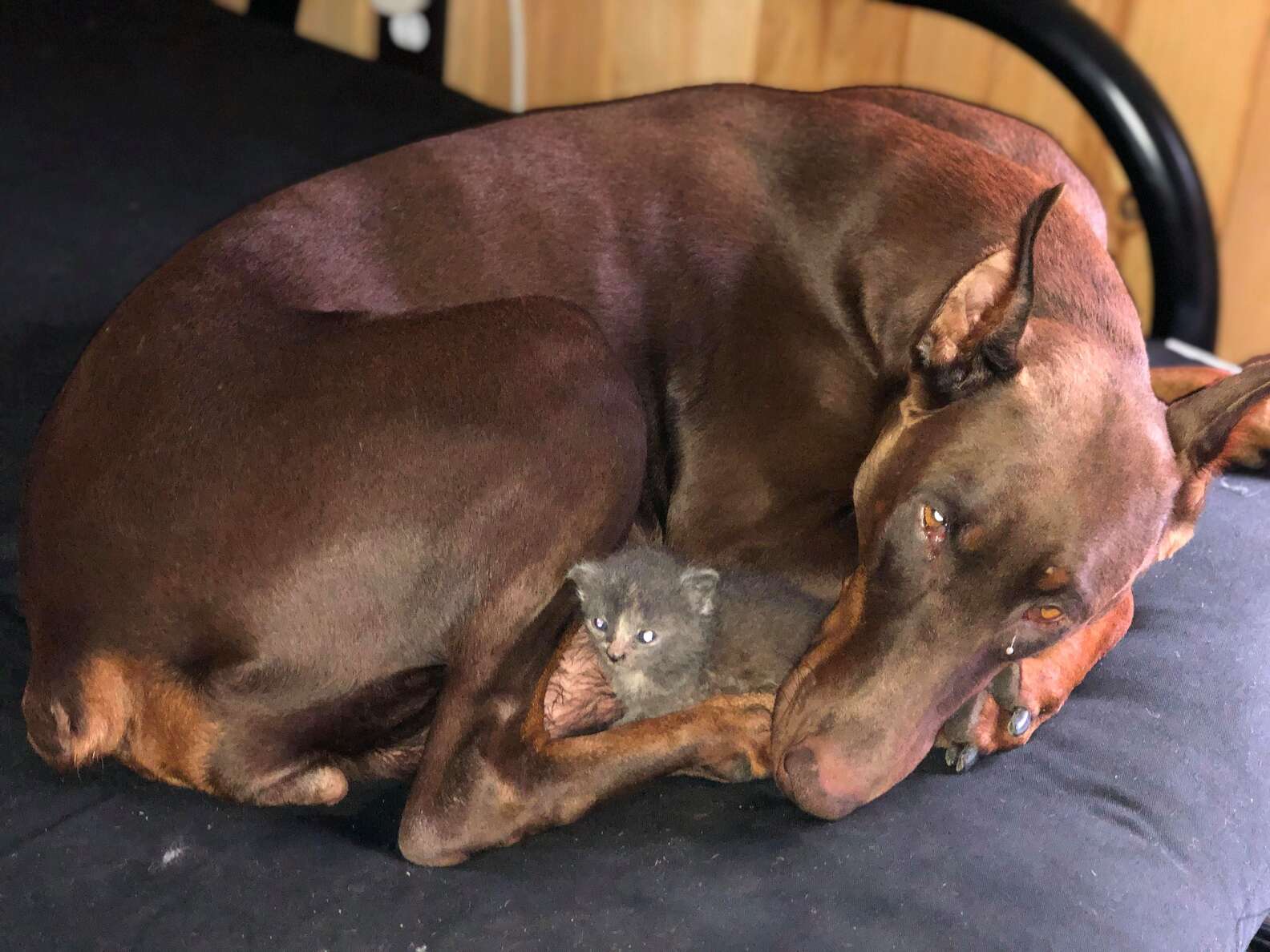
Big Mama Dog Adopts Newborn Kitten And Carries Her Around In Her Mouth

“She’s just obsessed with this kitten” ❤️️

By Lily Feinn, Published on the 27th September, 2021

Three weeks ago, Brittany Callan wasn’t planning on adding more animals to her life. Then she heard meowing coming from the back of her aunt’s garage.

There, in the grass, was a newborn kitten. Callan placed the little animal on a soft blanket in the shade nearby, hoping the mom would return. But hours later, the kitten was still alone. She knew the little animal wouldn’t make it through the night, so she decided to take the little blind baby home.

BRITTANY CALLAN

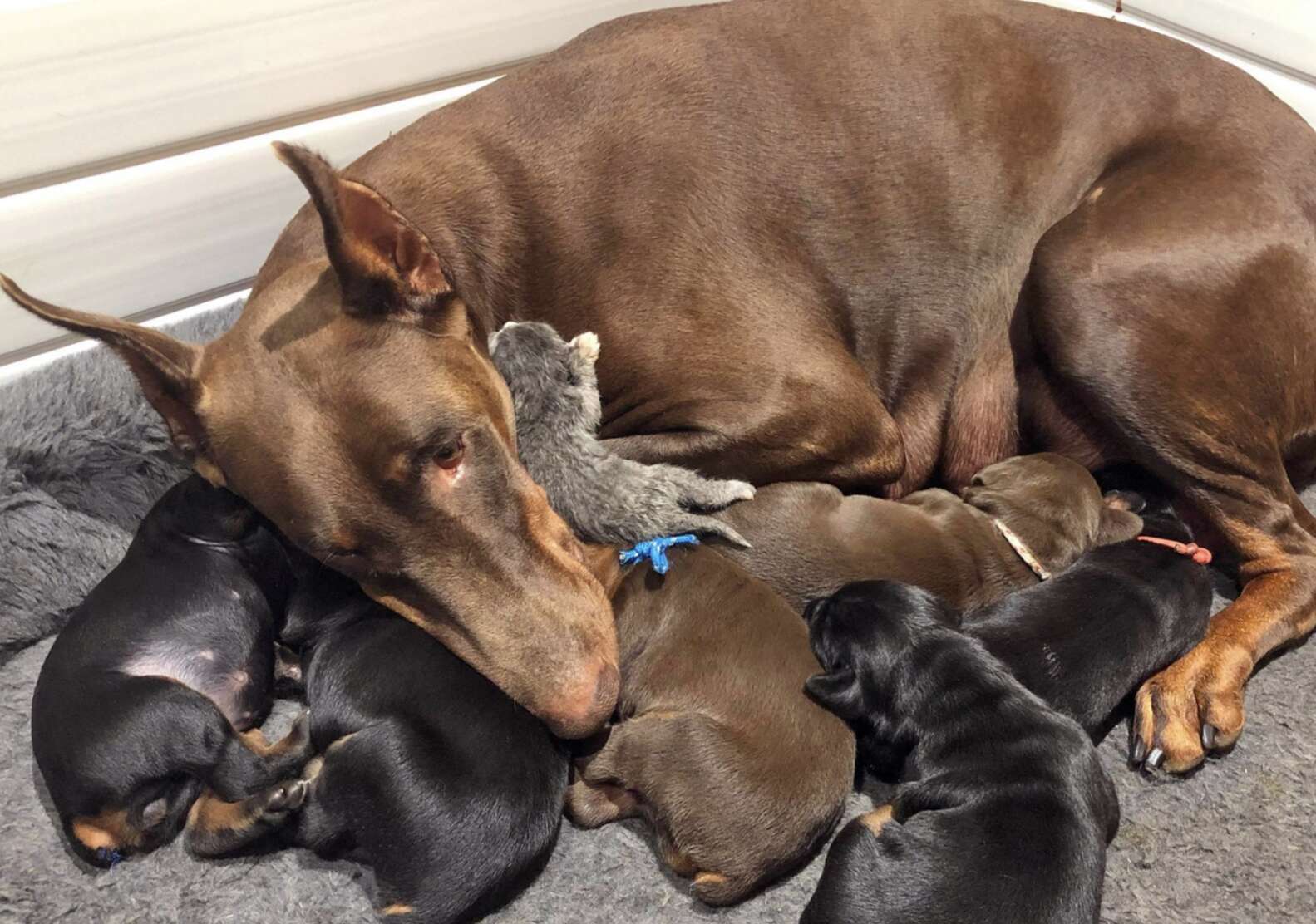
Callan’s Doberman pinscher, Ruby, had just had puppies, and she hoped that the dog’s mothering instincts would kick in when she saw the helpless kitten.

“We’ve had baby bunnies and guinea pigs, and she just licks them like she’s their mom,” Callan told The Dodo. “She was carrying around the baby bunnies in her mouth and hiding them in the couch like they were hers — she even tried to nurse them when she was younger.”

BRITTANY CALLAN

Ruby and the kitten couldn’t look more different, but none of that mattered when they met. Callan held the kitten out to her dog, and Ruby immediately accepted the new baby into her pack.

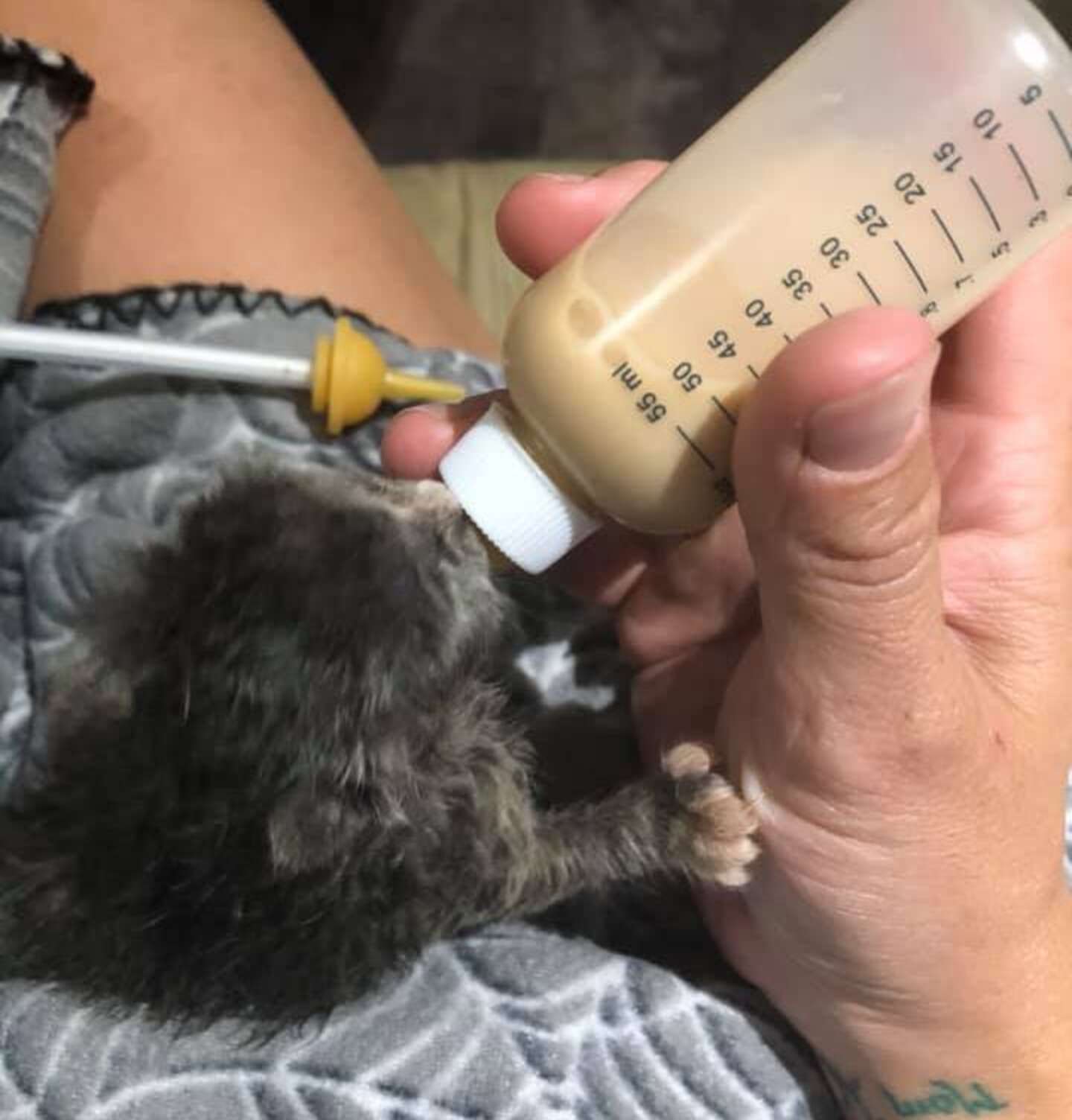
“She just started cleaning it and nudging it out of my hand,” Callan said. “Then I just opened up the kitten’s mouth and put it on Ruby’s smallest nipple, and it started eating right away. Ruby looked at it and laid her head down.”

BRITTANY CALLAN

Rubys’ puppies were already three times her size, but that didn’t stop the kitten from crawling in to snuggle with her dog brothers and sisters.

And her new mom always makes sure the kitten is clean and safe. “She looks like the scruffiest kitten ever because she’s always wet from Ruby licking her or carrying her around in her mouth,” Callan said. “Her back end is either sopping wet or matted down from Ruby cleaning her so much.”

Ruby is now weaning her puppies, but refuses to be separated from her tiniest baby for more than a few minutes.

“She’s just obsessed with this kitten,” Callan said. “She doesn’t want to be outside — she’ll go to every door and whine and scratch until you let her in, and then she’ll just pick up the kitten and carry it around in her mouth.”

BRITTANY CALLAN

Under Ruby’s care, the little orphaned kitten is thriving, and when she’s old enough, she will travel to her forever home with Callan’s cousin.

But for now, the only mom the kitten needs is Ruby. It just goes to show when it comes to family, size doesn’t matter — it’s the love that counts.

ooOOoo

it’s the love that counts.

Lily Feinn has gone to the heart of Ruby’s care for this kitten: Love!

It is a great example to us humans as well. Nothing is ever gained from hate and war.

Our Oregon wolves

A very close relative to the domestic dog.

Indeed until a short time ago it was thought that the dog evolved from the grey wolf but recently I read that the dog evolved as its own species.

But the following is a republication of an article on Oregon Wild about wolves returning to the State of Oregon.

ooOOoo

Wolves in Oregon

Gray wolves (Canis lupus) were once common in Oregon, occupying most of the state. However, a deliberate effort to eradicate the species was successful by the late 1940s.

In fact, trouble for wolves began almost 100 years earlier, in the years before Oregon became a state. In 1843 the first wolf bounty was established and Oregon’s first legislative session was called in part to address the “problem of marauding wolves.” By 1913, people could collect a $5 state bounty and an Oregon State Game Commission bounty of $20. The last recorded wolf bounty was paid out in 1947.

After an absence of over half a century, wolves began to take their first tentative steps towards recovery. Having dispersed from Idaho, the native species is once again trying to make a home in Oregon. One of the first sightings came in 1999 when a lone wolf was captured near the middle fork of the John Day River, put in a crate and quickly returned to Idaho by government wildlife agents. In 2000, two wolves were found dead – one killed by a car, the other illegally shot.

In 2006, a flurry of sightings led biologists to believe a number of wild wolves were living in Northeast Oregon near the Wallowa Mountains and the Eagle Cap Wilderness. Sadly, a wolf found shot to death near La Grande in May 2007 clearly indicated wolves had arrived in the area.

After that sad chapter, wolves began to establish a fragile foothold in the state. In July 2008 pups were confirmed to a wolf named Sophie by the Oregon Wild wolf pack (and B-300 to government biologists). Those pups represented the first wolves in Oregon in nearly 60 years! A second set of six pups were confirmed and videotaped in November 2009. The following July, a third litter of pups was confirmed.

Unfortunately, the news was tempered with additional poaching and heavy-handed state management. After peaking at 26 confirmed wolves, wolf recovery stalled out in 2011. While some wolves dispersed from the Imnaha Pack, only one pup was confirmed to Oregon’s best-known pack, and two pups were confirmed in one of the state’s other two packs (the Walla Walla and Wenaha). Oregon’s confirmed wolf population fell to 17, and then to 14, when the state killed three more wolves (two on purpose) and poachers killed a fourth.

In 2011, wolves in Eastern Oregon lost their federal protections due to an unprecedented congressional budget rider sponsored by Montana Sen. John Tester. Hours later,  Oregon used their new authority to kill two wolves and issue dozens of landowner kill permits at the request of the livestock industry.

Meanwhile, anti-wildlife interests and their political allies pushed over half a dozen bills in Salem aimed at making it easier to kill wolves and undermine wolf recovery. Most of the bills were defeated, but a compensation fund and new predator killing fund were approved.

Wolf hunts in nearby states also threaten the region’s fragile recovery. When wolves were federally delisted the region was home to an estimated population of about 1,700 wolves. Over 1,000 were killed in the first two seasons alone.

The large tracts of pristine and unspoiled Wilderness and roadless areas in Northeast Oregon are vital components in the successful recovery of wolves, and other wildlife too. (Ed: see the photograph below of the wild lands of Oregon.) The reappearance of wolves, wolverines, and other endangered wildlife in Oregon further underscores the importance of protecting those roadless areas that remain on public land.

Anticipating the eventual return of wolves, the state of Oregon completed a Wolf Conservation and Management Plan in 2005 aimed at making rational decisions in the light of day that would lead to wolf recovery. Though state polling put support for wolf recovery at over 70 percent, the plan was weak, allowed the state to kill wolves, and set scientifically indefensible recovery goals.

Even so, the plan was actively opposed by the Oregon Cattlemen’s Association. They argued in their minority report that “wolves are being used as a biological weapon” and that wolves are a non-native species that citizens should have the right to shoot without permits. 

Oregon Wild and other conservationists generally – if reluctantly – agreed to honor the compromise embodied in the plan. Most believed lethal control would be an option of last resort and conservation would be a priority.

After the state shot two young wolves in response to the first livestock depredations in over half a century, it was clear the state was willing to address the concerns of the livestock industry by killing wolves.

In 2010, the plan was reviewed and revised. The public process took the better part of a year and demonstrated that support for wolf recovery had grown. Over 90 percent of a staggering 20,000 public comments were in favor of stronger protections for Oregon’s endangered gray wolves. Oregon Wild joined other conservationists and the Oregon public in defending the plan against continued attacks. Though the plan survived relatively intact, most of the approved changes made it easier to kill wolves. 

In 2011, a lone wolf from the Imnaha Pack generated international headlines when he became the first in Western Oregon since 1947, and then the first in California in nearly a century. The story of Journey (OR-7) provided a welcome opportunity to step away from the unnecessary controversy manufactured by those opposed to wolf recovery and instead reflect on the positive story of a native species retaking its rightful place on the landscape.

Since 2012, wolf recovery in Oregon has slowly started to get back on track. Although the population has increased over the last several years, in 2015, and with only 78 known adult wolves in the state, the Oregon Department of Fish and Wildlife and its Commission decided to prematurely strip wolves of state Endangered Species Act protections — despite what peer reviewed, independent scientists recommended. Shortly after, lawmakers in Salem passed HB 4040: a bill that statutorily affirmed the delisting of Oregon’s wolves. The passage of HB 4040 essentially blocked the ability of conservation organizations to bring forth a lawsuit challenging the merits of the Commission’s decision.

The latest update to the Wolf Conservation and Management Plan — which was approved by the Commission in June of 2019 —  significantly erodes protections for wolves by lowering the threshold for when the state can kill wolves, removing requirements for non lethal conflict deterrence, and opening the door toward public hunting and trapping. 

For many, wolves are a symbol of freedom, wilderness, and the American west, and Oregon’s wolf country contains some of the most spectacular landscapes in the world. Science continues to demonstrate the positive impacts of wolves on the landscape and the critical role played by big predators, and interest in their return is fueling tourism in Oregon’s wolf country and elsewhere in the west.

Still, wolves are threatened by a purposeful campaign of misinformation and fear. This webpage shoots down many of the common myths about wolves. A small number of vocal anti-wolf activists, along with industry lobbyists and their political allies, continue to work to undermine already weak protections for wolves and other wildlife.

The Future

For a state that prides itself on its green reputation, the extermination of wolves is one of our greatest environmental tragedies. Their return represents an opportunity at redemption.

Most Oregonians value native wildlife and believe wolves have a rightful place on the landscape. We are happy to know the silence of a hike in the Eagle Cap might be broken by the lonely howl of a wolf. If that howl is to remain, it’s critical that those who value wolves and other native wildlife stand up and speak up on their behalf.

ooOOoo

Plus there were photographs embedded within the text that I thought would be better appreciated if they were offered separately. Here they are:

oooo
oooo
oooo
oooo

Finally a collection of wolf photographs from a link on Oregon Wild that is no longer in use. I downloaded these pictures in 2016!

OR2
130518_OR4_odfw

Long may they prosper!

Who wants to kiss a dog!

Well Jeannie does for sure.

All our six dogs are beautifully friendly but there’s one dog that just loves to be kissed and returns the favour just as much. That is Oliver!

Oliver

I don’t have a photograph of Oliver and Jean kissing and that’s me being lazy rather than anything else.

Now for whatever deep-seated reason I won’t give Oliver or any of the other dogs a tongue-to-tongue kiss but I am envious of Jean and Oliver; they both love it!

All of which serves as a preamble to an article from The Dodo on dogs’ mouths! Here it is, and it is quite a lengthy one, so settle yourself down and quietly read it completely:

ooOOoo

Are Dogs’ Mouths Cleaner Than Humans’?

For everyone who kisses their pup on the mouth 😘

By LAUREN TAYLOR, Published on the 24th September, 2021

If anyone has ever shamed you for letting your dog give you a kiss, you might have told them that dogs’ mouths are cleaner than humans’ mouths. But is that actually true, or is it just something obsessed dog parents made up to justify letting their dogs lick them?

The truth is that dogs’ mouths actually aren’t cleaner than human mouths — but they’re not really dirtier either. We just have different germs.

The Dodo spoke to Dr. Jonathan Roberts, a remote veterinarian with DoggieDesigner.com, to find out everything you need to know about dog saliva.

Why dogs’ mouths aren’t cleaner than human mouths.

Your dog’s mouth isn’t exactly clean. Just like people have bacteria living in our mouths, dogs do too.

“Multiple studies have discovered that dogs have many unique and potentially dangerous bacteria and other parasites lurking in their mouths,” Dr. Roberts told The Dodo. “Around 600 different species of bacteria have been discovered in both canine and human mouths.”

The type and amount of bacteria living in a dog’s mouth depends on the level of periodontal (dental) disease present, which is determined by a number of factors, including:

  • Diet
  • Breed (smaller dogs tend to be at greater risk because they have smaller teeth and mouths, leading to more food getting stuck, and they have less bone mass, leading to tooth loss)
  • Frequency of teeth brushing
  • Frequency of professional dental cleaning by a vet

What diseases can you get from dog saliva?

There are lots of bacteria in a dog’s mouth that are different from what humans have in our mouths. Some of these are harmless, but some could make you sick.

Some of the bacteria found in dogs’ mouths that can be dangerous to people include:

  • E. coli, Clostridia, Salmonella and Campylobacter — “[These are] bacteria that can cause severe gastrointestinal illness in people,” Dr. Roberts said. “Dogs are often carriers of these bacteria, yet they do not become ill from them. They usually get these bacteria in their mouths through licking their anuses or ingesting other animals’ feces. Another common source of these illness-causing bacteria is from ingesting raw food.”
  • Pasteurella — This can cause skin infections that can travel to your lymph nodes and cause severe disease, such as cellulitis or meningitis.
  • Capnocytophaga canimorsus — “[This] enters the wounds in skin after being licked by a dog’s tongue,” Dr. Roberts said. “Mostly only immune-compromised people are susceptible to this disease that develops into septicemia [blood poisoning].”
  • Giardia and Cryptosporidium — These are actually protozoa, not bacteria, but they can still make you sick by your dog licking your face and can cause gastrointestinal illnesses.
  • Parasites — If your dog has parasites, such as worms, and licks his anus and then your face, you could contract the parasite.

So what is the risk of getting sick from your dog licking you? Even with all those germs, if you’re healthy and don’t have a compromised immune system, the risk is luckily pretty low.

“Most human immune systems will neutralize these parasites before they can cause illness,” Dr. Roberts said. “Those with weakened immune systems, such as persons going through chemotherapy, persons with HIV, very young and very old people should be more careful around pets.”

Ultimately, it’s up to you to determine if it’s a risk you want to take.

But to be safe, you can follow these steps to avoid getting sick from dog saliva:

  • Keep your dog up to date on his deworming medications and flea and tick medications.
  • Get checked out by a doctor if you get bitten or scratched by a dog.
  • Don’t let a dog lick your wounds.
  • Frequently wash items that your dog’s mouth touches, like toys and food and water bowls.
  • Don’t let your dog lick you if you’re immunocompromised, and don’t let him lick others who are immunocompromised.

Does dog saliva heal wounds?

It’s an old belief that dog saliva heals wounds. But is it actually true?

“There may be some truth to this after all,” Dr. Roberts said. “The action of licking helps to remove debris and necrotic tissue from the wound.”

Dog saliva also contains proteins that can be beneficial in healing.

“Mammal saliva contains a protein called histatin,” Dr. Roberts said. “This protein is able to kill bacteria before they can cause infection.”

Histatins have antimicrobial and antifungal properties and are part of the immune system. They have been found to play a role in wound closure.

But while it’s possible that dog saliva could help to heal a paper cut, you shouldn’t let your dog lick all of your cuts and scrapes — there are much better ways to take care of your injuries, and you always run the risk of infecting your wound instead of making it better.

“I would still not allow my dog to lick my wounds,” Dr. Roberts said. “We have excellent wound care products on the market these days that not only do a better job of keeping wounds clean but also come without the risk of introducing nasty infections or potential parasites.”

How to keep your dog’s mouth clean

If you do let your dog give you occasional kisses (and even if you don’t), you should try to keep his mouth as clean as possible since it’s also important for his health.

You can do this by regularly brushing his teeth and by providing toys that help clean his teeth.

Try this dog toothpaste from Chewy for $4.99.

“The most important way to keep your dog’s mouth clean and healthy is (just like humans) through regular teeth brushing and dental cleaning by a professional,” Dr. Roberts said. “Start introducing your dog to teeth brushing from a young age and aim to brush at least twice a week.”

You can also let your dog chew on dental treats to clean his teeth in between brushing. (These treats received The Dodo’s Paw of Approval, and you can get them from Amazon for $4.98.)

So dogs’ mouths aren’t actually cleaner than people’s, and you shouldn’t let your dog lick your wounds. But if you keep your dog’s mouth and teeth clean, a kiss from your pup every now and then should be fine (if it’s something you’re comfortable with).

We independently pick all the products we recommend because we love them and think you will too. If you buy a product from a link on our site, we may earn a commission.

ooOOoo

I suggest that if you want to purchase any of the products described above then you go directly to The Dodo website and place your order via The Dodo.

Overall I find this a very useful article and I am grateful to The Dodo for allowing me to republish it.

Another example of a dog’s love

This time between a dog and a parrot.

Again, Jess and Cheryl sent me this YouTube link. It has the subtitles coming up because I won’t subscribe to whatever service is being promoted. But it doesn’t detract from the pleasure of this video.

A smile for the weekend!

Senior dogs

We are all on the same journey!

Well here we are in October! No reason why it is so but sensation wise when one gets into the senior years time seems to go faster. Wonder if it is the same for our four-legged friends.

A recent post courtesy of The Dodo spoke of this, in a roundabout way.

ooOOoo

Dog Walker Finds A Mysterious Box With A Heartwarming Message On It

“I thought it was an incredible gesture.”

By Lily Feinn, Published on the 16th September, 2021.

Last week, Kayley Drewitt was walking a dog in Ely Country Park when she stumbled across a cardboard box in the grass. Drewitt runs The Animal Ark Pet Services and spends a lot of time outside with her clients’ dogs — but she’d never seen anything like this in the park before.

“I was curious at first,” Drewitt told The Dodo. “Once we had approached it and I read the message written on the side of it, I couldn’t believe it. I had never seen anything like that before.”

“I thought it was an incredible gesture,” she added. “Something really heartwarming.”

INSTAGRAM/THE ANIMAL ARK

Written in Sharpie on the side of the box was a message reading: “I am too old to play with my favorite tennis balls now. But it would make me very happy to know that some younger doggies would have fun with them. Love from Jarvis.

INSTAGRAM/THE ANIMAL ARK

The dog Drewitt was walking didn’t need to read the message to know exactly what to do. He stuck his nose in the box and pulled out a ball.

“We played fetch for quite a while [and] he tried out lots of different balls,” Drewitt said.

INSTAGRAM/THE ANIMAL ARK

Drewitt was so touched by the sweet gesture that she snapped a few pictures of the box of donated balls and posted them on social media. “I wanted to thank [Jarvis’ owner] and make other dog owners aware of this lovely idea,” Drewitt said.

Her social media post quickly gained attention, and Jarvis’ mom reached out to let Drewitt know how happy seeing other dogs playing with the balls made her feel.

Jarvis, a cocker spaniel, is nearly 11 and has severe arthritis. He can’t play like he used to, but his mom knew he’d want someone to enjoy his beloved tennis balls.

KAYLEY DREWITT

Jarvis may no longer be able to chase balls, but the senior pup still loves to socialize and will get a special surprise on his next trip to the park.

“We have agreed to meet up for a dog walk sometime soon,” Drewitt said, “so Jarvis can meet some of the younger dogs now benefiting from all the balls he’s gifted.”

ooOOoo

Time after time people do wonderful things connected to dogs. Dogs are so perfect and the phrase unconditional love really does have meaning when it comes to our dogs.

Now that’s not to say that people who do not have dogs don’t do wonderful things. But it is my guess that dogs help bring out the best in humans.

The Wise One

Fond memories of June, 2007.

I have been trying to tidy up my office these last few days and came across a tribute that I wrote for Pharaoh in 2007. I flew out to California in June, 2007 and stayed with Dan Gomez and, quite by chance, Suzanne, Dan’s sister, called by and invited me to stay with her and her husband, Don, in Mexico. I flew from Los Angeles to Hermosillo on the 14th December, 2007. That was where Jean and I met for the first time!

ooOOoo

Pharaoh

June 3rd, 2003 – June 19th, 2017

Just being a dog!

I am your dog and have something I would love to whisper in your ear. I know that you humans lead very busy lives. Some have to work, some have children to raise, some have to do this alone. It always seems like you are running here and there, often too fast, never noticing the truly grand things in life.

Look down at me now. While you sit at your computer. See the way my dark, brown eyes look at yours.

You smile at me. I see love in your eyes. What do you see in mine? Do you see a spirit? A soul inside who loves you as no other could in the world? A spirit that would forgive all trespasses of prior wrong doing for just a single moment of your time? That is all I ask. To slow down, if even for a few minutes, to be with me.

So many times you are saddened by others of my kind passing on. Sometimes we die young and, oh, so quickly, so suddenly that it wrenches your heart out of your throat. Sometimes we age slowly before your eyes that you may not even seem to know until the very end, when we look at you with grizzled muzzles and cataract-clouded eyes. Still the love is always there even when we must take that last long sleep dreaming of running free in a distant, open land.

I may not be here tomorrow. I may not be here next week. Someday you will shed the water from your eyes that humans have when grief fills their souls and you will mourn the loss of just one more day with me. Because I love you so, this future sorrow even now touches my spirit and grieves me. I read you in so many ways that you cannot even start to contemplate.

We have now together. So come and sit next to me here on the floor and look deep into my eyes. What do you see? Do you see how if you look deeply at me as we talk, you and I, heart to heart. Come not to me as my owner but as a living soul. Stroke my fur and let us look deep into the other’s eyes and talk with our hearts.

I may tell you something about the fun of working the scents in the woods where you and I go. Or I may tell you something profound about myself or how we dogs see life in general. I know you decided to have me in your life because you wanted a soul to share things with. I know how much you have cared for me and always stood up for me even when others have been against me. I know how hard you have worked to help me be the teacher that I was born to be. That gift from you has been very precious to me. I know too that you have been through troubled times and I have been there to guard you, to protect you, and to always be there for you. I am very different to you but here I am. I am a dog but just as alive as you.

I feel emotion. I feel physical senses. I can revel in the differences of our spirits and souls. I do not think of you as a dog on two feet; I know what you are. You are human, in all your quirkiness, and I love you still.

So come and sit with me. Enter my world and let time slow down if only for a few minutes. Look deep into me eyes and I will know your true self. We may not have tomorrow but do have now.

(Written on the 14th September, 2007 to reflect the special relationship that I have with me and my 4-year-old German Shepherd.)

ooOOoo

I first got Pharaoh as a puppy from a breeder. When he was sufficiently old to start training I learnt that he was a beta dog. Let me explain. In a dog pack there are three dogs with status. The first is always a female and she is the pack leader, or alpha dog. The alpha has first pick of the male dogs as a mate. The second-in-command is the beta dog and is always a male. The beta dog is to keep control and break up fights and squabbles. The third dog, either gender, is the omega dog or the clown dog and its role is to keep the pack happy.

The training was suitably modified and Pharaoh quickly became a perfect friend to me.

On the beach in Devon

Taken near the end of Pharaoh’s life.

So you can see that the above tribute to Pharaoh makes more sense. Especially as on the 20th December, 2006, the 50th anniversary of my father’s death, when I had turned 12 on November 8th 1956, my then wife walked out on me.

Pharaoh was a huge comfort to me at that time. I wasn’t to know then that on the 14th December, nearly a year later, I was to meet the woman of my life. Then in 2008 I flew out to Mexico with Pharaoh to start the most beautiful relationship I have ever had. Pharaoh died in June, 2017.

I still miss him badly. But that, dear folks, is life!

A video about human behaviours!

Involving our dogs!

My apologies once again, I am late on parade and just have time to share this YouTube video with you. Mind you, it does appear to be a good video!

Best wishes to you all!

Eating out with your ….

…. dog!

The last few days have been sidetracking me from writing the blog. Apart from editing my third book The One We Feed and dealing with critical fire conditions and hoping with all our hearts for the rain due on Friday night to materialise, and … You get the message!

Anyway, The Dodo came up with a lovely snippet on the 20th August. Here it is:

ooOOoo

Diner Spots A Guy Out On The Sweetest Date With His Dog

Relationship goals 💞 

By Stephen Messenger, Published on the 20th August, 2021.

The other day, Gemma Colón stopped by a restaurant in New York City to grab a bite. But the visit ended up satisfying more than just her appetite.

“I was presented with one of the most unexpectedly heartwarming views,” Colón told The Dodo. “I noticed this dog seated across from his owner, perched up on a chair, acting like an absolute proper gentleman.”

The dog and his owner were apparently on a date.

GEMMA COLÓN

Colón was fortunate enough to be seated in view of the adorable pair — basking the sight of the good thing they have going.

“[The man] was doing a crossword puzzle and sipping a glass of red wine with his meal. His date (the dog) was enjoying his own bowl of water, which he slurped politely,” Colón said. “It was really amazing how well-behaved the pup was. I saw better table manners displayed by this dog than I’ve seen from some humans.”

While the man and his dog dined, Colón saw other patrons smile at the sweet scene as well. No one had the heart to interrupt their meal to comment on their cuteness, but Colón did overhear an exchange with their server — revealing that this wasn’t just a one-off outing.

“I heard a waitress comment on how good the dog was at one point, and the man replied saying he brings the dog with him everywhere,” Colón said. “It definitely seemed like a very pleasant date, with lovely company.”

ooOOoo

This is really a delightful story but it isn’t surprising. Because dogs that are loved and cared for by us humans are so loving and caring in return. As the waitress heard the man brings his dog everywhere. He is never separated from the dog.

Perfect!

A short but interesting video

CBS present an item about dogs.

I was a bit tight on time yesterday and just looked for a YouTube video that might please.

Anyway, I quickly came across this from CBS. It goes back 7 years but so what, it is still very pertinent today.

People will tell you it’s not what you say to a dog that counts, it’s how you say it. But now researchers say dogs respond to much more than your tone of voice. They say brain scans confirm that canines can understand exactly what you’re saying. Michelle Miller reports.

The big question!

That I wonder if it will ever be answered?

For the first day of September I wanted to change the topic to an item that was recently published by The Conversation.

Space has always been fascinating to me. One of my enduring memories was standing on the roof of my Land Rover in 1969 during a long journey around the interior of Australia. We were in the Nullabor desert and it was flat, and lonely, for miles and miles. This particular night I clambered up onto the roof and just took in the night sky. There was not a single spot of human-caused light pollution and the night sky was beautiful beyond words.

Later on when I was sailing I used to regard the North Star as my friend.

Anyway, here’s a little question for this day.

ooOOoo

Does outer space end – or go on forever?

It can stretch your mind to ponder what’s really out there. Stijn Dijkstra/EyeEm via Getty Images

Jack Singal, University of Richmond


What is beyond outer space? – Siah, age 11, Fremont, California


Right above you is the sky – or as scientists would call it, the atmosphere. It extends about 20 miles (32 kilometers) above the Earth. Floating around the atmosphere is a mixture of molecules – tiny bits of air so small you take in billions of them every time you breathe.

Above the atmosphere is space. It’s called that because it has far fewer molecules, with lots of empty space between them.

Have you ever wondered what it would be like to travel to outer space – and then keep going? What would you find? Scientists like me are able to explain a lot of what you’d see. But there are some things we don’t know yet, like whether space just goes on forever.

Planets, stars and galaxies

At the beginning of your trip through space, you might recognize some of the sights. The Earth is part of a group of planets that all orbit the Sun – with some orbiting asteroids and comets mixed in, too.

A diagram of the solar system, showing the sun and its orbiting planets.
A familiar neighborhood. Mark Garlick/Science Photo Library via Getty Images

You might know that the Sun is actually just an average star, and looks bigger and brighter than the other stars only because it is closer. To get to the next nearest star, you would have to travel through trillions of miles of space. If you could ride on the fastest space probe NASA has ever made, it would still take you thousands of years to get there.

If stars are like houses, then galaxies are like cities full of houses. Scientists estimate there are 100 billion stars in Earth’s galaxy. If you could zoom out, way beyond Earth’s galaxy, those 100 billion stars would blend together – the way lights of city buildings do when viewed from an airplane.

Recently astronomers have learned that many or even most stars have their own orbiting planets. Some are even like Earth, so it’s possible they might be home to other beings also wondering what’s out there.

An image showing detail of one galaxy, but visually implying there are many more.
A galaxy among many other galaxies. Michael Miller/Stocktrek Images via Getty Images

You would have to travel through millions of trillions more miles of space just to reach another galaxy. Most of that space is almost completely empty, with only some stray molecules and tiny mysterious invisible particles scientists call “dark matter.”

Using big telescopes, astronomers see millions of galaxies out there – and they just keep going, in every direction.

If you could watch for long enough, over millions of years, it would look like new space is gradually being added between all the galaxies. You can visualize this by imagining tiny dots on a deflated balloon and then thinking about blowing it up. The dots would keep moving farther apart, just like the galaxies are.

Is there an end?

If you could keep going out, as far as you wanted, would you just keep passing by galaxies forever? Are there an infinite number of galaxies in every direction? Or does the whole thing eventually end? And if it does end, what does it end with?

These are questions scientists don’t have definite answers to yet. Many think it’s likely you would just keep passing galaxies in every direction, forever. In that case, the universe would be infinite, with no end.

Some scientists think it’s possible the universe might eventually wrap back around on itself – so if you could just keep going out, you would someday come back around to where you started, from the other direction.

One way to think about this is to picture a globe, and imagine that you are a creature that can move only on the surface. If you start walking any direction, east for example, and just keep going, eventually you would come back to where you began. If this were the case for the universe, it would mean it is not infinitely big – although it would still be bigger than you can imagine.

In either case, you could never get to the end of the universe or space. Scientists now consider it unlikely the universe has an end – a region where the galaxies stop or where there would be a barrier of some kind marking the end of space.

But nobody knows for sure. How to answer this question will need to be figured out by a future scientist.

Jack Singal, Associate Professor of Physics, University of Richmond

This article is republished from The Conversation under a Creative Commons license. Read the original article.

ooOOoo

“But nobody knows for sure. How to answer this question will need to be figured out by a future scientist.”

I wonder if that future scientist will ever be able to answer the question.

Then there’s the thought that the universe may be infinite. That is an astounding idea, that it goes on forever.

There’s only one way to close this post. With this photograph from Unsplash.