Dr. Michael Shermer is the Founding Publisher of Skeptic magazine, the Executive Director of the Skeptics Society, a monthly columnist for Scientific American, the host of the Skeptics Distinguished Science Lecture Series at Caltech, and Adjunct Professor at Claremont Graduate University.
Finally, Joe Keohane (with thanks to Tom M. for the intro.)
Joe wrote a fascinating article that appeared in the Boston Globe last July that opens,
How facts backfire
Researchers discover a surprising threat to democracy: our brains
It’s one of the great assumptions underlying modern democracy that an informed citizenry is preferable to an uninformed one. “Whenever the people are well-informed, they can be trusted with their own government,” Thomas Jefferson wrote in 1789. This notion, carried down through the years, underlies everything from humble political pamphlets to presidential debates to the very notion of a free press. Mankind may be crooked timber, as Kant put it, uniquely susceptible to ignorance and misinformation, but it’s an article of faith that knowledge is the best remedy. If people are furnished with the facts, they will be clearer thinkers and better citizens. If they are ignorant, facts will enlighten them. If they are mistaken, facts will set them straight.
This is a very smart article and much recommended, do read it fully here.
I suspect very few of you regular readers will recall that in 2009 (24th June to be precise) I ran a very short article under a similar title. This is what was published.
A simple heading but, in truth, a very complex subject. This was brought home by a recent article in The Economist by Bagehot. That is “Politicians frequently lie. So does everyone else. Why all the fuss?”
Bagehot writes a Blog so those who don’t read the newspaper can read the rest of his thesis here.
Here’s some of that essay by Bagehot,
On lying
Jun 30th 2009, 14:43 by Bagehot
THE WORD “lie” means something very specific. It doesn’t mean a misleading statement, or an exaggeration, or a half-truth: it is a falsehood advanced intentionally and knowingly. That is why, in my column last week, I wrote that probably only Tony Blair and his crew could know whether they “lied” about Iraq’s weapons of mass destruction. Only they can know what was in their heads, and how far their public utterances diverged from their inner convictions. For that reason the question of lying over Iraq seems to me a bit of a red herring and distraction. What can be proved about their sloppiness and embellishments, and has been, is bad enough.
Lying is back in the news this week. Gordon Brown stands accused by various newspapers and columnists of deliberately misleading the public about the government’s fiscal position. Ditto Ed Balls, the prime minister’s henchman, who evidently doesn’t take kindly to having his integrity impugned in this way. David Cameron is a bit more periphrastic, knowing that in political parlance the “l” word is a nuclear accusation; but he came pretty close to it yesterday with his talk of “a thread of dishonesty” running through Mr Brown’s premiership.
There are (at least) two big questions provoked by this revived interest in lying. First and most obviously, are Mr Brown, Mr Balls and others really and indisputably liars? Do the fiscal figures they cite and twist in any way support the interpretation they put on them–at least enough to make it credible that they believe what they are saying, even if no-one else does? If so, they may not be lying. They may be over-optimistic, incompetent or deluded. But they are not obviously liars.
Just re-read those last few sentences, “Do the fiscal figures they cite and twist in any way support the interpretation they put on them–at least enough to make it credible that they believe what they are saying, even if no-one else does? If so, they may not be lying. They may be over-optimistic, incompetent or deluded. But they are not obviously liars.”
Delay your judgement for just a few minutes while we go to this next item. This next item is a recent essay from John Maudlin, the financial expert, about the latest jobs report in the US.
The US jobs report came out this morning, and it was simply dismal. This week we look at not only the jobs report but also “what-if” proffers for the US and global economies. There’s a lot to cover, so let’s jump in.
First, there were only 18,000 jobs created in June, the lowest since September 2010. While private employment rose by 57,000, government workers dropped by 39,000, continuing a trend as governments at all levels work to cut their budgets. Long-time readers know I think it is important to look at the direction of the revisions, and we got no help. May was revised down by 29,000 jobs and April a further down 15,000.
I saw some headlines and talking heads in the mainstream media saying the poor number was due to “seasonals,” and I just shook my head. If you are that reflexively bullish when presented with what was clearly a bad report, how can you be taken seriously? You know who you are. And then Philippa Dunne of the Liscio Report sent the following note. She is one of the best data mavens there is on jobs and employment.
John M. then includes quite a long extract from Philippa’s note. You can read it and the rest of John’s article here. Here’s how that extract from Philippa Dunne ends,
Also, there is no adjustment to the headline number – the sectors are adjusted separately (96 different industries at the 3-digit NAICS level, to be precise) and the total is the sum of those components. The whole argument is bogus.
Notice that last sentence, “The whole argument is bogus.” [My emboldening, Ed.]
OK, clearly not lying, in the strict definition of the term. But still delay your judgement.
Back on the 25th June this year, I wrote a piece with the title of Lying is OK, that’s official! Duh! I stated very clearly that lying is wrong! Mind you, one could at least congratulate Jean Claude Juncker for honestly admitting being a liar. (Jean Claude Juncker is the Prime Minister of Luxembourg and the head of the Eurogroup council of eurozone finance ministers.) Here’s that video clip with Juncker admitting that when it’s serious one has to lie! (Listen carefully, the words are quietly spoken.)
Finally, I have long followed Yves Smith’s excellent Blog, Naked Capitalism. Just yesterday, Yves wrote a powerful piece,
Not only is Obama assuring that he will go down as one of the worst Presidents in history, but for those who have any doubts, he is also making it clear that his only allegiance is to the capitalist classes and their knowledge worker arms and legs.
It’s an angry essay that has, at it’s heart, an anger at the lack of true representative government, remember the one that Abraham Lincoln had in mind when he wrote, “Government of the people, by the people, for the people, shall not perish from the Earth.”
Yves concludes in that article thus,
Even knowing how dedicated to bad ends Obama is, I still feel like I’ve walked into a parallel universe. He’s now determined to make these horrific entitlement cuts a sign of his manhood. This is “Change” for sure, to a more brutal, grasping, dog eat dog society, all administered by self serving elites. They will in the end reap the whirlwind they are creating, but not before it mows a path of destruction through our social order.
Right, time to draw it all together.
Despite my chest-beating on the subject of politicians and leaders deliberately lying in that recent piece about Juncker, there’s something much more fundamental. What defines lying is really not that important. It’s whether or not we trust that our leaders are doing their best for their constituents, to the best of their abilities.
Whether you support left-leaning or right-leaning policies is unimportant; indeed political differences and the ability to vote for one’s beliefs is at the heart of an open democracy.
But if we don’t trust that our leaders are doing their best for our country then that causes the destruction of faith. If we do not have faith in those that lead us then the breakdown of a civilised social order becomes a very real risk.
These are such difficult times impacting us across so many fronts. Scarily, one seems to find many who have lost much faith in their leaders.
Two recent videos highlight the mystery and fascination of determining what, exactly, is consciousness.
Before I get started, it crossed my mind that some readers on Learning from Dogs might struggle finding any link between the the title of the Blog and such esoteric topics as consciousness. Let me try and explain. On the home page of this Blog is written,
But 10,000 years of farming the planet’s plant and mineral resources have brought mankind to the edge of extinction, literally as well as metaphorically.
Dogs know better! Time again for man to learn from dogs!
Here’s a recent comment I made to an article on Naked Capitalism,
In a much broader sense, it feels to me as though we have been partying on the edge of a global volcano for years and years. Greece is surely a metaphor for the craziness of so many countries.
Continuing that broader sense, the period that we are in, from political, economical, societal, environmental and ethical perspectives, seems bust. Good will eventually come out of this transition, of that I have no doubt, but what a fascinating period in which to be alive!
I firmly believe that the period we are presently living through is a transition between the last, say 30 years (in a sense, many more decades than that) and a more aware, sensitive period where mankind embraces a deeper, sustainable, relationship with the planet that is home and life to all of us. Frankly, there is no choice!
Thus the nature of consciousness, our awareness of self, is a crucial element of the future. The greater our self-awareness, the greater our self-understanding and from that better self-understanding comes all hope of recognising our attitudes and knowing that it is our attitudes that drive our behaviours.
So here follow two videos. Settle back and be entranced!
The first is the last episode in a brilliant BBC series broadcast in 2007, probably one of the best TV series on psychology and neuroscience ever produced. The full series is on Top Documentary Films but the last episode called The Final Mystery is all about consciousness. Beware you are going to never see the world in quite the same way!
Here it is, The Final Mystery presented by neuroscientist Susan Greenfield.
The second video is from Season Two of the Through the Wormhole series. It is called Is there Life after Death? and also explores the deeper aspects of consciousness. As the introduction to the video says,
In the premiere episode of the second season of Through the Wormhole, Morgan Freeman dives deep into this provocative question that has mystified humans since the beginning of time.
Modern physics and neuroscience are venturing into this once hallowed ground, and radically changing our ideas of life after death.
Freeman serves as host to this polarized debate, where scientists and spiritualist attempt to define what is consciousness, while cutting edge quantum mechanics could provide the answer to what happens when we die.
Here’s the film; same health warning applies! You are going to see the world differently after watching this!
Finally, do you have a dog at home? If you do, ponder on how their conscious world engages them. If science can’t explain human consciousness then all we have is our own intuition with regard to animals. Not sure about you but when one is feeling a little low and a dog comes up and lays a head across you I feel a very strong conscious connection.
I suppose if you don’t have a dog it is hard to understand why anyone would be so upset (that isn’t an insult or a judgement just a statement of fact) and if you do there isn’t much need to explain.
As so often he’s spot-on. I remember in my teens a girlfriend walking through the door one Saturday morning and bursting into floods of tears – and it wasn’t the state of my room.
“What’s the matter ?”
“They’ve taken her to the vet to be put down!” – ‘her’ being the companion of her childhood, a thousand walks and a hundred days out in the country with parents. But I didn’t think like that at the time – I was properly sympathetic and held her till my shoulders were soaked in tears – but it was only a dog, a nice enough dog, but still a dog. At this distance memory fails, but I probably assumed it was just a girl thing, what with being more emotionally open and all that.
The same blindness afflicted me with regard to the effect of children, although I think I wasn’t alone in this. Our single lives were so endlessly fascinating, what friends were doing, who was with whom, the places to go, the people, the parties, that we looked on people who’d got children slightly pityingly, as if they’d been afflicted with a crippling disease (and it IS crippling to a wild social life, although I know a few exceptional people and couples who have just carried on – I’m just not exceptional) which not only curtailed their social life but made them talk about children an awful lot – as if that topic was of any interest at all compared to the important things.
You live and learn. Hopefully. Now I feel more that becoming a parent is gaining access to the secret heart of life and the long chain of familial links down the generations. Not that it doesn’t have its many, many drawbacks. Susan and I looked at each other one day after #2 had arrived and said “whatever did we do with all that time we had?”.
I digress. So I finally learned about why parents are interested in kids, but still didn’t get the dog thing. Our neighbours were childless but treated their dogs like their children – they slept upstairs and their doings were part of our everyday chats. Most odd, we thought.
Dog lovers …
I’d taken my firstborn up to visit his grandpa, and grandpa and I were out walking with grandpa’s dog and the pushchair plus baby. I loved that new dad bit, with bonny boy getting cooed over by all and sundry … the checkout queue turning into a little love fest … and he WAS a beautiful baby – he’s 21 now and six foot.
Lady approaching on the pavement, breaks into happy smile :
“Oh, what a beautiful …”
(Dad smiles modestly… he’s getting used to this …)
“Dog!”
(Smile vanishes instantly)
Then our youngest went off to Big School, and it left a bit of a gap in Susan’s life. Suddenly there were no babies to care for – and she likes caring for things. One day she went off and returned with this chap (and promptly had him snipped, to my horror). Apparently Labradors were very even tempered, good with children and an all round ideal first dog for a family with no dog-owning history on either side, at least since our great-grandparents were on the farm. What’s impressive is that AFAIK, apparently all dogs are descended from domesticated wolves. Just shows what breeding will do.
The kids were thrilled, promised to walk him etc., etc., – didn’t last and soon Mum and Dad were doing most of the walks. But the exercise is great – he and we usually get about three miles a day in – it’s good for an ageing chap with a desk job. I’ve learned most of the footpaths and circular routes round the house.
Labradors seem to eat anything – three week old bird carcases, stones, deer poo, sheep poo, horse poo – and they roll in fox poo, which is not a nice smell and means an hour shampooing him in the garden (then a shower and complete change of clothes). On the good side they love apples, blackberries, plums, the farmer’s turnips – healthy eaters.
He once found a rotting, rank dead rabbit inside a plastic bag, scoffed it, then sat in his crate in the kitchen and disgorged the lot some hours later. Not a nice clean-up job – the smell at close quarters was truly evil.
They’re meant to have more acid in their stomachs than humans to enable digestion of bad food – but ours pushes that way beyond the limits. The Muslims are right enough when they consider dogs unclean. They’re filthy, dirty creatures.
But they have a way of wrapping themselves round the heart. Always pleased to have human company, playful, cheery. All the family quickly grew to love him – even grandma, very much a non-dog person, has a soft spot.
October last year, grandma is round for Sunday tea/dinner, I’m just out in the garden using the last of the light at ten to six.
“Can he stay out here with you? ”
“OK”
The call for tea. I call him – he’s not anywhere in the garden. Round the house – no sign.
“Has he come in?”
“No”
“He’s not in the garden”
Poor grandma. She was left alone in the house while everyone emptied into the darkening garden, calling, then after a quick conference and grabbing of mobiles, two cars head slowly in opposite directions, and the boys are in the local wood with torches. Daughter and I take the car across rough farm tracks, along the routes of his favourite walks, stopping, scanning the gloomy fields, calling him, on again, repeat.
Forty minutes later it’s pitch black and the cars are back. The boys have been right through the woods to the fields on the other side, which we’ve also scanned from the cars as best we could, then back again. Up and down the village – again – half expecting to see a limp form in the headlights. Not a sight or sound.
Tea at seven in almost total silence. The only thing I can compare it with was the first family Christmas without my grandmother.
Eight o’clock. He’s been gone two hours. We’ve been out in the garden and around the house again. Nothing. The feeling that he’s gone for good starts to solidify.
Nine o’clock. My daughter’s standing at the back door, calling his name. Nothing. I feel she’s wasting her time, but in solidarity I go to the side door to call. Open it – he’s standing on the step.
God knows where he’d been. One moment of tremendous pleasure – calling my daughter into the kitchen, without telling her who was there, then watching the ecstatic reunion – the boys hearing the noise and tumbling in, happy uproar. “For he was lost, and is found“.
Once again Mr Kipling has the words :
There is sorrow enough in the natural way
From men and women to fill our day;
And when we are certain of sorrow in store,
Why do we always arrange for more?
Brothers and sisters, I bid you beware
Of giving your heart to a dog to tear.
Buy a pup and your money will buy
Love unflinching that cannot lie
Perfect passion and worship fed
By a kick in the ribs or a pat on the head.
Nevertheless it is hardly fair
To risk your heart to a dog to tear.
When the fourteen years which Nature permits
Are closing in asthma, or tumour, or fits,
And the vet’s unspoken prescription runs
To lethal chambers or loaded guns,
Then you will find – it’s your own affair
But … you’ve given your heart to a dog to tear.
When the body that lived at your single will,
With its whimper of welcome, is stilled (how still!)
When the spirit that answered your every mood
Is gone – wherever it goes – for good,
You will discover how much you care,
And will give your heart to a dog to tear.
We’ve sorrow enough in the natural way,
When it comes to burying Christian clay.
Our loves are not given, but only lent,
At compound interest of cent per cent.
Though it is not always the case, I believe,
That the longer we’ve kept ’em, the more do we grieve:
For, when debts are payable, right or wrong,
A short-term loan is as bad as a long
So why in Heaven (before we are there)
Should we give our hearts to a dog to tear?
More on the many and varied approaches to this complex subject. Again, a long piece which, dear reader, I hope you will stay with.
As I wrote in response to Per Kurowski’s comment on yesterday’s Part One of this article, ” I am reminded of the saying that in war the first casualty is truth. It ‘feels’a lot like that in this scenario.”
Part Two isn’t attempting to indicate the truth, just the many opinions out there.
First, let me quote an email that Patrice sent to me late last night,
Hi Paul!
I think that the propaganda from the fossil fuel and other feudal plutocracies have confused the issue. The primary problem is not “climate change” (aka planetary heating/broiling).I am not confused, because it’s NOT about climate change. Climate change is a second order effect. It may, or may not happen, short term.
The gist of my essay is that climate change will NOT happen, short term, if the sun cools down spectacularly, as it did TWICE in the last five centuries (~ Little Ice Age).
The way to look at things correctly, thus, is CO2 POISONING. Even if the sun cooled down spectacularly, as I emphasized, the ACIDIFICATION of the oceans would proceed unabated. After killing the oceans, if the sun goes back to normal, the greenhouse would rebound enormously.
Although I did not speak of it in that particular essay, we now know the rate of CO2 in the atmosphere, through shell formation in the ocean, for at least 20 million years (and soon at least 100 million; the method should work for half a billion years!). Thus we know the level of CO2 equivalent is the highest in 20 million years (although some have claimed that transitory fluxes much higher than that have occured, from volcanoes; that would not be a problem, as a high flux does not allow storage in the oceans!)
Feel free to quote from this, I just thought of this formulation now, and it may help clarify matters (and it is clearly the idea of the essay). BTW, let me emphasize that my essay explains why FLOODING, by no means certain on a proxymal massive scale, is, however a clear possibility. London under water seems even a near certainty on the scale of a century (but for enormous works, requiring huge energy!)
Patrice
OK, a useful footnote to yesterday’s piece. But then if one goes back to Patrice’s original article on his Blog on 31st May, 2009 and reads the comments, you find this, (and I’m going to quote entirely from Mr Day’s comments).
Barry Day says
(QUOTE)What does this mean? We should be cooling down, because the sun’s output has been going down as much as an astounding 6% in some frequencies. But, nevertheless, the lower troposphere has been warming up (END QUOTE)
Ever heard of lag?
“New data show that the balance between the airborne and the absorbed fraction of carbon dioxide has stayed approximately constant since 1850, despite emissions of carbon dioxide having risen from about 2 billion tons a year in 1850 to 35 billion tons a year now.”
“This suggests that terrestrial ecosystems and the oceans have a much greater capacity to absorb CO2 than had been previously expected.” From Pysorg.com of November 10th, 2009.
“Apart from the “long-term” trends shown above, which show an ongoing persistent increase, it is perhaps more stark to record that earthquakes across the planet show a marked increase in activity since 1997. There are more major earthquakes occurring now, and this on an ever more frequent basis.”
“A total of 1,085 earthquakes measuring magnitude 6 or greater occurred between 1980 to 1989, averaging 109 per year over the decade. In the 1990s the decadal total increased to 1,492 averaging at 149 major earthquake per year over the period.
Since January 1, 2000 [ see table below for the date and time] a total of 1,438 major earthquakes have so far occurred worldwide raising the annual total over the last 9 years to 160 with more than 12 and a half months to go to the decade’s end.
The increase from 109 to 160 major earthquakes per year in the 1980 to 2008 period translates to a rise of 47 percent in just under three decades.” [This reference is dated December 13th, 2008, before the Japanese earthquake, Ed.]
The Barry Day goes on to highlight these references,
Abstract
The United Nations Intergovernmental Panel on Climate Change (IPCC) released its Fourth Assessment Report (AR4) in 2007. Here we show that the accurate value for climate sensitivity is 0.277 K/(W/m^2), which is 3 times smaller than the generally accepted value of 0.8 K/(W/m^2). Thus the climate change on doubling CO2 from 300 ppm to 600 ppm will be 1.0 degree, not 3 degrees. Because the IPCC data show that doubling CO2 will not double absorption of infrared radiation, the Beer-Lambert law is not being followed, because of diminishing returns after more-than-50% absorption.
[This is an extremely difficult essay for a non-scientist to follow. All I can do is to include the source of the article, as below, Ed.]
This article by Roger Taguchi, 234 Knox Crescent, Ottawa, Ontario, Canada K1G 0K8, e-mail address rtaguchi@sympatico.ca, was posted on Monday Aug. 31, 2009.
Then just a small selection from other items posted by Barry (to see the full extent of Barry’s comments, do go to Patrice’s original post here).
Scientists stumble across huge underwater mountain 29 May 09 – Marine scientists have discovered a massive underwater volcano off Indonesia’s western coast. The 4,600m (15,000ft) mountain spans 30 miles at its base, with its summit some 1,300 meters below the surface. Its discovery was “completely unexpected.”
————–
Galapagos volcano erupts – lava flowing into the ocean 12 Apr 09 – Again, we have 2,150-degree lava pouring into the ocean – ten times the boiling point – and we keep blaming humans for heating the seas.
————–
Underwater volcano building new mountain 7 May 09 – “An active underwater volcano near the island of Guam erupts so frequently that it has built a new cone 131ft high (13 stories) and 984ft wide in just three years.
————–
Undersea volcanic eruption in Tonga heating the water? 19 Mar 09 – Sea Surface Temperature (SST) maps show a warm anomaly in the Tonga that extends off to the east. Is that a result of the underwater volcano, or just a coincidence?
————–
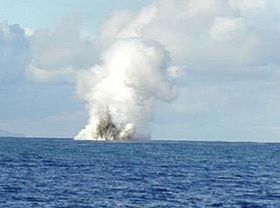
Underwater volcano erupts off Tonga 19 Mar 09 – Spectacular columns of steam and smoke spewed out of the seaabout 6 miles (10 km) from the main island of Tongatapu – an area where up to36 undersea volcanoes are clustered. Large
amounts of pumice from the volcanowill likely clog beaches on the southern coast of nearby Fiji islands shortly.
————–
Global warming may be caused by underwater volcanoes (Which I’ve been saying for years) 8 Dec 08 – A new study shows that the rise in land temperatures can be tied directly to increased heat and humidity coming from warmer oceans, which in turn may be caused solely by natural forces, including underwater volcanoes.
————–
Ocean Floor Geysers Warming The Seas (And we wonder why the oceans are warming) 22 Sep 08 – “It’s like finding Old Faithful in Illinois. When we went out to try to get a feel for how much heat was coming from the ocean floor and
how much sea water might be moving through it, we found that there was much more heat than we expected at the outcrops.”
————–
Geothermal heat may be melting the Greenland glaciers Nov 2007 – “Hansen’s model is wrong! In reality, the Greenland and Antarctic ice sheets occupy deep basins, and cannot slide down a plane. Furthermore glacial flow depends on stress as well as temperature, and much of the ice sheets are well below melting point.
————–
World’s deepest chain of undersea volcanoes to be explored 1 Sep 08 — Scientists at the National Oceanography Centre are set to explore the world’s deepest undersea volcanoes five kilometers beneath the Caribbean.
————–
‘Black smokers’ found in Arctic Ocean 4 Aug 08 – Jets of searingly hot water spewing up from the sea floor have been discovered in a far-northern zone of the Arctic Ocean, Swiss-based scientists announced Monday.
————–
Boiling Hot Water Found in Frigid Arctic Sea 24 Jul 08 – “Many miles inside the Arctic Circle, scientists have found
vents of scalding liquid rising out of the seafloor at temperatures that are more than twice the boiling point of water.
————–
Undersea volcanic activity blamed for mass extinction 93 million years ago 16 Jul 08 – Researchers from the University of Alberta, Canada, find evidence of underwater volcanism in rocks dating to a mass extinction 93 million years ago.
————–
Huge Underwater Volcanoes in the Arctic Ocean, but scientists see no significant connection to melting ice? 27 Jun 08 – The eruptions discharge large amounts of carbon dioxide, helium, trace metals and heat into the water over long distances, but scientists see no significant connection to melting ice.
————–
Giant Undersea Volcano Found Off Iceland (And we wonder why the oceans are warming) 22 Apr 08 – It’s an active volcano that rises about 3,300 feet (1,000 meters) above the surrounding sections, coming within 1,300 feet (400 meters) of the surface.
————–
Hawaiian volcano pumping more lava than usual into the ocean 5 Jul 08 – The Hawaiian Volcano Observatory said Saturday that Hawaii’s Kilauea volcano is pumping more lava than usual into the ocean.
————–
Magma May Be Melting Greenland Ice
18 Dec 07 – I added another article to this posting
13 Dec 07 – Scientists have found at least one natural-magma hotspot under the Greenland Ice Sheet where heat from Earth’s insides could seep through,
————–
Arctic seabed afire with lava-spewing volcanoes 25 Jun 08 – Red-hot magma has been rising from deep inside the earth
and blown the tops off dozens of submarine volcanoes, four kilometers below the ice. And we wonder what is melting the ice.
————–
Underwater Volcanic Eruptions, Not Meteor, May Have Killed Dinosaurs New discovery validates theories in Not by Fire but by Ice 30 Oct 07 – “A series of monumental volcanic eruptions in India may have killed the dinosaurs 65 million years ago, not a meteor impact in the Gulf of Mexico.
Then Barry adds another comment,
We’ve forgotten that this isn’t the first time our seas have warmed. Sea temperatures also shot upward 10º to 18ºF just prior to the last ice age.
As the oceans warmed, evaporation increased. The excess moisture then fell to the ground as giant blizzards, giant storms and floods (Noah’s Deluge type floods), and a new ice age began.
The same thing is happening today.
It’s not global warming, it’s ocean warming, and humans have nothing to do with it. Our seas are being heated, I believe, by underwater volcanism. Here’s why:
We are living in a period of vastly increased volcanism, said Dixy Lee Ray in her 1993 book Environmental Overkill, the greatest in 500 years. Eighty percent of all volcanism (say experts at NOAA) occurs underwater. Therefore, underwater volcanism should also be the greatest in 500 years.
Our seas, heated by underwater volcanism, are leading us directly into the next ice age . . . and we don’t even know it.
That’s what El Niño is all about. Warmer seas send excess moisture into the sky, leading to increased precipitation.
Worldwide flood activity is the worst since before Christopher Columbus. In Poland, it’s the worst in several thousand years. In the U.S., precipitation has increased 20 percent just since 1970. This is no coincidence.
When that precipitation begins falling in the winter, you have the makings of an ice age.
South America’s oldest trees give up the ghost of climate past.
They’ve been dead for over 50,000 years, but South America’s longest-living trees still have a few tales to tell. A new study of the growth rings of partially fossilized trees in southern Chile hints that the global climate before the last ice age was rather like today’s.
Barry mentions Kavachi Island and I did a quick search and came up with this.
From Wikipedia,
Kavachi is one of the most active submarine volcanoes in the south-west Pacific Ocean.Located south of Vangunu Island in the Solomon Islands, it is named after a sea god of the New Georgia Group islanders, and is also referred to locally as Rejo te Kavachi (“Kavachi’s oven’). The volcano has become emergent and then been eroded back into the sea at least eight times since its first recorded eruption in 1939.
In May 2000, an international research team aboard the CSIRO research vessel FRANKLIN fixed the position of the volcano at 8° 59.65’S, 157° 58.23’E. At that time the vent of the volcano was below sea level, however frequent eruptions were ejecting molten lava up to 70m above sea level, and sulfurous steam plumes up to 500m. The team mapped a roughly conical feature rising from 1,100 m water depth, with the volcano having a basal diameter of about 8 km.
When the volcano erupted in 2003, a 15-meter-high island formed above the surface, but it disappeared soon after. Additional eruptive activity was observed and reported in March 2004 and April 2007.
Kavachi erupting May 14th, 2000.
Barry then looks as CO2 levels, he writes,
Carbon dioxide
If today’s rising carbon dioxide are caused by humans, what caused the dramatic rise in CO2 levels at the dinosaur extinction?
It was a matter of a moment’s search to find this, from Ice Age Now, Home Page here
If today’s rising carbon dioxide are caused by humans, then what caused the dramatic rise in CO2 levels at the dinosaur extinction?
Research shows that there was “a sudden and dramatic rise” in carbon dioxide in the Earth’s atmosphere at the dinosaur extinction of 65 million years ago. A recent report attributes the rise in CO2 levels to an asteroid impact.
See http://news.bbc.co.uk/1/hi/sci/tech/2038599.stm
I disagree. I think today’s rise in CO2 levels can be attributed to our warming oceans. After all, the oceans are known as a carbon dioxide “sink,” especially when the water is cold.
But as the water warms up, it releases CO2 into the atmosphere. This happens in much the same way that a warm bottle of home-brewed root beer will release CO2. And if you give that CO2 no way to escape, the bottle will explode.
We’ve got it backwards. We’ve got cause and effect in reverse.
The CO2 is not causing global warming. Instead, our warming oceans are releasing CO2 into the atmosphere.
It’s not global warming, it’s ocean warming, and it’s leading us into an ice age.
Finally, Barry offers this,
No Global Warming
“Even with needed corrections, data still don’t show the expected signature of global warming,” says Dr. Roy Spencer, Senior Scientist for Climate Studies NASA/Marshall Space Flight Center.
Unfortunately, the URL that Barry included didn’t function. But a quick search on the NASA website came up with this,
Scientists are working to understand why the lower atmosphere isn’t heating up as fast as some global warming models predict.
July 21, 2000 — The question sounds like a Zen koan: How could the globe be warming and not warming at the same time?
That’s the riddle posed to climatologists by satellite and radiosonde data which show that while the Earth’s surface has been warming over the past decades, the lowest layer of the atmosphere shows a weaker warming trend.
The measurements are surprising, because computer simulations of the world’s climate predict that the two lowest layers of the atmosphere — which together form the “troposphere” — should be warming faster than the Earth’s surface.
Read the full article here. It’s well worth reading and concludes with these closing paragraphs,
Current models suffer from several shortcomings.
For example, clouds are not well represented by the models. The resolution of current models is too coarse for features as small as clouds, Spencer said. Yet clouds clearly play a crucial role in climate due to their influence on humidity, precipitation and albedo (the percentage of solar energy reflected back into space as light).
“The role of clouds is still regarded as one of the biggest uncertainties in global warming predictions,” Spencer said.
The ability of plants to remove carbon dioxide from the atmosphere and the role of soils have only recently been added to the models, and scientists aren’t confident yet of how the models portray these factors, Spencer said.
“While we know that vegetation takes up some of the carbon dioxide we generate from burning of fossil fuels, how that sink of carbon will change in the future is still pretty uncertain,” Spencer said.
Climate models are also limited by the computing power available.
“The global models would be much better if computers were much faster,” Spencer said. “Instead, a lot of approximations are made to make the models simple enough to do climate simulations over the whole globe.
“Unfortunately,” Spencer continued, “we know that many of the processes that are crudely represented are quite non-linear, and so have the potential to respond in unexpected ways.”
The Global Hydrology and Climate Center is a joint venture between government and academia to study the global water cycle and its effect on Earth’s climate. Jointly funded by NASA and its academic partners, and jointly operated by NASA’s Marshall Space Flight Center in Huntsville, Ala., and the University of Alabama in Huntsville, the Center conducts research in a number of critical areas.
Web Links
Global Hydrology and Climate Center — a joint venture between government and academia to study the global water cycle and its effect on Earth’s climate
OK, that’s enough from me for today. Clearly it would take a great time for a layman, such as yours truly, to go through all this material, and more, to determine the truth of it all, to the very best abilities of science. For the verdict on whether man’s increased generation of CO2 in the atmosphere is having a global effect on the global climate should be in the hands of scientists.
Once science has shown cause and effect then, and only then, should politicians endeavour to offer the way forward for society.
Having said that, there is no reason at all for mankind to maintain the present disconnect from Planet Earth. Even if the jury is still well and truly out in terms of the effect of CO2 on the atmosphere, the number of other issues that are just as important for our long-term survival are still prodigious. There’s an old saying in aviation, “If there’s any doubt, there’s no doubt.”
On the 24th June, I wrote a piece from the Extraordinary Animals series from the UK’s Channel Five TV station. In particular, the article focussed on Scamp’s ability to detect when people in care were dying.
Scamp is a little Schnauzer who resides at The Pine nursing home in Canton, Ohio. Like many live-in pets at nursing homes, Scamp brings companionship to the residents but he also does more than that. Scamp seems to have a gift that tells him when the end is near for one of the residents and he loyally stays with them during their final hours.
Jim & Diane Walker
The first of the three YouTube videos, some ten minutes long, examined how Scamp knew that a patient was dying and how scientists Jim and Diane Walker believed it was due to the incredible sense of smell that dogs possess. From The Examiner of June 1st, 2009,
An amazing scientist, Dr. James Walker of the Sensory Research Institute at Florida State University, documented the power of a dog’s nose in 2002. Using n-amyl acetate (nAA), Dr. Walker documented that a dog can detect chemicals at one ten-thousandth to one hundred-thousandth the concentrations that humans can. In other words, at a minimum, dogs can smell 10,000 times better than a human.
OK, back to that YouTube video.
If you didn’t watch it on the 24th, do watch it again. Watch it this time to pick up just what Scamp is doing. At minute 6:30 hear how Dr. Bob Andrysco describes how the sense of smell of a dog is 100,000 times more powerful than that of a human.
Then stay with the video until minute 9:20 when Jim & Diane Walker show how a dog can detect a substance as diluted as 2 parts in a trillion. That is so diluted as to be beyond comprehension; well to a non-scientist like me!
As the presenter describes, “That’s the equivalent of a teaspoonful of sugar in ten billion cups of tea!” To me that is utterly mind-boggling. Let me try and demonstrate the power of 2 parts per trillion, which is the equivalent of 1 part per half-trillion (500,000 million). Half-a-trillion fluid ounces is 522,189,675.651 ft³ – just over 522 million cubic feet. What does that volume look like?
Here’s the picture of twelve fluid ounces – you’ll just have to imagine what one fluid ounce would look like!
Standard Coke can = 12 fluid ounces
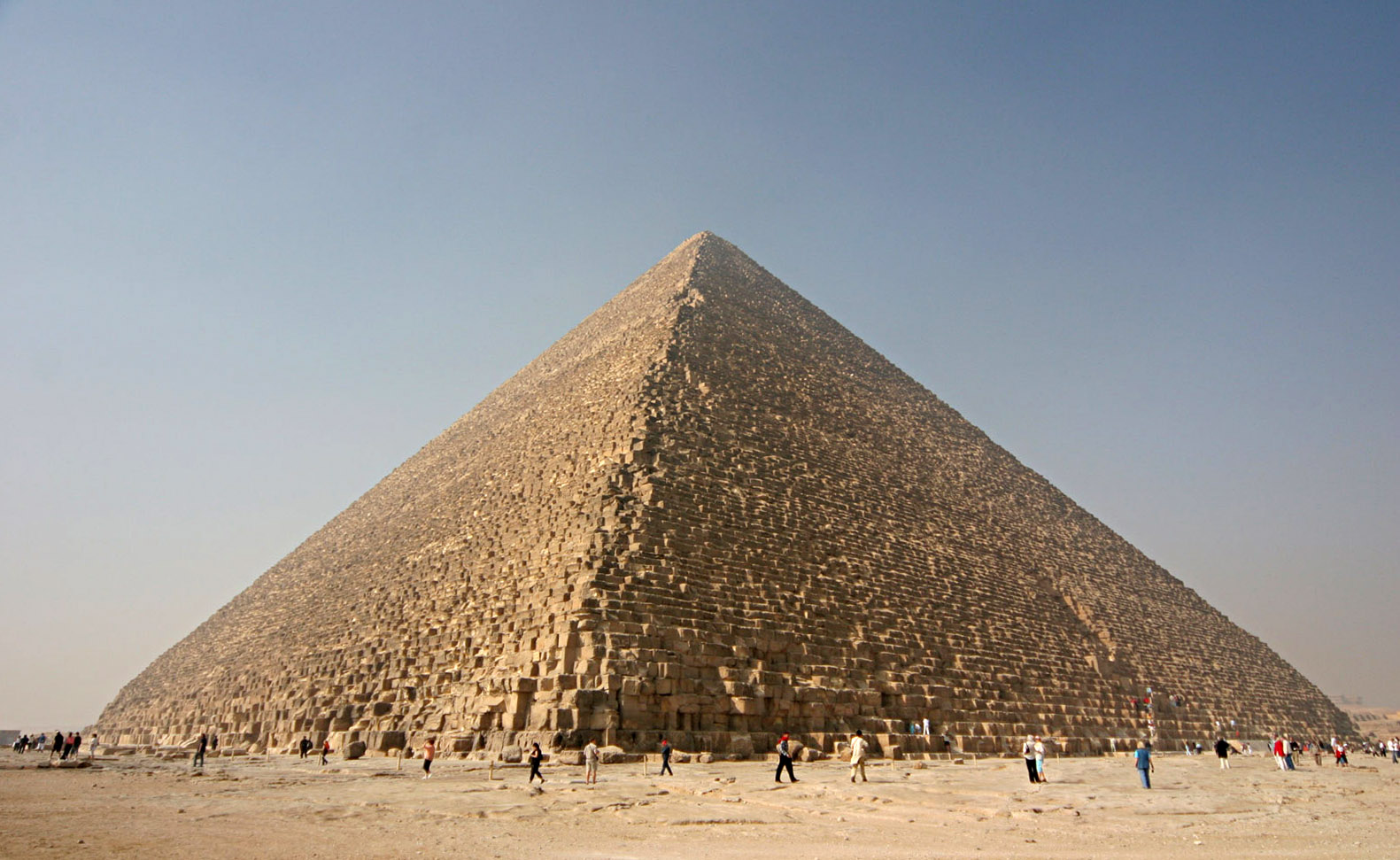
Here’s a picture of ninety million cubic feet – you’ll just have to imagine what five hundred and twenty-two million look like!
Great Pyramid of Giza = 90 million cubic feet
OK, last one from me to allow us all to really, really appreciate the magical ability of that dog’s nose.
Two parts per trillion is the equivalent of smelling that can of Coke (12 fluid ounces) in a volume the equivalent of seventy, yes seventy, Great Pyramids (6,264,000,000 cubic feet).
Think I need to lie down in a darkened room for a while!
Another example of the astounding bond between dog and man.
Regular supporters of Learning from Dogs will be aware that yesterday I wrote, under the heading of Paws of Love, about two examples of the most amazing bond that develops between the dog and man, one of them a very personal account.
Moving on.
We subscribe to the website, Top Documentary Films, and the other night we watched a 48-minute program about The Grim Reaper Dog. The link to the TDF programme is here. (It includes three separate films.)
Scamp
The Grim Reaper Dog is about Scamp, a little Schnauzer who resides at The Pine nursing home in Canton, Ohio. Like many live-in pets at nursing homes, Scamp brings companionship to the residents but he also does more than that. Scamp seems to have a gift that tells him when the end is near for one of the residents and he loyally stays with them during their final hours.
So if you want to watch the film in full within the TDF website, then go here.
If you want to watch it directly from YouTube then the three parts of the film are below – prepared to be amazed! Or perhaps those of you who live emotionally close to a dog will just find the film as confirmation of what you already know!
It was back in March, the 8th to be precise, when I first wrote about Peter Russell. Well just over a week ago, I came across another article by Russell from the Huffington Post. It was then a moment’s work to find it on Peter Russell’s own website. (This links to various essays on the topic.)
Science has had remarkable success in explaining the structure and functioning of the material world, but when it comes to the inner world of the mind science falls curiously silent. There is nothing in physics, chemistry, biology, or any other science that can account for our having an interior world. In a strange way, scientists would be much happier if there were no such thing as consciousness.
David Chalmers, professor of philosophy at the University of Arizona, calls this the “hard problem” of consciousness. The so-called “easy problems” are those concerned with brain function and its correlation with mental phenomena: how, for example, we discriminate, categorize, and react to stimuli; how incoming sensory data are integrated with past experience; how we focus our attention; and what distinguishes wakefulness from sleep.
It would be wrong to publish anything more so if you are interested in more, then go here and pick away or better still buy the book!
If you have a quiet 30 minutes, settle down and watch these videos
Last Friday (10th) I wrote about a recent article that appeared in the Newsweek magazine of June 6th and mused about there seeming to be a growing awareness of the changing of the Planet Earth.
I just wanted to add a few other important elements (pardon the pun) of the current awareness.
First, at the time of writing this (June 2nd) the website that shows the monthly level of CO2 in the atmosphere was still showing the figure for April. Here it is,
CO2 in the atmosphere
Go here and check out what it is for May 2011. We all know that it won’t be below 393.18, which is already over 12% above the maximum safe level that scientists have determined.
UPDATE (June 7th): The figures for May are now on the website CO2 Now and they are 394.35 up, as predicted, from the figure of 393.18 for April, 2011.
Then go and watch this, from Bill McKibben,
Then go to the CO2 Now website and read, and ponder and think about what is becoming increasingly obvious to us all.
Finally, read a article that Bill McKibben has recently written that seems to have been widely published. Here it is on the TomDispatch website. It starts thus,
Three Strikes and You’re Hot
Time for Obama to Say No to the Fossil Fuel Wish List
By Bill McKibben
In our globalized world, old-fashioned geography is not supposed to count for much: mountain ranges, deep-water ports, railroad grades — those seem so nineteenth century. The earth is flat, or so I remember somebody saying.
But those nostalgic for an earlier day, take heart. The Obama administration is making its biggest decisions yet on our energy future and those decisions are intimately tied to this continent’s geography. Remember those old maps from your high-school textbooks that showed each state and province’s prime economic activities? A sheaf of wheat for farm country? A little steel mill for manufacturing? These days in North America what you want to look for are the pickaxes that mean mining, and the derricks that stand for oil.
Yes, it all seems ‘doom and gloom’ around us at present but then consider that the only way we, as in mankind, can change to a truly sustainable relationship with this Planet is through better understanding and a global realisation that the time for change is now! That is a very positive message!
What even a lovely boy, just one year old, can offer the world.
I’m writing this around 5pm UK time on the 8th June. A little over 4 hours ago, at 1230 give or take, I witnessed a tiny event, something that for many of us wouldn’t have been seen as anything but trivial, albeit lovely.
Here’s what happened.
I had been to an introductory meeting with Richard White of The Accidental Salesman fame. We met in Pall Mall, just by Trafalgar Square, at the offices of The Institute of Directors.
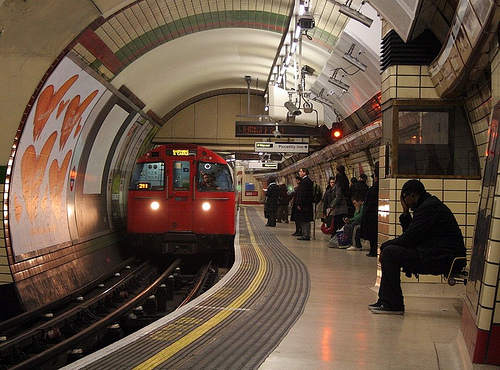
Shortly before 1230, after Richard and I had said our goodbyes, I jumped on a Bakerloo train at the London Underground station at Piccadilly Circus heading north for Baker Street.
Bakerloo line train at Piccadilly Circus station
I think it was one stop later that into my carriage entered parents with their small son. They sat down and the father, who had been carrying the young lad, was clearly beautifully bonded (not my favourite word, can’t think of a better one just now) with the small boy. The love and joy of the parents and their child just poured out into the ‘ether’ of the carriage. Result?
One man, middle-aged, sitting opposite to one side of the family beamed smiles in the direction of the young boy. You could sense that his emotional outlook had been transformed by the unencumbered joy flowing across the carriage. He really smiled more or less non-stop until I and this family got off at Baker Street station.
Another man, my guess upper middle-aged, was formally dressed in the business suit, tie and polished black shoes. He was reading a newspaper. But the boy’s joyful infectiousness touched him. He put the paper to one side and discretely looked across at the child bouncing on his father’s lap and a private smile crossed his face.
I was standing observing all of this and, of course, seeing the truth of something so core to the needs of humans. That is, the power of living beautifully in the present and how it demonstrates what my colleague Jon Lavin so often says, “The world reflects back what we think about most”.
Why do I write ‘of course’? Because what was so natural for this boy at the tender age of one is so natural for dogs throughout all their lives; wonderfully enjoying the present.
In a most un-English manner, I briefly caught up with the parents and established that the young boy’s name was Thomas.
Well done, Thomas, and may that joy in you be with you and all those around you for ever and ever.





 Learning from Dogs
