As I implied when I introduced Part 2 last Thursday, Why Are We Here?, these are deeply interesting films. Do find time to watch them both (Part 1 Are We Aloneis here ) if you can. So here is the concluding part, Are We Real? You can either go to it via this link, or watch the YouTube elements below.
There is a fundamental chasm in our understanding of ourselves, the universe, and everything. To solve this, Sir Martin takes us on a mind-boggling journey through multiple universes to post-biological life.
On the way we learn of the disturbing possibility that we could be the product of someone else’s experiment.
I do hope you all found these three films as stimulating and thought-provoking as Jean and I did.
Powerful prose, stunning pictures and an insight into the last 1.8 billion years of our planet.
The Payson Roundup is the local newspaper for Payson. To be frank, most weeks it’s a fairly quick read. That’s not a reflection of the quality of the newspaper, just an acknowledgement that Payson is a small American city some 80 miles NE of Phoenix up in the high desert. Indeed, the Roundup has a good record of winning awards.
However on the 6th January, there was a stunning article about the Grand Canyon, less than 4 hours driving from Payson. It was written by Pete Aleshire, a Staff Reporter with the Roundup. I can vouch for Pete’s literary skills as he teaches the creative writing course at the local college that Jean and I attended last term (semester) and will be restarting tomorrow.
I am very grateful to the Payson Roundup for their permission to republish this wonderful work. So here it is.
Woe and beauty on an ancient edge
by Pete Aleshire
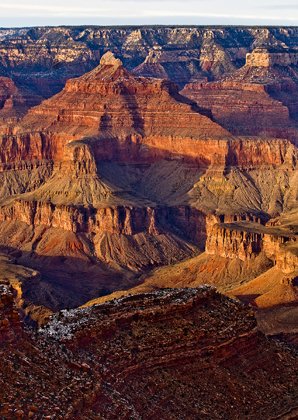
This view of the canyon reveals the layers of limestones and sandstones that testify to vanished seas and deserts. Note the strong, narrow white layer of Coconino Sandstone near the top, composed of 260-million year-old sand dunes. Also note in the center of the photo the 500-foot-tall cliff of Redwall Limestone formed on a seabottom 300-400 million years ago. Photo Tom Brossart/Roundup
I took a step — a long step — a million years step. Then I stopped, turned and faced north. Perched on the jagged edge of my life, I looked down deep into the shadowed layers of lost worlds — terrible deaths, fractured continents, vanished seas, mass extinctions.
Taking a breath, I took another step — a long step — another million years.
Curiously, I felt better — my troubles for the moment shrunk to no more than a ledge of Tapeats Sandstone in the wall of the Grand Canyon opposite. A layer of fossilized beach sand laid down 570 million years ago, the Tapeats Sandstone lies atop a mystery of missing stone — dubbed the “Great Unconformity.”
I studied that light, crumbling layer of sandstone in the canyon wall just across the way, knowing that all the great, riotous thrust of life that took us from pond scum to troubled writers has taken place since the lapping waves of a vanished sea left that layer of crumbling gray stone on a barren beach.
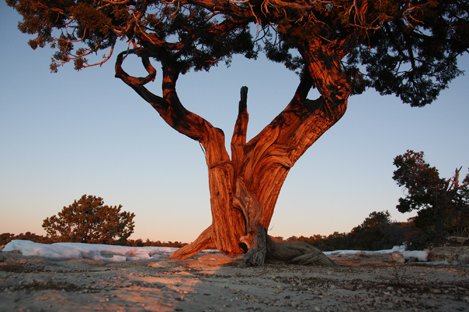
Perched on the wind-tormented branch of a twisted juniper nearby, a glossy black raven croaked at me.
“Nevermore,” he gurgled in my mind’s ear.
“You raise a good point,” I said to the raven and the wind that rose up out of the canyon’s 1.8-billion-year gash of time. I let loose a breath, a sigh, a puff of steam — frail and fleeting as life in the shadow of so much time. It should have depressed me, to stand so mite-like on the edge of such immensity. All I had dreamed or hoped or failed to do would not amount to a swirl of dust on this crumbling edge. I ought to have felt insignificant. Instead, I felt obscurely better.
So I took another step. A long step — a million years.
They had not built the Trail Through Time along the edge of the Grand Canyon between the El Tovar and Yaqui Point the last time I lingered on this edge. Now, it offers the most exciting crash course in geology I’ve ever encountered, although I’ve sought after rocks and unconformities all my life — and have even written geology books for confused people.
The 1.2-mile-long trail presents sliced and polished rocks representing almost all of the 24 major rock layers laid bare in the canyon wall from the 240-million-year-old limestone, siltstone, gypsum and chert layers of the Kaibab Formation to the 1.8-billion-year-old Vishnu Schist in the canyon bottom, among the oldest exposed rock’s on the planet’s surface.
Each step along the 1.2-mile path represents a million years, starting in the present and ending up at the 1.8-billion-year-old start of everything.
The Grand Canyon reveals a 1.8-billion year glimpse into Earth’s past from views like these along the 1.2-mile-long Trail of Time, with displays of rocks from each of the two dozen rock layers in the mile-deep canyon. A juniper catches the last light. Photo by Pete Aleshire
The Grand Canyon represents the most vividly revealed slice of Earth’s history anywhere on the planet. That makes the canyon one of the few places a person can grasp both the astonishing violence and the tormented timescale of the planet that sustains us all. This unique cross-section of time comes as a result of the relatively level uplift of the Colorado Plateau in the past 5 million to 8 million years. In most places, such a vast uplift would jumble the buried rock layers. But much of the 130,000 square miles of the Colorado Plateau rose at the rate your fingernails grow without deforming the miles-deep layers of sandstones, limestones and shales laid down on the bottoms of long-vanished seas and deserts.
As the Colorado Plateau rose, the northern edge crumpled into the Rocky Mountains. The southern edge dropped away along a 200-mile-long chain of 1,500-foot cliffs — which north of Payson forms the Mogollon Rim. Oak Creek cut back into that rising edge of the plateau to uncover the striking red rock formations of Sedona.
The Colorado River did the same thing, but on a grand scale. Many geologists believe the Colorado River originally ran north into a vast, interior sea. But as the Colorado Plateau rose, another river that ran south cut backward until it captured the north-flowing ancestral Colorado River, reversing the flow so that it now ran south into the Gulf of California.
This capture some 6 million years ago began the process of carving out the Grand Canyon. As the plateau rose, the flood-prone Colorado River cut down through it, like pressing a log up against a chain saw. Meanwhile, the steep tributaries widened the canyon by carrying those soft layers of sedimentary rock down to the main stem of the Colorado.
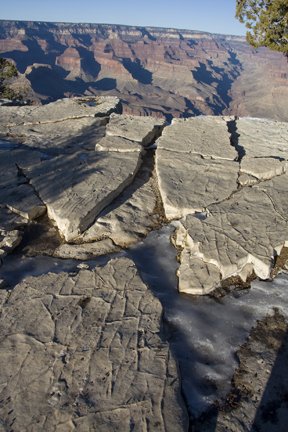
A layer of 230-million year old Kaibab Limestone caps the rim. The Grand Canyon reveals a 1.8-billion year glimpse into Earth’s past from views like these along the 1.2-mile-long Trail of Time, with displays of rocks from each of the two dozen rock layers in the mile-deep canyon. Photo by Pete Aleshire
That process started at about the time the genetic evidence suggests humans, chimps and gorillas last shared a common ancestor and continues to this day.
As a result of this vast uplift, the relatively young Colorado River has revealed in the walls of the Grand Canyon the long buried history of the Earth going back nearly halfway to its creation. That encompassed the entire period in which life progressed from single celled organisms in the ocean to its present, dazzling complexity.
The meander down that Trail Through Time reveals much of that history, preserved in the rock layers and the fossils they contain. Of course, erosion has already removed more than 200 million years of that history, so that the youngest rocks on the rim of the canyon are older than the dinosaurs.
A few dominant layers stand out.
Near the top, the fossilized desert sand dunes of the light Coconino Sandstone bear witness to a vast desert that covered the Southwest some 260 million years ago. At that time, what would become North America was part of a “supercontinent” that gathered almost all the dry land on the planet into a single mass.
In the middle of the canyon, lies the great, blood-red wall of Redwall Limestone, formed on the bottom of a shallow sea between 300 million and 400 million years ago. Today, the fused layers of microscopic skeletons of ancient sea creatures forms a sheer 500-foot-tall band of cliffs that pose the greatest single barrier to reaching the canyon bottom from the rim. All of the trails to the bottom must pass through fault lines in the Redwall Limestone, stained red by iron oxides leaching out of the layers above.
Farther down, the easily eroded Bright Angel Shale forms the shelf above the 1,800-foot-deep inner gorge. Shales form on shallow sea bottoms, compared to the deeper marine environments that create limestones. Most of the trails in the canyon run along its wide shelf. Formed 530 million years ago, the Bright Angel Shale represents the era when trilobites ruled the world.
Just below the Bright Angel Shale lies the Great Unconformity, where erosion in the inconceivably distant past removed 1.2 billion years worth of rock. This records another period of uplift, when erosion carried off layers of rock many times higher than Mt. Everest.
Below that unconformity, the story continues — down through a dozen more layers in the inner gorge, each one mounted alongside the trail and polished smooth. The Grand Canyon Supergroup spans the period between 570 million and 1.2 billion years ago, again recording the meanderings of the continents and the ebb and flow of oceans, as the planet breathes in, breathes out.
After another, smaller unconformity, the river finally reveals the inconceivably ancient Vishnu Schist and Zoraster Granite. The schists started as sandstone, limestone and shale, before they were buried, reheated and fused into this dense, primordial rock. The Zoraster Granite ooze up from the molten depths of the Earth, forming veins revealed finally by the relentlessly downcutting river.
I could not see the metamorphosed Vishnu Schist from my perch atop the rim, but I have seen it on raft trips in the dark heart of the canyon where it has been fluted and carved and sandblasted by eons of floods.
Finally I stood stock still, my breath coming still in moist, warm, puffs as the planet spun so that the dust of the atmosphere gave the sun’s long light a warm red glow, reflected off the ancient worlds across the way.
My raven friend — or one of his kin — flew past with an audible whoosh of his wings, then banked to consider the possibilities. He croaked, that guttural warble that only ravens dare.
Odds are, he noted my proximity to the edge and so paused to ponder my potential as carrion.
But I prefer to think that he felt our shared pulse of life and caught the updraft of my yearning.
In either case, he settled on the branch of a weirdly stunted ponderosa pine nearby and we shared the sunset.
The shadows rose up out of the canyon, swallowing continents and oceans.
I kept my gaze on the glow of the Redwall Limestone until the shadow took it, then shifted to the luminous yellow of the Coconino Sandstone.
For I came to the canyon full of woe holding my life in my fingernails, my heart in the shadows. But now my troubles seemed fleeting, the world full of marvels, my life aglow like that desert turned to sandstone in the last light of day.
My breath came in a puff, transparent but warm in the still, cold air.
“Nevermore,” quoth the raven, “nevermore.”
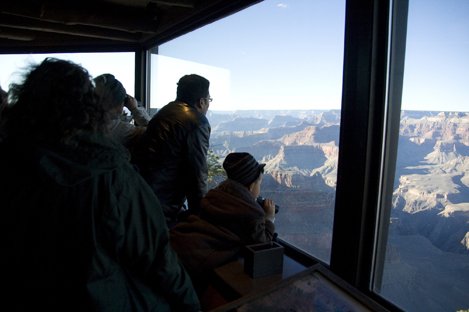
Visitors study the colorful layers of the Grand Canyon from the observation window in the geology museum at Yaqui Point. Photo by Pete Aleshire
oooOOOooo
Such beautiful words. Any additional thoughts from yours truly are utterly superfluous.
On Tuesday, I introduced the first of three films hosted by Lord Martin Rees. That was called Are We Alone. I do hope many of you were able to watch that. Film two is also from the website Top Documentary Films and the link is here. But, again, the film is available in 5 parts from YouTube and follows below.
In total, just around an hour to watch and well worth while. You will find, believer in God or not, that there are some deeply spiritual aspects to Martin Rees’ wonderful presentation.
Everything you thought you knew about the universe is wrong. It’s made of atoms, right?
Wrong. Atoms only account for a measly 15% of everything that exists!
The mass of the universe consists of something so mysterious and elusive that it has been dubbed ‘dark matter’.
The final film of the trilogy will be presented on Learning from Dogs next Tuesday, the 17th January.
On the 5th January, I presented a piece, called Life and the Cosmos, that was based on a deeply interesting lecture given by Britain’s Lord Martin Rees at the University of Melbourne’s Medical School in 2010. I wrote that I was going to pick up on some of the points made by Lord Rees in that lecture and I do so starting today.
On the website Top Documentary Films there is a collection of three films, originally shown on Channel 4 television in the UK, under the broad banner of What We Still Don’t Know? They make deeply fascinating viewing. Luckily they appear to be available on YouTube as well, thus can be included directly in this Post. However, if you have any problems with the YouTube versions then click here.
So here is the first programme, Are We Alone?
Are we alone? Sir Martin explores the possibility that life exists on planets beyond our own. He unveils an unsettling scientific debate that has startling consequences for us Earthlings. Do you believe in aliens? Why are we here? Everything you thought you knew about the universe is wrong. It’s made of atoms, right? Wrong. Atoms only account for a measly 15% of everything that exists. The mass of the universe consists of something so mysterious and elusive that it has been dubbed ‘dark matter’. Are we real? There is a fundamental chasm in our understanding of ourselves, the universe, and everything. To solve this, Sir Martin takes us on a mind-boggling journey through multiple universes to post-biological life. On the way we learn of the disturbing possibility that we could be the product of someone else’s experiment.
The second programme Why Are We Here? will be presented on Learning from Dogs on Thursday.
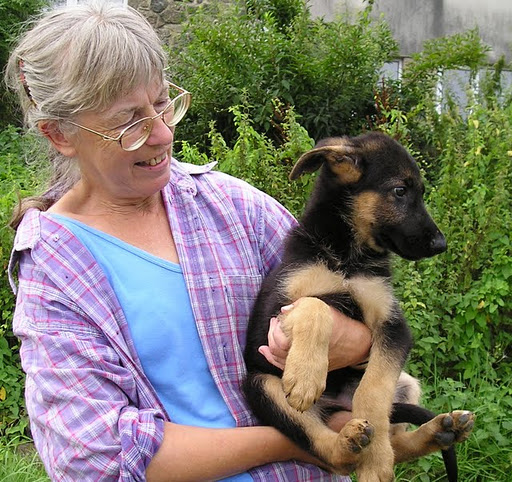
Way back before I came into Jean’s life, or perhaps I should expand on that by saying way before Pharaoh and I came into the life of Jean, her 12 dogs and 6 cats, Jean had come across a feral litter of pups.
This was in 1998 when Jean was living with her husband, Ben, in San Carlos, Sonora State, Mexico. Jean had already been rescuing feral dogs for a number of years. This litter of four puppies had been born underneath a trailer parked on a dirt road near Ben and Jean’s house. They were all cute, healthy little pups and Jean quickly found homes for three of them. However, the fourth had ended up being taken in by Jean and Ben and named Sammy.
The picture below shows Jean holding Sammy when she was around 3 months old.
Jean and Sammy
Thus, as it does for all of us, time passed to the point where last Friday, Sammy’s back legs had become so arthritic that she was unable to walk without a great deal of pain and, at the grand old age of 13 1/2, it was time for her to go to that big dog prairie in the sky.
Sammy, January 6th 2012 - now forever out of pain.
For Jean especially, this was a tough loss as Ben had loved Sammy so much. Sammy was the most sweet and gentle of dogs. I know that all of you who have had experience of putting a dog or cat to sleep will share the angst that Jean endured last Friday.
Thank you Sammy for being such a loving animal throughout your entire life.
We had to put one of our dogs to sleep on Friday, not a GSD, but one of Jean’s rescued dogs from way back. At this moment in time (11am US Mountain Time, Saturday) I’m writing a piece about this wonderful dog that will appear tomorrow.
Thus not in the mood to post my usual light-hearted item for a Sunday. So I resorted to looking up an appropriate dog video on YouTube.
Came across this,
Of course, that reminded me of how precious our Pharaoh is and it only took a few moments to find a couple of earlier pics of him.
Here’s Pharaoh the day I collected him from GSD breeders Jutone‘s in Dartmoor, SW England. That’s Sandra Tucker, the owner of Jutone, with Pharaoh; the date being 12th August 2003 when Pharaoh was then just over 8 weeks old.
Sandra Tucker holding young Pharaoh
The next photograph was taken on the 11th March, 2008 at London’s Heathrow Airport. The occasion being the time that Jean came across to England from her home in Mexico. Jean came to see if the romance that had blossomed between us at Christmas in 2007 in San Carlos, Mexico was alive and well. Luckily, it was!
Jean meeting Pharaoh for the very first time!
Thus it came to pass that in September, 2008, Pharaoh and I travelled out from Devon, England to Mexico where we lived until February, 2010, when Jean and I, Pharaoh and 12 other dogs and 6 cats relocated to Payson, Arizona.
Just a short note to say how very grateful I am for the number of readers who have signed up as subscribers over the last couple of weeks.
Many of you are already bloggers and very soon I’m going to find a way of linking Learning from Dogs to your blog. The obvious way would be to use the Blog Roll feature but methinks the list would be too long. I shall put my thinking cap on this aged head and see what would be an effective way of linking back to all those subscribers who also Blog. Feel free to add a comment if you have ideas.
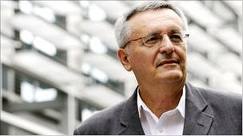
Over a week ago there was a fascinating and very thought-provoking BBC radio broadcast by Mr. John Gray, the political philosopher and author of the book False Dawn: The Delusions of Global Capitalism, .
Mr. John Gray
The BBC website then carried a further article by John Gray. But before quoting from that article, I do recommend that you put aside just 14 minutes to listen to that broadcast. If you click here you will be taken to the BBC podcast page for the Point of View series and then scroll down to the item that is headlined: The End, yet again? 26 Dec 2011.
There will see that a simple ‘right click & save target as’ allows you to download the audio file so you can listen at your pleasure.
Indeed, having listened to Point of View over the many years when living in England, I can thoroughly recommend them. Described on the website, “Weekly reflections on topical issues from a range of contributors including historian Lisa Jardine, novelist Sarah Dunant and writer Alain de Botton.”
Here are some extracts from the John Gray article that appeared on the BBC website.
A Point of View: The endless obsession with what might be
If we can stop thinking about what the future might bring and embrace the present for what it is, we would be a lot better off, writes John Gray.
It’s been some time now since history didn’t end. Twenty-odd years ago, when the Berlin Wall was coming down, there were many who believed that there would be no more serious conflicts.
The American writer Francis Fukuyama, who promoted the idea of the end of history in the autumn of 1989, declared that the chief threat in future would be boredom. A new era, different from any before, had arrived.
Of course it hadn’t. The end of the Soviet Union was followed by conflicts and upheavals of the sort that happen when empires fall apart – war in the Caucasus and economic collapse in Russia, for example.
In any realistic perspective the idea that a single event – however large – could mark the end of human conflict was absurd. But those who were seduced by the idea were not thinking in realistic terms.
They were swayed by a myth – a myth of progress in which humanity is converging on a universal set of institutions and values. The process might be slow and faltering and at times go into reverse, but eventually the whole of humankind would live under the same enlightened system of government.
When you’re inside a myth it looks like fact, and for those who were inside the myth of the end of history it seems to have given a kind of peace of mind. Actually history was on the move again. But since it was clearly moving into difficult territory, it was more comfortable to believe that the past no longer mattered.
Then later on in the article, John writes,
Life’s framework
The implication is that sudden shifts are relatively rare in history. But consider continental Europe over the past 70 years – until recently a normal human lifetime. Unless they were Swedish or Swiss, an ordinary European man or woman lived during that period under several quite different systems of government.
Nearly all of Europe, some of it democratic, succumbed for a time to Nazism or fascism. Half of Europe moved from Nazism to communism with only a brief interval of democracy. Most of that half, though not Russia, became functioning democracies after the end of the Cold War.
Not only have political forms changed during a normal lifetime, systems of law and banking have come and gone along with national currencies. The entire framework in which life was lived has changed not once, but several times. In any longer historical perspective discontinuities of these kinds are normal.
The article then concludes, thus,
We seem to be approaching one of those periods of discontinuity that have happened so often in the past. It may seem unthinkable that the European banking system could implode, or that a global currency like the euro could dissolve into nothing.
Yet something very much like that was the experience of citizens of the former Soviet Union when it suddenly melted down, and there is nothing to say something similar could not happen again.
For believers in progress it must be a dispiriting prospect. But if you can shake off this secular myth you will see there is no need to despair. The breakdown of a particular set of human arrangements is not after all the end of the world.
Surely we would be better off if we put an end to our obsession with endings. Humans are sturdy creatures built to withstand regular disruption. Conflict never ceases, but neither does human resourcefulness, adaptability or courage.
We tend to look forward to a future state of fulfilment in which all turmoil has ceased. Some such condition of equilibrium was envisioned by the American prophet of the end of history with whom I began.
As Fukuyama admitted, it’s not an altogether appealing vision. But living in fear of the end is as stultifying as living in hope of it. Either way our lives are spent in the shadow of a future that’s bound to be largely imaginary.
Without the faith that the future can be better than the past, many people say they could not go on. But when we look to the future to give meaning to our lives, we lose the meaning we can make for ourselves here and now.
The task that faces us is no different from the one that has always faced human beings – renewing our lives in the face of recurring evils. Happily, the end never comes. Looking to an end-time is a way of failing to cherish the present – the only time that is truly our own.
I have extracted more than perhaps I ought, and there was so much more to read than is presented here. So please go to the BBC website and read it in full; it’s a very powerful essay.
Finally, let me take you back to a piece that I wrote back in September about Transitions. I closed that piece thus,
There is significant evidence, real hard evidence, that the patterns of mankind’s behaviours of the last few decades cannot continue. Simply because mankind will go over the edge of self-extinction. Darwin’s evidence and all that! We have to accept that humans will see the bleedin’ obvious before it is too late. We have to keep the faith that our species homo sapiens is capable of huge and rapid change when that tipping point is reached, so eloquently written by Paul Gilding in his book, The Great Disruption, reviewed by me here. We have to embrace the fact that just because the world and his wife appears to be living in total denial, the seedlings of change, powerful change, are already sprouting, everywhere, all over the world.
So let’s welcome those changes. Let’s nurture those seedlings, encourage them to grow and engulf our society with a new richness, a new fertile landscape.
Let’s embrace the power of now, the beauty of making today much better and letting go of tomorrow.
For today, I am in charge of my life,
Today, I choose my thoughts,
Today, I choose my attitudes,
Today, I choose my actions and behaviours.
With these, I create my life and my destiny.
It’s very difficult to make predictions, especially when they involve the future!
For reasons that I am not clear about, there is a mood of pessimism about my person. Whether it is the scale of global issues that I see ahead that drags me down, whether the year of an American Presidential election will remind me of the loss of reason that afflicts so many modern democracies, whether the messages in Kunstler’s book The Long Emergency still resonate in my mind well, who knows?
But when one does look at the broader picture of modern society, there is much that troubles.
So forgive me if I provide a couple of examples of these troubles. I do so on the grounds of communication – the more that understand the risks ahead of us, the more likely we, as in the peoples of this planet, will say to our leaders, “Enough of this! For the sake of my children, my grandchildren and all of humanity we have to change our priorities, and soon!”
Climate change increases the risk of record-breaking extreme weather events that threaten communities across the country. In 2011, there were at least 2,941 monthly weather records broken by extreme events that struck communities in the US.
That was backed up by an article on the Onearth website that opened,
By many measures, 2011 was the most extreme weather year for the United States since reliable record-keeping began in the 19th century — and the costs have been enormous. According to the National Oceanic and Atmospheric Administration, 2011 set a record for the most billion-dollar disasters in a single year. There were 12, breaking the old record of nine set in 2009. The aggregate damage from these 12 events totals at least $52 billion, NOAA found.
And that just for the USA. But will climate change be the Number One political issue in 2012? And if not in 2012, when will it be?
Let me move on to my second example, very different from the one above but, in a sense, just as scary. This is an interview that was in a recent article on the Food Freedom website ( brilliant website, by the way). Dr. Joseph Mercola, the leading natural health practitioner, interviews Dr. Don M. Huber, one of the senior scientists in the U.S about the area of science that relates to genetically modified organisms (GMO). Here’s an extract from the article on Food Freedom,
Toxic botulism in animals linked to RoundUp
Dr Mercola recently interviewed Dr Don Huber, whose letter to the USDA warning that Monsanto’s RoundUp, a broad-spectrum “herbicide” that has been linked with spontaneous abortion in animals, continues to be ignored by food and environmental safety authorities. In this important hour-long discussion, Huber, a plant pathologist for over 50 years, explains how RoundUp is destroying our healthy soils by killing needed microorganisms.
Not only did his team discover a new soil pathogen, but he reports that animals are coming down with over 40 new diseases, like toxic botulism. Huber explains that before the widespread use of herbicides, pesticides and genetically modified food and feed, natural probiota would have kept Clostridium botulinum in check
The video, below, of the interview is included in the article. Please don’t be put off by the length, the material covered is riveting and critical to our general knowledge about the threats to our society.
So that’s enough from me for one day! On Monday, I shall include another video relating to the RoundUp issue that reveals, both directly and metaphorically, how the only solution to pessimism is to embrace the need to make change happen. Be inspired by this poem by Sam Keen, included in the latest Sabbath Moment from Terry Hershey,
I Want to Surrender
God, I want to surrender
to the rhythm of music and sea,
to the seasons of ebb and flow,
to the tidal surge of love.
I am tired of being hard,
tight, controlled,
tensed against tenderness,
afraid of softness.
I am tired of directing my world,
making, doing, shaping.
Tension is ecstasy in chains.
The muscles are tightened to prevent trembling.
Nerves strain to prevent trust,
hope, relaxation….
Surrender is a risk no sane man may take.
Sanity never surrendered
is a burden no man may carry.
God give me madness
that does not destroy
wisdom,
responsibility,
love.








 Learning from Dogs