A moving, insightful postscript to the life of the late Ernest Callenbach.
This is a continuation of the republication of a recent TomDispatch Tomgram. As I explained in Part One published yesterday I have been a follower of Tom Dispatch for some time and frequently find the essays most interesting. However, reading the words of Ernest Callenbach touched me in many ways, some of which are still evolving. Callenbach was clearly a man who many years ago not only foresaw how our world was heading but via his writings was able to articulate the solutions. Today, as the video at the end of the Post so clearly exemplifies, those solutions are spot on.
The other point that strikes me is that in leaving this ‘message’ on his computer asking for it to be released after his death, Callenbach isn’t trying to prove anything. We are reading the words of a person who feels so strongly about the fate of mankind that he wants those words to be his epitaph for ever more. Trust me. When you read the words below you will be as touched as I was, indeed still continue to be. It is a rare privilege to republish them.
Ernest ‘Chick’ Callenbach Epistle to the Ecotopians
By Ernest Callenbach[This document was found on the computer of Ecotopia author Ernest Callenbach (1929-2012) after his death.]
To all brothers and sisters who hold the dream in their hearts of a future world in which humans and all other beings live in harmony and mutual support — a world of sustainability, stability, and confidence. A world something like the one I described, so long ago, in Ecotopia and Ecotopia Emerging.
As I survey my life, which is coming near its end, I want to set down a few thoughts that might be useful to those coming after. It will soon be time for me to give back to Gaia the nutrients that I have used during a long, busy, and happy life. I am not bitter or resentful at the approaching end; I have been one of the extraordinarily lucky ones. So it behooves me here to gather together some thoughts and attitudes that may prove useful in the dark times we are facing: a century or more of exceedingly difficult times.
How will those who survive manage it? What can we teach our friends, our children, our communities? Although we may not be capable of changing history, how can we equip ourselves to survive it?I contemplate these questions in the full consciousness of my own mortality. Being offered an actual number of likely months to live, even though the estimate is uncertain, mightily focuses the mind. On personal things, of course, on loved ones and even loved things, but also on the Big Picture.
But let us begin with last things first, for a change. The analysis will come later, for those who wish it.
Hope. Children exude hope, even under the most terrible conditions, and that must inspire us as our conditions get worse. Hopeful patients recover better. Hopeful test candidates score better. Hopeful builders construct better buildings. Hopeful parents produce secure and resilient children. In groups, an atmosphere of hope is essential to shared successful effort: “Yes, we can!” is not an empty slogan, but a mantra for people who intend to do something together — whether it is rescuing victims of hurricanes, rebuilding flood-damaged buildings on higher ground, helping wounded people through first aid, or inventing new social structures (perhaps one in which only people are “persons,” not corporations). We cannot know what threats we will face. But ingenuity against adversity is one of our species’ built-in resources. We cope, and faith in our coping capacity is perhaps our biggest resource of all.
Mutual support. The people who do best at basic survival tasks (we know this experimentally, as well as intuitively) are cooperative, good at teamwork, often altruistic, mindful of the common good. In drastic emergencies like hurricanes or earthquakes, people surprise us by their sacrifices — of food, of shelter, even sometimes of life itself. Those who survive social or economic collapse, or wars, or pandemics, or starvation, will be those who manage scarce resources fairly; hoarders and dominators win only in the short run, and end up dead, exiled, or friendless. So, in every way we can we need to help each other, and our children, learn to be cooperative rather than competitive; to be helpful rather than hurtful; to look out for the communities of which we are a part, and on which we ultimately depend.
Practical skills. With the movement into cities of the U.S. population, and much of the rest of the world’s people, we have had a massive de-skilling in how to do practical tasks. When I was a boy in the country, all of us knew how to build a tree house, or construct a small hut, or raise chickens, or grow beans, or screw pipes together to deliver water. It was a sexist world, of course, so when some of my chums in eighth grade said we wanted to learn girls’ “home ec” skills like making bread or boiling eggs, the teachers were shocked, but we got to do it. There was widespread competence in fixing things — impossible with most modern contrivances, of course, but still reasonable for the basic tools of survival: pots and pans, bicycles, quilts, tents, storage boxes.
We all need to learn, or relearn, how we would keep the rudiments of life going if there were no paid specialists around, or means to pay them. Every child should learn elementary carpentry, from layout and sawing to driving nails. Everybody should know how to chop wood safely, and build a fire. Everybody should know what to do if dangers appear from fire, flood, electric wires down, and the like. Taking care of each other is one practical step at a time, most of them requiring help from at least one other person; survival is a team sport.
Organize. Much of the American ideology, our shared and usually unspoken assumptions, is hyper-individualistic. We like to imagine that heroes are solitary, have super powers, and glory in violence, and that if our work lives and business lives seem tamer, underneath they are still struggles red in blood and claw. We have sought solitude on the prairies, as cowboys on the range, in our dependence on media (rather than real people), and even in our cars, armored cabins of solitude. We have an uneasy and doubting attitude about government, as if we all reserve the right to be outlaws. But of course human society, like ecological webs, is a complex dance of mutual support and restraint, and if we are lucky it operates by laws openly arrived at and approved by the populace.
If the teetering structure of corporate domination, with its monetary control of Congress and our other institutions, should collapse of its own greed, and the government be unable to rescue it, we will have to reorganize a government that suits the people. We will have to know how to organize groups, how to compromise with other groups, how to argue in public for our positions. It turns out that “brainstorming,” a totally noncritical process in which people just throw out ideas wildly, doesn’t produce workable ideas. In particular, it doesn’t work as well as groups in which ideas are proposed, critiqued, improved, debated. But like any group process, this must be protected from domination by powerful people and also over-talkative people. When the group recognizes its group power, it can limit these distortions. Thinking together is enormously creative; it has huge survival value.
Learn to live with contradictions. These are dark times, these are bright times. We are implacably making the planet less habitable. Every time a new oil field is discovered, the press cheers: “Hooray, there is more fuel for the self-destroying machines!” We are turning more land into deserts and parking lots. We are wiping out innumerable species that are not only wondrous and beautiful, but might be useful to us. We are multiplying to the point where our needs and our wastes outweigh the capacities of the biosphere to produce and absorb them. And yet, despite the bloody headlines and the rocketing military budgets, we are also, unbelievably, killing fewer of each other proportionately than in earlier centuries. We have mobilized enormous global intelligence and mutual curiosity, through the Internet and outside it. We have even evolved, spottily, a global understanding that democracy is better than tyranny, that love and tolerance are better than hate, that hope is better than rage and despair, that we are prone, especially in catastrophes, to be astonishingly helpful and cooperative.
We may even have begun to share an understanding that while the dark times may continue for generations, in time new growth and regeneration will begin. In the biological process called “succession,” a desolate, disturbed area is gradually, by a predictable sequence of returning plants, restored to ecological continuity and durability. When old institutions and habits break down or consume themselves, new experimental shoots begin to appear, and people explore and test and share new and better ways to survive together.
It is never easy or simple. But already we see, under the crumbling surface of the conventional world, promising developments: new ways of organizing economic activity (cooperatives, worker-owned companies, nonprofits, trusts), new ways of using low-impact technology to capture solar energy, to sequester carbon dioxide, new ways of building compact, congenial cities that are low (or even self-sufficient) in energy use, low in waste production, high in recycling of almost everything. A vision of sustainability that sometimes shockingly resembles Ecotopia is tremulously coming into existence at the hands of people who never heard of the book.
___________________
Now in principle, the Big Picture seems simple enough, though devilishly complex in the details. We live in the declining years of what is still the biggest economy in the world, where a looter elite has fastened itself upon the decaying carcass of the empire. It is intent on speedily and relentlessly extracting the maximum wealth from that carcass, impoverishing our former working middle class. But this maggot class does not invest its profits here. By law and by stock-market pressures, corporations must seek their highest possible profits, no matter the social or national consequences — which means moving capital and resources abroad, wherever profit potential is larger. As Karl Marx darkly remarked, “Capital has no country,” and in the conditions of globalization his meaning has come clear.
The looter elite systematically exports jobs, skills, knowledge, technology, retaining at home chiefly financial manipulation expertise: highly profitable, but not of actual productive value. Through “productivity gains” and speedups, it extracts maximum profit from domestic employees; then, firing the surplus, it claims surprise that the great mass of people lack purchasing power to buy up what the economy can still produce (or import).
Here again Marx had a telling phrase: “Crisis of under-consumption.” When you maximize unemployment and depress wages, people have to cut back. When they cut back, businesses they formerly supported have to shrink or fail, adding their own employees to the ranks of the jobless, and depressing wages still further. End result: something like Mexico, where a small, filthy rich plutocracy rules over an impoverished mass of desperate, uneducated, and hopeless people.
Barring unprecedented revolutionary pressures, this is the actual future we face in the United States, too. As we know from history, such societies can stand a long time, supported by police and military control, manipulation of media, surveillance and dirty tricks of all kinds. It seems likely that a few parts of the world (Germany, with its worker-council variant of capitalism, New Zealand with its relative equality, Japan with its social solidarity, and some others) will remain fairly democratic.
The U.S., which has a long history of violent plutocratic rule unknown to the textbook-fed, will stand out as the best-armed Third World country, its population ill-fed, ill-housed, ill-educated, ill-cared for in health, and increasingly poverty-stricken: even Social Security may be whittled down, impoverishing tens of millions of the elderly.
As empires decline, their leaders become increasingly incompetent — petulant, ignorant, gifted only with PR skills of posturing and spinning, and prone to the appointment of loyal idiots to important government positions. Comedy thrives; indeed writers are hardly needed to invent outrageous events.
We live, then, in a dark time here on our tiny precious planet. Ecological devastation, political and economic collapse, irreconcilable ideological and religious conflict, poverty, famine: the end of the overshoot of cheap-oil-based consumer capitalist expansionism.
If you don’t know where you’ve been, you have small chance of understanding where you might be headed. So let me offer a capsule history for those who, like most of us, got little help from textbook history.
At 82, my life has included a surprisingly substantial slice of American history. In the century or so up until my boyhood in Appalachian central Pennsylvania, the vast majority of Americans subsisted as farmers on the land. Most, like people elsewhere in the world, were poor, barely literate, ill-informed, short-lived. Millions had been slaves. Meanwhile in the cities, vast immigrant armies were mobilized by ruthless and often violent “robber baron” capitalists to build vast industries that made things: steel, railroads, ships, cars, skyscrapers.
Then, when I was in grade school, came World War II. America built the greatest armaments industry the world had ever seen, and when the war ended with most other industrial countries in ruins, we had a run of unprecedented productivity and prosperity. Thanks to strong unions and a sympathetic government, this prosperity was widely shared: a huge working middle class evolved — tens of millions of people could afford (on one wage) a modest house, a car, perhaps sending a child to college. This era peaked around 1973, when wages stagnated, the Vietnam War took a terrible toll in blood and money, and the country began sliding rightward.
In the next epoch, which we are still in and which may be our last as a great nation, capitalists who grew rich and powerful by making things gave way to a new breed: financiers who grasped that you could make even more money by manipulating money. (And by persuading Congress to subsidize them — the system should have been called Subsidism, not Capitalism.) They had no concern for the productivity of the nation or the welfare of its people; with religious fervor, they believed in maximizing profit as the absolute economic goal. They recognized that, by capturing the government through the election finance system and removing government regulation, they could turn the financial system into a giant casino.
Little by little, they hollowed the country out, until it was helplessly dependent on other nations for almost all its necessities. We had to import significant steel components from China or Japan. We came to pay for our oil imports by exporting food (i.e., our soil). Our media and our educational system withered. Our wars became chronic and endless and stupefyingly expensive. Our diets became suicidal, and our medical system faltered; life expectancies began to fall.
And so we have returned, in a sort of terrible circle, to something like my boyhood years, when President Roosevelt spoke in anger of “one third of a nation ill-housed, ill-fed, ill-clothed.” A large and militant contingent of white, mostly elderly, Anglo-Saxon, Protestant right wingers, mortally threatened by their impending minority status and pretending to be liberty-lovers, desperately seek to return us still further back.
Americans like to think of ours as an exceptional country, immune through geographical isolation and some kind of special virtue to the tides of history. Through the distorted lens of our corporate media, we possess only a distorted view of what the country is really like now. In the next decades, we shall see whether we indeed possess the intelligence, the strength, and the mutual courage to break through to another positive era.
No futurist can foresee the possibilities. As empires decay, their civilian leaderships become increasingly crazed, corrupt, and incompetent, and often the military (which is after all a parasite of the whole nation, and has no independent financial base like the looter class) takes over. Another possible scenario is that if the theocratic red center of the country prevails in Washington, the relatively progressive and prosperous coastal areas will secede in self-defense.
Ecotopia is a novel, and secession was its dominant metaphor: how would a relatively rational part of the country save itself ecologically if it was on its own? AsEcotopia Emerging puts it, Ecotopia aspired to be a beacon for the rest of the world. And so it may prove, in the very, very long run, because the general outlines of Ecotopia are those of any possible future sustainable society.
The “ecology in one country” argument was an echo of an actual early Soviet argument, as to whether “socialism in one country” was possible. In both cases, it now seems to me, the answer must be no. We are now fatally interconnected, in climate change, ocean impoverishment, agricultural soil loss, etc., etc., etc. International consumer capitalism is a self-destroying machine, and as long as it remains the dominant social form, we are headed for catastrophe; indeed, like rafters first entering the “tongue” of a great rapid, we are already embarked on it.
When disasters strike and institutions falter, as at the end of empires, it does not mean that the buildings all fall down and everybody dies. Life goes on, and in particular, the remaining people fashion new institutions that they hope will better ensure their survival.
So I look to a long-term process of “succession,” as the biological concept has it, where “disturbances” kill off an ecosystem, but little by little new plants colonize the devastated area, prepare the soil for larger and more complex plants (and the other beings who depend on them), and finally the process achieves a flourishing, resilient, complex state — not necessarily what was there before, but durable and richly productive. In a similar way, experiments under way now, all over the world, are exploring how sustainability can in fact be achieved locally. Technically, socially, economically — since it is quite true, as ecologists know, that everything is connected to everything else, and you can never just do one thing by itself.
Since I wrote Ecotopia, I have become less confident of humans’ political ability to act on commonsense, shared values. Our era has become one of spectacular polarization, with folly multiplying on every hand. That is the way empires crumble: they are taken over by looter elites, who sooner or later cause collapse. But then new games become possible, and with luck Ecotopia might be among them.
Humans tend to try to manage things: land, structures, even rivers. We spend enormous amounts of time, energy, and treasure in imposing our will on nature, on preexisting or inherited structures, dreaming of permanent solutions, monuments to our ambitions and dreams. But in periods of slack, decline, or collapse, our abilities no longer suffice for all this management. We have to let things go.
All things “go” somewhere: they evolve, with or without us, into new forms. So as the decades pass, we should try not always to futilely fight these transformations. As the Japanese know, there is much unnoticed beauty in wabi-sabi — the old, the worn, the tumble-down, those things beginning their transformation into something else. We can embrace this process of devolution: embellish it when strength avails, learn to love it.
There is beauty in weathered and unpainted wood, in orchards overgrown, even in abandoned cars being incorporated into the earth. Let us learn, like the Forest Service sometimes does, to put unwise or unneeded roads “to bed,” help a little in the healing of the natural contours, the re-vegetation by native plants. Let us embrace decay, for it is the source of all new life and growth.
Ernest Callenbach, author of the classic environmental novel Ecotopiaamong other works, founded and edited the internationally known journal Film Quarterly. He died at 83 on April 16th, leaving behind this document on his computer.
Copyright Ernest Callenbach 2012
The above video is 56 minutes long. It consists of Ernest Callenbach and Harvey Wasserman chatting together in front of a camera. But please don’t let that put you off watching it. The video is deeply fascinating. In it Ernest Callenbach (ECOTOPIA, 1975) and Harvey Wasserman (SOLARTOPIA, 2007) discuss the role of the visionary novelist in opening public discourse to ‘outside the box’ possibilities. They look at the many elements of Callenbach’s Ecotopian vision that have actually come into being (and some that haven’t yet) and explore the catalytic power of realistic hope to shape the present and the future. They agree the time has come to democratically enlarge our vision of sustainable society from local, national and regional spheres to the planetary context.
Finally, I was delighted to come across a review recently written in The New York Times that is recommended to you. Here’s how NYT author Mark Bittman closed that review:
Callenbach, who grew up in central Pennsylvania and lived to be 83, led a life as “American” — whatever that means — as any of us. The messages I take from him are these: hope is necessary, organizing is imperative, and a government by and for the vast majority of the people must not be considered impossible.
Some of life’s lessons are easy to learn – once we have been taught!
Readers be warned! This is one of my more subjective posts written in the hope that many will ‘connect’ with the emotions expressed.
Learning touch from Casey
I want to explore the power of touch.
Not just in a direct manner such as a hug or an arm around the shoulder but also the way that love can reach out and ‘touch’ us from afar. I’m going to do that by recounting something that Jean and I have experienced over the last couple of weeks. Here we go!
A while after we had moved to Payson in February, 2010 both Jean and I noticed that I was getting forgetful. Initially we thought it was just a characteristic of the vestibular migraine that I was diagnosed with in 2009 but eventually it seemed a good idea to have a local doctor here in Payson check me out. That examination took place last April 24th., a little over two weeks ago. The doctor dropped a huge bombshell in our laps by saying that she thought that I was exhibiting signs of early-onset Alzheimer’s Disease!
To say that I was shocked was an understatement. Jean was beside herself with worry as her late American husband, who had died in 2005, had suffered badly from Alzheimer’s Disease for his last two years. We had 48-hours of wall-to-wall worry!
A few days later, I was getting very angry at the lack of gentleness in the way that the doctor had spoken to me. Jean had the brilliant idea of contacting a retired doctor friend. His response was loud and clear; he advised me to get a second opinion and continued by recommending a neurologist that he knew well. That appointment was held this last Tuesday, May 8th, down in Phoenix.
The neurologist asked me many questions, including such verbal tests as how many animals can you name in a minute, spell the word ‘world’ backwards, deduct 7 from 95 (and then keep deducting 7 from the resultant answer!!), and then undertook a physical examination including co-ordination skills, blood flow in the neck and other relevant aspects.
All of which lead him to the conclusion that I was not showing any signs of dementia. My forgetfulness was normal for someone of my age (67 last birthday) especially taking into account all the life changes of the past few years.
Then the neurologist went on to warn me about anxiety. He said it was a ‘killer’ of healthy bodies and healthy minds, especially as we got older. So my anxiety over my sister’s dementia, my half-sister living in Devon, England, whom I am very close to, is now badly affected by vascular dementia and got me thinking I might be following in her path, and my anxiety over thinking my life now was ‘too good to be true’, was getting in the way of me being a relaxed, ‘go with the flow’ individual.
Thus a couple of extremely stressful and worrying weeks came to a most wonderful conclusion; an outcome that couldn’t have been better. The degree of emotional and psychological disruption that Jean and I have been through was not however without some major lessons being learnt.
Being scared – I’ve always taken for granted that I would have good health throughout my life, aided and abetted by the fact that I have never been admitted to hospital and have avoided serious illnesses. The first doctor’s so-called diagnosis was one giant slap-in-the-face especially realising that the future in store could be a steady decline in my cognitive skills.
For the first time in my life I was truly scared and last Monday, the day before the visit to the neurologist, I broke down in Jean’s arms saying how scared I was. Revealing such vulnerability was not easy for me but being held by Jean under those circumstances was deep and pure bliss. As the saying goes, ‘If one doesn’t run the risk of being lost, then one can never be found.’
Love and friendship – The number of people that came up to Jean and me, gave us big hugs and said that they would be thinking of us during our trip down to Phoenix last Tuesday was indescribably beautiful. So many showed such a depth of feeling for what Jean and I were going through. Many others from distant places sent encouraging emails or telephoned. It all amounted to preventing us from feeling alone and reinforced our determination that whatever the medical outcome, we would find a way of handling it.
The power of the mind – my brother-in-law, in a recent telephone call, said that once the mind latches on to an idea, it does everything it can to reinforce that idea, however illogical it may be. Thus over the last couple of weeks, every time I dropped something, or forgot where I had put my glasses, or wasn’t clear which day of the week it was, and on and on, I used that as ‘proof’ that I was rapidly losing my mind. It should serve as a strong warning that we can literally think ourselves into a crisis!
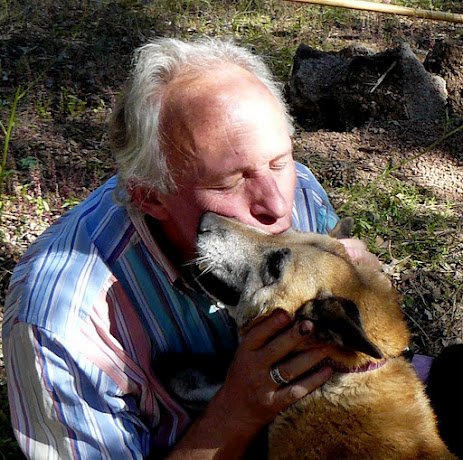
The love between a dog and a human – hugging a dog when one is feeling emotionally vulnerable is beyond measure. Dogs always sense when we humans are feeling fragile and they offer their uncomplicated hearts to us without any condition or need for return. That selfless love is an inspiring example of what we all need to learn to give one another.
Touch and social intimacy – we have so much to learn from dogs when it comes to touch and social intimacy. We are all needy for touch.
Which leads me providentially to a recent item from Terry Hershey. Terry came to Payson in March, 2011 and he was a most inspirational speaker. I have followed him ever since.
Last Monday’s Sabbath Moment included the following story, republished with Terry’s kind permission – the story is all about touch!
Caroline was very sad. Caroline was only six years old and her father had just died. In fact, her father had been assassinated.
Sitting in the back of big black limousine, Caroline Kennedy didn’t quite know what to do with her sadness. On the seat next to her sat her nanny, Maud Shaw, and next to Maud, Caroline’s younger brother John.
Through the windshield Caroline could see her mother, Jackie, and her uncles, Robert and Ted, walking in front of the limousine as it slowly made it’s way down the Boulevard to St. Matthew’s Cathedral. Looking out of her side of the car, Caroline recognized the friendly face of Secret Service agent, Robert Foster. She liked and trusted Robert Foster.
Not knowing what to do with her sadness, and on impulse, she rolled down the window and stuck out her six-year old hand. Agent Foster had a choice to make. Secret Service agents are not allowed to have their hands occupied, needing to be ready for any emergency. But Robert Foster didn’t even think twice. He held Caroline’s hand tightly the entire way to the cathedral.
Later, Agent Foster said it was all he could do to “fight back his own tears of sadness, for little Caroline Kennedy.” When asked about his kindness, he seemed surprised, “All I did was hold a hand,” he answered.
Terry then goes on to say,
We all know sadness. Life breaks for each one of us in different ways and in different places. And sometimes the sadness seems too much to carry.
It requires courage to roll down the window, to connect or ask or invite. For whatever reason, there is a knee-jerk need to deny any sadness, or dismiss it, or apologize for it. “I’m sorry,” people will say, wiping away their tears, as if their sadness is a violation of some tenet of propriety. Heaven forbid if any humanity is exposed.
So sometimes I am afraid to ask. Not sometimes; most times. I don’t want to appear weak. Asking for help is a hard pill to swallow.
I spent Saturday in Clearwater, Florida, with a group talking about intimacy and communication. (Yes, it is easier to talk about than to practice.) Here’s what I told the group.
If we don’t bring it with us, we’re not going to find it there. Which means intimacy–trust, vulnerability, authenticity, honesty–begins here.
With me. With this me.
I was raised in a religious environment that taught me to eradicate my messiness (to quash my sadness or grief or untidiness).
I now believe differently. I now know that we find and express acceptance, love and grace (the place where we can be fully human), in our messy, imperfect, and fully thorny selves. In other words: We can embrace this life–without any need to photoshop it.
To be human is to be vulnerable. I am capable of being wounded and cut and sad… which also means that I am capable of being kind and generous and present.
In such moments of heartache, I can have the courage to ask for a hand to hold.
In such moments of heartache, I can have the courage to hold a hand the needs to be held.
Robert Foster didn’t think twice about holding a hand that needed to be held. And he wasn’t posturing or amassing heavenly brownie points. He was doing what needed to be done.
Here’s the deal: we don’t need more remedies or advice. We need more touch. We become more human when we touch. Why? Because when we touch, we are seen. And when we are seen, we recognize that our value is not tied solely to our sorrow.
And we, you and I, will find no better lesson to learn from our beautiful canine friends, than this lesson of touch.
Sometimes one wonders what happened to common sense!
Today’s Post is motivated by a number of items that have crossed my screen over the last few days which when looked at collectively might remind one of the old saw, “You don’t have to be mad to work here, but it does help!”
Sit with me, metaphorically, and allow me to muse.
First was a recent Post on 350 or bust that included the March 2012 TED Conference in Long Beach, California where NASA climate scientist Dr. James Hansen explains why he must speak out about climate change. (See the video later on.) That Post refers to an item on Martin Lack’s Blog, Lack of Environment, where Martin as well as including the video below also lists the challenges that we on this single, finite planet face. Here is that list,
The Earth’s current energy imbalance is 0.6 Watts per sq.m.; a rate of energy input 20 times greater than the energy output of all human activity; and equivalent to the detonation of 400,000 Hiroshima-type atomic bombs every day.
Since measurements began in 2003, there has been a noticeable acceleration in the annual rate of mass loss from both the Greenland and Antarctica ice caps.
The last time atmospheric CO2 was 390 ppm, sea levels were 15 m higher than they are today, which implies even if we stopped burning all fossil fuels tomorrow, this is where they would end up several centuries from now because the warming “is already in the pipeline” (i.e. because the Earth must warm-up in order to restore its energy balance).
Unless we stop burning fossil fuels soon, sea level rise will continue to accelerate, which is likely to cause between 1 and 5 metre rise by 2100AD (depending on how quickly we now decide to stop burning them).
Palaeoclimatology tells us that 350 ppm is the safe limit for avoiding significant disruption to the planet’s ecological carrying capacity (i.e. in terms of both populations of individual species and overall biodivesity); and it now seems likely that between 20%-50% of all species will be “ticketed for extinction” by the end of the century.
If we had started to get off fossil fuels in 2005, it would have required 3% reduction per year in order to restore energy imbalance by 2100AD. If we start next year, it will require 6% p.a. If we wait 10 years it will require 15% p.a.
Recent droughts in Texas, Oklahoma and New Mexico were 3 Standard Deviations outside the norm. Events such as these cannot therefore be ascribed to natural variability; anthropogenic climate disruption (ACD) is happening just as Hansen said it would 24 years ago (if we did not change course – which we haven’t).
Pursuing emissions limits (i.e. Cap and Trade) will not work because there is no actual incentive to reduce emissions without any self-imposed restraint being to the advantage of others who do not do the same (i.e. the Tragedy of the Commons problem).
Hansen uses the analogy of an approaching asteroid – the longer we wait to prevent it hitting us the harder it becomes to do so.
Do watch that Hansen video,
Second is that yesterday Martin Lack published an item that really does seem to endorse the view that there is no sign of intelligent life living on Planet Earth (not counting dogs!).
Think about it. The planet is warming up. The use of carbon-based fuels is a strong suspect, putting it mildly, of the rising levels of CO2 in our atmosphere, 394.45 on April 5th, so rather than change the incentives for using such fuels, we are taking advantage of this warming planet causing the melt of the Arctic ice cap by allowing Shell to drill for oil in the Arctic. But even crazier than that, Shell have contracted for a Finnish icebreaker to assist them in breaking up the ice! (I really do feel a headache coming on!)
The pristine and beautiful Arctic: Shell wants to exploit it for oil. We want it protected.
Dozens of Greenpeace Nordic activists have boarded and occupied a Shell-contracted icebreaker in Helsinki harbour as it prepares to leave for the Alaskan Arctic.
Drilling in this fragile ecosystem – home to the polar bear, narwhal, Arctic fox and other iconic species – is unacceptable. A spill or accident in these waters would be disastrous and the harsh conditions would make responding to such a disaster almost impossible.
Demand Shell stop their plans to put the fragile Arctic and its biodiversity at risk. We’ll keep you updated on our campaigns.
Write to Mr. Peter Voser.
Mr Peter Voser, Shell
The Arctic isn’t a place you can exploit, it’s a place we have to protect. Time and time again, experts have expressed serious doubts about the possibility of cleaning up an oil spill in the Arctic. The technical challenges posed by drilling there are obvious and no matter how much you try to convince people that your company can operate safely in such a harsh environment, we know the truth.
Because of this, I demand that you scrap your Arctic plans immediately.
Yours sincerely,
————–
By the end of this week we want 500,000 people shouting at Shell that it must end its campaign of Arctic destruction. Click here now. [N.B. This is a time-sensitive campaign response – please visit Greenpeace website and enter your name and email address and they will email Shell on your behalf.]
We can change things! Together we can stop Shell and other oil companies from destroying the Arctic. Not everyone can board a ship to demand that change. But today, you can email Shell and ask them to stop drilling for oil and ask 10 of your friends to do the same. Together, we can save the Arctic!
Rosa Gierens
Greenpeace Nordic activist from Finland.
In closing, luckily there are many voices being raised about putting an end to this madness; see the recent item from Patrice Ayme. Hopefully, all these voices will bring about the changes to the way so many of us are governed. As Patrice commented recently on Learning from Dogs, “Hope is the breathing of the planet“. Maybe, just maybe, hope will win through. No better put than by James Hansen,
Most impressive is the work of the Citizens Climate Lobby, a relatively new, fastgrowing, nonpartisan, nonprofit group with 46 chapters across the United States and Canada. If you want to join the fight to save the planet, to save creation for your grandchildren, there is no more effective step you could take than becoming an active member of this group.”
– Dr. James Hansen, head of Goddard Institute for Space Studies, NASA
Oh, and before I forget, a tornado touched down in Southern France! Not common and not making sense!
Forgive me, dear readers, but something light and simple for today. I don’t mean in the sense of the content, far from it, just easy for me to put the post together as it is from a presentation that I gave a year ago.
Here’s a picture of our solar system.
Most of us are reasonably familiar with this visual concept of our solar system, but what of it’s age? That’s much more difficult to embrace in a way that we can relate to.
So let’s use something to represent the age of our solar system, the distance from Phoenix to Payson.
In round terms, Payson is 80 miles North-East from Phoenix. Put another way, that’s 422,400 feet!
So if those 80 miles represented the age of our solar system, what would be the significant milestones on this metaphorical journey?
Phoenix represents the start, the ‘start’ of our solar system some 4.54 billion years ago
It was 1,075,000,000 years before Blue-green algae appeared. That is the equivalent of travelling 18.94 miles from Phoenix North-East along Highway 87. Or looking back, those algae appeared some 3.465 billion years ago.
But on we travel, metaphorically an unimaginable 3,459,800,000 years after the arrival of Blue-green algae until the next milestone; the earliest hominids. In terms of our Highway that’s a further 60.97 miles. Again, looking back that was 5,200,000 years ago.
The sharp-eyed among you will see that 18.94 miles added to 60.97 miles is 79.91 miles. Goodness that’s awfully close to the total distance of 80 miles between Phoenix and Payson! In fact, the 0.09 miles to run is the equivalent of 484 feet!
So let’s look at those last 484 feet.
The first 465.20 feet represents the approximately 5 million years after the earliest hominids appeared before H. sapiens arrived, some 200,000 years ago.
The appearance of Homo sapiens brings us to just 18.6 feet from Payson.
But first, we travel 9.3 feet and see the arrival of dogs, generally regarded to have separated, in DNA terms, from the Grey Wolf 100,000 years ago.
And are you 60 years old? You were born just 0.0669 inches or 7/100ths of an inch from Payson! If my maths is correct (someone please check!) 0.0669 inches is about 34 times the thickness of the human hair! That’s very close to Payson!
Don’t know about you but it puts the age of our solar system into a perspective one might be able to get one’s arms around.
On the scale used above, one inch represents 895.68 years, one foot the equivalent of 10,748.11 years and a mile represents 56,750,000 years.
Anybody want to hazard a guess as to the state of our planet in one further inch?
The difference an inch makes! 895.68 years!
OK, let me stay more or less on topic and just round things off.
EarthSky website seems to have some great items, including this one.
Ten things you may not know about the solar system
9 ) Pluto is smaller than the USA
The greatest distance across the contiguous United States is nearly 2,900 miles (from Northern California to Maine). By the best current estimates, Pluto is just over 1400 miles across, less than half the width of the U.S. Certainly in size it is much smaller than any major planet, perhaps making it a bit easier to understand why a few years ago it was “demoted” from full planet status. It is now known as a “dwarf planet.”
How far do the stars stretch out into space? And what’s beyond them? In modern times, we built giant telescopes that have allowed us to cast our gaze deep into the universe. Astronomers have been able to look back to near the time of its birth. They’ve reconstructed the course of cosmic history in astonishing detail.
From intensive computer modeling, and myriad close observations, they’ve uncovered important clues to its ongoing evolution. Many now conclude that what we can see, the stars and galaxies that stretch out to the limits of our vision, represent only a small fraction of all there is.
Does the universe go on forever? Where do we fit within it? And how would the great thinkers have wrapped their brains around the far-out ideas on today’s cutting edge?
For those who find infinity hard to grasp, even troubling, you’re not alone. It’s a concept that has long tormented even the best minds.
Over two thousand years ago, the Greek mathematician Pythagoras and his followers saw numerical relationships as the key to understanding the world around them.
But in their investigation of geometric shapes, they discovered that some important ratios could not be expressed in simple numbers.
Take the circumference of a circle to its diameter, called Pi.
Computer scientists recently calculated Pi to 5 trillion digits, confirming what the Greeks learned: there are no repeating patterns and no ending in sight.
The discovery of the so-called irrational numbers like Pi was so disturbing, legend has it, that one member of the Pythagorian cult, Hippassus, was drowned at sea for divulging their existence.
A century later, the philosopher Zeno brought infinity into the open with a series of paradoxes: situations that are true, but strongly counter-intuitive.
In this modern update of one of Zeno’s paradoxes, say you have arrived at an intersection. But you are only allowed to cross the street in increments of half the distance to the other side. So to cross this finite distance, you must take an infinite number of steps.
In math today, it’s a given that you can subdivide any length an infinite number of times, or find an infinity of points along a line.
What made the idea of infinity so troubling to the Greeks is that it clashed with their goal of using numbers to explain the workings of the real world.
To the philosopher Aristotle, a century after Zeno, infinity evoked the formless chaos from which the world was thought to have emerged: a primordial state with no natural laws or limits, devoid of all form and content.
But if the universe is finite, what would happen if a warrior traveled to the edge and tossed a spear? Where would it go?
It would not fly off on an infinite journey, Aristotle said. Rather, it would join the motion of the stars in a crystalline sphere that encircled the Earth. To preserve the idea of a limited universe, Aristotle would craft an historic distinction.
On the one hand, Aristotle pointed to the irrational numbers such as Pi. Each new calculation results in an additional digit, but the final, final number in the string can never be specified. So Aristotle called it “potentially” infinite.
Then there’s the “actually infinite,” like the total number of points or subdivisions along a line. It’s literally uncountable. Aristotle reserved the status of “actually infinite” for the so-called “prime mover” that created the world and is beyond our capacity to understand. This became the basis for what’s called the Cosmological, or First Cause, argument for the existence of God.
Amazing to find that the saying was recorded as far back as 1546 when it is first recorded in John Heywood’s A dialogue conteinyng the nomber in effect of all the prouerbes in the Englishe tongue: “An yll wynde that blowth no man to good, men say.”
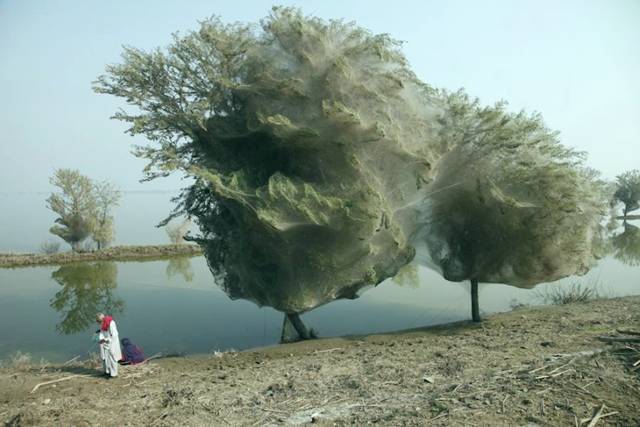
The reason this comes to mind is that good friend, John H. from here in Payson, recently sent me a piece under the title of Spider’s Web. This is how it started,
An unexpected side-effect of the flooding in parts of Pakistan has been
that millions of spiders climbed up into the trees to escape the rising flood
waters.
An unexpected side effect of the 2010 flooding in parts of Sindh, Pakistan, was that millions of spiders climbed up into the trees to escape the rising flood waters; because of the scale of the flooding and the fact that the water took so long to recede, many trees became cocooned in spiderwebs. People in the area had never seen this phenomenon before, but they also reported that there were fewer mosquitoes than they would have expected, given the amount of standing water that was left. Not being bitten by mosquitoes was one small blessing for people that had lost everything in the floods.
(This photo and caption were submitted to the 2011 National Geographic Photo Contest.)
John’s email also included more images, that are reproduced below.
So it looks as though we have much to learn from spiders as well as from dogs!
Or maybe, it’s just another example of the beauty, magic and mystery of nature!
A remarkable story about two very clever men and an equally clever dog!
Five days ago, I received an email from a Richard Hake quite out of the blue! This is what it said,
Dear Paul Handover,
I’m taking the liberty of cc’ing this to Tim Pennings since he may be interested in your blog “Learning from Dogs.”
As founding author of the great blog “Learning from Dogs”, I thought you might be interested in the work of Tim Pennings.
Paraphrasing from the Hope College website:
*~*~*~*~*~*~*~*~*~*~*~*~*~*~*~*~*~*~*~*~*~*
Tim Pennings is a professor of mathematics at Hope College and owner of a famous Welsh Corgi dog, Elvis, who knows calculus. He has given over a hundred talks – including several speaking tours – based on his papers “Do Dogs Know Calculus?” [Pennings (2003)] and “Do Dogs Know Bifurcations?” [Minton & Pennings (2007)]. Articles about Elvis are easily found on Google and Youtube. For example:
1. “A Dog, a Ball, and Calculus” Ivars Peterson’s MathTrek,
2. “Calculating Dogs” Ivars Peterson’s MathTrek ,
3. “Dog Plays Fetch With Calculus” YouTube (see below)
4. “Elvis The Calculus Dog at Roanoke College” Vime0 Videos.
*~*~*~*~*~*~*~*~*~*~*~*~*~*~*~*~*~*~*~*~*~*
Regards,
Richard Hake, Emeritus Professor of Physics, Indiana University
Honorary Member, Curmudgeon Lodge of Deventer, The Netherlands
President, PEdants for Definitive Academic References which Recognize the Invention of the Internet (PEDARRII)
Well what fun!
Let me start with that YouTube video mentioned above:
Tim Pennings of Hope College in Madison, Wisconsin takes a look at the mathematics his dog Elvis uses to play fetch.
And here are a number of wonderful pictures of Elvis from which comes this one:
Elvis: Professor Tim Pennings' dog.
More may be learnt about Tim Pennings from here, from which I quote:
I am a professor of mathematics at Hope College. My areas of research and writing include dynamical systems (the shadowing property in particular), mathematical modeling, and the infinite. I have directed the Mathematics REU Site since 1995 and have mentored research students almost every year since 1990. A complete list of published papers, talks, and other professional activity is included in my vitae.
I have a famous Welsh Corgi dog, Elvis, who knows calculus. Here are some pictures of us. We have given over a hundred talks – including several speaking tours – based on our papers “Do Dogs Know Calculus?” and “Do Dogs Know Bifurcations?” (written with Roland Minton) both published in the The College Mathematics Journal of the MAA. Articles about Elvis are easily found on Google and Youtube.
Finally, the author of the email, Richard Hake, is no slouch! Here’s Richard’s Blog Hake’sEdStuff and information on his academic background.
How lady luck brought joy for a ‘down-and-out’ Londoner and a cat called Bob!
I was chatting with my son yesterday and he happened to mention that perhaps I should write about a cat for a change! Alex mentioned a book recently published in the UK called A Street Cat Named Bob: How One Man and His Cat Found Hope on the Streets.
This is how the book is described on Amazon (UK site),
When James Bowen found an injured, ginger street cat curled up in the hallway of his sheltered accommodation, he had no idea just how much his life was about to change. James was living hand to mouth on the streets of London and the last thing he needed was a pet. Yet James couldn’t resist helping the strikingly intelligent tom cat, whom he quickly christened Bob. He slowly nursed Bob back to health and then sent the cat on his way, imagining he would never see him again. But Bob had other ideas. Soon the two were inseparable and their diverse, comic and occasionally dangerous adventures would transform both their lives, slowly healing the scars of each other’s troubled pasts. A Street Cat Named Bob is a moving and uplifting story that will touch the heart of anyone who reads it.
A quick web search found volumes of material, so let’s start with this video,
The local London newspaper the Islington Tribune wrote this back in 2010,
Two cool cats… the Big Issue seller and a stray called Bob
Inseparable: musician James Bowen with Bob
Down-on-his-luck musician teams up with ‘wonderful loyal friend’ he rescued from streets
Published: 24 September, 2010
by PETER GRUNER
NOT since the legendary Dick Whittington has a man and his cat become such unlikely celebrities on the streets of Islington.
Big Issue seller James Bowen and his docile ginger cat Bob, who go everywhere together, have been attracting comments since they first appeared outside Angel Tube station.
The story of how they met – widely reported in blogs on the internet – is one of such extraordinary pathos that it seems only a matter of time before we get a Hollywood film.
James, 31, who lives off Seven Sisters Road, Holloway, is a musician who has fallen on hard times.
He ekes out a basic living selling the homeless people’s magazine Big Issue at Angel and Covent Garden.
Bob was a stray discovered by James outside his accommodation one day.
The cat was limping after apparently being attacked by another animal, possibly a fox.
After failing to discover the cat’s owner, James took him to the RSPCA hospital at Finsbury Park, which prescribed a course of antibiotics.
“I kept him for two weeks until he was well enough to go on his way,” said James. “But when I opened the front door to let him out Bob wouldn’t move. He seemed to me to be saying: ‘I want to stay with you.’
“Now we go everywhere together. I even have a cat harness when we go out and Bob gets really excited when I show it to him.”
Read the rest of the article here and if you want more information, a web search on Bob the Cat will finds loads more.
It’s a fabulous story with a great message of hope for not just for James and Bob but for all of us that find ourselves ‘up a creek without a paddle’ at points in our lives.
Here’s how the newspaper The Daily Mail wrote about it on their website,
[last half of the story]
But then Bob started following him and it became increasingly difficult to shoo him away, especially as there were dangerous roads to be crossed. One day there was nothing for it but to put Bob on a makeshift lead and take him along. Bob travelled sitting on James’s shoulders.
The trouble was, so many cat-mad passers-by stopped him to stroke the animal that James arrived late at his pitch, secretly cursing Bob for thereby costing him some of his usual £25-a-day takings. He couldn’t have been more wrong.
Within minutes, people who would normally have walked by without giving James a second glance were lingering to make a fuss of the cat sitting sedately in his guitar case, and most made a donation. By the end of the day, he’d racked up more than £60.
It was the beginning of a phenomenon as tourists and commuters befriended Bob and James, many bringing titbits for the cat. People were amazed at how placidly Bob would sit all day, quite happily watching the world go by while James earned a living. Not that it was always without a hitch; on a couple of occasions Bob bolted when startled, leading to a frantic chase through the crowded streets.
Bob’s popularity continued when James switched from busking to selling the Big Issue, the magazine produced and sold by homeless people. This change in direction was part of James’s growing sense of a need to get his life in order, which he puts down to the responsibility of looking after Bob, and the example the cat offered of the possibility of a second chance.
It enabled James to make the final push to end his drug dependency, going through the necessary cold turkey to get off heroin substitutes, and to mend broken contacts with his family. The final result of Bob’s influence came when a literary agent who passed the duo every day and had seen them on YouTube suggested James tell their story in a book. The result is this heart-warming tale with a message of hope that will appeal especially to the many cat obsessives out there.
A discovery of some writing from the past triggers memories.
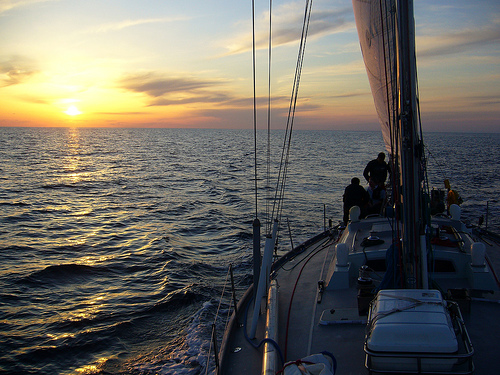
Way back on the 15th November, 2009, I wrote a post about single-handed sailing and how it caused me much disquiet. Rather than just leave you with a link to that reflection, I’m going to include the post again, below. The reason is that a few days ago, in looking through some of my earlier writings in conjunction with a writing group that Jean and I belong to, I came across a piece that I wrote following a solo voyage from Larnaca in Cyprus, west along the Mediterranean Sea and then out over the Atlantic from Gibraltar to Horta on the island of Faial in the Azores. That last leg was a little over 1,100 nautical miles (1,300 land miles) and took me eight days.
So first here’s that earlier post from 2009.
A personal reflection on this rather strange way of travelling!
The recent Post about young Jessica Watson sailing alone around the world raised a few comments but also reminded me of my own experiences of solo sailing.
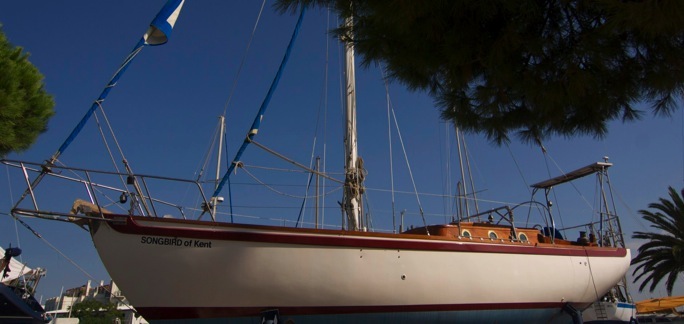
Some years ago, having successfully sold my own IT company, I warmed to the idea of being a full-time yachtie! A second-hand Tradewind 33 was discovered on the Island of Corfu. (Now here’s a surprise! I was just browsing the web looking for a picture of a Tradewind and came across my old yacht currently up for sale. Her name is Songbird of Kent! Picture below.)
Tradewind 33 - Songbird of Kent
Anyway, the deal was done and having sold my house in England I flew out to Corfu to collect Songbird of Kent. Inevitably it was a number of months before the boat was ready to head out into the Mediterranean but in early Spring 1988 it was time to explore the long coastlines of Greece and Turkey.
After a fantastic summer cruising from one idyllic anchorage to another mostly with friends or family on board, it was time to find a winter haven. Many recommended Larnaca Marina in Cyprus. Thus it was late in the summer of 1988 that I said goodbye to friends and set out on my own to cross from Antalya in Turkey to Cyprus and along the South coast of Cyprus to Larnaca, on the SE side of the island.
That sea crossing, a little over 200 nautical miles, was to become a regular solo experience at the start and end of each summer season. Impossible to do in a single day thus it always included a night at sea and rarely, if things didn’t go well with the weather, a couple of nights. I hated it! Maybe it was the sudden transition from coastal sailing to a deep water crossing, often going from having friends on board to being alone, but whatever it was I never enjoyed my time on my own and knew that long-distance solo sailing was never going to be my scene.
Anyway, I ended up spending several very happy winters in Larnaca.
One time, there was news of a Frenchman who had come into Larnaca on his way home to France having nearly completed a circumnavigation of the world. He was on his own!
I was astounded to hear how someone could do this and made a point of calling round to his berth. The boat was a beautiful, solid steel yacht, the very epitome of a craft that could challenge the oceans. The owner’s name was Pierre (it would be!). Pierre invited me aboard and we went down to his saloon to drink a hot coffee – real French coffee!
Inevitably the conversation turned to the challenges of sailing alone. Pierre said that the big cargo ships at sea moved quickly relative to the speed of a yacht so at night he set an alarm for every 15 minutes. That was the time that a ship could go from being hull down over the horizon to being close enough to be a hazard. Thus while at sea Pierre got up briefly every 15 minutes during the night to avoid being run down! It sounded totally exhausting.
Then Pierre asked me about the sailing I had done and whether I had sailed on my own. I declared my trivial journeys back and forth from Cyprus to Turkey and revealed that being on my own made me very, very unhappy. Pierre was surprised to hear that as he admitted that being at sea alone was one of the most tranquil and peaceful experiences ever. Pierre asked how long these solo journeys took. I replied, two or three days.
“Ah!”, he said, “That is the problem.” “I, too, hate the three days. It is always a period where you adjust and it is terrible.“
“My friend, you must find a way to be alone for more than three days. You will see that it is very different.“
It was some years before that opportunity came about but, in the end, I did undertake a solo journey of 8 days. Pierre was right. The first three days were hell, the rest were heaven!
Thank you, Songbird of Kent, you gave me some fabulous memories!
By Paul Handover
Now on to my writings about being out at sea alone on a small yacht.
Being at Sea
Going to sea in a small vessel is a profound experience.
In harbour we build up a reliance on things external. We have no need to worry if there is insufficient food on board, we can plug into the dockside power supply, sleep through the night undisturbed and we can wander off and enjoy the company of others if the boat feels a little claustrophobic.
Then slowly, imperceptibly, but with huge force, arrives the need to move on. The realisation that our cosy life connected to the busy, bustling and self-obsessed world of shoreside is not fulfilling our search for adventure and for the truths that lay over the horizon. It is time to leave.
The act of casting off is always exciting as it heralds a new adventure. But it also carries feelings of loss and apprehension as one lets go of the bonds of a previous certainty. The first few hours are filled with the workload of getting one’s craft shipshape and battened down for the unknown seas. Then gradually comes the realisation that the land is now less the dominating visual feature than the vastness of the seascape that is ahead. But with the land in sight, albeit a distant horizon behind one, you can still sense the life you are leaving.
Now all that surrounds you is the sea. You are now truly disconnected from the land. It is often at this point that despondency and uncertainty play with your mind; after all this new life is still very unfamiliar compared to the warmth of that island home that still resonates in your heart. Time to remind yourself of why you wanted to take this voyage.
A small boat is very fragile. Just a centimetre of hull separating you from the unimaginable depths of the ocean beneath your keel. Not until the end of your voyage, when you draw your boat up, metaphorically on to that beach, will you ever stop feeling how close fate is, how it rides on your shoulder night and day. That, of course, is why we go to sea. It is the place where we taste life, where we savour each moment of the present because the future seems too bound up in the mystery, the uncertainty of the ocean. You are in charge of your tiny craft. Your survival depends on how you manage your small ship, how you navigate these seas, how you read the weather ahead and avoid the storms.
Soon your life on the ocean becomes everything to you. You have time to reflect on so much that is left behind. The distance seems to dissolve all the nuisances, bring into focus all the things that are important to you. There is no certainty with the ocean apart from the knowledge that you are very small and very, very vulnerable and yet, in a sense, also so strong.
In the end, we have to break away from our insecurities and our emotional dependencies on external people and situations because, without that, we are never able to command our own life and the destiny that flows from that captaincy. There is a real strength in knowing ourselves as we would know our own boat. If we really know every spar, sail, rope and fitting, if we have real understanding of the strengths and weaknesses of our small vessel then we are able to know when to breast the waves or when to turn and run before the storm. We are secure that our small craft will protect us day and night.
Thus self-knowledge gives us the same freedom to manage our lives, to know when to fight and when to turn away. And just as after every long voyage the boat will need hours of careful maintenance so our own souls need regular love and caring from our spiritual keeper.
The first picture comes from Merci O. from here in Payson.
Lost for words!
The next two are from the camera of ‘yours truly’.
Tough work being a puppy!
Cleo has settled in so beautifully and we can’t believe that these two weeks have gone so quickly.
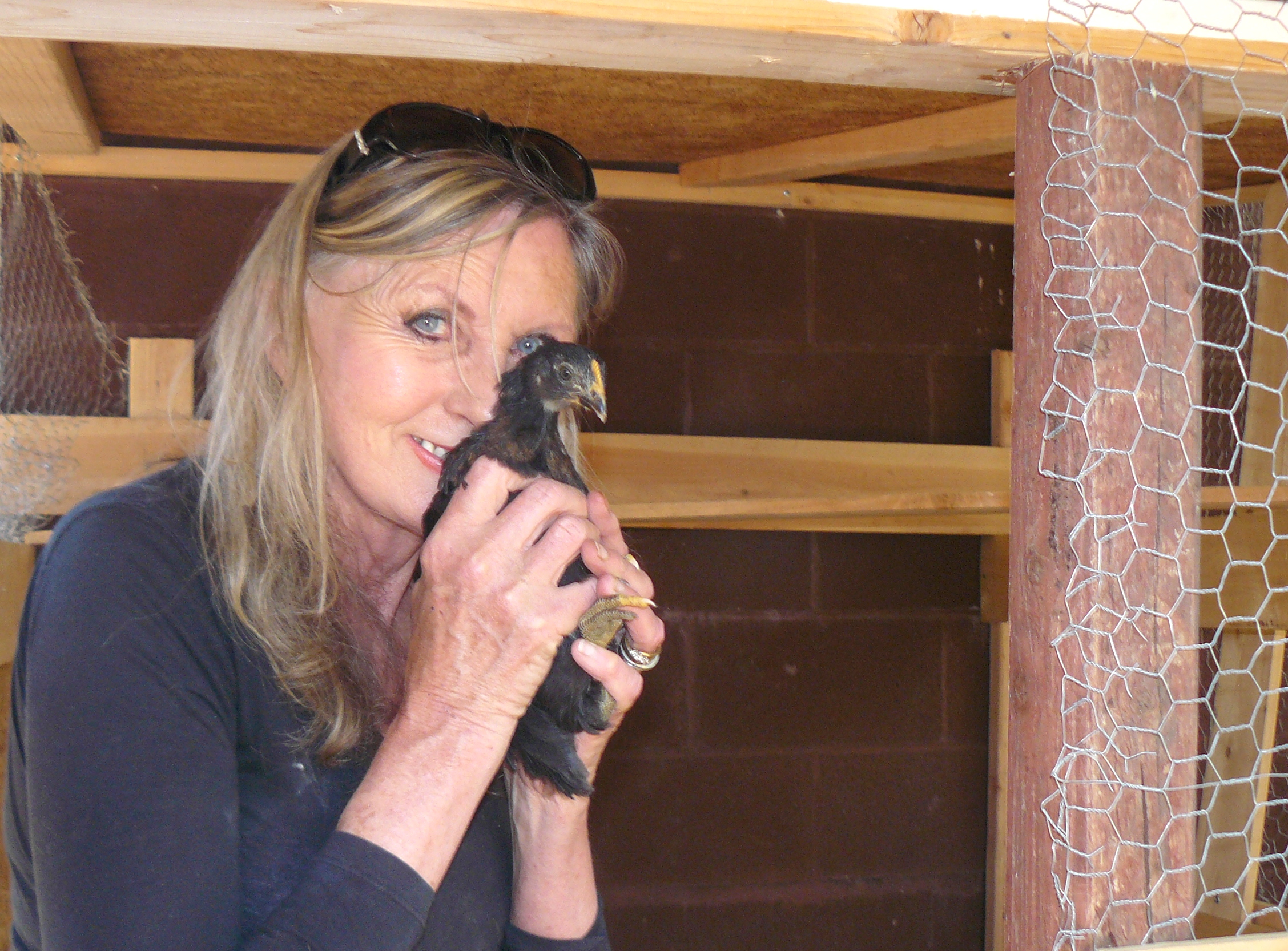
Finally, talking of settling in, our five young chicks have reached the stage where they could be housed outside in their new chicken house, the move taking place just five days ago.
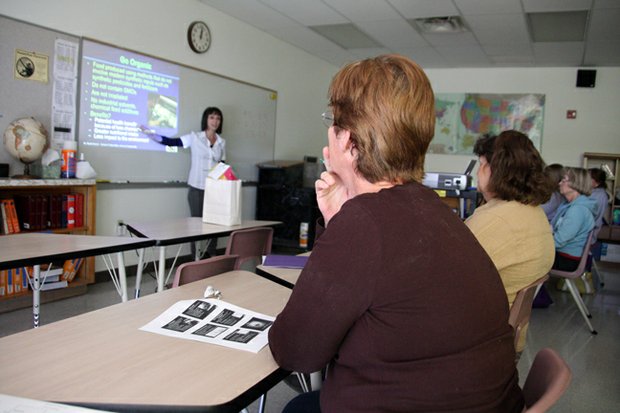
Professor Nicole Darnall, ASU, outlines what can be done.
At home, we subscribe to the Payson Roundup, our local newspaper, and in the April 10th edition there was a full back-page article written by Pete Ayleshire, Editor, about …. well let me quote from the on-line copy,
ASU professor Nicole Darnall taught a session on living a sustainable lifestyle at the Women’s Wellness Forum. Photo by Pete Aleshire.
Save money.
Get healthy.
Save the planet.
Why wait?
That’s the message Arizona State University professor Nicole Darnall delivered recently to a roomful of savvy planet
Prof. Nicole Darnall
huggers at the Women’s Wellness Forum. The daylong event drew about 240 women to listen to speakers on an array of topics.
Darnall offered a gripping presentation that started with global disaster, but ended with a reassuringly doable list of steps individuals can take to solve the seemingly overwhelming problems.
As I wrote at the end of last Friday’s article on Autism and bees, “I hope to publish a summary of a fascinating presentation given to a local women’s group here in Payson that shows the many obvious and easy steps we can all take to revert back to a resilient life on this planet.”
It’s so easy to be overwhelmed by the barrage of ‘doom and gloom’ stories that abound and, make no mistake, if each of us do nothing, the future does look ‘interesting’!
I don’t know about you but the degree of awareness of the changes we all need to make is huge and growing. So Prof. Darnall was right on the button when she spoke to that women’s forum. For instance,
“Livestock generates more greenhouse gases than all the planes, trains and automobiles on the planet,” said Darnall. In part, that’s because the methane from, well, the other end of cows, has 21 times the greenhouse gas warming effect as carbon dioxide.
Darnall’s solution? Meatless Mondays — to start curving that scary trend line.
A few paragraphs later,
The average person generates 4.5 pounds of trash daily. Of that, 75 percent can be recycled — but less than 30 percent actually ends up recycled.
Worse yet, we discard half of the food we produce, which works out to 474 pounds of wasted food per person.
Once again: The answer lies surprisingly close to home.
Start a composting bin: That would reduce discarded trash by about one-third — while increasing the health of your garden, not to mention averting the production of chemical fertilizers.
Then there’s this …..
Quit buying the plastic water bottles that add 25 million items to the waste stream every day. After all, tap water must meet higher health and purity standards than bottled water.
And not forgetting …..
Worried about all the bleach and other chemicals used in household cleaning products? No problem, said Darnall — before offering up a recipe for environmentally friendly scouring involving vinegar and baking soda. You can also ditch the ammonia in the window cleaner, with a mixture of corn starch — great for smudged mirrors and spots in the carpet.
Then this touched the spot for this part of Arizona with this year’s rainfall already far below the 30-year average.
Worried about the reckless use of fresh water, with predictions of longer deeper droughts well established?
Shorter showers can save 150 gallons each time — and a low-flow shower head can save 175 gallons a month. Get rid of the lawn, cut the water bill by 60 percent.
Rounding off by …..
But here’s the kicker, she said — you can save your wallet by saving the planet.
Make your cleaning products and you not only protect streams you also save money.
Change over to LED lights, you not only reduce greenhouse gas emissions — you save money.
Install solar tubes and you reduce greenhouse gases — and save money.
Eat less meat and reduce global warming — and also lose weight.
And heck: You might even make the cows happy.
Delightful close to the article that is Pete Ayleshire all over. (Pete teaches the creative writing class at the local extension college that Jean and I have been attending for two terms.)
It seems to me that one of the many lucky aspects of living in Payson is having the Arizona State University (ASU) School of Sustainability in the area and being able to draw on the expertise of people such as Prof. Darnall.
So look around and see what small steps you can take to make a difference, and start those small changes. As in the words of an old saying from my England days, ‘By the inch, it’s a cinch, by the yard it’s hard!‘