Many of you read the post I called Please help! that came out exactly a week ago. If you were one of those readers you will have read how Dan and I go back 33 years. In many ways we see eye-to-eye but not over mankind’s influence over the climate of our Planet. To be clear, my own view is that we are very close, if not already past, the point of preventing a massive collapse of the biosphere. Dan believes that we are living through possibly the biggest hoax in history.
Dan, however, has been willing to provide evidence that supports his view and has given me permission to reproduce some of his emails to me. That’s generous of him – thanks Dan.
PH – I guess I could write all day and provide numerous scientific papers and positioning that would repudiate a lot of the popular press on “Global Warming” or “Climate Change”, if that is more PC. Read a little from the good Senator below and then I’ll buy you HIS book.
This is all about money and power, not weather. As the Senator points out, when he saw that the “Cap and Trade” bill was shot down, he stopped commenting. Then, more and more regulation from the UN and EPA Agency provoked this new book.
Once again, the science is at best moot and at worst fraudulent. Each of us must make up his own mind. Global climate cooling or heating will continue operating under geological time rules and, oh yeah, the Sun, Oceans and Regional Oscillations contribute a little.
As long as world governments don’t take public money or redistribute public money for their own “climate control” self-interests, I don’t really care. If there was no public money at stake, there would be no controversy.
People will continue to build houses below sea level in New Orleans. Another, bigger hurricane will flood them out again. Apparently, we can’t even stop this kind of nonsense through more legislation and then expensive emergency re-routing of public funds. This is part of the reason that the public sector is broke.
If private agencies wish to donate money to stop the rising seas or just support related studies, tant mieux. Just don’t add yet another set of agencies and regulations as another layer of big government. This only results in an ever higher tax structure and declining standards of living.
Book Description
Publication Date: February 28, 2012
Americans are over-regulated and over-taxed. When regulation escalates, the result is an increase in regulators. In other words, bigger government is required to enforce the greater degree of regulation. Bigger government means bigger budgets and higher taxes. “More” simply doesn’t mean “better.” A perfect example is the entire global warming, climate-change issue, which is an effort to dramatically and hugely increase regulation of each of our lives and business, and to raise our cost of living and taxes. In The Greatest Hoax, Senator James Inhofe will reveal the reasons behind those perpetuating the Hoax of global warming, who is benefitting from the general acceptance of the Hoax and why the premise statements are blatantly and categorically false.
In another couple of emails, Dan wrote,
There are two questions to answer: Whose science do you want to believe and who profits? My source of direction stems from a natural skepticism of big science when big money is involved. One of the definitions of science is that it is never completely understood and new discoveries as well as new methods of collecting data are ever changing. As we know, new evidence pops up everyday. So, to assume that “my science or your science” is irrefutable relevant to global warming, is not “good science”. Taking billions of global dollars out of private enterprise as well as higher public sector tax in order to “change the world- maybe” is irresponsible and dangerous.
Oh yeah, and I forgot, the world’s broke. Ask a Greek plumber or, for that matter, a Greek apparatchik, where global warming fits into his budget decisions……?
Then Dan wrote in another email,
Emotionalism aside, I can’t argue the science issues except by contributing relevant articles by other scientists with opposing views. There are many. I can comment on the political power and self-interest motivations of many proponents and that’s always fun……
Before spending trillions that the world does not have, let’s see if we can get the conversation a little more firmed up….. We need to really find out how sensitive the atmosphere, lithosphere and hydrosphere really are – without assumptions. Pretty hard thing to do even with advanced mainframes, GIGO…..
and then offered the article,
Ten Years After the Warming
February 26th, 2012 by Roy W. Spencer, Ph. D.
The version of global warming theory being pushed by the IPCC is that anthropogenic emissions of greenhouse gases are causing a radiative energy imbalance of the climate system, leading to warming.
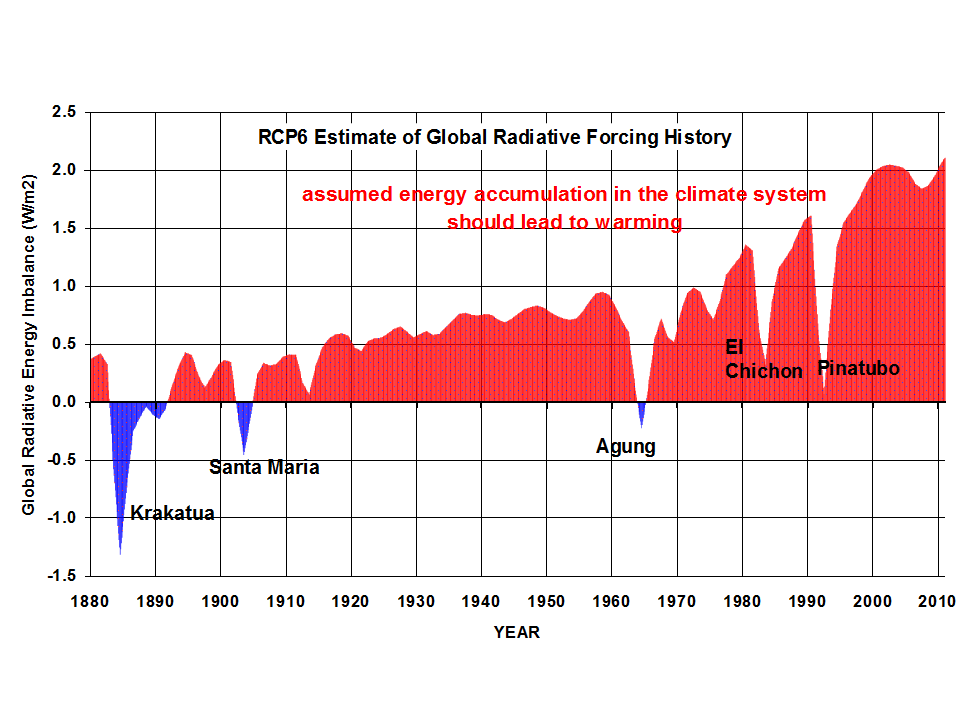
The radiative forcing history being used in the latest IPCC climate models looks something like the following, with red areas representing times when the climate system’s “stove is turned up”, that is, with heat accumulating in the system.
(Actually, the correct analogy would be that the stove setting remains the same, but the lid partially covering the pot is covering it a little more over time…but that’s too hard to explain.)
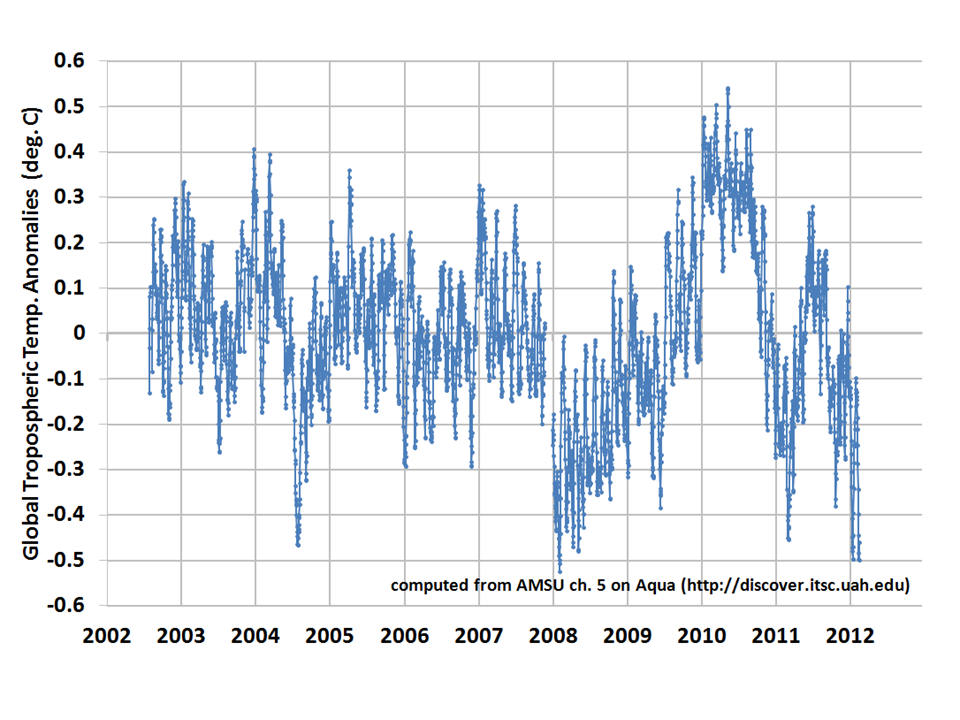
As can be seen, in the last 10 years the estimated forcing has been the strongest. Yet, most if not all temperature datasets show little or no global-average warming recently, either in the atmosphere, at the surface, or in the upper 700 meters of the ocean. For example, here are the tropospheric temperatures up though a few days ago:
So what is happening? You cannot simply say a lack of warming in 10 years is not that unusual, and that there have been previous 10-year periods without warming, too. No, we are supposedly in uncharted territory with a maximum in radiative forcing of the climate system. One cannot compare on an equal basis the last 10 years with any previous decades without warming.
There are 5 possibilities for the recent cessation of warming which are most discussed:
1) cooling from anthropogenic aerosols has been cancelling out warming from more greenhouse gases
2) natural cooling from internal climate fluctuations or the sun is cancelling out the GHG warming
3) increased ocean mixing is causing the extra energy to be distributed into the deep ocean
4) the temperature ’sensitivity’ of the climate system is not as large as the IPCC assumes.
5) there is something fundamentally wrong with the GHG warming theoryitself
Of course, some combination of the above 5 explanations is also possible.
The 1st possibility (aerosol cooling is cancelling out GHG forcing) is one of the more popular explanations with the climate modelers, and especially with NASA’s James Hansen. The uncertain strength (and even sign) of aerosol forcing allows the climate modelers to use aerosols as a tuning knob (aka fudge factor) in making their models produce warming more-or-less consistent with past observations. Using an assumed large aerosol cooling to cancel out the GHG warming allows the modelers to retain high climate sensitivity, and thus the fear of strong future warming if those aerosols ever dissipate.
The 2nd possibility (natural cooling) is a much less desirable explanation for the IPCC crowd because it opens the door to Mother Nature having as much or more influence on the climate system than do humans. We can’t have that, you know. Then you would have to consider the possibility that most of the warming in the last 50 years was natural, too. Goodbye, AGW funding.
The 3rd possibility (increased ocean mixing) is one of the more legitimate possibilities, at least theoretically. It’s popular with NCAR’s Kevin Trenberth. But one would need more observational evidence this is happening before embracing the idea. Unfortunately, how vertical mixing in the ocean naturally varies over time is poorly understood; the different IPCC models have widely varying strengths of mixing, and so ocean mixing is a huge wild card in the global warming debate, as is aerosol cooling. I believe much of past climate change on time scales of decades to many centuries might be due to such variations in ocean mixing, along with their likely influence on global cloud cover changing the amount of solar input into the climate system.
The 4th possibility (the climate system is relatively insensitive to forcing) is the top contender in the opinion of myself, Dick Lindzen, and a few other climate researchers who work in this field.
The 5th possibility (increasing GHGs don’t really cause warming) is total anathema to the IPCC. Without GHG warming, the whole AGW movement collapses. This kind of scientific finding would normally be Nobel Prize territory…except that the Nobel Prize has become more of a socio-political award in recent years, with only politically correct recipients. The self-flagellating elites don’t like the idea humans might not be destroying the Earth.
The longer we go without significant warming, the more obvious it will become that there is something seriously wrong with current AGW theory. I don’t think there is a certain number of years – 5, 10, 20, etc. – which will disprove the science of AGW….unless the climate system cools for the next 10 years. Eek! But I personally doubt that will happen.
As long as strong warming does not resume, the heat-hiding-in-the-deep-ocean explanation will provide refuge for many years to come, and will be difficult to convincingly rule out as an explanation since it takes so long for the deep ocean to warm by even a tiny amount.
Instead, there probably will be a tipping point (sooner than later) in popular perception when the public and Congress decide the jig is up, and they are no longer interested in hearing how we ‘might’ be headed for Armageddon.
The public already knows how awful scientists are at forecasting the future…especially a future of doom, which curiously seems to be the only future scientists know how to predict.
Now the challenge in this Post is not to make it so long that it becomes tiresome on the eyes, irrespective of the content.
So I’m going to leave it at this point and, perhaps, next time include some of Dan’s other points and comments in the light of how readers respond to this Post.
Ginger I. who works at the Payson branch of the Humane Society of Central Arizona recently sent me the following video on the magic of a flock of starlings. It’s … well, you watch it and fill in the rest of the sentence; I ran out of words.
A short film that follows the journey of two girls in a canoe on the River Shannon and how they stumble across one of nature’s greatest phenomenons; a murmuration of starlings.
A murmuration is a…
/merr’meuh ray”sheuhn/, n.
1. an act or instance of murmuring.
2. a flock of starlings.
Ginger also included the following in her email,
A mystery of nature:
No one knows why they do it. Yet each fall, thousands of starlings dance in the twilight above England and Scotland. The birds gather in shape-shifting flocks called murmurations, having migrated in the millions from Russia and Scandinavia to escape winter’s frigid bite.
Scientists aren’t sure how they do it, either. The starlings’ murmurations are manifestations of swarm intelligence, which in different contexts is practised by schools of fish, swarms of bees and colonies of ants. As far as I am aware, even complex algorithmic models haven’t yet explained the starlings’ aerobatics, which rely on the tiny birds’ quicksilver reaction time of under 100 milliseconds to avoid aerial collisions—and predators—in the giant flock.
Despite their tour de force in the dusky sky, starlings have declined significantly in the UK in recent years, perhaps because of a decline in suitable nesting sites. The birds still roost in several of Britain’s rural pastures, however, settling down to sleep (and chatter) after their evening ballet.
Two young ladies were out for a late afternoon canoe ride and fortunately one of them remembered to bring her video camera. What they saw was a wonderful murmuration display, caught in the short video above. Watch the variation of colour and intensity of the patterns that the birds make in close proximity to one other.
I also quickly found a second video on YouTube that seemed worthy of including in this Post.
This astonishing sequence was filmed by wild life cameraman and travel journalist Dylan Winter who is currently sailing around the UK in an 18 foot boat. You can follow his journey and see more of his work at www.keepturningleft.co.uk.
Now I know that as I get older I seem to be turning into an emotional mess! But a very happy mess! I mention this because both films had me in tears. Why? Not really sure. But I sense that when one looks at such beauty, such real pure magical beauty, and then reflects on the stupidity, greed and shortsightedness of mankind the contrast is almost too much to handle!
A plea to those who understand climate science so much better than I do!
Background to this Post.
Among my friends, two go way back. One of them, Dan Gomez, a lively, ebullient Californian, was indirectly responsible for me and Jean meeting in Mexico back on December 17th, 2007. I first met Dan at a dealers’ conference in Boston way back in the early days of Commodore Computers. That was the Spring of 1979 and I had flown to Boston as the owner of the 8th Commodore Computer dealership to be appointed in the UK, based in Colchester, Essex. Later, I became the global distributor of an English word processing program known as Wordcraft, written by Pete Dowson in the UK, and appointed Dan as my US West Coast Wordcraft distributor. It gave me a wonderful reason to come out to Southern California several times a year; on business, of course!
Dan and I therefore go back 33 years! Dan’s sister Suzann has a house down in San Carlos, Mexico. Suzann invited me out to Mexico for Christmas 2007 which is where I first met Jean and, bingo, Jean and I then fell in love with each other! How life flows! (Two years ago yesterday, Jean and I moved into our house in Payson with our, then, 13 dogs and 6 cats!)
Paul & Dan Jan. 15th 2008
OK, to the Post!
Dan has been a climate change skeptic, as in caused by man, for many years. Regular readers of Learning from Dogs will know I see things very differently. But Dan and I agree fundamentally on getting to the truth. This Blog proudly claims to seek “The underlying theme of Learning from Dogs is about truth, integrity, honesty and trust in every way.”
So when the other day Dan sent me a number of links supporting his view that “My point remains that climate change is an enormous, complex process that no computer model is going to predict and no human activity modify significantly. Big money is now at stake here and as the article shows, even trusted scientists will produce fraudulent information to further their goals as well as fill politician’s coffers.” I found my faith in my own views slighted dented. Dan is a smart guy, a good thinker and not beholden to any firm or organisation with a vested interest in denying anthropogenic global warming.
IPCC Scientist Admits Fake Data Used To Pressure World Leaders
A scientist responsible for a key 2007 United Nations Intergovernmental Panel on Climate Change report warning Himalayan glaciers would be completely melted by 2035 has admitted that the claim was made to put political pressure on world leaders.
Such was revealed by the British Daily Mail Sunday in an article destined to further reduce the credibility of the world’s so-called leading authority on manmade global warming.
As NewsBusters reported Saturday, the IPCC acknowledged earlier this week that its claim concerning these glaciers was based on junk science.
Anthropogenic (Human Caused) Global Warming – Is This The Greatest Scientific Myth of our Generation?”
January 25th, 2012, Portland, Oregon
First Speaker – Gordon Fulks, PhD Physics, University of Chicago
[Extract]
Dr. Fulks said: “My thesis tonight is simple: virtually ALL of what climate alarmists put forth as science is not. Some is half correct, some is incorrect, and too much is just plain nonsense or worse.”
This led him into what he called “one of the central problems with Anthropogenic Global Warming,” “the integrity of the data.” He discussed a variety of temperature data from land surface data that shows various manipulations and biases to the best global data from NASA satellites to the excellent ice core temperature proxies going back 450,000 years.
Second Speaker – Chuck Wiese, Meteorologist – Oregon State University
[Extract]
Mr. Wiese finished his presentation with the following conclusions:
1. There is nothing in the REAL atmospheric record that supports the recent temperature rise of the last century to carbon dioxide induced anthropogenic warming.
2. The tropospheric water vapor optical depth is remarkably stable but has declined recently over the last 70 years of record as carbon dioxide rose substantially in the atmosphere during the same period. This is a consistent outcome as expected by the first principle founding physics and inconsistent with atmospheric climate models.
3. Without water vapor acting as a positive feedback ( growth pattern ) to increasing carbon dioxide concentrations, the projected radiative forcing on the earth’s surface is but a grossly exaggerated calculation of what the earth’s temperature will actually do in response to carbon dioxide.
4. The earth’s “greenhouse effect” is NOT controlled by atmospheric carbon dioxide. It is modulated and governed by atmospheric water vapor and clouds, where the warming modulation is controlled by the amount of vapor and optical depth. Clouds with the hydrological cycle act to trim out water vapor into a hydrostatic, convective equilibrium. The stable atmospheric optical depth likes the earth mean temperature of 59 deg F without further solar or planetary modulation.
5. The Anthropogenic warming hypothesis by atmospheric CO2 is falsified by the real record and radiation physics.
Third Speaker – George Taylor, former Oregon State Climatologist
[Extract]
His presentation finished with his conclusions:
1. Human activities DO affect climate, in a variety of ways. Greenhouse gases are just one parameter.
2. Natural variations affect climate. I believe that they have been more significant influences on climate because they do a much better job of explaining observed variations.
3. Effects of future changes in CO2 are likely to be modest and manageable.
4. Many aspects of climate remain poorly understood.
The full transcripts and supporting materials may be seen here.
Then, in stark contrast, this week’s edition of The Economist has a leader about the problem of overfishing. “Of all the sea’s many problems, overfishing should be the most fixable. ” What jumped off the page at me was how that leader article started,
ACIDIFICATION, warming, the destruction of coral reefs: the biggest problems facing the sea are as vast, deep and seemingly intractable as the oceans themselves. So long as the world fails to cut its emissions of greenhouse gases, cause of the global warming behind these troubles, they will grow.
So a newspaper of the standing of The Economist is clear, “So long as the world fails to cut its emissions of greenhouse gases, cause of the global warming behind these troubles”
So if, dear reader, you can offer good supporting evidence as to why the Oregon Chapter of the American Meteorological Society seems to contradict what so many now believe, that mankind is changing the Earth’s climate, please comment or, better still, consider writing a guest post.
As I mentioned on February 14th, Jean and I are attending a creative writing class at our local extension college and on that day I published a story from me called Messages from the Night. Now it’s Jean’s turn.
The Kiss
by
Jean Handover
She sat at the end of the bar. Her misery was palpable. An invisible shroud that hunched her shoulders and bent her head over the glass of wine. She peered into the pale liquid like it were a pool to drown in.
She was pretty in a faded way. Trying hard; skirt a little too short, blouse a little too low and blood red lipstick. Dark for a pinched mouth. A slim body the way I liked it! All around were drunken revellers whilst she remained in a bubble. I wanted to take her in my arms and crush her to my body and burst that bubble.
Hoisting my beer, I ambled to the stool beside her. She didn’t stir. Seemed unaware of my presence. I looked at our reflections in the mirror opposite. Then at Rose the barmaid. Rose of the buzzcut and tattoos. The tattoo on her neck. Then a small voice, “Why would anyone have lips tattooed on their neck?”
“Guess that’s where Rose likes to be kissed,” I said, taking a gulp of my beer and casting a glance in her direction.
“Yeah, that is a nice place for a kiss.”
She turned and a small smile twitched her lips. “I shouldn’t have come here. I’m not used to this scene,” she said.
“How long have you been divorced?” I asked.
“How can you tell I’m divorced?” she replied.
“Your ring finger has a wide indent.”
She fanned her fingers and looked. “Dead giveaway, isn’t it,” she wanely replied.
“What happened?” I asked.
“He came home one night and said he’d found someone else!”
“Younger woman?” I asked.
“No worse, a younger man!”
“Oops!” I said.
She swivelled in the stool and faced the crowd. The shroud was slipping perceptively. I finished my beer and beckoned for Rose to bring us another round. The divorcee was prettier that I thought at first. Her hand pushed a lock of hair behind an ear and trailed down her neck, then smoothing her skirt rested on a rounded knee. A fluid sensuous motion. I wanted to touch that hand.
“Oh God, no,” she gasped. Eyes large and face suddenly flushed. “It’s him with the boyfriend. They’ve just come in.”
“Don’t worry, Babe. Let’s just walk right past and get out of here.”
I took her hand and as we strolled past the two men I gently leaned over and kissed her on the neck. On the same place as Rose’s tattoo.
My lips lingered and with my arm around her waist, we drifted out into the night.
About a week ago, via the blogsite Paleo Works, a couple of comments brought me into contact with Amy. Of course being an Englishman any woman with the name of Amy Johnson is going to cause a double-take on the name. This Amy shared the same name as the English pioneering aviator Amy Johnson, albeit from an earlier era, the aviator that is!
An exchange of emails between Amy and myself revealed an experience that Amy had when she was very young, and I asked Amy if she would like to write a guest post. This, then, is Amy’s story about overcoming a fear of dogs.
Amy J.
I have a cousin who is about the same age as me. My cousin’s mom, my aunt, used to babysit me and the dog in question, a big female, reddish golden retriever was always around and like any retriever was a loving, and lovable, happy-go-lucky dog.
The event goes back to when both my cousin and I were about four-years-old, maybe just five. For some inexplicable reason the dog attacked my cousin. I grew up believing the dog may have been frightened, startled, but I don’t think it was provoked. Certainly, the dog didn’t have any history of biting.
Anyway, that attack on my cousin caused a ton of stitches, 15 or 17, and scarred us both. Physical scars for my cousin and emotional scars for me. As an aside, I don’t remember the dog ever being around again so am fairly confident the dog was put to sleep.
Thus ever since that event, I’ve moved through life with this crippling fear of dogs. Throughout the remainder of my childhood and into my teen years I masked my fear pretending not to be afraid of dogs. It seemed like the whole world loved dogs, and my fear made me feel oddly isolated.
Of course, dogs always sensed my fear and they would usually bark like crazy around me – or jump. I ended up equating dog barking as screaming or yelling, and it was quite disturbing. I would tense up frozen in fear.
Dogs, like humans, come with all kinds of personalities, from one extreme where they are so calm and laid back you wonder whether they even have a pulse to the another extreme of being so ferocious sounding with snarly barky faces and totally tensed bodies.
When a dog was approaching me on the sidewalk, just minding his own business and ignoring me, I would walk far away into the street or grass to be at a safe distance. I avoided dogs at all costs, because like any human, I tried my best to avoid negative emotions; anxiety, fear, worry.
Thus I avoided dogs my whole life, that is, until my niece Emma came into the world. Emma loves dogs, all dogs. Barky dogs, jumpy dogs, big dogs, little dogs, scrappy dogs, arrogant dogs. If you had a dog, Emma would literally stalk you until you allowed her to pet and offer love to your dog.
Barking and jumping dogs never ever deterred Emma; she lights up with love and openness to all dogs. And via her openness and pure love, compassion and joy for dogs Emma has helped me understand that most dogs are a-ok. They aren’t barking screaming, they are barking excitement! They aren’t jumping to chomp my cheek, they are jumping to lick my lips – eewww, but oh what a light bulb that was turned on in me! I feel immense gratitude for Emma helping me move beyond this debilitating fear and for me being open to accepting her help.
It is so true that we can learn from dogs, indeed we can learn from everyone and everything, if we are open to learning and absorbing new information, open to reflection and inner stillness, open to course-corrections along our way.
Thank you Amy, I have no doubt that will reach out to many readers.
Today’s Post was prompted by a recent email, here it is in full,
Dear Brian et al,
I know it’s really tough, but we have to figure out a way to take the message of the Steady State Economy viral.
We HAVE to.
Every time I look at who has signed the petition at www.steadystate.org, I am inspired, because the signers come from all over the world. But two or three a day?
Certainly, I’m not telling you anything you don’t know. I’ve tried on my own, and when I talk to folks one-on-one, they often enthusiastically sign, but they don’t “pay it forward.”>What can we do together to break through this wall of apathy?
Very best regards,
Carla Rautenberg
Cleveland, Ohio
I was one of the 8 addressees, for reasons that I am not really sure about. But it doesn’t matter. Here are my thoughts.
There is no doubt in my mind that the present course of mankind on this planet is not sustainable. There is much on Learning from Dogs from my ‘pen’ and others that supports that view. As Carla writes, when one speaks to others, the majority seem to share that view.
So what is it about change that is so difficult? Well, I’m not competent to give a reliable answer to that but a web search on change delivers yards of material and even more quotations. Just as a random example, here is a website that offers ‘The 45 Most Inspiring Quotes on Change.‘ But do you know what? There’s only one which, to my mind, hits at the real heart of change. It was this one,
“All great changes are preceded by chaos.” -Deepak Chopra
Last week I published a short story that ended,
The message from the night, as clear as the rays of this new day’s sun, the message to pass to all those he loved. If you don’t get lost, there’s a chance you may never be found.
‘Chaos’, ‘getting lost’ are expressions of, to use a relatively modern phrase, ‘tipping points’ ! It seems to me that real motivation to change can only come when one’s present world is falling apart in spades.
Then, and only then, those that offer clear ways forward will be held up as saviours.
So there’s my thought for the day! And if any of you wonderful readers have further thoughts and contributions, please offer them as comments. Big thank-you.
A wonderful enlightened approach to the challenges facing our beautiful planet.
Rob Hopkins is a remarkable fellow. In so many ways he is the most unlikely person to have kicked off almost single-handedly, a gathering world-wide revolution.
I am as guilty as the next person in promoting ‘doom and gloom’ when it comes to what mankind is doing to this planet. I devoted a couple of thousand words to that theme in a guest sermon that appeared on Learning from Dogs a week ago. That’s not to say that unless mankind, in the millions, changes in significant ways then avoiding a catastrophy to our species, and many others, is going to be hugely difficult.
But motivating us all to change is far better undertaken from a position of positive guidance and inspiration, than out of fear!
So when Jean and I listened to a recent BBC radio broadcast by Rob as part of the BBC Radio 4 Four Thought series we were blown away by the guidance and inspiration that Rob presented.
It’s 15 minutes of hope, and you too can listen to it from anywhere in the world by going here or by going here.
This is how the BBC introduces the programme,
Rob Hopkins, co-founder of the Transition Culture movement, believes that “engaged optimism” is the best way to face the global challenges of the future, be it climate change, oil supplies running out or the economic downturn. He believes initiatives enabling people to produce their own goods and services locally – from solar powered bottled beer to micro currencies like the Brixton pound – are the best way to build community resilience. Four Thought is a series of talks in which speakers give a personal viewpoint recorded in front of an audience at the RSA in London.
Producer: Sheila Cook.
So do listen to the programme and then click across to the Transition Culture website where Rob has posted a transcript of his talk. Please, whatever your plans today find time to listen to the programme and read the transcript. Here’s how Rob closes his talk,
I often end talks I give with Arundhati Roy’s quote “another world is not only possible, she is on her way. On a quiet day I can hear her breathing”. I think we might adapt her quote, so that, in the context of this bottom-up drive for more resilient communities, communities better prepared for uncertain times, it is not only a case of hearing another world breathing, but being able to see her around us, already setting up local businesses, reviving her local economy, setting up bakeries, breweries, food hubs, mentoring scores of young people with business ideas, attracting inward social investment finance, creating the models whereby people can invest in their communities and see them being strengthened and supported.
That’s why I get out of bed in the morning, because I feel that the potential in our getting this right is so exquisite that it’s all I can do, and because the grim predictability of what will happen if we do nothing is just unthinkable, especially in relation to the challenge of climate change. If we are able to turn things around on the scale we need to turn them around on, to replace vulnerability, carbon intensity and fragility with resilience, it will be an achievement our children will tell tales about, sing songs about. I hope I am there to hear them. Thank you.
This is in response to the item that I republished last Thursday, originally on Nakib’s blogsite, Freedom to Survive. Do visit it. Marcia in response sent in the following poem.
The Onlooker
He stood across the street and sadly saw
The little match girl standing in the rain;
She looked as if she didn’t have a prayer.
He wondered why there wasn’t yet a law
To spare her from unnecessary pain,
And how could people just walk by her there?
He raised his head toward Heav’n in awe and fear
And let the raindrops hit his youthful face,
While speaking toward the softly weeping sky,
“Dear God, why haven’t you done something here?
“I have the faith that You’re nearby some place,
“But there’s no sign that you’ve been helping; why?”
Then God replied, “I have…it’s nothing new;
“For such a purpose I created you.”
Thank you, Marcia.
When I see how this new, virtual world connects us across the world with so many others that know what is truly important, I do have hope for the future.
As many of you will appreciate, this has been a bit of a week. It started last Sunday with my contribution to the national ‘preach-in’ for the health of our planet, and ended with the sad loss of Phoebe. I normally post something light-hearted or trivial for the week-end but seem to be in a more reflective mood just now (Friday).
For some time I have subscribed to the weekly spiritual offering from Terry Hershey and am going to republish a story that came out from Terry Hershey on the 13th.
Letting go and walking
February 13, 2012
Some of us think holding on makes us strong, but sometimes it is letting go. Herman Hesse.
Uncertainty is the only certainty there is, and knowing how to live with insecurity is the only security. John Allen Paulos
When you let go of trying to get more of what you don’t really need, it frees up oceans of energy to make a difference with what you have. Lynne Twist
And now the story,
There is a Tibetan story about an earnest young man seeking enlightenment. (Earnest people must think this quite unfair–since they play a central role in most parables and stories about enlightenment.)
A famous sage passes through the man’s village. The man asks the sage to teach him the art of meditation. The sage agrees. He tells the man, “Withdraw from the world. Mediate every day in the specific way I will teach you. Do not waver and you will attain enlightenment.”
The earnest man follows the sage’s instructions to the letter. Time passes–and no enlightenment. Two years, five, ten, twenty pass.
It happens that the sage once again passes through the man’s village. The man seeks him out, grumbling that despite his best intentions and devotion and diligent efforts, he does not achieve enlightenment. “Why?”
The sage asks, “What type of meditation did I teach you?”
The man tells him.
The sage says, “Oh, what a terrible mistake I made! That is not the right meditation for you. You should have done another kind altogether. Too bad, for now it is too late.”
Disconsolate, the man returns to his cave. Staking his life on the sage’s instructions, and now believing he is without hope, the man abandons all his wishes and efforts and need to control his road to enlightenment. He does not know what to do. So, he does what knows best: he begins meditating. And in a short while, much to his astonishment, his confusion begins to dissolve, and his inner world comes to life. A weight falls away and he feels lighter, and regenerated. When he walks out of the cave, the sky is bluer, the snow capped mountains whiter, and the world around him more vivid.
There is no doubt that all too often, our efforts–to succeed or achieve or attain–get in the way of our living. It brings to mind my favorite Robert Capon quote, “We live life like ill-taught piano students. So inculcated with the flub that will get us in dutch, we don’t hear the music, we only play the right notes.”
I understand. I was weaned on a spirituality that predicated itself on artifice. In other words, the importance is placed upon appearance, rather that just being. (It was vital to “look spiritual.” Which begs the question, “What do spiritual people look like?” As a boy, I always thought the “spiritual people” looked as if some part of their clothing was a size too small.)
What is it we are holding on to–so rigid, so firm, white-knuckled in our determination? At some point, we’ve got to breathe. Just breathe. Without realizing it (and after the sage’s disheartening news), the man in the story “let go.”
He let go of the need to see life as a problem to be solved.
He let go of the need to have the correct answers (or experiences) for his “enlightenment.”
He let go of the need to see his spiritual life in terms of a formula.
He let go of the restraints that come from public opinion.
Abandon your masterpiece, sink into the real masterpiece. Leonard Cohen
Without realizing it, he took Leonard Cohen’s advice. He abandoned his “masterpiece”–the perception of what he needed to accomplish, or how he needed to appear, or what he needed to feel–in order to allow himself to sink down into this life, this moment, even with all of its uncertainty and insecurity.
So a big thank you to Terry Hershey for those words of wisdom.





 Learning from Dogs