Examples like this, of the love and compassion seen in our animals, seem to be doubly valuable in these crazy times.
Published on Apr 30, 2015
Lilo the Siberian husky is a wonderful surrogate to our new foster, little Rosie❤️ Rosie was really lethargic and unresponsive after the first night. So we decided to let her cuddle extensively with Lilo (the husky). Lilo has always had an innate motherly instinct, but she really surprised us when she went full surrogate mode! Even letting Rosie suckle on her and stimulating her to eliminate! Lilo has never had puppies of her own, and never will. But motherhood may just be her calling 🙂 Like what you see? 🙂 LOOK BELOW!
Note: Let me declare immediately that I have a personal interest in this post. Namely that my daughter, Maija Handover, is a partner of the charitable company SOUND UK. Their most recent sound adventure is extremely interesting.
Sonic Journeys are soundtracks to specific journeys. Each commissioned piece is available as a free download for limited periods, enabling listeners to experience the music travelling through the landscape that inspired it. Or wherever they choose.
Let me allow Sonic Journeys to explain in their words what it is about:
Sonic Journeys is a series of soundtracks to specific journeys. The series commissions artists to create new works in response to journeys that inspire them. These works are recorded and available for free download for a limited period, enabling listeners to experience the music travelling through the landscape that inspired it. Previous commissions include Adrian Utley from Portishead (2012, a walk through ancient trees at National Trust’s Croft Castle & Parkland), Mica Levi (2011, a walk at Barbican Centre), Shackleton & Vengeance Tenfold (2011, two train journeys in Devon), Will Gregory from Goldfrapp (2009, a walk in Malvern Hills for Big Chill festival).
For those that would like to create and share their own Sonic Journey, we are inviting online submissions of music, or music and video, to journeys the public find personally inspiring here. Previous Your Sonic Journeys have included music to journeys in Kew Gardens in London, Bregenz in Austria, South Western Transylvania and more.
Here’s an example of one of those commissioned journeys, from my old home county of Devon. It is called Shackleton + Vengeance Tenfold – South Devon, stopping train from Starcross → Teignmouth and the Field Notes explain:
Unique British bass producer Shackleton collaborated with his original musical partner, spoken word artist Vengeance Tenfold, to present his own distinctive vision of a journey through some very special parts of Devon; the main railway line between Exeter and Totnes, and part of the Tarka railway line between Exeter and Barnstaple.
Travelling from Exeter to Newton Abbot, in South Devon the artists respond to the iconic stretch of railway as the stopping train travels through the Exe estuary from Starcross station and journeys along the sea and wonderfully dramatic scenery.
Earl Fontainelle a.k.a. Vengeance Tenfold lives on Dartmoor in Devon. He plays in the Amsterdam-based Cajun deathcountry band Earl Fontainelle and the Pearl of Great Price and has worked in many other musical and lyrical projects, including a long-term collaborative relationship with Shackleton with whom he worked together on a live performance alongside the Tom Dale Dance Company involving spoken word, live electronic music, a Siberian Jew’s harp, and a lantern.
This link will allow you to listen to the Sonic Journey. To give those unfamiliar with this part of Devon, South-West England here’s a video of that train journey.
Published on Sep 17, 2013
Here I have some footage of a famous scenic coastal main line railway route that runs from Teignmouth via Dawlish to Starcross in South Devon. It is used by both long distance and local train services currently operated by First Great Western and Cross Country that runs from Cornwall and Plymouth to all points north and east.
I know I’m biased but it still strikes me as one incredibly innovative idea! Well done, the team!
If you had to make a playlist of your life, what would be on it?
That intriguing sub-title comes from a video that Jean and I watched a couple of weeks ago.
But first I want to return to the matter of Parkinson’s Disease (PD) that was written about in a post dated the 24th February Personal Journeys. I wrote, in part,
Sue, and everyone else, we returned from seeing Dr. Lee, the neurologist, a little under two hours ago. Dr. Lee’s prognosis is that Jean is showing the very early signs of Parkinson’s disease, and Jean is comfortable with me mentioning this.
Everyone’s love and affection has meant more than you can imagine. I will write more about this next week once we have given the situation a few ‘coatings of thought’.
Jean sends her love to you all!
In recent weeks Jean has been experiencing increasing feelings of apathy, lack of motivation, lack of energy, all of which she summed up as a feeling of isolation. Plus the tremor in her hand has been slowly worsening.
Last week we decided that rather than waiting until August for the next planned appointment with Dr. Eric Lee, the neurologist, we should appraise Dr. Lee of the decline in Jean’s overall mood. That has now been done and Dr. Lee’s response is that Jean should start a trial course of the drug Sinamet® that a quick web search (see link on trade name) explains is:
SINEMET® (carbidopa-levodopa) is a combination of carbidopa and levodopa for the treatment of Parkinson’s disease and syndrome.
As before, Jean is happy for me to share this with you.
So back to the theme of playlists of our lives.
The Australian Broadcast Commission, ABC, have a YouTube channel ABCTVCatalyst that is full of great science programmes. As that website explains:
At Catalyst we know that science is a dynamic force for change. Each week Catalyst brings you stories from Australia and around the world. Our passion to meet scientists at the forefront of discovery is matched by our fascination with science breakthroughs however big or small. Science changes all our lives. For better or worse, we are committed to showing you what our future holds.
That is how Jean and I came across the following incredibly interesting talk about the role of music in our past lives assisting those with fading cognitive skills, as in my case, and including those with PD. It is just twenty-nine minutes long and something we should all watch, irrespective of our present age.
Published on Mar 8, 2016
If you had to make a playlist of your life, what would be on it? And if, toward the end of your life, your mind and memories were fading away, would this soundtrack help bring them back?
My final observation is that as a direct result of watching this programme I blew the dust off my iPod that I hadn’t used in many months. It was remarkable that despite me struggling at times to recall something I did just a few hours ago, I can hum along with tunes that are on my iPod that go back ten or twenty years.
When we let the dogs out last thing on Tuesday evening there was a local pack of coyotes not far from our fence line. Cleo started barking and some of the coyotes responded with their spine-chillingly beautiful howls. The sound really does transport one back thousands of years in a mystical sense.
I started doing some research as to whether we, as in us humans, had studied what the song of the coyote means. I came across The Natural History of the Urban Coyote website and therein was an article called Translating the Song Dog. It’s a fabulously interesting article and I do hope it’s OK to share with you.
ooOOoo
The scientific name for the coyote is Canis latrans, which translates to “barking dog,” a perfect name for this species which has been called the most vocal of North America’s mammals.
Less formally, the coyote is known as the song dog, and one listen to a group howl by a pack of coyotes makes it clear why. Rather than the simple but soul-haunting sound of a wolf’s howl, the coyote’s howl can be made up of high-pitched howls, barks, and yips that make it clear the coyote has a whole lot of lyrics in a single song. But what exactly do those lyrics say?
The coyote has a range of vocalizations depending on social context and message. In 1978, Philip N. Lehner published his research of coyote communication and what the various vocalizations mean, which has been included in Coyotes: Biology, Behavior, and Management.
“The vocal repertoire of the adult coyote contains eleven vocalizations, several of which are also given by pups. These vocalizations grade into one another such that their separation into eleven types is somewhat arbitrary based on their different sounds, behavior context, and physical characteristics.”
In other words, the coyote language is complex and depends on the social situation, the coyote’s body language in addition to the sounds, the intensity of the vocalization, and other factors. This makes sense considering that when one digs a little into hunting forums, some coyote hunters are convinced they know more than eleven calls for coyotes. Indeed, there are likely more vocalizations when one looks at subtleties.
If you have paid close attention the vocalizations of domestic dogs, especially those more talkative breeds, you’ll likely find it easy to decode coyote sounds. There is a lot of overlap in the sounds dogs, coyotes and other canid species make – from a startled huff to a whine of greeting, from an antagonistic growl to a bark of alarm. But coyotes take the language of canids to another level with their extensive list of sounds, especially the yips, howls, and of course their choral group howls.
Though Lehner notes that it’s a bit arbitrary to categorize coyote sounds, we can at least begin to understand them by breaking them down into the types of sounds they make along with their purpose. So he created the following 11 categories, which can also be considered sign-posts on a gradient of meaning and intensity.
Types of Coyote Vocalizations
1. Growl – This vocalization holds no mystery. A growl is used as a threat, specifically for something within close range.
2. Huff – This is the expulsion of air through the nose and mouth, and is also used as a high-intensity threat in close proximity. Huffs are used, for instance, when there’s bickering over carrion.
3. Woof – This vocalization is made as both a low-intensity threat and as an alarm. It’s a sound made when a coyote is startled and unsure of exactly what is happening, but knows it is not comfortable with whatever it is.
4. Bark – The bark is a long-distance threat or alert of low to medium intensity.
5. Bark-Howl – This is when the coyote gets serious about a threat. The bark-howl is used as a long-distance high-intensity threat or alarm. It starts with a bark and blends into a howl.
What is interesting about the bark and the bark-howl is that research suggests that the varying intensity and frequency of barks could contain different information. More recent research by Brian R. Mitchell has shown that coyotes likely identify individuals by their barks and bark-howls.
“By analyzing spectrograms of howls and barks,” writes Mitchell, “I was able to determine that both of these vocalizations do indeed contain individually specific information. Because of the tremendous advantage of being able to determine individual identities, I presume that coyotes use the information in barks to identify individuals they are familiar with.”
“Another interesting aspect of coyote barks and howls,” he continues, “is that howls stably convey information for distances of at least one kilometer. Barks, on the other hand, rapidly attenuated and did not appear suitable for transmitting information. Barks likely serve other purposes, such as attracting information and providing information that listeners could use to estimate distance to the barking animal.”
Barks and bark-howls, then, can serve in saying, “I’m here, and here’s how I’m feeling” and allow listening coyotes to recognize if those individuals are family or strangers. Mitchell underscores that a coyote recognizing an individual by their howl isn’t about the howling coyote shouting his own name again and again; rather it is akin to how we can recognize a family member or friend by the sound of their voice no matter what they’re saying, because of their unique pitch, timbre, cadence and even accent.
6. Whine – This sound is used to express submission and is usually given by a subordinate coyote to a more dominant coyote.
7. Yelp – The yelp takes the whine up a notch and represents high-intensity submission. However, it can also be a response to being startled. As is the case with several other of these vocalizations, this categorization shows that coyote communication is more of a gradient. Lehner writes, “A yi-e-e-e often precedes or follows the yelp portion and resembles a high-frequency bark [and] appears on a sonogram like a short howl chopped into segments.”
8. Woo-oo-wow – This is the “greeting song” of coyotes, and is used during high-intensity greeting displays. The vocalization modulates in frequency and amplitude as a coyote’s motivation shifts, Lehner notes, and so can fluctuate from a whine to a growl.
9. Lone Howl – The lone howl is just what you probably already know it to be: a howl by a single coyote, which is often started with a series of barks that reseracher R. M. Mengel called “herald barks.” As mentioned above, coyotes can distinguish individuals based on their unique howl, and the purpose of the howl is to announce one’s location to others in their social group. Often, the lone howl gets an answer, and the coyotes can find each other to meet up.
10. Group Howl – A group howl is sent up when two or more coyotes come together after being apart, or it could be given as a response to the howls of distant coyotes. It is, according to Lehner, essentially two or more coyotes giving their own lone howls either successively or simultaneously, as a way of giving out location information to any listeners.
11. Group Yip-Howl – This is what coyotes are really known for. The group yip-howl is sent up when coyotes reunite, or just before they separate to go off hunting individually. As more coyotes join in, the more intense the vocalizations become, increasing in frequency and amplitude. Lehner notes that the group yip-howl includes sounds that researcher H. McCarley called screams, gargles and laughs. In other words, the many variations of coyote vocalizations show up in this chorus.
According to Lehner, the group yip-howl probably strengthens social bonds, may help to synchronize mood, and may also reaffirm social status within the pack. He also notes that the group yip-howl “may be most important in announcing territorial occupancy and preventing visual contact between groups of coyotes.”
The chorus tells any nearby coyote packs about whose turf this is, and thus keeps other coyotes away. It also reveals (or hides) how many coyotes are in the area and may help regulate coyote density through reproductive rate. Research has shown that female coyotes will produce larger litters when there is little competition, and smaller litters when there is a high density of coyotes in the habitat. This is one of the secrets to the coyote’s success at spreading across the continent in the last century.
[Note: This is also why indiscriminate killing of coyotes to decrease their density doesn’t work as a management strategy. Coyotes repopulate an area quickly and easily when competition is eliminated, with the population rebounding or even expanding in a very short time. Perhaps a more effective, cost-cutting and non-lethal strategy for reducing the number of coyotes in an area would be playing recorded group yip-howls to make resident coyotes think there is more competition for resources. This is something several researchers have expressed interest in exploring, specifically in order to reduce conflicts with ranchers. If we can discover more about what specific messages are embedded in certain howls or barks, ranchers could play specific recordings to keep coyotes away from livestock as well as minimize the number of coyotes living in an area.]
Mitchell writes, “Group yip-howls are produced by a mated and territorial pair of ‘alpha’ coyotes, with the male howling while the female intersperses her yips, barks, and short howls. ‘Beta’ coyotes (the children of the alpha pair from previous years) and current year pups may join in if they are nearby, or respond with howls of their own. And once one group of coyotes starts howling, chances are that any other alpha pairs nearby will respond in kind, with chorus after chorus of group yip-howls rippling across the miles.”
In Talking to Coyotes with the Song Dog, a pamphlet about using a coyote caller, Major L. Boddicker, Ph.D. brings up a personal experience with such a chain reaction. After sending up what he calls a “Joy of Life Call” which is a group yip-howl, “It sounded like every coyote in the USA responded in the musical see-saw coyote chant which went on and on for 3-5 minutes. I later called a friend in Steamboat Springs, Colorado (150 miles away) to check for the time when the coyotes started to sing there. Given the time it took sound to travel and coyotes to react, I very likely started the chorus.” Whether or not the chorus traveled that far, it is indeed possible to start a chain of coyotes sending up group yip-howls.
Boddicker discusses Lehner’s list of vocalizations in his pamphlet, and brings in two more vocalizations that he or experienced coyote callers have heard. He notes that these my fall into the umbrella categories identified by Lehner, but are distinct enough to point out anyway. They are:
Whoop – This sound is used as part of more complex sounds such as the group howl or group yip-howls.
Yodel – This is when a howl tapers up and ends abruptly, rather than tapering down in a typical howl, which gives the howl a sound like the coyote is asking a question. Boddicker notes that this happens when coyotes howl for an unusual reason such as for a lost family member.
How Many Coyotes Are Howling?
“When people hear coyote howls, they often mistakenly assume that they’re hearing a large pack of animals, all raising their voices at once,” writes Mitchell. “But this is an auditory illusion called the ‘beau geste’ effect.”
Coyotes howl both to reunite and to keep trespassers at bay. It may be in their favor that if they howl, they sound like a bigger pack than they really are. They accomplish complicated and confusing howls by a smart strategy of using wavering howls and changing their pitch rapidly. This, combined with the howls bouncing off objects in the environment such as rocks, trees, or the far side of a valley may make it hard for a listener to know if they are hearing one coyote or several howling simultaneously.
When two or three coyotes howl together, they can sound like a pack of six or ten or more, which perhaps makes them seem much more formidable to any nearby competitors or predators.
Coyotes May Have Local Accents
We know that coyotes vary in size and build depending on their location, as the difference between western and eastern coyotes clearly demonstrates. Does their location also mean they have accents? We know that other species with complex communication such as whales have different accents, so it makes sense that coyotes may also have regional accents. And does that affect how they might interpret or respond to strangers?
Sara Waller, associate professor of philosophy at Montana State University in Bozeman, told the Bozman Gazette, “We know that dogs have ‘accents’ just as people do — we can reliably tell the difference between British dog barks and American dog barks. When we have enough recordings to really compare Eastern and Western coyotes, we may find that like dogs, and people, they have regionally based differences in the way they communicate with each other. This would show that coyote vocalizations are impacted by social and environmental factors just as human speech is.”
What Can Coyotes Teach Us About Language?
There is still so much to learn about what coyotes are saying through their complex and varied vocalizations. The more we learn about the way coyotes communicate as social predators, the more we can learn about not just their species, but our own as well.
Coyotes can sense things we humans can’t, and Waller questions, “How does that impact the way they think? They are social, communicative predators, and so are very like humans in many ways. If we could figure out what some of these vocalizations mean, it would give us insight into how our own language works, and how human minds differ from those of other social predators.”
Examples of Coyote Vocalizations
In the video below, two coyotes give barks and bark-howls as an alarm against the person recording the video:
The person who uploaded this video notes that the coyotes had been hanging around a lot and ventured a guess that is because her dog was in heat. However, the date on the video is in late May, which is about the time when coyote pups are emerging from the den and becoming active around the den site. So it is possible that these are the parents and/or helper coyote keeping a watch on the person taking a video and giving alarm, warning them away from a nearby den.
In the video below, coyotes send up a group yip-howl. Note that the howls do not begin with a bark, like the previous video. As Lehner notes, the group yip-howl starts usually with the dominant individual of the pack. That seems to happen here as the coyote in the video joins in after another coyote begins the howl:
The video below is a coyote group yip-howl, likely started with reunion of group members, and includes yips, whines and other vocalizations on the coyote-sounds spectrum as the members interact. There is so much great behavior and body language captured in this video, showing the group dynamics of submissive members with more dominant members of the pack:
And that beautiful photograph of the howling coyote at the start of today’s post? That came from this website that also included the following that I will use to close this post.
“when the end comes there will be coyotes and coach roaches left in the world and the coyote will eat the coach roach and that will be that!” Some say that “Cher” will still be on tour though.
We humans take self-awareness for granted. The key measure, as I understand it, is our ability to recognise ourselves, as in a mirror or photograph, for example.
I have more than once mentioned in posts in this place, that the evolutionary journey for us humans and our canine companions has resulted in the two species now sharing a number of psychological and physical ailments.
But what has been implicitly understood is that the one thing that dogs and us do not share is self-awareness. Hitherto, it has been believed that dogs do not recognise themselves in the mirror test.
All of which is an introduction to an item that was recently posted on the ScienceAlert website and was brought to my attention by dear friend Dan Gomez.
ooOOoo
Guise Barbiani, Flickr
Dogs show signs of self-consciousness in new ‘sniff test’ We knew it!
BEC CREW 10 DEC 2015
Self-awareness might seem like the most basic part of life to us humans, but it’s a surprisingly rare concept when it comes to other animals. While great apes, dolphins, orcas, rhesus macaques, Eurasian magpies, and a single Asiatic elephant have all passed the self-recognition test, everything from pandas and pigeons to sea lions, gorillas, and several species of monkey have failed to show signs of consciousness.
Dogs were also on that list of failures – until now. Traditionally, self-consciousness is evaluated via the ‘mirror test’. If an animal uses its own reflection to examine or touch a red mark that’s been applied to its body without its knowledge, scientists can confirm that they possess some sense of self. But what if the animal isn’t that visually oriented?
“I believed that because dogs are much less sensitive to visual stimuli with respect to what, for example, humans and many apes are, it is likely that the failure of this and of other species in the mirror test is mainly due to the sensory modality chosen by the investigator to test the self-awareness and not, necessarily, to the absence of this latter,” says evolutionary biologist Roberto Cazzolla Gatti from Tomsk State University in Russia.
Gatti was prompted into this line of thinking by the fact that in past mirror tests, dogs have shown no interest in looking at their reflection in the mirror, but they will go ahead and sniff the area and possibly even urinate around it. While this got them a big old “fail” in previous studies, Gatti thought the behaviour warranted a closer look.
Back in 2001, renowned animal behaviour expert, Marc Bekoff, investigated the ‘mirror sniffing’ phenomenon via an experiment dubbed the ‘yellow snow test’. Yep it’s exactly what it sounds like. Over a five-year period, Bekoff took his dog Jethro on walks during the winter months, and timed how long he would sniff clumps of snow soaked in his own or other dogs’ urine.
“Bekoff would wait until Jethro or other known female and male dogs urinated on snow, and then scoop up the clump of yellow snow as soon as Jethro was elsewhere and did not see him pick it up or move it (Bekoff used clean gloves each time and took other precautions to minimise odour and visual cues).
Bekoff then moved the yellow snow varying distances down the path so that Jethro would run across the displaced urine: (i) within about 10 seconds, (ii) between 10 and 120 seconds later, or (iii) between 120 and 300 seconds later. After Jethro arrived, Bekoff recorded how long he sniffed at the yellow snow, whether he urinated over it using the typical male raised-leg posture, and whether urination immediately followed the sniffing (‘scent marking’).”
Not surprisingly, Jethro paid a lot less attention to his own urine than he did to that of other dogs, so Bekoff concluded that his pet had to have some sense of self to be able to distinguish between scents. But with a sample size of one, the experiment wasn’t exactly going to set the scientific community on fire.
Gatti decided to come up with something a little more convincing. Called the Sniff Test of Self-Recognition (STSR), the experiment involved collecting urine samples from four stray dogs and systematically exposing them to the scents. He repeated this four times a year at the beginning of every season.
“I placed within a fence five urine samples containing the scent of each of the four dogs and a ‘blank sample’, filled only with cotton wool odourless,” he says. “The containers were then opened and each dog was individually introduced to the inside of the cage and allowed to freely move for 5 minutes. The time taken by each dog to sniff each sample was recorded.”
Just like Jethro, each dog spent way more time smelling the urine samples of other dogs than their own, which supports the hypothesis that they know their own scent and aren’t that interested in it. The result was stronger the older the dog, which suggests that self-awareness develops with age.
It might seem obvious that dogs would know their own scent, but if you’ve ever seen a dog bark at its own reflection, or completely ignore it – totally unaware of its own appearance and movements – you can see the significance.
“I demonstrated that even when applying it to multiple individuals living in groups and with different ages and sexes, this test provides significant evidence of self-awareness in dogs and can play a crucial role in showing that this capacity is not a specific feature of only great apes, humans, and a few other animals, but it depends on the way in which researchers try to verify it,” says Gatti.
Now, I know what you’re thinking: that sample size of four is pretty crap. And yep, it is, so we can’t really call this an official “pass” just yet. But the fact that we may well need to rethink the mirror test and figure out how to better align it with how certain species see the world is certainly worthy of a proper investigation. Certain behaviours such as empathy have been linked to self-awareness, and thanks to the ‘yawn test’, there’s evidence that dogs feel empathy towards their owners.
We’ll just have to wait and see if scientists are prepared to conduct a giant yellow snow test to put this conundrum to bed once and for all. In the meantime, here’s dolphins passing the mirror test adorably:
ooOOoo
Speaking of self-awareness, today, December 12th, is the centenary of the birth of Frank Sinatra.
Photo of Frank SINATRA, posed, c.early 1960s (Photo by GAB Archive/Redferns)
Today’s post is inspired by something I read that is very special.
The last time I published a post headed What is love?, back in 2012, I included this:
I would imagine that there are almost as many ideas about the meaning of love as there are people on this planet. Dictionary.com produces this in answer to the search on the word ‘love’.
love
[luhv] noun, verb, loved, lov·ing. noun
a profoundly tender, passionate affection for another person.
a feeling of warm personal attachment or deep affection, as for a parent, child, or friend.
sexual passion or desire.
a person toward whom love is felt; beloved person;sweetheart.
(used in direct address as a term of endearment, affection,or the like): Would you like to see a movie, love?
But, I don’t know about you, those definitions leave something missing for me. Here’s my take on what love is, and it’s only by having so many dogs in my life that I have found this clarity of thought.
“Love is trust, love is pure openness, love is knowing that you offer yourself without any barriers. Think how you dream of giving yourself outwardly in the total surrender of love. Reflect on that surrender that you experience when deeply connecting, nay loving, with your dog.“
One of the very special qualities of our dogs is their natural and instinctive ability to love, unconditionally, both us humans and other animals around them (with some notable exceptions; of course.)
Yet as much as we want to learn unconditional love from our dogs, there is something just too complex about us humans to manage that. Possibly rooted in our inability to really live in the present, another quality our dogs also demonstrate so perfectly.
“What is love” was the most searched phrase on Google in 2012, according to the company. In an attempt to get to the bottom of the question once and for all, the Guardian has gathered writers from the fields of science, psychotherapy, literature, religion and philosophy to give their definition of the much-pondered word.
So I sub-titled today’s post by saying that I was inspired by something.
Here it is, recently published over on The Conversation and republished within their terms. I think you are going to love it!
ooOOoo
The life-changing love of one of the 20th century’s greatest physicists
December 9, 2015
Author: Richard Underman, Chancellor’s Professor of Medicine, Liberal Arts, and Philanthropy, Indiana University
Love is for everyone. mawazeFL/Flickr, CC BY-NC
One of the great short stories of the 20th century is Nobel Laureate Isaac Bashevis Singer’s The Spinoza of Market Street. It tells of an aged scholar who has devoted his life to the study of Spinoza’s great work, Ethics. Protagonist Dr Fischelson has lost his library job and, like his hero, been expelled from his religious community for his heretical views. Looking down from his garret with disdain at the crowded street below him, he devotes his days to solitary scholarship. At night he gazes up through his telescope at the heavens, where he finds verification of his master’s wisdom.
Then one day Dr Fischelson falls ill. A neighbor, an uneducated “old maid,” nurses him back to health. Eventually, though the good doctor never understands exactly how or why, they are married. On the night of the wedding, after the unlikeliest of passionate consummations, the old man gazes up at the stars and murmurs, “Divine Spinoza, forgive me. I have become a fool.” He has learned that there is more to life than the theoretical speculations that have preoccupied him for decades.
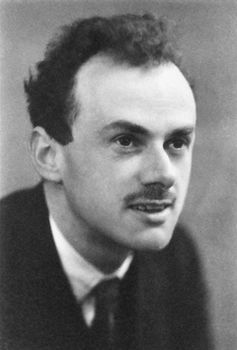
The history of modern physics boasts its own version of Fischelson. His name was Paul Dirac. I first encountered Dirac in physics courses, but was moved to revisit his life and legacy through my service on the board of the Kinsey Institute for the Study of Human Sexuality and teaching an undergraduate course on sexuality and love.
A brilliant but very strange man
Born in Bristol, England, in 1902, Dirac became, after Einstein, the second most important theoretical physicist of the 20th century. He studied at Cambridge, where he wrote the first-ever dissertation on quantum mechanics. Shortly thereafter he produced one of physics’ most famous theories, the Dirac equation, which correctly predicted the existence of antimatter. Dirac did more than any other scientist to reconcile Einstein’s general theory of relativity to quantum mechanics. In 1933 he received the Nobel Prize in Physics, the youngest theoretical physicist ever to do so.
At the time Dirac received the Nobel Prize, he was leading a remarkably drab and, to most eyes,
Paul Dirac in 1933. Nobel Foundation via Wikimedia Commons
unappealing existence. As detailed in Graham Farmelo’s wonderful biography, The Strangest Man: The Hidden Life of Paul Dirac, Mystic of the Atom, on which I rely heavily in this article, Dirac was an incredibly taciturn individual. Getting him to utter even a word could prove nearly impossible, leading his mischievous colleagues to introduce a new unit of measure for the rate of human speech, the Dirac, which amounted to one word per hour.
Dirac was the kind of man who would “never utter a word when no word would do.” Farmelo describes him as a human being completely absorbed in his work, with absolutely no interest in other people or their feelings, and utterly devoid of empathy. He attributes this in part to Dirac’s tyrannical upbringing. His father ruthlessly punished him for every error in speech, and the young Dirac adopted the strategy of saying as little as possible.
Dirac was socially awkward and showed no interest in the opposite sex. Some of his colleagues suspected that he might be utterly devoid of such feelings. Once, Farmelo recounts, Dirac found himself on a two-week cruise from California to Japan with the eminent physicist Werner Heisenberg. The gregarious Heisenberg made the most of the trip’s opportunities for fraternization with the opposite sex, dancing with the flapper girls. Dirac found Heisenberg’s conduct perplexing, asking him, “Why do you dance?” Heisenberg replied, “When there are nice girls, it is always a pleasure to dance.” Dirac pondered this for some minutes before responding, “But Heisenberg, how do you know beforehand that the girls are nice?”
Love finds the professor
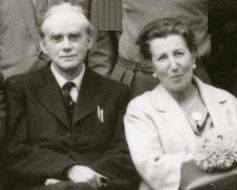
Then one day, something remarkable entered Dirac’s life. Her name was Margit Wigner, the sister of a Hungarian physicist and recently divorced mother of two. She was visiting her brother at the Institute for Advanced Study in Princeton, New Jersey, where Dirac had just arrived.
Known to friends and family as “Manci,” one day she was dining with her brother when she observed a frail, lost-looking young man walk into the restaurant. “Who is that?” she asked. “Why that is Paul Dirac, one of last year’s Nobel laureates,” replied her brother. To which she replied, “Why don’t you ask him to join us?”
Thus began an acquaintance that eventually transformed Dirac’s life. Writes Farmelo:
His personality could scarcely have contrasted more with hers: to the same extent that he was reticent, measured, objective, and cold, she was talkative, impulsive, subjective, and passionate.”
A self-described “scientific zero,” Manci embodied many things that were missing in Dirac’s life. After their first meeting, the two dined together occasionally, but Dirac, whose office was two doors down from Einstein, remained largely focused on his work.
After Manci returned to Europe, they maintained a lopsided correspondence. Manci wrote letters that ran to multiple pages every few days, to which Dirac responded with a few sentences every few weeks. But Manci was far more attuned than Dirac to a “universally acknowledged truth” best expressed by Jane Austen: “A single man in possession of a good fortune must be in want of a wife.”
She persisted despite stern warnings from Dirac:
I am afraid I cannot write such nice letters to you – perhaps because my feelings are so weak and my life is mainly concerned with facts and not feelings.
When she complained that many of her queries about his daily life and feelings were going unanswered, Dirac drew up a table, placing her questions in the left column, paired with his responses on the right. To her question, “Whom else should I love?” Dirac responded, “You should not expect me to answer this question. You would say I was cruel if I tried.” To her question, “Are there any feelings for me?” Dirac answered only, “Yes, some.”
Realizing that Dirac lacked the insight to see that many of her questions were rhetorical, she informed him that “most of them were not meant to be answered.” Eventually, exasperated by Dirac’s lack of feeling, Manci wrote to him that he should “get a second Nobel Prize in cruelty.” Dirac wrote back:
You should know that I am not in love with you. It would be wrong for me to pretend that I am, as I have never been in love I cannot understand fine feelings.
Yet with time, Dirac’s outlook began to change. After returning from a visit with her in Budapest, Dirac wrote, “I felt very sad leaving you and still feel that I miss you very much. I do not understand why this should be, as I do not usually miss people when I leave them.” The man whose mathematical brilliance had unlocked new truths about the fundamental nature of the universe was, through his relationship with Manci, discovering truths about human life that he had never before recognized.
Soon thereafter, when she returned for a visit, he asked her to marry him, and she accepted immediately. The couple went on two honeymoons little more than month apart. Later he wrote to her:
Manci, my darling, you are very dear to me. You have made a wonderful alteration in my life. You have made me human… I feel that life for me is worth living if I just make you happy and do nothing else.
A Soviet colleague of Dirac corroborated his friend’s self-assessment: “It is fun to see Dirac married, it makes him so much more human.”
In Dirac, a thoroughly theoretical existence acquired a surprisingly welcome practical dimension.
Paul and Manci in 1963. GFHund via Wikimedia Commons, CC BY
A man who had been thoroughly engrossed in the life of the mind discovered the life of the heart. And a human being whose greatest contributions had been guided by the pursuit of mathematical beauty discovered something beautiful in humanity whose existence he had never before suspected.
In short, a brilliant but lonely man found something new and wonderful that had been missing his entire life: love. As my students and I discover in the course on sexuality and love, science can reveal a great deal, but there are some aspects of reality – among them, love – that remain largely outside its ambit.
ooOOoo
Picking up on that last sentence, “there are some aspects of reality – among them, love – that remain largely outside its ambit.” all I can offer is to introduce dogs to the students!
I struggled for ages wondering how to close today’s post. In the end, decided on the following:
A video on YouTube raises some fundamental questions about our changing climate.
Let me say straight away that my belief in Anthropogenic Global Warming (AGW) is based on instinct, and not on me understanding the science, simply because I am not a scientist; far from it! As I share on this blog:
Paul Handover is a child of the post-war era in Great Britain having been born in London a few months before the end of WWII. After a rather shaky attempt at being educated, including 2 years studying for a Diploma in Electrical Engineering, Paul’s first job was as a commercial apprentice at the British Aircraft Corporation. He then joined the sales desk of British Visqueen, a polythene film and products manufacturer located in Stevenage, Hertfordshire, and part of ICI Plastics Division. In 1968, he travelled out to Sydney, Australia and became part of the sales team at ICIANZ’s Inorganic Chemicals Division.
I am a fundamentally a retired salesman/entrepreneur with a very out-of-date knowledge of electrical engineering and radio communications (G3PUK), and now struggling to be an author. 😉
Plus, my generally sceptical view of how countries are governed, my awareness of a terrible lack of integrity in politicians, plays to those instincts of mine that humanity is, indeed, responsible primarily for our changing climate. And there is no shortage of supporting evidence!
A very quick web search found this NASA site that included the following graph and text (in part):
This graph, based on the comparison of atmospheric samples contained in ice cores and more recent direct measurements, provides evidence that atmospheric CO2 has increased since the Industrial Revolution. (Credit: Vostok ice core data/J.R. Petit et al.; NOAA Mauna Loa CO2 record.)
The Earth’s climate has changed throughout history. Just in the last 650,000 years there have been seven cycles of glacial advance and retreat, with the abrupt end of the last ice age about 7,000 years ago marking the beginning of the modern climate era — and of human civilization. Most of these climate changes are attributed to very small variations in Earth’s orbit that change the amount of solar energy our planet receives.
Scientific Consensus
Ninety-seven percent of climate scientists agree that climate-warming trends over the past century are very likely due to human activities, and most of the leading scientific organizations worldwide have issued public statements endorsing this position.
Click here for a partial list of these public statements and related resources.
However, a dear and close friend of nearly 40 years, Dan Gomez, is sceptical and simply says to me: “Paul, follow the money!” Dan is a very widely-read person and a great thinker.
Plus, among our wonderful neighbours there is a couple, Dordie and Bill, that we get on with extremely well. Bill is a sceptic of AGW and recently sent me the link to the following video.
Please watch it. If you have evidence that all or many of the facts on this video are incorrect then I would love to hear from you.
For this is way too important for the truth not to be widely promoted.
It really is about good people refusing to let evil dominate our world.
The response to yesterday’s post was incredible and very gratifying.
For I was conscious that many would simply reject the proposition that I saw in John Zande’s book, namely that, “there was an evil origin to the universe and, more directly, that the deep, and growing, suffering of the pinnacle of evolution, us humans, can be traced back to that evil origin.”
The emotional challenge, of which I am acutely aware, is recognising that core proposition, that as we humans evolve so too does the capacity for human suffering, yet not wanting to give up on my personal core belief that better times ahead are possible, given sufficient people sharing that power of hope. Echoing what Sue wrote as a response to yesterday’s post that motivated me to reply, in part, thus:
If there was one sentence of yours that struck me as spot on, it was your declaration that what we think is what we create. Or as I often reflect, we are what we think.
Jean and I last night watched the latest BBC Panorama report about the migrant/refugee crisis in Europe. It was profoundly upsetting for reasons that many will understand.
George Monbiot’s essay that follows shortly is also profoundly upsetting.
But if hope is to be translated into a determination to make a difference, then it demands that we don’t ignore the pain but use our anger to fuel our passion to behave appropriately: We are what we think! Or in the much more eloquent words of Albert Einstein:
Learn from yesterday, live for today, hope for tomorrow. The important thing is not to stop questioning.
George Monbiot is to be saluted for his commitment to questioning and I am privileged to have his permission to republish the following.
There may be water on Mars. But is there intelligent life on Earth?
By George Monbiot, published in the Guardian 30th September 2015
Evidence for flowing water on Mars – this opens up the possibility of life; of wonders we cannot begin to imagine. Its discovery is an astonishing achievement. Meanwhile, Martian scientists continue their search for intelligent life on Earth.
We might be captivated by the thought of organisms on another planet, but we seem to have lost interest in our own. The Oxford Junior Dictionary has been excising the waymarks of the living world. Adders, blackberries, bluebells, conkers, holly, magpies, minnows, otters, primroses, thrushes, weasels and wrens are now surplus to requirements.
In the past four decades, the world has lost 50% of its vertebrate wildlife. But across the latter half of this period, there has been a steep decline in coverage. In 2014, according to a study at Cardiff University, there were as many news stories broadcast by the BBC and ITV about Madeline McCann (who went missing in 2007) as there were about the entire range of environmental issues.
Think of what would change if we valued terrestrial water as much as we value the possibility of water on Mars. Only three percent of the water on this planet is fresh, and of that two-thirds is frozen. Yet we lay waste to the accessible portion. Sixty percent of the water used in farming is needlessly piddled away by careless irrigation. Rivers, lakes and aquifers are sucked dry, while what remains is often so contaminated that it threatens the lives of those who drink it. In the UK, domestic demand is such that the upper reaches of many rivers disappear during the summer. Yet still we install clunky old toilets and showers that gush like waterfalls.
As for salty water of the kind that enthralls us when apparently detected on Mars, on Earth we express our appreciation with a frenzy of destruction. A new report suggests that fish numbers have halved since 1970. Pacific bluefin tuna, that once roamed the seas in untold millions, have been reduced to an estimated 40,000, yet still they are pursued. Coral reefs are under such pressure that most could be gone by 2050. And in our own deep space, our desire for exotic fish rips through a world scarcely better known to us than the red planet’s surface. Trawlers are now working at depths of 2000 metres. We can only guess at what they might be destroying.
A few hours before the Martian discovery was announced, Shell terminated its Arctic oil prospecting in the Chukchi Sea. For the company’s shareholders, it’s a minor disaster: the loss of $4 billion. For those who love the planet and the life it sustains, it is a stroke of great fortune: it happened only because the company failed to find sufficient reserves. Had Shell succeeded, it would have exposed one of the most vulnerable places on Earth to spills that are almost inevitable, where containment is almost impossible. Are we to leave such matters to chance?
At the beginning of September, two weeks after he granted Shell permission to drill in the Chukchi Sea, Barack Obama travelled to Alaska to warn Americans about the devastating effects that climate change, caused by the burning of fossil fuels, might catalyse in the Arctic. “It’s not enough just to talk the talk”, he told them. “We’ve got to walk the walk.” We should “embrace the human ingenuity that can do something about it.” Human ingenuity is on abundant display at Nasa, which released those astounding images. But when it comes to policy, the search for intelligent life goes on.
Let the market decide: this is the way in which governments seek to resolve planetary destruction. Leave it to the conscience of consumers, while that conscience is muted and confused by advertising and corporate lies. In a near-vacuum of information, we are each left to decide what we should take from other species and other people; what we should allocate to ourselves or leave to succeeding generations. Surely there are some resources and some places – such as the Arctic and the deep sea – whose exploitation should simply stop?
All this drilling and digging and trawling and dumping and poisoning – what is it for anyway? Does it enrich human experience, or stifle it? A couple of weeks ago, I launched the hashtag #extremecivilisation, and invited suggestions. They have flooded in. Here are just a few of the products my correspondents have found. All of them, as far as I can tell, are real.
An egg tray for your fridge, that syncs with your phone to let you know how many eggs are left. A gadget for scrambling them – inside the shell. Wigs for babies, to allow “baby girls with little or no hair at all the opportunity to have a beautifully realistic hair style”. The iPotty, that permits toddlers to keep playing on their iPads while toilet training. A £2000 spider-proof shed. A snow sauna, on sale in the United Arab Emirates, in which you can create a winter wonderland with the flick of a switch. A refrigerated watermelon case on wheels: indispensable for picnics. Or perhaps not, as it weighs more than the melon. Anal bleaching cream, for … to be honest, I don’t want to know. An “automatic watch rotator” that saves you the bother of winding your luxury wrist candy. A smart phone for dogs, with which they can take pictures of themselves. Pre-peeled bananas, in polystyrene trays covered in clingfilm. Just peel back the packaging …
Every year, clever new ways of wasting stuff are devised, and every year we become more inured to the pointless consumption of the world’s precious resources. With each subtle intensification, the baseline of normality shifts. It should not be surprising to discover that the richer a country becomes, the less its people care about their impacts on the living planet.
Our alienation from the world of wonders with which we evolved has only intensified since David Bowie described a girl stumbling through a “sunken dream”, on her way to be “hooked to the silver screen”, where a long series of distractions diverts her from life’s great questions. The song, of course, was Life on Mars.






 Learning from Dogs