A nearly 30-year old film has real relevance for today!
Those of you that read yesterday’s Post right through to the end will have picked up on the fact that after completing that article last Friday, Jean and I watched the movie The Verdict.
Amazingly, this powerful film was released on the 8th December 1982.
So why the connection between the film and the Post written yesterday?
Well yesterday I wrote about two recent examples of, at best, a terrible lack of integrity, or, at worst, blatant examples of powerful institutions lying to us. It troubled me greatly and I found no adequate way of closing the Post expressing my troubles in a succinct and fitting way. Stay with me for a few moments.
In the film The Verdict, Paul Newman plays Frank Galvin – here’s the synopsis from the IMDb website:
Frank Galvin is a down-on-his luck lawyer, reduced to drinking and ambulance chasing. Former associate Mickey Morrissey reminds him of his obligations in a medical malpractice suit that he himself served to Galvin on a silver platter: all parties willing to settle out of court. Blundering his way through the preliminaries, he suddenly realizes that perhaps after all the case should go to court: to punish the guilty, to get a decent settlement for his clients, and to restore his standing as a lawyer.
As one might have guessed, Galvin wins the case against all the odds, which doesn’t in any way reduce the power of the film. Newman was brilliant.
Tackling a medical malpractice case that could revive his once glorious career, attorney Frank Galvin (Paul Newman) questions a key witness, Dr. Thompson (Joe Seneca), in the compelling courtroom drama The Verdict.
At the end of the hearing Galvin rises to give his summation. Technically the case appears utterly lost to his side. Galvin slowly stands, hesitantly looks as his notes, cast the sheet aside and reluctantly addresses the jury.
You know, so much of the time we’re just lost.
We say, “Please, God, tell us what is right; tell us what is true.” And there is no justice: the rich win, the poor are powerless. We become tired of hearing people lie.
And after a time, we become dead… a little dead. We think of ourselves as victims… and we become victims. We become… we become weak. We doubt ourselves, we doubt our beliefs. We doubt our institutions. And we doubt the law.
But today you are the law. You ARE the law. Not some book… not the lawyers… not the, a marble statue… or the trappings of the court. See those are just symbols of our desire to be just. They are… they are, in fact, a prayer: a fervent and a frightened prayer. In my religion, they say, “Act as if ye had faith… and faith will be given to you.” IF… if we are to have faith in justice, we need only to believe in ourselves. And ACT with justice. See, I believe there is justice in our hearts.
Now go back and read my Post of yesterday. Read of the Citi executives paying token fines for lying to investors. Read of the allegation that the 2009 data set in the US GDP report was a “bald-faced lie”.
Now read again, aloud to yourself if you can, the first few sentences of Galvin’s summation. Here they are again (my emphasis).
You know, so much of the time we’re just lost.
We say, “Please, God, tell us what is right; tell us what is true.” And there is no justice: the rich win, the poor are powerless. We become tired of hearing people lie.
And after a time, we become dead… a little dead. We think of ourselves as victims… and we become victims. We become… we become weak. We doubt ourselves, we doubt our beliefs. We doubt our institutions. And we doubt the law.
I firmly believe that this is where millions of ordinary, hard-working, caring citizens of many countries have arrived today because of the lack of integrity, the lack of honesty and the lack of grace shown by so many in positions of power and privilege.
But do not despair because if we do that, then all is lost. No, believe in the power of good men. Back to the summation from the film:
In my religion, they say, “Act as if ye had faith… and faith will be given to you.” IF… if we are to have faith in justice, we need only to believe in ourselves. And ACT with justice. See, I believe there is justice in our hearts.
Just a couple of items from disparate sources came together last Friday to demonstrate just how possibly corrupt it has been over the last so many years! But there is a golden lining to this stuff.
That is the ever increasing spread and reach of all forms of digital communications, from the humble email through to Wikileaks, is making it increasingly difficult for those that wish to cheat and lie their way through their lives, at the expense of others, to do so without detection.
Anyway, back to the theme of the Post.
The first item is from here (thanks to Naked Capitalism for the link):
A news story today provides further confirmation of the rule by the banking classes in the US, with only token gestures to the rule of law.
(and after an in-depth review closes with:)
The message seems pretty clear. Sarbox [Sarbanes-Oxley Act. Ed]was intended to curtail phony corporate accounting in the wake of Enron. But why resort to complicated transactions like the energy company’s famed Raptors when Citi shows that mere lying will produce the same results with much less fuss?
All three years of the revision period were revised down. Again, if a mistake or inaccuracy (as opposed to intentional falsehood) is responsible for errors, one would expect them to be normally distributed – that is, some would be positive, some negative. This is obviously not the case.
Is there any good news in the report? Well, yes – there was a material uptick in non-residential fixed investment, centered around equipment and software. How much of this is a normal replacement cycle (deferred last year) and how much signifies real expansion is an open question and one not easily answered. However, I wouldn’t call this particularly “robust”, despite the pump monkey characterization this morning in the media.
The drops in some of the previously-published numbers were, however, simply stunning. For example, PCE (personal consumption) was previously reported for Q1/2010 as 2.13. The revision is 1.33, a thirty percent downward revision. That’s not an error, it was a falsehood.
Worse was the services false report. The previous reported number for Q1/2010 was 0.69. Revised was 0.03, a downward revision of ninety-five percent.
The services revision backward was truly sickening – the entirety of 2009 was negative with the exception of the fourth quarter, where all but the first was previously reported positive, and the changes were ridiculous. First quarter was revised down from -0.13% to -0.75%, second from +0.09% to -0.79%, and so on. Again,that’s not an error, it’s a lie.
Needless to say when I get all my graph source data updated, it’s going to look worse than it did – including my “government ponzi support” graph, one of my favorites.
The futures are diving on the report, as well they should. Not because it’s bad – but because the entirety of the 2009 data set was a bald-faced lie.
Frankly, I’m much less interested in what is happening to Western economies – my views have been regularly reported on Learning from Dogs.
What appals me is how far we seem from those famous words in the Gettysburg Address given by President Abraham Lincoln on the afternoon of Thursday, November 19, 1863 (my emphasis):
It is rather for us to be here dedicated to the great task remaining before us—that from these honored dead we take increased devotion to that cause for which they gave the last full measure of devotion—that we here highly resolve that these dead shall not have died in vain—that this nation, under God, shall have a new birth of freedom—and that government of the people, by the people, for the people, shall not perish from the earth.
Pres. Lincoln's words
P.S. As it happens, after finishing this article last Friday, Jean and I watched the film The Verdict in the evening. The words used by the lawyer Frank Galvin (Paul Newman) in his summation struck me so powerfully that I have made them a separate Post for tomorrow. By Paul Handover
This is how an excellent film by Rick Ray on the Dalai Lama is introduced. We watched the DVD a few evenings ago and it was heart-stirring and full of the extraordinary wisdom from one of the leading spiritual leaders alive today.
Do watch it if you can. Here’s the official trailer from YouTube:
As so often seems to be the case these days, there is a website for the movie here. And the Dalai Lama’s website is here.
Finally, I see that part of the film, where Rick Ray is having an audience with His Holiness, is available on YouTube. I’ll post links to the four videos over the next two days.
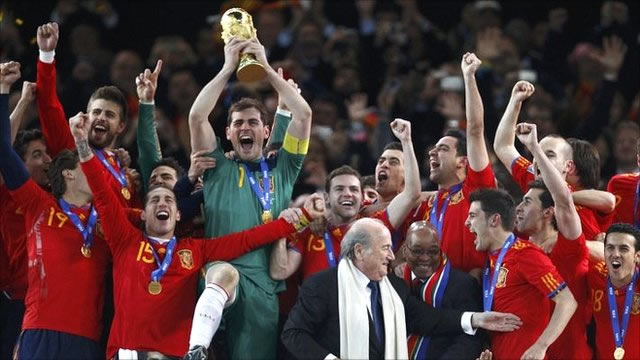
SPAIN AT LAST - AND DESERVEDLY - WIN THE WORLD CUP!!
Background: People of my generation were doubly spoilt in the 60s to 80s; it was a golden age of both popular music and football. As for the latter, we thrilled at the Brazilian and Argentinian magic, the famous German “efficiency” – and occasional touch of magic of their own – and of course the Dutch sides of 1974 and 1978. Their “total football” and tremendous skills made them exhilarating to watch. The names still linger in the memory; Cruyff, Krol, Neeskens, Hahn, Rep, Rensenbrinck, van Hanegem, van de Kerkhof …
But they never quite made it to the summit. This was not through any lack of quality, but they didn’t have – for me – that little bit of luck at the right time that you almost always need at this level. Could this latest Dutch team possibly do what the astounding Cruyff team hadn’t quite managed to pull off?
Setting the Scene: Unfortunately, the omens for the final weren’t that great. The Dutch coach had made noises about it “not being pretty” and that he didn’t mind how they won as long as they did. There was in fact to be no romantic looking back to the magic of the Dutch sides of 1974 and 1978; this Dutch side was pragmatic. They were going to make up for the past. They were NOT going to be the third Dutch team to lose in the final ……
In truth, they had done well to make the final, in particular stunning the much-fancied Brazil; you had to take them seriously after that. But they were efficient rather than slinky-skilled like the Spanish. With only one real star, the mercurial Arjen Robben, they were hard and “pragmatic”, which unfortunately – and as it once again proved in the final – often means “rough and brutal”.
The Spanish had shown great footballing skills, particularly in their mastery of the midfield, where they choked the life-blood out of the Germans in the semi-final. Pundits had agreed that the Germans had shown them “too much respect” and “allowed them to play their own game.” This, however, was one mistake the Dutch were NOT going to repeat. They were unlikely to be able to out-football the Spanish, so another strategy had to be found.
The Referee: What an honour to referee the World Cup Final! What excitement Howard Webb and his team must have felt as the kick-off approached. But it’s a fantastic “one-off”; you can never turn back the clock. Mistakes are fixed in time and unerasable, and there were to be several to scar the memory of his special day; which is a personal tragedy in itself.
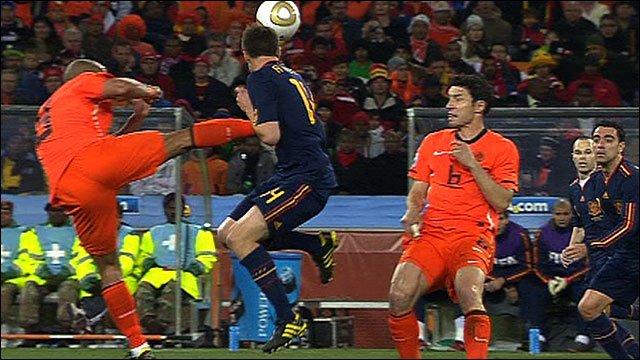
The Game: Let’s not beat about the bush; the first half was a disgrace. The Dutch game-plan seemed to be to kick the Spain out of their rhythm and indeed even off the field. Some of the tackling was appalling. Feet were smashing in left, right and centre with no hope of getting the ball. Webb was forced to issue yellow after yellow, yet seemed so stunned by and unprepared for the ferocity of what was going on that in fact, he was over-lenient despite the number of bookings (14 yellows and one red, easily a record for the final). The Dutch were lucky to reach the interval with 11 players. Van Bommel could well have gone with a straight red; how de Joong didn’t get a straight red is a total mystery to everyone I’ve talked or listened to.
It was appalling, and not just in terms of what was actually happening, it being quite sickening to see players smashed recklessly to the ground. After all, a single clumsy, violent and of course illegal challenge can end a player’s career. No, the deeper tragedy was in the realization that in their desperation to win, the Dutch had cast aside sportsmanship and in essence betrayed the memories of their magical predecessors. I have no idea what their coach said before, but the brutality of much of the tackling seemed so widespread that one felt it could only be part of a game plan and not just “World Cup nerves”. After some time, the Spanish (somewhat naturally) began to respond in kind so that the yellow cards began to mount up on both sides, and then, mercifully, came half time.
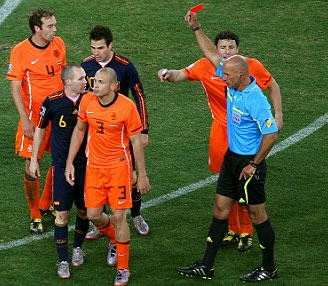
The second half was a bit better; had the players had a bollocking in the dressing room? Of course, for almost half the Dutch side they now HAD to be more careful, since a second booking meant they were off and their team one man down. As it happens, they survived till extra time before they had a man sent off; how is a mystery, and sadly, the referee has to take the blame. Yes, it is a showpiece. Yes, in one sense a sending-off would “spoil the game”, but the spoiling would have been self-inflicted by the Dutch, not the referee’s fault.
The Result? Non-partisan before the game, I was now rooting for Spain. Despite my nostalgia for Dutch teams of the past, their cynical approach could not prevail, could it? But the Spanish were doing everything possible to gift them the game. They simply could not find the goal, despite their usual domination of the midfield. The funny thing is that despite their being “the best side of the tournament”, they won it by scoring the fewest goals in World Cup history – only EIGHT, and winning ALL the knock-out stages just 1-0. As time went on, it seemed they would never score, with shot after shot whizzing miles over the bar or left or right of an untroubled goalkeeper, while the Dutch lurked and waited and should have won with Robben’s one-on-one with the Spanish goalkeeper after a magnificent through-ball on the counter-attack. Mysteriously – and tragically for the Dutch – Robben could not lift the ball a couple of feet and thus surely over Cepillas’ desperately-sliding legs.
And so we went into extra time, the Dutch seeming to play for a draw until finally their misdeeds caught up with them and Heitinga was sent off. With Dutch legs flagging Spain launched wave after wave of attacks and finally found the target with 10 minutes to go. This spared us the agony of a penalty shoot-out, which I would have backed the pragmatic Dutch to win.
But thank God they didn’t and that their brutality of the first half was not rewarded. I asked myself whether a Dutchman could have been proud of this side. Surely nationalism and pride should not prevail over sportsmanship? I am waiting to see what the great Cruyff has to say about it all. (see below)
Agreed, the ref had a very poor game (though the players must take much of the blame for this.) Apart from all the brutality, he missed an obvious corner to the Dutch just before the latter scored their goal. But had the Dutch won, I suspect there would have been an absolute furore in the media, and a legacy of much bitterness.
But in the end, they had nothing to complain about (which didn’t stop them looking). The better – and MORE IMPORTANTLY – more sporting side won, but the post-mortem will continue. And the final questions are:
Is winning really worth losing your honour? If it is, then I’ll stop watching professional football; it’s already going that way to some extent as we saw on Sunday.
Will FIFA one day get its act together and sort out the constant gamesmanship and brutality that scar the game? Video evidence seems essential here, INCLUDING its use AFTER games to retrospectively punish bad and unsporting play, which too many players get away with.
Why is FIFA so CONSERVATIVE? Why not as in rugby a SIN-BIN for players booked? Knowing that a yellow card would mean 10 or 15 minutes off the pitch would seriously concentrate the minds one thinks. I hate punishment on a philosophical level, but if it IS felt necessary then it HAS TO BE EFFECTIVE. It is not for nothing that I have nicknamed the FIFA President Sepp Blabber, or even Blather – either seems appropriate.
By Chris Snuggs
PS I found out about Cruyff – as I had hoped and suspected he would, he has severely criticised his own national team, showing the same admirable qualities as a man that he did as a player. His countrymen have to take a long, hard look at themselves after all this, not just at the way the team played but at how some people in Holland have reacted to the defeat.
Well, the World Cup is great at one thing, throwing up moral dilemmas.
No, it's not Netball!
Once again a MASSIVE injustice has been done through inadequate and idiotic rules, but the REAL issue is the moral vacuity of much of this world, with an inability to be honest, true, moderate and humble.
Why “moderate”? Because so many are so GREEDY. Greedy for “success”, fame, money at WHATEVER THE MORAL COST.
Suarez of Uruguay hand-balled (see picture) to prevent a certain goal by Ghana. This would have meant Ghana won the game and became the FIRST African team to make it to a World Cup Semi-Final.
Handball is illegal; it is therefore absolutely clear that Uruguay defeated Ghana thanks to an illegal act. That is one tragedy.
The second and greater tragedy is that Suarez and millions of South Americans have REJOICED in this win obtained through cheating. But what sort of moral code is it that makes people REJOICE when they win through cheating? It is totally against the ethics of true sportsmanship, and is enough to make one vomit.
I don’t know what hope there is for the world when cheating is so widely applauded by those who benefit from it, and who would no doubt be the first to complain if cheating disadvantaged them.
Yes, this was three-ways a depressing nonsense:
We lost the chance to see an African side progress, and the whole African continent feels justifiably robbed.
The moral bankruptcy of the rejoicing Uruguayans and South Americans is nauseating.
The idiocy of FIFA is shocking; this has been a problem for DECADES which they have FAILED to address; unlike rugby of course, where a penalty try can be awarded.
FIFA is a disgrace. They threaten France and Nigeria with expulsion for “interfering” in the affairs of their national footballing federation, yet does anyone in their right mind suppose that football in North Korea is not totally and utterly controlled by the tyrannical regime?
Sepp Blabber is a blot on the landscape, a moral and practical vacuum of pontificating mediocrity.
A professional footballer’s instinct is NOT to handle the ball. His reaction certainly was “instinctive”, but to instinctively CHEAT.
The bottom line is that CHEATING HAS GAINED A MASSIVE ADVANTAGE. It should not and never should. Have we heard any apology from the Uruguayans? Ha, bloody ha. Man’s ability to rationalize his greed is astounding.
[Interesting article by Robert Peston of the BBC about England’s approach to the World Cup. Ed.]
Congratulations to Martin Wolf of the Financial Times
An article was published in the FT on the 29th June that beautifully describes the ways in which we are all being so beautifully ‘screwed’ by the world of finance. (Note, you may need to register to see this article, but please do. Registration is free and the FT is full of great content.)
It starts like this:
This global game of ‘pass the parcel’ cannot end well
By Martin Wolf
Published: June 29 2010 23:31 | Last updated: June 29 2010 23:31
Paul here. Pass the parcel is a game for kids’ parties that involves passing a multi-wrapped ‘present’ around where the kid holding the parcel when the music stops gets to unwrap one sheet, then passes it on, etc., etc., until the kid holding the parcel with just one wrapper on it when the music stops gets the present.
Martin continues:
Our adult game of pass the parcel is far more sophisticated: there are several games going on at once; and there are many parcels, some containing prizes; others containing penalties.
So here are four such games. The first is played within the financial sector: the aim of each player is to ensure that bad loans end up somewhere else, while collecting a fee for each sheet unwrapped along the way. The second game is played between finance and the rest of the private sector, the aim being to sell the latter as much service as possible, while ensuring that the losses end up with the customers. The third game is played between the financial sector and the state: its aim is to ensure that, if all else fails, the state ends up with these losses. Then, when the state has bailed it out, finance can win by shorting the states it has bankrupted. The fourth game is played among states. The aim is to ensure that other countries end up with any excess supply. Surplus countries win by serially bankrupting the private and then public sectors of trading partners. It might be called: “beggaring your neighbours, while feeling moral about it”. It is the game Germany is playing so well in the eurozone.
It’s an article that really does need to be read in full. Martin concludes thus:
Yet it is quite clear that an isolated discussion of the need to reduce fiscal deficits will not work. These cannot be shrunk without resolving the overindebtedness of damaged private sectors, reducing external imbalances, or both.
The games we have been playing have been economically damaging. We will be on the road to recovery, when we start playing better ones.
Now I really don’t want Learning from Dogs to focus on ‘doom and gloom’. There’s more than enough of that to go round twice and thrice.
But when someone writes in such a great clarifying way – then it deserves the widest promulgation. The more we all know about the games being played, the better we can change the rules to benefit society. Well done, Martin.
Football – and the winner is ……. money and the lust for fame.
Well, the England v Germany game was tragic of course. But it wasn’t because:
the England team lost
they played not only badly but moronically, with an idiotic rush upfield of the whole defence as if it were the last few minutes of the game, thus allowing the Germans to score more or less at will
they repeated a few minutes later EXACTLY the same error as described above
the Germans scored a goal straight from the kick-off, which BBC commentators said they had never before seen in an international match
many of the players seemed “tired”, though this didn’t seem to trouble other players of the Premier League who were playing for other countries
the English players mostly plodded about like sleepy elephants compared to the racing panthers of Germany (resisting the temptation to say ‘panzers’)
the 5 million quid manager didn’t seem to have a clue; playing people out of position in a 4-4-2 formation that NOBODY else uses
there were no specialist wingers; quite useful for getting behind the defence and lobbing in crosses, a strategy that seems as foreign to the manager as he is himself
the same person was clearly unable to motivate and organise his players; as he speaks a different language this is not all that surprising – NO OTHER NATIONAL TEAM has a foreign manager, but we have to be different
the manager – with three goals needed in 15 minutes brought on Emile Heskey as our ‘last hope’, no doubt a worthy person but with a very poor goal-scoring record
the forward with the best goal-scoring record of all the English team (Crouch) hardly got a look-in
the players were clearly disorganised and uninspired
there seemed to be little real leadership on or off the field, with rumblings of discontent in the camp
for all of the above the FA is paying this hopeless manager nearly £20,000 per working day of the year
No, all the above is or was silly – or perhaps a better word is “pathetic”. The real tragedy concerns the goal that wasn’t.
The Goal that wasn't ....
Of course, this was every bit as silly as the rest of it, FIFA looking completely ridiculous by its refusal to contemplate the use of technology to enhance “fairness” (a concept I am quite keen on but which seems a bit out of fashion generally). It seems that some of the vastly-paid and expensively-hotelled world-ranging FIFA executives think that technology would “reduce the drama”. I am seriously hoping that Argentina “do a Lampard” on Germany in the Friday game so that the idiocy of this policy will be rubbed in, especially to the (rather sadly) gloating Germans.
But we STILL haven’t got to the tragic bit, which is that the Germans missed a chance to be remembered for ever as the team that owned up to a goal. Neuer, the German goalkeeper, has said that when the ball rebounded from the bar and went in (as it clearly did) he at once reached behind, grabbed it and hoofed it upfield “so that the referee wouldn’t think it had gone in.” which of course (being blind) he didn’t.
In other words, Neuer KNEW it wasn’t a goal but didn’t say so. With this action he joined the serial cheats, divers, “get-an-opposing-player-sent-off” and Maradona “Hand-of-God” players who will do anything to win. These are people to whom the concept of sportsmanship, fairness, honesty and “doing the right stuff” are alien.
In the case of Maradona, the ability of humans to reach the peaks of irony was once again illustrated when before the World Cup started he made a plea for “fair play”. I am unaware that he has ever apologised for his own cheating, but of course it is much easier to urge other people to behave in a certain way than to do it yourself.
Anyway, I do not claim the English would have done any different; we’ll never know. Just as we’ll never know what the score of this match WOULD have been HAD the goal been given. What we DO know is that we’ll be thinking for the next forty years about how silly and unjust this was just as the Germans have been whinging on for the same length of time about 1966. It could and should have been so different. HAD the Germans gone at once to the ref and said: “It was a goal”, they would have been moral heroes for the rest of footballing history rather than remembered (by me at least) as just another bunch of cheats.
The tragedy of course is that a TREMENDOUS OPPORTUNITY was lost to make a pitch for honesty, fairness, sportsmanship and decency. What an example that would have been to everyone, especially our kids! And WHAT A CHANCE to dump for ever and ever the image of football as a cheats’ activity dominated by the false Gods of money and fame as well as the stereo-typed image that some idiotic Brits have of Germans as unfeeling Nazis.
No, their instinct was NOT to admit the goal and to benefit from an unfair error. Sad … for the next 40 years we’ll be talking about the unfairness rather than what a wonderful gesture they made.
Oh, and as for 1966, let’s lay this ghost to rest. There was NEVER ANY QUESTION that it wasn’t a goal. The referee and linesman on that day BOTH said it was a goal and it is obvious from the reaction of the players that it was a goal, even if in those times the cameras were not as sophisticated as today’s and cannot definitively PROVE it was a goal. I am afraid this 1966: “It wasn’t a goal – we wuz robbed.” stuff is a bit like the urban myth: “The German army was stabbed in the back by politicians.” that Hitler exploited after WWI.
Well, for me the World Cup has lost some sheen; it is all so silly, nationalistic and rife with unsportsmanship. All that one lives with (one is used it these days), but the missed opportunity to make a moral stand is one I deeply regret.
I hope it is clear that this has NOTHING TO DO with my being English. Had our boys done the same I would have been just as sad, even more so, as – perhaps stupidly – I would like to think we are made of better stuff. However, football is not cricket and even cricket is often not cricket today either.
I can’t possibly add anything of substance to the hours and millions of words spoken about this tragic event.
All I felt as I watched the Congressional Hearing live on CNN was both embarrassment and sadness as a fellow Englishman demonstrated how the lawyers have won.
Hayward, from the couple of hours that I saw, said nothing of substance, nothing of real value and nothing that recognised how the American people, and the world in general, deserved openness and in-depth answers.





 Learning from Dogs