“You’ve got to do your own growing, no matter how tall your grandfather was.” Irish quotation.
In England, inexplicable happenings are commonly ascribed to being ‘Irish’! It’s meant in a loving way; there is a great deal of warmth towards the different ways that Irish people appear to see the world. But what is facing Ireland (and other countries) as a result of some distinctly unfunny goings-on in the USA is potentially hugely damaging.
To many the way that the world has descended into a dark, economic abyss, which is likely to affect us all in so many ways, and in which we are going to remain for a long time (a la Japan?), is also inexplicable.
Thus a chance comment from Norm Cimon to a recent post on Baseline Scenario set off a chain of discovery that for me has been very interesting. Here’s how it ran.
I have subscribed to Baseline Scenario for some time. It describes itself thus:
The Baseline Scenario is dedicated to explaining some of the key issues in the global economy and developing concrete policy proposals. Since it was launched in September 2008, this blog has been cited by virtually every major newspaper, Internet site, and blog covering economic and financial issues.
It’s a great resource.
A recent Post on Baseline Scenario, Irish Worries For The Global Economy, had already attracted 135 comments at the time of writing this post. A recent one was from a Norm Cimon, who is described in Linked In as the owner of Info Synchronicity LLC. This is what he said:
That is the other side of the coin. William Black has been lucid on this topic, and clear on the morality of the current age and how to fix it. Put people in jail and let everyone know why they were sent there. If you want to change perceptions then change the reality. The anger of the general public and the disdain of Wall Street are tied to that one issue. No one has paid for the crime of the millenium and everybody knows it.
And included was this recording of Bill Moyers interviewing Bill Black, the author of The Best Way to Own a Bank is to Rob One.
Here’s the interview:
However, there’s more to this discovery than the YouTube video. If one clicks on the link behind Norm Cimon’s name on that Baseline post, then one is taken here. It’s a pdf of a paper written by Norm Cimon entitled, “Computing Power and Human Greed.” It seems to me to explain the tools, for want of a better word, that enabled the American banking system to behave in the way that Bill Black so roundly condemns in the Bill Moyer interview. Here’s how Cimon ends his paper:
With networked computers now cast by all organizations, including the financial sector, into the role of wizard-behind-the-curtain, we all live in Oz. It’s long past time we pull back the veil and call a halt to the mindless application of this supreme and supremely dangerous creation before the damage gets any greater.
Unfortunately, there isn’t a date to the paper but my guess was that it was written late in 2009. Whatever the date, it is a very apt observation.
Focus warning! This is a longer piece that usual but also a more important piece than usual. Please find the time to read it and explore the links. Thank you.
Many, many years ago I lived in Tamarama Bay, just East of Sydney,
Bronte Beach, Australia
Australia. It was a very short walk to Bronte Beach which was much better experience than the famous Bondi Beach about half a mile North of where we lived.
Thus when I saw the name Bronte Capital it caught my eye because of old resonances from the word “Bronte”.
OK, to the point!
John Hempton is a principle at Bronte Capital, an Australian fund manager. John is no slouch having been in his past a Chief Analyst for the New Zealand Treasury and Executive Assistant to the CEO of ANZ Bank in New Zealand. John’s CV is here.
Bronte Capital have a Blog – well who doesn’t – and it was a link to that Blog from Naked Capitalism that caused me to read a recent article from John about deregulation.
Despite me not understanding many of the technical aspects, it struck me with some force, so much so that I wanted to reproduce chunks of it on Learning from Dogs. John was gracious enough to give me written permission to so do! Thanks John.
I have just read Daniel Amman’s excellent biography of Marc Rich – the oil trader notoriously pardoned by Bill Clinton. I don’t want to get into the politics and ethics of the pardon other than to note that few things in it are black-and-white when you finished reading the book.
and a couple of paragraphs later explains that Marc Rich has a rather appropriate surname – well this is how John writes:
Marc Rich exploited price fixing/import/export controls to make simply unbelievable profits trading oil. Marc Rich & Co (the Swiss vehicle) was started with just over $1 million in capital and a couple of years later was making in excess of $200 million in profit. This level of profitability exceeds – by far – any other trading operation I have ever seen – and was probably the most profitable trading operation in history. Marc Rich & Co (since renamed Glencore) is possibly the most valuable business in Switzerland within the lifetime of its founder.
Just stop here for a moment.
This man, Rich, goes from one million dollars in capital to two hundred million dollars in profits in 2 years, give or take! Read on:
A typical Marc Rich & Co trade involved Iran (under the Shah), Israel, Communist Albania and Fascist Spain. The Shah needed a path to export oil probably produced in excess of OPEC quotas and one which was unaudited and hence could be skimmed to support the Shah’s personal fortune. Israel – a pariah state in the Middle East – wanted oil. Spain had rising oil demand and limited foreign currency but was happy to buy oil (slightly) on the cheap. Spain however did not recognise Israel and hence would not buy oil from Israel – so it needed to be washed through a third country. Albania openly traded with both Israel and Spain. Oh, and there is an old oil pipeline which goes from Iran through Israel to the sea.
So what is the deal? The Shah sells his non-quota oil down the pipeline through Israel and skims his take of the proceeds. Israel skim their take of the oil. Someone doing lading and unlading in Albania gets their take and hence make it – from the Spanish perspective – Albanian, not Israeli oil. The Spanish ask few questions. The margins are mouth-watering – and they all come from giving people what they really want rather than what they say they want. We know what the Shah wanted (folding stuff). We know what Israel wanted (oil). We know what Spain wanted (cheap oil). Who cares that Spain was publicly spouting anti-Israel rhetoric. [Similar trades allowed South Africa to break the anti-Apartheid trade embargoes.]
John explains:
It also helped that Marc Rich & Co was a (highly) multilingual firm. Rich is fluent in Spanish (it is the language he talks to his children in). He speaks English, German, Yiddish and presumably Hebrew. His business partner (Pincus Green – pardoned the same day as Rich) speaks Farsi amongst many other languages. They could do this deal because they could negotiate it and – deep in their heart they hold the Ayn Rand view that trade is a moral virtue and hence they do not need to be concerned with other morality. [The only line that matters is the law – and then it might not be the law of his adopted country – Switzerland – rather than the United States where he was resident.]
My italics, by the way. Just stay with me for a short while longer to ‘get’ John’s important message. Here’s John again:
The regulatory regime for domestic American oil was also perverse. Old oil (meaning wells drilled before the first oil crisis) received one price. New oil (wells drilled after the crisis) received a higher price. Squeeze oil (oil that was extracted from wells that ran less than 10 barrels per day) received a higher price still. The oil could be chemically identical and the price difference over $20 per barrel. Obviously a trader with a method (any method) of changing the oil source could make a fortune. Again I am not commenting on legality or morality. That was just plain fact. Ayn Rand applies – you give a value and you receive a value.
What all this regulation did was that it allowed people to make simply grotesque profits by thwarting regulation. The regulation thus worked less well and it was socially unfair. Pincus Green was good at negotiating in Farsi. He was astoundingly brave going to Iran immediately after the Shah fell. He was good at organising shipping. He worked really hard – but he did not invent something that changed the world and he wound up a billionaire. Traders make money by intermediating real business solutions – but these were real business solutions to problems made by legislation. Bad regulation, moral indignation about “trading with the enemy” or “trading with Israel” or with racists in South Africa made people with Ayn Rand morals exceedingly wealthy because you could arbitrage your way around any of these regulations.
OK, you are probably getting the drift of this important article from John. If any of this ruffles your hair, then read it all – it’s a very important message. This is what John is saying:
As a plea then I want a debate about the right form of regulation – a regulation that controls agency problems but does not allow arbitrage opportunities to people with “Ayn Rand morals”.
We are not going to get that from the current Tea Party Republicans. They simply argue that regulation (they say but do not mean all regulation) impinges on “freedom” (something that is clearly a good but hard to define). However many of the same people want planning regulations to ban a mosque in downtown New York because it is an insult to the victims of 9/11 (and banning mosques is not a restriction on “freedom”).
If that is the level of debate we are not going to get good re-regulation – we are just going to get pandering to whichever lobby group manages to garner most support. And that is a real risk because we will leave agency problems in place (they benefit the rich and powerful) and we will introduce the same sort of (dumb) regulation that made Marc Rich and Pincus Green astoundingly wealthy. That sort of regulation also benefits the rich and powerful – especially those with “Ayn Rand morals”. [The rich and powerful – if you have not noticed – are good lobbyists. Unless we are careful many amongst them will get their way.]
You didn’t rush those last three paragraphs, did you?
John concludes thus:
I don’t know how to do this well – but I thought I would state the obvious. The most obvious things that need regulation are things with a government guarantee (implicit or explicit). If you have an implicit guarantee (as we now know almost all large financial institutions have) then regulation really matters. If there are large agency problems (small shareholders, large management) then regulation should be deliberately biased to put power in the hands of shareholders not managers (eg banning staggered board elections).
Likewise other agency problems should be strongly policed and the regulation should be of the form that allows that policing. When Elliot Spitzer found that Marsh – a large insurance broker – was participating in bid rigging against schools buying insurance that was shocking – and is precisely the sort of thing in financial markets that should be policed strongly. But it took Elliot considerable effort to find and prove his case. The rules should be established so that sort of behaviour is really difficult to hide.
And I do not think that I need to explain to anyone how much mortgage brokers contributed to the crisis by (a) deliberately misleading borrowers about conditions on their mortgage and (b) participating in the faking of borrowers income/assets/education level when they on-sold the loans to Wall Street. Agency problems were at the core of the crisis.
On the other side if there is no agency problem then deregulation should remain the order of the day. Trade restrictions create arbitrageurs – and the arbitrageurs ensure the trade restrictions don’t work anyway.
There are obviously going to be extensions to this rough rule – and this post is really to garner discussion. But for a start I expect agents who benefit from their agency (and the abuse of their agency) to join the Tea Party.
It is difficult to get policy right. And when and if the policy is got right we are in for a very long fight to implement it.
I take my hat off to Mr John Hempton. He’s in the ‘finance’ industry, probably doing well, and yet he has the courage to hold a mirror up to the desperately immoral happenings going on around him.
It’s a real pleasure and honour to publish this Post.
Let me close with a short piece from the Sydney Morning Herald of the 2nd January, 2010.
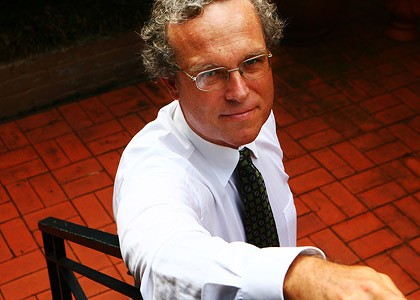
John Hempton ... blog locally, act globally. Photo: Domino Postiglione
WHEN John Hempton started a blog as he recovered from pneumonia, he did not expect to send shockwaves through the finance industry.
But that is exactly what the 42-year-old fund manager did through his Bronte Capital blog. His exposé of an unrelated US hedge fund would eventually lead to $426 million in investments being frozen and authorities seizing control of the Albury fund manager Trio Capital shortly before Christmas.
We recently watched a film about an Akita dog called Hachi, Hachikō in Japanese, that demonstrates the loyalty that dogs can have for their human owners.
Here’s the official movie trailer. [UPDATE – for copyright reasons that movie trailer has been removed from YouTube.]
It’s a very moving film – seriously so! Expect to shed many tears. Even more so when one reflects that the Hollywood film is based, reasonably accurately, on a true story. The details of this story are in Wikipedia from which is quoted:
In 1924, Hidesaburō Ueno, a professor in the agriculture department at the University of Tokyo took in Hachikō as a pet. During his owner’s life Hachikō saw him out from the front door and greeted him at the end of the day at the nearby Shibuya Station. The pair continued their daily routine until May 1925, when Professor Ueno did not return on the usual train one evening. The professor had suffered from a cerebral hemorrhage at the university that day. He died and never returned to the train station where his friend was waiting. Hachikō was loyal and every day for the next nine years he waited sitting there amongst the town’s folk.
Hachikō was given away after his master’s death, but he routinely escaped, showing up again and again at his old home. Eventually, Hachikō apparently realized that Professor Ueno no longer lived at the house. So he went to look for his master at the train station where he had accompanied him so many times before. Each day, Hachikō waited for Professor Ueno to return. And each day he did not see his friend among the commuters at the station.
The permanent fixture at the train station that was Hachikō attracted the attention of other commuters. Many of the people who frequented the Shibuya train station had seen Hachikō and Professor Ueno together each day. They brought Hachikō treats and food to nourish him during his wait.
This continued for nine years with Hachikō appearing precisely when the train was due at the station
This hasn’t been the only film about this dog. See below:
Back to the Wikipedia entry:
That same year, another of Ueno’s faithful students (who had become something of an expert on the Akita breed) saw the dog at the station and followed him to the Kobayashi home (the home of the former gardener of Professor Ueno — Kikuzaboro Kobayashi) where he learned the history of Hachikō’s life. Shortly after this meeting, the former student published a documented census of Akitas in Japan. His research found only 30 purebred Akitas remaining, including Hachikō from Shibuya Station.
Professor Ueno’s former student returned frequently to visit the dog and over the years published several articles about Hachikō’s remarkable loyalty. In 1932 one of these articles, published in Tokyo’s largest newspaper, threw the dog into the national spotlight. Hachikō became a national sensation. His faithfulness to his master’s memory impressed the people of Japan as a spirit of family loyalty all should strive to achieve. Teachers and parents used Hachikō’s vigil as an example for children to follow. A well-known Japanese artist rendered a sculpture of the dog, and throughout the country a new awareness of the Akita breed grew.
Eventually, Hachiko’s legendary faithfulness became a national symbol of loyalty.
Hachikō died on March 8, 1935. He was found on a street in Shibuya. His heart was infected with filarial worms and 3-4 yakitori sticks were found in his stomach. His stuffed and mounted remains are kept at the National Science Museum of Japan in Ueno, Tokyo.
Hachiko
The Akita breed has a great reputation for loyalty. But knowing that doesn’t in any way weaken the power of the message for the present times.
A dog offers loyalty, trust and love in exchange for being treated, in turn, with integrity and compassion.
I was a client for many years but had to terminate that client relationship when residence in the USA became highly likely! Very happy with the service and advice provided – extremely so! (I have no relationship at any level with that firm now!).
Anyway, David publishes what he calls Contrary View from time to time. His latest is reproduced with his permission.
No. 074 9th August 2010 A statistical impression
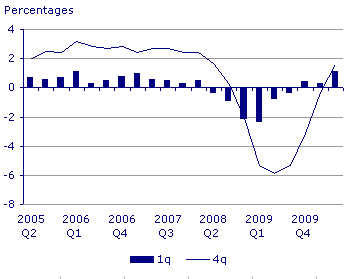
Over the last few weeks a number of graphs have appeared showing how the economy has apparently picked up to where it was before the credit crunch started. Such graphs invariably show a ‘U’ shaped curve demonstrating perfect recovery. This is the impression easily formed by a glance at such a graph, but it is the wrong assumption to make.
National Statistics reports Gross Domestic Product (GDP) as two different measures, both estimates showing a decline in GDP. Here are the latest figures (estimated), taken from their website last week:
3rd Qtr 2008 Index 102.6
2nd Qtr 2010 Index 99.0
This GDP index shows a permanent loss of output.
Detailed figures are also available (Table 1.02 of the UK economic accounts) and on the same estimating basis, seasonally adjusted, report:
3rd Qtr 2008 GDP £340,780 million
2nd Qtr 2010 GDP £328,766 million
No matter how you look at these figures, there has been a permanent loss of output of just over 3.5% in this period.
This loss of output means less work, so debts are more difficult to service. Why do the press produce graphs showing an apparently perfect recovery? The answer is that the graphs are taken from the National Statistics press release, for example on 23rd July 2010. The graph that is offered is a rate of change, not the level of output, and may simply have been copied without consideration of the impression formed.
WARNING: The firm can only be responsible for action taken on our advice given personally and specifically to be suitable for each individual. Statements on this site do not, on their own, constitute advice. Please note that UK regulatory requirements prevent us commenting on your existing investments or giving specific advice, unless you first sign one of our portfolio service agreements.
As I mentioned in a comment to a regular reader of Learning from Dogs:
To me, sufficiently old to have watched Governments for some decades now, the most striking thing about the present circumstances is the terrible decline in political integrity.
On 12th May 1997 former British Foreign Minister Robin Cook made a famous speech in which he outlined his intention to give Britain’s foreign policy an “ethical dimension.”
Here is an extract:
Burma
“Our foreign policy must have an ethical dimension and must support the demands of other peoples for the democratic rights on which we insist for ourselves. The Labour Government will put human rights at the heart of our foreign policy and will publish an annual report on our work in promoting human rights abroad.”
In truth this became something of an albatross since it is easier to pledge an “ethical foreign policy” than to actually deliver it, and sadly Robin Cook never lived to see his brain-child through to maturity. [He died on the 6th August, 2005. Ed.]
However, many were inspired by this speech and felt that a new beginning was being made, one where national interests and economic greed might take second place to “ethics”. However, like many great ideas, it seems to have come to nothing when faced with the cold, hard light of day. And nowhere is the demise of this dream more clear than in the current British Prime Minster’s recent trade mission to India.
Yes, the PM these days is as much a travelling salesman as moral, spiritual and practical leader ….. unfortunately, he chose to visit India the week after this great country had been graced with a visit from the leader of Burma, General Than Shwe.
This “leader” is of course in reality a gangster dictator who seized power after an election gave victory to the democratic opposition. He now rules over a police state from the middle of the jungle, rumouredly using astrology as one of his principal policy-making guides.
Senior General Than Shwe arrived in India on Sunday (25th July) to sign economic agreements. On the first day of his visit, he travelled to Bodh Gaya and Sarnath, two important pilgrimage sites related to the life of Gautama Buddha.
He also laid a wreath at the the site where the world’s most famous non-violent protester, Mahatma Gandhi was cremated; Rajghat in New Delhi. What Gandhi would of thought of that one can only imagine – two days earlier, the Burmese military wiped out a Christian village in Karen State, eastern Myanmar.
This was no great surprise, since this is one of the nastiest, most corrupt and oppressive regimes on Earth. This from Wikipedia: (This is a long extract from Wikipedia but please read it carefully.)
Human rights in Burma are a long-standing concern for the international community and human rights organisations. There is general consensus that the military regime in Burma is one of the world’s most repressive and abusive regimes.Several human rights organisations, including Human Rights Watch and Amnesty International, and the American Association for the Advancement of Science have reported on human rights abuses by the military government.[95][96] They have claimed that there is no independent judiciary in Burma. The military government restricts Internet access through software-based censorship that limits the material citizens can access on-line.[97][98]Forced labour, human trafficking, and child labour are common.[99] The military is also notorious for rampant use of sexual violence as an instrument of control, including allegations of systematic rapes and taking of sex slaves as porters for the military. A strong women’s pro-democracy movement has formed in exile, largely along the Thai border and in Chiang Mai. There is a growing international movement to defend women’s human rights issues.[100]
The Freedom in the World 2004 report by Freedom House notes that “The junta rules by decree, controls the judiciary, suppresses all basic rights, and commits human rights abuses with impunity. Military officers hold all cabinet positions, and active or retired officers hold all top posts in all ministries. Official corruption is reportedly rampant both at the higher and local levels.”[101]
Brad Adams, director of Human Rights Watch’s Asia division, in a 2004 address described the human rights situation in the country as appalling: “Burma is the textbook example of a police state. Government informants and spies are omnipresent. Average Burmese people are afraid to speak to foreigners except in most superficial of manners for fear of being hauled in later for questioning or worse. There is no freedom of speech, assembly or association.”[102]
Evidence has been gathered suggesting that the Burmese regime has marked certain ethnic minorities such as the Karen for extermination or ‘Burmisation’.[103] This, however, has received little attention from the international community since it has been more subtle and indirect than the mass killings in places like Rwanda.[104]
In April 2007, the U.S. Government Accountability Office (GAO) identified financial and other restrictions that the military government places on international humanitarian assistance. The GAO report, entitled “Assistance Programs Constrained in Burma”, outlined the specific efforts of the government to hinder the humanitarian work of international organisations, including restrictions on the free movement of international staff within the country. The report notes that the regime has tightened its control over assistance work since former Prime Minister Khin Nyunt was purged in October 2004. The military junta passed guidelines in February 2006, which formalised these restrictive policies. According to the report, the guidelines require that programs run by humanitarian groups “enhance and safeguard the national interest” and that international organisations coordinate with state agents and select their Burmese staff from government-prepared lists of individuals. United Nations officials have declared these restrictions unacceptable.
Burma’s government spends the least percentage of its GDP on health care of any country in the world, and international donor organisations give less to Burma, per capita, than any other country except India.[105] According to the report named “Preventable Fate”, published by Doctors without Borders, 25,000 Burmese AIDS patients died in 2007, deaths that could largely have been prevented by Anti Retroviral Therapy drugs and proper treatment.[105]
Here’s something very recent:
New Delhi (AsiaNews) – Soldiers from the Burmese Army attacked Tha Dah Der, a Christian village in Karen State, eastern Myanmar, on 23 July, burning 50 homes, a school and a church. Over 600 villagers fled in the jungle as the army advanced, joining 300 more from neighbouring villages who had also abandoned their homes in fear.
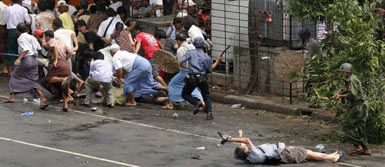
A Burmese photographer dies ....
Yes, we have got used to nasty regimes, and to states sucking up to their psychopathic gangster leaders, but there are limits, surely?
Why is the British Prime Minister grovelling to India (and by the way grossly insulting Pakistan at the same time) when India is laying out the red carpet for the Burmese murderer?
I don’t think “murderer” is too strong a word. Apart from all the usual and well-documented pogroms against minorities (remind anyone of Hitler?) the Burmese mafia government refused to allow international aid agencies to help after the catastrophic 2008 cyclone, the worst in Burma’s history. This condemned hundreds of thousands of Burmese citizens to heartless, needless suffering and certainly cost many lives.
Well, above I asked “why”?
Of course, it’s for selfish national interest. India wants access to Burma’s natural resources, especially oil, while Britain wants industrial contracts with India. Cynics would say Cameron succeeded; a follow-on deal for India to buy British Hawk trainer fighters has just been announced.
But why am I reminded of Goethe’s “Faust”? Is it really worth selling our soul to the Devil (indirectly condoning India’s sickening sycophancy to the Burmese Fuehrer) for the sake of some British jobs? A confirmative answer would seem to suggest that ethics in foreign policy is well and truly dead.
Once again, a vicious dictatorship flourishes by divide and rule. Where is the united international front that might help to put an end to our fellow-humans’ suffering? We managed this unity to help end South African apartheid; have our moral standards declined so much since then?
PS South Africa? Oh weep …. In January 2007, Russia and China vetoed a draft resolution before the United Nations Security Council calling on the government of Myanmar to respect human rights and begin a democratic transition. South Africa also voted against the resolution.
Still, they put on a good World Cup, so that’s all right then ……
A nearly 30-year old film has real relevance for today!
Those of you that read yesterday’s Post right through to the end will have picked up on the fact that after completing that article last Friday, Jean and I watched the movie The Verdict.
Amazingly, this powerful film was released on the 8th December 1982.
So why the connection between the film and the Post written yesterday?
Well yesterday I wrote about two recent examples of, at best, a terrible lack of integrity, or, at worst, blatant examples of powerful institutions lying to us. It troubled me greatly and I found no adequate way of closing the Post expressing my troubles in a succinct and fitting way. Stay with me for a few moments.
In the film The Verdict, Paul Newman plays Frank Galvin – here’s the synopsis from the IMDb website:
Frank Galvin is a down-on-his luck lawyer, reduced to drinking and ambulance chasing. Former associate Mickey Morrissey reminds him of his obligations in a medical malpractice suit that he himself served to Galvin on a silver platter: all parties willing to settle out of court. Blundering his way through the preliminaries, he suddenly realizes that perhaps after all the case should go to court: to punish the guilty, to get a decent settlement for his clients, and to restore his standing as a lawyer.
As one might have guessed, Galvin wins the case against all the odds, which doesn’t in any way reduce the power of the film. Newman was brilliant.
Tackling a medical malpractice case that could revive his once glorious career, attorney Frank Galvin (Paul Newman) questions a key witness, Dr. Thompson (Joe Seneca), in the compelling courtroom drama The Verdict.
At the end of the hearing Galvin rises to give his summation. Technically the case appears utterly lost to his side. Galvin slowly stands, hesitantly looks as his notes, cast the sheet aside and reluctantly addresses the jury.
You know, so much of the time we’re just lost.
We say, “Please, God, tell us what is right; tell us what is true.” And there is no justice: the rich win, the poor are powerless. We become tired of hearing people lie.
And after a time, we become dead… a little dead. We think of ourselves as victims… and we become victims. We become… we become weak. We doubt ourselves, we doubt our beliefs. We doubt our institutions. And we doubt the law.
But today you are the law. You ARE the law. Not some book… not the lawyers… not the, a marble statue… or the trappings of the court. See those are just symbols of our desire to be just. They are… they are, in fact, a prayer: a fervent and a frightened prayer. In my religion, they say, “Act as if ye had faith… and faith will be given to you.” IF… if we are to have faith in justice, we need only to believe in ourselves. And ACT with justice. See, I believe there is justice in our hearts.
Now go back and read my Post of yesterday. Read of the Citi executives paying token fines for lying to investors. Read of the allegation that the 2009 data set in the US GDP report was a “bald-faced lie”.
Now read again, aloud to yourself if you can, the first few sentences of Galvin’s summation. Here they are again (my emphasis).
You know, so much of the time we’re just lost.
We say, “Please, God, tell us what is right; tell us what is true.” And there is no justice: the rich win, the poor are powerless. We become tired of hearing people lie.
And after a time, we become dead… a little dead. We think of ourselves as victims… and we become victims. We become… we become weak. We doubt ourselves, we doubt our beliefs. We doubt our institutions. And we doubt the law.
I firmly believe that this is where millions of ordinary, hard-working, caring citizens of many countries have arrived today because of the lack of integrity, the lack of honesty and the lack of grace shown by so many in positions of power and privilege.
But do not despair because if we do that, then all is lost. No, believe in the power of good men. Back to the summation from the film:
In my religion, they say, “Act as if ye had faith… and faith will be given to you.” IF… if we are to have faith in justice, we need only to believe in ourselves. And ACT with justice. See, I believe there is justice in our hearts.
Just a couple of items from disparate sources came together last Friday to demonstrate just how possibly corrupt it has been over the last so many years! But there is a golden lining to this stuff.
That is the ever increasing spread and reach of all forms of digital communications, from the humble email through to Wikileaks, is making it increasingly difficult for those that wish to cheat and lie their way through their lives, at the expense of others, to do so without detection.
Anyway, back to the theme of the Post.
The first item is from here (thanks to Naked Capitalism for the link):
A news story today provides further confirmation of the rule by the banking classes in the US, with only token gestures to the rule of law.
(and after an in-depth review closes with:)
The message seems pretty clear. Sarbox [Sarbanes-Oxley Act. Ed]was intended to curtail phony corporate accounting in the wake of Enron. But why resort to complicated transactions like the energy company’s famed Raptors when Citi shows that mere lying will produce the same results with much less fuss?
All three years of the revision period were revised down. Again, if a mistake or inaccuracy (as opposed to intentional falsehood) is responsible for errors, one would expect them to be normally distributed – that is, some would be positive, some negative. This is obviously not the case.
Is there any good news in the report? Well, yes – there was a material uptick in non-residential fixed investment, centered around equipment and software. How much of this is a normal replacement cycle (deferred last year) and how much signifies real expansion is an open question and one not easily answered. However, I wouldn’t call this particularly “robust”, despite the pump monkey characterization this morning in the media.
The drops in some of the previously-published numbers were, however, simply stunning. For example, PCE (personal consumption) was previously reported for Q1/2010 as 2.13. The revision is 1.33, a thirty percent downward revision. That’s not an error, it was a falsehood.
Worse was the services false report. The previous reported number for Q1/2010 was 0.69. Revised was 0.03, a downward revision of ninety-five percent.
The services revision backward was truly sickening – the entirety of 2009 was negative with the exception of the fourth quarter, where all but the first was previously reported positive, and the changes were ridiculous. First quarter was revised down from -0.13% to -0.75%, second from +0.09% to -0.79%, and so on. Again,that’s not an error, it’s a lie.
Needless to say when I get all my graph source data updated, it’s going to look worse than it did – including my “government ponzi support” graph, one of my favorites.
The futures are diving on the report, as well they should. Not because it’s bad – but because the entirety of the 2009 data set was a bald-faced lie.
Frankly, I’m much less interested in what is happening to Western economies – my views have been regularly reported on Learning from Dogs.
What appals me is how far we seem from those famous words in the Gettysburg Address given by President Abraham Lincoln on the afternoon of Thursday, November 19, 1863 (my emphasis):
It is rather for us to be here dedicated to the great task remaining before us—that from these honored dead we take increased devotion to that cause for which they gave the last full measure of devotion—that we here highly resolve that these dead shall not have died in vain—that this nation, under God, shall have a new birth of freedom—and that government of the people, by the people, for the people, shall not perish from the earth.
Pres. Lincoln's words
P.S. As it happens, after finishing this article last Friday, Jean and I watched the film The Verdict in the evening. The words used by the lawyer Frank Galvin (Paul Newman) in his summation struck me so powerfully that I have made them a separate Post for tomorrow. By Paul Handover
This is how an excellent film by Rick Ray on the Dalai Lama is introduced. We watched the DVD a few evenings ago and it was heart-stirring and full of the extraordinary wisdom from one of the leading spiritual leaders alive today.
Do watch it if you can. Here’s the official trailer from YouTube:
As so often seems to be the case these days, there is a website for the movie here. And the Dalai Lama’s website is here.
Finally, I see that part of the film, where Rick Ray is having an audience with His Holiness, is available on YouTube. I’ll post links to the four videos over the next two days.







 Learning from Dogs