A new angle on the famous ‘hear no evil, see no evil, speak no evil’ saying!
What climate change??
That new angle being ‘hear no climate change, see no climate change, speak no climate change!‘
So what has prompted this outburst from me? It started with me seeing a truly scary graph that was on Peter Sinclair’s Climate Crock blogsite on the 20th September. That was the graph that was published yesterday on Learning from Dogs under the post title of It’s not rocket science! If you didn’t see that graph yesterday, don’t read further on until you have looked at it.
Thus while today’s post could easily be interpreted as yet another blogpost from yet another writer about climate change, that is not the case. What I am doing is taking a quick trip across a few recently published items that really do make it utterly clear what is happening to the Earth’s biosphere, all in support of a very simple question to two gentlemen who are currently in the news; stay with me for all to become clear!
However, this is what caught my eye, (an interview between Dr. Francis and Peter Sinclair).
What she told me in a recent interview was that the sea ice record is not something that we just pay attention to in September – there will, in fact, be reverberations that will make fall and winter “very interesting” around the globe.
An unusually strong storm formed off the coast of Alaska on August 5 and tracked into the center of the Arctic Ocean, where it slowly dissipated over the next several days. The center of the storm was located in the middle of the Arctic Ocean.
On Wednesday, the National Snow and Ice Data Center concluded Arctic sea ice is at its lowest late-August level since records began, and the area covered by ice has continued to shrink in September. Since 1979, the 1.54 million square miles of ice is the smallest coverage on record at the North Pole, the report states.
With so many questions surrounding these latest findings, perhaps one of the most immediate is whether this melting of sea ice will affect the upcoming winter across the United States and Northern Hemisphere. Is it possible that a lack of Arctic sea ice could change weather patterns across the globe?
Four meteorologists spoke about these possibilities, and while they didn’t say dramatic weather shifts are imminent in the short-term, they did give some thoughts on what could happen.
One of the meteorologists was Dr. Jeff Masters, Director of Meteorology, Weather Underground. He wrote,
In my December 2011 blog post, I discuss research by Dr. Jennifer Francis of Rutgers University, who found that Arctic sea ice loss may significantly affect the upper-level atmospheric circulation, slowing its winds and increasing its tendency to make contorted high-amplitude loops. High-amplitude loops in the upper level wind pattern (and associated jet stream) increases the probability of persistent weather patterns in the Northern Hemisphere, potentially leading to extreme weather due to longer-duration cold spells, snow events, heat waves, flooding events, and drought conditions.
Several studies published in 2012 have linked Arctic sea ice loss to an increase in probability of severe winter weather in Western Europe, Eastern North America and Eastern Asia.
Then if one goes to that December 2011 blog post, one reads this,
“The question is not whether sea ice loss is affecting the large-scale atmospheric circulation…it’s how can it not?” That was the take-home message from Dr. Jennifer Francis of Rutgers University, in her talk “Does Arctic Amplification Fuel Extreme Weather in Mid-Latitudes?“, presented at last week’s American Geophysical Union meeting in San Francisco. Dr. Francis presented new research in review for publication, which shows that Arctic sea ice loss may significantly affect the upper-level atmospheric circulation, slowing its winds and increasing its tendency to make contorted high-amplitude loops. High-amplitude loops in the upper level wind pattern (and associated jet stream) increases the probability of persistent weather patterns in the Northern Hemisphere, potentially leading to extreme weather due to longer-duration cold spells, snow events, heat waves, flooding events, and drought conditions.
Arctic sea ice loss can slow down jet stream winds
Dr. Francis looked at surface and upper level data from 1948 – 2010, and discovered that the extra heat in the Arctic in fall and winter over the past decade had caused the Arctic atmosphere between the surface and 500 mb (about 18,000 feet or 5,600 meters) to expand. As a result, the difference in temperature between the Arctic (60 – 80°N) and the mid-latitudes (30 – 50°N) fell significantly. It is this difference in temperature that drives the powerful jet stream winds that control much of our weather. The speed of fall and winter west-to-east upper-level winds at 500 mb circling the North Pole decreased by 20% over the past decade, compared to the period 1948 – 2000, in response to the extra warmth in the Arctic. This slow-down of the upper-level winds circling the pole has been linked to a Hot Arctic-Cold Continents pattern that brought cold, snowy winters to the Eastern U.S. and Western Europe during 2009 – 2010 and 2010 – 2011.
OK, nearly finished! Stay with me for one last item. Did you note in that blog post (the first section quoted) this, “Dr. Francis presented new research in review for publication …“? Here’s the Abstract from that publication, from which one reads,
Evidence linking Arctic amplification to extreme weather in mid-latitudes
Key Points
Enhanced Arctic warming reduces poleward temperature gradient
Weaker gradient affects waves in upper-level flow in two observable ways
Both effects slow weather patterns, favoring extreme weather
Jennifer A. Francis, Institute of Marine and Coastal Sciences, Rutgers University, New Brunswick, New Jersey, USA
Stephen J. Vavrus, Center for Climatic Research, University of Wisconsin-Madison, Madison, Wisconsin, USA
So to the point of both yesterday’s Post and the information above.
Will someone tell me why Messrs Barack Obama and Willard Mitt Romney so fervently adopt the stance of ‘hear no climate change, see no climate change, speak no climate change!‘
I am indebted to Peter Sinclair for his permission to reproduce the graph below. It was embedded in his post on Climate Crocks on the 20th September, a post he not unreasonably called The Planetary Emergency.
As Peter wrote,
As you can see from the graphic above, the actual observations of arctic sea ice melt are far outstripping the climate model predictions of just a few years ago, that the denial-sphere continues to call “alarmist”. Apparently, not alarming enough.
The point of publishing this on Learning from Dogs is simply as an introduction to a post coming out tomorrow called Hear no evil; or is that hear no climate change?, the purpose of which is to ask a very simple question of the two gentlemen wishing to reside in the White House as President of the USA for another four years. All revealed tomorrow!
A reflection on why living in harmony with Planet Earth seems so challenging.
John Hurlburt is the ‘mover and shaker’ behind a series of talks and discussions under the overall title of Everything Fits Together, part of the adult education umbrella of St Paul’s Episcopal Church here in Payson, AZ. John generously asked if I would lead the discussion tonight (19th) along the theme of Nature and Faith. I plan to close the session with these words and the compelling video that was on Learning from Dogs last Friday A planet worth protecting.
oooOOOooo
Man – a study in behaviours.
The relationship between Planet Earth and man goes back a very long way. But what of today?
There is little doubt that many people, even with the minimum of awareness about the world in which we live, are deeply worried. On so many fronts there are forbidding and scary views. It feels as though all the certainty of past times has gone; as if all the trusted models of society are now broken. Whether we are talking politics, economics, employment or the environment, nothing seems to be working.
Why might this be?
It would be easy to condemn man’s drive for progress and an insatiable self-centredness as the obvious causes of our society failing in widespread ways. But in my view that’s too simple an explanation. It’s much more complex.
I propose that the challenges we all face today have their roots in the dawning of our evolution. Let’s remind ourselves how far back that goes.
The earliest documented members of the genus Homo are Homo habilis which evolved around 2.3 million years ago. Homo habilis was the first species for which we have positive evidence of the use of stone tools.
A theory known as Recent African Ancestry theory, postulates that modern humans evolved in Africa possibly from Homo heidelbergensis and migrated out of the continent some 50,000 to 100,000 years ago, replacing local populations of Homo erectus and Homo neanderthalensis.
Thus for tens of thousands of years, the behaviours of humans have served our species well, by definition. Ergo, mankind has evolved as the result of mankind’s behaviours. Behaviours that may have changed little over those countless years.
So one might speculate that these behaviours have been potentially damaging to the ultimate survival of our species, perhaps hugely damaging, for a very long time. But because man’s population footprint has been so small for 99% of eternity the consequences have not impinged on the planet until now. Let’s reflect on those population figures.
Until the development of agriculture, around the 11th millennium BC, the world population was stable at around one million persons, as man lived out a subsistence hunter-gatherer existence. By about 2000 years ago the global population of man had climbed to around 300 million. It took another 1,200 years for that global population to reach the first billion, as it did in 1804.
However, just 123 years later, in 1927, the two-billionth baby was born. The three-billionth baby was born in 1960, just 33 years later! Only a further 14 years slip by for the four-billionth baby to be born in 1974. Another blink of the geological eyelid and 13 years later, in 1987, along comes the five-billionth bundle of joy. Around October 1999, the sixth-billionth baby is born! It is likely that we are in a world where there are now seven billion people! Indeed, the world population clock estimates that on September 12th, a week ago, the world population was 7,039,725,283 persons.
About a billion every decade. The equivalent of a growth of 100 million each and every year, or around 270,000 every single day! Or if you prefer 11,250 an hour (Remember that’s the net growth, births minus deaths, of the population of humans on this planet!)
Combine man’s behaviours with this growth of population and we have the present situation. A totally unsustainable situation on a planet that is our only home.
The only viable solution is to amend our behaviours. To tap into the powers of integrity, self-awareness and mindfulness and change our game.
All of us, no exceptions, have to work with the fundamental, primary relationships we have with each other and with the planet upon which we all depend. We need the birth of a new level of consciousness; of our self, of each other and of the living, breathing planet. A new consciousness that will empower change. We need spiritual enlightenment. We need a spiritual bond with this beautiful planet.
Over eons of time, Planet Earth has favoured our evolution. Now, today, not tomorrow, it is time to favour our beautiful planet with our love and with our faith. It is the ultimate decision for our species.
oooOOOooo
If you need a reminder of how beautiful our planet is (and I’m sure the majority of LfD readers don’t require that reminder) then go back and watch David Attenborough’s video and voice-over to the song What a Wonderful World.
I will close by inserting into this post, the video that Martin Lack included in a recent comment to my post The wind doth blow!
While Learning from Dogs trawls around a wide variety of topics, the theme behind the writings is, as the banner says on the home page: Dogs are integrous animals. We have much to learn from them.
Integrity, defined more or less universally as the ‘adherence to moral and ethical principles; soundness of moral character; honesty.‘
Please trust me that this position is taken not from the perspective of the writer, I’m struggle with ‘right’ and ‘wrong’ as much as the next guy. No, this position is the result of one very simple and stark vision: If we don’t understand pretty damn soon what we, as in mankind, are doing to our planet, both directly and indirectly, then we are living through the era of the end of civilised man; these are the last times.
The relationship between man and the dog is ancient beyond contemplation. It is widely believed by scientists who study the history of man that, at the very least, dogs assisted man in evolving from hunter-gatherers to farmers. But some scientists believe that without the support of dogs, man never would had made the transition to farming. Either way the relationship goes back more than 10,000 years.
So what on earth does that have to do with integrity? Simply that alongside millions of us, dogs offer us the examples of loyalty, faith, meditation, patience, truth in love; an example of an adherence to moral and ethical principles; soundness of moral character; honesty.‘ In a single word: integrity!
OK, now that I have got that off my chest, to the topic of today’s post. For some months now I have subscribed to the blog run by The Permaculture Research Institute of Australia. It has much that will be useful for Jean and me when we move to Oregon in November. But also, not infrequently, the Institute highlights deeper, more fundamental, issues.
Thus it was that a few days ago, my attention was drawn to an item with the title of We Need Your Help to End the Era of Ecocide. It was about the work of English woman, Polly Higgins. I’m ashamed to say that I had not heard of her before! A very quick search came across the website Eradicating Ecocide, from which one quickly learns that Polly,
In March 2010 international barrister and award winning author Polly Higgins proposed to the United Nations that Ecocide be made the fifth Crime Against Peace. There are currently four Crimes Against Peace: genocide, war crimes, crimes of aggression and crimes against humanity. Ecocide is the missing fifth crime – it is a crime against humanity, against current and future generations, and against all life on Earth.
Wow, that makes sense. So what is ecocide? Again, Eradicating Ecocide offers the answer,
Back to the specific topic. This is a copy of what is the latest news item on the Eradicating Ecocide website and it is reproduced in full. I’ve included the Editor’s introduction from the Permaculture News website, as I couldn’t say it any better.
oooOOOooo
We need your help to end this era of Ecocide
Editor’s Note: We’ve covered a little of Polly Higgin’s important work before (see here and here). If you’re not already familiar with Polly’s work, I would strongly encourage you to check out the web pages and videos linked to below, as well as our aforementioned pieces. Permaculturists dream of whole earth restoration, but our efforts, whilst essential, are, if I may, largely piecemeal. The reason for this is that for every positive step someone makes, an industry or government does, or allows, something significantly more destructive to take place that more than overshadows it. We will never break out of this destructive cycle unless we make environmental destruction illegal, and hold the people responsible accountable. As you are able, please support Polly’s work. If you cannot donate, please at least do what you can to share and circulate this page.
Polly Higgins
I have something I would like to share with you. Today myself and my team have reached zero. The pot is now bare and our funding resources are in urgent need of replenishing. In the past year your donations of over £200,000 funded my and my team’s work; we planted some incredible seeds in the run up to the Rio Earth Summit. Out of that we have had some wonderful successes; in the past year alone we have held a mock Ecocide Trial in the UK Supreme Court, the University of London launched their Ecocide Project, I have travelled to countries and spoken on many platforms, I launched my second book Earth is our Business, I have been awarded Overall Champion by the PEA awards, I have started a training programme for others to learn how to become a Voice for the Earth and I have submitted a concept paper, Closing the door to dangerous industrial activity to all government’s around the world. All this has been done with the help of your money and without it none of this would have been at all possible.
Yesterday we held an emergency meeting; despite the enormous efforts of our fundraiser over the past few months we have been unable to raise more than a few thousand pounds. We are looking squarely at the future and we see enormous opportunity to take forward all that I have already achieved; just think how close we are to making this law a reality.
Everything we do is governed by permaculture ethics; people care, earth care and fair share. Ecocides occur when we take far more than our fair share, which affects both our people and our Earth. To ensure we live within our planetary limits, a law of Ecocide creates a legal framework that can ensure we all live in peaceful enjoyment.
Please help me to continue to build upon all of this good work; now more than ever people care, earth care and fair share matters. Together we can end the era of Ecocide.
With love for the Earth,
Polly
oooOOOooo
If you read this and want to share this Post, feel free to so do. If you want to do that and more, then:
Send a cheque to us at 6 Highbury Corner, Highbury Crescent, London N5 1RD. Please write your cheque out to our charity, The Earth Community Trust.
In the US you can donate via the Iris Arts and Education Group 1856 San Antonio Ave, Berkeley, California 94707. Please write your cheque out to our charity, The Earth Community Trust.
Please become one of our funding volunteers. We are seeking a team of people to help us fundraise. This can be done in a number of ways. If you think you can help, please email our intern Nina: nina (at) eradicatingecocide.com
We are seeking a volunteer for 2 weeks full time to come into our London office: please email Louise with your CV: louise (at) eradicatingecocide.com
And don’t forget to go to the Eradicating Ecocide website to become more aware and then take action! Speaking of becoming more aware, do watch this video.
Looking at the human-animal relationship, from the perspective of the animal.
This is a guest post from Virginia Ingram. Virginia is becoming more involved in the animal rescue movement. As such, she knows only too well how vital it is to give so many precious animals a second chance.
In a very real sense we, as in mankind, owe our humanity to dogs and other animals. As I wrote here in the essay What is love?
“But understanding animals and empathizing with them also triggered other changes in humanity’s evolution, Shipman said.
All those things allow people to live with people. Once people have domesticated animals, they start to live in stable groups. They have fields, crops and more permanent dwellings.”
We owe so much!
So with that in mind, here is Virginia’s guest post.
oooOOOooo
WE CAN MAKE A DIFFERENCE
Recently I started to question the time I spend on the internet reading articles, essays and recommendations of books about all things concerned with animals. I receive animal stories from friends, acquaintances and business associates from all corners of the globe. I love to get them because, well….. hey, I really enjoy them!
After I read them I forward them to others who I think will also enjoy them. They make me feel warm and fuzzy. They are enlightening, poignant, humorous, inspiring and sometimes heart-rending. I find I cannot ignore any cute email containing animal pictures even though I may have already seen it a dozen times before. Give me a story about a dog who ate a popsicle and to me ‘that’s entertainment’ as they say. We human beings love to feel moved by great stories and these communications are full of it. I am such a sap when it comes to animal stories; so many of us are.
But here is the rub. What do the animals get out of it?
We chuckle and get our jollies from these incredible beings from a distance on the World Wide Web but the fact of the matter is that so many of these wonderful creatures end up unwanted, uncared for or even starved and beaten in shelters across the world.
Unknown and uncared for!
What gives? Why is there such a disconnect? How can we love animals from a distance and not be concerned with the abuses that go on in our own environment?
We know that there are those who don’t understand that animals have feelings and emotions, that they experience deep loss and sadness as well as happiness and joy. What can we do raise to the consciousness of human beings who don’t get it?
I think it involves sticking our collective necks out. I think that we need to be ready to risk some things. It might involve changing or damaging a relationship with someone who is acting in irresponsible ways towards animals. We need to be ready to risk it.
Do you see it on your own street? Maybe it’s a neighbor who leaves their dog on a chain in the yard on weekends regardless of weather or exposure to other animals. Maybe it’s the guy next door who ‘forgets’ to feed his animal.
Let’s stand up for these animals who have no voice. Let’s be advocates for these amazing creatures who cannot be their own advocate. Let’s hold humans accountable. Let’s risk a friendship and say something, make that difficult phone call on behalf of a animal. Let’s talk to people about animal issues and problems. Let’s try to change the weak laws that do not properly address animal cruelty. Let’s summon our courage and do the unpopular things which will enhance the quality of life for these precious beings.
Can you imagine how animals feel when they have been turned over to an animal shelter by the person whom they loved more than themselves? Trust me, the sense of abandonment and fear, the bewilderment in their eye is excruciating to observe. I have seen it not from the distance of my computer but in person. Let’s DO something to change all this. It’s time to get involved.
By all means keep the cute emails going but for every minute we spend on the internet, reading the books and enjoying the emails let’s put the same amount of time into getting something done to improve the lives of animals. Stand up, walk out the door, volunteer or donate money. We can help the suffering. We can make a difference.
oooOOOooo
Powerful words indeed. Don’t know about you but I read a strength of feeling that was very moving. A clear message that we must never turn the head, never just ‘tut tut’ but do something. Even if only befriending a stray animal. Because one might argue that even that feral dog without a home is demonstrating something all of us on this green planet need to understand; living a sustainable life!
Finally, living proof of what we can give an animal when we care and love it. The dog in the picture below is Loopy, a dog that Jean rescued in Mexico many years ago. She was so badly hurt by humans that it took Jean six months before Loopy would let Jean touch and hug her.
When I came on the scene, my gender was against me. It took me twelve months before Loopy trusted me. Now she will come to me and let me place my face against hers in the most loving, caring embrace that one can imagine.
So why the fearful look on Loopy’s face as she turns away from the camera? Somehow the camera is reminding Loopy of some sort of weapon that was used to beat her!
Loopy
As Virginia so lovingly wrote, “We can help the suffering. We can make a difference.“
Schalk is the author of the Blog One in a Billion which describes itself as ‘A DIY guide to saving our world while building a happy, healthy and wealthy life.‘ The Billion in the title refers to ‘the billion wealthiest world citizens, are creating serious global problems through our unsustainable consumption habits.’
My name is Schalk Cloete, a South African research scientist currently living and working in Norway. Officially, my research is centered around the mathematical modelling of fluidized bed reactors; something which makes nice pictures, but which is not exactly the most brilliant blog material. I will therefore not bore you with further details about the kinetic theory of granular flows.
Nope, the material I write about here; building a happy, healthy, wealthy and sustainable life within our affluent modern society, should be much more interesting. I use the word “building” quite a lot because that is exactly what needs to be done. One literally needs to build the environment within which one functions from day to day with the same level of diligence and attention to detail one would use to build a house.
Anyway, with no further ado, let me go to Schalk’s guest post.
oooOOOooo
YOU are responsible
Not so long ago, Paul left a very thought-provoking comment on my blog: the One in a Billion project, and suggested that my response to that comment was worth publishing as a guest post on Learning from Dogs. Needless to say, I gratefully accepted this generous offer! Before we go any further though, I’d just like briefly to describe my blog so that the comment can be seen in perspective.
The principle objective of my blog is to advocate personal lifestyle change as a lasting solution to the pressing sustainability problems we are facing today.
The rationale behind this overall theme is threefold:
Our current systems are fundamentally guaranteed to collapse (more about this here)
A personal lifestyle change is the one and only sustainable solution to this impending crisis (further detail can be found here)
Such personal lifestyle changes towards sustainable living are the one and only road to lasting health, wealth and happiness.
So, on that backdrop, here was Paul’s comment:
Any successful attempt at reversing and correcting the perilous journey humanity is on has to focus on the nature of change, how humans change, why the change required in this case is psychologically complex, and how the reward feedback process has to work. In my opinion these are the core issues to be tackled.
And my response:
Change is driven by a complex set of internal and external triggers that influence our consciousness every second of every day. If these triggers collectively indicate to a person (based on his or her unique subjective interpretations and subconscious filters) that some alternative is more attractive or that the current reality is unacceptable, motivation for change is granted. The exact nature of the change that this project requests is a change in day-to-day lifestyle choices which stems from shaping a person’s interpretation and filtering of the various internal and external triggers to accurately represent the reality that a lifestyle aimed at sustainable happiness is infinitely more attractive than one focused on consumerism.
This project tries to motivate people to take action by strongly emphasizing on the immediate personal benefits of making these lifestyle changes, the ease with which these changes can be made (and made permanent), the short and long term hazards of not making these changes and the moral obligation we have to the poor and to future generations to make these changes.
The change is psychologically complex because the entire environment we live in today just begs us to consume at ever increasing rates. This is the reason why this project repeatedly emphasizes on the construction of micro-environments to protect against this toxic macro-environment and make the correct actions natural and automatic. On a higher level, change is psychologically complex because we now have to abandon a system that has raised our standard of living tremendously while we still had abundant cheap fossil fuels and a limitless planet. Our most powerful weapon has turned into our greatest threat and it should come as no surprise that we seem totally unable to handle that.
The reward-feedback process in the One in a Billion initiative is actually quite interesting. As stated before, a lot of emphasis is placed on the immediate rewards of making certain lifestyle choices, but the thing that makes it really interesting is the holistic and complementary nature of this plan. Because it covers such a broad spectrum of areas, one quickly finds that gains in one area start to enhance gains in other areas. From personal experience, this truly is an extremely exciting journey and even becomes addictive, thereby all but guaranteeing further lifestyle changes. As soon as this spiral is started, the mind becomes a lot more open to the wealth of information on sustainability out there and this understanding then stimulates further action. In the end, you end up with a completely self-sustaining upwards spiral towards happy, healthy, wealthy and sustainable living.
In closing, the change that is needed within the developed world today can basically be summarized as follows: hundreds of millions of people must be reconditioned away from a debilitating and self-destructive culture of consumerism and entitlement towards a healthy and fulfilling culture of contribution and personal responsibility. It is my sincere hope that the One in a Billion project can contribute to this change and help overcome the great challenges discussed above.
This really is a dream of mine which I have recently described in more detail under my Dream heading for anyone who might be interested. Please spend a minute or two to think about this philosophy and whether you might consider developing a similar dream of your own.
oooOOOooo
Trust me, Schalk’s blog is full of very interesting propositions. Yet another sign that opinions are changing across this great interconnected world.
How the relationship that we have with domesticated animals taught us the meaning of love.
This exploration into the most fundamental emotion of all, love, was stimulated by me just finishing Pat Shipman’s book The Animal Connection. Sturdy followers of Learning from Dogs (what a hardy lot you are!) will recall that about 5 weeks ago I wrote a post entitled The Woof at the Door which included an essay from Pat, republished with her permission, that set out how “Dogs may have been man’s best friend for thousands of years longer than we realized“.
The following day, I wrote a further piece introducing the book and then commenced reading it myself. Please go there and read about the praise that the book has received.
What I want to do is to take a personal journey through love. I should add immediately that I have no specialist or professional background with regard to ‘love’ just, like millions of others, a collection of experiences that have tapped me on the shoulder these last 67 years.
I would imagine that there are almost as many ideas about the meaning of love as there are people on this planet. Dictionary.com produces this in answer to the search on the word ‘love’.
love
[luhv] noun, verb, loved, lov·ing. noun
a profoundly tender, passionate affection for another person.
a feeling of warm personal attachment or deep affection, as for a parent, child, or friend.
sexual passion or desire.
a person toward whom love is felt; beloved person;sweetheart.
(used in direct address as a term of endearment, affection,or the like): Would you like to see a movie, love?
But, I don’t know about you, those definitions leave something missing for me. Here’s my take on what love is, and it’s only by having so many dogs in my life that I have found this clarity of thought.
Love is trust, love is pure openness, love is knowing that you offer yourself without any barriers. Think how you dream of giving yourself outwardly in the total surrender of love. Reflect on that surrender that you experience when deeply connecting, nay loving, with your dog.
Here’s how Pat Shipman expressed it in her book:
Clearly, part of the basis of our intimacy with tame or domesticated animals involves physical contact. People who work with animals touch them. It doesn’t matter if you are a horse breeder, a farmer raising pigs, a pet owner, a zoo keeper, or a veterinarian, we touch them, stroke them, hug them. Many of us kiss our animals and many allow them to sleep with us. We touch animals because this is a crucial aspect of the nonverbal communication that we have evolved over millennia. We touch animals because it raises our oxytocin levels – and the animal’s oxytocin levels. We touch animals because we and they enjoy it. (p.274)
Pat soon after writes,
From the first stone tool to the origin of language and the most recent living tools, our involvement with animals has directed our course.
Thus it is not beyond reason to presume that tens of thousands of years of physical and emotional closeness between humans and their animals have developed the emotion of love in us humans, so eloquently expressed in art and life.
There’s another aspect of what we may have learned from dogs. In Alexandra Horowitz’s book Inside of a Dog, she writes of the way that dogs look at us,
Having been folded into the world of humans, dogs no longer needed some of the skills that they would to survive on their own. As we’ll see, what dogs lack in physical skills, they make up for in people skills.
AND THEN OUR EYES MET ….
There is one final, seemingly minor difference between the two species. This one small behavioral variation between wolves and dogs has remarkable consequences. The difference is this: dogs look at our eyes.
Dogs make eye contact and look to us for information – about the location of food, about our emotions, about what is happening. Wolves avoid eye contact. In both species, eye contact can be a threat: to stare is to assert authority. So too is it with humans. In one of my undergraduate psychology classes, I have my students do a simple field experiment wherein they try to make and hold eye contact with everyone they pass on campus. Both they and those on the receiving end of their stares behave remarkably consistently: everyone can’t wait to break eye contact. It’s stressful for the students, a great number of whom suddenly claim to be shy: they report their hearts begin to race and they start sweating when simply holding someone’s gaze for a few seconds. They concoct elaborate stories on the spot to explain why someone looked away, or held their gaze for a half second longer. For the most part, their staring is met with deflected gazes from those they eyeball.
Then a few sentences later, Alexandra continues to write,
Dogs look, too. Though they have inherited some aversion to staring too long at eyes, dogs seem to be predisposed to inspect our faces for information, for reassurance, for guidance. Not only is this pleasing to us – there is a certain satisfaction in gazing deep into a dog’s eyes gazing back at you – it is also perfectly suited to getting along with humans. (pps 45-46)
No apologies for now inserting the photograph of Pharaoh that adorns the Welcome page of Learning from Dogs. Underlines what Alexandra wrote above in spades.
Now that is a gaze!
OK, time to start bringing this to a close.
The Toronto Star ran a great review of Pat Shipman’s book from which I will just take this snippet,
“But understanding animals and empathizing with them also triggered other changes in humanity’s evolution, Shipman said.
All those things allow people to live with people. Once people have domesticated animals, they start to live in stable groups. They have fields, crops and more permanent dwellings.”
In other words, we can see that living with animals took us from nomadic hunter-gatherers to living with other people in stable groups; the birth of farming. It is my contention that the evolution of communities and the resulting more stable relationships elevated love leading to love becoming a higher order emotion than just associated with the ‘grunt’ of reproduction.
I started by saying that it was Pat Shipman’s book that stimulated me to wander through my own consciousness and realise that when I bury my face in the side of one of the dogs, say on the bed, it resonates with the most ancient memories in my human consciousness. Indeed, I am of no doubt that my openness and emotional surrender to that dog enables me to be a better, as in more loving, person for Jean.
So let me close this essay by asking you to return here and read the guest post tomorrow from author Eleanore MacDonald, where Eleanore writes of the loss of their dog Djuna. You will read the most precious and heart-rending words about love. Thank you.
Normally my week-end posts are lighthearted. But I do hope you will forgive the departure for today.
Regular readers of Learning from Dogs will recall that on the 2nd August I published a piece under the title of Changing the person: Me. It offered several examples of how personal change or transition is tough but that the rewards that come from understanding the personal and emotional consequences of big life changes are immense. As I wrote then,
The most important thing to note, and this is why so many ‘change’ ambitions fail, is that change is deeply unsettling at first. When change happens for the majority of us, often ‘forced’ on us as a result of unplanned life events, we are left deeply unsettled; a strong feeling of being lost, of being in unfamiliar surroundings. Think divorce or, worse, the death of a partner or child, reflect on how many sign up for bereavement counselling in such circumstances. Big-time change is big-time tough (apologies for the grammar!).
Then I came across the story of how Eric Clapton coped when his four-year-old son fell from the window of the 53rd-floor window of his mother’s friend’s New York City apartment. Here’s an extract from the WikiPedia entry:
The years following 1990 were extremely turbulent for Clapton. In August 1990, his manager and two of his roadies (along with fellow musician Stevie Ray Vaughan) were killed in a helicopter accident. Seven months later, on March 20, 1991, Clapton’s four-year-old son Conor died after falling from the 53rd-floor window of his mother’s friend’s New York City apartment. He landed on the roof of an adjacent four-story building. After isolating himself for a period, Clapton began working again, writing music for a movie about drug addiction called Rush. Clapton dealt with the grief of his son’s death by co-writing “Tears in Heaven” with Will Jennings.
Here’s Tears in Heaven. Please stop whatever you are doing now and play this video. In under 5 minutes it demonstrates the power of the saying from Henry David Thoreau, the American author and poet – “Not until we are lost do we begin to understand ourselves”.
In an interview with Daphne Barak, Clapton stated, “I almost subconsciously used music for myself as a healing agent, and lo and behold, it worked… I have got a great deal of happiness and a great deal of healing from music“.
Eric Clapton
Let me close with another saying, this time from George Moore, the novelist, “A man travels the world over in search of what he needs and returns home to find it.”
The last couple of weeks of Posts seem to have been rather dominated by the risks to the planet’s biosphere from the highly probable actions of mankind. I feel a little uncomfortable about this as Learning from Dogs is not a single issue Blog. Well not in the sense of a tightly defined issue. But in another sense, it is about the issue of integrity; about raising the values of truth and openness so that it’s clear how we are to move forward as a species and pass through these ‘interesting times’ with hope and confidence.
Dogs are such pure creatures, as I try and explain in the Dogs and Integrity sidelink. As I wrote in the Vision,
Our children require a world that understands the importance of faith, integrity and honesty
Learning from Dogs will serve as a reminder of the values of life and the power of unconditional love – as so many, many dogs prove each and every day
Constantly trying to get to the truth …
The power of greater self-awareness and faith …
So that’s the issue!
If we don’t embrace the truth of what is happening to our planet, then we can’t embrace change.
Dianne was unaware when she contacted me that her timing was exquisite! Why? Because it had recently crossed my mind that many readers must wonder why a blog with the name of Learning from Dogs so infrequently had articles about dogs! Hopefully both the Welcome page and my piece on Dogs and integrity make it clear that it is the qualities of dogs, the examples they set to mankind, that inspire these writings. As I say in Dogs and integrity,
value and cherish the ‘present’ in a way that humans can only dream of achieving
are, by eons of time, a more successful species than man.
So it is a double pleasure to offer Dianne’s guest post today because it reminds us, so clearly, that the qualities of dogs are something very real for mankind.
Dianne Gray
Dianne is a writer. As she explains on her blog site,
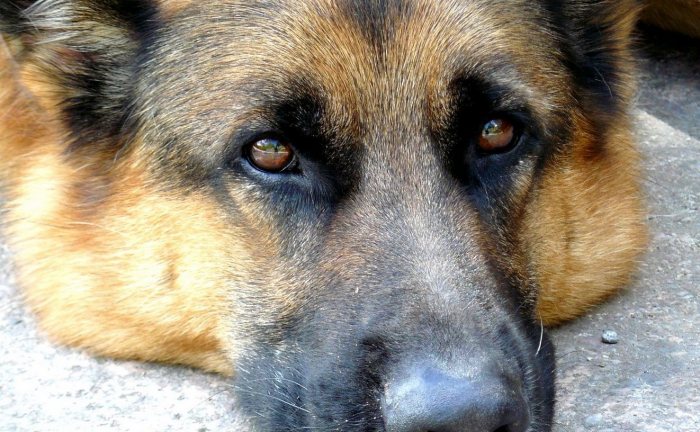
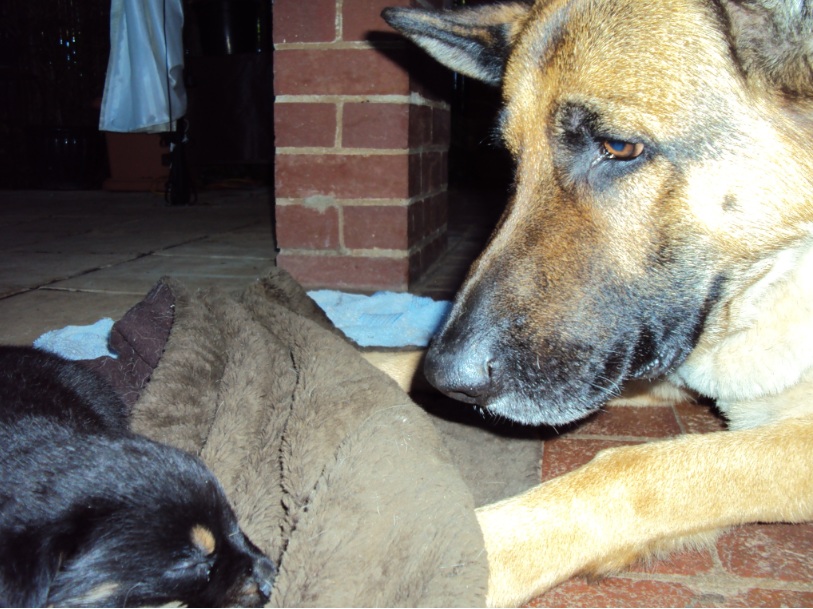
I live in Australia, have a sensitive-new-age Rottweiler called Kitty and a German Shepherd (in desperate need for The Dog Whisperer) called Sabre.
I’ve had interesting jobs, including working in a crocodile farm in Far North Queensland.
Sabre came into our lives in November 2004. He was seven weeks old. We were lucky enough to get Sabre from Bob Knight, a German shepherd breeder in Canberra, Australia. For those of you who don’t live in Australia you wouldn’t know that Bob was tragically shot and killed in 2010 while driving his truck through Sydney – the innocent victim of a gang war taking place several blocks away, he was hit by a stray bullet.
Bob was very passionate about his dogs and would interview those who were interested in buying one of the litter. If he didn’t think you were capable of managing a German shepherd he would not sell you one. He also ensured that each and every one of his puppies were brought back to him weekly (if possible) for free puppy training. So for over twelve months we (and the others who had bought one of the litter) met at the lake to take our dogs for a walk and training.
We live in the inner city and have an enormous yard so Sabre loved playing catch and patrolling the borders of our property. We live adjacent to a laneway and had some trouble with junkies shooting up near our fence and threatening to kill him if he barked at them. When he was two years old he became very ill very suddenly (it was Good Friday and near impossible to find a vet). We took him to the out-of-hours vet in the city who just looked at him and ($A800 later) told us not to feed him for the rest of the weekend.
By Saturday morning he could hardly move. We called Bob who told us about a woman called Jan who would be available to see him who lived in a nearby town. She was a country vet and looked after horses and cattle – so we loaded him in the car. This was the best move we ever made because, as it turned out, Jan would save his life a couple of times. When Jan saw him she couldn’t believe another vet would tell us not to feed him. “You don’t feed animals, they die,” she said. She gave us some horse paste (I still don’t know to this day what it was) and told us to put some in his mouth every hour. She said to try and give him his favourite food as often as possible and to call her every hour and tell her if he had eaten anything. She said he had the classic symptoms of having ingested a common bait (I’m not revealing what it was publically) and if we couldn’t get him to eat within four hours we had to bring him straight back to her. Basically he was starving to death.
We put the paste in his mouth as often as possible and tried to tempt him with cheese (his favourite) for three hours. Finally, he took a small mouthful of cheese and we celebrated like it was Christmas! We took him back to Jan for the next three days and he got stronger and stronger and within a week was back to his old playful self.
Twelve months later he began to walk with his head to one side and then he’d shake it and basically seemed very uncomfortable. We took him back to Jan who looked in his ear to find he had a chronic ear infection. She gave him antibiotics and cleaned his ear, but weeks passed and it just didn’t want to budge. We took him back to Jan every weekend and she would clean his ear (he wouldn’t let us touch it) and give him a penicillin injection. I surfed the net trying to find out what I could do to get rid of this damn infection – we were trying everything possible and it still wouldn’t budge. Then I read somewhere that yoghurt in a dog’s diet can be good for this kind of thing. I added yoghurt to his diet and within a week he was looking better. We still had him back to Jan’s every weekend for a few months and I still put yoghurt in his diet!
Six months later he started to change and became obnoxious and aggressive with us. We thought it may have had something to do with the ear infection so we took him back to Jan. She laid him on his back and felt his testies. He was kind of shocked and so were we, but she had definitely done the right thing because at this stage he had testicular cancer in both testies. She operated and found that the cancer was at the advanced stage. She was pretty sure she had got it all, but told us the signs to watch for over the next few months. She put him on ‘girly hormones’ as she called them and he was on those for about twelve months – and what a pleasure he became. He was behaving himself and not cranky or aggressive like before the operation. He was a different boy! If you have a male dog that is not de-sexed and he becomes even the slightest bit aggressive, I strongly suggest you have him checked for testicular cancer!
Because we’d had so much trouble with the junkies I decided to get cameras around the outside of the house. It was such a novelty at first – I’d come home from work and check the cameras to see what had happened during the day, but then I noticed something really sad. Sabre would say goodbye to me at the gate every morning and then just sit there ALL DAY waiting for me to come home. It was heartbreaking, I’d never realised until this time how lonely he was. I’d watch the tape on X30 and it reminded me of one of those television advertisements where someone stands still while everything around them speeds past. So hubby and I decided it was time for another dog. This is where Kitty comes into the picture. From the moment Sabre saw her he absolutely loved her and she loved him. She is obsessed with his tail and when we go anywhere she grips onto his tail and follows him.
First meeting Sabre and Kitty.
Sometimes when they’re playing in the yard she grabs his tail and runs past him so fast he ends up running sideways! Kitty has had her fair share of problems as well. She was spade (by a vet other than Jan because she doesn’t have the capacity or equipment to spade female pups) and three months later she went on heat! I took her back to the other vet and he had only removed one ovary. So she had to be spade again, the poor darling. Meanwhile, Sabre must have had enough male hormones left in him to want to mount her every five minutes. So what I did was rub eucalyptus oil on Kitty’s back and this was enough to keep him away (the smell made him sneeze). Now we find Kitty has arthritis (she’s only fifteen months old) so we’re back to see Jan every other weekend for treatment. We’re kind of like a family now!
Sabre and Kitty today.
Kitty and Sabre are a wonderful pair and now when I watch the cameras when I get home from work all I can see is the two of them playing all day long. It’s a wonderful life!
oooOOOooo
So back to me! Couple of items to close this lovely story from Dianne.
“Writing has nothing to do with publishing. Nothing. People get totally confused about that. You write because you have to – you write because you can’t not write. The rest is show-business. I can’t state that too strongly. Just write – worry about the rest of it later, if you worry at all. What matters is what happens to you while you’re writing the story, the poem, the play. The rest is show-business.” — Peter S. Beagle






 Learning from Dogs