Category: Morality

A powerful brand of truth!

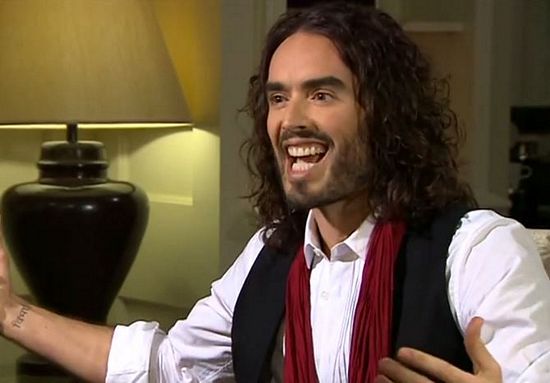
Russell Brand speaks the truth to wide applause.

Yesterday’s post here on Learning from Dogs looked at the utter insanity, the greed, the short-sightedness of extracting oil in greater and more varied ways; as if the future for all of life on this planet just didn’t matter.  I guess the truth is that for those who stand to benefit from this wealth, the future of the planet just doesn’t matter.

Revealing the obvious!

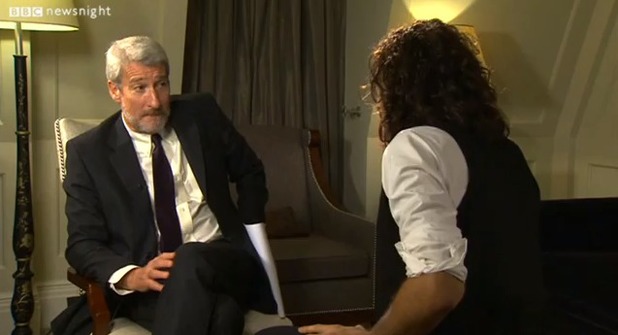
The recent interview on BBC Newsnight by Jeremy Paxman of British comedian Russell Brand has gone viral.  At the time of writing this post, YouTube report 7,661,280 viewings!  It’s not surprising because what Russell Brand is saying is obvious to millions of people all around the world.  What Brand is expressing is as clear as a lone, lighted beacon at midnight on the darkest Winter night one could imagine.

The UK’s Guardian newspaper published an article about the interview last Friday.  It was called: Russell Brand takes on the crisis of civilisation. But what now?  Here’s how that article opened:

During his Wednesday night interview with Jeremy Paxman on BBC Newsnight, comedian and actor Russell Brand said what no politician or pundit would ever dare say: that without dramatic, fundamental change, the prevailing political and economic system is broken, and hell-bent on planetary-level destruction:

With Dr Ahmed, the author of that Guardian article, concluding:

And in doing so, we might begin to realise that it is precisely the lack of a single, top-down manifesto that is our greatest strength – because, unlike the old, dying, fossil fuel dependent paradigm of endless growth for its own sake for the corporate few, the new, emerging post-carbon paradigm will be co-created by people themselves from the ground up.

That is why Brand’s answer for the way forward is so compelling:

“We shouldn’t destroy the planet. We shouldn’t create massive economic disparity. We shouldn’t ignore the needs of the people.”

If we want our children to inherit a habitable planet, rather than bashing Brand for not having a more coherent solution, we need to start being part of it.

Dr Nafeez Ahmed is executive director of the Institute for Policy Research & Development and author of A User’s Guide to the Crisis of Civilization: And How to Save It among other books. Watch his film, The Crisis of Civilization, for free. Follow him on Twitter @nafeezahmed

“We need to start being part of it.”

You know what!  The incredible response to that Paxman-Brand interview shows the millions of us who are already “part of it.”  Yes, it really does feel that the time is now.  That time that so very many of us, in a myriad of different ways, are fighting for our beautiful planet from the ground up.

Finally, if you want to read that interview between Paxman and Brand in detail, then over on Corrente there is a full transcript of the exchange between them.

Long may this run!

Passion for speaking the truth about our present times!

Truth, Justice, Sanity and Brotherhood.

plus ça change, plus c’est la même chose

The more it changes, the more it’s the same thing.” Apparently an epigram by Jean-Baptiste Alphonse Karr in the January 1849 issue of his journal Les Guêpes (“The Wasps”). Source.

Both the heading and the sub-heading to today’s post reflect strong connections to Chris Snuggs.  Chris has featured previously several times on Learning from Dogs and, I’m sure, my association with Chris has been mentioned.  An association going back too many years to the time when Chris invited me to run a course on sales and marketing for the students at the French Institute ISUGA in Quimper, France.  It became a regular event and Chris and I got to know each other well.

Chris has his own blogsite Nemo Insula Est from where one learns this about him:

A retired teacher, I am very worried about the state and future of the world. One thing may help, a determination to communicate and state the truth as one sees it, which is what I seek to do. I try to see things objectively; my horror of being brainwashed or motivated by some dogma or partisan viewpoint is absolute.

I salute the free press which has a good record of unearthing nepotism, corruption, dishonest and lunacy. However, the nepotists, the despots, the corrupt, the dishonest and the lunatics often have a lot of power, money and therefore influence. This allied to the fact that the lumpenmass is too busy toiling away to survive and often shrugs its shoulders in hopelessness means that the aforementioned get away with it.

Anyway, enough of me waffling on!  In my email in-box earlier today was an email from Chris offering me a couple of links to his posts on Nemo Insula Est.  One was very funny and one was decidedly less so.  The latter is being republished here today, with Chris’s permission.  It is called The State of America.

oooOOOooo

The State of America

A Blog post from the “Daily Telegraph” on October 3rd, 2013 by:

Ghislane400

I haven’t got time to verify all of these statistics, but I assume they are accurate. I have added some from Nicholas Kristoff at the end.

As far as I understand, the only reason the USA is not totally bankrupt right now is because the rest of the world keeps lending to it, believing that it is “too big to fail.” Many countries and Empires in history have believed they are too big and important to fail, France being yet another one ………. On that point, see:  The Life Cycle of a Democracy, which is rather sobering!

After DECADES of bad decisions, America is now dangerously in debt!  Obama has crippled America since he was re-elected, and his ineptitude is highlighted by the facts below: 

  • 30 years ago the US national debt stood at about one trillion dollars.  Today it stands at almost 17 TRILLION DOLLARS!
  • About 40 years ago the TOTAL debt stood at about 2 trillion dollars, today it is more than 56 TRILLION DOLLARS!  
  • At the same time as they have run up all of this debt, their economic infrastructure and their ability to create wealth has been completely gutted.  Since 2001, America has lost more than 56,000 manufacturing facilities and millions of jobs have been moved overseas. 
  • Their share of the global GDP declined from 31.8% in 2001 to 21.6% in 2011.
  • The percentage of self-employed Americans is at an all time low whilst the amount of them on benefits is at a record high.
  • During Obama’s first term, the federal government accumulated more debt than it did under the first 42 U.S presidents combined.
  • If they started to pay off the new debt accumulated under Obama at the rate of $1 per second, it would take them 184,000 years to pay it off.
  • Every hour of every day, the federal government steals more than 100 MILLION DOLLARS from their children and your grandchildren.
  • America has dropped in global economic competitiveness for the past 4 years running. 
  • According to “The Economist”, America was the best place to be born in 1988; now they tie for 16th place.
  • There are fewer Americans working in manufacturing today than in 1950, despite the fact that their population has doubled since then.
  • In Detroit alone, there are over 70,000 abandoned buildings.
  • When NAFTA was pushed through American Congress in 1933, they had a trade surplus with Mexico of 1.6 billion dollars.  They had a trade DEFICIT with them of 61.6 billion dollars come 2010.
  • Their trade deficit with China was 6 MILLION DOLLARS in 1985 for the entire year.  In 2012 their trade deficit with China was 315 BILLION DOLLARS.  This is the largest trade deficit between nations in the history of the world.  
  • America also loses half a million jobs to China annually. Fewer than 65% of all men in America have jobs. 53% of American male workers make less than $30,000 a year! Only 7% of all non-farm workers in the States are self-employed.  This is an all time low.
  • 146 million Americans are either ‘poor’ or ‘low income’.  49% of them live in a home that receives benefits from the federal government, according to the U.S Census Bureau. One in every 6 Americans is on Medicaid and Obamacare will add another 16 million to the Medicaid rolls; this will be a total of 73.2 million come 2025. This will increase liabilities of 38 trillion dollars to Medicare over the next 75 years, which equates to $328,404.00 for every single household in the United States.
  • Of the 56 million Americans collecting Social Security benefits now, by 2035 that will soar to an astounding 91 MILLION!  That is a 134 trillion dollar shortfall over the next 75 years.
  • Americans on Social Security Disability exceed the population of Greece, and those on food stamps exceed the population of Spain.
  • 45% of all children in Miami now live in poverty, more than 50% of all children in Cleveland live in poverty, 60% of all children in Detroit live in poverty.  
  • More than 1 million public school students in America are HOMELESS.  This is the first time in American history this has ever happened.
  • Since Obama got back in, those Americans on food stamps have risen from 32 million to 47 million.  That number exceeds the combined populations of Alaska, Arkansas, Connecticut, Delaware, District of Colombia, Hawaii, Idaho, Iowa, Kansas, Maine, Mississippi, Montana, Nebraska, Nevada, New Hampshire, New Mexico, North Dakota, Oklahoma, Oregon, Rhode Island, South Dakota, Utah, Vermont, West Virginia and Wyoming!

What a spiffing good job Obama is doing of bankrupting America!  Anyone would think he hates the States!  Seriously, anyone who voted for him owes an apology to the children of America, for whom a terrible country full of debt has been created by the biggest clown one could imagine.

AND, from Nicholas Kristoff in “The New York Times”:

  • The richest 1 percent of Americans now take home almost 24 percent of income, up from almost 9 percent in 1976. As Timothy Noah of Slate noted in an excellent series on inequality, the United States now arguably has a more unequal distribution of wealth than traditional banana republics like Nicaragua, Venezuela and Guyana.
  • C.E.O.’s of the largest American companies earned an average of 42 times as much as the average worker in 1980, but 531 times as much in 2001. Perhaps the most astounding statistic is this: From 1980 to 2005, more than four-fifths of the total increase in American incomes went to the richest 1 percent.

POSTSCRIPT:

The fact that we are here today to debate raising America’s debt limit is a sign of leadership failure. It is a sign that the U.S. Government can’t pay its own bills. It is a sign that we now depend on on-going financial assistance from foreign countries to finance our Government’s reckless fiscal policies. … Increasing America’s debt weakens us domestically and internationally. Leadership means that “the buck stops here.” Instead, Washington is shifting the burden of bad choices today onto the backs of our children and grandchildren. America has a debt problem and a failure of leadership. Americans deserve better.

Want to know who said that, and when? ……

Senator Barack Obama on March 20, 2006.

oooOOOooo

Just a footnote on that level of US inequality reported by Nicholas Kristoff using an extract from a recent post on Learning from DogsOur broken ways:

OK, that’s enough ‘copying’ from me so please go and read more about the plight of those poor billionaires.  But if the NYT and Paul Krugman will forgive me, here’s the paragraph towards the end of the Krugman essay that makes me sick [my emboldening]:

The thing is, by and large, the wealthy have gotten their wish. Wall Street was bailed out, while workers and homeowners weren’t. Our so-called recovery has done nothing much for ordinary workers, but incomes at the top have soared, with almost all the gains from 2009 to 2012 going to the top 1 percent, and almost a third going to the top 0.01 percent — that is, people with incomes over $10 million.

(Patrice Ayme has a parallel essay on this topic.)

There will be hundreds of thousands, if not millions, who share my view that this dimming of America’s historic beacon of truth and justice is a failure not just for the United States of America but for the rest of the world.

It seems appropriate to remind all you dear readers as to why I write this Blog.  Most easily encapsulated in what appears on my Welcome page:

Dogs live in the present – they just are!  Dogs make the best of each moment uncluttered by the sorts of complex fears and feelings that we humans have. They don’t judge, they simply take the world around them at face value.  Yet they have been part of man’s world for an unimaginable time, at least 30,000 years.  That makes the domesticated dog the longest animal companion to man, by far!

As man’s companion, protector and helper, history suggests that dogs were critically important in man achieving success as a hunter-gatherer.  Dogs ‘teaching’ man to be so successful a hunter enabled evolution, some 20,000 years later, to farming,  thence the long journey to modern man.  But in the last, say 100 years, that farming spirit has become corrupted to the point where we see the planet’s plant and mineral resources as infinite.  Mankind is close to the edge of extinction, literally and spiritually.

Dogs know better, much better!  Time again for man to learn from dogs!

Pharaoh, as with all dogs, is an integrous creature – man has much to learn from him, and all dogs.

Each and every one of us must fight for truth, justice, sanity and brotherhood!

Heads I win: Tails you lose!

How the foreclosure crisis was a boon for the super wealthy.

For some time now, must be quite a few years, I have subscribed to Yves Smith’s Naked Capitalism blog.  I do so for a number of reasons.

Thus it was that a few days ago I read with a mixture of anger and disgust an article about the consequences of the foreclosure crisis on the wealthy.  Within a few hours of me requesting by email permission to republish that article on Learning from Dogs came the reply from Yves granting such permission.

Try not to get too angry!

oooOOOooo

SUNDAY, OCTOBER 6, 2013

How the Foreclosure Crisis Made the Rich Even Richer

This is Naked Capitalism fundraising week. 53 donors [now well over 400, Ed.] have already invested in our efforts to shed light on the dark and seamy corners of finance. Join us and participate via our Tip Jar or another credit card portal, WePay in the right column, or read about why we’re doing this fundraiser and other ways to donate, such as by check, as well as our current goal, on our kickoff post.

It’s a welcome departure to see Adam Davidson’s weekly column in the New York Times, which usually puts a happy face on how the 1% are winning the class war in America, have a guest writer look at the other side of the story.

Catherine Rampell has a short but compelling piece on how the foreclosure crisis was wealth transfer from lower and middle income families to the rich. Her points are simple: the typical person who lost their home wasn’t a greedhead who bought too much house or refied to buy flat panel TVs and go on cruises (if you hang out with mortgage types, you’ll get a big dose of profligate consumer urban legend). The people who were like that (and there were some) for the most part were in subprime loans that reset in 2007 and 2008 and were in the early wave of foreclosures. The people who’ve lost their homes in later foreclosures were overwhelmingly people who had the bad fortune to buy late in the housing bubble (so when the bust hit, they had negative equity and couldn’t use lower rates to refi into cheaper payments) and took economic hits as a direct result of the crisis (hours cuts and job losses; other people who were hurt were in the more typical “shit happens” categories, like suffering medical problems, with their situation made much worse by their inability to sell or refinance their home).

Rampell’s contribution is to look at the phenomenon of investors, both big and small, and how they’ve bought properties at foreclosure and then flipped them. Separately, Josh Rosner recently released the astonishing statistic: that sales of owner-occupied properties showed only a 1% gain in the last 12 months. The gains that have been driving the indexes were all in investor owned properties. Some flipped to other investors. In hot markets, local investors have been doing “mini-bulks,” acquiring small portfolios to sell to private equity investors, some without renovating them, others with modest fix-ups. Others sold them to homebuyers.

Rampell uses the example of a couple who believed that renting was throwing away their money, and had the bad luck to buy a moderately-priced fixer-upper in early 2007. Each wage earner saw their income drop and unable to get a loan modification, they lost their home. Their $309,000 Seattle home went to an investor for $155,000 in the summer of 2011. That investor just sold it to a homeowner for $290,000, not far below what the hapless couple paid for it. But the new buyer paid all cash.

Rampell tells us:

Of the 87,062 foreclosures in the last five years that were bought by corporate investors and have been flipped, about a quarter were sold for at least $100,000 more than what the investor originally paid, according to [an online real estate listings site] Redfin (Although it’s impossible to know how much investors spent on upgrades or renovations.)….

The boom-bust-flip phenomenon is just one of the most obvious ways that research suggests the financial crisis has benefited the upper class while brutalizing the middle class. Rents have risen at twice the pace of the overall cost-of-living index, partly because middle-class families can’t get the credit they need to buy. That means “landlords can raise rents with impunity,” says Glenn Kelman, chief executive of Redfin. And according to a report by David Autor, the M.I.T. economist, job losses during and after the recession were concentrated in midskilled and midwage jobs, like white-collar sales, office and administrative jobs; and blue-collar production, craft, repair and operative jobs. Employment for higher-skilled workers, on the other hand, has grown substantially.

There is a second way foreclosures have served as a wealth transfer to the capitalist classes. Foreclosures don’t necessarily result in evictions. Banks often leave properties in a “zombie” state, starting foreclosures but not completing them, leaving the owner who thought he was foreclosed on still on the hook for property taxes. Another variant which is much less damaging is to leave the homeowner in place. I recently met an investor who is acquiring homes in Atlanta. The day after he buys a house, he goes to introduce himself to the former homeowner to see if he can work out a deal to keep them in place as tenant. In the overwhelming majority of cases, he can. “They were paying $1100 on their mortgage and the bank wouldn’t give them a mod. I’ll let them rent for $700, which is way above what they’d have gotten if they wrote the principal down to the price at which I bought the house. And I tell the tenants I’d be happy to sell the home to them.” We didn’t discuss details, but it sounded as if he’d be willing to structure rent to own deals (where part of the rent would go to a down payment on the house).

He was clear that his business depended on what he saw as value destroying behavior by banks. He described how he’d recently bought a home and when he went for his usual visit to the house, a well-dressed black man met him and invited him in, saying he’d be out in 30 days and assumed it wasn’t a problem. The new owner saw the house was in impeccable shape. He chatted with the owner a bit and found out he was a bodybuilder with a high-end training business. He asked the homeowner: “You look like you take good care of yourself and the house. You’d been paying on time. What happened?”

The trainer told him that he’d bought the house at the peak of the cycle for $160,000. The house was clearly now worth way less. He tried to get the bank to modify it to a principal balance of $100,000. The bank wouldn’t consider it. “So I bought a house which is comparable to this one for $50,000 and gave this one up.”

In this case, the homeowner had enough cash to arbitrage himself. The investor told me he’d bought the foreclosed home for $40,000. Had the bank cut a deal for $100,000 (and who knows, the homeowner might have accepted a higher number), it would have come out way ahead. But that also assumes that the bank owned the mortgage. It’s pretty much a given that the bank was a servicer, and as we’ve seen again and again, servicers don’t have the incentives or the infrastructure to do mods. So investor in the mortgages lose, homeowners lose. The winners are the banks as inefficient looters (the money they skim off the servicing is chump change relative to the damage done by negligent and predatory servicing) and the investors who profit by picking up the pieces. This is isn’t a well-functioning economic system, it’s rentier capitalism. And it’s looking more and more like a doomsday machine for what remains of the middle class.

oooOOOooo

Can’t add anything polite to this!  Except, to say it’s a very long way from integrity!

Lies, damn lies, and politicians!

A blatant example of what is so wrong with these present times.

Yesterday, in my post, A return to integrity, I offered up the hope:

Each of us, whoever you are, for the sake of your children and for all of the children in the world, embrace today the qualities, the values of Nature.

Love, Honesty, Loyalty, Trust, Openness, Faithfulness, Forgiveness, Affection.

Now if the shenanigans going on over here in my home country aren’t bad enough, then a recent essay from George Monbiot about the UK’s Department of Environment (DOE) really takes the cake.  The essay is called Age of Unreason, published in the UK Guardian newspaper, and for obvious copyright reasons, I can only offer limited extracts.  This is how the essay opens:

The governments of Britain, Canada and Australia are trying to stamp out scientific dissent.

By George Monbiot, published in the Guardian 1st Ooctober 2013

It’s as clear and chilling a statement of intent as you’re likely to read. Scientists should be “the voice of reason, rather than dissent, in the public arena.”(1) Vladimir Putin? Kim Jong-un? No, Professor Ian Boyd, chief scientific adviser at the UK’s department for environment.

Boyd’s doctrine is a neat distillation of government policy in Britain, Canada and Australia. These governments have suppressed or misrepresented inconvenient findings on climate change, pollution, pesticides, fisheries and wildlife. They have shut down programmes which produce unwelcome findings and sought to muzzle scientists. This is a modern version of Soviet Lysenkoism: crushing academic dissent on behalf of bad science and corporate power(2).

Mr. Monbiot offers a very convincing argument to show how Professor Ian Boyd used poor scientific data to justify the culling of British badgers and how Boyd’s boss, the UK’s Environment Secretary Owen Paterson, is playing down the dangers of global warming – even suggesting the process had its advantages. George Monbiot goes on to show how that aforementioned Department has claimed, “that its field trials of neonicotinoid pesticides on bees showed that “effects on bees do not occur under normal circumstances”! [my italics].

Oh, and that there was an attempt to cull British buzzards to enable the rich and famous to ‘enjoy’ better pheasant shoots!

And more!  All very properly documented with footnotes.

Mr. Monbiot’s essay closes thus:

To be reasonable, when a government is manipulating and misrepresenting scientific findings, is to dissent. To be reasonable, when it is helping to destroy human life and the natural world, is to dissent. As Julien Benda argued in La Trahison des Clercs, democracy and civilisation depend on intellectuals resisting conformity and power(28).

A world in which scientists speak only through their minders and in which dissent is considered the antithesis of reason is a world shorn of meaningful democratic choices. You can judge a government by its treatment of inconvenient facts and the people who expose them. This one does not emerge well.

snarling-dog-e1360684279321
It’s enough to make a dog very angry!

oooo

Please do go across and read the essay in full because Mr. Monbiot is a journalist whom one can trust.  In stark contrast to so many that purport to be governing on our behalf.

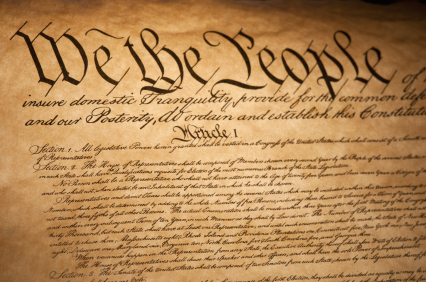
As an Englishman grateful to have the right to live in this fair country, it pains me to see what is happening to both my old country and my new one.  When I was granted my visa, my fiancee visa, from the US Embassy in London I was given a small booklet containing the text of the US Constitution.  Page One is open in front of me at this moment:

We the People of the United States, in Order to form a more perfect Union, establish Justice, insure domestic Tranquility, provide for the common defence, promote the general Welfare, and secure the Blessings of Liberty to ourselves and our Posterity, do ordain and establish this Constitution for the United States of America.

Enough said!

A return to integrity

Can we mend our broken ways? Just possibly.

Yesterday’s long rant was the outcome of me promising ‘a debate’ with Patrice Ayme.  Succinctly, I had disagreed with a comment from Patrice where he had written: “Force is the truth of man. Everything else is delusion, even the vegetarian style.” and wanted to respond within the space of a post rather than the more restrictive comment.

For my disagreement with Patrice had been essentially about his statement, ‘Force is the truth of man‘.  I don’t recall a war in the last 50 years that has been a force for good.

But then it was Alex’s comment, see below, that stopped me short.  For I realised that I was confusing ‘force’ with ‘war’ and that was probably a big mistake on my behalf.  Of course, I’m writing this without the benefit of knowing better what Patrice meant in his comment! Blogging, as powerful a media as it is, does not provide for immediate interaction!

Nevertheless, Alex’s comment yesterday was powerfully inspirational.  Because so many of us (and I include me in that ‘us’) all too often behave as though we are a species utterly divorced from Nature.

I closed yesterday’s post with these words;

So what to do?  Because I am fundamentally at odds with the sentiment expressed by Patrice Ayme; “Force is the truth of man. Everything else is delusion, even the vegetarian style.

The answer takes us to tomorrow’s post, A return to integrity.

And, yes, it does mention dogs!  Rather a lot as it happens!

Dogs are the one species that man has lived with longer than any other species.  So when we refer to the qualities of the dog it is simply because we are so familiar with them.  In no way does that exclude the numerous other species that bond with man and share the same wonderful qualities.

Qualities so easily seen: Love, Honesty, Loyalty, Trust, Openness, Faithfulness, Forgiveness and Affection. Together they are Integrity.

Of course dogs will kill a rabbit, for example, as readily as a cat will kill a mouse.  In this respect force is the truth of Nature.

The only way for species man to survive on this planet is for every element of man’s existence on this planet to be rethought of in terms of the natural order.  Read the comment left by Alex in yesterday’s post:

Hi Paul, what you highlight are examples of disconnection between humanity with nature and each other. I have on my own blog highlighted a concept of Ubuntu – “I am because we are” – which is only possible when the self realises they are part of an inter-connected network of life. Your example of islands of fragmented forest where disconnected wildlife are dying out is how it is with disconnected humanity, we are doomed to destruction because we are cut off from the life-giving connection to nature.

All the problems you highlight are symptoms of the disease of disconnection, until there is reconnection to nature none of these symptoms can be successfully addressed.

War is an integral part of nature, when people seek to dismiss this then they add to the disconnection from nature. I was stung in the face by a drunken wasp a few days ago, this is how it is with nature, it is beautiful but also brutal. Peace and balance are illusions, life is in a becoming because of unbalance and strife. I advocate harmony, like a downhill skier we do not seek to control our surroundings, but instead act in harmony by moving around the obstacles such as rock and tree.

Disconnection can be as large as destroying whole forests by ignorant energy policies to those idiots who kicked a puffball to pieces before I could harvest it, or the new owners of my former home who have taken a chainsaw to all the trees and bushes in the garden. People who are disconnected do not consider how their actions impact nature or people contrary to the philosophy of Ubuntu.

I am because we are!” Each and every one of us is where we are today, for good or ill, because of what we are: part of Nature.  It’s so incredibly obvious – we are a natural species – yet who reading this wouldn’t admit at times to behaving “as though we are a species utterly divorced from Nature.”

Millions of us have pets and animals that we love.  Yet we still miss the key truth of our pets.  That we are a part of Nature, subject to Natural order, just as much as our pets are.  We have so much to learn from our animals.

Take this rather sad story but, nonetheless, a formidable story of the integrity of one species for another.  Watch the video.

oooo

Take this rather happier story about the integrity of one species for another. Watch the video.

oooo

Thus when we see the extraordinary benefits that arise from love and trust, from loyalty and faithfulness, and much more, why oh why is so much of our society fundamentally broken?

As John Hurlburt wrote in a recent email, it is because, “we are spiritual bankrupt. We spend too much of our time thinking about ourselves and what we want and too little of our time thinking about other people and what we all need.”  John went on to add that this spiritual bankruptcy had preceded our moral and economical bankruptcy. He pointed out that the solution to our moral and financial problems, as well as our salvation as individuals and as a species, is spiritual. “We simply need to love the Nature of God, the earth and each other regardless of what we may believe God to be.”

Now whether you are a religious soul, or a heathen, or somewhere in the middle, it matters not.  For if we continue to defy Nature and the natural laws of this planet we are going to be dust before the end of this century.  Again in John’s powerful words:

Denying climate change is a death wish.

Nature always wins in the long run.

Nature is balanced. Are we?

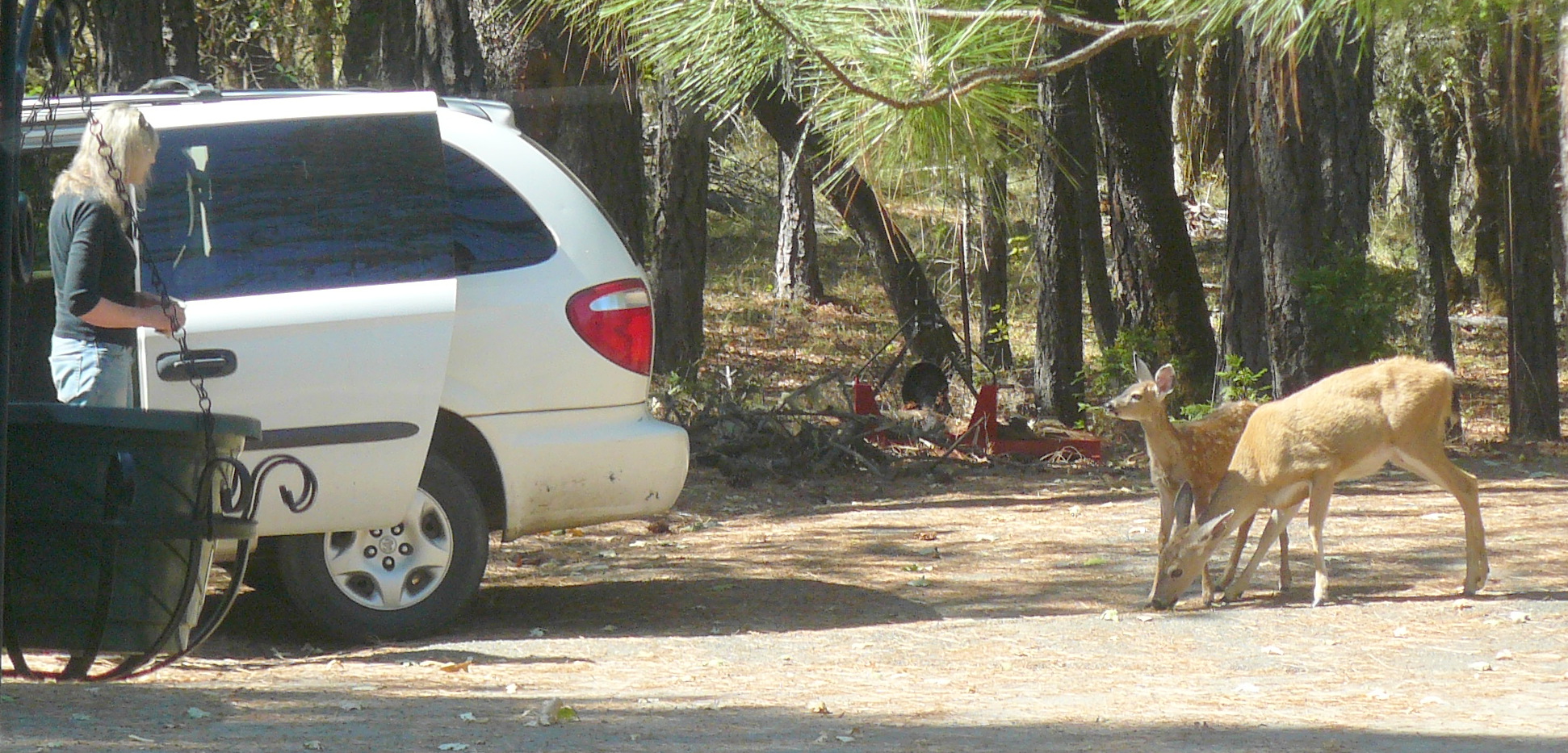
As if to endorse the great examples that Nature offers us in terms of the benefits of love and trust, take a look at these three recent photographs from here in Oregon.

A young timid deer responding to me sitting quietly on the ground.
A young timid deer showing her trust of me as I sat quietly on the ground less than 30 feet away.

oooo

A mother and her fawn trusting Jean's love for them, and getting a good feed!
A mother and her fawn trusting Jean’s love for them, and getting a good feed!

oooo

Sweeny, on back of settee, and Cleo in peace and comfort.
Little Sweeny and Cleo converting trust to peace and happiness.  (Not to mention Jean!)

Now these are not photographs to ‘ooh’ and ‘ah’ over, these are reminders that kindness, generosity, selflessness and trust are part of Nature.  All the great virtues and values of man do not come from a vacuum, they come to us via Nature.

We have been blessed by an evolution that has allowed mankind to achieve remarkable things.  Even to the point of leaving the confines of our planet and setting foot on the Moon and sending probes from out of our Solar System.  There’s a sense, a distinctly tangible sense, that man has conquered all; that we have broken the link from being part of Nature; from being of Nature.

And now Mother Earth is reminding all of her species, every single one of them including species man, that everything is bound by her Natural Laws.

Does this mean that man has to revert to some form of pre-civilised stone-age era?  Of course not!  Progress can be as much within the Natural order than in competition with it, as it has been in recent times.  In fact, Professor Pat Shipman explains our progress is benefited by being part of that Natural order.  Here’s how Amazon describe her book, The Animal Connection.

The Animal Connection: A New Perspective on What Makes Us Human

A bold, illuminating new take on the love of animals that drove human evolution.

Why do humans all over the world take in and nurture other animals? This behavior might seem maladaptive—after all, every mouthful given to another species is one that you cannot eat—but in this heartening new study, acclaimed anthropologist Pat Shipman reveals that our propensity to domesticate and care for other animals is in fact among our species’ greatest strengths. For the last 2.6 million years, Shipman explains, humans who coexisted with animals enjoyed definite adaptive and cultural advantages. To illustrate this point, Shipman gives us a tour of the milestones in human civilization-from agriculture to art and even language—and describes how we reached each stage through our unique relationship with other animals. The Animal Connection reaffirms our love of animals as something both innate and distinctly human, revealing that the process of domestication not only changed animals but had a resounding impact on us as well.

It’s a powerful read and greatly recommended.  Here’s an extract from the book [page 274, my emphasis]:

Clearly, part of the basis of our intimacy with tame or domesticated animals involves physical contact.  People who work with animals touch them.  It doesn’t matter if you are a horse breeder, a farmer raising pigs, a pet owner, a zoo keeper, or a veterinarian, we touch them, stroke them, hug them.  Many of us kiss our animals and many allow them to sleep with us.  We touch animals because this is a crucial aspect of the nonverbal communication that we have evolved over millennia.  We touch animals because it raises our oxytocin levels – and the animal’s oxytocin levels.  We touch animals because we and they enjoy it.

From the first stone tool to the origin of language and the most recent living tools, our involvement with animals has directed our course.

So to round this off.  These last two posts came from my need to debate with Patrice the statement that “Force is the truth of man.”  If Patrice’s meaning was that the truth of man is subject to the force of Nature, then I agree one-hundred percent.

For the time for man to recognise that the force of Nature is “the truth of man” is running out.

Each of us, whoever you are, for the sake of your children and for all of the children in the world, embrace today the qualities, the values of Nature.

Love, Honesty, Loyalty, Trust, Openness, Faithfulness, Forgiveness, Affection.

(Unknown author)

If you can resist treating a rich friend better than a poor friend,

If you can face the world without lies and deceit,

If you can say honestly that deep in your heart you have no prejudice against creed, colour, religion or politics,

Then, my friend, you are almost as good as your dog.

Let us learn from dogs.

Let us return to integrity.

Our broken ways.

Our many broken ways!

Introspection warning! Long rant from me!

On the 21st., I published a post Be in peace this day! It was noting this year’s International Peace Day.  One of the comments left by Patrice Ayme, in response to an earlier comment from Alex Jones, was this:

Alex: I read your message, and I approve it. Very well put. As Lord Keynes said: ”In the end, we are all dead.” Death seems pretty violent to me. Yet, one can live with it, and embrace it, because, as there is no choice, we may as well.

War is not anymore a problem than peace is. What matters most is the harmony of the society with the environment, not strife within. Plutocrats have unbalanced the environment, so they should be reduced, and that means war, because peace certainly will not reduce them.

Force is the truth of man. Everything else is delusion, even the vegetarian style.

To which I replied:

Patrice, as much as I deeply respect your intellect, I fundamentally am at odds with the sentiments you express. But rather than hide behind a short reply that few will read and even fewer take notice of, I’m going to write a post exploring my reactions in detail. As always, your comments are welcomed.

This, then, is that post.

But where oh where to start?  Perhaps by me setting out this general premise.

Wherever one looks, it seems there are examples of madness bordering on the criminally insane.

In so many ways and at so many levels we are running the very real risk that by 2050 the end of this present era of human civilisation by the end of the century will be unavoidable.  Ergo: Born after 1980? Then brace yourself for the end times.

The only solution is to adopt the core values of humanity.  Very soon!

So on to a few examples of the present madness (and I would be the first to admit that I am, perhaps prejudicially, inclined to see the darkness of our present times).

First: Climate Change

The recent IPCC report made it clear that climate change is most likely a result of man’s activities on this planet.  As the summary for policy makers says (selected extracts):

Warming of the climate system is unequivocal, and since the 1950s, many of the observed changes are unprecedented over decades to millennia. The atmosphere and ocean have warmed, the amounts of snow and ice have diminished, sea level has risen, and the concentrations of greenhouse gases have increased.

and

Human influence on the climate system is clear. This is evident from the increasing greenhouse gas concentrations in the atmosphere, positive radiative forcing, observed warming, and understanding of the climate system.

and [my emboldening]

Human influence has been detected in warming of the atmosphere and the ocean, in changes in the global water cycle, in reductions in snow and ice, in global mean sea level rise, and in changes in some climate extremes (Figure SPM.6 and Table SPM.1). This evidence for human influence has grown since AR4. It is extremely likely that human influence has been the dominant cause of the observed warming since the mid-20th century.

George Monbiot in his blog on The Guardian newspaper, wrote:

Former Irish President, Mary Robinson.

But denial is only part of the problem. More significant is the behaviour of powerful people who claim to accept the evidence. This week the former Irish president Mary Robinson added her voice to a call that some of us have been making for years: the only effective means of preventing climate breakdown is to leave fossil fuels in the ground. Press any minister on this matter in private and, in one way or another, they will concede the point. Yet no government will act on it.

As if to mark the publication of the new report, the Department for Business, Innovation and Skills has now plastered a giant poster across its ground-floor windows: “UK oil and gas: Energising Britain. £13.5bn is being invested in recovering UK oil and gas this year, more than any other industrial sector.”

The message couldn’t have been clearer if it had said “up yours”. It is an example of the way in which all governments collaborate in the disaster they publicly bemoan. They sagely agree with the need to do something to avert the catastrophe the panel foresees, while promoting the industries that cause it.

It doesn’t matter how many windmills or solar panels or nuclear plants you build if you are not simultaneously retiring fossil fuel production. We need a global programme whose purpose is to leave most coal and oil and gas reserves in the ground, while developing new sources of power and reducing the amazing amount of energy we waste.

But, far from doing so, governments everywhere are still seeking to squeeze every drop out of their own reserves, while trying to secure access to other people’s. As more accessible reservoirs are emptied, energy companies exploit the remotest parts of the planet, bribing and bullying governments to allow them to break open unexploited places: from the deep ocean to the melting Arctic.

And the governments who let them do it weep sticky black tears over the state of the planet.

The BBC News website published some reactions from notable people.  Take this one:

Kevin Anderson, professor of energy and climate change at the University of Manchester

What has changed significantly since the last report is that we have pumped an additional 200 billion tonnes of CO2 into the atmosphere. Annual emissions are now 60% higher than at the time of the first report in 1990 and atmospheric CO2 levels are the highest they have been for over two million years.

So what are we doing in the UK to help reverse this reckless growth in emissions? Record levels of investment in North Sea oil, tax breaks for shale gas, investment in oil from tar sands and companies preparing to drill beneath the Arctic.

Against this backdrop, the UK Treasury is pushing for over 30 new gas power stations, whilst the government supports further airport expansion and has dropped its 2030 decarbonisation target – all this alongside beleaguered plans for a few wind farms and weak energy efficiency measures. Governments, businesses and high-emitting individuals around the world now face a stark choice: to reduce emissions in line with the clear message of the IPCC report, or continue with their carbon-profligate behaviour at the expense of both climate-vulnerable communities and future generations.

OK, let’s move to another example of our collective madness.

Second: The way we treat the natural wildlife.

Last Thursday, the New York Times published an item about a recent report confirming the terrible cost to our wildlife of fragmenting their habitat.  Here are the opening paragraphs, including the leading photograph in that NYT piece.

In Fragmented Forests, Rapid Mammal Extinctions

27zimmer-articleLarge-1
An isolated forest in the Chiew Larn reservoir. A Thai government project to supply hydroelectric power to the area transformed 150 forested hilltops into islands. ANTONY LYNAM
By CARL ZIMMER
September 26, 2013

In 1987, the government of Thailand launched a huge, unplanned experiment. They built a dam across the Khlong Saeng river, creating a 60-square-mile reservoir. As the Chiew Larn reservoir rose, it drowned the river valley, transforming 150 forested hilltops into islands, each with its own isolated menagerie of wildlife.

Conservation biologists have long known that fragmenting wilderness can put species at risk of extinction. But it’s been hard to gauge how long it takes for those species to disappear. Chiew Larn has given biologists the opportunity to measure the speed of mammal extinctions. “It’s a rare thing to come by in ecological studies,” said Luke Gibson, a biologist at the National University of Singapore.

Over two decades, Dr. Gibson and his colleagues have tracked the diversity of mammals on the islands. In Friday’s issue of the journal Science, they report that the extinctions have turned out to be distressingly fast.

“Our results should be a warning,” said Dr. Gibson. “This is the trend that the world is going in.”

On a similar theme, many will recall my post back on the 19th, Pity the bees; pity us when I drew attention to the drastic reduction in the numbers of wild bees, including the quote  “the vanishing honeybee could be the herald of a permanently diminished planet.

Guard their future - and ours!
Guard their future – and ours!

Third: Money and power.

Again from The New York Times but this time an essay by Paul Krugman.

OP-ED COLUMNIST

Plutocrats Feeling Persecuted

By 

Published: September 26, 2013

Robert Benmosche, the chief executive of the American International Group, said something stupid the other day. And we should be glad, because his comments help highlight an important but rarely discussed cost of extreme income inequality — namely, the rise of a small but powerful group of what can only be called sociopaths.

For those who don’t recall, A.I.G. is a giant insurance company that played a crucial role in creating the global economic crisis, exploiting loopholes in financial regulation to sell vast numbers of debt guarantees that it had no way to honor. Five years ago, U.S. authorities, fearing that A.I.G.’s collapse might destabilize the whole financial system, stepped in with a huge bailout. But even the policy makers felt ill used — for example, Ben Bernanke, the chairman of the Federal Reserve, later testified that no other episode in the crisis made him so angry.

And it got worse. For a time, A.I.G. was essentially a ward of the federal government, which owned the bulk of its stock, yet it continued paying large executive bonuses. There was, understandably, much public furor.

So here’s what Mr. Benmosche did in an interview with The Wall Street Journal: He compared the uproar over bonuses to lynchings in the Deep South — the real kind, involving murder — and declared that the bonus backlash was “just as bad and just as wrong.”

OK, that’s enough ‘copying’ from me so please go and read more about the plight of those poor billionaires.  But if the NYT and Paul Krugman will forgive me, here’s the paragraph towards the end of the Krugman essay that makes me sick [my emboldening]:

The thing is, by and large, the wealthy have gotten their wish. Wall Street was bailed out, while workers and homeowners weren’t. Our so-called recovery has done nothing much for ordinary workers, but incomes at the top have soared, with almost all the gains from 2009 to 2012 going to the top 1 percent, and almost a third going to the top 0.01 percent — that is, people with incomes over $10 million.

(Patrice Ayme has a parallel essay over at his blog.)

Staying with the struggles of our billionaires for a moment longer, try the recent report on Bloomberg about the recent Monaco Yacht Show that included this:

As the yacht size has stretched — this year saw the launch of a record-holding 590-footer called the Azzam — so has the list of distractions onboard. Soaking in a jacuzzi, shooting hoops on a floating court or playing a baby grand Steinway piano no longer cut it.

“There is a change in attitude of super-yacht owners,” said Bert Houtman, founder and chairman of the Netherlands-based U-Boat Worx, surveying two of his submarine models on display quai-side in Monaco. “They’re fed up with drinking white wine and riding jet skis so they’re looking for another thrill.”

later including:

“A lot of guys who are billionaires have profound financial accomplishments and are now concerned about their legacy,” said Deppe. (Marc Deppe, Triton Subs vice-president of sales and marketing.)

It’s enough to make one weep!

Fourth: Politicians and governments not serving their peoples.

Making this my last example.  Simply because a recent item published on Naked Capitalism had so much detail on what is wrong with our leaders; in this particular case regarding the American Affordable Care Act (ACA).  This is how the article opens:

ObamaCare’s shameful and lethal three-year history — and future

Many people, and especially Obama supporters, characterize the ACA (ObamaCare) as “just starting” or a “work in progress” and then go on to urge that the program will have “glitches,” needs to be “tweaked,” isn’t yet “fully implemented,” and so forth. We think it’s a mistake to see the ACA as just starting. We also think it’s a mistake not to weigh the costs of ObamaCare’s stately three-year progress toward partial coverage for the the American people, and just as important to weigh the opportunity costs.

The ACA was passed in March 2010, incorporating many features designed to meet Republican objections to the Bill. Yet, in the end, Democrats never put Medicare for All on the table, abandoned the public option and many other features, and did not get a single Republican vote in either chamber.

The Democrats even saw to it that the bill was fiscally neutral over a 10 year projection at a time when the tanked economy needed more deficit spending and the jobs that would have brought. And to do that, they postponed implementation of most of the bill for more than three years, until now, allowing people to go without care, to die, to divorce, and to lose their homes or go bankrupt due to medical bills, just so they could argue that the bill was fiscally neutral. In gauging the record of the bill, these 3 to 3.5 years of waiting for its implementation and their real costs to the people of the United States must be taken into account.

It also must be taken into account that in the year before the ACA was passed there were some 45 million Americans uninsured, and they were dying at the rate of 1,000 more for every million than in the general population. That is, lack of insurance was causing more than 45,000 fatalities per year. (The cost of those deaths in money terms: $1.38 trillion).

This is how the article closes [my emphasis]:

That’s what we’ve lost by not trying to pass HR 676 and by trying instead to take a bipartisan insurance company conciliation approach to passing the ACA. This post, gives the total for the anticipated opportunity cost by comparing Romney’s 2012 alternative to the ACA, the baseline of no reform at all, the ACA, and Medicare for All over the period 2010 – 2022. Bottom line: the ACA is projected to cost 286,500 lives through 2022, assuming no change. That’s a lot better than the baseline and a lot better than Romney’s 2012 alternative. But it’s still terrible compared to what we might have had if we had a President who really represented people rather than Wall Street.

What if an effort to pass HR 676 had failed in 2009 because too many Democrats in the Senate defected to pass it? Well, I think this would have been very unlikely with the very large Democratic majority and the popularity of the president at its height, but even if it would have failed, then the Democrats could still have compromised with members of their party to pass enhanced Medicare for All for everyone under 26 and over 45, or under 26 and over 50, or whatever compromise would have moved those wayward Democrats up to the 50 vote mark. Such a compromise bill would still have lowered the fatalities substantially by providing insurance for those who needed it most and by enhancing the Medicare program for seniors (full coverage and no co-pays). It would also have been something Democrats could have run on and built upon in each successive election year, rather than having to defend the sorry ACA with its package of inadequate goodies, silly mandate, IRS enforcement, high cost for lousy coverage, and Rube Goldberg eligibility determination. Again there would have been no Tea Party, because Tea Partiers like Medicare, and there would have been no Republican nationwide sweep in 2010, no gerrymandering, no voter suppression, no anti-woman bills, and none of all the rest of the nonsense we’ve seen because the Democrats did what they did.

Earlier in the post I offered a general premise that included, “Wherever one seems to look there are examples of madness bordering on the criminally insane.

To my mind, these examples support that premise. Trust me, there are countless more examples.

So what to do?  Because I am fundamentally at odds with the sentiment expressed by Patrice Ayme; “Force is the truth of man. Everything else is delusion, even the vegetarian style.

The answer takes us to tomorrow’s post, A return to integrity.

And, yes, it does mention dogs!  Rather a lot as it happens!

Passionate involvement!

This is beginning to look like a theme!

Regular followers will be aware that both Monday’s post, The growth of empathy, and Tuesday’s post, Questions without answers, had a common theme. That of “the rising consciousness of all the millions of ordinary people just trying to leave the world in a better place”, as I wrote on Monday, in contrast, even stark contrast, with the blindness, for want of a stronger term, of those charged with governing our societies.

Around 12:45 on Monday I received a note that there was another follower of Learning from Dogs. Here is that note:

dcardiff just started following you at http://learningfromdogs.com. They will receive an email every time you publish a post. Congratulations.

You might want to go see what they’re up to! Perhaps you will like their blog as much as they liked yours!

Like many other bloggers I try and go to whatever blog site that follower has and leave a ‘thank you’ message.

So off I went to Gotta Find a Home.  The blogsite is by Dennis Cardiff and the sub-title of the blog is The plight of the homeless.

Here’s how Dennis introduces his blog:

Throughout the past few years I have come to know many people, now friends, who for various reasons are, or were, homeless. Antonio, slept on a park bench and was beaten, had his teeth kicked out, for no other reason than his choice to sleep outdoors. He is a small, gentle man who has a phobia about enclosed spaces.

Craig, slept on the sidewalk in the freezing cold. I see him every morning and am never sure if, when I lift the corner of his sleeping bag, I will find him dead or alive. Sometimes, he confided, he would prefer never to awake.

Joy is a friend who fell on hard times. She slept behind a dumpster in back of Starbucks. I have seen her with blackened eyes, bruised legs, cracked ribs, cut and swollen lips. I usually see her sitting on the sidewalk ‘panning’ for change.

I can’t do much for these people except to show them love, compassion, an ear to listen, perhaps a breakfast sandwich and a coffee. I would like to do more. To know them is to love them. What has been seen cannot be unseen. I have started to write an account of their daily lives. I intend to turn this into a book and have it published. That is my goal.

I am writing articles and biographies of Joy and other street people. They have been informed that they don’t have to use their real names, that any profits would go back to the homeless and that it could be a vehicle to say whatever they want to the population at large.

Not only does that stir one’s heart and conscience but more so the fact that there are 6,069 followers of Dennis’s blog.

Please, please go along to Gotta Find A Home and embrace what wonderful people like Dennis and countless others are doing in this world. Go and read how the blogsite came about:

My lungs ached, as frost hung in the bitterly cold December morning air, making breathing difficult. I trudged in the falling snow toward Place Bell where I work, in the city’s gray, concrete, office tower canyon. I dodged other pedestrians, also trying to get to work on time, I noticed a woman seated cross-legged on the sidewalk with her back against the wall of the library. A snow-covered Buddha wrapped in a sleeping bag, shivering in the below freezing temperature. I guessed her to be in her forties. Everything about her seemed round. She had the most angelic face, sparkling blue eyes and a beautiful smile. A cap was upturned in front of her. I thought,There but for the grace of God go I. Her smile and blue eyes haunted me all day.

In the past I’ve been unemployed, my wife and I were unable to pay our mortgage and other bills, we went through bankruptcy, lost our house, my truck. Being in my fifties, my prospects looked dim. It could have been me, on the sidewalk, in her place.

I’ve been told not to give money to pan handlers because they’ll just spend it on booze. I thought to myself, What should I do, if anything? What would you do? I asked for advice from a friend who has worked with homeless people. She said, “The woman is probably hungry. Why don’t you ask her if she’d like a breakfast sandwich and maybe a coffee?”

That sounded reasonable, so the next day I asked, “Are you hungry? Would you like some breakfast, perhaps a coffee?”

“That would be nice,” she replied.

When I brought her a sandwich and coffee she said to me, “Thank you so much, sir. You’re so kind. Bless you.” I truly felt blessed.

This has become a morning routine for the past two and a half years. The woman (I’ll call Joy) and I have become friends. Often I’ll sit with her on the sidewalk. We sometimes meet her companions in the park. They have become my closest friends. I think of them as angels. My life has become much richer for the experience.

Reflect on how when you see a homeless person with so little, how so often they have a dog.

The power of love.
The power of love.

To close, let me tell you more about the photograph.  I saw it on the blogsite Erick’s Odyssey in the following post.

This is how a real man treats his best friend

A friend of mine posted this photo on their Facebook wall. Like most people when they first see it, I was overwhelmed with several emotions.

First of all, I felt a swell of compassion for these two. I don’t even know them, but I was immediately concerned with their wellbeing. I wanted them to be warm and fed, and protected.

Secondly, I was touched with the apparent love and friendship shared by the two, even though they are not even of the same species. I thought, “They may have nothing, but they have each other, so they have everything.” I don’t know by what circumstance this man and this dog came to be together, living on the streets, but I think it is a reflection of the callousness of our society.

Whatever the reason they are homeless, they are an opportunity for us, those who have the necessities of life in abundance, to show kindness and compassion. Remember this the next time you drive by a similar scene in your warm car. Remember that if you were in their shoes, you would want, or even if you would be too ashamed to ‘want,’ you would ‘need’ someone to help you.

Our apathy is what makes us truly destitute.

Yet another example of the power of this new world of interconnectedness and how, ultimately, those connections between all those millions who care will bring about a new caring era!

Questions without answers.

Why is truth so often the first casualty?

As is the way of things, my post yesterday, The growth of empathy, unwittingly set the scene for today’s post.  Here’s why!

In yesterday’s post I mentioned Fukushima and the power of blogging in connecting so many all across the world.  Maurice Barry, who writes his own blog, left a comment:

Regarding Fukashima I’m still left wondering whether the real problem is the lack of social conscience in the top level leaders or the apathy of ordinary people like you and I who let them carry out their plans.

To which I replied, “Maybe just the power of 20:20 hindsight?”

So to today’s post.

One of the items in yesterday’s Naked Capitalism Links was the headline: Is there a media blackout on the fracking flood disaster in Colorado? That caught my eye and in a moment I had gone across to the blogsite: Bluedaze Drilling Reform.

This is what I read:

Is there a media blackout on the fracking flood disaster in Colorado?

by TXSHARON on SEPTEMBER 15, 2013

in UNCATEGORIZED

See update below before trying to post a comment.

I will update this post as residents send me pictures and video.

We need the national news stations to go cover the environmental disaster that’s happening in Colorado right now.

This picture taken by a resident is from yesterday.

From an email.

flood-in-Weld-County-yesterday-Sept-13-e1379256241135
I see you’ve noticed the underwater wells in Weld County, Colorado. Amazing; we’ve emailed the Denver TV stations, other media, and state and local politicians. We’ve sent pictures that our members have taken. It’s like the media and politicians have been TOLD not to say anything about it. There has been no mention of the gas wells on the Denver newscasts either last night or this evening although all stations have had extensive and extended flood coverage. You can see underwater wells in the background of some of the newscast videos, and yet the reporters say absolutely nothing.

Here’s a picture one of our members took yesterday in Weld County, Colorado. We’ve got tons more on our website. Check it out. The tanks are tipping and, in some cases, have fallen over. They have to be leaking toxins into the flood waters. There have to be hundreds if not thousands of underwater well pads in Weld County as a result of the flooding.

Please publicize this in Texas since our media people and politicians have gone silent!

https://www.facebook.com/EastBoulderCountyUnited

East Boulder County United

Lafayette, Colorado

Post from yesterday shows leaking tank floating down the river.

WeldCountyFloatingTank-e1379213713195

The reason I called today’s post ‘Questions without answers’ was because there are so many complex issues today.  So many issues that cannot be understood in simple ‘question and answer’ ways.  But one hope of finding answers to the complex questions of these times is through the sharing, caring ways of communicating that so many can access.  No more passionately demonstrated than by TXSharon in her About section of her blog.

Finally, I shall leave you with another great dog picture from Chris Snuggs.  So beautifully appropriate to the complex world we live in.

sunsetdog

But what does it all MEAN?

The growth of empathy.

As they say in the old country, it’s an ill wind that doesn’t blow anyone any good!

So often when I stare at the screen wondering just what on earth to write about, along comes something to fire me up.

In this case, it was a small clutch of disconnected items that seemed to have a common thread for me.

The first was reading the links in this morning’s Naked Capitalism summary and seeing this:

The REAL Fukushima Danger

Posted on September 14, 2013 by WashingtonsBlog

The Real Problem …

The fact that the Fukushima reactors have been leaking huge amounts of radioactive water ever since the 2011 earthquake is certainly newsworthy.  As are the facts that:

But the real problem is that the idiots who caused this mess are probably about to cause a much biggerproblem.

Specifically, the greatest short-term threat to humanity is from the fuel pools at Fukushima.

If one of the pools collapsed or caught fire, it could have severe adverse impacts not only on Japan … but the rest of the world, including the United States.   Indeed, a Senator called it a national security concern for the U.S.:

The radiation caused by the failure of the spent fuel pools in the event of another earthquake could reach the West Coast within days. That absolutely makes the safe containment and protection of this spent fuel a security issue for the United States.

Nuclear expert Arnie Gundersen and physician Helen Caldicott have both said that people should evacuate the Northern Hemisphere if one of the Fukushima fuel pools collapses. Gundersen said:

Move south of the equator if that ever happened, I think that’s probably the lesson there.

Former U.N. adviser Akio Matsumura calls removing the radioactive materials from the Fukushima fuel pools “an issue of human survival”.

So the stakes in decommissioning the fuel pools are high, indeed.

But in 2 months, Tepco – the knuckleheads who caused the accident – are going to start doing this very difficult operation on their own.

The New York Times reports:

Thousands of workers and a small fleet of cranes are preparing for one of the latest efforts to avoid a deepening environmental disaster that has China and other neighbors increasingly worried: removing spent fuel rods from the damaged No. 4 reactor building and storing them in a safer place.

The Telegraph notes:

Tom Snitch, a senior professor at the University of Maryland and with more than 30 years’ experience in nuclear issues, said  “[Japan officials] need to address the real problems, the spent fuel rods in Unit 4 and the leaking pressure vessels,” he said. “There has been too much work done wiping down walls and duct work in the reactors for any other reason then to do something….  This is a critical global issue and Japan must step up.”

Apologies, that’s more than sufficient to ruin your day!  If you really want to read to the end, the item is here.

However, the next item carries a much more positive thread.  It was an essay that was highlighted on Linked-In back in June.

The Number One Job Skill in 2020

What’s the crucial career strength that employers everywhere are seeking — even though hardly anyone is talking about it? A great way to find out is by studying this list of fast-growing occupations, as compiled by the U.S. Bureau of Labor Statistics.

Sports coaches and fitness trainers. Massage therapists, registered nurses and physical therapists. School psychologists, music tutors, preschool teachers and speech-language pathologists. Personal financial planners, chauffeurs and private detectives. These are among the fields expected to employ at least 20% more people in the U.S. by 2020.

Did you notice the common thread? Every one of these jobs is all about empathy.

In our fast-paced digital world, there’s lots of hand-wringing about the ways that automation and computer technology are taking away the kinds of jobs that kept our parents and grandparents employed. Walk through a modern factory, and you’ll be stunned by how few humans are needed to tend the machines. Similarly, travel agents, video editors and many other white-collar employees have been pushed to the sidelines by the digital revolution’s faster and cheaper methods.

But there’s no substitute for the magic of a face-to-face interaction with someone else who cares. Even the most ingenious machine-based attempts to mimic human conversation (hello, Siri) can’t match the emotional richness of a real conversation with a real person.

Coincidentally, that thought about the ‘magic of a face-to-face interaction’ really echoed in me.  Why?  Because, I was ruminating on the wonderful world of human interaction this world of blogging delivers.  It seems to combine all the benefits of meeting real people with a global consciousness of those same real people spread way beyond our own local domains.

Hence  the reason why I offer the next seemingly unrelated item. The recent post from Sue Dreamwallker that I am republishing in full.

A Big Thank You to you ALL.

by Sue Dreamwalker

many-thanks-to-all_thumb

This is just a short post to say a Big thank you to all of my readers and to those who visit regular and comment upon my posts. You Bring with you such light and encouragement, and I often at a loss to say how much your kind support means.

I logged onto my Blog today and discover that my readership has swelled to 400 followers and so I just want to say a Big thank you for all of my oldest friends who have been with me since my beginnings of Windows Live Spaces days when I started in 2007, My first real post after transferring was called Finding Answers  here on WordPress.  And I remember well spending the best part of a Day getting to know and personalise my header  and  Blog back then as everything was alien that day was in Oct 2010.  A move I am so pleased to have made, as I just love the W.P. Community of friends we have gathered here and whom I have got to know and love.

And I just want to say a big thank you to all of my newest arrivals who have clicked the follow button.. I hope to get around to discovering your blogs as soon as time allows.And to say thank you to my email subscribers also.. And Welcome, I hope you enjoy my thoughts and if not please don’t be shy to air your opinions for that’s how we grow and learn by sharing knowledge and understanding.

Today I just want to post what I have been up to in recent days besides  the ‘Day-job’ in picture format.. So if you click the photos, you should be able to read more in the caption headings.. [Photos available on Sue’s blogsite.]

Take care all of you and I have a busy week a head in my Day Job, so I will catch you when I can…

Love and Blessings

~Sue~

Still the resonances continued.  For Rebecca Solnit published yesterday an incredibly powerful essay over on TomDispatch.  It was called Victories Come in All Sizes.  As always, Tom writes a wonderful introduction.  Let me skip to Rebecca’s opening paragraphs.

Joy Arises, Rules Fall Apart 
Thoughts for the Second Anniversary of Occupy Wall Street 
By Rebecca Solnit

I would have liked to know what the drummer hoped and what she expected. We’ll never know why she decided to take a drum to the central markets of Paris on October 5, 1789, and why, that day, the tinder was so ready to catch fire and a drumbeat was one of the sparks.

To the beat of that drum, the working women of the marketplace marched all the way to the Palace of Versailles, a dozen miles away, occupied the seat of French royal power, forced the king back to Paris, and got the French Revolution rolling. Far more than with the storming of the Bastille almost three months earlier, it was then that the revolution was really launched — though both were mysterious moments when citizens felt impelled to act and acted together, becoming in the process that mystical body, civil society, the colossus who writes history with her feet and crumples governments with her bare hands.

She strode out of the 1985 earthquake in Mexico City during which parts of the central city collapsed, and so did the credibility and power of the Institutional Revolutionary Party, the PRI that had ruled Mexico for 70 years. She woke up almost three years ago in North Africa, in what was called the Arab Spring, and became a succession of revolutions and revolts still unfolding across the region.

Such transformative moments have happened in many times and many places — sometimes as celebratory revolution, sometimes as terrible calamity, sometimes as both, and they are sometimes reenacted as festivals and carnivals. In these moments, the old order is shattered, governments and elites tremble, and in that rupture civil society is born — or reborn.

It really is an essay that you need to read in full.

However, this further extract covering the closing paragraphs explains why it resonated so strongly with me in terms of the rising consciousness of all the millions of ordinary people just trying to leave the world in a better place:

Part of what gave Occupy its particular beauty was the way the movement defined “we” as the 99%.  That (and that contagious meme the 1%) entered our language, offering a way of imagining the world so much more inclusive than just about anything that had preceded it. And what an inclusive movement it was: the usual young white suspects, from really privileged to really desperate, but also a range of participants from World War II to Iraq War veterans to former Black Panthers, from libertarians to liberals to anarchist insurrectionists, from the tenured to the homeless to hip-hop moguls and rock stars.

And there was so much brutality, too, from the young women pepper-sprayed at an early Occupy demonstration and the students infamously pepper-sprayed while sitting peacefully on the campus of the University of California, Davis, to the poet laureate Robert Hass clubbed in the ribs at the Berkeley encampment, 84-year-old Dorli Rainey assaulted by police at Occupy Seattle, and the Iraq War veteran Scott Olsen whose skull was fractured by a projectile fired by the Oakland police. And then, of course, there was the massive police presence and violent way that in a number of cities the movement’s occupiers were finally ejected from their places of “occupation.”

Such overwhelming institutional violence couldn’t have made clearer the degree to which the 1% considered Occupy a genuine threat. At the G-20 economic summit in 2011, the Russian Prime Minister, Dmitry Medvedev, said, “The reward system of shareholders and managers of financial institution[s] should be changed step by step. Otherwise the ‘Occupy Wall Street’ slogan will become fashionable in all developed countries.” That was the voice of fear, because the realized dreams of the 99% are guaranteed to be the 1%’s nightmares.

We’ll never know what that drummer girl in Paris was thinking, but thanks to Schneider’s meticulous and elegant book, we know what one witness-participant was thinking all through the first year of Occupy, and what it was like to be warmed for a few months by that beautiful conflagration that spread across the world, to be part of that huge body that wasn’t exactly civil society, but something akin to it, perhaps in conception even larger than it, as Occupy encampments and general assemblies spread from Auckland to Hong Kong, from Oakland to London in the fall of 2011. Some of them lasted well into 2012, and others spawned things that are still with us: coalitions and alliances and senses of possibility and frameworks for understanding what’s wrong and what could be right. It was a sea-change moment, a watershed movement, a dream realized imperfectly (because only unrealized dreams are perfect), a groundswell that remains ground on which to build.

On the second anniversary of that day in lower Manhattan when people first sat down in outrage and then stayed in dedication and solidarity and hope, remember them, remember how unpredictably the world changes, remember those doing heroic work that you might hear little or nothing about but who are all around you, remember to hope, remember to build. Remember that you are 99% likely to be one of them and take up the burden that is also an invitation to change the world and occupy your dreams.

Rebecca Solnit, author most recently of The Faraway Nearby spent time at Occupy San Francisco, Occupy Oakland, and Occupy Wall Street in 2011 and wrote about Occupy often for TomDispatch in 2011-2012. This essay is adapted from her introduction to Nathan Schneider’s new book, Thank You, Anarchy (University of California Press).

Copyright 2013 Rebecca Solnit

The final element was from an email yesterday in from Chris Snuggs.  Chris has previously written guest posts on Learning from Dogs, the last one being In Defence of Politics back on July 8th.  In that email was the following photograph.

"You touch my mate and I'll have ya."
“You touch my mate and I’ll have ya.”

Let me draw out the thread that I saw in all these items.

That is that the 1% that Rebecca Solnit wrote about are incredibly powerful people, with access to more power, money and control than one can even imagine.  But what that 1% cannot control is the growing consciousness, the growing mindfulness and awareness of millions of people across this planet that something as simple and pure and beautiful as unconditional love will conquer all.

The most fundamental lesson that we can learn from dogs!

In the name of progress!

Or might that be in the name of insanity?

John Hurlburt is a frequent contributor to Learning from Dogs, as a quick search through the blog will reveal.

A few days ago, John sent Jean and me a film to watch.  It was the documentary Surviving Progress.  We watched it on Monday evening.  Here’s more on the film and related information.

survivingprogresssplash3

Here’s the trailer.

Published on Apr 6, 2012

Surviving Progress Trailer (Documentary 2012).

Directed by Mathieu Roy, Surviving Progress documentary film is based on the best selling book A Short History of Progress. From Executive Producer Martin Scorsese, this provocative documentary explores the concept of progress in our modern world, guiding us through a sweeping but detailed survey of the major “progress traps” facing our civilization in the arenas of technology, economics, consumption, and the environment….

Like all films these days, there is an associated website, from which one can read the synopsis, as follows:

“Every time history repeats itself the price goes up.”

Surviving Progress presents the story of human advancement as awe-inspiring and double-edged. It reveals the grave risk of running the 21st century’s software — our know-how — on the ancient hardware of our primate brain which hasn’t been upgraded in 50,000 years. With rich imagery and immersive soundtrack, filmmakers Mathieu Roy and Harold Crooks launch us on a journey to contemplate our evolution from cave-dwellers to space explorers.

Ronald Wright, whose best-seller, “A Short History Of Progress” inspired this film, reveals how civilizations are repeatedly destroyed by “progress traps” — alluring technologies serve immediate needs, but ransom the future. With intersecting stories from a Chinese car-driving club, a Wall Street insider who exposes an out-of-control, environmentally rapacious financial elite, and eco-cops defending a scorched Amazon, the film lays stark evidence before us. In the past, we could use up a region’s resources and move on. But if today’s global civilization collapses from over-consumption, that’s it. We have no back-up planet.

Surviving Progress brings us thinkers who have probed our primate past, our brains, and our societies. Some amplify Wright’s urgent warning, while others have faith that the very progress which has put us in jeopardy is also the key to our salvation. Cosmologist Stephen Hawking looks to homes on other planets. Biologist Craig Venter, whose team decoded the human genome, designs synthetic organisms he hopes will create artificial food and fuel for all.

Distinguished Professor of Environment Vaclav Smil counters that five billion “have-nots” aspire to our affluent lifestyle and, without limits on the energy and resource-consumption of the “haves”, we face certain catastrophe. Others — including primatologist Jane Goodall, author Margaret Atwood, and activists from the Congo, Canada, and USA — place their hope in our ingenuity and moral evolution.

Surviving Progress leaves us with a challenge: To prove that making apes smarter was not an evolutionary dead-end.

WikiPedia adds:

Surviving Progress is a 2011 Canadian documentary film loosely based on A Short History of Progress, a book and a 2004 Massey Lecture series by Ronald Wright about societal collapse. The film was produced by Daniel LouisDenise Robert, and Gerry Flahive and written/directed by Mathieu Roy and Harold Crooks.

So now to reactions to the film.

To say that it was compelling watching is both correct and, yet, emotionally disconnected.

The blunt truth is that the film is scary beyond belief.  Like watching a giant wave about to engulf you, or a snake about to strike; nothing to do but be transfixed; to be mesmerized by these last few moments of your life.

Because a reasonable conclusion to the weight of evidence put forward by the film is that the time left to pull back from the certainty of the end of life on Planet Earth is minuscule. By that I mean we are speaking of a decade, perhaps two at most.  Ninety-nine percent of the people reading this, living in your neighborhood, or your region, or your country will suffer the terrible consequences of the impending end of this planet as a home for life.

Unless?

Unless there is most incredible awakening of global consciousness in the next two or three years.  Unless the free world, from the highest in those lands to the vast masses of decent, working people, say, “Enough is enough.”

Unless every level of society, from local and national Governments, from Universities, from Churches, from employers both large and small, recognize that this time it’s different.  This is about to become a global crisis.

I taken the following from the Amazon page for Ronald Wright’s book A Short History of Progress, that inspired the film:

From Neanderthal man to the Sumerians to the Roman Empire, A Short History of Progress dissects the cyclical nature of humanity’s development and demise, the 10,000-year old experiment that we’ve unleashed but have yet to control. It is Wright’s contention that only by understanding and ultimately breaking from the patterns of progress and disaster that humanity has repeated around the world since the Stone Age can we avoid the onset of a new Dark Age.

the 10,000-year old experiment that we’ve unleashed but have yet to control.

So let’s seek some solace.  Back to John Hurlburt who in a post in July, Maybe home is found in our quietness, offered this:

Evening Meditation

Our world is increasingly spiritually, morally, mentally, physically and economically bankrupt. Many people would like to change the world one way or another. Most don’t really know why. Some folks simply don’t care. The idea is to leave life a bit better than we found it when we were born.

The fact is we’re all intrinsically sacred in a universe we didn’t create. We tend to prioritize illusion and delusion above reality. Playing God is a precursor of evil.  A supreme faith in Money is self contradictory and ultimately fatal. Arrogance compounds the problem.

We connect in unified awareness through serene meditation. We experience harmony within an emerging celestial symphony. Answers flow from the inside out as we surrender to the eternal energy flow.

Be still and know…

an old lamplighter

I was going to close with a quotation from that most famous of Brits, Winston Churchill.  The one that goes:  “To improve is to change; to be perfect is to change often.”

But after I had put the post ‘to bed’, so to speak, I started to read the Transition Primer from Transition US.  It was such a positive message that I decided to write about Transition tomorrow. Then there was a quote in the Primer that just had to be the one to close today’s post.

“Never doubt that a small group of thoughtful, committed citizens can change the world.  Indeed, it is the only thing that ever has.”

Margaret Mead.

Ever noticed how quickly a dog returns to wagging its tail!