Category: Morality

We are all connected.

Such a fundamental aspect of all conscious life on Planet Earth.

As many of you know, weekend posts on Learning from Dogs are usually pretty innocuous.  But two things came together to make me want to offer today’s central thoughts while they were fresh and clear in my mind.

The first thing flowed from good friend, John Hurlburt. Together with Jon Lavin, John had helped me develop my Statement of Purpose for my book.  It was John who proposed a chapter under the heading of “The biological interconnectedness of all conscious earthly life“; a proposal I embraced with open arms.

The second thing was that Alex Jones, he of the blog The Liberated Way, published a post yesterday that, succinctly and beautifully, supported John Hurlburt’s thesis.

What do we mean by the idea that all of us are connected? (…. and ignoring the many of you who wonder why the question even has to be asked.)

I’m going to answer that most fundamental of all questions in this rather roundabout manner.

As someone who in previous times has been a glider pilot (aka sailplane in US speak), and a long-distance sailor (Tradewind 33), the weather about me was very much part of my life. Long ago I came to love clouds.  Yesterday morning we had to take puppy Oliver to the vet and, unusually for this time of year in Southern Oregon, overhead there were beautiful grey stratus clouds covering 90% of the sky.  There wasn’t the time to grab my camera but the following stock photograph found on the web is close to what we saw.

Still en-route in answer to the question, take a look at the next photograph; also from the web.

clouds animals lions 3277x2048 wallpaper_www.wallpaperfo.com_49

Now to the next photograph. (Hang on in there!)

stratocumulus

See how the road, a man-made road stretching away to the horizon, is such an intimate part of the landscape and the sky.

Now to my final photograph.

Watch-the-Lion-Whisperer-Hug-and-Play-with-Animals-in-the-WIld

I see a strong and clear theme behind these four beautiful images. A theme that answers the question of what we mean by the idea that all of us are connected.

It is this.

Our planet’s atmosphere gives us all that we need to live.  All the oxygen and water and other essentials for all of life. Over millions of years it has provided all that life has needed to evolve and grow.

The land prospered. Beautiful animals arrived. Then came man and over time he left his mark on the lands of the planet. For aeons of time, man and animals shared their lives upon the land. Indeed, man and animals frequently demonstrated they had the capacity to love each other without denying the fact that both man and animals, in many cases, were also meat-eaters. To state the obvious, the beauty of the obvious, is to say that everything on this planet is connected under Nature. Man, animals, lands: all part of that same Nature.

Loving each other: woman and dog!

Let me close by republishing with Alex’s permission his post from yesterday.

ooOOoo

One in nature

The joy of knowing nature and self are one.

The butterfly and I enjoyed a common connection in the sun on a fallen tree – we became one.

Sitting upon a fallen dead tree, one that could have but did not kill me when it fell in the storms last year, an orange butterfly flew and settled next to me. Here we were, butterfly and I, enjoying the warm sun sitting on the same tree trunk like two people on a park bench. The butterfly would after a time fly away returning later to sit next to me. In this moment I shared something in common with this butterfly, different species, but living on and coming from the same planet earth.

Another day it is raining, I huddle under the garden conifers eating raspberries, watching the clouds empty their water upon a thirsty garden, my cat Pebbles sitting at my feet. Out of the fallen branches two little mice played, oblivious to me and the cat, which did not seem to notice them.

For many people there are degrees of separation from nature, us and them. For some like me, Ubuntu, I am because we are. There is only connection, the animals and I are one.

Camping in the rain, a knocking at the tent door. I looked out of the tent, I looked into the eyes of a frog, which then vanished into the rainy darkness.

ooOOoo

Last words from John.

1. Competition is a natural result of evolution.

2. Population growth intensifies competition.

3. Nature maintains our equilibrium.

4. Denying Nature is a sure path to extinction.

And another postscript!

Further reflections on Tom’s essay Is Climate Change a Crime Against Humanity?

If you are new to this thread then drop in here to read the essay and here to read my postscript from last Monday.

This further postscript is founded on a recent email from Dan Gomez that included two stories that seemed relevant to the theme.  I’m going to reproduce the email as Dan sent it to me.

Idealism, Pragmatism, Irony and Hypocrisy

Two short stories attempting to explain why everyone should think twice about their leaders, their promises and their intent regarding climate change and money:

Story One

The guy who just made the big global warming/climate change announcement, President Obama, today [Dan’s email was dated 7th July] flew into Los Angeles at around 5PM, rush hour. At a cost of $6M and unbelievable amounts of expended carbon matter, one B747 and two C-141 four-engined jets landed at LAX. LAX TCA [Terminal Control Area] was tied up for hours. And this is to say nothing of the traffic disruption caused by multiple street shut-downs as everyone headed home.

The C-141 delivered Marine One, Obama’s helicopter; a Sikorsky SH-3 Sea King. After assembly, Obama flew 12 miles to a hotel in Beverly Hills. This only cost several thousand dollars and just a bit more hydrocarbons.

Why did Obama come to LA? To raise Money. Really? Millions to raise a million?

At a Beverly Hills hotel, and after several SUVs, also flown in, dropped off the support team, Obama and his entourage delivered a dinner speech to many wealthy Hollywood types to raise money for the Democratic Party. Most expensive “donation” – $38,500 per plate. Just think, all this public money spent for a partisan political campaign revenue event.

This is the guy who the day before claimed that “climate change” and CO2 contributions were causing the destruction of the planet. In one event, over a couple of hours, he wasted millions of tax payer dollars and injected a shit load of carbon into the atmosphere to wine and dine a few very wealthy party donors.

Why the press does not point out this obvious hypocrisy, I’ll never know.

Why the public and climate idealists who live the dream cannot understand that their leaders are as greedy, corrupt and egocentric as any Wall Street Hedge Fund Manager, I’ll never know.

Anyway, this is the guy who everyone loves and ostensibly believes has the best interests of his constituency and the future of the world at heart. Right.

Story Two

Last week, Toyota announced it was vacating California for Texas after more than 50 years running its USA business from Torrance, CA. Taxes and local EPA regulations finally drove them out. Over the years, all of Toyota’s production lines were developed in other business friendly states. With HQ finally debouching, 3,000 good paying jobs are gone, mostly due to strict environmental regulatory laws harder and harder to comply with.

Now, Tesla, the new, tax-payer supported, alternative car company, who has declined to build any manufacturing plants in California is being aggressively wooed by Governor Brown. Brown wants Tesla’s battery technology to be manufactured here. Fits with his idealistic view of California’s future. Only thing is, Tesla wants no part of this due to the same issues that Toyota, a conventional auto builder, has stated. It’s too expensive in California with too many regulations and unknown future regulations. California’s predatory regulatory agencies are now “bending” all the rules to try to get them to come into California. Irony and hypocrisy, all rolled up in one.

Crazy world.

Dan.

Reminds me of the old saying, “There are lies, damn lies, and politicians!”

Irishman

It also reminds me of that wonderful Irish response to a young Englishman who was asking an elderly local how to get to Tipperary in Southern Ireland.  The old Irishman pulled at his grey beard for a while, looked the young man full in the face and said, “I’ve been thinkin’ about it and have to tell ‘ee, me young man, that if I were going to Tipperary, I wouldn’t been startin’  out from here!

So whatever the rights and wrongs of Dan’s two stories, core issues, as in deeper, more fundamental concerns, override them both.

More on the theme tomorrow.

Fountains of wisdom

Irrespective of the author, it’s always the words that count.

Just recently, a very good friend of this blog sent me a wonderful and inspiring set of words attributed to George Carlin.

As is usual, I took a quick dip into the internet to learn more about how these words came to be.  I soon came upon the Snopes website and their page The Paradox of Our Time.

Here’s what I read:

In May 1998, Jeff Dickson posted the ‘Paradox of Our Time’ essay to his Hacks-R-Us online forum, loosing it upon the Internet. That essay has since spread far and wide and has commonly been attributed to a variety authors, including comedian George Carlin, an unnamed Columbine High School student, the Dalai Lama, and that most prolific of scribes, Anonymous!

George Carlin very emphatically denied he had had anything to do with “Paradox,” a piece he referred to as “a sappy load of shit,” and posted his comments about being associated with this essay on his own web site. (The line about “His wife recently died” which was added to many forwarded versions referenced Brenda Carlin, the comedian’s wife, who passed away on 11 May 1997 of liver cancer. Carlin himself died in June 2008.)

The true author of the piece isn’t George Carlin, Jeff Dickson, or the Dalai Lama, nor is he anonymous. Credit belongs to Dr. Bob Moorehead, former pastor of Seattle’s Overlake Christian Church (who retired in 1998 after 29 years in that post). This essay appeared under the title “The Paradox of Our Age” in Words Aptly Spoken, Dr. Moorehead’s 1995 collection of prayers, homilies, and monologues used in his sermons and radio broadcasts.

Now, of course, what is presented on the Snopes webpage also may not be correct. But does it really matter? No!

What matters are the words themselves and the ability of words to inspire us and change the way we think about our lives.  So with that, here are those words.

ooOOoo

The Paradox of Our Age

The paradox of our time in history is that we have taller buildings but shorter tempers, wider Freeways, but narrower viewpoints.

We spend more, but have less, we buy more, but enjoy less.

We have bigger houses and smaller families, more conveniences, but less time.

We have more degrees, but less sense, more knowledge, but less judgment, more experts, yet more problems, more medicine, but less wellness.

We drink too much, smoke too much, spend too recklessly, laugh too little, drive too fast, get too angry, stay up too late, get up too tired, read too little, watch TV too much, and pray too seldom.

We have multiplied our possessions, but reduced our values. We talk too much, love too seldom, and hate too often.

We’ve learned how making a living, but not a life.

We’ve added years to life not life to years.

We’ve been all the way to the moon and back, but have trouble crossing the street to meet a new neighbor. We conquered outer space but not inner space. We’ve done larger things, but not better things.

We’ve cleaned up the air, but polluted the soul.

We’ve conquered the atom, but not our prejudice.

We write more, but learn less.

We plan more, but accomplish less.

We’ve learned to rush, but not to wait.

We build more computers to hold more information, to produce more copies than ever, but we communicate less and less.

These are the times of fast foods and slow digestion, big men and small character, steep profits and shallow relationships. These are the days of two incomes but more divorce, fancier houses, but broken homes. These are days of quick trips, disposable diapers, throwaway morality, one night stands, overweight bodies, and pills that do everything from cheer, to quiet, to kill. It is a time when there is much in the showroom window and nothing in the stockroom. A time when technology can bring this letter to you, and a time when you can choose either to share this insight, or to just hit delete…

ooOOoo

I chose to share this with you. (Dear reader, feel free to share this as well!)

That good friend also included some of his own wisdoms.

  • Remember, spend some time with your loved ones, because they are not going to be around forever.
  • Remember, say a kind word to someone who looks up to you in awe, because that little person soon will grow up and leave your side.
  • Remember, to give a warm hug to the one next to you, because that is the only treasure you can give with your heart and it doesn’t cost a cent.
  • Remember, to say, ‘I love you’ to your partner and your loved ones, but most of all mean it. A kiss and an embrace will mend hurt when it comes from deep inside of you.
  • Remember to hold hands and cherish the moment. For someday that person will not be there again.
  • Give time to love, give time to speak! And give time to share the precious thoughts in your mind.

AND ALWAYS REMEMBER:

  • Life is not measured by the number of breaths we take, but by the moments that take our breath away.

See you all tomorrow.

Climate Change and Humanity: Postscript.

A personal viewpoint after reading Tom’s essay Is Climate Change a Crime Against Humanity?

Last Thursday, July 3rd, I republished a post, what Tom calls a Tomgram, from TomDispatch comparing the USA’s attitude to the very small risk of a country exploding a weapon of mass destruction, WMD, over American soil to the 95% risk of the USA being harmed from the effects of climate change.  Here’s an extract from the central part of Tom’s essay:

So here’s a question I’d like any of you living in or visiting Wyoming to ask the former vice president, should you run into him in a state that’s notoriously thin on population: How would he feel about acting preventively, if instead of a 1% chance that some country with weapons of mass destruction might use them against us, there was at least a 95% — and likely as not a 100% — chance of them being set off on our soil? Let’s be conservative, since the question is being posed to a well-known neoconservative. Ask him whether he would be in favor of pursuing the 95% doctrine the way he was the 1% version.

After all, thanks to a grim report in 2013 from the Intergovernmental Panel on Climate Change, we know that there is now a 95% -100% likelihood that “human influence has been the dominant cause of the observed warming [of the planet] since the mid-20th century.” We know as well that the warming of the planet — thanks to the fossil fuel system we live by and the greenhouse gases it deposits in the atmosphere — is already doing real damage to our world and specifically to the United States, as a recent scientific report released by the White House made clear. We also know, with grimly reasonable certainty, what kinds of damage those 95% -100% odds are likely to translate into in the decades, and even centuries, to come if nothing changes radically: a temperature rise by century’s end that could exceed 10 degrees Fahrenheit, cascading species extinctions, staggeringly severe droughts across larger parts of the planet (as in the present long-term drought in the American West and Southwest), far more severe rainfall across other areas, more intense storms causing far greater damage, devastating heat waves on a scale no one in human history has ever experienced, masses of refugees, rising global food prices, and among other catastrophes on the human agenda, rising sea levels that will drown coastal areas of the planet.
Tom’s essays had many great links to background research papers and other supporting material.  The penultimate link was embedded (my italics) in this sentence: “In the case of a major exchange of such weapons, we would be talking about “the sixth extinction” of planetary history.”  That linked to the Amazon page describing the book, released earlier this year, of the same name written by Elizabeth Kolbert, as follows:

A major book about the future of the world, blending intellectual and natural history and field reporting into a powerful account of the mass extinction unfolding before our eyes

Over the last half a billion years, there have been five mass extinctions, when the diversity of life on earth suddenly and dramatically contracted. Scientists around the world are currently monitoring the sixth extinction, predicted to be the most devastating extinction event since the asteroid impact that wiped out the dinosaurs. This time around, the cataclysm is us. In The Sixth Extinction, two-time winner of the National Magazine Award and New Yorker writer Elizabeth Kolbert draws on the work of scores of researchers in half a dozen disciplines, accompanying many of them into the field: geologists who study deep ocean cores, botanists who follow the tree line as it climbs up the Andes, marine biologists who dive off the Great Barrier Reef. She introduces us to a dozen species, some already gone, others facing extinction, including the Panamian golden frog, staghorn coral, the great auk, and the Sumatran rhino. Through these stories, Kolbert provides a moving account of the disappearances occurring all around us and traces the evolution of extinction as concept, from its first articulation by Georges Cuvier in revolutionary Paris up through the present day. The sixth extinction is likely to be mankind’s most lasting legacy; as Kolbert observes, it compels us to rethink the fundamental question of what it means to be human.

Here’s an interview of Elizabeth Kolbert taken from the Democracy Now programme. It’s a tad under 20 minutes so easy to put aside a little of your time to watch it.

PLEASE DO!

http://www.youtube.com/watch?v=prxeJmjxEA4

Published on Feb 11, 2014
February 2014 on Democracy Now!

In the history of the planet, there have been five known mass extinction events. The last came 65 million years ago, when an asteroid about half the size of Manhattan collided with the Earth, wiping out the dinosaurs and bringing the Cretaceous period to an end. Scientists say we are now experiencing the sixth extinction, with up to 50 percent of all living species in danger of disappearing by the end of the century. But unlike previous extinctions, the direct cause this time is us — human-driven climate change. In “The Sixth Extinction: An Unnatural History,” journalist Elizabeth Kolbert visits four continents to document the massive “die-offs” that came millions of years ago and those now unfolding before our eyes. Kolbert explores how human activity — fossil fuel consumption, ocean acidification, pollution, deforestation, forced migration — threatens life forms of all kinds. “It is estimated that one-third of all reef-building corals, a third of all fresh-water mollusks, a third of sharks and rays, a quarter of all mammals, a fifth of all reptiles, and a sixth of all birds are headed toward oblivion,” Kolbert writes. “The losses are occurring all over: in the South Pacific and in the North Atlantic, in the Arctic and the Sahel, in lakes and on islands, on mountaintops and in valleys.”

Elizabeth Kolbert, is well known for her reporting on global warming as a staff writer at The New Yorker magazine, which led her to investigate climate species extinction. Her new book is The Sixth Extinction: An Unnatural History. In 2006, she wrote Field Notes from a Catastrophe: Man, Nature, and Climate Change.

Make no mistake, that short video interview doesn’t pull any punches.  Just as Kolbert’s book.  It is very tempting to want to hide, to close one’s ears and eyes and pretend it’s all a bad dream and, soon, we will awaken to a bright, new dawn.

(Now for something really lovely! It’s 1:40pm on Sunday, 6th)

I took a quick break to think about my next sentence.  I was looking for some words that would encourage us all to do something!  Because as John Hurlburt recently wrote: “Failure to act condemns us to death as a species of fools.

In that short break I saw that someone else had signed up to follow Learning from Dogs.  That person describes herself as Elsie Bowen-Dodoo.  Her blog is called BowenDiaries. On her About page, Elsie writes:

Elsie Bowen-Dodoo. Living life with a purpose. Persevering to inspire all races.

I write to inspire people hoping that they reading my articles and stuff will be touched to do something positive in their lives.

We really can all make this world a better place to live in.

Talent should not be wasted.

This is the picture on Elsie’s home page.

Positive inspiration!

So here’s my take on where we, as in all mankind, are at.

  • We have to turn our backs on growth, greed and materialism.
  • Each of us must place caring for our planet our highest priority in life.
  • Each of us must be alive to making a positive difference.
  • Being true to what we know is right will set us free.
  • This will also create ripples of positive energy that will set others free.
  • That is the only sustainable way to go.

Let me close by returning to dogs.  After all this blog is called Learning from Dogs! By recognising, of course, that these are challenging times. As we are incessantly reminded by the drumbeat of the doom-and-gloom news industry every hour, frequently every half-hour, throughout the day. A symphony of negative energy.

Yet right next to us is a world of positive energy. The world of dogs. A canine world full of love and trust, playfulness and relaxation. A way of living that is both clear and straightforward; albeit far from being simple. As anyone will know who has seen the way dogs interact with each other and with us humans.

In other words, dogs offer endless examples of positive behaviours. The wonderful power of compassion for self, and others, and of loving joy. The way to live that we humans crave for. A life full of hope and positive energy that keeps the power of negativity at bay.

That is the only way forward!

Oliver, Cleo and Hazel playing together.
Oliver, Cleo and Hazel joyfully playing together.

Climate Change and Humanity

A powerful essay by Tom Engelhardt from his blogsite TomDispatch.

Regular readers of Learning from Dogs know that essays from TomDispatch often find their way onto these pages.  They are republished with the generous permission of Tom and I endeavour to select those essays that shine a new light on a current issue.   No less so than with today’s essay, first published over on TomDispatch on May 22nd, 2014.

Just a note before you start reading Tom’s very important essay.  That there are many links to papers, articles and other references throughout the essay.  (I know, they took me a couple of hours to set up!)  Could I recommend strongly that you ‘click’ on each link and make a note of the references you wish to read at a later time.  I shall be referring to some of them next week when I comment more generally on this fabulous essay.

ooOOoo

Tomgram: Engelhardt, Is Climate Change a Crime Against Humanity?

The 95% Doctrine

Climate Change as a Weapon of Mass Destruction 

By Tom Engelhardt

Who could forget? At the time, in the fall of 2002, there was such a drumbeat of “information” from top figures in the Bush administration about the secret Iraqi program to develop weapons of mass destruction (WMD) and so endanger the United States. And who — other than a few suckers — could have doubted that Saddam Hussein was eventually going to get a nuclear weapon? The only question, as our vice president suggested on “Meet the Press,” was: Would it take one year or five? And he wasn’t alone in his fears, since there was plenty of proof of what was going on. For starters, there were those “specially designed aluminum tubes” that the Iraqi autocrat had ordered as components for centrifuges to enrich uranium in his thriving nuclear weapons program. Reporters Judith Miller and Michael Gordon hit the front page of the New York Times with that story on September 8, 2002.

Then there were those “mushroom clouds” that Condoleezza Rice, our national security advisor, was so publicly worried about — the ones destined to rise over American cities if we didn’t do something to stop Saddam. As she fretted in a CNN interview with Wolf Blitzer on that same September 8th, “[W]e don’t want the smoking gun to be a mushroom cloud.” No, indeed, and nor, it turned out, did Congress!

And just in case you weren’t anxious enough about the looming Iraqi threat, there were those unmanned aerial vehicles — Saddam’s drones! — that could be armed with chemical or biological WMD from his arsenal and flown over America’s East Coast cities with unimaginable results. President George W. Bush went on TV to talk about them and congressional votes were changed in favor of war thanks to hair-raising secret administration briefings about them on Capitol Hill.

In the end, it turned out that Saddam had no weapons program, no nuclear bomb in the offing, no centrifuges for those aluminum pipes, no biological or chemical weapons caches, and no drone aircraft to deliver his nonexistent weapons of mass destruction (nor any ships capable of putting those nonexistent robotic planes in the vicinity of the U.S. coast). But what if he had? Who wanted to take that chance? Not Vice President Dick Cheney, certainly. Inside the Bush administration he propounded something that journalist Ron Suskind later dubbed the “one percent doctrine.” Its essence was this: if there was even a 1% chance of an attack on the United States, especially involving weapons of mass destruction, it must be dealt with as if it were a 95%-100% certainty.

Here’s the curious thing: if you look back on America’s apocalyptic fears of destruction during the first 14 years of this century, they largely involved three city-busting weapons that were fantasies of Washington’s fertile imperial imagination. There was that “bomb” of Saddam’s, which provided part of the pretext for a much-desired invasion of Iraq. There was the “bomb” of the mullahs, the Iranian fundamentalist regime that we’ve just loved to hate ever since they repaid us, in 1979, for the CIA’s overthrow of an elected government in 1953 and the installation of the Shah by taking the staff of the U.S. embassy in Tehran hostage. If you believed the news from Washington and Tel Aviv, the Iranians, too, were perilously close to producing a nuclear weapon or at least repeatedly on the verge of the verge of doing so. The production of that “Iranian bomb” has, for years, been a focus of American policy in the Middle East, the “brink” beyond which war has endlessly loomed. And yet there was and is no Iranian bomb, nor evidence that the Iranians were or are on the verge of producing one.

Finally, of course, there was al-Qaeda’s bomb, the “dirty bomb” that organization might somehow assemble, transport to the U.S., and set off in an American city, or the “loose nuke,” maybe from the Pakistani arsenal, with which it might do the same. This is the third fantasy bomb that has riveted American attention in these last years, even though there is less evidence for or likelihood of its imminent existence than of the Iraqi and Iranian ones.

To sum up, the strange thing about end-of-the-world-as-we’ve-known-it scenarios from Washington, post-9/11, is this: with a single exception, they involved only non-existent weapons of mass destruction. A fourth weapon — one that existed but played a more modest role in Washington’s fantasies — was North Korea’s perfectly real bomb, which in these years the North Koreans were incapable of delivering to American shores.

The “Good News” About Climate Change

In a world in which nuclear weapons remain a crucial coin of the realm when it comes to global power, none of these examples could quite be classified as 0% dangers. Saddam had once had a nuclear program, just not in 2002-2003, and also chemical weapons, which he used against Iranian troops in his 1980s war with their country (with the help of targeting information from the U.S. military) and against his own Kurdish population. The Iranians might (or might not) have been preparing their nuclear program for a possible weapons breakout capability, and al-Qaeda certainly would not have rejected a loose nuke, if one were available (though that organization’s ability to use it would still have been questionable).

In the meantime, the giant arsenals of WMD in existence, the American, Russian, Chinese, Israeli, Pakistani, and Indian ones that might actually have left a crippled or devastated planet behind, remained largely off the American radar screen. In the case of the Indian arsenal, the Bush administration actually lent an indirect hand to its expansion. So it was twenty-first-century typical when President Obama, trying to put Russia’s recent actions in the Ukraine in perspective, said, “Russia is a regional power that is threatening some of its immediate neighbors. I continue to be much more concerned when it comes to our security with the prospect of a nuclear weapon going off in Manhattan.”

Once again, an American president was focused on a bomb that would raise a mushroom cloud over Manhattan. And which bomb, exactly, was that, Mr. President?

Of course, there was a weapon of mass destruction that could indeed do staggering damage to or someday simply drown New York City, Washington D.C., Miami, and other East coast cities. It had its own efficient delivery systems — no nonexistent drones or Islamic fanatics needed. And unlike the Iraqi, Iranian, or al-Qaeda bombs, it was guaranteed to be delivered to our shores unless preventive action was taken soon. No one needed to hunt for its secret facilities. It was a weapons system whose production plants sat in full view right here in the United States, as well as in Europe, China, and India, as well as in Russia, Saudi Arabia, Iran, Venezuela, and other energy states.

So here’s a question I’d like any of you living in or visiting Wyoming to ask the former vice president, should you run into him in a state that’s notoriously thin on population: How would he feel about acting preventively, if instead of a 1% chance that some country with weapons of mass destruction might use them against us, there was at least a 95% — and likely as not a 100% — chance of them being set off on our soil? Let’s be conservative, since the question is being posed to a well-known neoconservative. Ask him whether he would be in favor of pursuing the 95% doctrine the way he was the 1% version.

After all, thanks to a grim report in 2013 from the Intergovernmental Panel on Climate Change, we know that there is now a 95%-100% likelihood that “human influence has been the dominant cause of the observed warming [of the planet] since the mid-20th century.” We know as well that the warming of the planet — thanks to the fossil fuel system we live by and the greenhouse gases it deposits in the atmosphere — is already doing real damage to our world and specifically to the United States, as a recent scientific report released by the White House made clear. We also know, with grimly reasonable certainty, what kinds of damage those 95%-100% odds are likely to translate into in the decades, and even centuries, to come if nothing changes radically: a temperature rise by century’s end that could exceed 10 degrees Fahrenheit, cascading species extinctions, staggeringly severe droughts across larger parts of the planet (as in the present long-term drought in the American West and Southwest), far more severe rainfall across other areas, more intense storms causing far greater damage, devastating heat waves on a scale no one in human history has ever experienced, masses of refugees, rising global food prices, and among other catastrophes on the human agenda, rising sea levels that will drown coastal areas of the planet.

Buy the Book

From two scientific studies just released, for example, comes the news that the West Antarctic ice sheet, one of the great ice accumulations on the planet, has now begun a process of melting and collapse that could, centuries from now, raise world sea levels by a nightmarish 10 to 13 feet. That mass of ice is, according to the lead authors of one of the studies, already in “irreversible retreat,” which means — no matter what acts are taken from now on — a future death sentence for some of the world’s great cities. (And that’s without even the melting of the Greenland ice shield, not to speak of the rest of the ice in Antarctica.)

All of this, of course, will happen mainly because we humans continue to burn fossil fuels at an unprecedented rate and so annually deposit carbon dioxide in the atmosphere at record levels. In other words, we’re talking about weapons of mass destruction of a new kind. While some of their effects are already in play, the planetary destruction that nuclear weapons could cause almost instantaneously, or at least (given “nuclear winter” scenarios) within months, will, with climate change, take decades, if not centuries, to deliver its full, devastating planetary impact.

When we speak of WMD, we usually think of weapons — nuclear, biological, or chemical — that are delivered in a measurable moment in time. Consider climate change, then, a WMD on a particularly long fuse, already lit and there for any of us to see. Unlike the feared Iranian bomb or the Pakistani arsenal, you don’t need the CIA or the NSA to ferret such “weaponry” out. From oil wells to fracking structures, deep sea drilling rigs to platforms in the Gulf of Mexico, the machinery that produces this kind of WMD and ensures that it is continuously delivered to its planetary targets is in plain sight. Powerful as it may be, destructive as it will be, those who control it have faith that, being so long developing, it can remain in the open without panicking populations or calling any kind of destruction down on them.

The companies and energy states that produce such WMD remain remarkably open about what they’re doing. Generally speaking, they don’t hesitate to make public, or even boast about, their plans for the wholesale destruction of the planet, though of course they are never described that way. Nonetheless, if an Iraqi autocrat or Iranian mullahs spoke in similar fashion about producing nuclear weapons and how they were to be used, they would be toast.

Take ExxonMobil, one of the most profitable corporations in history. In early April, it released two reports that focused on how the company, as Bill McKibben has written, “planned to deal with the fact that [it] and other oil giants have many times more carbon in their collective reserves than scientists say we can safely burn.” He went on:

The company said that government restrictions that would force it to keep its [fossil fuel] reserves in the ground were ‘highly unlikely,’ and that they would not only dig them all up and burn them, but would continue to search for more gas and oil — a search that currently consumes about $100 million of its investors’ money every single day. ‘Based on this analysis, we are confident that none of our hydrocarbon reserves are now or will become “stranded.”‘

In other words, Exxon plans to exploit whatever fossil fuel reserves it possesses to their fullest extent. Government leaders involved in supporting the production of such weapons of mass destruction and their use are often similarly open about it, even while also discussing steps to mitigate their destructive effects. Take the White House, for instance. Here was a statement President Obama proudly made in Oklahoma in March 2012 on his energy policy:

Now, under my administration, America is producing more oil today than at any time in the last eight years. That’s important to know. Over the last three years, I’ve directed my administration to open up millions of acres for gas and oil exploration across 23 different states. We’re opening up more than 75% of our potential oil resources offshore. We’ve quadrupled the number of operating rigs to a record high. We’ve added enough new oil and gas pipeline to encircle the Earth and then some.

Similarly, on May 5th, just before the White House was to reveal that grim report on climate change in America, and with a Congress incapable of passing even the most rudimentary climate legislation aimed at making the country modestly more energy efficient, senior Obama adviser John Podesta appeared in the White House briefing room to brag about the administration’s “green” energy policy. “The United States,” he said, “is now the largest producer of natural gas in the world and the largest producer of gas and oil in the world. It’s projected that the United States will continue to be the largest producer of natural gas through 2030. For six straight months now, we’ve produced more oil here at home than we’ve imported from overseas. So that’s all a good-news story.”

Good news indeed, and from Vladmir Putin’s Russia, which just expanded its vast oil and gas holdings by a Maine-sized chunk of the Black Sea off Crimea, to Chinese “carbon bombs,” to Saudi Arabian production guarantees, similar “good-news stories” are similarly promoted. In essence, the creation of ever more greenhouse gases — of, that is, the engine of our future destruction — remains a “good news” story for ruling elites on planet Earth.

Weapons of Planetary Destruction

We know exactly what Dick Cheney — ready to go to war on a 1% possibility that some country might mean us harm — would answer, if asked about acting on the 95% doctrine. Who can doubt that his response would be similar to those of the giant energy companies, which have funded so much climate-change denialism and false science over the years? He would claim that the science simply isn’t “certain” enough (though “uncertainty” can, in fact, cut two ways), that before we commit vast sums to taking on the phenomenon, we need to know far more, and that, in any case, climate-change science is driven by a political agenda.

For Cheney & Co., it seemed obvious that acting on a 1% possibility was a sensible way to go in America’s “defense” and it’s no less gospel for them that acting on at least a 95% possibility isn’t. For the Republican Party as a whole, climate-change denial is by now nothing less than a litmus test of loyalty, and so even a 101% doctrine wouldn’t do when it comes to fossil fuels and this planet.

No point, of course, in blaming this on fossil fuels or even the carbon dioxide they give off when burned. These are no more weapons of mass destruction than are uranium-235 and plutonium-239. In this case, the weaponry is the production system that’s been set up to find, extract, sell at staggering profits, and burn those fossil fuels, and so create a greenhouse-gas planet. With climate change, there is no “Little Boy” or “Fat Man” equivalent, no simple weapon to focus on. In this sense, fracking is the weapons system, as is deep-sea drilling, as are those pipelines, and the gas stations, and the coal-fueled power plants, and the millions of cars filling global roads, and the accountants of the most profitable corporations in history.

All of it — everything that brings endless fossil fuels to market, makes those fuels eminently burnable, and helps suppress the development of non-fossil fuel alternatives — is the WMD. The CEOs of the planet’s giant energy corporations are the dangerous mullahs, the true fundamentalists, of planet Earth, since they are promoting a faith in fossil fuels which is guaranteed to lead us to some version of End Times.

Perhaps we need a new category of weapons with a new acronym to focus us on the nature of our present 95%-100% circumstances. Call them weapons of planetary destruction (WPD) or weapons of planetary harm (WPH). Only two weapons systems would clearly fit such categories. One would be nuclear weapons which, even in a localized war between Pakistan and India, could create some version of “nuclear winter” in which the planet was cut off from the sun by so much smoke and soot that it would grow colder fast, experience a massive loss of crops, of growing seasons, and of life. In the case of a major exchange of such weapons, we would be talking about “the sixth extinction” of planetary history.

Though on a different and harder to grasp time-scale, the burning of fossil fuels could end in a similar fashion — with a series of “irreversible” disasters that could essentially burn us and much other life off the Earth. This system of destruction on a planetary scale, facilitated by most of the ruling and corporate elites on the planet, is becoming (to bring into play another category not usually used in connection with climate change) the ultimate “crime against humanity” and, in fact, against most living things. It is becoming a “terracide.

Tom Engelhardt is a co-founder of the American Empire Project and author of The United States of Fear as well as a history of the Cold War, The End of Victory Culture (from which some of this essay has been adapted). He runs the Nation Institute’s TomDispatch.com. His latest book, co-authored with Nick Turse, is Terminator Planet: The First History of Drone Warfare, 2001-2050.

Copyright 2014 Tom Engelhardt

ooOOoo

There are so many strong and fundamental points raised in this essay from Tom that I am going to return to them next week.  (Will give it a rest for July 4th!)

Human arrogance – a guest post.

A powerful and compelling post from friend and follower: John Hurlburt.

Anyone who can compose phrases such as “an enlightened interest in the quality of the harvest of our transitory lives” deserves to be listened to! Our friend, John, from our Payson, AZ, days, is a regular author of essays that arrive here in Hugo Road via the mail.  It’s always a pleasure to read John’s words and frequently I feel the need to share them with you, dear reader.  So it was with John’s latest.

I’ll say no more except to promise you that you will be enthralled.

ooOOoo

Arrogance ‘R Us

We hear the drumbeat of steadily increasing global, national, state, regional and local problems every day. When common-sense solutions are offered for any of these problems, the solutions are immediately demonized as actions which would aggravate the problems they would logically solve. This sort of nonsensical circular argument is both a paralyzing paradox and a guaranteed death spiral for our relatively young biological species.

We imagine that we know far more than we do. The Earth doesn’t need living species in order to regenerate life. Human beings continue to need the Earth from which we are made and which sustains our consciously aware being. Some of us believe that having money is the answer to all our problems. Actually, the imaginary power of human “money” is killing life on Earth from the bottom of the food chain up.

Every government in the world competes with every other government in the world for power and control to one degree or another. The richer the nation, the greater it’s illusion of power. We’ve forgotten about responsibility, morality and faith in the power of Nature. Change is a constant. Failure to adapt to change is a death knell for living beings.

We live to learn. Why? Is death a finality or a new beginning? Both classic and quantum physics recognize Conservation of Information and the exchange of energy and matter at the level of fundamental forces. How much of the energy of our lives is absorbed by the cosmos and how much is recycled as life energy? We have no earthly idea of the answer.

Aye, there’s the rub.

We do know that everything fits together. Otherwise, we’d be random atoms. We also know that the cosmos does not exist for the pleasure of human beings. To the contrary, if the cosmos were even minimally different, life as we know it would not exist. We are an infinitesimally small part of Reality.

Statistically, we’re not alone as consciously aware life forms in our universe. When we release ourselves from the bondage of our biological limitations, we connect with the living energy of our planet in harmony with the geo-magnetic network of our planet, our living galaxy, and our living universe. We realize that other life on Earth shares conscious awareness in varying degrees.

Don’t believe it? That’s a matter of choice. Consider that denying the facts of reality is a foundation for ignorance. Letting go is a gateway to enlightenment.

Those who do not accept change profess to believe that the immensity of a universe beyond our inclusive comprehension has existed since the beginning of time solely for their personal benefit. Their corporate slogan is “Arrogance ‘R Us”.

More precisely, the statistical probability of human conscious awareness being unique in the universe is so infinitesimal that it would be laughable if it weren’t for our present species peril.

Not only have we amassed enough fire power to turn the earth into a burning sphere overnight, we are now proceeding to systematically and efficiently eliminate the natural resources we need to live.

We can’t eat computers or opinions. Clean air, clean water, clean food and clean energy are more than slogans. They’re essential for human life. Are we a swarm of predatory locusts or are we stewards of the blessings of a life we don’t fully understand?

Money has dissolved the human contract with Nature which began about 14 million years ago on a planet that’s been around in one form or another for roughly the last 14 billion years. Preservation, sustainability and natural efficiency are enemies of our present delusional global economic system. No living species on Earth is safe from the ecocide being committed by human insanity. We’re experiencing a systemic failure and treating it as a side-show.

We’re suffering from a fatally immoral addiction to what we may personally consider to be the good life. It’s time for our conscious awareness to transcend self and species. We need to combine our spiritual awareness, our natural awareness, our moral awareness, our cultural awareness, our social awareness and our common sense for the immediate purpose of preserving, sustaining and accepting the natural efficiency of our pale blue dot in a universally remote solar system.

So, where do we begin? We begin wherever we are. Today is the tomorrow we dreamed of yesterday. What is our vision of tomorrow? Is it an Earth that is unchanging in the midst of constant change? Is it an Earth that is scorched and barren? Perhaps it can become an Earth that continues to grow and nurture our existence.

The choice is made by our daily actions. Time is not currently in our favor. Freedom is not the exclusive privilege of wealth. Freedom is everyone’s responsibility. Poverty is the deadliest form of violence. Seven trillion dollars of worthless derivatives tick like a time-bomb in dank Wall Street sub-basements. Environmental bankruptcy threatens all life on Earth. It’s more than past half-time to face our shared Reality. There’s no place to hide.

We grieve our former lives. We begin with the suppressed anger we have self-generated through fear until it has become a traumatic syndrome. The antidote for fear is faith. What do we believe? What are our values? Are we moral, semi-moral, immoral or amoral? Do we believe we are the purpose of the Cosmos or a relatively young animal living on a garden planet far from the heart of an emerging universe? Is our immediate gratification more important than any long-term purpose?

Global recovery depends upon inclusive personal recovery and the ability to recognize the urgency of our common purpose. Personal and cultural recovery begin by surrendering the illusionary cocoon of “self”. Stepping stones include daily humility, hope, study, acceptance, inventory, amends, sharing and compassionate service. The result is a new lease on life.

We surrender our politics. We learn to think for ourselves. We question authority. We test our ideas and follow the evidence. Science belongs to all of us. We reserve judgment. We realize that our imagination is nothing in comparison to the majesty of the truth of our shared Reality. We become creative rather than destructive.

We build a global resource management system based on the concepts of common well-being, strategic preservation and strategic efficiency. Our objective is to maintain, grow and recycle natural resources utilizing our technology as a constructive tool rather than as a weapon.

The concept of ownership needs to be replaced by the idea of strategic access to what we need as opposed to what we may superficially believe or think we want. We stop competing and start co-operating as the result of an enlightened interest in the quality of the harvest of our transitory lives.

As we live and learn together, we realize that love is as important to life as air, food, water and shelter.

Peace beyond all understanding,

an old lamplighter

ooOOoo

Fabulous essay! Breathtakingly so! Making it clear that there is so much for us humans to learn! Yet offering a clear pathway to that learning. Starting with unconditional love and openness! Now where’s a dog to learn from!

Hazel offering such openness and love in her eyes.
Hazel teaching us openness and love through her eyes.

Morality, intelligence and humanism.

An open letter reply to Patrice Ayme.

Two days ago I published a rather introspective post called The temptation to turn ever inwards. It was the result of reading three disturbing essays about the ‘affairs of man’; essays by Tom Engelhardt, Jim Wright and George Monbiot.  Frankly, I wasn’t expecting a great response either in the form of ‘Likes’ or written replies.  However, the first reply, a long reply, came in from Patrice Ayme.  I made the decision to reply to Patrice via a new post; ergo today’s post. Since making that decision a further comment came in from Sue Dreamwalker, also republished today.

What I am going to do is to reproduce Patrice’s comment but interspersed with my replies.

oooo

The biosphere evolved over billions of years. Now it is taken over by critters who live for just a few years. Solution? Make it so that said critters live longer, thus attaching a greater value upon survival.

I presume that the ‘said critters’ refer to humans? The average lifespan of humans has increased hugely. From a life expectancy of 30 years [1] at birth in Medieval Britain, back in the 13th Century, to an average of 67.2 years for humans worldwide in 2010. [2]

That’s an increase of 124% in a little over 700 years.  Yet despite that incredible increase in lifespan, humans have shown no interest in attaching a greater value to their survival: far from it!  One might even muse that humans have attached a greater value to those things that actively harm our survival.

For all the (over-) elaborate set-up of dear Monbiot, it’s simpler than that. Instead of going back to Baby Thatcher, Baroness god save the queen knows what, let’s grab a clear and present example.

I’m unclear as to what is meant by “the over-elaborate set-up” but as a long-time reader of Mr. Monbiot‘s essays I applaud both his commitment to the highest standards of journalism and to the UK’s Guardian newspaper for publishing so many of them over the years.  I would invite Patrice to give an example of over-elaboration coming from the pen of George Monbiot.

Britain, and many of the Brits, say our dear friend Chris Snuggs, a participant to your, and my, site, have said that they hated Europe, because Europe was not democratic enough. However, one of the latest improvement of the European Constitution is now effective: the head of the EC, the European Commission, is now to be elected by the just elected European PARLIAMENT. Guess what?

Chris Snuggs is more than a participant to Learning from Dogs, he is a close friend of many years.  Yes, he has strong views about Europe but those views are expressed in a declared, personal manner.

Chameleon Cameron, came out of the woodworks to bark, in the clearest way, that it was out of the question to do things differently from before, and now dare to have the European Parliament to elect (what is basically) the European Prime Minister.

Never mind that Britain voted for that European Constitutional change.

Never mind that in representative democracies, the leaders of the executive are elected by Parliament.

So what do we see here?

Contradiction within moods and thoughts systems (Britain agreed to the democratic change, and now does not). We also see erroneous ideas imposed (leaders of the executive says Cameron should be nominated undemocratically, that’s erroneous).

The same sort of things is also perking up in Iraq: the USA caused the mess there, committing several major war crimes in the process. Precisely because those war crimes were not prosecuted, a strong push has been exerted on Obama to duplicate Bush, and go back to attack Iraq some more.

Thus, it is simple: there bad ideas out there, and they need to be destroyed. And bad moods too (an example of bad moods is the enormity that the American population was made, by Bush, Cheney, Rumsfeld, etc., into an accomplice of the most major war crime there is, war of aggression. Now that this war is in the process of being lost, some clamor to have the war pursued with renewed vigor.

We are now the stewards of the biosphere, whether we like it, or not. We can’t just sit on our rumps, strokes dogs, and whine we will attend to our garden (Voltaire style). By doing nothing, we leave criminals such as Bush, or their spirit, or their mood, in power. And thus we become accomplices.

There is total agreement for the idea that humans are the stewards of the biosphere.  But if the “sit on our rumps, strokes dogs and whine we will attend to our garden” is aimed at me, as it appears to be, then I strongly disagree.  Living as simple a life as we can is a long way from “doing nothing”.

So go out there, and engage in combat, bad moods, and bad ideas. That’s what even very old alpha monkeys, covered with age spots, do. We don’t want to let very old monkeys be examples of moral rectitude we cannot emulate.

A last point: Monbiot does not realize the contradiction he engages in. In the guise of criticising the opposition, he puts it on a pedestal, and engages in its very propaganda. Monbiot, and many like him, bemoan a “shift towards conservatism”. Nothing could be more false. People who destroy the biosphere are NOT conservatives. They play conservatives on TV. In truth, they are just the opposite. They are destructionists.

I am of the opinion, totally so, that George Monbiot is not playing at conservatism.

oooo

So, dear reader, there is little in the comment from Patrice that has me nodding my head.  Don’t get me wrong! Patrice Ayme is an individual of extreme intellect as even a dip into his blog will confirm. I am a regular reader of the writings over at that place.

However, there is one major stumbling block for me, one that I have communicated privately to the said Patrice, and that is the issue of anonymity. Because Patrice Ayme is a nom-de-plume.  Despite following ‘his’ writings for some time and sharing the occasional private email, I have almost no idea about who the person is. Yes, ‘his’ writings are often very strong and highly critical of many aspects of modern life, especially the American political system.  But that is not unique.  There is a long line-up of writers doing the same, and doing the same over their signatures: Tom Engelhardt, Jim Wright and George Monbiot and many, many others

For me, hiding one’s identity so securely behind a ‘virtual’ mask yet writing so passionately about many of the issues critically affecting the future of mankind, doesn’t work.  If one can’t or won’t be honest about who they are, then better, perhaps, that they keep their thoughts and ideas close to them.  There is no shortage of people openly being critical about the American Government and much else across the world, and being critical openly.

Later, Sue of Sue Dreamwalker added a comment.  That resonated perfectly with me and it, too, is reproduced in full.

Paul sometimes I despair at how Mankind plays out his life in the world Paul… We bemoan lots as we sit in our homes as the virus of hate, greed, and disaster pours into our living rooms via the BLACK BOX of FEAR tricks… Which helps depress, make us anxious, fearful,…. It insights anger, aggression and the spiral of thought escalates out via the Web… Internet at our fingertips- instant reactions…

Some times I wonder as I ponder… at the soup being remixed… as only this week we hear of ISIS another branch of the terrorists we are now supposed to fear… As the UK now makes friends with its long time enemy Iran.. reinstating diplomatic relationships again.. The Saga runs on an on… With Oil as the major players .

That’s why turning inward is sometimes Paul the only thing we can do… As we can only live our lives… While I so want to save the world.. The world has also got to want to save itself…

I can only live my own life and stop the petty squabbles, the judgements, the criticisms as I mend my own world to live at peace within it…
Once we all realise its our thoughts which in fact we send out, in fear, in anger, as we judge and condemn that are reflected back …

WE create the world.. We consume its products, We want to live in the lifestyles that demand this World to exploit others for riches.. And yet condemn the conditions of the haves and have nots…

We have lost sight of our basic values in life Paul…

So yes I often retreat inwards… I have too.. Because I worry too much about the kind of Earth we are leaving our Grandchildren to grow up in…
~Sue

In final reply to Patrice, I shall reproduce this well-known quotation [3]:

I disapprove of what you say, but I will defend to the death your right to say it.

References:

1. “A millennium of health improvement“. BBC News. 1998-12-27.

2. CIA Factbook.

3.This saying is widely attributed to Voltaire, but cannot be found in his writings. With good reason. The phrase was invented by a later author as an epitome of his attitude. It appeared in The Friends of Voltaire (1906), written by Evelyn Beatrice Hall under the pseudonym Stephen G. Tallentyre.

The temptation to turn ever inwards.

A run of essays that, collectively, deeply disturb me.

My seventieth birthday is fewer than six months away. Indeed, it will be just a little over two weeks after we celebrate the second anniversary of our arrival to this beautiful homestead back on October 25th, 2012.  Two years: Seventy years! Time seems to run through one’s fingers like the proverbial sand.  It’s difficult to avoid the irony that comes with recognising the two journeys.  The one journey bringing me to living here on our rural Oregonian acres, with stunning scenery, wonderful animals and so much love in the air.  The other journey bringing me to the realisation that this is the Autumn of my life and the sense, the keen sense, of my own mortality.

What, may you ask, has brought this feeling, these words, to the surface?

Well, I’ll tell you.

It’s been the coincidence of essays from three authors across the ‘blogosphere’ that I have recently read.  Taken together, they paint a picture that disturbs me. Very much so. They sing out to me that mankind is spiralling ever downwards to oblivion and that the dark forces of greed, power and control will never be stopped; well not by man that is!

Here are the links to those essays.

The first was from Tom Englehardt.  It was an essay entitled: A Record of Unparalleled Failure published on June 10th. That opened:

The United States has been at war — major boots-on-the-ground conflicts and minor interventions, firefights, air strikes, drone assassination campaigns, occupations, special ops raids, proxy conflicts, and covert actions — nearly nonstop since the Vietnam War began. That’s more than half a century of experience with war, American-style, and yet few in our world bother to draw the obvious conclusions.

Given the historical record, those conclusions should be staring us in the face. They are, however, the words that can’t be said in a country committed to a military-first approach to the world, a continual build-up of its forces, an emphasis on pioneering work in the development and deployment of the latest destructive technology, and a repetitious cycling through styles of war from full-scale invasions and occupations to counterinsurgency, proxy wars, and back again.

The second was from another American, Jim Wright, who is the author of the blog Stonekettle Station. Jim describes himself as:

I’m a retired US Navy Chief Warrant Officer. Nowadays I live in Alaska where I spend most of my time working in my woodshop or fishing. I occasionally consult for the Military. I have delusions of becoming a full time writer – or conquering the universe, whichever is easier…

Thanks to Yves Smith’s Naked Capitalism, I followed a link to a recent essay from Jim under the title of Absolutely Nothingpublished on the 14th June.

I’m not going to quote from it, not because I don’t approve of his essay, far from it, but because there are many tough, profane words and I do not wish inadvertently to upset my readers.  But it is very strongly recommended.

The third essay is from fellow Englishman, George Monbiot, whose work has been regularly republished on Learning from Dogs.

While his essay is not specifically about war, unlike the other two, it does, nonetheless, contribute to my feelings of not wanting to engage with anything that is outside being a better husband, landowner and animal lover.  It is called The Values Ratchet and is republished here with the generous permission of George Monbiot.

ooOOoo

The Values Ratchet

June 10th, 2014

How to ensure that nations slide ever further into selfishness, and ever further to the right.

By George Monbiot, published in the Guardian 11th June 2014

Any political movement that fails to understand two basic psychological traits will, before long, fizzle out. The first is Shifting Baseline Syndrome. Coined by the biologist Daniel Pauly, it originally described our relationship to ecosystems(1), but it’s just as relevant to politics. We perceive the circumstances of our youth as normal and unexceptional – however sparse or cruel they may be. By this means, over the generations, we adjust to almost any degree of deprivation or oppression, imagining it to be natural and immutable.

The second is the Values Ratchet (also known as policy feedback). If, for example, your country has a public health system which ensures that everyone who needs treatment receives it without payment, it helps instil the belief that it is normal to care for strangers, and abnormal and wrong to neglect them(2,3). If you live in a country where people are left to die, this embeds the idea that you have no responsibility towards the poor and weak. The existence of these traits is supported by a vast body of experimental and observational research, of which Labour and the US Democrats appear determined to know nothing.

We are not born with our core values: they are strongly shaped by our social environment. These values can be placed on a spectrum between extrinsic and intrinsic. People towards the intrinsic end have high levels of self-acceptance, strong bonds of intimacy and a powerful desire to help other people. People at the other end are drawn to external signifiers, such as fame, financial success, image and attractiveness(4). They seek praise and rewards from others.

Research across 70 countries suggests that intrinsic values are strongly associated with an understanding of others, tolerance, appreciation, cooperation and empathy(5,6,7). Those with strong extrinsic values tend to have lower empathy, a stronger attraction towards power, hierarchy and inequality, greater prejudice towards outsiders and less concern for global justice and the natural world(8,9). These clusters exist in opposition to each other: as one set of values strengthens, the other weakens(10,11).

People at the extrinsic end tend to report higher levels of stress, anxiety, anger, envy, dissatisfaction and depression than those at the intrinsic end of the spectrum(12,13,14). Societies in which extrinsic goals are widely adopted are more unequal and uncooperative than those with deep intrinsic values. In one experiment, people with strong extrinsic values who were given a resource to share soon exhausted it (unlike a group with strong intrinsic values), as they all sought to take more than their due(15).

As extrinsic values are strongly associated with conservative politics, it’s in the interests of conservative parties and conservative media to cultivate these values. There are three basic methods. The first is to generate a sense of threat. Experiments reported in the journal Motivation and Emotion suggest that when people feel threatened or insecure they gravitate towards extrinsic goals(16). Perceived dangers – such as the threat of crime, terrorism, deficits, inflation or immigration – trigger a short-term survival response, in which you protect your own interests and forget other people’s.

The second method is the creation of new frames, structures of thought through which we perceive the world. For example, if tax is repeatedly cast as a burden, and less tax is described as relief, people come to see taxation as a bad thing that must be remedied(17). The third method is to invoke the Values Ratchet: when you change the way society works, our values shift in response. Privatisation, marketisation, austerity for the poor, inequality: they all shift baselines, alter the social cues we receive and generate insecurity and a sense of threat.

Margaret Thatcher’s political genius arose from her instinctive understanding of these traits, long before they were described by psychologists and cognitive linguists: “Economics are the method; the object is to change the heart and soul.”(18) But Labour and the Democrats no longer have objects, only methods. Their political philosophy is simply stated: if at first you don’t succeed, flinch, flinch and flinch again. They seem to believe that if they simply fall into line with prevailing values, people will vote for them by default. But those values and baselines keep shifting, and what seemed intolerable before becomes unremarkable today. Instead of challenging the new values, these parties keep adjusting. This is why they always look like their opponents, with a five-year lag.

There is no better political passion killer than Labour’s Zero-Based Review(19). Its cover is Tory blue. So are the contents. It promises to sustain the coalition’s programme of cuts and even threatens to apply them to the health service(20). But, though it treats the deficit as a threat that must be countered at any cost, it says not a word about plugging the gap with innovative measures such as a Robin Hood tax on financial transactions, a land value tax, a progressively-banded council tax or a windfall tax on extreme wealth. Nor does it mention tax avoidance and evasion. The poor must bear the pain through spending cuts, sustaining a cruel and wildly unequal social settlement.

At the end of last month, Chris Leslie, Labour’s Shadow Chief Secretary to the Treasury, promised, like George Osborne, that the cuts would be sustained for “decades ahead”(21). He asserted that Labour’s purpose in government would be to “finish that task on which [the Chancellor] has failed”: namely “to eradicate the deficit”. The following day the shadow business secretary, Chuka Umunna, sought to explain why Labour had joined the political arms race on immigration. In doing so, he revealed that his party will be “radical in reforming our economy” in support of “a determinedly pro-business agenda”(22). They appear to believe that success depends on becoming indistinguishable from their opponents.

It’s not quite as mad as the old tactic among some Marxist groups of promoting inequality and injustice in the hope that popular fury would lead to revolution, but it’s not far off. Quite aside from the obvious flaw (what’s the sodding point of voting for a party that offers no substantial change in policy?), it evinces a near-perfect psychological illiteracy. When a party reinforces conservative values and conservative ideas, when it fails clearly to expound any countervailing values, when it refuses to reverse the direction of the Values Ratchet, what outcome does it expect, other than a shift towards conservatism?

http://www.monbiot.com

References:

1. Daniel Pauly, 1995. Anecdotes and the Shifting Baseline Syndrome of Fisheries. Trends in Ecology and Evolution 10. 10:430.

2. Stefan Svallfors, 2010 Policy feedback, generational replacement, and attitudes to state intervention: Eastern and Western Germany, 1990-2006, European Political Science Review, 2, 119-135.

3. Tom Crompton, September 2010. Common Cause: The Case for Working with our Cultural Values. WWF-UK. http://assets.wwf.org.uk/downloads/common_cause_report.pdf

4. Tim Kasser, November 2011. Values and Human Wellbeing. The Bellagio Initiative. http://www.bellagioinitiative.org/wp-content/uploads/2011/10/Bellagio-Kasser.pdf

5. Shalom H. Schwartz, 2006. Basic Human Values: Theory, Measurement, and Applications. Revue Française de Sociologie, 47/4. http://bit.ly/1hL1JFJ

6. Frederick Grouzet et al, 2005. The structure of goal contents across fifteen cultures. Journal of Personality and Social Psychology, 89, 800-816. http://psycnet.apa.org/journals/psp/89/5/800/

7. Tom Crompton, September 2010. Common Cause: The Case for Working with our Cultural Values. WWF-UK. http://assets.wwf.org.uk/downloads/common_cause_report.pdf

8. Tim Kasser, November 2011. Values and Human Wellbeing. The Bellagio Initiative. http://www.bellagioinitiative.org/wp-content/uploads/2011/10/Bellagio-Kasser.pdf

9. Kennon M. Sheldon and Charles P. Nichols, 2009. Comparing Democrats and Republicans on
Intrinsic and Extrinsic Values. Journal of Applied Social Psychology, 2009, 39, 3, pp. 589–623.

10. Tim Kasser, November 2011. Values and Human Wellbeing. The Bellagio Initiative. http://www.bellagioinitiative.org/wp-content/uploads/2011/10/Bellagio-Kasser.pdf

11. Tom Crompton, September 2010. Common Cause: The Case for Working with our Cultural Values. WWF-UK. http://assets.wwf.org.uk/downloads/common_cause_report.pdf

12. Tim Kasser, 2014. Changes in materialism, changes in psychological well-being: Evidence from three longitudinal studies and an intervention experiment. Motivation and Emotion, 38:1–22. doi: 10.1007/s11031-013-9371-4

13. Kennon M. Sheldon and Tim Kasser, 2008. Psychological threat and extrinsic goal striving. Motivation and Emotion, 32:37–45. Doi: 10.1007/s11031-008-9081-5 http://www.selfdeterminationtheory.org/SDT/documents/2008_SheldonKasser_MOEM.pdf

14. Tim Kasser, November 2011. Values and Human Wellbeing. The Bellagio Initiative. http://www.bellagioinitiative.org/wp-content/uploads/2011/10/Bellagio-Kasser.pdf

15. Kennon M. Sheldon, and Holly McGregor, 2000. Extrinsic value orientation and the “tragedy of the commons.” Journal of Personality, 68, 383–411. http://onlinelibrary.wiley.com/doi/10.1111/1467-6494.00101/abstract;jsessionid=A7F705A627AE58C7814C6AC62749E128.f03t04

16. Kennon M. Sheldon and Tim Kasser, 2008. Psychological threat and extrinsic goal striving. Motivation and Emotion, 32:37–45. Doi: 10.1007/s11031-008-9081-5 http://www.selfdeterminationtheory.org/SDT/documents/2008_SheldonKasser_MOEM.pdf

17. Tom Crompton, September 2010. Common Cause: The Case for Working with our Cultural Values. WWF-UK. http://assets.wwf.org.uk/downloads/common_cause_report.pdf

18. http://www.margaretthatcher.org/document/104475

19. http://www.yourbritain.org.uk/uploads/editor/files/Zero_Based_Review.pdf

20. “We will be cutting departmental spending in 2015-16 and not raising it, with no more borrowing to cover day-to-day spending”
“The fundamental principle of the Zero-Based Review is that all spending is in scope and all budgets will be challenged. The review will cover all areas of public spending, including those that have been protected in the current Spending Review such as health”.

21. http://press.labour.org.uk/post/87284550049/long-termism-in-public-finance-speech-by-chris-leslie

22. http://www.theguardian.com/commentisfree/2014/may/30/labour-immigration-ukip-farage

ooOOoo

Sometimes, nay too many times, one has to wonder about the human race and where it is heading!

If after all these thousands of years man continues failing to learn from history, perhaps we should try something different?

Learn from dogs!

Now, the first lesson is about love - unconditional love.
Now, the first lesson is about love – unconditional love.

Very simple message.

As I’m sure you will agree!

Found on the Facebook page of Dog Bless You.

dog and mother

Have a loving weekend.

D-Day anniversary muse.

Just a personal reflection.

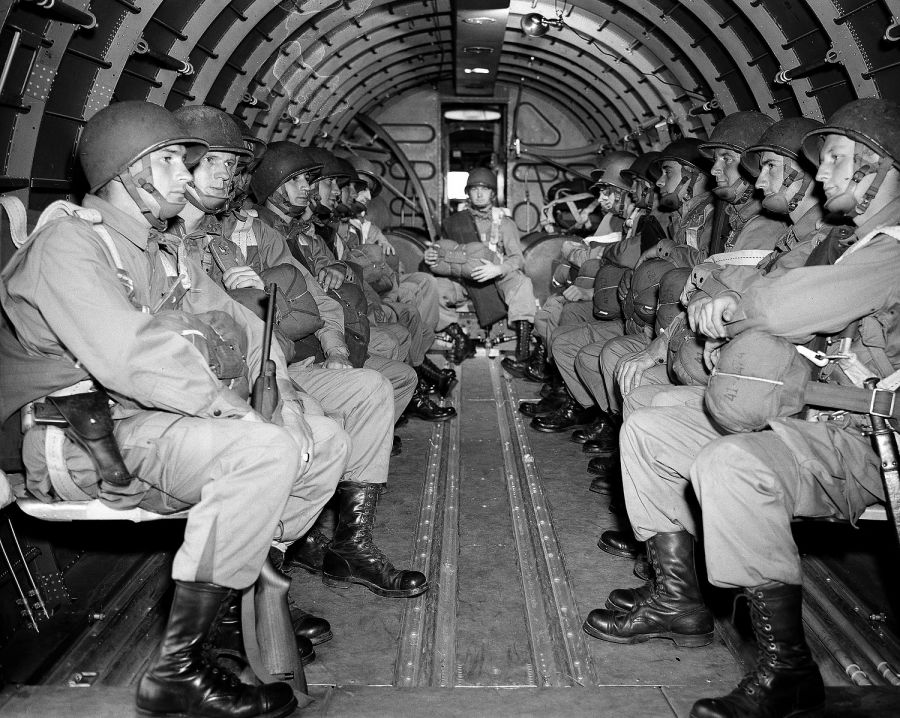
American paratroopers, heavily armed, sit inside a military plane as they soar over the English Channel en route to the Normandy French coast for the Allied D-Day invasion of the German stronghold during World War II, June 6, 1944. (AP Photo)

Seventy years ago, to this day, as the whole world now knows, the start of the end of World War II swung into action.  As this website put it (from where this photograph came),

On D-Day, June 6, 1944, Allied troops departed England on planes and ships, made the trip across the English Channel and attacked the beaches of Normandy in an attempt to break through Hitler’s “Atlantic Wall” and break his grip on Europe. Some 215,000 Allied soldiers, and roughly as many Germans, were killed or wounded during D-Day and the ensuing nearly three months it took to secure the Allied capture of Normandy.

On this day, seventy years ago, my mother was living in London four months pregnant with yours truly. I was born in November, 1944.

The USA frequently gets a hammering in the media, including blog sites, for a whole range of activities.

But the 6th June, 1944 reminds me that when the American people turn their hand to helping others across the world, they can be a most powerful force for good.

That I have lived my almost seventy years in an environment that has allowed me freedom and opportunity and that I write this as a relatively new resident of the United States of America, living happily in rural Oregon, is a testament to that force for good.

Thank you Yankees!

flags