Category: Morality

Thanksgiving theme: Love

The power of love

Today’s post is inspired by a comment left by Virginia Hamilton to a post that was published in this place back on 27th September, 2009. The post was called Sticks and stones. This is a flavour of the post.

oooo

I make no apologies for today’s post being more emotional and sentimental.

The phrase ‘sticks and stones may break my bones but names will never hurt me‘ is well known throughout the English-speaking world and surprisingly goes back some way.  A quick web search found that in the The Christian Recorder of March 1862, there was this comment:

Remember the old adage, ‘Sticks and stones will break my bones, but words will never harm me’. True courage consists in doing what is right, despite the jeers and sneers of our companions.

So if in 1862 the saying was referred to as an ‘old adage’ then it clearly pre-dated 1862 by some degree.

A few days ago, Dusty M., here in Payson, AZ, sent me a short YouTube video called The Power of Words.  I’m as vulnerable as the next guy to needing being reminded about what’s important in this funny old world.  Then I started mulling over the tendency for all of us to be sucked into a well of doom and gloom.  Take my posts on Learning from Dogs over the last couple of days, as an example.

There is no question that the world in which we all live is going through some extremely challenging times but anger and negativity is not going to be the answer.  As that old reference spelt out so clearly, “True courage consists in doing what is right, despite the jeers and sneers of our companions.

So first watch the video,

then let me close by reminding us all that courage is yet something else we can learn from dogs.

oooo

Then this is the comment from Virginia left to that post just a few days ago:

Our sermon today was about sticks and stones which is perfect timing because my sixth graders are throwing words at each other and it is hurting. So I looked up the phrase and found you. We were shown the video in a faculty meeting and since you tie into dogs I was hoping to find “the answer.” When you look at the website you’ll see out community project where I have twenty schools training in three shelters. One would think that because these kids are so loving to the animals that they could pass that kindness to each other. Any words of wisdom? Also check this video out. Thank you, Virginia

Virginia is a gifted teacher in Indialantic, FL. She uses her love of animals to teach students about giving back and community service. Her students volunteer at animal shelters and help train dogs so they are more easily adoptable. By doing this they get outside of the classroom and learn important life skills.

oooo

My reply to Virginia was: “Virginia, I took a break from the writing and saw your comment to this post and was blown away to use the vernacular! Thank you so much. Don’t know about me offering words of wisdom but I am going to publish a new post based entirely around your comment, and the question. Before the end of the week! Thank you so much for dropping by.”

To that end, I am going to do nothing more than quote a chunk from a forthcoming chapter of my book: Learning from Dogs. The chapter is the first in Part Five: Dog qualities we have to learn. What follows is the last 400 words of that chapter.

Let’s turn to the world of novels. Some book authors make a distinction between unconditional love and conditional love. In the sense that conditional love is love that is earned through conscious or unconscious conditions being met by the lover. Whereas in unconditional love, love is given to the loved one no matter what. Loving is primary: an acting of feelings irrespective of will.

There’s another aspect of unconditional love that relates commonly between individuals and their dogs. That is that our love for a dog encompasses a desire for the dog to have the very best life in and around us humans. Take the example of acquiring a new puppy. The puppy is cute, playful, and the owner’s heart swells with love for this adorable new family member. Then the puppy urinates on the floor. One does not stop loving the puppy but recognises the need to modify the puppy’s behaviour through love and training than, otherwise, continue to experience behaviours that would be unacceptable in a particular situation.

Having explored the concept of love and how dogs offer us the beauty of unconditional love, how should we adopt a loving approach to the world, and why?

It’s the little things that count is a famous truism and one no better suited to the world of love. Little things that we can do in countless different ways throughout the day. Sharing a friendly word and a smile with a stranger, dropping a coin or two into a homeless person’s hands or, better still, a loaf of bread or a chocolate bar. Being courteous on the road, holding a door open for someone at your nearby store, showing patience in a potentially frustrating situation. Never forgetting that we have two ears and one mouth and should use them in that proportion, be more attentive when a loved one is speaking with us, engineer periods of quiet contemplation, understand that the world will not come to an end if the television or ‘smartphone’ is turned off for a day. The list of loving actions is endless.

Why?

Because this world of ours so desperately needs a new start and that start must come from a loving attitude to each other, to the plants and animals, and to the blue planet that sustains us.

We need our hearts to open; open enough to tell our heads about the world of love.

Copyright 2014: Paul Handover

It would be lovely, Virginia, if this could be read out to your classes. Even better if young peoples’ thoughts, responses, and questions could be posted here as comments.

A very Happy Thanksgiving to all.

The God of Growth.

A grim reminder of these mad times.

I am conscious that in thirty minutes, my latest draft chapter of the book of the same name as this blog is published. Published under the heading of Faith in goodness.

It seems entirely at odds with the theme of today’s post, the reposting of a recent essay from George Monbiot.  But in a sense the two posts are compatible. Because what George Monbiot writes about, so elegantly in my opinion, is a window into the lives of those in power, politics, and in money.  Whereas, down at street level, so to speak, down where ordinary people lead ordinary lives, one finds a huge gap between the ambitions of the ‘top table’ and decent, everyday folk who are basically good people.

So with that in mind, on to George Monbiot’s essay of the 18th November, published in this place with his kind permission.

ooOOoo

The Insatiable God

The blind pursuit of economic growth stokes a cycle of financial crisis, and wrecks our world.
By George Monbiot, published in the Guardian 19th November 2014

Another crash is coming. We all know it, now even David Cameron acknowledges it (1). The only questions are what the immediate catalyst will be, and when it begins.

You can take your pick. The Financial Times reports today that China now resembles the US in 2007 (2). Domestic bank loans have risen 40% since 2008, while “the ability to repay that debt has deteriorated dramatically”. Property prices are falling and the companies that run China’s shadow banking system provide “virtually no disclosure” of their liabilities. Just two days ago, the G20 leaders announced that growth in China “is robust and is becoming more sustainable” (3). You can judge the value of their assurances for yourself.

Housing bubbles in several countries, including Britain, could pop at any time. A report in September revealed that total world debt (public and private) has reached 212% of GDP (4). In 2008, when it helped to cause the last crash, it stood at 174%. The Telegraph notes that this threatens to cause “renewed financial crisis … and eventual mass default.” (5) Shadow banking has gone beserk, stocks appear to be wildly overvalued, the Eurozone is bust again. Which will blow first?

Or perhaps it’s inaccurate to describe this as another crash. Perhaps it’s a continuation of the last one, the latest phase in a permanent cycle of crisis, exacerbated by the measures (credit bubbles, deregulation, the curtailment of state spending) which were supposed to deliver uninterrupted growth. The system the world’s governments have sought to stabilise is inherently unstable, built on debt, fuelled by speculation, run by sharks.

If it goes down soon, as Cameron fears, in a world of empty coffers and hobbled public services, it will precipitate an ideological crisis graver than the blow to Keynesianism in 1970s. The problem that then arises – and which explains the longevity of the discredited ideology that caused the last crash – is that there is no alternative policy, accepted by mainstream political parties, with which to replace it. They will keep making the same mistakes while expecting a different outcome.

To try to stabilise this system, governments behave like soldiers billeted in an ancient manor, who burn the furniture, the panelling, the paintings and the stairs to keep themselves warm for a night. They are breaking up the post-war settlement, our public health services and social safety nets, above all the living world, to produce ephemeral spurts of growth. Magnificent habitats, the benign and fragile climate in which we have prospered, species that have lived on earth for millions of years, all are being stacked onto the fire, their protection characterised as an impediment to growth.

David Cameron boasted on Monday that he will revive the economy by “scrapping red tape” (6). This “red tape” consists in many cases of the safeguards defending both people and places from predatory corporations. Today, the Small Business, Enterprise and Employment Bill is passing through the House of Commons (7), spinelessly supported, as ever, by Labour. The bill seeks to pull down our protective rules to “reduce costs for business”, even if that means increasing costs for everyone else, while threatening our health and happiness. But why? As the government boasted last week, the UK already has “the least restrictive product market regulation and the most supportive regulatory and institutional environment for business across the G20.” (8) And it still doesn’t work. So let’s burn what remains.

This bonfire of regulation is accompanied by a reckless abandonment of democratic principles, not least of equality before the law. In the House of Commons on Monday, Cameron spoke for the first time about the Transatlantic Trade and Investment Partnership (9). If this treaty between the EU and the US goes ahead, it will grant corporations a separate legal system to which no one else has access, through which they can sue governments passing laws that might affect their profits. Cameron insisted that “it does not in any way have to affect our national health service” (10). (Note those words “have to”.) Pressed to explain this, he cited the former EU trade commissioner, who claimed that “public services are always exempted” (11).

But I have read the EU’s negotiating mandate(12), and it contains no such exemption, just plenty of waffle and ambiguity on this issue. When the Scottish government asked Cameron’s officials for an “unequivocal assurance” that the NHS would not be exposed to such litigation, they refused to provide it(13). This treaty could rip our public services to shreds for the sake of a short and (studies suggest (14,15)) insignificant fizzle of economic growth.

Is it not time to think again? To stop sacrificing our working lives, our prospects, our surroundings to an insatiable god (16)? To consider a different economic model, which does not demand endless pain while generating repeated crises?

Amazingly, this consideration begins on Thursday. For the first time in 170 years, parliament will debate one aspect of the problem: the creation of money (17). Few people know that 97% of our money supply is created not by the government (or the central bank), but by commercial banks in the form of the loans they issue (18). At no point was a democratic decision made to allow banks to do this. So why do we let it happen? This, as Martin Wolf has explained in the Financial Times (19), “is the source of much of the instability of our economies”. The parliamentary debate won’t stop the practice, but it represents the opening of a long-neglected question.

This, though, is just the beginning. Is it not also time for a government commission on post-growth economics? Drawing on the work of thinkers like Herman Daly, Tim Jackson, Peter Victor, Kate Raworth, Rob Dietz and Dan O’Neill, it would investigate the possibility of moving towards a steady state economy: one that seeks distribution rather than blind expansion; that does not demand infinite growth on a finite planet. It would ask the question that never gets asked: why?

Why are we wrecking the natural world and public services to generate growth when that growth is not delivering contentment, security or even, for most of us, greater prosperity? Why have we enthroned growth, regardless of its utility, above all over outcomes? Why, despite failures so great and so frequent, have we not changed the model? When the next crash comes, these questions will be inescapable.

http://www.monbiot.com

References:

1. http://www.theguardian.com/commentisfree/2014/nov/16/red-lights-global-economy-david-cameron

2. http://www.ft.com/cms/s/0/e13e2cf8-6e48-11e4-bffb-00144feabdc0.html#ixzz3JP5QF3et

3. G20, November 2014. Brisbane Action Plan. http://bit.ly/1xk6mLR

4. Luigi Buttiglione et al, September 2014. Deleveraging? What Deleveraging? Geneva Reports on the World Economy 16. http://www.voxeu.org/content/deleveraging-what-deleveraging-16th-geneva-report-world-economy

5. http://www.telegraph.co.uk/finance/economics/11129108/Mass-default-looms-as-world-sinks-beneath-a-sea-of-debt.html

6. http://www.theguardian.com/commentisfree/2014/nov/16/red-lights-global-economy-david-cameron

7. http://services.parliament.uk/bills/2014-15/smallbusinessenterpriseandemployment.html

8. G20, November 2014. Comprehensive Growth Strategy – United Kingdom. http://bit.ly/1yPuIv7

9. http://www.theguardian.com/commentisfree/2014/nov/04/british-government-leading-gunpowder-plot-democracy-eu-us-trade

10. http://www.publications.parliament.uk/pa/cm201415/cmhansrd/cm141117/debtext/141117-0001.htm#14111713000002

11. http://www.bbc.co.uk/news/health-29181332

12. http://bit.ly/1xYr3L6

13. http://www.scotsman.com/news/uk/scottish-government-demands-nhs-ttip-guarantees-1-3589393

14. http://www.theguardian.com/commentisfree/2013/jul/15/us-trade-deal-with-europe-hype

15. http://www.newscientist.com/article/mg22429932.800-ttip-beware-the-treatys-empty-economic-promises.html

16. http://pollystreaming.com/South-Park-Season-13-Episode-3-Margaritaville_v5905

17. http://www.positivemoney.org/2014/11/uk-parliament-debate-money-creation-first-time-170-years/

18. https://www.positivemoney.org/wp-content/uploads/2014/11/Backbench-Briefing-Note.pdf

19. http://www.ft.com/cms/s/0/7f000b18-ca44-11e3-bb92-00144feabdc0.html#ixzz2zsutuZis

The book! Part Three: Greed, inequality and poverty

Note:

I read this out aloud to Jeannie last night, as I do with every post that is published, and found this chapter really didn’t flow.  I’m making the mistake of including too many words of direct quotations, many of which are not easy to follow.

So just wanted to let you know that if this strikes you the same way, you are not alone! 😉

It is, of course, just the first draft, but nonetheless …. wanted you to read this first.

oooo

Greed, inequality and poverty

Just three words: greed; inequality; poverty.

Just three words that metaphorically come to me like a closed, round, wooden lid hiding a very deep, dark well. That lifting this particular lid, the metaphorical one, exposes an almost endless drop into the vastness of where our society appears to have fallen.

That this dark well, to stay with the metaphor, is lined with example after example of greed, inequality and poverty is a given.

One might conclude that examining any of those examples is pointless, not in terms of the reality of our world, but in terms of influencing the views of a reader. If you are a reader who is uncertain about the current levels of greed, inequality and poverty then it’s unlikely that a few examples, or a few hundred examples, are going to change minds. (One might argue that you wouldn’t be reading this book in the first place!)

Thus when I was digging around, looking for insight into how and why we, as in society, are in such times, I was looking for core evidence. Very quickly, it struck me that the chapter title really should simply have been: Inequality. Because inequality, by implication, is the result of greed and results in poverty.

In November, 2014, at the time I was drafting this book, a new report was issued by the Center of Economic Policy Research (CEPR) on the latest (American) Survey of Consumer Finances. It painted a picture very familiar to many: the rich becoming richer while those with less wealth are falling further and further behind.

David Rosnick of the CEPR, and one of the report co-authors, made this important observation:

The decline in the position of typical households is even worse than the Consumer Finances survey indicates. In 1989, many workers had pensions. Far fewer do now. The value of pensions isn’t included in these surveys due to the difficulty of determining what they are worth on a current basis. But they clearly are significant assets that relatively few working age people have now.

Sharmini Peries, of The Real News Network, in an interview with David Rosnick, asked:

PERIES: David, just quickly explain to us what is the Consumer Finance Survey. I know it’s an important survey for economists, but why is it important to ordinary people? Why is it important to us?

ROSNICK: So, every three years, the Federal Reserve interviews a number of households to get an idea of what their finances are like, do they have a lot of wealth, how much are their house’s worth, how much they owe on their mortgages, how much they have in the bank account, how much stocks do wealthy people own. This gives us an idea of their situations, whether they’re going to be prepared for retirement. And we can see things like the effect of the housing and stock bubbles on people’s wealth, whether they’ve been preparing for eventual downfalls, how they’ve reacted to various economic circumstances, how they’re looking to the long term. So it’s a very useful survey in terms of finding out how households are prepared and what the distribution of wealth is like.

PERIES: So your report is an analysis of the report. And what are your key findings?

ROSNICK: So, largely over the last 24 years there’s been a considerable increase in wealth on average, but it’s been very maldistributed. Households in the bottom half of the distribution have actually seen their wealth fall, but the people at the very top have actually done very well. And so that means that a lot of people who are nearing retirement at this point in time are actually not well prepared at all for retirement and are going to be very dependent on Social Security in order to make it through their retirement years.

PERIES: So, David, address the gap. You said there’s a great gap between those that are very wealthy and those that are not. Has this gap widened over this period?

ROSNICK: It absolutely has. As, say, the top 5 percent in wealth, the average wealth for people in the top 5 percent is about 66 percent higher in 2013, the last survey that was completed, compared to 1989. By comparison, for the bottom 20 percent, their wealth has actually fallen 420 percent. They basically had very little to start with, and now they have less than little.

PERIES: So the poorer is getting poorer and the richer is getting extremely richer.

ROSNICK: Very much so.

To my way of thinking, if in the period 1989 through to 2013 “the average wealth for (American) people in the top 5 percent is about 66 percent higher” and “for the bottom 20 percent, their wealth has actually fallen 420 percent” it’s very difficult not to see the hands of greed at work and a consequential devastating increase in inequality.

In other words, the previous few paragraphs seemed to present, and present clearly, the widening gap between the ‘haves’ and the ‘have-nots’, comparatively speaking, and that it was now time for society to understand the trends, to reflect on where this is taking us, if left unchallenged, and to push back as hard as we can both politically and socially.

I wrote that shortly before another item appeared in my email ‘in-box’ in the middle of November (2014), a further report about inequality that, frankly, emotionally speaking, just smacked me in the face. It seemed a critical addition to the picture I was endeavouring to present.

Namely, on the 13th October, 2014, the US edition of The Guardian newspaper published a story entitled: US wealth inequality – top 0.1% worth as much as the bottom 90%. The sub-heading enlarged the headline: Not since the Great Depression has wealth inequality in the US been so acute, new in-depth study finds.

The study referred to was a paper released by the National Bureau of Economic Research, Cambridge, MA, based on research conducted by Emmanuel Saez and Gabriel Zucman. The paper’s bland title belied the reality of the research findings: Wealth Inequality in the United States since 1913.

As the Guardian reported:

Wealth inequality in the US is at near record levels according to a new study by academics. Over the past three decades, the share of household wealth owned by the top 0.1% has increased from 7% to 22%. For the bottom 90% of families, a combination of rising debt, the collapse of the value of their assets during the financial crisis, and stagnant real wages have led to the erosion of wealth. The share of wealth owned by the top 0.1% is almost the same as the bottom 90%.

The picture actually improved in the aftermath of the 1930s Great Depression, with wealth inequality falling through to the late 1970s. It then started to rise again, with the share of total household wealth owned by the top 0.1% rising to 22% in 2012 from 7% in the late 1970s. The top 0.1% includes 160,000 families with total net assets of more than $20m (£13m) in 2012.

In contrast, the share of total US wealth owned by the bottom 90% of families fell from a peak of 36% in the mid-1980s, to 23% in 2012 – just one percentage point above the top 0.1%.

The report was not exclusively about the USA. As the closing paragraphs in The Guardian’s article illustrated:

Among the nine G20 countries with sufficient data, the richest 1% of people (by income) have increased their income share significantly since 1980, according to Oxfam. In Australia, for example, the top 1% earned 4.8% of the country’s income in 1980. That had risen to more than 9% by 2010.

Oxfam says that in the time that Australia has held the G20 presidency (between 2013 and 2014) the total wealth in the G20 increased by $17tn but the richest 1% of people in the G20 captured $6.2tn of this wealth – 36% of the total increase.

I find it incredibly difficult to have any rational response to those figures. I am just aware that there is a flurry of mixed emotions inside me and, perhaps, that’s how I should leave it. Nonetheless, there’s one thing that I can’t keep to myself and that this isn’t the first time that such inequality has arisen, the period leading up the the Great Depression of the 1930s comes immediately to mind, and I doubt very much that it will be the last.

Unless!

Unless the growing catalogue of unsustainable aspects of this 21st century, a few of which have been the focus of this Part Three, brings about, perhaps in many different ways, a force for change that is unstoppable.

But before that is explored in Part Four, there is the one final element of the greed, inequality and poverty theme of this chapter that must be aired; the issue of poverty.

Contrary to my anticipation, the figures for poverty trends can be read in many ways and don’t give a clear-cut uniform picture. Nevertheless, it does’t take a genius to work out that the future, especially for young people, could be alarming.

Today, the poor people are the young. Today, the young are heading into a future that has many frightening aspects.

Take the present population numbers, the mind-boggling scale of the use of energy in these times, not to mention the levels of debt across so many countries (on the 14th November, 2014, the Federal Debt of the USA was about $18,006,100,032,000), possible unsustainable global climate change trends, and is it any wonder that those born in the period 1928 to 1945 (I was born in 1944), the generation that has been called the Silent Generation, must be wondering what the future holds for their children and grandchildren and what they or anyone can do today and tomorrow, to prevent these future generations sinking into oblivion.

I came across a quotation from Simon Caulkin, the award winning management writer: “It’s all the product of human conduct!”

Yes, Simon is right. Only human conduct will find that sustainable, balanced relationship with each other and, critically, with the planet upon which all our futures depend. Yet, something nags at me; a half-conscious doubt that starts with the word ‘but!’ Not that it doesn’t all come down to human conduct; not a moment’s hesitation on that one. But there’s still that half-conscious doubt. A doubt that starts to take shape on the back of that wonderful quotation from Einstein: “Insanity: doing the same thing over and over again and expecting different results.

Then from that half-conscious place in one’s head comes another word. The word: Faith. Faith in us, as in faith in humanity. Faith that not only can we change our relationship with ourselves, with our communities and, above all, with our planet, but that we will. Faith that we, as in mankind, will embrace the many beautiful qualities of the animal that is so special to so many millions of us: our dogs. Not just embrace but pin our future on the premise that adopting the qualities of love, trust, honesty, openness and more, qualities that we see daily in our closest animal companions, is our potential salvation.

Thus comes the end of this set of depressing aspects of our 21st century. Time to move on in this story of learning from dogs and envelope ‘Of change in thoughts and deeds’; the title of the next section of this book. For we truly need a change to a better future.

1923 words Copyright © 2014 Paul Handover

The book! Part Three: Power and Corruption

I am using the software Scrivener to write this book. I fail to recall how I came across Scrivener but, boy of boy, am I glad I did. It is fabulous. One can set out the raw structure of the book, section by section, chapter by chapter, much helping keep one’s mind on the construction of the book as the writing progresses.

All of which is a preamble for me telling you that when I clicked on the chapter ‘folder’ that was named Power and corruption, a folder empty of any words, my heart sank. Power and corruption! Where, oh where, does one start!

Then almost immediately kicked myself; metaphorically speaking! Simply for the reason that one of the most famous sayings is surely that of Lord Acton, the 19th-century British historian: “Power tends to corrupt; Absolute power corrupts absolutely.That is the place to start this essay on power and corruption.

History has plenty of examples of the tendency of power to corrupt. Of course, when the word ‘power’ is used on its own it misses its natural companion words; the words ‘other people’. Ergo: Power over other people tends to corrupt; Absolute power over other people corrupts absolutely. Napoleon Bonaparte declaring himself as emperor comes to mind, as does further back in time, the Roman emperors, who declared themselves gods, demonstrated absolute corruption from the absolute power, over other people, that they wielded.

Anyway, returning to Lord Acton, or to give him his full name, John Emerich Edward Dalberg Acton. He was the 19th century historian and moralist who was otherwise known more simply as Lord Acton, as in the first Baron Acton (Lord Acton lived from 1834 until 1902). His expression, “Absolute power corrupts absolutely; ……” arose expressed in a letter to Bishop Mandell Creighton in 1887:

Power tends to corrupt, and absolute power corrupts absolutely. Great men are almost always bad men.

Great men are almost always bad men: Now there’s a statement to play with!

Despite the text written in Lord Acton’s letter to the Bishop having become a favourite of the many collectors of quotations, it is probable that Lord Acton didn’t invent the idea; quotations very similar had been uttered by several authors well before 1887.

Let us explore the central question as to why it is that power has a corrupting characteristic; a largely corrupting characteristic might be more accurate. For in the Smithsonian magazine of October, 2012, there was an article that examined the social science behind why power brings out both the worst in some people, but also, at times, the best in people.

Why Power Corrupts

His [Lord Acton’s] maxim has been vividly illustrated in psychological studies, notably the 1971 Stanford Prison Experiment, which was halted when one group of students arbitrarily assigned to serve as “prison guards” over another group began to abuse their wards.

But new scholarship is bringing fresh subtlety to psychologists’ understanding of when power leads people to take ethical shortcuts — and when it doesn’t. Indeed, for some people, power seems to bring out their best. After all, good people do win elective office, says Katherine A. DeCelles, a professor of management at the University of Toronto, and no few business executives want to do good while doing well. “When you give good people power,” DeCelles says she wondered, are they more able than others “to enact that moral identity, to do what’s right?”

In a study recently published in the Journal of Applied Psychology, DeCelles and her co-authors found that the answer is yes. People’s sense of “moral identity”—the degree to which they thought it was important to their sense of self to be “caring,” “compassionate,” “fair,” “generous” and so on—shaped their responses to feelings of power.

Christopher Shea, the author of the Smithsonian article, went on to explain that:

DeCelles and her colleagues developed moral identity scores for two groups, 173 working adults and 102 undergraduates, by asking the participants to rate how important those ethically related attributes were to them. The researchers had some participants write an essay recalling an incident in which they felt powerful, while others wrote about an ordinary day. Then the participants took part in lab experiments to probe how they balanced self-interest against the common good.

Christopher Shea then concluded:

The experiment involving the adults found a similar relationship between moral identity, ethical behavior and innate aggressiveness. Assertive people who scored low on the moral-identity scale were more likely to say they’d cheated their employer in the past week than more passive types with similar moral-identity scores. But among those with high moral-identity scores, the assertive people were less likely to have cheated.

In sum, the study found, power doesn’t corrupt; it heightens pre-existing ethical tendencies. Which brings to mind another maxim, from Abraham Lincoln: “Nearly all men can stand adversity, but if you want to test a man’s character, give him power.

Yet despite the evidence presented that power does not automatically corrupt, the news is so often full of stories of powerful men, well predominantly men, behaving badly in all manner of ways: sex with their staff, assaulting others, such as hotel maids, cheating and lying. So if there is no direct wiring between power and corruption, that power does not automatically corrupt, it still leaves open the question of why power so often does corrupt. What motivates people in power to behave so badly?

In my research, I came across an article in WIRED magazine, How Power Corrupts, that revealed:

Psychologists refer to this [Why does power corrupt] as the paradox of power. The very traits that helped leaders accumulate control in the first place all but disappear once they rise to power. Instead of being polite, honest and outgoing, they become impulsive, reckless and rude. According to psychologists, one of the main problems with authority is that it makes us less sympathetic to the concerns and emotions of others. For instance, several studies have found that people in positions of authority are more likely to rely on stereotypes and generalizations when judging other people. They also spend much less time making eye contact, at least when a person without power is talking.

Then later on Jonah Lehrer, the author of the article, explained:

Although people almost always know the right thing to do — cheating is wrong — their sense of power makes it easier to rationalize away the ethical lapse. For instance, when the psychologists asked the subjects (in both low- and high-power conditions) how they would judge an individual who drove too fast when late for an appointment, people in the high-power group consistently said it was worse when others committed those crimes than when they did themselves. In other words, the feeling of eminence led people to conclude that they had a good reason for speeding — they’re important people, with important things to do — but that everyone else should follow the posted signs.

Concluding:

The larger lesson is that Foucault had a point: The dynamics of power can profoundly influence how we think. When we climb the ladder of status, our inner arguments get warped and our natural sympathy for others is vanquished. Instead of fretting about the effects of our actions, we just go ahead and act. We deserve what we want. And how dare they resist. Don’t they know who we are?

At this point, I sat staring at the screen for some time, wondering what to make of my research findings. Just ‘hearing’ my mind coming up with questions, questions that were rhetorical in nature, not hearing hard, clear questions that could command hard, clear answers. Questions such as:

• Is this characteristic of power warping our judgment, profoundly influencing how we think, as Foucault is recorded as saying, ‘hard-wired’ in humans?
• If so, has it always been this way?
• If not having always been this way with man, then what brought it on?
• Irrespective of the scale of an emergency affecting mankind, either on a regional or global scale, would power always have a tendency to corrupt?
• What cultural changes would need to take place to break the link between power and corruption?
• Indeed, could there be any changes that would achieve this?

Readers will have realised that I have not offered a single example, over and above the fleeting mentions of Napoleon Bonaparte and the Roman emperors, of power and corruption in recent times. For the straightforward reason that there are too many examples of the abuses of power around and picking, almost randomly, one from here and one from there, in no way adds anything to this chapter. That’s my view and I’m sticking to it!
1,443 words. Copyright © 2014 Paul Handover

Maybe this is how it started?

I mean the first meeting between man and wolf.

Again, another long day of hammering away at the keyboard.

One of the items that I incorporated into ‘the book’ was a story told to me back in 2009.  I had forgotten just how wonderful this true story was.

So it is repeated today. You will love it; of that I have no doubt!

oooo

An amazing true story of a relationship between a wild wolf and a man.

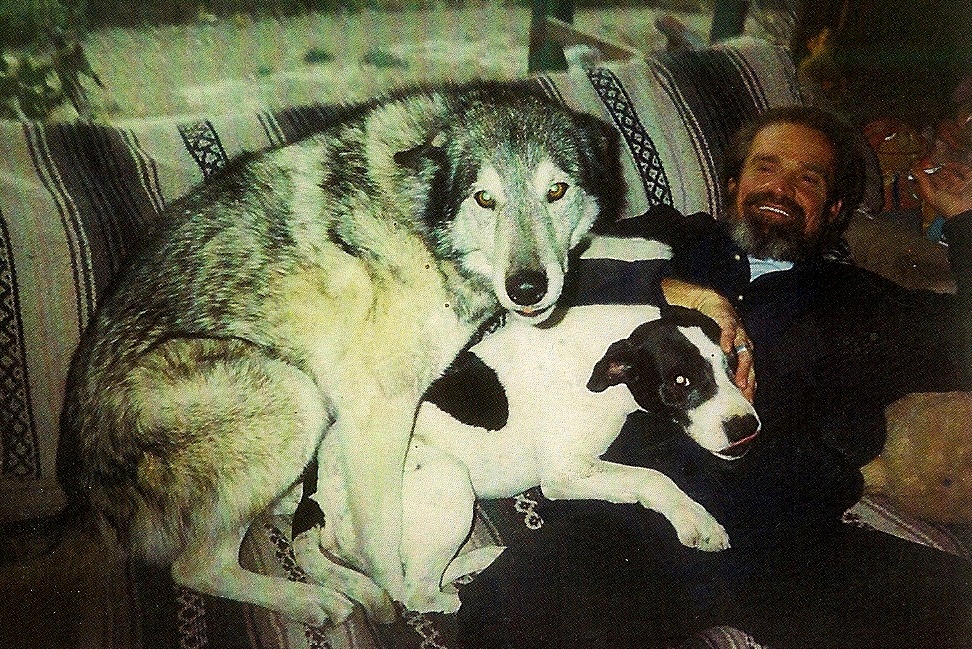
This is a story of a particular event in the life of Tim Woods told to me by his brother, DR.  It revolves around the coming together of a man sleeping rough, with his dog, on Mingus Mountain, and a fully grown female Grey Wolf.  Mingus is in the Black Hills mountain range between Cottonwood and Prescott in Arizona, USA.

DR and his brother, Tim, belong to a large family; there are 7 sons and 2 daughters.  Tim had a twin brother, Tom, and DR knew from an early age that Tim was different.

As DR explained,

Tim was much more enlightened than the rest of us.  I remember that Tim and Tom, as twin brothers, could feel each other in almost a mystical manner.  I witnessed Tom grabbing his hand in pain when Tim stuck the point of his knife into his (Tim’s) palm.  Stuff like that!  Tim just saw more of life than most other people.

The incident involving the wolf was when Tim was in his late 40s and, as mentioned, was living in a rough shack on the mountain.  The shack was simply a plywood shelter with an old couch and a few blankets for the cold nights.  The dog was companion, guard and a means of keeping Tim in food; the dog was a great hunter.  But Tim was no stranger to living in the wild.

DR again,

Tim was ex-US Army and a great horseman.  There was a time when he was up in the Superstition Mountains, sleeping rough, riding during the day.  At night Tim would get the horse to lay down and Tim would sleep with his back next to the horse for warmth.

Anyway, Tim was up on Mingus Mountain using an old disk from an agricultural harrow as both a cook-pan and plate.  After he had finished eating, Tim would leave his ‘plate’ outside his shack.  It would be left out in the open over night.

Tim became aware that a creature was coming by and licking the plate clean and so Tim started to leave scraps of food on the plate.  Then one night, Tim was awoken to to the noise of the owner of the ‘tongue’ and saw that it was a large, female gray wolf.

The wolf became a regular visitor and Tim became sure that the wolf, now having been given the name Luna by Tim, was aware that she was being watched by a human.

Over many, many months Luna built up sufficient trust in Tim that eventually she would take food from Tim’s outstretched hand.  It was only now a matter of time before Luna started behaving more like a pet dog than the wild wolf that she was.  The photo below is a scan from a traditional photograph and is unaltered.

Luna, the wild wolf, taken in 2006.

From now on, Luna would stay the night with Tim and his dog, keeping watch over them.

DR also recalls,

I remember Tim being distraught because, without warning, Luna stopped coming by. Then a few months later back she was. Tim never did know what lay behind her absence but guessed it might have been because she went off to have pups.

Unfortunately, this wonderful tale does have a sad ending.

About two years ago, Tim lost his dog. He was awakened to hear a pack of coyotes yelping and his dog missing.

Then tragically some 6 months later Tim contracted a gall bladder infection. Slowly it became worse.

By the time he realised that it was sufficiently serious to require medical treatment, it was too late. Despite the best efforts of modern medicine, Tim died on June 25th, 2009, just 51 years young.

So if you are ever out on Mingus Mountain and hear the howl of a wolf, reflect that it could just be poor Luna calling out for her very special man friend.

With very grateful thanks to DR for sharing such a special story.

Wherein lays the truth?

It is said that the first casualty in war is truth!

Ansel Adams

In yesterday’s post Vested interests, perhaps, I featured an article brought to my attention by dear friend, Dan Gomez. Namely an article featured in the UK’s Daily Mail newspaper that was headlined: ‘There is NO climate crisis’: Man-made global warming is a lie and not backed up by science, claims leading meteorologist.

Dan’s strong belief is that labelling the natural change in the world’s climate as anthropogenic global warming (AGW) serves governments and many large institutions incredibly well because it offers greater leverage to raise taxes.  In other words, Dan has no doubt that the climate is changing, but as a result of natural forces that go back long before the days of man.  In other words, it is being ‘sold’ as the direct result of man’s activities because it makes it easier to apply taxes and levies for purposes not related to climate matters.

As John Coleman was reported as saying:

John Coleman, who co-founded the Weather Channel, claims that the belief humans are causing climate change is not backed up by science.

In an open letter attacking the UN, the 80-year-old from San Diego, said that what ‘little evidence’ there is for global warming points to natural cycles in temperature.

‘There is no climate crisis,’ he wrote. ‘The ocean is not rising significantly. The polar ice is increasing, not melting away. Polar bears are increasing in number. ‘Heat waves have actually diminished, not increased. There is not an uptick in the number or strength of storms.

‘I have studied this topic seriously for years. It has become a political and environment agenda item, but the science is not valid.’

Now I am as sceptical about the workings of governments as the next man. But I find it incredibly difficult to believe that AGW is a myth, hoax or conspiracy.  There is a wall of science to say that we, as in man, are dangerously close to going over the edge, going beyond ‘tipping points’ from which there is no returning.

A quick dip into Wikipedia tells us [my emphasis]:

Scientific understanding of the cause of global warming has been increasing. In its fourth assessment (AR4 2007) of the relevant scientific literature, the Intergovernmental Panel on Climate Change (IPCC) reported that scientists were more than 90% certain that most of global warming was being caused by increasing concentrations of greenhouse gases produced by human activities. In 2010 that finding was recognized by the national science academies of all major industrialized nations.

Affirming these findings in 2013, the IPCC stated that the largest driver of global warming is carbon dioxide (CO2) emissions from fossil fuel combustion, cement production, and land use changes such as deforestation.

Only last Wednesday there was an item on Naked Capitalism that opened [again, my emphasis]:

J.D. Alt: Have We Passed the Tipping Point of Biological Collapse?

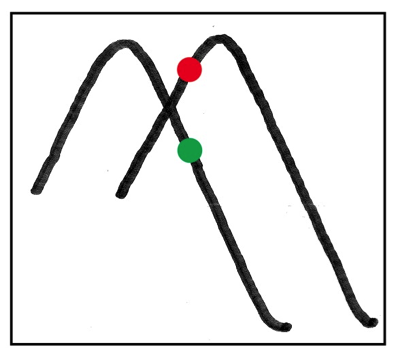
alt1The squiggle illustrated here may look like the Ebola virus, but it isn’t. The resemblance is just an eerie coincidence. It’s actually a graphical snapshot of the classic “Predator-Prey Model.” This mathematical exercise, first developed in the 1920s, serves as the introductory basis for a more recent NASA funded effort which produced—amidst a brief flurry of news and commentary last spring—the startling conclusion that a complete collapse of modern civilization may now be “irreversible.”

The NASA study involved the creation and running of a more elaborate model—HANDY (Human and Nature Dynamics)—which simulates the human consumption of naturally replenishing systems, as well as (intriguingly, given today’s news cycle) wealth and income inequality between two classes of citizens: “Elites” and “Commoners.” Now a new study, just released by the World Wildlife Fund, reports a grim statistic suggesting the abstract mathematics of the HANDY Model may be more than just a theoretical exercise. According to the WWF, in the last forty years—from 1970 to 2010—the Earth has lost over HALF (52%) of its wildlife population.

There are yards and yards of solid information all over the internet about our changing climate. The loss of wildlife, the destruction of forests and wild lands is beyond argument, and those aspects of this ‘modern’ world are most certainly the direct result of man’s activities!  Our inability to stop growing as a global population is insane.  Our inability to stop seeing continual economic and material growth as a ‘good thing’ is insane. We need massive change  – now!

Therein lays the problem.  Because, whether or not there is an approaching climate catastrophe as a result of man’s activities is, in a very real sense, irrelevant. If that seems a bizarre thing to write, I mean it is irrelevant in terms of what you and I, ordinary people trying to lead civilised lives, can do to make a difference.

Patrice Ayme recently published a post under the title of Total Plutocracy covering the death of Christophe de Margerie when his jet hit a snow plough on a Moscow runway at midnight, flipped on its back, caught fire, and skidded across. All four on board died.

Now the accidental death of any person is a tragedy, make no mistake, but as Patrice revealed in his post, this particular accident did raise some interesting aspects.  Here’s a little of what Patrice wrote:

With 200 billion Euros in revenue, TOTAL SA is not far behind the French government budget. TOTAL’s profits are 14 billion Euros (“Soyons serieux!” laughed Margerie). It pays nearly no tax in France, having concentrated there its money losing refineries.

Other countries get nearly all their fuel from French refineries; TOTAL has also a green light to frack in Britain. So this is not just a French situation. TOTAL is one of the five great oil companies concentrating the fossil fuel firepower. Those companies have the best technology. Some of TOTAL’s specialties are very deep water drilling, and using steam to extract tar oil in Canada.

What was de Margerie doing at midnight? Flying back to France, after meeting with Putin and Medvedev, late at night.

That’s how these guys are: great fun. Putin was recently invited to Milan for a big time European meeting. He arrived several hours late to visit with Merkel, who was not amused. After keeping her up past midnight, he motored to Berlusconi’s mansion, and the two plutocrats reveled together until 4 am. (We don’t know how many female teenagers were in attendance to further their studies.)

The next European meeting was at 8am, and Putin showed up.

Supposedly Margerie had just told Medvedev and Putin to cool it with Ukraine. At least that’s the massaging message Margerie’s minions floated after his death.

Why was Margerie so important to the Russian dictators? Because the six “supermajor” oil companies have the advanced technology. After all, they recruit from the best universities in the world (that’s paid by taxpayers). TOTAL SA was the spearhead of high tech development for hydrocarbon production in Russia. Among other things, it’s helping to build a gas liquefaction plant in the far north, to load special ships with methane (something TOTAL does with Qatar, in the world’s largest such installation).

Once a ship is fully loaded, it has several times the explosive power deployed at Hiroshima (such a catastrophic accident has not happened yet, but it’s just a matter of time).

When citizen Lambda dies, Mr. Anybody, nobody official cares. When a major plutocrat dies, our leaders, even our socialist leaders, weep, and present the accident as a national, even international tragedy.

Is the death of a plutocrat worth that much more, that all this public weeping has to occur?

And, by the way, who and what has authorized Mr. Margerie to lead his own foreign policy? Who authorized him to make nice with thermonuclear dictators? To the point of allowing their survival?

I recommend that you read it in full for it says so much about what is wrong with these present times: so much inequality and so many abuses of power.

Just the other day the Guardian newspaper published an article under the title of: Richest 1% of people own nearly half of global wealth, says report.

The richest 1% of the world’s population are getting wealthier, owning more than 48% of global wealth, according to a report published on Tuesday which warned growing inequality could be a trigger for recession.

According to the Credit Suisse global wealth report (pdf), a person needs just $3,650 – including the value of equity in their home – to be among the wealthiest half of world citizens. However, more than $77,000 is required to be a member of the top 10% of global wealth holders, and $798,000 to belong to the top 1%.

“Taken together, the bottom half of the global population own less than 1% of total wealth. In sharp contrast, the richest decile hold 87% of the world’s wealth, and the top percentile alone account for 48.2% of global assets,” said the annual report, now in its fifth year.

On October 8th, George Monbiot published an essay in The Guardian newspaper under the title of The Toll-Booth Economy.  The opening lines set the theme.

Corporate power is the real enemy within, but none of the major parties will confront it.

The more power you possess, the more insecure you feel. The paranoia of power drives people towards absolutism. But far from curing them of the conviction that they are threatened and beleaguered, it becomes only stronger.

On Friday, the Chancellor of the Exchequer, George Osborne, claimed that business is under political attack on a scale it has not faced since the fall of the Berlin wall. He was speaking at the Institute of Directors, where he was introduced with the claim that “we are in a generational struggle to defend the principles of the free market against people who want to undermine it or strip it away.” A few days before, while introducing Osborne at the Conservative party conference, Digby Jones, formerly the head of the Confederation of British Industry, warned that companies are at risk of being killed by “regulation from Big Government” and of drowning “in the mire of anti-business mood music encouraged by vote-seekers.” Where is that government and who are these vote-seekers? They are a figment of his imagination.

Read the full essay here.

Yes, one could go on and on.

Indeed, I will. Go on with just one more reference.  From the Smithsonian. An article that started, as follows:

Five Conflicts and Collapses That May Have Been Spurred by Climate Change

Earth’s changing climate has been a spectre in centuries of civil conflict and, at times, the collapse of whole civilizations

By Natasha Geiling
smithsonian.com
October 20, 2014

Is climate change a matter of national security? In a warming world, sea-level rise, drought and soil degradation are putting basic human needs such as food and shelter at risk. In March, the U.S. Department of Defense called climate change a “threat multiplier,” saying that competition for resources “will aggravate stressors abroad such as poverty, environmental degradation, political instability and social tensions—conditions that can enable terrorist activity and other forms of violence.”

Connecting climate change to a global increase in violence is tricky, and attempts to make such a link receive a fair amount of criticism. A hotter planet doesn’t automatically become a more conflict-ridden one. The 2000s, for instance, saw some of the highest global temperatures in recorded history—and some of the lowest rates of civil conflict since the 1970s.

But there are historical examples of civilizations that did not fare well when faced with drastic environmental change, and those examples may offer a window into the future—and even help prevent catastrophe. “We can never know with 100-percent certainty that the climate was the decisive factor [in a conflict],” says Solomon Hsiang, assistant professor of public policy at the University of California, Berkeley. “But there’s a lot of cases where things look pretty conspicuous.”

Read the five historical examples and realise that we are not immune.

Earlier on I ventured the idea that whether or not an approaching climate catastrophe was a result of man’s activities was, in a very real sense, irrelevant.  Because of the lack of individual power to make a real difference, especially a political difference.

What is relevant is improving the way we govern ourselves. The abuses of money and power are too widespread to be ignored.  We need to start with strong local democracies and thence building a system of global governance that really is of the people by the people for the people.

Phew – I need a dog to hug!

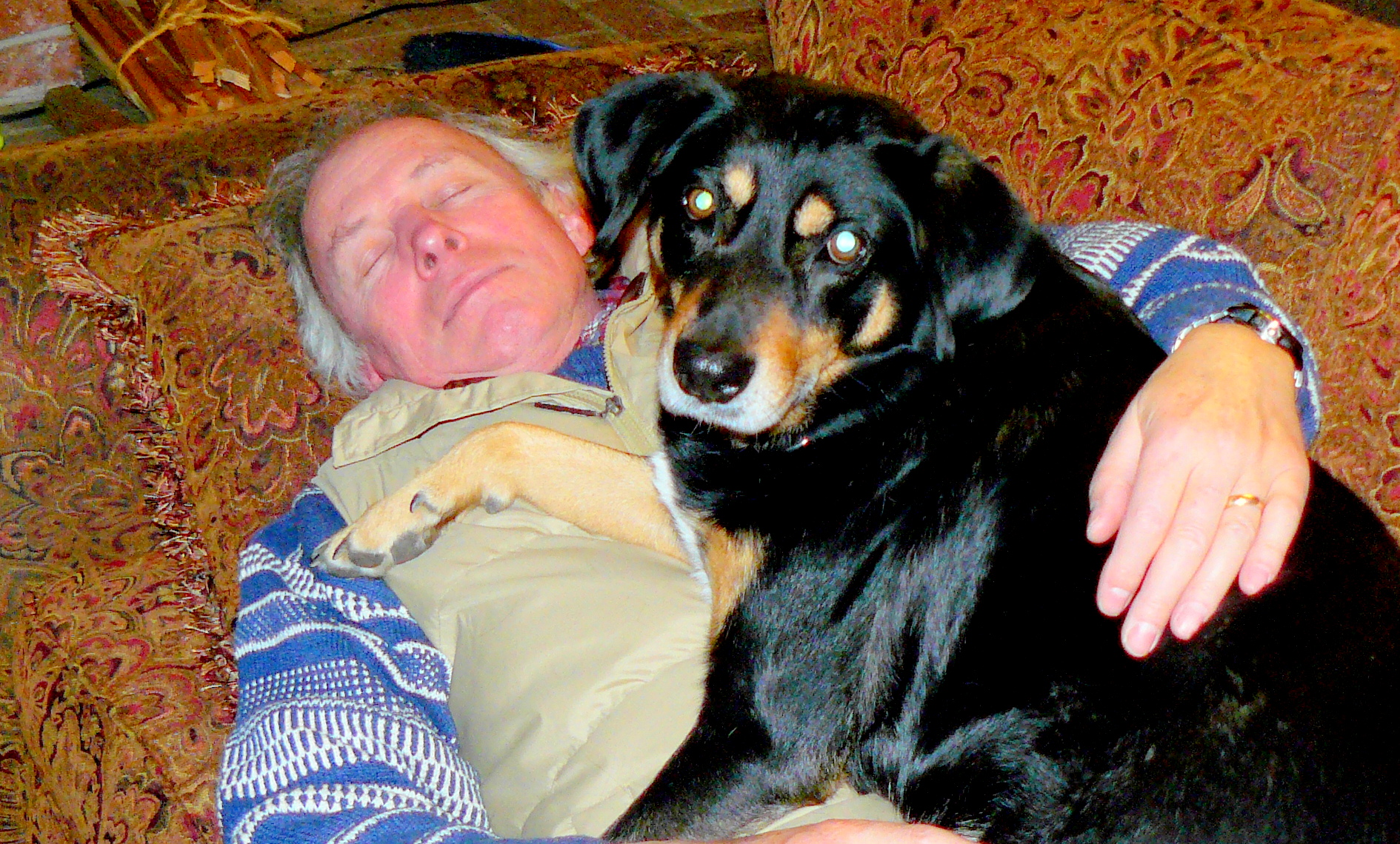
The truest of love between a man and a dog!
Hazel providing the ‘love-in’.

Vested interests, perhaps.

I’m being very brave and stepping into the climate change cauldron!

Learning from Dogs has been posting a wide range of items for well over five years. Indeed, today’s post is number 2,238!

Over those five years, my position regarding climate change or global warming has been pretty clear: a belief in the proposition that man’s behaviours are changing the very climate of our planet.  For instance, a little over a year ago I posted under the title Sceptical about global warming?  It opened:

Learning from Dogs is not a blogsite about climate change!

Why, you may ask, do I start today’s post with that sub-heading?  Because, I am conscious that many of my posts do touch on this subject.  For example, just two days ago there was Breaking news.  Then there was the piece about the climate implications for Phoenix, Arizona.  Followed the next day by the changes in the flow of the jet stream across the North Atlantic with all the weather implications for North-West Europe.

Indeed, as the heading to today’s post makes clear, this is also about the changes going on to our planet.

Learning from Dogs is about a different way of living and behaving.  A campaign, if one wants to call it that, to show that the way that modern man is living is corrupt.  Not with a big ‘C’ but still in the sense of living a dishonest life.  Learning from Dogs attempts to show that our wonderful dogs, a source of so much love and pleasure for so many millions, offer us an example of a life in and of this planet.

If there was ever a time in the history of man when we needed being reminded of our frailty and vulnerability, it is now.  As the following so starkly illustrates.

Peter Sinclair of Climate Crocks recently republished an item from Skeptical Science that opened up as follows:

A new study of ocean warming has just been published in Geophysical Research Letters by Balmaseda, Trenberth, and Källén (2013).  There are several important conclusions which can be drawn from this paper.

  • Completely contrary to the popular contrarian myth, global warming has accelerated, with more overall global warming in the past 15 years than the prior 15 years.  This is because about 90% of overall global warming goes into heating the oceans, and the oceans have been warming dramatically.

Then last week-end, Dan Gomez, friend for over 40 years, sent me the following:

Weather Channel Founder: Global Warming Science ‘Not Valid’

Meteorologist John Coleman, who co-founded The Weather Channel, says the claim that human activity is leading to global warming is no longer scientifically credible.

Instead, the “little evidence” there is for rising global temperatures points to a “natural phenomenon,” Coleman asserts.

In an open letter to the United Nations’ Intergovernmental Panel on Climate Change (IPCC), he wrote: “There is no climate crisis. The ocean is not rising significantly. The polar ice is increasing, not melting away. Polar bears are increasing in number.

“Heat waves have actually diminished, not increased. There is not an uptick in the number or strength of storms.

“I have studied this topic seriously for years. It has become a political and environmental agenda item, but the science is not valid.”

Coleman says he based his views on the findings of the Nongovernmental International Panel on Climate Change (not to be confused with the U.N. panel), a body of scientists and scholars who assess the science of global warming.

“There is no significant man-made global warming at this time. There has been none in the past and there is no reason to fear any in the future,” says Coleman, who was the original meteorologist on “Good Morning America.”

“Efforts to prove the theory that carbon dioxide is a significant greenhouse gas and pollutant causing significant warming or weather effects have failed.

“There has been no warming over 18 years.”

The U.N.’s IPCC argues that their research shows man-made global warming will lead to extreme weather events becoming more frequent and unpredictable, the Express in Britain reported.

Climate expert William Happer, a professor at Princeton University, expressed support for Coleman’s claims.

“No chemical compound in the atmosphere has a worse reputation than CO2, thanks to the single-minded demonization of this natural and essential atmospheric gas by advocates of government control [of] energy production,” Happer said.

“The incredible list of supposed horrors that increasing carbon dioxide will bring the world is pure belief disguised as science.”

What Dan had seen was an article in the UK Daily Mail that, in turn, was echoed on the US WesternJournalism blogsite.  Here’s how that Daily Mail story opens:

Climate change has been proven to be a lie, according to a leading meteorologist.

John Coleman, who co-founded the Weather Channel, claims that the belief humans are causing climate change is not backed up by science.

In an open letter attacking the UN, the 80-year-old from San Diego, said that what ‘little evidence’ there is for global warming points to natural cycles in temperature.

‘There is no climate crisis,’ he wrote. ‘The ocean is not rising significantly. The polar ice is increasing, not melting away. Polar bears are increasing in number. ‘Heat waves have actually diminished, not increased. There is not an uptick in the number or strength of storms.

‘I have studied this topic seriously for years. It has become a political and environment agenda item, but the science is not valid.’

The WesternJournalism post runs with the story explaining (in part):

John Coleman, the original meteorologist for ABC’s Good Morning America and the founder of The Weather Channel, which launched in 1982, wrote an open letter to the UCLA’s Hammer Forum urging them “to re-examine their plan” for their forum, scheduled for this past Thursday, after they announced their experts, both of whom believe in climate change science.

Coleman has made his position against climate change science clear in the past.

“There is no significant man-made global warming at this time, there has been none in the past and there is no reason to fear any in the future. Efforts to prove the theory that carbon dioxide is a significant ‘greenhouse’ gas and pollutant causing significant warming or weather effects have failed. There has been no warming over 18 years.”

The Weather Channel founder cites professors from Princeton University, Massachusetts Institute of Technology (MIT), Harvard Smithsonian Observatory, and the University of Alabama, along with “9,000 Ph.D scientists” who agree with him.

“Yet at your October 23 Hammer Forum on Climate Change you have scheduled as your only speakers two people who continue to present failed science as though it is the final and complete story on global warming/climate change. This is a major mistake.”

Coleman urged the UCLA group to reconsider, noting he is not a “flat Earther,” or a “paid shill of the Koch Brothers.”

In a discussion yesterday with Dan, he was of the clear mind that, yes, the climate is changing, as it always has over eons of time, but that the degree of change that is directly attributed to man’s affairs is minute.  Then all around me I see sign after sign, read article after article, that we, as in mankind, are relentlessly ‘fouling our own nest’ and the time left for us to learn how to live sustainably on this planet is fast running out.

Can we get to the truth? The topic will be continued tomorrow!

Returning to the land – a guest essay.

A question of a possible catastrophe

Note: As tomorrow’s post will explain, the next few weeks will be encroaching seriously on my blogging time. So it was very timely to receive this guest essay from John in the last couple of days and even more generous of him to give me permission to republish it.

It will make an interesting comparison to an item from Dan Gomez being published on Thursday.

ooOOoo

Notes on Dealing With Imminent Catastrophe

We know that our world economy is leveraged at least twenty-five times beyond any earthly material foundation. Regardless of this reality, we have made an artificial global economy more real than our physical world. This situation only makes sense when we recognize that we’re being encouraged to re-establish our awareness of reality. It’s a final exam time for a leading edge species of clever monkeys.

Nature has tolerated human activities for millions of years. Now that our demographics ravenously swarm the globe, belch poisons into the five mile band of air that sustains surface life on earth, dumps wastes and toxins into streams, rivers, lakes and oceans, and arrogantly refuses to understand obvious warnings; Nature is reacting.

For those who are inclined to either or choices, in accordance with the physical Law of Entropy, the decision is between pursuing constructive or destructive actions. For those who are more spiritually oriented, there is no question. In either case, we know what needs to be done.

Our first order of business is to stabilize our inclusive global economy through green initiatives that are operated for profit without damage to the eco-system. Yes, this sounds impossible the first time we think about it. Can we come up with a better plan? Not really, when we stop and honestly consider our situation. We’re poised on the brink of a material, economic and cultural collapse created by human beings.

Wars continue to be waged world wide over territory and rapidly diminishing fossil fuel resources. We have essentially lost trust in each other as equal members of a common community we call Earth. And, we are rapidly losing faith in the unsustainably inflated symbol of trust we call Money.

A green economy is our best solution for the multiple problems that plague us. Here’s why and a few suggestions about how we go about the process. Essentially, our critical need for renaissance is a process of education, formation and transformation.

When we return to the land as a global priority, the use of solar energy can replace massive industrial electrical generators running on fossil fuel derivatives. Most industrial generators may be easily converted to bio-diesel fuel. Industrial diesel generators worldwide can be converted to bio-fuel overnight. No mechanical adaptation is required.

Electric cars already set speed records at Europe’s classic racetracks. Solar electric cars are on the horizon. A bio-diesel engine to power a golf cart costs about $500 today and is available from Amazon.

There’s a natural need for co-operation when we return to the land and collectively re-establish our financial roots. First, we recognize that each of our actions affects the well being of the earth and its inhabitants. Second we realize that we are responsible for the well being of the Earth which sustains our being.

Third, we re-establish our natural connection with the unity of a living universe. We begin with the community gardens and farmer’s markets that are already operational, and rebuild accordingly.

When we are foolish, we act independently for our personal well being. When we are wise, we act together for the well being of the earth and each other. Growing our own food not only assures that what we eat will be free of chemical by-products; it also makes us aware of how fragile our consumer supply lines have become. Recycling our food waste as fertilizer completes a natural growth cycle.

By the way, a back yard greenhouse can produce enough bio-fuel to operate a diesel vehicle and a solar panel array can generate enough energy to charge your electric car. How much money does this save each year?

We don’t need nuclear reactors that sometimes melt down and sicken us with a continual stream of radiation carried by the tides and the winds of an integrated planet. We don’t need the wastes of nuclear reactors that poison the earth for millennium.

We don’t need nuclear weapons capable of destroying most, if not all, of the life on earth in an all out suicidal war. The only creatures to survive the holocaust of nuclear war would need to be radiation resistant; shielded deep underground or deep under the sea.

Harnessing wind, water and geothermal energy are wiser ways to keep our world energized in a green economy. A combination of habitats and communities powered by solar and geothermal energy will produce a new building boom as we shed the skin of our former infrastructure and a green architectural industry emerges.

Recycling the components of our technological world not only reduces our industrial waste, it decreases the cost of manufacture. Similarly, adapting and reusing what we already have decreases our personal expenses and reduces our demands on the earth.

These are only a few of the ideas which are already possible. Many more are already in the process of becoming our greater reality.

Still think such a massive transformation is impossible? If so, please know that you remain in our prayers.

There is hope for tomorrow. Science consistently opens new doors. Faith in the Nature of God of which we are each an infinitesimal part makes us unified and strong as a consciously aware biological species.

John Hurlburt

an old lamplighter

ooOOoo

The love of a dog – big time.

As post sequels go, it doesn’t get much better than this!

I was so pleased at how yesterday’s post was received and, serendipitously, the ‘add-ons‘ that appeared as comments to that post.

So how to follow that today?

Chris Snuggs came to the rescue in sending me a link to a recent item in the UK newspaper The Daily Telegraph: Touching moment sick elderly man is reunited with his dog.

Luckily, rather than republish the Telegraph item without permission, the video and background information were over on YouTube.

Here it is:

Watch heart-melting moment stricken patient makes shock recovery after being reunited with pet dog.

http://www.youtube.com/watch?v=BW5YSx5gA2Q

Published on Oct 18, 2014

James Wathen, 73, and his beloved one-eyed Chihuahua, Bubba, both stopped eating for six weeks after they were separated.

This is the heartwarming moment a seriously ill elderly patient made a “tremendous recovery” thanks to an emotional reunion with his pet dog.

James Wathen, 73, looked doomed when his condition – related to an unknown illness – deteriorated after six weeks at Baptist Health Corbin hospital in Kentucky.

The pensioner was so ill he could barely speak and had stopped eating.

However, all that changed when he managed to whisper to nurses that he was missing his one-eyed Chihuahua Bubba.

His revelation sparked a desperate search for the beloved dog, which was being kept at the Knox-Whitely Animal Shelter.

Pets are banned at the hospital, but nurses managed to sneak Bubba in and then filmed the emotional reunion.

There wasn’t a dry eye in the room,” the hospital’s chief nursing officer Kimberly Probus told WKTV. In a further twist, Mary-Ann Smyth, from the animal shelter, said the dog had also stopped eating when the pair were separated.

They didn’t think James was going to make it,” she told NBC. “He [Mr Wathen] has done a complete turnaround. He’s speaking, he’s sitting up, he’s eating.

He doesn’t look like the same guy, and the dog is eating and doing better now, too.”

The hospital has allowed Bubba to visit his owner several times since, with staff saying they have both made a “tremendous recovery”.

It’s what this blog is all about. There is no limit to what our dogs offer us; love being at the top of the list.

James Wathen and his beloved dog Bubba.

The struggle between the forces of light and dark.

At least dogs can go off and find new homes!

Let’s start with the Ebola outbreak with the latest news from the BBC suggesting:

The death toll from the Ebola virus outbreak has risen to 4,447, with the large majority of victims in West Africa, the World Health Organization (WHO) says.

WHO assistant director-general Bruce Aylward also said there could be up to 10,000 new cases a week within two months if efforts were not stepped up,

But the rate of new infections in some areas has slowed down, he added.

Next up.

I’ve been musing as to whether or not I was going to republish a recent essay from George Monbiot.  The one in question being The Kink in the Human Brain.  It opens, thus:

Pointless, joyless consumption is destroying our world of wonders.

By George Monbiot, published in the Guardian 2nd October 2014

This is a moment at which anyone with the capacity for reflection should stop and wonder what we are doing.

If the news that in the past 40 years the world has lost over 50% of its vertebrate wildlife (mammals, birds, reptiles, amphibians and fish) fails to tell us that there is something wrong with the way we live, it’s hard to imagine what could. Who believes that a social and economic system which has this effect is a healthy one? Who, contemplating this loss, could call it progress?

In fairness to the modern era, this is an extension of a trend that has lasted some two million years. The loss of much of the African megafauna – sabretooths and false sabretooths, giant hyaenas and amphicyonids (bear dogs), several species of elephant – coincided with the switch towards meat eating by hominims (ancestral humans). It’s hard to see what else could have been responsible for the peculiar pattern of extinction then.

My spirits continued downward, especially when I clicked on that first link and read this from the Guardian website:

Rubbish dumped on the tundra outside llulissat in Greenland stand in stark contrast to icebergs behind from the Sermeq Kujullaq or llulissat Ice fjord – a Unesco world heritage site. Photograph: Global Warming Images/WWF-Canon

The number of wild animals on Earth has halved in the past 40 years, according to a new analysis. Creatures across land, rivers and the seas are being decimated as humans kill them for food in unsustainable numbers, while polluting or destroying their habitats, the research by scientists at WWF and the Zoological Society of London found.

“If half the animals died in London zoo next week it would be front page news,” said Professor Ken Norris, ZSL’s director of science. “But that is happening in the great outdoors. This damage is not inevitable but a consequence of the way we choose to live.” He said nature, which provides food and clean water and air, was essential for human wellbeing.

“We have lost one half of the animal population and knowing this is driven by human consumption, this is clearly a call to arms and we must act now,” said Mike Barratt, director of science and policy at WWF. He said more of the Earth must be protected from development and deforestation, while food and energy had to be produced sustainably.

Then a few days ago, one of our neighbours sent me an email with his latest news about ISIS.  This is what he sent:

Got this from one of my closest friends today, it came from his brother so I’m pretty confident that it’s true. There is some really bad stuff on the horizon and it’s probably gonna come this way like a runaway train!! Everybody better start thinking about where they want to stand when push comes to shove!

With “this’ being in part:

Missionaries who are in the areas that are being attacked by ISIS. ISIS has taken over the town they are in today. He said ISIS is systematically going house to house to all the Christians and asking the children to denounce Jesus. He said so far not one child has. And so far all have consequently been killed. But not the parents. The UN has withdrawn and the missionaries are on their own. They are determined to stick it out for the sake of the families – even if it means their own deaths. They are very afraid, have no idea how to even begin ministering to these families who have had seen their children martyred. Yet he says he knows God has called them for some reason to be His voice and hands at this place at this time. Even so, they are begging for prayers for courage to live out their vocation in such dire circumstances. And like the children, accept martyrdom if they are called to do so. These brave parents instilled such a fervent faith in their children that they chose martyrdom. Please surround them in their loss with your prayers for hope and perseverance.

One missionary was able to talk to her brother briefly by phone. She didn’t say it, but I believe she believes it will be their last conversation. Pray for her too. She said he just kept asking her to help him know what to do and do it. She told him to tell the families we ARE praying for them and they are not alone or forgotten — no matter what. Please keep them all in your prayers.

I didn’t and still don’t know how to reply.  That is until Maria Matthews left a comment to yesterday’s post.

Love the poem/verse Illusion. The lines, Following the herd, bleating like sheep, Held captive, half asleep. hit a strong note with me.

As we often wonder why people can’t think for themselves outside the box but then again maybe that is part of being human. Life is a mystery isn’t it? Enjoyed the post,

Maria’s comment about life being a mystery was interpreted by me as humans being a mystery and the realisation that it has ever been so. For it resonated with a recent programme over on the BBC that included information on the ancient Teotihuacan people who ruled in what is present-day Mexico some 2,000 years ago.  From Wikipedia:

View of the Avenue of the Dead and the Pyramid of the Sun, from Pyramid of the Moon (Pyramide de la Luna).

Teotihuacan /teɪˌoʊtiːwəˈkɑːn/, also written Teotihuacán (Spanish About this sound teotiwa’kan (help·info)), was a pre-Columbian Mesoamerican city located in the Valley of Mexico, 30 miles (48 km) northeast of modern-day Mexico City, known today as the site of many of the most architecturally significant Mesoamerican pyramids built in the pre-Columbian Americas. Apart from the pyramids, Teotihuacan is also anthropologically significant for its complex, multi-family residential compounds, the Avenue of the Dead, and the small portion of its vibrant murals that have been exceptionally well-preserved. Additionally, Teotihuacan exported a so-called “Thin Orange” pottery style and fine obsidian tools that garnered high prestige and widespread utilization throughout Mesoamerica.

The city is thought to have been established around 100 BC, with major monuments continuously under construction until about AD 250. The city may have lasted until sometime between the 7th and 8th centuries AD, but its major monuments were sacked and systematically burned around 550 AD. At its zenith, perhaps in the first half of the 1st millennium AD, Teotihuacan was the largest city in the pre-Columbian Americas, with a population estimated at 125,000 or more, making it at minimum the sixth largest city in the world during its epoch. Teotihuacan began as a new religious center in the Mexican Highland around the first century AD. This city came to be the largest and most populated center in the New World. Teotihuacan was even home to multi-floor apartment compounds built to accommodate this large population. The civilization and cultural complex associated with the site is also referred to as Teotihuacan or Teotihuacano.

That BBC programme also included the fact that almost on a daily basis the Teotihuacan authorities viewed the assassinations of often hundreds of lower class people as perfectly normal.

In other words, despicable cruelty of man upon man, not to mention an utter disregard for the natural world, has been going on for thousands of years!

Thus it underlined to me, in spades, that what ‘other people’ get up to is, to a very great extent, irrelevant.  Because whatever the circumstances we have a choice: we always have a choice.  Or if you will forgive me for repeating my closing sentences in yesterday’s post:

Whatever is going on in the world, whatever has the power to create fear in our minds, in the end it comes down to another power, the power of thought, and our choice of the behaviors that we offer the world.

That is why dogs are so important. Because they almost predominantly love sharing and living their lives in the company of humans.


evil