Category: Morality

When dark shadows fall across our hearts.

One of the most important lessons we can learn from our dogs: coping with death.

In writing about the lesson of death that we can learn from our dogs I am, of course, speaking of our own death, of the inevitability of our death. That largely unspoken truth that Sharon Salzberg described in her book Faith: “What does it mean to be born in a human body, vulnerable and helpless, then to grow old, get sick and die, whether we like it or not?” [page 34.]

Anyone who has loved a dog has most likely been intimately involved in the end of that dog’s life. It is, to my mind, the ultimate lesson that dogs offer us: how to be at peace when we die and how to leave that peace blowing like a gentle breeze through the hearts of all the people who loved us.

Our beloved dogs have much shorter life spans than us, thus almost everyone who has loved a dog will have had to say goodbye to that gorgeous friend at some point in their lives. Very sadly, perhaps, saying goodbye to more than one loved dog.

All of which is my introduction to a recent essay published on The Conversation blogsite. The essay is written by Bernard Rollin, Professor of Philosophy, Animal Sciences and Biomedical Sciences at Colorado State University. The essay is called: When is it ethical to euthanise your pet?

ooOOoo

When is it ethical to euthanize your pet?

August 12, 2015 6.18am EDT

In the 1960s, I knew people who, before going on vacation, would take their dogs to a shelter to be euthanized. They reasoned that it was cheaper to have a dog euthanized – and buy a new one upon returning – than pay a kennel fee.

Two decades later, I was working at Colorado State’s veterinary hospital when a group of distraught bikers on Harley-Davidsons pulled up carrying a sick chihuahua. The dog was intractably ill, and required euthanasia to prevent further suffering. Afterwards, the hospital’s counselors felt compelled to find the bikers a motel room: their level of grief was so profound that the staff didn’t think it was safe for them to be riding their motorcycles.

These two stories illustrate the drastic change in how animals have been perceived. For thousands of years, humans have kept animals as pets. But only during the past 40 years have they come to be viewed as family.

While it’s certainly a positive development that animals are being treated humanely, one of the downsides to better treatment mirrors some of the problems the (human) health care system faces with end-of-life care.

As with humans, in many cases the lives of pets are needlessly prolonged, which can cause undue suffering for the animals and an increased financial burden for families.

The growth of veterinary medicine and ethics

In 1979, I began teaching veterinary medical ethics at Colorado State University’s veterinary school, the first such course ever taught anywhere in the world.

A year later, the veterinary school hired an oncologist to head up a new program on animal oncology. Soon, our clinic was applying human therapeutic modalities to animal cancer. The visionary head of the veterinary program also hired a number of counselors to help pet owners manage their grief – another first in veterinary circles.

I’d been under the impression that people would be reluctant to spend much money on animal treatments, so I was genuinely shocked when the following April, the Wall Street Journal reported individuals spending upwards of six figures on cancer treatments for their pets.

As a strong advocate for strengthening concern for animal welfare in society, I was delighted with this unprecedented turn of events. I soon learned that concern for treating the diseases of pets besides cancer had also spiked precipitously, evidenced by a significant increase in veterinary specialty practices.

One of the family

So what’s behind the shift in how pets are perceived and treated?

For one, surveys conducted over the last two decades indicate an increasing number of pet owners who profess to view their animals as “members of the family.” In some surveys, the number is as high as 95% of respondents, but in nearly all surveys the number is higher than 80%.

In addition, the breakdown of nuclear families and the uptick of divorce rates have contributed to singles forming tighter bonds with companion animals.

Such attitudes and trends are likely to engender profound changes in societal views of euthanasia. Whereas before, many owners didn’t think twice about putting down a pet, now many are hesitant to euthanize, often going to great lengths to keep sick animals alive.

Vets caught in the middle

However, veterinarians continue to experience extensive stress as they experience two opposite – but equally trying – dilemmas: ending an animal’s life too soon, or waiting too long.

In a paper that I published entitled Euthanasia and Moral Stress, I described the significant stress experienced by veterinarians, veterinary technicians and humane society workers. Many chose their profession out of a desire to improve the lot of animals; instead, they invariably ended up euthanizing large numbers of them, often for unethical reasons.

These ranged from “I got the dog to jog with me, and now it’s too old to run,” to “If I die, I want you to euthanize the animal because I know it can’t bear to live without me.”

In other cases, the animal is experiencing considerable suffering, but the owner is unwilling to let the animal go. With owners increasingly viewing pets as family members, this has become increasingly common, and many owners fear the guilt associated with killing an animal too soon.

Ironically this, too, can cause veterinarians undue trauma: they know the animal is suffering, but there’s nothing they can do about it unless the owner gives them permission.

The consequences are manifest. One recent study showed that one in six veterinarians has considered suicide. Another found an elevated risk of suicide in the field of veterinary medicine. Being asked to kill healthy animals for owner convenience doubtless is a major contribution.

How to manage the decision to euthanize

Here is my suggestion to anyone who is thinking about getting a pet: when you first acquire it, create a list of everything you can find that makes the animal happy (eating a treat, chasing a ball, etc). Put the list away until the animal is undergoing treatment for a terminal disease, such as cancer. At that point, return to the list: is the animal able to chase a ball? Does the animal get excited about receiving a treat?

If the animal has lost the ability to have positive experiences, it’s often easier to let go.

This strategy can be augmented by pointing out the differences between human and animal consciousness. As philosopher Martin Heidegger has pointed out, for humans much of life’s meaning is derived from balancing past experiences with future aspirations, such as wishing to see one’s children graduate or hoping to see Ireland again.

Animals, on the other hand, lack the linguistic tools to allow them to anticipate the future or create an internal narrative of the past. Instead, they live overwhelmingly in the present. So if a pet owner is reluctant to euthanize, I’ll often point out that the animal no longer experiences pleasant “nows.”

In the end, managing euthanasia represents a major complication of the augmented status of pets in society. Ideally, companion animal owners should maintain a good relationship with their general veterinary practitioner, who has often known the animal all of its life, and can serve as a partner in dialogue during the trying times when euthanasia emerges as a possible alternative to suffering.

ooOOoo

So much to learn from these beautiful creatures and so many ways to return the unlimited love we receive from them.

The happiness of wolves

Loving dogs must mean, surely, loving and protecting our wolves.

In yesterday’s post, George Dvorsky wrote:

Unlike a certain companion animal that will go unnamed, dogs lose their minds when reunited with their owners. But it’s not immediately obvious why our canine companions should grant us such an over-the-top greeting—especially considering the power imbalance that exists between the two species. We spoke to the experts to find out why.

Call of the Wild

In order to gain an appreciation for dog behavior, it’s important to understand that dogs are descended from wolves (or at least a common wolf-like ancestor). Clearly, the two species, separated by about 10,000 to 15,000 years, share a lot in common.

Like dogs, wolves greet each other with vigorous face licking (Credit: Sander van der Wel CC A-SA 2.0)

That reference to wolves seemed like as good a reason as any to write further about the wonderful wolf. Or more specifically about the wolves of Oregon.

Such as this from a recent newsletter from Oregon Wild:

Dear Oregon Wild Supporter,

It’s been a busy last few days for Oregon’s wolves and those working to protect them, with new places, new dates, and new pups!

When I wrote to you last, it was about an important Oregon Department of Fish and Wildlife (ODFW) Commission meeting in Seaside. But there’s been a change! The agenda for that meeting has moved and the ODFW Commission will now be taking comments on whether to delist gray wolves on Friday, Oct. 9th in Florence, Oregon. Please sign up to attend and testify on behalf of Oregon’s wolves. After all, they can’t testify for themselves!

I also shared with you a video of the Rogue Pack yearlings playing, caught by trail cam. These were Journey’s pups from last year, but it was also reported that he and his mate had produced another litter this year. Thanks to the US Fish and Wildlife Service, we have a look at these new pups.

Here’s that video:

Published on Jul 8, 2015
A camera captured images of three yearling wolves playing in June, providing biologists with confirmation the offspring of Oregon’s wandering wolf OR7 and his mate have survived.

I can well imagine that the majority of the readers of Learning from Dogs will not be able to attend that ODFW Commission meeting in Florence, OR, on the 9th October (as we can’t) but that doesn’t stop you from wanting to support wolf recovery here in Oregon by signing and sharing the Oregon Wild petition.

Thank you.

The male of the species, Part One

Dogs, women and men.

I did warn you, my dear reader, at the end of yesterday’s post that my introspective mood continues!

Over today and tomorrow, I want to explore why we humans can be so incredibly clever, especially in a group sense, yet the males of our species find it so difficult to express themselves, and what that means for the future of humanity (at the risk of sounding a tad pompous).

More or less at random, a dip into yesterday’s selection of blogs brought to light some deeply disturbing items.

Professor William Even, Professor of Economics at the Farmer School of Business at Miami University was reported in The Conversation saying that:

As of 2014, there were approximately 39 million people aged 16-24 in the US, and 5.4 million of them were neither employed nor in school. That’s almost 14% of the age cohort, or more than two-and-a-half times the national rate of unemployment.

In that same bulletin from The Conversation, John Shepherd, a Professorial Research Fellow in Earth System Science at the University of Southampton in England, in writing about the challenges of directly removing CO2 from the atmosphere, stated (my emphasis):

A new paper in Nature Communications shows just how big the required rates of removal actually are. Even under the IPCC’s most optimistic scenario of future CO2 emission levels (RCP2.6), in order to keep temperature rises below 2℃ we would have to remove from the atmosphere at least a few billion tons of carbon per year and maybe ten billion or more – depending on how well conventional mitigation goes.

We currently emit around eight billion tonnes of carbon per year, so the scale of the enterprise is massive: it’s comparable to the present global scale of mining and burning fossil fuels.

Then Raúl Ilargi Meijer authored an item on The Automatic Earth blog, a blog that usually writes almost exclusively about money matters. His article was called: Power and Compassion. He opens his essay:

Time to tackle a topic that’s very hard to get right, and that will get me quite a few pairs of rolling eyes. I want to argue that societies need a social fabric, a social contract, and that without those they must and will fail, descend into chaos.

Then after referring to the European Union, he goes on to write (my emphasis):

Though it may look out of far left field for those of us -and there are many- who think in economic and political terms only, we cannot do without a conscious definition of a social contract. We need to address the role of compassion, morals, even love, in our societies. If Jesus meant anything, it was that.

There have been times through history when this subject would have been much easier to breach, but we today almost seem to think they are irrelevant, that we can do without them. We can’t. But in the US, people get killed at traffic stops every day, and in Europe, they die of sheer negligence. Developments like these will lead to ‘centers that cannot hold’.

In that part of the media whirlwind that we at the Automatic Earth expose ourselves to, virtually all discussions about our modern world, and what goes wrong with it, which is obviously a whole lot, are conducted in rational terms, in financial and political terminology.

But that’s exactly what we should not be doing. Because it’s never going to get us anywhere. In the end, let alone in the beginning too, we are not rational creatures. And if and when we resort to only rational terms to define ourselves, as well as our world and the societies we create in that world, we can only fail.

For a society to succeed, before and beyond any economic and political features are defined, it must be based solidly on moral values, a moral compass, compassion, humanity and simple decency among its members. And those should never be defined by economists or lawyers or politicians, but by the people themselves. A social contract needs to be set up by everyone involved, and with everyone’s consent. Or it won’t last.

How and why that most basic principle got lost should tell us a lot about where we are today, and about how we got here. Morals seem to have become optional. The 40-hour death struggle of Cecil the lion exemplifies that pretty well. And no, his is not some rare case. The lack of morals involved in killing Cecil is our new normal.

Let me now set the stage for what I want to write about tomorrow. And I’m going to do that by referring to a TED Talk that was recorded by historian and author Yuval Noah Harari. Here’s how that TED Talk was introduced:

Seventy thousand years ago, our human ancestors were insignificant animals, just minding their own business in a corner of Africa with all the other animals. But now, few would disagree that humans dominate planet Earth; we’ve spread to every continent, and our actions determine the fate of other animals (and possibly Earth itself). How did we get from there to here? Historian Yuval Noah Harari suggests a surprising reason for the rise of humanity.

Yuval Harari’s talk is based firmly on his thesis presented in his book: Sapiens: A Brief History of Humankind. (There’s a review of his book in The Guardian newspaper.) Namely:

The book surveys the history of humankind from the evolution of archaic human species in the Stone Age up to the twenty-first century. Its main argument is that Homo sapiens dominates the world because it is the only animal that can cooperate flexibly in large numbers. The book further argues that Homo sapiens can cooperate flexibly in large numbers, because it has a unique ability to believe in things existing purely in its own imagination, such as gods, nations, money and human rights. The author claims that all large scale human cooperation systems – including religions, political structures, trade networks and legal institutions – are ultimately based on fiction.

Other salient arguments of the book are that money is a system of mutual trust; that capitalism is a religion rather than only an economic theory; that empire has been the most successful political system of the last 2000 years; that the treatment of domesticated animals is among the worst crimes in history; that people today are not significantly happier than in past eras; and that humans are currently in the process of upgrading themselves into gods.

It is my contention that humankind’s evolution, our ability to “cooperate flexibly in large numbers”, is rooted in the gender differences between man and woman. A contention that I expand upon tomorrow.

Saturday smile.

Wonderful volunteers keep a stranded Orca whale alive.

I saw this shared on Facebook by George Ball, a friend from my English days. It’s a lovely example of the compassionate side of man.

ooOOoo

From CBS News:

Stranded orca saved by volunteers who kept it cool for hours until high tide

A pump and sheets were used to keep whale alive near Hartley Bay on B.C.’s North Coast

By Maryse Zeidler, CBC News Posted: Jul 23, 2015 7:20 AM PT – Last Updated: Jul 24, 2015 5:35 AM PT

An orca that was stranded on some rocks was kept alive for eight hours by a dedicated team of whale researchers and volunteers on the North Coast of B.C.

“She cried often, which tore at our hearts, but as the tide came up there were many cheers as this whale was finally free,” said in a Facebook post from the group The Cetacean Lab.

Early Wednesday morning, the group received a call from a colleague about the beached orca, which was stuck on some rocks at low tide.

“We decided the best thing to do would be to keep her cool, that meant to put water on her body and we used blankets and sheets,” said Hermann Meuter, a co-founder of Cetacean Lab.

“It was the only thing we could do.”

Meuter said they could see the orca’s behaviour change as they began to help her.

“At first she was stressed, you could see that her breathing was getting a little faster,” said Meuter.

But after about 15 to 20 minutes, she began to calm down.

“I think she knew that we were there to help her,” said Meuter.

Around 4 p.m. PT, the tide began to rise and the orca was able to start freeing herself.

“It took her about 45 minutes to negotiate how best to get off the rocks,” said Meuter. “We all just kept our distance at that point.”

When she swam away, the orca was quickly reunited with her pod, which was nearby.

Metuer said members of the World Wildlife Fund and the Git G’at Guardians from Hartley Bay were also on the scene helping to free the animal.

“We all cared about this whale and we were just very lucky to give that whale another chance,” said Meuter.

ooOOoo

There are photographs to view on that CBS News item plus this video (wish it could have been longer) was also included in Maryse Zeidler’s report.

Well done to everyone who helped save this magnificent animal.

Another love story.

This is what happens when an animal trainer finds a bear cub.

(Today’s post has a number of very beautiful photographs. However, it is much better presented to you, dear reader, as a standalone post rather than under the umbrella of a Picture Parade.)

Thanks to Suzann for sending this on to me.

ooOOoo

A Man Found Two Bear Cubs Beside Their Dead Mother.

A naturalist named Casey Anderson stumbled across two grizzly bear cubs nestled beside their dead mother in the wild mountains of Alaska . Casey couldn’t just leave these little guys to die in the wilderness, so he made the brave decision to take them with him. He trains animals for a living, so he knew he would be able to give these cubs a real shot. That simple decision, borne out of grief, turned into one of the most unique and adorable rehabilitation stories we have ever laid eyes on.

bears1

This is Casey and the little cubs. Unfortunately, only one survived and Casey decided to adopt him.

He named him Brutus.

bears2

Brutus grew up as part of the family, albeit a very fuzzy part.

bears3

It was Casey’s job to train animals, so raising and training Brutus was normal for him.

bears4oooo

bears5

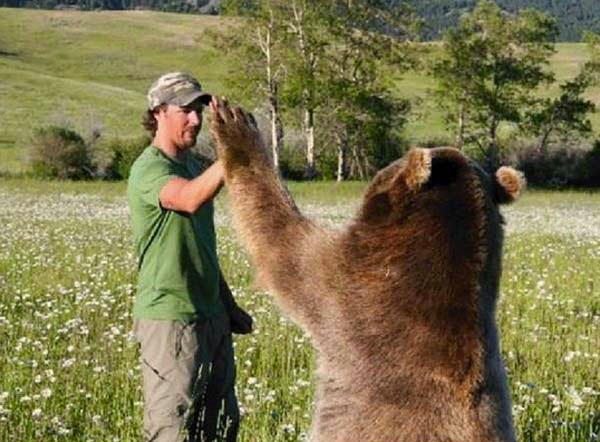
Over the years, they became close friends and brothers.

bears6

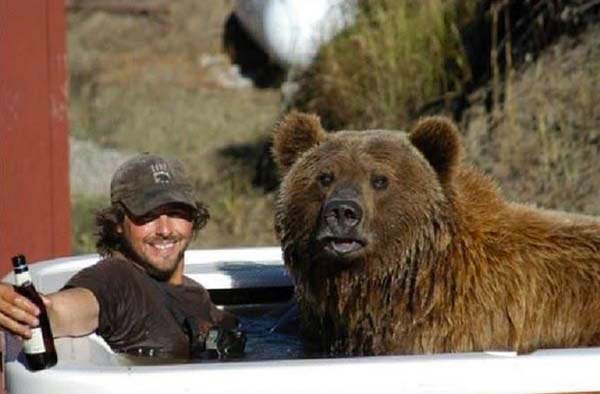
And Brutus got the run of the pool.

bears7

oooo

bears8

oooo

bears9

oooo

bears10

Brutus grew to be so close to Casey, he was even his best man (bear) at the wedding.

bears11

It may have made the bride a little nervous.

bears12

But she was probably glad Brutus wasn’t capable of taking him out to dinner (no thumbs).

bears13

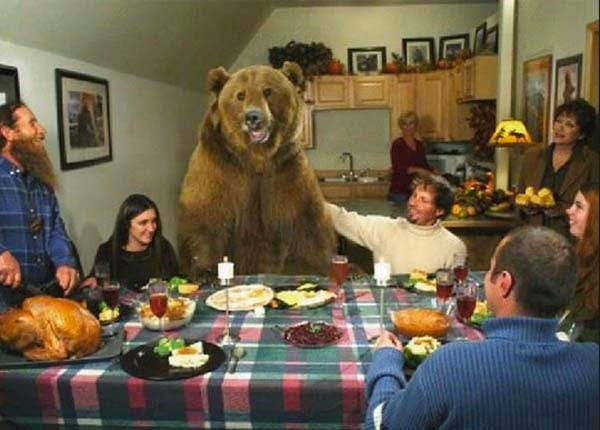
Brutus also gets a place of honor at the Thanksgiving table.

bears14

Life is good for this not-so-average bear.

bears15

oooo

bears16

oooo

bears17

oooo

bears18

oooo

bears19

oooo

bears20

You’ll be hard pressed to find a situation cooler than being best friends with a killer grizzly bear. If Casey and Brutus made you smile, then you should probably spread the joy and share this.

This is a lovely story. Shame all humans aren’t this kind and understanding. Though many are and this is a lovely example of such a person.

A chance in life

The second of two beautiful videos

As I explained yesterday, Jean and I are taking part in a local garage sale that isn’t leaving much time for the usual things each day.

I’m very embarrassed in not recalling if someone sent me the link to the following video or whether I saw it on one of the general blogs that I subscribe to.

Learning about last breaths from our dog.

The wisdom of a six-year-old.

Very grateful to Chris Snuggs for sending this on to me. As seen on the BoredBug website:

ooOOoo

They Told This Little Boy His Dog Was Going To Be Put Down. His Response STUNNED Them.

On Belker’s last day, Shane seemed calm, petting the old dog as if he understood that he was saying a last “goodbye”. Within minutes, Belker slipped peacefully away. Shane seemed to accept Belker’s transition without any difficulty or confusion.

Saying-Good-Bye

They all sat together after Belker’s death, wondering aloud how sad it is that animals lives are shorter than humans. Shane, who had been listening quietly, spoke ”I know why! People are born so that they can learn how to live a good life, like loving everybody all the time and being nice, right?” The six-year-old continued, ”Well, dogs already know how to do that, so they don’t have to stay as long.”

Shanes-Wise-Explanation

ooOOoo

You all have a good, loving weekend.

Has the human ‘pack’ moved on!

Believers and non-believers alike owe Pope Francis a giant ‘thank you’.

As regular followers of this place will have heard before, one of the roles of the ‘alpha’ dog, or more accurately referred to these days as the Mentor dog, in other words the female dog that in the days before domestication was the leader of her pack, was to move her pack if she intuited that the pack’s home range was not sustaining them. (Her other role was pick of the male dogs!)

Thus the title of today’s post came to me as just possibly the metaphorical equivalent. That the global human ‘pack’ has been sharply reminded by one of the world’s key religious leaders that ‘more of the same’ isn’t going to work for much longer.

Quite rightly, there has been a huge amount of reporting and analysis of last week’s Papal Encyclical. But one of the most beautiful and profoundly eloquent came from the writer Jennifer Browdy. If you haven’t come across her before then do drop across to her website; you will love what she presents!  I have been a subscriber to her blog posts for some time and that was how I came across her post called: And the Walls Came Tumbling Down: Pope Francis Shows Us the Way. Jennifer very kindly gave me permission to republish her post today.

ooOOoo

And the Walls Came Tumbling Down: Pope Francis Shows Us the Way

By Jennifer Browdy

The Encyclical on climate change and the environment released by Pope Francis this week has all the magic of the fall of the Berlin Wall in 1991. Back then, the antagonism between the U.S. and the U.S.S.R. seemed implacable and unresolvable, a fight to the death. And then suddenly the wall came down and the world walked through, marveling, into a new era.

Now we have another abrupt shift, this time of a religious order. The leaders of the Catholic Church can hardly be accused of being “radical tree-huggers.” And yet here is Pope Francis, solemnly exhorting his flock of a billion Catholics worldwide to be respectful to Mother Earth and all the living beings she supports. In the blink of an eye, the language of Native American spirituality has been taken up by the same Catholic Church that once tortured and executed indigenous peoples precisely because of their different religious beliefs.

I urge you to read the entire Encyclical for yourself. It is a truly remarkable document, worth serious study. Of many passages I’d like to underline, here are two:

228 Care for nature is part of a lifestyle which includes the capacity for living together and communion. Jesus reminded us that we have God as our common Father and that this makes us brothers and sisters. Fraternal love can only be gratuitous; it can never be a means of repaying others for what they have done or will do for us. That is why it is possible to love our enemies. This same gratuitousness inspires us to love and accept the wind, the sun and the clouds, even though we cannot control them. In this sense, we can speak of a “universal fraternity”.

229 We must regain the conviction that we need one another, that we have a shared responsibility for others and the world, and that being good and decent are worth it. We have had enough of immorality and the mockery of ethics, goodness, faith and honesty. It is time to acknowledge that light-hearted superficiality has done us no good. When the foundations of social life are corroded, what ensues are battles over conflicting interests, new forms of violence and brutality, and obstacles to the growth of a genuine culture of care for the environment.

Here we find spiritual ecology enshrined as Catholic doctrine. And one thing about the Catholic Church—it is big on obedience. For believers, to ignore the Pope is to risk hellfire and damnation. In this case, though, the hellfire and damnation will be earthly, if we do not listen to the wise advice of Pope Francis and curb the insanity of industrial growth that goes beyond the limits of the planet to support.

Scientists appeal to our sense of reason, presenting compelling evidence that if we continue on our present path of wasteful consumption of the Earth’s resources, we will destroy our own future as a flourishing species. Religious leaders appeal to human beings’ moral conscience in invoking the responsibility of current parents and grandparents to leave a livable world to our descendants. It is up to the politicians, though, to translate vision into practice.

For too long, Christian conservatives in the U.S. have played the role of the ideological wing of Big Business, using money, manipulation and scare tactics to buy politicians and votes. In the face of the new Papal Encyclical, can American Christians really continue in good conscience to support the worst of the planet’s polluters and plunderers? Can they continue to elect mercenary politicians who hold our country hostage to the highest bidder?

If all good people who love our Earth and its creatures were to translate our love into action, as Pope Francis has just done so forcefully, I have no doubt the seemingly invincible wall of the industrial growth society we’ve been living with these past 200 years would melt away, revealing the path into a green, prosperous future.

“Where there’s a will, there’s a way,” the saying goes. Pope Francis has just shown us the will, and the way. It is now the task of us ordinary citizens to break the stranglehold of Big Business on politics and insist that our politicians follow his lead.

I close with an excerpt from the Pope’s “Christian Prayer in Union with Creation,” a vision of ecological interdependence if ever there was one:

“Triune Lord, wondrous community of infinite love,

teach us to contemplate you

in the beauty of the universe,

for all things speak of you.

“Awaken our praise and thankfulness

for every being that you have made.

Give us the grace to feel profoundly joined to everything that is.

God of love, show us our place in this world

as channels of your love

for all the creatures of this earth,

for not one of them is forgotten in your sight.

Enlighten those who possess power and money

that they may avoid the sin of indifference,

that they may love the common good, advance the weak,

and care for this world in which we live.”

Amen.

Browdy
And the meek shall inherit the Earth…. Photo by J. Browdy, 2015

ooOOoo

I am sure that, whatever your religious or spiritual persuasion, you will agree with me with regard to the beauty of Jennifer’s essay. I know there are millions and millions of people who will want to look back in a few years time and see how Pope Francis’ legacy literally saved our lives.

Reintroducing ourselves to the wolf

A guest essay from Karla Powell.

A couple of weeks ago, an email arrived in my ‘in-box’, as follows:

Hi Karla and Paul,

I hope this email finds you both well. I recently met Karla on an Oregon Wild hike last weekend in the Gorge. Karla is a longtime Oregon Wild supporter, passionate wildlife advocate and published author. She recently wrote a really lovely article on the human connection to wolves that I found quite inspiring.

I wanted you two to connect as Paul is also a wildlife advocate, now living in southern Oregon with his wonderful partner Jean. Paul, I thought you might be able to recommend a place, online or otherwise, Karla might be able to submit this article. I think you’ll quite enjoy it.

Thank you both for supporting our work for so many years,
Bridget

Clearly, I was able to recommend a place where Karla could submit her article! Here on Learning from Dogs!

Karla and I made contact and, bingo!, here is her remarkable essay.

ooOOoo

Reintroducing Ourselves to the Wolf

Karla Powell

Is it possible that by reconciling our troubled relationship with the North American wolf, we may come to better know our own nature as well as theirs? In the realm of natural history, wolves have long been left to myth and superstition. “Well into the 20th century, even science lagged behind in its knowledge of wolves and retained certain biases,” says award-winning nature writer, Barry Lopez, in his definitive book Of Wolves and Men. Even in the 21st century, science still can be skewed towards special interests. Yet the relative merits of facts notwithstanding, it is opinions about wolves that hold sway, points out Lopez.

As a lifelong urban creature, I had neither opinions nor knowledge when it came to the existence of wolves. Then in mid-life I found myself living alone in a cabin in rural Oregon and running a Junior Rangers program for the local state park. I also oversaw the weekend evening family programs. One such program featured hybrid wolves who’d found shelter in a nearby sanctuary and were presented for educational purposes. It was the closest I’d ever come to the real thing. So the next day I incorporated the theme of wolves into my Jr. Ranger activity.

I began by encouraging my young charges to howl along with me. I’d been practicing in the car on the way and it felt great! (I can see why they say wolves may howl at times for sheer pleasure.) My Jr. Rangers eagerly entered the fray, and every dog in the campground soon followed. Contrast this youthful exuberance to the dispiriting recollection of Joseph Marshall, author of The Wolf: A Native American Symbol. Marshall’s tale is recounted in the book War Against Wolf. “As a seven-year-old, I knew that there were no wolves left in my world, and I knew why. One day my grandfather… told me that the spirits of all the dead wolves … would wait until the time was right for them to return and walk again on the earth.”

Marshall, a Sicangu Lakota, believed that the 1995 reintroduction of wolves in Yellowstone heralded that this day had arrived. Yet we’re still a far cry from the sustainable recovery of a species we nearly annihilated. Reintroduction efforts in several western states contend with tired old beliefs. This vocal minority seem to me not far removed from those distant ancestors whose hysteria about the animal went so far as to conjure human “werewolves,” who were hunted and burned alive.

The folklore that led to such extremes was ultimately carried to our shores. In the book Vicious: Wolves and Men in America, the author tells of “Euro-American colonists who captured live wolves and tortured them for fun, ignoring the animals’ cowering for clemency.” Yet canines at home could display similar signals, which their masters sympathetically interpreted.

None other than John James Audubon casually recorded the maniacal torture and vicious killing of a pack of wolves by an Ohio farmer in 1814. Audubon and other observers, including trappers, sometimes noted the meek submittal of wolves to human aggression. Yet even a naturalist at that time couldn’t extrapolate this to meaningful analysis of wolves’ socialization, which includes “signaling” postures as a plea for mercy.

“This is not predator control,” says Lopez in his chapter on the gruesome excesses of “wolf fever” in the settling of our continent. “It is the violent expression of a terrible assumption: that men have the right to kill other creatures not for what they do, but for what we fear they may do.” Lopez then goes on to discuss “theriophobia” or “fear of the beast as an irrational, violent, insatiable creature.” The author continues: “At the heart of theriophobia is the fear of one’s own nature.”

Some 200 years before Christ, the Roman dramatist Plautus pithily depicted the beast we humans carry within by saying, “Man is wolf to man.” A glance at today’s headlines reveals that man’s dual nature is far from reconciled. Our legacy with the wolf is equally dualistic. In conquest, labels of savagery or demonization of the “other” are commonly projected by the oppressor onto those whom they, in turn, savagely treat. Wilderness and wildlife also are targets of such dominating impulses.

The most basic familiarity with human psychology recognizes that if we repress or deny our own capacity for shadowy motives, we invariably project such motives onto scapegoats. In America’s nation-building, the 19th century campaign to exterminate the wolf indicates we were far more guilty of depradation upon them than they upon us.

The ever-popular Saint Francis of Assisi also lived in a time of conquest run amok. An allegory about a wolf in Gubbio, Italy, has Francis and this village interloper come to an amical agreement that restored harmony for all. A contemporary visionary can be found in environmental activist George Monbiot. His 2013 TEDGlobal talk addresses the trophic cascade that resulted from the reintroduction of wolves into Yellowstone.

This phenomenon begins at the top of the food chain and tumbles down, says Monbiot. The return of wolves to Yellowstone has restored the entire ecosystem to a more healthful balance, recalling the “complex, lost, natural food chains that once prevailed,” explains Monbiot. This trophic cascade brought about by wolves simply being wolves has regenerated entire valleys and even changed the behavior of a river, he points out.

Just as St. Francis struck a deal with the wolf of Gubbio by promising he’d be fed by the villagers, we moderns too might benefit from a more cooperative pact. The wolf was a source of fascination to Homo sapiens when they also existed as communal hunters. Some theorize that prehistoric man’s social structure was modeled on how effectively wolves assured their packs’ common good.

The advent of an agrarian society disrupted this complex food chain that formerly prevailed. An agrarian society also emphasized the notion of property. The most common argument against wolves in agricultural communities is they kill animals that are human property. Yet since we’ve eradicated the natural habitat and prey of our indigenous wolf, their only guilt is they must eat to survive. This is no sin, as St. Francis demonstrated at Gubbio.

Top predators such as wolves needed time to adapt to such “quirky and aggressive killers {as man},” says Vicious author Jon T. Coleman. “The short supply of energy at the top of the food pyramid denied them this time. Euro-American colonists attacked animals in a vulnerable niche, creatures stuck with few options in a thermodynamic dead end.”

Consider that the very term “civilizing forces” is an oxymoron. Judging from how we have in some ways devolved into morbid obesity and epidemic diet-related diseases (many of them induced by altering food’s integrity), is it not possible for us to restore more wonder into our world by “rewilding” somewhat, as Monbiot and others propose? Not a return to the Stone Age. But perhaps a truly evolutionary step. One that restores us to a future that can reimagine coexistence as an effective survival strategy.

As an archetype in differing cultures, the wolf has been both revered and demonized. Yet whether seen as good or evil, it is still being objectified. Can we not instead view it as a living being worthy of both reason and regard? Despite more data about wolves than ever before, reason still lags behind, Lopez notes in the afterword to his original book. “Some folklore is so deeply entrenched that its adherents completely shut out emerging insights … In their rigid stances, they are impervious even to reason.”

As for regard, I suggest some discernment that takes us beyond even the necessary rational analysis. No less than Kepler, Darwin and Einstein have said that intuition is key to the scientific process, Lopez points out. He then suggests that we remind ourselves, “There could be more, there could be things we don’t understand.” Such a reminder may be our only hope for the wolf— as well as for us.

ooOOoo

I have no doubt that everyone who reads Karla’s wonderful essay will be enthralled by the beautiful messages.

Only one way to close today’s post.

The long-awaited return of the Yellowstone wolf!

My tribute to Pharaoh

Pharaoh has been my dearest companion every day for these last 12 years.

I’m choosing today to recognise what Pharaoh has meant to me since I took him in my arms, both literally and emotionally, in August, 2003.

Pharaoh, nine months old.

oooo

The story of a great dog!

Pharaoh, as of yesterday afternoon!
Pharaoh, as of 25th March, 2013.

The biggest, single reward of having Pharaoh as my friend goes back quite a few years.  Back to when I was living in Devon, South-West England, and to the time when Jon Lavin and I used to spend hours talking together.  Pharaoh was always contentedly asleep in the same room as Jon and me.

It was Jon who introduced me to Dr. David Hawkins and his Map of Consciousness. It was also Jon, who one day when looking down at the sleeping Pharaoh, pointed out that Dr. Hawkins offered evidence that dogs are creatures of integrity with a ‘score’ on that Map of between 205 and 210. (Background is here.)

So this blog, Learning from Dogs, and me writing a book of the same name flow from that awareness of what dogs mean to us humans and what Pharaoh specifically means to me.  No, more than that!  As a result of that mix of Jon, Dr. David Hawkins, experiencing unconditional love from an animal living with me day-in, day-out, came a journey into myself.  From that journey came the self-awareness that allowed me truly to like who I was, to be openly loved by this dog of mine, and be able to love openly in return.  As is said: “You cannot love another until you love yourself.

Trying to pick out a single example of the bond that Pharaoh and I have had is practically impossible.  I have to rely on photographs to remind me of the thousands of times that a simple look or touch between Pharaoh and me ‘speaks’ to me in ways that words fail. Here’s an extract from my celebration of Pharaoh’s tenth birthday in June, 2013. It perfectly illustrates the friendship bond between us.

oooo

For many years I was a private pilot and in later days had the pleasure, the huge pleasure, of flying a Piper Super Cub, a group-owned aircraft based at Watchford Farm in South Devon.  The aircraft, a Piper PA-18-135 Super Cub, was originally supplied to the Dutch Air Force in 1954 and was permitted by the British CAA to carry her original military markings including her Dutch military registration, R-151, although there was a British registration, G-BIYR, ‘underneath’ the Dutch R-151.  (I wrote more fully about the history of the aircraft on Learning from Dogs back in August 2009.)

Piper Cub R151
Piper Cub R151

Anyway, every time I went to the airfield with Pharaoh he always tried to climb into the cockpit.  So one day, I decided to see if he would sit in the rear seat and be strapped in.  Pharaoh had absolutely no problem with that!

Come on Dad, let's get this thing off the ground!
Come on Dad, let’s get this thing off the ground!

My idea had been to fly a gentle circuit in the aircraft.  First, I did some taxying around the large grass airfield that is Watchford to see how Pharaoh reacted.  He was perfectly behaved.

But then I thought long and hard about taking Pharaoh for a flight.  In the Cub there is no autopilot so if Pharaoh struggled it would have been almost impossible to fly the aircraft and cope with Pharaoh.  So, in the end, I abandoned the idea of taking him for a flight.  The chances are that it would have been fine.  But if something had gone wrong, the outcome just didn’t bear thinking about.

So we ended up motoring for 30 minutes all around the airfield which, as the next picture shows, met with doggie approval.  The date was July 2006.

That was fun!
That was fun!

oooo

Moving on again.  This time to another flying experience.  To the day when Pharaoh and I flew out of London bound for Los Angeles and a new life with Jeannie and all her dogs (16 at that time) down in San Carlos, Sonora, Mexico.  The date: September 15th, 2008.  Just ten months after I had met Jean in Mexico and realised that this was the woman that I was destined to love! (Now you will understand why earlier on I described the Jon Lavin, Dr. Hawkins, Pharaoh mix as the biggest, single reward of having Pharaoh as my friend!)

There followed wonderful happy days for me and Pharaoh.  It was gorgeous to see how Pharaoh became so much more a dog, if that makes sense, from having his own mini-pack around him.  Those happy days taking us all forwards to Payson, AZ, where Jean and I were married, and then on to Merlin, Oregon arriving here in October, 2012.

Fr. Dan Tantimonaco with the newly weds!

oooo

Pharaoh 'married' to his dearest friends. December, 2013.
Pharaoh ‘married’ to his dearest friends in Oregon. December, 2013.

oooo

Perfect closeness. Pharaoh and Cleo with Hazel in the middle.  Taken yesterday.
Smelling the flowers! Pharaoh and Cleo with Hazel in the middle.

I could go on!  Hopefully, you get a sense, a very strong sense, of the magical journey that both Pharaoh and I have experienced since I first clasped him in my arms back in September, 2003.

Both Pharaoh and I are in the Autumn of our lives; he has just turned 12, I am now 70, and we both creak a little. But so what! Pharaoh has been my greatest inspiration of the power of unconditional love; of the need to smell the flowers in this short life of ours.

One very great animal! (March 25th, 2014)

Thank you, my dear, dear friend!

Can’t close today’s tribute without adding one last photograph of this great dog; a photograph of Pharaoh greeting Cleo, back in 2012.

First meeting between Pharaoh and Cleo; April 7th, 2012.

Nor can I close without including a quotation from the author, Suzanne Clothier:

“There is a cycle of love and death that shapes the lives of those who choose to travel in the company of animals. It is a cycle unlike any other. To those who have never lived through its turnings or walked its rocky path, our willingness to give our hearts with full knowledge that they will be broken seems incomprehensible. Only we know how small a price we pay for what we receive. Our grief, no matter how powerful it may be, is an insufficient measure of the joy we have been given.

Writing in his essay, “The Once Again Prince,” animal lover and gifted writer Irving Townsend summed it up:

We who choose to surround ourselves with lives even more temporary than our own, live within a fragile circle easily and often breached. Unable to accept its awful gaps, we still would live no other way. We cherish memory as the only certain immortality, never fully understanding the necessary plan. It is a fragile circle. But it goes round and round without end.”