It is so easy to become disillusioned with the world around us. But then all it takes is a little story or an act of kindness to remind us of what really is important.
That was my emotional reaction when I recently read the following item over on the Care2 website. I am taking the liberty of republishing it in full.
ooOOoo
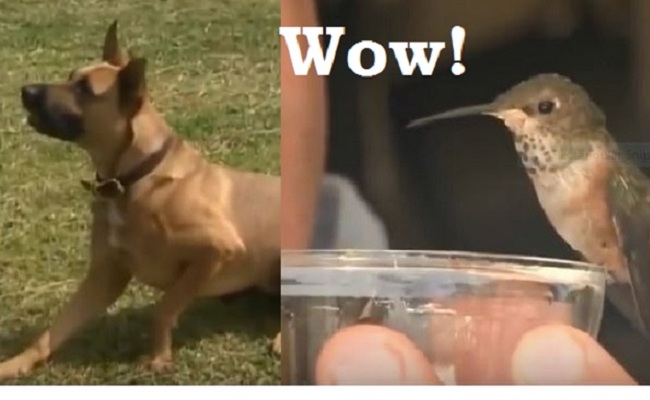
Dangerous Dog Rescues Helpless Hummingbird in Grass
One can only speculate why a rescued dog named Rex refused to leave the side of an injured hummingbird lying in the grass. Was it compassion or simple curiosity?
According to Rex’s guardian, Ed Gernon, his German Shepherd mix was homeless for a very long time and had a reputation for getting along poorly with other animals.
“He was dangerous” told CBS News. “I mean, he fought with other dogs and he killed cats. He was an animal that had learned to live on the streets.”
During a neighborhood walk, Rex came to an abrupt halt with a laser-focus on the ground in front of him.
“He suddenly stopped and he would not move,” Gernon said of Rex’s discovery of the near-death hummingbird. “It’s tiny and it’s dead as far as I’m aware. It’s covered in ants. It’s got no feathers.”
But Rex apparently knew better. Not only did he realize that the bird was still alive, but he refused to leave it.
“He was trying to protect her, so I thought I’d go the distance.”
So, Gernon did the only thing he could think of at the moment. He scooped up the hummingbird and took it home. And there began a year-long process of rehabilitation inside Gernon’s home. That included using a hairdryer to help Hummer fly as well as regular feedings of sugar water.
Today Hummer is strong and ready for return to the wild, only she shows no interest in leaving just yet.
“It’s time for her to start mating,” Gernon said in his recent interview. “I keep leaving the doors and windows open thinking she’ll leave.”
ooOOoo
Laura closes her article by including the sensible advice:
Wildlife experts advise that licensed rehabilitation specialists should be consulted when caring for an injured wild animal.
As I said in my preamble all it takes is a little story or an act of kindness to remind us of what really is important.
With a swish of his flipper, a dolphin named Octavius became the first to be rescued, rehabilitated and released back into the wild off Louisiana’s coast. The rescued dolphin returned to the Gulf of Mexico on April 29 after five months of rehabilitation and medical monitoring in Louisiana.
The process from rescue to release was spearheaded by the Audubon Nature Institute and the Louisiana Department of Wildlife and Fisheries (LDWF) with assistance from the NOAA’s National Marine Fisheries Service and Chicago Zoological Society’s Sarasota Dolphin Research Program.
After receiving a call from a private citizen regarding a washed up dolphin on Grand Isle Beach, biologists from the LDWF headed for the scene in October 2015 to see if the dolphin could be saved.
“We had a short window to diagnose whether the animal could be released or brought back to Freeport-McMoRan Audubon Species Survival Center (FMASSC) in New Orleans for treatment,” said Audubon’s Stranding and Rescue Coordinator Gabriella Vazquez. “He was lethargic and had short, shallow breaths. We attempted a soft release in the surf, but he showed no initiative to swim back into the Gulf.”
The dolphin was transported to FMASSC where the process to get him ready for reintroduction to the ocean began.
Determining if the dolphin — named Octavius in honor of the veterinarian working most with him — was ready for release was a multi-step process. Octavius was monitored for behavioral challenges, ranging from swimming and breathing to becoming reliant on and desensitized to humans. Octavius demonstrated no such issues.
“Dolphins are very intelligent animals. Over time, they can learn to associate humans and boats as a source for food, which is why it is illegal to feed them in the wild,” explained Mandy Tumlin, the Louisiana state stranding coordinator for marine mammals and sea turtles.
The next two steps Octavius had to clear dealt with his overall health. He demonstrated no signs of hearing impairment, a key component for dolphins’ survival. In addition to hearing, veterinarians checked Octavius’s blood for congenital defects or other medical problems that could make surviving in the wild more difficult.
Octavius passed all three of the steps related to release, but vets weren’t through just yet. Because of his potential age — vets estimated Octavius to be between 1 and 7 years old — Octavius was affixed with a tag to the dorsal fin by Dr. Randy Wells, director of the Chicago Zoological Society’s Sarasota Dolphin Research Program.
“The tag allows for satellite tracking as well as radio tracking. Since he could be a younger animal, this type of monitoring is necessary to ensure he is thriving back in the wild,” said Tumlin.
After all of this, Octavius was transported to Barataria Bay where he was released and swam back into the ocean of his own volition.
ooOOoo
Enjoy this video.
Published on May 2, 2016
A young dolphin has been released back into the waters off Louisiana’s coast after being found stranded on a beach a year ago. The Audubon Nature Institute believes that high waters and rough sears from Hurricane Patricia likely caused him to get stuck there. He was lethargic and short of breath. They named him Octavius and brought him back to their facility for rehabilitation. Before he could be released he had to reach milestones that include behavior and medical tests.
These seem like times where very little makes sense.
Blogger Patrice Ayme posted an item on Wednesday under the title of Doomed Dems. It was, inevitably, a commentary on the recent news regarding Donald Trump. Here’s how Patrice’s post opens:
So Donald Trump will be the Republican committee ( 😉 ) for the presidency. And Trump will, probably, be elected US president. Why? Because people want change, and they did not get it. Instead they got more of the drift down, after the reign of the teleprompter reading president. Average family income is DOWN $4,000 since (“Bill”) Clinton’s last year as president. According to a FOX News poll, 64% of Americans blame Wall Street. Meanwhile in a vast report in the New York Times, Obama celebrates, in May 2016, the alliance he said he made with Wall Street in 2008.
Later on in that same post, Patrice goes on to write about the horrific fire in Alberta, Canada, and the damage to trees in Yosemite National Park in California. At first sight those two events would appear disconnected. But not according to Patrice:
Meanwhile a friend of mine went to Yosemite ten days ago. She told me she could not believe the devastation of the forest. Most of it is fiery red. It is devastated by the Pine Bark Beetle. To kill the Beetle, one needs twenty days well below freezing. However, this hard freeze is now a memory. So the Beetle invades, and kills forest. Treating tree by tree is hopelessly expensive, and futile. Yes, the forests will burn soon, adding to CO2 in the atmosphere. And it is all the way like that to Alaska.
Massive walls of flames prompted authorities to order the evacuation of all the city’s more than 80,000 residents last night. The blaze has been caused by un-naturally high temperatures. Such giant fires are our immediate future. Nobody said the Greenhouse crisis was going to be nice. More evacuations coming.
Anything to do with dogs? Well, yes!
For this coming Saturday I am giving a talk about my book, Learning from Dogs, to our local Rogue Valley Humanist and Freethinkers (both Jean and I are members) and it struck me that what Patrice wrote about and what we see all around us are part of the same big picture. That we need to be reminded of a few fundamentals. As I will be saying in my talk:
Dogs are creatures of integrity! Wow! Now you might see where this is leading to!
But more than that, much more than that, they offer us humans a model for a range of behavioural qualities that we ignore at our peril:
I then list the qualities that we see in our dogs, and continue:
Hold those values close to you for just a few moments. Imagine what would flow out across the world if those were the characteristics, the behavioural values, of us humans!
Finally, towards the end of that talk on Saturday I will be saying:
Nature will always have the last word regarding her natural world, to which we humans are so intricately linked. Standing alongside and respecting nature as the future comes to us will be so much wiser than pushing back against nature, and ultimately failing, trying to “convert” nature to some form of materialistic human resource. Because that route will only return those of us who survive to a life of hunting and gathering. Which, so many thousands of years previously, is where early dogs started humankind on the long journey leading to now.
Dogs have been the making of humans and a viable future for humankind on this beautiful planet depends on us never forgetting this oldest relationship of all, the one between dog and human.
Because if we, as a global society, don’t understand that when it comes to power all the plutocrats and all of their money come to naught in contrast to the power of nature then these present lands are going to become very strange indeed!
And nature is rapidly encroaching on these lands that we are now traversing.
I am referring to the one between human and animal.
The millions of people who love their pets probably never stop to think about how far that love would extend. As I observe Jean’s patience in coaxing Hazel to take food, time and time again each day, it never crosses my mind that there would be a limit to that devotion from her.
When I think about our animals and the special relationships we have with them all, dogs, horses and cats, never for a moment do I weigh up the pros and cons, despite there being many limitations when one stops and ponders the fact. Like the fact that Jean and I have not been away for a honeymoon or any other vacation together since we were married in 2010.
All it takes is for a dog to rub its head against my leg, or a cat to curl up on my lap, or a horse to give in to a hug around its head, something that happens many times each day, and I am content.
However, the following article that appeared on the Care2 blogsite really underlined how much people will give for their animals.
A story recently went viral about a Colombian man who risked his life to save a dog that was hanging from a balcony. The dog, who belongs to the man’s upstairs neighbors, was caught in the railing and was close to falling to the ground. The neighbor, whose name is Diego Andrés Dávila Jimenez, made a dangerous climb from his balcony up to his neighbors’ in order to save the dog.
For animal lovers, there wouldn’t be a second thought about doing the same, whether it was their own pet, someone else’s or an animal in the wild. People go great lengths for animals every day. Here are just a few inspirational examples of them.
Ric O’Barry Does Jail Time for Dolphins
In 1970, Ric O’Barry founded The Dolphin Project and since then, he has dedicated his life to saving dolphins. His life’s work hasn’t been easy, though. O’Barry – who was featured in the 2009 documentary The Cove – has been detained, fined and threatened for his dolphin activism. In January, he was detained at a Japanese airport on his way to monitor the annual dolphin hunt in Taiji. By now, being detained is nothing new to O’Barry, as it happens nearly every time he visits Japan for the hunt. In August, O’Barry was arrested in Japan for not carrying his passport. Still, he carries on with his mission to rescue dolphins.
Adam Warwick saved a black bear from drowning
When a bear is roaming around a neighborhood, sedating it is one of the only safe options. That’s what Florida wildlife officers did when they got a call about a black bear wandering around an Alligator Point neighborhood. The officers shot the bear with a tranquillizer dart, but the bear ran away and headed straight into water, where he would eventually fall asleep and drown. Biologist Adam Warwick came to the bear’s rescue and pulled the 400-pound bear back on land. The bear was then safely transported back to its home in a national forest.
Motorist fights traffic to save injured dog
A Mexican woman was driving down a busy highway when she saw a dog get hit by a car and lay injured on the side of a crash barrier. Nobody stopped or slowed down as they drove by, leaving her to try to dodge traffic to get to the dog. The timid dog tried to limp away, but she eventually gained its trust and took it to an area vet to have its injuries treated.
Man saves a stranger’s dog that was blown off a pier
An Australian woman was walking her Shih Tzu-Maltese Bibi on a pier when a strong gust of wind picked the dog up and carried him into the water. Raden Soemawinata was at the pier scattering his grandmother’s ashes when he saw the Bibi in the water and immediately jumped in to save him. Soemawinata humbly told media that “it wasn’t such a great feat.” We think otherwise.
Two Norwegian men save lamb from drowning
Three friends were out taking pictures when they noticed a lamb struggling in choppy waters. Two of the young men worked together to rescue the lamb, while the other used the camera to take incredible pictures of the rescue. They pulled the lamb to safety and reunited it with its flock.
Randy Jordan removes hooks from sharks
Most people try to avoid sharks. Randy Jordan has made a mission to help them. The diver frequently noticed fishing hooks caught in sharks’ mouths, so he made it his mission to remove the hooks from the sharks he encountered. He worked with scientists in order to find the safest way – for himself and the sharks – to have the hooks removed. Jordan has gone on to free multiple sharks from the painful hooks.
Men save baby giraffe in crocodile-infested waters
For four hours, a baby giraffe tried to keep its head above the Uaso Nyiro river’s harsh waters. The Kenyan river is not only fast moving, but is home to many crocodiles. A group of men ignored the river’s danger and waded through the water to pull the giraffe back onto land.
With so many reminders, especially in the media, of the greed and selfishness of people it really does one good to read these seven examples of how wonderful is the bond between humans and animals.
Giving back, in so many different ways, is fundamental to who we are, and to whom we must be!
I introduced yesterday’s Earth Day post with the sub-heading, “A fabulous example of how we reach out to others across the internet!” Today’s post is another fabulous example.
I just had to share this lovely post with you all from a beautiful friend. You have to explore her blog to see all the transformations she does when she gives a new lease of life to furniture. And her home.. What is even more remarkable, and I hope Lois will not mind me mentioning this is that Lois does all of this work from the confines of a wheelchair..
I hope you visit and see just how generous a nature she has ..
Love and Blessings
Sue
Curious, I went across to Lois’s blog Living in Denim and to the particular post that Sue had spoken about. Without hesitation I asked if I might republish that post here and share it with you all. Lois was delighted to offer me such permission.
Read it and you will see why I asked so quickly.
ooOOoo
Giving Back: A Yard Sale Redo for a Deserving Child
We had a beautiful weekend, if I didn’t know it was April I could have easily believed this was summer. I headed outside thinking I would finally get some work done on the exterior of the house when my phone rang.
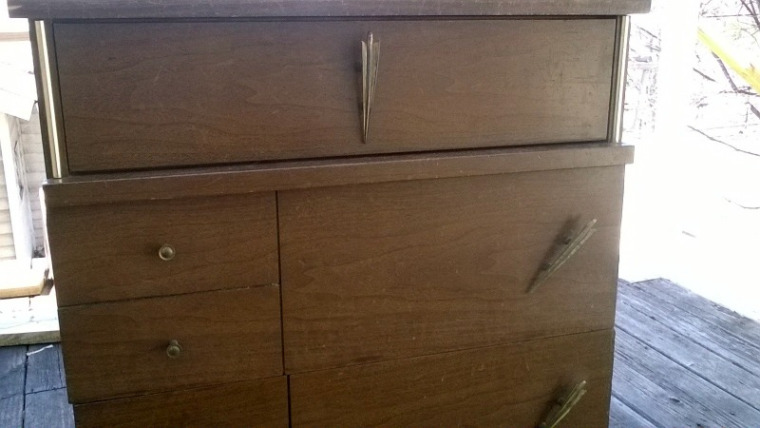
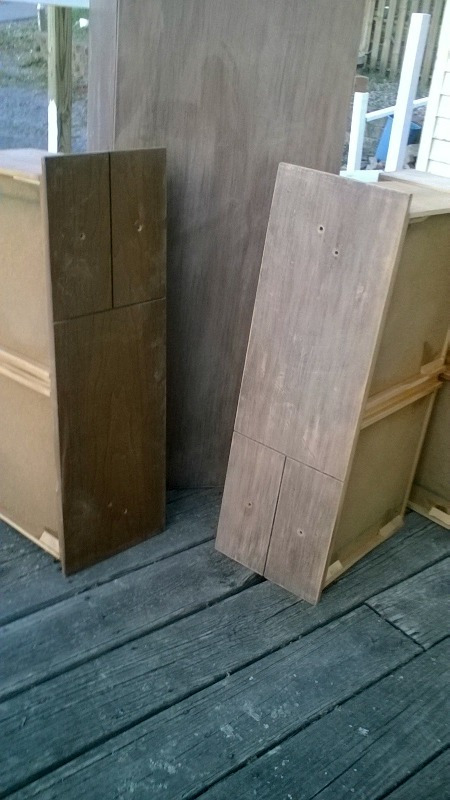
The caller wanted to know if I could redo and paint a dresser for a foster child that has been placed with her family long term. I took that to mean, can you fix then paint a dresser. My answer was probably. A few minutes later this was delivered
The family shared many of the details surrounding this little eight-year old child’s placement with them. I was informed they were trying really hard with limited funds to give her a room personalized for her so she would feel welcome and comfortable.
How could I say no?
When asked how much I would charge, I ignored the question by changing the subject and asked if the foster parent was looking for a grown-up dresser (aka Pottery Barn painted look) for the child or something more whimsical an eight-year old would like now. I was informed I could do whatever I wanted and they were concerned with giving the child a dresser she would love today not a few years down the road.
With permission I asked a few questions of the child to see what her likes were. I was careful in how I phrased my questions and took it slow to see how open she was. I began with her favorite colors. She was outgoing and friendly, happy to answer. Her favorite colors were (in order) blue, red and black. Not good, I don’t have those colors in any significant quantity on hand. Then she added white. That I had.
My next question was the most sensitive. Foster care children often are taken from their homes with nothing but the clothes on their backs but I needed to know what she liked. Instead of asking what her favorite toys were, afraid to bring up feelings of loss, I asked What she liked to do for fun.
She stumbled and admitted she didn’t know.
I decided to turn my attention to the family member who brought the dresser to me to give the child a moment to think. I asked a bit about the rest of the child’s room. Was there a theme or color scheme when suddenly the child mentioned she liked swimming pools and flowers.
Now I had something to work with.
I didn’t give my house or the work I’d planned to do a second thought, my poor house was abandoned for this dresser.
The dresser is circa 1960. It’s a cheap laminate that the family picked up for $5 at a yard sale. I shouldn’t be too judgemental the dresser has lasted for more than 50 years. The knobs and pulls had to go. The pulls were so close to the drawer faces that I couldn’t get a finger in to pull the drawers open. My fingers are rather small, being that I comfortably wear size 5 rings and when I glanced at the child’s hands I thought her fingers could have been a bit bigger than mine, I knew the pulls wouldn’t work.
You can see here how the laminate was assembled on to a wooden frame.
I repaired a couple of the drawers by adding glue and screws to keep the sides attached. Then came the sanding. I didn’t get far when the neighbor boy stopped to ask if he could help. I explained how he would have to have a very gentle touch and then we were hard at work.
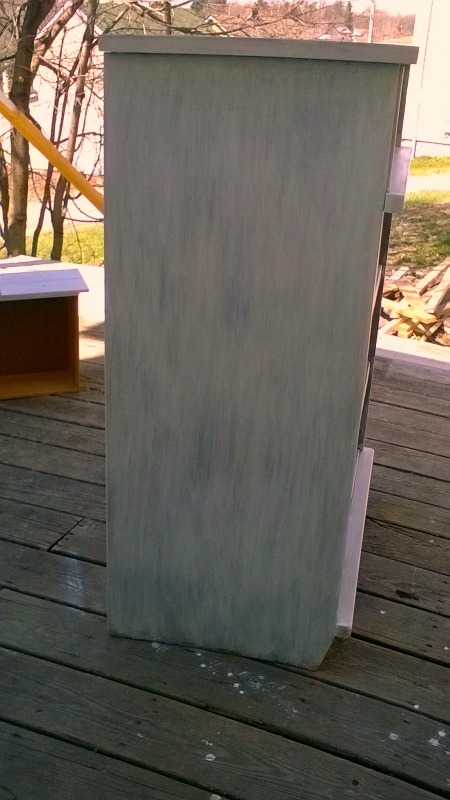
The moment I saw the dresser the first thought that crossed my mind was that I wanted to white wash it. I’ve worked on several of these types of laminate dressers from this period but never tried a white wash. When the child told me she liked swimming pools I knew a white-washed finish was perfect. It would give that beach-y, driftwood look that would become my background.
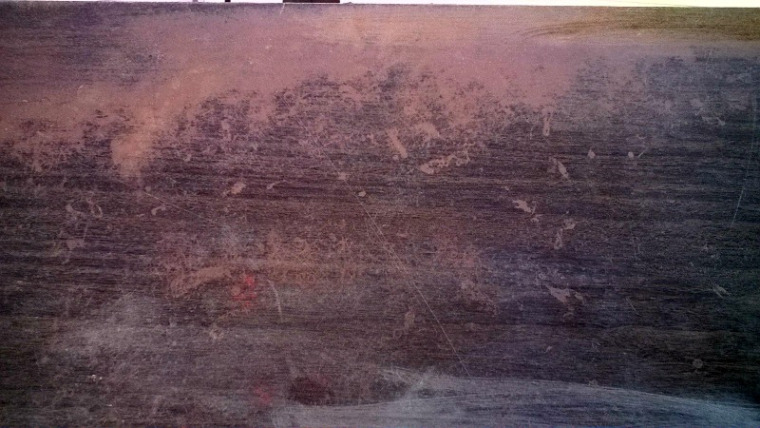
Comparison of what the finish looked like before and after a good sanding.
I mixed equal parts white satin latex paint and water, then wearing gloves soaked a rag in the paint and rubbed it on to the dresser.
You must apply the paint in the same direction, with the grain of the “wood” for the best results. It took 2-3 coats of paint to get the desired effect. When the dresser was dry I added two coats of polycrylic to seal the finish, but I’m getting ahead of myself a bit.
I was told flowers were important to this child. As I sanded the dresser down I contemplated the best way to add flowers to the piece. At first I thought maybe I’d sketch grass using green milk paint to the lower drawer then stems up the drawer fronts to use the knobs as the center of the flowers and sketch around them different colored flowers. This didn’t feel right to me but still I played with the idea.
Then I realized I didn’t have enough colors of paint to do this. I briefly considered heading to the store to purchase an assortment of different colored permanent markers, but again I dismissed this. I worked until I lost daylight on Saturday and woke with an idea.
For months now my granddaughters and I have enjoyed coloring Patricia Zapata’s Flower Nook. Patricia is a well-known blogger at A Little Hut. I’ve already removed some of the completed pages to frame for the girl’s room upstairs, now I would remove more and use them on the dresser.
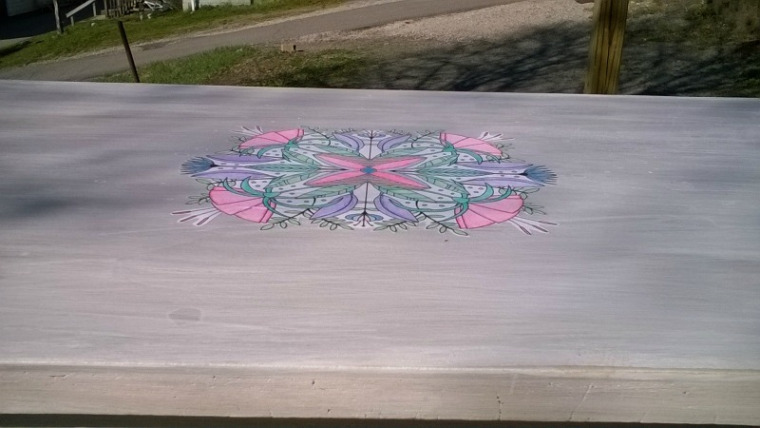
I added three designs to the drawers and one to the top of the dresser.
Top of the dresser.
These are the designs I used on the drawer fronts.
The most time consuming part of this was trimming the designs to remove the excess white paper. I laid them out and when I was happy with the placement decoupaged them on and sealed the entire drawer fronts with polycrylic.
In questioning the little girl I learned she liked gold over silver so I headed to my hardware stash and pulled out all the heavy substantial gold knobs. I toyed around with using two knobs on the left with one pull on the right, the way the drawers were to begin with. In the end I didn’t have enough gold pulls I liked and decided to use only knobs. I used wood filler to fill in the holes from the original pulls then drilled new holes. I kept the distance from the side of the drawer for the new knobs the same as the existing knobs on the other side and then centered them on the fronts.
Once I took this photo I saw that I hadn’t painted the very bottom and did go back and paint them, if you were wondering.
The top drawer I simply used a permanent marker, I have a couple in the house, and a four inch stencil to add her first initial.
By Sunday at 3pm I called to let the family know the dresser was ready to pick up. They arrived with the little girl and a friend of hers. I wish I could show you their faces, but I can’t. The girls didn’t miss a thing. They spotted the little girl on the middle drawer, they loved the heavy gold knobs and the white washed paint effect.
I know a little about this foster parent, I know she adopted a previous foster child and raised him as her own even though she has very little disposable income. She herself is on disability. She loves these children and has given this little child so much love that when the question arose again as to how much they owed me, I informed her the child’s expression was well worth the work and I wanted to make this a gift from me to them. Thankfully, the family accepted my gift as long as I promised to call if there is ever anything they can do for me.
Tonight I am tired and even sore. I did get a bit of work done outside after all but while I thought getting more accomplished on the house would perk me up, in reality it was the dresser that made the weekend a success for me.
Welcome to Territorio de Zaguates, or “Land of the Strays”.
When it comes to loving stray dogs I thought that the friends of John Zande and his wife were showing the rest of the world how to do it. For it is my understanding that Sandra and her partner down in Brazil are providing a home for around 300 ex-rescue dogs.
Dogs frolic in a lush green field at the Territorio de Zaguates dog sanctuary in Costa Rica. (Photo: Territorio de Zaguates)
Welcome to Territorio de Zaguates, or “Land of the Strays,” an amazing, privately funded, volunteer-run animal sanctuary in Costa Rica where no mutt is turned away.
Located less than an hour outside the bustling capital city of San José, this doggie safe haven is home to hundreds of abandoned canines that have been given a second chance at life.
This is no ordinary animal sanctuary, though. After all, when you live in a place as beautiful as Costa Rica, you take advantage of what the landscape provides. That’s why volunteers lead the ragtag pack of rescued mutts on scenic hikes through the gorgeous mountains nearly every day. It’s a sight to behold.
A volunteer at Territorio de Zaguates leads a pack of dogs up a hill. (Photo: Territorio de Zaguates)
Aside from the free-range mountain hikes with breathtaking scenery, Territorio de Zaguates functions just like any other animal rescue or sanctuary.
“First thing we do when a new dog gets here is spay/neuter, vaccinate and get rid of parasites,” the organization explains on its Facebook page. “Then we assess if the dog requires any other type of special treatment [and] put them in quarantine if necessary.”
Once this initial processing is completed, the new dog is released into the general population, where it can either be adopted by a loving human or spend the rest of its days frolicking in what is essentially a doggy paradise.
There are all kinds of mutts living at Territorio de Zaguates. (Photo: Territorio de Zaguates)
What makes Territorio de Zaguates even more special is the creative approach to finding the dogs forever homes.
To encourage adoption, every doggie resident at the sanctuary is not only given a name, but also a customized “breed” name based on the dog’s phenotypic traits. These one-of-a-kind breed monikers include memorable titles like “Alaskan collie fluffy terrier” and the “chubby-tailed German doberschnauzer.”
The resounding message behind this strategy is that when you adopt a mutt, you’re adopting a unique breed. Learn more about this clever campaign in the video below:
As any animal rescuer will know, maintaining such an massive sanctuary requires an enormous amount of time, money and labor. But thanks to a host of charitable donors and an eager base of volunteers, the sanctuary is a great success.
“We have a very small staff but still we manage to do everything from daily picking up the poo and disposing of it properly, to feeding and medicating the dogs, and everything in between,” a spokesperson for the organization writes.
Continue below for just a glimpse of what life is like for these adorable pups at Territorio de Zaguates:
Mattresses are provided for the dogs to lounge on throughout the day. (Photo: Territorio de Zaguates)
Mattresses provide natural lounge spots for the dogs throughout the day.
A pack of rescued dogs take a leisurely walk in the woods with a few of the sanctuary’s hard-working volunteers. (Photo: Territorio de Zaguates)
The pack takes a leisurely hike in the woods with a few of the sanctuary’s hard-working volunteers and some prospective dog adopters
Photo: Territorio de Zaguates)
Lunch time at Territorio de Zaguates means serious business, which is why kibble donations are so important!
Cushy bed donations are also very important for the sanctuary. (Photo: Territorio de Zaguates)
In addition to food, comfy dog beds are also a much welcomed donation item for the sanctuary!
A volunteer leads the pack downhill. (Photo: Territorio de Zaguates)
A sanctuary volunteer leads the pack downhill during a scenic hike through the mountains.
(Photo: Territorio de Zaguates)
In case you were wondering where all those yummy kibble donations went … behold the trough
(Photo: Territorio de Zaguates)
A few of the sanctuary’s senior residents rest on the steps of the facility. Even if the pups aren’t adopted out, they’ll always be guaranteed a luxurious forever home at the sanctuary.
(Photo: Territorio de Zaguates)
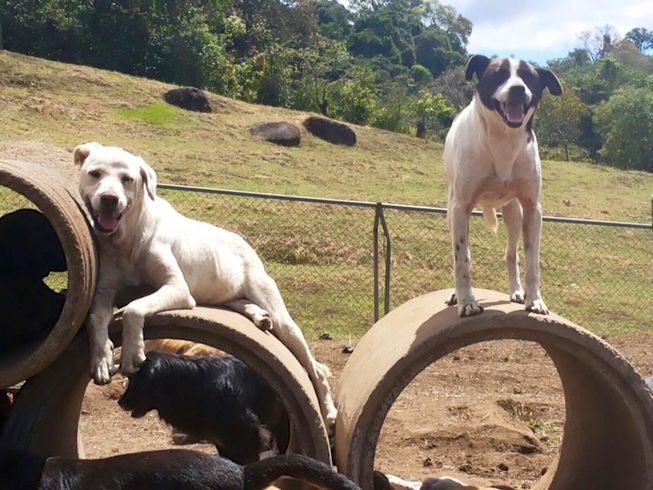
Concrete drainage pipes makes excellent (and sturdy!) makeshift dog houses
(Photo: Territorio de Zaguates)
Rescued dogs hang out in the shade of the sanctuary’s many trees
(Photo: Territorio de Zaguates)
A nice refreshing dip … in some drinking water
(Photo: Territorio de Zaguates)
After a long, fun-filled day of being a dog, there’s nothing like cuddling up with a friend and snoozing before dinner time
ooOOoo
Well it certainly puts our ten dogs in the shade!
In doing a trawl through YouTube I came across this video that I will use to close off today’s post. Chances are that, as with me, you won’t understand the voice-over but it won’t diminish your pleasure at looking at these dogs.
Published on Jul 3, 2014
“Territorio de Zaguates” ubicado en las hermosas montañas de Costa Rica, es un albergue de animales donde se le da casa, comida, atención veterinaria, ejercicio, esparcimiento y cariño a 700 perros callejeros víctimas del maltrato, el abuso, el abandono y la negligencia humana.
–ENGLISH– “Territorio de Zaguates” is a No-kill-shelter in the beautiful mountains of Costa Rica that provides home, food, vet care, exercise, recreation and affection to over 700 stray dogs, victims of neglect, abandonment and abuse.
Actually, let me close off today’s post with these two sets of words from the story above:
Once this initial processing is completed, the new dog is released into the general population, where it can either be adopted by a loving human or spend the rest of its days frolicking in what is essentially a doggy paradise.
“essentially a doggy paradise.”
The resounding message behind this strategy is that when you adopt a mutt, you’re adopting a unique breed.
That is so true! Each and every dog, especially an ex-rescue dog, is a unique breed.
The force of public opinion has never been more important; critically so!
As you all know this world of blogging: authors; followers; readers, is a great number of wonderful communities right across the planet. It is nothing like the traditional media, now owned and controlled by just a handful of large corporations, because the vast majority of blogging participants are free to say what they want, when they want.
Here’s an example.
Martin Lack is an Englishman who is the author of the blog Lack of Environment. As his home page quietly states:
Although scientificly trained (with degrees in Geology and Hydrogeology – see my About page), this blog arises from my having also got an MA in Environmental Politics and, as such, as the tagline indicates, is a blog on “the politics and psychology underlying the denial of all our environmental problems”… I hope you will take this on board; and enjoy the discussion.
“There is something fundamentally wrong in treating the Earth as if it were a business in liquidation” – Herman E. Daly (former World Bank economist).
The science about the chemistry of climate change especially the new danger of methane is clear. The commitment of our political leaders is less clear. But that doesn’t mean that we shouldn’t keep shouting out loud.
The Prime Minister
10 Downing Street
London, SW1A 2AA
Dear Prime Minister,
Whatever happened to the greenest government ever?
Given my experience of working in environmental consultancy or regulation, I understand the importance of making pragmatic, risk-based decisions (as opposed to dogmatic, opinion-based ones). I therefore believe that government policy should be formulated this way. Unfortunately, however, this does not always seem to be the case.
As a pragmatic scientist, I am not ideologically opposed to nuclear power. However, I do question the logic of pursuing ‘Hinkley Point C’ when equivalent investment in distributed renewable technologies – from domestic solar PV to submarine tidal stream – could probably generate more electricity faster. Indeed, as Greenpeace has recently pointed out, the UK could meet nearly all its electricity generation needs from renewable energy sources by 2030.[1]
With regard to risk, the scientific consensus is that, in order to minimise anthropogenic climate disruption (ACD), the World must now embark upon the fastest-possible transition to a zero carbon economy. Therefore, I also question the logic of simultaneously promoting investment in shale gas; discouraging investment in renewables; and cancelling investment in Carbon Capture and Storage research.
It is now over 50 years since scientists started warning of the climatic implications of continuing to burn fossil fuels;[2] and 50 years since fossil fuel company executives started spending huge sums of money on being “Merchants of Doubt”.[3] As such, along with their counterparts in the tobacco industry, they have clearly not acted in the long-term interest of humanity as a whole.
However, as with the individual health benefit of ceasing to smoke tobacco, the sooner we stop burning fossil fuels the greater the collective environmental benefit will be. Therefore, I am pragmatically opposed to shale gas exploration because burning it is not consistent with the need to transition away from fossil fuels as fast as possible.
I am certain that you would like to secure an enduring political legacy; and would therefore like to ask just one question:
What could be better than being remembered as the Prime Minister that committed the UK to meeting nearly all its electricity generation needs from renewable energy sources by 2030?
Let me finish today’s post by republishing an exchange between Patrice Ayme and Martin over on a recent PA essay, that I republished in full in this place: Runaway Antarctica.
Martin:
I know I am wasting my time writing letters to David Cameron; and I know my opinions are irrelevant. However, the facts of history are not; nor will they be in the future.
Patrice:
I know you are doing the right thing. Writing to Cameron is entirely correct. But of course, he is a guy with just a salary and a few “savings”, a few tens of millions dollars of savings, maybe, or maybe not, and knew nothing about his recently deceased father having a fund of around 50 million dollars sheltered by shell companies, out there, somewhere related to Panama, or the British Virgin Islands, or the Bahamas, or Bermuda, whatever…
OK, David’s wife, officially, has a fund of more than twenty million pounds….
Martin:
For the record: I am socially-conservative (i.e. as opposed to liberal) but under no illusion as to the folly of what has been called ‘money fetishism’ (Karl Marx); and ‘growthmania’ (Herman E. Daly).
Patrice:
Hi Martin, thanks for the comment. I spent a whole hour reading the hard cover version of the paper the electronic version of which I criticized above. It’s quite a bit different. They use RCPs (Reasonable Carbon Projections, or the like in meaning). Yet, they don’t explain what they consist of exactly. All I know is that we are around 500 ppmv, and they work with 400 ppmv, in the 130 K-115 K years BP, when orbital conditions were cooler than now.
Plus we are going to be at 550 ppmv within ten years, at the present rate. The earliest date they have for the failure of Larsen C in their worst RCP 8.5 is 2055 CE. I would be surprised if it did not fail within ten years.
However, the paper version is more insistent on the danger of AIR warming, not just subsurface.
Also the Hansen paper has a scenario, which is suitably apocalyptic, but not apocalyptic enough in my book. Temperatures over the Arctic were strikingly high this winter, of the order of 4 to 5 degrees Centigrade higher than normal, and sometimes more. Nobody expected this sort of jumps. Except for yours truly!
Martin:
Thanks for the explanation, Patrice. This is all very reminiscent of the position of (Arizona) Professor Guy McPherson, who believes most scientists are in denial about the consequences of multiple positive feedback mechanisms we can already see operating: http://lackofenvironment.wordpress.com/2013/02/19/what-on-earth-are-we-doing/
You all have a wonderful weekend and keep hugging those dogs of yours!
I thought after yesterday’s rather gloomy post, the republication of an essay from Patrice Ayme under the heading of Runaway Antarctica, we should be reminded of the goodness that is very much alive within humanity.
It was prompted by a comment left by Marg to that post. Here is a part of her comment:
It’s easy to get very despondent. However, I must say that probably the main thing in my life which lifts my spirits and gives me joy on a daily basis, even more than my family, are my pets, especially my No. 1 buddy, my Jack Russell cross.
That reminder came in the form of an item on yesterday’s Care2 selection, and is republished in full, as follows:
ooOOoo
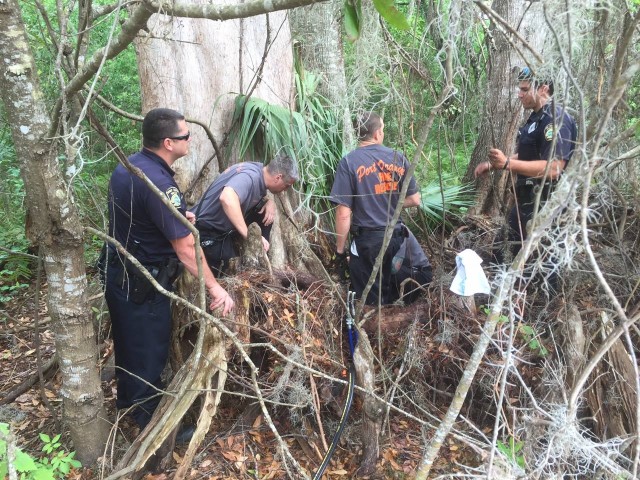
Dog Gets Trapped in a Giant Tree Trunk, Firefighters Rescue Her.
We’ll never know exactly what species of animal “Jane Dog” was chasing through the woods when she got her head wedged inside the trunk of a tree, but for the sake of her pride, let’s just pretend it was a panther.
Credit: Port Orange Police Department/ Facebook
Last week a Port Orange, Fla., family was walking their own dog when they heard Jane Dog’s whimpers. They tracked the sound and were surprised to see a full-grown dog stuck in an opening at the base of a very large tree trunk.
Port Orange police and firefighters were called to the scene and were joined by Dr. Malensek from Ravenwood Veterinary Clinic.
An on-site health check immediately following the rescue does not reveal any serious health concerns.
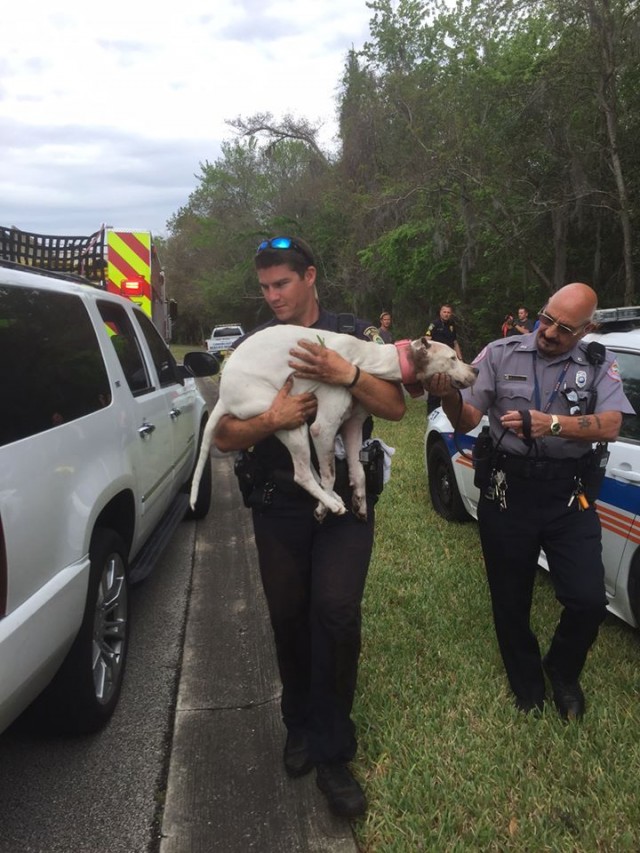
Fortunately, Jane Dog is doing just fine and has been reunited with her family who, while amused by her temporary name, have gone back to calling her Sailor.
Police officers carry Jane Dog who’s true identity was later revealed to be Sailor.
Photos courtesy of Port Orange Police Department Facebook page.
Now one might argue that this has nothing whatsoever to do with Learning from Dogs but I would disagree. For as I declare in The Vision of this blog:
It seems to me that a Vision statement should encapsulate just why the owners of the enterprise are committed to that venture. The author of Learning from Dogs is committed to this project; here is the Vision.
Our children require a world that understands the importance of faith, integrity and honesty
Learning from Dogs will serve as a reminder of the values of life and the power of unconditional love – as so many, many dogs prove each and every day
Constantly trying to get to the truth …
The power of greater self-awareness and faith; faith that the only way forward for us is through the truth …
For in a very real and devastating way even a small rise in global sea level is going to cause tens of thousands of dogs, and their loving owners, to become homeless. We are long overdue a commitment from our global leaders and power-brokers to that, “.. faith, integrity and honesty.”
However, championing that greater self-awareness is what blogger Patrice Ayme does almost all of the time. With his kind permission, I republish his latest post on the state of the Antarctic Ice.
ooOOoo
Runaway Antarctica
I have written for years that a runaway Antarctica was certain, with half the icy continent melting rather spectacularly on an horizon of two centuries at most, and probably much less than that. This rested on the fact that half of Antarctica rests on nothing but bedrock at the bottom of the sea. At the bottom of what should naturally be the sea, in the present circumstances of significant greenhouse gas concentrations.
Visualize this: until sometimes in the Nineteenth Century, GreenHouse Gas (GHG) concentration was 280 ppm (280 parts per million), including the man-made sort. Now we are close to 500 ppm, using a variety of exotic gases we produce industrially, among them, CO2. In CO2 alone we are at: Week beginning on March 20, 2016: 405.62 ppm. Weekly value from 1 year ago: 401.43 ppm. Weekly value from 10 years ago: 382.76 ppm. So the CO2 alone is augmenting at a bit more than 1% a year. Thus we will be at an equivalent of 550 ppm in ten years (including the full panoply of all the other man-made greenhouse gases, not just CO2). There is evidence that, with just 400 ppm, disaster is guaranteed.
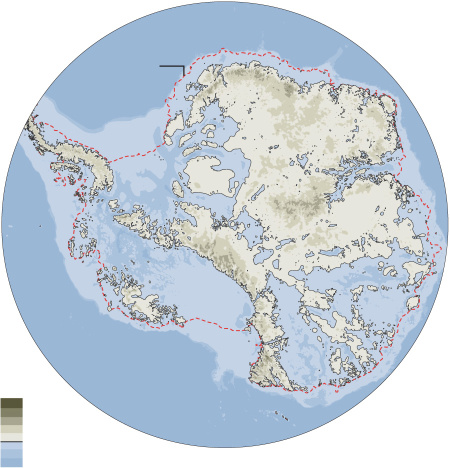
Now visualize this:
How Antarctica would appear if its ice melted: it’s half under the sea.
Why so watery? Because the enormous glaciers, up to nearly 5,000 meter thick, press down on the continent with their enormous weight. Since the end of the last glaciation, 10,000 years ago, Scandinavia has been rising, and is still rising (I long used a picture with a similar information about Antarctica’s bedrock.)
Polar temperatures over the last several million years have, at times, been slightly warmer than today, yet global mean sea level has been 6–9 metres higher as recently as the Last Interglacial (130,000 to 115,000 years ago) and possibly higher during the Pliocene epoch (about three million years ago). In both cases the Antarctic ice sheet has been implicated as the primary contributor, hinting at its future vulnerability. Here we use a model coupling ice sheet and climate dynamics—including previously underappreciated processes linking atmospheric warming with hydrofracturing of buttressing ice shelves and structural collapse of marine-terminating ice cliffs—that is calibrated against Pliocene and Last Interglacial sea-level estimates and applied to future greenhouse gas emission scenarios. Antarctica has the potential to contribute more than a metre of sea-level rise by 2100 and more than 15 metres by 2500, if emissions continue unabated. In this case atmospheric warming will soon become the dominant driver of ice loss, but prolonged ocean warming will delay its recovery for thousands of years.
Notice that the scenario evoked in the last sentence is different from my very old scenario, which is similar to the one advanced in November 2015 by the famous Hansen and Al. (I raised the alarm before Hansen, at least seven years ago). In my scenario, and Hansen’s the ice sheets melt from below, due to warm sea water intrusion.
The West Antarctic Ice Sheet is larger than Mexico.
Here is a taste of the paper (I have a Nature subscription):
“Reconstructions of the global mean sea level (GMSL) during past warm climate intervals including the Pliocene (about three million years ago)1 and late Pleistocene interglacials2,3,4,5 imply that the Antarctic ice sheet has considerable sensitivity. Pliocene atmospheric CO2 concentrations were comparable to today’s (~400 parts per million by volume, p.p.m.v.)6, but some sea-level reconstructions are 10–30 m higher1,7. In addition to the loss of the Greenland Ice Sheet and the West Antarctic Ice Sheet (WAIS)2, these high sea levels require the partial retreat of the East Antarctic Ice Sheet (EAIS), which is further supported by sedimentary evidence from the Antarctic margin8. During the more recent Last Interglacial (LIG, 130,000 to 115,000 years ago), GMSL was 6–9.3 m higher than it is today2,3,4, at a time when atmospheric CO2 concentrations were below 280 p.p.m.v. (ref.9) and global mean temperatures were only about 0–2 °C warmer10. This requires a substantial sea-level contribution from Antarctica of 3.6–7.4 m in addition to an estimated 1.5–2 m from Greenland11,12 and around 0.4 m from ocean steric effects10.”
So notice: when CO2 ppm per volume was at 280 130,000 to 115,000 years ago, sea level was up to ten meter higher than now. And now we are at 500 ppmv…
And notice again: When CO2 ppmv was at 400, sea level was up to 30 meters (100 feet) higher than today. And now we are at 500 ppm, and, in a blink, in ten years, at 550 ppm.
Here is another example from the paper. I said all of this before, but to have scientists paid to do research in this area write it black on white in the world’s most prestigious scientific magazine, will no doubt endow me with greater, and much desired, gravitas. So let me indulge, not so much for my greater glory, but because it should help taking what I have long said more seriously.
“Much of the WAIS sits on bedrock hundreds to thousands of metres below sea level (Fig. 1a)13. Today, extensive floating ice shelves in the Ross and Weddell Seas, and smaller ice shelves and ice tongues in the Amundsen and Bellingshausen seas (Fig. 1b) provide buttressing that impedes the seaward flow of ice and stabilizes marine grounding zones (Fig. 2a). Despite their thickness (typically about 1 km near the grounding line to a few hundred metres at the calving front), a warming ocean has the potential to quickly erode ice shelves from below, at rates exceeding 10 m yr−1 °C−1 (ref. 14). Ice-shelf thinning and reduced backstress enhance seaward ice flow, grounding-zone thinning, and retreat (Fig. 2b). Because the flux of ice across the grounding line increases strongly as a function of its thickness15, initial retreat onto a reverse-sloping bed (where the bed deepens and the ice thickens upstream) can trigger a runaway Marine Ice Sheet Instability (MISI; Fig. 2c)15, 16, 17. Many WAIS grounding zones sit precariously on the edge of such reverse-sloped beds, but the EAIS also contains deep subglacial basins with reverse-sloping, marine-terminating outlet troughs up to 1,500 m deep (Fig. 1). The ice above floatation in these East Antarctic basins is much thicker than in West Antarctica, with the potential to raise GMSL by around 20 m if the ice in those basins is lost13. Importantly, previous ice-sheet simulations accounting for migrating grounding lines and MISI dynamics have shown the potential for repeated WAIS retreats and readvances over the past few million years18, but could only account for GMSL rises of about 1 m during the LIG and 7 m in the warm Pliocene, which are substantially smaller than geological estimates.”
I said it before. Including the details. So the evidence was clear, and out there. The optimism (it will take 5 centuries for 50 feet of sea level rise) is not supported by evidence. Actually collapsing channels coming from inverted rivers running up on the bellies of ice sheets are now obvious on satellite pictures and collapse of major ice shelves is going to be a matter of years, not centuries.
But science is made by tribes and these tribes honor the gods (of plutocracy) who finance them, and their whims. So they don’t want to make their sponsors feel bad. So they say unsupported, optimistic stuff, contradicted by a first order analysis.
Science is good, metascience, better. Metascience includes the sociological reasons which explain why some scientists will take some “facts” for obvious (although, coming from another sociology, they are not).
Deep in the Nature paper, in the quote above, or in four drawings and graphs of future sea level rise, one can find projections according to what various models “predict”… 130,000 years ago (!) The “Old Physics” model predicts one meter rise of the sea (this is the official UN maximal prediction for 2100). The new model, again starting with the present conditions, predict more than a six meter rise (!) This is a case of metascience playing with sea level.
This way, the authors of the paper will be able to say, one day: we told you so. While at the same time not irritating their sponsors now (because to understand what they are really saying takes quite a while, and has to be understood as tongue in cheek, when they pretend to apply the analysis to 130,000 years ago… What they really mean is six meters now, not just one meter… Bye bye Wall Street. Punished by its own instruments…)
The question is not whether we will be able to avoid a twenty meter sea level rise: that’s, unbelievably, a given (barring unforeseeable, yet imaginable technological advances to extract quickly a lot of CO2 from the atmosphere). The question is whether we will avoid a 60 meter rise.
A stark warning from Institute researchers on the probability that ‘2°C capital stock’ will be reached in 2017
A new study from the Institute for New Economic Thinking at the Oxford Martin School and the Smith School for Enterprise and Environment, University of Oxford, shows that we are uncomfortably close to the point where the world’s energy system commits the planet to exceeding 2°C.
In the paper, to be published in the peer-reviewed journal Applied Energy, the authors calculate the Two degree capital stock – the global stock of electricity infrastructure from which future emissions have a 50% probability of staying within 2°C of warming. The researchers estimate that the world will reach Two degree capital stock next year, in 2017.
Yesterday, a visitor to this place left a comment to a post published in September, 2012. Simply, he wrote, “Some food for thought midst all the drivel and crap.” The post was under the heading of The Charles Schulz Philosophy. I had forgotten about it. I thought it would be nice to republish it today (or rather the essence of that post).
ooOOoo
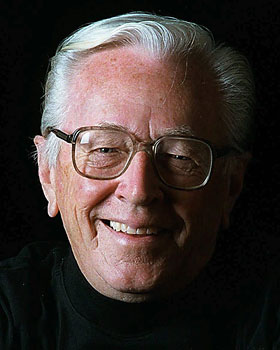
Charles Schulz
The following is the philosophy of Charles Schulz, the creator of the ‘Peanuts’ comic strip.
You don’t have to actually answer the questions. Just ponder on them. It will make very good sense!
Here’s A Little Quiz
You don’t have to actually answer the questions. Just read them straight through, ponder a tad, and you’ll get the point.
Name the five wealthiest people in the world.
Name the last five Heisman trophy winners.
Name the last five winners of the Miss America pageant.
Name ten people who have won the Nobel or Pulitzer Prize.
Name the last half dozen Academy Award winners for best actor and actress.
Name the last decade’s worth of World Series Winners.
How did you do?
The point is, none of us remember the headliners of yesterday. These are no second-rate achievers. They were the best in their fields.
But the applause dies. Awards tarnish over time. Achievements are forgotten and accolades and certificates are buried with their owners.
Here’s another quiz. See how you do on this one:
List a few teachers who aided your journey through school.
Name three friends who have helped you through a difficult time.
Name five people who have taught you something worthwhile.
Think of a few people who have made you feel appreciated and special!
Think of five people you enjoy spending time with.
Did you find that Easier? Of course you did!
So here’s the lesson!
The people who make a difference in your life are not the ones with the most credentials, or the most money…or the most awards…they simply are the ones who care the most.
 By: Laura S. May 10, 2016













 Learning from Dogs