Category: Innovation

More on our existence.

The Einstein-Freud Letters

I was born in London in November, 1944. Exactly six months before the Second World War ended in April, 1945.

Thus it was of great interest to me that yesterday Jean and I listened to a BBC Radio 4 programme about the letters that were exchanged between two great Jewish men: Einstein and Freud, in 1932. The programme was called Why War? The Einstein-Freud Letters.

The programme ends with offering the listener a fundamental choice, which I won’t spoil for you now. But to me it is an extension of my post (or Patrice’s post) that I published recently on March 19th.

I believe, and hope, you can listen to it by clicking on this link. Here also is the text that is at that link:

In 1932 the world-famous physicist Albert Einstein wrote a public letter to the founder of psychoanalysis, Sigmund Freud. Einstein, a keen advocate of the League of Nations and peace campaigner, asked Freud if he thought war and aggression was forever tied to human psychology and the course of international relations: could we ever secure a lasting world peace? 

Einstein’s letter is deeply prescient, as is Freud’s extraordinary response. The exchange was titled ‘Why War?’. The two thinkers explore the nature of war and peace in politics and in all human life; they think about human nature, the history of warfare and human aggression and the hope represented by the foundation of the League of Nations (precursor to the UN) and its promise of global security and a new architecture of international law. 

At the time of their exchange, Freud is in the last great phase of his career and has already introduced psychoanalysis into the field of politics and society. Einstein, the younger of the two, is using his huge international profile as a physicist for political and pacifist intervention.

For Einstein, future world security means a shared moral understanding across the global order – that humankind rise above the ‘state of nature’ never to devolve into total war again. He wrote to Freud, as ‘a citizen of the world…immune to nationalist bias…I greatly admire your passion to ascertain the truth. You have shown how the aggressive and destructive instincts are bound up in the human psyche with those of love and the lust for life. At the same time, you make manifest your devotion to the goal of liberation from the evils of war…’ Is it possible, Einstein asks Freud, to make us ‘proof against the psychoses of hate and destructiveness?’. Freud’s answer is fascinating and quite unexpected. 

The exchange of letters was sponsored by the International Institute of Intellectual Cooperation, an organisation promoting global security by using prominent thinkers, drawing on multiple fields of knowledge (from science to psychology, politics and law) to achieve a new language for international peace, following the lessons learned from the Great War of 1914-18. 

But even as Einstein wrote to Freud in the summer of 1932, the Nazi party became the largest political party in the German Reichstag. Both men felt a sense of apprehension about what was coming; both were pacifist, both Jewish, both would be driven into exile (both Einsteinian physics and Freudian psychoanalysis were denounced by the new regime). The letters were finally published in 1933 when Hitler came to power, suppressed in Germany, and as a result never achieved the circulation intended for them. 

Featuring readings from the Einstein–Freud letters and contributions from historians of warfare and psychoanalysis, war journalism and global security, this feature showcases the little-known exchange between two of the 20th century’s greatest thinkers, ‘Why War?’ – a question just as relevant in today’s world.

Contributors include historian of war and peace Margaret MacMillan, BBC chief international correspondent Lyse Doucet, defence and security expert Mark Galeotti, historian of international relations Patrick O Cohrs, author Lisa Appignanesi, who has written on Freud and the history of psychoanalysis, and Faisal Devji, historian of conflict and political violence in India and the Middle East. 

Readings are by Elliot Levey (Einstein) and Henry Goodman (Freud) 

Produced by Simon Hollis

A Brook Lapping production for BBC Radio 4

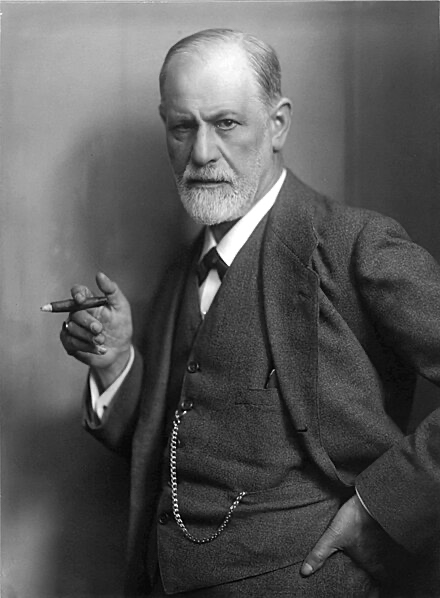
Albert Einstein
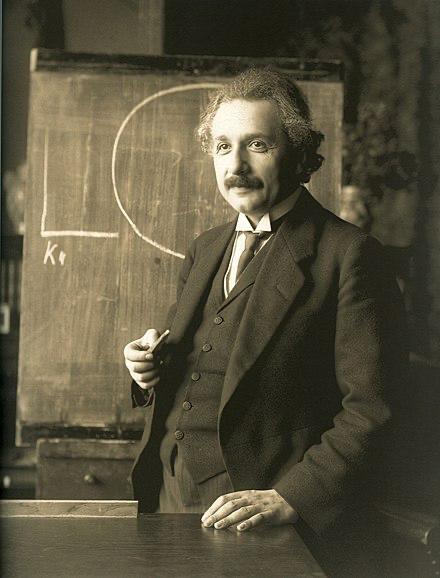
Portrait by Ferdinand Schmutzer, 1921

Sigmund Freud

Freud, 1921

Two very great men.

A study on dog aging

It is very likely to lose funding.

I am reading the latest issue of Science, the magazine put out by AAAS – the American Academy for the Advancement of Science. One of the news items in that issue is entitled Massive study of dog aging likely to lose funding.

One reads, in part, a remark by biogerontologist, Steve Austed of the University of Alabama at Birmingham: “It was going to be the most informative study of aging that was not done in humans.

The project has a website, Dog Aging Project, from which one finds, under Project Details:

Science’s Best Friend

DOGS & HUMANS

Studying aging in humans is challenging and expensive, but dogs truly are science’s best friends. Even though they age more rapidly than humans, they experience the same diseases of aging, they are genetically diverse, and they share our environment. By studying aging in dogs, we can more quickly expand our knowledge of the aging process not just in dogs but in humans too!

It is a great shame that the likelihood is that the project will cease.

Photo by Hannah Lim on Unsplash

Artificial intelligence to the rescue

The colonisation of space.

Patrice Ayme is a writer who lives in France and is a person of extreme breadth of knowledge, and very clever to boot.

He writes blog posts on a variety of topics. His latest post is breathtakingly powerful and could be the way we all go over the future years. Read it for yourself online or as follows:

ooOOoo

How Solar System Colonization Will Save Earth

By Patrice Ayme

Saving Earth and colonizing the Solar System are basically the same problem and have the same solution: much more advanced technology [1]. There is no contradiction, far from it. There is complementarity, as technology that will have to be developed for space will be found to be useful for Earth. For psycho-political reasons those technologies won’t be developed directly for Earth. So those who complain about space, while claiming we should focus on Earth, get it only half right.

Colonizing Mars with present technology is not going to happen anymore than the technology of the 1960s enabled to colonize the Moon. A visit from a human crew on Mars with the technology SpaceX wants to develop is imaginable… Barely.  And those will just be visits, multi-year commitments full of lethal radiation and worse living accommodations than the highest maximum security prison: basically what was done on the Moon in the 1960s, but much more daunting.

It’s much more feasible to establish bases on the Moon. First, there is plenty of oxygen and hydrogen (so water) on the Moon, imprisoned in rocks: one only needs energy to extract them, and the Moon has plenty of that (solar panels!) Second, the gravity well of the Moon is also half that of Mars. Third, the Moon is close by and one can go there all the time (whereas Mars can be visited with present fossil fuel tech only every two years, when the planets align; serious commuting of goods and people between Earth and Mars will require nuclear propulsion).Monitoring robots on the Moon is possible, whereas on Mars, with up to twenty minutes delay, one will have to use advanced, autonomous AI. Fixing problems caused by dust in robots on the Moon with roaming human crews… A solution that won’t exist on Mars, for decades. 

Thus AI is the first order solution: AI just needs energy, not shelter, air, water and food. AI colonies on the Moon, and then, later, Mars could build environments that humans could then inhabit. Say pressurized lava tubes… 

Skeptics could object that I didn’t roll out specific techs. But space colonization, especially if robot and AI driven, will require much higher tech. For example solar energy, which works wonderfully, was led by its usage in space… where it has long worked splendidly. The solar cells used in space have an efficiency more than twice that of the ones used on the ground… from using more advanced (but expensive) materials, like Gallium… That has invited researchers and companies to boost the efficiency of the silicon and now perovskites cells used on the ground. SpaceX uses Reliable Reusable Rockets (RRR), lowering the cost of space access… That is revolutionary, but actually follows the tech used to land on the Moon in the first place. But the first landing rockets, the LEMS, were Lunar Exploration Modules… They showed the way…

Technology is impossible without wisdom, and wisdom impossible without technology. One can’t grow without the other. The quest for tech is a quest for wisdom.

We don’t need AI on Earth, at least so many “leaders” will think (and they would be very wrong)… However, for space colonization, clearly, we need AI. Space AI will then bring in the Earth AI we need to solve countless problems, including the ones we didn’t think we had. 

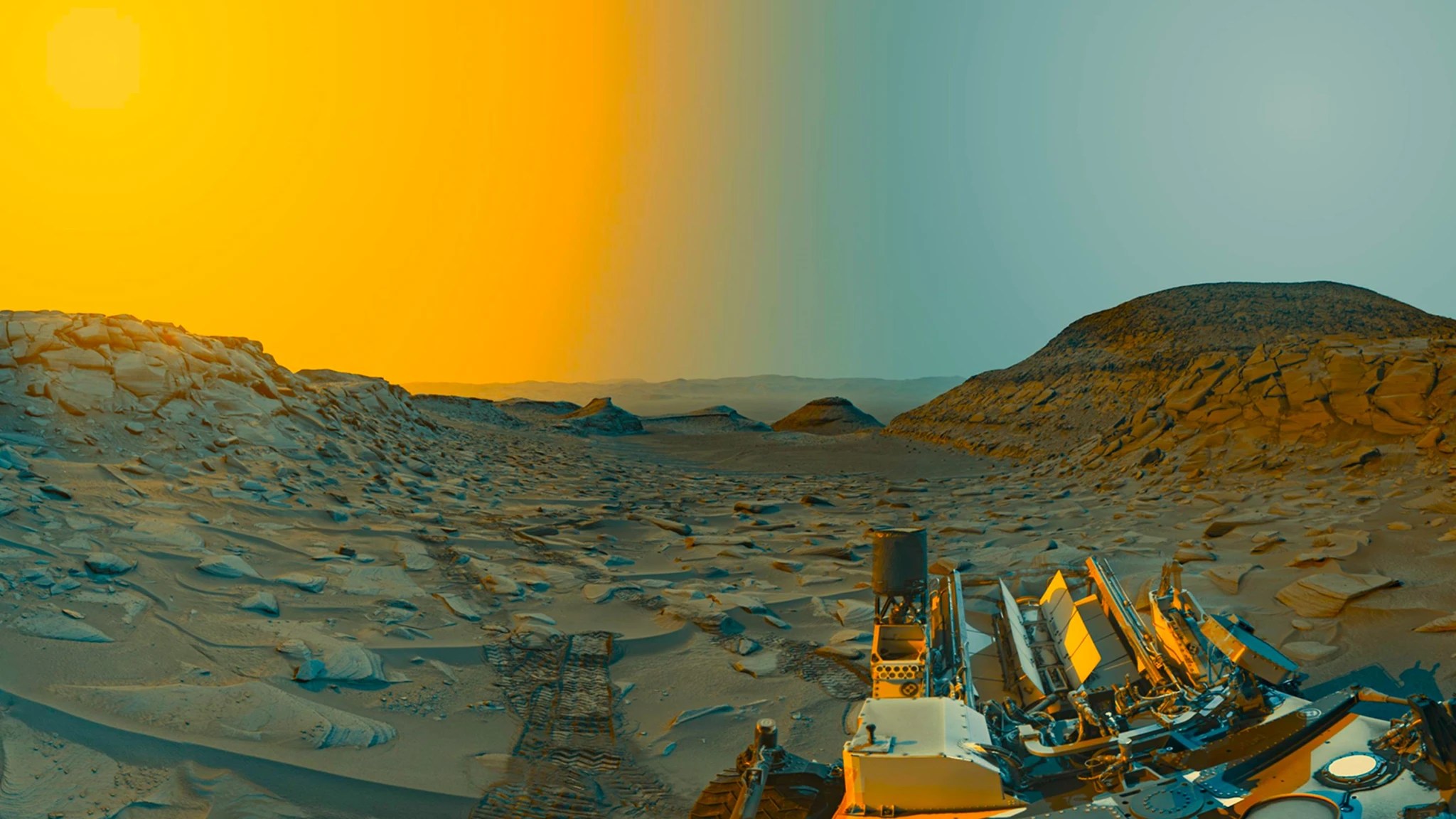
NASA picture from Curiosity rover on a rather barren, poisonous, irradiated, dusty and dry Mars

P/S: Scifi novels are an old genre: The Birds of Aristophanes, making fun of the colonies Athens established everywhere, by establishing one in the sky, preceded the space colonization of Lucian by seven centuries… 

***

[1] The European solution to the Earth Crisis has been Mathusianism: use less energy. This weakens Europe and encourages its dictatorial enemies. Actually the best solution is rather the opposite: to use more ABSOLUTE WORTH ENERGY. Use, much more EFFICIENT energy. In particular, we have to leverage fossil fuels to get out of them… using the energy they provide to invent new science and tech….

ooOOoo

Yet another masterpiece from Mr. Ayme. I cannot add anything to this post except to applaud it.

A new website found

Well it was new to me!

But first of all I should pass on a Very Happy Thanksgiving to you all. I apologise for forgetting to write this yesterday when I was preparing this post.

I came across the Dog Training Academy site the other day and found it full of tips. I trust that with the link in place in this post I can republish articles that are found on it.

For example, on July 14th, 2023 Laura Brown published a post on the philosophy of dog training. Here is the article.

ooOOoo

Developing a Effective Dog Training Philosophy: Techniques and Strategies

Dog training philosophy refers to the underlying principles and beliefs that guide how dog owners train and interact with their furry companions. Different dog owners have different philosophies when it comes to training their dogs, and each approach can have a significant impact on the dog’s behavior and well-being.

In this article, we’ll explore the different dog training philosophies and the benefits and drawbacks of each approach.

Positive Reinforcement

Positive reinforcement is a popular dog training philosophy that involves rewarding desired behaviors with treats, praise, or other positive stimuli. The idea is to encourage dogs to repeat behaviors that lead to positive outcomes while discouraging behaviors that lead to negative outcomes.

Positive reinforcement is a humane and effective way to train dogs. It builds trust and strengthens the bond between the owner and the dog. It’s also an enjoyable and rewarding experience for both the dog and the owner.

One potential drawback of positive reinforcement is that it can be time-consuming. Owners must be patient and consistent in rewarding desired behaviors, and it may take longer for some dogs to learn new behaviors than others.

Punishment-Based Training

Punishment-based training is a dog training philosophy that involves punishing undesirable behaviors with negative stimuli, such as physical correction or verbal scolding. The idea is to discourage dogs from repeating behaviors that lead to negative outcomes while encouraging behaviors that lead to positive outcomes.

Punishment-based training can be effective in stopping unwanted behaviors quickly. However, it can also have negative consequences for the dog’s emotional well-being. Dogs that are punished frequently may become fearful or aggressive, and their trust in their owners may be damaged.

Moreover, punishment-based training can result in a negative relationship between the owner and the dog. Dogs may learn to fear their owners, which can lead to a breakdown in communication and a lack of trust.

Dominance-Based Training

Dominance-based training is a dog training philosophy that is based on the belief that dogs are pack animals that instinctively seek to establish a social hierarchy. The idea is to assert dominance over the dog and establish the owner as the pack leader.

Dominance-based training can be effective in certain situations, such as when dealing with aggressive dogs. However, it can also be harmful to the dog’s emotional well-being. Dogs that are subjected to dominance-based training may become fearful, anxious, or aggressive, and their trust in their owners may be damaged.

Moreover, the concept of dominance in dog behavior has been debunked by many dog behaviorists and trainers. While dogs do live in social groups and establish hierarchies, the idea that dogs constantly seek to establish dominance over their owners is not supported by scientific evidence.

Relationship-Based Training

Relationship-based training is a dog training philosophy that is based on the belief that dogs are social animals that thrive on positive interactions with their owners. The idea is to build a strong, positive relationship between the owner and the dog, which will lead to a well-behaved and happy dog.

Relationship-based training is a humane and effective way to train dogs. It emphasizes positive reinforcement and building a strong bond between the owner and the dog. It also encourages owners to understand their dog’s behavior and to communicate effectively with their furry companion.

One potential drawback of relationship-based training is that it can be time-consuming. It requires a significant amount of effort and dedication on the part of the owner to build a strong relationship with their dog. Moreover, some dogs may require more time and effort to establish a strong bond with their owner.

Balanced Training

Balanced training is a dog training philosophy that combines elements of positive reinforcement, punishment-based training, and dominance-based training. The idea is to use a variety of training methods to achieve the desired behavior in the dog.

Balanced training can be effective in certain situations, such as when dealing with complex behavior issues. However, it can also be confusing and overwhelming for dogs. They may not understand what behavior is being rewarded or punished, and their trust in their owner may be compromised.

Moreover, balanced training can lead to a lack of consistency in the training approach, which can confuse the dog and make it difficult for them to learn new behaviors.

Conclusion

In conclusion, there are different dog training philosophies, and each approach can have a significant impact on the dog’s behavior and well-being. Positive reinforcement and relationship-based training are generally considered to be the most humane and effective ways to train dogs. Punishment-based and dominance-based training can have negative consequences for the dog’s emotional well-being and may damage the relationship between the owner and the dog.

Balanced training can be effective in certain situations, but it requires a significant amount of skill and knowledge to implement properly. Moreover, it can be confusing and overwhelming for dogs, and their trust in their owner may be compromised.

As a dog owner, it’s essential to understand the different dog training philosophies and choose the approach that best suits your dog’s needs and personality. It’s also essential to seek the advice of a professional dog trainer or behaviorist if you’re experiencing issues with your dog’s behavior. A trained professional can help you identify the underlying causes of your dog’s behavior and develop a training plan that will address those issues effectively.

In the end, the goal of dog training should be to build a strong, positive relationship between the owner and the dog. When dogs are well-trained, happy, and healthy, they make wonderful companions and enrich our lives in countless ways. By choosing the right dog training philosophy and approach, you can help your furry friend become the best possible version of themselves.

ooOOoo

As I said at the beginning, I hope republishing this text is alright. Because I think it is a very good article from a very useful website.

The expansion of the Universe

I am reproducing a recent article published by The Conversation.

It is a reflection of the latest research undertaken by NASA, it is beyond fascinating!

ooOOoo

The universe is expanding faster than theory predicts – physicists are searching for new ideas that might explain the mismatch

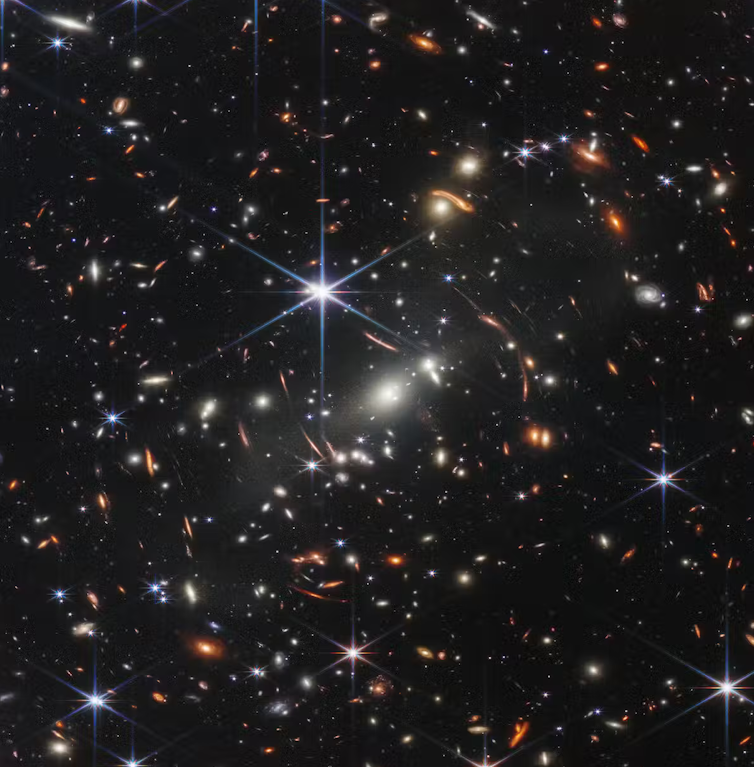
The James Webb Space Telescope’s deep field image shows a universe full of sparkling galaxies. NASA/STScI

Ryan Keeley, University of California, Merced

Astronomers have known for decades that the universe is expanding. When they use telescopes to observe faraway galaxies, they see that these galaxies are moving away from Earth.

To astronomers, the wavelength of light a galaxy emits is longer the faster the galaxy is moving away from us. The farther away the galaxy is, the more its light has shifted toward the longer wavelengths on the red side of the spectrum – so the higher the “redshift.”

Because the speed of light is finite, fast, but not infinitely fast, seeing something far away means we’re looking at the thing how it looked in the past. With distant, high-redshift galaxies, we’re seeing the galaxy when the universe was in a younger state. So “high redshift” corresponds to the early times in the universe, and “low redshift” corresponds to the late times in the universe.

But as astronomers have studied these distances, they’ve learned that the universe is not just expanding – its rate of expansion is accelerating. And that expansion rate is even faster than the leading theory predicts it should be, leaving cosmologists like me puzzled and looking for new explanations.

Dark energy and a cosmological constant

Scientists call the source of this acceleration dark energy. We’re not quite sure what drives dark energy or how it works, but we think its behavior could be explained by a cosmological constant, which is a property of spacetime that contributes to the expansion of the universe.

Albert Einstein originally came up with this constant – he marked it with a lambda in his theory of general relativity. With a cosmological constant, as the universe expands, the energy density of the cosmological constant stays the same.

Imagine a box full of particles. If the volume of the box increases, the density of particles would decrease as they spread out to take up all the space in the box. Now imagine the same box, but as the volume increases, the density of the particles stays the same.

It doesn’t seem intuitive, right? That the energy density of the cosmological constant does not decrease as the universe expands is, of course, very weird, but this property helps explain the accelerating universe.

A standard model of cosmology

Right now, the leading theory, or standard model, of cosmology is called “Lambda CDM.” Lambda denotes the cosmological constant describing dark energy, and CDM stands for cold dark matter. This model describes both the acceleration of the universe in its late stages as well as the expansion rate in its early days.

Specifically, the Lambda CDM explains observations of the cosmic microwave background, which is the afterglow of microwave radiation from when the universe was in a “hot, dense state” about 300,000 years after the Big Bang. Observations using the Planck satellite, which measures the cosmic microwave background, led scientists to create the Lambda CDM model.

Fitting the Lambda CDM model to the cosmic microwave background allows physicists to predict the value of the Hubble constant, which isn’t actually a constant but a measurement describing the universe’s current expansion rate.

But the Lambda CDM model isn’t perfect. The expansion rate scientists have calculated by measuring distances to galaxies, and the expansion rate as described in Lambda CDM using observations of the cosmic microwave background, don’t line up. Astrophysicists call that disagreement the Hubble tension.

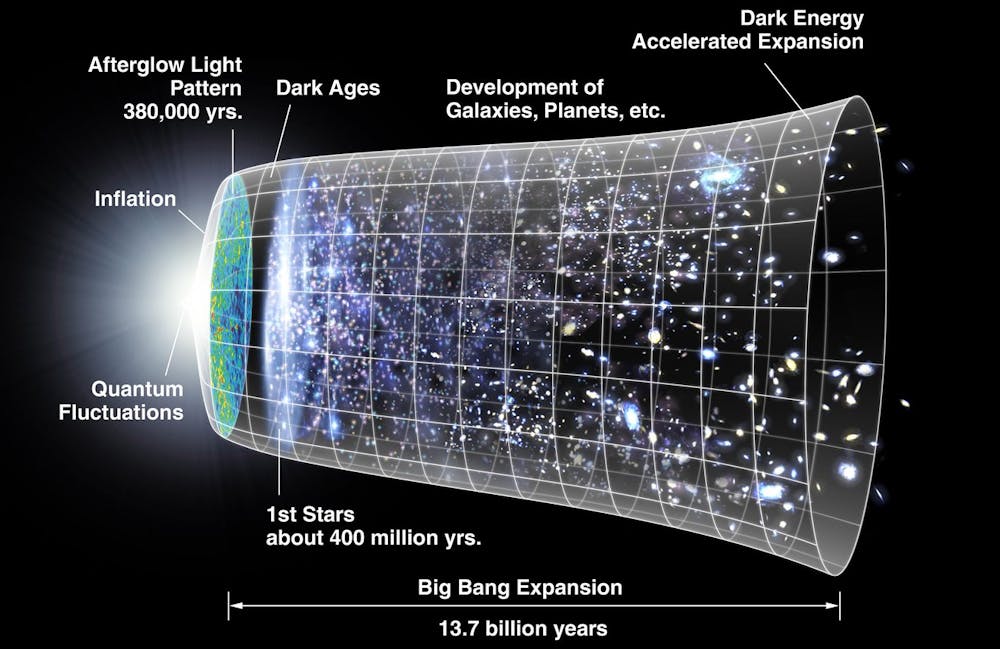
An illustration showing the progression of the Universe's expansion after the Big Bang. The Universe is depicted as a cylindrical funnel with labels along the bottom showing the first stars, the development of planets, and now the dark energy acceleration
The universe is expanding faster than predicted by popular models in cosmology. NASA

The Hubble tension

Over the past few years, I’ve been researching ways to explain this Hubble tension. The tension may be indicating that the Lambda CDM model is incomplete and physicists should modify their model, or it could indicate that it’s time for researchers to come up with new ideas about how the universe works. And new ideas are always the most exciting things for a physicist.

One way to explain the Hubble tension is to modify the Lambda CDM model by changing the expansion rate at low redshift, at late times in the universe. Modifying the model like this can help physicists predict what sort of physical phenomena might be causing the Hubble tension.

For instance, maybe dark energy is not a cosmological constant but instead the result of gravity working in new ways. If this is the case, dark energy would evolve as the universe expands – and the cosmic microwave background, which shows what the universe looked like only a few years after its creation, would have a different prediction for the Hubble constant.

But, my team’s latest research has found that physicists can’t explain the Hubble tension just by changing the expansion rate in the late universe – this whole class of solutions falls short.

Developing new models

To study what types of solutions could explain the Hubble tension, we developed statistical tools that enabled us to test the viability of the entire class of models that change the expansion rate in the late universe. These statistical tools are very flexible, and we used them to match or mimic different models that could potentially fit observations of the universe’s expansion rate and might offer a solution to the Hubble tension.

The models we tested include evolving dark energy models, where dark energy acts differently at different times in the universe. We also tested interacting dark energy-dark matter models, where dark energy interacts with dark matter, and modified gravity models, where gravity acts differently at different times in the universe.

But none of these could fully explain the Hubble tension. These results suggest that physicists should study the early universe to understand the source of the tension.

Ryan Keeley, Postdoctoral Scholar in Physics, University of California, Merced

This article is republished from The Conversation under a Creative Commons license. Read the original article.

ooOOoo

Ryan Keeley explains it above. Hopefully most of you who read this understand the physics involved. Ryan has a website here.

As I said at the start it is beyond fascinating! In the truest sense, out of this world!

Dogs are such perfect creatures.

A re-publishing of a post from 2009.

I was looking through posts from a few years ago and came across ‘Dogs – their deep ties to man” and thought it would be a grand post to publish again.

ooOOoo

Dogs – their deep ties to man!

It’s impossible not to admire, respect and love a dog

(First published on the 4th August, 2009 but it relates to an event even before I left the United Kingdom. I met Jean in December, 2007 and Pharaoh and me travelled out to Mexico a year later.)

An incident last night reminded me of the complexity of the dog’s mind.  It has not been the first time this has happened.

Our 6 year-old German Shepherd dog, Pharaoh, was given a bone as a treat during the previous day and, as sometimes happens, it was a bit tough on his stomach.  So at around 1.30 am, I was woken up.  Nothing so special about that.  But reflect on how this happened.

1.30 am is the part of night where, hopefully, we are in that very deep phase of sleep.  How then does Pharaoh calculate the best way of awakening me so that he can be let out into the yard?  One might consider the various options:

– He barks

– He paws at the bed

– He jumps on the bed

– He scratches at the door

and so on.

What Pharaoh did (and has done before, so this is a calculated behaviour) is very gently put his damp nose onto the side of my face, just below my left ear, which was the part of my face nearest to the edge of the bed.  It woke me so gently from my deep sleep but made me immediately aware (as a parent is when their young child cries) that Pharaoh required urgent attention.

A moment later he was standing by the bedroom door, letting out that soft, quiet whine that is only used when he needs to use the yard.  Within seconds his collar and lead were on and he was outside doing what nature was prompting him.

Pharaoh resting on an English lawn

No big deal but it stayed with me this morning as I reflected on the empathetic way that Pharaoh had communicated with me during the night.

Dogs sensitivity to the world around them is a powerful reminder that the less we focus in on ourselves the more we learn.

ooOOoo

Memories!

Common dog diseases

A very valuable guest post.

Back on September 19th I received an email offering me a guest post. It was from Luna Angeni. At first I was highly suspicious thinking of scams and the like and replied: “Before responding further please explain what your niche is?”

Luna replied: “Thank you for your response. I’m working on Animal Health care. It’s the perfect fit for your site.”

I agreed and this is her article.

ooOOoo

How to Control and Prevent Common Dog Diseases Effectively

By Luna Angeni

Man’s best friend” is a phrase that perfectly defines the deep bond between humans and their canine companions.

It’s our duty to ensure the health and well-being of our furry friends. One of the most critical aspects of canine care is disease prevention and control. This is what we are going to focus on here.

In this blog, we will learn about some effective ways we can control and prevent common dog diseases to keep our canine fellows happy and healthy.

Let’s get started!

Understanding Common Dog Diseases

Dogs, like humans, are susceptible to a range of diseases and health issues.

To effectively control and prevent these complications, we need to understand them first.

Let’s review some common canine diseases:

Canine Parvovirus (Parvo)

Canine parvovirus is a highly contagious and potentially fatal disease that affects puppies and unvaccinated dogs.

It spreads through direct contact with an infected dog or contaminated environment.

Symptoms include:

1. Severe diarrhea

2. Vomiting
3. Lethargy
4. Loss of appetite

To prevent parvo, ensure your dog is up-to-date on vaccinations and avoid areas where the virus may be present.

Canine Distemper

Canine distemper is another contagious viral disease that can be fatal, particularly in puppies.

It affects various body systems and presents symptoms such as:

1. Fever
2. Nasal discharge

3. Coughing
4. Neurological signs

Vaccination is the most effective way to prevent distemper.

Heartworm Disease

Heartworm disease is transmitted through mosquito bites and can be life-threatening if left untreated.

It affects the heart and lungs, leading to symptoms like:

1. Coughing
2. Exercise intolerance

3. Weight loss

Prevention through vaccination is key for this common dog disease.

Preventive Measures for Common Canine Diseases

Preventing common dog diseases is often more manageable than treating them.

Here are some essential preventive measures every dog owner should follow:

Vaccination

Regular vaccination is the cornerstone of disease prevention in dogs.

As your veterinarian recommends, ensure your dog receives all necessary vaccinations against parvovirus, distemper, rabies, and others.

Regular Exercise

Exercise not only keeps your dog physically fit but also mentally stimulated.

Engaging in regular exercise helps boost dogs’ overall health and keeps obesity-related diseases at bay.

Proper Nutrition

A balanced diet is crucial for maintaining a healthy immune system.

Consult your veterinarian to determine the best diet for your dog’s specific needs.

Avoid feeding your canine human food, as some ingredients can be toxic to them.

Hygiene and Cleanliness

Maintaining proper hygiene for your dog and their living environment is essential.

In this regard, you must ensure:

1. Regular grooming
2. Cleaning your dog’s bedding
3. Keeping their living area free from parasites and bacteria

Regular Vet Check-ups

Routine visits to the veterinarian are crucial for early disease detection and prevention.

Your vet can identify potential health issues before they become severe and provide guidance on maintaining your dog’s health.

Recognizing the Signs of Illness

Despite your best efforts, your dog may still fall ill occasionally.

Recognizing the early signs of common dog diseases is essential for prompt treatment.

Here are some common signs of complications in dogs:

Changes in Appetite

A sudden loss of appetite or excessive hunger can indicate a health issue.

So, you must monitor your dog’s eating habits closely.

Changes in Behavior

Drastic changes in behavior, such as increased aggression, withdrawal, or excessive vocalization, can be indicative of pain or discomfort.

Vomiting and Diarrhea

Frequent vomiting or diarrhea can be symptomatic of various diseases, including gastrointestinal complications.

Lethargy

If your dog is unusually lethargic or lacks energy, it could be a sign of an underlying problem.

In such cases, seek a veterinarian’s help immediately.

Breathing Problems

Labored breathing, coughing, or wheezing may suggest respiratory or cardiac problems.

Immediate Action and Veterinary Care

Taking immediate action is essential if you notice any signs of illness or discomfort in your dog.

Contact your veterinarian and follow their guidance.

Early intervention can often make a significant difference in the outcome of the disease.

Conclusion

Your dog’s health is in your hands.

Effective disease control and prevention are crucial for ensuring your furry friend’s long and happy life.

Understanding common dog diseases and treatment and following preventive measures can significantly reduce the risk of complications and provide them with the best possible care.

For more guides on animal health solutions and tips for healthy dogs, you must visit Vet and Tech – a source for online veterinary education.

FAQs

What Vaccinations Does My Dog Need?

Consult your vet for a personalized vaccination schedule. Common dog vaccinations include rabies, distemper, parvovirus, and kennel cough.

What’s the Best Diet for My Dog?

High-quality commercial dog food is a good option. Still, you need to consult your vet for a diet tailored to your dog’s age, breed, and health.

How Often Should I Take My Dog to the Vet?

Generally, annual check-ups are recommended, but older dogs can benefit more from biannual visits. And–puppies may need more frequent check-ups.

ooOOoo

That is a wonderful set of recommendations and advice. Really of no surprise when one considers Luna’s biography:

I am a clinical veterinarian, researcher, and professional content writer. Being a medical professional and a content writer, I hold key writing skills such as Blog writing. I shall provide beautifully crafted, interesting to read, easily understood, highly informative, 100% original, error, and plagiarism-free content. 

Luna Angeni

I sincerely hope this will be far from the one and only post!

P.S. I also openly admit that I have featured her blog site Vet and Tech but will also explain that I have no special association with her blog or with Luna Angeni.

OSIRIS-REx report

I just find this incredible!

Firstly, I am simply going to post three YouTube videos of this amazing feat by NASA.

The first by Associated Press at less than two minutes:

And the next two from NASA with the second at just over an hour long:

and the third at over three hours long:

Then I am going to republish, hopefully with permission, an article from Nature that further explains what has just happened:

ooOOoo

Special delivery! Biggest-ever haul of asteroid dust and rock returns to Earth

Samples collected by NASA’s OSIRIS-REx mission excite scientists with their potential to reveal secrets of the Solar System.

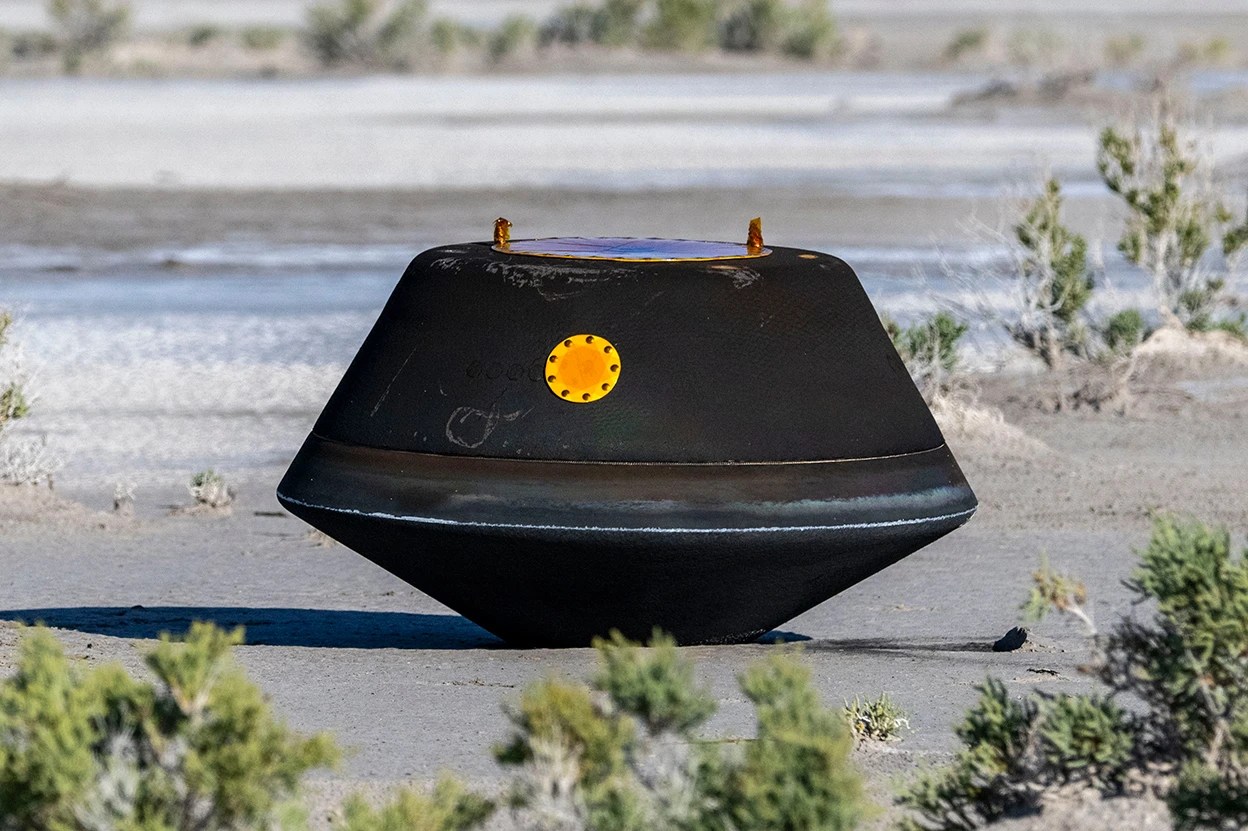
The OSIRIS-REx sample capsule, which contains pieces of the asteroid Bennu, landed safely in the Utah desert on 24 September. Credit: Keegan Barber/NASA via Getty

Dugway Proving Ground, Utah

A saucer-shaped capsule parachuted down gently in the Utah desert today, after a years-long journey through space. Its cargo is a precious collection of rocks and dust from the asteroid Bennu — the first time NASA has ever brought pieces of this type of celestial object back to Earth.

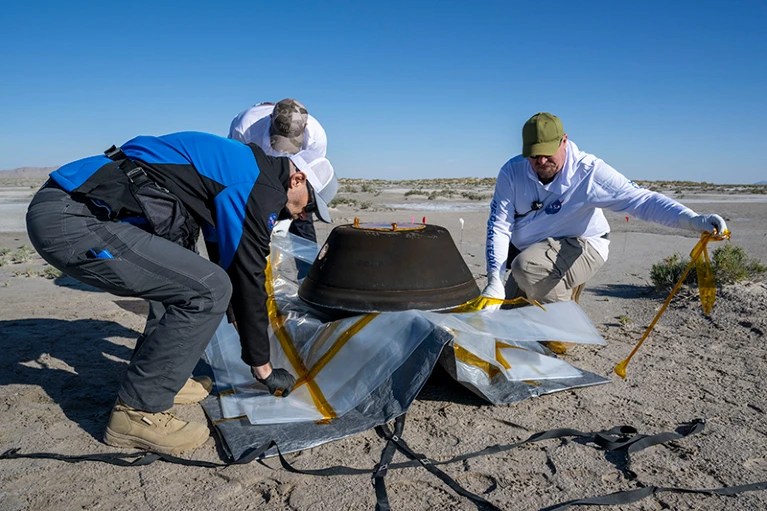
Over the coming days, NASA will fly the bits of Bennu to the Johnson Space Center in Houston, Texas. There, curators will carefully disassemble the container and begin analysing the chemistry and mineralogy of the pristine samples — which might hold clues to the origins of the Solar System.

“I feel like a kid on Christmas Eve who is just too excited to go to sleep,” says Michelle Thompson, a planetary scientist at Purdue University in West Lafayette, Indiana, and a member of the ‘quick look’ team who will have the first chance to study the rocks.

Space hoover

The material comes from the US$1.2-billion OSIRIS-REx (Origins, Spectral Interpretation, Resource Identification, Security-Regolith Explorer) mission, which launched in 2016 and arrived at Bennu in 2018. It spent nearly two years studying the dark-coloured, diamond-shaped asteroid before extending its robotic arm to the rocky surface, blasting it with a puff of gas and collecting the dust and rocks it kicked up. That ‘fist bump’ hoovered up so much material that pieces of rock got jammed in the collection mechanism, allowing some of the smaller pebbles to escape. Watching some of those samples get away was “heart breaking”, says Dante Lauretta, a planetary scientist at the University of Arizona in Tucson who was the first principal investigator of the OSIRIS-REx mission.

Still, the spacecraft managed to collect around 250 grams of rocks and dirt — a large cupful — including several chunks that are at least one centimetre long. It is by far the largest amount of material ever brought back from an asteroid. The Japan Aerospace Exploration Agency (JAXA) had previously collected less than one milligram from the asteroid Itokawa in 2005, and 5.4 grams from the asteroid Ryugu in 2019.

Bringing planetary samples back to Earth allows researchers to use cutting-edge laboratory techniques to study what the rocks are made of. The NASA curation team planned to put the Bennu samples into an atmosphere of pure nitrogen soon after the capsule touched down, to reduce the potential for contamination. That will enable scientists to study the asteroid’s geology and chemistry, preserved all the way back to the formation of the Solar System, more than 4.5 billion years ago. The pristine material hasn’t been altered by passing through Earth’s atmosphere, as happens with meteorites. “The thing that will really be different about this sample is we’ll have that chain of custody of keeping it protected from Earth’s atmosphere,” says Nicole Lunning, the mission’s lead sample curator at the Johnson Space Center.

Precious cargo

Bennu is a carbon-rich asteroid, so the samples might resemble carbon-rich meteorites that have fallen to Earth, Thompson says. The bits collected by OSIRIS-REx probably contain organic compounds — carbon-based molecules found in many meteorites that are the building blocks of many exciting types of chemistry, including those conducive to life. “What I find most fascinating are the nucleobases, the components of the genetic code that make up all life from DNA and RNA,” says Daniel Glavin, the senior scientist for sample return at NASA’s Goddard Space Flight Center in Greenbelt, Maryland. These compounds have been found in meteorites before, but those rocks have not been as pristine as the Bennu samples are expected to be. “We can trust the results, because this stuff is clean,” he says.

NASA curators will work their way through unpacking and studying the dust and pebbles inside OSIRIS-REx’s storage container in the coming weeks. Using nitrogen-filled gloveboxes, technicians will analyse the samples with scanners and other instruments to discern how many rock types were collected, and they will record the samples’ colour, volume and porosity.

Mission specialists prepare the OSIRIS-REx sample capsule for transport to a clean room after its landing in the Utah desert on 24 September.Credit: Keegan Barber/NASA via Getty

The curators will collect up to 100 milligrams for the quick-look team to analyse over the first 72 hours. That initial sample will probably be made up of fine-grained material obtained from the outermost parts of the sample capsule, Thompson says. After that, the team will get a chance to study grains that were picked up by 24 stainless-steel contact pads on the outside of the sample container — which were the first things to actually come into contact with Bennu. It will probably be several weeks before the curators open the heart of the sample container and begin extracting the bulk of the material inside.

Early experiments could include looking at how material that was on the surface of Bennu compares with what came from deeper inside the asteroid, Thompson says. OSIRIS-REx’s robotic arm might have plunged as deep as 40 centimetres under Bennu’s rubbly surface when executing its fist bump.

Work interrupted?

NASA has scheduled a press conference on 11 October to unveil the first scientific results. But its work on the mission could be interrupted if the US government shuts down on 1 October. Republicans and Democrats in Congress have been battling over priorities for funding the federal government in 2024.

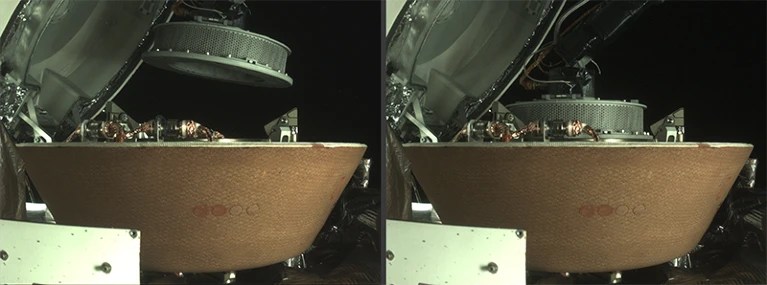
After OSIRIS-REx fist-bumped the asteroid Bennu in 2020, it pulled the collected samples into the spacecraft (left) and stowed them inside its sample-return capsule (right).Credit: NASA/Goddard/Univ. Arizona/Lockheed Martin

If the situation remains in a stalemate by the time the US fiscal year ends on 30 September, then federal agencies, including NASA, might close until an agreement can be reached. If that were to happen while the Bennu sample is at NASA, then “certain steps leading to its highly anticipated analysis will possibly be delayed, but the sample will remain protected and safe”, says Lori Glaze, head of NASA’s planetary sciences division. “The sample waited for more than 4 billion years for humans to study it, and if it takes us a little longer, I think we’ll be okay.”

At least 70% of the Bennu material will be saved for scientists outside NASA and for future generations to study. Furthermore, 4% of the sample will go to the Canadian Space Agency, which helped to build a laser instrument aboard OSIRIS-REx, and 0.5% will go to JAXA in exchange for samples of Ryugu, so that researchers can compare the two asteroids.

Meanwhile, the rest of the OSIRIS spacecraft continues to fly through space after dropping off its sample-return capsule. It is headed to study Apophis, an asteroid with a different, ‘stony’, chemical composition that will whizz dramatically close past Earth in 2029.

Copyright © 2023, Springer Nature Limited

ooOOoo

There we go, my credit to an incredible feat of exploration that, hopefully, will lead to some interesting results over the next few weeks.

The Southern Ring Nebula

Just had to share this incredible vista with you!

The James Webb Space Telescope is amazing. Wikipedia have a long article on the telescope from which one reads (in part):

The James Webb Space Telescope (JWST) is a space telescope specifically designed to conduct infrared astronomy. Its high-resolution and high-sensitivity instruments allow it to view objects too old, distant, or faint for the Hubble Space Telescope. This enables investigations across many fields of astronomy and cosmology, such as observation of the first stars and the formation of the first galaxies, and detailed atmospheric characterization of potentially habitable exoplanets.

But I want to share with you this video, please watch it now it is just a minute long:

Time to forget about our earthly challenges for just a short time.

And for those that want more here is the home page of the Webb Telescope.

The James Webb telescope

Just astounding!

I was looking for something else on YouTube and came across this 8:56 video of what the James Webb has seen.

ooOOoo

Every Stunning Image Captured By James Webb Space Telescope So Far

21 Jul 2023

The James Webb Space Telescope has completed its first year of science operations. In its first year, the $10-billion infrared space observatory challenged our understanding of the cosmos and showed the universe in a way no other telescope in the past could. In this video, you will find every James Webb Space Telescope image released so far: From the mesmerizing images of the planets of the solar system to the gigantic galaxies seen at the edge of time.

Sunday Discovery Series: https://bit.ly/369kG4p

COSMOS in a Minute Series: https://bit.ly/470VLL8

Music 1: Ambient Piano by LukePN

Music 2: Interstellar by Stereonuts

Created by: Rishabh Nakra

Images: NASA/ESA/JWST

ooOOoo

Not everyone’s cup of tea but for those that cast their eyes to the stars this was astounding!